
Genesis 6:15

Hebrew (Westminster Leningrad Codex) Genesis 6:15 appears in the Hebrew Old Testament. The text above is from the Westminster Leningrad Codex. Each word links to its Strong’s number, a concise gloss, and parsing drawn from the Open Scriptures Hebrew Bible morphology. Click any word for its full Brown-Driver-Briggs (BDB) entry.
Download image
Cite this verse

Genesis 6:15 (World English Bible). Public Domain. Lemma interlinear Bible study tool, https://lemma.gebible.app/v/genesis/6/15.

Show BibTeX & RIS
BibTeX
RIS
English Translation
This is how you shall make it. The length of the ark will be three hundred cubits, the breadth of it fifty cubits, and the height of it thirty cubits.
World English Bible · Public Domain
Highlights
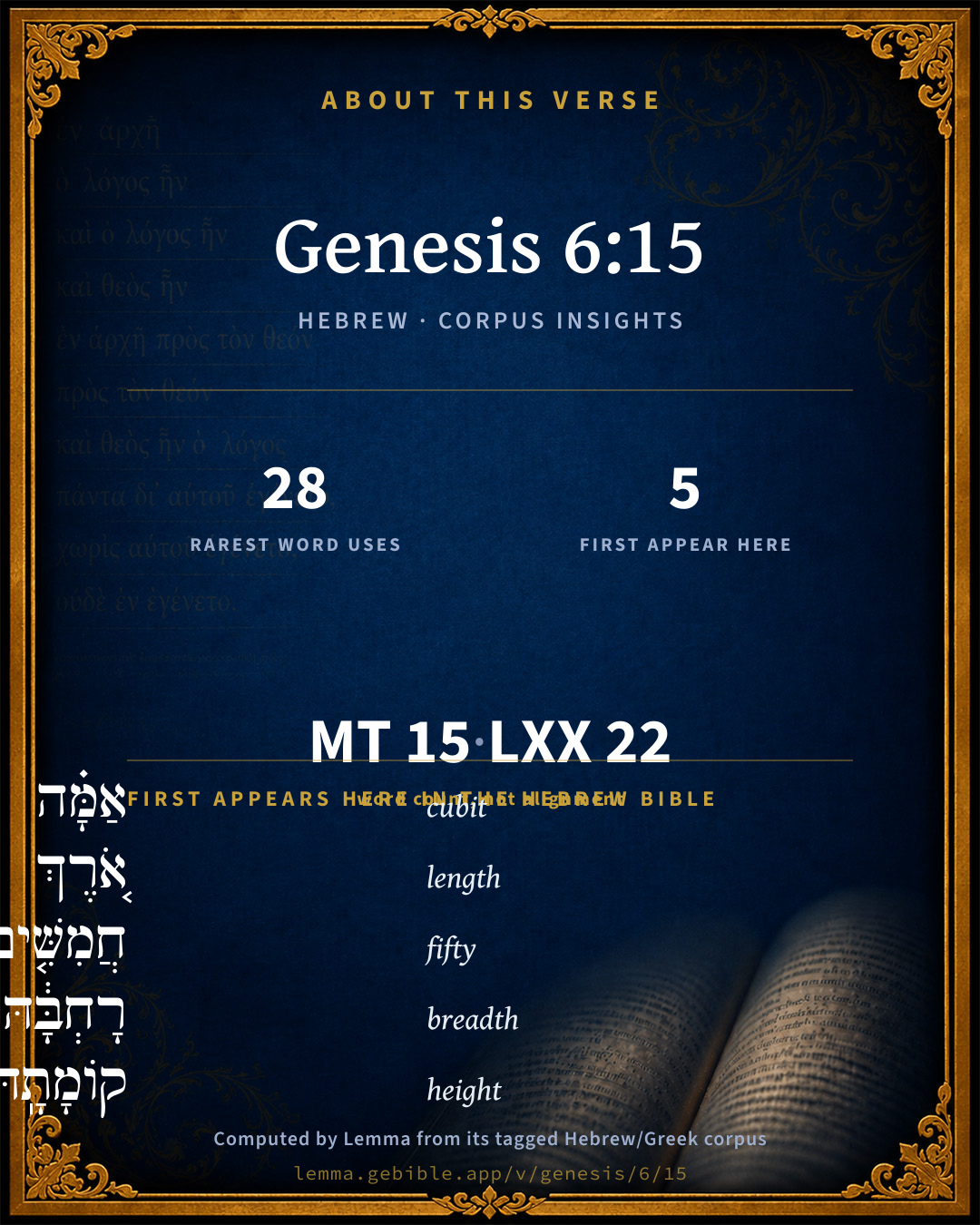
  • 5 first appearances in the Hebrew Bible
Full analysis ↓
Download a study sheet

One document with this verse’s original text, its word-by-word gloss line, the meaning frame, cross-references with their text, attributed commentary, and full source and license credits — printable, and it pastes into notes with its structure intact.

This verse Autodidact and up

Study sheet (.html) Plain text (.txt)

A passage Seminary Student

Up to 50 verses in one chapter. A passage sheet keeps up to 6 commentary sources and 12 cross-references per verse, in the order this page ranks them, and says so on the sheet whenever that leaves anything out. Ask for a single verse and you get the Autodidact verse sheet above.

Everything on this page stays free to read, with no account — the sheet is a download of what is already on screen, not access to it.

Want to remove ads? Support Godless Engineer
Compare translations 3

The same verse in 3 English versions, stacked beneath the original-language interlinear above. Click any original word for its lexicon entry.

Each is an independent rendering of the whole verse — the interlinear is not word-aligned to these translations.

Highlighted words mark where these versions differ — a whole-verse word diff, not a word-by-word alignment.

  • World English Bible Public Domain
    This is how you shall make it. The length of the ark will be three hundred cubits, the breadth of it fifty cubits, and the height of it thirty cubits.
  • King James Version Public Domain
    And this is the fashion which thou shalt make it of: The length of the ark shall be three hundred cubits, the breadth of it fifty cubits, and the height of it thirty cubits.
  • unfoldingWord Literal Text CC BY-SA 4.0
    And this how you must make it: the length of the ark 300 cubits, its width fifty cubits, and its height thirty cubits.

unfoldingWord Literal Text — © unfoldingWord, licensed CC BY-SA 4.0. Word-aligned USFM3 via Door43 (git.door43.org/unfoldingWord/en_ult).

Versions to compare (up to 4)

3 of 4 selected

Show all 18 translations

Every available English version of this verse, each an independent rendering of the whole verse.

  • World English Bible Public Domain
    This is how you shall make it. The length of the ark will be three hundred cubits, the breadth of it fifty cubits, and the height of it thirty cubits.
  • Berean Standard Bible Public Domain
    And this is how you are to build it: The ark is to be 300 cubits long, 50 cubits wide, and 30 cubits high.
  • Majority Standard Bible Public Domain
    And this is how you are to build it: The ark is to be 300 cubits long, 50 cubits wide, and 30 cubits high.
  • King James Version Public Domain
    And this is the fashion which thou shalt make it of: The length of the ark shall be three hundred cubits, the breadth of it fifty cubits, and the height of it thirty cubits.
  • American Standard Version (1901) Public Domain
    And this is how thou shalt make it: the length of the ark three hundred cubits, the breadth of it fifty cubits, and the height of it thirty cubits.
  • Revised Version (1885) Public Domain
    And this is how thou shalt make it: the length of the ark three hundred cubits, the breadth of it fifty cubits, and the height of it thirty cubits.
  • Geneva Bible (1599) Public Domain
    And thus shalt thou make it: The length of the Arke shalbe three hundreth cubites, the breadth of it fiftie cubites, and the height of it thirtie cubites.
  • Douay-Rheims (1899) Public Domain
    And thus shalt thou make it: The length of the ark shall be three hundred cubits: the breadth of it fifty cubits, and the height of it thirty cubits.
  • Young's Literal Translation Public Domain
    and this `is' that which thou dost with it: three hundred cubits `is' the length of the ark, fifty cubits its breadth, and thirty cubits its height;
  • Literal Standard Version CC BY-SA 4.0
    and this [is] how you do it: three hundred cubits [is] the length of the Ark, fifty cubits its breadth, and thirty cubits its height;
  • Unlocked Literal Bible CC BY-SA 4.0
    This is how you will make it: The length of the ark is to be three hundred cubits; the breadth of it is to be fifty cubits, and the height of it is to be thirty cubits.
  • unfoldingWord Literal Text CC BY-SA 4.0
    And this how you must make it: the length of the ark 300 cubits, its width fifty cubits, and its height thirty cubits.
  • Darby Bible Public Domain
    And thus shalt thou make it: let the length of the ark be three hundred cubits, the breadth of it fifty cubits, and the height of it thirty cubits.
  • World Messianic Bible Public Domain
    This is how you shall make it. The length of the ship shall be three hundred cubits, its width fifty cubits, and its height thirty cubits.
  • Webster's Bible Public Domain
    And this is the fashion in which thou shalt make it: the length of the ark shall be three hundred cubits, the breadth of it fifty cubits, and the height of it thirty cubits.
  • Free Bible Version CC BY-SA 4.0
    This is how to build it: the ark is to measure 300 cubits long, 50 cubits wide, and 30 cubits high.
  • Bible in Basic English Public Domain
    And this is the way you are to make it: it is to be three hundred cubits long, fifty cubits wide, and thirty cubits high.
  • JPS Tanakh (1917) Public Domain
    And this is how thou shalt make it: the length of the ark three hundred cubits, the breadth of it fifty cubits, and the height of it thirty cubits.

Literal Standard Version (2020), Covenant Press — licensed CC BY-SA 4.0. Text via the HelloAO Bible API (eBible.org). Unlocked Literal Bible (unfoldingWord) — licensed CC BY-SA 4.0. Text via the HelloAO Bible API (eBible.org). unfoldingWord Literal Text — © unfoldingWord, licensed CC BY-SA 4.0. Word-aligned USFM3 via Door43 (git.door43.org/unfoldingWord/en_ult). Free Bible Version, Dr. Jonathan Gallagher — licensed CC BY-SA 4.0. Text via the HelloAO Bible API (eBible.org).

Word by word

More ways to search: Search by grammar → Find every occurrence → Compare this word →

Practice this passage: Drill this verse → Learn its vocabulary →

הַתֵּבָ֔ה
têbâh
H8392
“the · ark”
Particle, Definite Article + Noun, Common, Feminine, Singular, Absolute
Part of Speech
Particle + Noun
Type
Common
Gender
Feminine
Number
Singular
State
Absolute
Full BDB Definition

Origin: perhaps of foreign derivation

TWOT: 2492

ark - vessel which Noah built - basket vessel in which Moses was placed
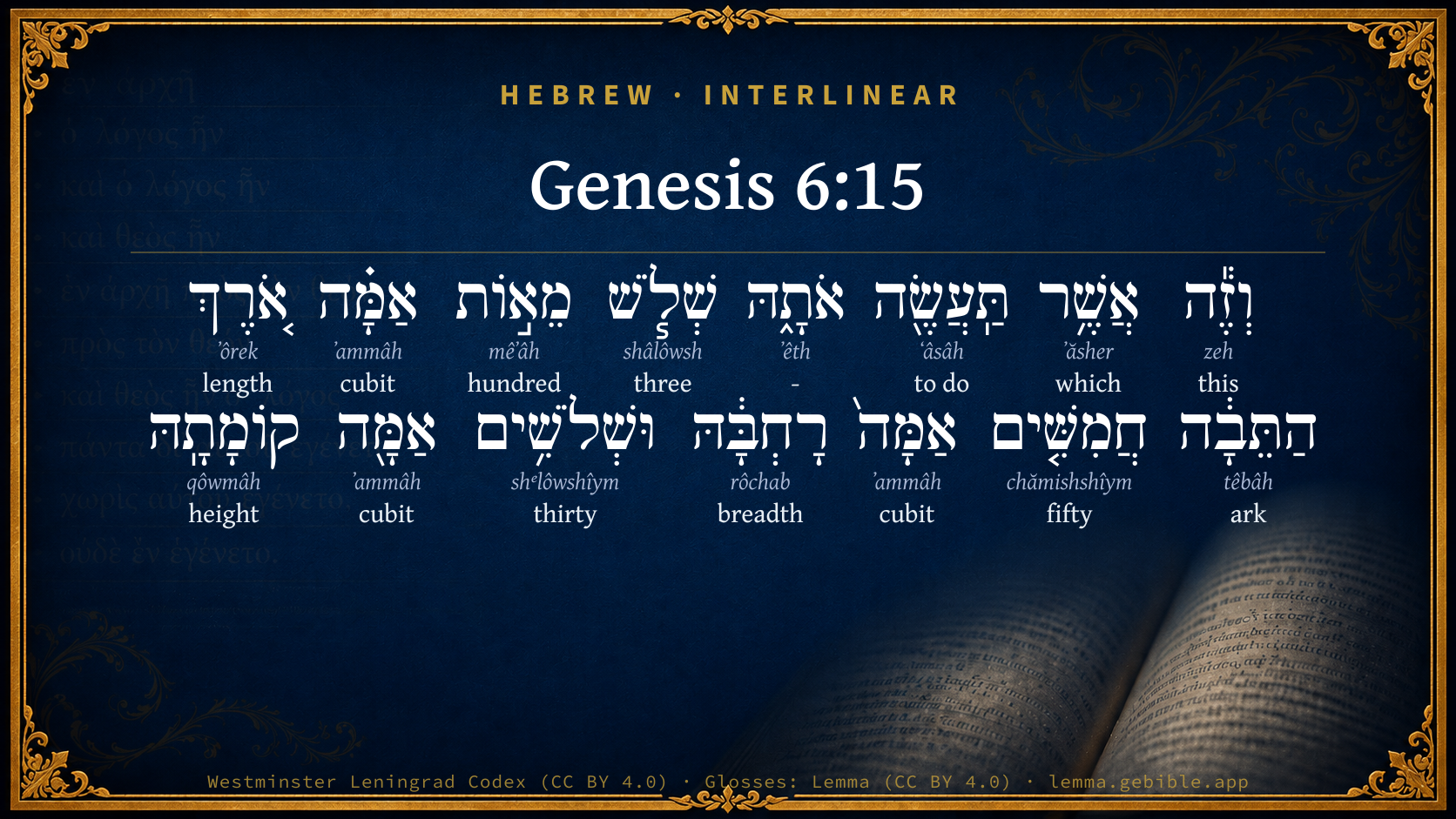
  1. וְזֶ֕ה zeh H2088 “and · this” Conjunction + Pronoun, Demonstrative, Masculine, Singular
  2. אֲשֶׁ֥ר ʼăsher H834 “which” Particle, Relative
  3. תַּֽעֲשֶׂ֖ה ʻâsâh H6213 “to do” Verb, Qal, Imperfect, 2nd Person, Masculine, Singular
  4. אֹתָ֑הּ ʼêth H853 “- · her” Particle, Direct Object + Suffix, Personal, 3rd Person, Feminine, Singular
  5. שְׁלֹ֧שׁ shâlôwsh H7969 “three” Adjective, Cardinal number, Feminine, Singular, Absolute
  6. מֵא֣וֹת mêʼâh H3967 “hundred” Adjective, Cardinal number, Both, Plural, Absolute
  7. אַמָּ֗ה ʼammâh H520 “cubit” Noun, Common, Feminine, Singular, Absolute
  8. אֹ֚רֶךְ ʼôrek H753 “length of” Noun, Common, Masculine, Singular, Construct
  9. חֲמִשִּׁ֤ים chămishshîym H2572 “fifty” Adjective, Cardinal number, Both, Plural, Absolute
  10. אַמָּה֙ ʼammâh H520 “cubit” Noun, Common, Feminine, Singular, Absolute
  11. רָחְבָּ֔הּ rôchab H7341 “breadth · her” Noun, Common, Masculine, Singular, Construct + Suffix, Personal, 3rd Person, Feminine, Singular
  12. וּשְׁלֹשִׁ֥ים shᵉlôwshîym H7970 “and · thirty” Conjunction + Adjective, Cardinal number, Both, Plural, Absolute
  13. אַמָּ֖ה ʼammâh H520 “cubit” Noun, Common, Feminine, Singular, Absolute
  14. קוֹמָתָֽהּ qôwmâh H6967 “height · her” Noun, Common, Feminine, Singular, Construct + Suffix, Personal, 3rd Person, Feminine, Singular

About this verse

These counts appear in no published source. They are computed here, from the morphology-tagged text and Lemma’s own curated glosses. What Lemma adds →

15
words
13
distinct lemmas
Pentateuch
section

First appearance in Scripture

These words make their first canonical appearance in the Hebrew Bible here:

  • אַמָּ֗ה cubit H520
  • אֹ֚רֶךְ length H753
  • חֲמִשִּׁ֤ים fifty H2572
  • רָחְבָּ֔הּ breadth H7341
  • קוֹמָתָֽהּ height H6967

Shared distinctive vocabulary

הַתֵּבָ֔ה ark H8392 occurs in 25 verses of the Hebrew Bible. Also found in:

Grammatical profile

  • 1 verb
  • 7 nouns
  • 4 adjectives
  • 1 pronoun
  • 2 particles

Verb forms

  • תַּֽעֲשֶׂ֖ה Qal · Imperfect

Repetition

A word recurs within this verse — often emphatic in Hebrew:

  • אַמָּ֗ה cubit H520 ×3

Hebrew & Septuagint length

In English translation the verse runs 30 words from the Hebrew and 27 from the Septuagint (LXX English) — closely comparable.

A rough comparison of the two English renderings, which tokenize alike — not a word-level alignment.

Word counts can differ between the Hebrew and the Greek without any difference in meaning — e.g. the Hebrew direct-object marker אֵת has no separate Greek word, and Greek often adds the article ὁ.

In the original languages it is 15 Hebrew tokens and 22 Greek tokens — but the two are counted differently (Hebrew bundles its prefixes and suffixes into one token; the Greek is in lemma form), so that isn’t a like-for-like length.

Cross-references

2

Topical passages linked to Genesis 6:15 in the Treasury of Scripture Knowledge — connected by theme and wording, ordered by reader-vote popularity; previews shown in the World English Bible.

  • Genesis 7:20 The waters prevailed fifteen cubits upward, and the mountains were covered.
  • Deuteronomy 3:11 (For only Og king of Bashan remained of the remnant of the Rephaim; behold, his bedstead was a bedstead of iron; isn't it in Rabbah of the children of Ammon? nine cubits was the length of it, and four cubits the breadth of it, after the cubit of a man.)

Cross-references courtesy of OpenBible.info (CC BY 4.0).

Hebrew and Greek witnesses Masoretic Hebrew ↔ Greek Septuagint

The same verse in the two great witnesses to the Old Testament, shown verse-for-verse.

These are two independent witnesses, not word-aligned to each other, and the Septuagint is shown in lemma (dictionary) form.

Hebrew Genesis 6:15 Masoretic · Westminster Leningrad Codex

וְזֶ֕ה אֲשֶׁ֥ר תַּֽעֲשֶׂ֖ה אֹתָ֑הּ שְׁלֹ֧שׁ מֵא֣וֹת אַמָּ֗ה אֹ֚רֶךְ הַתֵּבָ֔ה חֲמִשִּׁ֤ים אַמָּה֙ רָחְבָּ֔הּ וּשְׁלֹשִׁ֥ים אַמָּ֖ה קוֹמָתָֽהּ

This is how you shall make it. The length of the ark will be three hundred cubits, the breadth of it fifty cubits, and the height of it thirty cubits.

World English Bible · Public Domain

Greek LXX Genesis 6:15 Septuagint · lemma form

καί οὕτως ποιέω ὁ κιβωτός τριακόσιοι πῆχυς ὁ μῆκος ὁ κιβωτός καί πεντήκοντα πῆχυς ὁ πλάτος καί τριάκοντα πῆχυς ὁ ὕψος αὐτός

And thus shall you make the ark; three hundred cubits the length of the ark, and fifty cubits the breadth, and thirty cubits the height of it.

LXX2012 (modern English Septuagint) · Public Domain

Hebrew: Westminster Leningrad Codex (CC BY 4.0). Greek: Septuagint (public domain); English from LXX2012 (modern English Septuagint) (Public Domain). How the Septuagint differs from the Hebrew →

Targum (Aramaic paraphrase)

1

The Targum is the ancient Jewish Aramaic paraphrase of the Hebrew Scriptures — an interpretive translation, not the Hebrew text itself. Onkelos (literal) and Pseudo-Jonathan (expansive) render the Torah, and Jonathan the Prophets. Coverage is partial: where no permissively-licensed English translation exists for a verse, only the Aramaic is shown. This is verse-level text, not a word-by-word alignment to the Hebrew.

  1. Targum Onkelos Torah (Genesis–Deuteronomy)
    וְדֵין דְּתַעְבֵּד יָתַהּ תְּלַת מְאָה אַמִּין אֻרְכָּא דְתֵבוֹתָא חַמְשִׁין אַמִּין פְּתָיַהּ וּתְלָתִין אַמִּין רוּמַהּ

    And thus shalt thou make it: three hundred cubits shall be the length of the ark, fifty cubits its breadth, and thirty cubits its height.

    Targum Onkelos — Aramaic: “Onkelos Genesis” (public domain); “Onkelos Exodus” (public domain); “Onkelos Leviticus” (public domain); “Onkelos Numbers” (public domain); “Onkelos Deuteronomy” (public domain). English: “Sefaria Community Translation” (CC0 1.0 (public-domain dedication)); “J.W. Etheridge. The Targums of Onkelos and Jonathan Ben Uzziel on the Pentateuch. London: Longmans, Green, 1862” (public domain). Text via Sefaria.

Commentary

Notes on Genesis 6:15 from classic Christian and Jewish commentators (each source and its license shown beneath its notes). The classic Christian expositions comment on the surrounding passage and are grouped to its opening verse, so a note may address several verses; the Jewish commentaries on the Tanakh (Rashi and others) are per-verse, so they appear only where the commentator wrote on this verse.

Lemma curates 59 commentaries, every one of them public domain or Creative Commons licensed, each selected and text-cleaned for this edition rather than reprinted as found. About our sources →

Tyndale Open Study Notes

Tyndale Open Resources

6:15 This floating barge displaced around 43,300 tons of water.

Tyndale Open Study Notes — © Tyndale Open Resources, licensed CC BY-SA 4.0. Text via the HelloAO Bible API.

Geneva Bible (1599)

Geneva Bible translators

Or, of this measure.

Geneva Bible (1599) marginal notes — public domain. Text via Bolls.life.

Jamieson, Fausset & Brown

Robert Jamieson, A. R. Fausset & David Brown

And this is the fashion--According to the description, the ark was not a ship, but an immense house in form and structure like the houses in the East, designed not to sail, but only to float. Assuming the cubit to be 21.888 inches, the ark would be five hundred forty-seven feet long, ninety-one feet two inches wide, and forty-seven feet two inches high.

Jamieson, Fausset & Brown — Commentary Critical and Explanatory on the Whole Bible (1871) — public domain (CC PDM 1.0). Text via the HelloAO Bible API.

Adam Clarke's Commentary

Verse 15. Thou shalt make - the length of the ark-three hundred cubits, the breadth of it fifty cubits, and the height of it thirty cubits] Allowing the cubit, which is the length from the elbow to the tip of the middle finger, to be eighteen inches, the ark must have been four hundred and fifty feet in length, seventy-five in breadth, and forty-five in height. But that the ancient cubit was more than eighteen inches has been demonstrated by Mr. Greaves, who travelled in Greece, Palestine, and Egypt, in order to be able to ascertain the weights, moneys, and measures of antiquity. He measured the pyramids in Egypt, and comparing the accounts which Herodotus, Strabo, and others, give of their size, he found the length of a cubit to be twenty-one inches and eight hundred and eighty-eight decimal parts out of a thousand, or nearly twenty-two inches. Hence the cube of a cubit is evidently ten thousand four hundred and eighty-six inches. And from this it will appear that the three hundred cubits of the ark's length make five hundred and forty-seven feet; the fifty for its breadth, ninety-one feet two inches; and the thirty for its height, fifty-four feet eight inches. When these dimensions are examined, the ark will be found to be a vessel whose capacity was more than sufficient to contain all persons and animals said to have been in it, with sufficient food for each for more than twelve months. This vessel Dr. Arbuthnot computes to have been eighty-one thousand and sixty-two tons in burden.

As many have supposed the capacity of the ark to have been much too small for the things which were contained in it, it will be necessary to examine this subject thoroughly, that every difficulty may be removed. The things contained in the ark, besides the eight persons of Noah's family, were one pair of all unclean animals, and seven pairs of all clean animals. with provisions for all sufficient for twelve months.

At the first view the number of animals may appear so immense that no space but the forest could be thought sufficient to contain them. If, however, we come to a calculation, the number of the different genera or kinds of animals will be found much less than is generally imagined. It is a question whether in this account any but the different genera of animals necessary to be brought into the ark should be included Naturalists have divided the whole system of zoology into CLASSES and ORDERS, containing genera and species. There are six classes thus denominated:

1. Mammalia;

2. Aves;

3. Amphibia;

4. Pisces;

5. Insectae; and

6. Vermes.

With the three last of these, viz., fishes, insects, and worms, the question can have little to do.

The first CLASS, Mammalia, or animals with teats, contains seven orders, and only forty-three genera if we except the seventh order, cete, i.e. all the whale kind, which certainly need not come into this account. The different species in this class amount, the cete excluded, to five hundred and forty-three.

The second CLASS, Aves, birds, contains six orders, and only seventy-four genera, if we exclude the third order, anseres, or web-footed fowls, all of which could very well live in the water. The different species in this class, the anseres excepted, amount to two thousand three hundred and seventy-two.

The third CLASS, Amphibia, contains only two orders, reptiles and serpents; these comprehend ten genera, and three hundred and sixty-six species, but of the reptiles many could live in the water, such as the tortoise, frog, c. Of the former there are thirty-three species, of the latter seventeen, which excluded reduce the number to three hundred and sixteen. The whole of these would occupy but little room in the ark, for a small portion of earth, c., in the hold would be sufficient for their accommodation.

Bishop Wilkins, who has written largely and with his usual accuracy on this subject, supposes that quadrupeds do not amount to one hundred different kinds, nor birds which could not live in the water to two hundred. Of quadrupeds he shows that only seventy-two species needed a place in the ark, and the birds he divides into nine classes, including in the whole one hundred and ninety-five kinds, from which all the web-footed should be deducted, as these could live in the water.

He computes all the carnivorous animals equivalent, as to the bulk of their bodies and food, to twenty-seven wolves and all the rest to one hundred and eighty oxen. For the former he allows one thousand eight hundred and twenty-five sheep for their annual consumption and for the latter, one hundred and nine thousand five hundred cubits of hay: these animals and their food will be easily contained In the two first stories, and much room to spare; as to the third story, no person can doubt its being sufficient for the fowls, with Noah and his family.

One sheep each day he judges will be sufficient for six wolves; and a square cubit of hay, which contains forty-one pounds, as ordinarily pressed in our ricks, will he amply sufficient for one ox in the day. When the quantum of room which these animals and their provender required for one year, is compared with the capacity of the ark, we shall be led to conclude, with the learned bishop, "that of the two it is more difficult to assign a number and bulk of necessary things to answer to the capacity of the ark, than to find sufficient room for the several species of animals and their food already known to have been there." This he attributes to the imperfection of our lists of animals, especially those of the unknown parts of the earth; and adds, "that the most expert mathematicians at this day," and he was one of the first in Europe, "could not assign the proportion of a vessel better accommodated to the purpose than is here done;" and concludes thus: "The capacity of the ark, which has been made an objection against Scripture, ought to be esteemed a confirmation of its Divine authority; since, in those ruder ages men, being less versed in arts and philosophy, were more obnoxious to vulgar prejudices than now, so that had it been a human invention it would have been contrived, according to those wild apprehensions which arise from a confused and general view of things, as much too big as it has been represented too little." See Bishop Wilkins's Essay towards a Philosophical Character and Language.

Adam Clarke's Commentary on the Bible (1810–1826) — public domain. Text from a community e-Sword/MySword module.

Ellicott's Commentary for English Readers

(15) Cubits.—The cubit is the length of the arm from the elbow to the tip of the middle finger. As, further, it was regarded as one-fourth of a man’s height, we may safely compute it at eighteen inches, except where the sacred or longer cubit is expressly mentioned. Thus the ark was 450 feet long, 75 broad, and 45 in depth. The Great Eastern is much larger, being: 680 feet in length. However simple her construction, there would be great difficulty in building so large a vessel, from the danger of her breaking her back, especially in the tempestuous weather which followed.

A Bible Commentary for English Readers, edited by Charles John Ellicott (1878–1897) — public domain. Text from a community e-Sword module.

The Cambridge Bible for Schools and Colleges

gen. ed. J. J. S. Perowne

15. The dimensions of the ark, as here given, are somewhat smaller than in the Assyrian account. Assuming that a cubit measured 1½ feet, the ark was 450 ft. long, 75 ft. broad, and 45 ft. high. It will be noticed that the breadth is exactly one-sixth, and the height exactly one-tenth, of the length. In the Assyrian account we miss these proportions. The length is not given, but the height and breadth are the same, viz. 120 cubits, or 180 ft., broad and high. Berossus, the Greek writer of Babylonian traditions, records that the ship of the Flood was 5 stadia (about ⅔ of a mile) long, and 2 stadia (about ¼ mile) broad.

The Cambridge Bible for Schools and Colleges (gen. ed. J. J. S. Perowne; Cambridge University Press, 1878–1918) — public domain. Text from a community e-Sword module.

John Gill's Exposition

And, behold, I, even I, do bring a flood of waters upon the earth,.... That there was such a flood of waters brought upon the earth, is confirmed by the testimonies of Heathen writers of all nations; only instead of Noah they put some person of great antiquity in their nation, as the Chaldeans, Sisithrus or Xisuthrus; the Grecians and Romans, Prometheus or Deucalion, or Ogyges. Josephus (z) says, all the writers of the Barbarian or Heathen history make mention of the flood and of the ark; and he produces the authorities of Berosus the Chaldean, and Hieronymus the Egyptian, who wrote the Phoenician antiquities, and Mnaseas, and many others, and Nicolaus of Damascus: and there are others that Eusebius (a) makes mention of, as Melo, who wrote against the Jews, yet speaks of the deluge, at which a man with his sons escaped; and Abydenus the Assyrian, whose account agrees with this of Moses that follows in many things; as do also what Lucian (b) and Ovid (c) have wrote concerning it, excepting in the name of the person in whose time it was: and not only the Egyptians had knowledge of the universal deluge, as appears from the testimony of Plato, who says (d), that an Egyptian priest related to Solon, out of their sacred books, the history of it; and from various circumstances in the story of Osiris and Typhon, which name they give to the sea, and in the Chaldee language signifies a deluge; and here the Targum of Onkelos renders the word by "Tuphana"; and the Arabs to this day call the flood "Al-tufan"; but the Chinese also frequently speak of the deluge (e); and even it is said the Americans of Mexico and Peru had a tradition of it (f); and the Bramines also (g), who say that 21,000 years ago the sea overwhelmed and drowned the whole earth, excepting one great hill, far to the northward, called "Biudd"; and that there fled thither one woman and seven men (whose names they give, see Gen 7:13) those understanding out of their books that such a flood would come, and was then actually coming, prepared against the same, and repaired thither; to which place also went two of all sorts of creatures (see Gen 6:19) herbs, trees, and grass, and of everything that had life, to the number in all of 1,800,000 living souls: this flood, they say, lasted one hundred and twenty years (see Gen 6:3) five months and five days; after which time all these creatures that were thus preserved descended down again, and replenished the earth; but as for the seven men and woman, only one of them came down with her, and dwelt at the foot of the mountain.And this flood was not topical or national only, but general and universal: it was brought "upon the earth", upon the whole earth, as the following account shows; and by the Lord himself, it was not through second causes, or the common course of things: and to show it possible and certain, this form of expression is used, "behold, I, even I, do bring"; it was wonderful, beyond the power of nature, and therefore a "behold" is prefixed; it was possible, because the Almighty God declares he would bring it; and it was certain, which the redoubling of the word points at; and would be quickly, since he said, "I am bringing", or "do bring"; just about to do it; wherefore the ark was not so long preparing as some have thought, and the command to build it was not long before the flood came. The word for the flood comes from one which signifies to fall (h), either because of the fall of the waters at it, or because it made all things to fall, wither, and decay, as herbs, plants, men, beasts, and all creatures; or from one that signifies to consume, or to mix and confound, and bring all things to confusion, as Jarchi suggests (i): and the end and intention of it, as here expressed, was

to destroy all flesh, wherein is the breath of life, from under heaven; every living creature, men and women, the beasts and cattle of the earth, and every creeping thing on it, and the fowls of the heaven, man principally, and these for his sake.

And everything that is in the earth shall die; but not what was in the waters, the fishes of the sea, which could live in the flood.

(z) Antiqu. l. 1. c. 3. sect. 6. (a) Praepar. Evangel. l. 9. c. 12, 19. (b) De Dea Syria. (c) Metamorph. l. 1. Fab. 7. (d) In Timaeo, & de Iside & Osir. (e) Sinic. Hist. l. 1. p. 3, 26. (f) See Bishop Patrick, in loc. (g) Miscellanea Curiosa, vol. 8. p. 261, 262. (h) "cecidit". (i) "consumpsit, vel" "confudit, miscuit".

John Gill's Exposition of the Whole Bible (1746–1763) — public domain (CC PDM 1.0). Text via the HelloAO Bible API.

Haydock's Catholic Bible Commentary

Three hundred cubits, &c. The ark, according to the dimensions here set down, contained four hundred and fifty thousand square cubits; which were more than enough to contain all the kinds of living creatures, with all necessary provisions: even supposing the cubits here spoken of to have been only a foot and a half each, which was the least kind of cubits. (Challoner) --- It is therefore unnecessary for us to have recourse, with Cappel, to the sacred cubit, which was twice as large as the common one, but which seems not to have been in use among the Jews before the Babylonian captivity. Still less need we adopt the geometrical cubit, which contains six ordinary ones, as we might be authorised to do by the great names of Origen and St. Augustine, City of God xv. 27. q. in Gen. i. 4. These dimensions would make the ark as large as a city. Moses always speaks of the same sort of cubit, used probably in Egypt. Apelles and other heretics, with some modern infidels, have attempted to shew, that this account of Moses is fabulous. But they have been amply refuted by able calculators, John Buteo, Pelletier, &c. This amazing structure, for which God himself gave the plan, was divided with three stories, besides the lower part of the vessel, which might serve to keep fresh water. The different species of animals are not so numerous, as some imagine. Fishes, and such creatures as can live in water, would not need to come into the ark. Animals deprived of exercise, and allowed barely what may support nature, will live upon a very little. Even an ox, according to Columella, will live on 30 pounds of hay, or on a cubic foot, a whole day, so that 400 of these large creatures might be supported on 146,000 cubic feet. The middle story, for provisions, would alone contain 150,000 cubits. Noe’s family, and the birds, would probably occupy the room above, in which was a window all around, of the height of a cubit, without glass or crystal, which were not yet invented, but defended with lattice work of wood, like our dairy rooms. (Haydock)

George Leo Haydock (1774–1849), Haydock's Catholic Family Bible and Commentary, 1859 edition — public domain. Excludes Psalms (Douay-Rheims chapter numbering differs from Protestant) and Deuterocanonical books (Catholic canon only).

Matthew Poole's English Annotations

This is the fashion, or, this is the measure, or the manner according to

which thou shalt make it; and it was a just and regular proportion, the length being six times more than the breadth, and ten times more than the height. There is no need to understand this of geometrical cubits, which are said to have contained nine ordinary cubits; nor of sacred cubits, which were a hand’s breadth longer than the ordinary, Eze 43:13; nor to suppose the stature of men at that time to have been generally larger, and consequently their cubit much longer. For the ordinary cubit consisting of a common foot and a half, is sufficient for the containing of all the kinds of living creatures and their provisions, which was to be put into the ark, as hath been at large demonstrated by learned men. Nor is there any considerable difficulty in the point, but what is made by the ignorance of infidels, and aggravated by their malice against the Holy Scriptures; especially if these things be considered:

1. That the differing kinds of beasts and birds, which unlearned men fancy to be innumerable, are observed by the learned, who have particularly searched into them, and written of them, to be little above three hundred, whereof the far greatest part are but small; and many of these which now are thought to differ in kind, in their first original were but of one sort, though now they be so greatly altered in their shape and qualifies, which might easily arise from the diversity of their climate and food, and other circumstances, and from the promiscuous conjunctions of those lawless creatures.

2. That the brute creatures, when they were enclosed in the ark, where they were idle, and constantly under a kind of horror and amazement, would be contented with far less provisions, and those of another sort than they were accustomed to, and such as might lie in less room, as hay, and the fruits of the earth. God also, who altered their natures, and made the savage creatures mild and gentle, might by the same powerful providence moderate their appetites, or, if he pleased, have increased their provision whilst they did eat it, as afterwards Christ did by the loaves. So vain and idle are the cavils of wanton wits concerning the incapacity of the ark for the food of so many beasts.

3. That supposing the ravenous creatures did feed upon flesh, here is also space enough and to spare for a sufficient number of sheep, for their food for a whole year, as upon computation will easily appear; there being not two thousand sheep necessary for them, and the ark containing no less than four hundred and fifty thousand cubits in it. But of this matter more may be seen in my Latin Synopsis.

Matthew Poole's English Annotations on the Holy Bible (1683–1685) — public domain. Text from a community e-Sword/MySword module.

Whedon's Commentary on the Bible

Daniel D. Whedon

15. Three hundred cubits — The cubit being at first a natural measure, like the foot and the hand, denoted the distance from the elbow to the end of the middle finger, and varied from 18 to 21.888 inches. It was generally reckoned (Ges., Jahn., Smith’s Dict.) at 21 inches, or 1.75 feet. This would make the ark 525 feet long, 87.5 feet wide, and 52.5 feet high. Experiments made in Holland and Denmark show that vessels built on this model are admirably adapted to freightage, though, of course, unfit for rapid progress through the water.

Daniel D. Whedon (gen. ed.), Commentary on the Old and New Testaments (1874–1909) — public domain. Text from a community e-Sword module.

The Pulpit Commentary

And this is the fashion which thou shalt make it of. The shape of it is not described, but only its dimensions given. The length of the ark shall be three hundred cubits, a cubit = the length from the elbow to the middle finger; (Deu_3:11) nearly twenty-two inches, if the sacred cubit; if the common, eighteen inches, the breadth of it fifty cubits, and the height of it thirty cubits. With a cubit of twenty-one inches, the length would he 525 feet, the breadth 87 feet 6 inches, dimensions not dissimilar to those of the Great Eastern which is 680 feet long, 83 feet broad, and 58 feet deep. The cubic contents of the ark with these dimensions would be 2, 411, 718"75 feet, which, allowing forty cubic feet per ton, would give a carrying capacity equal to 32, 800 tons. P. Jansen of Holland, in 1609, proved by actual experiment that a ship constructed after the pattern of the ark, though not adapted for sailing, would in reality carry a cargo greater by one-third than any other form of like cubical content. The difficulty of building a vessel of such enormous magnitude, T. Lewis thinks, may be got over by remembering the extreme simplicity of its structure, the length of time allowed for its erection, the physical constitution of the builders, and the facilities for obtaining materials which may have existed in abundance in their vicinity. Bishop Wilkins ("Essay towards a Philosophical Character and Language"), Dr. A. Clarke, and Bush are satisfied that the ark was large enough to contain all the animals directed to be taken into it, along with provision for a twelvemonth; but computations founded on the number of the species presently existing must of necessity be precarious; and besides, it is at least doubtful whether the Deluge was universal, or only partial and local, in which case the difficulty (so called) completely vanishes.

The Pulpit Commentary (1880–1919), ed. H.D.M. Spence-Jones & Joseph S. Exell — public domain. Text from a community e-Sword module.

Radak

Rabbi David Kimhi (Radak)

וזה אשר תעשה אותה, the measurements and shape are introduced by the word זה. The reason why the Torah uses the masculine mode זה instead of the feminine mode זאת, seeing that the word תבה, ark, is feminine, is because the word זה, “this,” masculine, describes the שעור, measurement, a noun which is masculine. G’d commanded Noach to make the width of the ark one sixth of its length, and the height one tenth of its length.] According to Bereshit Rabbah 31,10 the reason that the Torah gave these dimensions is precisely that shipbuilders are advised to stick to the relative measurements of width, length and height recorded here.

Radak on the Tanakh — English translations: “Sefaria Community Translation” (CC0 1.0 (public-domain dedication)); “Eliyahu Munk, HaChut Hameshulash” (CC BY 4.0); “Rabbi Mike Feuer, Jerusalem Anthology” (CC BY 4.0); and “R. David Kimhi on the first book of Psalms, Translated by R.G. Finch, London, 1919” (public domain). Text via Sefaria.

Lesson kit

Teaching starters — assembled from the data on this page, not authored interpretation. Every prompt links to the verse data it draws on. Edit before teaching.

Genesis, in the Pentateuch, opens this verse with 15 words (13 distinct Hebrew lemmas). Its most distinctive word is têbâh (“ark”). A historical commentator’s framing appears above. Read the whole chapter for the surrounding context.

Discussion questions

  1. The word têbâh carries the sense “ark.” How does it shape the verse?
  2. 5 words here appear for the first time in Scripture. What is being introduced at this debut?
  3. Genesis 6:14 shares the word «ark» with this verse. How do the two illuminate each other?
  4. “cubit” occurs 3× in this one verse. What is the effect of the repetition?
  5. These translations render this verse differently. What is at stake in choosing one wording over another?
  6. The verb «תַּֽעֲשֶׂ֖ה» is Qal Imperfect. How does its form color the action?
  7. Reading how Tyndale Open Study Notes and Geneva Bible (1599) read this verse, where do the two commentators agree and where do they part?

Things to notice

Reading settings

Reading text

Shown beneath each verse's original-language words.

Old Testament
Old Testament edition

Read the OT as the Masoretic Hebrew (MT) or the Greek Septuagint (LXX).

English shown for the Greek Septuagint (in the Hebrew ↔ Greek comparison).

Comparing translations? Open the Compare panel on any verse page to stack up to four side by side.