
Matthew 26:73

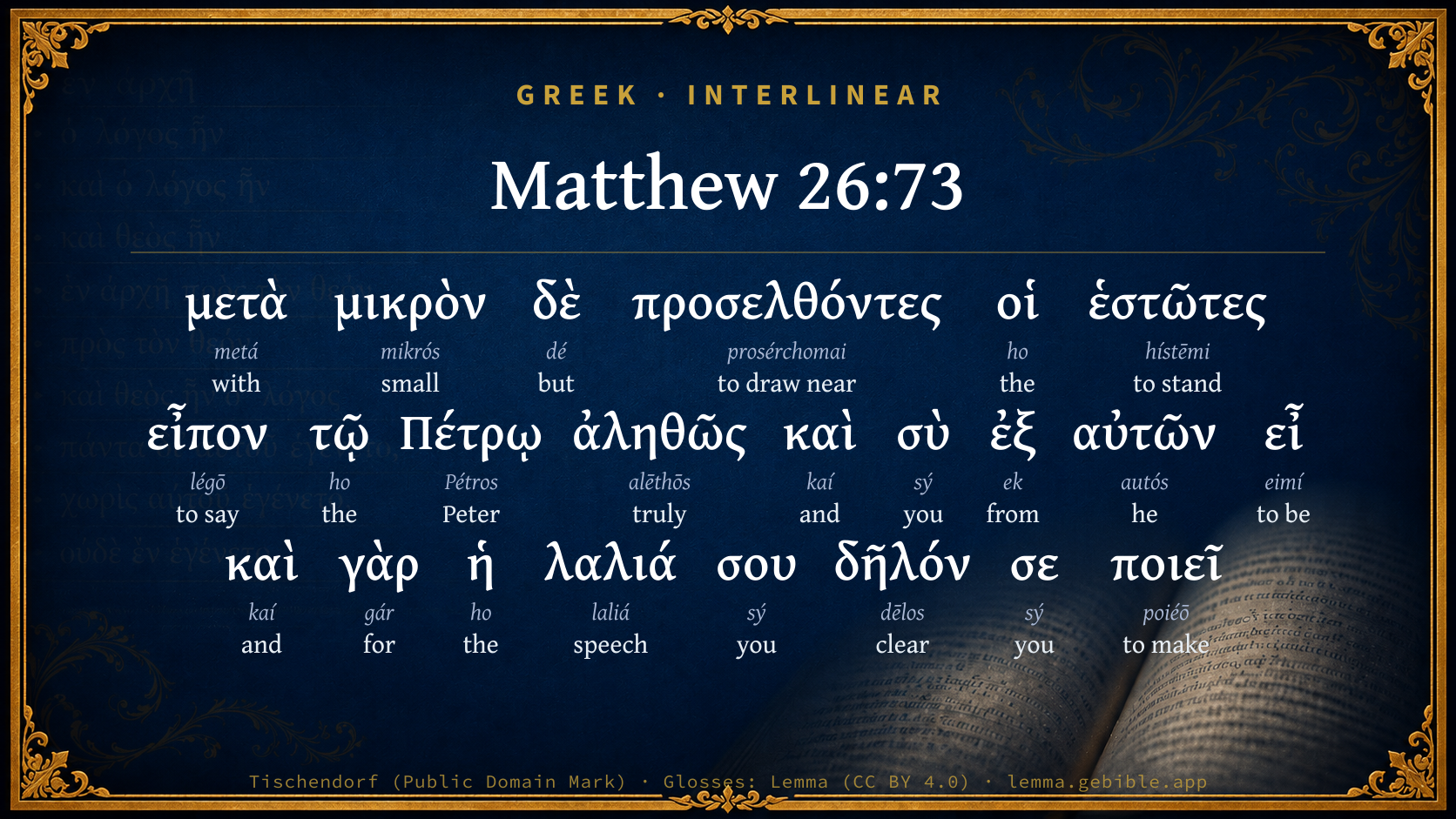
Greek (Tischendorf 8th ed.) Matthew 26:73 appears in the Greek New Testament. The text above is from the Tischendorf 8th edition. Each word links to its Strong’s number and a concise gloss. Click any word for its full Thayer’s Greek Lexicon entry.
Download image
Cite this verse

Matthew 26:73 (World English Bible). Public Domain. Lemma interlinear Bible study tool, https://lemma.gebible.app/v/matthew/26/73.

Show BibTeX & RIS
BibTeX
RIS
English Translation
After a little while those who stood by came and said to Peter, "Surely you are also one of them, for your speech makes you known."
World English Bible · Public Domain
Highlights
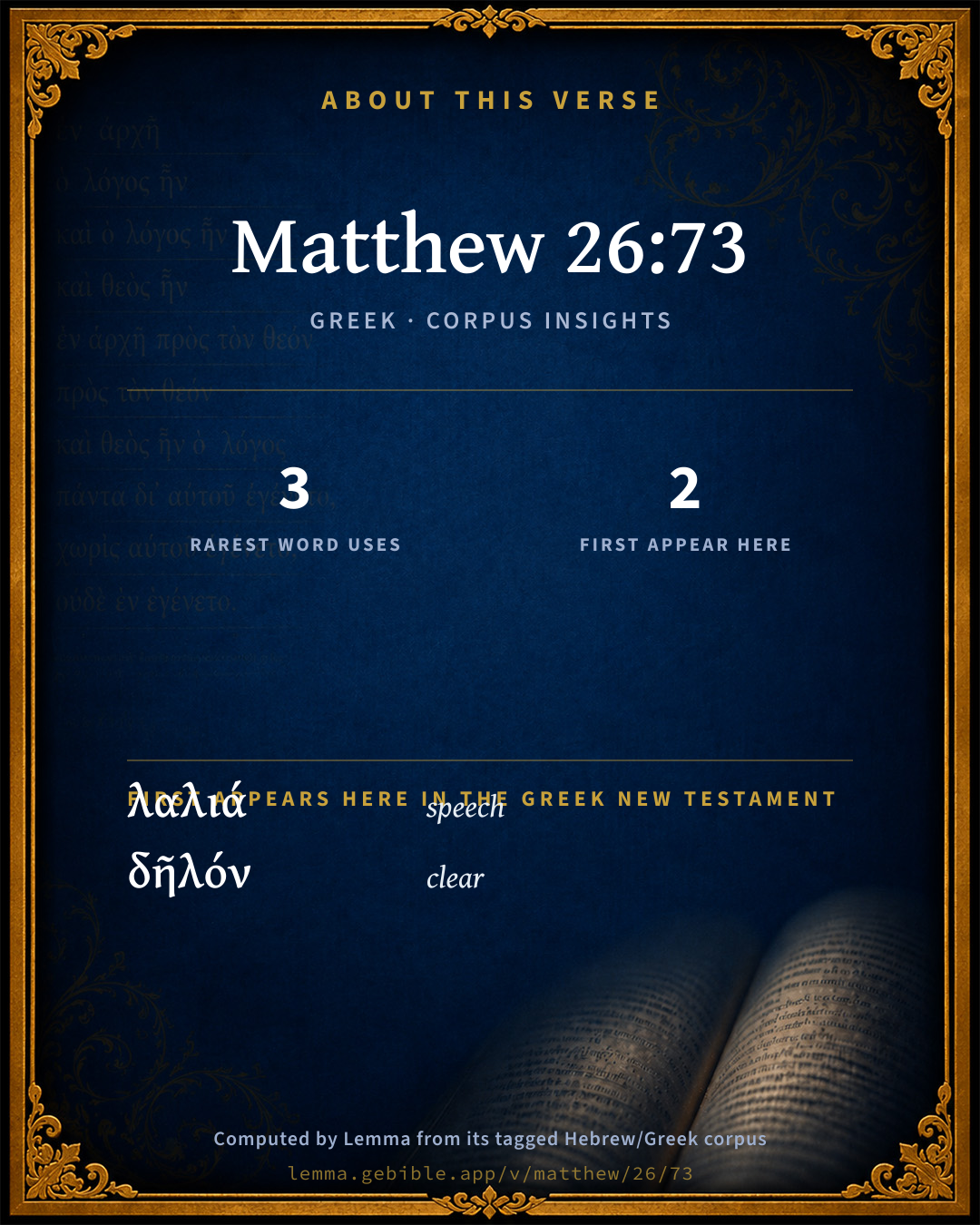
  • 2 first appearances in the Greek New Testament
Full analysis ↓
Download a study sheet

One document with this verse’s original text, its word-by-word gloss line, the meaning frame, cross-references with their text, attributed commentary, and full source and license credits — printable, and it pastes into notes with its structure intact.

This verse Autodidact and up

Study sheet (.html) Plain text (.txt)

A passage Seminary Student

Up to 50 verses in one chapter. A passage sheet keeps up to 6 commentary sources and 12 cross-references per verse, in the order this page ranks them, and says so on the sheet whenever that leaves anything out. Ask for a single verse and you get the Autodidact verse sheet above.

Everything on this page stays free to read, with no account — the sheet is a download of what is already on screen, not access to it.

Want to remove ads? Support Godless Engineer
Compare translations 3

The same verse in 3 English versions, stacked beneath the original-language interlinear above. Click any original word for its lexicon entry.

Each is an independent rendering of the whole verse — the interlinear is not word-aligned to these translations.

Highlighted words mark where these versions differ — a whole-verse word diff, not a word-by-word alignment.

  • World English Bible Public Domain
    After a little while those who stood by came and said to Peter, "Surely you are also one of them, for your speech makes you known."
  • King James Version Public Domain
    And after a while came unto him they that stood by, and said to Peter, Surely thou also art one of them; for thy speech bewrayeth thee.
  • unfoldingWord Literal Text CC BY-SA 4.0
    But after a little the ones standing, having approached, said to Peter, “Truly you also are from them, for also your speech makes you evident.”

unfoldingWord Literal Text — © unfoldingWord, licensed CC BY-SA 4.0. Word-aligned USFM3 via Door43 (git.door43.org/unfoldingWord/en_ult).

Versions to compare (up to 4)

3 of 4 selected

Show all 19 translations

Every available English version of this verse, each an independent rendering of the whole verse.

  • World English Bible Public Domain
    After a little while those who stood by came and said to Peter, "Surely you are also one of them, for your speech makes you known."
  • Berean Standard Bible Public Domain
    After a little while, those standing nearby came up to Peter. “Surely you are one of them,” they said, “for your accent gives you away.”
  • Majority Standard Bible Public Domain
    After a little while, those standing nearby came up to Peter. “Surely you are one of them,” they said, “for your accent gives you away.”
  • King James Version Public Domain
    And after a while came unto him they that stood by, and said to Peter, Surely thou also art one of them; for thy speech bewrayeth thee.
  • American Standard Version (1901) Public Domain
    And after a little while they that stood by came and said to Peter, Of a truth thou also art `one' of them; for thy speech maketh thee known.
  • Revised Version (1885) Public Domain
    And after a little while they that stood by came and said to Peter, Of a truth thou also art one of them; for thy speech bewrayeth thee.
  • Geneva Bible (1599) Public Domain
    So after a while, came vnto him they that stoode by, and sayde vnto Peter, Surely thou art also one of them: for euen thy speache bewraieth thee.
  • Douay-Rheims (1899) Public Domain
    And after a little while they came that stood by, and said to Peter: Surely thou also art one of them; for even thy speech doth discover thee.
  • Young's Literal Translation Public Domain
    And after a little those standing near having come, said to Peter, `Truly thou also art of them, for even thy speech doth make thee manifest.'
  • Literal Standard Version CC BY-SA 4.0
    And after a while those standing near having come, said to Peter, “Truly you also are of them, for even your speech makes you evident.”
  • Unlocked Literal Bible CC BY-SA 4.0
    After a little while those who were standing by came and said to Peter, “Surely you are also one of them, for the way you speak gives you away.”
  • unfoldingWord Literal Text CC BY-SA 4.0
    But after a little the ones standing, having approached, said to Peter, “Truly you also are from them, for also your speech makes you evident.”
  • Darby Bible Public Domain
    And after a little, those who stood [there], coming to [him], said to Peter, Truly *thou* too art of them, for also thy speech makes thee manifest.
  • World Messianic Bible Public Domain
    After a little while those who stood by came and said to Peter, “Surely you are also one of them, for your speech makes you known.”
  • Webster's Bible Public Domain
    And after a while came to him they that stood by, and said to Peter, Surely thou also art one of them; for thy speech betrayeth thee.
  • Free Bible Version CC BY-SA 4.0
    A little while later the people standing there came up to Peter and said, “You definitely are one of them. Your accent gives you away.”
  • Bible in Basic English Public Domain
    And after a little time those who were near came and said to Peter, Truly you are one of them; because your talk is witness against you.
  • Text-Critical English NT CC BY 4.0
    After a little while, the people standing there came up and said to Peter, “Truly yoʋ also are one of them, for even yoʋr accent gives yoʋ away.”
  • Tyndale New Testament (1534) Public Domain
    And after a whyle came vnto him they that stode bye and sayde vnto Peter: suerly thou arte even one of the for thy speache bewreyeth the.

Literal Standard Version (2020), Covenant Press — licensed CC BY-SA 4.0. Text via the HelloAO Bible API (eBible.org). Unlocked Literal Bible (unfoldingWord) — licensed CC BY-SA 4.0. Text via the HelloAO Bible API (eBible.org). unfoldingWord Literal Text — © unfoldingWord, licensed CC BY-SA 4.0. Word-aligned USFM3 via Door43 (git.door43.org/unfoldingWord/en_ult). Free Bible Version, Dr. Jonathan Gallagher — licensed CC BY-SA 4.0. Text via the HelloAO Bible API (eBible.org).

Word by word

More ways to search: Search by grammar → Find every occurrence → Compare this word →

Practice this passage: Drill this verse → Learn its vocabulary →

λαλιά
laliá
G2981
“speech”
Noun, Nominative, Singular, Feminine
Part of Speech
Noun
Case
Nominative
Number
Singular
Gender
Feminine
Full Thayer's Definition

Origin: from G2980

TDNT: None

1. speech, i.e a story 2. dialect, mode of speech, pronunciation a. speech which discloses the speaker's native country
  1. μετὰ metá G3326 “with” Preposition
  2. μικρὸν mikrós G3398 “small” Adjective, Accusative, Singular, Neuter
  3. δὲ dé G1161 “but” Conjunction
  4. προσελθόντες prosérchomai G4334 “to draw near” Verb, Aorist, Active, Participle, Nominative, Plural, Masculine
  5. οἱ ho G3588 “the” Article, Nominative, Plural, Masculine
  6. ἑστῶτες hístēmi G2476 “to stand” Verb, Perfect, Active, Participle, Nominative, Plural, Masculine
  7. εἶπον légō G3004 “to say” Verb, Aorist, Active, Indicative, 3rd person, Plural
  8. τῷ ho G3588 “the” Article, Dative, Singular, Masculine
  9. Πέτρῳ Pétros G4074 “Peter” Noun, Dative, Singular, Masculine
  10. ἀληθῶς alēthōs G230 “truly” Adverb
  11. καὶ kaí G2532 “and” Conjunction
  12. σὺ sý G4771 “you” Personal pronoun, 2nd person, Nominative, Singular
  13. ἐξ ek G1537 “from” Preposition
  14. αὐτῶν autós G846 “he” Personal pronoun, Genitive, Plural, Masculine
  15. εἶ eimí G1510 “to be” Verb, Present, Active, Indicative, 2nd person, Singular
  16. καὶ kaí G2532 “and” Conjunction
  17. γὰρ gár G1063 “for” Conjunction
  18. ἡ ho G3588 “the” Article, Nominative, Singular, Feminine
  19. σου sý G4771 “you” Personal pronoun, 2nd person, Genitive, Singular
  20. δῆλόν dēlos G1212 “clear” Adjective, Accusative, Singular, Masculine
  21. σε sý G4771 “you” Personal pronoun, 2nd person, Accusative, Singular
  22. ποιεῖ poiéō G4160 “to make” Verb, Present, Active, Indicative, 3rd person, Singular

About this verse

These counts appear in no published source. They are computed here, from the morphology-tagged text and Lemma’s own curated glosses. What Lemma adds →

23
words
18
distinct lemmas
Gospels
section

Notable vocabulary

The rarest word here is λαλιά speech G2981 — appearing just 3 times in the whole Greek New Testament.

First appearance in Scripture

These words make their first canonical appearance in the Greek New Testament here:

Shared distinctive vocabulary

λαλιά speech G2981 occurs in 3 verses of the Greek New Testament. Also found in:
Repetition

Words recur within this verse:

Cross-references

4

Topical passages linked to Matthew 26:73 in the Treasury of Scripture Knowledge — connected by theme and wording, ordered by reader-vote popularity; previews shown in the World English Bible.

  • Judges 12:6 then said they to him, Say now Shibboleth; and he said Sibboleth; for he couldn't manage to pronounce it right: then they laid hold on him, and killed him at the fords of the Jordan. There fell at that time of Ephraim forty-two thousand.
  • John 18:26–27 One of the servants of the high priest, being a relative of him whose ear Peter had cut off, said, "Didn't I see you in the garden with him?"
  • Nehemiah 13:24 and their children spoke half in the speech of Ashdod, and could not speak in the Jews' language, but according to the language of each people.
  • Luke 22:59–60 After about one hour passed, another confidently affirmed, saying, "Truly this man also was with him, for he is a Galilean!"

Cross-references courtesy of OpenBible.info (CC BY 4.0).

Commentary

Notes on Matthew 26:73 from classic Christian and Jewish commentators (each source and its license shown beneath its notes). The classic Christian expositions comment on the surrounding passage and are grouped to its opening verse, so a note may address several verses; the Jewish commentaries on the Tanakh (Rashi and others) are per-verse, so they appear only where the commentator wrote on this verse.

Lemma curates 59 commentaries, every one of them public domain or Creative Commons licensed, each selected and text-cleaned for this edition rather than reprinted as found. About our sources →

Joseph Benson's Commentary

Mat 26:73-74. And after a while came they that stood by, &c. — When the servants at the fire heard Peter deny the charge, which John has mentioned, they drew near and supported it by an argument drawn from the accent with which he had pronounced his answer: Surely thou art one of them, for thy speech bewrayeth thee. Η λαλια σου δηλον σε τοιει, thy manner of speech (meaning the Galilean dialect or pronunciation) maketh thee manifest — Or, as Mark expresses it, Thou art a Galilean, and thy speech agreeth thereto. Peter, being thus pressed from different quarters, and having now quite lost the reins, the government of himself; in order to give his lie the better colour, he profaned the name of God by swearing, and wished the bitterest curses on himself if he was telling a falsehood. Perhaps he hoped by these acts of impiety to convince them effectually that he was not the disciple of the holy Jesus. And immediately the cock crew — All the evangelists say, that the cock crew immediately after Peter pronounced the words of the third denial, which they themselves have related. But upon comparing the things said when this third attack was made, it appears that the speeches, at least which John has recorded, did not come from the persons mentioned by the other evangelists. Wherefore the third denial was occasioned by different attacks made in succession; unless the men spoke all at once, which is not very probable. It is more natural to think, that when Peter denied his Master to them who first attacked him, the others, who stood by, supported the charge, with an argument drawn from his dialect or pronunciation, which proved him to be a Galilean. However, as in either case the succession of his answers must have been very quick, the veracity of the evangelists remains unshaken, because thus the cock crew immediately after Peter pronounced the words which they have severally related. Thus through the mere fear of man, a principle from which have sprung many denials of Christ and his truth in different ages, Peter denied his Master three sundry times with many aggravating circumstances, forgetting the vehement protestations he had made a few hours before. He was permitted to fall in this manner to teach mankind several important lessons: as, 1st, That no dependance can be placed on any mere human strength, or on any resolutions man can form, without supernatural aid. 2d, That whatever a person’s attainments may have been formerly, if once he give way to temptation, so as to commit known and actual sin, he frequently, perhaps it may be said commonly, proceeds from bad to worse, one sin naturally drawing on another; for which reason the very least appearance of evil ought always to be dreaded, and the greatest humility and self-diffidence maintained. 3d, The goodness wherewith Jesus treated his fallen apostle, teaches us that no sinner whatever needs to despair of mercy who truly repents.

Joseph Benson's Commentary on the Old and New Testaments (1811–1818) — public domain. Text from a community e-Sword module.

Tyndale Open Study Notes

Tyndale Open Resources

26:73 your Galilean accent: Jews from Galilee had a distinctive accent, compared with those from Judea (cp. 4:13 and corresponding study note).

Tyndale Open Study Notes — © Tyndale Open Resources, licensed CC BY-SA 4.0. Text via the HelloAO Bible API.

Bengel's Gnomon

Johann Albrecht Bengel

Mat 26:73. Εἶ, thou art) The present tense. The temptation increases. Previously they had said ἦσθα, thou wast, Mat 26:69, in the imperfect.—λαλία, speech) i.e., manner of speaking, dialect. If Peter had remained silent, he would have been in less danger of discovery: by denying, which involved speaking, he increased the danger. Those men had, however, stronger proofs by which to convict Peter (see Mat 26:47; Mat 26:51); but the world generally employs the weakest arguments of all against the godly, especially in cases of misdirected zeal. Even as far back as the days of the Judges, tribes had peculiar dialects.[1165]

[1165] See Jdg 12:6, where the Ephraimites are discerned by the test of Shibboleth.—(I. B.)

Bengel's Gnomon of the New Testament — English translation (T&T Clark, Edinburgh, 1860) — public domain. Text from a community e-Sword module.

Meyer's Critical & Exegetical Commentary

Heinrich August Wilhelm Meyer

Mat_26:73. The answer of Peter given at Mat_26:72, and in the course of which his Galilaean dialect was recognised, gave occasion to those standing by (that they were exactly Sanhedrim officers, apparitores, Kuinoel, Paulus, does not necessarily follow from the use of ἑστῶτες) to step up to Peter after a little while, and to corroborate (ἀληθῶς) the assertion of the maid-servant.

ἐξ αὐτῶν] of those who were along with Jesus, Mat_26:71.

καὶ γάρ] for even, apart from circumstances by which thou hast been already identified.

ἡ λαλιά σου] thy speech (see on Joh_8:43), namely, through the coarse provincial accent. The natives of Galilee were unable to distinguish especially the gutturals properly, pronounced the letter שׁ like a ת, etc. See Buxtorf, Lex. Talm. p. 435, 2417; Lightfoot, Centur. Chorogr. p. 151 ff.; Wetstein on our passage; Keim, I. p. 310.

Meyer — Critical and Exegetical Commentary on the New Testament — English translation by Peter Christie, edited by Frederick Crombie (T&T Clark, 1880) — public domain. Text from a community e-Sword module.

Expositor's Greek Testament

ed. W. Robertson Nicoll

Mat 26:73 . οἱ ἑστῶτες , loungers; seeing Peter’s confusion, and amusing themselves by tormenting him. ἀληθῶς , beyond doubt, you, too, are one of them; of the notorious gang. ἡ λαλιά : They had heard him speak in his second denial, which so leads up to a third. Galilean speech was defective in pronouncing the gutturals, and making שׁ = ת .

The Expositor's Greek Testament, edited by W. Robertson Nicoll (1897–1910) — public domain. Text from a community e-Sword module.

Adam Clarke's Commentary

Verse 73. Thy speech] Thy manner of speech, η λαλια σου, that dialect of thine - his accent being different from that of Jerusalem. From various examples given by Lightfoot and Schoettgen, we find that the Galileans had a very corrupt pronunciation, frequently interchanging ת ה א and ע, and so blending or dividing words as to render them unintelligible, or cause them to convey a contrary sense.

Bewrayeth thee.] δηλου σε ποιει, maketh thee manifest, from the Anglo-saxon [Anglo-Saxon], to accuse, betray; a word long since lost from our language.

Adam Clarke's Commentary on the Bible (1810–1826) — public domain. Text from a community e-Sword/MySword module.

Ellicott's Commentary for English Readers

(73) Thy speech bewrayeth thee.—The Galilean patois was probably stronger when he spoke under the influence of strong excitement. It was said to have, as its chief feature, a confused thick utterance of the guttural letters of the Hebrew alphabet, so that they could not be distinguished from each other, and the change of Sh into Th. The half-detection which the remark implied, perhaps, also, some sense of shame at the provincialism attracting notice, led to the more vehement denial that followed.

A Bible Commentary for English Readers, edited by Charles John Ellicott (1878–1897) — public domain. Text from a community e-Sword module.

The Cambridge Bible for Schools and Colleges

gen. ed. J. J. S. Perowne

73. thy speech bewrayeth thee] Peter was discovered by his use of the Galilæan dialect. The Galilæans were unable to pronounce the gutturals distinctly, and they lisped, pronouncing sh like th. Perhaps Peter said, “I know not the ith,” instead of, “I know not the ish” (man).

To bewray, from the Anglo-Saxon wreian, to accuse, then, to point out, make evident,—the literal meaning of the Greek words.

“Here comes the queen, whose looks bewray her anger.”

Shaks. 3 Henry VI. 1. 1. (Bible Word-Book.)

The Cambridge Bible for Schools and Colleges (gen. ed. J. J. S. Perowne; Cambridge University Press, 1878–1918) — public domain. Text from a community e-Sword module.

John Gill's Exposition

Then began he to curse, and to swear,.... He swore before, and now he began "to curse"; not Christ, as Saul compelled some to blaspheme him, who professed him, and as the Jews formerly cursed Christ, and his followers, in their synagogues: for Peter's crime was bad enough, it need not be made worse than it was: he could never call Jesus accursed; in so doing he would have sinned the sin against the Holy Ghost; but he cursed himself; "he began to imprecate himself", as the Arabic version renders it; he made dreadful imprecations and wishes; wished that all the miseries and calamities he could think of might fall upon him, if he was one of the disciples of Jesus of Nazareth, or knew anything of him: saying,

I know not the man; if I do, God do so to me, or more also: let vengeance light upon me; may I be the most miserable creature in the world, if I know anything of him,

and immediately the cock crew: as he was swearing and cursing in this manner; as soon as ever the words were out of his mouth, and he had in this sad and solemn manner three times denied that he knew Christ, or was ever with him, or a disciple of his. It is forbid, by a Jewish canon, to keep cocks at Jerusalem; it runs thus (c):

"they do not bring up cocks in Jerusalem, because of the holy things, neither do the priests in all the land of Israel, because of the purifications.

Whether this canon was then in being, or how it was dispensed with, or whether there was any particular providence in the cock being here now, and so nigh the high priest's palace, is not certain; but one there was: nor can the Jews deny that there were cocks at Jerusalem; for they themselves speak of a cock, (d), "that was stoned at Jerusalem",

(c) Misn. Bava Kama, c. 7. sect. 7. T. Bab. Bava Kama, fol. 82. 2. Abot R. Nathan, c. 35. Maimon. Hilch. Beth Habechirah, c. 7. sect. 14. Shalshelet Hakabala, fol. 9. 2. (d) T. Hieros Erubin, fol. 26. 1. Caphtor, fol. 42. 1.

John Gill's Exposition of the Whole Bible (1746–1763) — public domain (CC PDM 1.0). Text via the HelloAO Bible API.

Trapp's Complete Commentary

John Trapp

73 And after a while came unto him they that stood by, and said to Peter, Surely thou also art one of them; for thy speech bewrayeth thee.

Ver. 73. For thy speech bewrayeth thee] Jacob must name himself Esau, with the voice of Jacob. The Ephraimite must lisp out his Shibboleth in despite of his heart or habit. Each countryman is known by his idiom or dialect. The fool saith to every one, that he is a fool, Ecc 10:3, when the wise man’s tongue "talketh of judgment," Psa 37:30.

John Trapp, A Commentary or Exposition upon All the Books of the Old and New Testament (1647–1656) — public domain. Text from a community e-Sword module.

Albert Barnes' Notes on the Bible

And after a while - That is, about an hour after (Luke). Peter by this time had returned into the palace or hall, and stood warming himself by the fire, Joh 18:25.

Thy speech bewrayeth thee - Your language makes it manifest that you are of his company. That is, as Mark adds, he was a “Galilean,” and in this way his speech betrayed him. It is probable that the Galileans were distinguished for some peculiarity of pronunciation, perhaps some unique rusticity or coarseness in their manner of speaking, that distinguished them from the refinement of the capital, Jerusalem. This charge, John says Joh 18:26, was supported by the express affirmation of a kinsman of Malchus, the servant of the high priest, that he had seen him in the garden.

Albert Barnes' Notes on the Bible (1834–1885) — public domain. Text from a community e-Sword/MySword module.

Haydock's Catholic Bible Commentary

And after a little while. St. Luke says, about an hour after: this seems to have been about the time that the cocks crow the second time. --- They that stood by came. St. Luke says, another man. St. John says, the cousin to him whose ear Peter cut off. It is probable not he alone, but others with him. --- Peter began to curse and swear. It is in vain to pretend to excuse Peter, as if he meant that he knew not Jesus, as man; but knew him as God.[10] They (says St. Jerome) who are for excusing Peter in this manner, accuse Christ of a lie, who foretold that he should deny him. (Witham) --- See how one fall draws on another, and generally deeper: to a simple untruth is added perjury; and to this, horrible imprecations against himself. Lord, Jesus, preserve us! or, I also shall deny thee!

===============================

[BIBLIOGRAPHY]

St. Jerome, in Matt. p. 133, scio quosdam pii affectus erga Apostolum Petrum, locum hunc ita interpretatos, ut dicerent Petrum non Deum negasse, sed hominem ... Hoc quam frivolum sit, prudens Lector intelligit; qui sic defendunt Apostolum, ut Deum mendacii reum faciant.

====================

George Leo Haydock (1774–1849), Haydock's Catholic Family Bible and Commentary, 1859 edition — public domain. Excludes Psalms (Douay-Rheims chapter numbering differs from Protestant) and Deuterocanonical books (Catholic canon only).

Matthew Poole's English Annotations

Mark saith, Mar 14:70,71, And a little after, they that stood by said again to Peter, Surely thou art one of them: for thou art a Galilean, and thy speech agreeth thereto. But he began to curse and to swear, saying, I know not this man of whom ye speak. Luke hath it, Luk 22:59,60, And about the space of one hour after another confidently affirmed, saying, Of a truth this fellow also was with him: for he is a Galilean. And Peter said, Man, I know not what thou sayest. And immediately, while he yet spake, the cock crew. One spake in the name of the rest that were gathered about Peter, and he charges Peter confidently; and he might well, for John saith, Joh 18:26, that this was one of the servants of the high priest, being his kinsman whose ear Peter cut off. He said, Did not I see thee in the garden with him? Temptations always grow upon us in the company of wicked men. Here Peter adds to his lying, swearing and cursing; all confirming of what he had said in the denial of his Master; all in an exact fulfilling of what Christ had told Peter, Mat 26:34, though he was then difficult to believe it; to teach us all not to presume too far upon our own strength, but to pray that we be not led into temptation; while we stand, to take heed lest we fall; and in order to it, to avoid the society of wicked men, and places in which we probably may be tempted. To teach us also charity to lapsed brethren, and not too hastily to condemn our brethren for falling a second and a third time into the same sin; especially, while the same fit of temptation holdeth. It is added, And immediately the cock crew, that is, the second time; so saith Mark, Mar 14:72, who had mentioned the cock’s first crowing, Mar 14:68, upon Peter’s first denial of his Master.

Matthew Poole's English Annotations on the Holy Bible (1683–1685) — public domain. Text from a community e-Sword/MySword module.

Whedon's Commentary on the Bible

Daniel D. Whedon

PETER’S THIRD DENIAL.

The place, probably in the court after a while.

There is nothing to indicate clearly the time. But the morning was now approaching, for the cock soon crew.

73. After a while — John says an hour. Thy speech bewrayeth thee — Peter had ventured to utter some remark which brought out his Gallilean brogue, and the bystanders noticed him. Bewrayeth — Detecteth.

Daniel D. Whedon (gen. ed.), Commentary on the Old and New Testaments (1874–1909) — public domain. Text from a community e-Sword module.

The Pulpit Commentary

After a while; meta micron : after a little interval. About an hour, according to St. Luke. Meantime had occurred the examination and informal condemnation of Christ, followed by the brutalities of the attendants, and the Lord"s temporary consignment to some chamber or gallery that overlooked the courtyard. The excitement of the trial and its accompaniments having somewhat subsided, attention was again turned upon Peter, who, in his nervous trepidation, could not remain quiet and silent, but aroused observation by his indiscreet movements and garrulity. They that stood by. Among whom, as St. John notes, was a kinsman of Malthus, who indistinctly remembered hating seen Peter at Gethsemane. Probably by this time some rumour of the presence of a disciple of Jesus had spread among the crowd, and there arose an eager desire to discover him. If Peter had not talked, he might have escaped further notice. Thy speech bewrayeth thee; makes thee known. His dialect (for doubtless he spoke Aramaic) showed that he was a Galilaean, and as most of Christ"s adherents came from that region, they inferred that he was one of Christ"s disciples. The language and pronunciation of the northern district differed materially from the polished dialect of Judaea and Jerusalem, and its provincialisms were readily detected. The Galilaeans, we are told, could not properly pronounce the guttural letters, aleph, kheth, and ayin, and used tau for shin, pe for beth, etc.; they also often omitted syllables in words, occasioning equivocal mistakes, which afforded much amusement to the better instructed.

The Pulpit Commentary (1880–1919), ed. H.D.M. Spence-Jones & Joseph S. Exell — public domain. Text from a community e-Sword module.

John Wesley's Explanatory Notes

Surely thou art also one of them, for thy speech discovereth thee - Malchus might have brought a stronger proof than this. But such is the overruling providence of God, that the world, in the height of their zeal, commonly catch hold of the very weakest of all arguments against the children of God.

John Wesley, Explanatory Notes Upon the Whole Bible (1754–1765) — public domain. Text via the GEBible commentary corpus.

The People's New Testament

B. W. Johnson

73. Thou art one of them; for thy speech bewrayeth thee. Matthew says, “After awhile;” Luke says, “About an hour after.” John says that the third charge was made by a kinsman of Malchus, who asserted that he saw Peter in the garden Mark says that they accused him of having a Galilean brogue. As most of the disciples of Jesus were Galileans, this draws attention to Peter. Different districts had their dialects, as in England, or the United States.

B. W. Johnson's The People's New Testament with Notes (1889–1891) — public domain. Electronic text from the Christian Classics Ethereal Library (CCEL) ThML edition.

unfoldingWord translationNotes

Door43 World Missions Community

one of them

"one of those who were with Jesus"

for the way you speak gives you away

This can be translated as a new sentence. AT: "We can tell you are from Galilee because you speak like a Galilean"

to curse

"to call down a curse on himself"

rooster crowed

A rooster is a bird that calls out loudly around the time the sun comes up. The sound a rooster makes is called "crowing." See how you translated this in Matthew 26:34.

Peter remembered the words that Jesus had said, "Before the rooster crows you will deny me three times."

This direct quotation can be stated as an indirect quotation. AT: "Peter remembered that Jesus told him that before the rooster crowed, he would deny Jesus three times" (See: Direct and Indirect Quotations)

translationWords

Peter

curse

oath

unfoldingWord translationNotes — © Distant Shores Media and the Door43 World Missions Community, licensed CC BY-SA 4.0. Source: git.door43.org/Door43/en_tn.

Cambridge Greek Testament for Schools and Colleges

73. λαλιά. An Aristophanic word, λαλιὰν ἀσκῆσαι, ‘to talk (practise), gossip.’ The same notion of contempt underlies the word, Joh 4:42, οὐκέτι διὰ τὴν σὴν λαλιὰν πιστεύομεν. Here thy ‘talk’ or ‘speech,’ as in A.V., not definitely ‘a dialect’ (Schleusner). In the LXX. it is used generally for ‘word’ or ‘speech.’

ἡ λαλιά σου κ.τ.λ. Peter was discovered by his use of the Galilæan dialect. The Galilæans were unable to pronounce the gutturals distinctly, and they lisped, pronouncing sh like th. Perhaps Peter said, ‘I know not the ith,’ instead of, ‘I know not the ish’ (man).

Cambridge Greek Testament for Schools and Colleges (Cambridge University Press, 1896; 21 vols, various authors incl. Carr, Maclear, Plummer, Farrar, Lumby, Moule, M. R. James, Simcox) — public domain. Text from a community e-Sword module.

Alford’s Greek Testament

Henry Alford

73. ἡ λαλιά] Wetstein (ad loc.) gives many examples of various provincial dialects of Hebrew. The Galilæans could not pronounce properly the gutturals, confounding , ע and ח; and they used ת for שׁ.

Henry Alford, The Greek Testament (1849–1861) — public domain. Text from a community e-Sword module.

International Critical Commentary

(M) 73. And after a little while there came they who stood (there), and said to Peter, Truly thou also art (one) of them; for thy speech bewrayeth thee.] Mk. has: “And after a little again they who stood by were saying to Peter, Truly thou art (one) of them; for thou art a Galilean.” Mt. omits Mk.’s πάλιν, as often.—προσελθόντες] see on 4:3.—καὶ γάρ, κ.τ.λ.] is apparently an explanatory interpretation of Mk.’s “for thou art a Galilean.” Mt. supposes that this was an inference from S. Peter’s language or pronunciation. See Dalm. Words, p. 80.

73. δῆλόν σε ποιεῖ] D latt. S1 have ὁμοιάζει = “is like,” i.e. “resembles theirs.”

E editorial passages.

M the Second Gospel.

S Syriac version: Peshitta.

1 S1 has: “Two days before it was the Unleavened Bread of Pasek” (Burkitt).

DCG. Dictionary of Christ and the Gospels.

Plut. Plutarch.

al i.e. with other uncial MSS.

S Syriac version: Sinaitic MS.

Ox. Pap. Oxyrhynchus Papyri.

1 See against this Chwolson, Das Letste Passamahl Christi, p. 4.

Jos. Josephus.

1 Entry into the house of a heathen caused uncleanness for seven days (Chwolson).

2 Monatsschrift für Gesch. und Wissensehaft des Judenthums, lxxiii. 537-555.

B. Babylonian Talmud.

Dalm. Dalman.

L the Matthæan Logia.

LXX. The Septuagint Version.

1 Mk. has ἕως. Cf. the same change in 14:22 = Mar 6:45. Mk.’s ἔως may perhaps mean “while” here and in 6:45, but Mt. uses ἕως οὗ in five other cases (1:25, 13:33, 14:22, 17:9, 18:34) in the sense “until,” so that it probably bears that meaning here. In Aramaic עד ד has either meaning.

1 So אc B, but אc A C D have the compound verb.

latt. Manuscripts of the Old Latin Version.

Ps.-Sol. The Psalms of Solomon.

1 ἄρτι does not occur in Mk. or Lk. In Mt. ἄρτι occurs 4 times, and including ἀπʼ ἄρτι 7 times. In 23:39 and 26:29 ἀπʼ ἄρτι means “from the present moment.” But in 26:64 this meaning cannot be pressed, because the period between the moment of utterance and the resurrection must in any case be excluded from the scope of the phrase. It is probably used here in the sense “hereafter” with the implication “soon.” On ἀπʼ ἄρτι, see Abbott, Johannine Grammar, 1915, vi.

WH. Westcott and Hort.

International Critical Commentary — older volumes (1896–1929), various authors — public domain. Text from a community e-Sword module.

Lesson kit

Teaching starters — assembled from the data on this page, not authored interpretation. Every prompt links to the verse data it draws on. Edit before teaching.

Matthew, in the Gospels, opens this verse with 23 words (18 distinct Greek lemmas). Its most distinctive word is laliá (“speech”). A historical commentator’s framing appears above. Read the whole chapter for the surrounding context.

Discussion questions

  1. The word laliá carries the sense “speech.” How does it shape the verse?
  2. 2 words here appear for the first time in Scripture. What is being introduced at this debut?
  3. John 4:42 shares the word «speech» with this verse. How do the two illuminate each other?
  4. “the” occurs 3× in this one verse. What is the effect of the repetition?
  5. These translations render this verse differently; the difference is in the English rendering, not the original. What questions does that raise?
  6. Reading how Joseph Benson's Commentary and Tyndale Open Study Notes read this verse, where do the two commentators agree and where do they part?

Things to notice

  • 2 words make their first canonical appearance in Scripture here.
  • These translations choose different wording for 18 words in this verse.
  • “the” occurs 3× in this single verse.
  • 18 distinct Greek lemmas span 23 words in this verse.

Reading settings

Reading text

Shown beneath each verse's original-language words.

Old Testament
Old Testament edition

Read the OT as the Masoretic Hebrew (MT) or the Greek Septuagint (LXX).

English shown for the Greek Septuagint (in the Hebrew ↔ Greek comparison).

Comparing translations? Open the Compare panel on any verse page to stack up to four side by side.