

Mark 12:9
Greek (Tischendorf 8th ed.) Mark 12:9 appears in the Greek New Testament. The text above is from the Tischendorf 8th edition. Each word links to its Strong’s number and a concise gloss. Click any word for its full Thayer’s Greek Lexicon entry.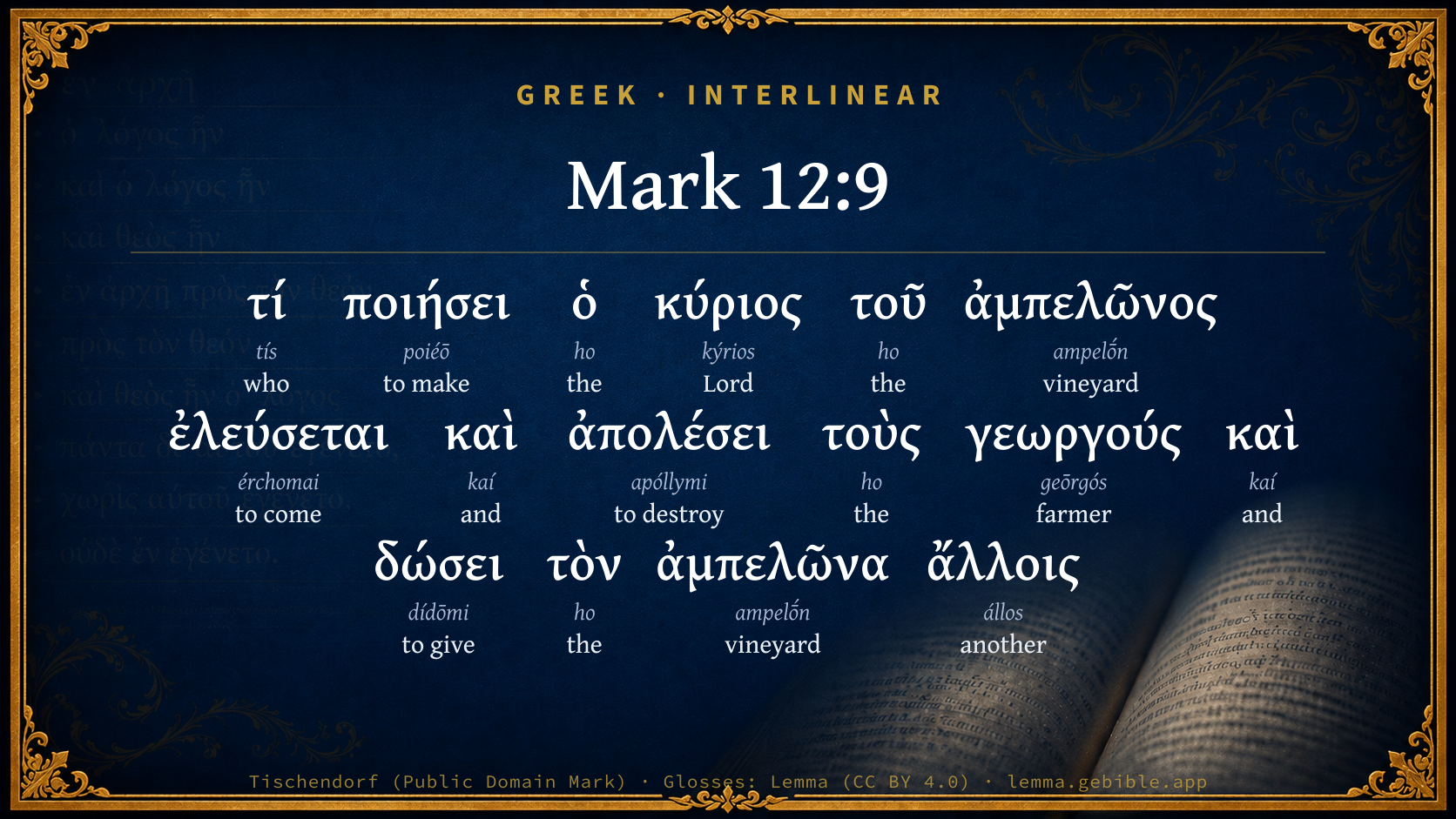
What therefore will the lord of the vineyard do? He will come and destroy the farmers, and will give the vineyard to others.
Download a study sheet
One document with this verse’s original text, its word-by-word gloss line, the meaning frame, cross-references with their text, attributed commentary, and full source and license credits — printable, and it pastes into notes with its structure intact.
This verse Autodidact and up
A passage Seminary Student
Up to 50 verses in one chapter. A passage sheet keeps up to 6 commentary sources and 12 cross-references per verse, in the order this page ranks them, and says so on the sheet whenever that leaves anything out. Ask for a single verse and you get the Autodidact verse sheet above.
Everything on this page stays free to read, with no account — the sheet is a download of what is already on screen, not access to it.
Compare translations 3
The same verse in 3 English versions, stacked beneath the original-language interlinear above. Click any original word for its lexicon entry.
Each is an independent rendering of the whole verse — the interlinear is not word-aligned to these translations.
Highlighted words mark where these versions differ — a whole-verse word diff, not a word-by-word alignment.
-
World English Bible Public Domain
What therefore will the lord of the vineyard do? He will come and destroy the farmers, and will give the vineyard to others.
-
King James Version Public Domain
What shall therefore the lord of the vineyard do? he will come and destroy the husbandmen, and will give the vineyard unto others.
-
unfoldingWord Literal Text CC BY-SA 4.0
What then will the lord of the vineyard do? He will come and destroy the farmers and will give the vineyard to others.
unfoldingWord Literal Text — © unfoldingWord, licensed CC BY-SA 4.0. Word-aligned USFM3 via Door43 (git.door43.org/unfoldingWord/en_ult).
Show all 19 translations
Every available English version of this verse, each an independent rendering of the whole verse.
-
World English Bible Public Domain
What therefore will the lord of the vineyard do? He will come and destroy the farmers, and will give the vineyard to others.
-
Berean Standard Bible Public Domain
What then will the owner of the vineyard do? He will come and kill those tenants, and will give the vineyard to others.
-
Majority Standard Bible Public Domain
What then will the owner of the vineyard do? He will come and kill those tenants, and will give the vineyard to others.
-
King James Version Public Domain
What shall therefore the lord of the vineyard do? he will come and destroy the husbandmen, and will give the vineyard unto others.
-
American Standard Version (1901) Public Domain
What therefore will the lord of the vineyard do? he will come and destroy the husbandmen, and will give the vineyard unto others.
-
Revised Version (1885) Public Domain
What therefore will the lord of the vineyard do? he will come and destroy the husbandmen, and will give the vineyard unto others.
-
Geneva Bible (1599) Public Domain
What shall then the Lord of the vineyard doe? He will come and destroy these husbandmen, and giue the vineyard to others.
-
Douay-Rheims (1899) Public Domain
What therefore will the lord of the vineyard do? He will come and destroy those husbandmen; and will give the vineyard to others.
-
Young's Literal Translation Public Domain
`What therefore shall the lord of the vineyard do? he will come and destroy the husbandmen, and will give the vineyard to others.
-
Literal Standard Version CC BY-SA 4.0
What therefore will the lord of the vineyard do? He will come and destroy the farmers, and will give the vineyard to others.
-
Unlocked Literal Bible CC BY-SA 4.0
Therefore, what will the owner of the vineyard do? He will come and destroy the vine growers and will give the vineyard to others.
-
unfoldingWord Literal Text CC BY-SA 4.0
What then will the lord of the vineyard do? He will come and destroy the farmers and will give the vineyard to others.
-
Darby Bible Public Domain
What therefore shall the lord of the vineyard do? He will come and destroy the husbandmen, and will give the vineyard to others.
-
World Messianic Bible Public Domain
What therefore will the lord of the vineyard do? He will come and destroy the farmers, and will give the vineyard to others.
-
Webster's Bible Public Domain
What therefore will the Lord of the vineyard do? he will come and destroy the husbandmen, and will give the vineyard to others.
-
Free Bible Version CC BY-SA 4.0
Now what is the owner of the vineyard going to do? He will come and kill those farmers, and then he will lease the vineyard to others.
-
Bible in Basic English Public Domain
What then will the master of the garden do? He will come and put the workmen to death, and will give the garden into the hands of others.
-
Text-Critical English NT CC BY 4.0
What then will the owner of the vineyard do? He will come and destroy those farmers and give the vineyard to others.
-
Tyndale New Testament (1534) Public Domain
What shall then the lorde of the vyneyarde do? He will come and destroye the tenauntes and let out the vyneyarde to other.
Literal Standard Version (2020), Covenant Press — licensed CC BY-SA 4.0. Text via the HelloAO Bible API (eBible.org). Unlocked Literal Bible (unfoldingWord) — licensed CC BY-SA 4.0. Text via the HelloAO Bible API (eBible.org). unfoldingWord Literal Text — © unfoldingWord, licensed CC BY-SA 4.0. Word-aligned USFM3 via Door43 (git.door43.org/unfoldingWord/en_ult). Free Bible Version, Dr. Jonathan Gallagher — licensed CC BY-SA 4.0. Text via the HelloAO Bible API (eBible.org).
Word by word
More ways to search: Search by grammar → Find every occurrence → Compare this word →
Practice this passage: Drill this verse → Learn its vocabulary →
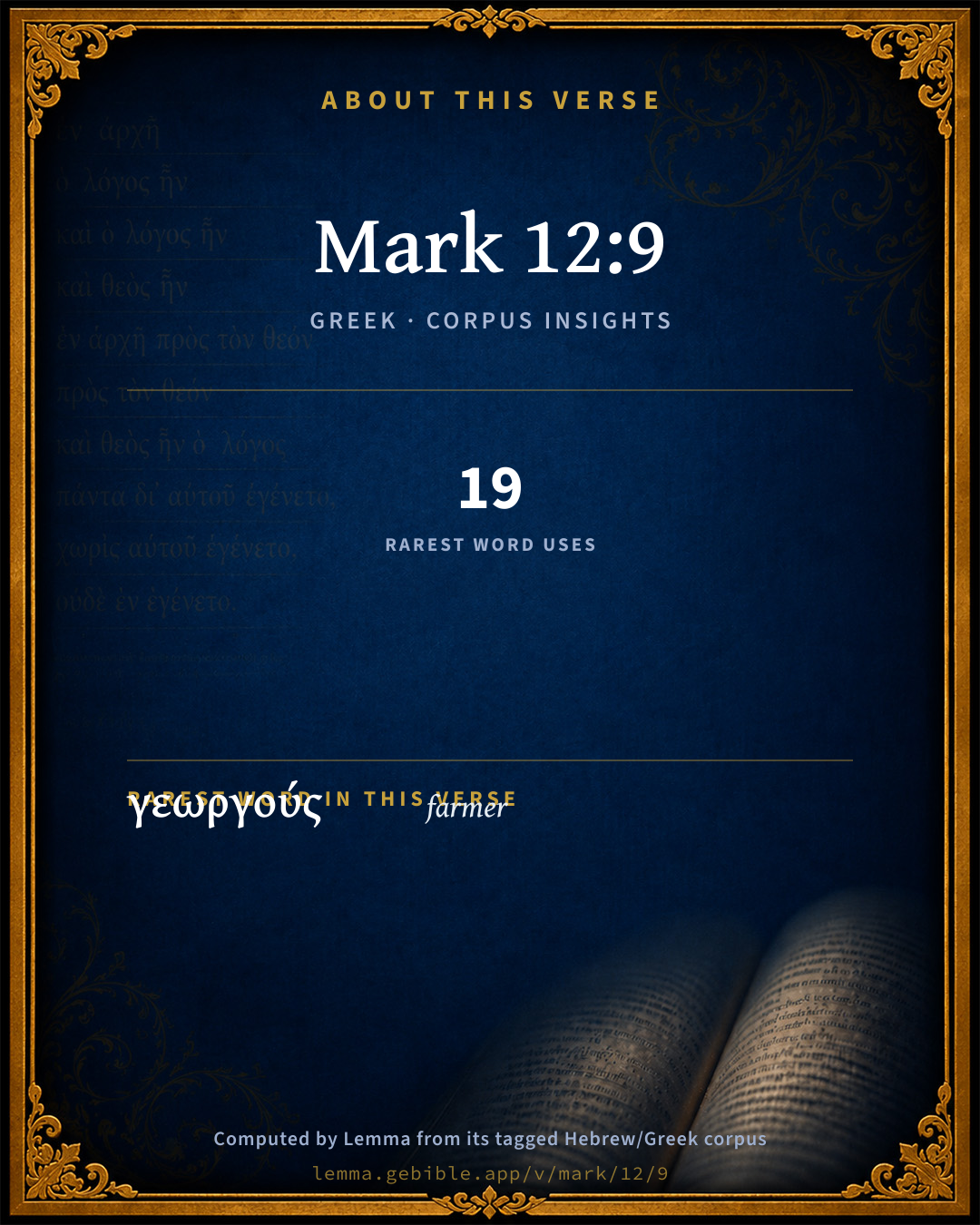
- Appears 19× in the Greek New Testament
- First appears at Matthew 21:33
- Part of Speech
- Noun
- Case
- Accusative
- Number
- Plural
- Gender
- Masculine
Full Thayer's Definition
- τί tís G5101 “who” Interrogative pronoun, Accusative, Singular, Neuter
- ποιήσει poiéō G4160 “to make” Verb, Future, Active, Indicative, 3rd person, Singular
- ὁ ho G3588 “the” Article, Nominative, Singular, Masculine
- κύριος kýrios G2962 “Lord” Noun, Nominative, Singular, Masculine
- τοῦ ho G3588 “the” Article, Genitive, Singular, Masculine
- ἀμπελῶνος ampelṓn G290 “vineyard” Noun, Genitive, Singular, Masculine
- ἐλεύσεται érchomai G2064 “to come” Verb, Future, Middle deponent, Indicative, 3rd person, Singular
- καὶ kaí G2532 “and” Conjunction
- ἀπολέσει apóllymi G622 “to destroy” Verb, Future, Active, Indicative, 3rd person, Singular
- τοὺς ho G3588 “the” Article, Accusative, Plural, Masculine
- γεωργούς geōrgós G1092 “farmer” Noun, Accusative, Plural, Masculine
- καὶ kaí G2532 “and” Conjunction
- δώσει dídōmi G1325 “to give” Verb, Future, Active, Indicative, 3rd person, Singular
- τὸν ho G3588 “the” Article, Accusative, Singular, Masculine
- ἀμπελῶνα ampelṓn G290 “vineyard” Noun, Accusative, Singular, Masculine
- ἄλλοις állos G243 “another” Adjective, Dative, Plural, Masculine
About this verse
These counts appear in no published source. They are computed here, from the morphology-tagged text and Lemma’s own curated glosses. What Lemma adds →
- 16
- words
- 11
- distinct lemmas
- Gospels
- section
Cross-references
29Topical passages linked to Mark 12:9 in the Treasury of Scripture Knowledge — connected by theme and wording, ordered by reader-vote popularity; previews shown in the World English Bible.
- Romans 10:20–11:12 Isaiah is very bold, and says, "I was found by those who didn't seek me. I was revealed to those who didn't ask for me."
- Matthew 21:43 "Therefore I tell you, the Kingdom of God will be taken away from you, and will be given to a nation bringing forth its fruits.
- Luke 19:27 But bring those enemies of mine who didn't want me to reign over them here, and kill them before me.'"
- Romans 9:30–33 What shall we say then? That the Gentiles, who didn't follow after righteousness, attained to righteousness, even the righteousness which is of faith;
- Leviticus 26:15–18 and if you shall reject my statutes, and if your soul abhors my ordinances, so that you will not do all my commandments, but break my covenant;
- Leviticus 26:23–24 "'If by these things you won't be reformed to me, but will walk contrary to me;
- Leviticus 26:27–28 "'If you in spite of this won't listen to me, but walk contrary to me;
- Deuteronomy 4:26–27 I call heaven and earth to witness against you this day, that you shall soon utterly perish from off the land whereunto you go over the Jordan to possess it; you shall not prolong your days on it, but shall utterly be destroyed.
- Deuteronomy 28:15–68 But it shall come to pass, if you will not listen to the voice of Yahweh your God, to observe to do all his commandments and his statutes which I command you this day, that all these curses shall come on you, and overtake you.
- Joshua 23:15 It shall happen, that as all the good things are come on you of which Yahweh your God spoke to you, so will Yahweh bring on you all the evil things, until he have destroyed you from off this good land which Yahweh your God has given you.
- Proverbs 1:24–31 Because I have called, and you have refused; I have stretched out my hand, and no one has paid attention;
- Isaiah 5:5–7 Now I will tell you what I will do to my vineyard. I will take away its hedge, and it will be eaten up. I will break down its wall of it, and it will be trampled down.
- Isaiah 29:17 Is it not yet a very little while, and Lebanon shall be turned into a fruitful field, and the fruitful field shall be esteemed as a forest?
- Isaiah 32:15–16 until the Spirit be poured on us from on high, and the wilderness become a fruitful field, and the fruitful field be esteemed as a forest.
- Isaiah 65:15 You shall leave your name for a curse to my chosen; and the Lord Yahweh will kill you; and he will call his servants by another name:
- Jeremiah 17:3 My mountain in the field, I will give your substance and all your treasures for a spoil, [and] your high places, because of sin, throughout all your borders.
- Daniel 9:26–27 After the sixty-two weeks the Anointed One shall be cut off, and shall have nothing: and the people of the prince who shall come shall destroy the city and the sanctuary; and the end of it shall be with a flood, and even to the end shall be war; desolations are determined.
- Zechariah 13:7–9 "Awake, sword, against my shepherd, And against the man who is close to me," says Yahweh of Hosts. Strike the shepherd, and the sheep will be scattered; And I will turn my hand against the little ones.
- Malachi 1:11 For from the rising of the sun even to the going down of the same, my name is great among the nations, and in every place incense will be offered to my name, and a pure offering: for my name is great among the nations," says Yahweh of Hosts.
- Matthew 3:9–12 Don't think to yourselves, 'We have Abraham for our father,' for I tell you that God is able to raise up children to Abraham from these stones.
- Matthew 8:11–13 I tell you that many will come from the east and the west, and will sit down with Abraham, Isaac, and Jacob in the Kingdom of Heaven,
- Matthew 12:45 Then he goes, and takes with himself seven other spirits more evil than he is, and they enter in and dwell there. The last state of that man becomes worse than the first. Even so will it be also to this evil generation."
- Matthew 21:40–41 When therefore the lord of the vineyard comes, what will he do to those farmers?"
- Matthew 22:7 When the king heard that, he was angry, and he sent his armies, destroyed those murderers, and burned their city.
- Matthew 23:34–38 Therefore, behold, I send to you prophets, wise men, and scribes. Some of them you will kill and crucify; and some of them you will scourge in your synagogues, and persecute from city to city;
- Luke 19:41–44 When he drew near, he saw the city and wept over it,
- Luke 20:15–16 They threw him out of the vineyard, and killed him. What therefore will the lord of the vineyard do to them?
- Acts 13:46–48 Paul and Barnabas spoke out boldly, and said, "It was necessary that God's word should be spoken to you first. Since indeed you thrust it from you, and judge yourselves unworthy of eternal life, behold, we turn to the Gentiles.
- Acts 28:23–28 When they had appointed him a day, many people came to him at his lodging. He explained to them, testifying about the Kingdom of God, and persuading them concerning Jesus, both from the law of Moses and from the prophets, from morning until evening.
Cross-references courtesy of OpenBible.info (CC BY 4.0).
Lesson kit
Teaching starters — assembled from the data on this page, not authored interpretation. Every prompt links to the verse data it draws on. Edit before teaching.
Mark, in the Gospels, opens this verse with 16 words (11 distinct Greek lemmas). Its most distinctive word is geōrgós (“farmer”). A historical commentator’s framing appears above. Read the whole chapter for the surrounding context.
Discussion questions
- How does “farmer” (geōrgós) shape what this verse is saying?
- How does Matthew 21:33, which shares the word «farmer», read alongside this verse?
- What does the repetition of “vineyard” (2× in this one verse) do in this verse?
- The translations on this page render this verse differently — a whole-verse word diff, not a word-by-word alignment. What might account for the different wordings?
- Compare how Tyndale Open Study Notes and Adam Clarke's Commentary read this verse. Where do they agree or differ?
Things to notice
- These translations choose different wording for 4 words in this verse.
- “vineyard” occurs 2× in this single verse.
- 11 distinct Greek lemmas span 16 words in this verse.
Commentary
Notes on Mark 12:9 from classic Christian and Jewish commentators (each source and its license shown beneath its notes). The classic Christian expositions comment on the surrounding passage and are grouped to its opening verse, so a note may address several verses; the Jewish commentaries on the Tanakh (Rashi and others) are per-verse, so they appear only where the commentator wrote on this verse.
Lemma curates 59 commentaries, every one of them public domain or Creative Commons licensed, each selected and text-cleaned for this edition rather than reprinted as found. About our sources →
Tyndale Open Study Notes
Tyndale Open Resources
Tyndale Open Study Notes — © Tyndale Open Resources, licensed CC BY-SA 4.0. Text via the HelloAO Bible API.
Adam Clarke's Commentary
Adam Clarke's Commentary on the Bible (1810–1826) — public domain. Text from a community e-Sword/MySword module.
Ellicott's Commentary for English Readers
A Bible Commentary for English Readers, edited by Charles John Ellicott (1878–1897) — public domain. Text from a community e-Sword module.
The Cambridge Bible for Schools and Colleges
gen. ed. J. J. S. Perowne
The Cambridge Bible for Schools and Colleges (gen. ed. J. J. S. Perowne; Cambridge University Press, 1878–1918) — public domain. Text from a community e-Sword module.
John Gill's Exposition
John Gill's Exposition of the Whole Bible (1746–1763) — public domain (CC PDM 1.0). Text via the HelloAO Bible API.
Haydock's Catholic Bible Commentary
George Leo Haydock (1774–1849), Haydock's Catholic Family Bible and Commentary, 1859 edition — public domain. Excludes Psalms (Douay-Rheims chapter numbering differs from Protestant) and Deuterocanonical books (Catholic canon only).
The Pulpit Commentary
The Pulpit Commentary (1880–1919), ed. H.D.M. Spence-Jones & Joseph S. Exell — public domain. Text from a community e-Sword module.
Scofield Reference Notes
C. I. Scofield
The Scofield Reference Bible (1917 edition), notes by C. I. Scofield — public domain. Text from a community e-Sword module.
Kretzmann's Popular Commentary
Paul E. Kretzmann
Paul E. Kretzmann, Popular Commentary of the Bible (1921–1924) — public domain. Text from a community e-Sword module.
Burkitt's Expository Notes on the New Testament
William Burkitt
William Burkitt's Expository Notes on the New Testament (1700–1703) — public domain. Text from a community e-Sword module.
Cambridge Greek Testament for Schools and Colleges
Cambridge Greek Testament for Schools and Colleges (Cambridge University Press, 1896; 21 vols, various authors incl. Carr, Maclear, Plummer, Farrar, Lumby, Moule, M. R. James, Simcox) — public domain. Text from a community e-Sword module.
Alford’s Greek Testament
Henry Alford
Henry Alford, The Greek Testament (1849–1861) — public domain. Text from a community e-Sword module.
International Critical Commentary
International Critical Commentary — older volumes (1896–1929), various authors — public domain. Text from a community e-Sword module.