Mark 3:6

Greek (Tischendorf 8th ed.) Mark 3:6 appears in the Greek New Testament. The text above is from the Tischendorf 8th edition. Each word links to its Strong’s number and a concise gloss. Click any word for its full Thayer’s Greek Lexicon entry.
Download image
Cite this verse

Mark 3:6 (World English Bible). Public Domain. Lemma interlinear Bible study tool, https://lemma.gebible.app/v/mark/3/6.

Show BibTeX & RIS
BibTeX
RIS
English Translation
The Pharisees went out, and immediately conspired with the Herodians against him, how they might destroy him.
World English Bible · Public Domain
Download a study sheet

One document with this verse’s original text, its word-by-word gloss line, the meaning frame, cross-references with their text, attributed commentary, and full source and license credits — printable, and it pastes into notes with its structure intact.

This verse Autodidact and up

Study sheet (.html) Plain text (.txt)

A passage Seminary Student

Up to 50 verses in one chapter. A passage sheet keeps up to 6 commentary sources and 12 cross-references per verse, in the order this page ranks them, and says so on the sheet whenever that leaves anything out. Ask for a single verse and you get the Autodidact verse sheet above.

Everything on this page stays free to read, with no account — the sheet is a download of what is already on screen, not access to it.

Want to remove ads? Support Godless Engineer
Compare translations 3

The same verse in 3 English versions, stacked beneath the original-language interlinear above. Click any original word for its lexicon entry.

Each is an independent rendering of the whole verse — the interlinear is not word-aligned to these translations.

Highlighted words mark where these versions differ — a whole-verse word diff, not a word-by-word alignment.

  • World English Bible Public Domain
    The Pharisees went out, and immediately conspired with the Herodians against him, how they might destroy him.
  • King James Version Public Domain
    And the Pharisees went forth, and straightway took counsel with the Herodians against him, how they might destroy him.
  • unfoldingWord Literal Text CC BY-SA 4.0
    And having gone out, the Pharisees immediately were making counsel with the Herodians against him so that they might destroy him.

unfoldingWord Literal Text — © unfoldingWord, licensed CC BY-SA 4.0. Word-aligned USFM3 via Door43 (git.door43.org/unfoldingWord/en_ult).

Versions to compare (up to 4)

3 of 4 selected

Show all 19 translations

Every available English version of this verse, each an independent rendering of the whole verse.

  • World English Bible Public Domain
    The Pharisees went out, and immediately conspired with the Herodians against him, how they might destroy him.
  • Berean Standard Bible Public Domain
    At this, the Pharisees went out and began plotting with the Herodians how they might kill Jesus.
  • Majority Standard Bible Public Domain
    At this, the Pharisees went out and began plotting with the Herodians how they might kill Jesus.
  • King James Version Public Domain
    And the Pharisees went forth, and straightway took counsel with the Herodians against him, how they might destroy him.
  • American Standard Version (1901) Public Domain
    And the Pharisees went out, and straightway with the Herodians took counsel against him, how they might destroy him.
  • Revised Version (1885) Public Domain
    And the Pharisees went out, and straightway with the Herodians took counsel against him, how they might destroy him.
  • Geneva Bible (1599) Public Domain
    And the Pharises departed, and straightway gathered a councill with the Herodians against him, that they might destroy him.
  • Douay-Rheims (1899) Public Domain
    And the Pharisees going out, immediately made a consultation with the Herodians against him, how they might destroy him.
  • Young's Literal Translation Public Domain
    and the Pharisees having gone forth, immediately, with the Herodians, were taking counsel against him how they might destroy him.
  • Literal Standard Version CC BY-SA 4.0
    and the Pharisees having gone forth, immediately, with the Herodians, were taking counsel against Him how they might destroy Him.
  • Unlocked Literal Bible CC BY-SA 4.0
    The Pharisees went out and immediately began to plot with the Herodians as to how they might put him to death.
  • unfoldingWord Literal Text CC BY-SA 4.0
    And having gone out, the Pharisees immediately were making counsel with the Herodians against him so that they might destroy him.
  • Darby Bible Public Domain
    And the Pharisees going out straightway with the Herodians took counsel against him, how they might destroy him.
  • World Messianic Bible Public Domain
    The Pharisees went out, and immediately conspired with the Herodians against him, how they might destroy him.
  • Webster's Bible Public Domain
    And the Pharisees went forth, and immediately took counsel with the Herodians against him, how they might destroy him.
  • Free Bible Version CC BY-SA 4.0
    The Pharisees left, and immediately began plotting with Herod's party as to how they might kill Jesus.
  • Bible in Basic English Public Domain
    And the Pharisees went out, and straight away made designs with the Herodians about how they might put him to death.
  • Text-Critical English NT CC BY 4.0
    Then the Pharisees went out and immediately took counsel with the Herodians against Jesus as to how they might destroy him.
  • Tyndale New Testament (1534) Public Domain
    And the Pharises departed and streyght waye gaddred a counsell with the that belonged to Herode agaynst him that they might destroye him.

Literal Standard Version (2020), Covenant Press — licensed CC BY-SA 4.0. Text via the HelloAO Bible API (eBible.org). Unlocked Literal Bible (unfoldingWord) — licensed CC BY-SA 4.0. Text via the HelloAO Bible API (eBible.org). unfoldingWord Literal Text — © unfoldingWord, licensed CC BY-SA 4.0. Word-aligned USFM3 via Door43 (git.door43.org/unfoldingWord/en_ult). Free Bible Version, Dr. Jonathan Gallagher — licensed CC BY-SA 4.0. Text via the HelloAO Bible API (eBible.org).

Word by word

More ways to search: Search by grammar → Find every occurrence → Compare this word →

Practice this passage: Drill this verse → Learn its vocabulary →

Ἡρῳδιανῶν
Hērōdianoí
G2265
“Herodians”
Noun, Genitive, Plural, Masculine
Part of Speech
Noun
Case
Genitive
Number
Plural
Gender
Masculine
Full Thayer's Definition

Origin: plural of a derivative of G2264

TDNT: None

1. Herodians, i.e. Herod's partisans. See note on 2264.
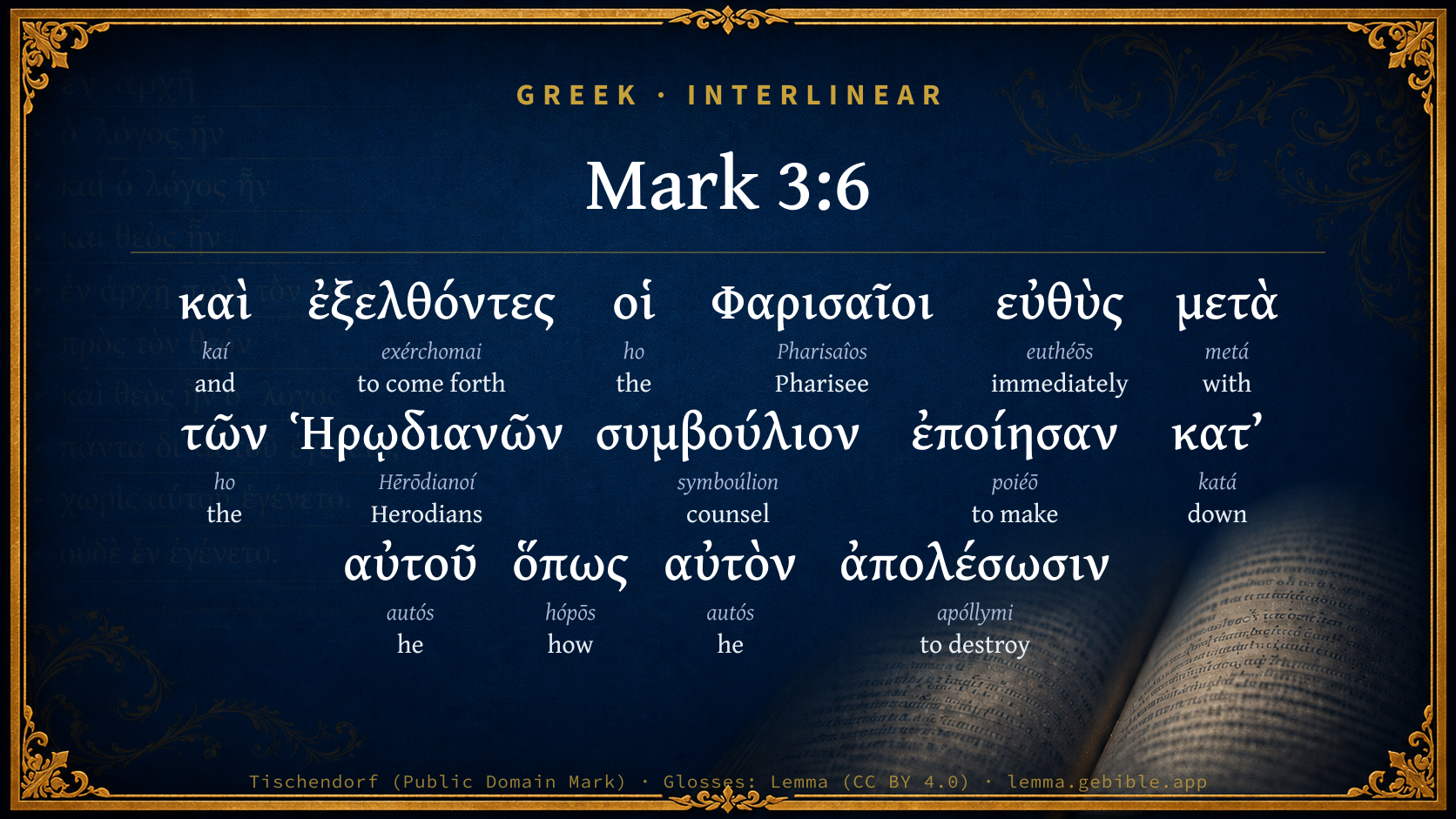
  1. καὶ kaí G2532 “and” Conjunction
  2. ἐξελθόντες exérchomai G1831 “to come forth” Verb, Aorist, Active, Participle, Nominative, Plural, Masculine
  3. οἱ ho G3588 “the” Article, Nominative, Plural, Masculine
  4. Φαρισαῖοι Pharisaîos G5330 “Pharisee” Noun, Nominative, Plural, Masculine
  5. εὐθὺς euthéōs G2112 “immediately” Adverb
  6. μετὰ metá G3326 “with” Preposition
  7. τῶν ho G3588 “the” Article, Genitive, Plural, Masculine
  8. συμβούλιον symboúlion G4824 “counsel” Noun, Accusative, Singular, Neuter
  9. ἐποίησαν poiéō G4160 “to make” Verb, Aorist, Active, Indicative, 3rd person, Plural
  10. κατ’ katá G2596 “down” Preposition
  11. αὐτοῦ autós G846 “he” Personal pronoun, Genitive, Singular, Masculine
  12. ὅπως hópōs G3704 “how” Adverb
  13. αὐτὸν autós G846 “he” Personal pronoun, Accusative, Singular, Masculine
  14. ἀπολέσωσιν apóllymi G622 “to destroy” Verb, Aorist, Active, Subjunctive, 3rd person, Plural

About this verse

These counts appear in no published source. They are computed here, from the morphology-tagged text and Lemma’s own curated glosses. What Lemma adds →

15
words
13
distinct lemmas
Gospels
section

Notable vocabulary

The rarest word here is Ἡρῳδιανῶν Herodians G2265 — appearing just 3 times in the whole Greek New Testament.

Shared distinctive vocabulary

Ἡρῳδιανῶν Herodians G2265 occurs in 3 verses of the Greek New Testament. Also found in:

Repetition

Words recur within this verse:

  • οἱ the G3588 ×2
  • αὐτοῦ he G846 ×2

Cross-references

9

Topical passages linked to Mark 3:6 in the Treasury of Scripture Knowledge — connected by theme and wording, ordered by reader-vote popularity; previews shown in the World English Bible.

  • Matthew 22:16 They sent their disciples to him, along with the Herodians, saying, "Teacher, we know that you are honest, and teach the way of God in truth, no matter who you teach, for you aren't partial to anyone.
  • Mark 12:13 They sent some of the Pharisees and of the Herodians to him, that they might trap him with words.
  • Matthew 12:14 But the Pharisees went out, and conspired against him, how they might destroy him.
  • Psalms 109:3–4 They have also surrounded me with words of hatred, And fought against me without a cause.
  • Mark 8:15 He charged them, saying, "Take heed: beware of the yeast of the Pharisees and the yeast of Herod."
  • Luke 6:11 But they were filled with rage, and talked with one another about what they might do to Jesus.
  • Luke 20:19–20 The chief priests and the scribes sought to lay hands on Him that very hour, but they feared the people--for they knew He had spoken this parable against them.
  • John 11:53 So from that day forward they took counsel that they might put him to death.
  • Luke 22:2 The chief priests and the scribes sought how they might put him to death, for they feared the people.

Cross-references courtesy of OpenBible.info (CC BY 4.0).

Commentary

Notes on Mark 3:6 from classic Christian and Jewish commentators (each source and its license shown beneath its notes). The classic Christian expositions comment on the surrounding passage and are grouped to its opening verse, so a note may address several verses; the Jewish commentaries on the Tanakh (Rashi and others) are per-verse, so they appear only where the commentator wrote on this verse.

Lemma curates 59 commentaries, every one of them public domain or Creative Commons licensed, each selected and text-cleaned for this edition rather than reprinted as found. About our sources →

The Biblical Illustrator

Joseph S. Exell

Mar_3:6

How they might destroy Him.

The meanness, evil, and sinfulness of hatred

I. The meanness of hatred is exhibited in the conduct of the Pharisees.

1. They professed to be peculiarly holy and righteous men. But here, on the Sabbath, in the synagogue, they watched Jesus, only that they might bring an accusation against Him.

2. They charged the Herodians with being traitors to their country. Yet now, in order to accomplish their murderous purpose on Jesus, they are willing to join hands with them.

II. The evil of hatred is here seen.

1. Its evil effects upon themselves. They grew more and more bitter towards Jesus, and their hearts and consciences more and more seared.

2. Its evil effects upon society. They ultimately induced the people in a fit of madness to demand the murder of Jesus.

III. The sinfulness of hatred.

1. The Bible denounces it as murder (1Jn_3:15).

2. It is inconsistent with a state of grace (1Jn_3:14; 1Jn_4:8). (D. C. Hughes, M. A.)

Sin breeds sin

The Pharisees having before harboured malice and hatred in their hearts, now show it by seeking Christs death. From this we may observe the policy of Satan, tempting and drawing men to the practice of sin by certain steps and degrees-first to lesser sins, and then to greater and more heinous ones. First the heart is drawn away and enticed by some sinful object: then lust conceives, i.e., consent is given to the sin in heart: then this inward consent brings forth actual sin: nor does the sinner stay here, but proceeds to the finishing or perfecting of sin, which is done by custom and continuance in it. This should teach us a point of spiritual wisdom, viz., to resist sin in the first beginnings of it, before we proceed far in it. Withstand the first motions of sin arising in the heart, or suggested by Satan; strive and pray against them at first; and labour at the very first to cast them out of the heart and mind, and not to suffer them to lodge or take possession there. Satan and sin are most easily resisted at first; but if either of them get hold in us, it will be very hard afterwards to dispossess them. Be wise, therefore, to resist and keep them out betimes. The only way to be kept from actual committing of gross sins is to withstand the first motions of those sins. The only way to be kept from the fearful sin of actual murder is, to guard against yielding to unadvised anger, and especially to take care not to harbour malice and rancour in our hearts against such as wrong us. These lower degrees of murder do often make way to the highest degree of that bloody sin; therefore, as thou wouldst be prevented from falling into the latter, beware of giving way to the former. Once give way to the first occasions and beginnings of any sin, and it is a thousand to one but thou wilt proceed further in it; and the further thou goest on in it, the worse and the harder thou wilt find the return by repentance; therefore resist it betimes. We must deal with sin, if we would mortify it in ourselves, as we do with venomous creatures such as adders or snakes; we must kill the young brood. If we could practise but this one point of resisting the first beginnings of sin in ourselves, how profitable would it be. How many dangerous sins might we be kept from by this means. And the not practising of this has been the cause of the fearful falls of many into most grievous sins. If our first parents, and David, Peter, Judas, had resisted the beginnings of those sins into which they fell, they had not fallen into them so dangerously as they did. Let us therefore be warned by their harms, and beware of giving way to the first occasions and beginnings of any sin, lest if we yield to them, the devil bring us by degrees to the highest pitch of that sin. (G. Petter.)

Hatred of Christ

A generous nature would have hoped for some other result than is here described; that on reflection they would mark the love, the omnipotence, the courage and the tenderness of Christ. Marking these things they might have learned some more excellent way than that bondage of scrupulous forms under which they groaned. But, alas! they only feel their discomfiture-not the Saviours greatness; the wound given to their pride-not the lesson given to their conscience. All His greatness seems to them a reason only for making their efforts to suppress Him more rigorous. And from the gracious teaching and the wondrous works of the Saviour they gather only harm and hatred. How true it is that the carnal mind is enmity against God. There is in all of us something which, if not checked, will grow into hatred of our Saviour. Our envy will make us dislike His goodness; our pride, His authority; our evil, the purity of His precepts; while our indolence will make us dislike His very love, because of the obligations under which it lays us. (R. Glover.)

The Biblical Illustrator, edited by Joseph S. Exell (c. 1880s–1900s) — public domain. Text from a community e-Sword module.

Joseph Benson's Commentary

Mar 3:6-12. And the Pharisees went forth, &c. — From Matthew’s observing that they held a council against him, it seems probable that those of them, with the scribes, who were present at this miracle, were members of the sanhedrim, or great council; with the Herodians — As bitter as they and the Pharisees usually were against each other. How they might destroy him — For to such a pitch was their anger raised, that nothing but his life would satisfy them. But Jesus withdrew himself — Knowing their designs, he retired into Galilee, where he preached the word, and wrought so many miracles, that his fame was spread abroad more than ever, and great multitudes were gathered round him from all parts; not only from Judea, but from Idumea, the natives of which had now professed the Jewish religion above one hundred and fifty years; and from beyond Jordan — The regions that lay east of that river; and they about Tyre and Sidon — The Israelites who lived in those coasts. And he spake, that a small ship should wait on him — Should be in readiness near him; because of the multitude which was now flocking around him; lest they should throng him — Namely, in a manner that would be very inconvenient to him, and would prevent great numbers from either seeing his miracles or hearing his discourses. For he had healed many — Matthew, he healed them all, namely, that applied to him. Insomuch that they pressed upon him — Gr. ωστε επιπιπτειν αυτω, so that they rushed, or fell upon him. The expression signifies, that they were ready to drive each other upon him, so that those nearer him could hardly stand, being pressed forward by those behind. For to touch him, as many as had plagues — Gr. μαστιγας, scourges, as the word properly signifies. Those very painful and afflictive disorders seem to be intended, which were frequently sent, or at least permitted of God, as a scourge or punishment of sin. And unclean spirits — That is, those who were possessed by them — when they saw him — Even though they had been entire strangers to him; fell down before him — In a posture of submission and homage; and cried, saying, Thou art the Son of God — That is, the true Messiah that was to come into the world. And he charged them that they should not make him known — It was not the time yet; nor were they fit preachers. For a further explanation of this passage, see notes on Mat 12:14-21.

Joseph Benson's Commentary on the Old and New Testaments (1811–1818) — public domain. Text from a community e-Sword module.

MacLaren's Expositions of Holy Scripture

Alexander MacLaren

Mark

AMBASSADORS FOR CHRIST

Mar 3:6 - Mar 3:19.

A common object of hatred cements antagonists into strange alliance. Hawks and kites join in assailing a dove. Pharisees and Herod’s partisans were antipodes; the latter must have parted with all their patriotism and much of their religion, but both parties were ready to sink their differences in order to get rid of Jesus, whom they instinctively felt to threaten destruction to them both. Such alliances of mutually repellent partisans against Christ’s cause are not out of date yet. Extremes join forces against what stands in the middle between them.

Jesus withdrew from the danger which was preparing, not from selfish desire to preserve life, but because His ‘hour’ was not yet come. Discretion is sometimes the better part of valour. To avoid peril is right, to fly from duty is not. There are times when Luther’s ‘Here I stand; I can do nothing else; God help me! Amen,’ must be our motto; and there are times when the persecuted in one city are bound to flee to another. We shall best learn to distinguish between these times by keeping close to Jesus.

But side by side with official hatred, and in some measure the cause of it, was a surging rush of popular enthusiasm. Pharisees took offence at Christ’s breaches of law in his Sabbath miracles. The crowd gaped at the wonders, and grasped at the possibility of cures for their afflicted. Neither party in the least saw below the surface. Mark describes two ‘multitudes’-one made up of Galileans who, he accurately says, ‘followed Him’; while the other ‘came to Him’ from further afield. Note the geographical order in the list: the southern country of Judea, and the capital; then the trans-Jordanic territories beginning with Idumea in the south, and coming northward to Perea; and then the north-west bordering lands of Tyre and Sidon. Thus three parts of a circle round Galilee as centre are described. Observe, also, how turbid and impure the full stream of popular enthusiasm was.

Christ’s gracious, searching, illuminating words had no attraction for the multitude. ‘The great things He did’ drew them with idle curiosity or desire for bodily healing. Still more impure was the motive which impelled the ‘evil spirits’ to approach Him, drawn by a strange fascination to gaze on Him whom they knew to be their conqueror, and hated as the Son of God. Terror and malice drove them to His presence, and wrung from them acknowledgment of His supremacy. What intenser pain can any hell have than the clear recognition of Christ’s character and power, coupled with fiercely obstinate and utterly vain rebellion against Him? Note, further, our Lord’s recoil from the tumult. He had retired before cunning plotters; He withdrew from gaping admirers, who did not know what they were crowding to, nor cared for His best gifts. It was no fastidious shrinking from low natures, nor any selfish wish for repose, that made Him take refuge in the fisherman’s little boat. But His action teaches us a lesson that the best Christian work is hindered rather than helped by the ‘popularity’ which dazzles many, and is often mistaken for success. Christ’s motive for seeking to check rather than to stimulate such impure admiration, was that it would certainly increase the rulers’ antagonism, and might even excite the attention of the Roman authorities, who had to keep a very sharp outlook for agitations among their turbulent subjects. Therefore Christ first took to the boat, and then withdrew into the hills above the lake.

In that seclusion He summoned to Him a small nucleus, as it would appear, by individual selection. These would be such of the ‘multitude’ as He had discerned to be humble souls who yearned for deliverance from worse than outward diseases or bondage, and who therefore waited for a Messiah who was more than a physician or a patriot warrior. A personal call and a personal yielding make true disciples. Happy we if our history can be summed up in ‘He called them unto Him, and they came.’ But there was an election within the chosen circle.

The choice of the Twelve marks an epoch in the development of Christ’s work, and was occasioned, at this point of time, by both the currents which we find running so strong at this point in it. Precisely because Pharisaic hatred was becoming so threatening, and popular enthusiasm was opening opportunities which He singly could not utilise, He felt His need both for companions and for messengers. Therefore He surrounded Himself with that inner circle, and did it then, The appointment of the Apostles has been treated by some as a masterpiece of organisation, which largely contributed to the progress of Christianity, and by others as an endowment of the Twelve with supernatural powers which are transmitted on certain outward conditions to their successors, and thereby give effect to sacraments, and are the legitimate channels for grace. But if we take Mark’s statement of their function, our view will be much simpler. The number of twelve distinctly alludes to the tribes of Israel, and implies that the new community is to be the true people of God.

The Apostles were chosen for two ends, of which the former was preparatory to the latter. The latter was the more important and permanent, and hence gave the office its name. They were to be ‘with Christ,’ and we may fairly suppose that He wished that companionship for His own sake as well as for theirs. No doubt, the primary purpose was their training for their being sent forth to preach. But no doubt, also, the lonely Christ craved for companions, and was strengthened and soothed by even the imperfect sympathy and unintelligent love of these humble adherents. Who can fail to hear tones which reveal how much He hungered for companions in His grateful acknowledgment, ‘Ye are they which have continued with Me in My temptations’? It still remains true that we must be ‘with Christ’ much and long before we can go forth as His messengers.

Note, too, that the miracle-working power comes last as least important. Peter had understood his office better than some of his alleged successors, when he made its qualification to be having been with Jesus during His life, and its office to be that of being witnesses of His resurrection {Act 1:1 - Act 1:26}.

The list of the Apostles presents many interesting points, at which we can only glance. If compared with the lists in the other Gospels and in Acts, it brings out clearly the division into three groups of four persons each. The order in which the four are named varies within the limits of each group; but none of the first four are ever in the lists degraded to the second or third group, and none of these are ever promoted beyond their own class. So there were apparently degrees among the Twelve, depending, no doubt, on spiritual receptivity, each man being as close to the Lord, and gifted with as much of the sunshine of His love, as he was fit for.

Further, their places in relation to each other vary. The first four are always first, and Peter is always at their head; but in Matthew and Luke, the pairs of brothers are kept together, while, in Mark, Andrew is parted from his brother Simon, and put last of the first four. That place indicates the closer relation of the other three to Jesus, of which several instances will occur to every one. But Mark puts James before John, and his list evidently reflects the memory of the original superiority of James as probably the elder. There was a time when John was known as ‘James’s brother.’ But the time came, as Acts shows, when John took precedence, and was closely linked with Peter as the two leaders. So the ties of kindred may be loosened, and new bonds of fellowship created by similarity of relation to Jesus. In His kingdom, the elder may fall behind the younger. Rank in it depends on likeness to the king.

The surname of Boanerges, ‘Sons of Thunder,’ given to the brothers, can scarcely be supposed to commemorate a characteristic prior to discipleship. Christ does not perpetuate old faults in his servants’ new names. It must rather refer to excellences which were heightened and hallowed in them by following Jesus. Probably, therefore, it points to a certain majesty of utterance. Do we not hear the boom of thunder-peals in the prologue to John’s Gospel, perhaps the grandest words ever written?

In the second quartet, Bartholomew is probably Nathanael; and, if so, his conjunction with Philip is an interesting coincidence with Joh 1:45, which tells that Philip brought him to Jesus. All three Gospels put the two names together, as if the two men had kept up their association; but, in Acts, Thomas takes precedence of Bartholomew, as if a closer spiritual relationship had by degrees sprung up between Philip, the leader of the second group, and Thomas, which slackened the old bond. Note that these two, who are coupled in Acts, are two of the interlocutors in the final discourses in the upper room {Joh 14:1 - Joh 14:31}. Mark, like Luke, puts Matthew before Thomas; but Matthew puts himself last, and adds his designation of ‘publican,’-a beautiful example of humility.

The last group contains names which have given commentators trouble. I am not called on to discuss the question of the identity of the James who is one of its members. Thaddeus is by Luke called Judas, both in his Gospel and in the Acts; and by Matthew, according to one reading, Lebbaeus. Both names are probably surnames, the former being probably derived from a word meaning breast, and the latter from one signifying heart. They seem, therefore, to be nearly equivalent, and may express large-heartedness.

Simon ‘the Canaanite’ {Auth. Ver.} is properly ‘the Cananæan’ {Rev. Ver.}. There was no alien in blood among the Twelve. The name is a late Aramaic word meaning zealot. Hence Luke translates it for Gentile readers. He was one of the fanatical sect who would not have anything to do with Rome, and who played such a terrible part in the final catastrophe of Israel. The baser elements were purged out of his fiery enthusiasm when he became Christ’s man. The hallowing and curbing of earthly passion, the ennobling of enthusiasm, are achieved when the pure flame of love to Christ burns up their dross.

Judas Iscariot closes the list, cold and venomous as a snake. Enthusiasm in him there was none. The problem of his character is too complex to be entered on here. But we may lay to heart the warning that, if a man is not knit to Christ by heart’s love and obedience, the more he comes into contact with Jesus the more will he recoil from Him, till at last he is borne away by a passion of detestation. Christ is either a sure foundation or a stone of stumbling.

Alexander MacLaren, Expositions of Holy Scripture (1904–1910) — public domain. Text from a community e-Sword module.

Bengel's Gnomon

Johann Albrecht Bengel

Mar 3:6. Εὐθέως, straightway) Their hatred increased; comp Mar 3:2 at the end of the v.—Ἡρωδιανῶν, the Herodians) although they perhaps had no great care for the Sabbath. Either by the order or permission of Herod, they were wishing to kill Jesus.

Bengel's Gnomon of the New Testament — English translation (T&T Clark, Edinburgh, 1860) — public domain. Text from a community e-Sword module.

Expositor's Greek Testament

ed. W. Robertson Nicoll

Mar 3:6 . ἐξελθόντες : the stretching forth of the withered hand in obedience to Christ’s command, conclusive evidence of cure, was the signal for an immediate exodus of the champions of orthodox Sabbath-keeping; full of wrath because the Sabbath was broken, and especially because it was broken by a miracle bringing fame to the transgressor the result plots ( συμβούλιον ἐδίδουν , here only) without delay ( εὐθὺς ) against His life. μετὰ τῶν Ἡρῳδιανῶν , with the Herodians, peculiar to Mk.; first mention of this party. A perfectly credible circumstance. The Pharisaic party really aimed at the life of Jesus, and they would naturally regard the assistance of people having influence at court as valuable.

The Expositor's Greek Testament, edited by W. Robertson Nicoll (1897–1910) — public domain. Text from a community e-Sword module.

Geneva Bible (1599)

Geneva Bible translators

See also Matt. 22:16.

The more the truth is kept under, the more it cometh out.

Geneva Bible (1599) marginal notes — public domain. Text via Bolls.life.

Adam Clarke's Commentary

Verse 6. Herodians] For an account of these, see the note on Mt 16:1; Mt 22:16.

Adam Clarke's Commentary on the Bible (1810–1826) — public domain. Text from a community e-Sword/MySword module.

The Cambridge Bible for Schools and Colleges

gen. ed. J. J. S. Perowne

6. And the Pharisees went forth] The effect of this miracle was very great. The Scribes and Pharisees were “filled with madness.” the Saviour had not merely broken their traditions, but He had put them to silence before all the people. In their blind hate they did not shrink even from joining the Herodians, the court party, and their political opponents, and taking counsel with them how they might put Him to death. As before at Jerusalem so now in Galilee this design is deliberately formed.

the Herodians] This is the first occasion on which the Herodians are mentioned. We shall meet with them again in Mar_12:13, on the “Day of Questions” in Holy Week. Just as the partisans of Marius were called “Mariani,” of Pompeius “Pompeiani,” of Otho “Othoniani,” so the partisans of Herod the Great and his successors were called “Herodiani.” The sect was rather a political than a religious body. Adopting Sadducean opinions, they held that the hopes of the Jewish nation rested on the Herods as a bulwark against Roman ambition, and almost looked to them for a fulfilment of the prophecies respecting the advent of the Messiah. They favoured the compromise between the ancient faith and later civilisation, which Herod inaugurated, and his successors endeavoured to realise. On one occasion our Lord warns his disciples against “the leaven of Herod” in close connection with “the leaven of the Pharisees” (Mar_8:15; Luk_12:1). Galilee being the chief centre of Christ’s activity, the Pharisees from Judæa were glad on the present occasion to avail themselves of any aid from the tetrarch of this part of Palestine and his followers.

The Cambridge Bible for Schools and Colleges (gen. ed. J. J. S. Perowne; Cambridge University Press, 1878–1918) — public domain. Text from a community e-Sword module.

John Gill's Exposition

And the Pharisees went forth,.... Out of the synagogue, being dreadfully galled with the reasonings of Christ, at the silence and confusion they were put to, and with the miracle he wrought, to the exposing of them, and establishing his own credit:

and straightway took counsel with the Herodians against him: See Gill on Mat 22:16.

How they might destroy him: persisting still in their evil intentions, though Christ had so fully and clearly exposed the wickedness of them: and it is to be observed, that those men who thought it was not lawful to heal a lame man on the sabbath day, yet make no scruple of meeting and consulting together on that day, and even with profane men, what measures and methods were best to take, to destroy the life of an innocent person.

John Gill's Exposition of the Whole Bible (1746–1763) — public domain (CC PDM 1.0). Text via the HelloAO Bible API.

Trapp's Complete Commentary

John Trapp

6 And the Pharisees went forth, and straightway took counsel with the Herodians against him, how they might destroy him.

Ver. 6. With the Herodians] Whom yet they hated in their hearts; but they can easily comport and comply to do Christ a mischief, as conceiving that Christ pertained to Herod’s jurisdiction.

John Trapp, A Commentary or Exposition upon All the Books of the Old and New Testament (1647–1656) — public domain. Text from a community e-Sword module.

Albert Barnes' Notes on the Bible

Straightway - Immediately, or as soon as possible.

Took counsel - Laid a plan. Consulted with them. Literally, “made a consultation.”

The Harridans - See the notes at Mat 22:16.

How they might destroy him - They hated him, he was so holy; because he reproved them; because he laid open their hypocrisy; and because he won the hearts of the people and lessened their influence. They therefore determined to remove him, if possible, and thus avoid his reproofs. Sinners would often rather put to death the man that reproves them than forsake their sins. The Pharisees had rather commit any crime, even to the murder of the Messiah, than forsake the sins for which he rebuked them.

Albert Barnes' Notes on the Bible (1834–1885) — public domain. Text from a community e-Sword/MySword module.

Matthew Poole's English Annotations

Who these Herodians were we cannot learn plainly from holy writ; it is most probable that they were a civil faction, who took Herod’s part, and were stiff for promoting his interest, and the interest of the Roman emperor, whose substitute Herod was. With these the Pharisees (in other cases their implacable enemies) mix counsels how they might destroy Christ. Christ gives place to their fury, his time being not yet come, and withdraweth himself from their sight, being followed by great multitudes, who in the fame of his miracles, or the hopes they had of receiving some good from him for themselves or for their friends, drew after him. Some of these are said to have come from Idumea, which was the country of Edom, and distinct from Judea anciently, as may be gathered from Jos 15:1, and Num 34:3, but whether it was at this time so or no, is doubted. Our Lord commandeth the devils not to make him known, not desiring any such preachers.

Matthew Poole's English Annotations on the Holy Bible (1683–1685) — public domain. Text from a community e-Sword/MySword module.

Whedon's Commentary on the Bible

Daniel D. Whedon

6. Straightway — The Greek word for straightway is a great favourite with Mark. It is used by him (translated variously) eight times in the first chapter, and thirty-nine times in the other fifteen chapters. Herodians — See notice on Mat_12:14.

Daniel D. Whedon (gen. ed.), Commentary on the Old and New Testaments (1874–1909) — public domain. Text from a community e-Sword module.

The Pulpit Commentary

The Pharisees and the Herodians combine together against the Lord. This was a terrible crisis in his history, or rather in the history of those unbelieving men. They are now in this dilemma: they must either accept his teaching, or they must take steps against him as a sabbath-breaker. But what had he done? The miracle had been wrought by a word only. It would have been difficult, therefore, to have obtained a judgment against him. Therefore they secured some fresh allies. They had already gained to their side some of the disciples of John the Baptist, (Mar_2:18) now they associate with themselves the Herodians. This is the first mention that we find made of the Herodians. They were the natural opponents of the Pharisees; but here they seem to have found some common ground of agreement, though it is not very easy to say what it was, in combining against our Lord. But it is no uncommon thing to find coalitions of men, strangely opposed to one another on most points, but united to effect some particular object; and it is easy to see how the purity and spirituality of our Lord and of his doctrine would be opposed, on the one hand, to the ceremonial formality of the Pharisee, and on the other to the worldly and secular spirit of the Herodian.

The Pulpit Commentary (1880–1919), ed. H.D.M. Spence-Jones & Joseph S. Exell — public domain. Text from a community e-Sword module.

John Wesley's Explanatory Notes

The Pharisees going out - Probably leaving the scribes to watch him still: took counsel with the Herodians - as bitter as they usually were against each other.

John Wesley, Explanatory Notes Upon the Whole Bible (1754–1765) — public domain. Text via the GEBible commentary corpus.

Burkitt's Expository Notes on the New Testament

William Burkitt

Observe here, 1. What dismal effects this famous miracle of Christ had upon the Pharisees and Herodians. Instead of being convinced by it, they conspire against him for it. These Herodians and Pharisees were of different opinions, enemies to one another, yet they join together in seeking the death of Christ.

The Pharisees were against paying tribute to Caesar, looking upon themselves as a free people, accounting the Roman emperor an usurper. The Herodians were for it. Herod being made by the Roman emperor king of the Jews, was zealous for having the Jews pay tribute to Caesar; and such of the Jews as sided with him, particularly his courtiers and favourites, were styled Herodians; but both Pharisees and Herodians take counsel against Christ.

Learn thence, That unity and consent is of itself alone far from being a mark and note of the true church. Unity in the faith and doctrine of Christ, and in the profession and practice of the true religion, is a note indeed of the true church: but unity in opposing Christ, his person, his doctrine, his people, is so far from being a mark of the true church, that it is the badge of the antichristian synagogue.

Observe, 2. The prudent means which our Saviour uses to preserve himself from the rage of the Pharisees, he withdrew himself from them. Christ’s example teaches his ministers their duty in a time of danger to fly from persecution, and to endeavour to preserve their lives, unless when their sufferings are like to do more good than their lives.

Observe, 3. The great zeal and forwardness of the people in flocking after our Saviour’s ministry; people come now at first from all places and countries, from Judea, from Idumea, from beyond Jordan, from Tyre and Sidon, to hear his doctrine, and see his miracles. The people came from all parts when our Saviour first began to preach. His ministers find it thus: at their first coming amongst a people their labours are most acceptable, and they do most good; our people’s affections are then warmest, and perhaps our own too.

Observe, 4. What sort of people they were which attended thus zealously upon our Saviour’s ministry, they were the common and ordinary people; the poor received the gospel, whilst the Pharisees, and other men of most account, the mighty, the noble, and the wise men after the flesh, despised our Saviour’s person, slighted his ministry, and sought his life. The ordinary and meanest sort of people ever have been more zealous and forward in embracing the gospel, than ever the great, and the rich, and the honourable part of the world have been.

It is a sad but certain truth, heaven is the place where few, comparatively, of the great men of the world, are like to come; their temptations are many, their lusts are strong, and their great estates, through their own abuse, become fuel to their lusts.

Observe, 5. The behaviour of these unclean spirits (the devils) towards our Saviour, and our Saviour’s carriage towards them; they fall down at the very sight of him, they cry out, and confess him to be the Son of God; but he sharply rebukes them, and charges them that they should not make him known. Not that our Saviour would have the knowledge of his person suppressed, but because the devils were not fit persons to preach Jesus Christ. A truth out of the mouth of the father of lies, is enough to render truth itself suspected. Besides, the time appointed for the full and clear manifestation of the Godhead of Christ was not yet come. This was not to be done till after his resurrection; the divine nature was to be hid under the veil of Christ’s flesh, during his state of humiliation and abasement.

William Burkitt's Expository Notes on the New Testament (1700–1703) — public domain. Text from a community e-Sword module.

The People's New Testament

B. W. Johnson

6. Pharisees. See note on Matt. 3:7. Herodians. See note on Matt. 22:16. Took counsel. Already these inveterate enemies were resolved to destroy Jesus. They took counsel how it might be done. As they went to the partisans of Herod, who ruled in Galilee, they probably sought to persuade them to have Herod put him to death.

B. W. Johnson's The People's New Testament with Notes (1889–1891) — public domain. Electronic text from the Christian Classics Ethereal Library (CCEL) ThML edition.

Cambridge Greek Testament for Schools and Colleges

6. ἐδίδουν ([419][420] rather than ἐποίησαν ([421][422][423]), or ἐποίουν ([424][425][426][427]), or ποιοῦντες ([428] The variants are substitutions of a more usual verb. Cf. Mar 15:1.

[419] Codex Vaticanus. 4th cent., but perhaps a little later than א. In the Vatican Library almost since its foundation by Pope Nicolas V., and one of its greatest treasures. The whole Gospel, ending at Mar 16:8. Photographic facsimile, 1889.

[420] Codex Regius. 8th cent. An important witness. At Paris. Contains Mar 1:1 to Mar 10:15; Mar 10:30 to Mar 15:1; Mar 15:20 to Mar 16:20, but the shorter ending is inserted between Mar 16:8 and Mar 16:9, showing that the scribe preferred it to the longer one.

[421] Codex Sinaiticus. 4th cent. Discovered by Tischendorf in 1859 at the Monastery of St Katharine on Mount Sinai. Now at St Petersburg. The whole Gospel, ending at Mar 16:8. Photographic facsimile, 1911.

[422] Codex Ephraemi. 5th cent. A palimpsest: the original writing has been partially rubbed out, and the works of Ephraem the Syrian have been written over it; but a great deal of the original writing has been recovered; of Mark we have Mar 1:17 to Mar 6:31, Mar 8:5 to Mar 12:29, Mar 13:19 to Mar 16:20. In the National Library at Paris.

[423] Codex Sangallensis. 9th or 10th cent. Contains the Gospels nearly complete, with an interlinear Latin translation. The text of Mark is specially good, agreeing often with CL. At St Gall.

[424] Codex Alexandrinus. 5th cent. Brought by Cyril Lucar, Patriarch of Constantinople, from Alexandria, and afterwards presented by him to King Charles I. in 1628. In the British Museum. The whole Gospel. Photographic facsimile, 1879.

[425] Codex Guelpherbytanus. 6th cent. Contains Mar 1:2-11; Mar 3:5-17; Mar 14:13-24; Mar 14:48-61; Mar 15:12-37.

[426] Codex Oxoniensis. 9th cent. Contains Mark, except Mar 3:35 to Mar 6:20.

[427] Codex Petropolitanus. 9th cent. Gospels almost complete. Mar 16:18-20 is in a later hand.

[428] odex Bezae. 6th cent. Has a Latin translation (d) side by side with the Greek text, and the two do not quite always agree. Presented by Beza to the University Library of Cambridge in 1581. Remarkable for its frequent divergences from other texts. Contains Mark, except Mar 16:15-20, which has been added by a later hand. Photographic facsimile, 1899.

6. ἐξελθόντες. The service would be over before the healing; Christ would not have interrupted it. They had expected that Christ would heal, and that in healing He would do something which they could denounce as a violation of the Sabbath; but He had not even touched the man.

εὐθὺς μετὰ τῶν Ἡρωδιανῶν. To be taken with what follows; “they at once took counsel with the Herodians.” The Herodians are mentioned only here and at the close of the Ministry (Mar 12:13 = Mat 22:16). They seem to have been a political rather than a religious party, and they would be opposed to one whose teaching was revolutionary. Perhaps we might call them the Royalist party or the Government party. That “in the country of the tetrarch Antipas there could not be a party called the Herodians” is both erroneous and irrelevant. In Galilee, as well as in Judaea, there might be those who wished Antipas to become what Herod the Great had been; and we are not told that this plot against Christ was laid in Galilee. With the termination comp. that of Χριστιανός.

συμβούλιον ἐδίδουν. See crit. note. Apparently, συμβούλιον is an official attempt to find an equivalent for consilium. Deissmann, Bib. St. p. 238. As with us, the usual phrase is “to take counsel,” λαμβάνειν συμβ. (So always in Mt.) Mk may mean that it was the Pharisees who originated and gave forth the idea, and that this was the beginning of a series of plots (imperf.). In fact, it was the beginning of the end. “The final rupture of Jesus with the religious authorities in Galilee arose out of the healing of the man with the withered hand in the Synagogue on the Sabbath” (Burkitt). We have reached “the parting of the ways.” Cf. Mar 15:1.

ὅπως. The only question was, How? Here only does Mk use ὅπως, which is freq. in Mt. and Lk. Only once in Jn (Joh 11:57).

Cambridge Greek Testament for Schools and Colleges (Cambridge University Press, 1896; 21 vols, various authors incl. Carr, Maclear, Plummer, Farrar, Lumby, Moule, M. R. James, Simcox) — public domain. Text from a community e-Sword module.

Alford’s Greek Testament

Henry Alford

6. Ἡρωδιανῶν] See notes on Mat 16:6, and 22:16. Why the Pharisees and Herodians should now combine, is not apparent. There must have been some reason of which we are not aware, which united these opposite sects in enmity against our Lord.

συμβ. ἐδίδουν, as also ἐποίουν, ch. 15:1, is an expression peculiar to Mark.

Henry Alford, The Greek Testament (1849–1861) — public domain. Text from a community e-Sword module.

International Critical Commentary

6. εὐθὺς—The immediateness of this act is noted by Mk. only, and is quite characteristic of his style, hitting off a situation with a word. The immediateness is here a sign of the violence of the feeling excited against Jesus. To estimate their fanatical zeal, we must remember that they valued the Sabbath far beyond any mere morality, and reacted with corresponding violence against any supposed violation of its sacredness. Fanaticism is always busy and eager over the mere outworks of religion.

τῶν Ἡρωδιανῶν—the Herodians. The adherents of Herod Antipas, tetrarch of Galilee. The Pharisees were zealous patriots, and as such were generally opposed to any foreign yoke. But here was an opportunity to use the foreign power against a common enemy. The common opinion ascribed Messianic pretensions to Jesus, and on more than one occasion attempted to force him to play the role according to the popular conception of the Messiah. This would be the argument by which the Pharisees excited the temporal power against him, as they did finally at Jerusalem. The preceding paragraphs have given us a view of Jesus in his work of undermining one after another of the Pharisaic positions, and this conspiracy is the natural result.

συμβούλιον ἐποίησαν (or ἐδίδουν)1—they took counsel.

ἐποίησαν, instead of ἐποίουν, Tisch. א C Δ 238 etc. ἐδίδουν, Treg. WH. BL 13, 28, 69, etc.

GROWTH OF POPULARITY

International Critical Commentary — older volumes (1896–1929), various authors — public domain. Text from a community e-Sword module.

Lesson kit

Teaching starters — assembled from the data on this page, not authored interpretation. Every prompt links to the verse data it draws on. Edit before teaching.

Mark, in the Gospels, opens this verse with 15 words (13 distinct Greek lemmas). Its most distinctive word is Hērōdianoí (“Herodians”). A historical commentator’s framing appears above. Read the whole chapter for the surrounding context.

Discussion questions

  1. The word Hērōdianoí carries the sense “Herodians.” How does it shape the verse?
  2. Matthew 22:16 shares the word «Herodians» with this verse. How do the two illuminate each other?
  3. “the” occurs 2× in this one verse. What is the effect of the repetition?
  4. The translations on this page render this verse differently — a whole-verse word diff, not a word-by-word alignment. What might account for the different wordings?
  5. Reading how The Biblical Illustrator and Joseph Benson's Commentary read this verse, where do the two commentators agree and where do they part?

Things to notice

Reading settings

Reading text

Shown beneath each verse's original-language words.

Old Testament
Old Testament edition

Read the OT as the Masoretic Hebrew (MT) or the Greek Septuagint (LXX).

English shown for the Greek Septuagint (in the Hebrew ↔ Greek comparison).

Comparing translations? Open the Compare panel on any verse page to stack up to four side by side.