
Matthew 13:23

Greek (Tischendorf 8th ed.) Matthew 13:23 appears in the Greek New Testament. The text above is from the Tischendorf 8th edition. Each word links to its Strong’s number and a concise gloss. Click any word for its full Thayer’s Greek Lexicon entry.
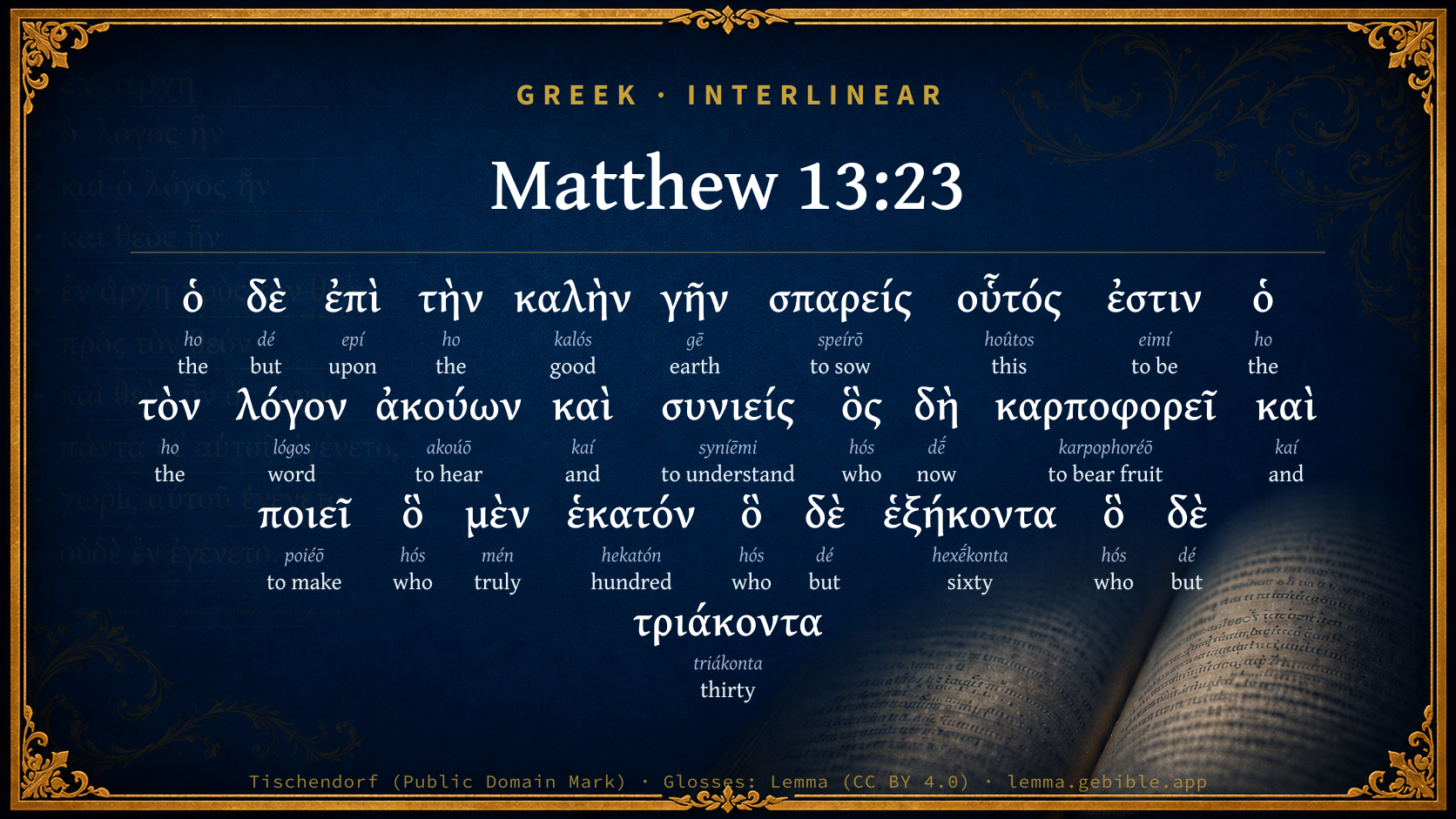
Download image
Cite this verse

Matthew 13:23 (World English Bible). Public Domain. Lemma interlinear Bible study tool, https://lemma.gebible.app/v/matthew/13/23.

Show BibTeX & RIS
BibTeX
RIS
English Translation
What was sown on the good ground, this is he who hears the word, and understands it, who most assuredly bears fruit, and brings forth, some one hundred times as much, some sixty, and some thirty."
World English Bible · Public Domain
Highlights
  • 2 first appearances in the Greek New Testament
Full analysis ↓
Download a study sheet

One document with this verse’s original text, its word-by-word gloss line, the meaning frame, cross-references with their text, attributed commentary, and full source and license credits — printable, and it pastes into notes with its structure intact.

This verse Autodidact and up

Study sheet (.html) Plain text (.txt)

A passage Seminary Student

Up to 50 verses in one chapter. A passage sheet keeps up to 6 commentary sources and 12 cross-references per verse, in the order this page ranks them, and says so on the sheet whenever that leaves anything out. Ask for a single verse and you get the Autodidact verse sheet above.

Everything on this page stays free to read, with no account — the sheet is a download of what is already on screen, not access to it.

Want to remove ads? Support Godless Engineer
Compare translations 3

The same verse in 3 English versions, stacked beneath the original-language interlinear above. Click any original word for its lexicon entry.

Each is an independent rendering of the whole verse — the interlinear is not word-aligned to these translations.

Highlighted words mark where these versions differ — a whole-verse word diff, not a word-by-word alignment.

  • World English Bible Public Domain
    What was sown on the good ground, this is he who hears the word, and understands it, who most assuredly bears fruit, and brings forth, some one hundred times as much, some sixty, and some thirty."
  • King James Version Public Domain
    But he that received seed into the good ground is he that heareth the word, and understandeth it; which also beareth fruit, and bringeth forth, some an hundredfold, some sixty, some thirty.
  • unfoldingWord Literal Text CC BY-SA 4.0
    Now the one having been sown on the good soil, this is the one hearing the word and understanding, who indeed bears fruit and yields, some 100, and some 60, and some 30.”

unfoldingWord Literal Text — © unfoldingWord, licensed CC BY-SA 4.0. Word-aligned USFM3 via Door43 (git.door43.org/unfoldingWord/en_ult).

Versions to compare (up to 4)

3 of 4 selected

Show all 19 translations

Every available English version of this verse, each an independent rendering of the whole verse.

  • World English Bible Public Domain
    What was sown on the good ground, this is he who hears the word, and understands it, who most assuredly bears fruit, and brings forth, some one hundred times as much, some sixty, and some thirty."
  • Berean Standard Bible Public Domain
    But the seed sown on good soil is the one who hears the word and understands it. He indeed bears fruit and produces a crop—a hundredfold, sixtyfold, or thirtyfold.”
  • Majority Standard Bible Public Domain
    But the seed sown on good soil is the one who hears the word and understands it. He indeed bears fruit and produces a crop—a hundredfold, sixtyfold, or thirtyfold.”
  • King James Version Public Domain
    But he that received seed into the good ground is he that heareth the word, and understandeth it; which also beareth fruit, and bringeth forth, some an hundredfold, some sixty, some thirty.
  • American Standard Version (1901) Public Domain
    And he that was sown upon the good ground, this is he that heareth the word, and understandeth it; who verily beareth fruit, and bringeth forth, some a hundredfold, some sixty, some thirty.
  • Revised Version (1885) Public Domain
    And he that was sown upon the good ground, this is he that heareth the word, and understandeth it; who verily beareth fruit, and bringeth forth, some a hundredfold, some sixty, some thirty.
  • Geneva Bible (1599) Public Domain
    But he that receiued the seede in the good ground, is he that heareth the worde, and vnderstandeth it, which also beareth fruite, and bringeth foorth, some an hundreth folde, some sixtie folde, and some thirtie folde.
  • Douay-Rheims (1899) Public Domain
    But he that received the seed upon good ground, is he that heareth the word, and understandeth, and beareth fruit, and yieldeth the one an hundredfold, and another sixty, and another thirty.
  • Young's Literal Translation Public Domain
    `And that sown on the good ground: this is he who is hearing the word, and is understanding, who indeed doth bear fruit, and doth make, some indeed a hundredfold, and some sixty, and some thirty.'
  • Literal Standard Version CC BY-SA 4.0
    And that sown on the good ground: this is he who is hearing the word, and is understanding, who indeed bears fruit, and makes, some indeed a hundredfold, and some sixty, and some thirty.”
  • Unlocked Literal Bible CC BY-SA 4.0
    What was sown on the good soil, this is the person who hears the word and understands it. He bears fruit and makes a crop, some yielding one hundred times as much as was planted, some sixty, and some thirty times as much.”
  • unfoldingWord Literal Text CC BY-SA 4.0
    Now the one having been sown on the good soil, this is the one hearing the word and understanding, who indeed bears fruit and yields, some 100, and some 60, and some 30.”
  • Darby Bible Public Domain
    But he that is sown upon the good ground -- this is he who hears and understands the word, who bears fruit also, and produces, one a hundred, one sixty, and one thirty.
  • World Messianic Bible Public Domain
    What was sown on the good ground, this is he who hears the word and understands it, who most certainly bears fruit and produces, some one hundred times as much, some sixty, and some thirty.”
  • Webster's Bible Public Domain
    But he that receiveth seed into the good ground is he that heareth the word, and understandeth it; who also beareth fruit, and bringeth forth, some a hundred fold, some sixty, some thirty.
  • Free Bible Version CC BY-SA 4.0
    The seeds sown on good soil are people who hear the message, and understand it, and who produce a good harvest—some one hundred, some sixty, and some thirty times what was sown.”
  • Bible in Basic English Public Domain
    And the seed which was put in good earth, this is he who gives ear to the word, and gets the sense of it; who gives fruit, some a hundred, some sixty, some thirty times as much.
  • Text-Critical English NT CC BY 4.0
    But the seed sown on the good soil is he who hears the word and understands it, who bears fruit and produces a hundred, sixty, or thirty times more than what was sown.”
  • Tyndale New Testament (1534) Public Domain
    He which is sowne in the good grounde is he that heareth the worde and vnderstodeth it which also bereth frute and bringeth forth some an hundred folde some sixtie folde and some thirty folde.

Literal Standard Version (2020), Covenant Press — licensed CC BY-SA 4.0. Text via the HelloAO Bible API (eBible.org). Unlocked Literal Bible (unfoldingWord) — licensed CC BY-SA 4.0. Text via the HelloAO Bible API (eBible.org). unfoldingWord Literal Text — © unfoldingWord, licensed CC BY-SA 4.0. Word-aligned USFM3 via Door43 (git.door43.org/unfoldingWord/en_ult). Free Bible Version, Dr. Jonathan Gallagher — licensed CC BY-SA 4.0. Text via the HelloAO Bible API (eBible.org).

Word by word

More ways to search: Search by grammar → Find every occurrence → Compare this word →

Practice this passage: Drill this verse → Learn its vocabulary →

δὴ
dḗ
G1211
“now”
Particle
Part of Speech
Particle
Full Thayer's Definition

Origin: probably akin to G1161

TDNT: None

1. now, then, verily, in truth, really, surely, certainly 2. forthwith, at once
  1. ὁ ho G3588 “the” Article, Nominative, Singular, Masculine
  2. δὲ dé G1161 “but” Conjunction
  3. ἐπὶ epí G1909 “upon” Preposition
  4. τὴν ho G3588 “the” Article, Accusative, Singular, Feminine
  5. καλὴν kalós G2570 “good” Adjective, Accusative, Singular, Feminine
  6. γῆν gē G1093 “earth” Noun, Accusative, Singular, Feminine
  7. σπαρείς speírō G4687 “to sow” Verb, Aorist, Passive, Participle, Nominative, Singular, Masculine
  8. οὗτός hoûtos G3778 “this” Demonstrative pronoun, Nominative, Singular, Masculine
  9. ἐστιν eimí G1510 “to be” Verb, Present, Active, Indicative, 3rd person, Singular
  10. ὁ ho G3588 “the” Article, Nominative, Singular, Masculine
  11. τὸν ho G3588 “the” Article, Accusative, Singular, Masculine
  12. λόγον lógos G3056 “word” Noun, Accusative, Singular, Masculine
  13. ἀκούων akoúō G191 “to hear” Verb, Present, Active, Participle, Nominative, Singular, Masculine
  14. καὶ kaí G2532 “and” Conjunction
  15. συνιείς syníēmi G4920 “to understand” Verb, Present, Active, Participle, Nominative, Singular, Masculine
  16. ὃς hós G3739 “who” Relative pronoun, Nominative, Singular, Masculine
  17. καρποφορεῖ karpophoréō G2592 “to bear fruit” Verb, Present, Active, Indicative, 3rd person, Singular
  18. καὶ kaí G2532 “and” Conjunction
  19. ποιεῖ poiéō G4160 “to make” Verb, Present, Active, Indicative, 3rd person, Singular
  20. ὃ hós G3739 “who” Relative pronoun, Accusative, Singular, Neuter
  21. μὲν mén G3303 “truly” Particle
  22. ἑκατόν hekatón G1540 “hundred” Adjective, Numeral (indeclinable)
  23. ὃ hós G3739 “who” Relative pronoun, Accusative, Singular, Neuter
  24. δὲ dé G1161 “but” Conjunction
  25. ἑξήκοντα hexḗkonta G1835 “sixty” Adjective, Numeral (indeclinable)
  26. ὃ hós G3739 “who” Relative pronoun, Accusative, Singular, Neuter
  27. δὲ dé G1161 “but” Conjunction
  28. τριάκοντα triákonta G5144 “thirty” Adjective, Numeral (indeclinable)

About this verse

These counts appear in no published source. They are computed here, from the morphology-tagged text and Lemma’s own curated glosses. What Lemma adds →

29
words
20
distinct lemmas
Gospels
section

Notable vocabulary

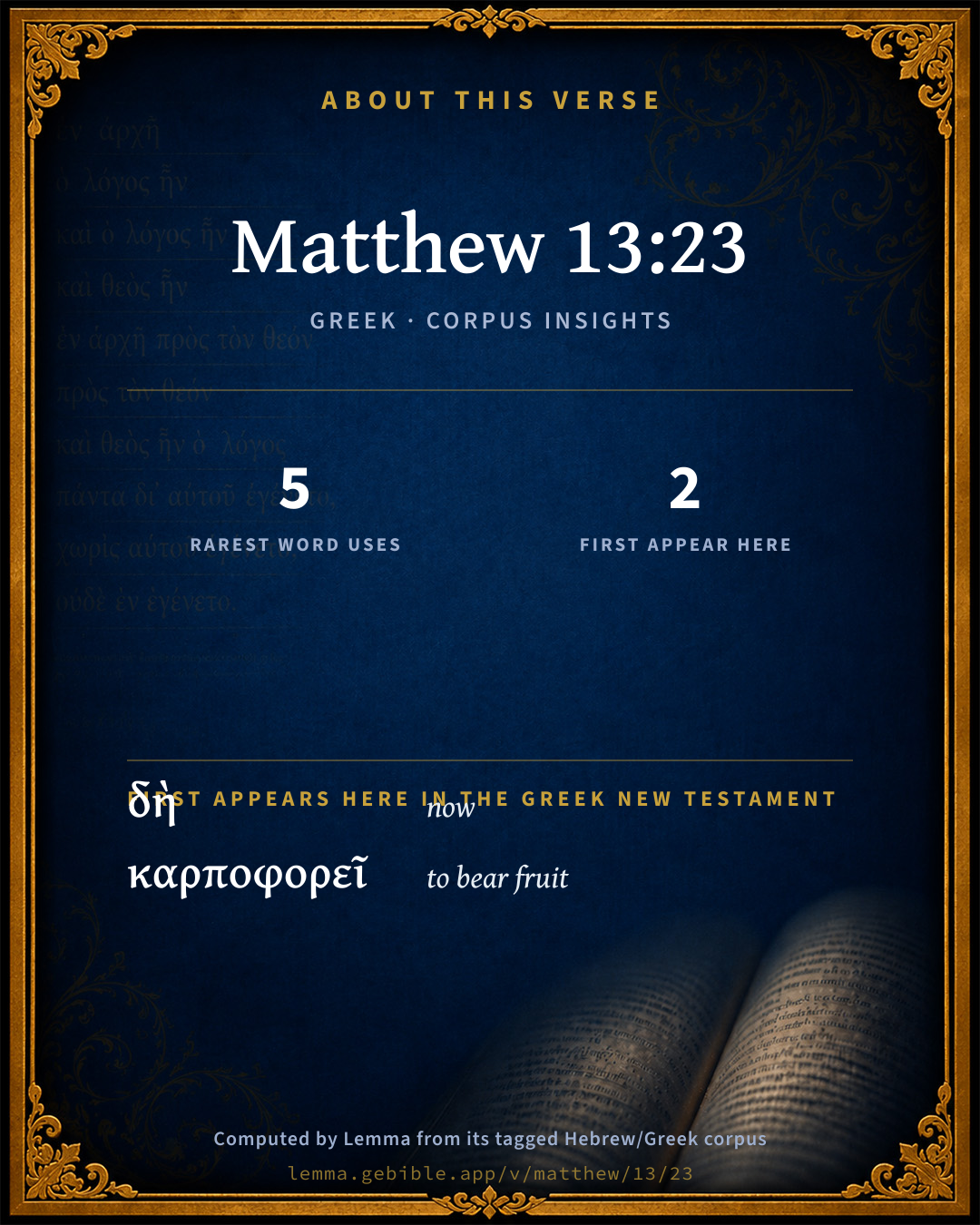
The rarest word here is δὴ now G1211 — appearing just 5 times in the whole Greek New Testament.

First appearance in Scripture

These words make their first canonical appearance in the Greek New Testament here:

  • δὴ now G1211
  • καρποφορεῖ to bear fruit G2592

Shared distinctive vocabulary

δὴ now G1211 occurs in 5 verses of the Greek New Testament. Also found in:
Repetition

Words recur within this verse:

Cross-references

42

Topical passages linked to Matthew 13:23 in the Treasury of Scripture Knowledge — connected by theme and wording, ordered by reader-vote popularity; previews shown in the World English Bible.

  • Philippians 1:11 being filled with the fruits of righteousness, which are through Jesus Christ, to the glory and praise of God.
  • Matthew 12:33 "Either make the tree good, and its fruit good, or make the tree corrupt, and its fruit corrupt; for the tree is known by its fruit.
  • John 15:16 You didn't choose me, but I chose you, and appointed you, that you should go and bear fruit, and that your fruit should remain; that whatever you will ask of the Father in my name, he may give it to you.
  • Galatians 5:22–23 But the fruit of the Spirit is love, joy, peace, patience, kindness, goodness, faithfulness,
  • Psalms 92:13–15 They are planted in Yahweh's house. They will flourish in our God's courts.
  • Matthew 13:8 and others fell on good soil, and yielded fruit: some one hundred times as much, some sixty, and some thirty.
  • John 15:1–8 "I am the true vine, and my Father is the farmer.
  • Colossians 1:6 which has come to you; even as it is in all the world and is bearing fruit and growing, as it does in you also, since the day you heard and knew the grace of God in truth;
  • Matthew 3:8 Therefore bring forth fruit worthy of repentance!
  • Luke 13:9 If it bears fruit, fine; but if not, after that, you can cut it down.'"
  • Colossians 1:10 that you may walk worthily of the Lord, to please him in all respects, bearing fruit in every good work, and increasing in the knowledge of God;
  • 2 Corinthians 8:1–2 Moreover, brothers, we make known to you the grace of God which has been given in the assemblies of Macedonia;
  • Philippians 4:17 Not that I seek for the gift, but I seek for the fruit that increases to your account.
  • 2 Peter 1:5–8 Yes, and for this very cause adding on your part all diligence, in your faith supply moral excellence; and in moral excellence, knowledge;
  • 2 Peter 3:18 But grow in the grace and knowledge of our Lord and Savior Jesus Christ. To him be the glory both now and forever. Amen.
  • 1 John 5:20 We know that the Son of God has come, and has given us an understanding, that we know him who is true, and we are in him who is true, in his Son Jesus Christ. This is the true God, and eternal life.
  • Mark 4:20 These are those which were sown on the good ground: such as hear the word, and accept it, and bear fruit, some thirty times, some sixty times, and some one hundred times."
  • 1 Thessalonians 4:1 Finally then, brothers, we beg and exhort you in the Lord Jesus, that as you received from us how you ought to walk and to please God, that you abound more and more.
  • 2 Thessalonians 2:10 and with all deception of wickedness for those who are being lost, because they didn't receive the love of the truth, that they might be saved.
  • 2 Thessalonians 2:13–14 But we are bound to always give thanks to God for you, brothers loved by the Lord, because God chose you from the beginning for salvation through sanctification of the Spirit and belief in the truth;
  • Hebrews 4:2 For indeed we have had good news preached to us, even as they also did, but the word they heard didn't profit them, because it wasn't mixed with faith by those who heard.
  • Hebrews 8:10 "For this is the covenant that I will make with the house of Israel. After those days," says the Lord; "I will put my laws into their mind, I will also write them on their heart. I will be to them a God, And they will be to me a people.
  • Psalms 1:1–3 Blessed is the man who doesn't walk in the counsel of the wicked, Nor stand in the way of sinners, Nor sit in the seat of scoffers;
  • Proverbs 1:5–6 That the wise man may hear, and increase in learning; That the man of understanding may attain to sound counsel:
  • Proverbs 2:2–6 So as to turn your ear to wisdom, And apply your heart to understanding;
  • Ezekiel 18:31 Cast away from you all your transgressions, in which you have transgressed; and make you a new heart and a new spirit: for why will you die, house of Israel?
  • Ezekiel 36:26 A new heart also will I give you, and a new spirit will I put within you; and I will take away the stony heart out of your flesh, and I will give you a heart of flesh.
  • Matthew 3:10 "Even now the axe lies at the root of the trees. Therefore, every tree that doesn't bring forth good fruit is cut down, and cast into the fire.
  • Mark 10:15 Most assuredly I tell you, whoever will not receive the Kingdom of God like a little child, he will in no way enter into it."
  • Luke 6:43–44 For there is no good tree that brings forth rotten fruit; nor again a rotten tree that brings forth good fruit.
  • Luke 8:15 That in the good ground, these are such as in an honest and good heart, having heard the word, hold it tightly, and bring forth fruit with patience.
  • John 1:11–13 He came to his own, and those who were his own didn't receive him.
  • John 8:47 He who is of God hears the words of God. For this cause you don't hear, because you are not of God."
  • John 10:26–27 But you don't believe, because you are not of my sheep, as I told you.
  • John 17:7–8 Now they have known that all things whatever you have given me are from you,
  • Acts 16:14 A certain woman named Lydia, a seller of purple, of the city of Thyatira, one who worshiped God, heard us; whose heart the Lord opened to listen to the things which were spoken by Paul.
  • Acts 17:11 Now these were more noble than those in Thessalonica, in that they received the word with all readiness of the mind, examining the Scriptures daily to see whether these things were so.
  • 2 Corinthians 9:10 Now may he who supplies seed to the sower and bread for food, supply and multiply your seed for sowing, and increase the fruits of your righteousness;
  • James 1:21–22 Therefore, putting away all filthiness and overflowing of wickedness, receive with humility the implanted word, which is able to save your souls.
  • 1 Peter 2:1–2 Putting away therefore all wickedness, all deceit, hypocrisies, envies, and all evil speaking,
  • Hebrews 6:7 For the land which has drunk the rain that comes often on it, and brings forth a crop suitable for them for whose sake it is also tilled, receives blessing from God;
  • Hebrews 13:15–16 Through him, then, let us offer up a sacrifice of praise to God continually, that is, the fruit of lips which make confession to his name.

Cross-references courtesy of OpenBible.info (CC BY 4.0).

Commentary

Notes on Matthew 13:23 from classic Christian and Jewish commentators (each source and its license shown beneath its notes). The classic Christian expositions comment on the surrounding passage and are grouped to its opening verse, so a note may address several verses; the Jewish commentaries on the Tanakh (Rashi and others) are per-verse, so they appear only where the commentator wrote on this verse.

Lemma curates 59 commentaries, every one of them public domain or Creative Commons licensed, each selected and text-cleaned for this edition rather than reprinted as found. About our sources →

The Biblical Illustrator

Joseph S. Exell

Mat_13:8; Mat_13:23

But other fell on good ground and brought forth fruit.

The fruit thirty-fold seems to represent the case of those who fear; sixty-fold the ease of those who hope; the hundredfold those who love. (Hermann.)

As in the bad ground, the diversity was threefold-the wayside, the stony, and the thorny:-so in the good ground there is a like diversity-the fruit yielding some a hundredfold, some sixty, some thirty. (Zeroing.)

Qualifications for the reception of Gods truth

1. Sensibility to religious impressions.

2. Thoughtfulness.

3. Unworldliness.

4. An honest and good heart.

Growth precious because perilous

In the soil of the heart is found all the nutriment of spiritual life, and all the nutriment of the weeds and poisons which destroy spiritual life. And it is this which makes Christian character, when complete, a thing so inestimably precious. There are things precious, not from the materials of which they are made, but from the risk and difficulty of bringing them to perfection. The speculum of the largest telescope foils the opticians skill in casting. Too much or too little heat-the interposition of a grain of sand, a slight alteration in the temperature of the weather, and all goes to pieces-it must be recast. Therefore, when successfully finished, it is a matter for almost the congratulation of a country. Rarer, and more difficult still than the costliest part of the most delicate of instruments, is the completion of Christian character. Only let there come the heat of persecution-or the cold of human desertion-a little of the worlds dust-and the rare and costly thing is cracked, and becomes a failure. (F. W. Robertson.)

Good ground

1. A good and honest heart is a perfect and sincere heart.

2. It is an obedient heart.

3. It is a faithful heart.

4. It is a jealous heart.

5. It is a fruitful heart. (B. Keach.)

The Biblical Illustrator, edited by Joseph S. Exell (c. 1880s–1900s) — public domain. Text from a community e-Sword module.

Joseph Benson's Commentary

Mat 13:23. He that received seed into the good ground — Described in note on verse eight, is he that heareth the word and understandeth, or, considereth it — Herein he differs from the first class of hearers: he understands what he hears, and makes it the matter of his serious and frequent meditation. And he differs from those of the second class; for, according to Luke, he keeps, or, retains it, as κατεχει signifies. Notwithstanding the opposition or persecution he meets with, he holds fast what he has received, namely, both the word of truth itself, and the change it was instrumental in producing in him. So that he not only endureth for a while, but to the end. He is also distinguished from those of the third class: for he receives and retains the truth in an honest and good heart, Luk 8:15; a heart, not honest and good by nature, but made such by grace; a new heart given him by God, and a new spirit put within him. Eze 36:26. Therefore he is not like the ground overrun with thorns, and other weeds, which was dishonest, so to speak; eluding the tiller’s toil, and deceiving the husbandman’s expectations. Which also beareth fruit — Namely, the fruits of the Spirit, internal and external, holy tempers, words, and works, repentance toward God, and fruits meet for repentance, faith in our Lord Jesus Christ, and the proper fruits of faith, godliness and righteousness, piety and virtue, in all their branches: some a hundred-fold, some sixty, some thirty — That is, in various proportions, some abundantly more than others, the situations and circumstances in which some are placed by the providence of God affording them far greater opportunities for receiving and doing good than fall to the lot of others, and the abilities and capacities for usefulness in some far exceeding those of others.

Joseph Benson's Commentary on the Old and New Testaments (1811–1818) — public domain. Text from a community e-Sword module.

Tyndale Open Study Notes

Tyndale Open Resources

13:23 produce a harvest: Probably a general reference to faithful obedience to Jesus’ commands (e.g., 5:1–7:27; 28:20).

Tyndale Open Study Notes — © Tyndale Open Resources, licensed CC BY-SA 4.0. Text via the HelloAO Bible API.

Bengel's Gnomon

Johann Albrecht Bengel

Mat 13:23. Ὃς, who) sc. the hearer; cf. Mar 4:20: otherwise ὃς might also be referred to τὸν λόγον, the word.—καρποφορεῖ, beareth fruit) sc. perfect fruit.—ὅ μὲν—ὃ δὲ—ὃ δὲ, some—some—some) The pronoun ὃ is clearly here in the accusative neuter; for the subject[619] ὃς, which occurs here in the singular number, cannot possibly be divided into three classes of good hearers of the word by Ὁ ΜῈΝ—Ὁ ΔῈ—Ὁ ΔῈ (one—another—a third), which is the common reading.[620] Moreover the protasis has ὃ in Mat 13:8, and the parallel passage in Mar 4:8; Mar 4:20, has ἛΝ also twice over.[621] A single hearer’s plentiful, moderate, and less plentiful progress from three several grains, so to speak, is signified by a hundred, sixty, and thirty.[622] As there are three degrees of hearing without fruit, so there are also three degrees of fruitfulness; which is not, however, restricted precisely to the proportions an hundred, sixty, and thirty fold: for another grain might also produce forty, fifty, seventy, eighty, ninety fold, etc.: since there is a greater distance between the numbers one hundred and sixty, than there is between sixty and thirty. To him that hath shall be given.

[619] The word “Subject” is used here in its logical sense, viz. the Subject of the Proposition, i.e. the person or thing concerning which something else is predicated or asserted.—(I. B.)

[620] Such is the reading of E. M. In his App. Crit. Bengel writes: “ὅ ter) codd. nonulli vetusti apud Stapulensem, vel etiam alii apud Rus T. i., Harm. Evang. p. 1047; Ephrem Syrus f. σ. κ. δ. in vitâ Abrahamii; Isidorus Pelus. l. 2, ep. 144. Lat. Neogrœc. vel plures nee non Syr. (ὁ ter) edd. Aug. 1, Byz., etc., perinde ut versu 8, ὁ pro ὃ, et Marc. Mat 4:8, ἑν pro ἕν, non nulli habent codices.”—(I. B.)

[621] i.e. the ἓν, which occurs three times in Mar 4:8, is repeated as many times in Mat 13:20.—(I. B.)

[622] When such a hearer turns the one and the same doctrine, on the opportunity of hearing it being given him even a hundred times, to his own profit and that of others.—V. g.

Beng. does not seem to me to speak of a different reading, but of the common interpretation, that there are here three classes of good hearers. He plainly understands there to be the one and the same good hearer, who bears fruit from the same seed in different degrees at different times. Hence Luk 8:8 gives the one degree only, viz. the hundredfold, as the normal state of the believer’s fruitfulness. However, in opposition to Beng., the transition from ὃς to ὃ μὲν, ὃ δὲ, neut. nominative, would not be unnatural (whether taken of one and the same good hearer, or of different classes of good hearers), as the individual becomes in a manner identified with the seed in process of time, just as the nutritive elements of the soil become identified with, and taken up into, the young germ: hence σπαρείς, he who is sown (applicable to the seed, but here also to the person), occurs in Mat 13:19, and ἄλλα, Mat 13:8, is nominative neuter, and plural, followed by ὃ μὲν, ὃ δὲ. There is no notable variety of readings in the case.—ED.

Bengel's Gnomon of the New Testament — English translation (T&T Clark, Edinburgh, 1860) — public domain. Text from a community e-Sword module.

Meyer's Critical & Exegetical Commentary

Heinrich August Wilhelm Meyer

Mat_13:23. Ὅς] refers to ἀκ. κ. συν.

For the more correct accentuation, συνίων, see note on Rom_3:11.

δή] gives significance and prominence to the ὅς: and now this is he who; ut intelligas, ceteros omnes infrugiferos, hunc demum reddere fructum, Erasmus. See Hartung, Partikell. I. p. 274 f.; Klotz, ad Devar. p. 404; Baeumlein, Partik. p. 106.

Whether we ought to read ὁ μὲν … ὁ δὲ … ὁ δέ (Beza, Grotius), or ὃ μὲν … ὃ δὲ … ὃ δέ (Bengel, Lachmann, Tischendorf, following the Vulgate), is certainly not to be determined by Mar_4:20, though I should say the latter is to be preferred, on account of the solemn emphasis with which, according to this reading, the concluding words of the parable itself are repeated at the close of the exposition, without their requiring any particular explanation: the one (seed, i.e., according to the blending which takes place of the figure and the person: one of those who hear and understand) brings forth a hundred, the other sixty, and so on.

Meyer — Critical and Exegetical Commentary on the New Testament — English translation by Peter Christie, edited by Frederick Crombie (T&T Clark, 1880) — public domain. Text from a community e-Sword module.

Expositor's Greek Testament

ed. W. Robertson Nicoll

Mat 13:23 . ἀκούων καὶ συνιείς . The specific feature of the fourth and alone satisfactory type is not brought out either in Mt. or in Mk. but only in Lk. by his happy phrase: ἐν καρδίᾳ καλῇ καὶ ἀγαθῇ . The third type understands (Mt.) and receives into the heart (Mk.), but the fourth in addition receives into a clean, i.e. , a “good and honest,” heart. ὃς δὴ : δὴ occurs here for the first time in Mt., and only a few times altogether in the N. T., but always with marked expressiveness. According to Passow and Baümlein ( Grammatik , § 669, and Untersuchungen über G. Partikeln , p. 98), connected with δῆλος in origin and meaning, and signifying that the thing stated is clear, specially important, natural in the given circumstances. ὃς δὴ here = who, observe, or of course. Given such conditions, fruitfulness certainly results. καρποφορεῖ , bringeth forth fruit such as is desired: ripe, useful. ὁ in last clause may be pointed either ὁ μὲν , ὁ δὲ (T. R.) or ὃ μὲν , ὃ δὲ (W. H [81] ). In the former case the meaning is: this man brings forth 100 fold, that man, etc.; in the latter, ὃ is accusative neuter after ποιεῖ , and refers to the fruit. Opinion very much divided, sense the same.

[81] Westcott and Hort.

This interpretation of the Sower raises two questions: Was it needed? Does it really explain the parable? which is in effect to ask: Does it proceed from Jesus? As to the former: could not even the general hearer, not to speak of the Twelve, understand the parable well enough? True, no hint that it related to the kingdom was given, but, as already remarked, that might go without saying. Jesus had all along been using similitudes explaining His meaning rather than needing explanation. Then parabolic speech was common even in Rabbinical circles, a source at once of entertainment and of light to hearers. In Mt.’s report the disciples do not even ask an explanation, so that that given comes on us as a surprise (Holtz. in H. C.). Christ’s audience might at least carry away the general impression that He was dissatisfied with the result of His ministry, in many cases in which His teaching seemed to Him like seed cast on unproductive places. It might require further reflection, more than the majority were capable of, to comprehend the reasons of failure. Self-knowledge and observation of character were needed for this. As to the interpretation given, it has been objected (Weiss, Jülicher, etc.) that it is allegorical in method, and that, while going into details as to the various persons and things mentioned in the parable and their import, it fails to give the one main lesson which it, like every parable, is designed to teach; in short, that we cannot see the wood for the trees. As to this it may be remarked: (1) There is a tangible difference between allegory and parable. Allegory and interpretation answer to each other part by part; parable and interpretation answer to each other as wholes. (2) Christ’s parables are for the most part not allegories. (3) It does not follow that none of them can be. Why should the use of allegory be interdicted to Him? May the Sower not be an exception? That it is has been ably argued by Feine in Jahrbücher für Prot. Theologie , 1888, q. v. (4) The exclusion of so-called allegorising interpretation may be carried to a pedantic extreme in connection with all the parables, as it is, indeed, in my opinion, especially by Weiss. Thus we are told that in the saying “the whole need not a physician,” Jesus did not mean to suggest that He was a physician but only to hint the special claims of a class on His attention. But the question may be asked in every case: What was the genesis of the parable? How did it grow in Christ’s mind? The Sower, e.g. ? Was it not built up of likenesses spontaneously suggesting themselves now and then; of Himself to a sower, and of various classes of hearers to different kinds of soil? In that case the “allegorical” interpretation is simply an analysis of the parable into its genetic elements, which, on that view, have more than the merely descriptive value assigned to them by Weiss. (5) As to missing the main lesson amid details: is it not rather given, Eastern fashion, through the details: the preaching of the kingdom not always successful, failure due to the spiritual condition of hearers? That is how we Westerns, in our abstract generalising way, put it. The Orientals conveyed the general through concrete particulars. Jesus did not give an abstract definition of the Fatherhood of God. He defined it by the connections in which He used the title Father. That Jesus talked to His disciples about the various sorts of hearers, their spiritual state, and what they resembled, I think intrinsically likely. It is another question whether His interpretation has been exactly reproduced by any of the Synoptists.

The Expositor's Greek Testament, edited by W. Robertson Nicoll (1897–1910) — public domain. Text from a community e-Sword module.

Adam Clarke's Commentary

Verse 23. Good ground] That which had depth of mould, was well ploughed, and well weeded.

Is he that heareth] Who diligently attends the ministry of the word.

And understandeth it] Lays the subject to heart, deeply weighing its nature, design, and importance.

Which also beareth fruit] His fruitfulness being an almost necessary consequence of his thus laying the Divine message to heart. Let it be observed, that to hear, to understand, and to bring forth fruit, are the three grand evidences of a genuine believer. He who does not hear the word of wisdom cannot understand what makes for his peace; and he who does not understand what the Gospel requires him to be and to perform, cannot bring forth fruit; and he who is not fruitful, very fruitful, cannot be a disciple of Christ - see Joh 15:8; and he who is not Christ's disciple cannot enter into the kingdom of God.

From the different portions of fruit produced by the good ground, a hundred, sixty, and thirty, we may learn that all sound believers are not equally fruitful; all hear, understand, and bring forth fruit, but not in the same degrees-occasioned, partly, by their situation and circumstances not allowing them such extensive opportunities of receiving and doing good; and, partly, by lack of mental capacity-for every mind is not equally improvable.

Let it be farther observed that the unfruitfulness of the different lands was not owing to bad seed or an unskilful sower - the same sower sows the same seed in all, and with the same gracious design-but it is unfruitful in many because they are careless, inattentive, and worldly-minded.

But is not the ground naturally bad in every heart? Undoubtedly. And can any but God make it good? None. But it is your business, when you hear of the justice and mercy of God, to implore him to work in you that which is pleasing in his sight. No man shall be condemned because he did not change his own heart, but because he did not cry to God to change it, who gave him his Holy Spirit for this very purpose, and which he, by his worldly-mindedness and impiety, quenched. Whoso hath ears to hear let him hear: and may the Lord save the reader from an impenitent and unfruitful heart!

Adam Clarke's Commentary on the Bible (1810–1826) — public domain. Text from a community e-Sword/MySword module.

Ellicott's Commentary for English Readers

(23) He that heareth the word, and under-standeth it.—The process is not merely an intellectual one. He takes it in, discerns its meaning. The phrases in the other Gospels express the same thing, “hear the word and receive it” (Mark), “in an honest and good heart” hear and retain it (Luke). Even here, however, there are different degrees of the holiness which is symbolised by “bearing fruit”—“some an hundredfold, some sixty, some thirty”—varying according to men’s capacities and opportunities.

It is allowable to fill up the outline-sketch of interpretation which thus formed the first lesson in this method in the great Master’s school. (1.) It may seem strange at first that the disciples were not told who in the work of the kingdom answered to “the Sower” of the parable. The interpretation is given in the parable of the Tares (“the Sower of the good seed is the Son of Man”), and, in part, it may be said that this was the one point on which the disciples were not likely to misunderstand Him; but in part also, we may believe, this explanation was not given, because, though the parable was true in the first instance of Him and of His work, He meant them to learn wisdom from it for their own work. True, they were reaping what they had not sown (Joh_4:38), yet they too were in their turn to be sowers as well as reapers. (2.) It is obviously one important lesson of the parable that it teaches us to recognise the possible existence of “an honest and good heart” (the first word meaning “noble,” “generous,” rather than “honest” in our modern sense) prior to the preaching of the word. Such characters were to be found in those living under the Law, or without the Law (Rom_2:14), and it was the work of the preacher to look out for them, and win them to something yet higher. What made the ground good, is a question which the parable was perhaps meant to suggest, but does not answer. Theologians may speak of “prevenient grace.” The language of Joh_4:37-38 leads us to think of the work of “the Light that lighteth every man.” Here also the law holds good that “to him that hath shall more be given.” (3.) It lies in the nature of such a parable that it represents the phenomena of the spiritual life only partially. It brings before us four classes of hearers, and seems to assume that their characters are fixed, incapable of change, issuing in results which might have been foreseen. But if so, then the work of the “word” thus preached would seem to be limited to order and progress, and the idea of “conversion”—the change of character—would almost be excluded. We must therefore supplement the parable in its practical application. The soil may be improved; the way-side and the stony places and that which contained the thorns may become as the good ground. It is the work of every preacher and teacher to prepare the soil as well as to sow the seed. In the words of an old prophet, which might almost seem to have suggested the parable itself, they are to “break up the fallow ground and sow not among thorns” (Jer_4:3).

A Bible Commentary for English Readers, edited by Charles John Ellicott (1878–1897) — public domain. Text from a community e-Sword module.

John Gill's Exposition

But while men slept,.... Good men, ministers, and churches; whose case this sometimes is to be asleep in a spiritual sense: and which sleepiness lies in a non-exercise of grace; in a sluggishness to and in duty; in a contentment in external exercises of religion; in lukewarmness about the cause of Christ; in an unconcernedness about sins of omission and commission; and in a willingness to continue in such a state; and which arises from a body of sin and death; from worldly cares; weariness in spiritual duties; a cessation from spiritual exercises; an absenting from spiritual company; oftentimes from outward ease, peace, and plenty, sometimes from a long expectation of the bridegroom's coming, and the delay of it; and from its being a night season, a time of darkness and security: such a case with the church, and good men, is very dangerous, as it exposes to every sin and snare; renders them liable to lose the presence of Christ, their liveliness and comfort; and tends to poverty and leanness of soul: such are in danger of being surprised with the midnight cry; and the churches are likely to be filled with hypocrites and heretics:

his enemy came; by whom is meant the devil, Mat 13:39 who is an enemy to Christ personally, and showed himself to be so in his infancy, by stirring up Herod to seek his life: and, when grown up, by instigating the Jews to contrive his death; which they attempted by various methods, and which, at last, he compassed by Judas, and the Scribes and Pharisees; and also to Christ mystical, to the church, and all true believers; whose adversary he is, going about, like a roaring lion, seeking whom he may devour: the same came into the field, the world, and church in it;

and sowed tares among the wheat; by "the wheat", is meant the same with the "good seed", the children of God, true believers in Christ; who are comparable to wheat, for the choiceness of it, that being the choicest grain, so they are the chosen of God, and precious, and the excellent in the earth: and because it dies before it rises and springs up; so the saints do, and will do, both in a spiritual and corporal sense; and because of the purity and whiteness of it, so they are pure and white, being sanctioned by the Spirit, washed in the blood of Christ, and justified by his righteousness; and because of its substance, fulness, weight, and permanence, so they are filled from Christ's fulness, and with the fulness of God, and fruits of righteousness, and remain, and cannot be driven as the chaff is, but continue to live, because Christ their head lives; and because of its gradual increase, so they increase in spiritual light, grace, and experience; and because of the chaff that adheres to it, so sin and corruption cleave to the saints in this life; and lastly, because it needs both the flail and the fan, so believers need chastisements, afflictions, and corrections: by "the tares" sown among them, are meant "the children of the wicked one"; Satan, the enemy and adversary, as in Mat 13:38 who are to be understood, not of profane sinners; though these are the children of the devil; but of professors of religion, men either of bad principles, or of bad lives and conversations; whom Satan, by some means or another, gets into churches, and they become members thereof: at first they look like wheat, like true believers, have a show of religion, a form of godliness, an appearance of grace, but are destitute of it; and prove tares, unfruitful, unprofitable, and of no account, yea hurtful, and whose end is to be burned.

And went his way; somewhere else, to do more mischief; and having done all he could at present here, undiscovered, not taken notice of by ministers and churches; they being all asleep, and having lost, in a great measure, the spirit of discerning. The word we render "tares", and the Ethiopic version "thistles", probably means the same the Jewish doctors call Zunin (s); and which, they say, is a sort of wheat, and not of a different kind from it; that when it is sown it looks like wheat, and is sown for it, but is changed in the earth, both as to its nature and form, and brings forth this kind. In the generation in which the flood was, they say (t), they sowed wheat, and the earth brought forth what we render "tares", and bids fair to be what is here meant; and fitly expresses false professors, nominal Christians, men of degenerate principles and practices: for not what we call tares, or vetches, can be meant, which may be removed from the wheat without danger, but rather this degenerate wheat; or that wheat which is blasted, and which may be observed sometimes to grow upon the same root, and therefore cannot be taken away, without rooting up the wheat also.

(s) Misn. Kilaim, c. 1. sect. 1. & Trumot, c. 2. sect, 6. & Maimon. in ib. T. Hieros. Kilaim, fol. 26. 4. Maimon. Hilch. Kilaim, c. 3. sect. 3. (t) Bereshit Rabba, sect. 28. fol. 23. 4.

John Gill's Exposition of the Whole Bible (1746–1763) — public domain (CC PDM 1.0). Text via the HelloAO Bible API.

Trapp's Complete Commentary

John Trapp

23 But he that received seed into the good ground is he that heareth the word, and understandeth it; which also beareth fruit, and bringeth forth, some an hundredfold, some sixty, some thirty.

Ver. 23. But he that received seed, &c.] Which is but a fourth part, if so much, of those that have the word purely and powerfully preached unto them. As at Ephesus, Act 19:31, so in our church assemblies, the more part know not wherefore they are come together. They will say, to serve God, and hear his word, but who this God is, or how his word is to be heard, they neither know nor care. If the belly may be filled, the back fitted, &c., {a} they have as much as they look after. And of such dust heaps as these all corners are full; our Church is as much pestered and even dark with these epicures and atheists, who yet will not miss a sermon, as Egypt was with the grasshoppers. These are those last and loosest times, wherein, by reason of the overflow of iniquity, "the love of many is waxen cold, but he that endureth to the end shall be saved," Mat 24:12-13. Where note, that for many that lose their love to God’s word, it is but a he in the singular number that holds out therein to the end.

Some an hundred fold] As Isaac’s seed did, that he sowed in the land of Canaan. This is not every man’s happiness: yet we must propound to ourselves the highest pitch. "And let as many as are perfect be thus minded." That man for heaven, and heaven for him, that sets up for his mark, "the resurrection of the dead," Php 3:11, that is, that perfection of holiness that accompanieth the estate of the resurrection.

Some sixty, some thirty] It befalls not every man to excel, but it behoves every man to exact of himself such a growth in grace, that his profiting may appear to all, and that he is "neither barren, nor unfruitful in the knowledge of Jesus Christ," 2Pe 1:8. The vine is the weakest of plants, yet bears abundantly. Philadelphia had but a little strength, yet a great door opened, Rev 3:8. The Colossians were but quickened, and not born, yet preciously esteemed of God, Col 2:13. He accepteth according to that a man hath, be it more or less, he blesseth our buds, Isa 44:3. Courage, therefore, though not so fruitful as thou wouldst be. Thine earnest pantings, inquietatious, and desires of better cannot but commend thee much to God. Prima sequentem honestum est in secundis tertiisque consistere, saith one. And Summum culmen affectantes, satis honeste vel in secundo fastigio conspiciemur, saith another. {b} Aspire to the highest pitch, but be not discouraged, though ye fall somewhat short of it. Every man cannot excel.

{a} Si ventri bene, si lateri, &c. Hor. Epist. I 12. 5.

{b} Cicer. de Orat. Columella, lib. 1, in praefat.

John Trapp, A Commentary or Exposition upon All the Books of the Old and New Testament (1647–1656) — public domain. Text from a community e-Sword module.

Matthew Poole's English Annotations

Mark saith much the same, Mar 4:20. Luke saith, Luk 8:15, But that on the good ground are they, which in an honest and good heart, having heard the word, keep it, and bring forth fruit with patience. To make a good Christian all these things must concur:

1. A hearing of the word.

2. An understanding or believing it.

3. A keeping of it.

4. A bringing forth of fruit.

5. A bringing forth fruit with patience.

He that receiveth the seed into good ground, is he (saith Luke) who in an honest and good heart, having heard the word, keep it.

The good ground, (in this parable), is the good and honest heart, that is, a heart renewed and sanctified by the Spirit of God.

He heareth the word: he (saith the apostle) who is born of God, heareth us: faith cometh by hearing. And understandeth it. Mark saith, receiveth it, that is, not in the mere notion, but by faith, and a mind willing to learn and be instructed. Luke adds, and keepeth it, retains the savour and impression of it upon his soul.

Which also beareth fruit, the fruit of holiness in his life, in an obedience to the will of God; for all seed bringeth forth fruit according to his kind. Luke adds, with patience, by which is to be understood certainty, constancy, and perseverance, and that notwithstanding all trials and oppositions he meets with from the world, the flesh, and the devil.

Some an hundredfold, some sixty, some thirty; not all alike. A soul may be an honest and good soul, and that (as we see here) in Christ’s opinion and judgment, though it doth not bring forth fruit in the same proportion with others.

Matthew Poole's English Annotations on the Holy Bible (1683–1685) — public domain. Text from a community e-Sword/MySword module.

Whedon's Commentary on the Bible

Daniel D. Whedon

23. Received… heareth… understandeth… beareth fruit — Here is the believer, the fruit bearer, the perseverer. Good ground — But is the ground of any human heart good antecedent to regeneration? Some say not; and on this ground some creeds affirm that regeneration must even precede justifying or saving faith. But certainly no man is regenerated, that is, born again, unless he is first forgiven. To be born again is to be made a child of God; and to be a child of God is impossible until after a man is forgiven. That is, regeneration is consequent upon forgiveness or justification.

And yet it is true that the ground of the human heart is never spiritually good by nature. It may be good in the sense that, having voluntarily complied with the influence of the Holy Spirit it has become ready to receive the offered word, and so is relatively good. That Spirit precedes the word and prepares the consenting heart. The good soil, therefore, for receiving the word may be called a sort of amalgam, or uniting of the Holy Spirit and the consenting will. When these combine, the word may be fully received and accepted; the man yields his full faith, and pardon, justification, regeneration, sanctification, fruit-bearing, and, upon perseverance, eternal life ensue. Happy are those eyes and those ears and those hearts that receive all this.

Hundredfold — The soil of Palestine could produce at this rate, but not ordinarily. To produce a hundred from one is a rich increase; but how rich the increase of every Christian who converts a hundred sinners!

Daniel D. Whedon (gen. ed.), Commentary on the Old and New Testaments (1874–1909) — public domain. Text from a community e-Sword module.

The Pulpit Commentary

Which also; who verily (Revised Version, ov dh), the particle giving exactness, to the relative (see Dr. Moulton"s note at the end of Winer, Some; o men (Westcott and Hort). Neuter, and so the Vulgate. Nominative, the thought refers to the seed as such (cf. ver. 8). A hundred fold, some sixty, some thirty. "100 longius absunt a 60, quam 60 a 30. Habenti dabitur" (Bengel). The reason of the difference in the produce of the good ground is not stated, but, according to the tenor of the whole passage since ver. 3. this lay in a difference already existing within this good ground. Into the question of the ultimate cause of some men being in a better state of preparedness to receive Divine truths than others, our Lord does not enter. Prevenient grace is not always to be insisted upon in practical exhortation.

The Pulpit Commentary (1880–1919), ed. H.D.M. Spence-Jones & Joseph S. Exell — public domain. Text from a community e-Sword module.

John Wesley's Explanatory Notes

Some a hundred fold, some sixty, some thirty - That is, in various proportions; some abundantly more than others.

John Wesley, Explanatory Notes Upon the Whole Bible (1754–1765) — public domain. Text via the GEBible commentary corpus.

Cambridge Greek Testament for Schools and Colleges

23. The word will be more fruitful in some hearts than in others. Even the Apostles exemplified this. The triple division in their number seems to point to differences of gifts and spiritual fruitfulness.

Cambridge Greek Testament for Schools and Colleges (Cambridge University Press, 1896; 21 vols, various authors incl. Carr, Maclear, Plummer, Farrar, Lumby, Moule, M. R. James, Simcox) — public domain. Text from a community e-Sword module.

Alford’s Greek Testament

Henry Alford

23.] Here also the fourth class must not be understood as a decided well-marked company, excluding all the rest. For the soil is not good by nature: the natural man receiveth not the things of the Spirit of God; but every predisposition to receive them is of God:—even the shallow soil covering the rock, even the thorny soil, received its power to take in and vivify the seed, from God. So that divine grace is the enabling, vivifying, cleansing power throughout: and these sown on the good land are no naturally good, amiable, or pure class, but those prepared by divine grace—receptive, by granted receptive power. The sowing is not necessarily the first that has ever taken place: the field has been and is continually resown, so that the care of the husbandman is presupposed. Again, no irresistible grace or absolute decree of God must be dreamt of here. God working not barely upon, but with man, is, as we said above, the μυστήριον τῆς βασιλείας here declared,—see Jer 4:3: Hos 10:12: Gal 6:7. See note on Luk 8:15.

ἑκατόν, ἑξήκοντα, τριάκοντα, the different degrees of faithfulness and devotedness of life with which fruit is brought forth by different classes of persons. There is no point of comparison with the different classes in the parable of the talents: for he who had five talents yielded the same increase as he who had two.

συνιῶν] So συνιοῦσιν ver. 13, and 2Co 10:12 (.), and this word itself Rom 3:11, from συνιέω, i. q. συνίημι,—of which the inf. συνιεῖν is found in Theognis, 565. It should be accented συνιῶν, or συνίων (from συνίω), not συνιών, which would be from σύνειμι. See Winer, § 14. 3.

Henry Alford, The Greek Testament (1849–1861) — public domain. Text from a community e-Sword module.

International Critical Commentary

(M) 23. And he that was sown upon the good ground, this is he who hears the word and understands, who brings forth and produces fruit, some an hundred fold, and some sixty, and some thirty.] Mk. has: “And these are they who were sown upon the good ground, who hear the word and receive it, and bring forth fruit, one thirty fold, and one sixty, and one an hundred. Lk., again, has the neuter—“that which,” etc. συνιείς, cf. v. 19, explains Mk.’s παραδέχονται.—ὃ—ὃ—ὅ] for Mk.’s ἕν—ἕν—ἕν. See on v. 8.—ὂ δέ] for Mk.’s καί, as often.

The parable as it stands here seems to describe the reception of the word, or good news, or teaching (v. 19) about the secrets of the kingdom (v. 11) as taught by Christ. Some do not understand it (v. 19). Some cannot endure the persecution with which its disciples are assailed (vv. 20-21). Some are too much preoccupied by worldly pursuits to allow it to influence them (v. 22). But others welcome it, and become true disciples of the kingdom (v. 28); cf. v. 52.

International Critical Commentary — older volumes (1896–1929), various authors — public domain. Text from a community e-Sword module.

Vincent's Word Studies in the New Testament

Marvin R. Vincent

Understandeth [σονιεις] . See on 11 25, prudent. The three evangelists give three characteristics of the good hearer. Matthew, he understandeth the word; Mark, he receiveth it; Luke, he keepeth it.

Marvin R. Vincent, Word Studies in the New Testament (1887–1900) — public domain. Text from a community e-Sword/MySword module.

Lesson kit

Teaching starters — assembled from the data on this page, not authored interpretation. Every prompt links to the verse data it draws on. Edit before teaching.

Matthew, in the Gospels, opens this verse with 29 words (20 distinct Greek lemmas). Its most distinctive word is dḗ (“now”). A historical commentator’s framing appears above. Read the whole chapter for the surrounding context.

Discussion questions

  1. How does “now” (dḗ) shape what this verse is saying?
  2. 2 words make their first appearance in Scripture here. What does this debut establish?
  3. How does Luke 2:15, which shares the word «now», read alongside this verse?
  4. What does the repetition of “the” (4× in this one verse) do in this verse?
  5. These translations render this verse differently. What is at stake in choosing one wording over another?
  6. Compare how The Biblical Illustrator and Joseph Benson's Commentary read this verse. Where do they agree or differ?

Things to notice

  • 2 words make their first canonical appearance in Scripture here.
  • These translations choose different wording for 38 words in this verse.
  • “the” occurs 4× in this single verse.
  • 20 distinct Greek lemmas span 29 words in this verse.

Reading settings

Reading text

Shown beneath each verse's original-language words.

Old Testament
Old Testament edition

Read the OT as the Masoretic Hebrew (MT) or the Greek Septuagint (LXX).

English shown for the Greek Septuagint (in the Hebrew ↔ Greek comparison).

Comparing translations? Open the Compare panel on any verse page to stack up to four side by side.