Luke 9:10

Greek (Tischendorf 8th ed.) Luke 9:10 appears in the Greek New Testament. The text above is from the Tischendorf 8th edition. Each word links to its Strong’s number and a concise gloss. Click any word for its full Thayer’s Greek Lexicon entry.
Download image
Cite this verse

Luke 9:10 (World English Bible). Public Domain. Lemma interlinear Bible study tool, https://lemma.gebible.app/v/luke/9/10.

Show BibTeX & RIS
BibTeX
RIS
English Translation
The apostles, when they had returned, told him what things they had done. He took them, and withdrew apart to a deserted place of a city called Bethsaida.
World English Bible · Public Domain
Download a study sheet

One document with this verse’s original text, its word-by-word gloss line, the meaning frame, cross-references with their text, attributed commentary, and full source and license credits — printable, and it pastes into notes with its structure intact.

This verse Autodidact and up

Study sheet (.html) Plain text (.txt)

A passage Seminary Student

Up to 50 verses in one chapter. A passage sheet keeps up to 6 commentary sources and 12 cross-references per verse, in the order this page ranks them, and says so on the sheet whenever that leaves anything out. Ask for a single verse and you get the Autodidact verse sheet above.

Everything on this page stays free to read, with no account — the sheet is a download of what is already on screen, not access to it.

Want to remove ads? Support Godless Engineer
Compare translations 3

The same verse in 3 English versions, stacked beneath the original-language interlinear above. Click any original word for its lexicon entry.

Each is an independent rendering of the whole verse — the interlinear is not word-aligned to these translations.

Highlighted words mark where these versions differ — a whole-verse word diff, not a word-by-word alignment.

  • World English Bible Public Domain
    The apostles, when they had returned, told him what things they had done. He took them, and withdrew apart to a deserted place of a city called Bethsaida.
  • King James Version Public Domain
    And the apostles, when they were returned, told him all that they had done. And he took them, and went aside privately into a desert place belonging to the city called Bethsaida.
  • unfoldingWord Literal Text CC BY-SA 4.0
    And the apostles, having returned, described to him as much as they had done. Then taking them, he withdrew by himself to a city called Bethsaida.

unfoldingWord Literal Text — © unfoldingWord, licensed CC BY-SA 4.0. Word-aligned USFM3 via Door43 (git.door43.org/unfoldingWord/en_ult).

Versions to compare (up to 4)

3 of 4 selected

Show all 19 translations

Every available English version of this verse, each an independent rendering of the whole verse.

  • World English Bible Public Domain
    The apostles, when they had returned, told him what things they had done. He took them, and withdrew apart to a deserted place of a city called Bethsaida.
  • Berean Standard Bible Public Domain
    Then the apostles returned and reported to Jesus all that they had done. Taking them away privately, He withdrew to a town called Bethsaida.
  • Majority Standard Bible Public Domain
    Then the apostles returned and reported to Jesus all that they had done. Taking them away privately, He withdrew to a deserted place of the city called Bethsaida.
  • King James Version Public Domain
    And the apostles, when they were returned, told him all that they had done. And he took them, and went aside privately into a desert place belonging to the city called Bethsaida.
  • American Standard Version (1901) Public Domain
    And the apostles, when they were returned, declared unto him what things they had done. And he took them, and withdrew apart to a city called Bethsaida.
  • Revised Version (1885) Public Domain
    And the apostles, when they were returned, declared unto him what things they had done. And he took them, and withdrew apart to a city called Bethsaida.
  • Geneva Bible (1599) Public Domain
    And when the Apostles returned, they tolde him what great things they had done. Then he tooke them to him, and went aside into a solitarie place, neere to the citie called Bethsaida.
  • Douay-Rheims (1899) Public Domain
    And the apostles, when they were returned, told him all they had done. And taking them, he went aside into a desert place, apart, which belongeth to Bethsaida.
  • Young's Literal Translation Public Domain
    And the apostles having turned back, declared to him how great things they did, and having taken them, he withdrew by himself to a desert place of a city called Bethsaida,
  • Literal Standard Version CC BY-SA 4.0
    And the apostles having turned back, declared to Him how they did great things, and having taken them, He withdrew by Himself into a city called Bethsaida,
  • Unlocked Literal Bible CC BY-SA 4.0
    When the apostles returned, they told him everything they had done. Then he took them with him, and they went away privately to a town called Bethsaida.
  • unfoldingWord Literal Text CC BY-SA 4.0
    And the apostles, having returned, described to him as much as they had done. Then taking them, he withdrew by himself to a city called Bethsaida.
  • Darby Bible Public Domain
    And the apostles having returned related to him whatever they had done. And he took them and withdrew apart into [a desert place of] a city called Bethsaida.
  • World Messianic Bible Public Domain
    The emissaries, when they had returned, told him what things they had done. He took them and withdrew apart to a desert region of a city called Bethsaida.
  • Webster's Bible Public Domain
    And the apostles, when they had returned, told him all that they had done. And he took them, and went aside privately into a desert place, belonging to the city called Bethsaida.
  • Free Bible Version CC BY-SA 4.0
    When the apostles returned they reported to Jesus what they had done. Then he left with them and went to a town called Bethsaida.
  • Bible in Basic English Public Domain
    And the twelve, when they came back, gave him an account of what they had done. And he took them with him and went away from the people to a town named Beth-saida.
  • Text-Critical English NT CC BY 4.0
    When the apostles returned, they told Jesus about all they had done. Then he took them and withdrew privately to a desolate place belonging to a town called Bethsaida.
  • Tyndale New Testament (1534) Public Domain
    And the Apostles retourned and tolde him what great thinges they had done. And he toke them and went a syde into a solitary place nye to a citie called Bethsaida.

Literal Standard Version (2020), Covenant Press — licensed CC BY-SA 4.0. Text via the HelloAO Bible API (eBible.org). Unlocked Literal Bible (unfoldingWord) — licensed CC BY-SA 4.0. Text via the HelloAO Bible API (eBible.org). unfoldingWord Literal Text — © unfoldingWord, licensed CC BY-SA 4.0. Word-aligned USFM3 via Door43 (git.door43.org/unfoldingWord/en_ult). Free Bible Version, Dr. Jonathan Gallagher — licensed CC BY-SA 4.0. Text via the HelloAO Bible API (eBible.org).

Word by word

More ways to search: Search by grammar → Find every occurrence → Compare this word →

Practice this passage: Drill this verse → Learn its vocabulary →

ὑπεχώρησεν
hypochōréō
G5298
“to withdraw”
Verb, Aorist, Active, Indicative, 3rd person, Singular
Part of Speech
Verb
Tense
Aorist
Voice
Active
Mood
Indicative
Person
3rd person
Number
Singular
Full Thayer's Definition

Origin: from G5259 and G5562

TDNT: None

1. to go back 2. withdraw
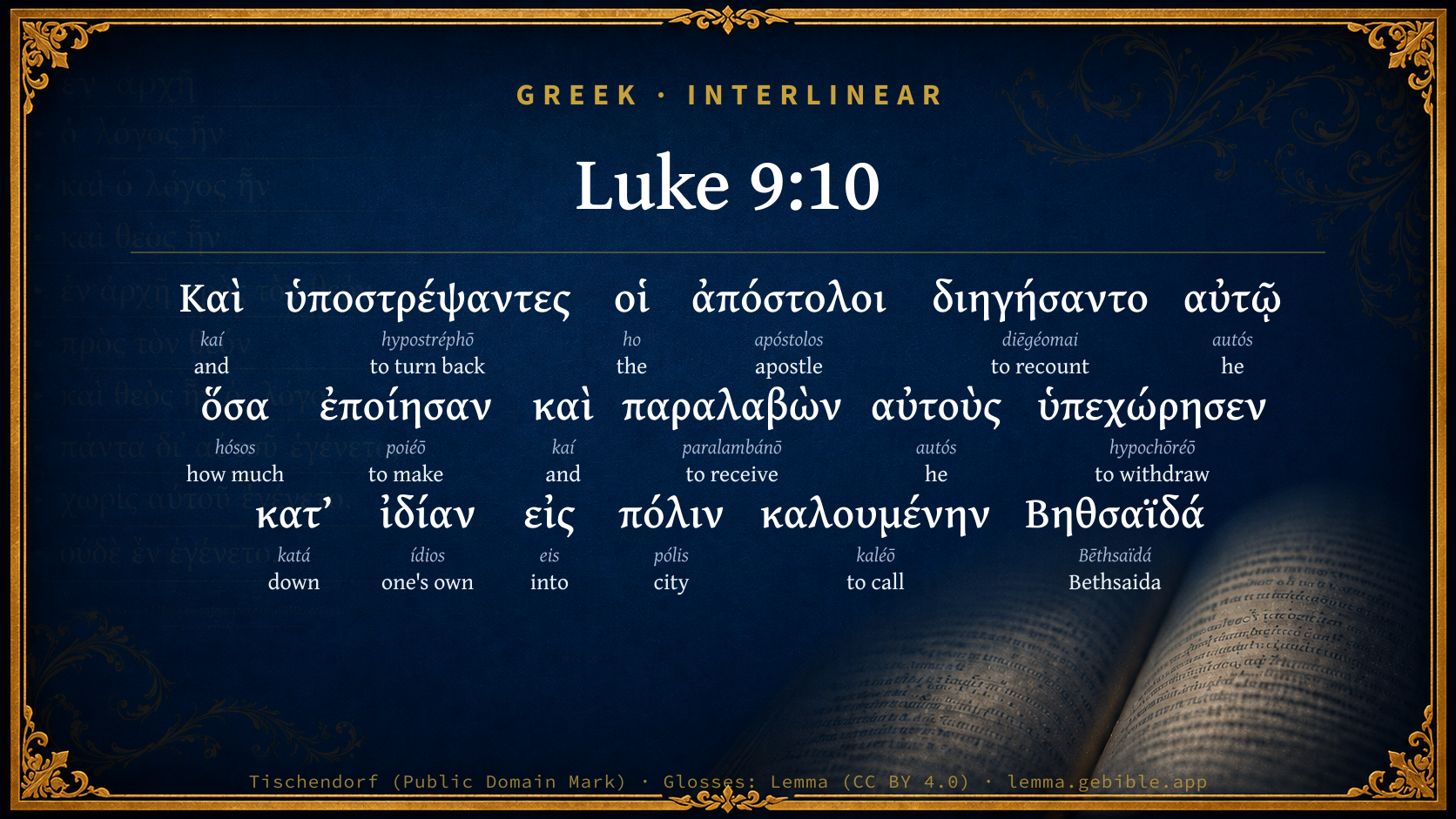
  1. Καὶ kaí G2532 “and” Conjunction
  2. ὑποστρέψαντες hypostréphō G5290 “to turn back” Verb, Aorist, Active, Participle, Nominative, Plural, Masculine
  3. οἱ ho G3588 “the” Article, Nominative, Plural, Masculine
  4. ἀπόστολοι apóstolos G652 “apostle” Noun, Nominative, Plural, Masculine
  5. διηγήσαντο diēgéomai G1334 “to recount” Verb, Aorist, Middle deponent, Indicative, 3rd person, Plural
  6. αὐτῷ autós G846 “he” Personal pronoun, Dative, Singular, Masculine
  7. ὅσα hósos G3745 “how much” Correlative pronoun, Accusative, Plural, Neuter
  8. ἐποίησαν poiéō G4160 “to make” Verb, Aorist, Active, Indicative, 3rd person, Plural
  9. καὶ kaí G2532 “and” Conjunction
  10. παραλαβὼν paralambánō G3880 “to receive” Verb, Aorist, Active, Participle, Nominative, Singular, Masculine
  11. αὐτοὺς autós G846 “he” Personal pronoun, Accusative, Plural, Masculine
  12. κατ’ katá G2596 “down” Preposition
  13. ἰδίαν ídios G2398 “one's own” Adjective, Accusative, Singular, Feminine
  14. εἰς eis G1519 “into” Preposition
  15. πόλιν pólis G4172 “city” Noun, Accusative, Singular, Feminine
  16. καλουμένην kaléō G2564 “to call” Verb, Present, Passive, Participle, Accusative, Singular, Feminine
  17. Βηθσαϊδά Bēthsaïdá G966 “Bethsaida” Noun, Proper, indeclinable

About this verse

These counts appear in no published source. They are computed here, from the morphology-tagged text and Lemma’s own curated glosses. What Lemma adds →

18
words
16
distinct lemmas
Gospels
section

Notable vocabulary

The rarest word here is ὑπεχώρησεν to withdraw G5298 — appearing just 2 times in the whole Greek New Testament.

Shared distinctive vocabulary

ὑπεχώρησεν to withdraw G5298 occurs in 2 verses of the Greek New Testament. Also found in:

Repetition

Words recur within this verse:

  • Καὶ and G2532 ×2
  • αὐτῷ he G846 ×2

Cross-references

10

Topical passages linked to Luke 9:10 in the Treasury of Scripture Knowledge — connected by theme and wording, ordered by reader-vote popularity; previews shown in the World English Bible.

  • Matthew 11:21 "Woe to you, Chorazin! Woe to you, Bethsaida! For if the mighty works had been done in Tyre and Sidon which were done in you, they would have repented long ago in sackcloth and ashes.
  • Matthew 14:13–21 Now when Jesus heard this, he withdrew from there in a boat, to a deserted place apart. When the multitudes heard it, they followed him on foot from the cities.
  • Hebrews 13:17 Obey your leaders and submit to them, for they watch on behalf of your souls, as those who will give account, that they may do this with joy, and not with groaning, for that would be unprofitable for you.
  • Zechariah 1:10 The man who stood among the myrtle trees answered, "They are the ones Yahweh has sent to go back and forth through the earth."
  • Mark 2:7 "Why does this man speak blasphemies like that? Who can forgive sins but God alone?"
  • Mark 6:30–45 The apostles gathered themselves together to Jesus, and they told him all things, whatever they had done, and whatever they had taught.
  • Luke 9:10–17 The apostles, when they had returned, told him what things they had done. He took them, and withdrew apart to a deserted place of a city called Bethsaida.
  • Luke 10:17 The seventy returned with joy, saying, "Lord, even the demons are subject to us in your name!"
  • John 1:44 Now Philip was from Bethsaida, of the city of Andrew and Peter.
  • John 6:5–13 Jesus therefore lifting up his eyes, and seeing that a great multitude was coming to him, said to Philip, "Where are we to buy bread, that these may eat?"

Cross-references courtesy of OpenBible.info (CC BY 4.0).

Where the printed editions differ

1 variant

Places in this verse where the major printed Greek editions disagree on the wording in a way that affects the translation — a comparison of editions, not a manuscript-by-manuscript collation. The editions are the modern critical texts (Nestlé-Aland 28/27, SBL, Westcott-Hort, Tregelles, Tyndale House) and the traditional texts behind the KJV (the Textus Receptus and the Byzantine/Majority text). It is not a claim about which reading is original.

  1. Extra text
    τόπον ἔρημον

    “place solitary”

    In TRByz Not in NA28NA27TynSBLWHTreg

    τόπον ἔρημον (topon erēmon) 'place solitary' is only in traditional manuscripts (TR+Byz)

Textual data: Translators Amalgamated Greek New Testament (STEPBible TAGNT) · CC BY 4.0.

Commentary

Notes on Luke 9:10 from classic Christian and Jewish commentators (each source and its license shown beneath its notes). The classic Christian expositions comment on the surrounding passage and are grouped to its opening verse, so a note may address several verses; the Jewish commentaries on the Tanakh (Rashi and others) are per-verse, so they appear only where the commentator wrote on this verse.

Lemma curates 59 commentaries, every one of them public domain or Creative Commons licensed, each selected and text-cleaned for this edition rather than reprinted as found. About our sources →

Albert Barnes' Notes on the Bible

See the Mat 14:13-21 notes, and Mar 6:30-44 notes.

Luk 9:10

Bethsaida - A city on the east bank of the river Jordan, near where the river enters into the Sea of Tiberias. In the neighborhood of that city were extensive wastes or deserts.

Luk 9:12

Day began to wear away - To decline, or as it drew near toward evening.

Albert Barnes' Notes on the Bible (1834–1885) — public domain. Text from a community e-Sword/MySword module.

The Biblical Illustrator

Joseph S. Exell

Luk_9:10

Aside privately

The profit of restful retirement

I had a friend once (he is now in heaven) who was one of those men that give their whole heart to business, and believe in nothing else on week days, while even on Sundays their worship is, never to be still if they are religious men, but to be doing something from daylight to bed-time.

One summer day the feeling came over him that he would wander away, just for once, into the silence, and take one whole day of perfect rest. It was toward an upland he took his way, wandering by some small lakes of an exquisite beauty, and enjoying every moment of his holiday; until away on in the afternoon, when he had drunk deep of the quietness, and was lying on his face in the grass, happening lazily to lift his head all at once, as by a flash, he saw that one of these lakes could be tapped for his mill-dam, and so give him water enough to tide him over the summer dryness and prevent his wheel from stopping, when it ought to go right on. He went home at sunset, blessing himself for his good fortune as well as for the leisure, which was likely to turn out a better days work than he had done for a long time, took a survey of the land next day, and when he told me the story he had made his connection with the new reservoir, and it answered entirely his expectation. I have often thought of my friends adventure since then as an illustration of a lesson we are rather loth to learn in this busy land of ours--how springs and reservoirs of blessing may sometimes be opened to us through a perfect quietness we can never find through incessant toil. We do not believe in rest as devoutly as we believe in work. It does not seem possible we can ever do as good service either for God or man to be still as to be stirring. In this intense life we easily believe that to do nothing one whole day is for that day to be nothing. It is as if we should do nothing in a boat alone among the rapids of the St. Lawrence. The majestic motion and contention of the life about us overcomes us so that the gracious word contemplation in the old, sweet sense, is about as strange to the most of us as Sanscrit. We contemplate the very heavens to remember how many millions of miles the sun travels in an hour. Work while it is day is the watchword of our age, and it is always day. Time means the time to do things. Let us then be up and doing is indeed our psalm of life. We fight the idea of the philosopher that God cannot have rested on the seventh day and hallowed it, and then often illustrate our own belief by filling the seventh day as full of care as the rest. (R. Collyer.)

The Biblical Illustrator, edited by Joseph S. Exell (c. 1880s–1900s) — public domain. Text from a community e-Sword module.

Joseph Benson's Commentary

Luk 9:10-17. And the apostles being returned, told him all that they had done — See notes on Mat 14:13-21; and Mar 6:30-44, where this whole paragraph is largely explained.

Joseph Benson's Commentary on the Old and New Testaments (1811–1818) — public domain. Text from a community e-Sword module.

Whedon's Commentary on the Bible

Daniel D. Whedon

§ 63.—FIVE THOUSAND FED, Luk_9:10-17.

See notes on Mat_14:13-21; Mar_6:32-44; Joh_6:1-14.

§ 62.—THE TWELVE RETURN, Luk_9:10.

Mar_6:30-31.

Daniel D. Whedon (gen. ed.), Commentary on the Old and New Testaments (1874–1909) — public domain. Text from a community e-Sword module.

The Preacher's Complete Homiletical Commentary

Joseph S. Exell (gen. ed.)

CRITICAL NOTES

Luk_9:10. Went aside privately.—The reason of this retirement is stated by St. Matthew (Mat_14:13) to have been Christ’s hearing of the violent death of John the Baptist. It was a precautionary measure, rendered all the more necessary by Herod’s desire to see Jesus. St. Mark says that it was for the sake of quiet (Luk_6:31)—as the excitement produced by the teaching of Jesus and His apostles was very great. There is no necessary discrepancy in the narratives: the retirement in question may have taken place for more reasons than one. City called Bethsaida.—This is not the Bethsaida near Capernaum on the west of the lake, but Bethsaida Julias on the north, in the tetrarchy of Philip, near which was “a desert place.”

Luk_9:11. Followed Him.—Jesus went by boat, and the people, seeing the direction in which He sailed, went thither on foot (Mar_6:33). Received them.—I.e. did not dismiss them, though their following Him defeated one of the purposes for which He had sought retirement.

Luk_9:13. Five loaves.—I.e. barley loaves (Joh_6:9), the food of the poor. The miracle that follows is the only one narrated by all four evangelists.

Luk_9:14. Five thousand.—Men, besides women and children (Mat_14:21).

Luk_9:16. Blessed them.—“Agreeably to the Jewish custom, by which it was usual for the head of the family, at every meal, to pronounce a blessing on the food, previously to partaking of it, commencing with the words, ‘Blessed art thou, O God, who bringest bread out of the earth,’ etc.” (Bloomfield).

Luk_9:17. Baskets.—The word used in all the narratives of this miracle is κόφινος—a wicker-basket, such as the Jews were accustomed to carry their food in when they were on a journey. The word used in the account of the other miracle of the kind (Mat_15:37; Mar_8:8) is σπυρίς—a large rope-basket, capable of holding a man’s body (cf. Act_9:25). St. Luke omits a long series of events which followed this miracle, and which are related in Mat_14:1 to Mat_16:12; Mar_6:45 to Mar_8:30; and John 6.

MAIN HOMILETICS OF THE PARAGRAPH.—Luk_9:10-17

Bread from Heaven.—The apostles needed rest after their journey. Our Lord suggested a brief retirement, and sought it at the Eastern Bethsaida, a couple of miles up the Jordan from its point of entrance to the lake. The curious crowd following on foot effectually destroyed all hope of retirement. Without a sigh or sign of impatience Jesus welcomed them. He received them patiently, because “He was moved with pity” (St. Mark), and saw in their rude crowding about Him the token of their lack of guides and teachers. They seemed to Him not merely a mob of intrusive sight-seers, but like a huddled mass of unshepherded sheep. Christ’s heart felt more lovingly than ours because His eye saw deeper, and His eye saw deeper because His heart felt more lovingly. If we lived nearer Him, we should see, as He did, enough in every man to draw out pity and help, even though he should jostle us and interfere with us. Coming to the miracle itself, we may divide the narrative into three parts: the preliminaries, the miracle, and the abundant overplus.

I. The preliminaries.—Our Lord leads up to the miracle by forcing home on the minds of the disciples the extent of the need, and the utter inadequacy of their resources to meet it, and by calling on them and the crowd for an act of obedience, which must have seemed ludicrous to many of them. The strange suggestion that the disciples should feed the crowd must have appeared to them absurd, but it was meant to bring out the clear recognition of the smallness of their supply. Therein lie great lessons. Commands are given and apparent duties laid on us, in order that we may find out how impotent we are to do them. It can never be our duty to do what we cannot do; but it is often our duty to attempt tasks to which we are conspicuously inadequate, in the confidence that He who gives them has laid them on us to drive us to Himself, and there to find sufficiency. The best preparation of His servants for their work in the world is the discovery that their own stores are small. Those who have learned that it is their task to feed the multitude, and who have said “We have no more than such and such scanty resources,” are prepared to be the distributers of His all-sufficient supply.

II. The miracle.—Like that of the draught of fishes, it was not called forth by the cry of suffering, nor was the need which it met one beyond the reach of ordinary means. It was certainly a miracle most plainly meant to strike the popular mind, and the enthusiasm excited by it, according to John’s account, was foreseen by Christ. Why did He evoke enthusiasm which He did not mean to gratify? For the very purpose of bringing the carnal expectations of the crowd to a head, that they might be the more conclusively disappointed. The miracle and its sequel sifted and sent away many disciples, and were meant to do so. He blessed the bread. What He blesses is blessed, for His words are deeds, and communicate the blessing which they speak. The point at which the miraculous multiplication of the food came in is left undetermined. The pieces grew under His touch, and the disciples always found His hands full when they came back with their own empty. The symbolical aspect of the miracle is set forth in the great discourse which follows it in St. John’s Gospel. Jesus is the bread of God which came down from heaven. That bread is broken for us. Not in His incarnation alone, but in His death, is He the food of the world; and we have not only to “eat His flesh,” but to “drink His blood,” if we would live. Nor can we lose sight of the symbol of His servants’ task. They are the distributers of the heaven-sent bread. If they will but take their poor stores to Jesus, with the acknowledgment of their insufficiency, He will turn them into inexhaustible supplies. What Christ blesses is always enough.

III. The abundant overplus.—Twelve baskets were filled: that is to say, each apostle, who had helped to feed the hungry, had a basketful to bring off for future wants. The “broken pieces” were not crumbs that littered the grass, but the portions that came from Christ’s hands. His provision is more than enough for a hungry world, and they who share it out among their fellows have their own possession of it increased. There is no surer way to receive the full sweetness and blessing of the gospel than to carry it to some hungry soul. These full baskets teach us, too, that in Christ’s gift of Himself as the bread of life there is ever more than at any given moment we can appropriate. Other food cloys and does not satisfy, and leaves us starving. Christ satisfies and does not cloy, and we have always remaining, yet to be enjoyed, the boundless stores which neither eternity will age nor a universe feeding on them consume.—Maclaren.

“Make them sit down.”

I. The command to make them sit down by fifties in a company was expressive of the authority of Christ over human multitudes whenever He comes into contact with them. There were five thousand men besides women and children present, and, according to three evangelists out of the four, special emphasis is attached to this command, “Make them sit down.” There was no doubt a growing confusion at this time: the night was at hand, and the multitude, wearied by a day of restlessness under a burning Eastern sky, and largely irritated by discussion, and carried away by the back-wave of the day’s excitement, had become well-nigh unmanageable. In the presence of that confusion the disciples had readily given their rough and ready solution, “Send the multitude away, that they may go into the towns and country round about, and lodge and get victuals: for we are here in a desert place.” Christ, on the contrary, said in brief, “Nay, make them sit down.” He, as the master of assemblies, did not seek to rid Himself of the confusion by ridding Himself of the multitude. In this respect, as well as in a thousand other respects, He towered above all others. He was never excited, and never doubtful as to what should be done; but was always calmly confident amid the seething passions and conflicting voices of human multitudes. Thus, at the very outset, we find this distinctive attribute of Christ’s ministry. He never lost command, but was ever calm and masterful as the Lord of men.

II. But this command was not only expressive of the unique authority of Jesus Christ; it was also an illustration of His most tender consideration for those who needed it most. John tells us that only the men sat in fifties; and Mark intimates the same. There were women and children there, but, as Matthew too asserts, the five thousand consisted of men apart from women and children. Luke tells us that they sat down “by fifties in a company.” The words which Mark uses suggest that the multitude looked like a garden of flowers, well arranged in groups of living men, turning their faces as expectant to the Christ as the flowers turn theirs to the sun. But observe that women and children were not in these regular ranks of panting humanity. No one has been in a throng of five thousand men, when there has been rushing movement, discord, irritation, and weariness, without being impressed with the danger for women and children, especially when the overwhelming majority were men. Here we have one of the many beautiful touches of the Gospel narrative—the thoughtfulness of Christ concerning the weak. Order is the first law of heaven, and when Christ would perform this miracle order was the first essential. Thoughtful consideration for the weak who were in danger of being trodden underfoot was the second—“Make the men sit down”—so that in addition to the orderliness of their own ranks there may be opportunity for the women and the children to have their share. Christ never overlooks any section of the community, ignores no small one in the greatest mass of human life.

III. This command awakened new hopes and expectations in the hearts of the assembled multitude. They had walked along the northern coast of the Sea of Galilee into that desert place on the eastern coast, and were wearied by the journey and the fatigue of the day. The length of the journey would make it probable that the women and children were few compared with the men. This is another subtle proof of the accuracy of Gospel records. The few, however, were not overlooked. All were weary—especially the women and children—with the events of the day. Their hopes had to a large extent been satisfied, yet weariness and hunger had taken possession of them. Now Christ awakened new hopes in their hearts. No one awakens within the heart of man such expectations as Jesus Christ. They soon came to the conclusion that the great Teacher was about to feed them. Where all was to come from they did not know, save that it would come from the same source of power and of grace as many other provisions for the need and sorrow of men had come in that unique ministry; and so every one in that vast throng was encouraged to hope for and expect some wonderful miraculous provision.

IV. By this command Christ willingly subjected Himself to a new test of His Divine power and sympathy. There was no necessity for His doing this save the irresistible promptings of His great love. The multitudes might have been dismissed, and yet He would have preserved His character apart from this further manifestation of His divinity. No one expected it; even His own disciples did not. It was not, therefore, done in an emergency; but this command going forth subjected Him willingly and voluntarily to a new test. That is what Christ ever does. Almost every command He gives to men subjects Him to new tests. “Believe in the Lord Jesus Christ,” that is the command; “and thou shalt be saved” is the promise. He stakes His honour, and stands or falls by every command that He gives us which has a latent promise in its folds.

V. By this command Christ subjected the disciples to a new test. They had to exercise sufficient confidence in Him to go and tell the multitude to sit down and wait for their meal. They had just been arguing with Christ. Two hundred pennyworth of bread would not suffice, according to their calculation. There was a boy present, it was true, who had brought his five loaves and two fishes; but what were they among so many? Now that is just what is taking place every day. Every faithful messenger of Jesus Christ, who goes forth to meet the wants of men and women, knows that, apart from the power of the Christ behind him, his task is one of forlorn hope and sad humiliation. But every mission has its test, and every man of God who has gone forth at the Master’s bidding has gone forth with the full assurance that he cannot be disappointed or humiliated.

VI. This command, moreover, came as a test for the multitude. Every one in that great multitude had to obey in anticipation of the feast. Now that was pre-eminently an act of faith. They had confidence that Jesus Christ would not have sent the message to them unless He meant to feed them. And still that is all that is required—that men should just do as He tells them, namely, look for the blessing and wait for it. How many there are unprepared to do that, and yet are surprised if they are not fed! There was not a man among the five thousand foolish enough to act in that fashion. “Make them sit down by fifties in a company. And they did so.”—Davies.

SUGGESTIVE COMMENTS ON Luk_9:10-17

Luk_9:10. “A desert place.”—The two miracles of feeding the multitudes were performed in desert places: this circumstance

(1) brought out most impressively the greatness of Christ’s power, who could, apart from ordinary means, feed so large a number of people; and

(2) reminded those present of the miraculous way in which God had for forty years sustained their nation in the wilderness.

The Christian Uses of Leisure.

I. Communion with outward nature.

II. Intercourse with fellow-believers.

III. A closer converse with Christ Himself.—Ker.

Luk_9:11. “The people … followed Him.”—The unexpected arrival of the people defeats the plan Jesus had formed. But the Lord is deeply touched by the love towards Him manifested by this multitude, which were like sheep without a shepherd (Mar_6:34): He “receives” them with tender loving-kindness; and while crowds arrive one after another in the course of the morning (Joh_6:5), a thought springs up in His heart. What it was St. John tells us (ibid. 4). The Passover season was drawing near. Jesus had not been able to go up to Jerusalem with His disciples, so violent was the rage of His enemies. So then in this unexpected gathering, like that of the people in Jerusalem, He discerns a signal from heaven, and He resolves to hold a feast in the wilderness to take the place of the Passover for those who surround Him.—Godet.

Luk_9:12. “Go into the towns.”—This miracle was not urgently called for by the physical necessities of the multitude, as in the other instance of miraculous feeding (Mar_8:2-3). The disciples themselves were of the opinion that in the neighbouring villages and country the people might get food. “It was a symbolic, didactic, critical miracle. It was meant to teach, and also to test: to supply a text for the subsequent sermon (recorded by St. John), and a touchstone to try the character of those who had followed Jesus with such enthusiasm. It was meant to say, ‘I Jesus am the bread of life. What this bread is to your bodies, I Myself am to your souls’ ” (Bruce).

Luk_9:13-16. “Took … blessed … gave.”—The significant points in the action of that day were

(1) the provision accepted from the disciples,

(2) the blessing of it by Jesus, and

(3) the distribution of it among the people.—Laidlaw.

Luk_9:13. “Give ye.”—The words are emphatic, for the disciples had been counselling the people to get food for themselves.

“Give ye them to eat.”—Christ wishes His disciples to realise their own utter inability, in order that they might by-and-by realise more intensely the fulness of His ability.

“We have no more.”—Here we may learn, at least, not to be too confident in our reckonings, so long as they are made for plus or minus. How many great counting-houses have forgotten in their books the column for the blessing or—the curse of God!—Stier.

Luk_9:14. “By fifties.”—In which subordinate circumstance we behold His wisdom who is the Lord and Lover of order. Thus all confusion was avoided. There was no danger that the weaker, the women and children, should be passed over, while the stronger and ruder unduly put themselves forward. The apostles were thus able to pass easily up and down among the multitude, and to minister in orderly succession to the needs of every part.—Burgon.

“Made them all sit down.”—The apostles caused the people to sit down before they knew what Christ was about to do. They obeyed His command. They were weak and inexperienced, but still they were childlike, and allowed themselves to be led by His hand. “This is the true kind of obedience,” says Bernhard which does not look at what is commanded, but is content to know that it is commanded by God.”

Luk_9:16. “Blessed them.”—To be thankful for little is the way to obtain more. The action of the Saviour, if we compare the various narratives of this miracle, consisted

(1) of thanksgiving—acknowledgment of all the goodness of God, and an anticipation of the coming display of His power and love; and

(2) of blessing the food for the use of the people. “To bless means to speak well of. Our Saviour on the present occasion would doubtless speak well of His Father; and, coincidently, He would speak well of the provision, His Father’s gift, which He was about to distribute and increase. He might speak well, too, in reference to the people petitioning for their weal. He would thus coincidently bless the Father, bless the food, and invoke blessing on the people” (Morison).

A Like Miracle ever being wrought.—He conceals the miracle, and no one sees how the bread multiplies in His hands, any more than one sees the grass growing. “The same Divine Person, in a manner less striking, because more gradual and regular, but certainly not less wonderful, ripens all the seeds in all the gardens and orchards and in all the vineyards and meadows of this world, in successive seasons, ever since man dwelt in Paradise, to minister food to His creatures” (Wordsworth).

Inexhaustible Provision.—The Bible is little in bulk, like the five barley loaves and the two fishes. What thousands upon thousands has it fed, and will it feed, in every age, in every land of Christendom, to the world’s end!

Luk_9:17. The Teaching of the Miracle.—The miracle teaches us—

I. That it is our duty to do what we can to supply the bodily wants of others.

II. That those who follow Christ may trust to Him for the necessaries of life.

III. That it is becoming to thank God for His goodness before partaking of food.

IV. That nothing should be lost or wasted.

“Fragments.”—The food Christ gave differed from the manna; for

(1) the manna was only sufficient for him who gathered it, and

(2) could not be kept. The fragments are more in bulk than the original stock: in their being gathered at the command of Christ we have a beautiful picture of God’s bounty in nature, which is at once lavish and careful.

“That remained.”—A sign that there had been abundance. Twelve baskets, because at Christ’s command the twelve apostles gathered up the fragments. “We have thus a visible symbol of that love which exhausts not itself by loving, but after the most prodigal outgoings upon others abides itself far richer than it would else have done; of the multiplying which there ever is in a true dispensing; of the increasing which may go along with a scattering (Pro_11:24 : cf. 2Ki_4:1-7)” (Trench).

The Preacher's Complete Homiletical Commentary (gen. ed. Joseph S. Exell; Funk & Wagnalls, c. 1892) — public domain (pre-1929). A full-Bible homiletical/sermon-outline anthology covering 65 of 66 books (2 John is absent from the source module). Text from a community e-Sword module.

Lange's Commentary on the Holy Scriptures

c. The Miracle Of The Loaves (Luk_9:10-17)

10And the apostles when they were returned, told him all that they had done. And he took them, and went aside privately into a desert place belonging to the city called Bethsaida.3 11And the people, when they knew it, followed him: and he received them, and spake unto them of the kingdom of God, and healed them that had need of healing. 12And when the day began to wear away, then came the twelve, and said unto him4, Send the multitude away, that they may go into the towns [villages] and country round about, and lodge, and get victuals; for we are here in a desert place. 13But he said unto them, Give ye them to eat. And they said, We have no more but [than] five loaves and two fishes; except we [ourselves, ἡμεῖς expressed] should go and buymeat [food] for all this people. 14For they were about five thousand men. And hesaid to his disciples, Make them sit down by fifties in a company. 15And they did so,and made them all sit down. 16Then he took the five loaves and the two fishes, and looking up to heaven, he blessed them, and brake, and gave to the disciples to set before the multitude. 17And they did eat, and were all filled [satisfied]: and there was [were] taken up of fragments that remained to them twelve baskets.

EXEGETICAL AND CRITICAL

Luk_9:10. And the Apostles, when they were returned.—In order to get a right conception of the whole connection of the occurrences, we must especially compare Mar_6:30-31. The Saviour receives almost simultaneously the account of the return of the Twelve and of the death of the Baptist. To this is added the rumor that Herod desires to see Him, which occasions Him to pass over from the province of Antipas to that of Philip. He will afford His disciples and Himself a quiet hour, which, however, becomes impossible on account of the thronging of the people. We may here make the general remark, that, above all, a comparison of the different accounts is requisite in order to come to a correct understanding of the miracle of the Loaves. We shall then find confirmed the remark of Lic. S. Rau, in an admirable essay upon John 6 found in the Deutsche Zeitschrift für christliche Wissenschaft und christliches Leben, 1850, p. Luke 263: “That as well by the point of time which the representations of the Synoptics and of John assign to this history, as by the significance which they ascribe to it, they equally place this miraculous act of the Saviour in the clearest light, and, as it were, upon that highest summit of the life of Christ up to which the fateful way to the sacrificial death leads to higher and higher self-unfolding, in order from now on to lead on to the fate necessarily following this self-unfolding, and lurking in the depth.” Especially for the examination of the Tübingen views respecting the Gospel of John, does the whole essay deserve to be compared.

Βηθσαϊδά.—Not the western (Winer, De Wette), but another town of this name on the northeastern shore of the lake, belonging to the province of Philip, who had given it the name Julias, and had considerably embellished it. Built near the shore at the place where the Jordan pours itself into the lake of Tiberias, it was surrounded by a desolate region which now, however, in the spring, was covered with a carpet of grass, large enough to receive a numerous throng. Thither does the Saviour proceed with the disciples, according to Matthew and Mark, in a ship, while Luke does not say that He goes by land (Meyer), but leaves the mode of the journey entirely undetermined. Apparently Capernaum was the place where the Saviour and the Twelve had, after the return of the latter, met one another again.

Luk_9:11. Followed Him.—As appears from Matthew and Mark, on foot by the land-way after they had seen Him depart, taking also sick persons with them, who were healed by Jesus. Von Ammon draws from the statement that these sick people also had come on foot, the conclusion that they could not, after all, have been so very sick; as though blind or deaf people, who could travel very well, might not have been among them; and as though the others who were not capable of walking, might not have been carried.

Luk_9:12. And when the day.—Here we must insert especially from Mark and John the preceding circumstances and deliberations which Luke, in his more summary account, passes over for the sake of brevity.

That they may go.—This demand of the disciples to send the multitude away, does not speak favorably for the view that the people had brought a tolerably large provision of their own with them, to the common distribution of which they were about to be prompted.

Luk_9:13. Give ye.—“With emphasis, for previously they had counselled to let the people get food for themselves.” Meyer.

Should go and buy.—It is self-evident that this whole language of the disciples is only the expression of the most pitiable perplexity, which had no other means at command. Whoever can assert in earnest that the disciples now actually did buy food with two hundred denarii, and then distributed it (Von Ammon), appears to expect that men are going to believe his rationalistic triflings at his word, without demanding any further proofs therefor.

Luk_9:14. By fifties.—We find no sufficient reason to insert ὡσεί (Lachmann). “Numerus commodus propter quinarium panum.” Bengel.

Luk_9:16. Blessed, εὐλόγησεν.—According to Jewish usage before the beginning of a meal. Here it becomes in the fullest sense of the word a miraculous blessing, whereby the deed of Almighty love is brought to pass. Between Matthew and Mark there exists no actual difference. It is noticeable that all four Evangelists take note of the act of prayer.

The Miracle Itself.—The miracle of the Loaves is certainly one of those whose possibility is quite as hard to bring within the sphere of our comprehension as its form within the sphere of our conception. See statement and criticism of the different views in Lange on Mat_14:20. So much the less can we overlook the fact that the external proofs of the reality of the miracle are so unanimous and decisive that concerning them scarcely a doubt is possible. It cannot be denied that the relative diversities of the individual accounts are less essential (Strauss). In the main points all the Evangelists give the same account, and he difficulties of the mythical explanation are here in fact insuperable. Or is perchance the whole historical narration to be taken as a mere symbol of the evangelical idea that Christ is the bread of eternal life? (Von Baur). As if this idea could not have been expressed and stated as well in a fact! How, then, would the enthusiasm of the people be explicable, and the mutual discourse, John 6, which is connected with this miracle, and, moreover, the great schism which in consequence of it took place among the μαθηταί, John 6? No, this very point is the great proof for the reality of the miracle, that it is indispensably necessary in order satisfactorily to explain the decrease then beginning in the following of Jesus. So far something had here taken place similar to that at the Lord’s resurrection; and this, at least, becomes immediately obvious, that here something must have taken place by which the great revolution in so many minds is sufficiently explained. Up to this day we see the following of Jesus increasing: He stands before us, as it were, on the steps of the throne, Joh_6:15; a few hours later, the enthusiasm has cooled and the throng of His followers noticeably diminished. Only a miracle like this could have roused so intense an expectation, and, when this expectation on the following day was not fulfilled, so great a bitterness as we have account of, especially in the fourth Gospel.

With this, however, we do not mean that we are blind to the difficulties which offer themselves here, even from a believing point of view. We can as little represent to ourselves that the fragments of bread had multiplied themselves in the hands of the people as in those of the disciples; and even if we make the miracle to have taken place immediately by the Saviour’s own hands, we can as little conceive continually growing loaves as continually reappearing fish; and although one should speak of a quickened process of nature (Olshausen; a representation, moreover, of which there is found an indication even in Luther), yet there is little gained by this, since, indeed, it appears no process of nature, but a process of art, to multiply in a miraculous way baked bread and cooked fish. Here one feels, more than ever, how difficult it is to enter in any way into transaction with the inconceivable, since, after all, everything finally depends upon our conception of God, upon our Christology, and upon the credibility of the evangelical history. Yet, on the other hand, we must not pass over the fact that the Saviour here by no means makes something out of nothing, but out of that already existing makes something more, and does not, therefore, pass the limits which the Incarnate Word has fixed for Himself, and that it could not be for Him too miraculous to raise Himself, if need were, over the artificial processes of preparing bread and fish for human use. We may call to mind, at the same time, that the ethical receptivity for this miracle must have existed in the people in consequence of all which they had this day already seen and heard of the Lord, and by which their faith had been first awakened, or their already awakened faith had been strengthened. And inasmuch as we now believe ourselves obliged to follow the example of the Evangelists, who do not more particularly describe the form of the miracle, we at the same time rejoice that the sublimity and the purpose of this sign are beyond all doubt. But if Christian science believes itself obliged to go a step further, and to venture an attempt to seek a modal, or perhaps a mystic, medium of bringing into effect what here took place, then certainly the profoundly-conceived attempt of Lange, L. J. ii., S. 309, deserves a careful examination. Comp. his remarks upon it in the Gospel of John.

DOCTRINAL AND ETHICAL

1. The deep impression which the death of the Baptist produces upon the Saviour, is a striking proof, on the one hand, of His genuine human nature and feeling; on the other hand, of His clear insight into the connection of the martyr-death of the Baptist with His own approaching Passion. He shows at the same time His tender care for the training of His disciples, when He, after some days of unusual exercise of body and soul, considers some hours of rest and solitude as absolutely necessary. Comp. the beautiful essay by A. Vinet: La solitude recommandée au pasteur.

2. The miracle of the Loaves is one of the most striking proofs of the truth of the word of the Lord to Philip, Joh_14:9. We admire here in the Saviour a veritably Divine might which speaks and it is done; in virtue of which He, in higher measure and from His own fulness of might, can repeat what in the Old Testament had already, in smaller measure, been brought to pass by prophets and at Divine command. (Comp. the manna-rain of Moses, and the multiplication of food by Elijah and Elisha.) Besides deep wisdom, which helps at the right time and by the simplest means, we see here, at the same time, in Jesus, the image of the God of peace (1Co_14:33), inasmuch as He takes care for the orderly division of the multitude and for the preservation of the fragments remaining. More than all, however, does His compassion attract us, which has at heart the fate of the unfortunate, which, with tenderest attention, chooses even the softest place for couch and table, and with ungrudging wealth bestows not only what is absolutely necessary, but also more than what is necessary. This whole miracle must serve as proof how He, like the Father, can out of little make much, and bless what is of little account. Above all, however, it is an image of the great truth which He the following day so powerfully develops (John 6), that He is the bread of eternal life.

3. The miracle of the Loaves is the faithful miracle of the way in which the Saviour satisfies the spiritual necessities of His own; but at the same time with all that is extraordinary, the concurrence of this miracle with the continuous care of Providence for the bodily support of its human children, is unmistakable. The whole narrative of the miracle is a practical commentary on the declaration, Psa_145:15-16.

HOMILETICAL AND PRACTICAL

The first report in the Gospel of labor accomplished.—Mournful accounts shake as little as joyful ones the holy rest of the Lord.—The Lord grants His faithful laborers rest.—Even unto our places of rest not seldom does earth’s disquiet follow us.—The unwearied Saviour never indisposed to beneficence.—Jesus the Physician of body and soul.—Human perplexity over against Divine knowledge; human sympathy over against Divine compassion; human counsel over against Divine action; human poverty over against Divine wealth.—Jesus refers the hungry multitude to His apostles.—Let all things be done with order.—Daily bread hallowed by thanksgiving and prayer.—“That nothing be lost:” a fundamental law in the kingdom of God in the use of all that which the Lord has bestowed.—The miracle of the Loaves a proof of the truth of Mat_6:33.—The Saviour keeps in the wilderness a feast with the poor, while He is awaited with longing at the court of Herod.—The Lord makes of little much.—The Lord never gives only so much that there is nothing left over.—They that seek the Lord shall not want any good thing.—The satisfying of earthly, the type of the satisfying of heavenly, necessities.—The conditions under which the Christian even now may expect the satisfying of his earthly necessities: 1. Believing trust; 2. befitting activity; 3. well-regulated order; 4. wise frugality, joined with, 5. thanksgiving and prayer.—“Open thy mouth wide, that I may fill it.” Psa_81:10 b.—The Lord permits us to suffer hunger only, in His own time, the more richly to relieve it.—He hath filled the hungry with good things.—The miracle of the Loaves a revelation of the glory of the Son of God and the Son of Man.—He dismisses no one empty but him who came full.

Starke:—Nova Bibl. Tub.:—Who loves Jesus follows Him even through rough ways.—Quesnel:—God lets us first recognize our human impotence before He displays His omnipotence.—Spiritual shepherds should feed their sheep.—By gold one can obtain all perishable goods, but the rich God can throw to us all that we need, even when we have little or no money.—It is to the Almighty Saviour all one to help by little or by much. Upon that, faith can venture all. 1Sa_14:6.—Nova Bibl. Tub.:—No one should imagine himself too good or too high to serve the needy.—Brentius:—In distress of hunger, the best refuge is to Christ.—God’s blessing one must not lavish away at once, but lay up for future need. Pro_11:27.—Heubner:—To be agents in the distribution of Divine gifts, like the disciples here, is a high honor and grace.—The requirement of that which man ought to do, according to God’s will, appears often very surprising, surpassing all capacity, for God has beforehand already taken care for all, and Himself concurs. His is properly the main act.—The feeling of compassion in Christ much mightier than the need of rest.—Van Oosterzee:—Jesus the bread of life. Intimation how He even now: 1. Meets with the same necessity; 2. exhibits the same majesty; 3. prepares the same refreshment; 4. deserves the same homage; 5. provokes the same schism as at the miracle of the Loaves.

Lange's Commentary on the Holy Scriptures (Critical, Doctrinal, and Homiletical), ed. John Peter Lange, English translation edited by Philip Schaff (1864–1880) — public domain. Text from a community e-Sword module.

MacLaren's Expositions of Holy Scripture

Alexander MacLaren

Luke

BREAD FROM HEAVEN

Luk 9:10 - Luk 9:17.

The Apostles needed rest after their trial trip as evangelists. John the Baptist’s death had just been told to Christ. The Passover was at hand, and many pilgrims were on the march. Prudence and care for His followers as well as Himself suggested a brief retirement, and our Lord sought it at the Eastern Bethsaida, a couple of miles up the Jordan from its point of entrance to the lake. Matthew and Mark tell us that He went by boat, which Luke does not seem to have known. Mark adds that the curious crowd, which followed on foot, reached the place of landing before Him, and so effectually destroyed all hope of retirement. It was a short walk round the north-western part of the head of the lake, and the boat would be in sight all the way, so that there was no escape for its passengers.

Luke records the self-oblivious cordiality of Christ’s reception of the intrusive crowd. Without a sigh or sign of impatience, He ‘welcomed them’-a difficult thing to do, and one which few of us could have achieved. The motives of most of them can have been nothing higher than what leads vulgar people of all ranks and countries to buzz about distinguished men, utterly regardless of delicacy or considerateness. They want to see the notoriety, no matter what it costs him. But Jesus received them patiently, because, as Mark touchingly tells, He was ‘moved with pity,’ and saw in their rude crowding round Him the token of their lack of guides and teachers. They seemed to Him, not merely a mob of intrusive sight-seers, but like a huddled mass of unshepherded sheep.

Christ’s heart felt more lovingly than ours because His eye saw deeper, and His eye saw deeper because His heart felt more lovingly. If we would live nearer Him, we should see, as He did, enough in every man to draw our pity and help, even though he may jostle and interfere with us.

The short journey to Bethsaida would be in the early morning, and a long day of toil followed instead of the hoped-for quiet. Note that singular expression, ‘Them that had need of healing He healed.’ Why not simply ‘them that were sick’? Probably to bring out the thought that misery made unfailing appeal to Him, and that for Him to see need was to supply it. His swift compassion, His all-sufficient power to heal, and the conditions of receiving His healing, are all wrapped up in the words. Coming to the miracle itself, we may throw the narrative into three parts-the preliminaries, the miracle, and the abundant overplus.

I. Our Lord leads up to the miracle by forcing home on the minds of the disciples the extent of the need and the utter inadequacy of their resources to meet it, and by calling on them and the crowd for an act of obedience which must have seemed to many of them ludicrous.

John shows us that He had begun to prepare them, at the moment of meeting the multitude, by His question to Philip. That had been simmering in the disciples’ minds all day, while they leisurely watched Him toiling in word and work, and now they come with their solution of the difficulty. Their suggestion was a very sensible one in the circumstances, and they are not to be blamed for not anticipating a miracle as the way out. However many miracles they saw, they never seem to have expected another. That has been thought to be unnatural, but surely it is true to nature. They moved in a confusing mixture of the miraculous and the natural which baffled calculation as to which element would rule at any given moment. Their faith was feeble, and Christ rebuked them for their slowness to learn the lesson of this very miracle and its twin feeding of the four thousand. They were our true brothers in their failure to grasp the full meaning of the past, and to trust His power.

The strange suggestion that the disciples should feed the crowd must have appeared to them absurd, but it was meant to bring out the clear recognition of the smallness of their supply. Therein lie great lessons. Commands are given and apparent duties laid on us, in order that we may find out how impotent we are to do them. It can never be our duty to do what we cannot do, but it is often our duty to attempt tasks to which we are conspicuously inadequate, in the confidence that He who gives them has laid them on us to drive us to Himself, and there to find sufficiency. The best preparation of His servants for their work in the world is the discovery that their own stores are small. Those who have learned that it is their task to feed the multitude, and who have said ‘We have no more than such and such scanty resources,’ are prepared to be the distributors of His all-sufficient supply.

What a strange scene that must have been as the hundred groups of fifty each arranged themselves on the green grass, in the setting sunlight, waiting for a meal of which there were no signs! It took a good deal of faith to seat the crowd, and some faith for the crowd to sit. How expectant they would be! How they would wonder what was to be done next! How some of them would laugh, and some sneer, and all watch the event! We, too, have to put ourselves in the attitude to receive gifts of which sense sees no sign; and if, in obedience to Christ’s word, we sit down expecting Him to find the food, we shall not be disappointed, though the table be spread in the wilderness, and neither storehouse nor kitchen be in sight.

II. The miracle itself has some singular features.

Like that of the draught of fishes, it was not called forth by the cry of suffering, nor was the need which it met one beyond the reach of ordinary means. It was certainly one of the miracles most plainly meant to strike the popular mind, and the enthusiasm excited by it, according to John’s account, was foreseen by Christ. Why did He evoke enthusiasm which He did not mean to gratify? For the very purpose of bringing the carnal expectations of the crowd to a head, that they might be the more conclusively disappointed. The miracle and its sequel sifted and sent away many ‘disciples,’ and were meant to do so.

All the accounts tell of Christ’s ‘blessing.’ Matthew and Mark do not say what He blessed, and perhaps the best supplement is ‘God,’ but Luke says that He blessed the food. What He blesses is blessed; for His words are deeds, and communicate the blessing which they speak. The point at which the miraculous multiplication of the food came in is left undetermined, but perhaps the difference in the tenses of the verbs hints at it. ‘Blessed’ and ‘brake’ are in the tense which describes a single act; ‘gave’ is in that which describes a continuous repeated action. The pieces grew under His touch, and the disciples always found His hands full when they came back with their own empty. But wherever the miraculous element appeared, creative power was exercised by Jesus; and none the less was it creative, because there was the ‘substratum’ of the loaves and fishes. Too much stress has been laid on their being used, and some commentators have spoken as if without them the miracle could not have been wrought. But surely the distinction between pure creation and multiplication of a thing already existing vanishes when a loaf is ‘multiplied’ so as to feed a thousand men.

The symbolical aspect of the miracle is set forth in the great discourse which follows it in John’s Gospel. Jesus is the ‘Bread of God which came down from heaven.’ That Bread is broken for us. Not in His Incarnation alone, but in His Death, is He the food of the world; and we have not only to ‘eat His flesh,’ but to ‘drink His blood,’ if we would live. Nor can we lose sight of the symbol of His servants’ task. They are the distributors of the heaven-sent bread. If they will but take their poor stores to Jesus, with the acknowledgment of their insufficiency, He will turn them into inexhaustible supplies, and they will find that ‘there is that scattereth, and yet increaseth.’ What Christ blesses is always enough.

III. The abundance left over is significant.

Twelve baskets, such as poor travellers carried their belongings in, were filled; that is to say, each Apostle who had helped to feed the hungry had a basketful to bring off for future wants. The ‘broken pieces’ were not crumbs that littered the grass, but the portions that came from Christ’s hands.

His provision is more than enough for a hungry world, and they who share it out among their fellows have their own possession of it increased. There is no surer way to receive the full sweetness and blessing of the Gospel than to carry it to some hungry soul. These full baskets teach us, too, that In Christ’s gift of Himself as the Bread of Life there is ever more than at any given moment we can appropriate. The Christian’s spiritual experiences have ever an element of infinity in them; and we feel that if we were able to take in more, there would be more for us to take. Other food cloys and does not satisfy, and leaves us starving. Christ satisfies and does not cloy, and we have always remaining, yet to be enjoyed, the boundless stores which neither eternity will age nor a universe feeding on them consume. The Christian’s capacity of partaking of Christ grows with what it feeds on, and he alone is safe in believing that ‘To-morrow shall be as this day, and much more abundant.’

Alexander MacLaren, Expositions of Holy Scripture (1904–1910) — public domain. Text from a community e-Sword module.

Godbey's Commentary on the New Testament

William B. Godbey

CHAPTER 32

FEEDING THE MULTITUDES

Mat 14:13-21; Mar 6:32-44; Luk 9:10-17; & Joh 6:1-14. Mark: “And they departed, into an uninhabited place apart, in a ship. And the multitudes saw them going, and many recognized Him; and they continued to run on foot from all the cities, and come before them, and come together to Him.” They sailed from the city of Capernaum, on the northern coast of the Galilean Sea, and, as Luke says, they went into an uninhabited region of the city of Bethsaida; i.e., into a portion of country belonging to that city. Bethsaida is on the northwest coast, and Tiberias on the west coast. This uninhabited region — i.e., a natural parkway off the coast, and perhaps about midway between these two cities. N.B. The Galilean Sea at that time was literally fenced in with cities, dotting the coast seventy-five miles in compass. Now, when He proceeds with the Twelve to embark for a rest in that desert place, the people in the cities round on the coast have a full view of them, and seeing the direction they are running, multitudes run around overland, actually arriving in the park before they do, while others come on in thronging multitudes. I saw all of this situation, and actually sailed over the route here specified, visiting all of the cities here mentioned. So you see how the eager multitudes defeated the plan of taking a rest, giving them an audience of about ten thousand instead of the solitude amid trees and rocks.

Joh 6:3 : “And Jesus came into the mountain, and was sitting there with His disciples.” The sea of Galilee, being depressed before the oceanic level seven hundred feet, as a natural consequence is surrounded on all sides by highlands, some of them (e.g., Mt. Hattin, on which Saladin, the Moslem general, defeated the Crusaders, thus putting an end to Christian rule in Galilee, A. D. 1187; and the Mount of Beatitudes, north of Capernaum) rising to great eminence. I saw the region off the coast on the mountain slope between Bethsaida and Tiberias, where this immense gathering took place. “And the Passover, the feast of the Jews, was nigh.” N.B. Our Lord began His ministry at the Passover by purifying the temple driving out all of the buyers and sellers. Having preached two or three weeks in Judea, He then came to Galilee, passing through and preaching in Samaria. Remaining in Galilee to the close of the year, He again attends the Passover at Jerusalem, immediately after which He returns to Galilee, where He remains, making, in all, three circuits throughout the country, and finally sending out His twelve apostles, heading six evangelistic bands. Now we see another year of our Lord’s ministry has gone by, and this great multitude, generally estimated at five thousand, but in all probability at least twice that number, as Matthew says there were five thousand, besides women and children, who, as a rule, constitute the larger half of an audience. The Jews were accustomed to go up to Jerusalem to their great solemnities by whole families, on foot, with a few donkeys and camels along to carry luggage, feeble old people, and babies, and frequently driving along sacrificial animals; thus going in great crowds for company and security against robbers and marauders. As we see here they were right on the eve of the Passover, doubtless this multitude had assembled in view of going on to Jerusalem, and attending their greatest national festival, which commemorated the birth of their nation.

Mar 6:34 : “And Jesus, going out, looked on the vast multitude, and was moved with compassion in their behalf, because they were as sheep having no shepherd; and He began to teach them many things.” We again find this frequently repeated affirmation of our Lord, “Sheep having no shepherd.” N.B. These were not heathens, nor outsiders, but the bona fide members of the Jewish Church, with their regular pastors, officers, and Church services. Still you see that in the Divine estimation they had no shepherds; i.e., no competent spiritual guides. How exceedingly pertinent does that alarming statement apply to the fallen Churches and worldly clergy of the present day! “And it already being a late hour, His disciples, coming to Him, say, That this is a desert place, and already the hour is late; send them away, that having gone into the surrounding country and villages, they may purchase for themselves bread; for they have nothing which they may eat. And responding, He said to them, You give them to eat. And they say to Him, Having gone away, must we buy two hundred pennies’ worth of bread and give them to eat?” Evidently having only two hundred pennies in the apostolical treasury. “And He says to them, How much bread have you? Go and see. And having ascertained, they say, Five loaves and two fishes. He commanded them all to sit down by companies on the green grass. And they sat by hundreds and fifties. Taking the five loaves and the two fishes, looking up to heaven, He blessed them, and broke the loaves, and gave them to His disciples that they may distribute to them; and He divided out the two fishes to all.”

Joh 6:12 : “And when they were filled, He says to His disciples, Gather ye up the remaining fragments, in order that nothing may be lost. Then they gathered them together, and filled twelve baskets with the fragments from the five barley loaves which remained to those who had eaten.”

Mat 14:21 : “And those eating were about five thousand men, besides women and children.” Evidently, as you see, at least ten thousand people, fed bountifully with the five barley loaves and two fishes, about enough for five persons, as the loaves in that country are generally small. That country is notorious for baskets, and generally very large, holding several bushels. A common sight at Jerusalem is a woman coming in, sitting on her little donkey, with one of these great baskets on either side filled with market stuff — i.e., vegetables and fruits — and a baby in her arms, and no bridle on the animal; sitting astride, apparently very comfortable, and frequently singing, as I supposed, for the entertainment of the baby. Hence, one basket would hold, in all probability, ten times the original amount of the whole supply with which they began to eat. Now ten thousand have eaten, and twelve baskets full of fragments were taken up. What a wonderful flood of spiritual truth pours in from this transcendent miracle! You go into an utterly destitute place like this to hold a revival-meeting. You can hardly rake and scrape fire enough on the old smoldering chunks to kindle into a flame. When once you get it started, it rolls a deluge over the neighborhood, running the devil out, and bringing heaven down. A hundred red-hot evangelists rise up from that meeting, and carry away fire enough to start a hundred new revivals. Spiritualities are the very opposite of materialities, as God’s ways are different from man’s. In temporal things, the more we use, the less we have. In spiritual, precisely the reverse is true: the more we use and give away, the more we have. You may hardly have religion enough to keep Satan from taking you, and go out and get some poor fellow gloriously converted, and, to your surprise, you will find that you have at least ten times as much as you had before you began this good work.

Joh 6:14 : “Therefore the people, seeing the miracle which Jesus performed, continued to say, That this is truly the Prophet who is to come into the world;” i.e., the Christ, the Messiah of God, the Redeemer of Israel, the Shiloh, the Savior for whom Israel has waited four thousand years; thus arousing and electrifying the multitude with the most thrilling enthusiasm, as the Jews have been listening to His preaching and diagnosing His miracles these two whole years, wondering if He is really the Messiah of prophecy, and at the same time ready to rally and crown Him King, as they all distinctly understand that the Christ is to be their King, break the Roman yoke, set them free, and even transcend the glory of David and Solomon, and reign over them forever; thus infelicitously mixing up the prophecies appertaining to His first and second coming, and running into a bewilderment, which, maneuvered by Satan, conduced awfully to blind their eyes and defeat their diagnosis of Messiahship in Jesus.

William B. Godbey, Commentary on the New Testament (1896–1900) — public domain. Text from a community e-Sword module.

Tyndale Open Study Notes

Tyndale Open Resources

9:10-17 The feeding of the 5,000 recalls God’s miraculous feeding of Israel with manna in the wilderness (Exod 16; see also 2 Kgs 4:42-44). It points forward to God’s final salvation as a great feast for all nations (Isa 25:6-8; 65:13-14; Luke 14:15-24).

9:10 he slipped quietly away: Jesus knew that the disciples needed a time of spiritual retreat. • The town of Bethsaida was located on the northern shore of the Sea of Galilee, east of the Jordan River. It was the hometown of Peter, Andrew (John 1:44), and Philip (John 12:21).

Tyndale Open Study Notes — © Tyndale Open Resources, licensed CC BY-SA 4.0. Text via the HelloAO Bible API.

Meyer's Critical & Exegetical Commentary

Heinrich August Wilhelm Meyer

Luk_9:10-17. See on Mat_14:13-21; Mar_6:30-44; Joh_6:1 ff. According to the reading εἰς πόλιν καλουμένην Βηθσ. (see the critical remarks), εἰς is to be understood of the direction whither (versus), and Luk_9:11 ff. is to be conceived as said of what happened on the way to Bethsaida. The Bethsaida meant at Mar_6:45, on the western shore of the lake (Βηθσ. τῆς Γαλιλ., Joh_12:21; Mat_11:21), is not the one intended, but Bethsaida-Julias, on the eastern shore in lower Gaulonitis (see on Mar_8:22), as Michaelis, Fischer, Paulus, Robinson, Ebrard, Lange, Ewald, Schegg, and others suppose, on the ground of Mar_6:45, where from the place of the miraculous feeding the passage is made across to the western Bethsaida. For the denial of this assumption, and for the maintenance of the view that Luke, in variation from the parallel passages, transposed the miraculous feeding to the western shore (Winer, de Wette, Hilgenfeld, Holtzmann, Eichthal, and with some hesitation Bleek), there is no foundation at all in Lukes text. For although Jesus had returned from Gadara to the western side of the lake (Luk_8:37; Luk_8:40), yet between this point of time and the miraculous feeding come the sending forth of the Twelve, and the period that elapsed until their return (Luk_9:1-10). Where they, on their return, met with Jesus, Luke does not say, and for this meeting the locality may be assumed to have been the eastern side of the lake where Bethsaida-Julias was situated. But if it is supposed, as is certainly more natural, that they met with Him again at the place whence they had been sent forth by Him on the western border of the lake, it is no contradiction of this that Jesus, according to Luke, wished to retire with His disciples by the country road to that Bethsaida which was situated at the north-eastern point of the lake (Bethsaida-Julias); and it is just this seeking for solitude which can alone be urged in favour of the more remote Bethsaida on the further side. The whole difference therefore comes to this, that, according to Luke, they went to the place of the miraculous feeding by land, but according to Mark (and Matthew), by ship.

Luk_9:11. ἀποδεξ.] He did not send them back, although He desired to be alone, but received them.

ἐπισιτισμόν] Provisions, a word which occurs only in this place in the New Testament, but is often found in the classical writers. Comp. Jdt_2:18; Jdt_4:5.

Luk_9:13. πλεῖον ἤ] These words do not fit into the construction. See Lobeck, ad Phryn. p. 410; Krüger, ad Dion. p. 287; Schoemann, ad Is. p. 444.

εἰ μήτι κ.τ.λ.] unless, perchance, etc.; this is neither to be regarded as a direct question (Kypke, Rosenmüller), nor is the thought: even therewith we cannot feed them, to be previously supplied (Beza, Grotius, de Wette, and others). On the contrary, the two parts of the sentence are closely connected: We have not more than … unless, perchance, we shall have bought. The tone of the address is not one of irony (Camerarius, Homberg, Kuinoel), as is often expressed by εἰ μή (Kühner, II. p. 561; Maetzner, ad Lycurg. in Leocr. p. 317), but of embarrassment at the manifest impossibility of carrying the order into effect (ἡμεῖς … εἰς πάντα τὸν λαόν). On εἰ with a subjunctive, which is to be recognised even in the Attic writers, although rarely, but is of frequent use in the later Greek, see Winer, p. 263 [E. T. 368]; Kühner, ad Xen. Mem. ii. 1. 12; Poppo, ad Cyrop. iii. 3. 50; Klotz, ad Devar. p. 500 ff.; Ellendt, Lex. Soph. I. p. 491. Winer is mistaken in regarding the mood in this case as a deliberative subjunctive not dependent on εἰ, as Buttmann, p. 191 [E. T. 221], also takes it. See above for the connection; and on the difference of meaning between the subjunctive with and without ἄν (condition absolutely, without dependence upon circumstances that may or may not happen), see Hermann, De part. ἄν, ii. 7, p. 95; Hartung, Partikell. II. p. 301.

ἡμεῖς] with emphasis; for previously they had advised to leave the people themselves to procure food.

Luk_9:14. Observe the numerical relation, five loaves, five thousand, ranks of companies by fifty. To form such companies is, in Luke, said to have been commanded even by Jesus Himself. The tradition is gradually rounded into shape as we advance from Matthew (and John) to Luke.

Luk_9:16. εὐλόγ. αὐτούς] an intimation of the benediction uttered in prayer, which was effectual in causing the increase. Matthew and Mark have it otherwise.

Luk_9:17. κλασμάτων] is, in accordance with the opinion of Valckenaer, Lachmann, and Tischendorf, to be regarded as governed by κόφινοι δώδεκα. If, in accordance with the usual view, it had been construed with τὸ περισσ. αὐτ., it would have been τῶν κλασμ. (comp. Mat_14:20; Soph. El. 1280: τὰ μὲν περισσεύοντα τῶν λόγων ἄφες; Plat. Legg. ix. p. 855 A) or τὰ περισσεύσαντα αὐτοῖς κλάσματα (Joh_6:12). Luke reproduces the κλασμάτων δώδεκα κοφίνους of Mark. Since, moreover, κλασμάτων contains a reference to κατέκλασε, Luk_9:16, it is manifest that the fanciful view of Lange, L. J. II. p. 309 f., is untenable: that Jesus, indeed, miraculously fed the thousands; but that the superfluity arose from the fact that the people, disposed by the love of Jesus to brotherly feeling, had immediately laid open their own stores. Thus the miraculous character of the transaction is combined with the natural explanation of Paulus and Ammon. With what a unanimous untruthfulness must in this case all the four reporters of the history have been silent about the peoples private stores. Just as persistent are they in their silence about the symbolic nature of the feeding behind which the marvellous How of the incident is put out of sight (Weizsäcker). Schenkel mingles together most discordant elements for explaining away the miracle, not rejecting even provisions brought with them, and in part procured in haste. But what is the meaning of Mar_8:18-20? And are all six narratives equally a misunderstanding?

Meyer — Critical and Exegetical Commentary on the New Testament — English translation by Peter Christie, edited by Frederick Crombie (T&T Clark, 1880) — public domain. Text from a community e-Sword module.

Expositor's Greek Testament

ed. W. Robertson Nicoll

Luk 9:10-17 . Feeding of the multitude (Mat 14:13-21 , Mar 6:30-44 , Joh 6:1-14 ).

Luk 9:10 . The Twelve return from their mission and report what they had done ; Mk. adds and taught . ὑπεχώρησε , withdrew, here and in Luk 5:16 , only, in N. T. The reason of this retirement does not appear in Lk.’s narrative, nor whether Jesus with His disciples went by land or by sea.

The Expositor's Greek Testament, edited by W. Robertson Nicoll (1897–1910) — public domain. Text from a community e-Sword module.

Godet's Commentaries

Frédéric Louis Godet

2. The Multiplication of the Loaves: Luk 9:10-17.

This narrative is the only one in the entire Galilean ministry which is common to the four evangelists (Mat 14:13 et seq.; Mar 6:30 et seq.; John 6). It forms, therefore, an important mark of connection between the synoptical narrative and John’s. This miracle is placed, in all four Gospels alike, at the apogee of the Galilean ministry. Immediately after it, in the Syn., Jesus begins to disclose to His apostles the mystery of His approaching sufferings (Luk 9:18-27; Mat 16:13-28; Mar 8:27-38); in John this miracle leads to an important crisis in the work of Jesus in Galilee, and the discourse which follows alludes to the approaching violent death of the Lord (Joh 6:53-56).

1 st. Luk 9:10-11. The Occasion.

According to Luke, the motive which induced Jesus to withdraw into a desert place was His desire for more privacy with His disciples, that He might talk with them of their experiences during their mission. Mark relates, with a slight difference, that His object was to secure them some rest after their labours, there being such a multitude constantly going and coming as to leave them no leisure. According to Matthew, it was the news of the murder of the forerunner which led Jesus to seek solitude with His disciples; which, however, could in no way imply that He sought in this way to shield Himself from Herod’s violence. For how could He, if this were so, have entered the very next day into the dominions of this sovereign (Mat 14:34; comp. with Mark and John)? All these facts prove the mutual independence of the Syn.; they are easily harmonized, if we only suppose that the intelligence of the murder of John was communicated to Jesus by His apostles on their return from their mission, that it made Him feel deeply the approach of His own end (on the relation between these two deaths, see Mat 17:12), and that it was while He was under these impressions that He desired to secure a season of retirement for His disciples, and an opportunity for more private intercourse with them.

The reading of the T. R.: in a desert place of the city called Bethsaïda, is the most complete, but for this very reason the most doubtful, since it is probably made up out of the others. The reading of the principal Alex., in a city called Bethsaïda, omits the notion, so important in this passage, of a desert place, probably because it appeared inconsistent with the idea of a city, and specially of Bethsaïda, where Jesus was so well known. The reading of אand of the Cureton Syriac translation, in a desert place, is attractive for its brevity. But whence came the mention of Bethsaïda in all the other variations? Of the two contradictory notions, the desert and Bethsaïda, this reading sacrifices the proper name, as the preceding had sacrificed the desert. The true reading, therefore, appears to me to be that which is preserved in the Syriac version of Schaaf and in the Italic, in a desert place called Bethsaïda. This reading retains the two ideas, the apparent inconsistency of which has led to all these alterations of the text, but in a more concise and, at the same time, more correct form than that of the received reading. It makes mention not of a city, but of an inhabited country on the shore of the lake, bearing the name of Bethsaïda. If by this expression Luke had intended to denote the city of Bethsaïda, between Capernaum and Tiberias, on the western side of the lake, the country of Peter, Andrew, and Philip, he would be in open contradiction to Matthew, Mark, and John, who place the multiplication of the loaves on the eastern side, since in all three Jesus crosses the sea the next day to return to Galilee (into the country of Gennesareth, Mat 14:34; to Bethsaïda, on the western shore, Mar 6:45; to Capernaum, Joh 6:17). But in this case Luke would contradict himself as well as the others. For Bethsaïda, near Capernaum, being situated in the centre of the sphere of the activity of Jesus, how could the Lord repair thither with the intention of finding a place of retirement, a desert place? The meaning of the name Bethsaïda (fishing place) naturally leads us to suppose that there were several fisheries along the lake of this name. The term Bethsaïda of Galilee, Joh 12:21, confirms this supposition; for this epithet must have served to distinguish this Bethsaïda from some other. Lastly, Josephus (Antiq. 18.2. 1; Bell. Jud. 3.10. 7) and Pliny (Luk 9:15) expressly mention another Bethsaïda, situated in Gaulonitis, at the north-east extremity of the sea of Galilee, near the embouchure of the Jordan. The tetrarch Philip had built (probably in the vicinity of a district of this country called Bethsaïda) a city, which he had named, after a daughter of Augustus, Bethsaïda-Julias, the ruins of which Pococke believes he has discovered on a hill, the name of which (Telui) seems to signify mountain of Julia (Morgenl. ii. p. 106). There Jesus would more easily find the solitude which He sought.

The term ὑπεχώρησε, He withdrew, does not inform us whether Jesus made the journey on foot or by boat. Luke doubtless did not know; he confines himself to reproducing his information. The three other narratives apprise us that the journey was made by water, but that the crowds which, contrary to the intention of Jesus, knew of His departure, set out to follow Him πεζῇ, on foot (Matthew and Mark), by land, and that the more eager of them arrived almost as soon as Jesus, and even, according to the more probable reading in Mark, before Him. The bend of the lake at the northern end approximates so closely to a straight line, that the journey from Capernaum to Julias might be made as quickly by land as by sea.

The unexpected arrival of the people defeated the plan of Jesus. But He was too deeply moved by the love shown for Him by this multitude, like sheep without a shepherd (Mark), to give them anything but a tender welcome (δεξάμενος, Luke); and while these crowds of people were flocking up one after another (Joh 6:5), a loving thought ripened in His heart. John has disclosed it to us (Luk 6:4). It was the time of the Passover. He could not visit Jerusalem with His disciples, owing to the virulent hatred of which He had become the object. In this unexpected gathering, resembling that of the nation at Jerusalem, He discerns a signal from on high, and determines to celebrate a feast in the desert, as a compensation for the Passover feast.

Frédéric Louis Godet — Commentaries on Luke, John, Romans, and 1 Corinthians — English translation (T&T Clark, Edinburgh, 1870s–1890s) — public domain. Text from a community e-Sword module.

Geneva Bible (1599)

Geneva Bible translators

The word signifieth a desert: note this was not in the town Bethsaida, but part of the fields belonging to the town.

They shall lack nothing that follow Christ, no not in the wilderness.

Geneva Bible (1599) marginal notes — public domain. Text via Bolls.life.

Matthew Henry's Commentary

We have here, I. The account which the twelve gave their Master of the success of their ministry. They were not long out; but, when they returned, they told him all that they had done, as became servants who were sent on an errand. They told him what they had done, that, if they had done any thing amiss, they might mend it next time.

II. Their retirement, for a little breathing: He took them, and went aside privately into a desert place, that they might have some relaxation from business and not be always upon the stretch. Note, He that hath appointed our man-servant and maid-servant to rest would have his servants to rest too. Those in the most public stations, and that are most publicly useful, must sometimes go aside privately, both for the repose of their bodies, to recruit them, and for the furnishing of their minds by meditation for further public work.

III. The resort of the people to him, and the kind reception he gave them. They followed him, though it was into a desert place; for that is no desert where Christ is. And, though they hereby disturbed the repose he designed here for himself and his disciples, yet he welcomed them, Luk 9:11. Note, Pious zeal may excuse a little rudeness; it did with Christ, and should with us. Though they came unseasonably, yet Christ gave them what they came for. 1. He spoke unto them of the kingdom of God, the laws of that kingdom with which they must be bound, and the privileges of that kingdom with which they might be blessed. 2. He healed them that had need of healing, and, in a sense of their need, made their application to him. Though the disease was ever so inveterate, and incurable by the physicians, though the patients were ever so poor and mean, yet Christ healed them. There is healing in Christ for all that need it, whether for soul or body. Christ hath still a power over bodily diseases, and heals his people that need healing. Sometimes he sees that we need the sickness for the good of our souls, more than the healing for the ease of our bodies, and then we must be willing for a season, because there is need, to be in heaviness; but, when he sees that we need healing, we shall have it. Death is his servant, to heal the saints of all diseases. He heals spiritual maladies by his graces, by his comforts, and has for each what the case calls for; relief for every exigence.

IV. The plentiful provision Christ made for the multitude that attended him. With five loaves of bread, and two fishes, he fed five thousand men. This narrative we had twice before, and shall meet with it again; it is the only miracle of our Saviour's that is recorded by all the four evangelists. Let us only observe out of it, 1. Those who diligently attend upon Christ in the way of duty, and therein deny or expose themselves, or are made to forget themselves and their outward conveniences by their zeal for God's house, are taken under his particular care, and may depend upon Jehovah-jireh - The Lord will provide. He will not see those that fear him, and serve him faithfully, want any good thing. 2. Our Lord Jesus was of a free and generous spirit. His disciples said, Send them away, that they may get victuals; but Christ said, "No, give ye them to eat; let what we have go as far as it will reach, and they are welcome to it." Thus he has taught both ministers and Christians to use hospitality without grudging, Pe1 4:9. Those that have but a little, let them do what they can with that little, and that is the way to make it more. There is that scatters, and yet increases. 3. Jesus Christ has not only physic, but food, for all those that by faith apply themselves to him; he not only heals them that need healing, cures the diseases of the soul, but feeds them too that need feeding, supports the spiritual life, relieves the necessities of it, and satisfies the desires of it. Christ has provided not only to save the soul from perishing by its diseases, but to nourish the soul unto life eternal, and strengthen it for all spiritual exercises. 4. All the gifts of Christ are to be received by the church in a regular orderly manner; Make them sit down by fifties in a company, Luk 9:14. Notice is here taken of the number of each company which Christ appointed for the better distribution of the meat and the easier computation of the number of the guests. 5. When we are receiving our creature-comforts, we must look up to heaven. Christ did so, to teach us to do so. We must acknowledge that we receive them from God, and that we are unworthy to receive them, - that we owe them all, and all the comfort we have in them, to the mediation of Christ, by whom the curse is removed, and the covenant of peace settled, - that we depend upon God's blessing upon them to make them serviceable to us, and desire that blessing. 6. The blessing of Christ will make a little go a great way. The little that the righteous man has is better than the riches of many wicked, a dinner of herbs better than a stalled ox. 7. Those whom Christ feeds he fills; to whom he gives, he gives enough; as there is in him enough for all, so there is enough for each. He replenishes every hungry soul, abundantly satisfies it with the goodness of his house. Here were fragments taken up, to assure us that in our Father's house there is bread enough, and to spare. We are not straitened, or stinted, in him.

Matthew Henry's Commentary on the Whole Bible (1708–1710) — public domain (CC PDM 1.0). Text via the HelloAO Bible API.

Adam Clarke's Commentary

Verse 10. Told him all] Related distinctly - διηγησαντο, from δια, through, and ηγεομαι, I declare: hence the whole of this Gospel, because of its relating every thing so particularly, is termed διηγησις, Lu 1:1, a particular and circumstantially detailed narration. See Clarke on Mr 6:30.

Adam Clarke's Commentary on the Bible (1810–1826) — public domain. Text from a community e-Sword/MySword module.

Ellicott's Commentary for English Readers

(10-17) And the apostles, when they were returned.—See Notes on Mat_14:13-21, and Mar_6:30-44.

A Bible Commentary for English Readers, edited by Charles John Ellicott (1878–1897) — public domain. Text from a community e-Sword module.

The Cambridge Bible for Schools and Colleges

gen. ed. J. J. S. Perowne

10-17. The Feeding of the Five Thousand.

10. told him all that they had done] This brief and meagre record, to which nothing is added by the other Evangelists, contrasts so strongly with the joyous exultation of the Seventy over their success, that we are led to infer that the training of the Twelve was as yet imperfect, and their mission less successful than the subsequent one.

went aside privately] The reasons—beside the natural need of the Twelve and of our Lord for rest—were (1) the incessant interruptions from the multitude, which left them no leisure even to eat (Mar_6:31), and (2) (as we see from the context) the news of the murder of John the Baptist and Herod’s enquiries about Jesus. Perhaps we may add (3) the desire to keep in retirement the Paschal Feast which He could not now keep at Jerusalem. This event constitutes another new departure in the ministry of Christ.

into a desert place belonging to the city called Bethsaida] There are here great variations in the MSS. and the best reading is to a city called Bethsaida. The omission may be due to the fact that there was nothing approaching to “a desert place” corresponding to this description near the only Bethsaida which was well known to the copyists, viz. the little fishing suburb of Capernaum on the west of the lake (Bethsaida of Galilee, Joh_12:21), Mar_6:45. This may also explain the variation of ‘village’ for ‘city.’ It is only in recent times that we have been made familiar with the existence of the other Bethsaida— Bethsaida Julias (Mar_8:22), at the north of the lake, another

‘House of Fish’ which had been recently beautified by Herod Philip (Luk_3:1) and named by him after the beautiful but profligate daughter of Augustus, Jos. Antt. xviii. 2, § I; B. J. 11. § 1. The ruins of this town still exist at Telui (a corruption of Julias), and close by it is the green, narrow, secluded plain of El Batihah, which exactly meets the description of the Evangelists. This important discovery, which explains several serious difficulties of this Gospel, is due to Reland (Palaest. p. 504), and shews us how easily difficulties would be removed if we knew all the facts.

The Cambridge Bible for Schools and Colleges (gen. ed. J. J. S. Perowne; Cambridge University Press, 1878–1918) — public domain. Text from a community e-Sword module.

John Gill's Exposition

And the apostles, when they were returned,.... From the several parts of the land where they had been sent, and had been preaching and working miracles, having gone through their circuit, and finished the service they were sent to do:

told him all they had done; what doctrines they had taught, how they had been received, and what success they met with, what miracles they had wrought, how they had dispossessed devils, and healed all sorts of diseases:

and he took them and went aside privately; by ship, over some part of the sea of Galilee; See Gill on Mar 6:32.

into a desert place belonging to the city called Bethsaida; the city of Andrew and Peter, Joh 1:44, and which, as Josephus (r) says, was by the lake of Gennesaret, and by Philip called Julias; and this desert place was the desert of Bethsaida, a lonely, wild, uncultivated, and desolate place, not far from it. Hither Christ went with his disciples, that they might be retired and alone, and have some refreshment and rest from their labours, and where they might privately converse together; and he give them some fresh instructions, and directions, and comfort.

(r) Antiqu. l. 18. c. 3.

John Gill's Exposition of the Whole Bible (1746–1763) — public domain (CC PDM 1.0). Text via the HelloAO Bible API.

Trapp's Complete Commentary

John Trapp

10 And the apostles, when they were returned, told him all that they had done. And he took them, and went aside privately into a desert place belonging to the city called Bethsaida.

Ver. 10. See Mat 14:13; Mar 6:30; Mar 6:32.

John Trapp, A Commentary or Exposition upon All the Books of the Old and New Testament (1647–1656) — public domain. Text from a community e-Sword module.

Matthew Poole's English Annotations

The evangelists give us but a summary account of things. We read of the mission, or sending out, of the apostles, Luk 9:1. Here we read of their return, and giving their Lord an account of their discharge of the trust he had reposed in them. Being returned, our Saviour goeth with them into a place near Bethsaida, not much inhabited, and therefore called desert. He never wanted followers, nor a heart to receive them, and to take all opportunities to do them good. Many followed him; he receiveth them, and preacheth to them for the good of their souls, and healeth those amongst them that were sick, to teach us to join spiritual with bodily, and bodily with spiritual, alms. Spiritual alms, such as instruction, reproof, counsel, are as much better than those that relieve only bodily wants, as the soul is better than the body. Spiritual alms, without bodily relief, from such as are able to give them, are fittest for spiritual persons; carnal, ignorant people, that have no sense of spiritual things, must, like children, be allured into a good opinion of the things and ways of God by some bodily charity, and so taken by guile, and enticed to the knowledge of God.

Matthew Poole's English Annotations on the Holy Bible (1683–1685) — public domain. Text from a community e-Sword/MySword module.

The Pulpit Commentary

Vers. 10-17. The Lord feeds the five thousand.

And the apostles, when they were returned, told him all that they had done. And he took them, and went aside privately into a desert place belonging to the city called Bethsaida. This, perhaps the most famous and oftenest told of the Lord"s miracles, was worked directly after the return of the twelve from their mission. He and they were no doubt very weary of the crowds which continually now thronged them. The excitement of the multitude about Jesus was now at its height. Directly after the discourse at Capernaum (John 6), which immediately followed the great miracle we are about to discuss, the popular enthusiasm began to wane. Intensely weary, dispirited too at the story of the murder of John the Baptist, which was told the Master by the disciples and the friends of John on their return from their mission, Jesus determined for a brief space to withdraw himself from the public gaze. He crossed the Lake of Gennesaret in one of his friends" fishing-boats to a town lately identified by modern research as Bethsaida Julias, a small city recently beautified by Herod Philip, and named Bethsaida Julias, after the daughter of Augustus. Bethsaida, "house of fish," was a name attached evidently to several of these fishing centres on the shores of the lake. Many of the multitude of whom we read subsequently in the account of the miracle, had watched his departure in the boat for the neighbourhood of Bethsaida Julias, and had gone on foot round the head of the lake to join the popular Teacher again. The distance round the north end of the lake from the point of embarkation, most likely Capernaum, to Bethsaida Julias is not very considerable. The crowd which soon joined him in retirement would be considerably swelled by many of the Passover pilgrims just arrived at Capernaum on their way to Jerusalem to keep the feast. These would be anxious, too, to see and to hear the great Galilaean Prophet, whose name just then was in every mouth. Not very far from Bethsaida Julias there is a secluded plain, El Batihah; thither Jesus no doubt went after leaving his fishing-boat, purposing to spend some time in perfect rest. Soon, however, the usually quiet plain becomes populous with the crowds following after the Galilaean Master. Though longing intensely for repose so necessary for himself and his disciples, he at once, moved by the eagerness of the multitude to hear and see him again, gives them his usual loving welcome, and begins in his old fashion to teach them many things, and to heal their sick.

The Pulpit Commentary (1880–1919), ed. H.D.M. Spence-Jones & Joseph S. Exell — public domain. Text from a community e-Sword module.

John Wesley's Explanatory Notes

Mark vi, 30.

John Wesley, Explanatory Notes Upon the Whole Bible (1754–1765) — public domain. Text via the GEBible commentary corpus.

Kretzmann's Popular Commentary

Paul E. Kretzmann

The Feeding of the Five Thousand.

The retirement of the apostles:

v. 10. And the apostles, when they were returned, told Him all that they had done. And He took them, and went aside privately into a desert place belonging to the city called Bethsaida.

v. 11. And the people, when they knew it, followed Him; and He received them, and spake unto them of the kingdom of God, and healed them that had need of healing.

When the apostles returned from their first missionary journey, they related to the Lord in detail what they had done and what success they had had. They had labored with all the enthusiasm of beginners; it had been a strenuous experience for them. And therefore Jesus took them along with Him, He withdrew with them alone into the neighborhood of the city Bethsaida Julias, on the northeast coast of the Sea of Galilee, not far from the river Jordan. Note: It is altogether well-pleasing to the Lord if one of His servants, after a period of strenuous activity in the interest of the kingdom of God, withdraws for a time and gains new physical strength for the new demands awaiting him. But the withdrawal of Jesus did not remain undiscovered. The multitudes found out about it, and, some of them having noticed the direction in which He sailed, they followed afoot around the north end of the lake. So the recess of Jesus was of but short duration, since His kind heart would not turn from the people after their long journey to find Him. He willingly received the multitude, and He began speaking to them, and continued for the larger part of the day, on His favorite topic, the kingdom of God, what it means, and how they might enter into it. And all those that were in need of His healing hand He did not disappoint, but ministered unto them with all the compassion and power of His Savior’s heart. Note: Jesus always has time for us; our prayers are never unwelcome to Him; His ear is always inclined to those that put their trust in Him, whether it be in matters concerning this world or that to come.

Paul E. Kretzmann, Popular Commentary of the Bible (1921–1924) — public domain. Text from a community e-Sword module.

Burkitt's Expository Notes on the New Testament

William Burkitt

St. Luke here gives a short account of several material passages, as,

1. Concerning the apostles’ return to Christ after their mission and sending forth; they acquaint their Master how they had executed their office, and discharged the trust he had reposed in them.

2. He withdraws privately into a desert place from the multitude, that he might enjoy himself and his disciples, but there the people find him out, and flock after him; and Christ, whose meat it was by day, and sleep by night, to do good, embraces the opportunity, bestowing upon their souls instruction, reproof and counsel: upon their bodies, health and healing: teaching us by the example to mix spiritual alms with bodily relief. We must be in fee with the body sometimes, that we may come at the soul.

Happy is that Christian whom God has made both able and willing to intermix spiritual alms with corporeal, and knows how to feed two at once, soul and body both! This is the duty of all, but especially of spiritual persons. The Lord gives us wisdom and grace to manage it to advantage!

William Burkitt's Expository Notes on the New Testament (1700–1703) — public domain. Text from a community e-Sword module.

McGarvey & Pendleton's Commentaries

J. W. McGarvey

J. W. McGarvey's The Fourfold Gospel [LXIII. A. Return of the Twelve].

LXIII. FIRST WITHDRAWAL FROM HEROD'S TERRITORY AND RETURN. (Spring, A. D. 29.) Subdivision A. RETURN OF THE TWELVE AND RETIREMENT\line TO THE EAST SHORE OF GALILEE. aMATT. XIV. 13; bMARK VI. 30-32; cLUKE IX. 10; dJOHN VI. 1.

b30 And the apostles gather themselves together unto Jesus; cwhen they were returned, band they told cdeclared unto bhim all things, whatsoever they had done, and whatsoever they had taught. [They had fulfilled the mission on which Jesus had sent them, and on returning each pair made to him a full report of their work.] 31 And he saith unto them, Come ye yourselves apart into a desert place [an uninhabited place], and rest a while. For there were many coming and going, and they had no leisure so much as to eat. [Need of rest was one reason for retiring to the thinly settled shores east of the lake. Matthew proceeds to give us another reason for his retiring.] a13 Now d1 After these things awhen Jesus heard it [Heard about John's death. The excitement caused by this event, and the efforts to use Jesus as a leader in revolt, as indicated at the close of the last section, constituted another reason why Jesus should withdraw from the multitude], che took them [the apostles], and withdrew athence capart b32 And they went away in the aa boat, dto the other side of the sea of Galilee, which is the sea of Tiberias. cto a city called Bethsaida. bto a desert place apart. [They sailed to the northeastern shore of the lake to a plain lying near the city of Bethsaida Julius.] [374]

[FFG 374]

J. W. McGarvey (with Philip Y. Pendleton), Commentaries on the New Testament (The Fourfold Gospel, 1914; Acts; and the epistles) — public domain. Text from a community e-Sword/MySword module.

The People's New Testament

B. W. Johnson

10–17. Went aside privately into a desert place. See notes on Matt. 14:13–27, for the feeding of the five thousand. Also Mark 6:30–44 and John 6:1–21. Bethsaida. Near the mouth of the Jordan into the Sea of Galilee. The desert place was near it on the eastern shore.

B. W. Johnson's The People's New Testament with Notes (1889–1891) — public domain. Electronic text from the Christian Classics Ethereal Library (CCEL) ThML edition.

unfoldingWord translationNotes

Door43 World Missions Community

Connecting Statement:

Though the disciples return to Jesus and they go to Bethsaida to spend time together, the crowds follow Jesus for healing and to listen to his teaching. He performs a miracle to provide bread and fish to the crowds as they return home.

apostles returned

"apostles came back to where Jesus was"

everything they had done

This refers to the teaching and healing that they did when they went to the other cities.

Bethsaida

This is the name of a city. (See: How to Translate Names)

translationWords

apostle

kingdom of God

cure

unfoldingWord translationNotes — © Distant Shores Media and the Door43 World Missions Community, licensed CC BY-SA 4.0. Source: git.door43.org/Door43/en_tn.

Cambridge Greek Testament for Schools and Colleges

10–17. THE FEEDING OF THE FIVE THOUSAND

10. εἰς πόλιν καλουμένην Βηθσαϊδά. BLX, Copt. Sah[186] Ti[187] W.H[188] &c. [D has κώμην] The variants rose from two difficulties, (1) The copyists did not know of the Northern Bethsaida. (2) They were puzzled by the ‘desert place.’ See note.

[186] Sah. Sahidic Version.

[187] Ti. Tischendorf.

[188] W.H. Westcott and Hort.

10. διηγήσαντο αὐτῷ ὅσα ἐποίησαν. This brief and meagre record, to which nothing is added by the other Evangelists, contrasts so strongly with the joyous exultation of the Seventy over their success, that we are led to infer that the training of the Twelve was as yet imperfect, and their mission less successful than the subsequent one.

ὑπεχώρησεν κατ’ ἰδίαν. The reasons—beside the natural need of the Twelve and of our Lord for rest—were (1) the incessant interruptions from the multitude, which left them no leisure even to eat (Mar 6:31), and (2) (as we see from the context) the news of the murder of John the Baptist and Herod’s inquiries about Jesus. Perhaps we may add (3) the desire to keep in retirement the Paschal Feast which He could not now keep at Jerusalem. This event constitutes another new departure in the ministry of Christ.

[εἰς τόπον ἔρημον πόλεως καλουμένης Βηθσαϊδά.] There are here great variations in the MSS. and the best reading is εἰς πόλιν καλουμένην Βηθσαϊδά. The omission may be due to the fact that there was no “desert place” corresponding to this description near the only Bethsaida which was well-known to the copyists, viz. the little fishing suburb of Capernaum on the west of the lake (Bethsaida of Galilee, Joh 12:21), Mar 6:45. This may also explain the variation of ‘village’ for ‘city.’ It is only in recent times that we have been made familiar with the existence of the other Bethsaida—Bethsaida Julias (Mar 8:22), at the north of the lake, another ‘House of Fish’ which had been recently beautified by Herod Philip (Luk 3:1) and named by him after the beautiful but profligate daughter of Augustus (Jos. Antt. XVIII. 2, § 1; B. J. II. § 1). The ruins of this town still exist at Telui (a corruption of Tel Julias), and close by it is the green, narrow, secluded plain of El Batîhah, which exactly answers to the description of the Evangelists. This important discovery, which explains several serious difficulties of this Gospel, is due to Reland (Palaest. p. 504), and shews us how easily difficulties would be removed if we knew all the facts.

Cambridge Greek Testament for Schools and Colleges (Cambridge University Press, 1896; 21 vols, various authors incl. Carr, Maclear, Plummer, Farrar, Lumby, Moule, M. R. James, Simcox) — public domain. Text from a community e-Sword module.

Alford’s Greek Testament

Henry Alford

10-17.] Return of the Apostles. Jesus retires to Bethsaida. Feeding of the five thousand. Mat 14:13-21.Mar 6:30-44Mar 6:30-44.Joh 6:1-13Joh 6:1-13. Compare the notes on each of these.

10.] He went in a ship (Matt., Mark, John), of which our Evangelist seems not to have been aware; for we should gather from our text that it was by land. A great difficulty also attends the mention of Bethsaida here. At first sight, it would appear to be the well-known Bethsaida, on the western bank of the lake, not far from Capernaum. But (1) our Lord was on this side before,—see ch. 8:37; and (2) Mark (6:45) relates that after the miracle of the loaves He caused His disciples to cross over to Bethsaida. But there were two places of this name:—another Bethsaida (Julias) lay at the top of the lake, on the Jordan: see Stanley, p. 381, edn. 3: Van de Velde, index, sub voce. Now it is very likely that our Lord may have crossed the lake to this Bethsaida, and St. Luke, finding that the miracle happened near Bethsaida, and not being aware of the crossing of the lake, may have left the name thus without explanation, as being that of the other Bethsaida. Mark gives us the exact account: that the Lord and the disciples, who went by sea, were perceived by the multitude who went by land, πεζῇ, and arrived before Him. How any of these accounts could have been compiled with a knowledge of the others, I cannot imagine.

Henry Alford, The Greek Testament (1849–1861) — public domain. Text from a community e-Sword module.

International Critical Commentary

10-17. The Feeding of the Five Thousand. This is the one miracle which is recorded by all four Evangelists (Mat 14:13; Mar 6:30; Joh 6:1). In all four it is the climax of the ministry. Henceforward attention is directed more and more to the death which will bring Christ’s work to a close. From S. John we learn that it took place shortly before the Passover. All four accounts should be compared. Each contributes some special features, and each appears to be to a large extent independent. The marks of Lk.’s style are abundant in his narrative.

10. ὑποστρέφαντες . See small print on 1:56. Lk. connects the miracle with the return of the Twelve; but he gives no hint as to the time of their absence. We may perhaps allow a few weeks. He does not often call the Twelve οἱ ἀπόστολοι (6:13, 17:5, 22:14, 24:10).

διηγήσαντο αὐτῷ ὅσα ἐποίησαν. What this was has already been recorded in brief (ver. 6). It is strange that anyone should infer from Lk.’s not expressly mentioning, as Mk. does (6:12, 13), the casting out of demons, “that Lk. wishes us to believe that they had failed in this respect,” and “had evidently been able to out only a part of their commission.” Lk. records the success of the Seventy in exorcizing demons (10:17): why should he wish to insinuate that the Twelve had failed? Excepting Mar 5:16, Mar 5:9:9; Heb 11:32, διηγεῖσθαι occurs only in Lk. (8:39; Act 8:33, Act 9:27, Act 12:17). Comp. ver. 49. Lk. perhaps wishes us to understand that it was the report which the Apostles brought of their doings that led to Christ’s taking them apart, as Mk. says, for rest. Mt states that it was the news of the Baptist’s death which led to the withdrawal. Jn. has only a vague μετὰ ταῦτα. All may be correct; but there can have been no borrowing.

παραλαβὼν αὐτούς. Comp. ver. 28, 18:31.

ὑπεχώρησεν κατʼ ἰδίαν. The verb occurs only here and 5:16 In NT. Comp. Ecclus. 13:9 (12). Lk. does not seem to be aware that Christ and His disciples went by boat across the lake (Mt. Mk. Jn.), while the multitude went round by land. Hence it is possible that he supposed that the miracle took place near Bethsaida on the west shore, and not at Bethsaida Julias on the near the north-east end of the lake. See D. B.2 art “Bethsaida.” Mt. Mk. and Lk. all have κατʼ ἰδίαν.

The common reading, εἰς τόπον ἔρημον πόλεως καλουμένης Βηθσαιδά (A D A G H K M S U V etc., Aeth. Arm. Goth.), seems to be an ingenious conflation of the original text, εἰς πόλιν καλουμένην Βηθσαιδά (B L X Ξ 33, Boh. Sah.),—which is supported by D [only κώμην for πόλιν],—with a correction of it, εἰς τόπον ἔρημον (א*), or εἰς τόπον ἔρημον Βηθσαιδά (b c ff2 l g Vulg. Syr.), or εἰς τόπον ἔρημον καλούμενον Βηθσαιδα (a e f). These corrections would be suggested by ver. 12 and Mt. and Mk. and the difficulty of associating the miracle with a πόλις. See WH. ii. Intr. p. 102, and also Wordsw. Vulg. in loco. For ther apparent instances of conflation see 11:54, 12:18, 24:53. Note Lk.’s favourite καλουμένην.

International Critical Commentary — older volumes (1896–1929), various authors — public domain. Text from a community e-Sword module.

Vincent's Word Studies in the New Testament

Marvin R. Vincent

Declared [διηγησαντο] . Related everything throughout [δια] . See on ver. 39; ch. 1 1.

Bethsaida. Peculiar to Luke. It means Fishing - place.

Healed [ιατο] them that had need of healing [θεραπειας] . See on ch. Luk 5:15.

Marvin R. Vincent, Word Studies in the New Testament (1887–1900) — public domain. Text from a community e-Sword/MySword module.

Lesson kit

Teaching starters — assembled from the data on this page, not authored interpretation. Every prompt links to the verse data it draws on. Edit before teaching.

Luke, in the Gospels, opens this verse with 18 words (16 distinct Greek lemmas). Its most distinctive word is hypochōréō (“to withdraw”). A historical commentator’s framing appears above. Read the whole chapter for the surrounding context.

Discussion questions

  1. What does “to withdraw” (hypochōréō) contribute to the verse as a whole?
  2. How does Luke 5:16, which shares the word «to withdraw», read alongside this verse?
  3. What does the repetition of “and” (2× in this one verse) do in this verse?
  4. The translations on this page render this verse differently — a whole-verse word diff, not a word-by-word alignment. What might account for the different wordings?
  5. Compare how Albert Barnes' Notes on the Bible and The Biblical Illustrator read this verse. Where do they agree or differ?

Things to notice

Reading settings

Reading text

Shown beneath each verse's original-language words.

Old Testament
Old Testament edition

Read the OT as the Masoretic Hebrew (MT) or the Greek Septuagint (LXX).

English shown for the Greek Septuagint (in the Hebrew ↔ Greek comparison).

Comparing translations? Open the Compare panel on any verse page to stack up to four side by side.