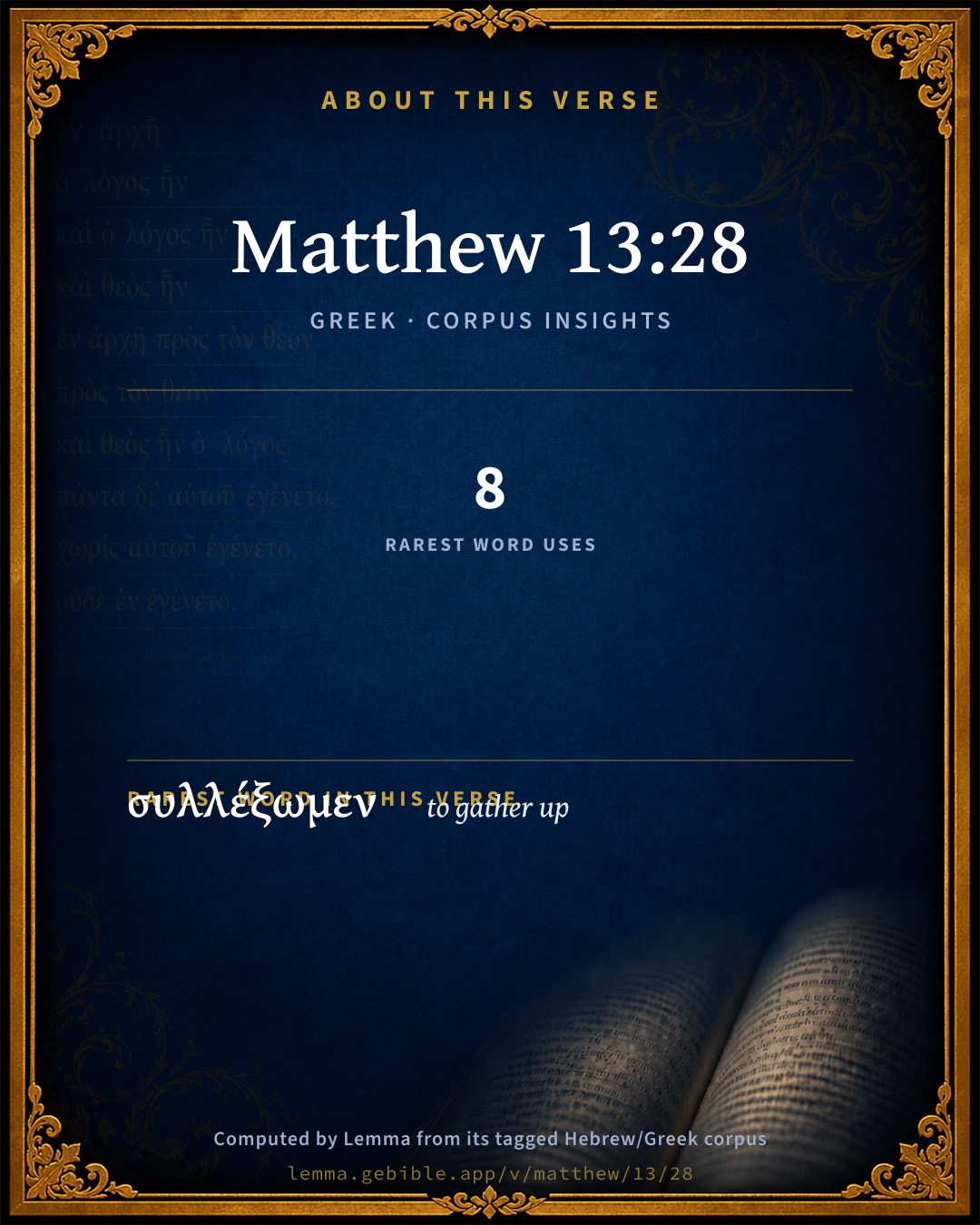
Matthew 13:28

Greek (Tischendorf 8th ed.) Matthew 13:28 appears in the Greek New Testament. The text above is from the Tischendorf 8th edition. Each word links to its Strong’s number and a concise gloss. Click any word for its full Thayer’s Greek Lexicon entry.
Download image
Cite this verse

Matthew 13:28 (World English Bible). Public Domain. Lemma interlinear Bible study tool, https://lemma.gebible.app/v/matthew/13/28.

Show BibTeX & RIS
BibTeX
RIS
English Translation
"He said to them, 'An enemy has done this.' "The servants asked him, 'Do you want us to go and gather them up?'
World English Bible · Public Domain
Download a study sheet

One document with this verse’s original text, its word-by-word gloss line, the meaning frame, cross-references with their text, attributed commentary, and full source and license credits — printable, and it pastes into notes with its structure intact.

This verse Autodidact and up

Study sheet (.html) Plain text (.txt)

A passage Seminary Student

Up to 50 verses in one chapter. A passage sheet keeps up to 6 commentary sources and 12 cross-references per verse, in the order this page ranks them, and says so on the sheet whenever that leaves anything out. Ask for a single verse and you get the Autodidact verse sheet above.

Everything on this page stays free to read, with no account — the sheet is a download of what is already on screen, not access to it.

Want to remove ads? Support Godless Engineer
Compare translations 3

The same verse in 3 English versions, stacked beneath the original-language interlinear above. Click any original word for its lexicon entry.

Each is an independent rendering of the whole verse — the interlinear is not word-aligned to these translations.

Highlighted words mark where these versions differ — a whole-verse word diff, not a word-by-word alignment.

  • World English Bible Public Domain
    "He said to them, 'An enemy has done this.' "The servants asked him, 'Do you want us to go and gather them up?'
  • King James Version Public Domain
    He said unto them, An enemy hath done this. The servants said unto him, Wilt thou then that we go and gather them up?
  • unfoldingWord Literal Text CC BY-SA 4.0
    But he was saying to them, ‘A hostile man did this.’ But the servants say to him, ‘Do you therefore desire that, having gone out, we would gather them?’

unfoldingWord Literal Text — © unfoldingWord, licensed CC BY-SA 4.0. Word-aligned USFM3 via Door43 (git.door43.org/unfoldingWord/en_ult).

Versions to compare (up to 4)

3 of 4 selected

Show all 19 translations

Every available English version of this verse, each an independent rendering of the whole verse.

  • World English Bible Public Domain
    "He said to them, 'An enemy has done this.' "The servants asked him, 'Do you want us to go and gather them up?'
  • Berean Standard Bible Public Domain
    ‘An enemy did this,’ he replied. So the servants asked him, ‘Do you want us to go and pull them up?’
  • Majority Standard Bible Public Domain
    ‘An enemy did this,’ he replied. So the servants asked him, ‘Do you want us to go and pull them up?’
  • King James Version Public Domain
    He said unto them, An enemy hath done this. The servants said unto him, Wilt thou then that we go and gather them up?
  • American Standard Version (1901) Public Domain
    And he said unto them, An enemy hath done this. And the servants say unto him, Wilt thou then that we go and gather them up?
  • Revised Version (1885) Public Domain
    And he said unto them, An enemy hath done this. And the servants say unto him, Wilt thou then that we go and gather them up?
  • Geneva Bible (1599) Public Domain
    And hee said to them, Some enuious man hath done this. Then the seruants saide vnto him, Wilt thou then that we go and gather them vp?
  • Douay-Rheims (1899) Public Domain
    And he said to them: An enemy hath done this. And the servants said to him: Wilt thou that we go and gather it up?
  • Young's Literal Translation Public Domain
    And he saith to them, A man, an enemy, did this; and the servants said to him, Wilt thou, then, `that' having gone away we may gather it up?
  • Literal Standard Version CC BY-SA 4.0
    And he says to them, A man, an enemy, did this; and the servants said to him, Will you, then, [that] having gone away we may gather it up?
  • Unlocked Literal Bible CC BY-SA 4.0
    He said to them, 'An enemy has done this.' The servants said to him, 'So do you want us to go and pull them out?'
  • unfoldingWord Literal Text CC BY-SA 4.0
    But he was saying to them, ‘A hostile man did this.’ But the servants say to him, ‘Do you therefore desire that, having gone out, we would gather them?’
  • Darby Bible Public Domain
    And he said to them, A man [that is] an enemy has done this. And the bondmen said to him, Wilt thou then that we should go and gather it [up]?
  • World Messianic Bible Public Domain
    “He said to them, ‘An enemy has done this.’ “The servants asked him, ‘Do you want us to go and gather them up?’
  • Webster's Bible Public Domain
    He said to them, An enemy hath done this. The servants said to him, Wilt thou then that we go and gather them?
  • Free Bible Version CC BY-SA 4.0
    ‘Some enemy has done this,’ he replied. ‘Do you want us to go and pull up the weeds?’ they asked him.
  • Bible in Basic English Public Domain
    And he said, Someone has done this in hate. And the servants say to him, Is it your pleasure that we go and take them up?
  • Text-Critical English NT CC BY 4.0
    He said to them, ‘An enemy has done this.’ So the servants said to him, ‘Do yoʋ want us to go and gather them up?’
  • Tyndale New Testament (1534) Public Domain
    He sayde to the the envious man hath done this. Then the servauntes sayde vnto him: wilt thou then that we go and gader them?

Literal Standard Version (2020), Covenant Press — licensed CC BY-SA 4.0. Text via the HelloAO Bible API (eBible.org). Unlocked Literal Bible (unfoldingWord) — licensed CC BY-SA 4.0. Text via the HelloAO Bible API (eBible.org). unfoldingWord Literal Text — © unfoldingWord, licensed CC BY-SA 4.0. Word-aligned USFM3 via Door43 (git.door43.org/unfoldingWord/en_ult). Free Bible Version, Dr. Jonathan Gallagher — licensed CC BY-SA 4.0. Text via the HelloAO Bible API (eBible.org).

Word by word

More ways to search: Search by grammar → Find every occurrence → Compare this word →

Practice this passage: Drill this verse → Learn its vocabulary →

συλλέξωμεν
syllégō
G4816
“to gather up”
Verb, Aorist, Active, Subjunctive, 1st person, Plural
Part of Speech
Verb
Tense
Aorist
Voice
Active
Mood
Subjunctive
Person
1st person
Number
Plural
Full Thayer's Definition

Origin: from G4862 and G3004 in its original sense

TDNT: None

1. to gather up 2. to collect in order to carry off
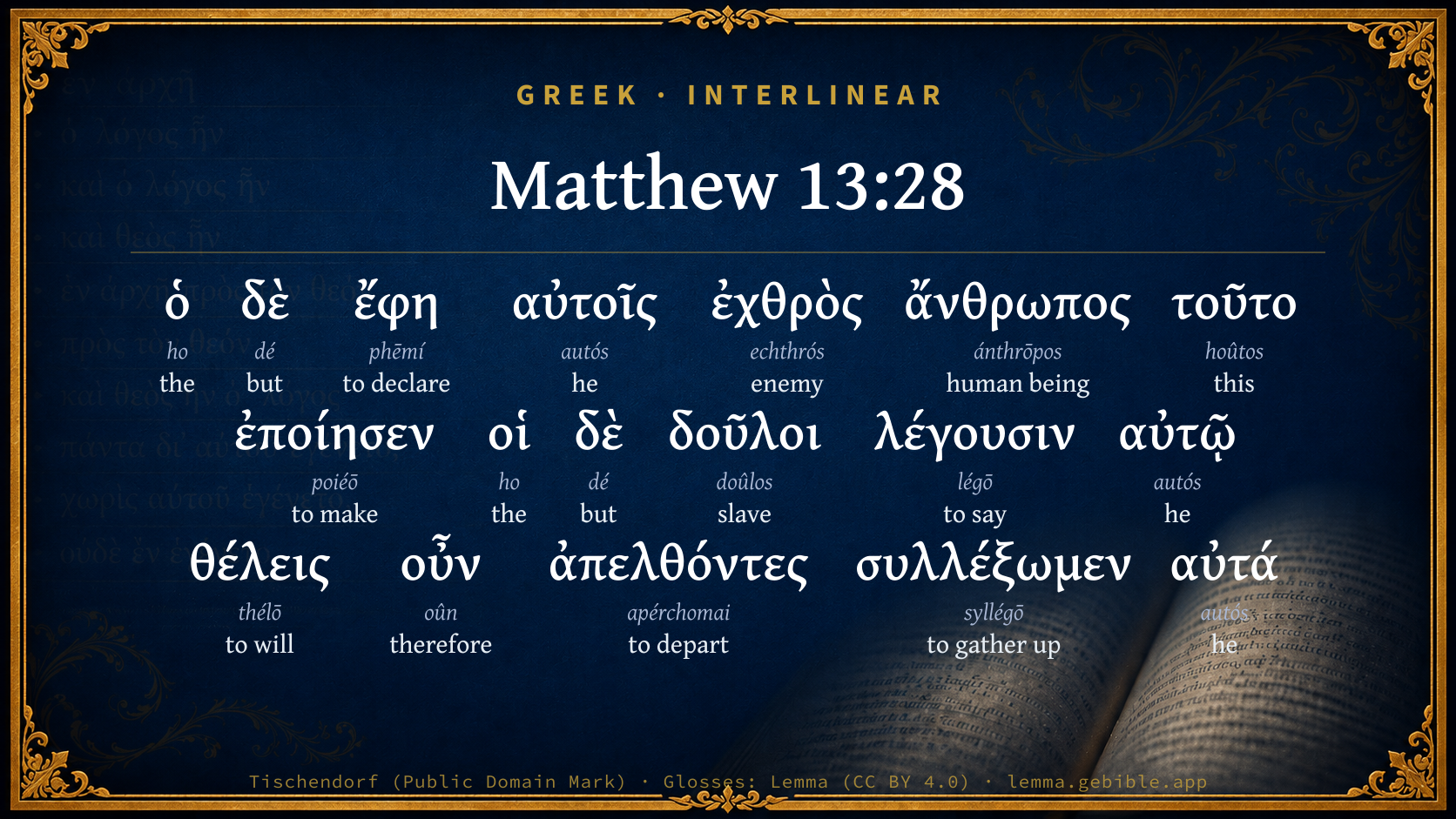
  1. ὁ ho G3588 “the” Article, Nominative, Singular, Masculine
  2. δὲ dé G1161 “but” Conjunction
  3. ἔφη phēmí G5346 “to declare” Verb, Imperfect, Active, Indicative, 3rd person, Singular
  4. αὐτοῖς autós G846 “he” Personal pronoun, Dative, Plural, Masculine
  5. ἐχθρὸς echthrós G2190 “enemy” Adjective, Nominative, Singular, Masculine
  6. ἄνθρωπος ánthrōpos G444 “human being” Noun, Nominative, Singular, Masculine
  7. τοῦτο hoûtos G3778 “this” Demonstrative pronoun, Accusative, Singular, Neuter
  8. ἐποίησεν poiéō G4160 “to make” Verb, Aorist, Active, Indicative, 3rd person, Singular
  9. οἱ ho G3588 “the” Article, Nominative, Plural, Masculine
  10. δὲ dé G1161 “but” Conjunction
  11. δοῦλοι doûlos G1401 “slave” Noun, Nominative, Plural, Masculine
  12. λέγουσιν légō G3004 “to say” Verb, Present, Active, Indicative, 3rd person, Plural
  13. αὐτῷ autós G846 “he” Personal pronoun, Dative, Singular, Masculine
  14. θέλεις thélō G2309 “to will” Verb, Present, Active, Indicative, 2nd person, Singular
  15. οὖν oûn G3767 “therefore” Conjunction
  16. ἀπελθόντες apérchomai G565 “to depart” Verb, Aorist, Active, Participle, Nominative, Plural, Masculine
  17. αὐτά autós G846 “he” Personal pronoun, Accusative, Plural, Neuter

About this verse

These counts appear in no published source. They are computed here, from the morphology-tagged text and Lemma’s own curated glosses. What Lemma adds →

18
words
14
distinct lemmas
Gospels
section

Notable vocabulary

The rarest word here is συλλέξωμεν to gather up G4816 — appearing just 8 times in the whole Greek New Testament.

Shared distinctive vocabulary

συλλέξωμεν to gather up G4816 occurs in 8 verses of the Greek New Testament. Also found in:

Repetition

Words recur within this verse:

Cross-references

5

Topical passages linked to Matthew 13:28 in the Treasury of Scripture Knowledge — connected by theme and wording, ordered by reader-vote popularity; previews shown in the World English Bible.

  • 1 Corinthians 5:3–7 For I most assuredly, as being absent in body but present in spirit, have already, as though I were present, judged him who has done this thing.
  • 1 Thessalonians 5:14 We exhort you, brothers, admonish the disorderly, encourage the fainthearted, support the weak, be patient toward all.
  • Luke 9:49–54 John answered, "Master, we saw someone casting out demons in your name, and we forbade him, because he doesn't follow with us."
  • 2 Corinthians 2:6–11 Sufficient to such a one is this punishment which was inflicted by the many;
  • Jude 1:22–23 On some have compassion, making a distinction,

Cross-references courtesy of OpenBible.info (CC BY 4.0).

Commentary

Notes on Matthew 13:28 from classic Christian and Jewish commentators (each source and its license shown beneath its notes). The classic Christian expositions comment on the surrounding passage and are grouped to its opening verse, so a note may address several verses; the Jewish commentaries on the Tanakh (Rashi and others) are per-verse, so they appear only where the commentator wrote on this verse.

Lemma curates 59 commentaries, every one of them public domain or Creative Commons licensed, each selected and text-cleaned for this edition rather than reprinted as found. About our sources →

Tyndale Open Study Notes

Tyndale Open Resources

13:28-30 Just as Jesus rebuked the sons of Zebedee for wanting to destroy unbelieving villages (Luke 9:54-55), he prohibited his followers from retaliating against enemies. Judgment is God’s work (see Matt 7:1-5). Jesus urges his followers to wait patiently for God’s righteous judgment (the harvest; see Luke 13:6-9).

Tyndale Open Study Notes — © Tyndale Open Resources, licensed CC BY-SA 4.0. Text via the HelloAO Bible API.

Expositor's Greek Testament

ed. W. Robertson Nicoll

Mat 13:28 . ἐχθρὸς ἄν .: an inference from the state of the field fact not otherwise or previously known. θέλεις … συλλέξωμεν , deliberative subjunctive in 1st person with θέλεις , 2nd person; no ἵνα used in such case (Burton, M. and T., § 171). The servants propose to do what was ordinarily done, and is done still ( vide Stanley, Sinai and Palestine , p. 426, and Furrer, Wanderungen , 293: “men, women and children were in many fields engaged in pulling up the weeds,” in which he includes “den Lolch”).

The Expositor's Greek Testament, edited by W. Robertson Nicoll (1897–1910) — public domain. Text from a community e-Sword module.

Jamieson, Fausset & Brown

Robert Jamieson, A. R. Fausset & David Brown

He said unto them, An enemy hath done this--Kind words these from a good Husbandman, honorably clearing His faithful servants of the wrong done to his field.

The servants said unto him, Wilt thou then that we go and gather them up?--Compare with this the question of James and John (Luk 9:54), "Lord, wilt Thou that we command fire to come down from heaven and consume" those Samaritans? In this kind of zeal there is usually a large mixture of carnal heat. (See Jam 1:20).

Jamieson, Fausset & Brown — Commentary Critical and Explanatory on the Whole Bible (1871) — public domain (CC PDM 1.0). Text via the HelloAO Bible API.

Adam Clarke's Commentary

Verse 28. An enemy hath done this] It is the interest of Satan to introduce hypocrites and wicked persons into religious societies, in order to discredit the work of God, and to favour his own designs.

Wilt thou then that we go and gather them up?] A zeal which is rash and precipitate is as much to be feared as the total lack of strict discipline.

Adam Clarke's Commentary on the Bible (1810–1826) — public domain. Text from a community e-Sword/MySword module.

John Gill's Exposition

Let both grow together until the harvest,.... By "the harvest", is meant "the end of the world", Mat 13:39 either of the Jewish world, the dissolution of their church and state, which was near; or of a man's life, which is the end of the world to him; or rather of this present world, the system of the universe, of the material world, as to its present form and use, and of the inhabitants of it, and of time in it. Now the end of the world is compared to harvest, because the time of it is fixed and settled; though it is not known when it will be, yet it is as certain as the time of harvest; and because as that is in the summer season, in hot weather, so this will be a time of wrath, when the day of the Lord will burn like an oven; and as the harvest time is a time of hurry and labour, so will it be in the end of the world, especially with the angels, who will be gathering the elect from the four winds, and all men, to appear before the judgment seat of Christ; and as at harvest the corn is cut down, the fields cleared, and all brought home, so it will be at the end of the world; the sickle will be thrust in, and the earth reaped, the tares bound in bundles, and cast into the fire, and the wheat gathered into the garner; and as the harvest, as it falls out to be good or bad, is matter of joy or sorrow, so will the end of the world be joy to saints, who will then enter into the joy of their Lord, and be for ever with him, and sorrow to the wicked, who will then go into everlasting punishment. Until this time, wheat and tares are to "grow" together. The "wheat", or true believers, "grow" in the exercise of grace, as of faith, hope, love, humility, &c. and in spiritual knowledge of the will of God, of the doctrines of grace, and of Christ; which growth is owing to the dews of divine grace, to the sun of righteousness shining upon them, to the gracious influences of the blessed Spirit, and to the word and ordinances as means. The "tares", or nominal professors, may "grow" in riches, in credit, and reputation among men, and in speculative knowledge; and oftentimes so it is, that they grow worse and worse, both in doctrinal and practical wickedness: when they are ordered to "grow together", the meaning is, not that their growth is equal, or of the same kind, nor in the same way, nor in the same things; but this only notes the time and duration of their growth: nor is this suffered and permitted, because of any love God has unto them, or any delight in, or approbation of them; but either because they are not fully ripe for ruin; or for the exercise of the saints, and for their temporal and spiritual good; for it is entirely a tender regard to the wheat, and not to the tares, that they are ordered to grow together,

And in the time of harvest, I will say to the reapers, the angels,

Mat 13:39.

gather ye together first the tares; that is, formal professors, hypocrites, and heretics; whom he will have removed out of his kingdom, his church, his field, in the world: and this order shows, that the angels will have a perfect and exact knowledge of these persons; and that their work will be to separate them from the righteous; when the churches will be pure, and without spot, or wrinkle: and this will be done first; that is, these wicked men will be first removed out of the church, before their more severe punishment takes place:

and bind them in bundles to burn them: which denotes the power of angels over these persons, the certainty and inevitableness of their ruin, their association together, and their destruction in company with one another; which will be an aggravation of their misery, which is expressed by "burning" with fire; not material, but metaphorical; the wrath of God, which will be a consuming fire, and be everlasting and unquenchable,

But gather the wheat into my barn; meaning the kingdom of heaven, which is as a garner or repository, in which none but wheat is put, and where it is safe, and lies together: so none but righteous, pure, and undefiled persons, are admitted into heaven; and being there, they are safe, and out of the reach of all enemies; and what adds to their happiness is, that they are together, enjoying all satiety and fulness; and are in Christ's barn, or garner, which he has made, and prepared for their reception. The gathering of them into it designs the introduction of the saints into heaven by angels, as their souls at death, and both souls and bodies, at the last day, when their happiness will be perfect and complete.

John Gill's Exposition of the Whole Bible (1746–1763) — public domain (CC PDM 1.0). Text via the HelloAO Bible API.

Trapp's Complete Commentary

John Trapp

28 He said unto them, An enemy hath done this. The servants said unto him, Wilt thou then that we go and gather them up?

Ver. 28. Wilt thou then that we go, &c.] This was zeal indeed, but rash and unseasonable, and is therefore to be moderated by prudence and patience. Those two sons of thunder had overly quick and hot spirits, Luk 9:55. Luther confessed before the emperor at Worms, that in his books against private and particular persons he had been more vehement than his religion and profession required. And he that writes the history of the Trent Council tells us, if we may believe him, that in Colloquio Possiaceno, Beza, speaker for the Protestants, entering into the matter of the Eucharist, spake with such heat, that he gave but ill satisfaction to those of his own party; so that he was commanded to conclude. Zeal should eat us up, but not eat up our discretion, our moderation.

John Trapp, A Commentary or Exposition upon All the Books of the Old and New Testament (1647–1656) — public domain. Text from a community e-Sword module.

Whedon's Commentary on the Bible

Daniel D. Whedon

28. Wilt thou… we go and gather them up — Ought not the wicked to be destroyed from the face of the earth? Why are they permitted to exist?

Does it not almost make atheists of us to see how God permits them to live and prosper? No; for the permission is for them to live to develope; and so God will not eradicate them out of the earth, and good men must not expect to be able to persecute them to destruction.

Eastern farmers maintain that tares are degenerate wheat, affirming that a field is frequently sown with wheat and the seed comes up tares. Dr. Thomson explains this singular fact thus:

“I suppose that several separate causes conspire to bring about the result. First, very wet weather in winter drowns and kills wheat, while it is the most favourable of all weather for tares. In a good season the wheat overgrows and chokes the tares, but in a wet one the reverse is true. The farmers all admit this, but still they ask, Whence the seed of the tares? we sowed ‘good seed.’ To this it may be answered: The tare is a very light grain, easily blown about by the wind; that a thousand little birds are ever carrying and dropping it over the fields; that myriads of ants are dragging it in all directions; that moles, and mice, and goats, and sheep, and nearly every other animal, are aiding in this work of dispersion; that much of the tares shell out in handling the grain in the field; that a large part of them is thrown out by the wind at the threshing-floor, which is always in the open country; that the heavy rains, which often deluge the country in autumn, carry down to the lower levels this outcast zowan (tares) and sow them there; and these are precisely the spots where the transmutation is said to occur. It is my belief that in these and in similar ways the tares are actually sown, without the intervention of an enemy, and their presence is accounted for without having recourse to this incredible doctrine of transmutation.”

Root up also the wheat — Commentators sometimes understand by this that we are forbidden to persecute heretics in the Church, for we may be mistaken in men’s characters and put innocent men to death. Now, first, this is a poor reason against persecution. Second, it is not the Church but the world which is symbolized by the field. Third, by this mode of interpretation the servants are both men and a part of the wheat at the same moment. And, fourth, the reason supposed is not the reason expressed in the text. The reason in the text is not that they might mistake wheat for tares, and so pull it up. It is that, in the violence of the work, both would be pulled up, and the field be destroyed. The destruction of probationary sinners would be the destruction of the probationary system.

It is no doubt true that the tares when first springing up strongly resemble the wheat, so as to be easily mistaken for it; but not after a little growth. Dr. Thomson expresses the real point, when he says: “Very commonly the roots of the two are so intertwined that it is impossible to separate them without plucking up both. Both, therefore, must be left to grow together until the time of harvest.”

Daniel D. Whedon (gen. ed.), Commentary on the Old and New Testaments (1874–1909) — public domain. Text from a community e-Sword module.

The Pulpit Commentary

He said unto them, An enemy hath done this. An enemy (ecyrov anyrwpov). Not "my enemy," referring to some one person, for in real life a man can seldom be at once sure, without inquiry, who it is that has injured him secretly. There are so many coincidences in this verse and ver. 39 (ecyrov anyrwpov touto epoihsen , Aman ponhro outov , o diabolov) with the LXX of Est_7:4-6, that it would almost seem as though the evangelist remembered that passage. The servants said unto him, Wilt thou then that we go and gather them up? Omit up (sullexwmen); the servants, in their zeal to separate the tares from the wheat, forget the difficulty connected with pulling them up.

The Pulpit Commentary (1880–1919), ed. H.D.M. Spence-Jones & Joseph S. Exell — public domain. Text from a community e-Sword module.

John Wesley's Explanatory Notes

He said, An enemy hath done this - A plain answer to the great question concerning the origin of evil. God made men (as he did angels) intelligent creatures, and consequently free either to choose good or evil: but he implanted no evil in the human soul: An enemy (with man's concurrence) hath done this. Darnel, in the Church, is properly outside Christians, such as have the form of godliness, without the power. Open sinners, such as have neither the form nor the power, are not so properly darnel, as thistles and brambles: these ought to be rooted up without delay, and not suffered in the Christian community. Whereas should fallible men attempt to gather up the darnel, they would often root up the wheat with them.

John Wesley, Explanatory Notes Upon the Whole Bible (1754–1765) — public domain. Text via the GEBible commentary corpus.

The People's New Testament

B. W. Johnson

28. An enemy hath done this. The great enemy, the prince of the world, who sows evil seed in human hearts. Wilt thou that we go and gather them up? It has been assumed by one class of interpreters that this a question whether discipline shall be administered upon recreant church members. If the field in which the tares are growing with the wheat is “the world,” then it refers to something quite different.

B. W. Johnson's The People's New Testament with Notes (1889–1891) — public domain. Electronic text from the Christian Classics Ethereal Library (CCEL) ThML edition.

International Critical Commentary

(L) 28. And he said to them, An enemy hath done this. And the servants say to him, Dost thou wish, therefore, that we go and gather them?]

International Critical Commentary — older volumes (1896–1929), various authors — public domain. Text from a community e-Sword module.

Lesson kit

Teaching starters — assembled from the data on this page, not authored interpretation. Every prompt links to the verse data it draws on. Edit before teaching.

Matthew, in the Gospels, opens this verse with 18 words (14 distinct Greek lemmas). Its most distinctive word is syllégō (“to gather up”). A historical commentator’s framing appears above. Read the whole chapter for the surrounding context.

Discussion questions

  1. What does “to gather up” (syllégō) contribute to the verse as a whole?
  2. Matthew 7:16 shares the word «to gather up» with this verse. How do the two illuminate each other?
  3. “he” occurs 3× in this one verse. What is the effect of the repetition?
  4. These translations render this verse differently; the difference is in the English rendering, not the original. What questions does that raise?
  5. Reading how Tyndale Open Study Notes and Expositor's Greek Testament read this verse, where do the two commentators agree and where do they part?

Things to notice

Reading settings

Reading text

Shown beneath each verse's original-language words.

Old Testament
Old Testament edition

Read the OT as the Masoretic Hebrew (MT) or the Greek Septuagint (LXX).

English shown for the Greek Septuagint (in the Hebrew ↔ Greek comparison).

Comparing translations? Open the Compare panel on any verse page to stack up to four side by side.