
Luke 18:7

Greek (Tischendorf 8th ed.) Luke 18:7 appears in the Greek New Testament. The text above is from the Tischendorf 8th edition. Each word links to its Strong’s number and a concise gloss. Click any word for its full Thayer’s Greek Lexicon entry.
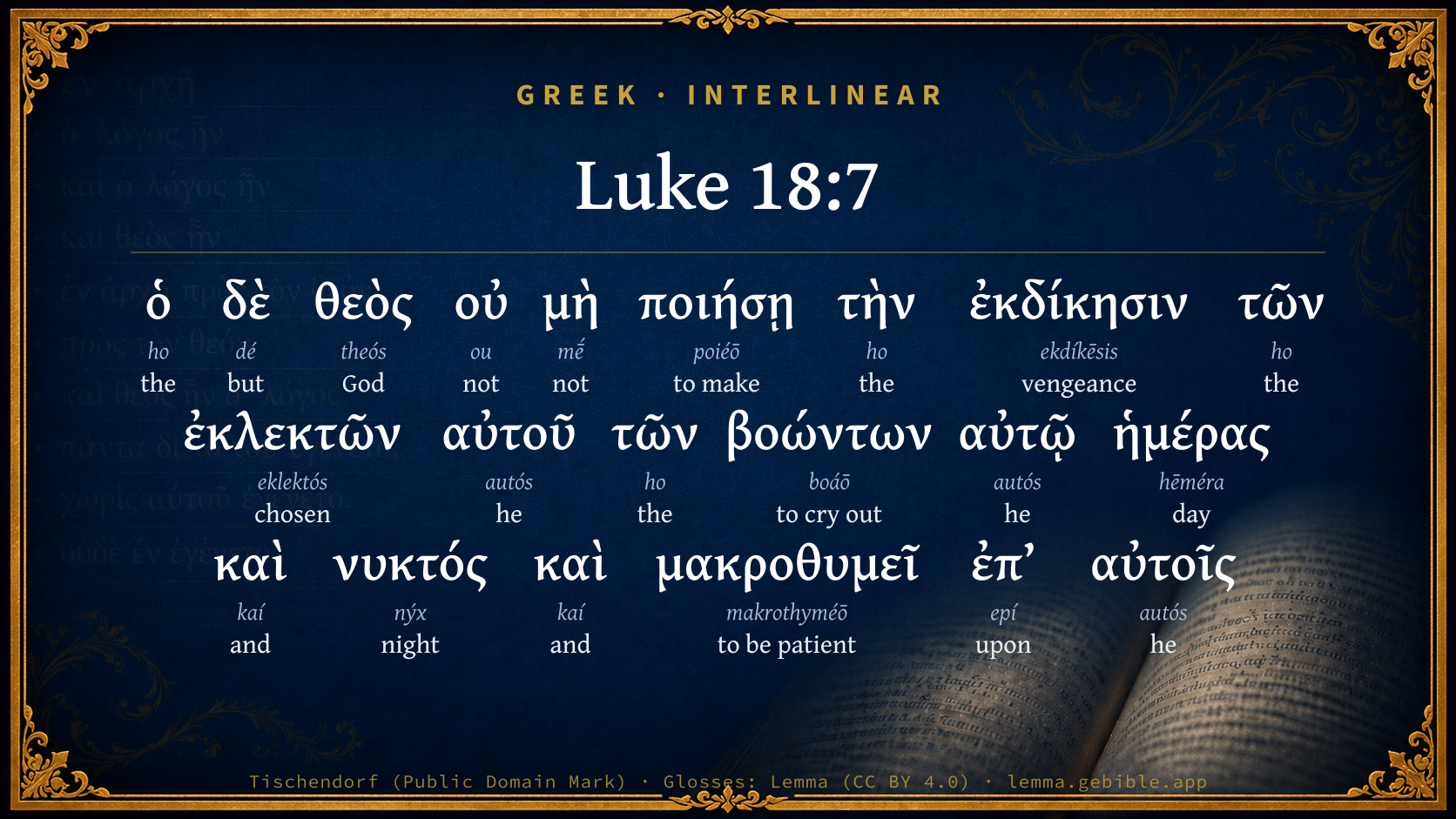
Download image
Cite this verse

Luke 18:7 (World English Bible). Public Domain. Lemma interlinear Bible study tool, https://lemma.gebible.app/v/luke/18/7.

Show BibTeX & RIS
BibTeX
RIS
English Translation
Won't God avenge his chosen ones, who are crying out to him day and night, and yet he exercises patience with them?
World English Bible · Public Domain
Highlights
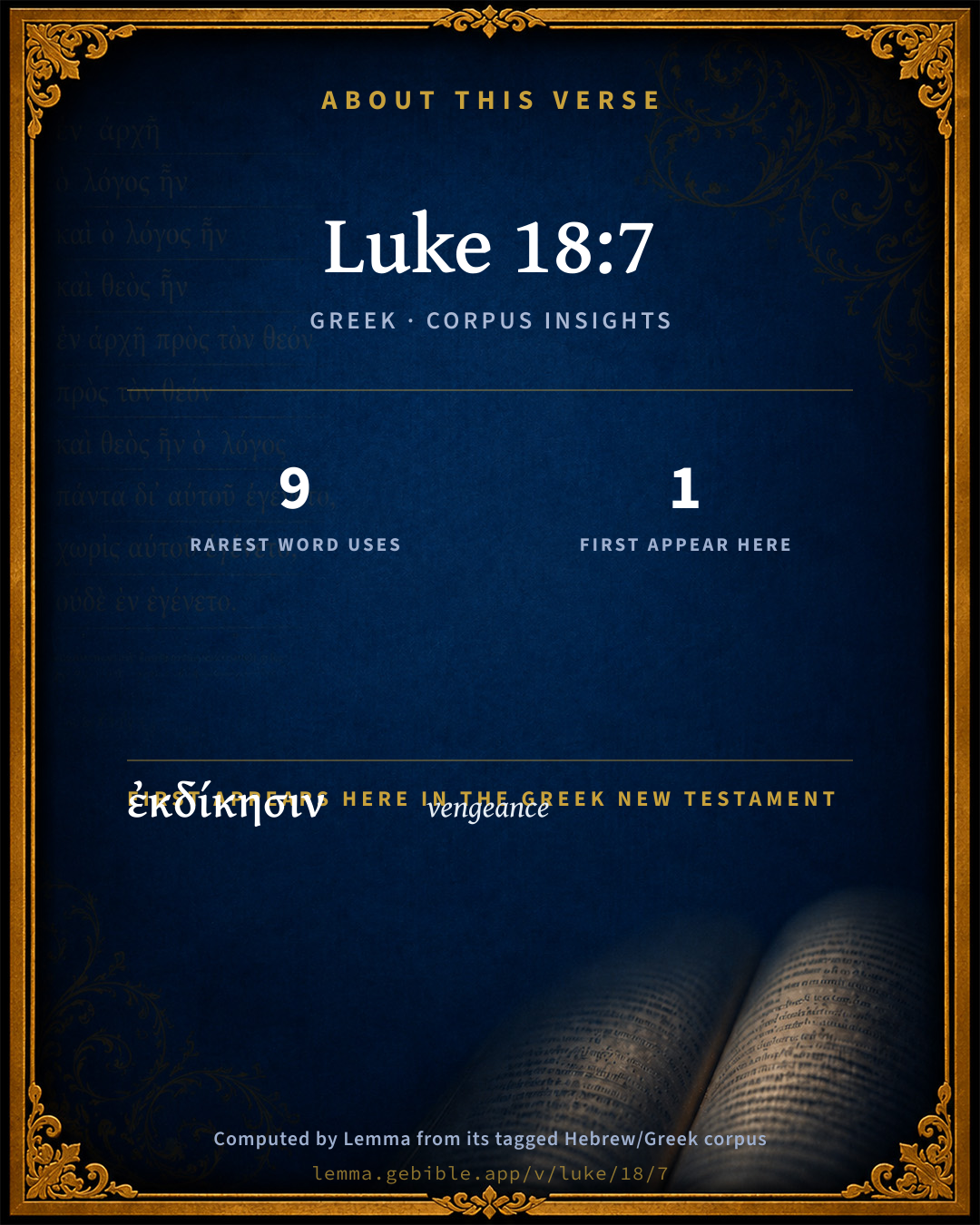
  • 1 first appearance in the Greek New Testament
Full analysis ↓
Download a study sheet

One document with this verse’s original text, its word-by-word gloss line, the meaning frame, cross-references with their text, attributed commentary, and full source and license credits — printable, and it pastes into notes with its structure intact.

This verse Autodidact and up

Study sheet (.html) Plain text (.txt)

A passage Seminary Student

Up to 50 verses in one chapter. A passage sheet keeps up to 6 commentary sources and 12 cross-references per verse, in the order this page ranks them, and says so on the sheet whenever that leaves anything out. Ask for a single verse and you get the Autodidact verse sheet above.

Everything on this page stays free to read, with no account — the sheet is a download of what is already on screen, not access to it.

Want to remove ads? Support Godless Engineer
Compare translations 3

The same verse in 3 English versions, stacked beneath the original-language interlinear above. Click any original word for its lexicon entry.

Each is an independent rendering of the whole verse — the interlinear is not word-aligned to these translations.

Highlighted words mark where these versions differ — a whole-verse word diff, not a word-by-word alignment.

  • World English Bible Public Domain
    Won't God avenge his chosen ones, who are crying out to him day and night, and yet he exercises patience with them?
  • King James Version Public Domain
    And shall not God avenge his own elect, which cry day and night unto him, though he bear long with them?
  • unfoldingWord Literal Text CC BY-SA 4.0
    And will not God do the vindication of his elect, the ones crying out to him day and night, and he delays long over them?

unfoldingWord Literal Text — © unfoldingWord, licensed CC BY-SA 4.0. Word-aligned USFM3 via Door43 (git.door43.org/unfoldingWord/en_ult).

Versions to compare (up to 4)

3 of 4 selected

Show all 19 translations

Every available English version of this verse, each an independent rendering of the whole verse.

  • World English Bible Public Domain
    Won't God avenge his chosen ones, who are crying out to him day and night, and yet he exercises patience with them?
  • Berean Standard Bible Public Domain
    Will not God bring about justice for His elect who cry out to Him day and night? Will He continue to defer their help?
  • Majority Standard Bible Public Domain
    Will not God bring about justice for His elect who cry out to Him day and night? Will He delay in helping them?
  • King James Version Public Domain
    And shall not God avenge his own elect, which cry day and night unto him, though he bear long with them?
  • American Standard Version (1901) Public Domain
    And shall not God avenge his elect, that cry to him day and night, and `yet' he is longsuffering over them?
  • Revised Version (1885) Public Domain
    And shall not God avenge his elect, which cry to him day and night, and he is longsuffering over them?
  • Geneva Bible (1599) Public Domain
    Now shall not God auenge his elect, which cry day and night vnto him, yea, though he suffer long for them?
  • Douay-Rheims (1899) Public Domain
    And will not God revenge his elect who cry to him day and night: and will he have patience in their regard?
  • Young's Literal Translation Public Domain
    and shall not God execute the justice to His choice ones, who are crying unto Him day and night -- bearing long in regard to them?
  • Literal Standard Version CC BY-SA 4.0
    and will God not execute justice to His chosen ones, who are crying to Him day and night—bearing long in regard to them?
  • Unlocked Literal Bible CC BY-SA 4.0
    Now will not God also bring justice to his chosen ones who cry out to him day and night? Will he delay long over them?
  • unfoldingWord Literal Text CC BY-SA 4.0
    And will not God do the vindication of his elect, the ones crying out to him day and night, and he delays long over them?
  • Darby Bible Public Domain
    And shall not God at all avenge his elect, who cry to him day and night, and he bears long as to them?
  • World Messianic Bible Public Domain
    Won’t God avenge his chosen ones who are crying out to him day and night, and yet he exercises patience with them?
  • Webster's Bible Public Domain
    And will not God avenge his own elect, who cry day and night to him, though he beareth long with them?
  • Free Bible Version CC BY-SA 4.0
    “Don't you think that God will make sure his chosen people receive justice, those who cry out to him day and night? Do you think he will make them wait?
  • Bible in Basic English Public Domain
    And will not God do right in the cause of his saints, whose cries come day and night to his ears, though he is long in doing it?
  • Text-Critical English NT CC BY 4.0
    If even he ultimately rendered a just decision, will not God patiently listen to his chosen ones, who cry out to him day and night, and give them justice?
  • Tyndale New Testament (1534) Public Domain
    And shall not god avenge his electe which crye daye and nyght vnto him ye though he differre them.

Literal Standard Version (2020), Covenant Press — licensed CC BY-SA 4.0. Text via the HelloAO Bible API (eBible.org). Unlocked Literal Bible (unfoldingWord) — licensed CC BY-SA 4.0. Text via the HelloAO Bible API (eBible.org). unfoldingWord Literal Text — © unfoldingWord, licensed CC BY-SA 4.0. Word-aligned USFM3 via Door43 (git.door43.org/unfoldingWord/en_ult). Free Bible Version, Dr. Jonathan Gallagher — licensed CC BY-SA 4.0. Text via the HelloAO Bible API (eBible.org).

Word by word

More ways to search: Search by grammar → Find every occurrence → Compare this word →

Practice this passage: Drill this verse → Learn its vocabulary →

ἐκδίκησιν
ekdíkēsis
G1557
“vengeance”
Noun, Accusative, Singular, Feminine
Part of Speech
Noun
Case
Accusative
Number
Singular
Gender
Feminine
Full Thayer's Definition

Origin: from G1556

TDNT: 09:25,2

1. a revenging, vengeance, punishment In 2 Cor 7:11 -- meeting out of justice; doing justice to allparties. See Luke 18:3 , 21:22 . The word also has the sense ofacquittal and carries the sense of vindication. - Vincent III p. 329
  1. ὁ ho G3588 “the” Article, Nominative, Singular, Masculine
  2. δὲ dé G1161 “but” Conjunction
  3. θεὸς theós G2316 “God” Noun, Nominative, Singular, Masculine
  4. οὐ ou G3756 “not” Particle, Negative
  5. μὴ mḗ G3361 “not” Particle, Negative
  6. ποιήσῃ poiéō G4160 “to make” Verb, Aorist, Active, Subjunctive, 3rd person, Singular
  7. τὴν ho G3588 “the” Article, Accusative, Singular, Feminine
  8. τῶν ho G3588 “the” Article, Genitive, Plural, Masculine
  9. ἐκλεκτῶν eklektós G1588 “chosen” Adjective, Genitive, Plural, Masculine
  10. αὐτοῦ autós G846 “he” Personal pronoun, Genitive, Singular, Masculine
  11. τῶν ho G3588 “the” Article, Genitive, Plural, Masculine
  12. βοώντων boáō G994 “to cry out” Verb, Present, Active, Participle, Genitive, Plural, Masculine
  13. αὐτῷ autós G846 “he” Personal pronoun, Dative, Singular, Masculine
  14. ἡμέρας hēméra G2250 “day” Noun, Genitive, Singular, Feminine
  15. καὶ kaí G2532 “and” Conjunction
  16. νυκτός nýx G3571 “night” Noun, Genitive, Singular, Feminine
  17. καὶ kaí G2532 “and” Conjunction
  18. μακροθυμεῖ makrothyméō G3114 “to be patient” Verb, Present, Active, Indicative, 3rd person, Singular
  19. ἐπ’ epí G1909 “upon” Preposition
  20. αὐτοῖς autós G846 “he” Personal pronoun, Dative, Plural, Masculine

About this verse

These counts appear in no published source. They are computed here, from the morphology-tagged text and Lemma’s own curated glosses. What Lemma adds →

21
words
15
distinct lemmas
Gospels
section

Notable vocabulary

The rarest word here is ἐκδίκησιν vengeance G1557 — appearing just 9 times in the whole Greek New Testament.

First appearance in Scripture

This word makes its first canonical appearance in the Greek New Testament here:

  • ἐκδίκησιν vengeance G1557

Shared distinctive vocabulary

ἐκδίκησιν vengeance G1557 occurs in 9 verses of the Greek New Testament. Also found in:
Repetition

Words recur within this verse:

Cross-references

24

Topical passages linked to Luke 18:7 in the Treasury of Scripture Knowledge — connected by theme and wording, ordered by reader-vote popularity; previews shown in the World English Bible.

  • Hebrews 10:35–37 Therefore don't throw away your boldness, which has a great reward.
  • 2 Peter 3:9 The Lord is not slow concerning his promise, as some count slowness; but is patient with us, not wishing that any should perish, but that all should come to repentance.
  • Luke 11:13 If you then, being evil, know how to give good gifts to your children, how much more will your heavenly Father give the Holy Spirit to those who ask him?"
  • 1 Timothy 5:5 Now she who is a widow indeed, and desolate, has her hope set on God, and continues in petitions and prayers night and day.
  • Jeremiah 20:11–13 But Yahweh is with me as an awesome mighty one: therefore my persecutors shall stumble, and they shall not prevail; they shall be utterly disappointed, because they have not dealt wisely, even with an everlasting dishonor which shall never be forgotten.
  • 2 Thessalonians 1:6 Since it is a righteous thing with God to repay affliction to those who afflict you,
  • Luke 2:37 and she had been a widow for about eighty-four years), who didn't depart from the temple, worshipping with fastings and petitions night and day.
  • Revelation 6:10 They cried with a loud voice, saying, "How long, Master, the holy and true, until you judge and avenge our blood on those who dwell on the earth?"
  • Habakkuk 2:3 For the vision is yet for the appointed time, and it hurries toward the end, and won't prove false. Though it takes time, wait for it; because it will surely come. It won't delay.
  • Matthew 7:11 If you then, being evil, know how to give good gifts to your children, how much more will your Father who is in heaven give good things to those who ask him!
  • Psalms 13:1–2 How long, Yahweh? Will you forget me forever? How long will you hide your face from me?
  • Psalms 88:1 Yahweh, the God of my salvation, I have cried day and night before you.
  • 1 Samuel 26:10–11 David said, As Yahweh lives, Yahweh will strike him; or his day shall come to die; or he shall go down into battle and perish.
  • Psalms 54:1–7 Save me, God, by your name. Vindicate me in your might.
  • Romans 8:33 Who could bring a charge against God's chosen ones? It is God who justifies.
  • Revelation 18:20 Rejoice over her, O heaven, you saints, apostles, and prophets; for God has judged your judgment on her."
  • 1 Samuel 24:12–15 Yahweh judge between me and you, and Yahweh avenge me of you; but my hand shall not be on you.
  • Psalms 9:8 He will judge the world in righteousness. He will administer judgment to the peoples in uprightness.
  • Psalms 10:15–18 Break the arm of the wicked. As for the evil man, seek out his wickedness until you find none.
  • Colossians 3:12 Put on therefore, as God's chosen ones, holy and beloved, a heart of compassion, kindness, lowliness, humility, and perseverance;
  • 1 Thessalonians 3:10 night and day praying exceedingly that we may see your face, and may perfect that which is lacking in your faith?
  • 2 Timothy 1:3 I thank God, whom I serve as my forefathers did, with a pure conscience. How unceasing is my memory of you in my petitions, night and day
  • Titus 1:1 Paul, a servant of God, and an apostle of Jesus Christ, according to the faith of God's chosen ones, and the knowledge of the truth which is according to godliness,
  • Revelation 7:15 Therefore they are before the throne of God, they serve him day and night in his temple. He who sits on the throne will spread his tent over them.

Cross-references courtesy of OpenBible.info (CC BY 4.0).

Commentary

Notes on Luke 18:7 from classic Christian and Jewish commentators (each source and its license shown beneath its notes). The classic Christian expositions comment on the surrounding passage and are grouped to its opening verse, so a note may address several verses; the Jewish commentaries on the Tanakh (Rashi and others) are per-verse, so they appear only where the commentator wrote on this verse.

Lemma curates 59 commentaries, every one of them public domain or Creative Commons licensed, each selected and text-cleaned for this edition rather than reprinted as found. About our sources →

Tyndale Open Study Notes

Tyndale Open Resources

18:7 God will surely give justice: If persistence resulted in justice from this unjust judge, how much more will God, who loves both people and justice, answer our prayers.

Tyndale Open Study Notes — © Tyndale Open Resources, licensed CC BY-SA 4.0. Text via the HelloAO Bible API.

Bengel's Gnomon

Johann Albrecht Bengel

Luk 18:7. Θεὸς, God) Who is a most righteous Judge.—ποιήσῃ τὴν ἐκδίκησιν, effect the avenging of) These words are presently after repeated with the greatest force.—τῶν ἐκλεκτῶν αὐτοῦ, of His own elect) He is speaking of those elect in particular [besides the general truth taught by the parable] who were living at that time, and who were about to escape safe through the destruction of the city.—βοώντων, who cry) as being in great straits, to ask for their being avenged. [As being destitute of every other aid. This was the sacred anchor of David, Psa 55:17-18.—V. g.]—[ἡμέρας καὶ νυκτὸς, day and night) They severally cry night and day; but the cry of all, taken collectively, is undoubtedly altogether continuous, and never ceaseth.—V. g.]—μακροθυμεῖ) A striking reading [which, though the margin of the larger Edition judged it to be the inferior reading, is notwithstanding preferred to the other reading by the Germ. Version, which follows the margin of the Second Ed.—E. B.[198]] Any one may readily perceive the force of the construction (involved) in it: The elect cry to God, but God μακροθυμεῖ, bears long (delays the answer long), in their case (respecting them). The verb of the former member of the sentence in the text passes into the participle βοώντων, who cry; whilst the verb of the other member, μακροθυμεῖ, bears long (delays His purpose long), remains unmoved. I have brought together several examples of this construction, which has been assailed by many in all quarters, in my note on Mar 3:27. Moreover in this passage there is commended that long-suffering [long tarrying in executing His purpose] on the part of God, whereby He regards both the wrongs done by the wicked and the sufferings of the saints in such a way (comp. Isa 64:11-12) [Psa 83:1-2] as that He does not immediately make an end of both, although men think that His wrath against the wicked and His compassion towards the saints require a most speedy end to be made. At length there is accomplished that which is said of the just, Sir. 35:22 (Al. 32:18), οὐδὲ μὴ μακροθυμήσει ἐπʼ αὐτοῖς Κραταιός.

[198] ABDQLX read μακροθυμεῖ; Vulg. “patientiam habebit;” Rec. Text, μακροθυμῶν, with abc.—E. and T.

Bengel's Gnomon of the New Testament — English translation (T&T Clark, Edinburgh, 1860) — public domain. Text from a community e-Sword module.

Expositor's Greek Testament

ed. W. Robertson Nicoll

Luk 18:7 . οὐ μὴ ποιήσῃ , etc., will not God avenge, etc., the question implying strongly that He will, but the emphasis is rendered necessary by appearances to the contrary, which strongly try men’s faith in His good will long delays in answering prayer which wear the aspect of indifference. τῶν ἐκλεκτῶν α ., His elect: standing in a close relation, so named to support the previous assertion. But in the dark hour of trial it is difficult to extract comfort from the title. Then the doubt arises: is the idea of election not a delusion? What are we to the far-off Deity? τῶν βοώντων : from these words down to the end of the sentence ( ἐπʼ αὐτοῖς ) is a single clause meant to define the situation of “the elect”. They are persons who keep crying to God day and night, while He seems to pay no heed to them, but delays action in their case, and in their interest. The words down to νυκτός describe the need of Divine interference; those which follow describe the experience which tempts to doubt whether succour will be forthcoming. μακροθυμεῖ : this verb means to be slow, leisurely, unimpulsive in temper, whether in punishing or in succouring, or in any other form of action. Instances of the use of the verb in the first-mentioned occur in 2Ma 6:14 (cited by Pricaeus) and Sirach 35:22 ( οὐ μὴ βραδύνῃ οὐδὲ μὴ μακροθυμήσει ἐπʼ αὐτοῖς , frequently quoted). In Jas 5:7 it is applied to the husbandman waiting for harvest. Here it is applied to God’s leisureliness in coming to the help of tried saints. The construction καὶ μακροθυμεῖ is of the Hebraistic type.

The Expositor's Greek Testament, edited by W. Robertson Nicoll (1897–1910) — public domain. Text from a community e-Sword module.

Geneva Bible (1599)

Geneva Bible translators

Though he seems slow in revenging the injury done to his.

Geneva Bible (1599) marginal notes — public domain. Text via Bolls.life.

Jamieson, Fausset & Brown

Robert Jamieson, A. R. Fausset & David Brown

shall not God--not unjust, but the infinitely righteous Judge.

avenge--redeem from oppression.

his own elect--not like this widow, the object of indifference and contempt, but dear to Him as the apple of the eye (Zac 2:8).

cry day and night--whose every cry enters into the ears of the Lord of Sabaoth (Jam 5:4), and how much more their incessant and persevering cries!

bear long with them--rather, "in their case," or "on their account" (as) Jam 5:7, "for it"), [GROTIUS, DE WETTE, &c.].

Jamieson, Fausset & Brown — Commentary Critical and Explanatory on the Whole Bible (1871) — public domain (CC PDM 1.0). Text via the HelloAO Bible API.

Adam Clarke's Commentary

Verse 7. And shall not God avenge his own elect] And will not God the righteous Judge do justice for his chosen? Probably this may refer to the cruel usage which his disciples had met with, and were still receiving, from the disobedient and unbelieving Jews; and which should be finally visited upon them in the destruction of their city, and the calamities which should follow. But we may consider the text as having a more extensive meaning. As God has graciously promised to give salvation to every soul that comes unto him through his Son, and has put his Spirit in their hearts, inducing them to cry unto him incessantly for it; the goodness of his nature and the promise of his grace bind him to hear the prayers they offer unto him, and to grant them all that salvation which he has led them by his promise and Spirit to request.

Which cry day and night unto him, c.] This is a genuine characteristic of the true elect or disciples of Christ. They feel they have neither light, power, nor goodness, but as they receive them from him and, as he is the desire of their soul, they incessantly seek that they may be upheld and saved by him.

Though he bear long with them?] Rather, and HE is compassionate towards THEM, and consequently not at all like to the unrighteous judge. Instead of μακροθυμων, and be long-suffering, as in our translation, I read μακροθυμει, he is compassionate, which reading is supported by ABDLQ, and several others. The reason which our Lord gives for the success of his chosen, is,

1. They cry unto him day and night.

2. HE is compassionate towards THEM.

In consequence of the first, they might expect justice even from an unrighteous judge; and, in consequence of the second, they are sure of salvation, because they ask it from that God who is towards them a Father of eternal love and compassion. There was little reason to expect justice from the unrighteous judge.

1. Because he was unrighteous; and

2. Because he had no respect for man: no, not even for a poor desolate widow.

But there is all the reason under heaven to expect mercy from God:

1. Because he is righteous, and he has promised it; and

2. Because he is compassionate towards his creatures; being ever prone to give more than the most enlarged heart can request of him.

Every reader must perceive that the common translation is so embarrassed as to be almost unintelligible; while that in this note, from the above authorities, is as plain as possible, and shows this beautiful parable to be one of the most invaluable pieces in the word of God.

Adam Clarke's Commentary on the Bible (1810–1826) — public domain. Text from a community e-Sword/MySword module.

Ellicott's Commentary for English Readers

(7) And shall not God avenge his own elect?—There is at first something which jars on us in this choice of an extreme instance of human unrighteousness as a parable from which we are to learn the nature and the power of prayer. It is not as it was with the Unjust Steward, for there, according to the true interpretation of the parable, the unrighteous man stood for those who were relatively, at least, themselves unrighteous. It is a partial explanation that our Lord presses home upon the disciples an a fortiori argument. If reiterated entreaties prevail with men, whose character and wills are set against them, how much more with God, in whom character and will anticipate the prayer? Even so, however, we have the difficulty that the idea of prayer as prevailing, at last, through manifold repetitions, seems at variance with the teaching that condemns vain repetitions, on the ground that our Father knows our necessities before we ask Him. (See Note on Mat_6:7.) May we not think that here, as elsewhere, there is an intentional assumption by our Lord of a stand-point which was not His own, but that of those whom He sought to teach? Even His disciples were thinking of God, not as their Father, who loved them, but as a far-off King, who needed to be roused to action. They called on Him in their afflictions and persecutions, and their soul fainted within them, and they became weary of their prayers. Might not the parable be meant (1) to teach such as these that from their own point of view their wisdom was to persevere in prayer, and (2) to lead them to reconsider the ground from which they had started? And the one result would in such a case lead on almost necessarily to the other. Prayer hag a marvellous self-purifying power, and the imperfect thoughts of God in which it may have had its beginning become clearer as it continues. It is one of the ever-recurring paradoxes of the spiritual life, that when we are most importunate we feel most strongly how little importunity is needed.

Avenge his own elect.—Literally, work out His vengeance for, the Greek noun having the article. The “vengeance” is not, however, that of retaliation such as human passions seek for, but primarily the “vindication” of God’s elect, the assertion of their rights, and includes retribution upon others only so far as it is involved in this. (Comp. the use of the word in Rom_12:19; 2Co_7:11; Heb_10:30.) This is the first occurrence of the word “elect” in St. Luke’s Gospel, but it begins to be prominent about this time in our Lord’s teaching. (See Notes on Mat_20:16; Mat_24:22.) The “elect” are the disciples who being “called” obey the “call” (Rom_8:30). The further question, What leads them to obey? is not here in view.

Which cry day and night unto him.—The words look to the coming trials and afflictions of the elect, which as yet the disciples knew not, or knew only in part. To see the world against them, and its rulers crushing them, to fight against overwhelming odds, this would tempt them to think that God was not with them, that He had deceived them. (Comp. the language of Jer_20:7.) In the prayer of the souls beneath the altar (Rev_6:10), we have an echo of the question. In St. Peter’s insistence on the “long-suffering” of God (2Pe_3:9), we have a proof that he had learnt the answer.

Though he bear long with them.—Literally, bearing long with them. The better MSS. give “and bear long with them.” The English, which suggests the thought that God bears with, i.e., tolerates, His elect, is misleading. What is meant is, that He shows Himself slow to anger “over them,” i.e., where they are concerned. They implore that “long-suffering” for themselves. They are tempted to murmur when it is extended to others.

A Bible Commentary for English Readers, edited by Charles John Ellicott (1878–1897) — public domain. Text from a community e-Sword module.

The Cambridge Bible for Schools and Colleges

gen. ed. J. J. S. Perowne

7. And shall not God] The argument is simply a fortiori. Even an unjust and abandoned judge grants a just petition at last out of base motives when it is often urged, to a defenceless person for whom he cares nothing; how much more shall a just and merciful God hear the cry and avenge the Cause of those whom He loves?

avenge his own elect, which cry day and night unto him] The best comment is furnished by Rev_6:9-11. But the ‘avenging’ is rather the ‘vindication,’ i.e. the deliverance from the oppressor.

which cry] Literally, shout. It is “strong crying,” comp. Jas_5:4, ‘the shouts of the reapers of your fields.’

though he bear long with them] Literally, “though being longsuffering in their case.” Here the longsuffering of God is shewn not to His elect (though they too need and receive it, 2Pe_3:9), but to their enemies. See Sir_35:17-18—another close parallel, probably an interpolated plagiarism from this Gospel. The elect are far more eager not only for deliverance, but even for vengeance, than God is. They shew too much of the spirit which God reproves in Jonah. But God knows man’s weakness and “therefore is He patient with them and poureth His mercy upon them.” Sir_18:11. But the best supported reading is καὶ μακροθυμεῖ ἐπ αὐτοῖς. This would denote that the longsuffering is shewn toward the elect. He is pitiful to them, in the midst of their impatience.

The Cambridge Bible for Schools and Colleges (gen. ed. J. J. S. Perowne; Cambridge University Press, 1878–1918) — public domain. Text from a community e-Sword module.

John Gill's Exposition

And shall not God avenge his own elect,.... Who are a select number, a special people, whom he has loved with an everlasting love, so as of his own sovereign good will and pleasure to choose in his Son Jesus Christ unto everlasting life and salvation, through certain ways and means of his own appointing, hence they are peculiarly his: and these he will avenge and vindicate, right their wrongs, do them justice, and deliver them from their adversaries, and take vengeance on them; as may be concluded from his hatred of sin, his justice, and his holiness, from his promises, and from his power, and from the efficacy of prayer, and the regard he has to it: for it follows,

which cry unto him day and night; whose prayers he always hears; whose tears he puts up in his bottle; and whose importunity must surely be thought to have more regard with him, than that of the poor widow with the unjust judge:

though he bear long with them? either with their adversaries, their oppressors, and persecutors, who are vessels of wrath, fitted for destruction, whom he endures with much longsuffering, till the sufferings of his people are accomplished, and the iniquities of these men are full; or rather with the elect, for the words may be rendered, "and is longsuffering towards them": delays his coming, and the execution of vengeance, as on the Jewish nation, so upon the whole world of the ungodly, till his elect are gathered in from among them; see Pe2 3:9.

John Gill's Exposition of the Whole Bible (1746–1763) — public domain (CC PDM 1.0). Text via the HelloAO Bible API.

Trapp's Complete Commentary

John Trapp

7 And shall not God avenge his own elect, which cry day and night unto him, though he bear long with them?

Ver. 7. Though he bear long with them] When they are at the utmost under. When their enemies are above fear, and they below hope; when there is not faith in earth to believe, then are there bowels in heaven to relieve and restore them.

John Trapp, A Commentary or Exposition upon All the Books of the Old and New Testament (1647–1656) — public domain. Text from a community e-Sword module.

Albert Barnes' Notes on the Bible

Shall not God avenge ... - We are not to suppose that the character of God is at all represented by this judge, or that “his” principles of conduct are at all like those of the judge. This parable shows us conclusively that many “circumstances” of a parable are not to be interpreted closely: they are mere appendages to the narrative. The great truth which our Saviour “designed” to teach is what we ought to endeavor to find. In this case there can be no doubt what that truth is. He has himself told us that it is, that “men ought always to pray and not to faint.” This he teaches by the example in the parable; and the argument which it implies is this:

A poor widow, by her perseverance only, obtained from an unjust man what otherwise she would “not” have obtained. God is not unjust. He is good, and disposed to do justice and to bestow mercy.

If, therefore, this “wicked man” by persevering prayer was induced to do justice, how much more shall “God,” who is good, and who is not actuated by any such selfish and base principles, do justice to them who apply to him!

Avenge - Do justice to or vindicate them. This may have a twofold reference.

1. To the disciples in the time of Jesus, who were about to be oppressed and persecuted, and over whom calamities were about to come, “as if” God did not regard their cries and had forsaken them. To them Jesus gives the assurance that God “would” hear their petitions and come forth to vindicate them; and that, notwithstanding all these calamities, he would yet appear for their deliverance.

2. It may have a more “general” meaning. The people of God are often oppressed, calumniated, persecuted. They are few in number and feeble. They seem to be almost forsaken and cast down, and their enemies triumph. Yet in due time God will hear their prayers, and will come forth for their vindication. And even if it should not be “in this life,” yet he will do it in the day of judgment, when he will pronounce them blessed, and receive them forever to himself.

His own elect - People of God, saints, Christians; so called because God has “chosen” them to be his. The term is usually given in the Scriptures to the true followers of God, and is a term of affection, denoting his great and special love in choosing them out of a world of sinners, and conferring on them grace, and mercy, and eternal life. See 1Th 1:4; Col 3:12; 1Pe 1:2; Eph 1:4. It signifies here that they are especially dear to him; that he feels a deep interest in their welfare, and that he will, therefore, be ready to come forth to their aid. The judge felt no special interest in that widow, yet he heard her; God feels a particular regard, a tender love for his elect, and, therefore, he will hear and save.

Which cry day and night - This expresses one striking characteristic of the elect of God; they pray, and pray constantly. No one can have evidence that he is chosen of God who is not a man of prayer. One of the best marks by which the electing love of God is known is that it disposes us to pray. This passage supposes that when the elect of God are in trouble and pressed down with calamities, they “will” cry unto him; and it affirms that if they do, he will hear their cries and answer their requests.

Though he bear long with them - This passage has been variously interpreted, and there is some variety of reading in the manuscripts. Some read, “Will not God avenge his elect? Will he linger in their cause?” But the most natural meaning is, “Although he defers long to avenge them, and greatly tries their patience, yet he will avenge them.” He tries their faith; he suffers their persecutions and trials to continue a long time; and it almost “appears” as if he would not interpose. Yet he will do it, and will save them.

Albert Barnes' Notes on the Bible (1834–1885) — public domain. Text from a community e-Sword/MySword module.

Whedon's Commentary on the Bible

Daniel D. Whedon

7. His own elect—They are all this while his own and elect. That is, they are chosen; a choice; for so the word elect means. They are chosen according to God’s eternal purpose in Christ, and according to his foreknowledge of their meeting the conditions of election, namely, of faith, repentance, and perseverance.

Cry day and night—Their prayer is earnest; for it is not an imprecation, nor a murmur, but a Godward ascending cry. That prayer mounts to his throne, for it arises day and night.

Daniel D. Whedon (gen. ed.), Commentary on the Old and New Testaments (1874–1909) — public domain. Text from a community e-Sword module.

The Pulpit Commentary

And shall not God avenge his own elect, which cry day and night unto him? The Master tells us that God permits suffering among his servants, long after they have begun to pray for deliverance. But we are counselled here to cry day and night unto him, and, though there be no signor reply, our prayers shall be treasured up before him, and in his own good time they will be answered. Though he bear long with them. With whom does God bear long? With the wrong-doers, whose works and words oppress and make life heavy and grievous to the servants of God; with these who have no claim to consideration will God bear long. And this announcement gives us some clue to the meaning of the delay we often experience before we get an answer to many of our prayers. The prayer is heard, but God, in the exercise of mercy and forbearance, has dealings with the oppressors. It were easy for the Almighty to grant an immediate answer, but only at the cost often of visiting some of the oppressors with immediate punishment, and this is not his way of working. God bears long before his judgments swift and terrible are sent forth. This has ever been his way of working with individuals as with nations. Was it not thus, for instance, that he acted towards Egypt and her Pharaohs during the long period of the bitter Hebrew bondage? We who would he God"s servants must be content to wait God"s time, and, while waiting, patiently go on pleading, sure that in the end "God will avenge his own elect, which cry day and night unto him."

The Pulpit Commentary (1880–1919), ed. H.D.M. Spence-Jones & Joseph S. Exell — public domain. Text from a community e-Sword module.

John Wesley's Explanatory Notes

And shall not God - The most just Judge, vindicate his own elect - Preserve the Christians from all their adversaries, and in particular save them out of the general destruction, and avenge them of the Jews? Though he bear long with them - Though he does not immediately put an end, either to the wrongs of the wicked, or the sufferings of good men.

John Wesley, Explanatory Notes Upon the Whole Bible (1754–1765) — public domain. Text via the GEBible commentary corpus.

Cambridge Greek Testament for Schools and Colleges

7. ὁ δὲ θεός. The argument is simply a fortiori. Even an unjust and abandoned judge grants a just petition at last out of base motives when it is often urged, to a defenceless person for whom he cares nothing; how much more shall a just and merciful God hear the cry and avenge the cause of those whom He loves?

τὴν ἐκδίκησιν τῶν ἐκλεκτῶν αὐτοῦ. The best comment is furnished by Rev 6:9-11. But the ‘avenging’ is rather the ‘vindication,’ i.e. the deliverance from the oppressor.

βοώντων αὐτῷ. ‘Shout.’ It is “strong crying,” comp. Jas 5:4, ‘the shouts of the reapers of your fields.’

καὶ μακροθυμεῖ ἐπ’ αὐτοῖς. ‘And He is longsuffering in their case.’ In the A. V[324] the longsuffering of God is shewn not to His elect (though they too need and receive it, 2Pe 3:9), but to their enemies. See Sir 35:17-18—another close parallel, probably an interpolated plagiarism from this Gospel. The elect are far more eager not only for deliverance, but even for vengeance, than God is. They shew too much of the spirit which God reproves in Jonah. But God knows man’s weakness and “therefore is He patient with them and poureth His mercy upon them.” Sir 18:11. But the best supported reading is καὶ μακροθυμεῖ ἐπ’ αὐτοῖς. This would denote that the longsuffering is shewn toward the elect. He is pitiful to them, in the midst of their impatience. Others take the word μακροθυμεῖ to mean ‘delay,’ and understand the previous μή; in the sense of num? ‘Does He delay in their case?’ Meyer takes it to mean ‘And is He slow (to strike) for them?’

[324] A. V. Authorised Version.

Cambridge Greek Testament for Schools and Colleges (Cambridge University Press, 1896; 21 vols, various authors incl. Carr, Maclear, Plummer, Farrar, Lumby, Moule, M. R. James, Simcox) — public domain. Text from a community e-Sword module.

Alford’s Greek Testament

Henry Alford

7.] The poor widow in this case (the forsaken Church, contending with her adversary the devil, 1Pe 5:8) has this additional claim, in which the right of her cause consists,—that she is the Elect of God,—His Beloved.

ἡμέρας κ. νυκτός] This answers to the πάντοτε in ver. 1, but is an amplification of it.

κ. μακροθυμεῖ … and He delays his vengeance in their case:—and He, in their case, is long-suffering. ‘Est in hac voce dilationis significatio, quæ ut debitori prodest, ita gravis est ei qui vim patitur.’ Grotius. The rec. reading, μακροθυμῶν, conveys the same meaning, καί being understood as καίπερ. This is perhaps what the E. V. means by ‘though He bear long with them,’ which is ambiguous as it stands. The μακροθ. has no doubt a general reference also to God’s dealing with man: see 2Pe 3:9, 2Pe 3:15.

Henry Alford, The Greek Testament (1849–1861) — public domain. Text from a community e-Sword module.

International Critical Commentary

7. οὐ μὴ ποιήσῃ. This intensive form of the simple negative may be used in questions as well as in statements, and expresses the confidence with which an affirmative answer is expected: comp. Joh 18:11.Rev 15:4 is not quite parallel. The argument here is à forliori, or (as Augustine, Quæst. Evang. ii. 45) ex dissimilitudine, and has many points. If an unjust judge would yield to the importunity of an unknown widow, who came and spoke to him at intervals, how much more will a just God be ready to reward the perseverance of His own elect, who cry to Him day and night ? comp. the very similar passage Eccles. 35:13-18 [32:18-22], and the similar argument Luk 11:13. The treatment of the Syrophenician woman (Mat 15:22-28 ||) is an illustration of the text. With τῶν βοώντων αὐῷ comp. the souls of the saints under the altar (Rev 6:9-11, ). In both cases it is deliverance from oppression that is prayed for.

καὶ μακροθυμεῖ ἐπʼ αὐτοῖς. “And He is long-suffering over them” (RV.). This, and not μαλροθυμῶν (E), is the reading of almost all uncials and of other important authorities: et patiens est in illis (d e), et patientiam habebit in illis (Vulg.).

The exact meaning of the different parts of the clause cannot be determined with certainty; but the general sense is clear enough, viz. that, however long the answer to prayer may seem to be delayed, constant faithful prayer always is answered.

The chief points of doubt are (1) the construction of καὶ μακροθυμεῖ, (2) the meaning of μακροθυμεῖ, (3) the meaning of ἐπʼ αὐτοῖς. (1) We need not join καὶ μακροθυμεῖ to οὐ μὴ ποιήσῃ, but may take it with τῶν βοώντων, which is equivalent to of οἳ βοῶσιν: the elect cry and He μακροθυμεῖ ἐπʼ αὐτοῖς. (2) We need not give μακροθυμεῖ its very common meaning of “is slow to anger”: it sometimes means “to be slow, be backward, tarry,” and is almost synonymous with βραδύνω. Comp. Heb 6:15; Jas 5:7; Job 7:16; Jer 15:15; and the remarkably parallel passage Eccles. 35 [32.] 22, καὶ ὁ Κύριος οὐ μὴ βραδύνῃ οὐδὲ μὴ μακροθυμήσει ἐπʼ αὐτοῖς. So also μακροθυμία may mean “slow persistency” as well as “slowness to anger.” Comp. 1 Mac. 8:4, and see Trench, Syn. liii. (3) This being so, there is no need to make ἐπʼ αὐτοῖς refer to the enemies of the elect, although such loose wording is not impossible, especially if Lk. had the passage in Ecclus. in his mind. The words naturally, and in strict grammar necessarily, refer to the elect, and indicate the persons in respect of whom the slowness of action takes place. Comp. μακροθυμῶν ἐπʼ αὐτῷ (Jas 5:7). The meaning, then, seems to be, “And shall not Clod deliver His elect who cry day and n ht to Him, while He is slow to act for them?” That is, to them in their need the μακροθυμία of God seems to be βραδύτης (Rev 6:10), just as it does to the ungodly, when they see no judgment overtaking them (2Pe 3:1-10). But it is possible that μακροθυμεῖ means “is not impatient.” The unjust judge heard the widow’s frequent request with impatience and dislike. God listens to the ceaseless crying of His is saints with willingness and pleasure. In this sense μακροθυμεῖν is the opposite of ὀξυθυμεῖν, “to be quick-tempered.”

International Critical Commentary — older volumes (1896–1929), various authors — public domain. Text from a community e-Sword module.

Vincent's Word Studies in the New Testament

Marvin R. Vincent

And shall not God. The emphasis is on God. In the Greek order, "and God, shall he not," etc.

Though he bear long with them. A very different passage, and interpretations vary greatly.

(1.) The verb makroqumew means to be long - suffering, or to endure patiently. Such is its usual rendering in the New Testament.

(2.) Them [αυτοις] refers not to the persecutors of God 's elect, but to the elect themselves. The Rev. cuts the knot by the most literal of renderings : "and he is long - suffering over [επι] them."

(3.) The secondary meaning of restraining or delaying may fairly be deduced from the verb, and explained either (a) of delaying punishment, or (b) of delaying sympathy or help.

The Am. Rev. adopts the former, and throws the sentence into the form of a question : "And is he slow to punish on their behalf" [επ αυτοις] ? I venture to suggest the following : Kai not infrequently has the sense of yet, or and yet. So Euripides : "Thou are Jove - born, and yet [και] thy utterance is unjust" (" Helena, "1147). Aristophanes :" O crown, depart, and joy go with thee : yet [και] I part from thee unwillingly "(" Knights," 1249). So Joh 9:30 : "Ye know not from whence he is, and yet [και] he hath opened my eyes." Joh 16:32 : "Ye shall leave me alone, and yet [και] I am not alone," etc. Render, then, "Shall not God avenge his own elect, which cry unto him day and night; yet he delayeth help on their behalf," even as the unjust judge delayed to avenge the widow ? Surely he will, and that ere long. This rendering, instead of contrasting God with the judge, carries out the parallel. The judge delays through indifference. God delays also, or seems to delay, in order to try his children 's faith, or because his purpose is not ripe; but he, too, will do justice to the suppliant. Tynd., Yea, though he defer them.

"He hides himself so wondrously, As though there were no God; He is least seen when all the powers Of ill are most abroad. O there is less to try our faith, In our mysterious creed, Than in the godless look of earth In these our hours of need. It is not so, but so it looks; And we lose courage then; And doubts will come if God hath kept His promises to men."

FABER.

Marvin R. Vincent, Word Studies in the New Testament (1887–1900) — public domain. Text from a community e-Sword/MySword module.

Lesson kit

Teaching starters — assembled from the data on this page, not authored interpretation. Every prompt links to the verse data it draws on. Edit before teaching.

Luke, in the Gospels, opens this verse with 21 words (15 distinct Greek lemmas). Its most distinctive word is ekdíkēsis (“vengeance”). A historical commentator’s framing appears above. Read the whole chapter for the surrounding context.

Discussion questions

  1. The word ekdíkēsis carries the sense “vengeance.” How does it shape the verse?
  2. This is the first place “vengeance” appears in Scripture (first appears here). What does its debut here establish?
  3. How does Luke 18:8, which shares the word «vengeance», read alongside this verse?
  4. What does the repetition of “the” (4× in this one verse) do in this verse?
  5. These translations render this verse differently. What is at stake in choosing one wording over another?
  6. Compare how Tyndale Open Study Notes and Bengel's Gnomon read this verse. Where do they agree or differ?

Things to notice

  • 1 word makes its first canonical appearance in Scripture here.
  • These translations choose different wording for 22 words in this verse.
  • “the” occurs 4× in this single verse.
  • 15 distinct Greek lemmas span 21 words in this verse.

Reading settings

Reading text

Shown beneath each verse's original-language words.

Old Testament
Old Testament edition

Read the OT as the Masoretic Hebrew (MT) or the Greek Septuagint (LXX).

English shown for the Greek Septuagint (in the Hebrew ↔ Greek comparison).

Comparing translations? Open the Compare panel on any verse page to stack up to four side by side.