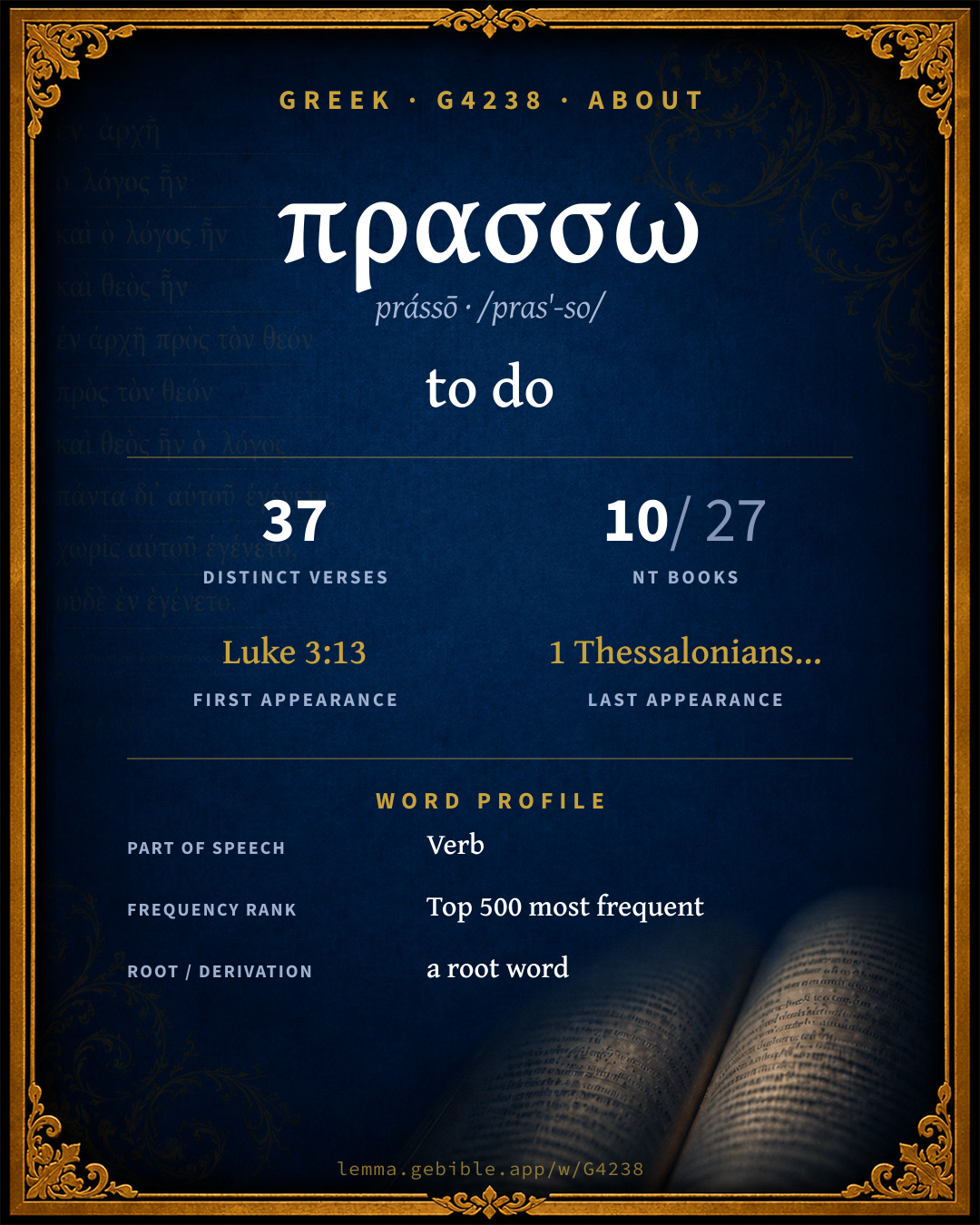
πράσσω
to do
‘to do’ is one of 4 main senses fuller range ↓
Full lexicon entry — Thayer's Greek Lexicon
From Thayer's Greek Lexicon
Where this word appears
See every Present-tense verb in the Greek New Testament →
Grammar key — what these labels mean
Part of speech
- Verb
- An action or state-of-being word.
Tense
- Present
- Ongoing or general action in present time (imperfective aspect).
- Aorist
- Action viewed as a simple whole, without regard to duration — often past (perfective aspect).
- Perfect
- A completed past action with continuing present results.
- Future
- Action expected in future time.
Voice
- Active
- The subject performs the action.
- Passive
- The subject receives the action.
Mood
- Indicative
- States a fact or asks a factual question (the mood of reality).
- Infinitive
- A verbal noun (“to write”), unmarked for person or number.
- Participle
- A verbal adjective (“writing,” “having written”).
- Imperative
- Expresses a command or request.
- Subjunctive
- Expresses probability, purpose, or possibility (the mood of contingency).
Case
- Accusative
- The case of the direct object and of extent.
- Genitive
- The case of source, possession, or “of” — answers “whose / from what.”
- Nominative
- The case of the subject (and the predicate nominative).
- Dative
- The case of the indirect object, means, or location — “to / for / with / in.”
Person
- 1st person
- The speaker (“I / we”).
- 3rd person
- The one spoken about (“he / she / it / they”).
- 2nd person
- The one addressed (“you”).
Gender
- Masculine
- Grammatically masculine.
- Neuter
- Grammatically neuter.
Number
- Singular
- One.
- Plural
- More than one.
Grammatical forms 26 distinct
- Verb, Present, Active, Indicative, 1st person, Singular 4 times (10%)
- Verb, Present, Active, Infinitive 4 times (10%)
- Verb, Present, Active, Participle, Accusative, Plural, Masculine 3 times (8%)
- Verb, Aorist, Active, Indicative, 3rd person, Singular 2 times (5%)
- Verb, Aorist, Active, Participle, Genitive, Plural, Masculine 2 times (5%)
- Verb, Present, Active, Imperative, 2nd person, Plural 2 times (5%)
- Verb, Present, Active, Participle, Nominative, Plural, Masculine 2 times (5%)
- Verb, Perfect, Passive, Participle, Nominative, Singular, Neuter 2 times (5%)
+18 more forms (18 occurrences)
Parsed forms decoded from the imported morphology (Robinson–Tischendorf, public domain), counted across 39 parsed occurrences — not distinct verses.
Every verse where G4238 appears — 37 distinct verses across 10 books. Click any verse to open its interlinear word-by-word view. Verse text shown in the World English Bible for context — . Each verse’s Greek form is shown with its reference; the English is not keyword-highlighted, since the data carries no word-level English alignment. Use “Compare translations” on any verse to read it across multiple English versions. This concordance covers the Greek New Testament; Septuagint (Greek Old Testament) occurrences of this word are not indexed here.
Luke 5 verses
- Luke 3:13 πράσσετε pres act impv 2pl He said to them, "Collect no more than that which is appointed to you."
- Luke 19:23 ἔπραξα aor act ind 1sg Then why didn't you deposit my money in the bank, and at my coming, I might have earned interest on it?'
- Luke 22:23 πράσσειν pres act inf They began to question among themselves, which of them it was who would do this thing.
- Luke 23:15 πεπραγμένον perf pass ptcp nom sg neut Neither has Herod, for I sent you to him, and see, nothing worthy of death has been done by him.
- Luke 23:41 ἐπράξαμεν ἔπραξεν aor act ind 1pl aor act ind 3sg And we indeed justly, for we receive the due reward for our deeds, but this man has done nothing wrong."
John 2 verses
- John 3:20 πράσσων pres act ptcp nom sg masc For everyone who does evil hates the light, and doesn't come to the light, lest his works would be exposed.
- John 5:29 πράξαντες aor act ptcp nom pl masc and will come out; those who have done good, to the resurrection of life; and those who have done evil, to the resurrection of judgment.
Acts 13 verses
- Acts 3:17 ἐπράξατε aor act ind 2pl "Now, brothers, I know that you did this in ignorance, as did also your rulers.
- Acts 5:35 πράσσειν pres act inf He said to them, "You men of Israel, be careful concerning these men, what you are about to do.
- Acts 15:29 πράξετε fut act ind 2pl that you abstain from things sacrificed to idols, from blood, from things strangled, and from sexual immorality, from which if you keep yourselves, it will be well with you. Farewell."
- Acts 16:28 πράξῃς aor act subj 2sg But Paul cried with a loud voice, saying, "Don't harm yourself, for we are all here!"
- Acts 17:7 πράσσουσιν pres act ind 3pl whom Jason has received. These all act contrary to the decrees of Caesar, saying that there is another king, Jesus!"
- Acts 19:19 πραξάντων aor act ptcp gen pl masc Many of those who practiced magical arts brought their books together and burned them in the sight of all. They counted the price of them, and found it to be fifty thousand pieces of silver.
- Acts 19:36 πράσσειν pres act inf Seeing then that these things can't be denied, you ought to be quiet, and to do nothing rash.
- Acts 25:11 πέπραχά perf act ind 1sg For if I have done wrong, and have committed anything worthy of death, I don't refuse to die; but if none of those things is true that they accuse me of, no one can give me up to them. I appeal to Caesar!"
- Acts 25:25 πεπραχέναι perf act inf But when I found that he had committed nothing worthy of death, and as he himself appealed to the emperor I determined to send him.
- Acts 26:9 πρᾶξαι aor act inf "I myself most assuredly thought that I ought to do many things contrary to the name of Jesus of Nazareth.
- Acts 26:20 πράσσοντας pres act ptcp acc pl masc but declared first to them of Damascus, at Jerusalem, and throughout all the country of Judea, and also to the Gentiles, that they should repent and turn to God, doing works worthy of repentance.
- Acts 26:26 πεπραγμένον perf pass ptcp nom sg neut For the king knows of these things, to whom also I speak freely. For I am persuaded that none of these things is hidden from him, for this has not been done in a corner.
- Acts 26:31 πράσσει pres act ind 3sg When they had withdrawn, they spoke one to another, saying, "This man does nothing worthy of death or of bonds."
Romans 9 verses
- Romans 1:32 πράσσοντες πράσσουσιν pres act ptcp nom pl masc pres act ptcp dat pl masc who, knowing the ordinance of God, that those who practice such things are worthy of death, not only do the same, but also approve of those who practice them.
- Romans 2:1 πράσσεις pres act ind 2sg Therefore you are without excuse, O man, whoever you are who judge. For in that which you judge another, you condemn yourself. For you who judge practice the same things.
- Romans 2:2 πράσσοντας pres act ptcp acc pl masc We know that the judgment of God is according to truth against those who practice such things.
- Romans 2:3 πράσσοντας pres act ptcp acc pl masc Do you think this, O man who judges those who practice such things, and do the same, that you will escape the judgment of God?
- Romans 2:25 πράσσῃς pres act subj 2sg For circumcision indeed profits, if you are a doer of the law, but if you are a transgressor of the law, your circumcision has become uncircumcision.
- Romans 7:15 πράσσω pres act ind 1sg For I don't know what I am doing. For I don't practice what I desire to do; but what I hate, that I do.
- Romans 7:19 πράσσω pres act ind 1sg For the good which I desire, I don't do; but the evil which I don't desire, that I practice.
- Romans 9:11 πραξάντων aor act ptcp gen pl masc For being not yet born, neither having done anything good or bad, that the purpose of God according to election might stand, not of works, but of him who calls,
- Romans 13:4 πράσσοντι pres act ptcp dat sg masc for he is a servant of God to you for good. But if you do that which is evil, be afraid, for he doesn't bear the sword in vain; for he is a minister of God, an avenger for wrath to him who does evil.
1 Corinthians 2 verses
- 1 Corinthians 5:2 πράξας aor act ptcp nom sg masc You are puffed up, and didn't rather mourn, that he who had done this deed might be removed from among you.
- 1 Corinthians 9:17 πράσσω pres act ind 1sg For if I do this of my own will, I have a reward. But if not of my own will, I have a stewardship entrusted to me.
2 Corinthians 2 verses
- 2 Corinthians 5:10 ἔπραξεν aor act ind 3sg For we must all be revealed before the judgment seat of Christ; that each one may receive the things in the body, according to what he has done, whether good or bad.
- 2 Corinthians 12:21 ἔπραξαν aor act ind 3pl that again when I come my God would humble me before you, and I would mourn for many of those who have sinned before now, and not repented of the uncleanness and sexual immorality and lustfulness which they committed.
Galatians 1 verse
Ephesians 1 verse
Philippians 1 verse
1 Thessalonians 1 verse
About this entry
At a glance — auto-summarized from this page’s data, not written by a person. Every figure links to its source below. This summary describes the numbers; it doesn’t interpret them.
The Greek verb πρασσω centers on the idea of “to do.” Lexicons map it across 4 senses. The Greek New Testament uses it across 37 verses — moderately common. Acts dominates its distribution — 13 of 37 verses. First canonically at Luke 3:13, it enters the text early. Dig into 37-verse concordance and the renderings breakdown below.
Gloss history
Strong's 1890 vs modern scholarship

About this word
Strong's G4238 catalogs a Greek word from the Greek New Testament.
These counts are not copied from any lexicon or concordance. They are computed here, from the morphology-tagged Greek New Testament. What Lemma adds →
- 37
- distinct verses
- The word appears in 37 distinct verses.
- 10 / 27
- NT books
- The word appears in 10 of 27 New Testament books.
- #385
- by frequency
- Top 500 most frequent Greek words (rank 385 of 5,347 Greek words by occurrence).
View all 37 occurrences in the concordance →
By section of the New Testament
By traditional corpus
Conventional, traditional groupings — biblical authorship is debated, so this is a traditional corpus grouping, not an authorship claim. Some books belong to more than one corpus (Luke is in both the Gospels and the Lukan corpus, and so on), so these shares overlap and need not total 100%. Each figure is a share of the word’s 37 distinct verses.
- Lukan (Luke–Acts) 18 verses · 49%
- Pauline corpus 17 verses · 46%
- Gospels 7 verses · 19%
- Johannine 2 verses · 5%
How translations render this word
Counts come from each version’s own published word-to-Strong’s tagging or interlinear alignment — an approximate guide to how each version renders this word, not a word-level alignment the data otherwise carries. Because each total is that version’s own tagged count, the per-version totals vary from one another and need not match the appearance or distinct-verse counts above. These counts may also differ from a printed concordance because Lemma counts each distinctly tagged rendering and does not collapse phrase taggings into a single head-word total. This is a fixed set of word-tagged versions (KJV, ASV, BSB, ULT) and does not change with the reading translation you choose elsewhere. Each version’s license is shown beside its name below (and on Sources).
- King James Version: Do 11×, Doeth 3×, I do 3×
- American Standard Version: Do 6×, Practise 4×, Doeth 2×
- Berean Standard Bible: Do 7×, Done 3×, Had done 2×
- unfoldingWord Literal Text: Do 7×, Practicing 6×, Doing 2×
King James Version Public Domain
Renders G4238 across 38 tagged occurrences — most commonly:
Plus 19 renderings that appear only once — usually multi-word phrases or single function words the recovered tagging swept in, not distinct renderings.
American Standard Version Public Domain
Renders G4238 across 38 tagged occurrences — most commonly:
Plus 22 renderings that appear only once — usually multi-word phrases or single function words the recovered tagging swept in, not distinct renderings.
Berean Standard Bible Public Domain
Renders G4238 across 36 tagged occurrences — most commonly:
Plus 20 renderings that appear only once — usually multi-word phrases or single function words the recovered tagging swept in, not distinct renderings. Not rendered by a distinct English word in 2 further occurrences.
unfoldingWord Literal Text CC BY-SA 4.0
Renders G4238 across 42 tagged occurrences — most commonly:
Plus 25 renderings that appear only once — usually multi-word phrases or single function words the recovered tagging swept in, not distinct renderings.
Senses in Thayer's
The 4 senses Thayer's distinguishes for this word, in lexicon order (not ranked by frequency or importance). The full entry — with sub-senses — is in the Lexicon Entry tab.
- to exercise, practise, to be busy with, carry on
- to commit, perpetrate
- to manage public affairs, transact public business
- to act
Word origin
Origin: a root word
A primary verb; to practise that is perform repeatedly or habitually (thus differing from G4160 which properly refers to a single act); by implication to execute accomplish etc.; specifically to collect (dues) fare (personally): - commit deeds do exact keep require use arts.
— Strong’s Exhaustive Concordance (1890), public domain.
Forms in the corpus
The 25 distinct written forms G4238 takes in the Greek New Testament, most frequent first — each parse links to that tense’s occurrences in the concordance.
Same root — word family
Other Thayer's entries built from the same root as G4238, grouped by Strong’s listed origin. These share a root / origin per the lexicon — not necessarily a shared meaning. Each links to that word’s own entry.
Derived from this word
Compare all same-root words → They share a root, not necessarily a meaning.
Septuagint usage
The same Greek word πρασσω appears 21 times in the Greek Old Testament (Septuagint), across 20 verses in 6 books.
- 21
- LXX occurrences
- Tagged occurrences of this Greek word in the Septuagint.
- 20
- verses
- Distinct Septuagint verses containing this word.
- 6 / 39
- OT books
- The word appears in 6 of the 39 Old Testament books.
Sample Septuagint occurrences
- Genesis 31:28 πράσσω
- Joshua 1:7 πράσσω
- Job 5:27 πράσσω
- Proverbs 10:23 πράσσω
- Isaiah 57:10 πράσσω
- Daniel 6:4 πράσσω
Septuagint occurrences (same lexeme)
Every verse where the same Strong’s number (G4238) appears in the Greek Septuagint. Verse text shown in the World English Bible for context; the Greek form is the matched word — the English is not keyword-highlighted.
- Genesis 31:28 πράσσω and didn't allow me to kiss my sons and my daughters? Now have you done foolishly.
- Joshua 1:7 πράσσω Only be strong and very courageous, to observe to do according to all the law, which Moses my servant commanded you: don't turn from it to the right hand or to the left, that you may have good success wherever you go.
- Job 5:27 πράσσω Look this, we have searched it, so it is; Hear it, and know it for your good."
- Job 7:20 πράσσω If I have sinned, what do I do to you, you watcher of men? Why have you set me as a mark for you, So that I am a burden to myself?
- Job 24:20 πράσσω The womb shall forget him. The worm shall feed sweetly on him. He shall be no more remembered. Unrighteousness shall be broken as a tree.
- Job 27:6 πράσσω I hold fast to my righteousness, and will not let it go. My heart shall not reproach me so long as I live.
- Job 34:21 πράσσω "For his eyes are on the ways of a man, He sees all his goings.
- Job 35:6 πράσσω If you have sinned, what effect do you have against him? If your transgressions are multiplied, what do you do to him?
- Job 36:21 πράσσω Take heed, don't regard iniquity; For this you have chosen rather than affliction.
- Job 36:23 πράσσω Who has prescribed his way for him? Or who can say, 'You have committed unrighteousness?'
- Proverbs 10:23 πράσσω It is a fool's pleasure to do wickedness, But wisdom is a man of understanding's pleasure.
- Proverbs 13:10 πράσσω Pride only breeds quarrels, But with ones who take advice is wisdom.
- Proverbs 13:16 πράσσω Every prudent man acts from knowledge, But a fool exposes folly.
- Proverbs 14:17 πράσσω He who is quick to become angry will commit folly, And a crafty man is hated.
- Proverbs 21:7 πράσσω The violence of the wicked will drive them away, Because they refuse to do what is right.
- Proverbs 25:28 πράσσω Like a city that is broken down and without walls Is a man whose spirit is without restraint.
- Proverbs 26:19 πράσσω Is the man who deceives his neighbor and says, "Am I not joking?"
- Proverbs 30:20 πράσσω So is the way of an adulterous woman: She eats and wipes her mouth, And says, 'I have done nothing wrong.'
- Isaiah 57:10 πράσσω You were wearied with the length of your way; yet you didn't say, It is in vain: you found a reviving of your strength; therefore you weren't faint.
- Daniel 6:4 πράσσω Then the presidents and the satraps sought to find occasion against Daniel as touching the kingdom; but they could find no occasion nor fault, because he was faithful, neither was there any error or fault found in him.
These are occurrences of the same Greek lexeme (G4238) in the Septuagint — not a translation of any one Hebrew word. The store carries no word-level Hebrew↔Greek alignment, so no Hebrew original is asserted here. Counts come from the recovered LXX Strong's tagging — high-frequency vocabulary is well covered, while rare or late forms may be untagged — so they reflect tagged occurrences and may slightly undercount.