Mark 2:25

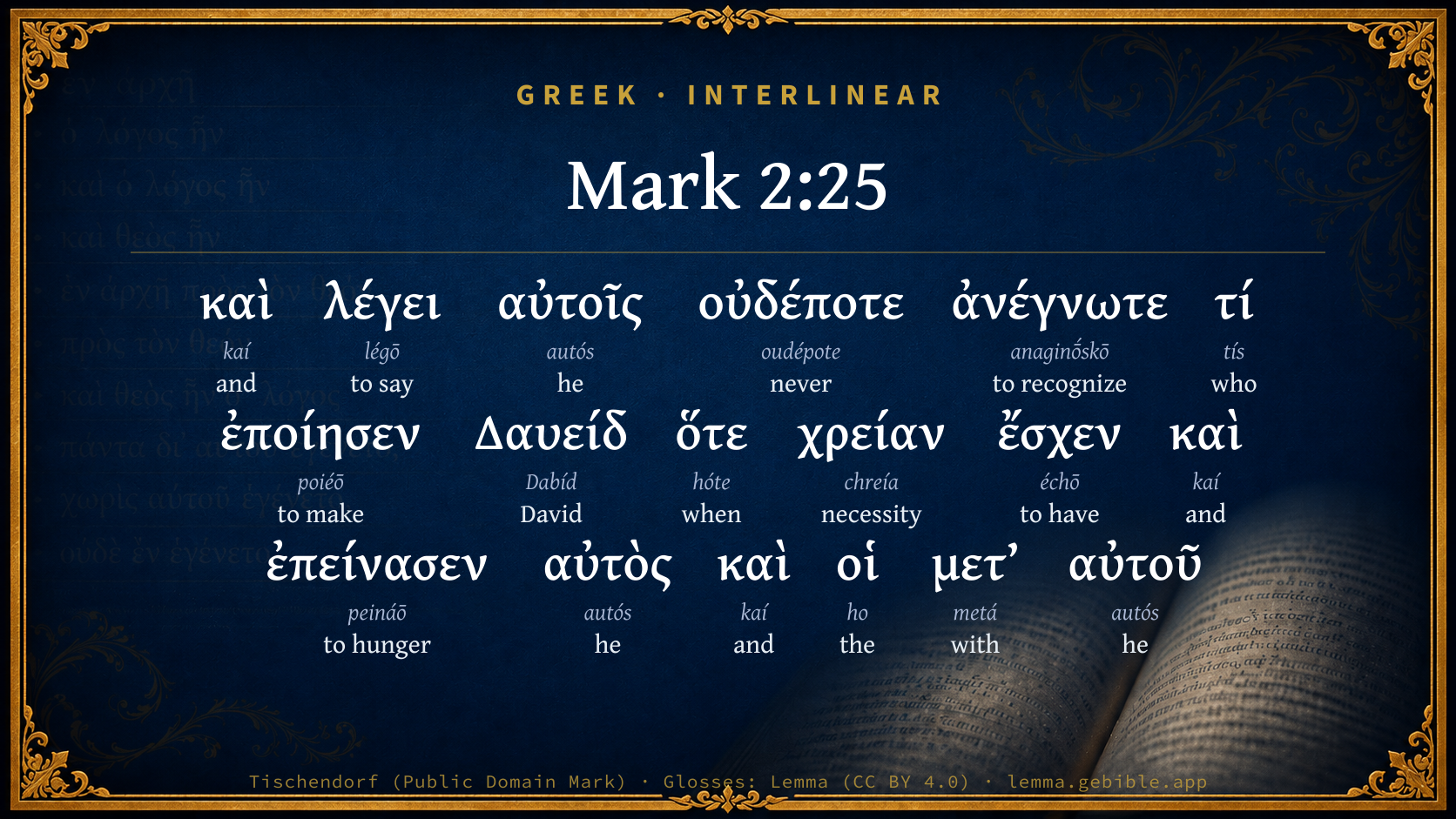
Greek (Tischendorf 8th ed.) Mark 2:25 appears in the Greek New Testament. The text above is from the Tischendorf 8th edition. Each word links to its Strong’s number and a concise gloss. Click any word for its full Thayer’s Greek Lexicon entry.
Download image
Cite this verse

Mark 2:25 (World English Bible). Public Domain. Lemma interlinear Bible study tool, https://lemma.gebible.app/v/mark/2/25.

Show BibTeX & RIS
BibTeX
RIS
English Translation
He said to them, "Did you never read what David did, when he had need, and was hungry--he, and they who were with him?
World English Bible · Public Domain
Download a study sheet

One document with this verse’s original text, its word-by-word gloss line, the meaning frame, cross-references with their text, attributed commentary, and full source and license credits — printable, and it pastes into notes with its structure intact.

This verse Autodidact and up

Study sheet (.html) Plain text (.txt)

A passage Seminary Student

Up to 50 verses in one chapter. A passage sheet keeps up to 6 commentary sources and 12 cross-references per verse, in the order this page ranks them, and says so on the sheet whenever that leaves anything out. Ask for a single verse and you get the Autodidact verse sheet above.

Everything on this page stays free to read, with no account — the sheet is a download of what is already on screen, not access to it.

Want to remove ads? Support Godless Engineer
Compare translations 3

The same verse in 3 English versions, stacked beneath the original-language interlinear above. Click any original word for its lexicon entry.

Each is an independent rendering of the whole verse — the interlinear is not word-aligned to these translations.

Highlighted words mark where these versions differ — a whole-verse word diff, not a word-by-word alignment.

  • World English Bible Public Domain
    He said to them, "Did you never read what David did, when he had need, and was hungry--he, and they who were with him?
  • King James Version Public Domain
    And he said unto them, Have ye never read what David did, when he had need, and was an hungred, he, and they that were with him?
  • unfoldingWord Literal Text CC BY-SA 4.0
    And he says to them, “Have you never read what David did when he had need and was hungry, he and the ones with him—

unfoldingWord Literal Text — © unfoldingWord, licensed CC BY-SA 4.0. Word-aligned USFM3 via Door43 (git.door43.org/unfoldingWord/en_ult).

Versions to compare (up to 4)

3 of 4 selected

Show all 19 translations

Every available English version of this verse, each an independent rendering of the whole verse.

  • World English Bible Public Domain
    He said to them, "Did you never read what David did, when he had need, and was hungry--he, and they who were with him?
  • Berean Standard Bible Public Domain
    Jesus replied, “Have you never read what David did when he and his companions were hungry and in need?
  • Majority Standard Bible Public Domain
    Jesus replied, “Have you never read what David did when he and his companions were hungry and in need?
  • King James Version Public Domain
    And he said unto them, Have ye never read what David did, when he had need, and was an hungred, he, and they that were with him?
  • American Standard Version (1901) Public Domain
    And he said unto them, Did ye never read what David did, when he had need, and was hungry, he, and they that were with him?
  • Revised Version (1885) Public Domain
    And he said unto them, Did ye never read what David did, when he had need, and was an hungred, he, and they that were with him?
  • Geneva Bible (1599) Public Domain
    And he saide to them, Haue yee neuer read what Dauid did when he had neede, and was an hungred, both he, and they that were with him?
  • Douay-Rheims (1899) Public Domain
    And he said to them: Have you never read what David did when he had need, and was hungry himself, and they that were with him
  • Young's Literal Translation Public Domain
    And he said to them, `Did ye never read what David did, when he had need and was hungry, he and those with him?
  • Literal Standard Version CC BY-SA 4.0
    And He said to them, “Did you never read what David did when he had need and was hungry, he and those with him?
  • Unlocked Literal Bible CC BY-SA 4.0
    He said to them, “Have you never read what David did when he was in need and hungry—he and the men who were with him—
  • unfoldingWord Literal Text CC BY-SA 4.0
    And he says to them, “Have you never read what David did when he had need and was hungry, he and the ones with him—
  • Darby Bible Public Domain
    And *he* said to them, Have ye never read what David did when he had need and hungered, *he* and those with him,
  • World Messianic Bible Public Domain
    He said to them, “Did you never read what David did when he had need and was hungry—he, and those who were with him?
  • Webster's Bible Public Domain
    And he said to them, Have ye never read what David did, when he had need, and was hungry, he and they that were with him?
  • Free Bible Version CC BY-SA 4.0
    “Haven't you ever read what David did when he and his men were hungry and in need?” Jesus asked them.
  • Bible in Basic English Public Domain
    And he said to them, Have you no knowledge of what David did, when he had need and was without food, he, and those who were with him?
  • Text-Critical English NT CC BY 4.0
    He said to them, “Have you never read what David did when he had need and was hungry, he and those who were with him,
  • Tyndale New Testament (1534) Public Domain
    And he sayde to them: have ye never rede what David dyd when he had nede and was anhogred bothe he and they that were with him?

Literal Standard Version (2020), Covenant Press — licensed CC BY-SA 4.0. Text via the HelloAO Bible API (eBible.org). Unlocked Literal Bible (unfoldingWord) — licensed CC BY-SA 4.0. Text via the HelloAO Bible API (eBible.org). unfoldingWord Literal Text — © unfoldingWord, licensed CC BY-SA 4.0. Word-aligned USFM3 via Door43 (git.door43.org/unfoldingWord/en_ult). Free Bible Version, Dr. Jonathan Gallagher — licensed CC BY-SA 4.0. Text via the HelloAO Bible API (eBible.org).

Word by word

More ways to search: Search by grammar → Find every occurrence → Compare this word →

Practice this passage: Drill this verse → Learn its vocabulary →

οὐδέποτε
oudépote
G3763
“never”
Adverb, Negative
Part of Speech
Adverb
Degree
Negative
Full Thayer's Definition

Origin: from G3761 and G4218

TDNT: None

1. never
  1. καὶ kaí G2532 “and” Conjunction
  2. λέγει légō G3004 “to say” Verb, Present, Active, Indicative, 3rd person, Singular
  3. αὐτοῖς autós G846 “he” Personal pronoun, Dative, Plural, Masculine
  4. ἀνέγνωτε anaginṓskō G314 “to recognize” Verb, Aorist, Active, Indicative, 2nd person, Plural
  5. τί tís G5101 “who” Interrogative pronoun, Accusative, Singular, Neuter
  6. ἐποίησεν poiéō G4160 “to make” Verb, Aorist, Active, Indicative, 3rd person, Singular
  7. Δαυείδ Dabíd G1138 “David” Noun, Proper, indeclinable
  8. ὅτε hóte G3753 “when” Adverb
  9. χρείαν chreía G5532 “necessity” Noun, Accusative, Singular, Feminine
  10. ἔσχεν échō G2192 “to have” Verb, Aorist, Active, Indicative, 3rd person, Singular
  11. καὶ kaí G2532 “and” Conjunction
  12. ἐπείνασεν peináō G3983 “to hunger” Verb, Aorist, Active, Indicative, 3rd person, Singular
  13. αὐτὸς autós G846 “he” Personal pronoun, Nominative, Singular, Masculine
  14. καὶ kaí G2532 “and” Conjunction
  15. οἱ ho G3588 “the” Article, Nominative, Plural, Masculine
  16. μετ’ metá G3326 “with” Preposition
  17. αὐτοῦ autós G846 “he” Personal pronoun, Genitive, Singular, Masculine

About this verse

These counts appear in no published source. They are computed here, from the morphology-tagged text and Lemma’s own curated glosses. What Lemma adds →

18
words
14
distinct lemmas
Gospels
section

Notable vocabulary

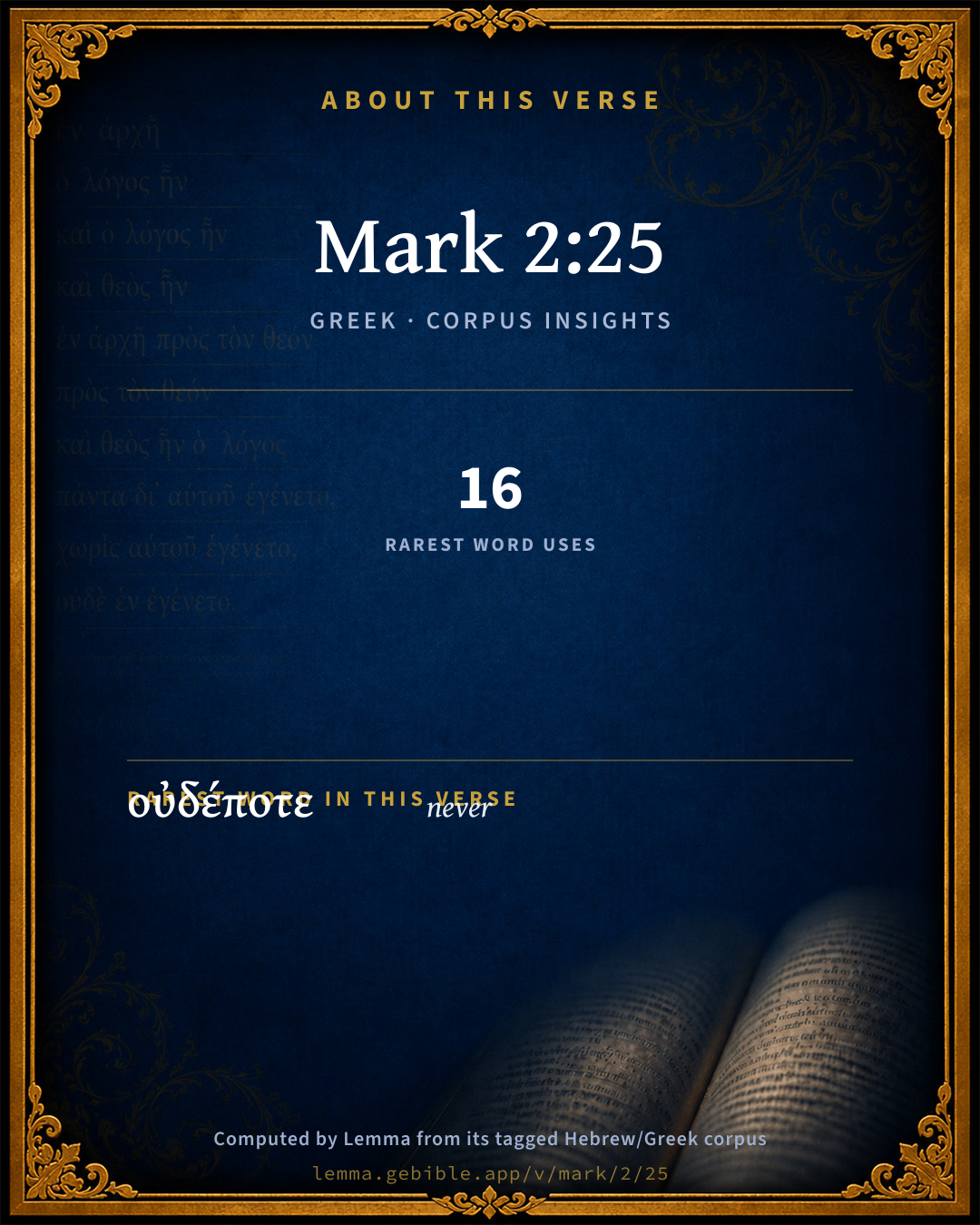
The rarest word here is οὐδέποτε never G3763 — appearing just 16 times in the whole Greek New Testament.

Shared distinctive vocabulary

οὐδέποτε never G3763 occurs in 15 verses of the Greek New Testament. Also found in:

Repetition

Words recur within this verse:

  • καὶ and G2532 ×3
  • αὐτοῖς he G846 ×3

Cross-references

2

Topical passages linked to Mark 2:25 in the Treasury of Scripture Knowledge — connected by theme and wording, ordered by reader-vote popularity; previews shown in the World English Bible.

  • 1 Samuel 21:3–6 Now therefore what is under your hand? give me five loaves of bread in my hand, or whatever there is present.
  • Luke 10:26 He said to him, "What is written in the law? How do you read it?"

Cross-references courtesy of OpenBible.info (CC BY 4.0).

Commentary

Notes on Mark 2:25 from classic Christian and Jewish commentators (each source and its license shown beneath its notes). The classic Christian expositions comment on the surrounding passage and are grouped to its opening verse, so a note may address several verses; the Jewish commentaries on the Tanakh (Rashi and others) are per-verse, so they appear only where the commentator wrote on this verse.

Lemma curates 59 commentaries, every one of them public domain or Creative Commons licensed, each selected and text-cleaned for this edition rather than reprinted as found. About our sources →

The Biblical Illustrator

Joseph S. Exell

Mar_2:25-26

And He said unto them, Have ye never read what David did?

How to read the Bible

I. In order to the true reading of the Scriptures there must be an understanding of them. The mind must be well awake to it. We must meditate upon it. We must pray about it. We must use all means and helps.

II. In reading we ought to seek out the spiritual teaching of the Word. This should be the case in reference to the historical passages, ceremonial precepts, and doctrinal statements.

III. Such a reading of Scripture as implies the understanding of, and the entrance into, its spiritual meaning, and the discovery of the Divine Person, who is the spiritual meaning, is profitable. It often begets spiritual life. It comforts the soul It nourishes the soul. It guides us. (C. H. Spurgeon.)

Pedantic Bible readers

The scribes and Pharisees were great readers of the law. They made notes of very little importance, but still very curious notes-as to which was the middle verse of the entire Old Testament, which verse was half-way to the middle, and how many times such a word occurred, and the size of the letter, and its peculiar position. According to Pharisaic interpretation, to rub an ear of corn is a kind of threshing, and, as it is very wrong to thresh on the Sabbath day, therefore it must be very wrong to rub out an ear or two of wheat when you are hungry on the Sabbath morning. (C. H. Spurgeon.)

The grace of Bible doctrine

The doctrines of grace are good, but the grace of the doctrines is better. (C. H. Spurgeon.)

Living in Gods Word

As I sat, last year, under a wide-spreading beech, I was pleased to mark with prying curiosity the singular habits of that most wonderful of trees, which seems to have an intelligence about it which other trees have not. I wondered at, and admired the beech, but I thought to myself, I do not think half as much of this beech tree as yonder squirrel does. I see him leap from bough to bough, and I feel sure he dearly values the old beech tree, because he has his home somewhere inside it, in a hollow place; these branches are his shelter, and these beech nuts are his food. He lives upon the tree. It is his world, his playground, his granary, his home; indeed it is everything to him, and it is not so to me, for I find my rest and food elsewhere. With Gods Word it is well for us to be like squirrels, living in it, and living on it. (C. H. Spurgeon.)

Bible glancing not Bible reading

An old preacher used to say: The Word has mighty free course among many nowadays, for it goes in at one of their ears, and out at the other. So it seems to be with some readers-they read a very great deal because they do not read anything. Their eye glances, but the mind never rests. The soul does not light upon the truth and stay there. It flits over the landscape as a bird might do, but it builds no nest therein, and finds no rest for the sole of its foot. Such reading is not reading. (C. H. Spurgeon.)

An interior reading of Scripture

In prayer there is such a thing as praying in prayer-a praying which is the bowels of the prayer. In praise there is a praising in song, an reward fire of intense devotion, which is the life of the hallelujah. It is even so with the reading of the Scriptures. There is an interior reading, a kernel reading; and, if it be not there, the reading is a mechanical exercise, and profits nothing. (C. H. Spurgeon.)

Illumination necessary to emotion

When the high priest went into the holy place he always lit the golden candlestick before he kindled the incense upon the brazen altar, as if to show that the mind must have illumination before the affections can rise towards God. (C. H. Spurgeon.)

Use of the Scriptures

The cause of so many gross and foolish opinions which many amongst us hold and maintain, is nothing else but their ignorance of the Scriptures, either because they read them not duly and diligently, or else because they understand them not aright. How many foolish and absurd opinions are held by ignorant people in many places? Such as these for example: That faith is nothing but a mans good meaning: That God is served by rehearsing the Ten Commandments and the Creed instead of prayers: That the Sabbath is kept well enough if men and women come to church, and be present at public prayers and at the sermon, though they spend the rest of the day either idly or profanely: That the Sabbath is well enough sanctified by bare reading of prayers, and so much preaching is needless: That it is lawful to swear in common talk to that which is true: That in religion it is best to do as the most do: That a man may make of his own as much as he can: That such as are not book learned need have no knowledge of religion. These, and such-like absurd opinions, proceed from nothing but ignorance of the Scriptures. If we would avoid such errors, and be led into all truth of doctrine necessary to salvation, let us

(1) be frequent and diligent in hearing the Scriptures explained in church;

(2) search them diligently and often in private reading;

(3) pray daily to God to open our understanding, that we may perceive their true meaning;

(4) confer with others touching those things which we read and hear. (G. Petter.)

Mercy better than sacrifice

When the Romans had ravaged the province of Azazane, and seven thousand Persians were brought to Armida, where they suffered extreme want. Acases, the bishop of that city, observed that as God said, I love mercy better than sacrifice, He would certainly be better pleased with the relief of His suffering creatures, than with being served with gold and silver in their churches. The clergy were of the same opinion. The consecrated vessels were sold, and with the proceeds, the seven thousand Persians were not only maintained during the war, but sent home at its conclusion with money in their pockets. Varenes, the Persian monarch, was so charmed with this humane action, that he invited the bishop to his capital, where he received him with the utmost reverencer and for his sake conferred many favours on the Christians.

The Biblical Illustrator, edited by Joseph S. Exell (c. 1880s–1900s) — public domain. Text from a community e-Sword module.

Tyndale Open Study Notes

Tyndale Open Resources

2:25-26 Jesus countered with reference to an incident in the life of King David (1 Sam 21). When David and his followers ate the sacred loaves—the twelve loaves in the Tabernacle that only priests were allowed to eat—they broke the law (see Lev 24:5-9). But deeper principles were at work (Mark 2:27-28).

Tyndale Open Study Notes — © Tyndale Open Resources, licensed CC BY-SA 4.0. Text via the HelloAO Bible API.

The Cambridge Bible for Schools and Colleges

gen. ed. J. J. S. Perowne

25. Have ye never read] Rather, Did ye never read? With a gentle irony He adopts one of the favourite formulas of their own Rabbis, and inquires if they had never read what David their favourite hero had done when flying from Saul. He came to the high priest at Nob, and entered the Tabernacle, and ate of the hallowed bread (1Sa_21:1-9), of the “twelve cakes of fine flour” which no stranger might eat (Exo_29:33).

The Cambridge Bible for Schools and Colleges (gen. ed. J. J. S. Perowne; Cambridge University Press, 1878–1918) — public domain. Text from a community e-Sword module.

John Gill's Exposition

How he went into the house of God,.... The tabernacle; for the temple was not yet built: thither David went to get bread for himself and his men, being hungry: so in a spiritual sense, where should such go, who are hungering and thirsting after righteousness, but into the house of God? Here is bread enough, and to spare; here is a table furnished with excellent provisions; here the Gospel is dispensed, which is milk for babes, and meat for strong men; here Christ, the bread of life, is set forth, whose flesh is meat indeed, and whose blood is drink indeed; here the ordinances are administered, which are breasts of consolation to the children of God; here is a feast of fat things, all things are ready, and souls are welcome, and therefore it must be right to attend here. And this was on the sabbath day that David went into the house of God: when the showbread loaves were removed, and divided, among the priests, and new ones were placed in their room: and so under the Gospel dispensation, on the Lord's day, the day set apart for public worship, it becomes the saints to go up to the house of the Lord, and feed upon the provisions of it: they are a royal priesthood, they are priests, as well as kings to God; and their business is in the house of the Lord, to offer up spiritual sacrifices to him; and as the goodness and fulness of his house appertains to them, they do well to attend and partake thereof.

In the days or Abiathar the high priest: and yet from the history it is clear, that it was in the days of Ahimelech the high priest, the father of Abiathar; wherefore the Jew charges (k) Mark with an error, and Matthew and Luke too: whereas the two last make no mention of the name of any high priest; and it might be observed, that in the Persic version of Mark it is rendered, "under Abimelech the high priest"; and in an ancient copy of Beza's, the whole clause is omitted; though it must be owned, that so it is read in other Greek copies, and in the ancient versions, the Vulgate Latin, Syriac, Arabic, and others: wherefore let it be further observed, that the fact referred to was done in the days of Abiathar, though it was before he was an high priest; and the particle may be so rendered, about, or "before Abiathar was high priest", as it is in Mat 1:11. Besides, Abiathar was the son of an high priest, and succeeded his father in the office: and might be at this time his deputy, who acted for him, or he by has advice; and according to a rule the Jews (l) themselves give,

"the son of an high priest, who is deputed by his father in his stead, , "lo! he is called an high priest".''

So that Abiathar might at this time be called the high priest; and is the rather mentioned, because he was the more eminent and famous man; and whom the Jews call (m) Urim and Thummim, because there was much inquiry made by them; in his and his father's days, and very little after: to which may be added, that the names of the father and the son are sometimes changed; Ahimelech is called Abiathar, and this Abiathar is called Ahimelech, the son of Abiathar, Sa2 8:17, and Abimelech the son of Abiathar, Ch1 18:16. And it seems as if both father and son had two names, and were sometimes called by the one, and sometimes by the other: for as the father is sometimes called Abiathar, the son is called Ahimelech, or Abimelech, as in the places mentioned; and which refer to the times when David was king of Israel, and long after the death of Saul, and consequently long after Ahimelech, and the rest of the priests at Nob, were killed by the order of Saul: wherefore Ahimelech, or Abimelech, in the said places, must be the son of Abiathar; and who afterwards was thrust out of the priesthood by Solomon, for joining with Adonijah in his usurpation, Kg1 1:25. And from whence it appears, that his father was called Abiathar also, and which some take to be their family name; and if so, then there is no difficulty, and the evangelist rightly says, that this affair was in the days of Abiathar: but be it that he intends the son, what has been before observed is a sufficient solution of this difficulty; for the evangelist does not say that Abiathar was high priest, when David came and eat the showbread; he only says, "it was in the days of Abiathar the high priest": for certain it is, that this happened in his days; and as certain, that he was an high priest; and Mark might with great propriety call him so, though he was not strictly one, till after this business was over: besides, he was not only the son of an high priest, and it may be his deputy, and some have thought officiated at this time, his father being sick or infirm through old age; but inasmuch as his father was directly killed by the order of Saul, he narrowly escaping, immediately succeeded him in the office of the high priesthood; and therefore his being an high priest so very near the time of this action, without any impropriety and impertinence, and especially without incurring the charge of falsehood, the evangelist might express himself as he does.

And did eat the showbread, which is not lawful to eat, but for the priests, and gave also to them which were with him? Who not only ate the showbread, which was set before the Lord, and was sacred, and which none but the priests might eat of, after it was removed from the table; but he did this on the sabbath day; and he not only eat of it himself, but the soldiers that were with him: and all this with the knowledge and leave of the high priest: for the Jews (n) have no reason to charge this evangelist and the others with an error, that others besides David ate of the showbread, urging that he came alone to Ahimelech; since it is evident from Sa1 21:2,

that David had servants in company with him when he fled, though they did not attend him when he went to the high priest; and that he asked bread, and it was given him, not only for himself, but for the young men that he had appointed to be at such a place: and therefore, if this was allowed to David and his men, when hungry, it ought not to be charged as an evil upon the disciples, for plucking and rubbing a few ears of corn to satisfy their hunger, though on a sabbath day; and especially when he, who was Lord of the sabbath, was present, and admitted of it; See Gill on Mat 12:4.

(k) R. Isaac Chizzuk Emuna, par. 9. c. 28. p. 419. (l) Siphra, fol. 17. 2. apud Kidder's Demonstration of the Messiah, par. 2. p. 73. (m) Bab. Sanhedrin, fol. 16. 2. (n) R. Isaac Chizzuk Emuna, par. 2. c. 28. p. 420. Jacob Aben Amrara apud Kidder, Demonstr. of the Messiah, par. 3. p. 48.

John Gill's Exposition of the Whole Bible (1746–1763) — public domain (CC PDM 1.0). Text via the HelloAO Bible API.

Trapp's Complete Commentary

John Trapp

25 And he said unto them, Have ye never read what David did, when he had need, and was an hungred, he, and they that were with him?

Ver. 25. Have ye never read?] Satis salse, q.d. Ignoratis adhuc, quod adeo notum et tritum. Miter ego vestram vel inscitiam, vel ignaviam. It is a shame for you, that you are yet so stupid or so stubborn.

John Trapp, A Commentary or Exposition upon All the Books of the Old and New Testament (1647–1656) — public domain. Text from a community e-Sword module.

Haydock's Catholic Bible Commentary

When he had need. In necessity many things are done without sin, which in other circumstances it would be unlawful to do. (Bristow)

George Leo Haydock (1774–1849), Haydock's Catholic Family Bible and Commentary, 1859 edition — public domain. Excludes Psalms (Douay-Rheims chapter numbering differs from Protestant) and Deuterocanonical books (Catholic canon only).

The Pulpit Commentary

Vers. 25, 26. David... and they that were with him. This seems opposed to what we read in 1Sa 21, where David is stated to have been alone. But the facts appear to have been these, that David, fleeing from Saul, went alone to Ahimelech the high priest, and sought and obtained five loaves of the "shewbread," which he carried away with him to his companions in flight, and shared with them; for he says, (1Sa_21:2) "I have appointed my servants to such and such a place." This incident actually happened in the high priesthood of Ahimelech the father of Abiathar. Bede says that they were both present when David came in his distress and obtained the shewbread. But Ahimelech having been slain, together with eighty-six priests, by Saul, Abiathar fled to David, and became his companion in his exile. Moreover, when he succeeded to the high priesthood on the death of Ahimelech, he did far more good service than his father had done, and so was worthy of being spoken of with this special commendation, and as though he was actually high priest, even though his father was then living. The words may properly mean "in the days when Abiathar was living who became high priest, and was more eminent than his father." The shewbread; literally, the bread of the face, that is, of the Divine presence, symbolizing the Divine Being who is the Bread of life. It was directed by the Law that within the sanctuary there should be a table of shittim (or acacia) wood; and every sabbath twelve newly baked loaves were placed upon it in two rows. These leaves were sprinkled with incense, and then remained there until the following sabbath. They were then replaced by twelve newly baked loaves, the old loaves being eaten by the priests in the holy place, from which it was unlawful to remove them. These twelve loaves corresponded to the twelve tribes. The force of our Lord"s reasoning is this: David, a man after God"s own heart, when sorely pressed by hunger, applied to the high priest and took some of these sacred loaves, loaves which under ordinary circumstances it was not lawful for the lay people to eat, because he wisely judged that a positive law, forbidding the laity to eat this bread, ought to yield to a law of necessity and of nature; which intimates to us that in a grave necessity of famine, life may be lawfully preserved by eating even sacred bread which has been dedicated to God. Therefore, in like manner, nay, much more, was it lawful for Christ and his disciples to pluck the ears of corn on the sabbath day, that by rubbing them in their hands they might pick out the good grain and satisfy their hunger.

The Pulpit Commentary (1880–1919), ed. H.D.M. Spence-Jones & Joseph S. Exell — public domain. Text from a community e-Sword module.

unfoldingWord translationNotes

Door43 World Missions Community

He said to them

"Jesus said to the Pharisees"

Have you never read what David ... those who were with him?

Jesus asks this question to remind the scribes and Pharisees of something David did on the Sabbath. The question is very long, so it can be divided into two sentences. (See: Rhetorical Question)

Have you never read what David did when he was in need and hungry—he and the men who were with him—how he ... him?

This can be stated as a command. AT: "Remember what you read about what David did ... him." (See: Rhetorical Question)

read what David

Jesus refers to reading about David in the Old Testament. This can be translated showing the implicit information. AT: "read in the scriptures what David" (See: Assumed Knowledge and Implicit Information)

how he went into the house of God ... to those who were with him?

This can be expressed as a statement separate from verse 25. AT: "He went into the house of God ... to those who were with him." (See: Rhetorical Question)

how he went

The word "he" refers to David.

bread of the presence

This refers to the twelve loaves of bread that were placed on a golden table in the tabernacle or temple building as a sacrifice to God during Old Testament times.

translationWords

David

house of God

Abiathar

high priest

bread

lawful

priest

unfoldingWord translationNotes — © Distant Shores Media and the Door43 World Missions Community, licensed CC BY-SA 4.0. Source: git.door43.org/Door43/en_tn.

Cambridge Greek Testament for Schools and Colleges

25. λέγει ([357][358][359] 33) rather than ἔλεγεν ([360][361][362][363][364]), which looks like assimilation to the preceding ἔλεγον.

[357] Codex Sinaiticus. 4th cent. Discovered by Tischendorf in 1859 at the Monastery of St Katharine on Mount Sinai. Now at St Petersburg. The whole Gospel, ending at Mar 16:8. Photographic facsimile, 1911.

[358] Codex Ephraemi. 5th cent. A palimpsest: the original writing has been partially rubbed out, and the works of Ephraem the Syrian have been written over it; but a great deal of the original writing has been recovered; of Mark we have Mar 1:17 to Mar 6:31, Mar 8:5 to Mar 12:29, Mar 13:19 to Mar 16:20. In the National Library at Paris.

[359] Codex Regius. 8th cent. An important witness. At Paris. Contains Mar 1:1 to Mar 10:15; Mar 10:30 to Mar 15:1; Mar 15:20 to Mar 16:20, but the shorter ending is inserted between Mar 16:8 and Mar 16:9, showing that the scribe preferred it to the longer one.

[360] Codex Alexandrinus. 5th cent. Brought by Cyril Lucar, Patriarch of Constantinople, from Alexandria, and afterwards presented by him to King Charles I. in 1628. In the British Museum. The whole Gospel. Photographic facsimile, 1879.

[361] Codex Vaticanus. 4th cent., but perhaps a little later than א. In the Vatican Library almost since its foundation by Pope Nicolas V., and one of its greatest treasures. The whole Gospel, ending at Mar 16:8. Photographic facsimile, 1889.

[362] Codex Oxoniensis. 9th cent. Contains Mark, except Mar 3:35 to Mar 6:20.

[363] Codex Sangallensis. 9th or 10th cent. Contains the Gospels nearly complete, with an interlinear Latin translation. The text of Mark is specially good, agreeing often with CL. At St Gall.

[364] Codex Petropolitanus. 9th cent. Gospels almost complete. Mar 16:18-20 is in a later hand.

25. Οὐδέποτε ἀνέγνωτε; Did ye never read? They had appealed to the traditional interpretation of Scripture; He appeals to Scripture itself. Cf. Mar 12:10; Mar 12:26; Mat 19:4; Mat 21:16; Mat 21:42; Mat 22:31. The aor. is used in all places; and ἀναγινώσκω, which occurs more than 30 times in N.T., seems always to mean “read,” and never “recognize,” or “admit.” See on 2Co 1:13; 2Co 3:2. The emphatic “never” is a pointed rebuke. He might have shown that their interpretation was wrong, and that the disciples had not broken the Sabbath. But He takes higher ground; charity comes before ritual propriety. The Pharisees’ error is a common one; when we appeal to Scripture, we often mean our inferences from Scripture.

Δαυείδ. 1Sa 21:1-6.

Χρείαν ἔσχεν. Mk alone has this; like ὁδὸν ποιεῖν, it is superfluous, for ἐπείνασεν suffices. Mt. alone tells us that the disciples were hungry; but their conduct indicates it; thus “David and his men find their counterpart in the Son of David and His disciples” (Swete). Mk perhaps inserts χρείαν ἔσχεν to show that the disciples, like David, could plead necessity; cf. Act 2:45; Act 4:35; Eph 4:28; 1Jn 3:17.

Cambridge Greek Testament for Schools and Colleges (Cambridge University Press, 1896; 21 vols, various authors incl. Carr, Maclear, Plummer, Farrar, Lumby, Moule, M. R. James, Simcox) — public domain. Text from a community e-Sword module.

Alford’s Greek Testament

Henry Alford

25. αὐτός] Himself, taking up the cause of his disciples and not leaving their defence to themselves.

Henry Alford, The Greek Testament (1849–1861) — public domain. Text from a community e-Sword module.

International Critical Commentary

25. Καὶ λέγει—And he says.

Omit αὐτὸς Tisch. Treg. WH. RV. א BCL 33, 69, mss. of Lat. Vet. Vulg. Memph. etc. λέγει, says, instead of ἔλεγεν, said, Tisch. Treg. WH. RV. א CL 33, 69, mss. of Lat. Vet. Memph. etc.

International Critical Commentary — older volumes (1896–1929), various authors — public domain. Text from a community e-Sword module.

Vincent's Word Studies in the New Testament

Marvin R. Vincent

Had need. Mark adds this to the was an hungered, which is in both Matthew and Luke. The analogy lay in the necessity. The had need is generic; the was hungry is specific, describing the peculiar character of the need.

Marvin R. Vincent, Word Studies in the New Testament (1887–1900) — public domain. Text from a community e-Sword/MySword module.

Lesson kit

Teaching starters — assembled from the data on this page, not authored interpretation. Every prompt links to the verse data it draws on. Edit before teaching.

Mark, in the Gospels, opens this verse with 18 words (14 distinct Greek lemmas). Its most distinctive word is oudépote (“never”). A historical commentator’s framing appears above. Read the whole chapter for the surrounding context.

Discussion questions

  1. The word oudépote carries the sense “never.” How does it shape the verse?
  2. Matthew 7:23 shares the word «never» with this verse. How do the two illuminate each other?
  3. “and” occurs 3× in this one verse. What is the effect of the repetition?
  4. The translations on this page render this verse differently — a whole-verse word diff, not a word-by-word alignment. What might account for the different wordings?
  5. Reading how The Biblical Illustrator and Tyndale Open Study Notes read this verse, where do the two commentators agree and where do they part?

Things to notice

Reading settings

Reading text

Shown beneath each verse's original-language words.

Old Testament
Old Testament edition

Read the OT as the Masoretic Hebrew (MT) or the Greek Septuagint (LXX).

English shown for the Greek Septuagint (in the Hebrew ↔ Greek comparison).

Comparing translations? Open the Compare panel on any verse page to stack up to four side by side.