
Luke 14:12

Greek (Tischendorf 8th ed.) Luke 14:12 appears in the Greek New Testament. The text above is from the Tischendorf 8th edition. Each word links to its Strong’s number and a concise gloss. Click any word for its full Thayer’s Greek Lexicon entry.
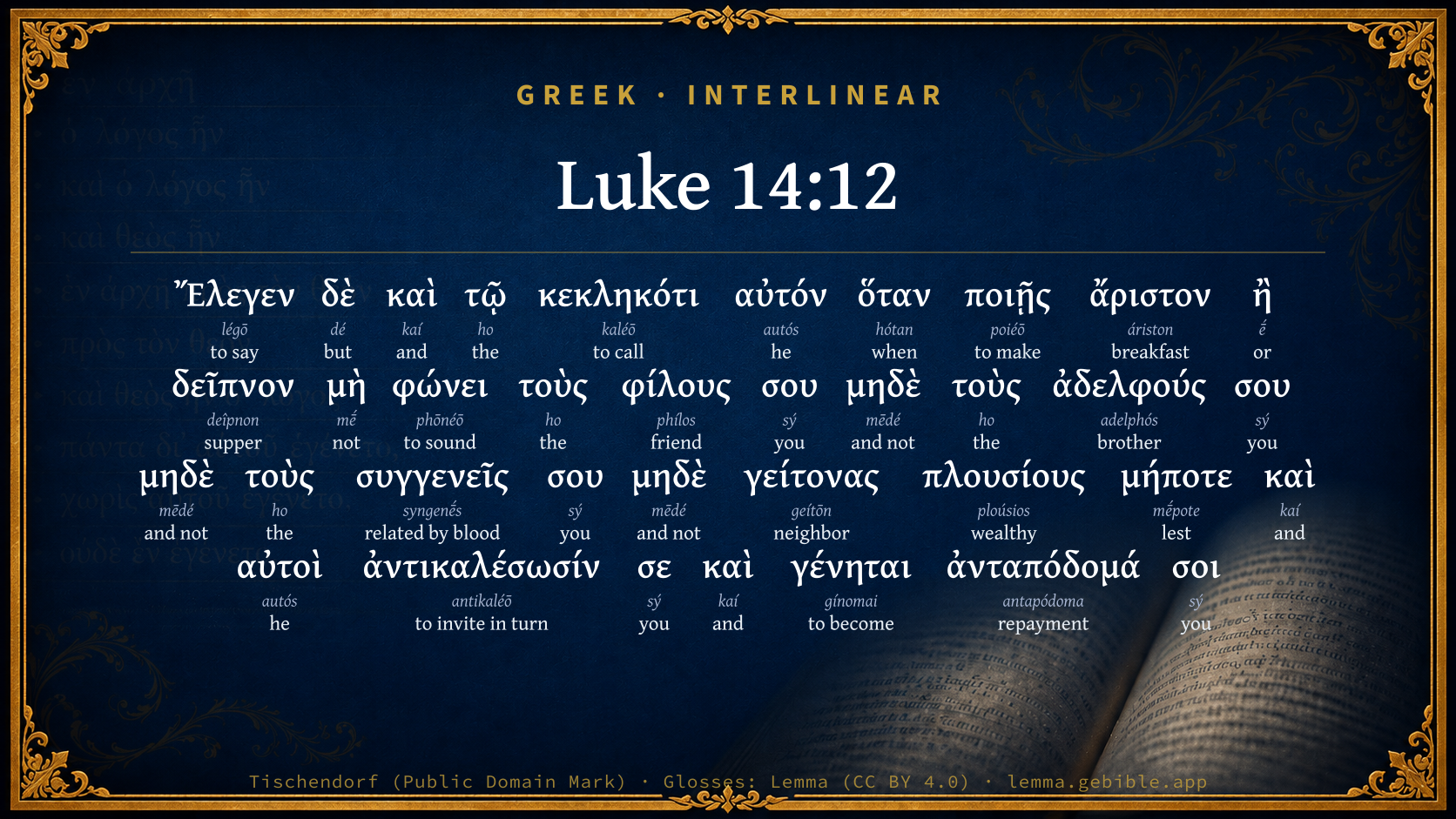
Download image
Cite this verse

Luke 14:12 (World English Bible). Public Domain. Lemma interlinear Bible study tool, https://lemma.gebible.app/v/luke/14/12.

Show BibTeX & RIS
BibTeX
RIS
English Translation
He also said to the one who had invited him, "When you make a dinner or a supper, don't call your friends, nor your brothers, nor your kinsmen, nor rich neighbors, or perhaps they might also return the favor, and pay you back.
World English Bible · Public Domain
Highlights
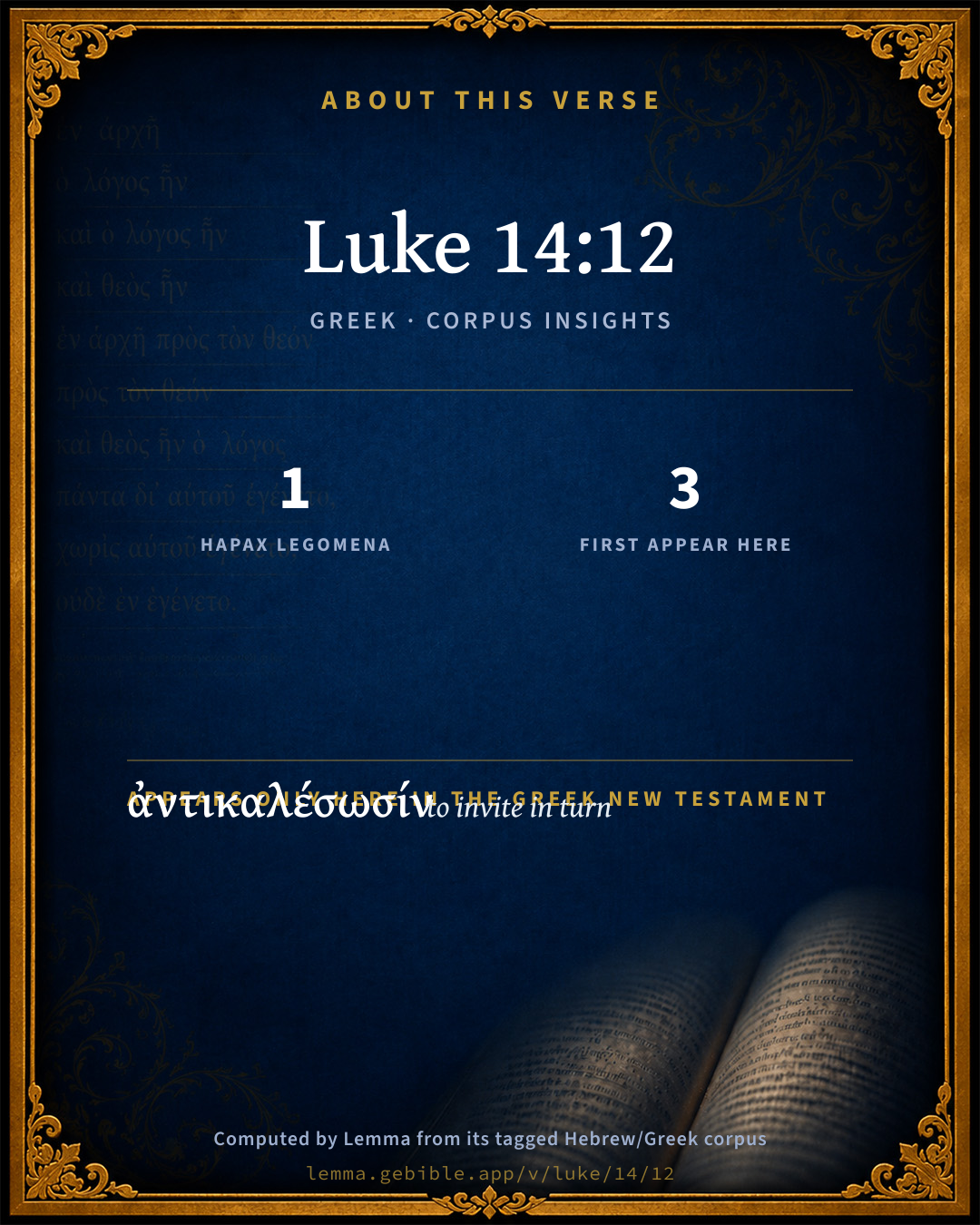
  • 1 hapax legomenon — only here in the Greek New Testament
  • 3 first appearances in the Greek New Testament
Full analysis ↓
Download a study sheet

One document with this verse’s original text, its word-by-word gloss line, the meaning frame, cross-references with their text, attributed commentary, and full source and license credits — printable, and it pastes into notes with its structure intact.

This verse Autodidact and up

Study sheet (.html) Plain text (.txt)

A passage Seminary Student

Up to 50 verses in one chapter. A passage sheet keeps up to 6 commentary sources and 12 cross-references per verse, in the order this page ranks them, and says so on the sheet whenever that leaves anything out. Ask for a single verse and you get the Autodidact verse sheet above.

Everything on this page stays free to read, with no account — the sheet is a download of what is already on screen, not access to it.

Want to remove ads? Support Godless Engineer
Compare translations 3

The same verse in 3 English versions, stacked beneath the original-language interlinear above. Click any original word for its lexicon entry.

Each is an independent rendering of the whole verse — the interlinear is not word-aligned to these translations.

Highlighted words mark where these versions differ — a whole-verse word diff, not a word-by-word alignment.

  • World English Bible Public Domain
    He also said to the one who had invited him, "When you make a dinner or a supper, don't call your friends, nor your brothers, nor your kinsmen, nor rich neighbors, or perhaps they might also return the favor, and pay you back.
  • King James Version Public Domain
    Then said he also to him that bade him, When thou makest a dinner or a supper, call not thy friends, nor thy brethren, neither thy kinsmen, nor thy rich neighbours; lest they also bid thee again, and a recompence be made thee.
  • unfoldingWord Literal Text CC BY-SA 4.0
    Then he also said to the one that had invited him, “When you make a lunch or a supper, do not invite your friends, nor your brothers, nor your relatives, nor rich neighbors, lest they also invite you in return and repayment happen to you.

unfoldingWord Literal Text — © unfoldingWord, licensed CC BY-SA 4.0. Word-aligned USFM3 via Door43 (git.door43.org/unfoldingWord/en_ult).

Versions to compare (up to 4)

3 of 4 selected

Show all 19 translations

Every available English version of this verse, each an independent rendering of the whole verse.

  • World English Bible Public Domain
    He also said to the one who had invited him, "When you make a dinner or a supper, don't call your friends, nor your brothers, nor your kinsmen, nor rich neighbors, or perhaps they might also return the favor, and pay you back.
  • Berean Standard Bible Public Domain
    Then Jesus said to the man who had invited Him, “When you host a dinner or a banquet, do not invite your friends or brothers or relatives or rich neighbors. Otherwise, they may invite you in return, and you will be repaid.
  • Majority Standard Bible Public Domain
    Then Jesus said to the man who had invited Him, “When you host a dinner or a banquet, do not invite your friends or brothers or relatives or rich neighbors. Otherwise, they may invite you in return, and you will be repaid.
  • King James Version Public Domain
    Then said he also to him that bade him, When thou makest a dinner or a supper, call not thy friends, nor thy brethren, neither thy kinsmen, nor thy rich neighbours; lest they also bid thee again, and a recompence be made thee.
  • American Standard Version (1901) Public Domain
    And he said to him also that had bidden him, When thou makest a dinner or a supper, call not thy friends, nor thy brethren, nor thy kinsmen, nor rich neighbors; lest haply they also bid thee again, and a recompense be made thee.
  • Revised Version (1885) Public Domain
    And he said to him also that had bidden him, When thou makest a dinner or a supper, call not thy friends, nor thy brethren, nor thy kinsmen, nor rich neighbours; lest haply they also bid thee again, and a recompense be made thee.
  • Geneva Bible (1599) Public Domain
    Then said he also to him that had bidden him, When thou makest a dinner or a supper, call not thy friendes, nor thy brethren, neither thy kinsemen, nor ye riche neighbours, lest they also bid thee againe, and a recompence be made thee.
  • Douay-Rheims (1899) Public Domain
    And he said to him also that had invited him: When thou makest a dinner or a supper, call not thy friends, nor thy brethren, nor thy kinsmen, nor thy neighbours who are rich; lest perhaps they also invite thee again, and a recompense be made to thee.
  • Young's Literal Translation Public Domain
    And he said also to him who did call him, `When thou mayest make a dinner or a supper, be not calling thy friends, nor thy brethren, nor thy kindred, nor rich neighbours, lest they may also call thee again, and a recompense may come to thee;
  • Literal Standard Version CC BY-SA 4.0
    And He also said to him who called Him, “When you may make an early meal or a dinner, do not be calling your friends, nor your brothers, nor your relatives, nor rich neighbors, lest they may also call you again, and a repayment may come to you;
  • Unlocked Literal Bible CC BY-SA 4.0
    Jesus also said to the man who had invited him, “When you give a dinner or a banquet, do not invite your friends or your brothers or your relatives or your rich neighbors, as they may also invite you in return, and you will be repaid.
  • unfoldingWord Literal Text CC BY-SA 4.0
    Then he also said to the one that had invited him, “When you make a lunch or a supper, do not invite your friends, nor your brothers, nor your relatives, nor rich neighbors, lest they also invite you in return and repayment happen to you.
  • Darby Bible Public Domain
    And he said also to him that had invited him, When thou makest a dinner or a supper, call not thy friends, nor thy brethren, nor thy kinsfolk, nor rich neighbours, lest it may be they also should invite thee in return, and a recompense be made thee.
  • World Messianic Bible Public Domain
    He also said to the one who had invited him, “When you make a dinner or a supper, don’t call your friends, nor your brothers, nor your kinsmen, nor rich neighbors, or perhaps they might also return the favor, and pay you back.
  • Webster's Bible Public Domain
    Then said he also to him that invited him, When thou makest a dinner or a supper, call not thy friends, nor thy brethren, neither thy kinsmen, nor thy rich neighbors; lest they also invite thee again, and a recompense be made thee.
  • Free Bible Version CC BY-SA 4.0
    Then he said to the man who had invited him, “When you give a lunch or a dinner, don't invite your friends, or your brothers, or your relatives, or your rich neighbors, for they may invite you back, and then you'd be repaid.
  • Bible in Basic English Public Domain
    And he said to the master of the house, When you give a feast, do not send for your friends and your brothers and your family or your neighbours who have wealth, for they may give a feast for you, and so you will get a reward.
  • Text-Critical English NT CC BY 4.0
    Jesus also said to the man who had invited him, “When yoʋ prepare a luncheon or a dinner, do not invite yoʋr friends, yoʋr brothers, yoʋr relatives, or yoʋr rich neighbors. If yoʋ do, they may invite yoʋ in return, and yoʋ will be repaid.
  • Tyndale New Testament (1534) Public Domain
    Then sayde he also to him that had desyred him to diner: When thou makest a diner or a supper: call not thy frendes nor thy brethren nether thy kinsmen nor yet ryche neghbours: lest they bidde the agayne and a recompence be made the.

Literal Standard Version (2020), Covenant Press — licensed CC BY-SA 4.0. Text via the HelloAO Bible API (eBible.org). Unlocked Literal Bible (unfoldingWord) — licensed CC BY-SA 4.0. Text via the HelloAO Bible API (eBible.org). unfoldingWord Literal Text — © unfoldingWord, licensed CC BY-SA 4.0. Word-aligned USFM3 via Door43 (git.door43.org/unfoldingWord/en_ult). Free Bible Version, Dr. Jonathan Gallagher — licensed CC BY-SA 4.0. Text via the HelloAO Bible API (eBible.org).

Word by word

More ways to search: Search by grammar → Find every occurrence → Compare this word →

Practice this passage: Drill this verse → Learn its vocabulary →

ἀντικαλέσωσίν
antikaléō
G479
“to invite in turn”
Verb, Aorist, Active, Subjunctive, 3rd person, Plural
Part of Speech
Verb
Tense
Aorist
Voice
Active
Mood
Subjunctive
Person
3rd person
Number
Plural
Full Thayer's Definition

Origin: from G473 and G2564

TDNT: 11:16,4

1. to invite in turn
  1. Ἔλεγεν légō G3004 “to say” Verb, Imperfect, Active, Indicative, 3rd person, Singular
  2. δὲ dé G1161 “but” Conjunction
  3. καὶ kaí G2532 “and” Conjunction
  4. τῷ ho G3588 “the” Article, Dative, Singular, Masculine
  5. κεκληκότι kaléō G2564 “to call” Verb, Perfect, Active, Participle, Dative, Singular, Masculine
  6. αὐτόν autós G846 “he” Personal pronoun, Accusative, Singular, Masculine
  7. ὅταν hótan G3752 “when” Conjunction
  8. ποιῇς poiéō G4160 “to make” Verb, Present, Active, Subjunctive, 2nd person, Singular
  9. ἄριστον áriston G712 “breakfast” Noun, Accusative, Singular, Neuter
  10. ἢ ḗ G2228 “or” Particle
  11. δεῖπνον deîpnon G1173 “supper” Noun, Accusative, Singular, Neuter
  12. μὴ mḗ G3361 “not” Particle, Negative
  13. φώνει phōnéō G5455 “to sound” Verb, Present, Active, Imperative, 2nd person, Singular
  14. τοὺς ho G3588 “the” Article, Accusative, Plural, Masculine
  15. φίλους phílos G5384 “friend” Adjective, Accusative, Plural, Masculine
  16. σου sý G4771 “you” Personal pronoun, 2nd person, Genitive, Singular
  17. μηδὲ mēdé G3366 “and not” Conjunction, Negative
  18. τοὺς ho G3588 “the” Article, Accusative, Plural, Masculine
  19. ἀδελφούς adelphós G80 “brother” Noun, Accusative, Plural, Masculine
  20. σου sý G4771 “you” Personal pronoun, 2nd person, Genitive, Singular
  21. μηδὲ mēdé G3366 “and not” Conjunction, Negative
  22. τοὺς ho G3588 “the” Article, Accusative, Plural, Masculine
  23. συγγενεῖς syngenḗs G4773 “related by blood” Adjective, Accusative, Plural, Masculine
  24. σου sý G4771 “you” Personal pronoun, 2nd person, Genitive, Singular
  25. μηδὲ mēdé G3366 “and not” Conjunction, Negative
  26. γείτονας geítōn G1069 “neighbor” Noun, Accusative, Plural, Masculine
  27. πλουσίους ploúsios G4145 “wealthy” Adjective, Accusative, Plural, Masculine
  28. μήποτε mḗpote G3379 “lest” Adverb, Negative
  29. καὶ kaí G2532 “and” Conjunction
  30. αὐτοὶ autós G846 “he” Personal pronoun, Nominative, Plural, Masculine
  31. σε sý G4771 “you” Personal pronoun, 2nd person, Accusative, Singular
  32. καὶ kaí G2532 “and” Conjunction
  33. γένηται gínomai G1096 “to become” Verb, Aorist, Middle deponent, Subjunctive, 3rd person, Singular
  34. ἀνταπόδομά antapódoma G468 “repayment” Noun, Accusative, Singular, Neuter
  35. σοι sý G4771 “you” Personal pronoun, 2nd person, Dative, Singular

About this verse

These counts appear in no published source. They are computed here, from the morphology-tagged text and Lemma’s own curated glosses. What Lemma adds →

36
words
24
distinct lemmas
Gospels
section

Notable vocabulary

1 hapax legomenon — a word that appears only here in the entire Greek New Testament:

  • ἀντικαλέσωσίν to invite in turn G479

First appearance in Scripture

These words make their first canonical appearance in the Greek New Testament here:

  • γείτονας neighbor G1069
  • ἀντικαλέσωσίν to invite in turn G479
  • ἀνταπόδομά repayment G468

Shared distinctive vocabulary

ἀνταπόδομά repayment G468 occurs in 2 verses of the Greek New Testament. Also found in:
Repetition

Words recur within this verse:

Cross-references

8

Topical passages linked to Luke 14:12 in the Treasury of Scripture Knowledge — connected by theme and wording, ordered by reader-vote popularity; previews shown in the World English Bible.

  • Matthew 5:46 For if you love those who love you, what reward do you have? Don't even the tax collectors do the same?
  • James 2:1–6 My brothers, don't hold the faith of our Lord Jesus Christ of glory with partiality.
  • Proverbs 22:16 Whoever oppresses the poor for his own increase and whoever gives to the rich, Both come to poverty.
  • Luke 6:32–36 If you love those who love you, what credit is that to you? For even sinners love those who love them.
  • Proverbs 14:20 The poor person is shunned even by his own neighbor, But the rich person has many friends.
  • Matthew 6:1–4 "Be careful that you don't do your charitable giving before men, to be seen by them, or else you have no reward from your Father who is in heaven.
  • Luke 1:53 He has filled the hungry with good things. He has sent the rich away empty.
  • Zechariah 7:5–7 "Speak to all the people of the land, and to the priests, saying, 'When you fasted and mourned in the fifth and in the seventh month for these seventy years, did you at all fast to me, really to me?

Cross-references courtesy of OpenBible.info (CC BY 4.0).

Commentary

Notes on Luke 14:12 from classic Christian and Jewish commentators (each source and its license shown beneath its notes). The classic Christian expositions comment on the surrounding passage and are grouped to its opening verse, so a note may address several verses; the Jewish commentaries on the Tanakh (Rashi and others) are per-verse, so they appear only where the commentator wrote on this verse.

Lemma curates 59 commentaries, every one of them public domain or Creative Commons licensed, each selected and text-cleaned for this edition rather than reprinted as found. About our sources →

The Biblical Illustrator

Joseph S. Exell

Luk_14:12-14

Call the poor

The Churchs duty to the poor

A recent advertisement on our city walls struck me as singularly suggestive; it contained the words, God and the poor.

Such a conjunction of words is most remarkable: the highest and the lowest, He who owns all things, and they who own nothing: it is a conjunction of extremes, and though it looked very extraordinary on a placard, yet if you examine the Old and New Testaments the idea will be discovered almost more frequently than any other.

I. THE RELATION OF GOD TO THE POOR. There is a strange mingling of terror and tenderness in Gods language in relation to the poor; terror towards their oppressors tenderness towards themselves. Take the former Pro_17:5; Isa_10:2; Jer_22:13; Amo_5:11; etc.). Such are some of the sentences of fire in which God speaks of the oppressor of the poor. We now turn from terror to tenderness. We shall hear how God speaks of the poor themselves. The lips that spoke in fire now quiver with messages set to music (Isa_58:6-7). There is an extract which I must give from Gods ancient legislation, and as I read you will be able to say whether ever Act of Parliament was so beautiful Deu_24:19-21). And why this beneficial arrangement? A memorial act; to keep the doers in grateful remembrance of Gods mighty interposition on their behalf. When men draw their gratitude from their memory, their hand will be opened in perpetual benefaction.

II. THE RELATION OF THE POOR TO THE CHURCH. The poor ye have always with you. For what purpose? As a perpetual appeal to our deepest sympathy; as an abiding memorial of our Saviours own condition while upon earth; as an excitement to our most practical gratitude. The poor are given into the charge of the Church, with the most loving commendation Of Christ their companion and Saviour.

1. The poor require physical blessing. Christ helped mans bodily nature. The Church devotes itself more to the spirit than to the flesh. This is right: yet we are in danger of forgetting that Christianity has a mission to the body as well as to the soul. The body is the entrance to the soul And is there no reward? Will the Lord who remembers the poor forget the poets benefactor? Truly not! (Psa_41:1).

2. The poor require physical blessing; but still more do they require spiritual blessing. The harvest is great, the labourers are few. Do you inquire as to recompense? It is infinite! They cannot recompense thee, but thou shalt be recompensed at the resurrection of the just. And yet they can recompense thee! Every look of the gleaming eye is a recompense! Every tone of thankfulness is a repayment. God is not unrighteous to forget our work of faith. If we do good unto one of the least of His brethren, Christ will receive the good as though offered to Himself. Terrible is the recompense of the wicked! Whoso stoppeth his ears at the cry of the poor, he also shall cry himself, but shall not be heard. Much is being said about Charity. They have carved her image in marble; they have enclosed her in gorgeously coloured glass; they have placed on her lofty brow the wreath of immortal amaranth; poesy has turned her name into rhythm, and music has chanted her praise. All this is well. All this is beautiful. It is all next to the best thing; but still the best thing is to incorporate charity in the daily life, to breathe it as our native air, and to express it in all the actions of our hand. Let this mind be in you which was also in Christ Jesus. If thou wilt be perfect, go and sell that thou hast, and give to the poor, and thou shalt have treasure in heaven. You will then be one with God! Hearken, my beloved brethren, Hath not God chosen the poor of this world rich in faith, and heirs of the kingdom which He hath promised to them that love Him? Then do not contemn the poor. He that giveth, let him do it with simplicity. (J. Parker, D. D.)

Christian beneficence

I. THE DUTY OF A CHRISTIAN TO DO GOOD; to lay himself out to do good to every one within his reach.

1. This arises from the very nature of the Christian character. Gratitude to Christ leads him to copy the Saviour, who went about doing good.

2. The duty of laying ourselves out to do good arises from our Christian calling. When the Holy Spirit of God makes a difference between sinners who are living in ungodliness and walking after the vanity of their minds, why does He make that difference? God calls forth His people to be witnesses for Him, in such a manner that those who are blind to His glory in creation, and who neglect His glory in revelation, cannot refuse to acknowledge it when it is evidenced and reflected from the people that He has called by His grace. When Gods people go forth doing good, when they manifest self-denial, when they are willing to spend and be spent, in order to contribute to the temporal necessities or to the spiritual welfare of their fellow-creatures, there is something in these actions which tells upon the heart that is closed to all other means of receiving the knowledge of Gods glory and salvation.

II. THE OBJECT OF CHRISTIAN BENEFICENCE. When a Christian does good, or tries to abound in any good work, it must not be from

(1) personal vanity,

(2) a desire of human applause,

(3) for worldly recompense.

His sole inducement must be the love of Christ; his one object the glory of God; his whole desire to advance the temporal and spiritual good of mankind.

III. THE CHRISTIANS ENCOURAGEMENT to lay himself out to do good unto all men, without looking for anything again. They cannot recompense thee; but, etc. (W. Cadman, M. A.)

Christian feasting

Much Of the impressiveness of our Lord as a preacher arose from the miracles He performed in confirmation of the divinity of His mission, and the truth of His doctrine; much also from His adapting Himself to the state and conditions of His hearers; and much also from His deriving His instructions and encouragements from present objects and occurrences, for this always gives a freshness to our discourse, and a superiority to the artificialness of study. He sees a sower going forth to sow, and for the instruction of the people is led to deliver a parable on the good seed of the kingdom.

I. THE OCCASION OF THE ADDRESS. Then said He also to him that bade Him. Concerning this invitation let us make four inquiries.

1. Who was it that bade Him? It was one of the chief Pharisees, a man of some substance and respectability, probably a ruler of the synagogue, or one of the Sanhedrim. We never read of any of the Sadducees inviting our Lord, nor do we ever read of the Herodians inviting Him. Though the Pharisees were the bitterest enemies of Christ, they had frequent interviews with Him.

2. For what was He bidden? Some suppose that this was a common meal, but the narrative requires us to view it as an entertainment, or some kind of festivity.

3. When was He bidden? We are told that it was on the Sabbath day.

4. Why was He bidden? He was invited by Martha from a principle of duty and benevolence, and she and Mary hoped to derive some spiritual advantage from Him. I wish I could think that this Pharisee invited our Lord under the influence of similar motives. But from whatever motive they were impelled tie went not to eat and drink only. No, He went about His Fathers business, this He constantly kept in view. He knew what His work required. He knew that the Good Shepherd must seek after the lost sheep until He find it. My brethren, you must here learn to distinguish between Him and yourselves. He had nothing inflammable in Him. The enemy came and found nothing in Him. But you have much remaining depravity, and are in danger from external circumstances; you therefore, must watch and pray lest you enter into temptation; you are safe when in the path of duty, there God has engaged to keep you. Let us learn from the Saviours conduct to exercise good behaviour, that others may not have occasion to speak evil of us on account of our religion. Consider--

II. WHAT OUR SAVIOUR FORBIDS. He said, When thou makest a dinner or a supper, call not thy friends, nor thy brethren, neither thy kinsmen, nor thy rich neighbours; lest they also bid thee again, and a recompense be made thee. This supper or dinner supposes something costly, for you observe that in the following verse it is called a feast. Observe, it is not absolutely wrong to invite our friends, or our brethren, or our rich kinsmen, or our rich neighbours; but our Saviour looks at the motive here, lest a recompense be made thee; as much as to say, there is no friendship or charity in all this. And the apostle says, Let all things be done with charity. You are to show more hospitality than vanity, and more charity than ostentation, and to be more concerned for those who want your relief. This brings us to consider--

III. WHAT HE ENJOINS. But when thou makest a feast, call the poor, the maimed, the lame, and the blind. Here we see what a variety of evils and miseries are incident to the human race. Here are the poor, without the necessaries of life; the maimed, whose hands are unable to perform their office; the halt, who are indebted to a crutch to enable them to walk at all; the blind. Here we learn, also, the proper objects of your compassion, and the fittest subjects of your charity. It is not necessary that you should always have the poor, the maimed, the halt, and the blind at your table. You may fulfil the Saviours design without this, and do as Nehemiah did, send portions to those for whom nothing is prepared.

IV. WHAT OUR SAVIOUR INSURES. And thou shalt be blessed; for they cannot recompense thee: for thou shalt be recompensed at the resurrection of the just.

1. The blessedness: Thou shalt be blessed. Blessed even in the act itself. Oh, the pleasures of benevolence! How blessed is it even in the review! for this blessedness can be continued and improved on reflection. How superior in the performance to sordid entertainments! Thou shalt be blessed--blessed by the receiver. Think of Job. He says, When the ear heard me, then it blessed me, and when the eye saw me, it gave witness to me. Because I delivered the poor that cried, and the fatherless, and him that had none to help him. The blessing of him that was ready to perish came upon me; and I caused the widows heart to sing for joy. What do we see yonder when we enter Joppa with Peter? When he was come they brought him into an upper chamber: and all the widows stood by him weeping, and showing the coats and garments which Dorcas made while she was with them. And thou shalt be blessed--blessed by the observers. Who does not observe? And who observes and does not bless on such occasions? Few, perhaps none of us, knew personally a Reynolds, a Thornton, or a Howard, of whom we have read; but in reading their history, when we come to their names we cannot help blessing them, and thus the words of the Scripture are fulfilled, The memory of the just is blessed. And thou shalt be blessed. Above all, blessed by God Himself, upon whom everything depends, whose favour is life, and whose loving-kindness is better than life. He blesses personally and relatively. He grants you spiritual and temporal blessings. David says, Let them curse, but bless Thou.

2. The certainty of this blessedness--For they cannot recompense thee. This seems a strange reason, and would tend to check rather than encourage a worldly man. The foundation of this reason is this, that charity must be recompensed. If the poor cannot do this themselves, some one else must undertake it for them, and therefore God Himself must become answerable; and it is much better to have God to recompense us than to rely upon a poor dying creature. Paul therefore, says, to those who had made a collection to relieve him, and had sent it by the hands of Epaphroditus, My God shall supply all your need according to His riches in glory by Christ Jesus. If, therefore, the thought ever occurs to your mind, I know not those persons who have relieved me; I shall never be able to repay them, so much the better, for then God must, and if there be any truth in His word, if there be any love in His heart, He will.

3. The time of this bestowment--For thou shalt be recompensed at the resurrection of the just. Not that this will be done then exclusively, for, as we have already shown, there are advantages attending charity now. But it will be principally then, publicly then. The apostle says to the Corinthians, Judge nothing before the time, until the Lord come, who both will bring to light the hidden things of darkness, and will make manifest the counsels of the heart; and then shall every man have praise of God. Then will it be done perfectly. It is not wrong to look for advantage in religion. But you should be upon your guard not to entertain a notion of meritoriousness in any of your doings. No, the reward is of grace, not of debt. (W. Jay.)

Christs counsel to his host

Our Lord does not here enjoin neglecting and refraining from ones friends, kinsfolk, and neighbours, to entertain only the poor, maimed, halt, and blind. What He says is, when you make a dinner or supper--that is, as He immediately explains, a feast--let it be, not for those with whom you are accustomed to associate, but rather for the destitute and forlorn outside your circle. It is a question, you see, not at all of social fellowship, but of expenditure, and of the objects to which our great expenditures should be devoted. When you would lavish trouble and money, says Christ, let the lavishing be, not for your own personal gratification, not with the view of securing some enjoyment or obtaining some benefit for yourself, but for the blessing of others. The point on which the whole admonition turns, and to which it refers, is largeness of outlay. This is obvious. Our Lord is thinking and speaking, not of, an ordinary meal such as might be spread any day, but of a feast, like the great supper of the parable that follows: and remember the occasion of His words, the circumstances under which they were uttered. He was dining on the Sabbath, in the house of one of the chief Pharisees, who had Him to eat Bread with him; and everything indicates that it was no common dinner at which He was present, but an entertainment on a large scale, got up probably with much pains, and regardless of cost. Christ noticed, we are told, how those who were bidden chose out the chief rooms; nay, such were the unseemly contests among the guests for precedence, and the rude struggling for the best places, which He witnessed, that when at last the tumult had subsided, and all were arranged, He could not forbear remarking on it in tones of rebuke. Evidently the meal was a grand affair, a banquet numerously attended and by many notable and distinguished persons. Contemplating, as He sat there, the profusion, the sumptuousness; picturing what it had cost--the amount of money, labour, and worry, and perhaps sacrifice, that had been expended on it--and penetrating that it was all mainly for selfish ends, with the idea and in the hope of some advantage through it; Christ turns His great mournful eyes upon the many with the words: When you would make such another feast as this, my friend, at so much trouble and cost, instead of calling to it your rich friends, who are likely to recompense you for it, you should call to it the destitute and afflicted, who are unable to recompense you, and thus be blessed at the resurrection of the just. The inner point and spirit of which form of words was this: Ah! my friend, it is a mistake to make your great outlays of strength and treasure with a view to your own gratification and aggrandisement, for it is poor recompense at the best, after all. These great outlays should be reserved rather to meet the needs and ameliorate the unfortunate condition of others; for the blessing of that, though more ethereal and less palpable, is infinitely more worth. You should not burden yourself to win ought of present enjoyment or acquisition for yourself. If you burden yourself at all, it should be to supply some want or serve some interest of the necessitous around you. And the lesson remains for us. Let your extensive expenditures, your toils and worries, and hardships and sacrifices, be for those outside who require ministry, rather than for yourself. When it is a question of your own personal amusement or pleasure, of your own worldly comfort or gain, be content to spend but little; dont make a fuss, or lie awake anxiously, or go out of your way for that. If you do so at all, do it when the welfare of others is concerned, when there are others to be succoured or saved by it; reserve for such ends the incurring of heavy cost, the taking on of heavy burdens of thought and care. (S. A. Tipple)

Christian entertainments

Jesus Christ did not intend that the rich should never have communion with one another, or hold intercourse with one another; that would be as absurd as it would be impracticable. The idea is that, having had your own fellowships and enjoyments, having eaten the fat and drunk the sweet, you are to send out a portion to him that hath none, and a blessing to him who sits in loneliness and sadness of heart. I had a wonderful dream some time ago--a singular dream. It was about the Mansion House and the Lord Mayor. I saw the great banquet ing hall filled, and I looked and wondered at the people, for they had such a peculiar expression upon their countenances. They seemed to be closing their eyes, and so they were. Alas! they were all blind people, and all over fifty years of age. It was the great Lord Mayor of London himself who had invited all the blind people over that age in London to meet one another, and have one happy night, so far as he could make it, in the ancient banqueting hall. No loving cup was passed round, lest accidents should occur; but many a loving word was spoken, many a sigh full of meaning was heaved--not the sigh of misery, but the sigh of thankfulness. And then a strange silence fell upon all the guests, and I heard a voice from above saying in the English tongue quite distinctly, They cannot recompense thee, but thou shalt be recompensed at the resurrection of the just. Then the banqueting hall seemed to be filled with spectators--glad witnesses--as if, at last there were upon the earth some fine touch of Christian feeling, some recognition of the mystery of charity and the boundlessness and condescension of Christian love. (J. Parker, D. D.)

True Christian festivity

I. It should be UNSELFISH. Not extended merely to those from whom we expect a similar return.

II. It should be MERCIFUL. Extended to those who are generally neglected.

III. THIS FESTIVITY WILL BE REWARDED. With the blessing of the poor now, and the commendation of the Judge hereafter. (Anon.)

Christian hospitality

Our Lord really means that hospitality is first to be exercised towards those who need it, because of their narrow means, and to whom kindness of this sort is more pleasant, because they receive such little notice from the world. These are to be first recipients of our hospitality, and after them our friends, relatives, and neighbours, who may be supposed to be able to ask us again. This, of course, is directly contrary to the practice of the world. Now I do not think that we obey this injunction of the Lord by following its spirit (as the saying is) rather than its letter. It has been said that the essence of the beatitude, as distinct from its form, remains for all who give freely, to those who can give them no recompense in return, who have nothing to offer but their thanks and prayers, and that relief, given privately, thoughtfully, discriminately, may be better both for the giver, as less ostentatious, and for the receiver, as tending to the formation of a higher character than the open feast of the Eastern form of benevolence. But it is to be noticed that the Lord is not speaking of relief, i.e., of almsgiving, but of hospitality. It is one thing to send relief in a basket to some poor person from your house, and quite another yourself to proffer to the same person food upon your own table of which you and he jointly partake. By relief or alms you almost of necessity constitute yourself his superior; by hospitality you assume that he is far more on the same level with yourself. Partaking of food in common has, by the absolutely universal consent of mankind, been esteemed a very different thing from the mere gift of food. If it be said that such hospitality as the Lord here recommends is contrary to the usages of even Christian society amongst us, we answer, Of course it is; but, notwithstanding this, it is quite possible that the Christianity of our Christian society, of which we have so high an opinion, may be very imperfect indeed, and require reformation, if not regeneration, and that the open feast of the Eastern form of benevolence may be worthy of more imitation amongst ourselves. Look at the extravagant cost of some entertainments--viands set before the guests simply because they are costly and out of season--and consider that the difference between a fair and creditable entertainment and this extravagance would enable the giver to act ten times more frequently on the principle which the Lord inculcates, and for which he would be rewarded; consider this, and the folly of such waste, not to say its wickedness, is manifest. (M. F. Sadler.)

A model feast

I cannot think there is no connection with Divine things in the counsels Christ gave to His host about making a feast. I think He meant more than to alter a custom, or change social habits. What He advised went deeper, and had a profounder intention than that. He was reaching down to the foundation of things; showing how God deals with men, and what are the principles, or what is the measure and scope of His kingdom. He pourtrays a model feast. And if I mistake not, the portraiture is a pattern of things in the heavens. A place at the feast, I think He means to say, does not depend upon social grade, position, or attainments, but upon the needs of those who are called. Necessity, misery, helplessness, were to be the qualifications--poor, maimed, halt, blind. Friends and rich neighbours were not to be left out; they might come and share the joy and blessing--the joy of ministering and doing good to others; but the sore and the stricken were to be the guests; the invitations were to be sent specially to them. The ado, the preparation, the plentifulness, and the freeness of the feast, must be all for them, to bless them, and make them glad. That is Gods feast. That is how God does. He prepares a feast for man roman the sinner, man the miserable, man the outcast, the hungry, the starved, the diseased, the dying; and He throws it open, and bids them all come, and sends to fetch them in. And when they gather, He lets His rich friends, the angels, rejoice with Him; for there is joy in the presence of the angels of God over one sinner that repenteth. (W. Hubbard.)

The poor invited to a feast

When I was quite a little boy, there lived in my fathers house a man whom, as I look back, I, in common with most who knew him, cannot help regarding as, perhaps, the holiest man we were acquainted with. He lived a life of singular devotion and self-denial, and seemed to walk constantly in the presence of God. Some little time ago, when m Liverpool, I accidentally came across the person in whose house be had lodged in the days when he had first devoted himself to God, when he was quite a young man, before his connection with my own beloved father was as close as it afterwards became. This good man, who kept the house in which this gentleman lodged, told me a few anecdotes about him, and, amongst others, I remember the following: Ah, Mr. Aitken! said the man, I shall never forget Mr. Cs Christmas dinner. I said, I wish you would tell me about it; and he replied, I will. Christmas Day came near, and Mr. C called up my wife, and said to her, Now, I want you to make the very best dinner you possibly can; I am going to give a dinner-party. Well, Mr. C, she said, you have been a long time in my house, and I never heard you talk of giving a dinner-party yet; but I will see to it that it is a right good dinner, and there shall be no mistake about it. Do your best, he said; I am going to invite my friends, and I want everything to be done properly. My wife set to work and got a very good dinner indeed. Christmas Day came. Towards evening we were expecting the gentlemen to turn up who had been invited by our lodger; we did not know who they were, but we made sure they would be people worthy of the occasion. After a time, there came a knock at the door. I opened the door, and there stood before me a man clothed in rags. He had evidently washed his face, and got himself up a little for the occasion; at the same time he was a beggar, pure and simple. He said, Does Mr. C live here? Yes, I replied; he lodges here, but you cannot see him; he is just going to sit down to dinner. But, said the man, I was invited to come here to dinner this evening. You may imagine my horror and astonishment; I could scarcely contain myself. What! I said; you invited to come here this evening, a man like you? I had scarcely got the words out of my mouth before I saw another poor, miserable specimen of humanity crawling round the corner; he was another of Mr. C s guests. By-and-by, there was a round dozen of them, or something like a score; and in they came, the most haggard, miserable, woe-begone objects you could possibly conceive. They went into my wifes nice, smart-looking dining-room, with that grand white cloth, and all the good things which had been so carefully prepared. It almost took ones breath away to see them. But when we saw the good man himself, setting to work, like the Master of old (who girded Himself to serve His disciples)--setting to work to make these men happy, and help them to spend a pleasant evening, without stiffness or formality, we thought, After all, he is right. This is the best sort of dinner-party; and we did not grudge the labour we had bestowed. Now, I have told that little anecdote in order to illustrate the fact that our Lords teaching on such subjects is eminently practical, and that when He gives a suggestion, you may be sure that it is a very sensible and sound one. (W. H. Aitken, M. A.)

Call the poor

Pococke informs us, that an Arab prince will often dine before his door, and call to all that pass, even to beggars, in the name of God, and they come and sit down to table, and when they have done retire with the usual form of returning thanks. It is always customary among the Orientals to provide more meats and drinks than are necessary for the feast! and then, the poor who pass by, or whom the rumour of the feast brings to the neighbourhood, are called in to consume what remains. This they often do in an outer room, to which the dishes are removed from the apartment in which the invited guests have feasted; or otherwise, every invited guest, when he has done, withdraws from the table, and his place is taken by another person of inferior rank, and so on, till the poorest come and consume the whole. The former of these modes is, however, the most common. (Biblical things not generally known.)

Feeding the hungry

It was the custom of St. Gregory, when he became pope, to entertain every evening at his own table twelve poor men, in remembrance of the number of our Lords apostles. One night, as he sat at supper with his guests, be saw, to his surprise, not twelve but thirteen, seated at his table; and he called to his steward, and said to him, Did not I command thee to invite twelve? and, behold! there are thirteen. And the steward told them over, and replied, Holy father, there are surely twelve only. And Gregory held his peace; and, after the meal, he called forth the unbidden guest, and asked him, Who art thou? And he replied, I am the poor man whom thou didst formerly relieve; but my name is The Wonderful and through Me thou shalt obtain whatever thou shalt ask of God. Then Gregory knew that he bad entertained an angel; or, according to another version of the story, our Lord Himself.

Christ-like hospitality

It is said of Lord Chief Justice Hale that he frequently invited his poor neighbours to dinner, and made them sit at table with himself, if any of them were sick, so that they could not come, he would send provisions to them from his own table. He did not confine his bounties to the poor of his own parish, but diffused supplies to the neighbouring parishes as occasion required. He always treated the old, the needy, and the sick with the tenderness and familiarity that became one who considered they were of the same nature with himself, and were reduced to no other necessities but such as he himself might be brought to. Common beggars he considered in another view. If any of these met him in his walks, or came to his door, he would ask such as were capable of working why they went about so idly. If they answered it was because they could not get employment, he would send them to some field to gather all the stones in it, and lay them in a heap, and then pay them liberally for their trouble. This being done, he used to send his carts, and caused the stones to be carried to such places of the highway as needed repair.

The Biblical Illustrator, edited by Joseph S. Exell (c. 1880s–1900s) — public domain. Text from a community e-Sword module.

Joseph Benson's Commentary

Luk 14:12-14. Then said he also to him that bade him — In the time of dinner, Jesus directed his discourse to the person who had invited him, and showed him what sort of people he should bid to his feasts. When thou makest a dinner, &c., call not thy friends — That is, I do not bid thee call thy friends, or thy rich neighbours. Our Lord leaves these offices of courtesy and humanity as they were, and teaches a higher duty. Or, “by no means confine thy hospitality to thy rich relations, acquaintance, and neighbours, lest the whole of thy reward be an invitation from them to a like entertainment.” So Macknight: but surely it is also implied in this precept of our Lord, that we should be sparing in entertaining those that need it not, in order that we may assist those that do need, with what is saved from those needless entertainments. Lest a recompense be made thee — This fear is as much unknown to the world as even the fear of riches. But when thou makest a feast, call the poor — Have tables also for the poor, that they may partake of thy entertainments. Dr. Whitby’s observations on this passage are worthy of attention. 1st, “Christ doth not absolutely forbid us to invite our friends, our brethren, or kinsfolk, to testify our mutual charity and friendship, and how dear our relations are to us; only he would not have us invite them out of a prospect of a compensation from them again, but to prefer the exercising of our charity to them who cannot recompense us. As comparative particles are sometimes in sense negative, so negative particles are often in sense only comparative: as Pro 8:10, Receive my instructions, and not (that is, rather than) silver; Joe 2:18, Rend your hearts, and not (that is, rather than) your garments; Joh 6:27, Labour not for the meat that perisheth, but for that which endureth, &c. So here, Be not so much concerned to call thy friends as to call the poor. 2d, Nor does he lay upon us a necessity, by this precept, to call the lame, the blind, or the maimed to our tables; but either to do this, or what is equivalent to us in respect of charge, and more advantageous to them and their families, namely, to send them meat or money, to refresh them at home.” And thou shalt be blessed — Μακαριος, happy. This will afford thee a much nobler satisfaction than banquets can give: for, though they cannot make thee any recompense in the same way, their prayers shall descend in blessings on thy head; and besides all the pleasure thou wilt find in the exercise of such beneficence, thou shalt be abundantly recompensed at the resurrection of the just, if thy bounties proceed from a principle of faith and piety.

Joseph Benson's Commentary on the Old and New Testaments (1811–1818) — public domain. Text from a community e-Sword module.

Whedon's Commentary on the Bible

Daniel D. Whedon

How to give feasts for a divine reward, Luk_14:12-14.

12. To him that bade him—We could almost suppose that our Lord meant to compliment the man who had furnished the feast for

him. A recompense—And then thou wilt be cheated of thy recompense from God. Our Lord here is giving no lesson against the interchange of hospitalities among friends. He does not deny that they have their healthful social influence among men. The repayments of the social debts of life, performed in the right spirit, have the blessing of God upon them. He would be evidently condemning himself in attending them, if he wore rebuking the inviters. But the bent of his lesson is this: As the feast of interchange has its return from thy fellow, so the feast of benevolence has its return from God.

Daniel D. Whedon (gen. ed.), Commentary on the Old and New Testaments (1874–1909) — public domain. Text from a community e-Sword module.

Godbey's Commentary on the New Testament

William B. Godbey

HEAVENLY RECOMPENSE

Luk 14:12-14. “But He also said to the one having invited Him, When you may make a dinner or a supper, do not call your rich friends, brothers, relatives, or neighbors, lest they may also call you in turn, and there may be a recompense unto you. But when you may make a feast, call the poor, maimed, halt, blind, and you shall be happy, because they have nothing to recompense you; and it shall be recompensed unto you in the resurrection of the righteous.” The Bible plainly teaches two resurrections

— that of the just and of the unjust. (Rev 20:5.) This is certainly an exceedingly beautiful paragraph, enunciated by our Lord to that Pharisaical ruler who had complimented Him with an invitation to that Sunday festival. With what meekness and simplicity does He administer this good advice to His kind host! As we find the theologians and Pharisees present at this festival, and no allusion to the presence of the different sympathetic characters here specified (i.e., the poverty-stricken, the lame, the maimed; i.e., persons whose hands were afflicted till they could not use them. All persons who are deprived of the use of either their feet or their hands are objects of universal charity; while the blind always deserve, not only our pity, but our benefactions), I trow this man had called his rich friends, brothers, relatives, and neighbors, while these real objects of charity are all absent. Jesus knew that they would all make a festival and invite this man, thus compensating his favor. Lord, pour in the light, that we may all see this beautiful truth taught by Thyself! How insignificant the recompense of another festival, where you will go, and lose your time, and make yourself sick, eating to gluttony! O what a grandeur and glory in the heavenly recompense of the first resurrection, giving you a place in the bridehood of Christ, to reign with Him a thousand years, during the glorious millennium, which will be succeeded by the celestial ages, promoting you to grander honors, and opening to you worlds of bliss and glory, possibilities, attainabilities, achievements, aggrandizements, emoluments, and triumphs infinitely beyond the possibility of conception while incarcerated in these mud houses! O the infinitude of immortal developments evolved out of the possibilities of redeemed intelligences, winging their flight from world to world, and exploring the grandeur, sublimity, and glory of Omnipotence through the flight of eternal ages! N.B. — “There are infinite degrees in the heavenly state.” (1 Corinthians 15). Do you not know that the heavenly recompense in the resurrection of the just is a thousand million times more valuable than the invitation which some rich family could give you to a dining? How strange that the followers of Jesus do not remember and practice this beautiful precept, calling the poor, distressed, unfortunate, afflicted people of every sort to a feast, and using the opportunity to preach Jesus to them and get their souls saved!

William B. Godbey, Commentary on the New Testament (1896–1900) — public domain. Text from a community e-Sword module.

Tyndale Open Study Notes

Tyndale Open Resources

14:12-13 don’t invite your friends: Jesus challenged the prevailing use of banquets to flaunt and elevate one’s status in the community. The host would invite friends of equal status and a few who were higher. These honored guests would then be expected to reciprocate, raising the first host’s social position and reputation. Jesus turned this hierarchy upside down by instructing his followers to invite those who had no social status and could not reciprocate. God invites sinful human beings to dine at his banquet table of salvation.

Tyndale Open Study Notes — © Tyndale Open Resources, licensed CC BY-SA 4.0. Text via the HelloAO Bible API.

Bengel's Gnomon

Johann Albrecht Bengel

Luk 14:12. [Τῷ κεκληκότι, to him that had bidden Him) This Pharisee was not one of the worst stamp; see Luk 14:14.—V. g.]—ἄριστον ἢ δεῖπνον, a dinner [rather the morning meal, or breakfast], or a supper [rather a dinner]) More usually there is made the simple mention of supper: therefore the meal at this time may have been the early meal [ἄριστον, prandium, breakfast or luncheon]. See Luk 5:1; Luk 5:25.—μὴ φώνει τοὺς φίλους, do not give an invitation to thy friends) that is to say, I do not tell thee to invite thy friends, etc. Jesus leaves as it were in their own place [as generally recognised] invitations which arise out of a natural or social tie of connection. He Himself enjoins [besides] a better class of invitations. He does not altogether abolish the offices of friendly courtesy.—πλουσίους, [when they happen to be] rich) This epithet is to be joined to τοὺς φίλους—ἀδελφοὺς—συγγενεῖς—γείτονας, those of thy friends, brethren, relatives, neighbours who may be rich, but who are often neglected when they are poor: But the epithet chiefly belongs to γείτονας, neighbours; to which four classes of those well-off in the world, there are opposed as many classes of those who are not so in Luk 14:13,—μήποτε—ἀνταπόδομα, lest—a recompense) This kind of fear is unknown to the world, as is also fear of riches [Give me neither poverty nor riches], Pro 30:8. This is the foundation of true liberality, and αὐταρκεία, independent contentedness. Who is there that would wish that all his acts in this life should be recompensed according to their desert? [And yet there are not wanting persons, who wish that everything whatever, which they give or lend, should be most quickly, abundantly, and with accumulated interest, repaid to them: nay they even hunt after both peculiar privileges and undeserved opportunities which for crushing many others, with such great eagerness, that one might suppose that there was no resurrection at hand or recompense of men’s deed, nay, indeed, as if nothing is to be taken away (wrested) from those, who practically deny their faith in things future by their unbridled panting after things present. At what a fearful cost do these things present stand to not a few persons, with whom they are turned into a matter of plunder and rapacity! Happy is he, who is not loath to wait (for his good things). Do not be unduly chagrined, if at any time it will happen that in some case you fail (are disappointed) in the world. But beware of judging rather harshly of others, whom, whether you will or not, you cannot but perceive to have precedency given to them above yourself.—V. g.]—καὶ γενήσεται) Concerning this construction, μήποτε καὶ αὐτοί σε ἀντικαλέσωσι [Subj.], καὶ γενήσεταί [Indic.], σοι ἀνταπόδομα, the exact counterpart to which occurs in Luk 14:9 [where see note], a judgment may be formed from the note on Mar 3:27, which see. From not observing this, many have altered γενήσεται to γένηται.[144]

[144] However the oldest authorities support γένηται, not γενἡσεται, ABa Vulg. Iren. (‘fiat’) Cypr. bc alone have ‘erit.’—E. and T.

Bengel's Gnomon of the New Testament — English translation (T&T Clark, Edinburgh, 1860) — public domain. Text from a community e-Sword module.

Meyer's Critical & Exegetical Commentary

Heinrich August Wilhelm Meyer

Luk_14:12-14. Doubtless the collocation of the company at table suggested these words, which likewise are meant not probably as an actual table arrangement, but parabolically, as a foil to the customary teaching, that instead of arranging the manifestations of human friendliness with a view to receiving a return, we should make such manifestations just to those who cannot repay them again; then shall we receive requital in the kingdom of the Messiah. At the root of this lies the idea that the temporal requital striven after excludes the Messianic compensation, the idea of the ἀπέχειν τὸν μισθόν (Mat_6:2; Mat_5:16). There is no allusion in this place to the calling of the heathen (Schenkel).

μή] not: non tam or non tantum (Kuinoel, and many others), which here would be even logically wrong on account of μήποτε κ. αὐτοί σε ἀντικ. Jesus gives, indeed, only a figurative discourse.

φώνει] purposely chosen; the manifest, obvious element of the καλεῖν (Luk_14:13) is denoted.

πλουσίους] belongs only to γείτονας (in opposition to Grotius).

μήποτε κ.τ.λ.] Hic metus mundo ignotus est, ut metus divitiarum, Bengel.

ἀντικαλέσωσι] Comp. Xen. Symp. i. 15 : οὔτε μὴν ὡς ἀντικληθησόμενος, καλεῖ μέ τις, ἐπεὶ πάντες ἴσασιν, ὅτι ἀρχὴν οὐδὲ νομίζεται εἰς τὴν ἐμὴν οἰκίαν δεῖπνον εἰσφέρεσθαι.

In respect of καὶ αὐτοί the general idea of the invitation has presented itself.

Luk_14:13. ἀναπήρους] maimed; Plat. Crit. p. 53 A: χωλοὶ καὶ τυφλοὶ καὶ ἄλλοι ἀνάπηροι.

Luk_14:14. ἀνταποδοθήσεται] Thucyd. iii. 40; Plat. Phaedr. p. 236 C; Rom_11:35; 1Th_3:9; placed first for emphasis.

ἐν τῇ ἀναστάσει τῶν δικαίων] This is the ἀνάστασις ζωῆς, see on Joh_5:28. The Jewish doctrine of a double resurrection is confirmed not only by Paul (1Co_15:22 f.; 1Th_4:16; comp. Act_24:15), but also in this place by Christ (comp. also Mat_24:31). Comp. Luk_20:34-36. Otherwise τῶν δικαίων would be a superfluous and unmeaning addition.[175] Moreover, it could not be taken by the pharisaic hearers in any other sense than in the particularistic one, but not in such a manner as that Jesus, because He had the δικαίους directly in view, only mentioned the resurrection of these, without thereby excluding that of the remaining people as contemporary (in opposition to Kaeufer, De ζωῆς αἰων. not. p. 52). The doctrine of the millennial kingdom between the first and second resurrection adopted in the Apocalypse (Bertholdt, Christol. § 38) is not, however, confirmed, nor are the Rabbinical traditions, partly varying very much among themselves on the several stages of the resurrection (Eisenmenger, Entdeckt. Judenth. II. p. 901 ff.); further, the assumption is not confirmed, according to which the Israelites in themselves were understood as the δικαίους who should first arise (Bertholdt, § 35; Eisenmenger, II. p. 902), or at least the righteous among the Israelites (Eisenmenger, l.c.). Jesus means the righteous in the moral sense, as the context shows (see Luk_14:13 f., 16 ff.), without limitation of race. The specific definition of the idea of those first to be awakened as οἱ τοῦ Χριστοῦ (1Co_15:23; comp. 1Th_4:16) lay of necessity in the development of the Christian consciousness of the ΔΙΚΑΙΟΣΎΝΗ only to be attained in Christ.

[175] It would be so also if it did not presuppose any ἀνάστασις τῶν ἀδίκων at all. This is against Georgii in Zellers Jahrb. 1845, I. p. 141., who finds in the Synoptic Gospels only a resurrection of the pious.

Meyer — Critical and Exegetical Commentary on the New Testament — English translation by Peter Christie, edited by Frederick Crombie (T&T Clark, 1880) — public domain. Text from a community e-Sword module.

Expositor's Greek Testament

ed. W. Robertson Nicoll

Luk 14:12-14 . A word to the host , also parabolic in character in so far as it gives general counsel under a concrete particular form (Hahn), but not parabolic in the strict sense of teaching spiritual truth by natural examples.

Luk 14:12 . φωνεῖν used for καλεῖν in Hellenistic Greek (Farrar, C. G. T.), denoting formal ceremonious invitation as on a great occasion (Hahn). τοὺς φίλους , etc.: four classes likely to be asked on ordinary social grounds are named personal intimates, brethren, relations (these two form one category), and rich neighbours. The epithet πλουσίους belongs to the last class alone. Friends and relatives are called because they are such. Mere neighbours are called only because they are rich, or, more generally, socially important. μήποτε , lest, presenting return invitations ( ἀντικαλεῖν , here only in N.T.) as an object of dread, a fear unknown to the world. ( Hic metus mundo ignotus , Bengel.)

The Expositor's Greek Testament, edited by W. Robertson Nicoll (1897–1910) — public domain. Text from a community e-Sword module.

Godet's Commentaries

Frédéric Louis Godet

3 d. Luk 14:12-14.

The company is seated. Jesus, then observing that the guests in general belonged to the upper classes of society, addresses to His host a lesson on charity, which He clothes, like the preceding, in the graceful form of a recommendation of intelligent self-interest. The μήποτε, lest (Luk 14:12), carries a tone of liveliness and almost of pleasantry: “Beware of it; it is a misfortune to be avoided. For, once thou shalt have received human requital, it is all over with divine recompense.” Jesus does not mean to forbid our entertaining those whom we love. He means simply: in view of the life to come, thou canst do better still.—᾿Ανάπηροι, those who are deprived of some one sense or limb, most frequently the blind or the lame; here, where those two categories are specially mentioned, the maimed in general.

In itself, the expression resurrection of the just, Luk 14:14, does not necessarily imply a distinction between two resurrections, the one of the just exclusively, the other general; it might signify merely, when the just shall rise at the inauguration of the Messianic kingdom. But as Luk 20:35 evidently proves that this distinction was in the mind of Jesus, it is natural to explain the term from this point of view (comp. 1Co 15:23; 1Th 4:16; Php 3:11; Revelation 20).

Frédéric Louis Godet — Commentaries on Luke, John, Romans, and 1 Corinthians — English translation (T&T Clark, Edinburgh, 1870s–1890s) — public domain. Text from a community e-Sword module.

Geneva Bible (1599)

Geneva Bible translators

Prov. 3:27; Job 4:7

Against them which lavish out their goods either ambitiously, or for hope of recompence, whereas Christian charity respecteth only the glory of God, and the profit of our neighbor.

Geneva Bible (1599) marginal notes — public domain. Text via Bolls.life.

Jamieson, Fausset & Brown

Robert Jamieson, A. R. Fausset & David Brown

call not thy friends--Jesus certainly did not mean us to dispense with the duties of ordinary fellowship, but, remitting these to their proper place, inculcates what is better [BENGEL].

lest . . . a recompense be given thee--a fear the world is not afflicted with [BENGEL]. The meaning, however, is that no exercise of principle is involved in it, as selfishness itself will suffice to prompt to it (Mat 5:46-47).

Jamieson, Fausset & Brown — Commentary Critical and Explanatory on the Whole Bible (1871) — public domain (CC PDM 1.0). Text via the HelloAO Bible API.

Adam Clarke's Commentary

Verse 12. Call not thy friends, c.] Our Lord certainly does not mean that a man should not entertain at particular times, his friends, c. but what he inculcates here is charity to the poor and what he condemns is those entertainments which are given to the rich, either to flatter them, or to procure a similar return; because the money that is thus criminally laid out properly belongs to the poor.

Adam Clarke's Commentary on the Bible (1810–1826) — public domain. Text from a community e-Sword/MySword module.

Ellicott's Commentary for English Readers

(12) A dinner or a supper.—The two words were used respectively for the morning and the evening meal—the former, like the Continental déjeûner, being taken commonly a little before noon, the latter, about sunset.

Thy friends, nor thy brethren.—The words were clearly chosen as including the classes of guests who were then present. Our Lord saw in that Sabbath feast nothing but an ostentatious hospitality, calculating on a return in kind. It might not be wrong in itself, but it could take no place, as the Pharisee clearly thought it would do, in the list of good works by which he sought to win God’s favour. The very fact that it met with its reward on earth excluded it, almost ipso facto, from the reward of the resurrection of the just.

A Bible Commentary for English Readers, edited by Charles John Ellicott (1878–1897) — public domain. Text from a community e-Sword module.

The Cambridge Bible for Schools and Colleges

gen. ed. J. J. S. Perowne

12-14. Whom to invite; a Lesson to the Host.

12. call not thy friends, nor thy brethren] In this, as many of our Lord’s utterances, we must take into account (1) the idioms of Oriental speech; (2) the rules of common sense, which teach us to distinguish between the letter and the spirit. It is obvious that our Lord did not mean to forbid the common hospitalities between kinsmen and equals, but only, as the context shews, (1) to discourage a mere interested hospitality intended to secure a return; and (2) to assert that unselfish generosity is superior to the common civilities of friendliness. The “not” therefore means, as often elsewhere in Scripture, “not only, but also,’ or “not so much...as,” as in Pro_8:10; Joh_6:27; 1Co_1:17; 1Co_15:10; 1Ti_2:9, &c. In other words, “not” sometimes denies “not absolutely but conditionally (Gal_5:21) and comparatively (1Co_1:17).” See Mat_9:13; Jer_7:22; Joe_2:13; Heb_8:11

and a recompence be made thee] In a similar case Martial says, “You are asking for gifts, Sextus, not for friends.” There is a remarkable parallel in Plato’s Phaedrus.

The Cambridge Bible for Schools and Colleges (gen. ed. J. J. S. Perowne; Cambridge University Press, 1878–1918) — public domain. Text from a community e-Sword module.

John Gill's Exposition

But when thou makest a feast,.... An entertainment for others, a dinner, or a supper:

call the poor, the maimed, the lame, and the blind; that is, the poor maimed, the poor lame, and the poor blind; otherwise it is possible that rich men may be maimed, lame, and blind; whereas these are not intended, but such who are in indigent circumstances, that stand in need of a meal, and to whom it is welcome.

John Gill's Exposition of the Whole Bible (1746–1763) — public domain (CC PDM 1.0). Text via the HelloAO Bible API.

Trapp's Complete Commentary

John Trapp

12 Then said he also to him that bade him, When thou makest a dinner or a supper, call not thy friends, nor thy brethren, neither thy kinsmen, nor thy rich neighbours; lest they also bid thee again, and a recompence be made thee.

Ver. 12. Nor thy rich neighbour] Laudent te esurientium viscera, non ructantium opulenta convivia, saith Jerome. Bishop Hooper had his board of beggars, who were daily served by four at a mess, with wholesome meats, before himself sat down to dinner. (Acts and Mon.)

John Trapp, A Commentary or Exposition upon All the Books of the Old and New Testament (1647–1656) — public domain. Text from a community e-Sword module.

Albert Barnes' Notes on the Bible

Call not thy friends ... - This is not to be understood as commanding us not to entertain “at all” our relatives and friends; but we are to remember the “design” with which our Lord spoke. He intended, doubtless, to reprove those who sought the society of the wealthy, and particularly rich relatives, and those who claimed to be intimate with the great and honorable, and who, to show their intimacy, were in the habit of “seeking” their society, and making for them expensive entertainments. He meant, also, to commend charity shown to the poor. The passage means, therefore, call “not only” your friends, but call also the poor, etc. Compare Exo 16:8; 1Sa 15:22; Jer 7:22-23; Mat 9:13.

Thy kinsmen - Thy relations.

A recompense - Lest they feel themselves bound to treat you with the same kindness, and, in so doing, neither you nor they will show any kind spirit, or any disposition to do good beyond what is repaid.

Albert Barnes' Notes on the Bible (1834–1885) — public domain. Text from a community e-Sword/MySword module.

Haydock's Catholic Bible Commentary

Christ does not here forbid the invitation of friends and relatives, since that would be acting directly contrary to his own maxims and spirit, which breathe nothing but charity and union. He merely wishes to purify our motives in the disposal of our charity, by insinuating that there is more merit in giving to the indigent, from whom we can expect no remuneration. (Calmet) --- It is only an effect of avarice, to be liberal to those who will repay us, says St. Ambrose. It is our duty as acknowledged even by heathens (Cicero de Off. lib. i.) to assist those who stand most in need of it; but our practice says the same author, is to be most obsequious to those from whom we expect most, though they want our services the least. St. Ambrose, Ven. Bede, and St. John Chrysostom are of the same opinion.

George Leo Haydock (1774–1849), Haydock's Catholic Family Bible and Commentary, 1859 edition — public domain. Excludes Psalms (Douay-Rheims chapter numbering differs from Protestant) and Deuterocanonical books (Catholic canon only).

Matthew Poole's English Annotations

Many things are delivered in Scripture in the form of an absolute and universal prohibition, which must not be so understood, amongst which this is one instance. None must think that our Saviour doth here absolutely or universally forbid our invitations of our brethren, or kinsmen, or rich neighbours, or friends, to dinners or suppers with us; there was nothing more ordinarily practised amongst the Jews; Christ himself was at divers meals: but Christ by this teacheth us,

1. That this is no act of charity; it is indeed a lawful act of humanity and civility, and of a good tendency sometimes to procure amity and friendship amongst neighbours and friends, but no such act of charity as they could expect a heavenly reward for.

2. That such feastings ought not to be upheld in prejudice to our duty in relieving the poor, that is, they ought not to be maintained in such excesses and immoderate degrees, as by them we shall disable ourselves from that relief of the poor, which God requireth of us, as our duty, with respect to the estate with which he hath blessed us.

3. That we may most reasonably expect a recompence from heaven for such good works as we do, for which we are not recompensed on earth.

4. That God’s recompences of us, for doing our duty in obedience to his commands, are often deferred until the resurrection of the just, but then they will not fail obedient souls.

Matthew Poole's English Annotations on the Holy Bible (1683–1685) — public domain. Text from a community e-Sword/MySword module.

The Pulpit Commentary

Then said he also to him that bade him, When thou makest a dinner or a supper, call not thy friends, nor thy brethren, neither thy kinsmen, nor thy rich neighbours; lest they also bid thee again, and a recompense be made thee. This remark of Jesus took place somewhat later in the course of the feast. Those present were evidently mostly, if not all, drawn from the upper ranks of Jewish society, and the banquet was no doubt a luxurious and costly entertainment. Godet"s comment is singularly interesting, and well brings out the half-sorrowful, half-playful sarcasm of the Master. He was the rich Pharisee"s Guest; he was partaking of his hospitality, although, it is true, no friendly feelings had dictated the invitation to the feast, but still he was partaking of the man"s bread and salt; and then, too, the miserable society tradition which then as now dictates such conventional hospitality, all contributed to soften the Master"s stern condemnation of the pompous hollow entertainments; so he "addresses to his host a lesson on charity, which he clothes, like "the preceding, in the graceful form of a recommendation of intelligent self-interest." The mhpote , lest (ver. 12), carries a tone of liveliness and almost of pleasantry. "Beware of it; it is a misfortune to be avoided. For, once thou shalt have received human requital, it is all over with Divine recompense." Jesus did not mean to forbid our entertaining those whom we love. He means simply, "In view of the life to come, thou canst do better still.

Vers. 12-14. Moderation; disinterestedness; patience.

We find in these words of our Lord

I THE CORRECTION OF A COMMON FAULT. Jesus Christ did not, indeed, intend to condemn outright all family or social gatherings of a festive character. He had already sanctioned these by his own presence. The idiomatic language, "do not, but," signifies, not a positive interdiction of the one thing, but the superiority of the other. Yet may we not find here a correction of social, festive extravagance; the expenditure of an undue measure of our resources on mutual indulgences? It is a very easy and a very common thing for hospitality to pass into extravagance, and even into selfish indulgence. Those who invite neighbours to their house in the full expectation of being invited in return may seem to themselves to be openhanded and generous, when they are only pursuing a system of well-understood mutual ministry to the lower tastes and gratifications. And it is a fact that both then and now, both there and here, men are under a great temptation to expend upon mere enjoyment of this kind a degree of time and of income which seriously cripples and enfeebles them. Thus that is given to display and indulgence which might be reserved for benevolence and for piety; thus life is lowered, and its whole service is reduced; thus we fail to reach the stature to which we might attain, and to render to our Master and his cause the service we might bring. In the matter of indulgence, direct or (as here) indirect, while we should keep away from asceticism, it is of still greater consequence that we do not approach a faulty and incapacitating selfishness.

II AN INVITATION TO A NOBLE HABIT. "Call the poor... and thou shalt be blessed; for they cannot recompense thee." An act of disinterested kindness carries its blessing with it.

1. It is an intrinsically excellent thing. "To do good and to communicate" is honourable and admirable; and to do this with no thought of return from those who are benefited, is an act of peculiar and exceptional worth. It takes very high rank in the scale of spiritual nobleness.

2. It allies us with the highest and the best in all the universe; with the noblest men and women that ever lived in any land or age; with the angels of God; (Heb_1:14) with our Divine Exemplar; (Mar_10:45) with the eternal Father himself. (Mat_5:45)

3. It leaves a benign and elevating influence on our own spirit. Every man is something the better, is so much the worthier and more Christ-like, for every humblest deed of disinterested benevolence.

III THE PROMISE OF A PURE REWARD. If the idea of recompense is admitted, everything turns upon the character of the reward, so far as the virtue of the action is concerned. To do something for an immediate and sensible reward is unmeritorious; to act in the hope of some pure and distant recompense is an estimable because a spiritual procedure. Our life is, then, based upon faith, upon hope, and especially upon patience. To do good and to be content to wait for our recompense until "the resurrection of the just," when we shall reap the approval of the Divine Master and the gratitude of those whom we have served below, this is conduct which our Lord approves; it bears the best mark it can bear that of his Divine benediction. C.

The Pulpit Commentary (1880–1919), ed. H.D.M. Spence-Jones & Joseph S. Exell — public domain. Text from a community e-Sword module.

John Wesley's Explanatory Notes

Call not thy friends - That is, I do not bid thee call thy friends or thy neighbours. Our Lord leaves these offices of humanity and courtesy as they were, and teaches a higher duty. But is it not implied herein, that we should be sparing in entertaining those that need it not, in order to assist those that do need, with all that is saved from those needless entertainments? Lest a recompense be made - This fear is as much unknown to the world, as even the fear of riches.

John Wesley, Explanatory Notes Upon the Whole Bible (1754–1765) — public domain. Text via the GEBible commentary corpus.

Kretzmann's Popular Commentary

Paul E. Kretzmann

Advice to the host:

v. 12. Then said He also to him that bade Him, When thou makest a dinner or a supper, call not thy friends, nor thy brethren, neither thy kinsmen, nor thy rich neighbors, lest they also bid thee again, and a recompense be made thee.

v. 13. But when thou makest a feast, call the poor, the maimed, the lame, the blind,

v. 14. and thou shalt be blessed; for they cannot recompense thee; for thou shalt be recompensed at the resurrection of the just.

A lesson in true, selfless service. Upon the occasion of a dinner or supper the invitations should not go out to friends and relatives and brothers, and especially not to rich neighbors, if this were intended as a bait for receiving greater favors in return. If any apparent service is rendered with that idea in mind, to receive in return, and perhaps more than was given, it does not come under the heading of charity and kindness, and should not be advertised as such. On the other hand, if, as the Law required of the Jews, Deu 14:28-29; Deu 16:11; Deu 26:11-13, a kindness is shown to such as are in need of it, to the poor, to those suffering with sickness or bodily debility, to the lame, to the blind, then the person performing such unselfish works will be happy in the pleasure of having done a kindness not to be repaid by the recipients. Such charity would flow out of faith and would therefore receive a reward of mercy at the hands of God on the last day. He would receive in return, just as though he were worthy of it, such kindness as would be altogether out of proportion to the small labor of love which he was glad to show his unfortunate neighbors. He will, on account of this proof of a faith which must come forth in works of love, be looked upon as just, as justified, in the sight of God. Note: Jesus, in this parable, does not condemn the festival meals of friends, relatives, and neighbors, otherwise He would not have accepted the invitation of the Pharisee, but He would call attention to this fact: If anyone on account of such intrinsically harmless parties and gatherings forgets the poor and unfortunate and neglects to show the proper manifestation of Christian charity, he places a false valuation upon social intercourse and forfeits the heavenly reward; he will have no part in the resurrection of the just for the recompense of the just. For where there is no charity toward one’s neighbor, faith also will be missing. Luther gives as the summary of the entire Gospel-lesson, vv. 1-14: "Charity and necessity must be the norms for all’ laws; and there should be no law that should not be bent and interpreted according to love; if there be, it should be abrogated, though an angel from heaven had made it. And all this serves for the purpose that our hearts and consciences be strengthened thereby. Then, also, the Lord teaches us how we shall humble ourselves and subject ourselves to others."

Paul E. Kretzmann, Popular Commentary of the Bible (1921–1924) — public domain. Text from a community e-Sword module.

Burkitt's Expository Notes on the New Testament

William Burkitt

Observe here, that it is not an absolute denial of calling brethren and kinsfolk, and rich neighbors: but Christ forbids the bidding of them alone, and requires that the poor be refreshed at or from our table: for when the rich feast one another, and let the poor fast and pine; this is very sinful.

Accordingly our Saviour, observing how the Pharisee that bade him to dinner, invited only the rich, overlooking and neglecting the poor, he exhorts him and the company, that whenever they make entertainments for the time to come, they should not only invite their rich neighbors, and friends. Who can and will invite them again; but remember the poor.

Here note,

1. That civil courtesies, and hospitable entertainments of kindred and friends, for maintaining and preserving love and concord, is not only lawful, but an expedient and necessary duty; Use hospitality one to another (says St. Peter) without grudging.

2. That though it be not unlawful to invite and feast the rich, yet it is most acceptable to God when we feed and refresh the poor: When thou makest a feast call rather the poor, and thou shalt be blessed. We must prefer the duties of Christian charity before the acts of common civility: blessed are those feast makers, who make the bowels of the hungry to bless them.

3. That God often times rewards our liberality to the poor very signally in this life; but if it be deferred, we shall not fail to receive it at the resurrection of the just: The poor cannot recompense thee, but thou shalt be recompensed at the resurrection of the just.

William Burkitt's Expository Notes on the New Testament (1700–1703) — public domain. Text from a community e-Sword module.

The People's New Testament

B. W. Johnson

12–14. When thou makest a feast. To give dinners for the sake of earthly reward is worldly; to feed the needy is heavenly, and will be rewarded in heaven.

B. W. Johnson's The People's New Testament with Notes (1889–1891) — public domain. Electronic text from the Christian Classics Ethereal Library (CCEL) ThML edition.

unfoldingWord translationNotes

Door43 World Missions Community

Connecting Statement:

Jesus continues speaking at the Pharisee's house, but addresses his host directly.

the man who had invited him

"the Pharisee who had invited him to his house for a meal"

When you give

"you" is singular because Jesus is speaking directly to the Pharisee that invited him. (See: Forms of You)

do not invite

This probably does not mean they can never invite these people. More likely it means they should invite others as well. AT: "do not only invite" or "do not always invite"

as they may

"because they might"

invite you in return

"invite you to their dinner or banquet"

you will be repaid

This can be stated in active form. AT: "in this way they will repay you" (See: Active or Passive)

translationWords

banquet

neighbor

unfoldingWord translationNotes — © Distant Shores Media and the Door43 World Missions Community, licensed CC BY-SA 4.0. Source: git.door43.org/Door43/en_tn.

Cambridge Greek Testament for Schools and Colleges

12–14. WHOM TO INVITE; A LESSON TO THE HOST

12. μὴ φώνει τοὺς φίλους σου. In this, as many of our Lord’s utterances, we must take into account (1) the idioms of Oriental speech; (2) the rules of common sense, which teach us to distinguish between the letter and the spirit. It is obvious that our Lord did not mean to forbid the common hospitalities between kinsmen and equals, but only, as the context shews, (1) to discourage a mere interested hospitality intended to secure a return; and (2) to assert that unselfish generosity is superior to the common civilities of friendliness. The “not” therefore means, as often elsewhere in Scripture, “not only, but also,” or “not so much … as,” as in Pro 8:10; Joh 6:27; 1Co 1:17; 1Co 15:10; 1Ti 2:9, &c. In other words, “not” sometimes denies “not absolutely but conditionally (Gal 5:21) and comparatively (1Co 1:17).” See Mat 9:13; Jer 7:22; Joe 2:13; Heb 8:11. In Hellenistic Greek φωνεῖν is used for καλεῖν.

μήποτε καὶ αὐτοὶ κ.τ.λ. Lest perchance they too. “This,” says Bengel, “is a fear not known to the world.” The turn of the sentence is, in fact, what a Greek would have described as a happy παρὰ προσδοκίαν. It teaches by surprise.

καὶ γένηται ἀνταπόδομά σοι. In a similar case Martial says, “You are asking for gifts, Sextus, not for friends.”

Cambridge Greek Testament for Schools and Colleges (Cambridge University Press, 1896; 21 vols, various authors incl. Carr, Maclear, Plummer, Farrar, Lumby, Moule, M. R. James, Simcox) — public domain. Text from a community e-Sword module.

Alford’s Greek Testament

Henry Alford

12-14.] The composition of the company before Him seems to have given occasion for this saying of our Lord. The Pharisee his host had doubtless, with the view (of watching Him) mentioned in ver. 1, invited the principal persons of the place, and with the intention of courting their favour, and getting a return. The Lord rebukes in him this spirit;—and it has been well remarked, that the intercourse and civilities of social life among friends and neighbours are here pre-supposed, (inasmuch as for them there takes place an ἀνταπόδομα, and they are struck off the list by this means,) with this caution,—that our means are not to be sumptuously laid out upon them, but upon something far better,—the providing for the poor and maimed and lame and blind. When we will make a sacrifice, and provide at some cost, let us not throw our money away, as we should if an ἀνταπόδομα is made to us in this world: but give it to the poor, i.e. lend it to the Lord; and then, as in ver. 14, there will be an ἀνταπόδ. ἐν τ. ἀναστ. τ. δικ.,—which shall not be a mere equivalent, but a rich reward. See an excellent note in Bleek.

Henry Alford, The Greek Testament (1849–1861) — public domain. Text from a community e-Sword module.

International Critical Commentary

12-14. The Duty of inviting Lowly Guests. The previous discourse was addressed to the guests (ver. 7): this is addressed to the host. It is a return for his hospitality. We cannot be sure that all the other guests were of the upper classes, and that this moved Jesus to utter a warning. Some of His disciples may have been with Him, and they were not wealthy. Still less may we assert that, if all the other guests were of the upper classes, this was wrong. All depends upon whether the motive for hospitality was selfish. But it is wrong to omit benevolence to the poor, in whose case the selfish motive is excluded. As before, we have a parable in a hortatory form; for Jesus is not merely giving rules for the exercise of social hospitality.

12. Ἔλεγεν δὲ καὶ τῷ κεκληκότι αὐτόν. “But He was saying to him also that had bidden Him”; qui invitaverat eum (d f), invitanti eum (δ), invitatori (a b c ff2 i l q r) : convivatori suo benigne rependens, πνευματικὰ ἀντὶ σαρκικῶν (Grotius). For ἄριδτον see on 11:37.

μὴ φώνει. Pres. imperat. “Do not habitually call.” It is the exclusive inivation of rich neighbours, etc., that is forbidden.

As distinct from καλεῖν φωνεῖν, would specially apply to invitation by word of mouth: and the use of φωνεῖν for invitations is very rare. Neither Vulg. nor any English Version before RV. distinguishes between φώνει here and κάλει, ver. 13, although in vv. 7, 8, 12 καλεῖν is rendered invitare and ver. 12 φωνεῖν, vocare.

πλουσίους. With γείτονας only. It is pleasant to entertain ones friends, seemly to entertain one’s relations, advantageous to entertain rich neighbours. But these are not high motives for hospitality; and we must not let our hospitality end there.

μή ποτε καὶ αὐτοὶ ἀντικαλέσωσίν σε. Godet remarks that this warning is playful. Prends-y garde: la pareille à recevoir, c’est un malheur à éviter! Car, une fois la retribution reçue, c’en est fait de la remuneration future. Comp. οὔτε μὲν ὡς ἀντικληθησόμενος καλεῖ με τις (Xen. Symp. i. 15).

International Critical Commentary — older volumes (1896–1929), various authors — public domain. Text from a community e-Sword module.

Vincent's Word Studies in the New Testament

Marvin R. Vincent

Dinner - supper. See on Mt 22:4. Supper [δειπνον] is the principal meal at evening, and corresponding to the modern late dinner. Call not thy friends, etc. A striking parallel occurs in Plato's "Phaedrus," 233. "And, in general, when you make a feast, invite not your friend, but the beggar and the empty soul, for they will love you, and attend you, and come about your doors, and will be the best pleased, and the most grateful, and will invoke blessings on your head."

Marvin R. Vincent, Word Studies in the New Testament (1887–1900) — public domain. Text from a community e-Sword/MySword module.

Lesson kit

Teaching starters — assembled from the data on this page, not authored interpretation. Every prompt links to the verse data it draws on. Edit before teaching.

Luke, in the Gospels, opens this verse with 36 words (24 distinct Greek lemmas). Its most distinctive word is antikaléō (“to invite in turn”). A historical commentator’s framing appears above. Read the whole chapter for the surrounding context.

Discussion questions

  1. What does “to invite in turn” (antikaléō) contribute to the verse as a whole?
  2. 1 word here appears nowhere else in the Greek New Testament. Why might the author reach for such rare wording?
  3. 3 words make their first appearance in Scripture here. What does this debut establish?
  4. How does Romans 11:9, which shares the word «repayment», read alongside this verse?
  5. What does the repetition of “and not” (3× in this one verse) do in this verse?
  6. These translations render this verse differently; the difference is in the English rendering, not the original. What questions does that raise?
  7. Compare how The Biblical Illustrator and Joseph Benson's Commentary read this verse. Where do they agree or differ?

Things to notice

  • 1 word in this verse appears nowhere else in the Greek New Testament.
  • 3 words make their first canonical appearance in Scripture here.
  • These translations choose different wording for 34 words in this verse.
  • “and not” occurs 3× in this single verse.
  • 24 distinct Greek lemmas span 36 words in this verse.

Reading settings

Reading text

Shown beneath each verse's original-language words.

Old Testament
Old Testament edition

Read the OT as the Masoretic Hebrew (MT) or the Greek Septuagint (LXX).

English shown for the Greek Septuagint (in the Hebrew ↔ Greek comparison).

Comparing translations? Open the Compare panel on any verse page to stack up to four side by side.