Matthew 4:19

Greek (Tischendorf 8th ed.) Matthew 4:19 appears in the Greek New Testament. The text above is from the Tischendorf 8th edition. Each word links to its Strong’s number and a concise gloss. Click any word for its full Thayer’s Greek Lexicon entry.

Download image
Cite this verse

Matthew 4:19 (World English Bible). Public Domain. Lemma interlinear Bible study tool, https://lemma.gebible.app/v/matthew/4/19.

Show BibTeX & RIS
BibTeX
RIS
English Translation
He said to them, "Come after me, and I will make you fishers for men."
World English Bible · Public Domain
Highlights
  • 1 first appearance in the Greek New Testament
Full analysis ↓
Download a study sheet

One document with this verse’s original text, its word-by-word gloss line, the meaning frame, cross-references with their text, attributed commentary, and full source and license credits — printable, and it pastes into notes with its structure intact.

This verse Autodidact and up

Study sheet (.html) Plain text (.txt)

A passage Seminary Student

Up to 50 verses in one chapter. A passage sheet keeps up to 6 commentary sources and 12 cross-references per verse, in the order this page ranks them, and says so on the sheet whenever that leaves anything out. Ask for a single verse and you get the Autodidact verse sheet above.

Everything on this page stays free to read, with no account — the sheet is a download of what is already on screen, not access to it.

Want to remove ads? Support Godless Engineer
Compare translations 3

The same verse in 3 English versions, stacked beneath the original-language interlinear above. Click any original word for its lexicon entry.

Each is an independent rendering of the whole verse — the interlinear is not word-aligned to these translations.

Highlighted words mark where these versions differ — a whole-verse word diff, not a word-by-word alignment.

  • World English Bible Public Domain
    He said to them, "Come after me, and I will make you fishers for men."
  • King James Version Public Domain
    And he saith unto them, Follow me, and I will make you fishers of men.
  • unfoldingWord Literal Text CC BY-SA 4.0
    And he says to them, “Come after me, and I will make you fishers of men.”

unfoldingWord Literal Text — © unfoldingWord, licensed CC BY-SA 4.0. Word-aligned USFM3 via Door43 (git.door43.org/unfoldingWord/en_ult).

Versions to compare (up to 4)

3 of 4 selected

Show all 19 translations

Every available English version of this verse, each an independent rendering of the whole verse.

  • World English Bible Public Domain
    He said to them, "Come after me, and I will make you fishers for men."
  • Berean Standard Bible Public Domain
    “Come, follow Me,” Jesus said, “and I will make you fishers of men.”
  • Majority Standard Bible Public Domain
    “Come, follow Me,” Jesus said, “and I will make you fishers of men.”
  • King James Version Public Domain
    And he saith unto them, Follow me, and I will make you fishers of men.
  • American Standard Version (1901) Public Domain
    And he saith unto them, Come ye after me, and I will make you fishers of men.
  • Revised Version (1885) Public Domain
    And he saith unto them, Come ye after me, and I will make you fishers of men.
  • Geneva Bible (1599) Public Domain
    And he sayd vnto them, Follow me, and I will make you fishers of men.
  • Douay-Rheims (1899) Public Domain
    And he saith to them: Come ye after me, and I will make you to be fishers of men.
  • Young's Literal Translation Public Domain
    and he saith to them, `Come ye after me, and I will make you fishers of men,'
  • Literal Standard Version CC BY-SA 4.0
    and He says to them, “Come after Me, and I will make you fishers of men,”
  • Unlocked Literal Bible CC BY-SA 4.0
    Jesus said to them, “Come, follow me, and I will make you fishers of men.”
  • unfoldingWord Literal Text CC BY-SA 4.0
    And he says to them, “Come after me, and I will make you fishers of men.”
  • Darby Bible Public Domain
    and he says to them, Come after me, and I will make you fishers of men.
  • World Messianic Bible Public Domain
    He said to them, “Come after me, and I will make you fishers for men.”
  • Webster's Bible Public Domain
    And he saith to them, Follow me, and I will make you fishers of men.
  • Free Bible Version CC BY-SA 4.0
    “Come and follow me, and I will teach you how to catch people,” he told them.
  • Bible in Basic English Public Domain
    And he said to them, Come after me, and I will make you fishers of men.
  • Text-Critical English NT CC BY 4.0
    Jesus said to them, “Follow me, and I will make you fishers of men.”
  • Tyndale New Testament (1534) Public Domain
    and he sayde vnto them folowe me and I will make you fisshers of men.

Literal Standard Version (2020), Covenant Press — licensed CC BY-SA 4.0. Text via the HelloAO Bible API (eBible.org). Unlocked Literal Bible (unfoldingWord) — licensed CC BY-SA 4.0. Text via the HelloAO Bible API (eBible.org). unfoldingWord Literal Text — © unfoldingWord, licensed CC BY-SA 4.0. Word-aligned USFM3 via Door43 (git.door43.org/unfoldingWord/en_ult). Free Bible Version, Dr. Jonathan Gallagher — licensed CC BY-SA 4.0. Text via the HelloAO Bible API (eBible.org).

Word by word

More ways to search: Search by grammar → Find every occurrence → Compare this word →

Practice this passage: Drill this verse → Learn its vocabulary →

About this verse

These counts appear in no published source. They are computed here, from the morphology-tagged text and Lemma’s own curated glosses. What Lemma adds →

11
words
10
distinct lemmas
Gospels
section

Notable vocabulary

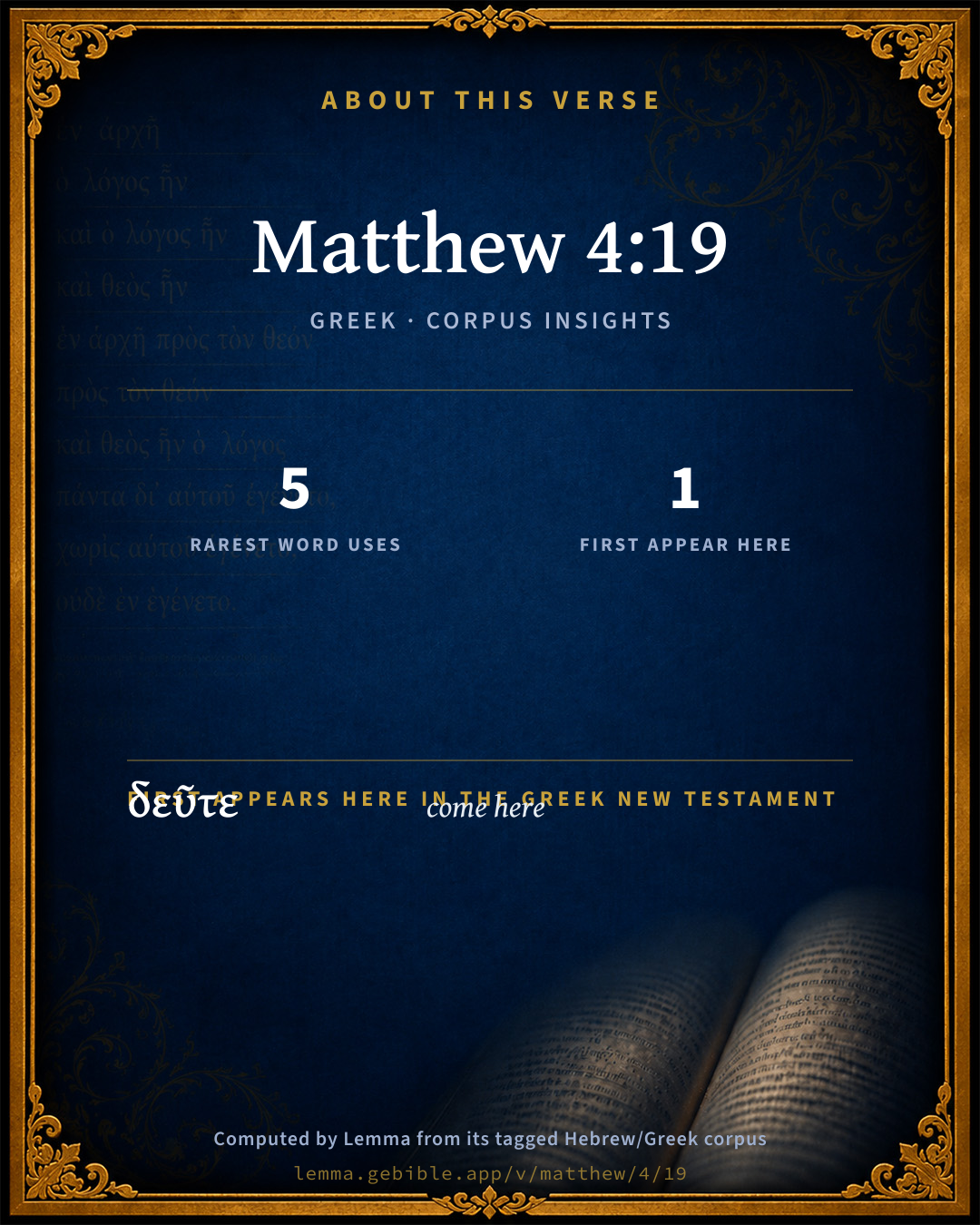
The rarest word here is ἁλεεῖς fisherman G231 — appearing just 5 times in the whole Greek New Testament.

First appearance in Scripture

This word makes its first canonical appearance in the Greek New Testament here:

  • δεῦτε come here G1205

Shared distinctive vocabulary

ἁλεεῖς fisherman G231 occurs in 5 verses of the Greek New Testament. Also found in:

Repetition

A word recurs within this verse:

Cross-references

14

Topical passages linked to Matthew 4:19 in the Treasury of Scripture Knowledge — connected by theme and wording, ordered by reader-vote popularity; previews shown in the World English Bible.

  • Mark 1:17–18 Jesus said to them, "Come after me, and I will make you into fishers for men."
  • John 12:26 If anyone serves me, let him follow me. Where I am, there will my servant also be. If anyone serves me, the Father will honor him.
  • Matthew 16:24 Then Jesus said to his disciples, "If anyone desires to come after me, let him deny himself, and take up his cross, and follow me.
  • Luke 9:59 He said to another, "Follow me!" But he said, "Lord, allow me first to go and bury my father."
  • John 1:43 On the next day, he was determined to go out into Galilee, and he found Philip. Jesus said to him, "Follow me."
  • John 21:22 Jesus said to him, "If I desire that he stay until I come, what is that to you? You follow me."
  • Luke 5:27 After these things he went out, and saw a tax collector named Levi sitting at the tax office, and said to him, "Follow me!"
  • Mark 2:14 As he passed by, he saw Levi, the son of Alphaeus, sitting at the tax office, and he said to him, "Follow me." And he arose and followed him.
  • Matthew 19:21 Jesus said to him, "If you want to be perfect, go, sell what you have, and give to the poor, and you will have treasure in heaven; and come, follow me."
  • Luke 5:10–11 and so also were James and John, sons of Zebedee, who were partners with Simon. Jesus said to Simon, "Don't be afraid. From now on you will be catching people alive."
  • Ezekiel 47:9–10 It shall happen, that every living creature which swarms, in every place where the rivers come, shall live; and there shall be a very great multitude of fish; for these waters are come there, and [the waters of the sea] shall be healed, and everything shall live wherever the river comes.
  • Matthew 8:22 But Jesus said to him, "Follow me, and leave the dead to bury their own dead."
  • Matthew 9:9 As Jesus passed by from there, he saw a man called Matthew sitting at the tax collection office. He said to him, "Follow me." He got up and followed him.
  • 1 Corinthians 9:20–22 To the Jews I became as a Jew, that I might gain Jews; to those who are under the law, as under the law, that I might gain those who are under the law;

Cross-references courtesy of OpenBible.info (CC BY 4.0).

Commentary

Notes on Matthew 4:19 from classic Christian and Jewish commentators (each source and its license shown beneath its notes). The classic Christian expositions comment on the surrounding passage and are grouped to its opening verse, so a note may address several verses; the Jewish commentaries on the Tanakh (Rashi and others) are per-verse, so they appear only where the commentator wrote on this verse.

Lemma curates 59 commentaries, every one of them public domain or Creative Commons licensed, each selected and text-cleaned for this edition rather than reprinted as found. About our sources →

The Biblical Illustrator

Joseph S. Exell

Mat_4:19

Follow Me.

Follow Me

1.Follow Christ as your Teacher.

2. As your Example.

3. As your Friend.

4. If you see to the following what will Christ do? (D. B. Hooke.)

1. These heavenly fishermen follow Christ personally.

2. They follow Him circumstantially.

3. They follow Him singly, with a single eye. (H. Cole.)

The great lesson of the text may be summed up in this-that successful work for Jesus must spring out of a devout imitation of Him. Follow Me, etc. In the example of Christ there are two points which it is important to look at.

I. The estimate Jesus Christ gave to humanity in contrast with all the other objects that engaged His attention. In comparison with the claims of man, everything else was regarded as subsidiary.

II. His whole career was evolved from this central conception in regard to humanity. To save men-that was His mission. I must work-that was His motto. These thoughts were always present to His mind. Our grand central controlling purpose must be the imitation of the Master, in striving to become the servant of all.

1. Christian work must so far resemble Christs work as to be inspired with the soul of earnestness.

2. The possession of yearning pity and interest in humanity.

3. The cultivation of a spirit of large self-denial.

4. Persistency in effort.

5. Prayer. Does this command stir your soul to nobler work and better service, etc.? What is your response? (W. Kelynack.)

Follow Me

I. Whom? Not simply a human teacher, but Jesus, who qualified Himself by His earthly life, with its temptations, toil, and suffering, to be the efficient leader of men.

II. How? We cannot follow His person as the disciples did; but we may-Obey His precepts and copy His example.

III. Why? We cannot direct our own course-there is no leader equal to Christ-if we follow Him we shall be in good company. Only thus can we escape spiritual danger and eternal death.

IV. Whither? To God: I am the way, etc. To heaven: In My:Fathers house, etc.

V. When? Now. Always. (Seeds and Saplings.)

The attractive face of Jesus

In lower human forms this magnetic attraction of man on man is not unknown. It is the orators power. The orators of revolutions-men like Mirabeau-are full charged with it; they are like jars laden with electric fire; there is that in their words which flashes out, and stirs, sways, and rules mankind. Christ constitutes in a still higher form the great Captains power. (J. B. Brown, B. A.)

Fishers of men.-

Ministers fishers of men

I. The appropriateness of the figure. The world is the sea, the scene of their labours.

II. The duty to be discharged. This net must be employed-constantly, diligently, skilfully.

1. Let the Christian fisherman rightly understand his net, and the appointed way of using it.

2. Let success be the grand object of attention.

3. Be cheerfully devoted to the work.

4. Our resources are infinite and exhaustless. (Dr. Burns.)

Fishers of men

1. To fish well, it is necessary to study the peculiarities of fish.

2. You must go to the fish. (Beecher.)

Scientific knowledge not enough for the preacher

It is necessary to know more than the science of ichthyology. What a book can tell a man about fishing is worth knowing, but it is little that a book can do towards making a man a true fisherman. If a man is going to fish for fish, he must become their scholar before he becomes their master; he must go to school in the brook, to learn its ways. And to fish for men, a man must learn their nature, their prejudices, their tendencies, and their courses. A man, to catch fish, must not only know their habits, but their tastes and their resorts; he must humour them according to their different natures, and adapt his instruments according to their peculiarities-providing a spear for some, a hook for others, a net for others, and baits for each one, as each one will. To sit on a bank or deck, and say to the fishes, Here I am, authorized to command you to come to me and to bite what I give you, is just as ridiculous as it can be, even though it does resemble some ways of preaching. The Christians business is not to stand in an appointed place and say to men, Here am I; come up and take what I give you as you should. The Christians business is to find out what men are, and to take them by that which they will bite at. (Beecher.)

Fishers of men

Christ came upon these men when they were busy at their everyday work. He saw them casting net into the sea. His eye is upon us in all the work we do in the world. And as:He looks upon us, so He calls us. It is true we may be so absorbed in other pursuits as not to hear the call.

I. What was His call? They were to leave their work that they might engage in higher work.

II. How shall we hope to be successful?

1. We must follow Christ.

2. We must submit to His teaching and influence.

3. Christ only can qualify us for the work. (A. Thomas.)

Industry an indication of worth

Whether, as He watched them putting out the net, He saw signs, which were indications to His penetrating and prophetic eye of fitness for the higher work to which they were to be called, we cannot tell. It is possible. For a very small thing will serve as a revelation of character to those who are keen-sighted, and who understand how the little is allied to the great. Just as a student like Owen will construct the entire skeleton if you give him a single bone, so the master, in the study of the human nature, will often be able to give a fair judgment of the whole character if he sees only what many would regard as casual and meaningless acts. (A. Thomas.)

Men miss the call of Christ through over occupation

You cannot attend to many things at once. There may be a glow of heavenly light on the mountain-top, but it will be nothing to the man whose eyes are fixed on the path along which he is painfully toiling. There may be the sound of sweet music carried on the night breezes; but it will be lost upon those who are disputing loudly and striving angrily with each other. (A. Thomas.)

1. A fisherman must be acquainted with the sea-we must know the locality in which we have to work.

2. A fisherman must also know how to allure fish.

3. The fisherman must be a man who can wait with patience.

4. A fisherman is one who must run hazards.

5. The fisherman must be one who has learned both how to persevere and how to expect. (C. H. Spurgeon.)

A fisherman must also know how to allure the fish.

I saw on Lake Come, when we visited Bellagio, some men fishing. They had torches burning in their boats, and the fish were attracted to them by the glare of the light. You must know how to get the fish together. You know there is such a thing as the ground-bait for the fishes. You must know how to allure men. The preacher does this by using images, symbols, and illustrations. You must know how to catch the fish, throwing out first. (C. H. Spurgeon.)

The Church enriched from the ranks of poverty.-

A few years ago, on a wintry morning, a boy in the habiliments of poverty entered an old schoolhouse among our western mountains, and avowed to the master his desire for an education. There was poverty laying one of her richest gifts on the altar of religion, for that boy was Jonas King. On his humble shoemakers bench, Carey laid the foundation of British Baptist Missions. John Newton found in his congregation an unfriended Scotch bey, whose soul was then glowing with new-born love to Christ. He took him to John Thornton, one of those noble merchants whose wealth, whose piety, and whose beneficence increased together. They educated him, and that boy became Claudius Buchanan, whose name India will bless when the names of Clive and Hastings are forgotten. John Bunyan was a gift of poverty to the Church. Zwingle came forth from an Alpine shepherds cabin; Melanethon from an armourers workshop; Luther from a miners cottage; the apostles, some of them, from fishermens huts. These are the gifts of poverty to the Church. (Dr. d. Harris.)

The Biblical Illustrator, edited by Joseph S. Exell (c. 1880s–1900s) — public domain. Text from a community e-Sword module.

Joseph Benson's Commentary

Mat 4:19-20. He saith unto them — Namely, after some previous circumstances, an account of which is given, Luk 5:1-11. Follow me — That is, not only now and then, as you have hitherto done, since my baptism, Joh 1:37; but now leave your ordinary employments, and become my constant attendants; that by continually hearing my doctrine, and seeing my miracles, you may be fitted, in due time, to become my messengers to mankind. It is observable that, when God has called men to offices of dignity and usefulness among his people, or has particularly appeared in their favour, they have generally been engaged in some honest employment. Saul was seeking his father’s asses, and David was keeping his father’s sheep, when the Lord called them to the kingdom. The shepherds were feeding their flocks when they received information from the angel, accompanied by the heavenly host, of the birth of Christ. God called Amos from the flock, Gideon from the threshing floor, and the apostles here from their fishing. God does not encourage idleness, nor despise persons in mean employments. And I will make you fishers of men — You shall gather men into the gospel net, and gain them over to the faith; and such abundant success will I give you, that the number of souls converted by you, shall be greater than that of the fishes you have been used to catch. See notes on Eze 37:6-10. Observe, reader! The work of ministers is here set forth. They are not to fish for a livelihood, much less for honour and applause to themselves, but to win souls to God, and are to bait their hooks and order their nets for this end: which, however, will never be answered if, either by mere general discourses, they make the meshes so wide that sinners will find an easy passage through them, or, by abstract reasonings, and fine-spun speculations, they make the threads so small that they can easily break them; or, if they neglect to close the net upon those they have enclosed, by a proper and pointed application of their subject. Nor will all our art or labour make us fishers of men, without the divine blessing. Without this, like the disciples of old, we may toil all day and all night, but we shall catch nothing, or nothing to purpose. And it is to be observed further, that the apostles were not immediately to enter upon the work of the ministry, but were first to follow Jesus. And the apostles, in the choice of one to succeed Judas, limited themselves in their election to those that had companied with them all the time the Lord Jesus had gone in and out among them, Act 1:21. Those who do not observe this become fishers for something else rather than the souls of men. They straightway left their nets and followed him — Influenced by the power of his word, and struck with the wonderful miracle recorded Luk 5:6-9. It is not of indispensable necessity that those who are called to the ministry of the word should have nothing else to do. Paul’s hand ministered to his necessities and those of his companions. But it is very desirable that they should be so supported as to be able to give themselves wholly up to the work of the Lord.

Joseph Benson's Commentary on the Old and New Testaments (1811–1818) — public domain. Text from a community e-Sword module.

Tyndale Open Study Notes

Tyndale Open Resources

4:19 Come, follow me: This involved accepting the beliefs and lifestyle of a master as one’s own (16:24; Deut 5:33; 1 Kgs 19:19-21). • fish for people: The disciples would participate in the saving and judging work of the Kingdom (see Matt 10:5-15; 13:47-51; Ezek 29:4-5; Amos 4:2).

Tyndale Open Study Notes — © Tyndale Open Resources, licensed CC BY-SA 4.0. Text via the HelloAO Bible API.

Bengel's Gnomon

Johann Albrecht Bengel

Mat 4:19. Δεῦτε, come ye) This word has the force of calling combined with the idea of the present moment; see Mat 11:28, Mat 21:38, etc. This is evident from the singular δεῦρο, hither.—ποιήσω, κ.τ.λ., I will make, etc.) The authority of Jesus Christ [is here asserted].—ἁλιεῖς, fishers) See Jer 16:16.

Bengel's Gnomon of the New Testament — English translation (T&T Clark, Edinburgh, 1860) — public domain. Text from a community e-Sword module.

Meyer's Critical & Exegetical Commentary

Heinrich August Wilhelm Meyer

Mat_4:19-20. Δεῦτε ὀπίσω μου] come here after me! לְכוּ אַחֲרַי (2Ki_6:19; 1Ki_11:5), be my pupils. The disciples were in constant attendance on their teacher; Schoettgen, Hor. in loc.

ποιήσω … ἀνθρώπων] I will put you in a position to gain men, that they may become members of the kingdom of the Messiah. Words borrowed from the domain of hunting and fishing (Jer_16:16) often denote the winning over of souls for themselves or others. Wetstein and Loesner, Hemsterhusius, ad Lucian. Dial. Mort. viii.; Burmann, ad Phaedr. iv. 4. Comp. on 2Co_11:20. Here the typical phraseology suggested itself from the circumstances.

εὐθέως] belongs to ἀφέντες, not to ἠκολ.

ἠκολ.] as disciples.

καταρτίζ., either arranging (Bengel) or repairing (Vulgate and most commentators). We cannot determine which; Luke has ἀπέπλυναν.

REMARK.

The want of harmony between Mat_4:18 ff. and Joh_1:35 ff. is to be recognised, and is not (as the Fathers of the church, Kuinoel, Gratz, Olshausen, Hoffmann, Krabbe, Neander, Ebrard, Arnoldi, Luthardt, Bleek, Riggenbach, Lange, Ewald, Hausrath, Märcker, have attempted) to be removed by supposing that in Matthew it is a second calling of the apostles in question that is recorded, viz. that they had already been at an earlier date (Joh_1:35 ff.) disciples of Jesus in the wider sense of the word, but that now for the first time they had become so in the narrower sensethat is, had become apostles. Comp. on John, remark after ch. 1. Matthew does not even agree with Luk_5:4 ff. See remarks on the passage, and Keim, Gesch. J. II. p. 215. We must in any case (in answer to Baur, Hilgenfeld) seek the true history of the occurrence in John, in whose account a merely preliminary adherence to Jesus is the less to be thought of, that immediately afterwards οἱ μαθηταὶ αὐτοῦ go with Him to Cana (ii. 2), to Capernaum (ii. 12), and to Jerusalem (ii. 17, 22). This also in, answer to Liicke on John, I. p. 466 f., and to Wieseler, who distinguishes a threefold act in the selection of the disciples: the preliminary calling in Joh_1:35 ff.; the setting apart to be constant attendants, Mat_4:18 ff; Mat_9:9 ff.; and the selection of the Twelve to be apostles, Mat_10:2-4. Wieseler (chronol. Synopse, p. 278) lays especial weight on the circumstance that John names τοὺς δώδεκα for the first time in Joh_6:67. But John in general, with the exception of this passage (and the Joh_6:70 and Joh_6:71 belonging to it), only once again expressly mentions the τοὺς δώδεκα (viz. in Joh_20:21), which is determined by the antithetic interest in the context. Especially in Joh_6:67 are the Twelve opposed to those others, many of whom had deserted Him. Previously, however, John had no opportunity, where this or any other antithetical relation might give him occasion, to give prominence to the number of the Twelve.

Besides, the history of the calling in Matthew, if it were not in contradiction to John, would by no means bear in itself a mythical character (Strauss finds in it a copy of the call of Elisha by Elijah, 1Ki_19:19 ff.), but is to be explained from the great, directly overwhelming impression made by the appearance of Jesus on minds prepared for it, which Matthew himself experienced (Mat_9:9); and this also is to be applied to the Johannine account. This narrative, which Schenkel and Keim relegate to the sphere of free invention, does not exclude the profound and certainly original words, fishers of men, which may have proceeded from the mouth of Jesus to His first called disciples on that day, Joh_1:40; and upon the basis of these words the narrative of the call, as it is preserved in Matthew and Mark, might easily be formed.

Meyer — Critical and Exegetical Commentary on the New Testament — English translation by Peter Christie, edited by Frederick Crombie (T&T Clark, 1880) — public domain. Text from a community e-Sword module.

Jamieson, Fausset & Brown

Robert Jamieson, A. R. Fausset & David Brown

And he saith unto them, Follow me--rather, as the same expression is rendered in Mark, "Come ye after Me" (Mar 1:17).

and I will make you fishers of men--raising them from a lower to a higher fishing, as David was from a lower to a higher feeding (Psa 78:70-72).

Jamieson, Fausset & Brown — Commentary Critical and Explanatory on the Whole Bible (1871) — public domain (CC PDM 1.0). Text via the HelloAO Bible API.

Adam Clarke's Commentary

Verse 19. Follow me] Come after me, δευτε οπισω μου. Receive my doctrines, imitate me in my conduct - in every respect be my disciples. We may observe that most of the calls of God to man are expressed in a few solemn words, which alarm, the conscience, and deeply impress the heart.

I will make you fishers of men.] Ezekiel Eze 47:8-10, casts much light on this place; and to this prophet our Lord probably alludes. To follow Christ, and be admitted into a partnership of his ministry, is a great honour; but those only who are by himself fitted for it, God calls. Miserable are those who do not wait for this call - who presume to take the name of fishers of men, and know not how to cast the net of the Divine word, because not brought to an acquaintance with the saving power of the God who bought them. Such persons, having only their secular interest in view, study not to catch men, but to catch money: and though, for charity's sake, it may be said of a pastor of this spirit, he does not enter the sheepfold as a thief, yet he certainly lives as a hireling. See Quesnel.

Some teach to work, but have no hands to row;

Some will be eyes, but have no light to see;

Some will be guides, but have no feet to go;

Some deaf, yet ears, some dumb, yet tongues will be;

Dumb, deaf, lame, blind, and maimed, yet fishers all!

Fit for no use but store an hospital.

Fletcher's Piscatory Eclogues. Ec. iv. 5, 18.

Following a person, in the Jewish phrase, signifies being his disciple or scholar. See a similar mode of speech, 2Kg 6:19.

Adam Clarke's Commentary on the Bible (1810–1826) — public domain. Text from a community e-Sword/MySword module.

Ellicott's Commentary for English Readers

(19) Follow me.—The command came, as we have seen, to those who were not unprepared. Short as it was, it was in some sense the first parable in our Lord’s teaching, the germ of an actual parable (Mat_13:47). It suggested a whole circle of thoughts. The sea is the troubled and evil world (Isa_57:20), and the souls of men are the fish that have to be caught and taken from it, and the net is the Church of Christ. The figure had been used before (Jer_16:16), but then it had presented its darker aspect, and the “fishers of men” were their captors and enslavers. The earliest extant hymn of the Church, by Clement of Alexandria, dwells on the image with a rich and suggestive playfulness. Christ is thus addressed:—

“Fisher of men, the blest,

Out of the world’s unrest,

Out of sin’s troubled sea

Taking us, Lord, to Thee;

Out of the waves of strife,

With bait of blissful life,

Drawing Thy nets to shore

With choicest fish, good store.”

A Bible Commentary for English Readers, edited by Charles John Ellicott (1878–1897) — public domain. Text from a community e-Sword module.

The Cambridge Bible for Schools and Colleges

gen. ed. J. J. S. Perowne

19. fishers of men] A condensed parable explicitly drawn out, ch. Mat_13:47-50.

The Cambridge Bible for Schools and Colleges (gen. ed. J. J. S. Perowne; Cambridge University Press, 1878–1918) — public domain. Text from a community e-Sword module.

John Gill's Exposition

And they immediately left the ship,.... More is expressed here than before, for they not only left their nets, but their ship too; which was of much more value; nay, even "their father" also, "with the hired servants", Mar 1:20 and so complied with the call of Christ to his people, Psa 45:10 and thereby proved, that they were sincerely his followers, Luk 14:26 and might expect the gracious promise of Christ to be made good unto them, Mat 19:28.

.

Matthew 4:23

mat 4:23

mat 4:23

mat 4:23And Jesus went about all Galilee,.... Having called four of his disciples, he took a tour throughout Galilee; a country mean and despicable, inhabited by persons poor, illiterate, vile, and wicked: such had the first fruits of Christ's ministry, and messages of his grace; which shows the freeness, sovereignty, and riches, of his abounding goodness. He went about "all" this country, both upper and nether Galilee, which was very populous: Josephus says (l), there were two hundred and four cities and towns in it; he means, which were places of note, besides villages. He went about, not like Satan, seeking the destruction of men; but as one that went along with him says, "doing good", Act 10:38, both to the bodies and souls of men; for he was

teaching in their synagogues, and preaching the Gospel of the kingdom. The places where he taught were "their synagogues": he did not creep into private houses, as the Pharisees then, and false apostles afterwards did; but he appeared openly, and declared his doctrine in places of public worship; where the Jews met together for divine service, to pray, read the Scriptures, and give a word of exhortation to the people; for though they had but one temple, which was at Jerusalem, they had many synagogues, or meeting places, all over the land: here Christ not only prayed and read, but "preached"; and the subject matter of his ministry was, "the Gospel of the kingdom": that is, the good news of the kingdom of the Messiah being come, and which now took place; wherefore he exhorted them to repent of, and relinquish their former principles; to receive the doctrines, and submit to the ordinances of the Gospel dispensation: he also preached to them the things concerning the kingdom of heaven; as that except a man be born again, he cannot see it; and unless he has a better righteousness than his own, he cannot enter into it: he was also

healing all manner of sickness, and all manner of disease among the people. It is in the Greek text, "every sickness and every disease"; that is, all sorts of maladies, disorders and distempers, which attend the bodies of men; and is another instance, besides Mat 3:5 in which the word "all", or "every", is to be taken in a limited and restrained sense, for "some", or "some of all sorts"; which teaches us how to understand those phrases, when used in the doctrine of redemption by Christ.

(l) In vita ejus.

John Gill's Exposition of the Whole Bible (1746–1763) — public domain (CC PDM 1.0). Text via the HelloAO Bible API.

Trapp's Complete Commentary

John Trapp

19 And he saith unto them, Follow me, and I will make you fishers of men.

Ver. 19. He saith unto them, Follow me] And together with his word there went forth a power inclining them to follow, whereby it appears that they were not only of the many that are called, but of those few that are chosen, Luk 6:13; Mat 22:14; "The Lord knoweth who are his," saith St Paul. But this knowing of his is carried secret, as a river underground, till by effectual calling he separates them from the rest, till they can "call upon the name of the Lord and depart from evil," 2Ti 2:19. This when they are once taught of Christ they must be acting; when he hath tuned and touched us, we must make music, and while the Spirit embreathes us, we must turn about as the mill, and follow the Lamb wheresoever he goeth, as these disciples did, Rev 4:4.

And I will make you fishers of men] Of live men, Luk 5:10, ανθρωπους ζωγρων, as fishers desire to catch fish alive, because they are more vendible: an apt metaphor, wherein, 1. The world is compared to the sea, for its unsettledness, tumultuousness, the oppression that is in it (the lesser fish being devoured by the greater), and the sway that Leviathan, the devil, bears there, Psa 104:26; Psa 2:1-12. The Church is compared to a boat, because it is continually tossed with the waves of affliction, as Noah, Jonah, the disciples, Paul, and those seafaring men, "that stagger like a drunken man," and all their cunning is gone, Psa 107:27; Psa 3:1-8. The fish to be caught out of this sea and to be brought into this ship are men, Joh 1:42; Mat 8:24. Nature hath, as it were, spawned us forth into this worldly sea; where we drink iniquity like water, wandering confusedly up and down, till caught and cast into the fish pool for the Master’s use and service. Unwittingly we are caught, and unwillingly we are kept, as fishes labour to get out of the net and would fain leap back out of the boat into the water. 4. Ministers are fishers. A busy profession, a toilsome calling, no idle man’s occupation, as the Vulgate conceit it, nor needless trade, taken up alate, to pick a living out of. Let God’s fishermen busy themselves as they must, sometimes in preparing, sometimes in mending, sometimes in casting abroad, sometimes in drawing in the net, "that they may separate the precious from the vile," &c., Jer 15:19; Mat 13:48; and no man shall have just cause to twit them with idleness, or to say they have an easy life, and that it is neither sin nor pity to defraud them.

John Trapp, A Commentary or Exposition upon All the Books of the Old and New Testament (1647–1656) — public domain. Text from a community e-Sword module.

Albert Barnes' Notes on the Bible

Fishers of men - Ministers or preachers of the gospel, whose business it shall be to win souls to Christ.

Albert Barnes' Notes on the Bible (1834–1885) — public domain. Text from a community e-Sword/MySword module.

Haydock's Catholic Bible Commentary

Jesus Christ here makes an allusion to the prior occupation of his apostles. David, in his Psalms, makes similar allusions to his former occupation of shepherd: "He took him from the flocks of sheep, he brought him from following the ewes big with young, to feed Jacob, his servant, and Israel, his inheritance." (Psalm lxxvii. ver. 70.) (Menochius)

George Leo Haydock (1774–1849), Haydock's Catholic Family Bible and Commentary, 1859 edition — public domain. Excludes Psalms (Douay-Rheims chapter numbering differs from Protestant) and Deuterocanonical books (Catholic canon only).

Matthew Poole's English Annotations

Here was their call to the office of apostles. It is observable that God’s calls of men to places of dignity and honour, and his appearances of favour to them, have ordinarily been when they have been busied in the honest employments of their callings. Saul was seeking his father’s asses, David keeping his father’s sheep, when the Lord called them to the kingdom. The shepherds were feeding their flocks when they had the revelation of Christ. He calleth four apostles from their fishery; Amos from amongst the herdmen of Tekoa; Matthew from the receipt of custom; Moses when keeping Jethro’s flock, Exo 3:1,2; Gideon from the threshing floor, Jdg 6:11. God never encourages idleness, but despiseth not persons in meanest employments.

Follow me, that is, to return no more to your employment.

I will make you fishers of men: here is the work of ministers set out, to gain souls to God; they are not to fish merely for a livelihood, much less for honour and applause to themselves, but to win souls to God, and are to bait their hooks and order their nets to this end, which they will never serve, if either by general discourses they make the meshes so wide that all will dart through them, or if by their wit and learning they make their discourses so fine and curious that few or none of their hearers can understand them. Nor will all our art make us fishers of men: I will make you, saith Christ. Paul may plant, and Apollos may water, God must give the increase. But yet we must order our nets rationally and probably in order to our end, and without that cannot expect God’s blessings. Nor were the apostles presently to enter upon the work of the ministry, but first to follow him. And indeed such should all gospel ministers be. In the choice of Matthias, Peter limited the people in their election to those that had accompanied with them all the time the Lord Jesus went in and out amongst them, Act 1:21. Other ministers commonly prove fishers for something else, not for the souls of men.

Matthew Poole's English Annotations on the Holy Bible (1683–1685) — public domain. Text from a community e-Sword/MySword module.

Whedon's Commentary on the Bible

Daniel D. Whedon

19. Fishers of men — The comparison of the preacher to the fisherman, as derived from this passage, was a favourite idea with the early writers of the Christian Church. Fish in the waters are as sinners in the world. It is the preacher’s art so to bait the hook of divine truth as that, with ready appetite, the sinner will receive it and be captured for salvation. Hence there was a striking accordance, and perhaps even an intended typeism, between the early engagements of these men and their subsequent profession as apostles.

Daniel D. Whedon (gen. ed.), Commentary on the Old and New Testaments (1874–1909) — public domain. Text from a community e-Sword module.

The Pulpit Commentary

Follow me; come ye after me (Revised Version); deute opisw mou . There is no thought of continuous following from place to place (akolouyein), but of immediate detachment from the present sphere of their interest and of attachment to Jesus as their leader. And I will make you fishers of men; Mark, "to become fishers of men," laying more stress on the change in their character necessary for success in this new kind of fishing. Luk_5:10 brings out the change in the nature of the work (apo tou nun). Fishers. The word suggests care, patience, skill, besides habits of life fitted for endurance of privation and fatigue. The same promise is, as it seems, related in Luk_5:10, where notice:

(1) It is connected with the miracle of the draught of fishes.

(2) It is not verbally identical with this: Mh fobou apo tou nun anyrwpouv esh zwgrwn ..

(3) The words are addressed individually to Simon.

Christ"s call to service.

"Follow me, and I will make you fishers of men." From John 1. we learn that these men were previously called to discipleship. It was well that they should have a time of fellowship with Christ before they were further called to the service of Christ. Observe how the full idea of the Messiahship was gradually unfolded, stage by stage. Our Lord never hurried. He set a noble example of "doing the next thing;" and all the Divine plan for him gradually but surely unfolded. These men were fishers. Our Lord used a figure which was quite familiar to them, and would be very suggestive. These thoughts would surely have come to their minds. As the fish have to be gathered, to be skilfully gathered, and to be persistently gathered, so have men. Christ wants us to fish for men as, during these long years, we have fished in this lake for fish. Here will come in careful descriptions of the boats, nets, and methods of the fishermen of Galilee.

I MEN HAVE TO BE GATHERED. Morally, and in view of their independence and self-willedness, men are like the fishes that roam free in the water, going this way or that at their own pleasure. But this freedom is moral peril. There are foes for men in their freedom, as there are for the fishes. Gather the fish and deliver them from their foes. Gather the men into the allegiance of Christ, and so deliver them from evil.

II MEN HAVE TO BE SKILFULLY GATHERED. Few occupations involve more skill than fishing. The fisherman must judge the weather, decide on his net or line, adapt his bait, and know the habits of the creatures. So the Apostle Paul, as the great gospel fisherman, would make himself" all things to all men." Illustrate by the conversions recorded in the New Testament, pointing out how different were the methods used in each case in order to effect the ingathering.

III MEN HAVE TO BE PERSISTENTLY GATHERED. Because there is a natural resistance which is too often successful, and must be dealt with again and again. Show where the fisher-figure fails. They who fish for men gather them in order that they may be everlastingly saved. R.T.

The Pulpit Commentary (1880–1919), ed. H.D.M. Spence-Jones & Joseph S. Exell — public domain. Text from a community e-Sword module.

Kretzmann's Popular Commentary

Paul E. Kretzmann

But the Lord had need of them:

v. 19. And He saith unto them, Follow Me, I will make you fishers of men.

v. 20. And they straightway left their nets, and followed Him.

This was not a request for mere companionship, but an authoritative, though genial call to apostleship, couched in language which would appeal to their unlearned minds. They had been His disciples, but without special obligation as to attending Him; they were now chosen as His steady followers, to be trained for their great and high calling. "That was the beginning and the first call, namely, to hear the Gospel of Christ the Lord. For should they preach to others, they must first hear and learn it. Afterward, when they should preach to others, the Lord calls them by another call and gives them command how and wherein they should comport themselves. Mat 10:1-42. " Jesus calls them, most appropriately, "fishers of men," since He wanted to train them to gain immortal souls for heaven, though they were but simple, unlearned men, "in order that the power and strength of God be indicated in this that He began such a great work with such lowly, simple people, and also performs it; in order that everyone should understand that this is not done out of human power, but out of divine power and might. " In this way their secular employment served as the emblem of their spiritual calling. How deeply the presence and teaching of Christ had impressed these poor Galilean fishermen appears from the fact that there was no hesitation, no conferring with flesh and blood. At once they left their nets, gave up their earthly calling, forsook all, and followed Him, became His disciples and theological students.

Paul E. Kretzmann, Popular Commentary of the Bible (1921–1924) — public domain. Text from a community e-Sword module.

The People's New Testament

B. W. Johnson

19. Follow me. Already disciples, they were now called to preparation for apostleship.

B. W. Johnson's The People's New Testament with Notes (1889–1891) — public domain. Electronic text from the Christian Classics Ethereal Library (CCEL) ThML edition.

Cambridge Greek Testament for Schools and Colleges

19. δεῦτε. Frequent in Homer and in lyric poets. It was used as an ‘animating interjection’ (Buttmann), without any necessary connection with movement, as ἔρως με δεῦτε Κύπριδος ἕκατι | γλυκὸς κατείβων καρδίαν ἰαίνει. Alcman. (Buttmann, Lex. 316–319.) This word is an instance of epic influence on Alexandrine Greek as it is not Attic: in N.T. it is rare except in this Gospel.

ἁλιεῖς ἀνθρώπων. A condensed parable explicitly drawn out, ch. Mat 13:47-50. Cp. Jer 16:16, ἰδοὺ ἐγὼ ἀποστέλλω τοὺς ἁλιεῖς τοὺς πολλούς, λέγει κύπιος καὶ ἁλιεύσουσιν αὐτούς.

Cambridge Greek Testament for Schools and Colleges (Cambridge University Press, 1896; 21 vols, various authors incl. Carr, Maclear, Plummer, Farrar, Lumby, Moule, M. R. James, Simcox) — public domain. Text from a community e-Sword module.

International Critical Commentary

19. And He saith to them, Come after Me, and I will make you fishers of men.] Mk. has: “And Jesus said to them, Come after Me, and I will make you to become fishers of men.” Mt. omits γενέσθαι as superfluous. For ὀπίσω as a preposition, see Blass, p. 129.—δεῦτε ὀπίσω] is Semitic.

(M)

International Critical Commentary — older volumes (1896–1929), various authors — public domain. Text from a community e-Sword module.

Lesson kit

Teaching starters — assembled from the data on this page, not authored interpretation. Every prompt links to the verse data it draws on. Edit before teaching.

Matthew, in the Gospels, opens this verse with 11 words (10 distinct Greek lemmas). Its most distinctive word is halieús (“fisherman”). A historical commentator’s framing appears above. Read the whole chapter for the surrounding context.

Discussion questions

  1. How does “fisherman” (halieús) shape what this verse is saying?
  2. The word “come here” first appears here in Scripture. What is being introduced at this debut?
  3. Matthew 4:18 shares the word «fisherman» with this verse. How do the two illuminate each other?
  4. “and” occurs 2× in this one verse. What is the effect of the repetition?
  5. The translations on this page render this verse differently — a whole-verse word diff, not a word-by-word alignment. What might account for the different wordings?
  6. Reading how The Biblical Illustrator and Joseph Benson's Commentary read this verse, where do the two commentators agree and where do they part?

Things to notice

  • 1 word makes its first canonical appearance in Scripture here.
  • These translations choose different wording for 5 words in this verse.
  • “and” occurs 2× in this single verse.
  • 10 distinct Greek lemmas span 11 words in this verse.

Reading settings

Reading text

Shown beneath each verse's original-language words.

Old Testament
Old Testament edition

Read the OT as the Masoretic Hebrew (MT) or the Greek Septuagint (LXX).

English shown for the Greek Septuagint (in the Hebrew ↔ Greek comparison).

Comparing translations? Open the Compare panel on any verse page to stack up to four side by side.