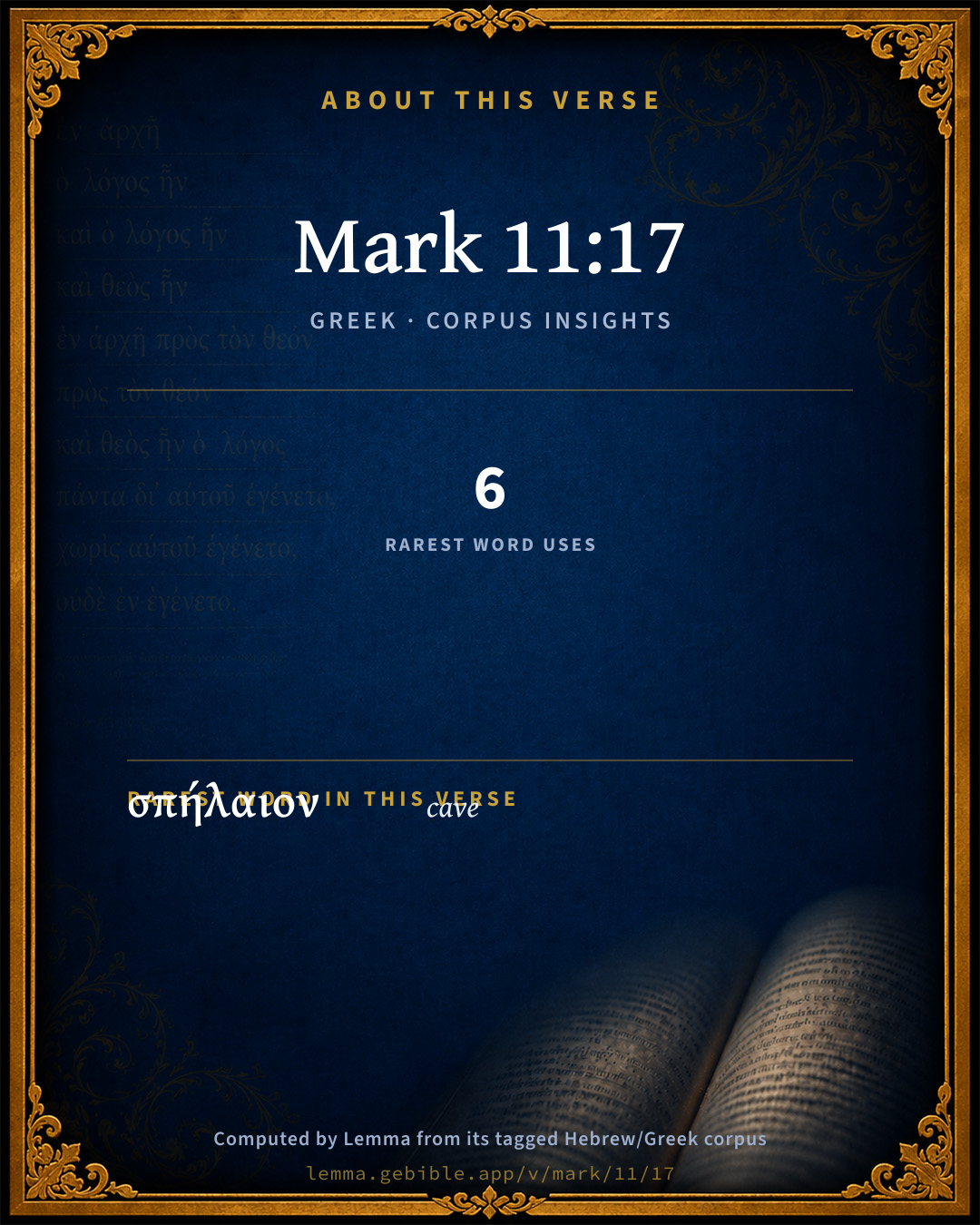
Mark 11:17

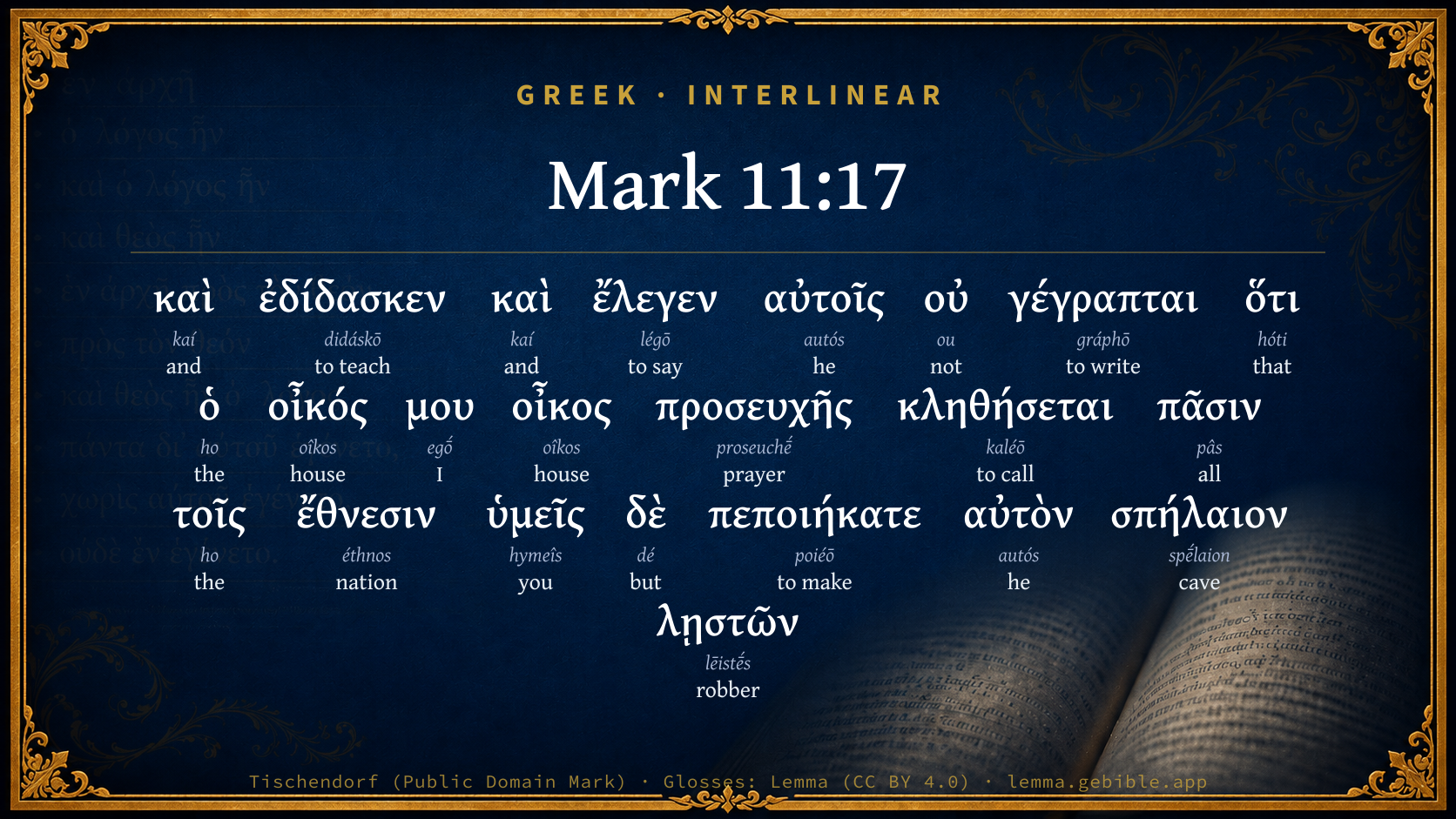
Greek (Tischendorf 8th ed.) Mark 11:17 appears in the Greek New Testament. The text above is from the Tischendorf 8th edition. Each word links to its Strong’s number and a concise gloss. Click any word for its full Thayer’s Greek Lexicon entry.
Download image
Cite this verse

Mark 11:17 (World English Bible). Public Domain. Lemma interlinear Bible study tool, https://lemma.gebible.app/v/mark/11/17.

Show BibTeX & RIS
BibTeX
RIS
English Translation
He taught, saying to them, "Isn't it written, 'My house will be called a house of prayer for all the nations?' But you have made it a den of robbers!"
World English Bible · Public Domain
Download a study sheet

One document with this verse’s original text, its word-by-word gloss line, the meaning frame, cross-references with their text, attributed commentary, and full source and license credits — printable, and it pastes into notes with its structure intact.

This verse Autodidact and up

Study sheet (.html) Plain text (.txt)

A passage Seminary Student

Up to 50 verses in one chapter. A passage sheet keeps up to 6 commentary sources and 12 cross-references per verse, in the order this page ranks them, and says so on the sheet whenever that leaves anything out. Ask for a single verse and you get the Autodidact verse sheet above.

Everything on this page stays free to read, with no account — the sheet is a download of what is already on screen, not access to it.

Want to remove ads? Support Godless Engineer
Compare translations 3

The same verse in 3 English versions, stacked beneath the original-language interlinear above. Click any original word for its lexicon entry.

Each is an independent rendering of the whole verse — the interlinear is not word-aligned to these translations.

Highlighted words mark where these versions differ — a whole-verse word diff, not a word-by-word alignment.

  • World English Bible Public Domain
    He taught, saying to them, "Isn't it written, 'My house will be called a house of prayer for all the nations?' But you have made it a den of robbers!"
  • King James Version Public Domain
    And he taught, saying unto them, Is it not written, My house shall be called of all nations the house of prayer? but ye have made it a den of thieves.
  • unfoldingWord Literal Text CC BY-SA 4.0
    And he was teaching them and saying, “Has it not been written, ‘My house will be called a house of prayer for all the nations’? But you have made it a ‘den of robbers.’”

unfoldingWord Literal Text — © unfoldingWord, licensed CC BY-SA 4.0. Word-aligned USFM3 via Door43 (git.door43.org/unfoldingWord/en_ult).

Versions to compare (up to 4)

3 of 4 selected

Show all 19 translations

Every available English version of this verse, each an independent rendering of the whole verse.

  • World English Bible Public Domain
    He taught, saying to them, "Isn't it written, 'My house will be called a house of prayer for all the nations?' But you have made it a den of robbers!"
  • Berean Standard Bible Public Domain
    Then Jesus began to teach them, and He declared, “Is it not written: ‘My house will be called a house of prayer for all the nations’? But you have made it ‘a den of robbers.’”
  • Majority Standard Bible Public Domain
    Then Jesus began to teach them, and He declared, “Is it not written: ‘My house will be called a house of prayer for all the nations’? But you have made it ‘a den of robbers.’”
  • King James Version Public Domain
    And he taught, saying unto them, Is it not written, My house shall be called of all nations the house of prayer? but ye have made it a den of thieves.
  • American Standard Version (1901) Public Domain
    And he taught, and said unto them, Is it not written, My house shall be called a house of prayer for all the nations? but ye have made it a den of robbers.
  • Revised Version (1885) Public Domain
    And he taught, and said unto them, Is it not written, My house shall be called a house of prayer for all the nations? but ye have made it a den of robbers.
  • Geneva Bible (1599) Public Domain
    And he taught, saying vnto them, Is it not written, Mine house shalbe called the house of prayer vnto all nations? but you haue made it a denne of theeues.
  • Douay-Rheims (1899) Public Domain
    And he taught, saying to them: Is it not written, My house shall be called the house of prayer to all nations But you have made it a den of thieves.
  • Young's Literal Translation Public Domain
    and he was teaching, saying to them, `Hath it not been written -- My house a house of prayer shall be called for all the nations, and ye did make it a den of robbers?'
  • Literal Standard Version CC BY-SA 4.0
    and He was teaching, saying to them, “Has it not been written: My house will be called a house of prayer for all the nations? And you made it a den of robbers!”
  • Unlocked Literal Bible CC BY-SA 4.0
    He taught them and said, “Is it not written, 'My house will be called a house of prayer for all the nations'? But you have made it a den of robbers.”
  • unfoldingWord Literal Text CC BY-SA 4.0
    And he was teaching them and saying, “Has it not been written, ‘My house will be called a house of prayer for all the nations’? But you have made it a ‘den of robbers.’”
  • Darby Bible Public Domain
    And he taught saying to them, Is it not written, My house shall be called a house of prayer for all the nations? but *ye* have made it a den of robbers.
  • World Messianic Bible Public Domain
    He taught, saying to them, “Isn’t it written, ‘My house will be called a house of prayer for all the nations’? But you have made it a den of robbers!”
  • Webster's Bible Public Domain
    And he taught, saying to them, Is it not written, My house shall be called by all nations the house of prayer? but ye have made it a den of thieves.
  • Free Bible Version CC BY-SA 4.0
    He explained to them, “Doesn't Scripture say, ‘My house will be called a house of prayer for all nations’? But you have turned it into a den of thieves!”
  • Bible in Basic English Public Domain
    And he gave them teaching, and said to them, Is it not in the Writings, My house is to be named a house of prayer for all the nations? but you have made it a hole of thieves.
  • Text-Critical English NT CC BY 4.0
    Then he began to teach the people, saying, “Is it not written, ‘My house shall be called a house of prayer for all nations’? But you have made it a den of robbers.”
  • Tyndale New Testament (1534) Public Domain
    And he taught sayinge vnto them is it not written: my housse shalbe called the housse of prayer vnto all nacions? But ye have made it a deen of theves.

Literal Standard Version (2020), Covenant Press — licensed CC BY-SA 4.0. Text via the HelloAO Bible API (eBible.org). Unlocked Literal Bible (unfoldingWord) — licensed CC BY-SA 4.0. Text via the HelloAO Bible API (eBible.org). unfoldingWord Literal Text — © unfoldingWord, licensed CC BY-SA 4.0. Word-aligned USFM3 via Door43 (git.door43.org/unfoldingWord/en_ult). Free Bible Version, Dr. Jonathan Gallagher — licensed CC BY-SA 4.0. Text via the HelloAO Bible API (eBible.org).

Word by word

More ways to search: Search by grammar → Find every occurrence → Compare this word →

Practice this passage: Drill this verse → Learn its vocabulary →

σπήλαιον
spḗlaion
G4693
“cave”
Noun, Accusative, Singular, Neuter
Part of Speech
Noun
Case
Accusative
Number
Singular
Gender
Neuter
Full Thayer's Definition

Origin: from a presumed derivative of speos (a grotto)

TDNT: None

1. a cave, den
  1. καὶ kaí G2532 “and” Conjunction
  2. ἐδίδασκεν didáskō G1321 “to teach” Verb, Imperfect, Active, Indicative, 3rd person, Singular
  3. καὶ kaí G2532 “and” Conjunction
  4. ἔλεγεν légō G3004 “to say” Verb, Imperfect, Active, Indicative, 3rd person, Singular
  5. αὐτοῖς autós G846 “he” Personal pronoun, Dative, Plural, Masculine
  6. οὐ ou G3756 “not” Particle, Negative
  7. γέγραπται gráphō G1125 “to write” Verb, Perfect, Passive, Indicative, 3rd person, Singular
  8. ὅτι hóti G3754 “that” Conjunction
  9. ὁ ho G3588 “the” Article, Nominative, Singular, Masculine
  10. οἶκός oîkos G3624 “house” Noun, Nominative, Singular, Masculine
  11. μου egṓ G1473 “I” Personal pronoun, 1st person, Genitive, Singular
  12. οἶκος oîkos G3624 “house” Noun, Nominative, Singular, Masculine
  13. προσευχῆς proseuchḗ G4335 “prayer” Noun, Genitive, Singular, Feminine
  14. κληθήσεται kaléō G2564 “to call” Verb, Future, Passive, Indicative, 3rd person, Singular
  15. πᾶσιν pâs G3956 “all” Adjective, Dative, Plural, Neuter
  16. τοῖς ho G3588 “the” Article, Dative, Plural, Neuter
  17. ἔθνεσιν éthnos G1484 “nation” Noun, Dative, Plural, Neuter
  18. ὑμεῖς hymeîs G5210 “you” Personal pronoun, 2nd person, Nominative, Plural
  19. δὲ dé G1161 “but” Conjunction
  20. πεποιήκατε poiéō G4160 “to make” Verb, Perfect, Active, Indicative, 2nd person, Plural
  21. αὐτὸν autós G846 “he” Personal pronoun, Accusative, Singular, Masculine
  22. λῃστῶν lēistḗs G3027 “robber” Noun, Genitive, Plural, Masculine

About this verse

These counts appear in no published source. They are computed here, from the morphology-tagged text and Lemma’s own curated glosses. What Lemma adds →

23
words
19
distinct lemmas
Gospels
section

Notable vocabulary

The rarest word here is σπήλαιον cave G4693 — appearing just 6 times in the whole Greek New Testament.

Shared distinctive vocabulary

σπήλαιον cave G4693 occurs in 6 verses of the Greek New Testament. Also found in:

Repetition

Words recur within this verse:

  • οἶκός house G3624 ×2
  • καὶ and G2532 ×2
  • αὐτοῖς he G846 ×2
  • ὁ the G3588 ×2

Cross-references

7

Topical passages linked to Mark 11:17 in the Treasury of Scripture Knowledge — connected by theme and wording, ordered by reader-vote popularity; previews shown in the World English Bible.

  • Isaiah 56:7 even them will I bring to my holy mountain, and make them joyful in my house of prayer: their burnt offerings and their sacrifices shall be accepted on my altar; for my house shall be called a house of prayer for all peoples.
  • Jeremiah 7:11 Is this house, which is called by my name, become a den of robbers in your eyes? Behold, I, even I, have seen it, says Yahweh.
  • Luke 19:46 saying to them, "It is written, 'My house is a house of prayer,' but you have made it a 'den of robbers'!"
  • John 2:16 To those who sold the doves, he said, "Take these things out of here! Don't make my Father's house a marketplace!"
  • 1 Kings 8:41–48 Moreover concerning the foreigner, who is not of your people Israel, when he shall come out of a far country for your name's sake
  • Isaiah 60:7 All the flocks of Kedar shall be gathered together to you, the rams of Nebaioth shall minister to you; they shall come up with acceptance on my altar; and I will glorify the house of my glory.
  • Hosea 12:7 A merchant has dishonest scales in his hand. He loves to defraud.

Cross-references courtesy of OpenBible.info (CC BY 4.0).

Commentary

Notes on Mark 11:17 from classic Christian and Jewish commentators (each source and its license shown beneath its notes). The classic Christian expositions comment on the surrounding passage and are grouped to its opening verse, so a note may address several verses; the Jewish commentaries on the Tanakh (Rashi and others) are per-verse, so they appear only where the commentator wrote on this verse.

Lemma curates 59 commentaries, every one of them public domain or Creative Commons licensed, each selected and text-cleaned for this edition rather than reprinted as found. About our sources →

Tyndale Open Study Notes

Tyndale Open Resources

11:17 Jesus quoted Isa 56:7 and Jer 7:11 in defense of his action. The first quotation emphasizes the importance of the Temple for Gentiles. God’s house was intended by its very architecture (i.e., the Court of the Gentiles) to assist Gentiles in becoming children of Abraham. Jesus’ act of judgment fell upon the leaders of Israel for hindering the Gentiles’ access to the Temple. They were desecrating the Temple by taking part of the Temple specifically designated as a house of prayer for all nations and turning it into a den of thieves through the profiteering taking place.

Tyndale Open Study Notes — © Tyndale Open Resources, licensed CC BY-SA 4.0. Text via the HelloAO Bible API.

Bengel's Gnomon

Johann Albrecht Bengel

Mar 11:17. Ἐδίδασκε, He taught) The addition of teaching makes punishment salutary in its effect.—πᾶσι τοῖς ἔθνεσι, to all nations) Construe with the house of prayer. Comp. the accents, Isa 56:7 [My house shall be called an house of prayer for all people.]

Bengel's Gnomon of the New Testament — English translation (T&T Clark, Edinburgh, 1860) — public domain. Text from a community e-Sword module.

Expositor's Greek Testament

ed. W. Robertson Nicoll

Mar 11:17 . ἐδίδασκε covers more than what He said just then, pointing to a course of teaching ( cf. Mar 11:18 and Luk 19:47 ). Here again we note that while Mt. speaks of a healing ministry in the temple (Mat 21:14 ) Mk. gives prominence to teaching. Yet Mt. gives a far fuller report of the words spoken by Jesus during the last week. πᾶσι τοῖς ἔθνεσιν , to all the Gentiles, as in Isa 56:7 , omitted in the parallels; very suitable in view of the fact that the traffic went on in the court of the Gentiles. A foreshadowing of Christian universalism. πεποιήκατε , ye have made it and it now is.

The Expositor's Greek Testament, edited by W. Robertson Nicoll (1897–1910) — public domain. Text from a community e-Sword module.

Geneva Bible (1599)

Geneva Bible translators

Shall openly be so accounted and taken.

Geneva Bible (1599) marginal notes — public domain. Text via Bolls.life.

Adam Clarke's Commentary

Verse 17. And he taught - them] See Clarke on Mt 21:12.

Adam Clarke's Commentary on the Bible (1810–1826) — public domain. Text from a community e-Sword/MySword module.

The Cambridge Bible for Schools and Colleges

gen. ed. J. J. S. Perowne

17. of all nations] Rather, for all nations. See margin. The words are cited from Isa_56:7.

a den of thieves] Literally, a cave of robbers or bandits. See Jer_7:11. The distinction is to be borne in mind between “the robber,” brigand or violent spoiler (Mat_21:13; Mat_26:55; Luk_22:52; Joh_18:40; 2Co_11:26), and the “thief” or secret purloiner (Mat_6:19; Joh_12:6; 1Th_5:2; Rev_3:3; Rev_16:15). Trench’s Synonyms, § 44. What our Lord alludes to is one of “those foul caves which He had so often seen, where brigands wrangled over their ill-gotten gains.” Farrar, Life, II. 205.

The Cambridge Bible for Schools and Colleges (gen. ed. J. J. S. Perowne; Cambridge University Press, 1878–1918) — public domain. Text from a community e-Sword module.

John Gill's Exposition

And he taught, saying unto them, is it not written,.... In Isa 56:7.

My house shall be called of all nations, the house of prayer? For not only the Jews went up to the temple to pray, see Luk 18:10, but the Gentiles also, who became of the Jewish religion, and had a court built for that purpose; and so the whole temple, from hence, was called an house of prayer: and the meaning is, not only that it should be called so by the Gentiles, but that it should be so to them, and made use of by them as such. Jarchi's note on the clause in Isa 56:7 is, "not for Israel only, but also for the proselytes."

But ye have made it a den of thieves; for no other, in our Lord's esteem, were the buyers and sellers of sheep, oxen, and doves, and the money changers, and the priests that encouraged them, and had a profit out of them: now these had their seats, shops, and tables, within the mountain of the house; and even in that part of it, which was assigned to the Gentiles, the nations of the world, who became proselytes, and came up to Jerusalem to worship there at certain times; See Gill on Mat 21:13.

John Gill's Exposition of the Whole Bible (1746–1763) — public domain (CC PDM 1.0). Text via the HelloAO Bible API.

Trapp's Complete Commentary

John Trapp

17 And he taught, saying unto them, Is it not written, My house shall be called of all nations the house of prayer? but ye have made it a den of thieves.

Ver. 17. My house shall be called, &c.] He inveighs against the same fault with the same arguments as before, Joh 2:16-17.

John Trapp, A Commentary or Exposition upon All the Books of the Old and New Testament (1647–1656) — public domain. Text from a community e-Sword module.

Haydock's Catholic Bible Commentary

Not to the Jews only, but to all nations; not in Jerusalem only, but in every city of the known world. It is no longer a temple of bulls, goats, and rams, but a temple of prayer. (Ven. Bede)

George Leo Haydock (1774–1849), Haydock's Catholic Family Bible and Commentary, 1859 edition — public domain. Excludes Psalms (Douay-Rheims chapter numbering differs from Protestant) and Deuterocanonical books (Catholic canon only).

The Pulpit Commentary

My house shall be called a house of prayer for all the nations (pasi toiv eynesin). St. Mark, writing for Gentiles, assures them that the God of the Jews is the God of all the nations; and that the court of the Gentiles, which was then so profaned, was a constituent part of his house of prayer. St. Jerome notes Christ"s action in driving out the profaners of the temple as a great proof of his Divine power, that he alone should have been able to cast out so great a multitude. He says, "A fiery splendor flashed from his eyes, and the majesty of Deity shone in his countenance." The words, "My house shall be called the house of prayer," are a quotation from Isa_56:7; and it is a remarkable coincidence that in Ver. 11 of that chapter the rulers of the people are described as looking "every one for his gain from his quarter." A den of thieves (sphlaion lhstwn); this should be rendered, a den of robbers. The Greek word for "thief" is klepthv , not lhsthv . The two terms are carefully distinguished in St. John, (Joh_10:1) "the same is a thief (klepthv) and a robber (lhsthv)." These priests, wholly intent upon gain, by various fraudulent acts plundered strangers and the poor, who came purchase offerings for the worship of God. Observe that the temple is called the house of God, not because he dwells in it in any corporeal sense, for "he dwelleth not in temples made with hands," but because the temple is the place set apart for the worship of God, in which he specially gives ear to the prayers of his people, and in which he specially promises his spiritual presence. Hence we learn what reverence is due to the houses of God; so that, as the master of a house resents any insult offered to his house as an insult to himself, so Christ reckons any willful dishonor done to his house as a wrong and insult to him.

The Church ideal and actual.

I THE CHURCH IN ITS IDEAL. As viewed under this aspect it has:

1. A twofold character. (Isa_56:7)

(1) A house of prayer. This recognition of a spiritual end to be secured by the institution of the temple is most remarkable, as having taken place in an era of ceremonialism. It is not a priestly but a prophetic point of view, in which details are lost sight of in the inward and eternal. The temple was to be "called a house of prayer" as indicative not of a special but rather of an exclusive purpose; any other being a transgression and an offense. It was to be set apart for the most sacred occupations of the soul intercourse and communion with God. An emphasis was thereby given to the Divine side of life. Men were to seek the presence of God that they might receive his grace and truth. A space was marked off from the business and secularities of life, so that, undisturbed from without, and aided by all the circumstances of devotion, the higher nature might be called forth and educated. Instead of worldly cares and competitions distracting the worshippers, they were to be engrossed for a while with their Father"s business. How important is this witness of the Church to the claims of the unseen and eternal! It is the sphere within which the highest exercise of human faculties may take place, and the noblest life may be laid hold of. There may be no immediate demand for what it provides, yet does it minister to the deepest and most lasting human needs.

(2) The spiritual home of mankind. The defect of Judaism was that it was too national and exclusive: all that was to cease. From the earliest times the universality of the Divine grace was declared by the prophets. Even from within a principle of expansion began to discover itself. The presence of the "stranger" within the camp led to the recognition of the "proselytes of the gate," and by-and-by to the institution of the "court of the Gentiles" in the temple itself. The fundamental doctrine of Jehovah itself implied such an intention as ultimate if not immediate, for before him there was no respect of persons, and he was the Father of all. The promises, too, were all couched in terms that precluded a merely local or temporary enjoyment of their blessings. Even as taught in the Old Testament the doctrine of election is declared to be a temporary provision for the benefit of others besides the elect. The chief end of the temple, or the Church which it represented, could not be secured save by the conversion of the world to the knowledge of Jehovah, and the spiritual coming of mankind to Zion. It is therefore the great mission of Christianity, as the spiritual successor of Judaism, to give effect to this. The Church is a witness to the oneness of the race in its origin and destiny, and the great foster-mother of mankind. Through her charity, and not by mechanical necessities or material interests, is the unity of the world to be realized.

2. This twofold intention of the Church is certain to be fulfilled. As we have seen, it is

(1) the Divine purpose: everything God wills will be; and

(2) the genius of Christianity. If Judaism declared a universal brotherhood, Christianity is that brotherhood. It teaches us to say," Our Father," and realizes itself in the communion of saints. The Church is not an end in itself, but is for the world. Christianity is nothing if it is not evangelistic and aggressive.

II THE CHURCH IN ITS CORRUPTION. In the mean time what God intended has been frustrated by the worldliness of men. The consequence has been:

1. A complete contradiction to its original purpose. Even in Jeremiah"s day the epithet, "a den of thieves," could be applied to it; (Jer_7:11) so soon does spiritual decay run to its term! That which was meant to be a universal good became a universal curse. The abuse of sacred things is ever the most mischievous of all abuses. Instead of Divine charity, human selfishness: the wrangling and violence of robbers where the peace of God was to be looked for. The contrast is utter, but the transition is easy and natural. The very extension of Judaism, outstripping as it did the expansion of affection in its members, sufficed to ensure its corruption. Worshippers came from distant places to offer sacrifice, and being unable to bring animals with them for the purpose, they sought for them on the spot. Gradually, therefore, the courts of the temple were invaded by cattle-dealers and their herds. Another inconvenience was felt in the difficulty of exchanging foreign money for the sacred coin which could alone be accepted in the treasury. Here the money-changer stepped in. The whole process was gradual and easily explained; but the result was none the less an evil, which required to be sternly corrected. Nor can Christians plead innocence of this sin. "The history of Christian Churches," says Plumptre, "has not been altogether without parallels that may help us to understand how such a desecration came to be permitted. Those who remember the state of the great cathedral of London, as painted in the literature of Elizabeth and James, when mules and horses, laden with market produce, were led through St. Paul"s as a matter of every-day occurrence, and bargains were struck there, and burglaries planned, and servants hired, and profligate assignations made and kept, will feel that even Christian and Protestant England has hardly the right to cast a stone at the priests and people of Jerusalem." It is a great deal, however, when it is recognized that this is not the purpose for which the sanctuary has been hallowed, and the lesson of the past is surely that of a constant watchfulness against insidious abuses, and above all of the need of a deeper and more continuous consecration of the worshippers themselves.

2. Divine anger and rejection. The wrath of the Lord of the temple was typical for all time. As the temple, so the Church or the soul which defiles itself will be visited by penal consequences. Sacred names and ceremonies will not consecrate vile ends. There is nothing more abhorrent to God than the travesty of religion, the seeking of gain under the mask of Godliness. M.

The Pulpit Commentary (1880–1919), ed. H.D.M. Spence-Jones & Joseph S. Exell — public domain. Text from a community e-Sword module.

John Wesley's Explanatory Notes

Isaiah lvi, 7; Jer. vii, 11.

John Wesley, Explanatory Notes Upon the Whole Bible (1754–1765) — public domain. Text via the GEBible commentary corpus.

unfoldingWord translationNotes

Door43 World Missions Community

General Information:

God had said earlier in his word, through the prophet Isaiah, that his temple would be a house of prayer for all the nations.

Is it not written, 'My house will be called ... the nations'?

Jesus is rebuking the Jewish leaders for their misuse of the temple. This can be written as a statement. AT: "It is written in the scriptures that God said, 'I want my house to be called a house where people from all nations may pray.'" (See: Rhetorical Question)

But you have made it a den of robbers

Jesus compares the people to robbers and the temple to a robbers' den. AT: "But you are like robbers who have made my house into a robbers' den" (See: Metaphor)

a den of robbers

"a cave where robbers hide"

they looked for a way

"they were seeking a way"

When evening came

"In the evening"

they left the city

"Jesus and his disciples left the city"

translationWords

written

house

pray

nation

chief priests

scribe

fear

amazed

teach

unfoldingWord translationNotes — © Distant Shores Media and the Door43 World Missions Community, licensed CC BY-SA 4.0. Source: git.door43.org/Door43/en_tn.

Cambridge Greek Testament for Schools and Colleges

17. ἐδίδασκεν. Mt. once more (see on Mar 6:34, Mar 10:1) mentions healing where Mk and Lk. mention teaching; but Mt. records more of Christ’s latest teaching than they do. Cf. Act 3:2. Although Jesus had allowed Himself to be proclaimed as the Messiah, yet He goes back to His old work of teaching (and healing). He shows that His mission is still, not to reign, but to serve (Mar 10:45); He went on teaching and saying to them.

Οὐ γέγραπται; He again appeals to what “stands written,” for which they professed such reverence, while they habitually ignored it (Mar 2:25, Mar 7:6-7, Mar 10:6-7, Mar 12:10; Mat 21:16). The quotation follows the LXX. of Isa 56:7.

πᾶσιν τοῖς ἔθνεσιν. For all the nations. Not only Mt., but Lk. also, omit these words, which looks as if Lk. had not Mk before him at this point. The words have special significance, for it was the Court of the Gentiles that Christ was restoring to its proper purpose as a “house of prayer.” Cf. 1Ki 8:41-42; Joh 12:20. See on Mar 13:10, Mar 14:9.

ὑμεῖς δέ. All are held responsible, all who took part in, or countenanced, the traffic. Renan, Vie, pp. 215, 344.

πεποιήκατε. More accurate, as covering both past and present, than ἐποιήσατε (Lk.) or ποιεῖτε (Mt.).

σπήλαιος λῃστῶν. A robbers’ den. A.V. often obscures the not unimportant difference between the mean, purloining κλέπτης and the violent λῃστής, who is more of a “brigand” or “bandit” than a “thief.” See on Joh 10:1; Joh 18:40. These words come from Jer 7:11, where the Prophet is exhorting the Jews to avert judgments by repentance, as Christ does here. The reference may be to the extortionate charges; διὰ τὸ ὁμοίως τοῖς λῃσταῖς φιλοκερδεῖν (Euthym.); or λῃστής may be used of any kind of flagrant offender. In any case, as Origen says, these traffickers were doing in the house of prayer τὰ ἐναντία τῇ εὐχῇ.

Cambridge Greek Testament for Schools and Colleges (Cambridge University Press, 1896; 21 vols, various authors incl. Carr, Maclear, Plummer, Farrar, Lumby, Moule, M. R. James, Simcox) — public domain. Text from a community e-Sword module.

Alford’s Greek Testament

Henry Alford

17.] πᾶσιν τοῖς ἔθν., omitted in Matt. and Luke, but contained in the prophecy:—‘mentioned by Mark as writing for Gentile Christians.’—Meyer, but qu.?

Henry Alford, The Greek Testament (1849–1861) — public domain. Text from a community e-Sword module.

International Critical Commentary

17. καὶ ἐδίδασκε, καὶ ἔλεγεν αὐτοῖς—and he taught and said to them.

καὶ ἔλεγεν, instead of λέγων, saying, Tisch. Treg. WH. RV. אBCL Δ 6, 13, 69, 346, one ms. Lat. Vet. Memph. Pesh.

οἶκος προσευχῆς1 πᾶσι τοῖς ἔθνεσιν—a house of prayer for all nations. The quotation is from Isa 56:7, a passage which predicts the admission of strangers who worship God, as well as Jews, to the privileges of the Temple. The rebuke is specific therefore, denouncing not only the misuse of the Temple, but of that part which made it the seat of a universal worship. It was the Court of the Gentiles which they had thought just good enough for these debased uses. σπήλαιον ληστῶν—a cave of robbers, not thieves. These words are quoted from Jer 7:11. The context in Jer. shows that the name is given there not because of the desecrating uses to which the Temple was put, but because of the character of those who used it. Their use of the Temple was legitimate, but they themselves defiled it by their character and conduct outside. Here, on the contrary, it is their illegitimate use of the Temple which is condemned. The use of this term robbers by our Lord adds an unexpected element to the denunciation of their practice. Evidently trade as such desecrates the Temple, making its precincts and sacrifices the place and occasion of personal gain. It is the incongruous and unhallowed mixture of God and mammon that Jesus elsewhere condemns. But when he calls it robbery, it is evident he means more than the condemnation of trade in itself in the Temple precincts. And yet, we have no reason to suppose that there was anything extraordinary in this traffic. Jesus would need only to see the opposition of all actual trade in principle to the Golden Rule, to condemn it in this strong language, when it invaded the courts of the Temple. It is the principle of trade to pursue personal advantage alone, and leave the other man to pursue his interests, in other words, competition, which makes trade robbery.

πεποιήκατε, instead of ἐποιήσατε, Tisch. Treg. WH. RV. BL Δ.

This was an exercise of Messianic authority on the part of Jesus; but it did not transcend his rule of purely spiritual kingship, since the power that he used was simply that of his personal ascendency. It was an impressive example of the authority of truth and goodness. Men are easily overawed by the indignations of righteousness. We should expect such an access of authority in the action and speech of Jesus after the announcement of his Messianic claim, but the element of force, which is the idea of government, is left out.

International Critical Commentary — older volumes (1896–1929), various authors — public domain. Text from a community e-Sword module.

Vincent's Word Studies in the New Testament

Marvin R. Vincent

Of all nations. Which rendering implies, shall be called by all nations. But render with Rev., a house of prayer for all the nations (pasin toiv eqnesin).

Thieves [ληστων] . Rev., correctly, robbers. See on Mt 21:13; Mt 26:55; Joh 10:1, 8. From lhiv or leia, booty. In classical usage mostly of cattle. The robber, conducting his operations on a large and systematic scale, and with the aid of bands, is thus to be distinguished from the klepthv, or thief who purloins or pilfers whatever comes to hand. A den would be appropriate to a band of robbers, not to thieves. Thus the traveler to Jericho, in Christ 's parable (Luk 10:30), fell among robbers, not thieves

Marvin R. Vincent, Word Studies in the New Testament (1887–1900) — public domain. Text from a community e-Sword/MySword module.

Lesson kit

Teaching starters — assembled from the data on this page, not authored interpretation. Every prompt links to the verse data it draws on. Edit before teaching.

Mark, in the Gospels, opens this verse with 23 words (19 distinct Greek lemmas). Its most distinctive word is spḗlaion (“cave”). A historical commentator’s framing appears above. Read the whole chapter for the surrounding context.

Discussion questions

  1. How does “cave” (spḗlaion) shape what this verse is saying?
  2. How does Matthew 21:13, which shares the word «cave», read alongside this verse?
  3. What does the repetition of “house” (2× in this one verse) do in this verse?
  4. The translations on this page render this verse differently — a whole-verse word diff, not a word-by-word alignment. What might account for the different wordings?
  5. Compare how Tyndale Open Study Notes and Bengel's Gnomon read this verse. Where do they agree or differ?

Things to notice

Reading settings

Reading text

Shown beneath each verse's original-language words.

Old Testament
Old Testament edition

Read the OT as the Masoretic Hebrew (MT) or the Greek Septuagint (LXX).

English shown for the Greek Septuagint (in the Hebrew ↔ Greek comparison).

Comparing translations? Open the Compare panel on any verse page to stack up to four side by side.