
Matthew 5:46

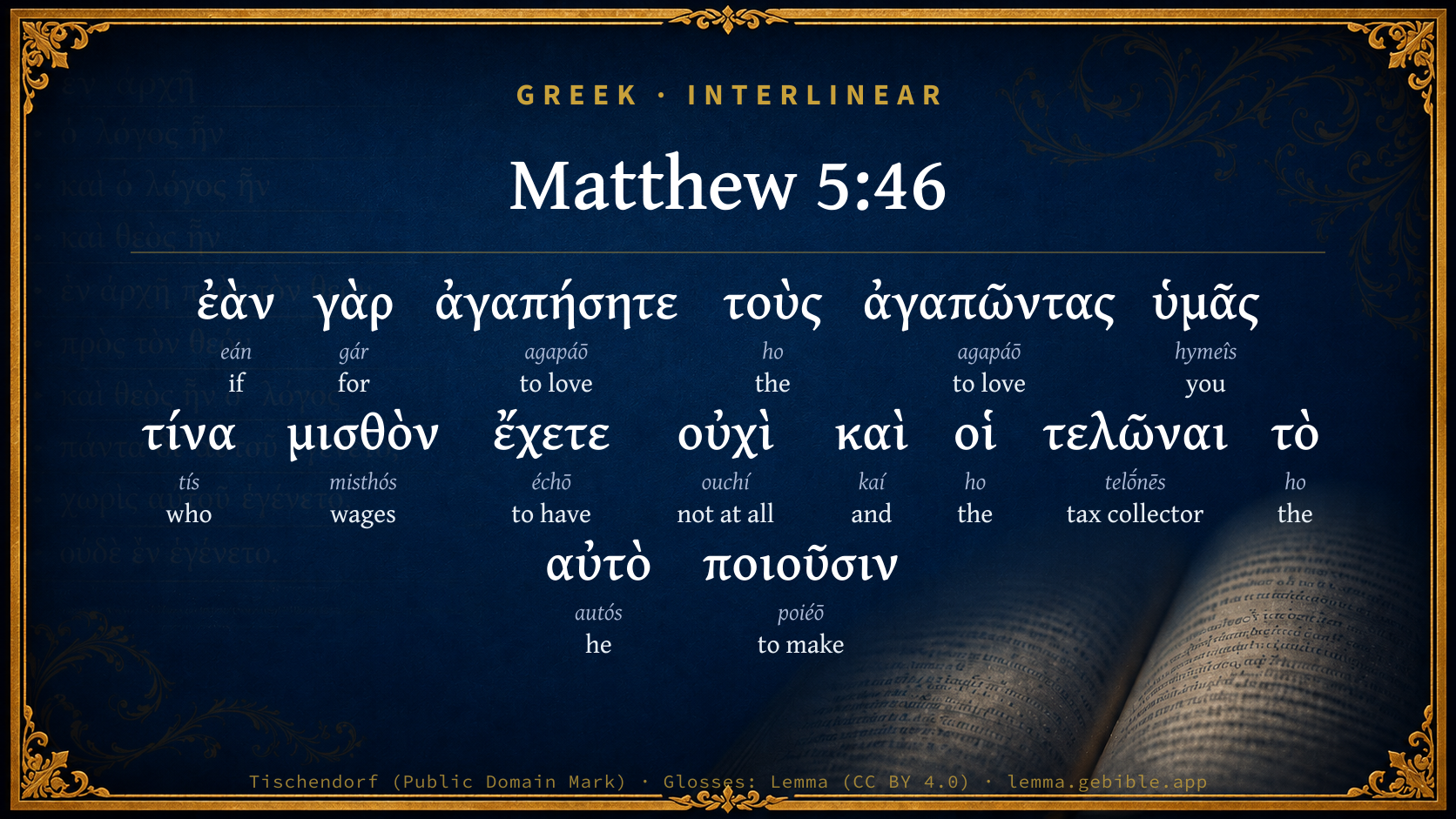
Greek (Tischendorf 8th ed.) Matthew 5:46 appears in the Greek New Testament. The text above is from the Tischendorf 8th edition. Each word links to its Strong’s number and a concise gloss. Click any word for its full Thayer’s Greek Lexicon entry.
Download image
Cite this verse

Matthew 5:46 (World English Bible). Public Domain. Lemma interlinear Bible study tool, https://lemma.gebible.app/v/matthew/5/46.

Show BibTeX & RIS
BibTeX
RIS
English Translation
For if you love those who love you, what reward do you have? Don't even the tax collectors do the same?
World English Bible · Public Domain
Highlights
  • 2 first appearances in the Greek New Testament
Full analysis ↓
Download a study sheet

One document with this verse’s original text, its word-by-word gloss line, the meaning frame, cross-references with their text, attributed commentary, and full source and license credits — printable, and it pastes into notes with its structure intact.

This verse Autodidact and up

Study sheet (.html) Plain text (.txt)

A passage Seminary Student

Up to 50 verses in one chapter. A passage sheet keeps up to 6 commentary sources and 12 cross-references per verse, in the order this page ranks them, and says so on the sheet whenever that leaves anything out. Ask for a single verse and you get the Autodidact verse sheet above.

Everything on this page stays free to read, with no account — the sheet is a download of what is already on screen, not access to it.

Want to remove ads? Support Godless Engineer
Compare translations 3

The same verse in 3 English versions, stacked beneath the original-language interlinear above. Click any original word for its lexicon entry.

Each is an independent rendering of the whole verse — the interlinear is not word-aligned to these translations.

Highlighted words mark where these versions differ — a whole-verse word diff, not a word-by-word alignment.

  • World English Bible Public Domain
    For if you love those who love you, what reward do you have? Don't even the tax collectors do the same?
  • King James Version Public Domain
    For if ye love them which love you, what reward have ye? do not even the publicans the same?
  • unfoldingWord Literal Text CC BY-SA 4.0
    For if you love the ones loving you, what reward do you have? Do not even the tax collectors do the same thing?

unfoldingWord Literal Text — © unfoldingWord, licensed CC BY-SA 4.0. Word-aligned USFM3 via Door43 (git.door43.org/unfoldingWord/en_ult).

Versions to compare (up to 4)

3 of 4 selected

Show all 19 translations

Every available English version of this verse, each an independent rendering of the whole verse.

  • World English Bible Public Domain
    For if you love those who love you, what reward do you have? Don't even the tax collectors do the same?
  • Berean Standard Bible Public Domain
    If you love those who love you, what reward will you get? Do not even tax collectors do the same?
  • Majority Standard Bible Public Domain
    If you love those who love you, what reward will you get? Do not even tax collectors do the same?
  • King James Version Public Domain
    For if ye love them which love you, what reward have ye? do not even the publicans the same?
  • American Standard Version (1901) Public Domain
    For if ye love them that love you, what reward have ye? do not even the publicans the same?
  • Revised Version (1885) Public Domain
    For if ye love them that love you, what reward have ye? do not even the publicans the same?
  • Geneva Bible (1599) Public Domain
    For if ye loue them, which loue you, what rewarde shall you haue? Doe not the Publicanes euen the same?
  • Douay-Rheims (1899) Public Domain
    For if you love them that love you, what reward shall you have? do not even the publicans this?
  • Young's Literal Translation Public Domain
    `For, if ye may love those loving you, what reward have ye? do not also the tax-gatherers the same?
  • Literal Standard Version CC BY-SA 4.0
    For if you may love those loving you, what reward do you have? Do the tax collectors not also do the same?
  • Unlocked Literal Bible CC BY-SA 4.0
    For if you love those who love you, what reward do you get? Do not even the tax collectors do the same thing?
  • unfoldingWord Literal Text CC BY-SA 4.0
    For if you love the ones loving you, what reward do you have? Do not even the tax collectors do the same thing?
  • Darby Bible Public Domain
    For if ye should love those who love you, what reward have ye? Do not also the tax-gatherers the same?
  • World Messianic Bible Public Domain
    For if you love those who love you, what reward do you have? Don’t even the tax collectors do the same?
  • Webster's Bible Public Domain
    For if ye love them who love you, what reward have ye? do not even the publicans the same?
  • Free Bible Version CC BY-SA 4.0
    For if you only love those who love you, what reward do you have? Don't even the tax collectors do that?
  • Bible in Basic English Public Domain
    For if you have love for those who have love for you, what credit is it to you? do not the tax-farmers the same?
  • Text-Critical English NT CC BY 4.0
    For if you love those who love you, what reward do you have? Do not even the tax collectors do the same?
  • Tyndale New Testament (1534) Public Domain
    For yf ye love them which love you: what rewarde shall ye have? Doo not the Publicans euen so?

Literal Standard Version (2020), Covenant Press — licensed CC BY-SA 4.0. Text via the HelloAO Bible API (eBible.org). Unlocked Literal Bible (unfoldingWord) — licensed CC BY-SA 4.0. Text via the HelloAO Bible API (eBible.org). unfoldingWord Literal Text — © unfoldingWord, licensed CC BY-SA 4.0. Word-aligned USFM3 via Door43 (git.door43.org/unfoldingWord/en_ult). Free Bible Version, Dr. Jonathan Gallagher — licensed CC BY-SA 4.0. Text via the HelloAO Bible API (eBible.org).

Word by word

More ways to search: Search by grammar → Find every occurrence → Compare this word →

Practice this passage: Drill this verse → Learn its vocabulary →

τελῶναι
telṓnēs
G5057
“tax collector”
Noun, Nominative, Plural, Masculine
Part of Speech
Noun
Case
Nominative
Number
Plural
Gender
Masculine
Full Thayer's Definition

Origin: from G5056 and G5608

TDNT: 09:28,1

1. a renter or farmer of taxes a. among the Romans, usually a man of equestrian rank 2. a tax gatherer, collector of taxes or tolls, one employed by a publican or farmer general in the collection of taxes. The tax collectors were as a class, detested not only by the Jews, but by other nations also, both on account of their employment and of the harshness, greed, and deception, with which they did their job.
  1. ἐὰν eán G1437 “if” Conditional
  2. γὰρ gár G1063 “for” Conjunction
  3. ἀγαπήσητε agapáō G25 “to love” Verb, Aorist, Active, Subjunctive, 2nd person, Plural
  4. τοὺς ho G3588 “the” Article, Accusative, Plural, Masculine
  5. ἀγαπῶντας agapáō G25 “to love” Verb, Present, Active, Participle, Accusative, Plural, Masculine
  6. ὑμᾶς hymeîs G5210 “you” Personal pronoun, 2nd person, Accusative, Plural
  7. τίνα tís G5101 “who” Interrogative pronoun, Accusative, Singular, Masculine
  8. μισθὸν misthós G3408 “wages” Noun, Accusative, Singular, Masculine
  9. ἔχετε échō G2192 “to have” Verb, Present, Active, Indicative, 2nd person, Plural
  10. οὐχὶ ouchí G3780 “not at all” Particle, Interrogative
  11. καὶ kaí G2532 “and” Conjunction
  12. οἱ ho G3588 “the” Article, Nominative, Plural, Masculine
  13. τὸ ho G3588 “the” Article, Accusative, Singular, Neuter
  14. αὐτὸ autós G846 “he” Personal pronoun, Accusative, Singular, Neuter
  15. ποιοῦσιν poiéō G4160 “to make” Verb, Present, Active, Indicative, 3rd person, Plural

About this verse

These counts appear in no published source. They are computed here, from the morphology-tagged text and Lemma’s own curated glosses. What Lemma adds →

16
words
13
distinct lemmas
Gospels
section

Notable vocabulary

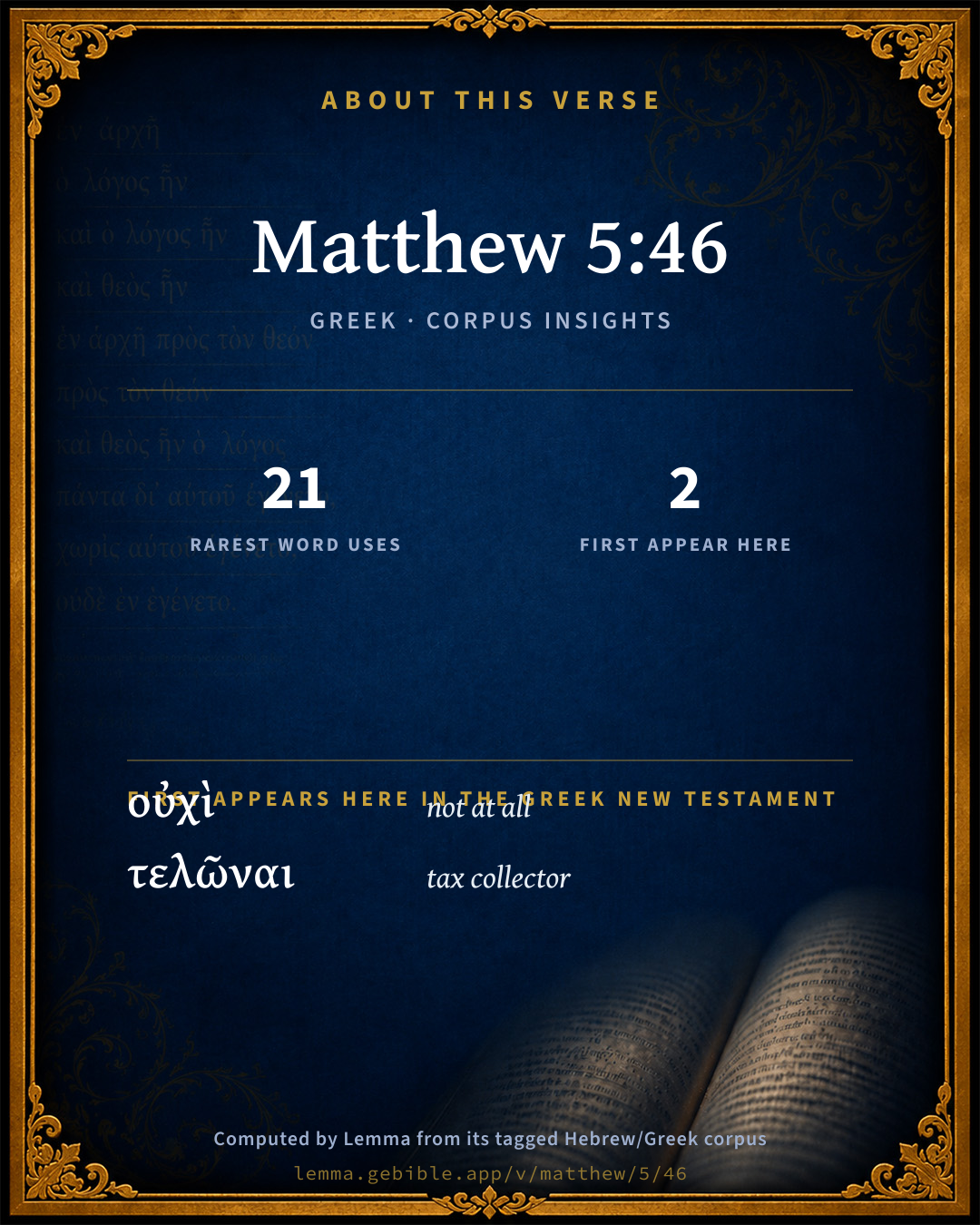
The rarest word here is τελῶναι tax collector G5057 — appearing just 21 times in the whole Greek New Testament.

First appearance in Scripture

These words make their first canonical appearance in the Greek New Testament here:

  • οὐχὶ not at all G3780
  • τελῶναι tax collector G5057

Shared distinctive vocabulary

τελῶναι tax collector G5057 occurs in 20 verses of the Greek New Testament. Also found in:
Repetition

Words recur within this verse:

  • ἀγαπήσητε to love G25 ×2
  • τοὺς the G3588 ×3

Cross-references

11

Topical passages linked to Matthew 5:46 in the Treasury of Scripture Knowledge — connected by theme and wording, ordered by reader-vote popularity; previews shown in the World English Bible.

  • Luke 6:32–35 If you love those who love you, what credit is that to you? For even sinners love those who love them.
  • 1 Peter 2:20–23 For what glory is it if, when you sin, you patiently endure beating? But if, when you do well, you patiently endure suffering, this is commendable with God.
  • Matthew 9:10–11 It happened as he sat in the house, behold, many tax collectors and sinners came and sat down with Jesus and his disciples.
  • Matthew 11:19 The Son of Man came eating and drinking, and they say, 'Behold, a gluttonous man and a drunkard, a friend of tax collectors and sinners!' But wisdom is justified by her children."
  • Matthew 18:17 If he refuses to listen to them, tell it to the assembly. If he refuses to hear the assembly also, let him be to you as a Gentile or a tax collector.
  • Luke 15:1 Now all the tax collectors and sinners were coming close to him to hear him.
  • Luke 18:13 But the tax collector, standing far away, wouldn't even lift up his eyes to heaven, but beat his breast, saying, 'God, be merciful to me, a sinner!'
  • Matthew 6:1 "Be careful that you don't do your charitable giving before men, to be seen by them, or else you have no reward from your Father who is in heaven.
  • Matthew 21:31–32 Which of the two did the will of his father?" They said to him, "The first." Jesus said to them, "Most assuredly I tell you that the tax collectors and the prostitutes are entering into the Kingdom of God before you.
  • Luke 19:2 There was a man named Zacchaeus. He was a chief tax collector, and he was rich.
  • Luke 19:7 When they saw it, they all murmured, saying, "He has gone in to lodge with a man who is a sinner."

Cross-references courtesy of OpenBible.info (CC BY 4.0).

Commentary

Notes on Matthew 5:46 from classic Christian and Jewish commentators (each source and its license shown beneath its notes). The classic Christian expositions comment on the surrounding passage and are grouped to its opening verse, so a note may address several verses; the Jewish commentaries on the Tanakh (Rashi and others) are per-verse, so they appear only where the commentator wrote on this verse.

Lemma curates 59 commentaries, every one of them public domain or Creative Commons licensed, each selected and text-cleaned for this edition rather than reprinted as found. About our sources →

Bengel's Gnomon

Johann Albrecht Bengel

Mat 5:46. Τίνα μισθὸν, what reward) God seeks in us an occasion for giving us a reward.—τελῶναι, publicans) who refer all things to gain; but have none in Heaven.

Bengel's Gnomon of the New Testament — English translation (T&T Clark, Edinburgh, 1860) — public domain. Text from a community e-Sword module.

Meyer's Critical & Exegetical Commentary

Heinrich August Wilhelm Meyer

Mat_5:46. Argumentum e contrario in favour of the command to love ones enemy; for the mere love of ones friend belongs to no higher stage of moral life than that of the publicans and heathens.

In what follows neither is a μόνον to be supplied after τοὺς ἀγαπ. ὑμᾶς, nor is ἔχετε to be taken for ἕξετε (both in answer to Kuinoel and others). Jesus opposes the doctrine, Love them who love you, and views the reward, as in Mat_5:12; Mat_6:1, as a possession, preserved in heaven with God, to be realized in the kingdom of the future.

οἱ τελῶναι] the tax-gatherers (partly natives, partly Romans), who were employed in the service of the Roman knights, who farmed the revenues. They were generally greatly hated amongst the Jews on account of their severity and avarice, especially, however, for being the servants of the Roman power. Wetstein on the passage; Keim, II. p. 217 f.

Meyer — Critical and Exegetical Commentary on the New Testament — English translation by Peter Christie, edited by Frederick Crombie (T&T Clark, 1880) — public domain. Text from a community e-Sword module.

Expositor's Greek Testament

ed. W. Robertson Nicoll

Mat 5:46 . μισθὸν : here, and three times in next chapter; one of several words used in this connection of thought περισσὸν (Mat 5:47 ), τέλειοι (Mat 5:48 ) having a legal sound, and capable of being misunderstood. The scribes and Rabbis had much to say about merit and reward vide Weber, Die Lehren des Talmud , c. xix. § 59, on the idea of Sechûth (merit). Totally opposed to Rabbinism, Jesus did not lose His balance, or allow Himself to be driven into extremes, after the usual manner of controversialists (Protestants and Catholics, e.g. ). He speaks of μισθὸς without scruple ( cf. on Luk 6:32 ). τελῶναι ( τέλος , tax, ὠνέομαι ), first mention of a class often referred to in the Gospels, unpopular beyond their deserts; therefore, like women unjustly treated by husbands, befriended by Jesus; the humble agents of the great farmers of taxes, disliked as representing a foreign yoke, and on account of too frequent acts of injustice, yet human and kindly within their own class, loving those that loved them. Jesus took advantage of this characteristic to win their love by friendly acts.

The Expositor's Greek Testament, edited by W. Robertson Nicoll (1897–1910) — public domain. Text from a community e-Sword module.

Jamieson, Fausset & Brown

Robert Jamieson, A. R. Fausset & David Brown

For if ye love them which love you, what reward have ye? do not even the publicans the same?--The publicans, as collectors of taxes due to the Roman government, were ever on this account obnoxious to the Jews, who sat uneasy under a foreign yoke, and disliked whatever brought this unpleasantly before them. But the extortion practiced by this class made them hateful to the community, who in their current speech ranked them with "harlots." Nor does our Lord scruple to speak of them as others did, which we may be sure He never would have done if it had been calumnious. The meaning, then, is, "In loving those who love you, there is no evidence of superior principle; the worst of men will do this: even a publican will go that length."

Jamieson, Fausset & Brown — Commentary Critical and Explanatory on the Whole Bible (1871) — public domain (CC PDM 1.0). Text via the HelloAO Bible API.

Adam Clarke's Commentary

Verse 46. For if ye love them which love you] He who loves only his friends, does nothing for God's sake. He who loves for the sake of pleasure or interest, pays himself. God has no enemy which he hates but sin; we should have no other.

The publicans] That is, tax-gatherers, τελωναι, from τελος a tax, and ωνεομαι I buy or farm. A farmer or collector of the taxes or public revenues. Of these there were two classes; the superior, who were Romans of the equestrian order; and the inferior, those mentioned in the Gospels, who it appears were mostly Jews.

This class of men was detestable among the Romans, the Greeks, and the Jews, for their intolerable rapacity and avarice. They were abhorred in an especial manner by the Jews, to whom the Roman government was odious: these, assisting in collecting the Roman tribute, were considered as betrayers of the liberties of their country, and abettors of those who enslaved it. They were something like the tythe-farmers of certain college-livings in some counties of England, as Lancashire, c. - a principal cause of the public burthens and discontent. One quotation, of the many produced by Kypke, will amply show in what detestation they were held among the Greeks. Theocritus being asked, Which of the wild beasts were the most cruel? answered, Εν μεν τοις ορεσιν αρκτοι και λεοντες· εν δε ταις πολεσιν, ΤΕΛΩΝΑΙ και συκοφανται. Bears and lions, in the mountains and TAX-GATHERERS and calumniators, in cities.

Adam Clarke's Commentary on the Bible (1810–1826) — public domain. Text from a community e-Sword/MySword module.

Ellicott's Commentary for English Readers

(46) The publicans.—An account of the “publicans” of our Lord’s time will find a more fitting place in the Notes on Mat_9:9. Here, it may be remarked that our Lord puts Himself, as it were, on the level of those to whom He speaks. They despised the publicans as below them, almost as a Pariah caste, and He speaks, as if He were using their own familiar language, yet with a widely different application. Were they after all above the publicans, if they confined their love to a reciprocity of good offices?

A Bible Commentary for English Readers, edited by Charles John Ellicott (1878–1897) — public domain. Text from a community e-Sword module.

The Cambridge Bible for Schools and Colleges

gen. ed. J. J. S. Perowne

46. publicans] taxgatherers; not collectors of a regular tax fixed by government as with us, but men who farmed or contracted for the publicum (state revenue), hence called Publicani. At Rome the equestrian order enjoyed almost exclusively the lucrative privilege of farming the state revenues.

The publicans of the N. T. however are a lower class of taxgatherers, to whom the contractors sublet the collection of taxes. These men repaid themselves by cruel and oppressive exactions. Only the least patriotic and most degraded of the population undertook these functions which naturally rendered them odious to their fellow-citizens.

It is this system pursued in the Turkish Empire that produces much frightful misery and illegal oppression.

The Cambridge Bible for Schools and Colleges (gen. ed. J. J. S. Perowne; Cambridge University Press, 1878–1918) — public domain. Text from a community e-Sword module.

John Gill's Exposition

For if ye love them which love you,.... That is, if ye only love such that love you; for that such who love should be loved again, is both natural and just: our Lord's meaning is not, that ye ought not to love them that love you, but that these should not be the only objects of your love; for should this be the case,

what reward have ye? or "shall ye have?" Do you deserve any thanks for your love now? none at all, it is what you are obliged to by your friend's love to you. Do you expect any hereafter with God? if you do, you will be mistaken; you have your reward with men, who have loved you as much as you have done them, and therefore none can be due to you, either from God or men: besides,

do not even the publicans the same? men of the worst characters, and who were most hateful to the Jews, upon many accounts; partly because of their business, which was to collect the Roman tax, and carry it to the proper officers appointed to receive it, and of whom they sometimes farmed it. Now the Roman yoke was very grievous to the Jews, who boasted of their being a free people; nor did they willingly pay their tribute money; and some of them would refuse to do it, under a pretence of religion; wherefore those publicans, or tax gatherers, which were oftentimes men of their own nation, as appears from the instances of Levi and Zacchaeus, were very odious to them; because they looked upon them as joining with the Romans, in oppressing them, and abridging them in their liberty: and partly because of their character and conduct, being men of great improbity, rapine, and covetousness: hence, as in the New Testament, they are frequently joined with "sinners", as being notorious ones themselves; so in the Talmudic writings, with thieves (a), and are reckoned as thieves, with murderers, and robbers (b); they were not allowed as witnesses (c) in any of their courts of judicature; nor were they to be kept company (d) with in private houses. Now our Lord instances in these men who were the most profligate part of the nation, and had in greatest contempt by the rest; and yet these, by the very dictates of nature, loved such as loved them: wherefore it must be shameful and scandalous in the Pharisees, and others, who pretended to great sanctity and religion, to do no more than these persons did.

(a) Maimon. Hilch. Gezela, c. 5. sect. 9. 11. (b) Misn. Nedarim, c. 3. sect. 4. (c) T. Bab. Sanhedrim, fol. 25. 2. Maimon. Hilch. Eduth, c. 10. sect. 4. Moses Kotsensis Mitzvot Tora pr. neg. 214. (d) Maimon. Hilch. Mishcab, c. 10. sect. 8.

John Gill's Exposition of the Whole Bible (1746–1763) — public domain (CC PDM 1.0). Text via the HelloAO Bible API.

Trapp's Complete Commentary

John Trapp

46 For if ye love them which love you, what reward have ye? do not even the publicans the same?

Ver. 46. For if ye love them that love you, what reward have you?] The Greek and Latin word (say the Rhemists) signifieth very wages or hire due for work; and so presupposeth a meritorious deed. But what will they say to St Luke, who calleth that χαρις, or grace, which St Matthew here called μισθος, a reward? It is a reward, but of mere grace, {see Rom 4:4} that God will give to them that love their enemies. {a} "If thine enemy be hungry, feed him, &c. For thou shalt heap coals of fire upon his head, and the Lord shall reward thee," saith Solomon, Pro 25:21-22. A double encouragement, and all little enough. 1. Thou shalt heap coals on his head; those coals are (as Austin interprets it) urentes poenitentiae gemitus, the scorching sighs of true repentance: q.d. thou shalt melt these Beza in Matt. vi. hardest metals (as many of the martyrs did their persecutors), thou shalt meeken their rancour, overcome their malice, cause them to turn short again upon themselves and upon sight of their sin, shame themselves, and justify thee, as Saul did David. 2. "The Lord shall reward thee" (and all his retributions are more than bountiful), yet not of merit (for what proportion between the work and wages? but first of mercy; -reward and mercy are joined together in the second commandment and Psa 62:12; secondly, of promise, for our encouragement), since our labour is not in vain in the Lord. Briefly, it is called a reward, not properly, but by similitude, because it is given after the work done. Next, it is a reward, not legal, but evangelical; promised in mercy, and in like mercy performed. Whence it is also called the "reward of inheritance," Col 3:24. Now an inheritance is not merited, but freely descendeth on sons, because they are sons. Let no man say, with profane Esau, What is this birthright to me? or with the prodigal in the gospel, Give me here the portion that belongeth unto me (such are those that love their friends only, here they have love for love, and that is all they are to look for); but look up to the recompense of reward, with Moses: and answer as Naboth, God forbid that I should so far gratify the devil and mine own evil heart, as to part with my patrimony, my hope of reward, for a little revenge, or whatsoever coin bearing Satan’s superscription.

{a} Praemium, sed gratuitum.

John Trapp, A Commentary or Exposition upon All the Books of the Old and New Testament (1647–1656) — public domain. Text from a community e-Sword module.

Albert Barnes' Notes on the Bible

What reward have ye? - The word “reward” seems to be used in the sense of “deserving of praise.” If you only love those that love you, you are selfish; it is not genuine love for the “character,” but love for the “benefit,” and you deserve no commendation. The very “publicans” would do the same.

The publicans - The publicans were tax-gatherers. Judea was a province of the Roman empire. The Jews bore this foreign yoke with great impatience, and paid their taxes with great reluctance. It happened, therefore, that those who were appointed to collect taxes were objects of great detestation. They were, besides, people who would be supposed to execute their office at all hazards; men who were willing to engage in an odious and hated employment; people often of abandoned character, oppressive in their exactions, and dissolute in their lives. By the Jews they were associated in character with thieves and adulterers; with the profane and the dissolute. Christ says that even these wretched people would love their benefactors.

Albert Barnes' Notes on the Bible (1834–1885) — public domain. Text from a community e-Sword/MySword module.

Haydock's Catholic Bible Commentary

The publicans. These were the gatherers of the public taxes: a set of men, odious and infamous among the Jews, for their extortions and injustice. (Challoner)

George Leo Haydock (1774–1849), Haydock's Catholic Family Bible and Commentary, 1859 edition — public domain. Excludes Psalms (Douay-Rheims chapter numbering differs from Protestant) and Deuterocanonical books (Catholic canon only).

Matthew Poole's English Annotations

Reason obliges you, who expect a reward from God for what you do, to do something more than those who know of no such reward, or at least live in no expectation of any such thing; and you who condemn others as great sinners, and men not worthy of your converse, ought to do something by which you may outdo those whom you so condemn, both in offices of piety towards God and charity towards men. But if you only show kindness to your relations and to your countrymen, you do no more than those whom you look upon as heathens and the worst of men, who act only from the light and law of nature, and know of no reward God hath to give, nor live in any such expectation of it. By loving here is meant doing good offices, either for the souls or bodies of others. By saluting is meant common offices of kindness, such as inquiring of our neighbours’ health, wishing them well, &c. The publicans were civil officers appointed by the Romans to gather up public taxes and revenues. The chief commissioners were knights and gentlemen of Rome, who either let out these revenues to others, or employed others under them in the collecting of them. These thus employed were some Jews, (such were Matthew and Zacchaeus), some Romans. These (as is ordinary) made their own markets, and exacted of the people, upon which accounts they were exceeding odious: and therefore ordinarily in Scripture we shall find publicans and sinners put together, Mat 9:11; 11:19; and they are joined with harlots, Mat 21:32; and the Pharisee in his justification gloried he was not as that publican, Luk 18:11. Those who condemn others ought to take care that they be better than others.

Matthew Poole's English Annotations on the Holy Bible (1683–1685) — public domain. Text from a community e-Sword/MySword module.

Whedon's Commentary on the Bible

Daniel D. Whedon

46. What reward have ye — How have you manifested at all the power of the Gospel? Ye have only done what the most depraved characters on earth are ready to do. How can you expect the Christian’s reward for a mere heathen’s virtue? Publicans — The Roman government had conquered Judea, and obliged the Jews to pay taxes and tribute to support its tyranny. The publicans were the officers who collected the Roman taxes, and though they might be otherwise respectable men, they were hated by the Jews as tools of a foreign despotism.

Daniel D. Whedon (gen. ed.), Commentary on the Old and New Testaments (1874–1909) — public domain. Text from a community e-Sword module.

The Pulpit Commentary

Vers. 46, 47; parallel passage: Luk_6:32, Luk_6:33. For if, etc. The principle of the Law, reciprocity love your neighbour and him only is in reality no better than the principle adopted by those who are renegades to true religion ( oi telwnai), or by those who have no knowledge of it (oi eynikoi). Such a principle brings with it no other corresponding effect (misyov , ver. 12, note) than such as even these receive. You aim at more, the privileges belonging to the sons of God; therefore do more. What reward have ye? i.e. already entered in God"s book of account (Winer, a). The publicans; Revised Version margin, "That is, collectors or renters of Roman taxes: and so elsewhere." To this short description little need be added. The Roman system of taxation was to put up the country, or certain productions of the country, at auction, and to "sell" them to any who would undertake to pay the greatest amount of revenue from them (cf. also Josephus"s account of the Egyptian method, B.C. 250, "Ant.," 12:4. 4; and Sayce"s article in the Jewish Quarterly, July, 1890, on a Jewish tax-gatherer at Thebes, B.C. 140). This contract was in turn divided and subdivided, those who actually drew the money from the people being generally natives. It thus being the interest of every contractor and sub-contractor to squeeze as much as possible from those under him, the whole system was demoralizing to all engaged in it. In the case of Judaea it was especially so, as there was a strong feeling among religious Jews against the lawfulness of paying taxes to a Gentile ruler. (cf. Mat_22:17, note) It is no wonder, therefore, that we find the native collectors (even of districts where the money raised went to Antipas"s treasury, Mat_9:9, note) classed with "harlots", (Mat_21:31) "sinners", (Mat_9:11) the heathen. (ver. 4:7 Mat_18:17) Yet out of these one was chosen to be among the twelve, and to write that Gospel which specially describes the relation of Jesus of Nazareth to the religious expectations of the nation.

The Pulpit Commentary (1880–1919), ed. H.D.M. Spence-Jones & Joseph S. Exell — public domain. Text from a community e-Sword module.

John Wesley's Explanatory Notes

The publicans - were officers of the revenue, farmers, or receivers of the public money: men employed by the Romans to gather the taxes and customs, which they exacted of the nations they had conquered. These were generally odious for their extortion and oppression, and were reckoned by the Jews as the very scum of the earth.

John Wesley, Explanatory Notes Upon the Whole Bible (1754–1765) — public domain. Text via the GEBible commentary corpus.

Kretzmann's Popular Commentary

Paul E. Kretzmann

And there is also the moral distinction;

v. 46. For if ye love them which love you, what reward have ye? Do not even the publicans the same?

v. 47. And if ye salute your brethren only, what do ye more than others? Do not even the publicans so?

That is the usual, the customary way of dealing in the world: Kind deeds are rewarded with kind deeds, friendly words are given in return for friendly words. That is the height of human morality. The word "salute" may be taken in its literal sense, as a mere greeting, for even so much the Jews denied the Gentiles. Or it may imply friendly relations and a readiness to serve, as became those that were united in the same confession. Outside of that they knew nothing, more they refused to do, Joh 4:9 b. Such a low moral level is not for the disciples of Christ. He expects them to distinguish themselves above the average morality, to carry out the ambition to excel, actually to be superior to a spirit characterized by smallness and meanness. The latter spirit might be expected in the publicans, the tax-collectors of Palestine, who were heartily disliked as being the representatives of the Roman power, and for their cheating and exactions. It is not a Pharisaic pride and arrogance that the Lord wishes to awaken, but the earnest desire to be elevated above a mere customary etiquette, which may become the most refined form of cruelty. A significant fact: Jesus finds something good even in the social outcasts!

Paul E. Kretzmann, Popular Commentary of the Bible (1921–1924) — public domain. Text from a community e-Sword module.

Burkitt's Expository Notes on the New Testament

William Burkitt

Yet farther to encourage us to this duty of loving our enemies, Christ assures his disciples, that he expects more from them than others; more than common humanity and civil courtesy towards friends; for even heathens by the light of nature were taught to love those that loved them: but he expected that Christianity should teach them better, and lead them farther, even to love their enemies, and to bless them that curse them.

Note, Love for love is justice; love for no love is favour and kindness; but love for hatred and enmity is divine goodness; a Christ-like temper, which will render us illustrious on earth, and glorious in heaven.

But Lord! how do men confine their love to little sects and parties? and from thence comes that bitterness of spirit of one party towards another; and oh! how hard it is to find a Christian of a true catholic love and temper.

William Burkitt's Expository Notes on the New Testament (1700–1703) — public domain. Text from a community e-Sword module.

The People's New Testament

B. W. Johnson

46. Do not even the publicans so? The publicans, the gatherers of the Roman tribute, were generally odious, and deemed the scum of the earth, but even they loved those who loved them.

B. W. Johnson's The People's New Testament with Notes (1889–1891) — public domain. Electronic text from the Christian Classics Ethereal Library (CCEL) ThML edition.

unfoldingWord translationNotes

Door43 World Missions Community

Connecting Statement:

Jesus finishes teaching about how he has come to fulfill the Old Testament law. This section began in Matthew 5:17.

General Information:

Jesus is talking to a group of people about what they as individuals should and should not do. All instances of "you" and "your" are plural. (See: Forms of You)

For if you love those ... what reward do you get?

Jesus uses this question to teach the people that loving those who love them is not something special that God will reward them for. AT: "For if you love only those ... you will not get any reward." (See: Rhetorical Question)

Do not even the tax collectors do the same thing?

The Jewish people considered the tax collectors to be very sinful. Jesus uses this question to remind them that even the tax collectors love those who love them. (See: Rhetorical Question)

If you greet only your brothers, what do you do more than others?

Jesus uses this question to teach the people that greeting their brothers is not something special that God will reward them for. AT: "For if you greet only your brothers, you are not doing anything more than what others do." (See: Rhetorical Question)

greet

This is a general term for showing a desire for the well-being of the hearer.

Do not even the Gentiles do the same thing?

The Jewish people considered the Gentiles to be very sinful. Jesus uses this question to remind them that even the Gentiles greet their own brothers. AT: "For even the Gentiles greet their own people." (See: Rhetorical Question)

Father

This is an important title for God. (See: Translating Son and Father)

translationWords

love

reward

tax

brother

Gentile

perfect

heaven

God the Father

unfoldingWord translationNotes — © Distant Shores Media and the Door43 World Missions Community, licensed CC BY-SA 4.0. Source: git.door43.org/Door43/en_tn.

Cambridge Greek Testament for Schools and Colleges

46. οἱ τελῶναι, tax-gatherers; not collectors of a regular tax fixed by government, as with us, but men who farmed or contracted for the publicum (state revenue), hence called Publicani. At Rome the equestrian order enjoyed almost exclusively the lucrative privilege of farming the state revenues.

The publicans of the N.T. however are a lower class of tax-gatherers, (exactores), to whom the contractors sublet the collection of taxes. These men repaid themselves by cruel and oppressive exactions. Only the least patriotic and most degraded of the population undertook these functions which naturally rendered them odious to their fellow-citizens.

It is this system pursued in the Turkish Empire that produces much frightful misery and illegal oppression.

Cambridge Greek Testament for Schools and Colleges (Cambridge University Press, 1896; 21 vols, various authors incl. Carr, Maclear, Plummer, Farrar, Lumby, Moule, M. R. James, Simcox) — public domain. Text from a community e-Sword module.

Alford’s Greek Testament

Henry Alford

46.] On ἀγαπᾷν and φιλεῖν, see Tittmann, p. 54. He remarks, “Manifesta est ratio cur Dominus jusserit ἀγαπᾷν τοὺς ἐχθρούς, non autem φιλεῖν. Nam φιλεῖν, amare, pessimum quemque vir honestus non potest: sed poterit eum tamen ἀγαπᾷν, i.e. bene ei cupere et facere, quippe homo homini, cui etiam Deus benefaciat. Amor imperari non potest, sed dilectio: dilectio humanitatis est, amor eorum tantum, quibus eadem mens est, idem animus.” See further in notes on Joh 11:5.

τελῶναι] This race of men, so frequently mentioned as the objects of hatred and contempt among the Jews, and coupled with sinners, were not properly the publicans, who were wealthy Romans, of the rank of knights, farming the revenues of the provinces; but their underlings, heathens or renegade Jews, who usually exacted with recklessness and cruelty. “The Talmud classes them with thieves and assassins, and regards their repentance as impossible.” Wordsw. In interpreting these verses we must carefully give the persons spoken of their correlative value and meaning: ye, Christians, sons of God, the true theocracy, the βασιλ. τ. οὐρ.,—these τελῶναι or ἐθνικοί, men of this world, actuated by worldly motives,—‘what thank have ye in being like them?’

Henry Alford, The Greek Testament (1849–1861) — public domain. Text from a community e-Sword module.

Lesson kit

Teaching starters — assembled from the data on this page, not authored interpretation. Every prompt links to the verse data it draws on. Edit before teaching.

Matthew, in the Gospels, opens this verse with 16 words (13 distinct Greek lemmas). Its most distinctive word is telṓnēs (“tax collector”). A historical commentator’s framing appears above. Read the whole chapter for the surrounding context.

Discussion questions

  1. What does “tax collector” (telṓnēs) contribute to the verse as a whole?
  2. 2 words make their first appearance in Scripture here. What does this debut establish?
  3. How does Matthew 9:10, which shares the word «tax collector», read alongside this verse?
  4. What does the repetition of “to love” (2× in this one verse) do in this verse?
  5. The translations on this page render this verse differently — a whole-verse word diff, not a word-by-word alignment. What might account for the different wordings?
  6. Compare how Bengel's Gnomon and Meyer's Critical & Exegetical Commentary read this verse. Where do they agree or differ?

Things to notice

  • 2 words make their first canonical appearance in Scripture here.
  • These translations choose different wording for 9 words in this verse.
  • “to love” occurs 2× in this single verse.
  • 13 distinct Greek lemmas span 16 words in this verse.

Reading settings

Reading text

Shown beneath each verse's original-language words.

Old Testament
Old Testament edition

Read the OT as the Masoretic Hebrew (MT) or the Greek Septuagint (LXX).

English shown for the Greek Septuagint (in the Hebrew ↔ Greek comparison).

Comparing translations? Open the Compare panel on any verse page to stack up to four side by side.