
Luke 23:31

Greek (Tischendorf 8th ed.) Luke 23:31 appears in the Greek New Testament. The text above is from the Tischendorf 8th edition. Each word links to its Strong’s number and a concise gloss. Click any word for its full Thayer’s Greek Lexicon entry.
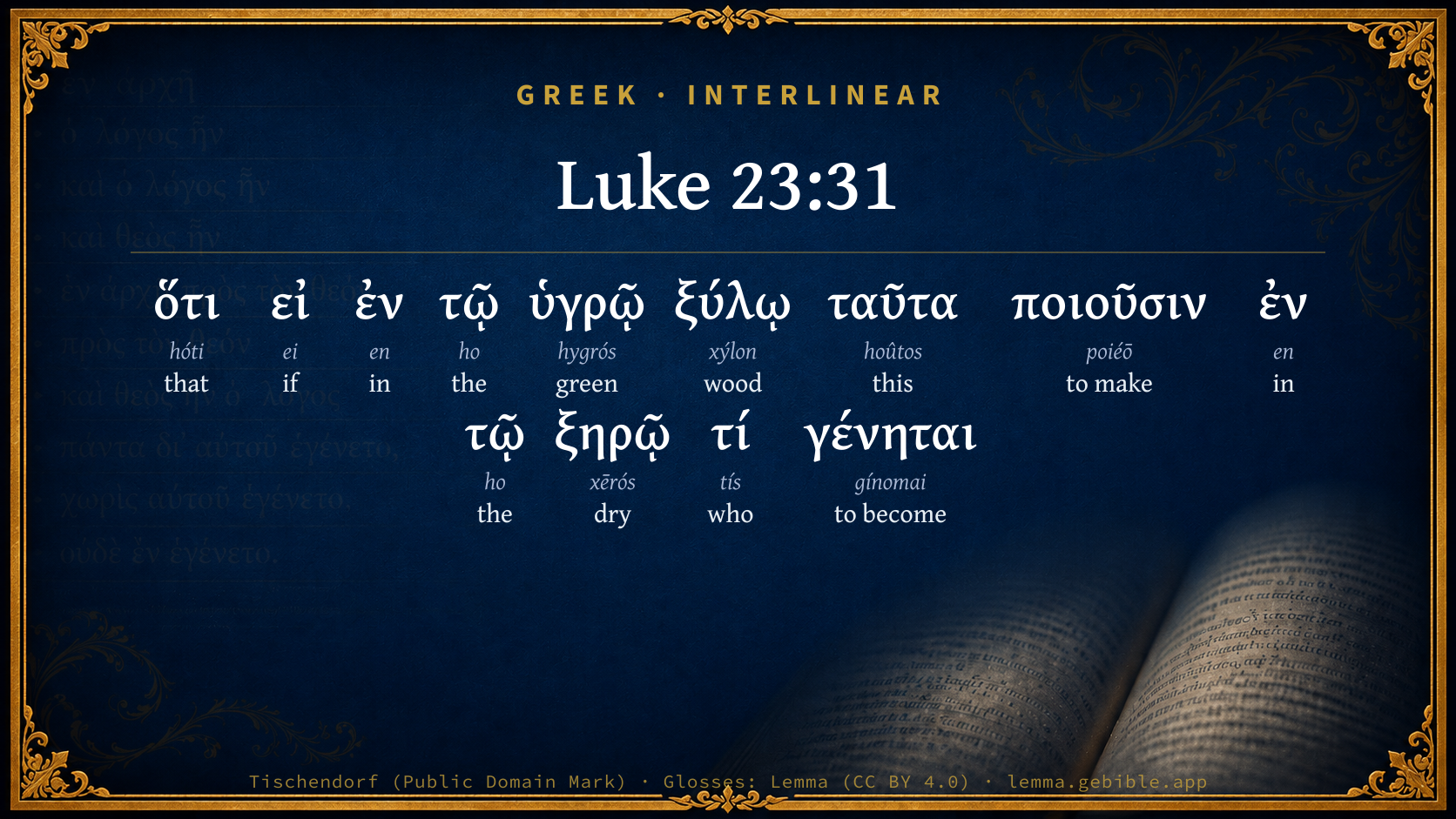
Download image
Cite this verse

Luke 23:31 (World English Bible). Public Domain. Lemma interlinear Bible study tool, https://lemma.gebible.app/v/luke/23/31.

Show BibTeX & RIS
BibTeX
RIS
English Translation
For if they do these things in the green tree, what will be done in the dry?"
World English Bible · Public Domain
Highlights
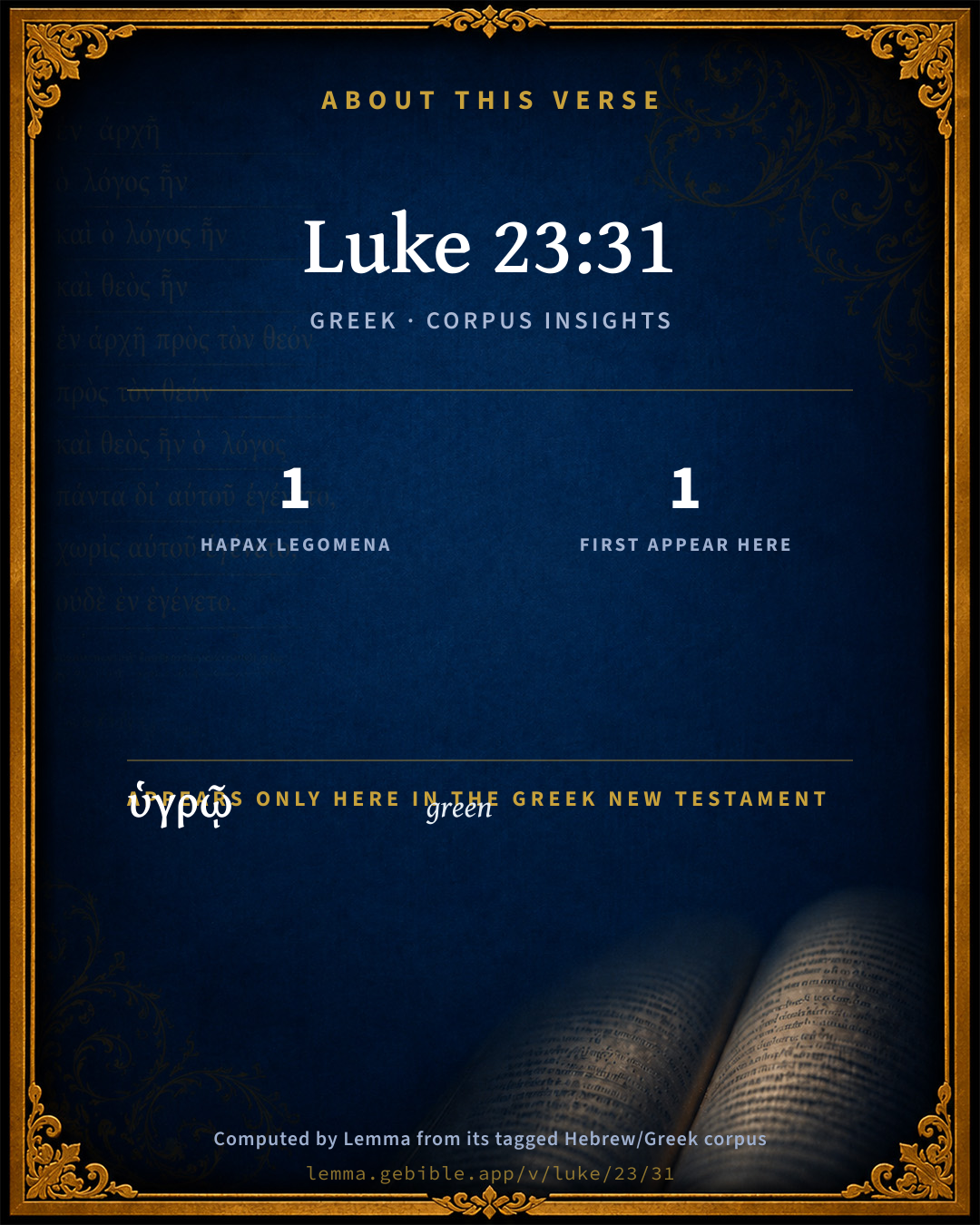
  • 1 hapax legomenon — only here in the Greek New Testament
  • 1 first appearance in the Greek New Testament
Full analysis ↓
Download a study sheet

One document with this verse’s original text, its word-by-word gloss line, the meaning frame, cross-references with their text, attributed commentary, and full source and license credits — printable, and it pastes into notes with its structure intact.

This verse Autodidact and up

Study sheet (.html) Plain text (.txt)

A passage Seminary Student

Up to 50 verses in one chapter. A passage sheet keeps up to 6 commentary sources and 12 cross-references per verse, in the order this page ranks them, and says so on the sheet whenever that leaves anything out. Ask for a single verse and you get the Autodidact verse sheet above.

Everything on this page stays free to read, with no account — the sheet is a download of what is already on screen, not access to it.

Want to remove ads? Support Godless Engineer
Compare translations 3

The same verse in 3 English versions, stacked beneath the original-language interlinear above. Click any original word for its lexicon entry.

Each is an independent rendering of the whole verse — the interlinear is not word-aligned to these translations.

Highlighted words mark where these versions differ — a whole-verse word diff, not a word-by-word alignment.

  • World English Bible Public Domain
    For if they do these things in the green tree, what will be done in the dry?"
  • King James Version Public Domain
    For if they do these things in a green tree, what shall be done in the dry?
  • unfoldingWord Literal Text CC BY-SA 4.0
    For if they do these things in the moist tree, what will happen in the dry?”

unfoldingWord Literal Text — © unfoldingWord, licensed CC BY-SA 4.0. Word-aligned USFM3 via Door43 (git.door43.org/unfoldingWord/en_ult).

Versions to compare (up to 4)

3 of 4 selected

Show all 19 translations

Every available English version of this verse, each an independent rendering of the whole verse.

  • World English Bible Public Domain
    For if they do these things in the green tree, what will be done in the dry?"
  • Berean Standard Bible Public Domain
    For if men do these things while the tree is green, what will happen when it is dry?”
  • Majority Standard Bible Public Domain
    For if men do these things while the tree is green, what will happen when it is dry?”
  • King James Version Public Domain
    For if they do these things in a green tree, what shall be done in the dry?
  • American Standard Version (1901) Public Domain
    For if they do these things in the green tree, what shall be done in the dry?
  • Revised Version (1885) Public Domain
    For if they do these things in the green tree, what shall be done in the dry?
  • Geneva Bible (1599) Public Domain
    For if they doe these things to a greene tree, what shalbe done to the drie?
  • Douay-Rheims (1899) Public Domain
    For if in the green wood they do these things, what shall be done in the dry?
  • Young's Literal Translation Public Domain
    for, if in the green tree they do these things -- in the dry what may happen?'
  • Literal Standard Version CC BY-SA 4.0
    for if they do these things in the green tree, what may happen in the dry?”
  • Unlocked Literal Bible CC BY-SA 4.0
    For if they do these things while the tree is green, what will happen when it is dry?”
  • unfoldingWord Literal Text CC BY-SA 4.0
    For if they do these things in the moist tree, what will happen in the dry?”
  • Darby Bible Public Domain
    for if these things are done in the green tree, what shall take place in the dry?
  • World Messianic Bible Public Domain
    For if they do these things in the green tree, what will be done in the dry?”
  • Webster's Bible Public Domain
    For if they do these things in a green tree, what will be done in the dry?
  • Free Bible Version CC BY-SA 4.0
    For if they do this to wood that is green, what will happen when it's dried out?”
  • Bible in Basic English Public Domain
    For if they do these things when the tree is green, what will they do when it is dry?
  • Text-Critical English NT CC BY 4.0
    For if they do these things when the wood is green, what will happen when it is dry?”
  • Tyndale New Testament (1534) Public Domain
    For yf they do this to a grene tree what shalbe done to the drye?

Literal Standard Version (2020), Covenant Press — licensed CC BY-SA 4.0. Text via the HelloAO Bible API (eBible.org). Unlocked Literal Bible (unfoldingWord) — licensed CC BY-SA 4.0. Text via the HelloAO Bible API (eBible.org). unfoldingWord Literal Text — © unfoldingWord, licensed CC BY-SA 4.0. Word-aligned USFM3 via Door43 (git.door43.org/unfoldingWord/en_ult). Free Bible Version, Dr. Jonathan Gallagher — licensed CC BY-SA 4.0. Text via the HelloAO Bible API (eBible.org).

Word by word

More ways to search: Search by grammar → Find every occurrence → Compare this word →

Practice this passage: Drill this verse → Learn its vocabulary →

About this verse

These counts appear in no published source. They are computed here, from the morphology-tagged text and Lemma’s own curated glosses. What Lemma adds →

13
words
11
distinct lemmas
Gospels
section

Notable vocabulary

1 hapax legomenon — a word that appears only here in the entire Greek New Testament:

First appearance in Scripture

This word makes its first canonical appearance in the Greek New Testament here:

Shared distinctive vocabulary

ξηρῷ dry G3584 occurs in 8 verses of the Greek New Testament. Also found in:
Repetition

Words recur within this verse:

Cross-references

8

Topical passages linked to Luke 23:31 in the Treasury of Scripture Knowledge — connected by theme and wording, ordered by reader-vote popularity; previews shown in the World English Bible.

  • 1 Peter 4:17–18 For the time has come for judgment to begin at the house of God. If it begins first with us, what will happen to those who don't obey the Gospel of God?
  • Proverbs 11:31 Behold, the righteous shall be repaid in the earth; How much more the wicked and the sinner!
  • John 15:6 If a man doesn't remain in me, he is thrown out as a branch, and is withered; and they gather them, throw them into the fire, and they are burned.
  • Ezekiel 20:47–48 and tell the forest of the South, Hear the word of Yahweh: Thus says the Lord Yahweh, Behold, I will kindle a fire in you, and it shall devour every green tree in you, and every dry tree: the flaming flame shall not be quenched, and all faces from the south to the north shall be burnt thereby.
  • Ezekiel 15:2–7 Son of man, what is the vine tree more than any tree, the vine-branch which is among the trees of the forest?
  • Ezekiel 21:3–4 and tell the land of Israel, Thus says Yahweh: Behold, I am against you, and will draw forth my sword out of its sheath, and will cut off from you the righteous and the wicked.
  • Matthew 3:12 His winnowing fork is in his hand, and he will thoroughly cleanse his threshing floor. He will gather his wheat into the barn, but the chaff he will burn up with unquenchable fire."
  • Jeremiah 25:29 For, behold, I begin to work evil at the city which is called by my name; and should you be utterly unpunished? You shall not be unpunished; for I will call for a sword on all the inhabitants of the earth, says Yahweh of Hosts.

Cross-references courtesy of OpenBible.info (CC BY 4.0).

Commentary

Notes on Luke 23:31 from classic Christian and Jewish commentators (each source and its license shown beneath its notes). The classic Christian expositions comment on the surrounding passage and are grouped to its opening verse, so a note may address several verses; the Jewish commentaries on the Tanakh (Rashi and others) are per-verse, so they appear only where the commentator wrote on this verse.

Lemma curates 59 commentaries, every one of them public domain or Creative Commons licensed, each selected and text-cleaned for this edition rather than reprinted as found. About our sources →

Tyndale Open Study Notes

Tyndale Open Resources

23:31 If the Romans crucified an innocent man when the tree was green (i.e., during a period of relative peace), what more horrible things would they do when it was dry (i.e., when the land had become a tinderbox of revolution)? During the siege of Jerusalem (AD 66–70), the Romans crucified thousands of Jews outside the city of Jerusalem.

Tyndale Open Study Notes — © Tyndale Open Resources, licensed CC BY-SA 4.0. Text via the HelloAO Bible API.

Bengel's Gnomon

Johann Albrecht Bengel

Luk 23:31. Ὅτι, For) By this adage Jesus either shows why He Himself desires the daughters of Jerusalem to weep; or rather brings before us the persons who desire to be overwhelmed beneath the mountains, stating the grounds of their terror. Therefore we may take the green tree as typifying the young, strong, and healthy: the dry tree (comp. Isa 56:3, “Neither let the eunuch say, Behold I am a dry tree;” Eze 21:3 [Eze 20:47], Eze 31:3,[257] etc.), the old, feeble, and barren. A remarkable passage occurs in Joseph., B. vi. de B. J. ch. 44. f 968, ed Lips. “When the soldiers were wearied out in killing the Jews, and a great multitude seemed still to be left surviving, Cæsar ordered that those alone who were armed and offered resistance should be slain, and that the rest should be made captives. But the soldiers μετὰ (the sense requires κατὰ) τῶν παρηγγελμένων, contrary to what had been commanded, slew the old and feeble (ΤΟΥΣ ΑΣΘΕΝΕΙΣ), (ΤΟ Δʼ ΑΚΜΑΖΟΝ), but shut up in confinement those who were vigorous and serviceable,” etc. Therefore in this crowning calamity they began debating with one another, as usually happens, which was the more miserable. Tending to the same view of the words is the fact, that ξύλον denotes either a tree that is standing, or the wood of a tree that has been cut, which latter also is wont to be either moist (for so Erasmus renders ὑγρὸν, humidum, still retaining the sap) or else dry. Elsewhere indeed Christ is the tree of life, perfect in its verdure: men, whilst outside of Him, are dry wood. See Joh 15:1-2. But His suffering (punishment) was truly more severe than that of any Jew, after the city was taken.

[257] Where the Assyrian is called “a cedar in Lebanon.” Comp. Luk 17:24, “I the Lord have dried up the green tree, and made the dry tree to flourish.”—E. and T.

Bengel's Gnomon of the New Testament — English translation (T&T Clark, Edinburgh, 1860) — public domain. Text from a community e-Sword module.

Expositor's Greek Testament

ed. W. Robertson Nicoll

Luk 23:31 . The sense of this proverbial phrase is obscure, but the connection demands this general idea: what is happening to me now is nothing to what is going to happen to this people. The green tree represents innocence, the dry tree guilt, ripe for the fire of judgment. Vide Eze 20:47 ; Eze 21:3 . Pricaeus cites as a parallel from Catullus: “quid facient crines quum ferro talia cedant?” The Rabbinical proverb, “si duo fuerint ligna arida et unum viride, arida illud lignum viride exurunt,” does not seem to bear the same meaning. ἐν ὑγρῷ ξύλῳ , in the wet tree, in ligno humido , Grotius. ξύλον χλωρὸν = lignum viride , in Ezekiel.

The Expositor's Greek Testament, edited by W. Robertson Nicoll (1897–1910) — public domain. Text from a community e-Sword module.

Geneva Bible (1599)

Geneva Bible translators

As if he said, If they do thus to me that am fruitful, and always flourishing, and who lives forever by reason of my Godhead, what will they do to you, that are unfruitful and void of all lively righteousness?

Geneva Bible (1599) marginal notes — public domain. Text via Bolls.life.

Jamieson, Fausset & Brown

Robert Jamieson, A. R. Fausset & David Brown

green tree--that naturally resists the fire.

the dry--that attracts the fire, being its proper fuel. The proverb here plainly means: "If such sufferings alight upon the innocent One, the very Lamb of God, what must be in store for those who are provoking the flames?"

Jamieson, Fausset & Brown — Commentary Critical and Explanatory on the Whole Bible (1871) — public domain (CC PDM 1.0). Text via the HelloAO Bible API.

Adam Clarke's Commentary

Verse 31. If they do these things in a green tree] This seems to be a proverbial expression, the sense of which is: If they spare not a tree which, by the beauty of its foliage, abundance and excellence of its fruits, deserves to be preserved, then the tree which is dry and withered will surely be cut down. If an innocent man be put to death in the very face of justice, in opposition to all its dictates and decisions, by a people who profess to be governed and directed by Divine laws, what desolation, injustice, and oppression may not be expected, when anarchy and confusion sit in the place where judgment and justice formerly presided? Our Lord alludes prophetically to those tribulations which fell upon the Jewish people about forty years after. See the notes on Mt 24:1-51.

Adam Clarke's Commentary on the Bible (1810–1826) — public domain. Text from a community e-Sword/MySword module.

Ellicott's Commentary for English Readers

(31) If they do these things in a green tree.—The word for “tree” primarily meant “wood” or “timber,” the tree cut down. In later Greek, however, as, e.g., in Rev_2:7; Rev_22:2; Rev_22:14; Rev_22:19, it was used for “tree.” The “green tree” is, therefore, that which is yet living, capable of bearing fruit; the “dry,” that which is barren, fruitless, withered, fit only for the axe (Mat_3:10; Luk_13:7). The words have so much the character of a proverb that the verb may almost be treated as practically impersonal. So far as any persons are implied, we must think of our Lord as speaking of the representatives of Roman power. If Pilate could thus sentence to death One in whom he acknowledged that he could find no fault, what might be expected from his successors when they had to deal with a people rebellious and in arms? In 1Pe_4:17 we have the same thought in a more general and less figurative form.

A Bible Commentary for English Readers, edited by Charles John Ellicott (1878–1897) — public domain. Text from a community e-Sword module.

The Cambridge Bible for Schools and Colleges

gen. ed. J. J. S. Perowne

31. For if they do these things in a green tree, what shall be done in the dry?] Rather, what must happen in the dry? The meaning of this proverb is not clear, and hence it early received the most absurd explanations. It can however only mean either (1) ‘If they act thus cruelly and shamefully while the tree of their natural life is still green, what horrors of crime shall mark the period of its blighting?’—in which case it receives direct illustration from Eze_20:47; comp. Luk_21:3-4; or (2) ‘If they act thus to Me the Innocent and the Holy, what shall be the fate of these, the guilty and false?’—in which case it expresses the same thought as 1Pe_4:17-18. (See Pro_11:31; Eze_20:47; Eze_21:4; Mat_3:10, and p. 385.) For the historic fulfilment in the horrors of a massacre so great as to weary the very soldiers, see Jos. B. f. vi. 44.

The Cambridge Bible for Schools and Colleges (gen. ed. J. J. S. Perowne; Cambridge University Press, 1878–1918) — public domain. Text from a community e-Sword module.

John Gill's Exposition

And when they were come to the place which was called Calvary,.... Or Cranion, which signifies a skull; so called from the skulls of persons that lay about, who were executed. It is a tradition of the ancients (y), that Adam was buried in this place where Christ was crucified, and that his skull lay here. It was usual to crucify on high places, and on mountains, such an one as this was (z):

there they crucified him, and the malefactors; the two thieves;

one on the right hand, and the other on the left; and so fulfilled the prophecy in Isa 53:12.

(y) Cyprian de Resurrectione Christi, p. 479. Hieron. Tom. 1. fol. 42. Bar Bahluli apud Castell. Lex. Polyglott. col. 3466. (z) Lipsius de Cruce, l. 3. c. 13.

John Gill's Exposition of the Whole Bible (1746–1763) — public domain (CC PDM 1.0). Text via the HelloAO Bible API.

Trapp's Complete Commentary

John Trapp

31 For if they do these things in a green tree, what shall be done in the dry?

Ver. 31. What shall be done in the dry?] Lo, little sucklings also are here called dry trees, dry wood, such as God’s wrath will soon kindle upon.

John Trapp, A Commentary or Exposition upon All the Books of the Old and New Testament (1647–1656) — public domain. Text from a community e-Sword module.

Albert Barnes' Notes on the Bible

For if they do these things in a green tree ... - This seems to be a proverbial expression. A “green” tree is not easily set on fire; a dry one is easily kindled and burns rapidly; and the meaning of the passage is - “If they, the Romans, do these things to me, who am innocent and blameless; if they punish me in this manner in the face of justice, what will they not do in relation to this guilty nation? What security have they that heavier judgments will not come upon them? What desolations and woes may not be expected when injustice and oppression have taken the place of justice, and have set up a rule over this wicked people?” Our Lord alludes, evidently, to the calamities that would come upon them by the Romans in the destruction of their city and temple. The passage may be applied, however, without impropriety, and with great beauty and force, to the punishment of the wicked in the future world.

Thus applied, it means that the sufferings of the Saviour, as compared with the sufferings of the guilty, were like the burning of a green tree as compared with the burning of one that is dry. A green tree is not adapted to burn; a dry one is. So the Saviour - innocent, pure, and holy - stood in relation to suffering. There were sufferings which an innocent being could not endure. There was remorse of conscience, the sense of guilt, punishment properly so called, and the eternity of woes. He had the consciousness of innocence, and he would not suffer forever. He had no passions to be enkindled that would rage and ruin the soul. The sinner is “adapted” to sufferings, like a dry tree to the fire. He is guilty, and will suffer all the horrors of remorse of conscience. He will be punished literally. He has raging and impetuous passions, and they will be enkindled in hell, and will rage forever and ever. The meaning is, that if the innocent Saviour suffered “so much,” the sufferings of the sinner forever in hell must be more unspeakably dreadful. Yet who could endure the sufferings of the Redeemer on the cross for a single day? Who could bear them forever and ever, aggravated by all the horrors of a guilty conscience, and all the terrors of unrestrained anger, and hate, and fear, and wrath? “Why will the wicked die?”

Albert Barnes' Notes on the Bible (1834–1885) — public domain. Text from a community e-Sword/MySword module.

Haydock's Catholic Bible Commentary

In the green wood: by which are signified persons of virtue and sanctity; as by the dry wood, the wicked, who bring forth no fruit, and who, like dry wood, are fit to be cast into the fire. (Witham) --- If they be thus cruel with me, how will they treat you!

George Leo Haydock (1774–1849), Haydock's Catholic Family Bible and Commentary, 1859 edition — public domain. Excludes Psalms (Douay-Rheims chapter numbering differs from Protestant) and Deuterocanonical books (Catholic canon only).

Whedon's Commentary on the Bible

Daniel D. Whedon

31. In a green tree… in the dry—A usual interpretation of this verse may be best given in the words of Bloomfield: “A proverbial form of expression; for (as we find from Psa_1:3; Eze_20:47; Eccl.

Luk_6:3, and especially the Rabbinical writers,) the Hebrews were accustomed to figuratively call the righteous, green trees, and the wicked, dry ones. Hence the sense here is: “If the innocent and the righteous be thus cut off, what may not be expected to befal the wicked and disobedient at the day of visitation, which impends over you.” But we are convinced that this is not the meaning of the passage. The green tree and the dry represent, if we rightly understand it, Jerusalem in its living and vigorous state, and Jerusalem in its dry and withered state. If in the former she commits crimes like these, what will be her judgments in the latter.

Daniel D. Whedon (gen. ed.), Commentary on the Old and New Testaments (1874–1909) — public domain. Text from a community e-Sword module.

The Pulpit Commentary

For if they do these things in a green tree, what shall be done in the dry? Bleek and others interpret this saying here thus: The green wood represents Jesus condemned to crucifixion as a traitor in spite of his unvarying loyalty to Rome and all lawful Gentile power. The dry wood pictures the Jews, who, ever disloyal to Rome and all Genesis tile authority, will bring on themselves with much stronger reason the terrible vengeance of the great conquering empire. Theophylact, however, better explains the saying in his paraphrase, "If they do these things in me, fruitful, always green, undying through the Divinity, what will they do to you, fruitless, and deprived of all life-giving righteousness?" So Farrar, who well summarizes, "If they act thus to me, the Innocent and the Holy, what shall be the fate of these, the guilty and false?"

The Pulpit Commentary (1880–1919), ed. H.D.M. Spence-Jones & Joseph S. Exell — public domain. Text from a community e-Sword module.

John Wesley's Explanatory Notes

If they do these things in the green tree, what shall be done in the dry? - Our Lord makes use of a proverbial expression, frequent among the Jews, who compare a good man to a green tree, and a bad man to a dead one: as if he had said, If an innocent person suffer thus, what will become of the wicked? Of those who are as ready for destruction as dry wood for the fire?

John Wesley, Explanatory Notes Upon the Whole Bible (1754–1765) — public domain. Text via the GEBible commentary corpus.

Cambridge Greek Testament for Schools and Colleges

31. ἐν τῷ ξηρῷ τί γένηται; ‘What must happen in the dry?’ The subjunctive is deliberative as in Mat 26:54; Mat 23:33. The meaning of this proverb is not clear, and hence it early received the most absurd explanations. It can however only mean either (1) ‘If they act thus cruelly and shamefully while the tree of their natural life is still green, what horrors of crime shall mark the period of its blighting?’—in which case it receives direct illustration from Eze 20:47; comp. Luk 21:3-4; or (2) ‘If they act thus to Me the Innocent and the Holy, what shall be the fate of these, the guilty and false?’—in which case it expresses the same thought as 1Pe 4:17-18. (See Pro 11:31; Eze 20:47; Eze 21:4; Mat 3:10, and p. 385.) For the historic fulfilment in the horrors of a massacre so great as to weary the very soldiers, see Jos. B. J. VI. 44. For the expression ‘green’ and ‘dry tree’ see Psa 1:5; Eze 21:3.

Cambridge Greek Testament for Schools and Colleges (Cambridge University Press, 1896; 21 vols, various authors incl. Carr, Maclear, Plummer, Farrar, Lumby, Moule, M. R. James, Simcox) — public domain. Text from a community e-Sword module.

Alford’s Greek Testament

Henry Alford

31.] This verse—the solemn close of our Lord’s teaching on earth—compares His own sufferings with that awful judgment which shall in the end overtake sinners, the unrepentant human kind—the dry tree. These things—ταῦτα—were a judgment on sin;—He bore our sins;—He,—the vine, the green tree, the fruit-bearing tree,—of Whom His people are the branches,—if He, if they in Him and in themselves, are so treated, so tried with sufferings,—what shall become of them who are cast forth as a branch and are withered? Read 1Pe 4:12-18;—ver. 18 is a paraphrase of our text. Theophylact’s comment is excellent: εἰ ταῦτα ποιοῦσιν ἐν ἐμοὶ ἐγκάρπῳ καὶ ἀειθαλεί καὶ ἀειζώῳ διὰ τὴν θεότητα, τί γένηται ἐν ὑμῖν ἀκάρποις καὶ πάσης δικαιοσύνης ζωοποιοῦ ἐστερημένοις;

The explanations which make the green-tree = the young, and the dry = the old (Bengel),—or the green-tree = the women, comparatively innocent, the dry = the guilty (Baumgarten-Crusius), at the destruction of Jerusalem—seem to me unworthy of the place which the words hold, though the latter agrees with the symbolism of Eze 20:47, compared with 21:4.

Henry Alford, The Greek Testament (1849–1861) — public domain. Text from a community e-Sword module.

International Critical Commentary

31. ὅτι εἰ ἐν τῷ ὑγρῷ ξύλῳ. This is not a continuation of the cry of despair, but gives the reason for predicting such things. “These horrors will certainly come, because, ” etc. In Syr-Sin. the ὅτι is omitted: “Who do these things in the moist tree, what shall they do in the dry?” Proverbs of similar import are found in various languages, and are capable of many applications: comp. Pro 11:31; 1Pe 4:17, 1Pe 4:18. This saying is an argument à fortiori, and it may be easily applied in more than one sense here. (1) If the Romans treat Me, whom they admit to be innocent, in this manner, how will they treat those who are rebellious and guilty? (2) If the Jews deal thus with One who has come to save them, what treatment shall they receive themselves for destroying Him? (3) If they behave thus before their cup of wickedness is full, what will they commit when it overflows? The use of εύλον, lignum, for a tree as well as for timber is late Greek (Gen 1:29, Gen 1:2:9, Gen 1:3:1; Isa 14:8; Psa 1:3). In Eze 21:3 [20:47] we have ξύλον χλωρόν and ξύλον ξηρόν combined; but otherwise there is no parallel.

For the delib. subjunct. γένηται comp. Mat 26:54, and Ὤμοι ἐγώ, τἱ πάθω; τί νύ μοι μήκιστα γένηται; (Hom. Od. v. 465). See Burton., § 169.

International Critical Commentary — older volumes (1896–1929), various authors — public domain. Text from a community e-Sword module.

Vincent's Word Studies in the New Testament

Marvin R. Vincent

Tree [ξυλω] . Originally wood, timber. In later Greek, a tree. Used of the cross by Peter, Act 5:30; Act 10:39; and 1Pe 2:24. Compare Gal 3:13.

Marvin R. Vincent, Word Studies in the New Testament (1887–1900) — public domain. Text from a community e-Sword/MySword module.

Lesson kit

Teaching starters — assembled from the data on this page, not authored interpretation. Every prompt links to the verse data it draws on. Edit before teaching.

Luke, in the Gospels, opens this verse with 13 words (11 distinct Greek lemmas). Its most distinctive word is hygrós (“green”). A historical commentator’s framing appears above. Read the whole chapter for the surrounding context.

Discussion questions

  1. The word hygrós carries the sense “green.” How does it shape the verse?
  2. This verse holds 1 word here found nowhere else in the Greek New Testament. What might the rare word draw attention to?
  3. The word “green” first appears here in Scripture. What is being introduced at this debut?
  4. Matthew 12:10 shares the word «dry» with this verse. How do the two illuminate each other?
  5. “in” occurs 2× in this one verse. What is the effect of the repetition?
  6. These translations render this verse differently; the difference is in the English rendering, not the original. What questions does that raise?
  7. Reading how Tyndale Open Study Notes and Bengel's Gnomon read this verse, where do the two commentators agree and where do they part?

Things to notice

  • 1 word in this verse appears nowhere else in the Greek New Testament.
  • 1 word makes its first canonical appearance in Scripture here.
  • These translations choose different wording for 6 words in this verse.
  • “in” occurs 2× in this single verse.
  • 11 distinct Greek lemmas span 13 words in this verse.

Reading settings

Reading text

Shown beneath each verse's original-language words.

Old Testament
Old Testament edition

Read the OT as the Masoretic Hebrew (MT) or the Greek Septuagint (LXX).

English shown for the Greek Septuagint (in the Hebrew ↔ Greek comparison).

Comparing translations? Open the Compare panel on any verse page to stack up to four side by side.