
Mark 11:28

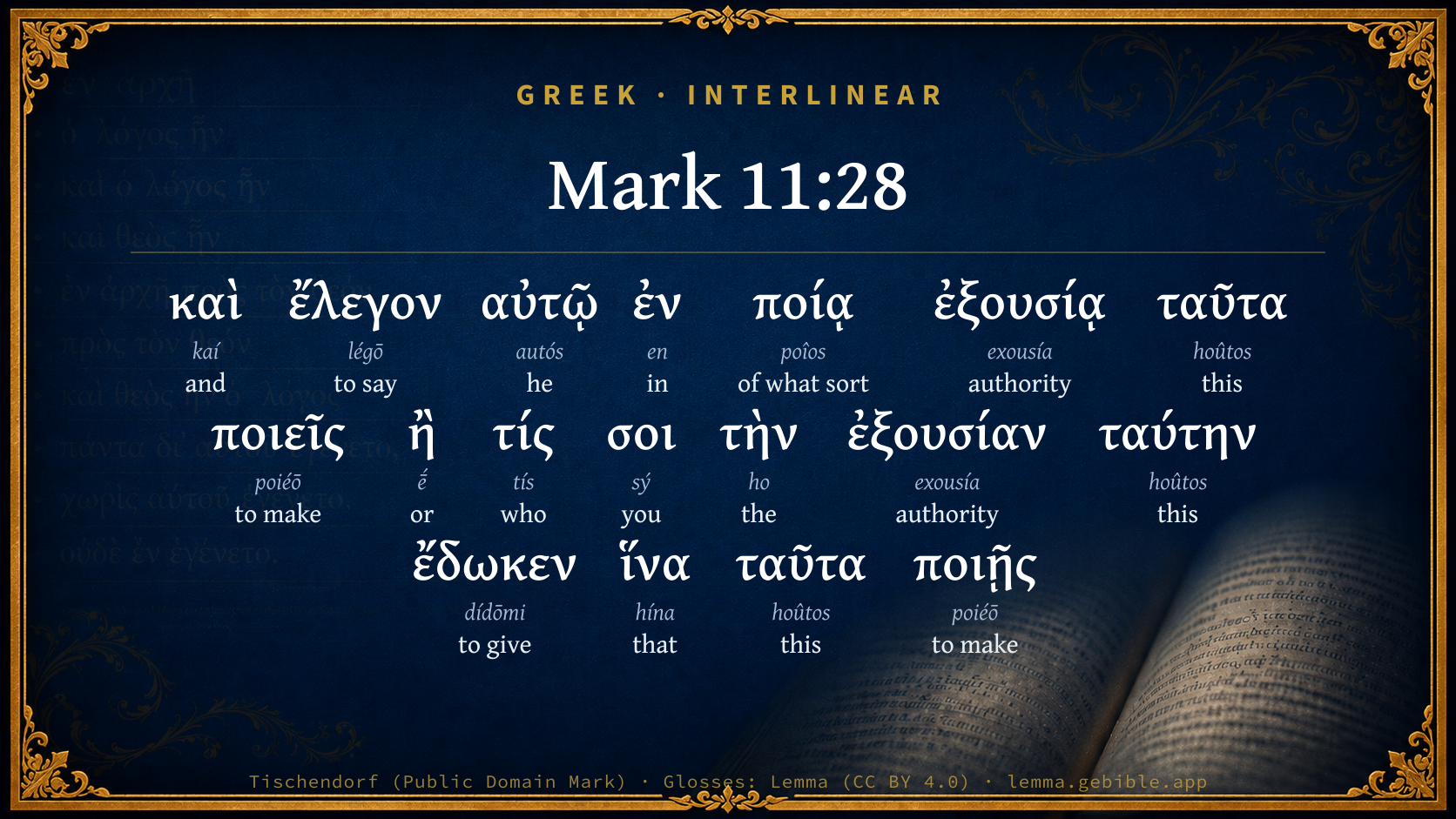
Greek (Tischendorf 8th ed.) Mark 11:28 appears in the Greek New Testament. The text above is from the Tischendorf 8th edition. Each word links to its Strong’s number and a concise gloss. Click any word for its full Thayer’s Greek Lexicon entry.
Download image
Cite this verse

Mark 11:28 (World English Bible). Public Domain. Lemma interlinear Bible study tool, https://lemma.gebible.app/v/mark/11/28.

Show BibTeX & RIS
BibTeX
RIS
English Translation
and they began saying to him, "By what authority do you do these things? Or who gave you this authority to do these things?"
World English Bible · Public Domain
Download a study sheet

One document with this verse’s original text, its word-by-word gloss line, the meaning frame, cross-references with their text, attributed commentary, and full source and license credits — printable, and it pastes into notes with its structure intact.

This verse Autodidact and up

Study sheet (.html) Plain text (.txt)

A passage Seminary Student

Up to 50 verses in one chapter. A passage sheet keeps up to 6 commentary sources and 12 cross-references per verse, in the order this page ranks them, and says so on the sheet whenever that leaves anything out. Ask for a single verse and you get the Autodidact verse sheet above.

Everything on this page stays free to read, with no account — the sheet is a download of what is already on screen, not access to it.

Want to remove ads? Support Godless Engineer
Compare translations 3

The same verse in 3 English versions, stacked beneath the original-language interlinear above. Click any original word for its lexicon entry.

Each is an independent rendering of the whole verse — the interlinear is not word-aligned to these translations.

Highlighted words mark where these versions differ — a whole-verse word diff, not a word-by-word alignment.

  • World English Bible Public Domain
    and they began saying to him, "By what authority do you do these things? Or who gave you this authority to do these things?"
  • King James Version Public Domain
    And say unto him, By what authority doest thou these things? and who gave thee this authority to do these things?
  • unfoldingWord Literal Text CC BY-SA 4.0
    And they were saying to him, “By what authority do you do these things, or who gave you this authority, so that you might do these things?”

unfoldingWord Literal Text — © unfoldingWord, licensed CC BY-SA 4.0. Word-aligned USFM3 via Door43 (git.door43.org/unfoldingWord/en_ult).

Versions to compare (up to 4)

3 of 4 selected

Show all 19 translations

Every available English version of this verse, each an independent rendering of the whole verse.

  • World English Bible Public Domain
    and they began saying to him, "By what authority do you do these things? Or who gave you this authority to do these things?"
  • Berean Standard Bible Public Domain
    “By what authority are You doing these things?” they asked. “And who gave You the authority to do them?”
  • Majority Standard Bible Public Domain
    “By what authority are You doing these things?” they asked. “And who gave You the authority to do them?”
  • King James Version Public Domain
    And say unto him, By what authority doest thou these things? and who gave thee this authority to do these things?
  • American Standard Version (1901) Public Domain
    and they said unto him, By what authority doest thou these things? or who gave thee this authority to do these things?
  • Revised Version (1885) Public Domain
    and they said unto him, By what authority doest thou these things? or who gave thee this authority to do these things?
  • Geneva Bible (1599) Public Domain
    And said vnto him, By what authoritie doest thou these things? and who gaue thee this authoritie, that thou shouldest doe these things?
  • Douay-Rheims (1899) Public Domain
    And they say to him: By what authority dost thou these things? and who hath given thee this authority that thou shouldst do these things?
  • Young's Literal Translation Public Domain
    and they say to him, `By what authority dost thou these things? and who gave thee this authority that these things thou mayest do?'
  • Literal Standard Version CC BY-SA 4.0
    and they say to Him, “By what authority do You do these things? And who gave You this authority that You may do these things?”
  • Unlocked Literal Bible CC BY-SA 4.0
    They said to him, “By what authority do you do these things, and who gave you the authority to do them?”
  • unfoldingWord Literal Text CC BY-SA 4.0
    And they were saying to him, “By what authority do you do these things, or who gave you this authority, so that you might do these things?”
  • Darby Bible Public Domain
    and they say to him, By what authority doest thou these things? and who gave thee this authority, that thou shouldest do these things?
  • World Messianic Bible Public Domain
    and they began saying to him, “By what authority do you do these things? Or who gave you this authority to do these things?”
  • Webster's Bible Public Domain
    And say to him, By what authority doest thou these things? and who gave thee this authority to do these things?
  • Free Bible Version CC BY-SA 4.0
    “By what authority are you doing all this?” they demanded. “Who gave you the right?”
  • Bible in Basic English Public Domain
    And they said to him, By what authority do you do these things? or who gave you authority to do these things?
  • Text-Critical English NT CC BY 4.0
    and said to him, “By what authority are yoʋ doing these things? And who gave yoʋ this authority to do them?”
  • Tyndale New Testament (1534) Public Domain
    and sayd vnto him: by what auctorite doest thou these thinges? and who gave the this auctorite to do these thinges?

Literal Standard Version (2020), Covenant Press — licensed CC BY-SA 4.0. Text via the HelloAO Bible API (eBible.org). Unlocked Literal Bible (unfoldingWord) — licensed CC BY-SA 4.0. Text via the HelloAO Bible API (eBible.org). unfoldingWord Literal Text — © unfoldingWord, licensed CC BY-SA 4.0. Word-aligned USFM3 via Door43 (git.door43.org/unfoldingWord/en_ult). Free Bible Version, Dr. Jonathan Gallagher — licensed CC BY-SA 4.0. Text via the HelloAO Bible API (eBible.org).

Word by word

More ways to search: Search by grammar → Find every occurrence → Compare this word →

Practice this passage: Drill this verse → Learn its vocabulary →

ποίᾳ
poîos
G4169
“of what sort”
Interrogative pronoun, Dative, Singular, Feminine
Part of Speech
Interrogative pronoun
Case
Dative
Number
Singular
Gender
Feminine
Full Thayer's Definition

Origin: from the base of G4226 and G3634

TDNT: None

1. of what sort or nature
  1. καὶ kaí G2532 “and” Conjunction
  2. ἔλεγον légō G3004 “to say” Verb, Imperfect, Active, Indicative, 3rd person, Plural
  3. αὐτῷ autós G846 “he” Personal pronoun, Dative, Singular, Masculine
  4. ἐν en G1722 “in” Preposition
  5. ἐξουσίᾳ exousía G1849 “authority” Noun, Dative, Singular, Feminine
  6. ταῦτα hoûtos G3778 “this” Demonstrative pronoun, Accusative, Plural, Neuter
  7. ποιεῖς poiéō G4160 “to make” Verb, Present, Active, Indicative, 2nd person, Singular
  8. ἢ ḗ G2228 “or” Particle
  9. τίς tís G5101 “who” Interrogative pronoun, Nominative, Singular, Masculine
  10. σοι sý G4771 “you” Personal pronoun, 2nd person, Dative, Singular
  11. τὴν ho G3588 “the” Article, Accusative, Singular, Feminine
  12. ἐξουσίαν exousía G1849 “authority” Noun, Accusative, Singular, Feminine
  13. ταύτην hoûtos G3778 “this” Demonstrative pronoun, Accusative, Singular, Feminine
  14. ἔδωκεν dídōmi G1325 “to give” Verb, Aorist, Active, Indicative, 3rd person, Singular
  15. ἵνα hína G2443 “that” Conjunction
  16. ταῦτα hoûtos G3778 “this” Demonstrative pronoun, Accusative, Plural, Neuter
  17. ποιῇς poiéō G4160 “to make” Verb, Present, Active, Subjunctive, 2nd person, Singular

About this verse

These counts appear in no published source. They are computed here, from the morphology-tagged text and Lemma’s own curated glosses. What Lemma adds →

18
words
14
distinct lemmas
Gospels
section

Shared distinctive vocabulary

ποίᾳ of what sort G4169 occurs in 32 verses of the Greek New Testament. Also found in:
Repetition

Words recur within this verse:

  • ἐξουσίᾳ authority G1849 ×2
  • ποιεῖς to make G4160 ×2
  • ταῦτα this G3778 ×3

Cross-references

6

Topical passages linked to Mark 11:28 in the Treasury of Scripture Knowledge — connected by theme and wording, ordered by reader-vote popularity; previews shown in the World English Bible.

  • Exodus 2:14 He said, "Who made you a prince and a judge over us? Do you plan to kill me, as you killed the Egyptian?" Moses was afraid, and said, "Surely this thing is known."
  • Numbers 16:3 and they assembled themselves together against Moses and against Aaron, and said to them, You take too much on you, seeing all the congregation are holy, everyone of them, and Yahweh is among them: why then lift yourselves up above the assembly of Yahweh?
  • Numbers 16:13 is it a small thing that you have brought us up out of a land flowing with milk and honey, to kill us in the wilderness, but you must needs make yourself also a prince over us?
  • Acts 7:27–28 But he who did his neighbor wrong pushed him away, saying, 'Who made you a ruler and a judge over us?
  • Acts 7:38–39 This is he who was in the assembly in the wilderness with the angel that spoke to him on Mount Sinai, and with our fathers, who received living oracles to give to us,
  • Acts 7:51 "You stiff-necked and uncircumcised in heart and ears, you always resist the Holy Spirit! As your fathers did, so you do.

Cross-references courtesy of OpenBible.info (CC BY 4.0).

Commentary

Notes on Mark 11:28 from classic Christian and Jewish commentators (each source and its license shown beneath its notes). The classic Christian expositions comment on the surrounding passage and are grouped to its opening verse, so a note may address several verses; the Jewish commentaries on the Tanakh (Rashi and others) are per-verse, so they appear only where the commentator wrote on this verse.

Lemma curates 59 commentaries, every one of them public domain or Creative Commons licensed, each selected and text-cleaned for this edition rather than reprinted as found. About our sources →

The Biblical Illustrator

Joseph S. Exell

Mar_11:28-33

By what authority doest Thou these things?

Christs authority and the way to discern it

I. From the side of the questioners and their question. By what authority doest Thou these things, etc. Christs power was a new power in the world at that time. It was different from the authority of the scribes, priests, elders, and Sanhedrim. They had a right to put this question, but were chargeable with negligence in not having settled it long before. They were Israels shepherds, and had a responsibility for the people over whom they were set. Year by year, and we may almost say day by day, there is some power or another growing up in society which in process of time will make itself felt, and which will gradually weaken and uproot all authority which is held in a wrong spirit, and which is exercised in a wrong way. And it has often made great way before its progress is observed. Christianity began by appealing to the hearts of men, to what men felt to be true. It began in Christs life and teaching. It pandered to no prejudice. It rested not till it brought every man, with his faults, into the presence of God. To these facts the priests and scribes were blind. There are men who will do nothing but by tradition and rule; they set form above substance. They slumbered whilst new forces were rising all around them. So like Christ there are men who strive to do good, striking, out a course for themselves, who look at what has to be done, if not in the old way, in one which will accomplish the object. These leave it to critics and cavillers to settle as best they can by what authority this work is done.

II. Look at the passage from the side of Christ. It was not His custom to be silent when men wished to learn. He received Nicodemus by night; reasoned with the Samaritan woman; Zaccheus. Christ says, Neither will I tell you. These words are not mere resolution on His part to withhold information; but in their being unable to receive what He might tell them. On another occasion the Jews came to Christ and said, If Thou be the Christ, tell us plainly. Christs answer was, I have told you before, and ye did not believe. In like manner the rulers had been virtually told before by what authority Christ had done these things. His words and works were His authority. This want of power to see the truth and to know it is the natural result of a spirit of unfaithfulness to former light and present convictions. Many people overlook this law of their spiritual being; they think that by neglect or carelessness they are at the most missing some advantage for a short season, and that when they please they can regain what has been lost. They forget that the loss is within, in the soul, character, and life, and that it is irreparable. When they wrong their inward convictions, they not merely defile their honour, but destroy the very powers of discerning right and wrong, truth and error. Each time that a man is unfaithful to the light within him he is laying a thicker film upon the spiritual eye. It is marvellous how men with an honest love of the truth are guided into it, and are led out of the labyrinth of darkness and perplexities which surround them. (A. Watson, D. D.)

Christs works His authority

His works were His authority, His teaching was His authority. Just as the discovery of a principle in science is the authority for accepting it, as the discovery of a law of nature is the authority for following it, as the invention of a piece of mechanism is the authority for using it, as the healing power of a new medicine is the authority for applying it so, one would think, there was no need to ask for the authority by which the sorrowful were comforted, or the ignorant taught, or the wicked reformed, or the worldly made spiritual. These works themselves showed whose authority they had. If you cannot see authority in an act of mercy or kindness, how can any words show it? If you cannot see the authority of a wise act, or of a true word, or of a good life, how can any assertions prove it? If a man is righteous, you do not ask him his authority for being just; or benevolent, you do not question his authority for kindness of heart: and if a man, by reading the hearts and consciences of men, succeeds in producing in them a purer and better life, in calming the passionate, in changing the idle into the industrious, the intemperate into the sober, the unholy into the chaste and virtuous-these changes themselves are for you the assurance of an authority which no man may deny. (A. Watson, D. D.)

The question of authority

There is something just in the words of Christs enemies. The idea of Divine revelation is inseparable from the idea of authority. If God speaks He will speak with authority. That authority will have nothing violent or arbitrary in it; it will be persuasive, it will set free instead of enthralling. Individual illumination becomes a dream if it claims to raise itself above Gods revelation. God, who has given revealed truth to men, has given them at the same time the institutions which preserve it. But we must make a fundamental distinction between the Divine truth and the institutions destined to preserve it. The authority of the first is direct; the authority of the second only derived. What is the aim of religious institutions? To preserve life. If the authority of the institution is put above that of the truth itself, if the form is put above the foundation, it is a perversion of the Divine order. Jesus to the Scribes is a person without authority. For them authority is wholly in the priestly institution. These men would have said to the sun, By what right dost thou shine at an hour we have not chosen? Prove to us that thou hast permission to give us light. Therefore they shut their eyes to the light. Let us never put questions of hierarchy and of the church above the truth. I am not indifferent to these things, the form here touches very closely the reality. I distrust a soldier that turns up his nose at his flag. We must, love and defend the church to which we belong. But we must know how to recognize everything outside of it that God makes beautiful, and by means which are not at its direction. We must choose between the pharisaical spirit that says to Christ, By what authority doest thou these things? and the spirit of truth which, when it sees the light, comes to the light, and says, God is here. (E. Bersier, D. D.)

The official religionist challenges the Prophet on a point of order

The method is always popular-plausible; it appeals to every commonplace instinct, and is flattering even to the lowest intelligence. By what authority? Who shall fathom the depth of Divine scorn in the Saviours glance ere He replied? In truth, by what authority did Nathan stand in the presence of David, and, after arraigning before him in his tale a black criminal, cry, Thou art the man? By what authority did Elijah confront Ahab and denounce him as the troubler of Israel? By what authority did Paul, the prisoner at the bar, stand before Felix, and reason with him concerning righteousness, temperance, and judgment to come? By what authority in all ages and everywhere does the spiritual man judge the carnal man; the heavenly assert supremacy over the earthly, sensual, and devilish? Before we listen to the question which Jesus in His turn puts to His questioner by way of answer, read the situation between the lines; let us pause to take in the full meaning of His searching, indignant gaze. You, it seems to say, you who question My authority, then, are the religious teachers. It is your business to know about spiritual things; to judge between the things of God and the things of man; to judge spiritual and carnal conduct; to protect religion; to guard the temple; to be the ministers and stewards of the mysteries. Is that so? Well, let Me see if you are fit for such duties-if you in the least understand them. If you do, you will have a right to question My action, not otherwise. Prove to Me your authority, I will prove to you Mine. The baptism of John, was it from heaven or of men? A silence-dead silence. The eyes of the crowd are on the Pharisees; they notice them whispering together. They are overheard muttering, If we say, of heaven, He will say, Why, then, did you not believe Him? if, of men, all the people will stone us, for they be persuaded that John was a prophet. Then at last these teachers, these judges of spiritual action, reply out loud, We cannot tell. Cannot tell-great doctors of the law-whether John was a charlatan or not; cannot tell the difference between true and false teaching-real and sham religion! Well, if they cannot tell about John, what is the value of their opinion about Christ? They are not ashamed to dub themselves imbeciles-incapables. Had they expressed an adverse opinion, it would have still been respectable; had they proclaimed John and Christ, fanatics, enthusiasts, or impostors, they would have found supporters, as everyone does who has the courage of his opinions. But no-We cannot tell. It was enough; they were answered out of their own mouths. There are some things it is quite useless to tell people who cannot tell; there are some things which, if not felt, can never be explained. (H. R. Haweis, M. A.)

Authority and presumption

I. Where the action is unquestionably right, some will censure the agent.

II. They who require reasons should be ready to give reasons.

III. Truth should be the first question with men, not consequences.

IV. Incompetency may be exposed, and assumption resisted, for the sake of truth. (J. H. Godwin.)

.

The Biblical Illustrator, edited by Joseph S. Exell (c. 1880s–1900s) — public domain. Text from a community e-Sword module.

Tyndale Open Study Notes

Tyndale Open Resources

11:28 Jesus’ authority includes his divine authority to cast out demons (1:22, 27; 5:1-13), heal (1:29–2:12; 5:21-43), forgive sins (2:10), and now cleanse the Temple. Jesus’ authority clearly was from God, but the religious leaders were unwilling to accept it.

Tyndale Open Study Notes — © Tyndale Open Resources, licensed CC BY-SA 4.0. Text via the HelloAO Bible API.

Expositor's Greek Testament

ed. W. Robertson Nicoll

Mar 11:28 . ἵνα ταῦτα ποιῆς : ἵνα with subjunctive after ἐξουσίαν instead of infinitive found in Mar 2:10 , Mar 3:15 .

The Expositor's Greek Testament, edited by W. Robertson Nicoll (1897–1910) — public domain. Text from a community e-Sword module.

Adam Clarke's Commentary

Verse 28. See Clarke on Mr 11:27.

Adam Clarke's Commentary on the Bible (1810–1826) — public domain. Text from a community e-Sword/MySword module.

The Cambridge Bible for Schools and Colleges

gen. ed. J. J. S. Perowne

28. By what authority doest thou these things?] They evidently wished to bring Him to account for His act of the day before, and for His assumption to teach as a Rabbi, without any license from the Schools, which was contrary to the established rule. The same question had been put to Him three years before and by the same persons (Joh_2:18).

The Cambridge Bible for Schools and Colleges (gen. ed. J. J. S. Perowne; Cambridge University Press, 1878–1918) — public domain. Text from a community e-Sword module.

John Gill's Exposition

And Jesus answered and said unto them,.... Being not in the least intimidated by such a body of men:

I will also ask of you one question; or "one word", or "one thing"; here answers to the Hebrew word which signifies both "word" and "thing":

and answer me, and I will tell you by what authority I do these things; See Gill on Mat 21:24.

John Gill's Exposition of the Whole Bible (1746–1763) — public domain (CC PDM 1.0). Text via the HelloAO Bible API.

Trapp's Complete Commentary

John Trapp

28 And say unto him, By what authority doest thou these things? and who gave thee this authority to do these things?

Ver. 28. {See Trapp on "Mat 21:23"}

John Trapp, A Commentary or Exposition upon All the Books of the Old and New Testament (1647–1656) — public domain. Text from a community e-Sword module.

Haydock's Catholic Bible Commentary

"It was a reasonable demand," says Dr. Barrow, "which was made to our Saviour: tell us by what authority thou doest these things, and who hath given thee this authority. The reasonableness of it our Lord did often avow, declaring, that if by his doctrine and works he had not vouched the divinity of his authority, it had been no sin to disbelieve or reject him." (John v. 31, 36; x. 25, 27; and xv. 22, 24.) Dr. Barrow on Supremacy, p. 49. --- This principle, which supposes in pastors the necessity of a lawful mission, was formerly, and may still be, triumphantly urged against Luther, Calvin, Tindal [Tyndale], Cranmer, and all the first pretended Reformers of the Catholic Church. For whence, said the Catholics, did these innovators derive their mission? Who sent them to preach? Who gave them authority to reform and alter the whole state of God’s Church? Let them shew their commission for this purpose, either ordinary or extraordinary. Unless they can do this, we have nothing to do with usurpers and intruders. ... If it be pretended that they had extraordinary mission, immediately derived from God, why did they not shew their credentials, stamped with the broad seal of heaven; that it, why did they not by clear and evident miracles, such as Christ and his apostles wrought, attest their being thus extraordinarily commissioned for the extraordinary work of the Reformation? Without such proofs as these, no pretensions to an extraordinary mission, in opposition to the ordinary Church authority, can be admitted. Otherwise every fanatic or enthusiast, following his own caprice, may pretend to a call from heaven; and, upon this foolish plea, preach up his own dreams for the pure word of God, in contempt of all authority, whether of Church or State. If it be said that the missions of the first reformers were ordinary, and derived to them by the ministry of men, it behoves them to point out what men these were from whom they received this ordinary power. Were they Catholics or Protestants? Not Protestants, for they cannot name any such who commissioned them to preach; not Catholics, because the religion which Luther and his reforming brethren endeavoured to propagate, was a new religion, directly opposite to that of Catholics, and therefore could not be taught, in virtue of any commission from Catholics. And how can they preach unless they be sent? (Romans x. 15.) If it be urged that Luther had received his orders in the Catholic Church, it is easily answered that this could not authorize him to commence preacher and teacher of another religion, any more than the order which Mr. Whiston and Mr. Wesley might receive in the Protestant church of England could authorize them to teach a doctrine anathematized by that Church. (Rutter)

George Leo Haydock (1774–1849), Haydock's Catholic Family Bible and Commentary, 1859 edition — public domain. Excludes Psalms (Douay-Rheims chapter numbering differs from Protestant) and Deuterocanonical books (Catholic canon only).

McGarvey & Pendleton's Commentaries

J. W. McGarvey

J. W. McGarvey's The Fourfold Gospel [CVIII. A. Third Great Group of Parables].

CVIII. IN REPLY TO THE QUESTIONS AS TO HIS AUTHORITY, JESUS GIVES THE THIRD GREAT GROUP OF PARABLES. (In the Court of the Temple. Tuesday, April 4, A. D. 30.) Subdivision A. INTRODUCTION aMATT. XXI. 23-27; bMARK XI. 27-33; cLUKE XX. 1-8.

c1 And it came to pass, on one of the days, bthey [Jesus and the disciples] come again to Jerusalem: a23 And when he was come into the temple, band as he was walking in the temple [The large outer court of the temple, known as the court of the Gentiles, was thronged during the feasts, and was no doubt the part selected by Jesus and his apostles when they taught or preached in the temple. We thrice find them on that side of it where Solomon's porch was located-- Joh_10:23, Act_3:11, Act_5:23], cas he was teaching the people and preaching the gospel [viz.: "the time is fulfilled, and the kingdom of God is at hand: repent ye"-- Mar_1:15], there came upon him { bcome aunto him bthe chief priests and the scribes, and cwith the elders; aof the people [the Sanhedrin (see Joh_10:24.] a24 And Jesus answered and said unto them, cI also will ask you a aone question, which if ye tell me, band answer me, aI likewise will tell you by what authority I do these things. 25 The baptism of John, whence was it? bWas it from heaven, or from men? answer me. [The question which Jesus asked was intimately and inseparably connected with the question which they had asked. Jesus, of course, did not derive his authority from John the Baptist, but John had testified plainly to the Messiahship of Jesus, and had, in no uncertain terms, designated Jesus as immeasurably greater than himself. Now, if the Pharisees admitted that John was a heaven-sent messenger or witness (of which fact his baptism was propounded as a test, since it was a religious ordinance introduced on his authority), then John had already answered the Sanhedrin that Jesus derived his authority from his Messiahship, and hence, all that the Sanhedrin had to do to satisfy their minds was simply to believe John. But if, on the other hand, the Pharisees rejected John's pretensions and claims as a heaven-sent messenger in the face of the almost universal popular conviction, then what was there for Jesus to present his claims to so blind, bigoted, and unreasoning a body?] 31 And they reasoned with themselves, saying, If we shall say, From heaven; he will say, aunto us, Why then did ye not believe him? [When he testified to the Messiahship of Jesus ( Joh_1:7, Joh_1:15, Joh_1:34, Joh_3:26-36, Joh_10:40-42). The Sanhedrin could not admit that the messenger was heaven-sent and yet deny his testimony.] 26 But if we shall { bshould we say, From men-- call the people will stone us: awe fear the multitude; for all hold John as a prophet. cfor they are persuaded that John was a prophet. bthey feared the people: for all verily held John to be a prophet. 33 And they answered [587] Jesus cthat they knew not whence it was. aand said, bsay, We know not. [It should be noted in their consultation there was no effort either to ascertain or to speak the truth. The question as to whether John really was or was not a prophet was in no sense the subject of their investigation. They were merely deciding what to say. They were seeking for the most expedient answer, and as neither truthful answer was expedient, they resolved to falsely deny any knowledge of the case. Men of such brazen dishonesty could not be dealt with openly and fairly as could sincere seekers after truth.] And Jesus, aalso said bsaith unto them, Neither tell I you by what authority I do these things. [Their spoken lie was, "We know not," but their inward and true answer was, "We will not tell," and Jesus answered the suppressed truth saying, "Neither tell I." How readily the subtle minds of the Jewish people would justify Jesus in thus declining to submit the question of his authority to judges who at that very moment publicly confessed their inability to even hazard an opinion, much less render a decision, as to the authority of John the Baptist, who claims were in popular estimation so obvious. It was plain that however well these men might judge human credentials, the divine testimonials of a prophet or of the Messiah were above their carnal sphere. Thus Jesus put his enemies to confusion in the first of man conflicts of that perilous Tuesday. But we may well imagine that they were rendered more bitter by the evidence of a wisdom so much beyond any which they possessed.]

[FFG 586-588]

J. W. McGarvey (with Philip Y. Pendleton), Commentaries on the New Testament (The Fourfold Gospel, 1914; Acts; and the epistles) — public domain. Text from a community e-Sword/MySword module.

Cambridge Greek Testament for Schools and Colleges

28. Ἐν ποίᾳ ἐξουσίᾳ; “In the right of what kind of authority art Thou acting thus?” Cf. Act 4:7. They refer specially to His interference with the hierarchy respecting the Temple-market, but indirectly they challenge His whole career. It was a reasonable question, and they were the right people to raise it. Did He hold that He was clothed with Divine or with human authority? and by whom was it conferred? It was not merely in order to protect the public from an impostor that they pressed this question. They sought to entangle Him fatally. If He claimed Divine authority, He might be convicted of blasphemy. If He claimed human authority as the Son of David, He might be handed over to the Procurator. If He disclaimed all authority, He might be denounced to the people as a convicted impostor. The second question is not a repetition of the first; it at once arises as soon as a claim to any kind of authority is made. Authority must be received from a power that is competent to confer it. Who conferred it on Jesus? Mk alone, with characteristic fulness, adds ἵνα ταῦτα ποιῇς, and Syr-Sin. omits it here. Burton § 215, 216. For ποῖος see on Mar 12:28.

Cambridge Greek Testament for Schools and Colleges (Cambridge University Press, 1896; 21 vols, various authors incl. Carr, Maclear, Plummer, Farrar, Lumby, Moule, M. R. James, Simcox) — public domain. Text from a community e-Sword module.

Alford’s Greek Testament

Henry Alford

28.] ταῦτα need not necessarily refer to the cleansing of the temple, as Meyer; but seems from Luke, to extend over our Lord’s whole course of teaching and putting himself forward in public. ἵνα ταῦτα ποιῇς is not a periphrasis of the infinitive, but contains the purpose of τὴν ἐξ. τ. ἔδ.

Henry Alford, The Greek Testament (1849–1861) — public domain. Text from a community e-Sword module.

International Critical Commentary

28. Ἐν ποίᾳ ἐξουσίᾳ.—By what kind of authority.2 It is more specific than simply what authority. They knew that Jesus claimed a certain kind of authority, but it seemed to them just the vague and uncertain thing that personal, as distinguished from official authority, always seems to the members of a hierarchy. ταῦτα ποιεῖς;—do you do these things? things, such as the cleansing of the temple, which took place only the day before. ἢ τίς σοι τ. ἐξοὐσίαν ταύτην ἔδωκεν, ἵνα ταῦτα ποιῇς;3—or who gave you this authority, to do these things?

ἢ, instead of καὶ, and, before τίς, Tisch. Treg. marg. WH. RV. אBL Δ 124, Memph. Harcl. marg.

The second question, who gave thee this authority? is different in form, but substantially the same. The idea of a divine authority, communicated directly to the man by inward suggestion, and showing its warrant simply in his personal quality, was outside the narrow range of men who recognized only external authority.

International Critical Commentary — older volumes (1896–1929), various authors — public domain. Text from a community e-Sword module.

Lesson kit

Teaching starters — assembled from the data on this page, not authored interpretation. Every prompt links to the verse data it draws on. Edit before teaching.

Mark, in the Gospels, opens this verse with 18 words (14 distinct Greek lemmas). Its most distinctive word is poîos (“of what sort”). A historical commentator’s framing appears above. Read the whole chapter for the surrounding context.

Discussion questions

  1. What does “of what sort” (poîos) contribute to the verse as a whole?
  2. How does Matthew 19:18, which shares the word «of what sort», read alongside this verse?
  3. What does the repetition of “authority” (2× in this one verse) do in this verse?
  4. The translations on this page render this verse differently — a whole-verse word diff, not a word-by-word alignment. What might account for the different wordings?
  5. Compare how The Biblical Illustrator and Tyndale Open Study Notes read this verse. Where do they agree or differ?

Things to notice

  • These translations choose different wording for 6 words in this verse.
  • “authority” occurs 2× in this single verse.
  • 14 distinct Greek lemmas span 18 words in this verse.

Reading settings

Reading text

Shown beneath each verse's original-language words.

Old Testament
Old Testament edition

Read the OT as the Masoretic Hebrew (MT) or the Greek Septuagint (LXX).

English shown for the Greek Septuagint (in the Hebrew ↔ Greek comparison).

Comparing translations? Open the Compare panel on any verse page to stack up to four side by side.