Luke 19:46

Greek (Tischendorf 8th ed.) Luke 19:46 appears in the Greek New Testament. The text above is from the Tischendorf 8th edition. Each word links to its Strong’s number and a concise gloss. Click any word for its full Thayer’s Greek Lexicon entry.
Download image
Cite this verse

Luke 19:46 (World English Bible). Public Domain. Lemma interlinear Bible study tool, https://lemma.gebible.app/v/luke/19/46.

Show BibTeX & RIS
BibTeX
RIS
English Translation
saying to them, "It is written, 'My house is a house of prayer,' but you have made it a 'den of robbers'!"
World English Bible · Public Domain
Download a study sheet

One document with this verse’s original text, its word-by-word gloss line, the meaning frame, cross-references with their text, attributed commentary, and full source and license credits — printable, and it pastes into notes with its structure intact.

This verse Autodidact and up

Study sheet (.html) Plain text (.txt)

A passage Seminary Student

Up to 50 verses in one chapter. A passage sheet keeps up to 6 commentary sources and 12 cross-references per verse, in the order this page ranks them, and says so on the sheet whenever that leaves anything out. Ask for a single verse and you get the Autodidact verse sheet above.

Everything on this page stays free to read, with no account — the sheet is a download of what is already on screen, not access to it.

Want to remove ads? Support Godless Engineer
Compare translations 3

The same verse in 3 English versions, stacked beneath the original-language interlinear above. Click any original word for its lexicon entry.

Each is an independent rendering of the whole verse — the interlinear is not word-aligned to these translations.

Highlighted words mark where these versions differ — a whole-verse word diff, not a word-by-word alignment.

  • World English Bible Public Domain
    saying to them, "It is written, 'My house is a house of prayer,' but you have made it a 'den of robbers'!"
  • King James Version Public Domain
    Saying unto them, It is written, My house is the house of prayer: but ye have made it a den of thieves.
  • unfoldingWord Literal Text CC BY-SA 4.0
    saying to them, “It has been written, ‘My house a house of prayer,’ but you made it a ‘den of robbers.’”

unfoldingWord Literal Text — © unfoldingWord, licensed CC BY-SA 4.0. Word-aligned USFM3 via Door43 (git.door43.org/unfoldingWord/en_ult).

Versions to compare (up to 4)

3 of 4 selected

Show all 19 translations

Every available English version of this verse, each an independent rendering of the whole verse.

  • World English Bible Public Domain
    saying to them, "It is written, 'My house is a house of prayer,' but you have made it a 'den of robbers'!"
  • Berean Standard Bible Public Domain
    He declared to them, “It is written: ‘My house will be a house of prayer.’ But you have made it ‘a den of robbers.’”
  • Majority Standard Bible Public Domain
    He declared to them, “It is written: ‘My house is a house of prayer.’ But you have made it ‘a den of robbers.’”
  • King James Version Public Domain
    Saying unto them, It is written, My house is the house of prayer: but ye have made it a den of thieves.
  • American Standard Version (1901) Public Domain
    saying unto them, It is written, And my house shall be a house of prayer: but ye have made it a den of robbers.
  • Revised Version (1885) Public Domain
    saying unto them, It is written, And my house shall be a house of prayer: but ye have made it a den of robbers.
  • Geneva Bible (1599) Public Domain
    Saying vnto them, It is written, Mine house is the house of prayer, but ye haue made it a denne of theeues.
  • Douay-Rheims (1899) Public Domain
    Saying to them: It is written: My house is the house of prayer. But you have made it a den of thieves.
  • Young's Literal Translation Public Domain
    saying to them, `It hath been written, My house is a house of prayer -- but ye made it a den of robbers.'
  • Literal Standard Version CC BY-SA 4.0
    saying to them, “It has been written, My house is a house of prayer—but you made it a den of robbers.”
  • Unlocked Literal Bible CC BY-SA 4.0
    saying to them, “It is written, 'My house will be a house of prayer,' but you have made it a den of robbers.”
  • unfoldingWord Literal Text CC BY-SA 4.0
    saying to them, “It has been written, ‘My house a house of prayer,’ but you made it a ‘den of robbers.’”
  • Darby Bible Public Domain
    saying to them, It is written, My house is a house of prayer, but *ye* have made it a den of robbers.
  • World Messianic Bible Public Domain
    saying to them, “It is written, ‘My house is a house of prayer,’ but you have made it a ‘den of robbers’!”
  • Webster's Bible Public Domain
    Saying to them, It is written, My house is the house of prayer, but ye have made it a den of thieves.
  • Free Bible Version CC BY-SA 4.0
    He told them, “Scriptures state that my house will be a house of prayer, but you've turned it into a den of thieves.”
  • Bible in Basic English Public Domain
    Saying to them, It has been said, My house is to be a house of prayer, but you have made it a hole of thieves.
  • Text-Critical English NT CC BY 4.0
    He said to them, “It is written, ‘My house is a house of prayer,’ but you have made it a den of robbers.”
  • Tyndale New Testament (1534) Public Domain
    sayinge vnto them that is written: my housse is the housse of prayer: but ye have made it a den of theves.

Literal Standard Version (2020), Covenant Press — licensed CC BY-SA 4.0. Text via the HelloAO Bible API (eBible.org). Unlocked Literal Bible (unfoldingWord) — licensed CC BY-SA 4.0. Text via the HelloAO Bible API (eBible.org). unfoldingWord Literal Text — © unfoldingWord, licensed CC BY-SA 4.0. Word-aligned USFM3 via Door43 (git.door43.org/unfoldingWord/en_ult). Free Bible Version, Dr. Jonathan Gallagher — licensed CC BY-SA 4.0. Text via the HelloAO Bible API (eBible.org).

Word by word

More ways to search: Search by grammar → Find every occurrence → Compare this word →

Practice this passage: Drill this verse → Learn its vocabulary →

σπήλαιον
spḗlaion
G4693
“cave”
Noun, Accusative, Singular, Neuter
Part of Speech
Noun
Case
Accusative
Number
Singular
Gender
Neuter
Full Thayer's Definition

Origin: from a presumed derivative of speos (a grotto)

TDNT: None

1. a cave, den
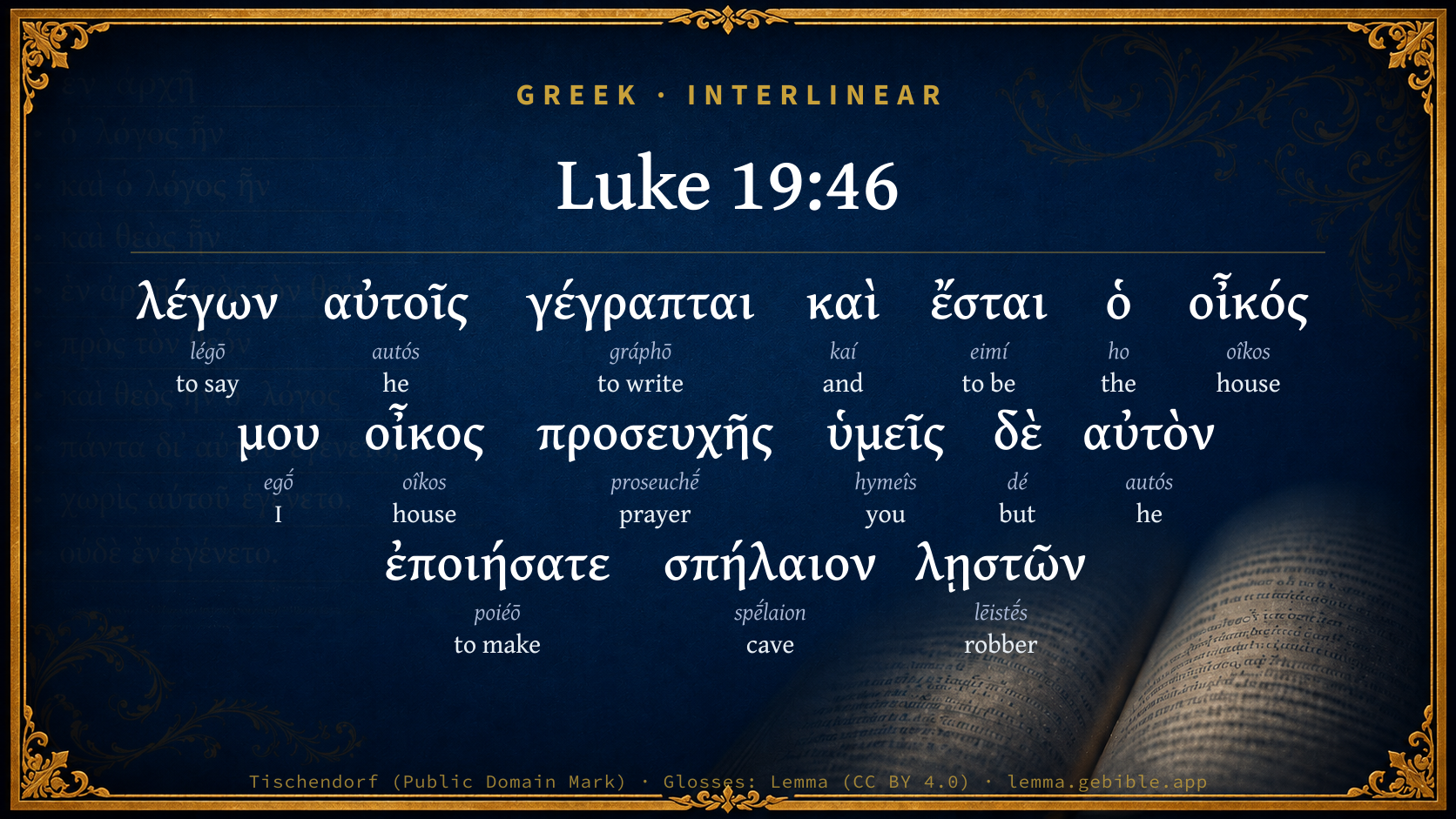
  1. λέγων légō G3004 “to say” Verb, Present, Active, Participle, Nominative, Singular, Masculine
  2. αὐτοῖς autós G846 “he” Personal pronoun, Dative, Plural, Masculine
  3. γέγραπται gráphō G1125 “to write” Verb, Perfect, Passive, Indicative, 3rd person, Singular
  4. καὶ kaí G2532 “and” Conjunction
  5. ἔσται eimí G1510 “to be” Verb, Future, Middle deponent, Indicative, 3rd person, Singular
  6. ὁ ho G3588 “the” Article, Nominative, Singular, Masculine
  7. οἶκός oîkos G3624 “house” Noun, Nominative, Singular, Masculine
  8. μου egṓ G1473 “I” Personal pronoun, 1st person, Genitive, Singular
  9. οἶκος oîkos G3624 “house” Noun, Nominative, Singular, Masculine
  10. προσευχῆς proseuchḗ G4335 “prayer” Noun, Genitive, Singular, Feminine
  11. ὑμεῖς hymeîs G5210 “you” Personal pronoun, 2nd person, Nominative, Plural
  12. δὲ dé G1161 “but” Conjunction
  13. αὐτὸν autós G846 “he” Personal pronoun, Accusative, Singular, Masculine
  14. ἐποιήσατε poiéō G4160 “to make” Verb, Aorist, Active, Indicative, 2nd person, Plural
  15. λῃστῶν lēistḗs G3027 “robber” Noun, Genitive, Plural, Masculine

About this verse

These counts appear in no published source. They are computed here, from the morphology-tagged text and Lemma’s own curated glosses. What Lemma adds →

16
words
14
distinct lemmas
Gospels
section

Notable vocabulary

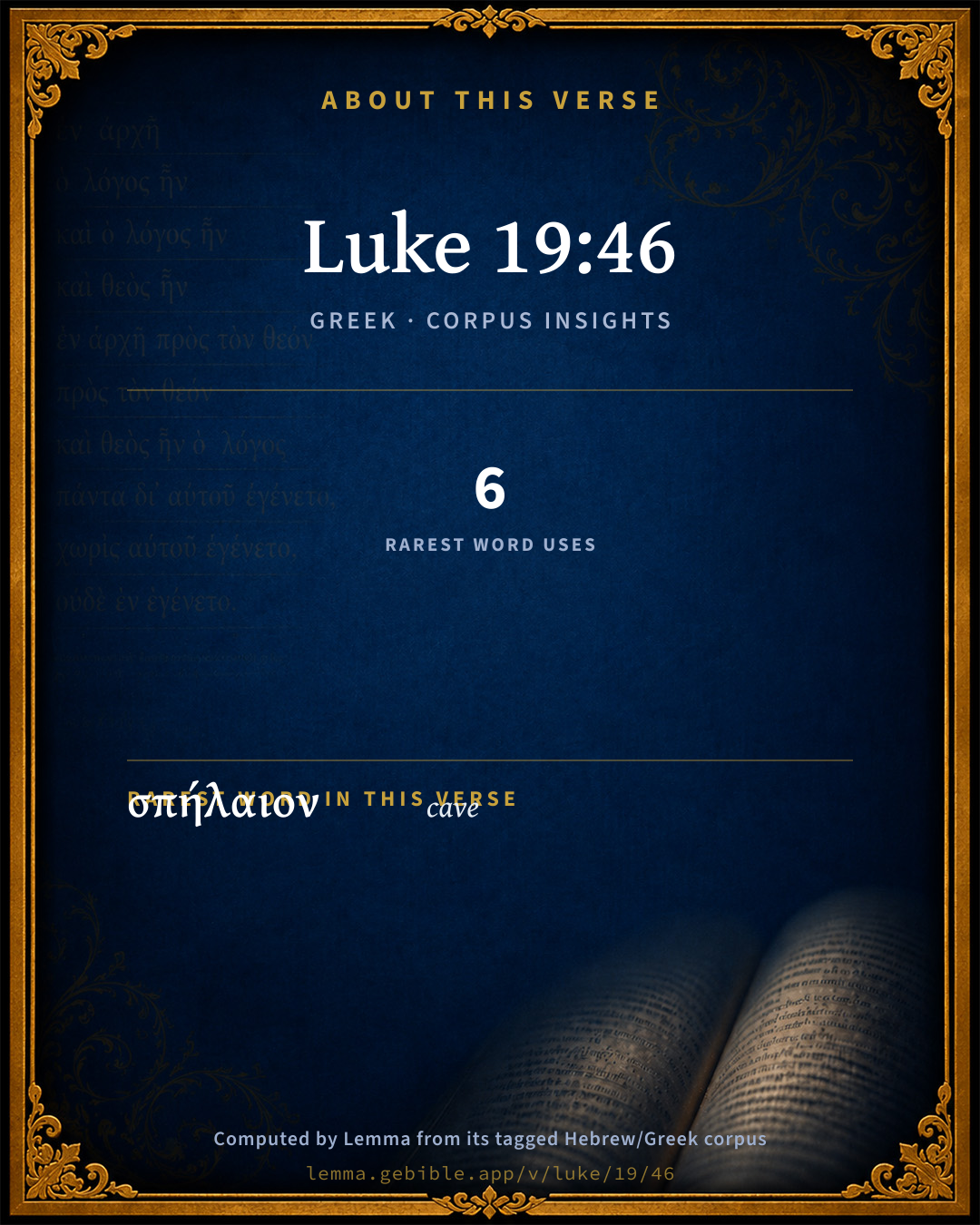
The rarest word here is σπήλαιον cave G4693 — appearing just 6 times in the whole Greek New Testament.

Shared distinctive vocabulary

σπήλαιον cave G4693 occurs in 6 verses of the Greek New Testament. Also found in:

Repetition

Words recur within this verse:

  • οἶκός house G3624 ×2
  • αὐτοῖς he G846 ×2

Cross-references

6

Topical passages linked to Luke 19:46 in the Treasury of Scripture Knowledge — connected by theme and wording, ordered by reader-vote popularity; previews shown in the World English Bible.

  • Isaiah 56:7 even them will I bring to my holy mountain, and make them joyful in my house of prayer: their burnt offerings and their sacrifices shall be accepted on my altar; for my house shall be called a house of prayer for all peoples.
  • Jeremiah 7:11 Is this house, which is called by my name, become a den of robbers in your eyes? Behold, I, even I, have seen it, says Yahweh.
  • Psalms 93:5 Your statutes stand firm. Holiness adorns your house, Yahweh, forevermore.
  • Ezekiel 43:12 This is the law of the house: on the top of the mountain the whole limit of it round about shall be most holy. Behold, this is the law of the house.
  • Matthew 23:13 "Woe to you, scribes and Pharisees, hypocrites! For you devour widows' houses, and as a pretense you make long prayers. Therefore you will receive greater condemnation.
  • Hosea 12:7 A merchant has dishonest scales in his hand. He loves to defraud.

Cross-references courtesy of OpenBible.info (CC BY 4.0).

Commentary

Notes on Luke 19:46 from classic Christian and Jewish commentators (each source and its license shown beneath its notes). The classic Christian expositions comment on the surrounding passage and are grouped to its opening verse, so a note may address several verses; the Jewish commentaries on the Tanakh (Rashi and others) are per-verse, so they appear only where the commentator wrote on this verse.

Lemma curates 59 commentaries, every one of them public domain or Creative Commons licensed, each selected and text-cleaned for this edition rather than reprinted as found. About our sources →

Bengel's Gnomon

Johann Albrecht Bengel

Luk 19:46. Γέγραπται, it is written) See Mat 21:13, note.

Bengel's Gnomon of the New Testament — English translation (T&T Clark, Edinburgh, 1860) — public domain. Text from a community e-Sword module.

Expositor's Greek Testament

ed. W. Robertson Nicoll

Luk 19:46 . καὶ ἔσται : the καὶ , a well-attested reading, does not occur in the text quoted (Isa 56:7 ). The words πᾶσιν τοῖς ἔθνεσιν , which do occur, are strangely omitted by Lk., the Gentile evangelist, perhaps to sharpen the contrast between the ideal a house of prayer , and the reality a den of robbers , i.e. , of dishonest traders, or it may be because the temple was now in ruins. The last part of the saying is from Jer 7:11 .

The Expositor's Greek Testament, edited by W. Robertson Nicoll (1897–1910) — public domain. Text from a community e-Sword module.

The Cambridge Bible for Schools and Colleges

gen. ed. J. J. S. Perowne

46. My house is the house of prayer] Isa_56:7. See on Luk_1:10, Luk_18:10.

a den of thieves] Rather, a brigands’ cave. Our Lord had seen many of these brigands’ caves on the steep rocky sides of the Wady Hamam and elsewhere. Comp. Jer_7:11, “Is this house which is called by my name become a den of robbers in your eyes?” It became still more a murderers’ cave when the sicarii made its pavement swim with blood (Jos. B. J. iv. 3, §§ 7, 10).

The Cambridge Bible for Schools and Colleges (gen. ed. J. J. S. Perowne; Cambridge University Press, 1878–1918) — public domain. Text from a community e-Sword module.

John Gill's Exposition

And could not find what they might do,.... The Vulgate Latin, Syriac, and Ethiopic versions, and so Beza's most ancient copy, add, "to him"; they could not find an opportunity of seizing him, nor any advantage against him; they knew not what steps to take, nor how to bring about their wicked design of destroying him.

For all the people were very attentive to hear him; there were great crowds always about him, that hung upon him, as the word rendered "attentive" signifies; they heard him with great eagerness and diligence, and were ready to catch every word that dropped from his lips; and were exceedingly taken with him, having never heard any man speak like him: wherefore having so many followers, and being so high in the opinion and affection of the people, the sanhedrim were at a loss what method to make use of to gain their point; and they feared the people, should they seize him publicly, lest they should rise and rescue him, and cause a tumult and disturbance.

Next: Luke Chapter 20

John Gill's Exposition of the Whole Bible (1746–1763) — public domain (CC PDM 1.0). Text via the HelloAO Bible API.

Trapp's Complete Commentary

John Trapp

46 Saying unto them, It is written, My house is the house of prayer: but ye have made it a den of thieves.

Ver. 46. See Mat 21:12-13, &c.; {See Trapp on "Joh 2:14"}

John Trapp, A Commentary or Exposition upon All the Books of the Old and New Testament (1647–1656) — public domain. Text from a community e-Sword module.

The Pulpit Commentary

The house of prayer.

The strong indignation of our Lord shown on this occasion is a plain indication of the importance he attached to right thought concerning the sanctuary, and to the right use of it. He brought into prominence the act of prayer as that which should, above all things, characterize the house of God. We enter into his thought if we consider

I THE SENSE IN WHICH SACRIFICE WAS PRAYER. The temple existed primarily and pre-eminently for sacrifice. There, and there alone, might sacrifices be offered to the Lord. It was the one place in all the land where the sin offerings and the burnt offerings could be presented. Was it not, then, essentially, the place of sacrifice? Truly; but sacrifice, when rightly viewed, was a form of prayer. In it and by it the offerer drew near, consciously, to the loving God; in it he made confession of sin to God; in it he made acknowledgment of his continual indebtedness to God; in it he supplicated the mercy and the grace of God. But this is prayer; it is prayer in the form of offering rather than in words. Less than this this conscious approach, this confession, thanksgiving, and supplication is not prayer at all. Inasmuch, then, as the temple was the place of sacrifice, it was the place of prayer.

II THE FACT THAT THERE WAS ROOM IN THE TEMPLE FOR PRAYER AS WE ORDINARILY UNDERSTAND IT. We gather from our Lord"s own words that the temple was the place commonly chosen by the people for the offering of prayer. (Luk_18:10) It was toward the temple that the exiled Jews looked when they knelt down to pray in distant lands; and it was in the temple that they stood to pray when that sacred building was within reach. It was, no doubt, regarded as of all places in the world the very fittest in which to realize the presence of Jehovah, and to spread forth the soul"s desires and aspirations before him. There were many places for prayer, but that was the place of prayer.

III THE PLACE OF PRAYER IN THE CHRISTIAN SANCTUARY. By what, above all things else, should the Christian sanctuary be characterized?

1. It should be the place of common assembly. Where all classes of the people meet together, the rich and the poor, and feel that the Lord is the Maker of them all; (Pro_22:2) where the learned and the unlearned worship and bow down together, and "kneel before the Lord their Maker"; (Psa_95:6) it is the place where human spirits meet, and where earthly circumstances are of no account whatever where wealth does not weigh, and rank creates no distinction.

2. It should be the place of spiritual enlightenment.

(1) Where the Word of God is read, and should be read (as it may be) impressively and effectually; for there is nothing in literature which is more fitted to attract and interest a miscellaneous assembly;

(2) where the will of God is faithfully delivered, and the gospel of Christ expounded and enforced;

(3) where the cause of the Master and of mankind is fully and earnestly pleaded. But most especially is it:

3. The place of prayer. Here, either in sacred psalmody, or through some prepared formula, or led by the extemporaneous thought and aspiration of the minister, the worshippers draw nigh to God in every way in which he is approached by man in adoration, in communion, in thanksgiving, in confession, in supplication, in consecration. No worshipper in the house of the Lord can reach a higher level of spiritual attainment than when he pours out his heart in prayer to God in these various utterances; and no minister in the house of the Lord can render to the people gathered together a truer or higher service than when he helps them thus to approach the Father of spirits, and thus to come into direct communion with him. Then is the house of God put to its noblest and worthiest use when it is made by those who meet within its wails "the house of prayer. C.

Desecration.

Our Lord was touched and troubled with a holy indignation as he saw the temple of Jehovah turned into a place of traffic; that which was intended for the approach of the human spirit to God made to serve the purpose of hard bargaining, and even, as we judge from the language of the text, of dishonest dealings. It was a shocking, an intolerable desecration, and, exerting the authority which always resided in him and which he occasionally put into exercise, he drove these hucksters from the sacred place which they were desecrating by their presence and their practices, What places are we now tempted to desecrate?

I THE SANCTUARY. When, instead of making it a place of worship, of drawing near to God, of speaking to him or for him, of learning something more of his holy will, we make it a place for distinguishing ourselves, or for advertising our respectability, or for gaining enjoyment which is wholly unspiritual.

II THE HOME. When that which should be the abode of peace, of love, of purity, of fellowship, of tenderness, of gracious ministry, of quiet growth and joy, is turned into a scene of bitterness, of recrimination, of estrangement, of deterioration, of unhappiness.

III THE PLACE OF BUSINESS. That might be a sphere where valuable virtues and most acceptable graces are manifested and are strengthened truth, equity, courtesy, honour, courage, sagacity; too often it is nothing better than a sphere in which deceit, low cunning, dishonesty, a mean and miserable selfishness, are sown and reaped bountifully.

IV THE HUMAN BODY. In our treatment of this bodily frame, so skilfully and so wonderfully made, so nicely adjusted to receive and convey impressions from and to the outside world of man and nature, we may and we should act as if we were dealing with a very sacred thing. By cleanliness, by moderation, by purity; by entertaining through the ear and the eye God"s own truth and wisdom; by employing the tongue to speak his love and to sing his praise; by letting the graces of Christian character write themselves, as they will, in lineaments of beauty upon our countenance; by letting our bodies be, as they may be, the very temples of the Holy Ghost, (1Co_6:19) we may make them worthy and sacred in the sight of God. But when we regard them as mere instruments of gratification, and make them the ministers of sinful and even shameful pleasure, how great is such desecration before God!

V HUMAN LIFE. It is here that the Holy One most often sees with Divine regret a pitiful desecration. He gave us our life that it might be spent, through all its stages, in sacred service, in spiritual growth, in elevating joy, in excellent preparation for the larger and fuller life beyond. How grievously is it desecrated when it is turned into a time for mere pecuniary acquisition, or for mere fleshly enjoyment, or for mere emptiness and aimlessness of existence!

1. What a pitiful waste is this I and how it will one day be deplored as absolutely irreparable!

2. How perilous to form such evil habits of the soul, every day becoming more fixed l how wise to hear the Master"s voice summoning us to noble service, "Why stand ye all the day idle? go, work in my vineyard"! C.

The Pulpit Commentary (1880–1919), ed. H.D.M. Spence-Jones & Joseph S. Exell — public domain. Text from a community e-Sword module.

John Wesley's Explanatory Notes

Isaiah lvi, 7.

John Wesley, Explanatory Notes Upon the Whole Bible (1754–1765) — public domain. Text via the GEBible commentary corpus.

Cambridge Greek Testament for Schools and Colleges

46. ἔσται, אBL, for ἐστιν.

46. οἶκος προσευχῆς. Isa 56:7. See on Luk 1:10, Luk 18:10.

σπήλαιον λῃστῶν. ‘A brigands’ cave.’ Our Lord had seen many of these brigands’ caves (Jos. Antt. I. 12) on the steep rocky sides of the Wady Hamâm and elsewhere. Comp. Jer 7:11, “Is this house which is called by my name become a den of robbers in your eyes?” It became still more a murderers’ cave when the sicarii made its pavement swim with blood (Jos. B. J. IV. 3, §§ 7, 10).

Cambridge Greek Testament for Schools and Colleges (Cambridge University Press, 1896; 21 vols, various authors incl. Carr, Maclear, Plummer, Farrar, Lumby, Moule, M. R. James, Simcox) — public domain. Text from a community e-Sword module.

Alford’s Greek Testament

Henry Alford

46.] Cleansing of the temple. See on Mat 21:12, Mat 21:13: Mar 11:15-17.

47,

Henry Alford, The Greek Testament (1849–1861) — public domain. Text from a community e-Sword module.

International Critical Commentary

46. Here the three narratives are almost verbatim the same, and very different from Joh 2:15, Joh 2:16. On the first occasion, He charged them not to make His Father’s house a house of traffic (οἶκον ἐμπορίου): now He charges them with having made it a robbers’ den (σπήλλαιον λῃστῶν). The scandal is worse than before. For a detailed description see Edersh. L. & T. 1. pp. 364-374; also a remarkable passage in Renan, V. de J. p. 215, in which he points out how “antichristian” the traditions of the temple have always been. In the passage from Isa 56:7 Lk. substitutes ἔσται for κληθήσεται, and with Mt. omits πᾶσιν τοῖς ἔθνεσιν, which one would have expected Lk. to preserve. Would he have omitted this, if he had had Mk., who preserves it, before him? See on 20:17. Comp. μὴ σπήλαιον λῃστῶν ὁ οἶκός μου οὖ ἐπικέκληται τὸ ὄνομά μου ἐπʼ αὐτῷ ἐκεῖ ἐνώπιον ὑμῶν; (Jer 7:11).

That καὶ ἔσται before ὁ οἶκος, and not ἐστιν after προσευχῆς is the right reading is sufficiently attested by א B L R, Arm., orig. But it is very unnatural to take καὶ ἔσται with γέγραπται: “It stands written and shall so.

International Critical Commentary — older volumes (1896–1929), various authors — public domain. Text from a community e-Sword module.

Vincent's Word Studies in the New Testament

Marvin R. Vincent

Thieves [ληστων] . See on Mt 26:55; Luk 10:30; Mr 11:17.

Marvin R. Vincent, Word Studies in the New Testament (1887–1900) — public domain. Text from a community e-Sword/MySword module.

Lesson kit

Teaching starters — assembled from the data on this page, not authored interpretation. Every prompt links to the verse data it draws on. Edit before teaching.

Luke, in the Gospels, opens this verse with 16 words (14 distinct Greek lemmas). Its most distinctive word is spḗlaion (“cave”). A historical commentator’s framing appears above. Read the whole chapter for the surrounding context.

Discussion questions

  1. The word spḗlaion carries the sense “cave.” How does it shape the verse?
  2. How does Matthew 21:13, which shares the word «cave», read alongside this verse?
  3. What does the repetition of “house” (2× in this one verse) do in this verse?
  4. These translations render this verse differently; the difference is in the English rendering, not the original. What questions does that raise?
  5. Compare how Bengel's Gnomon and Expositor's Greek Testament read this verse. Where do they agree or differ?

Things to notice

  • These translations choose different wording for 6 words in this verse.
  • “house” occurs 2× in this single verse.
  • 14 distinct Greek lemmas span 16 words in this verse.

Reading settings

Reading text

Shown beneath each verse's original-language words.

Old Testament
Old Testament edition

Read the OT as the Masoretic Hebrew (MT) or the Greek Septuagint (LXX).

English shown for the Greek Septuagint (in the Hebrew ↔ Greek comparison).

Comparing translations? Open the Compare panel on any verse page to stack up to four side by side.