Luke 12:43

Greek (Tischendorf 8th ed.) Luke 12:43 appears in the Greek New Testament. The text above is from the Tischendorf 8th edition. Each word links to its Strong’s number and a concise gloss. Click any word for its full Thayer’s Greek Lexicon entry.
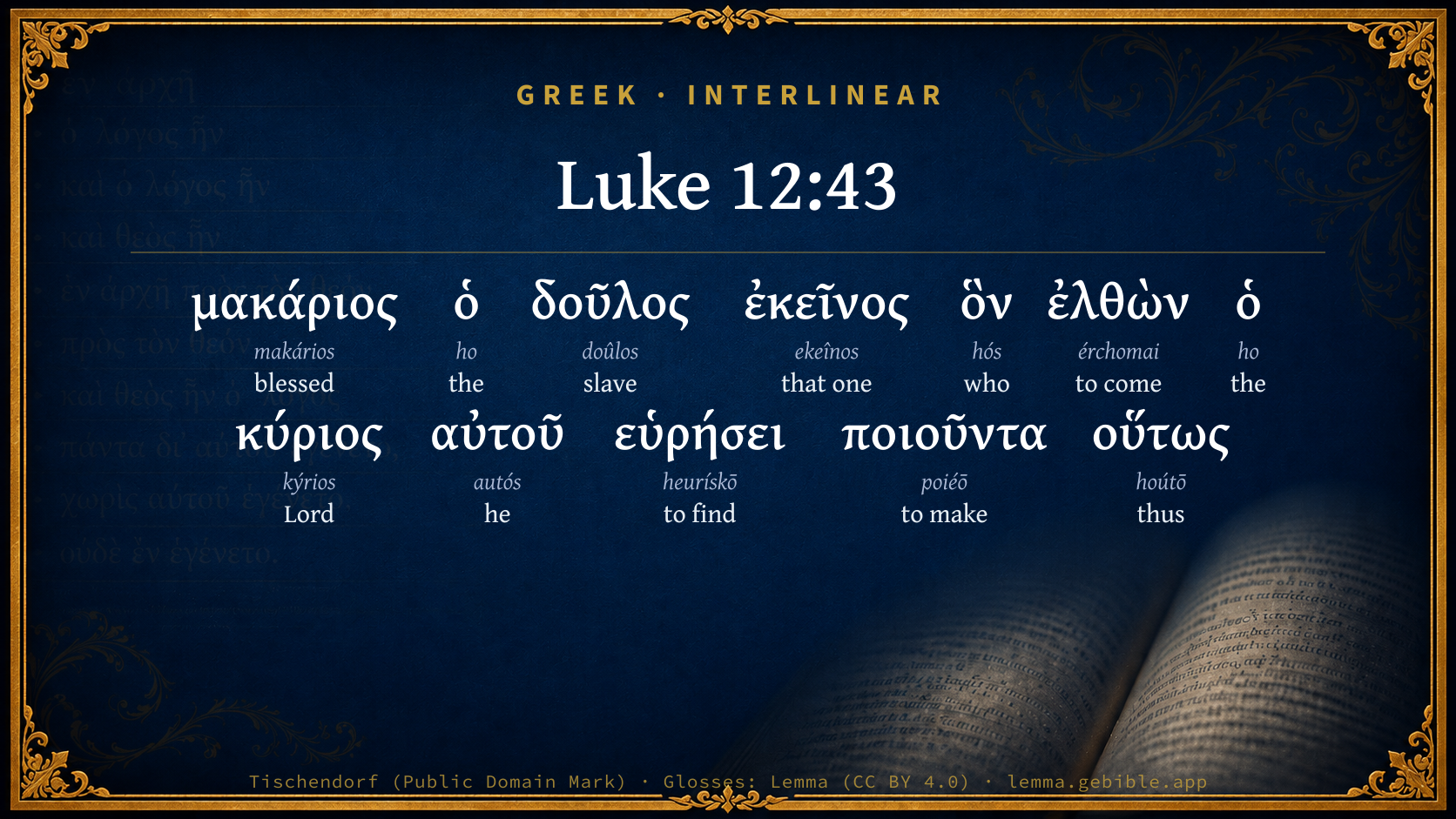
Download image
Cite this verse

Luke 12:43 (World English Bible). Public Domain. Lemma interlinear Bible study tool, https://lemma.gebible.app/v/luke/12/43.

Show BibTeX & RIS
BibTeX
RIS
English Translation
Blessed is that servant whom his lord will find doing so when he comes.
World English Bible · Public Domain
Download a study sheet

One document with this verse’s original text, its word-by-word gloss line, the meaning frame, cross-references with their text, attributed commentary, and full source and license credits — printable, and it pastes into notes with its structure intact.

This verse Autodidact and up

Study sheet (.html) Plain text (.txt)

A passage Seminary Student

Up to 50 verses in one chapter. A passage sheet keeps up to 6 commentary sources and 12 cross-references per verse, in the order this page ranks them, and says so on the sheet whenever that leaves anything out. Ask for a single verse and you get the Autodidact verse sheet above.

Everything on this page stays free to read, with no account — the sheet is a download of what is already on screen, not access to it.

Want to remove ads? Support Godless Engineer
Compare translations 3

The same verse in 3 English versions, stacked beneath the original-language interlinear above. Click any original word for its lexicon entry.

Each is an independent rendering of the whole verse — the interlinear is not word-aligned to these translations.

Highlighted words mark where these versions differ — a whole-verse word diff, not a word-by-word alignment.

  • World English Bible Public Domain
    Blessed is that servant whom his lord will find doing so when he comes.
  • King James Version Public Domain
    Blessed is that servant, whom his lord when he cometh shall find so doing.
  • unfoldingWord Literal Text CC BY-SA 4.0
    Blessed that slave whom his master, having come, will find doing thus.

unfoldingWord Literal Text — © unfoldingWord, licensed CC BY-SA 4.0. Word-aligned USFM3 via Door43 (git.door43.org/unfoldingWord/en_ult).

Versions to compare (up to 4)

3 of 4 selected

Show all 19 translations

Every available English version of this verse, each an independent rendering of the whole verse.

  • World English Bible Public Domain
    Blessed is that servant whom his lord will find doing so when he comes.
  • Berean Standard Bible Public Domain
    Blessed is that servant whose master finds him doing so when he returns.
  • Majority Standard Bible Public Domain
    Blessed is that servant whose master finds him doing so when he returns.
  • King James Version Public Domain
    Blessed is that servant, whom his lord when he cometh shall find so doing.
  • American Standard Version (1901) Public Domain
    Blessed is that servant, whom his lord when he cometh shall find so doing.
  • Revised Version (1885) Public Domain
    Blessed is that servant, whom his lord when he cometh shall find so doing.
  • Geneva Bible (1599) Public Domain
    Blessed is that seruant, whom his master when he commeth, shall finde so doing.
  • Douay-Rheims (1899) Public Domain
    Blessed is that servant, whom when his lord shall come, he shall find so doing.
  • Young's Literal Translation Public Domain
    Happy that servant, whom his lord, having come, shall find doing so;
  • Literal Standard Version CC BY-SA 4.0
    Blessed that servant, whom his lord, having come, will find doing so;
  • Unlocked Literal Bible CC BY-SA 4.0
    Blessed is that servant whom his lord finds doing that when he comes.
  • unfoldingWord Literal Text CC BY-SA 4.0
    Blessed that slave whom his master, having come, will find doing thus.
  • Darby Bible Public Domain
    Blessed is that bondman whom his lord [on] coming shall find doing thus;
  • World Messianic Bible Public Domain
    Blessed is that servant whom his lord will find doing so when he comes.
  • Webster's Bible Public Domain
    Blessed is that servant, whom his lord when he cometh shall find so doing.
  • Free Bible Version CC BY-SA 4.0
    It will be good for that servant when his master returns and finds him doing what he should.
  • Bible in Basic English Public Domain
    Happy is that servant who, when his lord comes, is doing so.
  • Text-Critical English NT CC BY 4.0
    Blessed is that servant whom his master finds doing so when he comes.
  • Tyndale New Testament (1534) Public Domain
    happy is that servaunt whom his master when he cometh shall finde soo doinge.

Literal Standard Version (2020), Covenant Press — licensed CC BY-SA 4.0. Text via the HelloAO Bible API (eBible.org). Unlocked Literal Bible (unfoldingWord) — licensed CC BY-SA 4.0. Text via the HelloAO Bible API (eBible.org). unfoldingWord Literal Text — © unfoldingWord, licensed CC BY-SA 4.0. Word-aligned USFM3 via Door43 (git.door43.org/unfoldingWord/en_ult). Free Bible Version, Dr. Jonathan Gallagher — licensed CC BY-SA 4.0. Text via the HelloAO Bible API (eBible.org).

Word by word

More ways to search: Search by grammar → Find every occurrence → Compare this word →

Practice this passage: Drill this verse → Learn its vocabulary →

μακάριος
makários
G3107
“blessed”
Adjective, Nominative, Singular, Masculine
Part of Speech
Adjective
Case
Nominative
Number
Singular
Gender
Masculine
Full Thayer's Definition

Origin: a prolonged form of the poetical makar (meaning the same)

TDNT: 10:02,5

1. blessed, happy
  1. ὁ ho G3588 “the” Article, Nominative, Singular, Masculine
  2. δοῦλος doûlos G1401 “slave” Noun, Nominative, Singular, Masculine
  3. ἐκεῖνος ekeînos G1565 “that one” Demonstrative pronoun, Nominative, Singular, Masculine
  4. ὃν hós G3739 “who” Relative pronoun, Accusative, Singular, Masculine
  5. ἐλθὼν érchomai G2064 “to come” Verb, Aorist, Active, Participle, Nominative, Singular, Masculine
  6. ὁ ho G3588 “the” Article, Nominative, Singular, Masculine
  7. κύριος kýrios G2962 “Lord” Noun, Nominative, Singular, Masculine
  8. αὐτοῦ autós G846 “he” Personal pronoun, Genitive, Singular, Masculine
  9. εὑρήσει heurískō G2147 “to find” Verb, Future, Active, Indicative, 3rd person, Singular
  10. ποιοῦντα poiéō G4160 “to make” Verb, Present, Active, Participle, Accusative, Singular, Masculine
  11. οὕτως hoútō G3779 “thus” Adverb

About this verse

These counts appear in no published source. They are computed here, from the morphology-tagged text and Lemma’s own curated glosses. What Lemma adds →

12
words
11
distinct lemmas
Gospels
section

Shared distinctive vocabulary

μακάριος blessed G3107 occurs in 49 verses of the Greek New Testament. Also found in:

Repetition

A word recurs within this verse:

Commentary

Notes on Luke 12:43 from classic Christian and Jewish commentators (each source and its license shown beneath its notes). The classic Christian expositions comment on the surrounding passage and are grouped to its opening verse, so a note may address several verses; the Jewish commentaries on the Tanakh (Rashi and others) are per-verse, so they appear only where the commentator wrote on this verse.

Lemma curates 59 commentaries, every one of them public domain or Creative Commons licensed, each selected and text-cleaned for this edition rather than reprinted as found. About our sources →

MacLaren's Expositions of Holy Scripture

Alexander MacLaren

Luke

SERVANTS AND STEWARDS HERE AND HEREAFTER

Luk 12:37, Luk 12:43 - Luk 12:44.

You will, of course, observe that these two passages are strictly parallel in form. Our Lord evidently intends them to run side by side, and to be taken together. The divergences are as significant and instructive as the similarities, and the force of these will be best brought out by just recalling, in a sentence or two, the occasion for the utterance of the second of the two passages which I have taken for my text. When our Lord had finished His previous address and exhortations, Peter characteristically pushed his oar in with the question, ‘Do these commandments refer to us, the Apostles, or to all,’ the whole body of disciples? Our Lord admits the distinction, recognises in His answer that the ‘us,’ the Twelve, were nearer Christ than the general mass of His followers, and answers Peter’s question by reiterating what He has been saying in a slightly different form. He had spoken before about servants. Now He speaks about ‘stewards,’ because the Apostles did stand in that relation to the other disciples, as being slaves indeed, like the rest of the household, but slaves in a certain position of authority, by the Master’s appointment, and charged with providing the nourishment which, of course, means the religious instruction, of their fellow-servants.

So, notice that the first benediction is upon the ‘servants,’ the second is upon the servants who are ‘stewards.’ The first exhortation requires that when the Master comes He shall find the servants watching; the second demands that when He comes He shall find the stewards doing their work. The first promise of reward gives the assurance that the watching servants shall be welcomed into the house, and be waited on by the Master himself; the second gives the assurance that the faithful steward shall be promoted to higher work. We are all servants, and we are all, if we are Christian men, stewards of the manifold grace of God.

So, then, out of these two passages thus brought together, as our Lord intended that they should be, we gather two things: the twofold aspect of life on earth-watchfulness and work; and the twofold hope of life in heaven-rest and rule. ‘Blessed is that servant whom his Lord, when He cometh, shall find watching.’ ‘Blessed is that steward whom his Lord, when He cometh, shall find’-not merely watching, but-’so doing.’

I. The twofold attitude here enjoined.

The first idea in watchfulness is keeping awake; and the second is looking out for something that is coming. Both these conceptions are intertwined in both our Lord’s use of the metaphor of the watching servant, and in the echoes of it which we find abundantly in the Apostolic letters. The first thing is to keep ourselves awake all through the soporific night, when everything tempts to slumber. Even the wise virgins, with trimmed lamps and girt loins, do in some degree succumb to the drowsy influences around them, and like the foolish ones, slumber, though the slumbers of the two classes be unlike. Christian people live in the midst of an order of things which tempts them to close the eyes of their hearts and minds to all the real and unseen glories above and around them, and that might be within them, and to live for the comparatively contemptible and trivial things of this present. Just as when a man sleeps, he loses his consciousness of solid external realities, and passes into a fantastic world of his own imaginations, which have no correspondence in external facts, and will vanish like

‘The baseless fabric of a dream,

If but a cock shall crow,’

so the men who are conscious only of this present life and of the things that are seen, though they pride themselves on being wide awake, are, in the deepest of their being, fast asleep, and are dealing with illusions which will pass and leave nought behind, as really as are men who lie dreaming upon couches, and fancy themselves hard at work. Keep awake; that is the first thing; which, being translated into plain English, points just to this, that unless we make a dead lift of continuous effort to keep firm grasp of God and Christ, and of all the unseen magnificences that are included in these two names, as surely as we live we shall lose our hold upon them, and fall into the drugged and diseased sleep in which so many men around us are plunged. It sometimes seems to one as if the sky above us were raining down narcotics upon us, so profoundly are the bulk of men unconscious of realities, and befooled by the illusions of a dream.

Keep yourselves awake first, and then let the waking, wide-opened eye, be looking forward. It is the very differentia, so to speak, the characteristic mark and distinction of the Christian notion of life, that it shifts the centre of gravity from the present into the future, and makes that which is to come of far more importance than that which is, or which has been. No man is living up to the height of his Christian responsibilities or privileges unless there stands out before him, as the very goal and aim of his whole life, what can never be realised until he has passed within the veil, and is at rest in the ‘secret place of the Most High.’ To live for the future is, in one aspect, the very definition of a Christian.

But the text reminds us of the specific form which that future anticipation is to take. It is not for us, as it is for men in the world, to fix our hopes for the future on abstract laws of the progress of humanity, or the evolution of the species, or the gradual betterment of the world, and the like. All these may be true: I say nothing about them. But what we have to fill our future with is that ‘that same Jesus shall so come in like manner as ye have seen Him go.’ It is much to be lamented that curious chronological speculations have so often discredited that great central hope of the Church, which is properly altogether independent of them; and that, because people have got befogged in interpreting such symbols as beasts, and horses, and trumpets, and seals, and the like, the Christian Church as a whole should so feebly be holding by that great truth, without which, as it seems to me, the truth which many of us are tempted to make the exclusive one, loses half its significance. No man can rightly understand the whole contents of the blessed proclamation, ‘Christ has come,’ unless he ends the sentence with ‘and Christ will come.’ Blessed is ‘that servant whom the Lord, when He cometh, shall find watching.’

Of course I need not remind you that much for which that second coming of the Lord is precious, and an object of hope to the world and the Church, is realised by the individual in the article of death. Whether Christ comes to the world or I go to Christ, the important thing is that there result union and communion, the reign of righteousness and peace, the felicities of the heavenly state. And so, dear brethren, just because of the uncertainty that drapes the future, and which we are often tempted to make a reason for dismissing the anticipation of it from our minds, we ought the more earnestly to give heed that we keep that end ever before us, and whether it is reached by His coming to us, or our going to Him, anticipate, by the power of realising faith grasping the firm words of Revelation, the unimaginable, and-until it is experienced-the incommunicable blessedness revealed in these great, simple words, ‘So shall we ever be with the Lord.’

But, then, look at the second of the aspects of Christian duty which is presented here, that watchfulness is to lead on to diligent work.

The temptation for any one who is much occupied with the hope of some great change and betterment in the near future is to be restless and unable to settle down to his work, and to yield to distaste of the humdrum duties of every day. If some man that kept a little chandler’s shop in a back street was expecting to be made a king to-morrow, he would not be likely to look after his poor trade with great diligence. So we find in the Apostle Paul’s second letter-that to the Thessalonians-that he had to encounter, as well as he could, the tendency of hope to make men restless, and to insist upon the thought-which is the same lesson as is taught us by the second of our texts-that if a man hoped, then he had with quietness to work and eat his own bread, and not be shaken in mind.

‘Blessed is that servant whom his Lord, when He cometh, shall find so doing.’ It may seem humble work to serve out hunches of bread and pots of black broth to the family of slaves, when the steward is expecting the coming of the master of the house, and his every nerve is tingling with anticipation. But it is steadying work, and it is blessed work. It is better that a man should be found doing the homeliest duty as the outcome of his great expectations of the coming of his Master, than that he should be fidgeting and restless and looking only at that thought till it unfits him for his common tasks. Who was it who, sitting playing a game of chess, and being addressed by some scandalised disciple with the question, ‘What would you do if Jesus Christ came, and you were playing your game?’ answered, ‘I would finish it’? The best way for a steward to be ready for the Master, and to show that he is watching, is that he should be ‘found so doing’ the humble task of his stewardship. The two women that were squatting on either side of the millstone, and helping each other to whirl the handle round in that night were in the right place, and the one that was taken had no cause to regret that she was not more religiously employed. The watchful servant should be a working servant.

II. And now I have spent too much time on this first part of my discourse; so I must condense the second. Here are two aspects of the heavenly state, rest and rule.

‘Verily I say unto you, He shall gird Himself, and make them to sit down to meat, and will come forth and serve them.’ I do not know that there is a more wonderful promise, with more light lying in its darkness, in all Scripture than that. Jesus Christ continues in the heavens to be found in ‘the form of a servant.’ As here He girded Himself with the towel of humiliation in the upper room, so there He girds Himself with the robes of His imperial majesty, and uses all His powers for the nourishment and blessedness of His servants. His everlasting motto is, ‘I am among you as one that serveth.’ On earth His service was to wash His disciples’ feet; in heaven the pure foot contracts no stain, and needs no basin: but in heaven He still serves, and serves by spreading a table, and, as a King might do at some ceremonial feasts, waiting on the astonished guests.

I say nothing about all the wonderful ideas that gather round that familiar but never-to-be-worn-into-commonplace emblem of the feast. Repose, in contrast with the girded loins and the weary waiting of the midnight watch; nourishment, and the satisfaction of all desires; joy, society-all these things, and who knows how much more, that we shall have to get there to understand, lie in that metaphor, ‘Blessed is that servant’ who is served by the Master, and nourished by His presence?

But modern popular presentations of the future life have far too predominantly dwelt upon that side of it. It is a wonderful confession of ‘the weariness, the fever, and the fret,’ the hunger and loneliness of earthly experience, that the thought of heaven as the opposite of all these things should have almost swallowed up the other thought with which our Lord associates it here. He would not have us think only of repose. He unites with that representation, so fascinating to us weary and heavy-laden, the other of administrative authority. He will set him ‘over all that he hath.’

The steward gets promotion. ‘On twelve thrones judging the twelve tribes of Israel’-these are to be the seats, and that is to be the occupation of the Twelve. ‘Thou hast been faithful over a few things; I will make thee ruler over many things.’ The relation between earthly faithfulness and heavenly service is the same in essence as that between the various stages of our work here. The reward for work here is more work; a wider field, greater capacities. And what depths of authority, of new dignity, of royal supremacy, lie in those solemn and mysterious words, I know not-’He will set him over all that he hath.’ My union with Christ is to be so close as that all His is mine and I am master of it. But at all events this we can say, that faithfulness here leads to larger service yonder; and that none of the aptitudes and capacities which have been developed in us here on earth will want a sphere when we pass yonder.

So let watchfulness lead to faithfulness, and watchful faithfulness and faithful watchfulness will lead to repose which is activity, and rule which is rest.

Alexander MacLaren, Expositions of Holy Scripture (1904–1910) — public domain. Text from a community e-Sword module.

John Gill's Exposition

Of a truth I say unto you,.... This, with Christ, was a strong way of asserting the truth of any thing; and the sense is, you may assure yourselves of it, this will certainly be the happy case of such servant:

that he will make him ruler over all that he hath; as Joseph was made by Pharaoh. Such an one shall reign with Christ on earth a thousand years, and then in heaven with him to all eternity, where he shall enjoy all things; See Gill on Mat 24:47

John Gill's Exposition of the Whole Bible (1746–1763) — public domain (CC PDM 1.0). Text via the HelloAO Bible API.

Trapp's Complete Commentary

John Trapp

43 Blessed is that servant, whom his lord when he cometh shall find so doing.

Ver. 43. See Mat 24:46-51.

John Trapp, A Commentary or Exposition upon All the Books of the Old and New Testament (1647–1656) — public domain. Text from a community e-Sword module.

John Wesley's Explanatory Notes

Happy is that servant - God himself pronounces him wise, faithful, happy! Yet we see, he might fall from all, and perish forever.

John Wesley, Explanatory Notes Upon the Whole Bible (1754–1765) — public domain. Text via the GEBible commentary corpus.

Lesson kit

Teaching starters — assembled from the data on this page, not authored interpretation. Every prompt links to the verse data it draws on. Edit before teaching.

Luke, in the Gospels, opens this verse with 12 words (11 distinct Greek lemmas). Its most distinctive word is makários (“blessed”). A historical commentator’s framing appears above. Read the whole chapter for the surrounding context.

Discussion questions

  1. The word makários carries the sense “blessed.” How does it shape the verse?
  2. How does Matthew 5:3, which shares the word «blessed», read alongside this verse?
  3. What does the repetition of “the” (2× in this one verse) do in this verse?
  4. The translations on this page render this verse differently — a whole-verse word diff, not a word-by-word alignment. What might account for the different wordings?
  5. Compare how MacLaren's Expositions of Holy Scripture and John Gill's Exposition read this verse. Where do they agree or differ?

Things to notice

Reading settings

Reading text

Shown beneath each verse's original-language words.

Old Testament
Old Testament edition

Read the OT as the Masoretic Hebrew (MT) or the Greek Septuagint (LXX).

English shown for the Greek Septuagint (in the Hebrew ↔ Greek comparison).

Comparing translations? Open the Compare panel on any verse page to stack up to four side by side.