
Matthew 1:24

Greek (Tischendorf 8th ed.) Matthew 1:24 appears in the Greek New Testament. The text above is from the Tischendorf 8th edition. Each word links to its Strong’s number and a concise gloss. Click any word for its full Thayer’s Greek Lexicon entry.
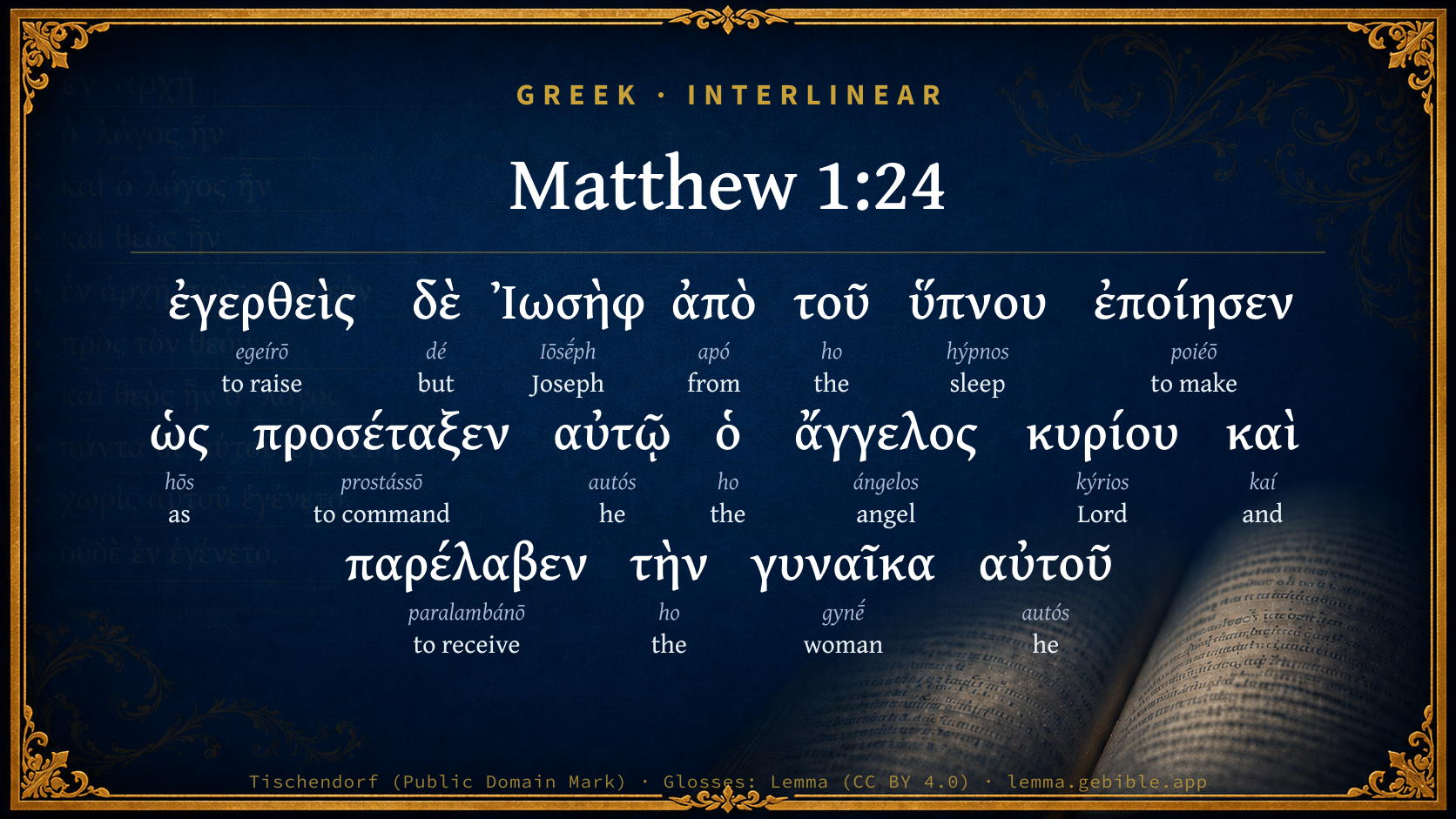
Download image
Cite this verse

Matthew 1:24 (World English Bible). Public Domain. Lemma interlinear Bible study tool, https://lemma.gebible.app/v/matthew/1/24.

Show BibTeX & RIS
BibTeX
RIS
English Translation
Joseph arose from his sleep, and did as the angel of the Lord commanded him, and took his wife to himself;
World English Bible · Public Domain
Highlights
  • 5 first appearances in the Greek New Testament
Full analysis ↓
Download a study sheet

One document with this verse’s original text, its word-by-word gloss line, the meaning frame, cross-references with their text, attributed commentary, and full source and license credits — printable, and it pastes into notes with its structure intact.

This verse Autodidact and up

Study sheet (.html) Plain text (.txt)

A passage Seminary Student

Up to 50 verses in one chapter. A passage sheet keeps up to 6 commentary sources and 12 cross-references per verse, in the order this page ranks them, and says so on the sheet whenever that leaves anything out. Ask for a single verse and you get the Autodidact verse sheet above.

Everything on this page stays free to read, with no account — the sheet is a download of what is already on screen, not access to it.

Want to remove ads? Support Godless Engineer
Compare translations 3

The same verse in 3 English versions, stacked beneath the original-language interlinear above. Click any original word for its lexicon entry.

Each is an independent rendering of the whole verse — the interlinear is not word-aligned to these translations.

Highlighted words mark where these versions differ — a whole-verse word diff, not a word-by-word alignment.

  • World English Bible Public Domain
    Joseph arose from his sleep, and did as the angel of the Lord commanded him, and took his wife to himself;
  • King James Version Public Domain
    Then Joseph being raised from sleep did as the angel of the Lord had bidden him, and took unto him his wife:
  • unfoldingWord Literal Text CC BY-SA 4.0
    And Joseph, having been awakened from sleep, did as the angel of the Lord commanded him and took her his wife.

unfoldingWord Literal Text — © unfoldingWord, licensed CC BY-SA 4.0. Word-aligned USFM3 via Door43 (git.door43.org/unfoldingWord/en_ult).

Versions to compare (up to 4)

3 of 4 selected

Show all 19 translations

Every available English version of this verse, each an independent rendering of the whole verse.

  • World English Bible Public Domain
    Joseph arose from his sleep, and did as the angel of the Lord commanded him, and took his wife to himself;
  • Berean Standard Bible Public Domain
    When Joseph woke up, he did as the angel of the Lord had commanded him, and embraced Mary as his wife.
  • Majority Standard Bible Public Domain
    When Joseph woke up, he did as the angel of the Lord had commanded him and embraced Mary as his wife.
  • King James Version Public Domain
    Then Joseph being raised from sleep did as the angel of the Lord had bidden him, and took unto him his wife:
  • American Standard Version (1901) Public Domain
    And Joseph arose from his sleep, and did as the angel of the Lord commanded him, and took unto him his wife;
  • Revised Version (1885) Public Domain
    And Joseph arose from his sleep, and did as the angel of the Lord commanded him, and took unto him his wife;
  • Geneva Bible (1599) Public Domain
    Then Ioseph, being raised from sleepe, did as the Angel of the Lord had inioyned him, and tooke his wife.
  • Douay-Rheims (1899) Public Domain
    And Joseph rising up from sleep, did as the angel of the Lord had commanded him, and took unto him his wife.
  • Young's Literal Translation Public Domain
    And Joseph, having risen from the sleep, did as the messenger of the Lord directed him, and received his wife,
  • Literal Standard Version CC BY-SA 4.0
    And Joseph, having risen from sleep, did as the messenger of the LORD directed him, and received his wife,
  • Unlocked Literal Bible CC BY-SA 4.0
    Joseph woke up from his sleep and did as the angel of the Lord commanded him and he took her as his wife.
  • unfoldingWord Literal Text CC BY-SA 4.0
    And Joseph, having been awakened from sleep, did as the angel of the Lord commanded him and took her his wife.
  • Darby Bible Public Domain
    But Joseph, having awoke up from his sleep, did as the angel of [the] Lord had enjoined him, and took to [him] his wife,
  • World Messianic Bible Public Domain
    Joseph arose from his sleep, and did as the angel of the Lord commanded him, and took his wife to himself;
  • Webster's Bible Public Domain
    Then Joseph, being raised from sleep, did as the angel of the Lord had bidden him, and took to him his wife:
  • Free Bible Version CC BY-SA 4.0
    Joseph woke up and did what the angel of the Lord told him to do.
  • Bible in Basic English Public Domain
    And Joseph did as the angel of the Lord had said to him, and took her as his wife;
  • Text-Critical English NT CC BY 4.0
    When Joseph woke from his sleep, he did as the angel of the Lord had commanded him. He took his wife
  • Tyndale New Testament (1534) Public Domain
    And Ioseph assone as he awoke out of slepe did as the angell of the Lorde bade hym and toke hys wyfe vnto hym

Literal Standard Version (2020), Covenant Press — licensed CC BY-SA 4.0. Text via the HelloAO Bible API (eBible.org). Unlocked Literal Bible (unfoldingWord) — licensed CC BY-SA 4.0. Text via the HelloAO Bible API (eBible.org). unfoldingWord Literal Text — © unfoldingWord, licensed CC BY-SA 4.0. Word-aligned USFM3 via Door43 (git.door43.org/unfoldingWord/en_ult). Free Bible Version, Dr. Jonathan Gallagher — licensed CC BY-SA 4.0. Text via the HelloAO Bible API (eBible.org).

Word by word

More ways to search: Search by grammar → Find every occurrence → Compare this word →

Practice this passage: Drill this verse → Learn its vocabulary →

ὕπνου
hýpnos
G5258
“sleep”
Noun, Genitive, Singular, Masculine
Part of Speech
Noun
Case
Genitive
Number
Singular
Gender
Masculine
Full Thayer's Definition

Origin: from an obsolete primary (perhaps akin to G5259 through the idea of subsilience)

TDNT: 17:05,1

1. sleep
  1. ἐγερθεὶς egeírō G1453 “to raise” Verb, Aorist, Passive, Participle, Nominative, Singular, Masculine
  2. δὲ dé G1161 “but” Conjunction
  3. Ἰωσὴφ Iōsḗph G2501 “Joseph” Noun, Proper, indeclinable
  4. ἀπὸ apó G575 “from” Preposition
  5. τοῦ ho G3588 “the” Article, Genitive, Singular, Masculine
  6. ἐποίησεν poiéō G4160 “to make” Verb, Aorist, Active, Indicative, 3rd person, Singular
  7. ὡς hōs G5613 “as” Adverb
  8. προσέταξεν prostássō G4367 “to command” Verb, Aorist, Active, Indicative, 3rd person, Singular
  9. αὐτῷ autós G846 “he” Personal pronoun, Dative, Singular, Masculine
  10. ὁ ho G3588 “the” Article, Nominative, Singular, Masculine
  11. ἄγγελος ángelos G32 “angel” Noun, Nominative, Singular, Masculine
  12. κυρίου kýrios G2962 “Lord” Noun, Genitive, Singular, Masculine
  13. καὶ kaí G2532 “and” Conjunction
  14. παρέλαβεν paralambánō G3880 “to receive” Verb, Aorist, Active, Indicative, 3rd person, Singular
  15. τὴν ho G3588 “the” Article, Accusative, Singular, Feminine
  16. γυναῖκα gynḗ G1135 “woman” Noun, Accusative, Singular, Feminine
  17. αὐτοῦ autós G846 “he” Personal pronoun, Genitive, Singular, Masculine

About this verse

These counts appear in no published source. They are computed here, from the morphology-tagged text and Lemma’s own curated glosses. What Lemma adds →

18
words
15
distinct lemmas
Gospels
section

Notable vocabulary

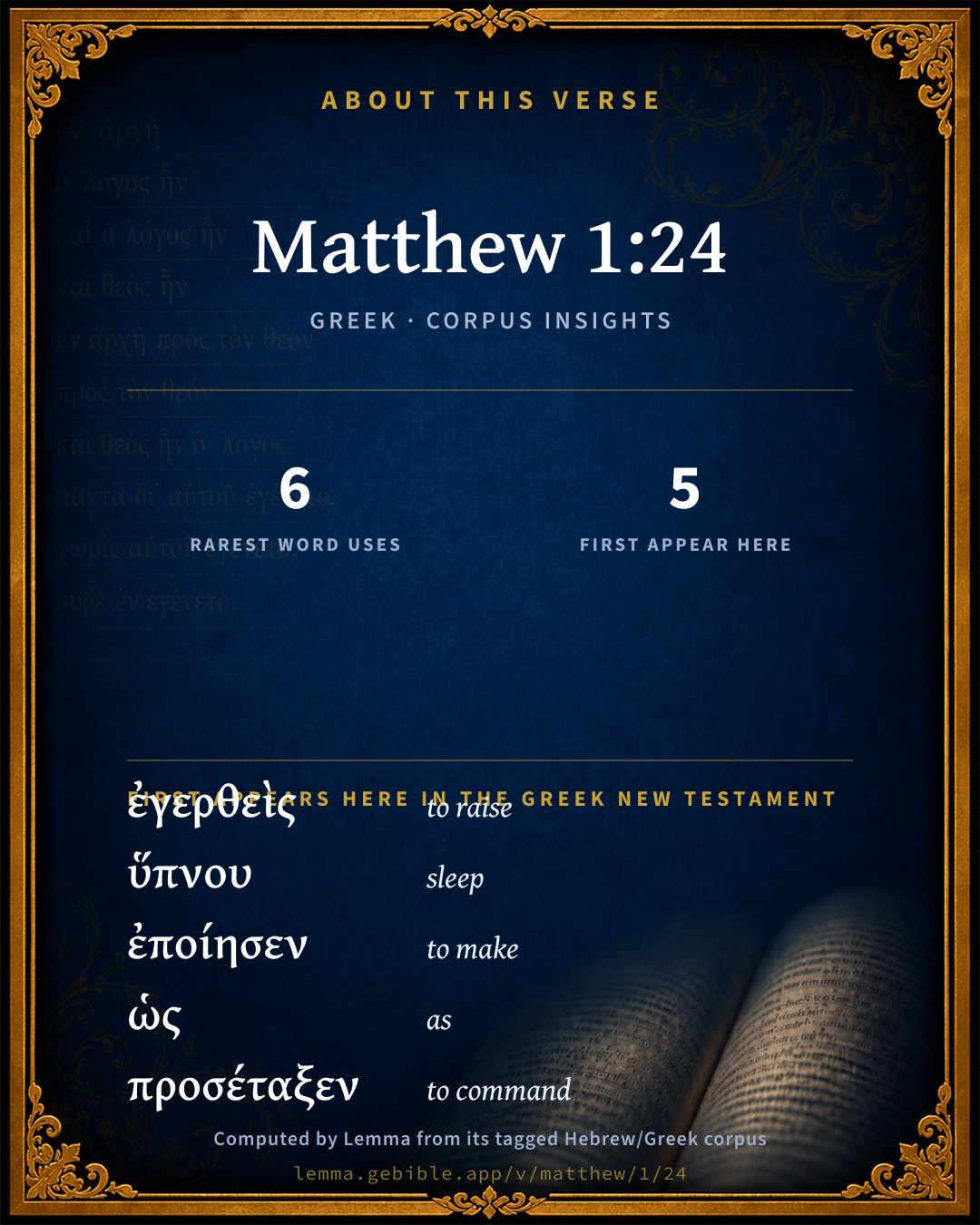
The rarest word here is ὕπνου sleep G5258 — appearing just 6 times in the whole Greek New Testament.

First appearance in Scripture

These words make their first canonical appearance in the Greek New Testament here:

  • ἐγερθεὶς to raise G1453
  • ὕπνου sleep G5258
  • ἐποίησεν to make G4160
  • ὡς as G5613
  • προσέταξεν to command G4367

Shared distinctive vocabulary

ὕπνου sleep G5258 occurs in 5 verses of the Greek New Testament. Also found in:
Repetition

Words recur within this verse:

  • τοῦ the G3588 ×3
  • αὐτῷ he G846 ×2

Cross-references

14

Topical passages linked to Matthew 1:24 in the Treasury of Scripture Knowledge — connected by theme and wording, ordered by reader-vote popularity; previews shown in the World English Bible.

  • John 15:14 You are my friends, if you do whatever I command you.
  • James 2:21–26 Wasn't Abraham our father justified by works, in that he offered up Isaac his son on the altar?
  • Genesis 22:2–3 He said, "Now take your son, your only son, whom you love, even Isaac, and go into the land of Moriah. Offer him there for a burnt offering on one of the mountains which I will tell you of."
  • Exodus 40:16 Thus did Moses: according to all that Yahweh commanded him, so he did.
  • Exodus 40:27 and he burnt incense of sweet spices on it, as Yahweh commanded Moses.
  • Exodus 40:32 When they went into the tent of meeting, and when they came near to the altar, they washed, as Yahweh commanded Moses.
  • John 2:5–8 His mother said to the servants, "Whatever he says to you, do it."
  • Hebrews 11:7–8 By faith, Noah, being warned about things not yet seen, moved with godly fear, prepared an ark for the saving of his house, through which he condemned the world, and became heir of the righteousness which is according to faith.
  • Genesis 6:22 Thus Noah did. According to all that God commanded him, so he did.
  • Genesis 7:5 Noah did everything that Yahweh commanded him.
  • Exodus 40:19 He spread the covering over the tent, and put the roof of the tent above on it, as Yahweh commanded Moses.
  • Exodus 40:25 He lit the lamps before Yahweh, as Yahweh commanded Moses.
  • Hebrews 11:24–31 By faith, Moses, when he had grown up, refused to be called the son of Pharaoh's daughter,
  • 2 Kings 5:11–14 But Naaman was angry, and went away, and said, Behold, I thought, He will surely come out to me, and stand, and call on the name of Yahweh his God, and wave his hand over the place, and recover the leper.

Cross-references courtesy of OpenBible.info (CC BY 4.0).

Commentary

Notes on Matthew 1:24 from classic Christian and Jewish commentators (each source and its license shown beneath its notes). The classic Christian expositions comment on the surrounding passage and are grouped to its opening verse, so a note may address several verses; the Jewish commentaries on the Tanakh (Rashi and others) are per-verse, so they appear only where the commentator wrote on this verse.

Lemma curates 59 commentaries, every one of them public domain or Creative Commons licensed, each selected and text-cleaned for this edition rather than reprinted as found. About our sources →

Joseph Benson's Commentary

Mat 1:24-25. Joseph did as the angel had bidden him — This sudden change of his resolution, shows his great faith and ready obedience to God. When God speaks to our hearts, we speedily and cheerfully do what before we not only scrupled, but thought, perhaps, most inconvenient and unpleasing, and even contrary to the dictates of reason. And took unto him his wife — That is, he took her home to his house. Nevertheless, in expectation of this wonderful event, and out of reverence to this sacred birth, he knew her not as his wife, though she dwelt under his roof; but she continued a pure virgin till at least Jesus was born. “On what terms they afterward lived,” says an eminent divine, “is of so little importance to us, that one cannot but wonder it should have been the subject of so much debate. It is sufficient for us to know that she was a virgin, not only at the time of Christ’s conception, but at his birth, as the prophecy foretold she should be. The evangelist, therefore, wisely contented himself with recording this, without affirming any thing further, either way, on this delicate subject.” We must observe, however, that the expression, Till she had brought forth her firstborn son, does not necessarily imply that he knew her afterward, any more than the Lord’s words to Jacob, Gen 28:15, I will not leave thee till I have done all that which I have spoken to thee of, imply that the Lord left Jacob after he had fulfilled his promises to him; or what is said, 2Sa 6:23, of Michal, Saul’s daughter, that she had no child till the day of her death, that she bore a child or children afterward; nor will the expression, her firstborn son, prove that she had afterward any more children, being in Scripture applied continually to the person that first opened the womb, as the phrase, is, whether there were any more children or not. Indeed, the Greek here, τον υιον αυτης, τον πρωτοτοκον, is literally, her son, the firstborn, or that firstborn, viz., that person eminent and dear to God above others that were the firstborn, whom all the firstborn in the Old Testament prefigured, whom the angels adore, Heb 1:6, and in whom those that believe become the firstborn, and the first fruits of God’s creatures. Nevertheless, when it is considered what is the great end of marriage, that Joseph took Mary to wife by the command of God himself, and that his law not only permits, but even enjoins husbands to perform the marriage duty, it is, as Dr. Whitby observes, “not easy to be conceived, that he should live twelve years with her he loved so well, and all that time deny that duty which was not to be diminished when the wife was less beloved:” especially as no just reason whatever can be assigned for such conduct. Be this as it may, we may safely conclude with St. Basil, an ancient father of the Church, that till she had brought forth her firstborn her virginity was necessary: “but what she was afterward let us leave undiscussed, as being of small concern to the mystery.”

Joseph Benson's Commentary on the Old and New Testaments (1811–1818) — public domain. Text from a community e-Sword module.

Bengel's Gnomon

Johann Albrecht Bengel

Mat 1:24. Ἐποίησεν, did) sc. without delay.—ὡς κ.τ.λ., as, etc.) Hence the command of the angel and the performance of Joseph are described in the same words in this passage, and in ch. Mat 2:13-14; Mat 2:20-21.—παρέλαβε τὴν γυναἰκα αὐτοῦ, took unto him his wife) sc., with the same appearance to those without, as though they lived together according to common custom.

Bengel's Gnomon of the New Testament — English translation (T&T Clark, Edinburgh, 1860) — public domain. Text from a community e-Sword module.

Meyer's Critical & Exegetical Commentary

Heinrich August Wilhelm Meyer

Mat_1:24. Ἀπὸ τοῦ ὕπνου] from the sleep in which he had had the vision.

καὶ παρέλ.] The course of the thought proceeds simply, without any participial construction, by means of the epexegetic and.

Meyer — Critical and Exegetical Commentary on the New Testament — English translation by Peter Christie, edited by Frederick Crombie (T&T Clark, 1880) — public domain. Text from a community e-Sword module.

Expositor's Greek Testament

ed. W. Robertson Nicoll

Mat 1:24-25 . Joseph hesitates no more : immediate energetic action takes the place of painful doubt. Euthymius asks: Why did he so easily trust the dream in so great a matter? and answers: because the angel revealed to him the thought of his own heart, for he understood that the messenger must have come from God, for God alone knows the thoughts of the heart. ἐγερθεὶς … Κυρίου : rising up from the sleep ( τοῦ ὕπνου ), in which he had that remarkable dream, on that memorable night, he proceeded forthwith to execute the Divine command, the first, chief, perhaps sole business of that day. καὶ παρέλαβεν … αὐτοῦ . He took Mary home as his wife, that her off-spring might be his legitimate son and heir of David’s throne.

The Expositor's Greek Testament, edited by W. Robertson Nicoll (1897–1910) — public domain. Text from a community e-Sword module.

Jamieson, Fausset & Brown

Robert Jamieson, A. R. Fausset & David Brown

Then Joseph, being raised from sleep--and all his difficulties now removed.

did as the angel of the Lord had bidden him, and took unto him his wife--With what deep and reverential joy would this now be done on his part; and what balm would this minister to his betrothed one, who had till now lain under suspicions of all others the most trying to a chaste and holy woman--suspicions, too, arising from what, though to her an honor unparalleled, was to all around her wholly unknown!

Jamieson, Fausset & Brown — Commentary Critical and Explanatory on the Whole Bible (1871) — public domain (CC PDM 1.0). Text via the HelloAO Bible API.

Ellicott's Commentary for English Readers

(24) Took unto him his wife.—These few words cover a great deal. They imply the formal ratification of the betrothal before witnesses; the benediction by a priest; the marriage-feast; the removal from the house that had hitherto been her home to that of Joseph. They imply also that what had seemed evidence of guilt among the neighbours of that home, brought with it to Joseph’s mind no ground for blame. To them, if they were not told the history, and it is not probable that they were, it must have been deemed an act of exceptional mercy and forbearance. The reverence implied in what the next verse records must have roused their wonder.

A Bible Commentary for English Readers, edited by Charles John Ellicott (1878–1897) — public domain. Text from a community e-Sword module.

John Gill's Exposition

Then Joseph being raised from sleep,.... That is, being awaked out of sleep, "that sleep", into which he either naturally fell, whilst he was meditating on the affair of Mary's being with child; or rather into which he was cast by the Lord, on purpose that he might have a revelation of the will of God to him in a dream; and rising up from his bed or place where he was, immediately and without any delay,

did as the angel of the Lord had bidden him; firmly believing that it was a messenger of God that was sent to him, and that this matter was of the Lord. Wherefore he

took unto him his wife, that is, he publicly married her, whom he had before espoused, took her to his house, or continued her there, lived with her as his wife, and owned her to be such, and henceforwards had no more thoughts of putting her away.

John Gill's Exposition of the Whole Bible (1746–1763) — public domain (CC PDM 1.0). Text via the HelloAO Bible API.

Trapp's Complete Commentary

John Trapp

24 Then Joseph being raised from sleep did as the angel of the Lord had bidden him, and took unto him his wife:

Ver. 24. Then Joseph, being raised from sleep, did as the angel, &c.] As well assured that it was of God, whom he was ready pressed to obey without sciscitation. Iussa sequi, tam velle mihi, quam posse, necesse est. (Lucan.) If some princes will not endure that subjects should scan their laws, but require absolute obedience: if generals excuse not in a soldier the neglect of their commands, but severely punish even prosperous disorders: if Jesuits exact blind obedience of their wretched novices (our Throgmorton dared not give up the ghost till he had obtained leave of his superior), {a} should not we much more obey God in his commands, counsels, promises, prohibitions, comminations, all?

{a} In articulo mortis nolebat obire, non impetrata a superiore venia.

John Trapp, A Commentary or Exposition upon All the Books of the Old and New Testament (1647–1656) — public domain. Text from a community e-Sword module.

Albert Barnes' Notes on the Bible

Being raised from sleep - Having fully awoke.

Did as the angel of the Lord had bidden him - That is, he took Mary to wife. Probably this was done immediately, since he was now convinced of her innocence, and, by delay, he would not leave any ground of suspicion that he had not confidence in her.

Albert Barnes' Notes on the Bible (1834–1885) — public domain. Text from a community e-Sword/MySword module.

Haydock's Catholic Bible Commentary

The heretic Helvidius argues from this text, and from what we read in the gospel of Christ’s brethren, that Christ had brothers, and Mary other sons. But it is evident that in the style of the Scriptures, they who were no more than cousins were called brothers and sisters. (Haydock)

George Leo Haydock (1774–1849), Haydock's Catholic Family Bible and Commentary, 1859 edition — public domain. Excludes Psalms (Douay-Rheims chapter numbering differs from Protestant) and Deuterocanonical books (Catholic canon only).

Matthew Poole's English Annotations

The will of God (as we heard) was revealed to Joseph in a dream. It is God that giveth a power to sleep, and a power to awake; therefore it is said, being raised from sleep, he showed both his faith and obedience; his faith in the Divine revelation, a certainty of which he had doubtless by some extraordinary Divine impression, and his obedience to the Divine precept.

He took unto him his wife, that is, he took her unto his house, (for betrothed virgins used to abide at their own friends’ houses till the consummation of the marriage), and owned her as his wife, yet not fully using her as such, for the text saith he

knew her not (a modest phrase used from the beginning of the world, as appears from Gen 4:1, to express the conjugal act)

till she had brought forth her firstborn Son. Some make a great stir in determining whether he knew her afterwards, yea or no. Some of the ancients were stiff in their opinion that he did not, so are the popish writers, and many protestant interpreters. Mr. Calvin I think determines best, that none will move such a question, but such as are unwarrantably curious; nor contend for either part, but such as are unreasonably quarrelsome. For as, on the one side, none can conclude that she had more children from the word

till, further than they can conclude, from Psa 110:1, that Christ shall not for ever sit at his Father’s right hand, (the word until being a particle only exclusive of a preceding time, not affirming the thing in future time), nor doth the term firstborn conclude any born afterward; so, on the other side, there are no cogent arguments to prove that Mary had no more children by Joseph. We read of the brother of our Lord, Gal 1:19, and of his mother and his "brethren," Mat 12:47; and though it be true brethren may signify kinsmen, according to the Hebrew dialect, yet that it doth so in these texts cannot be proved. The Holy Ghost had made use of the virgin for the production of the Messias; why after this her womb should be shut up, and Joseph take her home to be his wife, and not use her as such I cannot tell, nor yet what reproach it could be to Mary or to our Saviour, marriage being God’s ordinance, and the undefiled bed honourable: and those who think our Saviour would have been dishonoured in any others lying in the same bed after him, seem to forget how much he humbled himself in lying in that bed first, and then in a stable and a manger. We know he knew her not till Christ was born, whether he did afterward or no we are willingly ignorant because God hath not told us.

And he called his name Jesus: this is added to declare his obedience to the command received by the angel. We shall meet with more circumstances relating to the birth of Christ when we come to the two first chapters of Luke.

Matthew Poole's English Annotations on the Holy Bible (1683–1685) — public domain. Text from a community e-Sword/MySword module.

The Pulpit Commentary

Vers. 24, 25. Joseph"s threefold obedience taking Mary, not consummating the marriage, naming the child in faith.

Then Joseph being raised; and Joseph arose (Revised Version); for the stress of the Greek is not on "Joseph," but egeryeiv . Immediately on arising, Joseph obeyed. From sleep; from his sleep (Revised Version); i.e. which he was then enjoying. No stress is laid on sleep as such. Did as the angel of the Lord had bidden him, and took unto him his wife. "Bidden," in modern English, too much suggests "asking;" hence the Revised Version "commanded" (prosetaxen). Joseph"s faith was seen in immediate obedience to commands received.

The Pulpit Commentary (1880–1919), ed. H.D.M. Spence-Jones & Joseph S. Exell — public domain. Text from a community e-Sword module.

Scofield Reference Notes

C. I. Scofield

angel

(See Scofield "Heb 1:4")

The Scofield Reference Bible (1917 edition), notes by C. I. Scofield — public domain. Text from a community e-Sword module.

Kretzmann's Popular Commentary

Paul E. Kretzmann

The result of the angelic vision:

v. 24. Then Joseph, being raised from sleep, did as the angel of the Lord had bidden him, and took unto him his wife.

As soon as he awoke from sleep, he was immediately, energetically active and set about to act upon the divine instructions. He took Mary home as his wife, he celebrated the betrothal with all customary Jewish ceremonies. She who was his wife by betrothal now was given this position in the eyes of the whole world. But the marriage was not consummated at that time:

v. 25. And knew her not till she had brought forth her first-born son: and he called His name Jesus.

Joseph did not enter into the natural relations of marriage with Mary until her son, the promised Messiah, had been born. It is a moot question whether Mary and Joseph ever lived together in the usual matrimonial intercourse and begot children. The Roman Catholic theologians and a great many Protestant commentators argue with much spirit that the first-born son of Mary was her only son. Some have held with one of the early Church Fathers that the "brethren" of Jesus mentioned in various passages. Mat 12:46; Mat 13:55; Mar 3:31; Luk 8:19; Joh 2:12; Joh 7:5; Act 1:14; Gal 1:19, were the cousins of the Lord, the sons of Alphaeus, Joseph’s brother, and of Mary, the wife of Alphaeus, the sister-in-law (not sister) of the mother of the Lord. Others have held that they were the stepbrothers of Jesus, by a former marriage of Joseph. As a matter of fact, the question is of little import and can have no doctrinal significance. It is not for historical, exegetical, or dogmatic reasons, but only for motives of relevance that men have been prompted to insist upon the alleged fact of Mary’s perpetual virginity.

The evangelist concludes the narrative by stating that he, Joseph, called the name of Mary’s son Jesus, thus following the divine command, assuming the legal paternity of the child, and incidentally expressing his hopeful belief in the Savior of mankind.

Summary.Jesus Christ, the son and legal heir of David, beyond whom His genealogy can to Abraham, the father of the faithful of all times, was conceived and born of Mary, the virgin mother, after Joseph, His foster-father, had been instructed through a wonderful angelic vision as to God’s interposition.

Paul E. Kretzmann, Popular Commentary of the Bible (1921–1924) — public domain. Text from a community e-Sword module.

Burkitt's Expository Notes on the New Testament

William Burkitt

Joseph is no sooner assured that Mary is with child by the overshadowing power of the Holy Ghost, but he instantly obeys the Lord’s command, and takes Mary to him, without further disputing or delaying.

Learn thence, That a gracious person,when once satisfied in God’s word of command, disputes no further, but instantly complies with the will of God, even in the most hazardous and difficult duties.

William Burkitt's Expository Notes on the New Testament (1700–1703) — public domain. Text from a community e-Sword module.

The People's New Testament

B. W. Johnson

24. And Joseph … did. He obeyed at once, a fitting example for all men. When the Lord's will is spoken there should be no delay in obedience.

B. W. Johnson's The People's New Testament with Notes (1889–1891) — public domain. Electronic text from the Christian Classics Ethereal Library (CCEL) ThML edition.

unfoldingWord translationNotes

Door43 World Missions Community

Connecting Statement:

The author concludes his description of the events leading up to the birth of Jesus.

as the angel of the Lord commanded

The angel had told Joseph to take Mary as his wife and to name the child Jesus.

he took her as his wife

"he married Mary"

to a son

"to a male baby" or "to her son." Make sure it is clear that Joseph is not portrayed as the actual father.

Then he called his name Jesus

"Joseph named the child Jesus"

translationWords

Joseph (NT)

Jesus

angel

lord

command

had relations with

unfoldingWord translationNotes — © Distant Shores Media and the Door43 World Missions Community, licensed CC BY-SA 4.0. Source: git.door43.org/Door43/en_tn.

Alford’s Greek Testament

Henry Alford

24.] ἀπὸ τοῦ ὕπνου, from his sleep—the sleep which was on him when he had the dream.

Henry Alford, The Greek Testament (1849–1861) — public domain. Text from a community e-Sword module.

International Critical Commentary

(P) 24, 25. And Joseph being raised from sleep did as the angel of the Lord commanded him, and took his wife: and knew her not until she bore a son: and he called His name Jesus.]

For the redundant and Semitic use of ἐγερθείς see Dalman. Words of Jesus, 23, 36. The imperfect ἐγίνωσκεν is against the tradition of perpetual virginity.

24. τὴν γυναῖκα αὐτοῦ] S2 substitutes “Mary.”

International Critical Commentary — older volumes (1896–1929), various authors — public domain. Text from a community e-Sword module.

Vincent's Word Studies in the New Testament

Marvin R. Vincent

The or his sleep [του υπνου] . The force of the definite article; the sleep in which he had the vision. So Rev., "Arose from his sleep."

Marvin R. Vincent, Word Studies in the New Testament (1887–1900) — public domain. Text from a community e-Sword/MySword module.

Lesson kit

Teaching starters — assembled from the data on this page, not authored interpretation. Every prompt links to the verse data it draws on. Edit before teaching.

Matthew, in the Gospels, opens this verse with 18 words (15 distinct Greek lemmas). Its most distinctive word is hýpnos (“sleep”). A historical commentator’s framing appears above. Read the whole chapter for the surrounding context.

Discussion questions

  1. How does “sleep” (hýpnos) shape what this verse is saying?
  2. 5 words make their first appearance in Scripture here. What does this debut establish?
  3. How does Luke 9:32, which shares the word «sleep», read alongside this verse?
  4. What does the repetition of “the” (3× in this one verse) do in this verse?
  5. These translations render this verse differently; the difference is in the English rendering, not the original. What questions does that raise?
  6. Compare how Joseph Benson's Commentary and Bengel's Gnomon read this verse. Where do they agree or differ?

Things to notice

  • 5 words make their first canonical appearance in Scripture here.
  • These translations choose different wording for 10 words in this verse.
  • “the” occurs 3× in this single verse.
  • 15 distinct Greek lemmas span 18 words in this verse.

Reading settings

Reading text

Shown beneath each verse's original-language words.

Old Testament
Old Testament edition

Read the OT as the Masoretic Hebrew (MT) or the Greek Septuagint (LXX).

English shown for the Greek Septuagint (in the Hebrew ↔ Greek comparison).

Comparing translations? Open the Compare panel on any verse page to stack up to four side by side.