Matthew 21:6

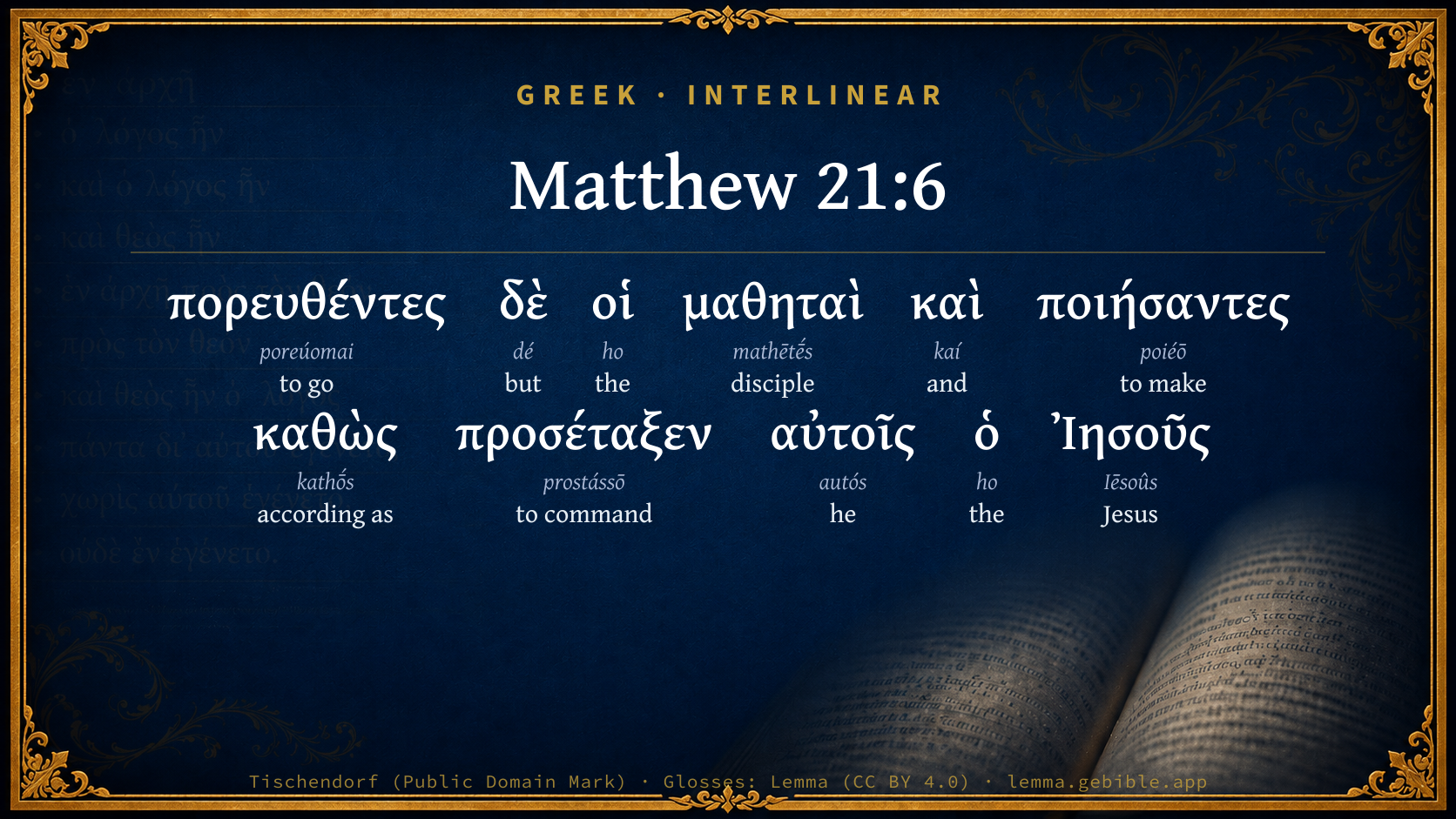
Greek (Tischendorf 8th ed.) Matthew 21:6 appears in the Greek New Testament. The text above is from the Tischendorf 8th edition. Each word links to its Strong’s number and a concise gloss. Click any word for its full Thayer’s Greek Lexicon entry.
Download image
Cite this verse

Matthew 21:6 (World English Bible). Public Domain. Lemma interlinear Bible study tool, https://lemma.gebible.app/v/matthew/21/6.

Show BibTeX & RIS
BibTeX
RIS
English Translation
The disciples went, and did just as Jesus commanded them,
World English Bible · Public Domain
Highlights
  • 1 first appearance in the Greek New Testament
Full analysis ↓
Download a study sheet

One document with this verse’s original text, its word-by-word gloss line, the meaning frame, cross-references with their text, attributed commentary, and full source and license credits — printable, and it pastes into notes with its structure intact.

This verse Autodidact and up

Study sheet (.html) Plain text (.txt)

A passage Seminary Student

Up to 50 verses in one chapter. A passage sheet keeps up to 6 commentary sources and 12 cross-references per verse, in the order this page ranks them, and says so on the sheet whenever that leaves anything out. Ask for a single verse and you get the Autodidact verse sheet above.

Everything on this page stays free to read, with no account — the sheet is a download of what is already on screen, not access to it.

Want to remove ads? Support Godless Engineer
Compare translations 3

The same verse in 3 English versions, stacked beneath the original-language interlinear above. Click any original word for its lexicon entry.

Each is an independent rendering of the whole verse — the interlinear is not word-aligned to these translations.

Highlighted words mark where these versions differ — a whole-verse word diff, not a word-by-word alignment.

  • World English Bible Public Domain
    The disciples went, and did just as Jesus commanded them,
  • King James Version Public Domain
    And the disciples went, and did as Jesus commanded them,
  • unfoldingWord Literal Text CC BY-SA 4.0
    Now the disciples, having gone and having done just as Jesus had directed them,

unfoldingWord Literal Text — © unfoldingWord, licensed CC BY-SA 4.0. Word-aligned USFM3 via Door43 (git.door43.org/unfoldingWord/en_ult).

Versions to compare (up to 4)

3 of 4 selected

Show all 19 translations

Every available English version of this verse, each an independent rendering of the whole verse.

  • World English Bible Public Domain
    The disciples went, and did just as Jesus commanded them,
  • Berean Standard Bible Public Domain
    So the disciples went and did as Jesus had directed them.
  • Majority Standard Bible Public Domain
    So the disciples went and did as Jesus had directed them.
  • King James Version Public Domain
    And the disciples went, and did as Jesus commanded them,
  • American Standard Version (1901) Public Domain
    And the disciples went, and did even as Jesus appointed them,
  • Revised Version (1885) Public Domain
    And the disciples went, and did even as Jesus appointed them,
  • Geneva Bible (1599) Public Domain
    So the disciples went, and did as Iesus had commanded them,
  • Douay-Rheims (1899) Public Domain
    And the disciples going, did as Jesus commanded them.
  • Young's Literal Translation Public Domain
    And the disciples having gone and having done as Jesus commanded them,
  • Literal Standard Version CC BY-SA 4.0
    And the disciples having gone and having done as Jesus commanded them,
  • Unlocked Literal Bible CC BY-SA 4.0
    Then the disciples went and did just as Jesus had instructed them.
  • unfoldingWord Literal Text CC BY-SA 4.0
    Now the disciples, having gone and having done just as Jesus had directed them,
  • Darby Bible Public Domain
    But the disciples, having gone and done as Jesus had ordered them,
  • World Messianic Bible Public Domain
    The disciples went and did just as Yeshua commanded them,
  • Webster's Bible Public Domain
    And the disciples went, and did as Jesus commanded them,
  • Free Bible Version CC BY-SA 4.0
    The disciples went and did as Jesus had instructed.
  • Bible in Basic English Public Domain
    And the disciples went and did as Jesus had given them orders,
  • Text-Critical English NT CC BY 4.0
    So the disciples went and did just as Jesus had directed them.
  • Tyndale New Testament (1534) Public Domain
    The disciples went and dyd as Iesus commaunded them

Literal Standard Version (2020), Covenant Press — licensed CC BY-SA 4.0. Text via the HelloAO Bible API (eBible.org). Unlocked Literal Bible (unfoldingWord) — licensed CC BY-SA 4.0. Text via the HelloAO Bible API (eBible.org). unfoldingWord Literal Text — © unfoldingWord, licensed CC BY-SA 4.0. Word-aligned USFM3 via Door43 (git.door43.org/unfoldingWord/en_ult). Free Bible Version, Dr. Jonathan Gallagher — licensed CC BY-SA 4.0. Text via the HelloAO Bible API (eBible.org).

Word by word

More ways to search: Search by grammar → Find every occurrence → Compare this word →

Practice this passage: Drill this verse → Learn its vocabulary →

About this verse

These counts appear in no published source. They are computed here, from the morphology-tagged text and Lemma’s own curated glosses. What Lemma adds →

11
words
10
distinct lemmas
Gospels
section

Notable vocabulary

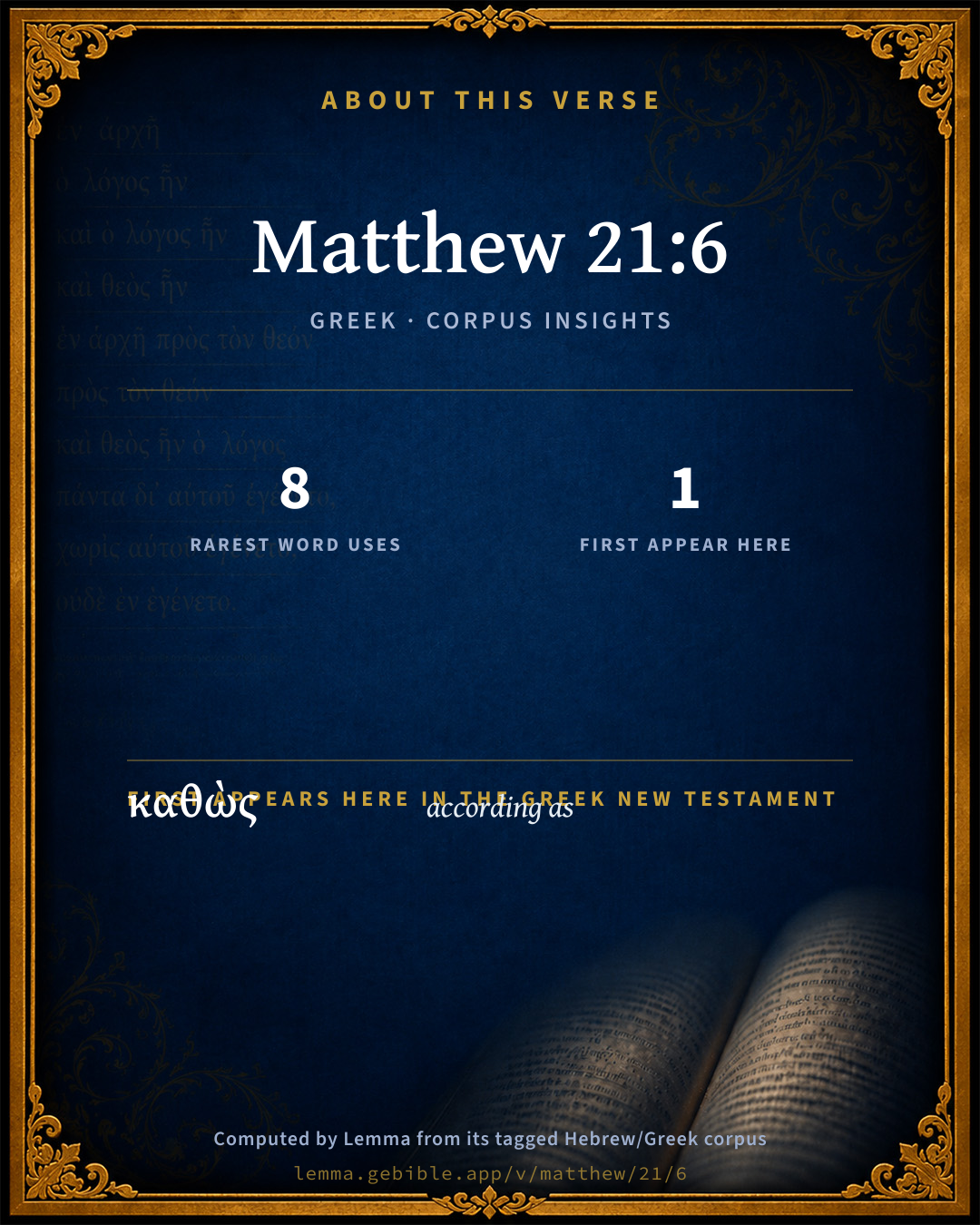
The rarest word here is προσέταξεν to command G4367 — appearing just 8 times in the whole Greek New Testament.

First appearance in Scripture

This word makes its first canonical appearance in the Greek New Testament here:

  • καθὼς according as G2531

Shared distinctive vocabulary

προσέταξεν to command G4367 occurs in 8 verses of the Greek New Testament. Also found in:

Repetition

A word recurs within this verse:

Cross-references

6

Topical passages linked to Matthew 21:6 in the Treasury of Scripture Knowledge — connected by theme and wording, ordered by reader-vote popularity; previews shown in the World English Bible.

  • Genesis 6:22 Thus Noah did. According to all that God commanded him, so he did.
  • Genesis 12:4 So Abram went, as Yahweh had spoken to him. Lot went with him. Abram was seventy-five years old when he departed out of Haran.
  • Exodus 39:43 Moses saw all the work, and, behold, they had done it as Yahweh had commanded, even so had they done it: and Moses blessed them.
  • Exodus 40:16 Thus did Moses: according to all that Yahweh commanded him, so he did.
  • 1 Samuel 15:11 It repents me that I have set up Saul to be king; for he is turned back from following me, and has not performed my commandments. Samuel was angry; and he cried to Yahweh all night.
  • John 15:14 You are my friends, if you do whatever I command you.

Cross-references courtesy of OpenBible.info (CC BY 4.0).

Commentary

Notes on Matthew 21:6 from classic Christian and Jewish commentators (each source and its license shown beneath its notes). The classic Christian expositions comment on the surrounding passage and are grouped to its opening verse, so a note may address several verses; the Jewish commentaries on the Tanakh (Rashi and others) are per-verse, so they appear only where the commentator wrote on this verse.

Lemma curates 59 commentaries, every one of them public domain or Creative Commons licensed, each selected and text-cleaned for this edition rather than reprinted as found. About our sources →

Joseph Benson's Commentary

Mat 21:6-8. The disciples went, &c. — (and found even as he had said unto them, Luke,) found his prediction exactly true. And how convincing must this have been of the divine mission of Jesus, not only to the two disciples that were sent, but to every unprejudiced person in that great multitude who were witnesses to his uttering the prediction, and saw the disciples bring the ass and the colt, and heard their testimony, that they had found every thing as Christ had foretold. This was another remarkable instance, like that recorded Mat 17:27; where see the note. And brought the ass, &c., and put on them their clothes — Τα ιματια, their mantles. — Campbell. And set him thereon — That is, on the clothes, which were spread upon the colt instead of a saddle. For though the creature had never been used in riding before, it was perfectly tame on this occasion. A very great multitude spread their garments, &c. — The multitude which attended him on this journey had increased prodigiously as he advanced toward Jerusalem, and he did not now shun them, as he had always done on former occasions. “The people were to honour him with the title of Messiah publicly, that he might have an opportunity of accepting that august name in the most avowed manner, before he ascended into heaven. Moreover, the priests, who had issued out a proclamation against him, (Joh 11:57,) were to be awed, at least, for a while, and restrained from offering him violence. For as he had doctrines to teach, rebukes to give, and other things to do, that would not fail to incense those proud rulers, without doubt they would have put him to death prematurely, had not the people appeared on his side.” Now, it seems, when this great multitude saw him mounted, they immediately bethought themselves of showing him the honours which kings were wont to receive at their creation; (see 2Ki 9:15;) and in their triumphal entries into their capital cities. For as they all firmly believed that he would take the reins of government into his own hands at this passover, they had a mind to make his entry into Jerusalem have the air of a triumph. Accordingly some spread their garments in the way: others cut down branches of the trees, and strewed them in the way — Carrying the larger sort on high in procession before the Messiah, as demonstrations of their joy.

Joseph Benson's Commentary on the Old and New Testaments (1811–1818) — public domain. Text from a community e-Sword module.

Bengel's Gnomon

Johann Albrecht Bengel

Mat 21:6. Καὶ ποιήσαντες, and when they had done.

Bengel's Gnomon of the New Testament — English translation (T&T Clark, Edinburgh, 1860) — public domain. Text from a community e-Sword module.

Ellicott's Commentary for English Readers

(6) And the disciples went.—St. Mark and St. Luke give more graphically an account of their finding the colt, of the question asked by the owner and the by-standers why they did it, and of their answering in the words they had been told to use, “The Lord hath need of them.” They returned with the ass and the colt, and then the procession began.

A Bible Commentary for English Readers, edited by Charles John Ellicott (1878–1897) — public domain. Text from a community e-Sword module.

John Gill's Exposition

And the disciples went,.... The two disciples, as the Arabic version reads, to the village over against them; and, as Mark says, "found the colt tied to the door without, in a place where two ways met": the house was just at the entrance of the village, at the door of which, on the outside in the street, was the colt fastened, where were two ways of going into, and coming out of the town; so that it was a public place; the colt was easily seen, nor could it well be taken away without being observed, as it was by the owners of it: and

did as Jesus commanded them; they loosed the colt; and whereas whilst they were loosing it, the owners of it asked them, what they meant by so doing? they returned for answer what Christ had directed them to say; upon which they were satisfied, and let them go with it; see Mar 11:4. This is a very considerable instance of the faith of the disciples in Christ, and their ready and cheerful obedience to him; who might have objected the appearance of theft, the scandal that might be brought upon them, and the trouble they might be exposed to hereby; but they make no hesitation, but go and do as he had ordered them; and in which, they are worthy of the imitation of all the followers of Jesus.

John Gill's Exposition of the Whole Bible (1746–1763) — public domain (CC PDM 1.0). Text via the HelloAO Bible API.

Trapp's Complete Commentary

John Trapp

6 And the disciples went, and did as Jesus commanded them,

Ver. 6. And the disciples went] With a certain blind obedience they went on Christ’s errand, though not very likely to speed. Their Master’s sole authority carried them on against all difficulties and absurdities. When God commands us anything, we may not dispute, but dispatch; argue, but agree to it, captivate our reason, exalt our faith.

John Trapp, A Commentary or Exposition upon All the Books of the Old and New Testament (1647–1656) — public domain. Text from a community e-Sword module.

Matthew Poole's English Annotations

Mark saith, Mar 11:4-6, And they went their way, and found the colt tied by the door without in a place where two ways met; and they loose him. And certain of them that stood there said unto them, What do ye, loosing the colt? And they said unto them even as Jesus had commanded: and they let them go. Luke saith, Luk 19:32-34, And they that were sent went their way, and found even as he had said unto them. And as they were loosing the colt, the owners thereof said unto them, Why loose ye the colt? And they said, The Lord hath need of him. The true obedience of Christ’s disciples is to be learned from the practice of these two disciples: they dispute not the commands of their Lord, nor make objections, nor raise any disputes, nor are afraid of any danger to themselves; they went, and that speedily, and are exact to what their Lord had commanded them; accordingly they find as he had said. They loose the colt. The owner seeing them, asks why they loose the colt. They tell him the Lord had need of him.

Matthew Poole's English Annotations on the Holy Bible (1683–1685) — public domain. Text from a community e-Sword/MySword module.

The Pulpit Commentary

As Jesus commanded them. They simply obeyed the order, not yet knowing what it portended, or how it carried out the will of God declared by his prophets.

Vers. 6-11. The triumphant ride.

This was arranged by Christ, and enthusiastically promoted by his disciples. Here was a last glint of sunshine before the storm. The gladness of the scene is in strange contrast with the awful sequel. Palm Sunday ushers in Passion Week. "Sufficient unto the day is the evil thereof." While the evil day has not yet come, gladness and the assurance of victory may be the best preparation for it.

I THE KING"S TRIUMPH. Few spectators would see anything kingly in this rustic fete. To the ruling classes of Jerusalem it would seem hut child"s play. But to the childlike followers of Jesus it had a deep meaning. These Galilaean pilgrims recognized in it the acceptance by Jesus of his royal rights. The question arises Were they mistaken? He was riding in triumph to Jerusalem. But it was a simple, homely, unconventional triumph. Moreover, it did not lead to the throne, but its promise ended at Calvary, or seemed to end there. We know that the issue was disappointing to the early disciples. (Luk_24:21) Nevertheless, we also know that, with Jesus, the way to death was the way to victory. He was most kingly when he suffered most. His Passion was his coronation. He reigns now in the hearts of his people, just because he died for them.

II THE PEOPLE"S ENTHUSIASM. Long suppressed emotions now break forth into unrestrained utterance. It seems to be impossible to do too much, in the hastily improvised procession, to show devotion to the Christ. This is expressed in two ways.

1. By actions. Garments laid on the animal he rides, garments flung on the road for the honour of being trampled on, sprigs from the wayside trees scattered on the ground, palm branches waved overhead, these things show the utmost enthusiasm. Strong feeling must manifest itself in action.

2. By words. The people quoted a well known Messianic psalm, praying for a blessing on the Christ. Their words had nearly the same meaning as our "God save the king!" and they were prompted by an overmastering passion of enthusiasm. This is not at all wonderful. The only wonder is that there was but one Palm Sunday, and that our Lord"s last Sunday on earth before his death. To know him is to see grounds for unbounded devotion, for love beyond measure, for glad praises which no words can contain. This is the great distinction of our Christian faith, its keynote is enthusiasm for Christ.

III THE CITY"S WONDER. The happy, noisy procession was heard in Jerusalem, and the citizens looked up from their trades and forgot their bargaining for a moment, in surprise at the unexpected commotion. We may preach the gospel by singing the praises of Christ. One reason why the world is apathetic about Christianity is that the Church is apathetic about Christ. A fearless enthusiasm for Christ will arouse the slumbering world. But we want to go further. In Jerusalem the effect was but slight and transitory. A deeper and more permanent impression was made at Pentecost; for it is the coming of the Holy Spirit, and no merely external excitement, that really touches and changes the hearts of people. Yet even this did not move the greater part of Jerusalem. Rejecting the peaceful coming of Christ, hardened sinners await his next coming, which is in wrath and judgment. W.F.A.

The Pulpit Commentary (1880–1919), ed. H.D.M. Spence-Jones & Joseph S. Exell — public domain. Text from a community e-Sword module.

Kretzmann's Popular Commentary

Paul E. Kretzmann

The triumphant entry:

v. 6. And the disciples went, and did as Jesus commanded them,

v. 7. and brought the ass and the colt, and put on them their clothes, and they set Him thereon.

v. 8. And a very great multitude spread their garments in the way; others cut down branches from the trees, and strewed them in the way.

v. 9. And the multitudes that went before, and that followed, cried, saying, Hosanna to the Son of David! Blessed is He that cometh in the name of the Lord; Hosanna in the highest!

While Jesus was waiting at the entrance to Bethphage, the disciples carried out His command, receiving, incidentally, further confirmation of their trust in Him. Obedience to His Word will never cause a Christian to be ashamed. The animals, as they were brought to the Lord, were not saddled. But now a peculiar ecstasy took hold of the disciples and of the ever-increasing multitude. Quickly taking off their outer garments, a kind of loose coat, they spread these upon the foal, to make a seat for their Master. The example of the first disciples was infectious. All the rest of them, as well as a large number of the people, took their garments and spread them out on the way, as if to receive an emperor, a mighty king. And still the excitement spread. Since many of the customs of the great festivals were, upon occasion, transferred from one to the other, the people did not hesitate, also in this instance, to borrow the usages of the Feast of Tabernacles. Some of them cut down or tore down branches from the trees along the way, and cast them down to make a leafy carpet before Him. But the climax of the exultation was reached at the summit of the Mount of Olives. Here the ranks of the early singers were swelled by great crowds of newcomers, and while the latter turned and marched ahead, the others followed behind the Lord. And in antiphonal shouting the joyous acclaim of the people rose up to heaven as they chanted sections from the great Hallel, with the doxology used on great festivals, Psa 118:25-26. They openly proclaim Him as the Son of David, as the true Messiah, they wish Him blessing and salvation from above. Far and wide, the people joined in this demonstration in honor of the lowly Nazarene. They gladly sacrificed their holiday garments, their festival ornaments, they brought the palm branches and waved the green fronds of early spring to give full expression to their joy, to their confession of their Lord, the Messiah. It is most unfortunate that this exultation was only temporary, and quickly forgotten. And yet the Spirit of the Lord had here, for a short while at least, taken hold of the people. God wanted thus to give testimony in behalf of His Son, before the shame and the horror of the cross would be laid upon Him. And it was prophetic of the time when every tongue would confess that Jesus is the Lord.

Paul E. Kretzmann, Popular Commentary of the Bible (1921–1924) — public domain. Text from a community e-Sword module.

Burkitt's Expository Notes on the New Testament

William Burkitt

Observe here, 1. The obedience of his disciples, and the motions of the multitude; the disciples never dispute their Lord’s commands, nor raise objections, nor are afraid of dangers, but speedily execute their Lord’s pleasure, and find every thing according to their Lord’s predictions. When our call is clear, our obedience must be speedy. What God commands we are not to dispute, but to obey. The disciples did as Jesus commanded them.

Observe, 2. The actions of the multitude in acknowledging Christ to be their king’ They cast their garments on the ground for him to ride upon, according to the custom of princes when they rid in state; and they do not only disrobe their backs, but expend their breath in joyful acclamations and loud hosannas, wishing all manner of prosperity to this meek but mighty king.

In this princely yet poor and despicable pomp, doth our Saviour enter into that famous city of Jerusalem. O how far was our holy Lord from affecting worldly greatness and grandeur! He despised that glory which worldly hearts fondly admire; yet because he was a king, he would be proclaimed such, and have his kingdom confessed, applauded and blest; but that it might appear, that his kingdom was not of this world, he abandons all worldly magnificence. O glorious yet homely pomp! O meek, but mighty prince.

William Burkitt's Expository Notes on the New Testament (1700–1703) — public domain. Text from a community e-Sword module.

unfoldingWord translationNotes

Door43 World Missions Community

cloaks

These were outer clothing or long coats.

crowd spread their cloaks on the road, and others cut branches from the trees and spread them in the road

These are ways to show honor to Jesus as he was entering Jerusalem. (See: Assumed Knowledge and Implicit Information and Symbolic Action)

translationWords

disciple

Jesus

instruct

donkey

unfoldingWord translationNotes — © Distant Shores Media and the Door43 World Missions Community, licensed CC BY-SA 4.0. Source: git.door43.org/Door43/en_tn.

International Critical Commentary

(M) 6. And the disciples went, and did as Jesus commanded them.] Mt. abbreviates Mk vv. 4-6.—πορευθέντες δέ] for Mk.’s καὶ ἀπῆλθον. The δέ for καί, as often. Cf. πορεύεσθαι for ἀπέρχεσθαι, Mat 26:14 = Mar 14:10.

International Critical Commentary — older volumes (1896–1929), various authors — public domain. Text from a community e-Sword module.

Lesson kit

Teaching starters — assembled from the data on this page, not authored interpretation. Every prompt links to the verse data it draws on. Edit before teaching.

Matthew, in the Gospels, opens this verse with 11 words (10 distinct Greek lemmas). Its most distinctive word is prostássō (“to command”). A historical commentator’s framing appears above. Read the whole chapter for the surrounding context.

Discussion questions

  1. How does “to command” (prostássō) shape what this verse is saying?
  2. This is the first place “according as” appears in Scripture (first appears here). What does its debut here establish?
  3. How does Matthew 1:24, which shares the word «to command», read alongside this verse?
  4. What does the repetition of “the” (2× in this one verse) do in this verse?
  5. These translations render this verse differently; the difference is in the English rendering, not the original. What questions does that raise?
  6. Compare how Joseph Benson's Commentary and Bengel's Gnomon read this verse. Where do they agree or differ?

Things to notice

  • 1 word makes its first canonical appearance in Scripture here.
  • These translations choose different wording for 10 words in this verse.
  • “the” occurs 2× in this single verse.
  • 10 distinct Greek lemmas span 11 words in this verse.

Reading settings

Reading text

Shown beneath each verse's original-language words.

Old Testament
Old Testament edition

Read the OT as the Masoretic Hebrew (MT) or the Greek Septuagint (LXX).

English shown for the Greek Septuagint (in the Hebrew ↔ Greek comparison).

Comparing translations? Open the Compare panel on any verse page to stack up to four side by side.