Luke 3:19

Greek (Tischendorf 8th ed.) Luke 3:19 appears in the Greek New Testament. The text above is from the Tischendorf 8th edition. Each word links to its Strong’s number and a concise gloss. Click any word for its full Thayer’s Greek Lexicon entry.
Download image
Cite this verse

Luke 3:19 (World English Bible). Public Domain. Lemma interlinear Bible study tool, https://lemma.gebible.app/v/luke/3/19.

Show BibTeX & RIS
BibTeX
RIS
English Translation
but Herod the tetrarch, being reproved by him for Herodias, his brother's wife, and for all the evil things which Herod had done,
World English Bible · Public Domain
Download a study sheet

One document with this verse’s original text, its word-by-word gloss line, the meaning frame, cross-references with their text, attributed commentary, and full source and license credits — printable, and it pastes into notes with its structure intact.

This verse Autodidact and up

Study sheet (.html) Plain text (.txt)

A passage Seminary Student

Up to 50 verses in one chapter. A passage sheet keeps up to 6 commentary sources and 12 cross-references per verse, in the order this page ranks them, and says so on the sheet whenever that leaves anything out. Ask for a single verse and you get the Autodidact verse sheet above.

Everything on this page stays free to read, with no account — the sheet is a download of what is already on screen, not access to it.

Want to remove ads? Support Godless Engineer
Compare translations 3

The same verse in 3 English versions, stacked beneath the original-language interlinear above. Click any original word for its lexicon entry.

Each is an independent rendering of the whole verse — the interlinear is not word-aligned to these translations.

Highlighted words mark where these versions differ — a whole-verse word diff, not a word-by-word alignment.

  • World English Bible Public Domain
    but Herod the tetrarch, being reproved by him for Herodias, his brother's wife, and for all the evil things which Herod had done,
  • King James Version Public Domain
    But Herod the tetrarch, being reproved by him for Herodias his brother Philip's wife, and for all the evils which Herod had done,
  • unfoldingWord Literal Text CC BY-SA 4.0
    But Herod the tetrarch, having been rebuked by him concerning Herodias, the wife of his brother, and concerning all the evil things that Herod had done,

unfoldingWord Literal Text — © unfoldingWord, licensed CC BY-SA 4.0. Word-aligned USFM3 via Door43 (git.door43.org/unfoldingWord/en_ult).

Versions to compare (up to 4)

3 of 4 selected

Show all 19 translations

Every available English version of this verse, each an independent rendering of the whole verse.

  • World English Bible Public Domain
    but Herod the tetrarch, being reproved by him for Herodias, his brother's wife, and for all the evil things which Herod had done,
  • Berean Standard Bible Public Domain
    But when he rebuked Herod the tetrarch regarding his brother’s wife Herodias and all the evils he had done,
  • Majority Standard Bible Public Domain
    But when he rebuked Herod the tetrarch regarding his brother’s wife Herodias and all the evils he had done,
  • King James Version Public Domain
    But Herod the tetrarch, being reproved by him for Herodias his brother Philip's wife, and for all the evils which Herod had done,
  • American Standard Version (1901) Public Domain
    but Herod the tetrarch, being reproved by him for Herodias his brother's wife, and for all the evil things which Herod had done,
  • Revised Version (1885) Public Domain
    but Herod the tetrarch, being reproved by him for Herodias his brother’s wife, and for all the evil things which Herod had done,
  • Geneva Bible (1599) Public Domain
    But when Herod the Tetrarch was rebuked of him, for Herodias his brother Philips wife, and for all the euils which Herod had done,
  • Douay-Rheims (1899) Public Domain
    But Herod the tetrarch, when he was reproved by him for Herodias, his brother's wife, and for all the evils which Herod had done;
  • Young's Literal Translation Public Domain
    and Herod the tetrarch, being reproved by him concerning Herodias the wife of Philip his brother, and concerning all the evils that Herod did,
  • Literal Standard Version CC BY-SA 4.0
    and Herod the tetrarch, being reproved by him concerning Herodias, the wife of his brother Philip, and concerning all the evils that Herod did,
  • Unlocked Literal Bible CC BY-SA 4.0
    When Herod the tetrarch had been reproved for marrying his brother's wife Herodias, and for all the other evil things that Herod had done,
  • unfoldingWord Literal Text CC BY-SA 4.0
    But Herod the tetrarch, having been rebuked by him concerning Herodias, the wife of his brother, and concerning all the evil things that Herod had done,
  • Darby Bible Public Domain
    But Herod the tetrarch, being reproved by him as to Herodias, the wife of his brother, and as to all the wicked things which Herod had done,
  • World Messianic Bible Public Domain
    but Herod the tetrarch, being reproved by him for Herodias, his brother’s wife, and for all the evil things which Herod had done,
  • Webster's Bible Public Domain
    But Herod the tetrarch, being reproved by him on account of Herodias, his brother Philip's wife, and for all the evils which Herod had done,
  • Free Bible Version CC BY-SA 4.0
    But when John reprimanded Herod the ruler for marrying Herodias, Herod's brother's wife, and for all the evil things he'd done,
  • Bible in Basic English Public Domain
    But Herod the king, because John had made a protest on account of Herodias, his brother's wife, and other evil things which Herod had done,
  • Text-Critical English NT CC BY 4.0
    But when John rebuked Herod the tetrarch because of his marriage to Herodias, his brother's wife, and because of all the evils he had done,
  • Tyndale New Testament (1534) Public Domain
    Then Herode the Tetrach (when he was rebuked of him for Herodias his brother Philippes wyfe and for all the evyls which Herod had done)

Literal Standard Version (2020), Covenant Press — licensed CC BY-SA 4.0. Text via the HelloAO Bible API (eBible.org). Unlocked Literal Bible (unfoldingWord) — licensed CC BY-SA 4.0. Text via the HelloAO Bible API (eBible.org). unfoldingWord Literal Text — © unfoldingWord, licensed CC BY-SA 4.0. Word-aligned USFM3 via Door43 (git.door43.org/unfoldingWord/en_ult). Free Bible Version, Dr. Jonathan Gallagher — licensed CC BY-SA 4.0. Text via the HelloAO Bible API (eBible.org).

Word by word

More ways to search: Search by grammar → Find every occurrence → Compare this word →

Practice this passage: Drill this verse → Learn its vocabulary →

τετραάρχης
tetrárchēs
G5076
“tetrarch”
Noun, Nominative, Singular, Masculine
Part of Speech
Noun
Case
Nominative
Number
Singular
Gender
Masculine
Full Thayer's Definition

Origin: from G5064 and G757

TDNT: None

1. a tetrarch a. a governor of the fourth part of a region. Thus Strabo states that Galactia was formerly divided into three parts, each one of which was distributed into four smaller subdivisions each of which was governed by a tetrarch. Strabo relates that Thessaly, before the time of Philip of Macedon, had been divided into four tetrarchies, each having its own tetrarch. b. the governor of a third part or half a country, or even a ruler of an entire country or district provided it were of comparatively narrow limits; a petty prince. Thus Antony made Herod (afterwards king) and Phasael, sons of Antipater, tetrarchs of Palestine. After the death of Herod the Great, his sons, Achelaus styled an ethnarch but Antipas and Philip with the title of tetrarchs, divided and governed the kingdom left by their father.
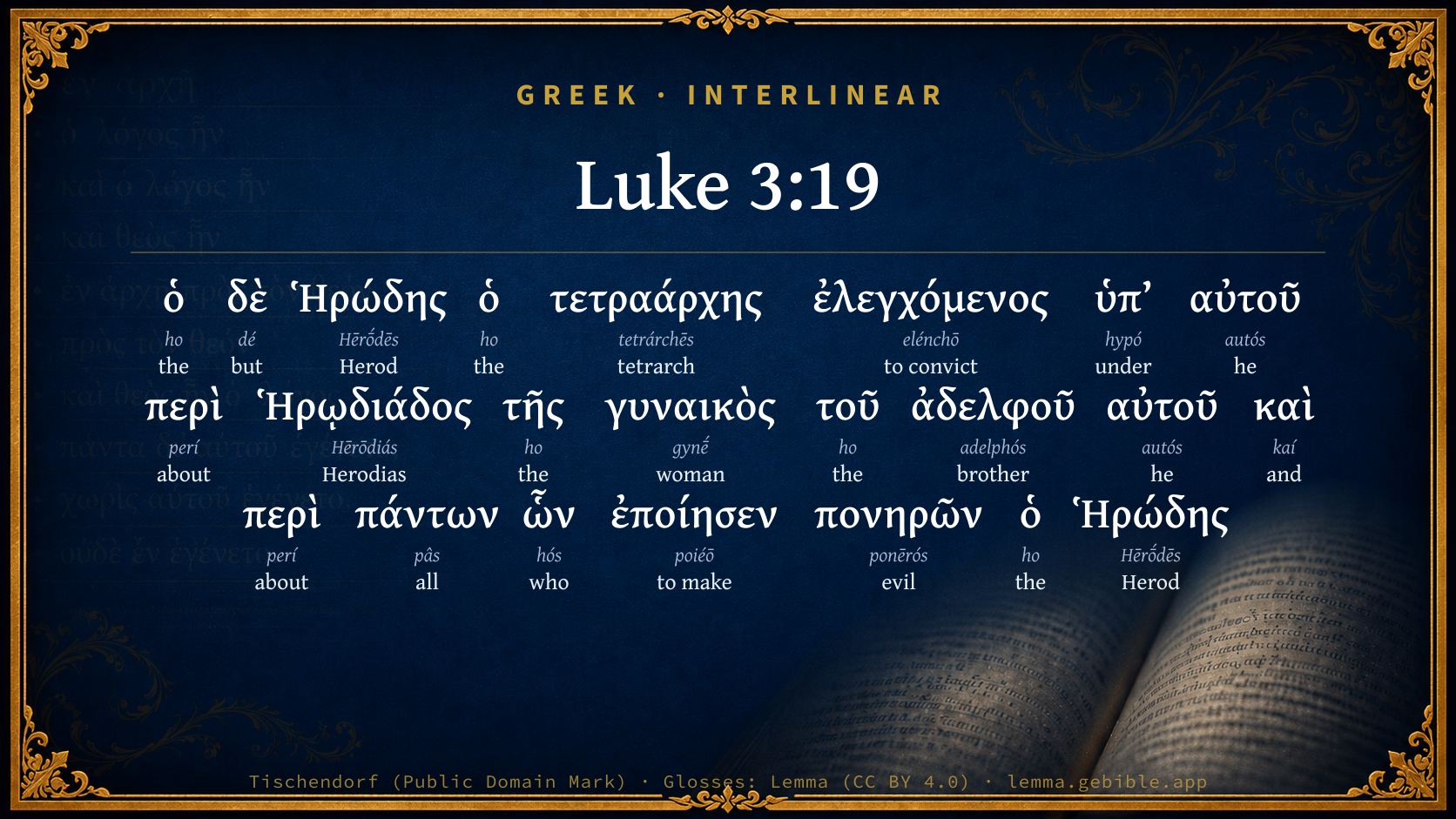
  1. ὁ ho G3588 “the” Article, Nominative, Singular, Masculine
  2. δὲ dé G1161 “but” Conjunction
  3. Ἡρώδης Hērṓdēs G2264 “Herod” Noun, Nominative, Singular, Masculine
  4. ὁ ho G3588 “the” Article, Nominative, Singular, Masculine
  5. ἐλεγχόμενος elénchō G1651 “to convict” Verb, Present, Passive, Participle, Nominative, Singular, Masculine
  6. ὑπ’ hypó G5259 “under” Preposition
  7. αὐτοῦ autós G846 “he” Personal pronoun, Genitive, Singular, Masculine
  8. περὶ perí G4012 “about” Preposition
  9. Ἡρῳδιάδος Hērōdiás G2266 “Herodias” Noun, Genitive, Singular, Feminine
  10. τῆς ho G3588 “the” Article, Genitive, Singular, Feminine
  11. γυναικὸς gynḗ G1135 “woman” Noun, Genitive, Singular, Feminine
  12. τοῦ ho G3588 “the” Article, Genitive, Singular, Masculine
  13. ἀδελφοῦ adelphós G80 “brother” Noun, Genitive, Singular, Masculine
  14. αὐτοῦ autós G846 “he” Personal pronoun, Genitive, Singular, Masculine
  15. καὶ kaí G2532 “and” Conjunction
  16. περὶ perí G4012 “about” Preposition
  17. πάντων pâs G3956 “all” Adjective, Genitive, Plural, Neuter
  18. ὧν hós G3739 “who” Relative pronoun, Genitive, Plural, Neuter
  19. ἐποίησεν poiéō G4160 “to make” Verb, Aorist, Active, Indicative, 3rd person, Singular
  20. πονηρῶν ponērós G4190 “evil” Adjective, Genitive, Plural, Neuter
  21. ὁ ho G3588 “the” Article, Nominative, Singular, Masculine
  22. Ἡρώδης Hērṓdēs G2264 “Herod” Noun, Nominative, Singular, Masculine

About this verse

These counts appear in no published source. They are computed here, from the morphology-tagged text and Lemma’s own curated glosses. What Lemma adds →

23
words
16
distinct lemmas
Gospels
section

Notable vocabulary

The rarest word here is τετραάρχης tetrarch G5076 — appearing just 4 times in the whole Greek New Testament.

Shared distinctive vocabulary

τετραάρχης tetrarch G5076 occurs in 4 verses of the Greek New Testament. Also found in:

Repetition

Words recur within this verse:

  • Ἡρώδης Herod G2264 ×2
  • περὶ about G4012 ×2
  • ὁ the G3588 ×5
  • αὐτοῦ he G846 ×2

Cross-references

6

Topical passages linked to Luke 3:19 in the Treasury of Scripture Knowledge — connected by theme and wording, ordered by reader-vote popularity; previews shown in the World English Bible.

  • Luke 3:1 Now in the fifteenth year of the reign of Tiberius Caesar, Pontius Pilate being governor of Judea, and Herod being tetrarch of Galilee, and his brother Philip tetrarch of the region of Ituraea and Trachonitis, and Lysanias tetrarch of Abilene,
  • Proverbs 15:12 A scoffer doesn't love to be reproved; He will not go to the wise.
  • Matthew 11:2 Now when John heard in the prison the works of Christ, he sent two of his disciples
  • Matthew 14:3–4 For Herod had laid hold of John, and bound him, and put him in prison for the sake of Herodias, his brother Philip's wife.
  • Mark 6:17–18 For Herod himself had sent out and arrested John, and bound him in prison for the sake of Herodias, his brother Philip's wife, for he had married her.
  • Proverbs 9:7–8 He who corrects a mocker invites insult. He who reproves a wicked man invites abuse.

Cross-references courtesy of OpenBible.info (CC BY 4.0).

Where the printed editions differ

1 variant

Places in this verse where the major printed Greek editions disagree on the wording in a way that affects the translation — a comparison of editions, not a manuscript-by-manuscript collation. The editions are the modern critical texts (Nestlé-Aland 28/27, SBL, Westcott-Hort, Tregelles, Tyndale House) and the traditional texts behind the KJV (the Textus Receptus and the Byzantine/Majority text). It is not a claim about which reading is original.

  1. Extra text
    φιλίππου

    “of Philip”

    In TR Not in NA28NA27TynSBLWHTregByz

    φιλίππου (philippou) 'of Philip' is only in traditional manuscripts (TR)

Textual data: Translators Amalgamated Greek New Testament (STEPBible TAGNT) · CC BY 4.0.

Commentary

Notes on Luke 3:19 from classic Christian and Jewish commentators (each source and its license shown beneath its notes). The classic Christian expositions comment on the surrounding passage and are grouped to its opening verse, so a note may address several verses; the Jewish commentaries on the Tanakh (Rashi and others) are per-verse, so they appear only where the commentator wrote on this verse.

Lemma curates 59 commentaries, every one of them public domain or Creative Commons licensed, each selected and text-cleaned for this edition rather than reprinted as found. About our sources →

Whedon's Commentary on the Bible

Daniel D. Whedon

§ 60. DEATH OF JOHN THE BAPTIST, Luk_3:19-20; Mar_6:17-20; Mat_14:3-5.

§ 16. BAPTISM OF JESUS, Luk_3:21-23; Mat_3:13-17; Mar_1:9-11.

We may remark on this passage that Luke’s account is much more concise than, and wholly independent of, the others. We have here, however, three additional particulars: First, that all the people were being baptized before the Lord’s baptism; second, that he was praying at the time of the descent of the Spirit; third, that the Spirit appeared in a bodily representation.

Daniel D. Whedon (gen. ed.), Commentary on the Old and New Testaments (1874–1909) — public domain. Text from a community e-Sword module.

Godbey's Commentary on the New Testament

William B. Godbey

ARREST & IMPRISONMENT OF JOHN THE BAPTIST

Mat 14:3-5; Mar 6:17-20; Luk 3:19-21. Mark: “For Herod himself, having sent, arrested John, and bound him in prison, on account of Herodias, the wife of his brother Philip, because he married her. For John said to Herod, It is not lawful for thee to have the wife of thy brother. And Herodias hated him, and wished to kill him; and was not able. For Herod revered John, knowing him to be a righteous and holy man; and he continued to hold him in prison, and hearing him, continued to do many things, and he was hearing him delightfully.” Matthew: “And wishing to kill him, he feared the multitude, because they had him as a prophet.” Luke: “And Herod the tetrarch, being convicted by him concerning Herodias, the wife of Philip, his brother, and concerning all those wicked things which Herod did, added also this to all, he also shut up John in prison.” We see from the concurrent histories of this dark tragedy, as given by Matthew, Mark, and Luke, that John the Baptist extended no royal courtesy whatever to the king and queen; but, looking them in the face, thus boldly and fearlessly exposed them in the presence of all the people, pronouncing his withering condemnation against their unlawful matrimony, Herodias, being the legal wife of his brother Philip — not the Philip who was at that time tetrarch of Iturea and Trachonitis (Luk 3:1), but of another Philip, who was his half-brother. Here we see a notable case of an honest preacher going into prison and to the executioner’s block, losing all his liberties, and even his life, rather than withhold a solitary item of the truth. If the preachers nowadays were to expose and condemn all of the unlawful marriages in their congregations, thousands of them would lose their pastoral heads, especially in the wealthy city churches. O how the present age needs preachers having the backbone of John the Baptist! This illustrates the absolute necessity of entire sanctification on the part of the clergy, as nothing but this grace can qualify the preacher to tell the truth under all circumstances, regardless of his reputation, financial interest, and his ecclesiastical head. In this whole transaction, Herod shows up a better spirit than Herodias. You see plainly from Mark that Herod imprisoned John, and kept him in prison nearly two years, to keep Herodias from killing him. If he had not been protected by those impregnable prison-walls, and kept night and day under lock and key, the queen would have hired an assassin to go and murder him. Machaerus, a city and strong fortification, which our dragoman pointed out to us, on the east bank of the Dead Sea, where Herod also had a palace and spent a portion of his time, was the place of John’s imprisonment. During these twenty months, which wound up with his decapitation through the stratagem of Herodias, Herod frequently heard John preach. Mark says: “Knowing him to be a righteous and holy man.” We become righteous in regeneration, and holy in sanctification. Hence you see that King Herod, an intelligent, unconverted Church-member, had gumption enough to believe in the two works of grace — i.e., regeneration and sanctification — and see them both in John the Baptist. Mark here informs us that John’s preaching had a powerful effect on Herod, who, like multiplied thousands of unsaved Church-members, wanted to be good. “And hearing him, he continued to do many things, and he continued to hear him delightfully.” All this took place during those twenty months of his imprisonment at Machaerus, where Herod had a palace, and spent much of his time, meanwhile holding John in prison to keep his haughty wife from having him killed, she, of course, being too mad at him to ever hear him any more, though her royal husband heard him very frequently, ever and anon, and was delighted with the wonderful truth so ably and faithfully dispensed by his prisoner. “He continued to do many things;” i.e., he was very religious, and obeyed John in many things, being literally carried away by the red-hot truth which he preached; yet he never made the final surrender and got saved; finally permitting his diabolical wife to constrain him to imbue his hands in the innocent blood of the preacher under whose ministry he had been delighted these two years, shed many a tear, and made many a holy vow.

William B. Godbey, Commentary on the New Testament (1896–1900) — public domain. Text from a community e-Sword module.

Tyndale Open Study Notes

Tyndale Open Resources

3:19-20 Herod Antipas, the ruler of Galilee, divorced his first wife and married Herodias, the wife of his half brother Herod Philip. When John publicly criticized Herod for this sin, Herod imprisoned and later executed him (cp. 9:9; Mark 6:16-29). Herod’s execution of John is also recorded by the Jewish historian Josephus (Antiquities 18.5.2).

Tyndale Open Study Notes — © Tyndale Open Resources, licensed CC BY-SA 4.0. Text via the HelloAO Bible API.

Bengel's Gnomon

Johann Albrecht Bengel

Luk 3:19. [Ἐλεγχόμενος ὑπʼ αὐτοῦ, being reproved by him) Although it was a considerable time after when Herod consigned John to prison: yet for convenience the fact is recorded here. In fact it is implied that John spake the truth to Herod no less, than to the people and to the publicans and soldiers.—Harm., p. 145].—καὶ περὶ πάντων, and concerning all) It is not a full discharge of a minister’s duty for him to reprove sinners, even though they be kings, for merely one fault.

Bengel's Gnomon of the New Testament — English translation (T&T Clark, Edinburgh, 1860) — public domain. Text from a community e-Sword module.

Expositor's Greek Testament

ed. W. Robertson Nicoll

Luk 3:19 . Ἡρώδης : the tetrarch named in Luk 3:1 . περὶ πάντων , implying that John’s rebuke was not confined to the sin with Herodias. Probably not, but it was what John said on that score that cost him his head.

The Expositor's Greek Testament, edited by W. Robertson Nicoll (1897–1910) — public domain. Text from a community e-Sword module.

Geneva Bible (1599)

Geneva Bible translators

John’s preaching is confirmed with his death.

Geneva Bible (1599) marginal notes — public domain. Text via Bolls.life.

Jamieson, Fausset & Brown

Robert Jamieson, A. R. Fausset & David Brown

But Herod, &c.--See on Mar 6:14, &c. (Also see on Mat 3:12.)

and for all the evils which Herod had done--important fact here only mentioned, showing how thoroughgoing was the fidelity of the Baptist to his royal hearer, and how strong must have been the workings of conscience in that slave of passion when, notwithstanding such plainness, he "did many things and heard John gladly" (Mar 6:20, Mar 6:26).

Jamieson, Fausset & Brown — Commentary Critical and Explanatory on the Whole Bible (1871) — public domain (CC PDM 1.0). Text via the HelloAO Bible API.

Adam Clarke's Commentary

Verse 19. Herod the tetrarch] See this subject explained at large, Mt 14:1, c., and Luke 6:21 Luke 6:23.

Adam Clarke's Commentary on the Bible (1810–1826) — public domain. Text from a community e-Sword/MySword module.

Ellicott's Commentary for English Readers

(19-20) But Herod the tetrarch.—See Notes on Mat_14:3-5. St. Luke’s anticipation of the close of the Baptist’s history supplies a curious instance of an arrangement which was obviously deliberate. It seemed to him better to complete the account of the Baptist’s ministry here than to bring in the account of the imprisonment as an episode later on. It coincides in part with St. John’s arrangement (Joh_3:24).

For all the evils which Herod had done.—The marriage with Herodias is conspicuous as the Tetrarch’s one great crime; but the sensual, crafty character of the man, with his fox-like nature (Luk_13:32), must have made any preaching of “righteousness, temperance, and judgment to come” as much a personal rebuke to him as it was to Felix (Act_24:25), and caused him also to tremble.

A Bible Commentary for English Readers, edited by Charles John Ellicott (1878–1897) — public domain. Text from a community e-Sword module.

The Cambridge Bible for Schools and Colleges

gen. ed. J. J. S. Perowne

19. But Herod the tetrarch] The incident which follows is here introduced by anticipation, that the subsequent narrative may not be disturbed. It should be compared with the fuller notice in Mar_6:17-20; Mat_14:3-5. From these passages we learn that John had reproved Antipas for many crimes, and that Antipas was so convinced of his holiness and justice as habitually to listen to him with pleasure (ἡδέως αὐτοῦ ἤκουεν), and after paying earnest heed to him was greatly at a loss about him. We learn further that he resisted the constant urgency of Herodias to put him to death.

being reproved] The reproof was of course based on Lev_18:16; Lev_20:21, and was perfectly uncompromising (Mat_14:4). In this respect the dauntless courage of John, under circumstances of far greater peril, contrasts most favourably with the timid and disgraceful concessions of the Reformers in the matter of the marriage of Philip of Hesse.

his brother Philip’s] The two first words are omitted by some of the best uncials, and “Philip’s” by nearly all of them. On this Herod Philip—who was not the tetrarch of that name—see on Luk_3:1.

The Cambridge Bible for Schools and Colleges (gen. ed. J. J. S. Perowne; Cambridge University Press, 1878–1918) — public domain. Text from a community e-Sword module.

John Gill's Exposition

Added yet this above all,.... This sin to all other sins, and which was of a more flagitious nature; and attended with more aggravating circumstances, especially in the issue of it:

that he shut up John in prison; in the castle of Machaerus, by the instigation of Herodias; See Gill on Mat 14:3.

John Gill's Exposition of the Whole Bible (1746–1763) — public domain (CC PDM 1.0). Text via the HelloAO Bible API.

Trapp's Complete Commentary

John Trapp

19 But Herod the tetrarch, being reproved by him for Herodias his brother Philip’s wife, and for all the evils which Herod had done,

Ver. 19. For Herodias his brother Philip’s wife] Whom it was not lawful for Herod to have, though Philip were dead, as Josephus saith he was. This was the case so much controverted here and beyond seas in Henry VIII’s time, touching his marriage with his brother Arthur’s widow, by Papal dispensation. The king had first a scruple cast into his mind about it by the bishop of Baion, the French ambassador, who came to him to consult of a marriage between the Lady Mary and the Duke of Orleans, whether Mary were legitimate, &c. This gave occasion to the casting the pope’s authority out of England. Mary was forced, for fear of death, to renounce the bishop of Rome, and to acknowledge her mother’s marriage to have been incestuous and unjust, &c. Though afterwards she set up the pope here again, and it was her policy so to get and keep the crown upon her head.

And for all the evils which Herod, &c.] John reproved him with the same liberty that Herod committed them. So did John Chrysostom the great ones of his time. Ita quidem ut etiam Ducum, Eutropii et Gainae, imo ipsius Imperatoris errata reprehenderet: he spared not dukes, princes, nay, not the Emperor himself. (Osiand. Hist. Eccles. Cent. 5.)

John Trapp, A Commentary or Exposition upon All the Books of the Old and New Testament (1647–1656) — public domain. Text from a community e-Sword module.

Albert Barnes' Notes on the Bible

See the notes at Mat 14:1-13. “Added this above all.” To all his former crimes he added this; not implying that this was the “worst” of his acts, but that this was “one” of his deeds, of like character as the others. The event here mentioned did not take place until some time after this, but it is mentioned here to show what was the end of John’s preaching, or to “fill out” the account concerning him.

Albert Barnes' Notes on the Bible (1834–1885) — public domain. Text from a community e-Sword/MySword module.

Haydock's Catholic Bible Commentary

See in St. Mark vi. 17. The wife of his brother (Philip.) The Greek adds the name, and he is also named in St. Mark; but he is a different person from the tetrarch, mentioned in chap. iii. ver. 1. (Bible de Vence) --- It was not at this time that John [the Baptist] was cast into prison; but, as St. John [the evangelist] relates, after our Saviour had begun to work miracles, and after his baptism. St. Luke anticipates this event, in order to describe more strongly the malice of Herod; who, whilst he saw multitudes flocking to hear the words of John, his own soldiers believing, and all the people receiving baptism, still could despise the Baptist, could imprison him, and put him to death. (Ven. Bede)

George Leo Haydock (1774–1849), Haydock's Catholic Family Bible and Commentary, 1859 edition — public domain. Excludes Psalms (Douay-Rheims chapter numbering differs from Protestant) and Deuterocanonical books (Catholic canon only).

Matthew Poole's English Annotations

These two verses sufficiently confirm to us, that we are not to expect to find the several passages in the Gospel concerning John the Baptist set down according to the order of time in which they happened, for the evangelist sets down the imprisonment of John before the baptism of Christ, mentioned in the two next verses, which we know could not be as to the order of time, our Saviour being baptized by John. John was in so great repute, that Herod himself heard him, did many things, and heard him gladly, Mar 6:20. But John was a faithful preacher, and could not but reprove him for his wicked courses, particularly for his incestuous taking of his brother Philip’s wife; for he was alive when he took her, if it be true which historians tell us, that John was imprisoned in the sixteenth year of Tiberius Caesar, and Philip died not till the twentieth; however, his brother leaving issue, (for we read Herodias had a daughter, Mat 14:1-36), it was unlawful for him to have married her, especially to turn away his own wife to take her. Matthew reports this history more fully, in Mat 14:3,4, &c.: See Poole on "Mat 14:3-4". It is said, that Herod added yet this above all, that is, above all his former or other wickedness, that he shut up John in prison. This spake him incorrigible in his wicked courses, resisting the remedy, or means to reduce him. A hypocrite may hear the word, and do many things; but he hath always some particular lust, as to which he must be spared, being neither willing to part with it, nor able to bear any reproof for it.

Matthew Poole's English Annotations on the Holy Bible (1683–1685) — public domain. Text from a community e-Sword/MySword module.

Scofield Reference Notes

C. I. Scofield

Herod

See margin ref., (See Scofield "Mat 14:1")

The Scofield Reference Bible (1917 edition), notes by C. I. Scofield — public domain. Text from a community e-Sword module.

McGarvey & Pendleton's Commentaries

J. W. McGarvey

J. W. McGarvey's The Fourfold Gospel [XXVI. A. Reasons for Retiring to Galilee].

XXVI. JESUS SETS OUT FROM JUDÆA FOR GALILEE. Subdivision A. REASONS FOR RETIRING TO GALILEE. aMATT. IV. 12; bMARK I. 14; cLUKE III. 19, 20; dJOHN IV. 1-4.

c19 but Herod the tetrarch [son of Herod the Great, and tetrarch, or governor, of Galilee], being reproved by him [that is, by John the Baptist] for Herodias his brother's wife, and for all the evil things which Herod had done [A full account of the sin of Herod and persecution of John will be found at Mat_14:1-12, Mar_6:14-29. John had spoken the truth to Herod as fearlessly as to the Pharisees, publicans and soldiers], 20 added this also to them all [the sins of Herod, as a ruler, already outweighed [138] his virtues; (comp. Dan_5:27); but, with reckless abandon, Herod went on, adding to the weighty reasons which justified his condemnation], that he shut up John in prison. [In the fortress at Machærus, east of the Dead Sea, as we learn from Josephus. The duration of the ministry of John the Baptist is variously estimated at from fourteen to eighteen months.] b14 Now after John was delivered up [either delivered up by the people to Herod ( Mat_17:12), or delivered up by Herod himself to the warden of the castle of Machærus ( Luk_12:58), or by Providence to Herod himself-- Act_2:23], awhen he [Jesus] heard [he was in Judæa when he heard it] that John was delivered up [and], d1 When therefore the Lord knew that the Pharisees had heard that Jesus was making and baptizing more disciples than John [We saw at Joh_3:26 how the Baptist heard about the number of Jesus' baptisms, being informed by his jealous friends. Like jealous friends, no doubt, informed the Pharisees. Jesus may have known of this information being given by reason of his supernatural powers, but it is more likely that he heard of it in a natural way] 2 (although Jesus himself baptized not, but his disciples) [Jesus, as divine Lawgiver, instituted baptism, and his disciples administered it. We nowhere hear of the disciples of John administering baptism. In fact, the Baptist, like the disciples of Jesus, baptized under a divine commission, and could not delegate the power to others. It was the office of Jesus to commission others to this work, not to perform it himself. Had he done so, those baptized by him might have foolishly claimed for themselves some peculiar honor by reason thereof ( 1Co_1:14, 1Co_1:15). Jesus was the spiritual baptizer, in which baptism the efficacy lies in the administrant; but water baptism, the efficacy of which lies rather in the spirit of the one baptized than in the virtues of the administrant, Jesus left to his disciples], 3 he left Judæa, and departed again { awithdrew bcame dinto Galilee. [We have in these verses two reasons assigned for the withdrawal of Jesus into Galilee, namely: 1. The imprisonment of John the Baptist [139] 2. Knowledge of the Pharisees that Jesus was baptizing more disciples than John. The first gives us the reason why he went to Galilee, the second the reason why he left Judæa. Jesus did not go into Galilee through fear of Herod, for Herod was tetrarch of Galilee. The truth is, the absence of John called for the presence of Jesus. The northern part of Palestine was the most fruitful soil for the gospel. During the last six or eight months of John's ministry we find him in this northern field, preparing it for Christ's kingdom. While we can not say definitely that John was in Galilee (Bethabara and Ænon being the only two geographical names given), yet he certainly drew his audiences largely from the towns and cities of Galilee. While John occupied the northern, Jesus worked in the southern district of Palestine; but when John was removed, then Jesus turned northward, that he might sow the seed of the kingdom in its most fruitful soil. But if there was a reason why he should go to Galilee, there was an equal reason why he should depart from Judæa. His popularity, manifesting itself in the number of his baptisms, was exciting that envy and opposition which caused the rulers of Judæa eventually to take the life of Jesus ( Mat_27:18). The Pharisees loved to make proselytes themselves ( Mat_23:15). They no doubt envied John's popularity, and much more, therefore, would they be disposed to envy Christ. The influence of the Pharisees was far greater in Judæa than in Galilee, and the Sanhedrin would readily have arrested Jesus had he remained in Judæa ( Joh_7:1, Joh_10:39), and arrest at this time would have marred the work of Jesus. Therefore, since it is neither sinful nor unbecoming to avoid persecution, Jesus retired to Galilee, when he remained until his second passover. By birth a prophet of Judæa, he became, in public estimation, by this retirement, a prophet of Galilee. Though Jesus first taught in Judæa, the ministry in Galilee so far eclipsed the work in Judæa that it was spoken of as the place of beginning ( Luk_23:5, Act_10:37), and prophetically designated as the scene of the divine manifestation-- Mat_4:14.] 4 And he must needs pass through Samaria. [The province which [140] took its name from the city of Samaria, and which lay between Judæa and Galilee. Owing to the hatred which existed between Jews and Samaritans, many of the Jews went from Jerusalem to Galilee by turning eastward, crossing the Jordan, and passing northward through Peræa. This journey required about seven days, while the more direct route, through Samaria, only took three days. Galilæans often passed through Samaria on their way to and from the Jerusalem feast (Josephus' Ant. xx. 6, 1). The arrest of John would scatter his flock of disciples ( Mar_14:27), and Jesus, as chief shepherd ( 1Pe_5:1-4), hastened to Galilee, to gather together those which might else go astray and be lost.]

[FFG 138-141]

J. W. McGarvey (with Philip Y. Pendleton), Commentaries on the New Testament (The Fourfold Gospel, 1914; Acts; and the epistles) — public domain. Text from a community e-Sword/MySword module.

The People's New Testament

B. W. Johnson

19, 20. But Herod the tetrarch. See notes on Matt. 14:1–12; also Mark 6:14–18.

B. W. Johnson's The People's New Testament with Notes (1889–1891) — public domain. Electronic text from the Christian Classics Ethereal Library (CCEL) ThML edition.

Cambridge Greek Testament for Schools and Colleges

19. The addition of Φιλίππου after γυναικὸς is a gloss, though a correct one, in AC. It is omitted in אBD and by the recent editors.

19. ὁ δὲ Ἡρώδης ὁ τετράρχης. The incident which follows is here introduced by anticipation, that the subsequent narrative may not be disturbed. We find similar anticipatory notices in Luk 1:66; Luk 1:80. It should be compared with the fuller notice in Mar 6:17-20; Mat 14:3-5. From these passages we learn that John had reproved Antipas for many crimes, and that Antipas was so convinced of his holiness and justice as habitually to listen to him with pleasure (ἡδέως αὐτοῦ ἤκουεν), and after paying earnest heed to him was greatly at a loss about him. We learn further that he resisted the constant urgency of Herodias to put him to death.

ἐλεγχόμενος. The reproof was of course based on Lev 18:16; Lev 20:21, and was perfectly uncompromising (Mat 14:4). In this respect the dauntless courage of John, under circumstances of far greater peril, contrasts most favourably with the timid and unworthy concessions of the Reformers in the matter of the marriage of Philip of Hesse.

τοῦ ἀδελφοῦ αὐτοῦ. These words are omitted by some of the best uncials, and “Philip’s” by most of them. On this Herod Philip—who was not the tetrarch of that name—see on Luk 3:1.

Cambridge Greek Testament for Schools and Colleges (Cambridge University Press, 1896; 21 vols, various authors incl. Carr, Maclear, Plummer, Farrar, Lumby, Moule, M. R. James, Simcox) — public domain. Text from a community e-Sword module.

International Critical Commentary

19. Ἡρῴδης. Antipas, as in ver. 1. The insertion of the name Φιλίππου after γυναικός comes from Mk. and Mt. (A C K X and some versions). This Philip must be carefully distinguished from the tetrarch Philip, with whom Jerome confuses him. He was the son of Mariamne, on account of whose treachery he had been disinherited by Herod the Great; and he lived as a private individual at Jerusalem (Jos. B. J. i. 30, 7). Josephus calls both Antipas and also this Philip simply “Herod” (Ant. xviii. 5, 4). Herodias became the evil genius of the man who seduced her from his brother. It was her ambition which brought about the downfall of Antipas. Lk. alone tells us that John rebuked Antipas for his wicked life (καὶ περὶ πάντων) as well as for his incestuous marriage. Obviously ἐλεγχόμενος means “rebuked, reproved” (1Ti 5:20; 2Ti 4:2), and not “convicted” or “convinced” (Joh 8:46, Joh 16:8). In the former sense ἐλέγχειν is stronger than ἐπιτιμᾷν: see Trench, Syn. iv.

Once more (see on ver. 1) we have a remarkable rendering in d: Herodes autem quaterducatus cum argueretur ad eo, etc.

Note the characteristic and idiomatic attraction (π ά ν τ ω ν ὦ ν), and comp. 2:20, 5:9, 9:43, 12:46, 15:16, 19:37, 24:25; Act 3:21, Act 10:39, Act 13:39, Act 22:10, Act 26:2.

International Critical Commentary — older volumes (1896–1929), various authors — public domain. Text from a community e-Sword module.

Vincent's Word Studies in the New Testament

Marvin R. Vincent

Being reproved [ελεγχομενος] . See on Jas 2:9.

Evils [πονηρων] . Of several words in the New Testament denoting evil, this emphasizes evil in its activity. Hence Satan is oJ ponhrov, the evil one. An evil eye (Mr 7:22) is a mischief working eye. See on Mr 7:22. Added [προσεθηκεν] . Used by Luke twice as often as in all the rest of the New Testament. A very common medical word, used of the application of remedies to the body, as our apply, administer. So Hippocrates, "apply wet sponges to the head;" and Galen, "apply a decoction of acorns," etc.

In prison. See on Mt 14:3.

21 - 23. Compare Mt 3:13 - 17; Mr 1:9 - 11.

Marvin R. Vincent, Word Studies in the New Testament (1887–1900) — public domain. Text from a community e-Sword/MySword module.

Lesson kit

Teaching starters — assembled from the data on this page, not authored interpretation. Every prompt links to the verse data it draws on. Edit before teaching.

Luke, in the Gospels, opens this verse with 23 words (16 distinct Greek lemmas). Its most distinctive word is tetrárchēs (“tetrarch”). A historical commentator’s framing appears above. Read the whole chapter for the surrounding context.

Discussion questions

  1. What does “tetrarch” (tetrárchēs) contribute to the verse as a whole?
  2. Matthew 14:1 shares the word «tetrarch» with this verse. How do the two illuminate each other?
  3. “Herod” occurs 2× in this one verse. What is the effect of the repetition?
  4. These translations render this verse differently. What is at stake in choosing one wording over another?
  5. Reading how Whedon's Commentary on the Bible and Godbey's Commentary on the New Testament read this verse, where do the two commentators agree and where do they part?

Things to notice

Reading settings

Reading text

Shown beneath each verse's original-language words.

Old Testament
Old Testament edition

Read the OT as the Masoretic Hebrew (MT) or the Greek Septuagint (LXX).

English shown for the Greek Septuagint (in the Hebrew ↔ Greek comparison).

Comparing translations? Open the Compare panel on any verse page to stack up to four side by side.