
Matthew 21:13

Greek (Tischendorf 8th ed.) Matthew 21:13 appears in the Greek New Testament. The text above is from the Tischendorf 8th edition. Each word links to its Strong’s number and a concise gloss. Click any word for its full Thayer’s Greek Lexicon entry.
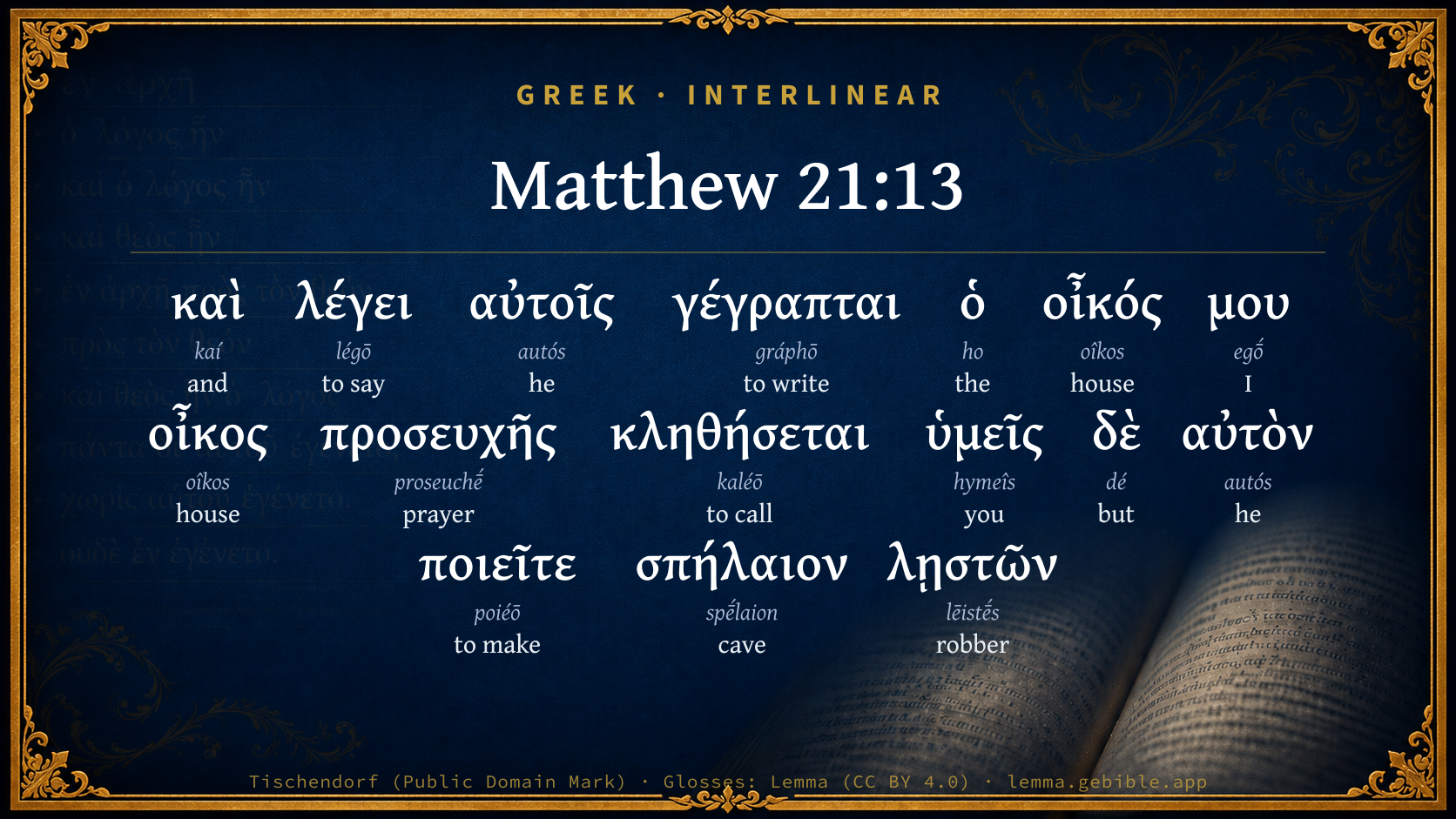
Download image
Cite this verse

Matthew 21:13 (World English Bible). Public Domain. Lemma interlinear Bible study tool, https://lemma.gebible.app/v/matthew/21/13.

Show BibTeX & RIS
BibTeX
RIS
English Translation
He said to them, "It is written, 'My house shall be called a house of prayer,' but you have made it a den of robbers!"
World English Bible · Public Domain
Highlights
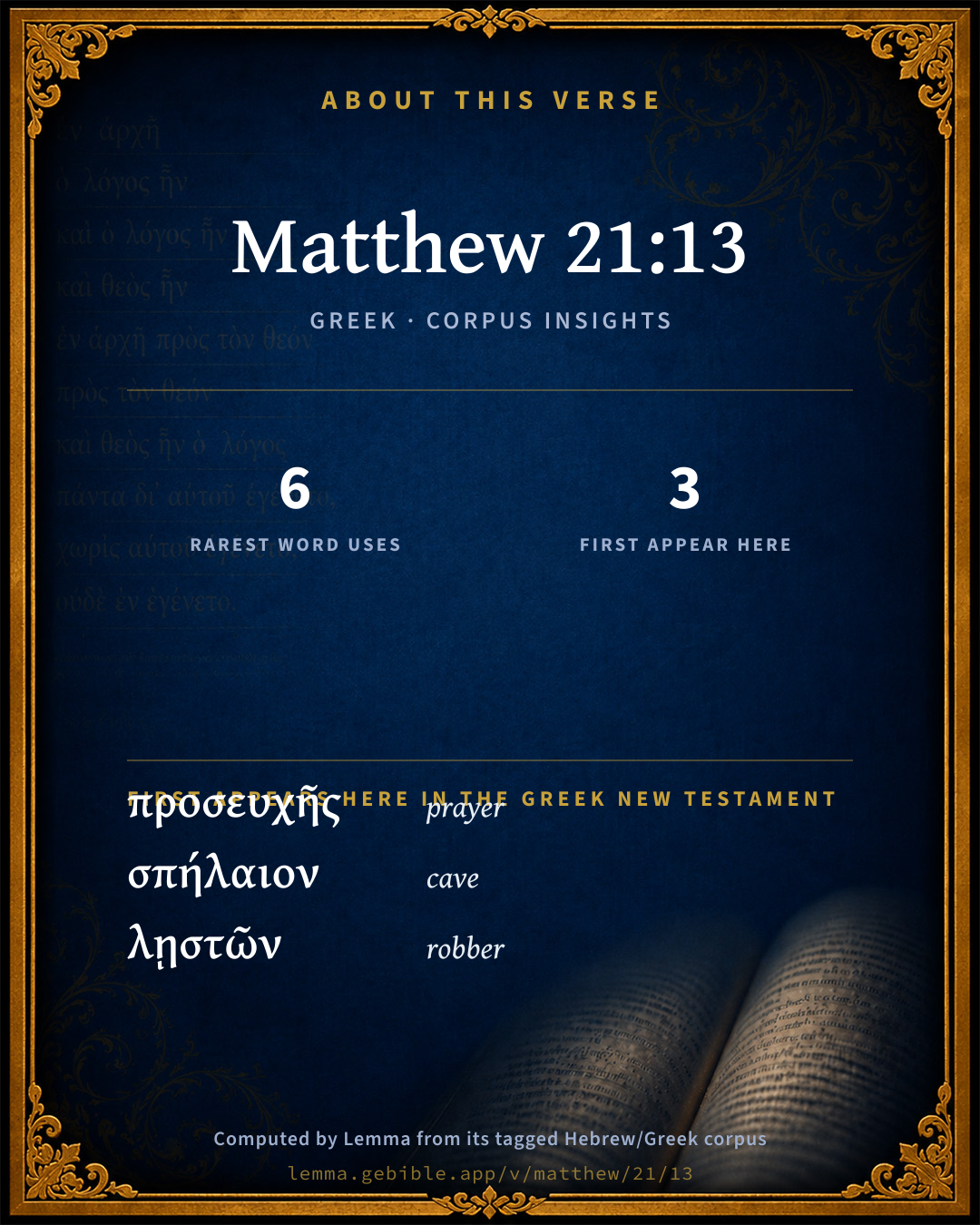
  • 3 first appearances in the Greek New Testament
Full analysis ↓
Download a study sheet

One document with this verse’s original text, its word-by-word gloss line, the meaning frame, cross-references with their text, attributed commentary, and full source and license credits — printable, and it pastes into notes with its structure intact.

This verse Autodidact and up

Study sheet (.html) Plain text (.txt)

A passage Seminary Student

Up to 50 verses in one chapter. A passage sheet keeps up to 6 commentary sources and 12 cross-references per verse, in the order this page ranks them, and says so on the sheet whenever that leaves anything out. Ask for a single verse and you get the Autodidact verse sheet above.

Everything on this page stays free to read, with no account — the sheet is a download of what is already on screen, not access to it.

Want to remove ads? Support Godless Engineer
Compare translations 3

The same verse in 3 English versions, stacked beneath the original-language interlinear above. Click any original word for its lexicon entry.

Each is an independent rendering of the whole verse — the interlinear is not word-aligned to these translations.

Highlighted words mark where these versions differ — a whole-verse word diff, not a word-by-word alignment.

  • World English Bible Public Domain
    He said to them, "It is written, 'My house shall be called a house of prayer,' but you have made it a den of robbers!"
  • King James Version Public Domain
    And said unto them, It is written, My house shall be called the house of prayer; but ye have made it a den of thieves.
  • unfoldingWord Literal Text CC BY-SA 4.0
    And he says to them, “It has been written, ‘My house will be called a house of prayer,’ but you make it a ‘den of robbers.’”

unfoldingWord Literal Text — © unfoldingWord, licensed CC BY-SA 4.0. Word-aligned USFM3 via Door43 (git.door43.org/unfoldingWord/en_ult).

Versions to compare (up to 4)

3 of 4 selected

Show all 19 translations

Every available English version of this verse, each an independent rendering of the whole verse.

  • World English Bible Public Domain
    He said to them, "It is written, 'My house shall be called a house of prayer,' but you have made it a den of robbers!"
  • Berean Standard Bible Public Domain
    And He declared to them, “It is written: ‘My house will be called a house of prayer.’ But you are making it ‘a den of robbers.’”
  • Majority Standard Bible Public Domain
    And He declared to them, “It is written: ‘My house will be called a house of prayer.’ But you have made it ‘a den of robbers.’”
  • King James Version Public Domain
    And said unto them, It is written, My house shall be called the house of prayer; but ye have made it a den of thieves.
  • American Standard Version (1901) Public Domain
    and he saith unto them, It is written, My house shall be called a house of prayer: but ye make it a den of robbers.
  • Revised Version (1885) Public Domain
    and he saith unto them, It is written, My house shall be called a house of prayer: but ye make it a den of robbers.
  • Geneva Bible (1599) Public Domain
    And said to them, it is written, My house shall be called the house of prayer: but ye haue made it a denne of theeues.
  • Douay-Rheims (1899) Public Domain
    And he saith to them: It is written, My house shall be called the house of prayer; but you have made it a den of thieves.
  • Young's Literal Translation Public Domain
    and he saith to them, `It hath been written, My house a house of prayer shall be called, but ye did make it a den of robbers.'
  • Literal Standard Version CC BY-SA 4.0
    and He says to them, “It has been written: My house will be called a house of prayer; but you made it a den of robbers.”
  • Unlocked Literal Bible CC BY-SA 4.0
    He said to them, “It is written, 'My house will be called a house of prayer,' but you make it a den of robbers.”
  • unfoldingWord Literal Text CC BY-SA 4.0
    And he says to them, “It has been written, ‘My house will be called a house of prayer,’ but you make it a ‘den of robbers.’”
  • Darby Bible Public Domain
    And he says to them, It is written, My house shall be called a house of prayer, but *ye* have made it a den of robbers.
  • World Messianic Bible Public Domain
    He said to them, “It is written, ‘My house shall be called a house of prayer,’ but you have made it a den of robbers!”
  • Webster's Bible Public Domain
    And said to them, It is written, My house shall be called the house of prayer, but ye have made it a den of thieves.
  • Free Bible Version CC BY-SA 4.0
    He told them, “Scripture says, ‘My house shall be called a house of prayer,’ but you've turned it into a den of thieves.”
  • Bible in Basic English Public Domain
    And he said to them, It is in the Writings, My house is to be named a house of prayer, but you are making it a hole of thieves.
  • Text-Critical English NT CC BY 4.0
    And he said to them, “It is written, ‘My house shall be called a house of prayer,’ but you have made it a den of robbers.”
  • Tyndale New Testament (1534) Public Domain
    and sayde to them: It is wrytten my housse shalbe called the housse of prayer. But ye have made it a denne of theves.

Literal Standard Version (2020), Covenant Press — licensed CC BY-SA 4.0. Text via the HelloAO Bible API (eBible.org). Unlocked Literal Bible (unfoldingWord) — licensed CC BY-SA 4.0. Text via the HelloAO Bible API (eBible.org). unfoldingWord Literal Text — © unfoldingWord, licensed CC BY-SA 4.0. Word-aligned USFM3 via Door43 (git.door43.org/unfoldingWord/en_ult). Free Bible Version, Dr. Jonathan Gallagher — licensed CC BY-SA 4.0. Text via the HelloAO Bible API (eBible.org).

Word by word

More ways to search: Search by grammar → Find every occurrence → Compare this word →

Practice this passage: Drill this verse → Learn its vocabulary →

σπήλαιον
spḗlaion
G4693
“cave”
Noun, Accusative, Singular, Neuter
Part of Speech
Noun
Case
Accusative
Number
Singular
Gender
Neuter
Full Thayer's Definition

Origin: from a presumed derivative of speos (a grotto)

TDNT: None

1. a cave, den
  1. καὶ kaí G2532 “and” Conjunction
  2. λέγει légō G3004 “to say” Verb, Present, Active, Indicative, 3rd person, Singular
  3. αὐτοῖς autós G846 “he” Personal pronoun, Dative, Plural, Masculine
  4. γέγραπται gráphō G1125 “to write” Verb, Perfect, Passive, Indicative, 3rd person, Singular
  5. ὁ ho G3588 “the” Article, Nominative, Singular, Masculine
  6. οἶκός oîkos G3624 “house” Noun, Nominative, Singular, Masculine
  7. μου egṓ G1473 “I” Personal pronoun, 1st person, Genitive, Singular
  8. οἶκος oîkos G3624 “house” Noun, Nominative, Singular, Masculine
  9. προσευχῆς proseuchḗ G4335 “prayer” Noun, Genitive, Singular, Feminine
  10. κληθήσεται kaléō G2564 “to call” Verb, Future, Passive, Indicative, 3rd person, Singular
  11. ὑμεῖς hymeîs G5210 “you” Personal pronoun, 2nd person, Nominative, Plural
  12. δὲ dé G1161 “but” Conjunction
  13. αὐτὸν autós G846 “he” Personal pronoun, Accusative, Singular, Masculine
  14. ποιεῖτε poiéō G4160 “to make” Verb, Present, Active, Indicative, 2nd person, Plural
  15. λῃστῶν lēistḗs G3027 “robber” Noun, Genitive, Plural, Masculine

About this verse

These counts appear in no published source. They are computed here, from the morphology-tagged text and Lemma’s own curated glosses. What Lemma adds →

16
words
14
distinct lemmas
Gospels
section

Notable vocabulary

The rarest word here is σπήλαιον cave G4693 — appearing just 6 times in the whole Greek New Testament.

First appearance in Scripture

These words make their first canonical appearance in the Greek New Testament here:

  • προσευχῆς prayer G4335
  • σπήλαιον cave G4693
  • λῃστῶν robber G3027

Shared distinctive vocabulary

σπήλαιον cave G4693 occurs in 6 verses of the Greek New Testament. Also found in:
Repetition

Words recur within this verse:

  • οἶκός house G3624 ×2
  • αὐτοῖς he G846 ×2

Cross-references

7

Topical passages linked to Matthew 21:13 in the Treasury of Scripture Knowledge — connected by theme and wording, ordered by reader-vote popularity; previews shown in the World English Bible.

  • Jeremiah 7:11 Is this house, which is called by my name, become a den of robbers in your eyes? Behold, I, even I, have seen it, says Yahweh.
  • Isaiah 56:7 even them will I bring to my holy mountain, and make them joyful in my house of prayer: their burnt offerings and their sacrifices shall be accepted on my altar; for my house shall be called a house of prayer for all peoples.
  • Luke 19:46 saying to them, "It is written, 'My house is a house of prayer,' but you have made it a 'den of robbers'!"
  • Mark 11:17 He taught, saying to them, "Isn't it written, 'My house will be called a house of prayer for all the nations?' But you have made it a den of robbers!"
  • Psalms 93:5 Your statutes stand firm. Holiness adorns your house, Yahweh, forevermore.
  • John 15:25 But this happened so that the word may be fulfilled which was written in their law, 'They hated me without a cause.'
  • Matthew 2:5 They said to him, "In Bethlehem of Judea, for thus it is written through the prophet,

Cross-references courtesy of OpenBible.info (CC BY 4.0).

Commentary

Notes on Matthew 21:13 from classic Christian and Jewish commentators (each source and its license shown beneath its notes). The classic Christian expositions comment on the surrounding passage and are grouped to its opening verse, so a note may address several verses; the Jewish commentaries on the Tanakh (Rashi and others) are per-verse, so they appear only where the commentator wrote on this verse.

Lemma curates 59 commentaries, every one of them public domain or Creative Commons licensed, each selected and text-cleaned for this edition rather than reprinted as found. About our sources →

Tyndale Open Study Notes

Tyndale Open Resources

21:13 Jesus’ actions were justified, because God’s glory was being desecrated through financial exploitation.

Tyndale Open Study Notes — © Tyndale Open Resources, licensed CC BY-SA 4.0. Text via the HelloAO Bible API.

Bengel's Gnomon

Johann Albrecht Bengel

Mat 21:13. Ὁ οἶκός Μου οἶκος προσευχῆς κληθήσεται· ὑμεῖς δὲ αὐτὸν ἐποιήσατε σπήλαιον λῃστῶν, My house shall be called ([918] or the) house of prayer; but ye have made it a den of thieves.—The LXX., in Isa 56:7, have—ὁ γὰρ οἶκός Μου, οἶκος προσευχῆς κληθήσεται πᾶσι τοῖς ἔθνεσιν, My house shall be called ([919] or the) house of prayer for all nations; and in Jer 7:11, μὴ σπηλαιον λῃστῶν ὁ οἶκός Μου; is My house become a den of thieves?—προσευκῆς, of prayer) Prayer is the principal part of public worship; see 1 Kings 8; therefore prayer is put before the apostolic ministry of the Word in Act 6:4. The synagogues also were places for teaching and houses of prayer as well. In the temple there was more prayer, in the synagogues more teaching.—σπήλαιο λῃστῶν, a den of thieves) A severe and proverbial expression, used of a place which admits all infamous characters and all profane things. He does not say, A market-place. in a den, thieves do not so much attack others, as house themselves.

[918] Vercellensis of the old ‘Itala,’ or Latin Version before Jerome’s, probably made in Africa, in the second century: the Gospels.

[919] Vercellensis of the old ‘Itala,’ or Latin Version before Jerome’s, probably made in Africa, in the second century: the Gospels.

Bengel's Gnomon of the New Testament — English translation (T&T Clark, Edinburgh, 1860) — public domain. Text from a community e-Sword module.

Meyer's Critical & Exegetical Commentary

Heinrich August Wilhelm Meyer

Mat_21:13. Free combination of Isa_56:7 and Jer_7:11, and taken from the Sept.

κληθής.] how sacred the purpose for which it was intended, but ye, etc.

ποιεῖτε (see critical notes) censures this desecration of the temple as a thing in which they are still persisting.

σπήλαιον λῃστῶν] The strong language of the prophet (otherwise in John) was in keeping with the emotion that was awakened in Jesus. The use of such language is sufficiently accounted for by the fact that avarice had taken up its abode in those sacred precincts to carry on its huckstering and money-changing: τὸ γὰρ φιλοκερδὲς λῃστρικὸν πάθος ἐστι, Theophylact. Differently Fritzsche: Vos undequaque pecuniam, animalia hue congerere sustinetis, ut latrones praedam comportant in speluncam,where, however, due prominence is not given to the distinctive point of comparison, viz. the robbery.

In Mat_21:12-13, Jesus acts with higher authority than that of a mere zealot (Num_25:11): He addresses Himself to the purifying of the temple and its worship with such a reforming energy as, according to Mal_3:1-3, befitted the Messiah. Comp. Bertholdt, Christol. p. 163; Ullmann, Sündl. p. 177. And the acquiescence of the astonished multitude is all the more intelligible on the occasion of this cleansing, that the indignant reformer had just celebrated His triumphal march into the city in the character of Messiah. But even on the first occasion, John 2, their acquiescence is sufficiently explicable from the sudden and decided nature of the proceeding, taken in connection with the spiritually-imposing character of the Lords person and bearing (divinitatis majestas lucebat in facie, Jerome), so that it is quite needless to resort to the hypothesis of a miracle (Origen, Jerome).

Meyer — Critical and Exegetical Commentary on the New Testament — English translation by Peter Christie, edited by Frederick Crombie (T&T Clark, 1880) — public domain. Text from a community e-Sword module.

Expositor's Greek Testament

ed. W. Robertson Nicoll

Mat 21:13 . γέγραπται , it stands written, in Isa 56:7 ; from the Sept [115] but with omission of πᾶσιν τοῖς ἔθνεσιν , retained in Mk., and a peculiarly appropriate expression in the circumstances, the abuse condemned having for its scene the court of the Gentiles. σπήλαιον λῃστῶν , a den of robbers, a strong expression borrowed from another prophet (Jer 7:11 ), pointing probably to the avarice and fraud of the traders ( τὸ γὰρ φιλοκερδὲς ληστρικὸν πάθος ἐστί , Theophy.), taking advantage of simple provincials. This act of Jesus has been justified by the supposed right of the zealot (Num 25:6 ; Num 25:13 ), which is an imaginary right: “ein unfindbar Artikel” (Holtz., H. C.), or by the reforming energy befitting the Messiah (Meyer). It needed no other justification than the indignation of a noble soul at sight of shameless deeds. Jesus was the only person in Israel who could do such a thing. All others had become accustomed to the evil.

[115] Septuagint.

The Expositor's Greek Testament, edited by W. Robertson Nicoll (1897–1910) — public domain. Text from a community e-Sword module.

Adam Clarke's Commentary

Verse 13. My house shall be called the house of prayer] This is taken from Isa 56:7.

But ye have made it a den of thieves.] This is taken from Jer 7:11.

Our Lord alludes here to those dens and caves in Judea, in which the public robbers either hid or kept themselves fortified.

They who are placed in the Church of Christ to serve souls, and do it not, and they who enjoy the revenues of the Church, and neglect the service of it, are thieves and robbers in more senses than one.

Our Lord is represented here as purifying his temple; and this we may judge he did in reference to his true temple, the Church, to show that nothing that was worldly or unholy should have any place among his followers, or in that heart in which he should condescend to dwell. It is marvellous that these interested, vile men did not raise a mob against him: but it is probable they were overawed by the Divine power, or, seeing the multitudes on the side of Christ, they were afraid to molest him. I knew a case something similar to this, which did not succeed so well. A very pious clergyman of my acquaintance, observing a woman keeping a public standing to sell nuts, gingerbread, &c., at the very porch of his Church, on the Lord's day, "desired her to remove thence, and not defile the house of God, while she profaned the Sabbath of the Lord." She paid no attention to him. He warned her the next Sabbath, but still to no purpose. Going in one Lord's day to preach, and finding her still in the very entrance, with her stall, he overthrew the stall, and scattered the stuff into the street. He was shortly after summoned to appear before the royal court, which, to its eternal reproach, condemned the action, and fined the man of God in a considerable sum of money!

Adam Clarke's Commentary on the Bible (1810–1826) — public domain. Text from a community e-Sword/MySword module.

Ellicott's Commentary for English Readers

(13) It is written.—The words which our Lord quotes are a free combination of two prophetic utterances: one from Isaiah’s vision of the future glory of the Temple, as visited both by Jew and Gentile (Isa_56:7); one from Jeremiah’s condemnation of evils like in nature, if not in form, to those against which our Lord protested (Jer_7:11).

A den of thieves.—The pictorial vividness of the words must not be passed over. Palestine was then swarming with bands of outlaw brigands, who, as David of old in Adullam (1Sa_22:1), haunted the lime-stone caverns of Judæa. The wranglings of such a company over the booty they had carried off were reproduced in the Temple, and mingled with the Hallelujahs of the Levites and the Hosannas of the crowds. We ask, as we read the narrative, how it was that the work of expulsion was done so effectively, and with so little resistance. The answer is found (1) in the personal greatness and intensity of will that showed itself in our Lord’s look and word and tone; (2) in the presence of the crowd that had followed Him from the Mount of Olives, and had probably filled the courts of the Temple; and (3) in the secret consciousness of the offenders that they were desecrating the Temple, and that the Prophet of Nazareth, in His zeal for His Father’s house, was the witness of a divine truth.

A Bible Commentary for English Readers, edited by Charles John Ellicott (1878–1897) — public domain. Text from a community e-Sword module.

The Cambridge Bible for Schools and Colleges

gen. ed. J. J. S. Perowne

13. My house shall be called the house of prayer] Isa_56:7, “Mine house shall be called a house of prayer for all people,” or for all nations, not of all nations (Mark).

a den of thieves] Rather, a cave of robbers or bandits. Cp. Jer_7:11, “Is this house which is called by my name become a den of robbers in your eyes?” The context of these words is strikingly suggestive: “if ye thoroughly amend your ways and your doings … and shed not innocent blood in this place … then will I cause you to dwell in this place in the land that I gave to your fathers for ever and ever.” The caves of Palestine had always been refuges for the lawless, and in the reign of Herod the Great the robbers dwelling in caves had rebelled against him and resisted his power, Jos. Ant. i. 12. Possibly this thought may be present here: “Ye have made my house a stronghold of rebels against God and the Messiah, when it ought to be a garrison of loyal subjects.” Also the disputes of the traffickers resembled the wrangling of bandits in their caves.

The Cambridge Bible for Schools and Colleges (gen. ed. J. J. S. Perowne; Cambridge University Press, 1878–1918) — public domain. Text from a community e-Sword module.

John Gill's Exposition

And said unto them, it is written,.... In Isa 56:7.

My house shall be called the house of prayer. These are the, words of God, calling the temple his house, which was built according to the plan he gave; and was the place of his worship, and where he dwelt, and vouchsafed his presence to his people; and signifying, that in time to come, it should be an house of prayer; not for the Jews only, but for the Gentiles also: "for all people", as it is expressed by the prophet, and cited by Mark; and particularly this part of it, in which were the money changers and sellers of doves; for that was the court of the Gentiles, where they were admitted to pray, and perform other parts of worship. These words are rightly applied by Christ to the temple; nor can the Jews themselves deny it; for their own Targum paraphrases it thus, , "the house of my sanctuary shall be called an house of prayer"; or shall be one; for the meaning is not that it should go by such a name, but should be for such use, and not for buying and selling, and merchandise, to which use the Jews now put it: hence it follows,

but ye have made it a den of thieves. These are the words of Christ, affirming what is complained of in Jer 7:11 and applying it to the present case, on account of the wicked merchandise, unlawful gain, avarice and extortion, of the priests and other officers of the temple, who had a considerable share in these things; and to whom the temple was, and by them used, as a den is to and by thieves and robbers, where they shelter themselves; for these persons robbed both God and man, and the temple was a sanctuary to them: here they screened themselves, and, under the appearance of religion and devotion, devoured widows' houses, plundered persons of their substance, and were full of extortion and excess.

John Gill's Exposition of the Whole Bible (1746–1763) — public domain (CC PDM 1.0). Text via the HelloAO Bible API.

Trapp's Complete Commentary

John Trapp

13 And said unto them, It is written, My house shall be called the house of prayer; but ye have made it a den of thieves.

Ver. 13. Shall be called the house of prayer] A principal piece of God’s public worship, and here put for the whole. Christ himself never came into this house but he preached as well as prayed. In the sanctuary was the incense altar in the middle, a type of prayer; the table of shewbread on the one side, betokening the twelve tribes, and the candlestick, a type of the word, on the other: to teach us that there is a necessity of both ordinances to all God’s people.

But ye have made it a den of thieves] So Christ calleth not the money merchants only, but the priests also that set them to work. And whereas they cried, "the temple of the Lord, the temple of the Lord" (for to those was this speech first addressed, Jer 7:11), as if they could not do amiss because they served in the temple, the prophet tells them there, and our Saviour these here, that it is so much the worse. What should an angel of darkness do in heaven? Who required these things at your hands, to tread the courts of my temple? This is the gate of the Lord, into which the righteous only should enter, Psa 118:20. The Papists in like sort cry out at this day, Ecclesia, Ecclesia, Nos sumus Ecclesia; and herewith think to shroud their base huckstering of holy things. For omnia Romae venalia, all things are saleable and soluble at Rome. But this covering is too short, and their gross thieveries are now made apparent to all the world, as their cross of grace and the blood of Hales were at Paul’s cross by that noble Cromwell; and as their cheating trade of indulgencies and pope’s pardons was by Luther, who by dint of argument overthrew those Romish money changers, and drove the country of those χριστοκαπηλοι and χριστεμποροι, as Nazianzen fitly calleth them.

John Trapp, A Commentary or Exposition upon All the Books of the Old and New Testament (1647–1656) — public domain. Text from a community e-Sword module.

Haydock's Catholic Bible Commentary

My house shall. That man is a thief, and turns the temple of God into a den of thieves, who makes religion a cloak for his avarice. Of all the innumerable miracles which Jesus performed, none appear greater in my eyes than this: that one man, at that time so contemned [sic; condemned] and despised, who was afterwards nailed to the tree, should with his single power be able to expel from the temple that multitude of Scribes and Pharisees, who were so maliciously bent upon his destruction, and so greedy of gain. Something more than human appeared in his celestial countenance on this occasion, and the majesty of the divinity shewed itself in his looks and gestures. Igneum quiddam, atque sidereum radiabat ex oculis ejus, et divinitatis majestas lucebat in facie. (St. Jerome) --- Hence it is not to be wondered at, if in the utmost fear and consternation they fled away. (Menochius)

George Leo Haydock (1774–1849), Haydock's Catholic Family Bible and Commentary, 1859 edition — public domain. Excludes Psalms (Douay-Rheims chapter numbering differs from Protestant) and Deuterocanonical books (Catholic canon only).

Whedon's Commentary on the Bible

Daniel D. Whedon

13. Den of thieves — Jer_7:11 : “Is this house which is called by my name become a den of robbers in thine eyes?” Den of thieves is a terrible antithesis to the house of God. The word den probably is an allusion to the caves and recesses of rocks in Judea in which robbers and bandits found shelter.

Daniel D. Whedon (gen. ed.), Commentary on the Old and New Testaments (1874–1909) — public domain. Text from a community e-Sword module.

The Pulpit Commentary

It is written. Jesus confirms his action by the word of Scripture. He combines in one severe sentence a passage from Isa_56:7 ("Mine house shall be called a house of prayer for all peoples"), and one from Jer_7:11 ("Is this house, which is called by my Name, become a den of robbers in your eyes?"). He brings out in strong contrast the high design and use of the house of God (an allusion specially appropriate at the coming festival), and the vile and profane purposes to which the greed and impiety of men had subjected it. Ye have made it; Revised Version, ye make it; and so many modern editors on good manuscript authority. These base traffickers had turned the hallowed courts into a cavern where robbers stored their ill-gotten plunder. It may also be said that to make the place of prayer for all the nations a market for boasts was a robbery of the rights of the Gentiles (Lange). And Christ here vindicated the sanctity of the house of God: the Lord, according to the prophecy of Malachi, (Mal_3:1-3) had suddenly come to his temple to refine and purify, to show that none can profane what is dedicated to the service of God without most certain loss and punishment.

The Pulpit Commentary (1880–1919), ed. H.D.M. Spence-Jones & Joseph S. Exell — public domain. Text from a community e-Sword module.

John Wesley's Explanatory Notes

A den of thieves - A proverbial expression, for a harbour of wicked men. Isaiah lvi, 7; Jer. vii, 11.

John Wesley, Explanatory Notes Upon the Whole Bible (1754–1765) — public domain. Text via the GEBible commentary corpus.

The People's New Testament

B. W. Johnson

13. It is written. In Isa. 56:7. A house of prayer. A place of sacred worship. A den of thieves. A cave or den of robbers. The language indicates that it was a corrupt and fraudulent traffic, which a corrupt and fraudulent priesthood had permitted to encroach on the worship of God. It is a desecration of religious institutions to use them for worldly gain.

B. W. Johnson's The People's New Testament with Notes (1889–1891) — public domain. Electronic text from the Christian Classics Ethereal Library (CCEL) ThML edition.

Cambridge Greek Testament for Schools and Colleges

13. ποιεῖτε (א B L) for ἐποιήσατε (C D E and the later uncials).

13. γέγραπται. See note, ch. Mat 2:5.

ὁ οἶκος κ.τ.λ. The passage is quoted from Isa 56:7, but, with the omission of the words πᾶσιν τοῖς ἔθνεσιν, these are included in the quotation by St Mark but not by St Luke. The context in Isaiah treats of the admission of the Gentiles: ‘Yet will I gather others to him, beside those that are gathered unto him’ (Mat 21:8).

ποιεῖτε σπήλαιον λῃστῶν, ‘are making it a cave of robbers or bandits,’ cp. Jer 7:11, ‘Is this house which is called by my name become a den of robbers in your eyes?’ Thus two separate passages of the O.T. are combined in a contrasted or parallel form. The context of these words is strikingly suggestive: ‘If ye thoroughly amend your ways and your doings … and shed not innocent blood in this place … then will I cause you to dwell in this place in the land that I gave to your fathers for ever and ever.’ The caves of Palestine had always been refuges for the lawless, and in the reign of Herod the Great the robbers dwelling in caves had rebelled against him and resisted his power, Jos. Ant. I. 12. Possibly this thought may be present here: ‘Ye have made my house a stronghold of rebels against God and the Messiah, when it ought to be a garrison of loyal subjects.’ Also the disputes of the traffickers resembled the wrangling of bandits in their caves. Comp. σπήλ. λῃστῶν with the less severe οἶκον ἐμπορίου of the first ‘cleansing’ (Joh 2:16).

Cambridge Greek Testament for Schools and Colleges (Cambridge University Press, 1896; 21 vols, various authors incl. Carr, Maclear, Plummer, Farrar, Lumby, Moule, M. R. James, Simcox) — public domain. Text from a community e-Sword module.

Alford’s Greek Testament

Henry Alford

13.] Stier remarks that the verse quoted from Jeremiah is in connexion with the charge of murder, and the shedding of innocent blood (see Jer 7:6). Luther translates σπ. λῃστ., Mardergrube.

On the intention of this act of our Lord, see notes on Joh 2:15. It was a purely Messianic act; see Mal 3:1-3.

15,

Henry Alford, The Greek Testament (1849–1861) — public domain. Text from a community e-Sword module.

International Critical Commentary

(M) 13. And saith to them, It stands written, My house shall be called a house of prayer; but ye made1 it a lair of robbers.] Mk. has: “And was teaching, and saying, Does it not stand written that My house shall be called a house of prayer for all nations? but ye have made it a lair of robbers.”—ὁ οἶκός μου, κ.τ.λ.] the quotation is from the LXX. of Isa 56:7. Mk. seems to have carried the quotation too far. The temple was not, in fact, a house of prayer πᾶσιν τοῖς ἔθνεσιν. Mt. omits the words.—σπήλαιον λῃστῶν] seems to be a reminiscence of Jer 7:11.

International Critical Commentary — older volumes (1896–1929), various authors — public domain. Text from a community e-Sword module.

Vincent's Word Studies in the New Testament

Marvin R. Vincent

Thieves [ληστων] . Rev., correctly, robbers. See on Mt 26:55; Luk 10:30.

Marvin R. Vincent, Word Studies in the New Testament (1887–1900) — public domain. Text from a community e-Sword/MySword module.

Lesson kit

Teaching starters — assembled from the data on this page, not authored interpretation. Every prompt links to the verse data it draws on. Edit before teaching.

Matthew, in the Gospels, opens this verse with 16 words (14 distinct Greek lemmas). Its most distinctive word is spḗlaion (“cave”). A historical commentator’s framing appears above. Read the whole chapter for the surrounding context.

Discussion questions

  1. The word spḗlaion carries the sense “cave.” How does it shape the verse?
  2. 3 words make their first appearance in Scripture here. What does this debut establish?
  3. How does Mark 11:17, which shares the word «cave», read alongside this verse?
  4. What does the repetition of “house” (2× in this one verse) do in this verse?
  5. The translations on this page render this verse differently — a whole-verse word diff, not a word-by-word alignment. What might account for the different wordings?
  6. Compare how Tyndale Open Study Notes and Bengel's Gnomon read this verse. Where do they agree or differ?

Things to notice

  • 3 words make their first canonical appearance in Scripture here.
  • These translations choose different wording for 12 words in this verse.
  • “house” occurs 2× in this single verse.
  • 14 distinct Greek lemmas span 16 words in this verse.

Reading settings

Reading text

Shown beneath each verse's original-language words.

Old Testament
Old Testament edition

Read the OT as the Masoretic Hebrew (MT) or the Greek Septuagint (LXX).

English shown for the Greek Septuagint (in the Hebrew ↔ Greek comparison).

Comparing translations? Open the Compare panel on any verse page to stack up to four side by side.