Luke 1:51

Greek (Tischendorf 8th ed.) Luke 1:51 appears in the Greek New Testament. The text above is from the Tischendorf 8th edition. Each word links to its Strong’s number and a concise gloss. Click any word for its full Thayer’s Greek Lexicon entry.
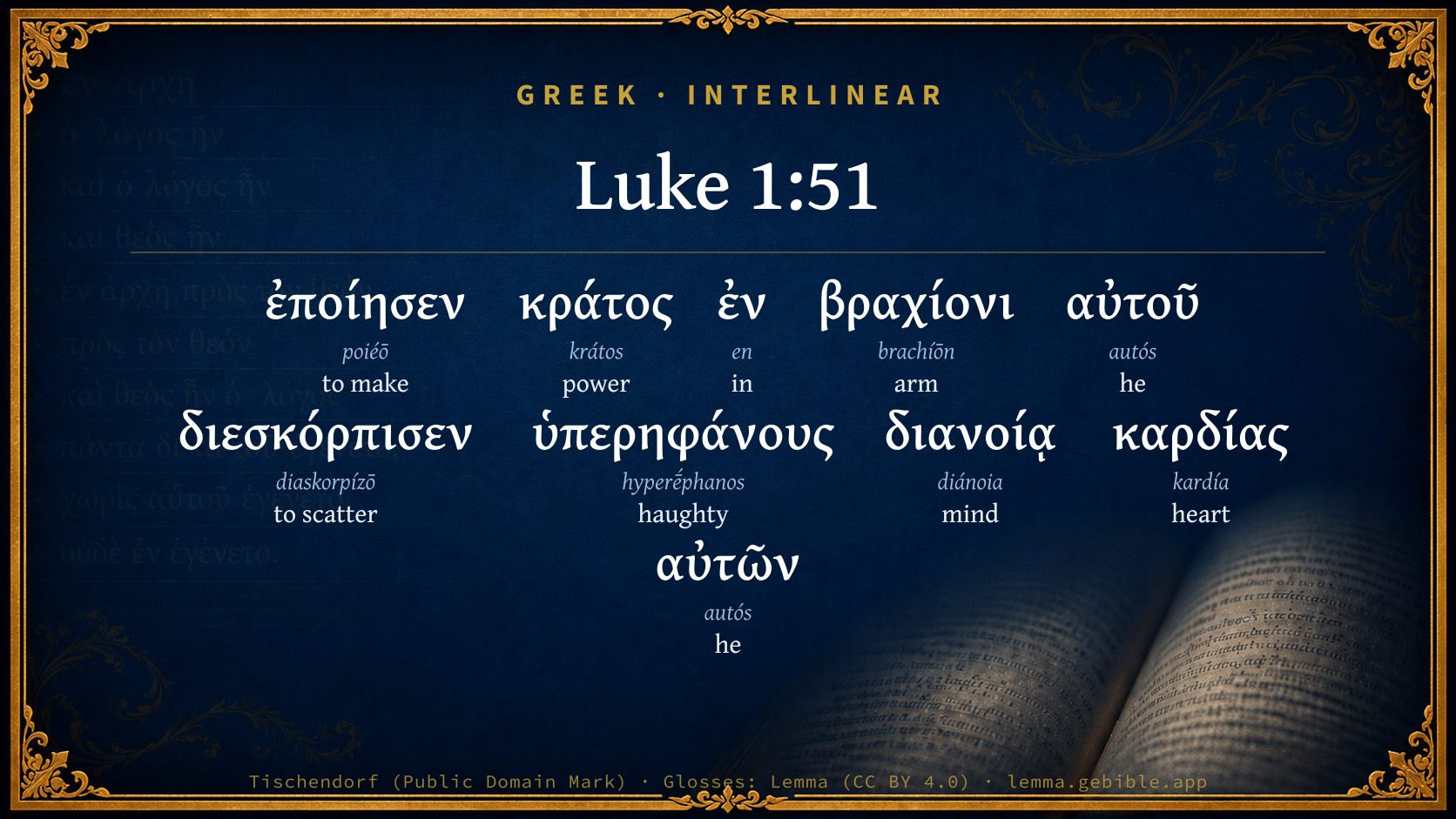
Download image
Cite this verse

Luke 1:51 (World English Bible). Public Domain. Lemma interlinear Bible study tool, https://lemma.gebible.app/v/luke/1/51.

Show BibTeX & RIS
BibTeX
RIS
English Translation
He has shown strength with his arm. He has scattered the proud in the imagination of their heart.
World English Bible · Public Domain
Highlights
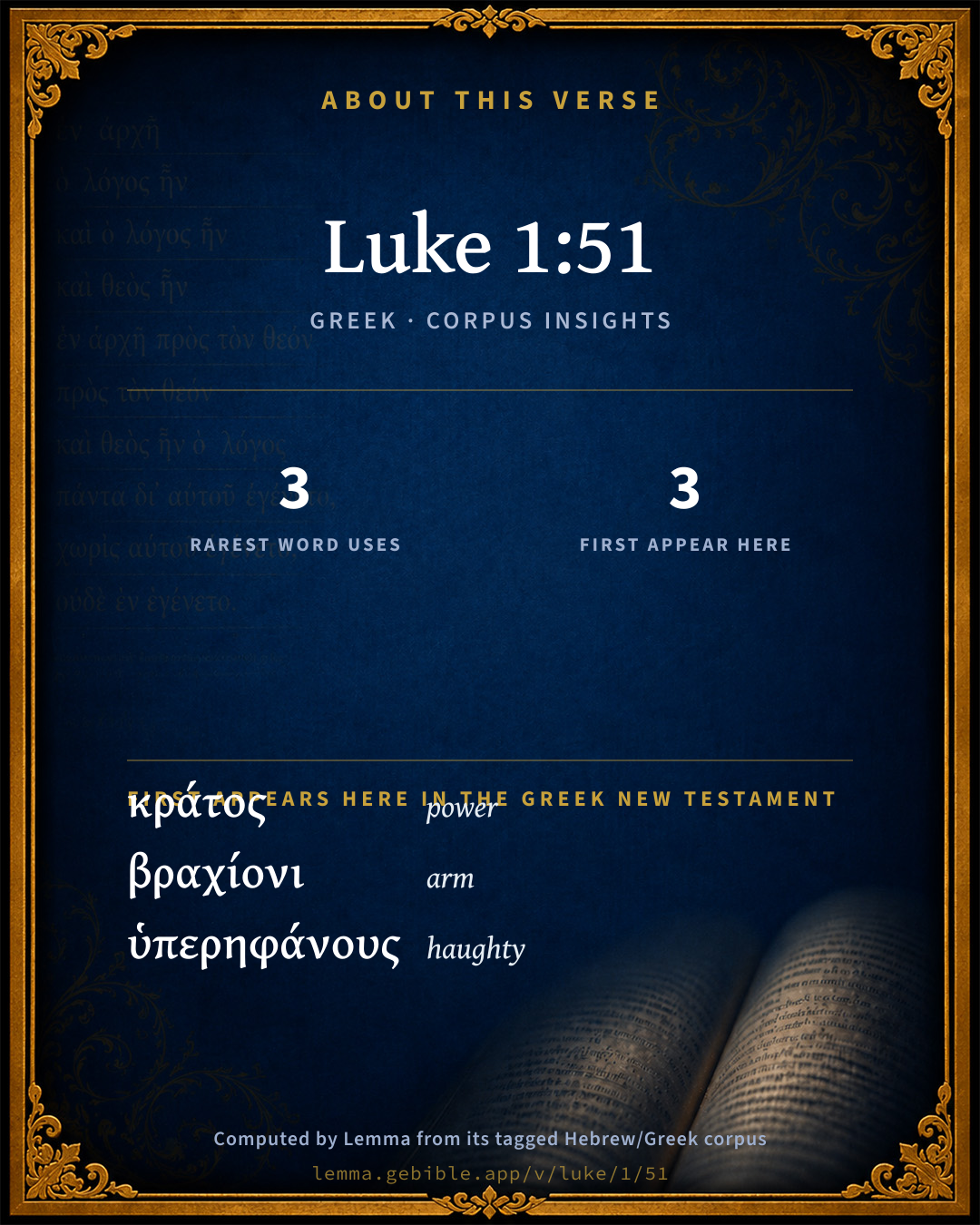
  • 3 first appearances in the Greek New Testament
Full analysis ↓
Download a study sheet

One document with this verse’s original text, its word-by-word gloss line, the meaning frame, cross-references with their text, attributed commentary, and full source and license credits — printable, and it pastes into notes with its structure intact.

This verse Autodidact and up

Study sheet (.html) Plain text (.txt)

A passage Seminary Student

Up to 50 verses in one chapter. A passage sheet keeps up to 6 commentary sources and 12 cross-references per verse, in the order this page ranks them, and says so on the sheet whenever that leaves anything out. Ask for a single verse and you get the Autodidact verse sheet above.

Everything on this page stays free to read, with no account — the sheet is a download of what is already on screen, not access to it.

Want to remove ads? Support Godless Engineer
Compare translations 3

The same verse in 3 English versions, stacked beneath the original-language interlinear above. Click any original word for its lexicon entry.

Each is an independent rendering of the whole verse — the interlinear is not word-aligned to these translations.

Highlighted words mark where these versions differ — a whole-verse word diff, not a word-by-word alignment.

  • World English Bible Public Domain
    He has shown strength with his arm. He has scattered the proud in the imagination of their heart.
  • King James Version Public Domain
    He hath shewed strength with his arm; he hath scattered the proud in the imagination of their hearts.
  • unfoldingWord Literal Text CC BY-SA 4.0
    He has done mighty deeds with his arm; he has scattered the proud in the thoughts of their hearts.

unfoldingWord Literal Text — © unfoldingWord, licensed CC BY-SA 4.0. Word-aligned USFM3 via Door43 (git.door43.org/unfoldingWord/en_ult).

Versions to compare (up to 4)

3 of 4 selected

Show all 19 translations

Every available English version of this verse, each an independent rendering of the whole verse.

  • World English Bible Public Domain
    He has shown strength with his arm. He has scattered the proud in the imagination of their heart.
  • Berean Standard Bible Public Domain
    He has performed mighty deeds with His arm; He has scattered those who are proud in the thoughts of their hearts.
  • Majority Standard Bible Public Domain
    He has performed mighty deeds with His arm; He has scattered those who are proud in the thoughts of their hearts.
  • King James Version Public Domain
    He hath shewed strength with his arm; he hath scattered the proud in the imagination of their hearts.
  • American Standard Version (1901) Public Domain
    He hath showed strength with his arm; He hath scattered the proud in the imagination of their heart.
  • Revised Version (1885) Public Domain
    He hath shewed strength with his arm; He hath scattered the proud in the imagination of their heart.
  • Geneva Bible (1599) Public Domain
    Hee hath shewed strength with his arme: hee hath scattered the proude in the imagination of their hearts.
  • Douay-Rheims (1899) Public Domain
    He hath shewed might in his arm: he hath scattered the proud in the conceit of their heart.
  • Young's Literal Translation Public Domain
    He did powerfully with His arm, He scattered abroad the proud in the thought of their heart,
  • Literal Standard Version CC BY-SA 4.0
    He did powerfully with His arm, || He scattered abroad the proud in the thought of their heart,
  • Unlocked Literal Bible CC BY-SA 4.0
    He has displayed strength with his arm; he has scattered those who were proud about the thoughts of their hearts.
  • unfoldingWord Literal Text CC BY-SA 4.0
    He has done mighty deeds with his arm; he has scattered the proud in the thoughts of their hearts.
  • Darby Bible Public Domain
    He has wrought strength with his arm; he has scattered haughty [ones] in the thought of their heart.
  • World Messianic Bible Public Domain
    He has shown strength with his arm. He has scattered the proud in the imagination of their hearts.
  • Webster's Bible Public Domain
    He hath shown strength with his arm; he hath scattered the proud in the imagination of their hearts.
  • Free Bible Version CC BY-SA 4.0
    With his power he has broken to pieces those who arrogantly think they're so clever.
  • Bible in Basic English Public Domain
    With his arm he has done acts of power; he has put to flight those who have pride in their hearts.
  • Text-Critical English NT CC BY 4.0
    He has done a mighty deed with his arm; he has scattered the proud in the thoughts of their hearts.
  • Tyndale New Testament (1534) Public Domain
    He sheweth strength with his arme he scattereth them that are proude in the ymaginacion of their hertes.

Literal Standard Version (2020), Covenant Press — licensed CC BY-SA 4.0. Text via the HelloAO Bible API (eBible.org). Unlocked Literal Bible (unfoldingWord) — licensed CC BY-SA 4.0. Text via the HelloAO Bible API (eBible.org). unfoldingWord Literal Text — © unfoldingWord, licensed CC BY-SA 4.0. Word-aligned USFM3 via Door43 (git.door43.org/unfoldingWord/en_ult). Free Bible Version, Dr. Jonathan Gallagher — licensed CC BY-SA 4.0. Text via the HelloAO Bible API (eBible.org).

Word by word

More ways to search: Search by grammar → Find every occurrence → Compare this word →

Practice this passage: Drill this verse → Learn its vocabulary →

About this verse

These counts appear in no published source. They are computed here, from the morphology-tagged text and Lemma’s own curated glosses. What Lemma adds →

10
words
9
distinct lemmas
Gospels
section

Notable vocabulary

The rarest word here is βραχίονι arm G1023 — appearing just 3 times in the whole Greek New Testament.

First appearance in Scripture

These words make their first canonical appearance in the Greek New Testament here:

  • κράτος power G2904
  • βραχίονι arm G1023
  • ὑπερηφάνους haughty G5244

Shared distinctive vocabulary

βραχίονι arm G1023 occurs in 3 verses of the Greek New Testament. Also found in:

Repetition

A word recurs within this verse:

  • αὐτοῦ he G846 ×2

Cross-references

30

Topical passages linked to Luke 1:51 in the Treasury of Scripture Knowledge — connected by theme and wording, ordered by reader-vote popularity; previews shown in the World English Bible.

  • Psalms 98:1 Sing to Yahweh a new song, For he has done marvelous things! His right hand, and his holy arm, have worked salvation for him.
  • Isaiah 52:10 Yahweh has made bare his holy arm in the eyes of all the nations; and all the ends of the earth have seen the salvation of our God.
  • 1 Samuel 2:3–4 Talk no more so exceeding proudly; Don't let arrogance come out of your mouth; For Yahweh is a God of knowledge, By him actions are weighed.
  • Isaiah 51:9 Awake, awake, put on strength, arm of Yahweh; awake, as in the days of old, the generations of ancient times. Isn't it you who did cut Rahab in pieces, who pierced the monster?
  • Romans 1:21 Because, knowing God, they didn't glorify him as God, neither gave thanks, but became vain in their reasoning, and their senseless heart was darkened.
  • Exodus 15:6–7 Your right hand, Yahweh, is glorious in power, Your right hand, Yahweh, dashes the enemy in pieces.
  • Daniel 4:37 Now I, Nebuchadnezzar, praise and extol and honor the King of heaven; for all his works are truth, and his ways justice; and those who walk in pride he is able to abase.
  • Exodus 18:11 Now I know that Yahweh is greater than all gods because of the thing in which they dealt arrogantly against them."
  • 1 Samuel 2:9–10 He will keep the feet of his holy ones; But the wicked shall be put to silence in darkness; For by strength shall no man prevail.
  • Job 40:9–12 Or have you an arm like God? Can you thunder with a voice like him?
  • Psalms 2:1–6 Why do the nations rage, And the peoples plot a vain thing?
  • Psalms 89:10 You have broken Rahab in pieces, like one of the slain. You have scattered your enemies with your mighty arm.
  • Psalms 89:13 You have a mighty arm. Your hand is strong, and your right hand is exalted.
  • Psalms 118:15 The voice of rejoicing and salvation is in the tents of the righteous. "The right hand of Yahweh does valiantly.
  • Isaiah 10:12–19 Therefore it shall happen that, when the Lord has performed his whole work on Mount Zion and on Jerusalem, I will punish the fruit of the stout heart of the king of Assyria, and the glory of his high looks.
  • Isaiah 40:10 Behold, the Lord Yahweh will come as a mighty one, and his arm will rule for him: Behold, his reward is with him, and his recompense before him.
  • Isaiah 63:12 who caused his glorious arm to go at the right hand of Moses? who divided the waters before them, to make himself an everlasting name?
  • Jeremiah 48:29–30 We have heard of the pride of Moab, [that] he is very proud; his loftiness, and his pride, and his arrogance, and the haughtiness of his heart.
  • Genesis 6:5 Yahweh saw that the wickedness of man was great in the earth, and that every imagination of the thoughts of his heart was only evil continually.
  • Genesis 8:21 Yahweh smelled the sweet savor. Yahweh said in his heart, "I will not again curse the ground any more for man's sake, because the imagination of man's heart is evil from his youth; neither will I ever again strike everything living, as I have done.
  • Exodus 15:9–13 The enemy said, 'I will pursue, I will overtake, I will divide the spoil. My desire shall be satisfied on them. I will draw my sword, my hand shall destroy them.'
  • Deuteronomy 29:19–20 and it happen, when he hears the words of this curse, that he bless himself in his heart, saying, I shall have peace, though I walk in the stubbornness of my heart, to destroy the moist with the dry.
  • Psalms 52:9 I will give you thanks forever, because you have done it. I will hope in your name, for it is good, In the presence of your saints.
  • Psalms 63:5 My soul shall be satisfied as with the richest food. My mouth shall praise you with joyful lips,
  • 2 Corinthians 10:5 throwing down imaginations and every high thing that is exalted against the knowledge of God, and bringing every thought into captivity to the obedience of Christ;
  • 1 Peter 5:5 Likewise, you younger ones, be subject to the elder. Yes, all of you gird yourselves with humility, to subject yourselves to one another; for "God resists the proud, but gives grace to the humble."
  • Revelation 18:8 Therefore in one day her plagues will come: death, mourning, and famine; and she will be utterly burned with fire; for the Lord God who has judged her is strong.
  • Deuteronomy 4:34 Or has God tried to go and take him a nation from the midst of [another] nation, by trials, by signs, and by wonders, and by war, and by a mighty hand, and by an outstretched arm, and by great terrors, according to all that Yahweh your God did for you in Egypt before your eyes?
  • Psalms 33:10 Yahweh brings the counsel of the nations to nothing. He makes the thoughts of the peoples to be of no effect.
  • Daniel 5:25–31 This is the writing that was inscribed: MENE, MENE, TEKEL, UPHARSIN.

Cross-references courtesy of OpenBible.info (CC BY 4.0).

Commentary

Notes on Luke 1:51 from classic Christian and Jewish commentators (each source and its license shown beneath its notes). The classic Christian expositions comment on the surrounding passage and are grouped to its opening verse, so a note may address several verses; the Jewish commentaries on the Tanakh (Rashi and others) are per-verse, so they appear only where the commentator wrote on this verse.

Lemma curates 59 commentaries, every one of them public domain or Creative Commons licensed, each selected and text-cleaned for this edition rather than reprinted as found. About our sources →

Tyndale Open Study Notes

Tyndale Open Resources

1:51 His mighty arm personifies God’s mighty power (see Ps 98:1; Isa 40:10).

Tyndale Open Study Notes — © Tyndale Open Resources, licensed CC BY-SA 4.0. Text via the HelloAO Bible API.

Bengel's Gnomon

Johann Albrecht Bengel

Luk 1:51. Ἐποίησε κράτος—ἐξαπέστειλε κενοὺς, He hath showed strength—He hath sent empty away) God designed to do all these things through the Messiah, and the mother of the Latter was receiving an experimental proof of the fact in her own self.—ὑπερηφάνους, the proud) both those visible and those invisible [Satan, etc.] of this character.

Bengel's Gnomon of the New Testament — English translation (T&T Clark, Edinburgh, 1860) — public domain. Text from a community e-Sword module.

Meyer's Critical & Exegetical Commentary

Heinrich August Wilhelm Meyer

Luk_1:51 ff. Mary now sees the Messianic catastrophe, which God will bring about by means of her son, and she announces it prophetically as having already happened; for she bears in fact the accomplisher of it already in her womb, and thus the work of God, which He is to execute, is before her enlightened gaze already as good as completed; in that way she sees and describes it.

The catastrophe itself is the restoration of the state of things to the divine rightful order, the overthrow of the Gentiles and the exaltation of the deeply-oppressed theocratic people (comp. Luk_1:68; Luk_1:71; Luk_1:74); the former are set forth by the words ὑπερηφάνους, δυνάστας, πλουτοῦντας; the latter, by ταπεινούς and πεινῶντας. This intended concrete application of the general expressions is put beyond doubt by ἀντελάβετο Ἰσραὴλ κ.τ.λ., Luk_1:54 f.

ὑπερηφάνους] such as are arrogant in the thoughts of their heart; διανοίᾳ is the dative of more precise definition; and on the notion (thinking and willing as directed outwards), comp. Beck, Seelenl. p. 58; on καρδία as the centre of the spiritual and psychic life, Delitzsch, bibl. Psychol. p. 248 ff.; finally, in διεσκόρπ. the haughty are conceived of as congregated and keeping together; comp. Mat_26:31; Act_5:37; Psa_89:10. That through Christianity the proud were humbled (de Wette), is not the thought expressed by Mary, but a generalization of it, as is also the confusio diabolicae superbiae (Calovius and others), and the like. Comp. Sir_10:14 ff.

Luk_1:52. He has cast down rulers from thrones, does not apply to the demons and Pharisees (Theophylact), but to the Gentile holders of power. Comp. on the idea of the overthrow of thrones in the times of the Messiah, Wis_5:23; Enoch xxxviii. 4, and Dillmann thereon.

Luk_1:53. ἀγαθῶν] not merely means of subsistence (Valckenaer, Bornemann, de Wette), but earthly possessions in general, among which the means of subsistence are included. Comp. Luk_12:18 f. De Wette, moreover, is in error in saying (comp. Olshausen) that it is spiritual hunger and spiritual satisfying that are to be thought of, and that the rich are a type of the wise men of this world. The whole is to be taken literally; the idealizing is not warranted according to the context. Comp. Psa_34:11.

ἐξαπέστ. κενούς] So that they retain nothing of their possessions, and have received nothing from the Messiah. On the expression, comp. Luk_20:10 f.; Job_22:9; Jdt_10:11; Hom. Il. ii. 298, Od. xiii. 214.

For descriptions of the divine inversion of relations from the classical writers, see Wetstein and Bornemann.

Meyer — Critical and Exegetical Commentary on the New Testament — English translation by Peter Christie, edited by Frederick Crombie (T&T Clark, 1880) — public domain. Text from a community e-Sword module.

Godet's Commentaries

Frédéric Louis Godet

Vers. 51-53. A much more strongly marked poetical parallelism characterizes this strophe. Mary here describes with a thrill of emotion, of which even her language partakes, the great Messianic revolution, the commencement of which she was beholding at that very time. In the choice God had made of two persons of such humble condition in life as herself and her cousin, she saw at a glance the great principle which would regulate the impending renewal of all things. It is to be a complete reversal of the human notions of greatness and meanness.

The poor and the hungry are evidently the Israelites fearing God of Luk 1:50. Such expressions cannot apply to Israel as a whole—to the proud Pharisees and rich Sadducees, for example. The line of demarcation which she draws in these words passes, therefore, not between the Jews and Gentiles, but between the pious Israelites and all that exalt themselves against God, whether in or beyond Israel. The proud, the mighty, and the rich, denote Herod and his court, the Pharisees and the Sadducees, as well as the foreign oppressors, Caesar and his armies, and all the powers of heathendom. The aorists of these three verses indicate, according to Bleek, the repetition of the act; so he translates them by the present. I rather think that to Mary’s eyes the catastrophe presents itself as already consummated in the act which God had just accomplished. Does not this act contain the principle of the rejection of all that is exalted in the world, and of the choice of whatever in human estimation is brought low? All these divine acts which are about to follow, one after another, will only be a further application of the same principle. They are virtually contained in that which Mary celebrates. Consequently the aorists are properly translated by the past.

The first proposition of Luk 1:51 applies to the righteous and wicked alike. Still the former of these two applications predominates (Luk 1:50). The arm is the symbol of force. The expression ποιεῖν κράτος, to make strength, is a Hebraism, עשָׂה†ָחיִל ׃ (ֹPsa 118:15). The LXX. translate it by ποιεῖν δύναμιν. If it was Luke who translated the Hebrew document into Greek, it is evident that he kept his version independent of the LXX.

The favour God shows to the righteous has its necessary counterpart in the overthrow of the wicked. This is the connection of the second proposition. The expression ὑπερηφάνους διανοίᾳ, proud in thought, answers to לֵבבּירֵי אַ(ִPsa 76:6); the LXX. translate this expression by ἀσύνετοι τῇ καρδίᾳ. The dative διανοίᾳ defines the adjective: “the proud in thought, who exalt themselves in their thoughts.” Mary represents all these as forming an opposing host to men that fear God; hence the expression scatter. With the reading διανοίας, ὑπερηφάνους is the epithet of the substantive, proud thoughts. This reading is evidently a mistake.

Frédéric Louis Godet — Commentaries on Luke, John, Romans, and 1 Corinthians — English translation (T&T Clark, Edinburgh, 1870s–1890s) — public domain. Text from a community e-Sword module.

Geneva Bible (1599)

Geneva Bible translators

That is, an heaping up of words more than needed, which the Hebrews use very much, and the arm is taken for strength.

Even as the wind doth the chaff.

He hath scattered them, and the imagination of their hearts; or by and through the imagination of their own hearts: so that their wicked counsel turned to their own destruction.

Geneva Bible (1599) marginal notes — public domain. Text via Bolls.life.

Adam Clarke's Commentary

Verse 51. He hath showed strength] Or, He hath gained the victory, εποιησε κρατος. The word κρατος is used for victory, by Homer, Hesiod, Sophocles, Euripides, and others.

With his arm] Grotius has well observed, that God's efficacy is represented by his finger, his great power by his hand, and his omnipotence by his arm. The plague of lice was the finger of God, Ex 7:18. The plagues in general were wrought by his hand, Ex 3:20, And the destruction of Pharaoh's host in the Red Sea, which was effected by the omnipotence of God, is called the act of his arm, Ex 15:16.

He hath scattered] διεσκορπισεν, hath scattered abroad; as a whirlwind scatters dust and chaff.

The proud] Or haughty, υπερηφανους; from υπερ above, and φαινω I show - the haughty men, who wish to be noticed in preference to all others, and feel sovereign contempt for all but themselves. These God scatters abroad-instead of being in his sight, as in their own, the most excellent of the earth, he treats them as straw, stubble, chaff, and dust.

In the imagination of their hearts.] While they are forming their insolent, proud, and oppressive projects - laying their plans, and imagining that accomplishment and success are waiting at their right hand, the whirlwind of God's displeasure blows, and they and their machinations are dissipated together.

Adam Clarke's Commentary on the Bible (1810–1826) — public domain. Text from a community e-Sword/MySword module.

Ellicott's Commentary for English Readers

(51) He hath shewed strength.—Literally, He wrought strength. Here the parallelism with 1Sa_2:3 becomes very close. Of whom the speaker thought as among the “proud,” we cannot know. They may have been the potentates of the world in which she lived, Herod and the Emperor of Rome. They may have been the men of Jerusalem, who despised Galilee; or those of the other towns and villages of Galilee, who despised Nazareth; or, though less probably, those of Nazareth itself, who despised the carpenter and his betrothed.

A Bible Commentary for English Readers, edited by Charles John Ellicott (1878–1897) — public domain. Text from a community e-Sword module.

The Cambridge Bible for Schools and Colleges

gen. ed. J. J. S. Perowne

51. with his arm] “Thou hast a mighty arm,” Psa_89:13. The nearest parallel to the remainder of the verse is Job_5:12.

The Cambridge Bible for Schools and Colleges (gen. ed. J. J. S. Perowne; Cambridge University Press, 1878–1918) — public domain. Text from a community e-Sword module.

John Gill's Exposition

He hath showed strength with his arm,.... Of almighty power, in the business of the incarnation, and in working out salvation for his people; which is done by his own arm, he being mighty to save, and travelling in the greatness of his strength; see Isa 63:1.

He hath scattered the proud in the imagination of their hearts; whom he always resists, and both in providence and grace, takes such methods, as tend to humble and confound them: here particularly, it may regard the proud and haughty Jews; who imagined nothing less, than that the Messiah would be born of one of the rich and noble families in Judea; that he would appear as a temporal prince, and set up a temporal kingdom in great state and splendour, and make them a free and flourishing people: when instead of this, he was to be born of a poor virgin, of whom they disdainfully say, is not his mother called Mary? who was of Nazareth in Galilee, of which it is said, shall Christ come out of Galilee? or any good thing out of Nazareth? A virgin betrothed to a carpenter, and her son of that business also, with which both were flouted; and because of this meanness, the Messiah was rejected by them; and thus were they scattered and confounded in their imaginations.

John Gill's Exposition of the Whole Bible (1746–1763) — public domain (CC PDM 1.0). Text via the HelloAO Bible API.

Trapp's Complete Commentary

John Trapp

51 He hath shewed strength with his arm; he hath scattered the proud in the imagination of their hearts.

Ver. 51. He hath showed strength, &c.] It appears by the whole frame of this holy song, that the blessed Virgin was well versed in the Scripture, which she here makes so much use of in sundry passages. She was eruditionis pietatis et modestiae delicium, as one speaketh of the Lady Jane Grey. She had by much reading made her bosom Bibliothecam Christi, Christ’s library, as a Father saith; and may seem to have been exercised in the good word of God from her infancy, as 2Ti 3:15, and as that sweet young gentlewoman, Mrs Elizabeth Wheatenhall, daughter of Mr Anthony Wheatenhall, of Tenterden, in Kent, deceased, who not yet being ten years old when she died, yea, before she was nine years old (not much above eight), could say all the New Testament by heart, and being asked where any words were, she would presently name book, chapter, and verse. One Mr Stoughton, a minister, writeth this upon his own knowledge and examination of her.

He hath scattered the proud] He by his strong arm hath so splitted them, that they shiver into pieces, διεσκορπισε; or hath made them as darts, which, being among the enemies, are lost; or hath hurled them hither and thither, as the wind doth the dust of the mountains.

John Trapp, A Commentary or Exposition upon All the Books of the Old and New Testament (1647–1656) — public domain. Text from a community e-Sword module.

Albert Barnes' Notes on the Bible

Hath showed strength with his arm - The “arm” is the symbol of strength. The expression in this and the subsequent verses has no particular reference to his mercy to Mary. From a contemplation of His goodness to her, she enlarges her views to a contemplation of His goodness and power in general, and to a celebration of the praises of God for all that he has done to all people. This is the nature of true piety. It does not terminate in thinking of God’s mercy toward ourselves. It thinks of others, and praises God that others also are made partakers of His mercy, and that His goodness is manifested to all His works.

He scattereth the proud - He hath often done it in time of battle and war. When the proud Assyrian, Egyptian, or Babylonian had come against the people of God, He had often scattered them and driven away their armies.

In the imagination of their hearts - Those who were lifted up or exalted in their own view. Those who “thought themselves” to be superior to other men.

Albert Barnes' Notes on the Bible (1834–1885) — public domain. Text from a community e-Sword/MySword module.

Haydock's Catholic Bible Commentary

The wise men of the Gentiles, the Pharisees and Scribes, were powerful; but these the Almighty cast down, and exalted those, who humbled themselves under his powerful hand. (1 Peter v.) The Jews were proud in their strength, but their incredulity brought on them their humiliation; whilst the low and mean among the Gentiles, have by faith ascended to the summit of perfection. (St. Cyril of Alexandria in St. Thomas Aquinas’ catena aurea.) (Witham)

George Leo Haydock (1774–1849), Haydock's Catholic Family Bible and Commentary, 1859 edition — public domain. Excludes Psalms (Douay-Rheims chapter numbering differs from Protestant) and Deuterocanonical books (Catholic canon only).

Matthew Poole's English Annotations

In these verses the virgin celebrates both the power and justice of God, as she before had done his holiness, and his mercy and goodness. The strength of a man is much seen in the effects of his arm; hence God, who hath no such parts as we have, is yet spoken of as if he had an arm, by which no more is signified than a mighty power, by which he bringeth things to pass; Exo 15:16; Psa 89:13; 98:1; Isa 40:10; so in many other texts.

He hath scattered the proud in the imagination of their hearts. Jethro, Exo 18:11, knew that the Lord was above all gods, because in the thing wherein they dealt proudly he was above them.

The proud in Scripture often signifies wicked men, as the humble signifies good and holy men; but proud, in a strict sense, signifieth men that have a high opinion of themselves: now there is nothing that a proud man dealeth more proudly in, than in following the imaginations of his own heart. There (saith Mary) God scattereth them, turning their counsels into folly, and confounding them in their own imaginations.

He hath put down the mighty from their seats: thus he did by Pharaoh, Nebuchadnezzar, &c.: he pulls down some, and sets up others. Promotion is not from the east, nor from the west.

And exalted them of low degree: this is God’s way; thus he exalted Moses, Joseph, Jacob, David. God thus showeth his mighty power and superintendency upon men’s affairs. He doth what he pleaseth with men, yet what he doth is infinitely wise, just, and good.

Matthew Poole's English Annotations on the Holy Bible (1683–1685) — public domain. Text from a community e-Sword/MySword module.

The Pulpit Commentary

Vers. 51-53. He hath showed strength with his arm; he hath soattered the proud in the imagination of their hearts. He hath put down the mighty from their seats, and exalted them of low degree. He hath filled the hungry with good things; and the rich he hath sent empty away. From adoration, Mary"s hymn proceeds to celebrate the mighty results effected by the Divine pity. As so often in thee prophetic strains, the speaker or writer speaks or writes as though the future had become the past; so Mary here describes the Messianic reversal of man"s conception of what is great and little, as though the unborn Babe had already lived and done his strange mighty work in the world. The "glorious arm" which, in old days, had wrought such mighty things for Israel, she recognized as belonging to the coming Deliverer (verse 51). His chosen instruments would be those of whom the world thought little, like herself. The proud and mighty would be put down; the men of low degree, and poor and humble, would be exalted. The hungry would be filled; and they who were rich only in this world"s goods would have no share in the new kingdom they would be sent empty away. How strangely had the virgin of Nazareth caught the thought, almost the very words, of the famous sermon her Divine Son, some thirty years later, preached on the mountainside near Gennesaret!

The Pulpit Commentary (1880–1919), ed. H.D.M. Spence-Jones & Joseph S. Exell — public domain. Text from a community e-Sword module.

John Wesley's Explanatory Notes

He hath wrought strength with his arm - That is, he hath shown the exceeding greatness of his power. She speaks prophetically of those things as already done, which God was about to do by the Messiah. He hath scattered the proud - Visible and invisible.

John Wesley, Explanatory Notes Upon the Whole Bible (1754–1765) — public domain. Text via the GEBible commentary corpus.

Cambridge Greek Testament for Schools and Colleges

51. ἐποίησεν κράτος. A Hebraism. Psa 118:15, &c.

ἐν βραχίονι αὐτοῦ. “Thou hast a mighty arm,” Psa 89:13. The nearest parallel to the remainder of the verse is Job 5:12.

Cambridge Greek Testament for Schools and Colleges (Cambridge University Press, 1896; 21 vols, various authors incl. Carr, Maclear, Plummer, Farrar, Lumby, Moule, M. R. James, Simcox) — public domain. Text from a community e-Sword module.

Alford’s Greek Testament

Henry Alford

51-55.] These aorists express, not the habit of the past, but the consequences involved for the future in that which the Lord had done to her.

51.] The dative διανοίᾳ apparently expresses the realm in which the ὑπερηφανία is shewn. Bleek quotes from Symmachus, Psa 75:6, ὑπερήφανοι τῇ καρδίᾳ: but it is τὴν καρδίαν: the LXX however in the same place has ἀσύνετοι τῇ καρδίᾳ.

Ver. 55 is not rendered in the E. V. according to the construction; from Psa 97:3 it will be seen that μνησθῆναι ἐλέους τῷ Ἀβ. are to be joined together, and therefore καθὼς … ἡμῶν will be parenthetical. See Mic 7:20.

Henry Alford, The Greek Testament (1849–1861) — public domain. Text from a community e-Sword module.

International Critical Commentary

51. Ἐποίησεν κράτος ἐν βραχίονι αὐτοῦ, διεσκόρπισεν, κ.τ.λ. Beginning of the third strophe. The six aorists in it are variously explained. 1. They tell of things which the Divine power and holiness and mercy (vv. 49, 50) have already accomplished in the past. 2. According to the common prophetic usage, they speak of the future as already past, and tell of the effects to be produced by the Messiah as if they had been produced. 3. They are gnomic, and express God’s normal acts. We may set aside this last. It is very doubtful whether the aor. is ever used of what is normal or habitual (Win. xl. 5. b, 1, p. 346). Of the other two explanations, the second is to be preferred. It is more likely that Mary is thinking of the farreaching effects of the blessing conferred upon herself than of past events unconnected with that blessing. In either case the six aorists must be translated by the English perfect. They show that in this strophe, as in the second, we have a triplet. There it was God’s power, holiness, and mercy. Here it is the contrasts between proud and humble, high and low, rich and poor.

Both ἐποίησεν κράτος and ἐν βραχίονι αὐτοῦ are Hebraisms. For the former comp. δεξιὰ Κυρίου ἐποίησεν δύναμιν (Psa 118:15). For βραχίων to express Divine power comp. Act 13:17 ; Joh 12:38 (from Isa 53:1); Psa 44:3, Psa 98:1, etc. The phrase ἐν χειρὶ κραταιᾷ καὶ ἐν βραχίονι ὑψηλῷ is frq). in LXX (Deu 4:34, Deu 5:15, Deu 6:21, Deu 26:8). This use of ἐν is in the main Hebraistic (22:49; Rev 6:8; Jdg 15:15, Jdg 15:20:16; 1Ki 12:18; Judith 6:12, 8:33). Win. xlviii. 3. d, p. 485.

ὑπερηφάνους διανοίᾳ καρδίας αὐτῶν. The dat. limits ὑπερηφάνους: they are proud and overweening in thought. In N.T. ὑπερήφανος is never “conspicuous above” others, but always in a bad sense, “looking down on” others (Jas 4:6; 1Pe 5:5; Rom 1:30; 2Ti 3:2. It is freq. in LXX. Comp. Ps. Sol. 2:35, κοιμίζων ὑπερηφάνους εἰς ἀπώλειαν αἰώνιον ἐν ἀτιμίᾳ; also 4:28. See Wsctt. on 1Jn 2:16, and Trench, Syn. xxix.

International Critical Commentary — older volumes (1896–1929), various authors — public domain. Text from a community e-Sword module.

Vincent's Word Studies in the New Testament

Marvin R. Vincent

Shewed strength [εποιησεν κρατος] . Lit., made strength. So Wyc., made might. A Hebrew form of expression. Compare Psa 118:15, Sept. : "The right hand of the Lord doeth valiantly" (ejpoihse dunamin, made strength).

In the imagination [διανοια] . The faculty of thought, understanding, especially moral understanding. Wyc. refers the word here to God : with mind of his heart. Some prefer to render "by the imagination," thus making the proud the instrument of their own destruction. Compare 2Co 10:5.

Marvin R. Vincent, Word Studies in the New Testament (1887–1900) — public domain. Text from a community e-Sword/MySword module.

Lesson kit

Teaching starters — assembled from the data on this page, not authored interpretation. Every prompt links to the verse data it draws on. Edit before teaching.

Luke, in the Gospels, opens this verse with 10 words (9 distinct Greek lemmas). Its most distinctive word is brachíōn (“arm”). A historical commentator’s framing appears above. Read the whole chapter for the surrounding context.

Discussion questions

  1. The word brachíōn carries the sense “arm.” How does it shape the verse?
  2. 3 words here appear for the first time in Scripture. What is being introduced at this debut?
  3. John 12:38 shares the word «arm» with this verse. How do the two illuminate each other?
  4. “he” occurs 2× in this one verse. What is the effect of the repetition?
  5. These translations render this verse differently; the difference is in the English rendering, not the original. What questions does that raise?
  6. Reading how Tyndale Open Study Notes and Bengel's Gnomon read this verse, where do the two commentators agree and where do they part?

Things to notice

  • 3 words make their first canonical appearance in Scripture here.
  • These translations choose different wording for 11 words in this verse.
  • “he” occurs 2× in this single verse.
  • 9 distinct Greek lemmas span 10 words in this verse.

Reading settings

Reading text

Shown beneath each verse's original-language words.

Old Testament
Old Testament edition

Read the OT as the Masoretic Hebrew (MT) or the Greek Septuagint (LXX).

English shown for the Greek Septuagint (in the Hebrew ↔ Greek comparison).

Comparing translations? Open the Compare panel on any verse page to stack up to four side by side.