1 Samuel 1:7

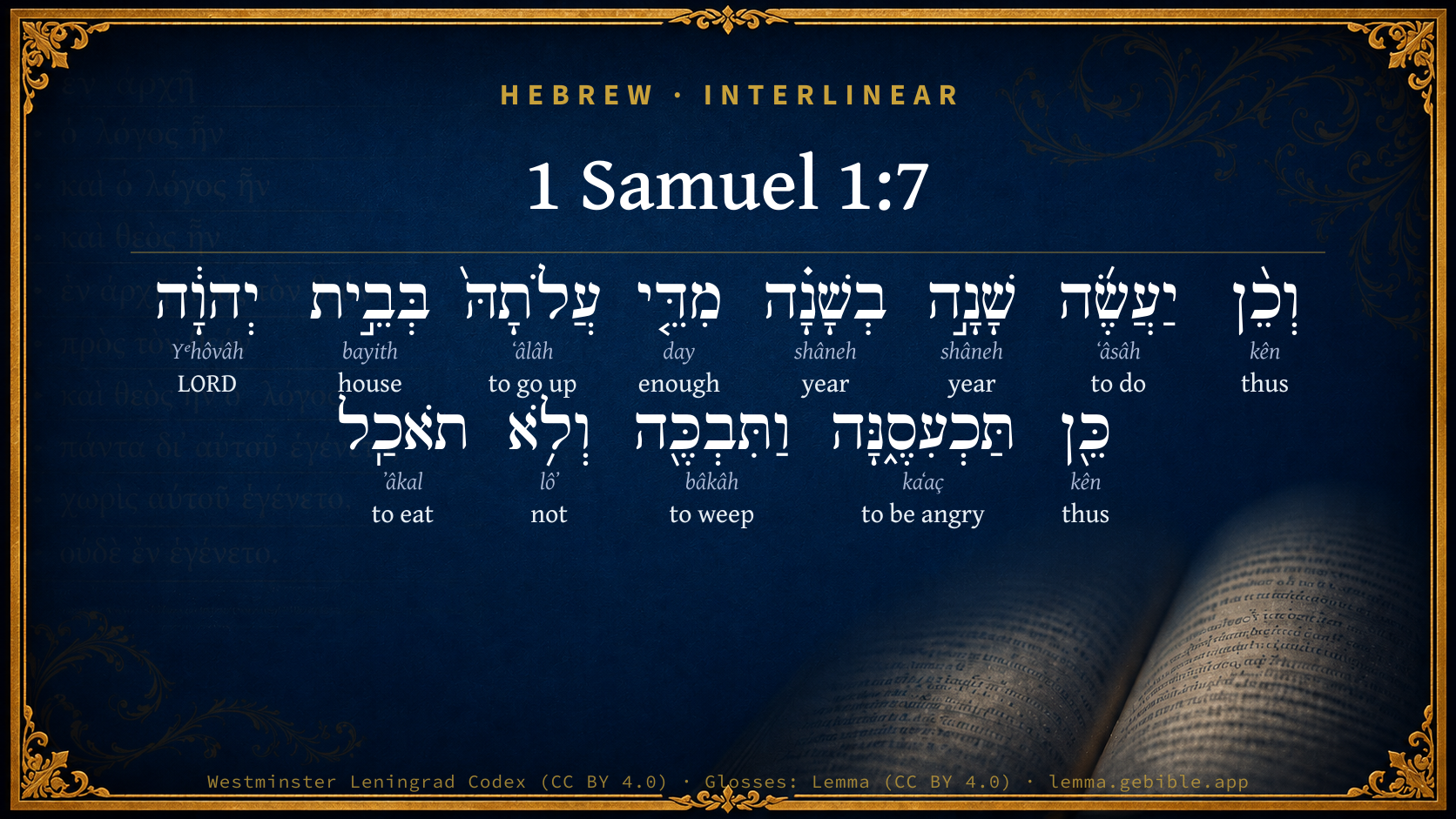
Hebrew (Westminster Leningrad Codex) 1 Samuel 1:7 appears in the Hebrew Old Testament. The text above is from the Westminster Leningrad Codex. Each word links to its Strong’s number, a concise gloss, and parsing drawn from the Open Scriptures Hebrew Bible morphology. Click any word for its full Brown-Driver-Briggs (BDB) entry.
Download image
Cite this verse

1 Samuel 1:7 (World English Bible). Public Domain. Lemma interlinear Bible study tool, https://lemma.gebible.app/v/1-samuel/1/7.

Show BibTeX & RIS
BibTeX
RIS
English Translation
[as] he did so year by year, when she went up to the house of Yahweh, so she provoked her; therefore she wept, and did not eat.
World English Bible · Public Domain
Download a study sheet

One document with this verse’s original text, its word-by-word gloss line, the meaning frame, cross-references with their text, attributed commentary, and full source and license credits — printable, and it pastes into notes with its structure intact.

This verse Autodidact and up

Study sheet (.html) Plain text (.txt)

A passage Seminary Student

Up to 50 verses in one chapter. A passage sheet keeps up to 6 commentary sources and 12 cross-references per verse, in the order this page ranks them, and says so on the sheet whenever that leaves anything out. Ask for a single verse and you get the Autodidact verse sheet above.

Everything on this page stays free to read, with no account — the sheet is a download of what is already on screen, not access to it.

Want to remove ads? Support Godless Engineer
Compare translations 3

The same verse in 3 English versions, stacked beneath the original-language interlinear above. Click any original word for its lexicon entry.

Each is an independent rendering of the whole verse — the interlinear is not word-aligned to these translations.

Highlighted words mark where these versions differ — a whole-verse word diff, not a word-by-word alignment.

  • World English Bible Public Domain
    [as] he did so year by year, when she went up to the house of Yahweh, so she provoked her; therefore she wept, and did not eat.
  • King James Version Public Domain
    And as he did so year by year, when she went up to the house of the LORD, so she provoked her; therefore she wept, and did not eat.
  • unfoldingWord Literal Text CC BY-SA 4.0
    And thus he did year by year; according to her going up to the house of Yahweh, thus she would provoke her. And she wept and did not eat.

unfoldingWord Literal Text — © unfoldingWord, licensed CC BY-SA 4.0. Word-aligned USFM3 via Door43 (git.door43.org/unfoldingWord/en_ult).

Versions to compare (up to 4)

3 of 4 selected

Show all 18 translations

Every available English version of this verse, each an independent rendering of the whole verse.

  • World English Bible Public Domain
    [as] he did so year by year, when she went up to the house of Yahweh, so she provoked her; therefore she wept, and did not eat.
  • Berean Standard Bible Public Domain
    And this went on year after year. Whenever Hannah went up to the house of the LORD, her rival taunted her until she wept and would not eat.
  • Majority Standard Bible Public Domain
    And this went on year after year. Whenever Hannah went up to the house of the LORD, her rival taunted her until she wept and would not eat.
  • King James Version Public Domain
    And as he did so year by year, when she went up to the house of the LORD, so she provoked her; therefore she wept, and did not eat.
  • American Standard Version (1901) Public Domain
    And `as' he did so year by year, when she went up to the house of Jehovah, so she provoked her; therefore she wept, and did not eat.
  • Revised Version (1885) Public Domain
    And as he did so year by year, when she went up to the house of the LORD, so she provoked her; therefore she wept, and did not eat.
  • Geneva Bible (1599) Public Domain
    (And so did he yeere by yeere) and as oft as she went vp to the house of the Lord, thus she vexed her, that she wept and did not eate.
  • Douay-Rheims (1899) Public Domain
    And thus she did every year, when the time returned that they went up to the temple of the Lord: and thus she provoked her: but Anna wept, and did not eat.
  • Young's Literal Translation Public Domain
    And so he doth year by year, from the time of her going up into the house of Jehovah, so it provoketh her, and she weepeth, and doth not eat.
  • Literal Standard Version CC BY-SA 4.0
    And so is done year by year, from the time of her going up into the house of YHWH, so she provokes her, and she weeps, and does not eat.
  • Unlocked Literal Bible CC BY-SA 4.0
    So year after year, when she went up to the house of Yahweh with her family, her rival always provoked her. Therefore she used to weep and eat nothing.
  • unfoldingWord Literal Text CC BY-SA 4.0
    And thus he did year by year; according to her going up to the house of Yahweh, thus she would provoke her. And she wept and did not eat.
  • Darby Bible Public Domain
    And [as] he did so year by year, as often as she went up to the house of Jehovah, she provoked her thus; and she wept and did not eat.
  • World Messianic Bible Public Domain
    So year by year, when she went up to the LORD’s house, her rival provoked her. Therefore she wept, and didn’t eat.
  • Webster's Bible Public Domain
    And as he did so year by year, when she went up to the house of the LORD, so she provoked her; therefore she wept, and did not eat.
  • Free Bible Version CC BY-SA 4.0
    This went on for years. Whenever Hannah went to the Lord's Temple, Peninnah would taunt her until she cried and couldn't eat.
  • Bible in Basic English Public Domain
    And year by year, whenever she went up to the house of the Lord, she kept on attacking her, so that Hannah gave herself up to weeping and would take no food.
  • JPS Tanakh (1917) Public Domain
    And as he did so year by year, when she went up to the house of the LORD, so she vexed her; therefore she wept, and would not eat.

Literal Standard Version (2020), Covenant Press — licensed CC BY-SA 4.0. Text via the HelloAO Bible API (eBible.org). Unlocked Literal Bible (unfoldingWord) — licensed CC BY-SA 4.0. Text via the HelloAO Bible API (eBible.org). unfoldingWord Literal Text — © unfoldingWord, licensed CC BY-SA 4.0. Word-aligned USFM3 via Door43 (git.door43.org/unfoldingWord/en_ult). Free Bible Version, Dr. Jonathan Gallagher — licensed CC BY-SA 4.0. Text via the HelloAO Bible API (eBible.org).

Word by word

More ways to search: Search by grammar → Find every occurrence → Compare this word →

Practice this passage: Drill this verse → Learn its vocabulary →

מִדֵּ֤י
day
H1767
“from · enough of”
Preposition + Noun, Common, Masculine, Singular, Construct
Part of Speech
Preposition + Noun
Type
Common
Gender
Masculine
Number
Singular
State
Construct
Full BDB Definition

Origin: of uncertain derivation

TWOT: 425

sufficiency, enough - enough - for, according to the abundance of, out of the abundance of, as often as
  1. וְכֵ֨ן kên H3651 “and · thus” Conjunction + Particle, Demonstrative
  2. יַעֲשֶׂ֜ה ʻâsâh H6213 “to do” Verb, Qal, Imperfect, 3rd Person, Masculine, Singular
  3. שָׁנָ֣ה shâneh H8141 “year” Noun, Common, Feminine, Singular, Absolute
  4. בְשָׁנָ֗ה shâneh H8141 “in/at · year” Preposition + Noun, Common, Feminine, Singular, Absolute
  5. עֲלֹתָהּ֙ ʻâlâh H5927 “to go up · her” Verb, Qal, Infinitive Construct + Suffix, Personal, 3rd Person, Feminine, Singular
  6. בְּבֵ֣ית bayith H1004 “in/at · house of” Preposition + Noun, Common, Masculine, Singular, Construct
  7. יְהוָ֔ה Yᵉhôvâh H3068 “LORD” Noun, Proper
  8. כֵּ֖ן kên H3651 “thus” Particle, Demonstrative
  9. תַּכְעִסֶ֑נָּה kaʻaç H3707 “to be angry · her” Verb, Hiphil, Imperfect, 3rd Person, Feminine, Singular + Suffix, Personal, 3rd Person, Feminine, Singular
  10. וַתִּבְכֶּ֖ה bâkâh H1058 “and · to weep” Conjunction + Verb, Qal, Sequential Imperfect, 3rd Person, Feminine, Singular
  11. וְלֹ֥א lôʼ H3808 “and · not” Conjunction + Particle, Negative
  12. תֹאכַֽל ʼâkal H398 “to eat” Verb, Qal, Imperfect, 3rd Person, Feminine, Singular

About this verse

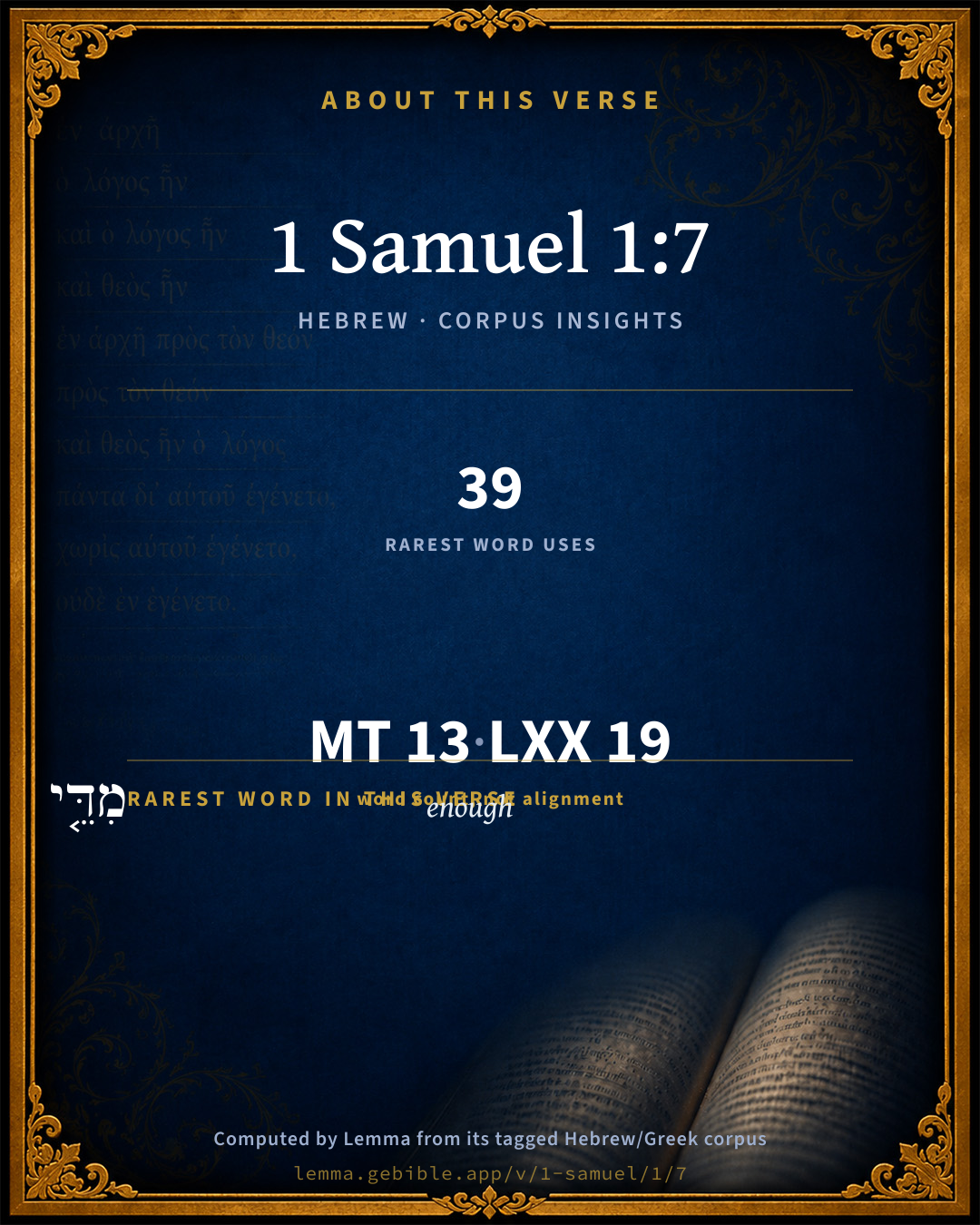
These counts appear in no published source. They are computed here, from the morphology-tagged text and Lemma’s own curated glosses. What Lemma adds →

13
words
11
distinct lemmas
Historical
section

Shared distinctive vocabulary

מִדֵּ֤י enough H1767 occurs in 35 verses of the Hebrew Bible. Also found in:

Grammatical profile

  • 5 verbs
  • 5 nouns
  • 3 particles

Verb forms

  • יַעֲשֶׂ֜ה Qal · Imperfect
  • עֲלֹתָהּ֙ Qal · Infinitive Construct
  • תַּכְעִסֶ֑נָּה Hiphil · Imperfect
  • וַתִּבְכֶּ֖ה Qal · Sequential Imperfect
  • תֹאכַֽל Qal · Imperfect

Repetition

Words recur within this verse — often emphatic in Hebrew:

  • וְכֵ֨ן thus H3651 ×2
  • שָׁנָ֣ה year H8141 ×2

Hebrew & Septuagint length

In English translation the verse runs 27 words from the Hebrew and 25 from the Septuagint (LXX English) — closely comparable.

A rough comparison of the two English renderings, which tokenize alike — not a word-level alignment.

Word counts can differ between the Hebrew and the Greek without any difference in meaning — e.g. the Hebrew direct-object marker אֵת has no separate Greek word, and Greek often adds the article ὁ.

In the original languages it is 13 Hebrew tokens and 19 Greek tokens — but the two are counted differently (Hebrew bundles its prefixes and suffixes into one token; the Greek is in lemma form), so that isn’t a like-for-like length.

Cross-references

1

Topical passages linked to 1 Samuel 1:7 in the Treasury of Scripture Knowledge — connected by theme and wording, ordered by reader-vote popularity; previews shown in the World English Bible.

  • 1 Samuel 2:19 Moreover his mother made him a little robe, and brought it to him from year to year, when she came up with her husband to offer the yearly sacrifice.

Cross-references courtesy of OpenBible.info (CC BY 4.0).

Hebrew and Greek witnesses Masoretic Hebrew ↔ Greek Septuagint

The same verse in the two great witnesses to the Old Testament, shown verse-for-verse.

These are two independent witnesses, not word-aligned to each other, and the Septuagint is shown in lemma (dictionary) form.

Hebrew 1 Samuel 1:7 Masoretic · Westminster Leningrad Codex

וְכֵ֨ן יַעֲשֶׂ֜ה שָׁנָ֣ה בְשָׁנָ֗ה מִדֵּ֤י עֲלֹתָהּ֙ בְּבֵ֣ית יְהוָ֔ה כֵּ֖ן תַּכְעִסֶ֑נָּה וַתִּבְכֶּ֖ה וְלֹ֥א תֹאכַֽל

[as] he did so year by year, when she went up to the house of Yahweh, so she provoked her; therefore she wept, and did not eat.

World English Bible · Public Domain

Greek LXX 1 Samuel 1:7 Septuagint · lemma form

οὕτως ποιέω ἐνιαυτός κατά ἐνιαυτός ἐν ὁ ἀναβαίνω αὐτός εἰς οἶκος κύριος καί ἀθυμέω καί κλαίω καί οὐ ἐσθίω

So she did year by year, in going up to the house of the Lord; and she was dispirited, and wept, and did not eat.

LXX2012 (modern English Septuagint) · Public Domain

Hebrew: Westminster Leningrad Codex (CC BY 4.0). Greek: Septuagint (public domain); English from LXX2012 (modern English Septuagint) (Public Domain). How the Septuagint differs from the Hebrew →

Targum (Aramaic paraphrase)

1

The Targum is the ancient Jewish Aramaic paraphrase of the Hebrew Scriptures — an interpretive translation, not the Hebrew text itself. Onkelos (literal) and Pseudo-Jonathan (expansive) render the Torah, and Jonathan the Prophets. Coverage is partial: where no permissively-licensed English translation exists for a verse, only the Aramaic is shown. This is verse-level text, not a word-by-word alignment to the Hebrew.

  1. Targum Jonathan Prophets (Joshua–Malachi)
    וְכֵן יַעֲבֵיד שְׁנָא בִּשְׁנָא בִּזְמַן מַסְקָהּ לְבֵית מַקְדְשָׁא דַייָ כֵּן מַרְגְזָא לָהּ וּבַכְיָא וְלָא אָכְלַת:

    (no public-domain English translation for this verse)

    Targum Jonathan — Aramaic: “Mikraot Gedolot” (public domain). English: “Sefaria Community Translation” (CC0 1.0 (public-domain dedication)); “London "Chaldee Paraphrase," 1871” (public domain). Text via Sefaria.

Commentary

Notes on 1 Samuel 1:7 from classic Christian and Jewish commentators (each source and its license shown beneath its notes). The classic Christian expositions comment on the surrounding passage and are grouped to its opening verse, so a note may address several verses; the Jewish commentaries on the Tanakh (Rashi and others) are per-verse, so they appear only where the commentator wrote on this verse.

Lemma curates 59 commentaries, every one of them public domain or Creative Commons licensed, each selected and text-cleaned for this edition rather than reprinted as found. About our sources →

Trapp's Complete Commentary

John Trapp

1Sa 1:7 And [as] he did so year by year, when she went up to the house of the LORD, so she provoked her; therefore she wept, and did not eat.

Ver. 7. And as he did so year by year.] His kindness to her thus continued, stirreth up the spirit of petulant Peninnah, whom he could not silence, to upbraid her with her barrenness, thereby boasting of her own fruitfulness, no otherwise than if she had it of herself, and not from the Lord.

When she went up to the house of the Lord, so she provoked her.] Then she provoked her, when she might do her most mischief - viz., at the very time of praying and offering sacrifice to the Lord, when she should have been most cheerful and free from all disquietment. And withal it implieth, saith a grave expositor, {a} that she upbraided her with the fruitlessness of her seeking to God so earnestly at those times for a child. Peter Martyr telleth us of some who, by Peninnah’s provoking of her, understand her urging of her to pray to God, who only hath power to make a woman fruitful. But if Peninnah put Hannah upon her prayer, it was merely by accident: as she that called Monica, Augustine’s mother, Meribibula, by way of reproach, made her more cautious and abstinent.

{a} Mr. Jackson.

John Trapp, A Commentary or Exposition upon All the Books of the Old and New Testament (1647–1656) — public domain. Text from a community e-Sword module.

The Biblical Illustrator

Joseph S. Exell

1Sa_1:7

And as he did so year by year, when she went up to the House of the Lord, so she provoked her.

The House of God

You must remember, that at the time when Elkanah was living, there was but one temple or church for all the worshippers of the true God; and those who lived at a great distance from this temple could not have the privilege of worshipping there, at most, above three times a year. Have you ever considered the mercy of being born in a country where there are so many places of public worship? places which have that honourable and blessed name of the house of God? When you draw near to a town, you see several of these precious buildings, higher than all the houses prepared for man to live in, beside many other smaller places of public worship: and you can scarcely find a village without some building in it where the people of God may assemble together. Now, you observe, that pious Elkanah and his family have to take a long journey once a year for the privilege of the public worship of God. What does all this say to you who have Gods house standing open for you within a very, very little distance, perhaps within a few steps, and yet you think it too much trouble to get there! You would not treat a nobleman so, if he invited you to his house; particularly, if you were very dependent upon him; and if you saw him standing at the door of his house, watching to see who accepted his invitation, and who slighted it. I have heard many people say, I can read my book at home, and I dont know but I get as much good as by going to church or meeting. But let me tell you, I do know that you cannot. If, indeed, you are confined at home by sickness, and your heart is right with God, He can and will be a little sanctuary to you, and will enable you to say, The Lord is my Shepherd; I shall not want: but when you idly stay at home, from the idea that you can get as much good there so in a place of public worship, you trample upon Gods express command, and expect that which He has not promised. (Helen Plumptre.)

Hannah

To know persons completely, it is necessary to view them in various situations and conditions. Character is not only displayed by trials, but it very much results from them. Both prosperity and adversity are states of acknowledged temptation; and few can equally encounter such opposite dangers. Hannah first comes before us in circumstances of disappointment and mortification. Her affliction was aggravated by reproach, for her adversary provoked her sore, for to make her fret, because the Lord had shut up her womb But who was this adversary? She was one of her own household, for Elkanah, her husband, had two wives. And in the case before us was the conduct of Elkanah justified by the result? Let us read and see. In the days of Malachi this evil practice abounded; and observe how the prophet speaks of it. The Lord hath been witness between thee and the wife of thy youth, against whom thou hast dealt treacherously: yet she is thy companion, and the wife of thy covenant. And did not he make one? Yet, had he the residue of the spirit. And wherefore one? That he might seek a godly seed. Here we find that marriage was originally confined to a single pair: end we see the reason. It was not from want of power or kindness in God. He could have made more than one Eve for Adam, and would have done it had his welfare required it. But it was because of the advantage derivable from individual union, especially with regard to the children who should arise from it, and be trained up in the nurture and admonition of the Lord. Hannahs adversary seems peculiarly unprincipled and ill-disposed. A noble mind is always generous and sympathising if it possesses any exclusive advantages, it will not be forward to display and boast of them; and if it sees a fellow creature in a humbler situation, it will not labour to increase his sense of deficiencies, but rather to diminish and soften it. The spirit that dwelleth in us lusteth to envy. But we may observe, that though envy loves to expose the defects of another, it springs from his excellencies or advantages, end feeds upon some real or imaginary privilege. Accordingly, we are born informed of the occasion of this womans present malevolence. At this season Elkanah treated Hannah with peculiar attention and distinction. And when the time was that Elkanah offered, he gave to Peninnah his wife, and to all her sons and her daughters, portions; but unto Hannah he gave a worthy portion. There is a considerable difference between the feeling and the expression of partiality; the one is much more in our power than the other. The display of it is commonly prejudicial to the object. Who does not remember the coat of many colours? The blame we attach to a man is not always so much for acting wrong, as for bringing himself into circumstances and conditions which will hardly allow of his acting right. Piety says, In all thy ways acknowledge Him and He shall direct thy paths; and Prudence says, Ponder the path of thy feet, and let all thy ways be established. Elkanah forgets this, and his folly fixes him in a state that leaves him not the possibility of escaping evil and reproach. What could Peninnah think of approaching the altar of the God of peace and love with a temper full of envy and malice, and a tongue set on fire of hell? How much better is omission than perversion, and neglect than inconsistency? Shall blessing and cursing proceed out of the same mouth? Keep thy foot when thou goest to the house of God, and be more ready to hear than to give the sacrifice of fools: for they consider not that they do evil Therefore, if thou bring thy gift to the altar, and there rememberest that thy brother hath ought against thee; leave there thy gift before the altar, and go thy way; first be reconciled to thy brother, and then come and offer thy gift. Year after year Hannah had been accustomed to bear ell this provocation, and till now she seems to have endured it patiently But where is the mind that always continues in one frame? (W. Jay.)

Womanly endurance

Patience is of two kinds. There is an active, and there is a passive endurance. The former is a masculine, the latter, for the most part, a feminine virtue. Female patience is exhibited chiefly in fortitude; in bearing pain and sorrow meekly without complaining. In the old Hebrew life female endurance shines almost as brightly as in any life which Christianity itself can mould. Hannah under the provocations and taunts of her rival, answering not again her husbands rebuke, humbly replying to Elis unjust blame, is true to the type of womanly endurance. For the type of mans endurance you may look to the patience of the early Christians under persecution. They came away from the Sanhedrim to endure and bear; but it was to bear as conquerors rushing on to victory, preaching the truth with all boldness, and defying the power of the united world to silence them. These two divers qualities are joined in One, and only One of woman born, in perfection. One there was in whom human nature was exhibited in all its elements symmetrically complete. (F. W. Robertson.)

Provocations in domestic life

A garden has a great many flowers in it. Some of them are weeds, some of them are purslane, and some of them are nettles, which are not very desirable for bouquets. In the garden, however, we can take our choice; but in the family we cannot. There we have to take all. If there is a complaining one, we have to take that one; if there is a weak and dull-eyed one, we have to take that one; if there is a moody and morose one, we have to take that one; and it takes but one bitter lemon to spoil the whole of your lemonade. If of half-a-dozen lemons five are perfectly good, and the other is bad, the whole mixture is bad; for the nature of this one bad lemon enters into it. So one person may spoil the pleasure of twenty. A mother may keep a cloud resting on the whole household from morning till night; thank God she sleeps at nights. A father may fret and worry the whole household; and therefore Paul says, Fathers, provoke not your children. They are apt to make the children cross, or to create in them an unrestful, unquiet disposition. It does not take more than one smoky chimney in a room to make it intolerable. (H. W. Beecher.)

A religious use of annoyance

The remarkable thing is: A religious use of a daily provocation. Peninnah persecuted Hannah daily; laughed at her, mocked her. It was a religious use. She prayed unto the Lord; she rose up and went forward that she might pray mightily before God; she spake in her heart and she poured out her soul before God. That was conquest,--that was victory! There is a possibility of having a daily annoyance, and yet turning that daily annoyance into an occasion of nearer and nearer approach to God. Let us then endeavour to turn all our household griefs, family torments into occasions of profound worship and loving homage to God. It was in human nature to avenge the insult; to cry out angrily against the woman who delighted in sneering and in provoking. But there is something higher than human nature, something better. (J. Parker, D. D.)

The Biblical Illustrator, edited by Joseph S. Exell (c. 1880s–1900s) — public domain. Text from a community e-Sword module.

Joseph Benson's Commentary

1Sa 1:7. As he did so year by year when she went, &c. — This circumstance is noted as the occasion of the contention, because at such times they were forced to more society with one another, by the way, and in their lodgings; whereas, at home they had distinct apartments, where they might be asunder, and then her husband’s extraordinary love and kindness were showed to Hannah, whereby Peninnah was the more exasperated; then also Hannah prayed earnestly for a child, which hitherto she had done in vain; and this possibly she reproached her with. So she provoked her — She constantly took this occasion to upbraid her with her barrenness when Elkanah expressed such extraordinary kindness to her. Therefore she wept, and did not eat — Being overwhelmed with grief, she had no inclination to eat on this festival occasion, nor did she consider herself as fit to partake of the sacred food, which they were forbid to eat in their mourning.

Joseph Benson's Commentary on the Old and New Testaments (1811–1818) — public domain. Text from a community e-Sword module.

Tyndale Open Study Notes

Tyndale Open Resources

1:7 the Tabernacle: Also called “the Temple of the Lord” in 1:9. These designations reflect that the Tabernacle, a portable structure, served as the central sanctuary at Shiloh.

Tyndale Open Study Notes — © Tyndale Open Resources, licensed CC BY-SA 4.0. Text via the HelloAO Bible API.

Adam Clarke's Commentary

Verse 7. And as he did so year by year] As the whole family went up to Shiloh to the annual festivals, Peninnah had both sons and daughters to accompany her, 1Sa 1:4, but Hannah had none; and Peninnah took this opportunity particularly to twit Hannah with her barrenness, by making an ostentatious exhibition of her children.

Therefore she wept] She was greatly distressed, because it was a great reproach to a woman among the Jews to be barren; because, say some, every one hoped that the Messiah should spring from her line.

Adam Clarke's Commentary on the Bible (1810–1826) — public domain. Text from a community e-Sword/MySword module.

Ellicott's Commentary for English Readers

(7) And as he did so year by year.—That is, Elkanah, on the occasion of every yearly visit to the national sanctuary, was in the habit of publicly giving the childless Hannah the double gift, to show his undiminished love; while the happier mother of his children, jealous of her rival, every year chose this solemn occasion of offering thank-offerings before the Tabernacle, especially to taunt the childless wife, no doubt referring the absence of children, which among the mothers of Israel was considered so deep a calamity, to the special auger of God.

A Bible Commentary for English Readers, edited by Charles John Ellicott (1878–1897) — public domain. Text from a community e-Sword module.

The Cambridge Bible for Schools and Colleges

gen. ed. J. J. S. Perowne

7. as he did so] Peninnah’s spitefulness was evoked by the display of Elkanah’s affection. Exultation at another’s misfortune is one of the most detestable forms of malice.

did not eat] Refused to take any part in the rejoicings of the sacrificial feast.

The Cambridge Bible for Schools and Colleges (gen. ed. J. J. S. Perowne; Cambridge University Press, 1878–1918) — public domain. Text from a community e-Sword module.

John Gill's Exposition

And as he did so year by year,.... Elkanah went up every year to Shiloh, and offered sacrifices, taking his family with him, and gave to Peninnah and her children their portion, and to Hannah a double portion, or if but one yet the best:

when she went up to the house of the Lord; that is, Peninnah, along with her husband, with whom she went every year to the tabernacle at Shiloh:

so she provoked her; her rival Hannah, upbraiding her with her barrenness; to which she was stirred up by seeing her husband on these festivals take so much notice of her, and show so much love and respect for her, as always to give her the best portion. Abarbinel thinks that Peninnah and Hannah lived at two separate places, the one at Ramah and the other at Ramatha, which both together are called Ramathaim; and that they only met with and saw one another at these festivals, and then it was that the one was so very insulting and provoking to the other:

therefore she wept and did not eat; that is, Hannah wept at the insults, reproaches, and scoffs, cast at her by her antagonist; insomuch that she could not eat of the peace offerings, though her husband always gave her the best part and portion of them; but her grief took away her stomach and appetite, that she could not eat; see Psa 42:3.

John Gill's Exposition of the Whole Bible (1746–1763) — public domain (CC PDM 1.0). Text via the HelloAO Bible API.

Albert Barnes' Notes on the Bible

And as he did so ... - It should rather be “And so she did year by year, as often as she went up to the House of the Lord, so she provoked her.” Though the verb is masculine, Peninnah must be the subject, because as often as SHE went up follows. The Vulgate has “they went up.”

Albert Barnes' Notes on the Bible (1834–1885) — public domain. Text from a community e-Sword/MySword module.

Haydock's Catholic Bible Commentary

Lord. Then they could hardly avoid being together on the road, and Anna was accustomed to pray earnestly (Menochius) to be delivered from her reproach. (Haydock)

George Leo Haydock (1774–1849), Haydock's Catholic Family Bible and Commentary, 1859 edition — public domain. Excludes Psalms (Douay-Rheims chapter numbering differs from Protestant) and Deuterocanonical books (Catholic canon only).

Matthew Poole's English Annotations

As he did so, i.e. either as oft as he went and carried them with him to worship; or as Elkanah expressed peculiar kindness to Hannah, as was said, 1Sa 1:5.

Year by year, i.e. every year, at the days or times mentioned, 1Sa 1:3.

When she went up to the house of the Lord. This circumstance is noted, first, As the occasion of the contention, because at such times they were forced to more society with one another by the way, and in their lodgings; whereas at home they had distinct apartments, where they might be asunder; and then her husband’s extraordinary love and kindness was showed to Hannah, whereby Peninnah was the more exasperated; then also Hannah prayed earnestly for a child, which hitherto she had done in vain; and this possibly she reproached her with. Secondly, As the aggravation of her sin, that when she came to worship God, and to offer sacrifices, when she should have been reconciled even to her enemies, Mat 5:23,24, she did quarrel with so near a relation.

Did not eat; either little, or rather nothing at all, as being overwhelmed with grief, and therefore unfit to eat of that sacred food, according to Deu 12:7.

Matthew Poole's English Annotations on the Holy Bible (1683–1685) — public domain. Text from a community e-Sword/MySword module.

Whedon's Commentary on the Bible

Daniel D. Whedon

7. He did so year by year — Elkanah yearly continued to show such special attention to Hannah as he and all his family went up to the tabernacle at Shiloh.

So she provoked her — Peninnah likewise continued to tantalize Hannah for her barrenness. This provocation was the more keenly felt because barrenness was a reproach to women among the Jews. See Gen_30:23; Luk_1:25.

Daniel D. Whedon (gen. ed.), Commentary on the Old and New Testaments (1874–1909) — public domain. Text from a community e-Sword module.

John Wesley's Explanatory Notes

When she went-This circumstance is noted as the occasion of the contention, because at such times they were forced to more society with one another, by the way, and in their lodgings; whereas at home they had distinct apartments, where they might be asunder; and then her husband's extraordinary love and kindness was shewed to Hannah, whereby Peninnah was the more exasperated; then also Hannah prayed earnestly for a child, which hitherto she had done in vain; and this possibly she reproached her with. Did not eat - Being overwhelmed with grief, and therefore unfit to eat of the sacred food. Which they were not to eat in their mourning.

John Wesley, Explanatory Notes Upon the Whole Bible (1754–1765) — public domain. Text via the GEBible commentary corpus.

unfoldingWord translationNotes

Door43 World Missions Community

her rival

This is Peninnah, the other wife of Elkanah. A rival is someone who competes against another person. In this case Peninnah was competing against Hannah to try to get Elkanah to love her best.

Hannah, why do you weep? Why do you not eat? Why is your heart sad? Am I not better to you than ten sons?

These rhetorical questions can be translated as statements, if necessary. AT: "Hannah, you should not weep. You should eat, and your heart should be glad because I am better to you than ten sons!" or "You have little reason for sadness. I favor you and that should be enough." (See: Rhetorical Question)

than ten sons

Elkanah is exaggerating to emphasize how important Hannah is to him. AT: "than any son could be" (See: Hyperbole and Generalization)

translationWords

house of God

heart

unfoldingWord translationNotes — © Distant Shores Media and the Door43 World Missions Community, licensed CC BY-SA 4.0. Source: git.door43.org/Door43/en_tn.

Rashi

Rabbi Shlomo Yitzchaki (Rashi)

He would do this. Elkonoh.

Year after year. He would give her a choice portion to demonstrate to her that he loved her; and her rival, according to the affection which her husband demonstrated to her, would anger her more and more.

Rashi on the Tanakh — English translations: “The Judaica Press complete Tanach with Rashi, translated by A. J. Rosenberg” (CC BY 4.0); “Pentateuch with Rashi's commentary by M. Rosenbaum and A.M. Silbermann, 1929-1934” (public domain); “The Metsudah Tanach series, Lakewood, N.J” (CC BY 4.0); and “The Book of Joshua, Metsudah Publications, 1997” (CC BY 4.0). Text via Sefaria.

Radak

Rabbi David Kimhi (Radak)

And as he would do this: Elkanah would do this every year, to go up to the House of the Lord with his household. And Peninah would also anger Channah each time when she would go up to the House of the Lord, since she would anger her about the matter of the portions - that there were portions for her and her children, whereas Channah only had one portion since she did not have children who would take portions.

Radak on the Tanakh — English translations: “Sefaria Community Translation” (CC0 1.0 (public-domain dedication)); “Eliyahu Munk, HaChut Hameshulash” (CC BY 4.0); “Rabbi Mike Feuer, Jerusalem Anthology” (CC BY 4.0); and “R. David Kimhi on the first book of Psalms, Translated by R.G. Finch, London, 1919” (public domain). Text via Sefaria.

Lesson kit

Teaching starters — assembled from the data on this page, not authored interpretation. Every prompt links to the verse data it draws on. Edit before teaching.

1 Samuel, in the Historical, opens this verse with 13 words (11 distinct Hebrew lemmas). Its most distinctive word is day (“enough”). A historical commentator’s framing appears above. Read the whole chapter for the surrounding context.

Discussion questions

  1. What does “enough” (day) contribute to the verse as a whole?
  2. Exodus 36:5 shares the word «enough» with this verse. How do the two illuminate each other?
  3. “thus” occurs 2× in this one verse. What is the effect of the repetition?
  4. These translations render this verse differently. What is at stake in choosing one wording over another?
  5. The verb «יַעֲשֶׂ֜ה» is Qal Imperfect. How does its form color the action?
  6. Reading how Trapp's Complete Commentary and The Biblical Illustrator read this verse, where do the two commentators agree and where do they part?

Things to notice

Reading settings

Reading text

Shown beneath each verse's original-language words.

Old Testament
Old Testament edition

Read the OT as the Masoretic Hebrew (MT) or the Greek Septuagint (LXX).

English shown for the Greek Septuagint (in the Hebrew ↔ Greek comparison).

Comparing translations? Open the Compare panel on any verse page to stack up to four side by side.