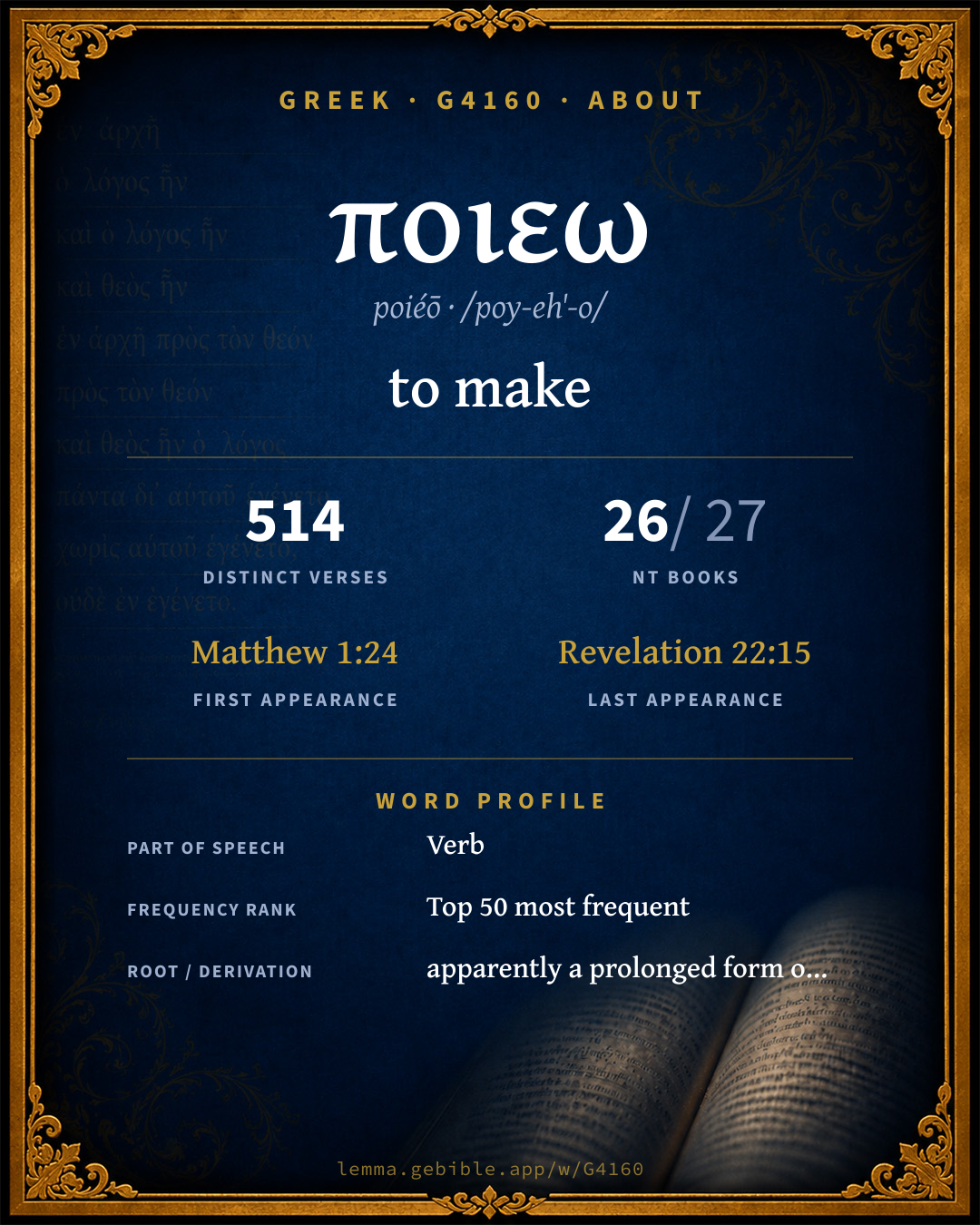
ποιέω
to make
‘to make’ is one of 15 main senses fuller range ↓
Full lexicon entry — Thayer's Greek Lexicon
From Thayer's Greek Lexicon
Where this word appears
See every Aorist-tense verb in the Greek New Testament →
Grammar key — what these labels mean
Part of speech
- Verb
- An action or state-of-being word.
Tense
- Aorist
- Action viewed as a simple whole, without regard to duration — often past (perfective aspect).
- Present
- Ongoing or general action in present time (imperfective aspect).
- Future
- Action expected in future time.
- Imperfect
- Continuous or repeated action in past time (“was writing”).
- Perfect
- A completed past action with continuing present results.
- Pluperfect
- A past action completed before another past point (“had written”).
Voice
- Active
- The subject performs the action.
- Middle
- The subject acts on or for itself, or with special interest in the action.
- Middle deponent
- Middle in form but active in meaning.
- Passive
- The subject receives the action.
Mood
- Indicative
- States a fact or asks a factual question (the mood of reality).
- Infinitive
- A verbal noun (“to write”), unmarked for person or number.
- Participle
- A verbal adjective (“writing,” “having written”).
- Subjunctive
- Expresses probability, purpose, or possibility (the mood of contingency).
- Imperative
- Expresses a command or request.
- Optative
- Expresses a wish or a remote possibility.
Case
- Nominative
- The case of the subject (and the predicate nominative).
- Accusative
- The case of the direct object and of extent.
- Dative
- The case of the indirect object, means, or location — “to / for / with / in.”
- Genitive
- The case of source, possession, or “of” — answers “whose / from what.”
Person
- 3rd person
- The one spoken about (“he / she / it / they”).
- 1st person
- The speaker (“I / we”).
- 2nd person
- The one addressed (“you”).
Gender
- Masculine
- Grammatically masculine.
- Neuter
- Grammatically neuter.
- Feminine
- Grammatically feminine.
Number
- Singular
- One.
- Plural
- More than one.
Every verse where G4160 appears in the Book of Acts — 65 distinct verses. Click any verse to open its interlinear word-by-word view. Verse text shown in the World English Bible for context — . Each verse’s Greek form is shown with its reference; the English is not keyword-highlighted, since the data carries no word-level English alignment. Use “Compare translations” on any verse to read it across multiple English versions. This concordance covers the Greek New Testament; Septuagint (Greek Old Testament) occurrences of this word are not indexed here.
Acts
- Acts 1:1 ἐποιησάμην ποιεῖν aor mid ind 1sg pres act inf The first book I wrote, Theophilus, concerned all that Jesus began both to do and to teach,
- Acts 2:22 ἐποίησεν aor act ind 3sg "Men of Israel, hear these words! Jesus of Nazareth, a man approved by God to you by mighty works and wonders and signs which God did by him in the midst of you, even as you yourselves know,
- Acts 2:36 ἐποίησεν aor act ind 3sg "Let all the house of Israel therefore know assuredly that God has made him both Lord and Christ, this Jesus whom you crucified."
- Acts 2:37 ποιήσωμεν aor act subj 1pl Now when they heard this, they were cut to the heart, and said to Peter and the rest of the apostles, "Brothers, what shall we do?"
- Acts 3:12 πεποιηκόσιν perf act ptcp dat pl masc When Peter saw it, he responded to the people, "You men of Israel, why do you marvel at this man? Why do you fasten your eyes on us, as though by our own power or godliness we had made him walk?
- Acts 4:7 ἐποιήσατε aor act ind 2pl When they had stood them in the middle of them, they inquired, "By what power, or in what name, have you done this?"
- Acts 4:16 ποιήσωμεν aor act subj 1pl saying, "What shall we do to these men? Because indeed a notable miracle has been done through them, as can be plainly seen by all who dwell in Jerusalem, and we can't deny it.
- Acts 4:24 ποιήσας aor act ptcp nom sg masc When they heard it, they lifted up their voice to God with one accord, and said, "O Lord, you are God, who made the heaven, the earth, the sea, and all that is in them;
- Acts 4:28 ποιῆσαι aor act inf to do whatever your hand and your council foreordained to happen.
- Acts 5:34 ποιῆσαι aor act inf But one stood up in the council, a Pharisee named Gamaliel, a teacher of the law, honored by all the people, and commanded to put the apostles out for a little while.
- Acts 6:8 ἐποίει impf act ind 3sg Stephen, full of faith and power, performed great wonders and signs among the people.
- Acts 7:19 ποιεῖν pres act inf The same took advantage of our race, and mistreated our fathers, and forced them to throw out their babies, so that they wouldn't stay alive.
- Acts 7:24 ἐποίησεν aor act ind 3sg Seeing one of them suffer wrong, he defended him, and avenged him who was oppressed, striking the Egyptian.
- Acts 7:36 ποιήσας aor act ptcp nom sg masc This man led them out, having worked wonders and signs in Egypt, in the Red Sea, and in the wilderness for forty years.
- Acts 7:40 ποίησον aor act impv 2sg saying to Aaron, 'Make us gods that will go before us, for as for this Moses, who led us out of the land of Egypt, we don't know what has become of him.'
- Acts 7:43 ἐποιήσατε aor act ind 2pl You took up the tent of Moloch, The star of your god Rephan, The figures which you made to worship. I will carry you away beyond Babylon.'
- Acts 7:44 ποιῆσαι aor act inf "Our fathers had the tent of the testimony in the wilderness, even as he who spoke to Moses commanded him to make it according to the pattern that he had seen;
- Acts 7:50 ἐποίησεν aor act ind 3sg Didn't my hand make all these things?'
- Acts 8:2 ἐποίησαν aor act ind 3pl Devout men buried Stephen, and lamented greatly over him.
- Acts 8:6 ἐποίει impf act ind 3sg The multitudes listened with one accord to the things that were spoken by Philip, when they heard and saw the signs which he did.
- Acts 9:6 ποιεῖν pres act inf But rise up, and enter into the city, and you will be told what you must do."
- Acts 9:13 ἐποίησεν aor act ind 3sg But Ananias answered, "Lord, I have heard from many about this man, how much evil he did to your saints at Jerusalem.
- Acts 9:36 ἐποίει impf act ind 3sg Now there was at Joppa a certain disciple named Tabitha, which when translated, means Dorcas. This woman was full of good works and acts of mercy which she did.
- Acts 9:39 ἐποίει impf act ind 3sg Peter got up and went with them. When he had come, they brought him into the upper chamber. All the widows stood by him weeping, and showing the coats and garments which Dorcas had made while she was with them.
- Acts 10:2 ποιῶν pres act ptcp nom sg masc a devout man, and one who feared God with all his house, who gave gifts for the needy generously to the people, and always prayed to God.
- Acts 10:33 ἐποίησας aor act ind 2sg Therefore I sent to you at once, and it was good of you to come. Now therefore we are all here present in the sight of God to hear all things that have been commanded you by God."
- Acts 10:39 ἐποίησεν aor act ind 3sg We are witnesses of everything he did both in the country of the Jews, and in Jerusalem; whom they also killed, hanging him on a tree.
- Acts 11:30 ἐποίησαν aor act ind 3pl which they also did, sending it to the elders by the hands of Barnabas and Saul.
- Acts 12:8 ἐποίησεν aor act ind 3sg The angel said to him, "Get dressed and put on your sandals." He did so. He said to him, "Put on your cloak, and follow me."
- Acts 13:22 ποιήσει fut act ind 3sg When he had removed him, he raised up David to be their king, to whom he also testified, 'I have found David the son of Jesse, a man after my heart, who will do all my will.'
- Acts 14:11 ἐποίησεν aor act ind 3sg When the multitude saw what Paul had done, they lifted up their voice, saying in the language of Lycaonia, "The gods have come down to us in the likeness of men!"
- Acts 14:15 ποιεῖτε ἐποίησεν pres act ind 2pl aor act ind 3sg "Men, why are you doing these things? We also are men of like passions with you, and bring you good news, that you should turn from these vain things to the living God, who made the sky and the earth and the sea, and all that is in them;
- Acts 14:27 ἐποίησεν aor act ind 3sg When they had arrived, and had gathered the assembly together, they reported all the things that God had done with them, and that he had opened a door of faith to the Gentiles.
- Acts 15:3 ἐποίουν impf act ind 3pl They, being sent on their way by the assembly, passed through both Phoenicia and Samaria, declaring the conversion of the Gentiles. They caused great joy to all the brothers.
- Acts 15:4 ἐποίησεν aor act ind 3sg When they had come to Jerusalem, they were received by the assembly and the apostles and the elders, and they reported all things that God had done with them.
- Acts 15:12 ἐποίησεν aor act ind 3sg All the multitude kept silence, and they listened to Barnabas and Paul reporting what signs and wonders God had done among the Gentiles through them.
- Acts 15:17 ποιῶν pres act ptcp nom sg masc That the rest of men may seek after the Lord; All the Gentiles who are called by my name, Says the Lord, who does all these things.
- Acts 15:33 ποιήσαντες aor act ptcp nom pl masc After they had spent some time there, they were sent back with greetings from the brothers to the apostles.
- Acts 16:18 ἐποίει impf act ind 3sg She was doing this for many days. But Paul, becoming greatly annoyed, turned and said to the spirit, "I charge you in the name of Jesus Christ to come out of her!" It came out that very hour.
- Acts 16:21 ποιεῖν pres act inf and set forth customs which it is not lawful for us to accept or to observe, being Romans."
- Acts 16:30 ποιεῖν pres act inf and brought them out and said, "Sirs, what must I do to be saved?"
- Acts 17:24 ποιήσας aor act ptcp nom sg masc The God who made the world and all things in it, he, being Lord of heaven and earth, doesn't dwell in temples made with hands,
- Acts 17:26 ἐποίησέν aor act ind 3sg He made from one blood every nation of men to dwell on all the surface of the earth, having determined appointed seasons, and the boundaries of their dwellings,
- Acts 18:23 ποιήσας aor act ptcp nom sg masc Having spent some time there, he departed, and went through the region of Galatia, and Phrygia, in order, establishing all the disciples.
- Acts 19:11 ἐποίει impf act ind 3sg God worked special miracles by the hands of Paul,
- Acts 19:14 ποιοῦντες pres act ptcp nom pl masc There were seven sons of one Sceva, a Jewish chief priest, who did this.
- Acts 19:24 ποιῶν pres act ptcp nom sg masc For a certain man named Demetrius, a silversmith, who made silver shrines of Artemis, brought no little business to the craftsmen,
- Acts 20:3 ποιήσας aor act ptcp nom sg masc When he had spent three months there, and a plot was made against him by Jews as he was about to set sail for Syria, he determined to return through Macedonia.
- Acts 20:24 ποιοῦμαι pres mid ind 1sg But these things don't count; nor do I hold my life dear to myself, so that I may finish my race with joy, and the ministry which I received from the Lord Jesus, to fully testify to the Gospel of the grace of God.
- Acts 21:13 ποιεῖτε pres act ind 2pl Then Paul answered, "What are you doing, weeping and breaking my heart? For I am ready not only to be bound, but also to die at Jerusalem for the name of the Lord Jesus."
- Acts 21:19 ἐποίησεν aor act ind 3sg When he had greeted them, he reported one by one the things which God had worked among the Gentiles through his ministry.
- Acts 21:23 ποίησον aor act impv 2sg Therefore do what we tell you. We have four men who have taken a vow.
- Acts 21:33 πεποιηκώς perf act ptcp nom sg masc Then the commanding officer came near, arrested him, commanded him to be bound with two chains, and inquired who he was and what he had done.
- Acts 22:10 ποιήσω ποιῆσαι aor act subj 1sg aor act inf I said, 'What shall I do, Lord?' The Lord said to me, 'Arise, and go into Damascus. There you will be told about all things which are appointed for you to do.'
- Acts 22:26 ποιεῖν pres act inf When the centurion heard it, he went to the commanding officer and told him, "Watch what you are about to do, for this man is a Roman!"
- Acts 23:12 ποιήσαντες aor act ptcp nom pl masc When it was day, some of the Jews banded together, and bound themselves under a curse, saying that they would neither eat nor drink until they had killed Paul.
- Acts 23:13 ποιησάμενοι aor mid ptcp nom pl masc There were more than forty people who had made this conspiracy.
- Acts 24:12 ποιοῦντα pres act ptcp acc sg masc In the temple they didn't find me disputing with anyone or stirring up a crowd, either in the synagogues, or in the city.
- Acts 24:17 ποιήσων fut act ptcp nom sg masc Now after some years, I came to bring gifts for the needy to my nation, and offerings;
- Acts 25:3 ποιοῦντες pres act ptcp nom pl masc asking a favor against him, that he would summon him to Jerusalem; plotting to kill him on the way.
- Acts 25:17 ποιησάμενος aor mid ptcp nom sg masc When therefore they had come together here, I didn't delay, but on the next day sat on the judgment seat, and commanded the man to be brought.
- Acts 26:10 ἐποίησα aor act ind 1sg This I also did in Jerusalem. I both shut up many of the saints in prisons, having received authority from the chief priests, and when they were put to death I gave my vote against them.
- Acts 26:28 ποιῆσαι aor act inf Agrippa said to Paul, "With a little persuasion are you trying to make me a Christian?"
- Acts 27:18 ἐποιοῦντο impf mid ind 3pl As we labored exceedingly with the storm, the next day they began to throw things overboard.
- Acts 28:17 ποιήσας aor act ptcp nom sg masc It happened that after three days Paul called together those who were the leaders of the Jews. When they had come together, he said to them, "I, brothers, though I had done nothing against the people, or the customs of our fathers, still was delivered prisoner from Jerusalem into the hands of the Romans,
About this entry
At a glance — auto-summarized from this page’s data, not written by a person. Every figure links to its source below. This summary describes the numbers; it doesn’t interpret them.
ποιεω — transliterated poiéō — is a Greek verb carrying the sense “to make.” “doeth” is the historic King James Version rendering; modern versions use “do.” See the renderings breakdown. Spanning 514 verses in 26 books, it ranks among the most common words of the Greek New Testament. Debuting at Matthew 1:24, it then recurs through the corpus. Its lexical range runs to 15 senses. Each statement above links to its evidence; the full detail follows below.
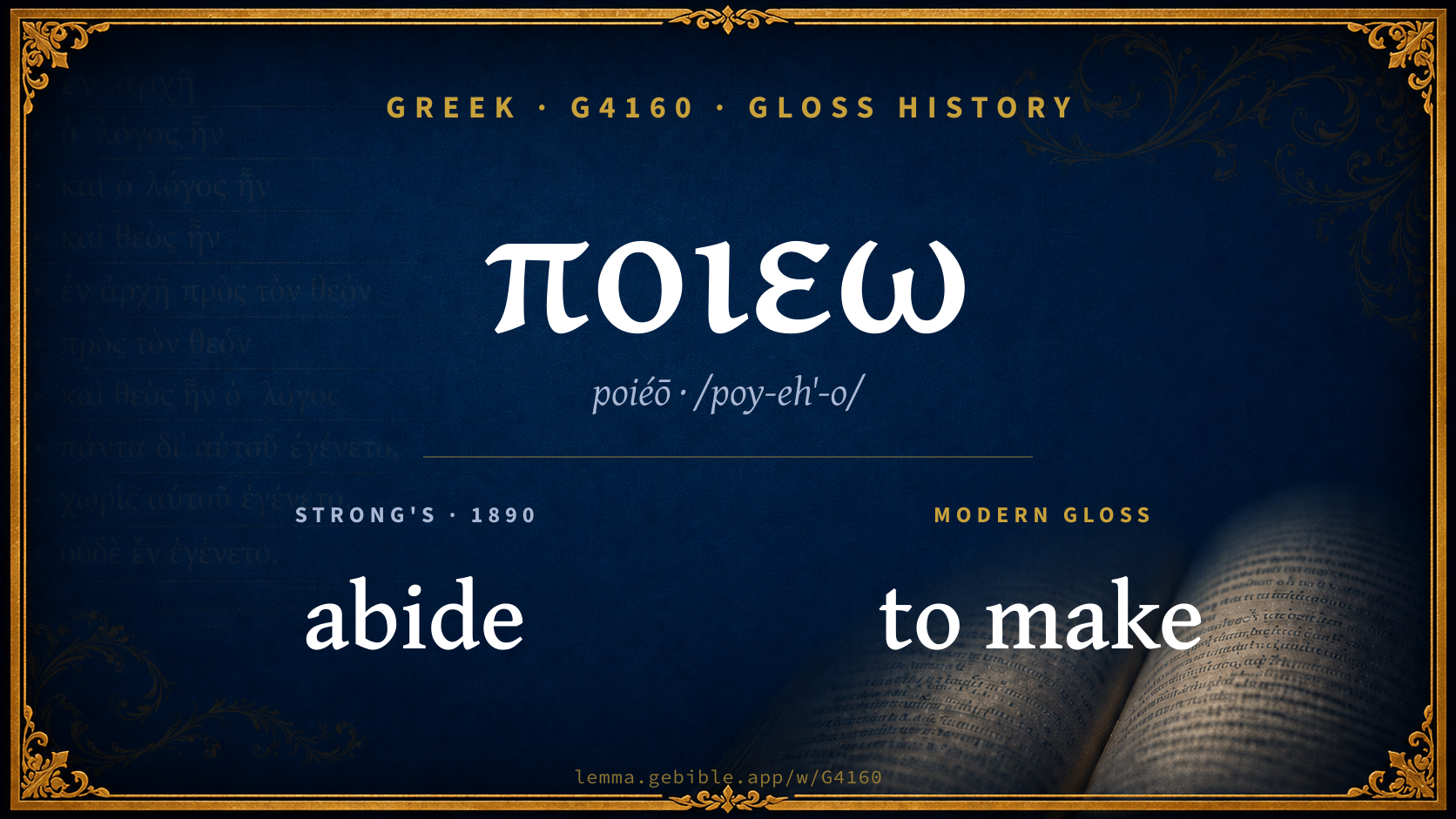
Gloss history
Strong's 1890 vs modern scholarship
About this word
Strong's G4160 catalogs a Greek word from the Greek New Testament.
These counts are not copied from any lexicon or concordance. They are computed here, from the morphology-tagged Greek New Testament. What Lemma adds →
- 514
- distinct verses
- The word appears in 514 distinct verses.
- 26 / 27
- NT books
- The word appears in 26 of 27 New Testament books.
- #34
- by frequency
- Top 50 most frequent Greek words (rank 34 of 5,347 Greek words by occurrence).
View all 514 occurrences in the concordance →
By section of the New Testament
By traditional corpus
Conventional, traditional groupings — biblical authorship is debated, so this is a traditional corpus grouping, not an authorship claim. Some books belong to more than one corpus (Luke is in both the Gospels and the Lukan corpus, and so on), so these shares overlap and need not total 100%. Each figure is a share of the word’s 514 distinct verses.
- Gospels 294 verses · 57%
- Lukan (Luke–Acts) 145 verses · 28%
- Johannine 138 verses · 27%
- Pauline corpus 78 verses · 15%
- General (Catholic) Epistles 33 verses · 6%
- Revelation 26 verses · 5%
- Hebrews 18 verses · 4%
How translations render this word
Counts come from each version’s own published word-to-Strong’s tagging or interlinear alignment — an approximate guide to how each version renders this word, not a word-level alignment the data otherwise carries. Because each total is that version’s own tagged count, the per-version totals vary from one another and need not match the appearance or distinct-verse counts above. These counts may also differ from a printed concordance because Lemma counts each distinctly tagged rendering and does not collapse phrase taggings into a single head-word total. This is a fixed set of word-tagged versions (KJV, ASV, BSB, ULT) and does not change with the reading translation you choose elsewhere. Each version’s license is shown beside its name below (and on Sources).
- King James Version: Do 100×, Make 31×, Did 30×
- American Standard Version: Do 105×, Make 33×, Did 31×
- Berean Standard Bible: Do 83×, Make 22×, Did 17×
- unfoldingWord Literal Text: Do 109×, Make 36×, Doing 32×
King James Version Public Domain
Renders G4160 across 586 tagged occurrences — most commonly:
Plus other, less common renderings. Plus 110 renderings that appear only once — usually multi-word phrases or single function words the recovered tagging swept in, not distinct renderings. Not rendered by a distinct English word in 16 further occurrences.
American Standard Version Public Domain
Renders G4160 across 583 tagged occurrences — most commonly:
Plus other, less common renderings. Plus 123 renderings that appear only once — usually multi-word phrases or single function words the recovered tagging swept in, not distinct renderings. Not rendered by a distinct English word in 1 further occurrence.
Berean Standard Bible Public Domain
Renders G4160 across 544 tagged occurrences — most commonly:
Plus other, less common renderings. Plus 163 renderings that appear only once — usually multi-word phrases or single function words the recovered tagging swept in, not distinct renderings. Not rendered by a distinct English word in 9 further occurrences.
unfoldingWord Literal Text CC BY-SA 4.0
Renders G4160 across 624 tagged occurrences — most commonly:
Plus other, less common renderings. Plus 105 renderings that appear only once — usually multi-word phrases or single function words the recovered tagging swept in, not distinct renderings.
15 senses in Thayer's, in lexicon order
The 15 senses Thayer's distinguishes for this word, in lexicon order (not ranked by frequency or importance). The full entry — with sub-senses — is in the Lexicon Entry tab.
- with the names of things made, to produce, construct, form, fashion, etc.
- to be the authors of, the cause
- to make ready, to prepare
- to produce, bear, shoot forth
- to acquire, to provide a thing for one's self
- to make a thing out of something
- to (make i.e.) render one anything
- to put one forth, to lead him out
- to make one do something
- to be the authors of a thing (to cause, bring about)
This word has an unusually long lexicon entry — 15 senses across its verb stems. The first 10 are shown above in lexicon order; the remaining 5 senses (more of the same, repeated under each stem) and the full sub-sense tree are in the Lexicon Entry tab.
Word origin
Origin: apparently a prolonged form of an obsolete primary
Apparently a prolonged form of an obsolete primary; to make or do (in a very wide application more or less direct): - abide + agree appoint X avenge + band together be bear + bewray bring (forth) cast out cause commit + content continue deal + without any delay (would) do (-ing) execute exercise fulfil gain give have hold X journeying keep + lay wait + lighten the ship make X mean + none of these things move me observe ordain perform provide + have purged purpose put + raising up X secure shew X shoot out spend take tarry + transgress the law work yield. Compare G4238 .
— Strong’s Exhaustive Concordance (1890), public domain.
Forms in the corpus
The 77 distinct written forms G4160 takes in the Greek New Testament, most frequent first — each parse links to that tense’s occurrences in the concordance.
The 60 most common forms are shown; 17 rarer forms follow in the full concordance.
Same root — word family
Other Thayer's entries built from the same root as G4160, grouped by Strong’s listed origin. These share a root / origin per the lexicon — not necessarily a shared meaning. Each links to that word’s own entry.
Derived from this word
Compare all same-root words → They share a root, not necessarily a meaning.
Septuagint usage
The same Greek word ποιεω appears 2,711 times in the Greek Old Testament (Septuagint), across 2,345 verses in 38 books.
- 2,711
- LXX occurrences
- Tagged occurrences of this Greek word in the Septuagint.
- 2,345
- verses
- Distinct Septuagint verses containing this word.
- 38 / 39
- OT books
- The word appears in 38 of the 39 Old Testament books.
Sample Septuagint occurrences
- Genesis 1:1 ποιέω
- Exodus 1:17 ποιέω
- Leviticus 2:7 ποιέω
- Numbers 1:54 ποιέω
- Deuteronomy 1:14 ποιέω
- Joshua 1:7 ποιέω
- Judges 1:7 ποιέω
- Ruth 1:8 ποιέω
- 1 Samuel 1:7 ποιέω
- 2 Samuel 2:5 ποιέω
- 1 Kings 1:5 ποιέω
- 2 Kings 1:18 ποιέω
Septuagint occurrences (same lexeme)
Every verse where the same Strong’s number (G4160) appears in the Greek Septuagint — showing the first 50 of 2,345. Verse text shown in the World English Bible for context; the Greek form is the matched word — the English is not keyword-highlighted.
- Genesis 1:1 ποιέω In the beginning God created the heavens and the earth.
- Genesis 1:7 ποιέω God made the expanse, and divided the waters which were under the expanse from the waters which were above the expanse, and it was so.
- Genesis 1:11 ποιέω God said, "Let the earth put forth grass, herbs yielding seed, and fruit trees bearing fruit after their kind, with its seed in it, on the earth," and it was so.
- Genesis 1:12 ποιέω The earth brought forth grass, herbs yielding seed after their kind, and trees bearing fruit, with its seed in it, after their kind: and God saw that it was good.
- Genesis 1:16 ποιέω God made the two great lights: the greater light to rule the day, and the lesser light to rule the night. He also made the stars.
- Genesis 1:21 ποιέω God created the large sea creatures, and every living creature that moves, with which the waters swarmed, after their kind, and every winged bird after its kind. God saw that it was good.
- Genesis 1:25 ποιέω God made the animals of the earth after their kind, and the cattle after their kind, and everything that creeps on the ground after its kind. God saw that it was good.
- Genesis 1:26 ποιέω God said, "Let us make man in our image, after our likeness: and let them have dominion over the fish of the sea, and over the birds of the sky, and over the cattle, and over all the earth, and over every creeping thing that creeps on the earth."
- Genesis 1:27 ποιέω God created man in his own image. In God's image he created him; male and female he created them.
- Genesis 1:31 ποιέω God saw everything that he had made, and, behold, it was very good. There was evening and there was morning, the sixth day.
- Genesis 2:2 ποιέω On the seventh day God finished his work which he had made; and he rested on the seventh day from all his work which he had made.
- Genesis 2:3 ποιέω God blessed the seventh day, and made it holy, because he rested in it from all his work which he had created and made.
- Genesis 2:4 ποιέω This is the history of the generations of the heavens and of the earth when they were created, in the day that Yahweh God made earth and the heavens.
- Genesis 2:18 ποιέω Yahweh God said, "It is not good that the man should be alone; I will make him a helper suitable for him."
- Genesis 3:1 ποιέω Now the serpent was more subtle than any animal of the field which Yahweh God had made. He said to the woman, "Yes, has God said, 'You shall not eat of any tree of the garden?'"
- Genesis 3:7 ποιέω Both of their eyes were opened, and they knew that they were naked. They sewed fig leaves together, and made themselves aprons.
- Genesis 3:13 ποιέω Yahweh God said to the woman, "What is this you have done?" The woman said, "The serpent deceived me, and I ate."
- Genesis 3:14 ποιέω Yahweh God said to the serpent, "Because you have done this, cursed are you above all cattle, and above every animal of the field. On your belly shall you go, and you shall eat dust all the days of your life.
- Genesis 3:21 ποιέω Yahweh God made coats of skins for Adam and for his wife, and clothed them.
- Genesis 4:10 ποιέω Yahweh said, "What have you done? The voice of your brother's blood cries to me from the ground.
- Genesis 5:1 ποιέω This is the book of the generations of Adam. In the day that God created man, he made him in God's likeness.
- Genesis 5:2 ποιέω He created them male and female, and blessed them, and called their name Adam, in the day when they were created.
- Genesis 6:6 ποιέω Yahweh was sorry that he had made man on the earth, and it grieved him in his heart.
- Genesis 6:7 ποιέω Yahweh said, "I will destroy man whom I have created from the surface of the ground; man, along with animals, creeping things, and birds of the sky; for I am sorry that I have made them."
- Genesis 6:14 ποιέω Make an ark of gopher wood. You shall make rooms in the ark, and shall seal it inside and outside with pitch.
- Genesis 6:15 ποιέω This is how you shall make it. The length of the ark will be three hundred cubits, the breadth of it fifty cubits, and the height of it thirty cubits.
- Genesis 6:16 ποιέω You shall make a roof in the ark, and to a cubit shall you finish it upward. You shall set the door of the ark in the side of it. You shall make it with lower, second, and third levels.
- Genesis 6:22 ποιέω Thus Noah did. According to all that God commanded him, so he did.
- Genesis 7:4 ποιέω In seven days, I will cause it to rain on the earth for forty days and forty nights. Every living thing that I have made, I will destroy from the surface of the ground."
- Genesis 7:5 ποιέω Noah did everything that Yahweh commanded him.
- Genesis 8:6 ποιέω It happened at the end of forty days, that Noah opened the window of the ark which he had made,
- Genesis 8:13 ποιέω It happened in the six hundred first year, in the first month, the first day of the month, the waters were dried up from off the earth. Noah removed the covering of the ark, and looked. He saw that the surface of the ground was dried.
- Genesis 8:21 ποιέω Yahweh smelled the sweet savor. Yahweh said in his heart, "I will not again curse the ground any more for man's sake, because the imagination of man's heart is evil from his youth; neither will I ever again strike everything living, as I have done.
- Genesis 9:6 ποιέω Whoever sheds man's blood, by man will his blood be shed, for in the image of God made he man.
- Genesis 9:24 ποιέω Noah awoke from his wine, and knew what his youngest son had done to him.
- Genesis 11:4 ποιέω They said, "Come, let's build us a city, and a tower, whose top reaches to the sky, and let's make us a name; lest we be scattered abroad on the surface of the whole earth."
- Genesis 11:6 ποιέω Yahweh said, "Behold, they are one people, and they have all one language; and this is what they begin to do. Now nothing will be withheld from them, which they intend to do.
- Genesis 12:2 ποιέω I will make of you a great nation. I will bless you, and make your name great. You will be a blessing.
- Genesis 12:18 ποιέω Pharaoh called Abram, and said, "What is this that you have done to me? Why didn't you tell me that she was your wife?
- Genesis 13:4 ποιέω to the place of the altar, which he had made there at the first. There Abram called on the name of Yahweh.
- Genesis 13:16 ποιέω I will make your offspring as the dust of the earth, so that if a man can number the dust of the earth, then your seed may also be numbered.
- Genesis 14:2 ποιέω that they made war with Bera, king of Sodom, and with Birsha, king of Gomorrah, Shinab, king of Admah, and Shemeber, king of Zeboiim, and the king of Bela (the same is Zoar).
- Genesis 18:5 ποιέω I will get a morsel of bread so you can refresh your heart. After that you may go your way, now that you have come to your servant." They said, "Very well, do as you have said."
- Genesis 18:6 ποιέω Abraham hurried into the tent to Sarah, and said, "Quickly make ready three measures of fine meal, knead it, and make cakes."
- Genesis 18:7 ποιέω Abraham ran to the herd, and fetched a tender and good calf, and gave it to the servant. He hurried to dress it.
- Genesis 18:8 ποιέω He took butter, milk, and the calf which he had dressed, and set it before them. He stood by them under the tree, and they ate.
- Genesis 18:17 ποιέω Yahweh said, "Will I hide from Abraham what I do,
- Genesis 18:19 ποιέω For I have known him, to the end that he may command his children and his household after him, that they may keep the way of Yahweh, to do righteousness and justice; to the end that Yahweh may bring on Abraham that which he has spoken of him."
- Genesis 18:25 ποιέω Be it far from you to do things like that, to kill the righteous with the wicked, that so the righteous should be as the wicked. May that be far from you. Shouldn't the Judge of all the earth do right?"
- Genesis 19:3 ποιέω He urged them greatly, and they came in with him, and entered into his house. He made them a feast, and baked unleavened bread, and they ate.
These are occurrences of the same Greek lexeme (G4160) in the Septuagint — not a translation of any one Hebrew word. The store carries no word-level Hebrew↔Greek alignment, so no Hebrew original is asserted here. Counts come from the recovered LXX Strong's tagging — high-frequency vocabulary is well covered, while rare or late forms may be untagged — so they reflect tagged occurrences and may slightly undercount.