
Luke 16:8

Greek (Tischendorf 8th ed.) Luke 16:8 appears in the Greek New Testament. The text above is from the Tischendorf 8th edition. Each word links to its Strong’s number and a concise gloss. Click any word for its full Thayer’s Greek Lexicon entry.
Download image
Cite this verse

Luke 16:8 (World English Bible). Public Domain. Lemma interlinear Bible study tool, https://lemma.gebible.app/v/luke/16/8.

Show BibTeX & RIS
BibTeX
RIS
English Translation
"His lord commended the dishonest manager because he had done wisely, for the children of this world are, in their own generation, wiser than the children of the light.
World English Bible · Public Domain
Highlights
  • 1 hapax legomenon — only here in the Greek New Testament
  • 2 first appearances in the Greek New Testament
Full analysis ↓
Download a study sheet

One document with this verse’s original text, its word-by-word gloss line, the meaning frame, cross-references with their text, attributed commentary, and full source and license credits — printable, and it pastes into notes with its structure intact.

This verse Autodidact and up

Study sheet (.html) Plain text (.txt)

A passage Seminary Student

Up to 50 verses in one chapter. A passage sheet keeps up to 6 commentary sources and 12 cross-references per verse, in the order this page ranks them, and says so on the sheet whenever that leaves anything out. Ask for a single verse and you get the Autodidact verse sheet above.

Everything on this page stays free to read, with no account — the sheet is a download of what is already on screen, not access to it.

Want to remove ads? Support Godless Engineer
Compare translations 3

The same verse in 3 English versions, stacked beneath the original-language interlinear above. Click any original word for its lexicon entry.

Each is an independent rendering of the whole verse — the interlinear is not word-aligned to these translations.

Highlighted words mark where these versions differ — a whole-verse word diff, not a word-by-word alignment.

  • World English Bible Public Domain
    "His lord commended the dishonest manager because he had done wisely, for the children of this world are, in their own generation, wiser than the children of the light.
  • King James Version Public Domain
    And the lord commended the unjust steward, because he had done wisely: for the children of this world are in their generation wiser than the children of light.
  • unfoldingWord Literal Text CC BY-SA 4.0
    And the master praised the unrighteous manager because he had acted shrewdly. For the sons of this age are shrewder than the sons of the light in their own generation.

unfoldingWord Literal Text — © unfoldingWord, licensed CC BY-SA 4.0. Word-aligned USFM3 via Door43 (git.door43.org/unfoldingWord/en_ult).

Versions to compare (up to 4)

3 of 4 selected

Show all 19 translations

Every available English version of this verse, each an independent rendering of the whole verse.

  • World English Bible Public Domain
    "His lord commended the dishonest manager because he had done wisely, for the children of this world are, in their own generation, wiser than the children of the light.
  • Berean Standard Bible Public Domain
    The master commended the dishonest manager because he had acted shrewdly. For the sons of this age are more shrewd in dealing with their own kind than are the sons of light.
  • Majority Standard Bible Public Domain
    The master commended the dishonest manager because he had acted shrewdly. For the sons of this age are more shrewd in dealing with their own kind than are the sons of light.
  • King James Version Public Domain
    And the lord commended the unjust steward, because he had done wisely: for the children of this world are in their generation wiser than the children of light.
  • American Standard Version (1901) Public Domain
    And his lord commended the unrighteous steward because he had done wisely: for the sons of this world are for their own generation wiser than the sons of the light.
  • Revised Version (1885) Public Domain
    And his lord commended the unrighteous steward because he had done wisely: for the sons of this world are for their own generation wiser than the sons of the light.
  • Geneva Bible (1599) Public Domain
    And the Lord commended the vniust stewarde, because he had done wisely. Wherefore the children of this worlde are in their generation wiser then the children of light.
  • Douay-Rheims (1899) Public Domain
    And the lord commended the unjust steward, forasmuch as he had done wisely: for the children of this world are wiser in their generation than the children of light.
  • Young's Literal Translation Public Domain
    `And the lord commended the unrighteous steward that he did prudently, because the sons of this age are more prudent than the sons of the light, in respect to their generation.
  • Literal Standard Version CC BY-SA 4.0
    And the lord commended the unrighteous steward that he did prudently, because the sons of this age are more prudent than the sons of the light in respect to their generation.
  • Unlocked Literal Bible CC BY-SA 4.0
    The master then commended the unrighteous manager because he had acted shrewdly. For the children of this world are more shrewd in dealing with their own people than are the children of light.
  • unfoldingWord Literal Text CC BY-SA 4.0
    And the master praised the unrighteous manager because he had acted shrewdly. For the sons of this age are shrewder than the sons of the light in their own generation.
  • Darby Bible Public Domain
    And the lord praised the unrighteous steward because he had done prudently. For the sons of this world are, for their own generation, more prudent than the sons of light.
  • World Messianic Bible Public Domain
    “His lord commended the dishonest manager because he had done wisely, for the children of this world are, in their own generation, wiser than the children of the light.
  • Webster's Bible Public Domain
    And the lord commended the unjust steward, because he had done wisely: for the children of this world are in their generation wiser than the children of light.
  • Free Bible Version CC BY-SA 4.0
    The rich man commended his dishonest manager for his cunning idea. The children of this world are more cunning towards one another than are the children of light.
  • Bible in Basic English Public Domain
    And his lord was pleased with the false servant, because he had been wise; for the sons of this world are wiser in relation to their generation than the sons of light.
  • Text-Critical English NT CC BY 4.0
    So the master commended the unrighteous steward because he had acted shrewdly. For the people of this world are more shrewd in dealing with their own generation than are the people of the light.
  • Tyndale New Testament (1534) Public Domain
    And the lorde comended the vniust stewarde because he had done wysly. For the chyldren of this worlde are in their kynde wyser then the chyldren of lyght.

Literal Standard Version (2020), Covenant Press — licensed CC BY-SA 4.0. Text via the HelloAO Bible API (eBible.org). Unlocked Literal Bible (unfoldingWord) — licensed CC BY-SA 4.0. Text via the HelloAO Bible API (eBible.org). unfoldingWord Literal Text — © unfoldingWord, licensed CC BY-SA 4.0. Word-aligned USFM3 via Door43 (git.door43.org/unfoldingWord/en_ult). Free Bible Version, Dr. Jonathan Gallagher — licensed CC BY-SA 4.0. Text via the HelloAO Bible API (eBible.org).

Word by word

More ways to search: Search by grammar → Find every occurrence → Compare this word →

Practice this passage: Drill this verse → Learn its vocabulary →

φρονίμως
phronímōs
G5430
“wisely”
Adverb
Part of Speech
Adverb
Full Thayer's Definition

Origin: from G5429

TDNT: None

1. prudently, wisely
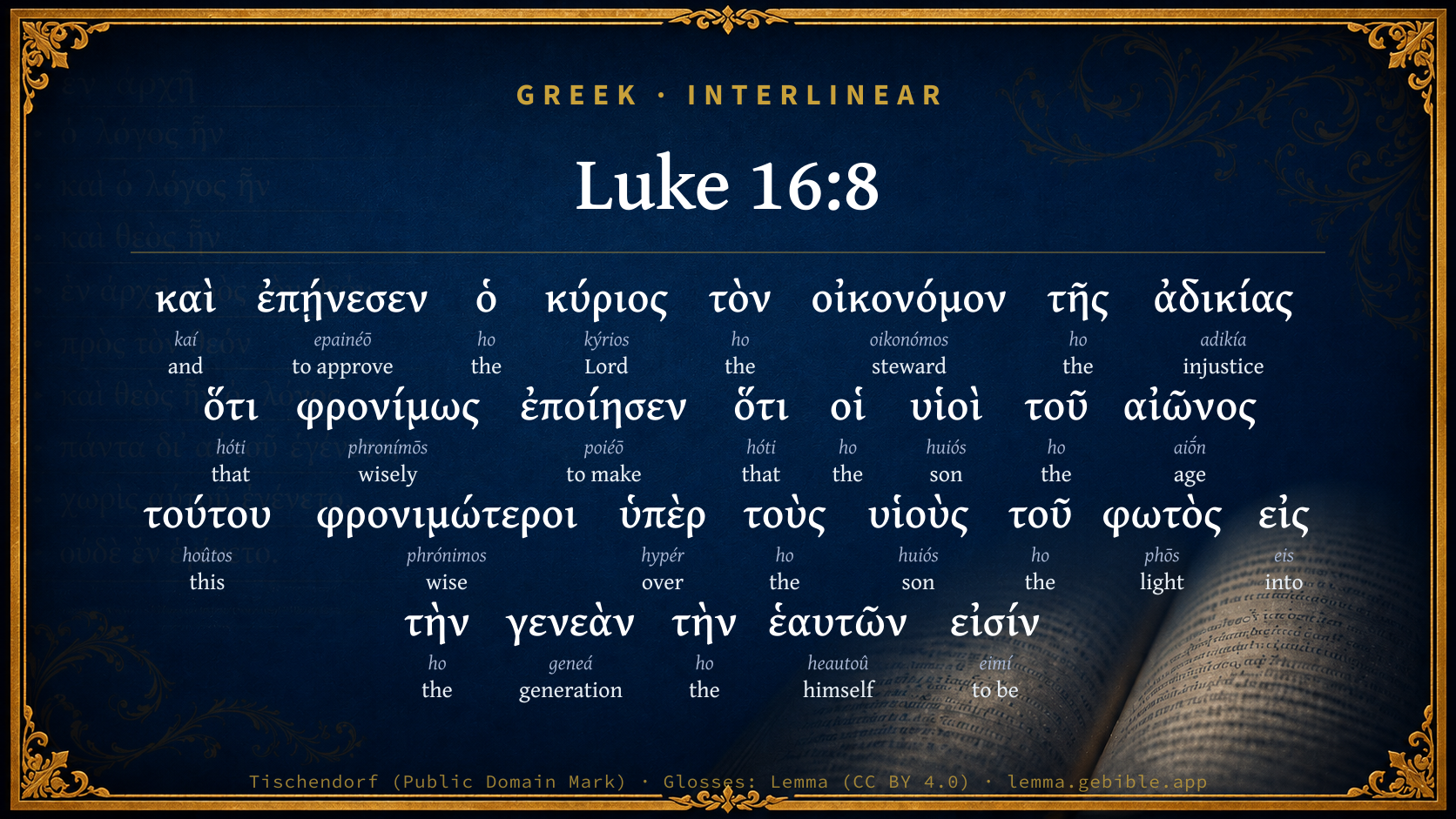
  1. καὶ kaí G2532 “and” Conjunction
  2. ἐπῄνεσεν epainéō G1867 “to approve” Verb, Aorist, Active, Indicative, 3rd person, Singular
  3. ὁ ho G3588 “the” Article, Nominative, Singular, Masculine
  4. κύριος kýrios G2962 “Lord” Noun, Nominative, Singular, Masculine
  5. τὸν ho G3588 “the” Article, Accusative, Singular, Masculine
  6. οἰκονόμον oikonómos G3623 “steward” Noun, Accusative, Singular, Masculine
  7. τῆς ho G3588 “the” Article, Genitive, Singular, Feminine
  8. ἀδικίας adikía G93 “injustice” Noun, Genitive, Singular, Feminine
  9. ὅτι hóti G3754 “that” Conjunction
  10. ἐποίησεν poiéō G4160 “to make” Verb, Aorist, Active, Indicative, 3rd person, Singular
  11. ὅτι hóti G3754 “that” Conjunction
  12. οἱ ho G3588 “the” Article, Nominative, Plural, Masculine
  13. υἱοὶ huiós G5207 “son” Noun, Nominative, Plural, Masculine
  14. τοῦ ho G3588 “the” Article, Genitive, Singular, Masculine
  15. αἰῶνος aiṓn G165 “age” Noun, Genitive, Singular, Masculine
  16. τούτου hoûtos G3778 “this” Demonstrative pronoun, Genitive, Singular, Masculine
  17. φρονιμώτεροι phrónimos G5429 “wise” Adjective, Nominative, Plural, Masculine, Comparative
  18. ὑπὲρ hypér G5228 “over” Preposition
  19. τοὺς ho G3588 “the” Article, Accusative, Plural, Masculine
  20. υἱοὺς huiós G5207 “son” Noun, Accusative, Plural, Masculine
  21. τοῦ ho G3588 “the” Article, Genitive, Singular, Neuter
  22. φωτὸς phōs G5457 “light” Noun, Genitive, Singular, Neuter
  23. εἰς eis G1519 “into” Preposition
  24. τὴν ho G3588 “the” Article, Accusative, Singular, Feminine
  25. γενεὰν geneá G1074 “generation” Noun, Accusative, Singular, Feminine
  26. τὴν ho G3588 “the” Article, Accusative, Singular, Feminine
  27. ἑαυτῶν heautoû G1438 “himself” Reflexive pronoun, 3rd person, Genitive, Plural, Masculine
  28. εἰσίν eimí G1510 “to be” Verb, Present, Active, Indicative, 3rd person, Plural

About this verse

These counts appear in no published source. They are computed here, from the morphology-tagged text and Lemma’s own curated glosses. What Lemma adds →

29
words
19
distinct lemmas
Gospels
section

Notable vocabulary

1 hapax legomenon — a word that appears only here in the entire Greek New Testament:

  • φρονίμως wisely G5430

First appearance in Scripture

These words make their first canonical appearance in the Greek New Testament here:

  • ἐπῄνεσεν to approve G1867
  • φρονίμως wisely G5430

Shared distinctive vocabulary

ἐπῄνεσεν to approve G1867 occurs in 5 verses of the Greek New Testament. Also found in:
Repetition

Words recur within this verse:

Cross-references

19

Topical passages linked to Luke 16:8 in the Treasury of Scripture Knowledge — connected by theme and wording, ordered by reader-vote popularity; previews shown in the World English Bible.

  • 1 Thessalonians 5:5 You are all children of light, and children of the day. We don't belong to the night, nor to darkness,
  • Ephesians 5:8 For you were once darkness, but are now light in the Lord. Walk as children of light,
  • Proverbs 6:6–8 Go to the ant, you sluggard. Consider her ways, and be wise;
  • Luke 16:10 He who is faithful in a very little is faithful also in much. He who is dishonest in a very little is also dishonest in much.
  • John 12:36 While you have the light, believe in the light, that you may become children of light." Jesus said these things, and he departed and hid himself from them.
  • Genesis 3:1 Now the serpent was more subtle than any animal of the field which Yahweh God had made. He said to the woman, "Yes, has God said, 'You shall not eat of any tree of the garden?'"
  • Exodus 1:10 Come, let us deal wisely with them, lest they multiply, and it happen that when any war breaks out, they also join themselves to our enemies, and fight against us, and escape out of the land."
  • Luke 16:4 I know what I will do, so that when I am removed from management, they may receive me into their houses.'
  • 1 John 3:10 In this the children of God are revealed, and the children of the devil. Whoever doesn't do righteousness is not of God, neither is he who doesn't love his brother.
  • 2 Samuel 13:3 But Amnon had a friend, whose name was Jonadab, the son of Shimeah, David's brother; and Jonadab was a very subtle man.
  • Psalms 17:14 From men by your hand, Yahweh, From men of the world, whose portion is in this life. You fill the belly of your cherished ones. Your sons have plenty, And they store up wealth for their children.
  • Psalms 49:10–19 For he sees that wise men die; Likewise the fool and the senseless perish, And leave their wealth to others.
  • Luke 20:34 Jesus said to them, "The children of this age marry, and are given in marriage.
  • 1 Corinthians 3:18 Let no one deceive himself. If anyone thinks that he is wise among you in this world, let him become a fool, that he may become wise.
  • Philippians 3:19 whose end is destruction, whose god is the belly, and whose glory is in their shame, who think about earthly things.
  • 2 Kings 10:19 Now therefore call to me all the prophets of Baal, all his worshippers, and all his priests; let none be wanting: for I have a great sacrifice [to do] to Baal; whoever shall be wanting, he shall not live. But Jehu did it in subtlety, to the intent that he might destroy the worshippers of Baal.
  • Matthew 17:26 Peter said to him, "From strangers." Jesus said to him, "Therefore the children are exempt.
  • Luke 18:6 The Lord said, "Listen to what the unrighteous judge says.
  • 1 Peter 2:9 But you are a chosen race, a royal priesthood, a holy nation, a people for God's own possession, that you may show forth the excellencies of him who called you out of darkness into his marvelous light:

Cross-references courtesy of OpenBible.info (CC BY 4.0).

Commentary

Notes on Luke 16:8 from classic Christian and Jewish commentators (each source and its license shown beneath its notes). The classic Christian expositions comment on the surrounding passage and are grouped to its opening verse, so a note may address several verses; the Jewish commentaries on the Tanakh (Rashi and others) are per-verse, so they appear only where the commentator wrote on this verse.

Lemma curates 59 commentaries, every one of them public domain or Creative Commons licensed, each selected and text-cleaned for this edition rather than reprinted as found. About our sources →

The Biblical Illustrator

Joseph S. Exell

Luk_16:8

And the Lord commended the unjust steward

The unjust steward teaching a lesson prudence

I.

HOW INTIMATELY MIXED UP WITH EACH OTHER ARE VIRTUES AND VICES, GOOD AND EVIL, IN THIS HUMAN WORLD. In fact, no bad man is without some redeeming quality; and no good man (who is merely man) is without some taint or defect that mars the harmony and soils the whiteness of character. In the best men there is something to regret; in the worst there is something to admire and to imitate. What, e.g., can possibly be worse than the general conduct of this steward? Here he is treated with generous confidence by his employer, and he is guilty first of a carelessness in dealing with his masters property, which amounts to a breach of trust, and next of a deliberate effort to gain credit for personal generosity, and to make provision for his own future by falsifying the bonds in his keeping, which represent debts due to his employer. The mans moral nature, we say, must have utterly broken down, before such conduct could have been possible; and yet our Lord discerns an excellence glittering amidst this moral darkness. He puts forth His hand, and He isolates from the corruption which surrounds it in the stewards character, and He lifts up on high, that it may be admired and copied in Christendom to the very end of time one single virtue--the virtue of prudence.

II. THE HIGH RELIGIOUS VALUE OF PRUDENCE; its need and function in relation to the life and future of the soul. Prudence is in man what providence is in Almighty Cod. Its great characteristic is, that it keeps its eye upon what is coming; it looks forward to the future that really awaits us. What is that future? Nothing, most assuredly, nothing that lies within the compass of the few years, if indeed, there are to be a few years, that will precede our disappearance from this visible scene, but the existence beyond, of whatever character it be, to which, so far as we know, there is neither term nor limit. We know what to think of the men who trifle with baubles when great earthly interests are trembling in the balance, in those solemn moments which come and pass, and come not again, the moments on which all depends. Who can forget Carlyles description of the unhappy Louis XVI., when, in his endeavour to escape from the triumphant revolution, he was brought to a standstill by the suspicious officiousness of some of the petty local authorities of Varennes? A little nerve would have enabled the king to escape the barrier that his enemies had thrown across the public road, by making a slight circuit in his carriage through the adjoining fields, and in twenty minutes or half an hour he would have been safe among his friends; and the course of his own life and all European history might have been very different, to say the least, from the event. But he hesitated, and hesitation was ruin. He hesitated, and as they showed him into the parlour of the village inn he discussed, with the good-humoured courtesy that belonged to him, the precise quality of the burgundy that was placed upon the table. But meanwhile events outside were shaping themselves irrevocably into the fatal grooves of that long procession of humiliation and suffering which ended with the guillotine. This life, for many of us, is the halt at Varennes. It is incumbent on us first of all to feel how immense are the issues that depend on the use we make of its fleeting moments. We must bear in mind that its opportunities are as brief as the consequences that depend on them are incalculable. This power of anticipating the reality, the reality as distinct from the appearance, is the first ingredient of religious prudence. We, too, have the sentence of dismissal hanging over us; but do we understand what it means, as did the unjust steward in the parable? For the second business of prudence is to take measures to prepare for that which is coming on us, and to lose no time in doing so. We must not let things drift, and trust for a good issue to some imaginary chapter of accident; we must make friends, as did the steward, who will receive us in this new future into their houses. And who are those friends? Clearly the friends suggested by the parable are the poor. The story of Fernandez de Cordova, who wrapped up in his robe the leper who was lying deserted by all men on the roadside, and who set him down on his bed to find indeed that he had passed away, but also to trace on his brow, on his hands, on his feet, the marks of His sacred passion, embodies why the poor can be said to be received into everlasting habitations. They are not alone, they are identified with One who has shared their sufferings without sharing their weakness; and who knows well how to reward that which is done to Himself in them. Yes, most assuredly, one Friend there is whose power to help us is without limit. He can help us through our passage to our new home, for He died that by His death He might destroy him that hath the power of death, and deliver them who through fear of death were all their lifetime subject to bondage. And He can provide for us when we get there, since among His parting words were these: In My Fathers house, etc. Are our relations with Him such as to warrant our claiming His help in the hour of need? (Canon Liddon.)

Lessons from the children of this world

1. From their sagacity learn to forecast how to please God; to forearm ourselves against all assaults and wiles of Satan; to fore-think, and to be in some measure provided beforehand of needful and proper expedients for any exigent or cross accident that may probably befall us.

2. From their industry learn not to be slothful in doing service, not to slack the time of our repentance and turning to God; to run with constancy and courage the race that is set before us; to think no pains, no travel, too much, that may bring us to heaven; to work out our salvation to the uttermost with fear and trembling.

3. From their hypocrisy and outward seeming holiness learn to have our conversations honest towards them that are without, not giving the least scandal in anything that may bring reproach upon the gospel; to shun the very appearances of evil; and having first cleansed the reside well, to keep the outside handsome too, that by our piety, devotion, meekness, patience, obedience, justice, charity, humility, and all holy graces, we may not only stop up the mouth of the adversary from speaking evil of us, but may also win glory to God, and honour and reputation to our Christian profession thereby.

4. From their unity learn to follow the truth in love, to lay aside vain janglings, and opposition of science falsely so called; to make up the breaches that are in the Church of Christ, by moderating and reconciling differences, rather than to widen them by multiplying controversies, and maintaining hot disputes; to follow the things that make for peace, and whereby we may edify one another. This doing, we may gather grapes of thorns; make oil of scorpions; extract all the medicinal virtue out of the serpent, and yet leave all the poisonous and malignant quality behind. (Bishop Sanderson.)

Ninth Sunday after Trinity;

It was a piece of sheer rascality from beginning to end. There was no honesty in the man. He was out and out a child of this world--an example of the bad faith and base principles which govern in those who have no fear of God before their eyes. Though he did most unjustly, he yet did wisely. There was a cunning, skill, calculation, farsightedness, and perfection of adjustment of means to his ends, worthy of all praise, if only it had been used in a better cause. And it is just here that we find the chief point in this parable. Separating the morality of the deed from the wit that directed it, the Saviour fixes upon the skill and prudence of this unjust man as an illustration of the foresight and calculation which should mark our conduct with reference to the necessities that are upon us in relation to eternity. There are three things specially noticeable in the case of this shrewd villain, in which his example furnishes copy for our imitation.

1. He considerately directed his thoughts towards the future. His worldliness and wickedness we are of course to eschew. But as he looked forward to his needs when his stewardship was ended, so are we to have respect to the solemn realities of the judgment and another life.

2. The unjust steward was also very diligent in improving his time, and making the most of his opportunities. If ever there was energy in him, it was now called into the fullest activity. Here was wisdom. Had he waited, postponed, delayed, the opportunity would have passed. O that miserable delusion. Time enough yet! How many has it utterly and irremediably ruined!

3. The unjust steward made very efficient use of very transient possessions. The control of his masters estates was in process of passing for ever from his hands. But he was wise enough to make them yet tell for his advantage in the beyond. And in allusion to this the Saviour says, Make to yourselves friends of the mammon of unrighteousness; that is, of the deceitful and fleeting riches of this world; that when ye fail they may receive you--or, ye may be received--into everlasting habitations. There is nothing so fleeting and uncertain as riches. But fleeting, deceptive, and uncertain as they are, so long as they are in our hands, they may be turned to good account, and made to tell advantageously upon our eternal peace. We cannot buy admission into heaven with money. But we can add to our blessedness with money, and attain to higher rewards in heaven by a right disposition of the possessions of this life. He that giveth to the poor, lendeth to the Lord; and the same shall be returned again with interest. The liberal soul shall be made fat. Closehanded miserliness, and reckless waste and speculation, are as sinful and incompatible with piety, as profaneness and unbelief. (J. A. Seiss, D. D.)

Worldlings an example to Christians

I. THEY RECOGNIZE MORE CLEARLY THE NECESSITY OF PERSONAL EFFORT TO ENSURE SUCCESS. It was so with this unjust steward. Must do something. It is so with the politician, lawyer, business man. Instead of merely hoping, wishing, they put their shoulder to the wheel.

II. THEY RECOGNIZE MORE CLEARLY THE NEED OF THOUGHT, REFLECTION, ON THE METHODS TO BE ADOPTED. III. THEY ARE MORE WILLING TO MAKE PERSONAL SACRIFICES.

IV. THEY MORE FREQUENTLY MAKE SELF-EXAMINATION. Take stock. See whether they are advancing or going backward. (J. Ogle.)

The wisdom of making provision for the future

I. IT IS PART OF GREAT WISDOM TO PROVIDE FOR THE FUTURE.

1. This appears by the care and practice of all wise, rational men.

2. It appears by the care and labour of irrational or mere animal creatures.

3. It appears to be a point of great wisdom, because God Himself bewails the folly of His people of old upon this respect (Deu_32:29).

4. It must needs be great wisdom to provide for the future well-being of our souls, because all that were ever esteemed to be wise before or above all other things preferred this matter (Heb_11:25-26; 2Co_4:18).

5. Because there is no avoiding our entering into an endless state of joy or sorrow.

6. Because the soul far exceeds in worth the body and all things in this world.

7. Because God from eternity studied and provided for the future good of our souls and bodies for ever.

8. Consider how soon I or any may fail, how soon the youngest may like a flower fade away; it may be this year, this month, this week, nay, this night.

9. If you are not provided for your future state, consider how dismal at death your state will be. Is it not the highest wisdom to prevent or seek to escape the greatest evil, and be possessed of the greatest good?

10. Consider that God has found out a way to make us happy for ever; and observe what promises He has made to such as before all things seek the kingdom of heaven and His righteousness.

11. How have many thousands bewailed their great folly in not providing for the time to come!

II. WHAT FUTURE TIME IS IT SUCH WISDOM TO PROVIDE FOR?

1. Against that time when the means of grace may fail, or all provision for the future may utterly be cut off, or our understanding fail.

2. The hour of death.

3. The day of judgment.

III. SHOW WHEREIN A WISE AND PRUDENT CARE TO PROVIDE FOR THE FUTURE CONSISTS.

1. We ought to think of our future state, into which we shall and must pass, when the soul shall be separated from the body.

(1) Think of the certainty of a future state of joy or sorrow.

(2) The nearness of it,

2. Consider the necessity of your knowing Christ, or of being united to Him by faith; for unless you truly believe in Jesus Christ, you cannot be prepared for the time to come.

3. This wisdom consists in a careful use of the means God affords, and has ordained, in order to faith, or a sinners believing in Christ Jesus.

(1) Prayer.

(2) The hearing of the Word (Isa_42:23).

Conclusion:

1. This reproves such as pursue the world as if they came into it for no other end but to eat and drink and heap a little white and yellow earth.

2. It reproves such as prefer the world above the Word, and the body above the soul.

3. It reproves such as put the evil day afar off, as if we spoke of things that will be long before they come.

4. It commends those who are heavenly, it shows the saints only are truly wise. (B. Keach.)

Lessons that the Church may learn from the world

Note some respects in which the world shames the Church.

1. There is the clearness of vision with which the worldly man perceives the object of his pursuit.

2. There is the unremitting effort with which, in relation to the attainment of this worlds good, men pursue their object. Religion is not so real to most of us as markets and money are to merchants.

3. Think how careful men of the world are to use all their resources for the attainment of their end. No drones. No square men in round holes..

4. Think how determinedly the children of this world refuse to be deterred from prosecuting their schemes by the temporary failure of their efforts.

5. Is it not true that even the children of light themselves prosecute their worldly affairs in far more vigorous fashion than their religious duties? Does not care sometimes wellnigh crowd prayer out of our lives? Are we not all too prone to count our own private business that which must be done, and Gods work that which may be done? (J. R. Bailey.)

An example of wisdom from the unjust steward

I. THE WISDOM OF THIS WORLD. There are three classes of men. Those who believe that one thing is needful, and choose the better part, who believe in and live for eternity; these are not mentioned here: those who believe in the world, and live for it: and those who believe in eternity, and half live for the world. Forethought for self made the steward ask himself, What shall I do? Here is the thoughtful, contriving, sagacious man of the world. In the affairs of this world, the man who does not provide for self, if he enter into competition with the world on the worlds principles, soon finds himself thrust aside; he will be put out. It becomes necessary to jostle and struggle in the great crowd if he would thrive. With him it is not, first the kingdom of God; but first, what he shall eat, and what he shall drink, and wherewithal shall he be clothed. Note the kind of superiority in this character that is commended. There are certain qualities which really do elevate a man in the seals of being, lie who pursues a plan steadily is higher than he who lives by the hour. You cannot but respect such an one. The value of self-command and self-denial is exemplified in the cases of the diplomatist who masters his features while listening; the man of pleasure who is prudent in his pleasures; the man of the world who keeps his temper and guards his lips. How often, after speaking hastily the thought which was uppermost, and feeling the cheek burn, you have looked back in admiration on some one who held his tongue even though under great provocation to speak.

II. In contrast with the wisdom of the children of this world, the Redeemer SHOWS THE INCONSISTENCIES OF THE CHILDREN OF LIGHT. Now the want of Christian wisdom consists in this, that our stewardship is drawing to a close, and no provision is made for an eternal future. We are all stewards. Every day, every age of life, every year, gives us superintendence over something which we have to use, and the use of which tells for good or evil on eternity. Childhood and manhood pass. The day passes: and, as its close draws near, the Masters voice is heard--Thou mayest be no longer steward. And what are all these outward symbols but types and reminders of the darker, longer night that is at hand? One by one, we are turned out of all our homes. The summons comes. The man lies down on his bed for the last time; and then comes that awful moment, the putting down the extinguisher on the light, and the grand rush of darkness on the spirit. Let us now consider our Saviours application of this parable. There are two expressions to be explained.

1. Mammon of unrighteousness. Mammon is the name of a Syrian god, who presided over wealth. Mammon of unrighteousness means the god whom the unrighteous worship--wealth. It is not necessarily gold. Any wealth; wealth being weal or well-being. Time, talents, opportunity, and authority, all are wealth. Here the steward had influence. It is called the mammon of unrighteousness, because it is ordinarily used, not well, but ill. Power corrupts men. Riches harden more than misfortune.

2. Make to yourselves friends. Wise arts, holy and unselfish deeds, secure friends. Wherever the steward went he found a friend. The acts of his beneficence were spread over the whole of his masters estate. Go where he would, he would receive a welcome. In this way our good actions become our friends. And if it be no dream which holy men have entertained, that on this regenerated earth the risen spirits shall live again in glorified bodies, then it were a thing of sublime anticipation, to know that every spot hallowed by the recollection of a deed done for Christ, contains a recollection which would be a friend. Just as the patriarchs erected an altar when they felt God to be near, till Palestine became dotted with these memorials, so would earth be marked by a good mans life with those holiest of all friends, the remembrance of ten thousand little nameless acts of piety and love. (F. W. Robertson, M. A.)

The superiority of the worldly mans wisdom to the godly mans

I. Our first object is TO ESTABLISH THE FACT, THAT THE CHILDREN OF THIS WORLD ARE WISER IN THEIR GENERATION THAN THE CHILDREN OF LIGHT. We hold unreservedly, in both these respects, the wisdom of the children of this world is a vast deal more conspicuous than the wisdom of the children of light. You need only cast your eye over the busy group of the worlds population, and you will observe for the most part a fixedness of purpose which is altogether admirable. If a man have turned his desires on the amassing of money, he will not be driven aside, even for a solitary moment, from the business of accumulation; it will be plain to all around him, that he is literally given up to the influence of one engrossing and domineering passion; and if pleasure and ambition do exert over him authority, they are but tributaries to the prominent desire, and in no sense the principal in the empire of his heart. The case is exactly the same with the man of ambition: he has fastened his wishes on some lofty point in the scale of human preferment, and it is not the syren voice of voluptuousness, and it is not the stern ruggedness of the upward path, by which he can be induced to turn away his eagle glance from the shadowy prize which floats above him. But if we turn from the children of this world to the children of light, we shall not find the fixedness and constancy of purpose which we see indicated in the children of the world. But we go on to observe, in the second place, that wisdom is to be discovered in the choice and employment of means as well as in fixedness and constancy of purpose; and thus we think in this respect the comparison will go against the children of light. You cannot fail to observe among the men of the world a singular shrewdness in finding out the methods most likely to effect their designs, and as singular a diligence in trying and adapting them. You will see nothing irrelevant, nothing which in all probability is likely to frustrate in place of forwarding, no risks run unless the chances of advantage do more than apparently counterbalance the chances of damage. You will not find them endangering their property by exposing it to sharpers, as a Christian does his piety by bringing it in contact with unrighteousness. You will not observe them so dull of apprehension, when there are opportunities of personal aggrandizement to be improved, as religious men appear when God affords them occasions to become better acquainted with Himself. You will not detect in them that indiscreetness in making associations with parties who are not likely to help them, which you see in believers running heedlessly into fellowship with unbelievers. The complaint of the prophet has lost nothing of its force in coming down through a succession of centuries; Men are wise to do evil, but to do good they have no knowledge. And if in the choice of means, pre-eminence of wisdom must be denied to the children of light, then in the employment of means we fear they still less can be held supreme. If you take the children of light in the Church where they are professedly giving their whole soul to the service of God, and take the children of this world on the exchange, when avowedly occupied with their temporal aggrandizement, on which side will yon find the most devoted attention to the business in hand? If you take the children of light, when met by difficulties in their heavenward career, and the children of the world when stopped in the path of human preferment, which will set themselves with the most out and out energy to overleap the impediments? If you take the children of light when scoffers are around them jeering their piety, and the children of the world when sarcasms are being passed on covetousness or ambition, which will he most moved

II. We come now to INVESTIGATE THE CAUSES TO WHICH THE SUPERIORITY UNDER REVIEW MAY BE LEGITIMATELY TRACED. In the first place it would seem well-nigh impossible that the delights of the next world should exert as powerful and pervading an influence as the delights of the present world, which address themselves directly to our senses. The children of the world have nothing to do but to follow the dictates of their senses; while we do almost say, that the children of light begin by doing violence to their senses. And thus, while worldly men may bring mind and body, and life together to the pursuit of their end, godly men have the body as well as the mind from the outset to the termination of their career to combat with; and if it be lawful to bring forward these truths, by way of excuse they may clearly be adduced, as accounting for the fact that the ungodly exhibit greater constancy of purpose than the godly; or in other words, that the children of this world are in their generation wiser than the children of light. Again, the unrighteous have only to do with one world; whereas the righteous have necessarily to do with two worlds. If I make the amassing of wealth my end, I may give to it an undivided and an undistracted attention, I concern not myself with the things of eternity; and what then shall interfere with my pressing on in the pursuit of the things of time? It is widely different with the children of light. There must be earthly matters just as well as heavenly matters which require their attention; they cannot detach themselves from commerce, or from labour, or from study, and care only for the soul as ii there were no body to provide for, just as the worldly care only for the body as if there were no soul to provide for; and though it may be perfectly true, according to some of our foregoing remarks, that the minor interests may be, and ought to be, made subservient to the major; it is equally true that the difficulty is almost incalculable of so using the present world as not to abuse it, and following the occupations of earth with the dispositions of heaven. (H. Melvill, B. D.)

The children of this world wiser than the children of light

The words are a comparison, in which we have--

1. The persons compared, the children of this world, and the children of light. It is a very usual phrase among the Hebrews, when they would express anything to partake of such a nature or quality, to call it the son or child of such a thing. Thus good men are called the children of God, and bad men the children of the devil; those who mind earthly things, and make the things of this world their greatest aim and design, are called the children of this world; and those who are better enlightened with the knowledge of their own immortality, and the belief of a future state after this life, are called the children of light.

2. Here is the thing wherein they are compared, and that is, as to their wisdom and prudence.

3. The object of this prudence, which is not the same in both; as if the sense were that the children of this world are wiser than the children of light as to the things of this world; but here are two several objects intended, about which the prudence of these two sorts of persons is respectively exercised, the concernments of this world and the other; and our Saviours meaning is, that the children of this world are wiser in their generation, that is, in their way; viz., as to the interests and concernments of this world, than the children of light are in theirs; viz., as to the interests and concernments of the other world.

4. Here is a decision of the matter, and which of them it is that excels in point of prudence, in their way; and our Saviour gives it to the children of this world; they are wiser in their generation than the children of light.

I. I SHALL ENDEAVOUR TO CONFIRM AND ILLUSTRATE THE TRUTH OF THIS, BY CONSIDERING THE SEVERAL PARTS AND PROPERTIES OF WISDOM.

1. They are usually more firmly fixed and resolved upon their end. Whatever they set up for their end, riches, or honours, or pleasures, they are fixed upon it, and steady in the prosecution of it.

2. The children of this world are wiser in the choice of means in order to their end; and this is a great part of wisdom, for some means will bring about an end with less pains, and difficulty, and expense of time than others.

3. The children of this world are commonly more diligent in the use of means for the obtaining of their end; they will sweat and toil, and take any pains, rise up early, and lie down late, and eat the bread of carefulness; their thoughts are continually running upon their business, and they catch at every opportunity of promoting it; they will pinch nature, and harass it; and rob themselves of their rest, and all the comfort of their lives, to raise their fortune and estate.

4. The men of the world are more invincibly constant and pertinacious in the pursuit of earthly things; they are not to be bribed or taken off by favour or fair words; not to be daunted by difficulties, or dashed out of countenance by the frowns and reproaches of men.

5. The men of the world will make all things stoop and submit to that which is their great end and design; their end rules them, and governs them, and gives laws to all their actions; they will make an advantage of everything, and if it will not serve their end one way or other, they will have nothing to do with it.

II. GIVE SOME PROBABLE ACCOUNT OF THIS BY CONSIDERING WHAT ADVANTAGES THE CHILDREN OF THIS WORLD HAVE ABOVE THE CHILDREN OF LIGHT.

1. The things of this world are present and sensible, and, because of their nearness to us, are apt to strike powerfully upon our senses, and to affect us mightily, to excite our desires after them, and to work strongly upon our hopes and fears: but the things of another world being remote from us, are lessened by their distance, and consequently are not apt to work so powerfully upon our minds.

2. The sensual delights and enjoyments of this world are better suited, and more agreeable to the corrupt and degenerate nature of men, than spiritual and heavenly things are to those that are regenerate.

3. The worldly mans faith and hope, and fear of present and sensible things, is commonly stronger than a good mans faith and hope, and fear of things future and eternal. Now faith, and hope, and fear, are the great principles which govern and bear sway in the actions and lives of men.

4. The men of the world have but one design, and are wholly intent upon it, and this is a great advantage. Application to one thing, especially in matters of practice, gains a man perfect experience in it, and experience furnisheth him with observations about it, and these make him wise and prudent in that thing. But good men, though they have a great affection for heaven and heavenly things, yet the business and necessities of this life do very much divert and take them off from the care of better things; they are divided between the concernments of this life and the other, and though there be but one thing necessary in comparison, yet the conveniences of this life are to be regarded; and though our souls be our main care, yet some consideration must be had-of our bodies, that they may be fit for the service of our souls; so that we cannot always and wholly apply ourselves to heavenly things, and mind them as the men of the world do the things of this world.

5. The men of the world have a greater compass and liberty in the pursuit of their worldly designs, than good men have in the prosecution of their interests. The children of light are limited and confined to the use of lawful means for the compassing of their ends; but the men of the world are not so strait-laced; they are resolved upon the point, and will stick at no means to compass their end.

Concluding remarks:

1. Notwithstanding the commendation which hath been given of the wisdom of this world, yet upon the whole matter it is not much to be valued and admired. It is, indeed, great in its way and kind; but it is applied to little and low purposes, employed about the concernments of a short time and a few days, about the worst and meanest part of ourselves, and accompanied with the neglect of greater and better things. This ii wisdom, to regard our main interest; but if we be wrong in our end (as all worldly men are), the faster and farther we go, the more fatal is our error and mistake. The children of this world are out in their end, and mistaken in the main; they are wise for this world, which is inconsiderable to eternity; wise for a little while, And fools for ever,

2. From what hath been said, we may infer, that if we lose our souls, and come short of eternal happiness, it is through our own fault and gross neglect; for we see that men are wise enough for this world; and the same prudence, and care, and diligence, applied to the concernments of our souls, would infallibly make us happy.

3. What a shame and reproach is this to the children of light! (Archbishop Tillotson.)

Sagacity commended

It is merely the wisdom, the practical sagacity, the savoir faire of the steward that is commended to our attention and imitation. A bad thing may be well done. The most admirable qualities--industry, perseverance, bravery, quickness--may serve to accomplish a wicked as well as a righteous purpose. Few can withhold a tribute of applause from the forger who successfully copies a very difficult banknote, or elaborates a professedly medieval document so as to deceive even the experts. No one commends the morality of David when he played the madman at Gath, and scrabbled on the gate; but who has not smiled at his skill in meeting the occasion, in overreaching all his enemies, and making them serve him by the simple device of hiding the brightest intellect of the age under the vacant, silly stare of the idiot? The wisdom of the unjust steward, which we are invited to admire, appeared mainly in his businesslike apprehension of the actual situation in which he was placed, and his sagacity and promptitude in making the most of it. He looked the facts in the face. He did not buoy himself up with delusive hopes. He did not waste his brief opportunity in idle expectations. He manfully faced the inevitable, and this was his salvation. The ability to do so is a great part of what is known as a strong character (Marcus Dods, D. D.)

The true wisdom.

Our Lord pronounced the children of this world wise in their generation; and who can doubt that thousands who are lost would, with Gods blessing, be saved, did they bring the same prudence, and diligence, and energy to their eternal, as they do to their temporal interests? But in how many people is consummate wisdom joined to the greatest folly? They are wise enough to gain the world, and fools enough to lose their souls. Convince a man that the only way to save his life is to part with his limb, and he does not hesitate an instant between living with one limb and being buried with two. Borne into the operating theatre, pale, yet resolute, he bares the diseased member to the knife. And how well does that bleeding, fainting, groaning sufferer teach us to part with our sins rather than with our Saviour. If life is better than a limb, how much better is heaven than a sin? Two years ago a man was called to decide between preserving his life, and parting with the gains of his lifetime. A gold-digger, he stood on the deck of a ship that, coming from Australian shores, had--as some all but reach heaven--all but reached her harbour in safety. The exiles had been coasting along their native shores: and to-morrow, husbands would embrace their wives, children their parents, and not a few realize the bright dream of returning to pass the evening of their days in happiness amid the loved scenes of their youth. But as the proverb runs, there is much between the cup and the lip. Night came lowering down; and with the night a storm that wrecked ship, and hopes, and fortunes, all together. The dawning light but revealed a scene of horror--death staring them in the face. The sea, lashed into fury, ran mountains high; no boat could live in her. One chance still remained. Pale women, weeping children, feeble and timid men must die; but a stout, brave swimmer, with trust in God, and disencumbered of all impediments, might reach the shore, where hundreds stood ready to dash into the boiling surf, and, seizing, save him. One man was observed to go below. He bound around his waist a heavy belt, filled with gold, the hard gains of his life; and returned to the deck. One after another, he saw his fellow-passengers leap overboard. After a brief but terrible struggle, head after head went down--sunk by the gold they had fought hard to gain, and were loth to lose. Slowly he was seen to unbuckle his belt. His hopes had been bound up in it. It was to buy him land, and ease, and respect--the reward of long years of hard and weary exile. What hardships he had endured for it! The sweat of his brow, the hopes of day and the dreams of night, were there. If he parts with it, he is a beggar; but then if he keeps it, he dies. He poised it in his hand; balanced it for a while; took a long, sad look at it; and then with one strong, desperate effort, flung it far out into the roaring sea. Wise man I It sinks with a sullen plunge; and now he follows it--not to sink, but, disencumbered of its weight, to swim; to beat the billows manfully; and, riding on the foaming surge, to reach the shore. Well done, brave gold-digger! Ay, well done, and well chosen; but if a man, as the devil said, who once spoke Gods truth, will give all that he hath for his life, how much more should he give all he hath for his soul? Better to part with gold than with God; to bear the heaviest cross than miss a heavenly, crown! (T. Guthrie, D. D.)

The Biblical Illustrator, edited by Joseph S. Exell (c. 1880s–1900s) — public domain. Text from a community e-Sword module.

Joseph Benson's Commentary

Luk 16:8-9. And the lord — Rather, his lord, or master, for it is Jesus, and not the evangelist, who speaks this, as is plain from both the structure of the parable itself, and from the application which Jesus makes of it in the next verse; commended the unjust steward, because he had acted wisely — Or, prudently for himself, as φρωνιμως here signifies. Properly, indeed, his master commended neither the actor nor the action; but solely the provident care about his future interest which the action displayed; a care worthy the imitation of those who have in view a nobler futurity, eternal life. And the commendation is here mentioned by our Lord, merely in order that he might recommend that precaution to our imitation. For, though the dishonesty of such a servant was detestable, yet his foresight, care, and contrivance about the interests of this life, deserve to be imitated by us, with regard to the more important concerns of another. For the children of this world — Those who seek no other portion than the things of this world; are wiser than the children of light — Not absolutely, for they are, one and all, egregious fools, and must be accounted such by all who believe there is a life to come, a life of unspeakable and eternal happiness or misery; but they are more consistent with themselves; they are truer to their principles; they more steadily pursue their end; they are wiser in their generation: that is, in their own way, and for this present life, than the children of God are, with respect to the life that is future and eternal. The latter, though enlightened by God to see where their true happiness lies, seldom appear so thoughtful and active in the great concerns of religion, as worldly men are in pursuit of the momentary and precarious possessions of this world. Make yourselves friends of the mammon of unrighteousness — Be good stewards even of the lowest talents wherewith God hath intrusted you, and particularly of your property. Make yourselves friends of this, by doing all possible good with it, particularly to the children of God. Mammon means riches, or money, which is here termed mammon of unrighteousness, or of deceit, or unfaithfulness, as αδικιας may be rendered, because of the manner in which it is either used or employed; or on account of its being so apt to fail the expectation of the owners; in which view it is opposed to true riches: Luk 16:11. The phrase is plainly a Hebraism, as οικονομος της αδικιας, steward of unrighteousness, or unfaithfulness, Luk 16:8; and, κριτης της αδικιας, judge of unrighteousness, Luk 18:6, which two last expressions our translators have, with perfect fidelity, changed into the unjust steward, and the unjust judge: if they had taken the same liberty in many other places: they would have made the Scriptures plainer than they now appear to be to an English reader. It is justly observed by Dr. Doddridge here, that “nothing can be more contrary to the whole genius of the Christian religion, than to imagine that our Lord would exhort men to lay out their ill-gotten goods in works of charity, when justice so evidently required they should make restitution to the utmost of their abilities.” That when ye fail — When your flesh and heart fail; when this earthly tabernacle is dissolved, those of them who are gone before, may receive, may welcome you into everlasting habitations — And you may for ever enjoy the reward of your pious charity and love, in the friendship of all those truly worthy persons who have been relieved by it. Or, this expression, they may receive you, may be a mere Hebraism for, ye shall be received, namely, by God, if you make a right use of his gifts. Here, as it were, our Lord, with great propriety, suggests the thoughts of death as an antidote against covetousness, an unreasonable passion, to which, however, many on the very borders of the grave are wretchedly enslaved. Upon the whole, the true scope of this parable is, to teach those who have their views extended to eternity, to be as active and prudent in their schemes for the life to come as the children of this world are for the present; and particularly to do all the good to others in their power; a duty highly incumbent on those especially whose business it is to reclaim sinners, not only because sinners are in themselves fit objects of charity, as well as saints, but because charitable offices done to them, may have a happy tendency to promote their conversion. “That this was the lesson which Jesus designed particularly to inculcate by this parable, is evident from the application of it; and his advice therein is worthy of the most serious attention; the best use we can make of our riches being undoubtedly to employ them in promoting the salvation of others. For if we use our abilities and interest in bringing sinners to God, if we spend our money in this excellent service, we shall conciliate the good-will of all heavenly beings, who greatly rejoice at the conversion of sinners, as was represented in the preceding parables; so that, with open arms, they will receive us into the mansions of felicity. And therefore, while self-seekers shall have their possessions, and honours, and estates torn from them, with the utmost reluctancy, at death, they who have devoted themselves, and all that they had, to the service of God, shall find their consumed estates to be greatly increased, and their neglected honours abundantly repaired, in the love and friendship of the inhabitants of heaven, and in the happiness of the world to come, and shall rejoice in having disposed of their wealth to such an advantage.” — Macknight.

Joseph Benson's Commentary on the Old and New Testaments (1811–1818) — public domain. Text from a community e-Sword module.

MacLaren's Expositions of Holy Scripture

Alexander MacLaren

Luke

THE FOLLIES OF THE WISE

Luk 16:8.

The parable of which these words are the close is remarkable in that it proposes a piece of deliberate roguery as, in some sort, a pattern for Christian people. The steward’s conduct was neither more nor less than rascality, and yet, says Christ, ‘Do like that!’ The explanation is to be found mainly in the consideration that what was faithless sacrifice of his master’s interests, on the part of the steward, is, in regard to the Christian man’s use of earthly gifts, the right employment of the possessions which have been entrusted to him. But there is another vindication of the singular selection of such conduct as an example, in the consideration that what is praised is not the dishonesty, but the foresight, realisation of the facts of the case, promptitude, wisdom of various kinds exhibited by the steward. And so says our Lord-shutting out the consideration of ends, and looking only for a moment at means,-the world can teach the Church a great many lessons; and it would be well for the Church if its members lived in the fashion in which the men of the world do. There is eulogium here, a recognition of splendid qualities, prostituted to low purposes; a recognition of wisdom in the adaptation of means to an end; and a limitation of the recognition, because it is only in their generation that ‘the children of this world are wiser than the children of light.’

I. So we may look, first, at these two classes, which our Lord opposes here to one another.

‘The children of this world’ would have, for their natural antithesis, the children of another world. The ‘children of light’ would have, for their natural antithesis, ‘the children of darkness.’ But our Lord so orders His words as to suggest a double antithesis, one member of which has to be supplied in each case, and He would teach us that whoever the children of this world may be, they are ‘children of darkness’; and that the ‘children of light’ are so, just because they are the children of another world than this. Thus He limits His praise, because it is the sons of darkness that, in a certain sense, are wiser than the enlightened ones. And that is what makes the wonder and the inconsistency to which our Lord is pointing. We can understand a man being a consistent, thorough-paced fool all through. But men whose folly is so dashed and streaked with wisdom, and others whose wisdom is so spotted and blurred with folly, are the extraordinary paradoxes which experience of life presents to us.

The children of this world are of darkness; the children of light are the children of another world. Now I need not spend more than a sentence or two in further explaining these two antitheses. I do not intend to vindicate them, or to vindicate our Lord’s distinct classification of men into these two halves. What does He mean by the children of this world? The old Hebrew idiom, the children of so-and-so, simply suggests persons who are so fully possessed and saturated with a given quality, or who belong so entirely to a given person, as that they are spoken of as if they stood to it, or to him, in the relation of children to their parents. And a child of this world is a man whose whole thoughts, aims, and objects of life are limited and conditioned by this material present. But the word which is employed here, translated rightly enough ‘world,’ is not the same as that which is often used, especially in John’s writings, for the same idea. Although it conveys a similar idea, still it is different. The characteristic quality of the visible and material world which is set forth by the expression here employed is its transiency. ‘The children of this epoch’ rather than ‘of this world’ is the meaning of the phrase. And it suggests, not so much the inadequacy of the material to satisfy the spiritual, as the absurdity of a man fixing his hopes and limiting his aims and life-purpose within the bounds of what is destined to fade and perish. Fleeting wealth, fleeting honours, mortal loves, wisdom, and studies that pass away with the passing away of the material; these, however elevating some of them may be, however sweet some of them may be, however needful all of them are in their places, are not the things to which a man can safely lash his being, or entrust his happiness, or wisely devote his life. And therefore the men who, ignoring the fact that they live and the world passes, make themselves its slaves, and itself their object, are convicted by the very fact of the disproportion between the duration of themselves and of that which is their aim, of being children of the darkness.

Then we come to the other antithesis. The children of light are so in the measure in which their lives are not dependent exclusively upon, nor directed solely towards, the present order and condition of things. If there be a this, then there is a that. If there be an age which is qualified as being present, then that implies that there is an age or epoch which is yet to come. And that coming ‘age’ should regulate the whole of our relations to that age which at present is. For life is continuous, and the coming epoch is the outcome of the present. As truly as ‘the child is father of the man,’ so truly is Eternity the offspring of Time, and that which we are to-day determines that which we shall be through the ages. He that recognises the relations of the present and the future, who sees the small, limited things of the moment running out into the dim eternity beyond, and the track unbroken across the gulfs of death and the broad expanse of countless years, and who therefore orders the little things here so as to secure the great things yonder, he, and only he, who has made time the ‘lackey to eternity,’ and in his pursuit of the things seen and temporal, regards them always in the light of things unseen and eternal, is a child of light.

II. The second consideration suggested here is the limited and relative wisdom of the fools.

The children of this world, who are the children of darkness, and who at bottom are thoroughly unwise, considered relatively, ‘are wiser than the children of light.’ The steward is the example. ‘A rogue is always’-as one of our thinkers puts it-’a roundabout fool.’ He would have been a much wiser man if he had been an honester one; and, instead of tampering with his lord’s goods, had faithfully administered them.

But, shutting out the consideration of the moral quality of his action, look how much there was in it that was wise, prudent, and worthy of praise. There were courage, fertility of resource, a clear insight into what was the right thing to do. There was a wise adaptation of means to an end. There was promptitude in carrying out the wise means that suggested themselves to him. The design was bad. Granted. We are not talking about goodness, but about cleverness. So, very significantly, in the parable the person cheated cannot help saying that the cheat was a clever one. The ‘lord,’ although he had suffered by it, ‘commended the unjust steward, because he had done wisely.’

Did you never know in Manchester some piece of sharp practice, about which people said, ‘Ah, well, he is a clever fellow,’ and all but condoned the immorality for the sake of the smartness? The lord and the steward belong to the same level of character; and vulpine sagacity, astuteness, and qualities which ensure success in material things seem to both of them to be of the highest value. ‘The children of this world, in their generation’-but only in it-are wiser than the children of light.’

Now I draw a very simple, practical lesson, and it is just this, that if Christian men, in their Christian lives, would practise the virtues that the world practises, in pursuit of its shabby aims and ends, their whole Christian character would be revolutionised. Why, a boy will spend more pains in learning to whistle than half of you do in trying to cultivate your Christian character. The secret of success religiously is precisely the same as the secret of success in ordinary things. Look at the splendid qualities that go to the making of a successful housebreaker. Audacity, resource, secrecy, promptitude, persistence, skill of hand, and a hundred others, are put into play before a man can break into your back kitchen and steal your goods. Look at the qualities that go to the making of a successful amuser of people. Men will spend endless time and pains, and devote concentration, persistence, self-denial, diligence, to learning how to play upon some instrument, how to swing upon a trapeze, how to twist themselves into abnormal contortions. Jugglers and fiddlers, and circus-riders and dancers, and people of that sort spend far more time upon efforts to perfect themselves in their profession, than ninety-nine out of every hundred professing Christians do to make themselves true followers of Jesus Christ. They know that nothing is to be got without working for it, and there is nothing to be got in the Christian life without working for it any more than in any other.

Shut out the end for a moment, and look at the means. From the ranks of criminals, of amusers, and of the purely worldly men of business that we come in contact with every day, we may get lessons that ought to bring a blush to all our cheeks, when we think to ourselves how a wealth of intellectual and moral qualities and virtues, such as we do not bring to bear on our Christian lives, are by these men employed in regard of their infinitely smaller pursuits.

Oh, brethren! we ought to be our own rebukes, for it is not only other people who show forth in other fields of life the virtues that would make so much better Christians of us, if we used them in ours, but that we ourselves carry within ourselves the condemning contrast. Look at your daily life! Do you give anything like the effort to grow in the knowledge of your Lord and Saviour, Jesus Christ, that you do to make or maintain your position in the world? When you are working side by side with the children of this world for the same objects, you keep step with them, and are known to be diligent in business as they are. When you pass into the church, what do you do there? Are we not ice in one half of our lives, and fire in the other? We may well lay to heart these solemn words of our Lord, and take shame when we think that not only do the unwise, who choose the world as their portion, put us to shame in their self-denial, their earnestness, their absorption, their clear insight into facts, their swiftness in availing themselves of every opportunity, their persistence and their perseverance, but that we rebuke ourselves because of the difference between the earnestness with which we follow the things that are of this world, and the languor of our pursuit after the things that are unseen and eternal.

Of course the reasons for the contrast are easy enough to apprehend, and I do not need to spend time upon them. The objects that so have power to stimulate and to lash men into energy, continuously through their lives, lie at hand, and a candle near will dim the sunshine beyond. These objects appeal to sense, and such make a deeper impression than things that are shown to the mind, as every picture-book may prove to us. And we, in regard to the aims of our Christian life, have to make a continual effort to bring and keep them before us, or they are crowded out by the intrusive vulgarities and dazzling brilliances of the present. And so it comes to pass that the men who hunt after trifles that are to perish set examples to the men who say that they are pursuing eternal realities. ‘Go to the ant, thou sluggard, consider her ways and be wise.’ Go to the men of the world, thou Christian, and do not let it be said that the devil’s scholars are more studious and earnest than Christ’s disciples.

III. Lastly, note the conclusive folly of the partially wise.

‘In their generation,’ says Christ; and that is all that can be said, The circle runs round its 360 degrees, and these people take a segment of it, say forty-five degrees, and all the rest is as non-existent. If I am to call a man a wise man out and out, there are two things that I shall have to be satisfied about concerning him. The one is, what is he aiming at? and the other, how does he aim at it? In regard to the means, the men of the world bear the bell, and carry away the supremacy. Let in the thought of the end, and things change. Two questions reduce all the world’s wisdom to stark, staring insanity. The first question is, ‘What are you doing it for?’ And the second question is, ‘And suppose you get it, what then?’ Nothing that cannot pass the barrier of these two questions satisfactorily is other than madness, if taken to be the aim of a man’s life. You have to look at the end, and the whole circumference of the circle of the human being, before you serve out the epithets of ‘wise’ and ‘foolish.’

I need not dwell on the manifest folly of men who give their lives to aims and ends of which I have already said that they are disproportioned to the capacity of the pursuer. Look at yourselves, brothers; these hearts of yours that need an infinite love for their satisfaction, these active spirits of yours that can never be at rest in creatural perfection; these troubled consciences of yours that stir and moan inarticulately over unperceived wounds until they are healed by Christ. How can any man with a heart and a will, and a progressive spirit and intellect, find what he needs in anything beneath the stars? ‘Whose image and superscription hath it? They say unto Him, Caesar’s’; we say ‘God’s.’ ‘Render unto God the things that are God’s.’ The man who makes anything but God his end and aim is relatively wise and absolutely foolish.

Let me remind you too, that the same sentence of folly passes, if we consider the disproportion between the duration of the objects and of him who makes them his aim. You live, and if you are a wise man, your treasures will be of the kind that last as long as you. ‘They call their lands after their own name; they think that their houses shall continue for ever. They go down into the dust. Their glory shall not descend after them,’ and, therefore, ‘this, their way, is their folly.’

Brethren, all that I would say may be gathered into two words. Let there be a proportion between your aims and your capacity. That signifies, let God be your end. And let there be a correspondence between your end and your means. That signifies, ‘Thou shalt love the Lord thy God with all thy heart, and with all thy soul, and with all thy strength, and with all thy mind.’ Or else, when everything comes to be squared up and settled, the epitaph on your gravestone will deservedly be; ‘Thou fool !’

Alexander MacLaren, Expositions of Holy Scripture (1904–1910) — public domain. Text from a community e-Sword module.

Tyndale Open Study Notes

Tyndale Open Resources

16:8-9 Jesus seems to commend the manager’s dishonesty, but Jesus’ point is that believers need to use resources shrewdly in preparation for eternity.

16:8 The ways of the world are the opposite of God’s ways. The children of this world use all their resources to get ahead in this world. God’s people do just the opposite (16:9). • The children of the light are the people of God (see John 12:36; 1 Thes 5:5).

Tyndale Open Study Notes — © Tyndale Open Resources, licensed CC BY-SA 4.0. Text via the HelloAO Bible API.

Bengel's Gnomon

Johann Albrecht Bengel

Luk 16:8. Ἐπῄνεσεν) Not merely did He ratify the measure adopted by the steward, but He approved of and praised it.—ὁ κύριος, the Lord) of the steward: see Luk 16:3; Luk 16:5.—τὸν οἰκονόμον τῆς ἀδικίας, the steward of injustice [i.e. Hebraicè, the unjust steward]) The steward is called unjust, not merely on account of the original squandering away of his master’s goods, but also on account of his newly-adopted plan, whereby he intercepted fifty baths (measures) of oil and twenty cori,[168] and bestowed them on the debtors, though the property did not belong to him but to another, viz. his master, in order that he might provide for himself. Compare with one another verses 4 and 9, in both of which ἵνα, ὅταν, in order that, when, occur [and mutually correspond]. Furthermore, from this injustice of the steward the mammon of injustice (unrighteousness) himself takes his denomination, Luk 16:9; in the same way as a little after the term unjust is first said of the man, and from him subsequently the term is applied to the mammon, Luk 16:10 [“He that is unjust,” ἌΔΙΚΟς], 11 [“in the unjust” or “unrighteous mammon”]. Moreover, the steward was unjust, not towards the debtors of his master, but towards his master himself: therefore man is regarded as “unjust,” who does not use mammon precisely for the advantage of God, so to speak, but for that of his own self. That injustice is either of a kind, coarse, nefarious, and calculated to accumulate punishment on him: such as is described in the verses after this parable, 10, 11; or else, softening the expression injustice by the parable [to accord with its qualified meaning in the parable], it is of a kind refined, noble, and inoffensive. For as the term just is used according to the aspect of it presented in Isa 49:24 [“Shall the lawful captive delivered” or “the captivity of the just—be taken from the mighty”], so is injustice here used.[169] To wit, those goods, which are denoted by the term mammon are the goods of another (“another man’s,” ἐν τῷ ἀλλοτρίω, Luk 16:12), in the same sense as spiritual and eternal goods on the other hand (on the opposite side) are our own (τὸ ὑμέτερον, Luk 16:12, “that which is your own”). Moreover, whosoever seeks and derives his own advantage from the goods of another is so far unjust. Therefore, it is admirable indulgence, and as it were an exceeding degree of connivance, that God concedes to us, nay even advises us, that we should acquire friends for ourselves by means of His goods. He would have the just right of demanding, that we who are His stewards should dispense His goods precisely and exclusively to His advantage, so to speak, so as not to derive any benefit from them ourselves; whereas, as it is, He wishes that we should, with a noble exercise of the discretion given us, blend with the consideration of His interest, or substitute for it, a regard to our own interest. So God waives His just right, exhibiting thereby great condescension, to which the case is similar of which Rom 3:4 treats; where see the note. When we, right or wrong, i.e. indefatigably[170] receive and embrace the right so waived by God, we incur the charge of injustice, but an injustice of such a kind as is not only not censured itself, but is even regarded as combined with praiseworthy prudence. O how much more unjust as also more imprudent are they, who in the case of the goods of God seek solely their own self-indulgence. All injustice is no doubt a sin against God; and so the injustice, which is ascribed to mammon, might be taken in the bad sense which is the ordinary one: as Lightfoot, who compares the case of Zaccheus [who restored the goods which he had wrongfully taken and in this sense made friends of the mammon of unrighteousness], shows the phraseology ממון שקר, to be most common. But at the same time in this passage the injustice lay in the very act itself of the steward, whereby he acquired friends for himself; and that act drives us to adopt the recondite meaning of injustice given above.[171] Moreover it is a frequent catachresis [not strictly proper use of a word] often combining at once sweetness and grandeur, whereby a term for a thing which is not good is, notwithstanding, used in a good sense, there being extant no other more appropriate term. For instance we have ἄλογον (strictly absurd, unreasonable) in the catachrestic sense, that which is not calculated upon: ἀχάριστον (ungrateful) catachrestically, that for which no sufficiently great thanks can be returned: So also, ἐξέστημεν (“we are beside ourselves” with Christian zeal and love) καταναρκᾶν, and ἐσύλησα, 2Co 5:13; 2Co 11:8 [“I robbed other churches, taking wages of them,” etc., “When I was in want I was chargeable (burdensome) to no man”]; and what comes nearer in point to the present case, διὰ κενῆς, Job 2:3; Job 9:17 [without cause]; 2Ki 2:10, ἐσκλήρυνας αἰτήσασθαι [“Thou hast asked a hard thing;” strictly, σκληρύνω would imply a hardening of the heart]: Jer 49:12 or 11, οὐ νόμος:[172] ΒΙΑΣΤΑΙ [in a good sense] ἉΡΠΆΖΟΥΣΙΝ in Mat 11:21: ἈΝΑΊΔΕΙΑ (importunity in a good cause) in Luk 11:8. If this interpretation be thought too far-fetched, the ‘Mammon’ may be supposed to be called unjust, because it does not justly admit of the appellation ‘goods’—ὍΤΙ, since) Jesus adds to the parable the reason for which the steward obtained such high commendation for prudence.—οἱ υἱοὶ) The sons of this world [“the children of this world”] (ch. Luk 20:34), are those who make this world, covered over as it is with thick darkness, and the world’s goods their chief aim: the children [sons] of light (1Th 5:5; Eph 5:8), are they who though living in this world yet seek those goods of the light which the Father of lights bestows, Jas 1:17. This is a sublime sentiment, most worthy to come from the Divine lips of Jesus Christ.—ΦΡΟΝΙΜΏΤΕΡΟΙ, more prudent) The comparative is here used, and that in a not strict and a diminishing sense: For the prudence of the world does not deserve to be called prudence in the positive. The force of the comparative is already in the ὙΠῈΡ [ΤΟῪς ΥἹΟῪς ΤΟῦ ΦΩΤΌς] ὙΠῈΡ) Above. The sons of the light do not exceedingly care for this world. On this account the sons of this world easily excel them, and carry off from them the commendation (ἘΠῄΝΕΣΕΝ) of superiority in this respect; nor do the sons of the light always in very deed (in their actual conduct) evince as much prudence and vigilance even in spiritual matters [as the sons of the world evince in temporal matters]. See Mat 25:5. They hardly have as much carefulness as is needed; the worldly have more than is necessary. [Hardly any son of the light would expend either fifty baths of oil or twenty cori of wheat, in order that he might gain for himself the favour of a certain (any particular) saint; but the men of this world at times acquire for themselves a friend or a patron at an enormous cost.—V. g.]—ΕἸς ΤῊΝ ΓΕΝΕᾺΝ, in respect to their generation) εἰς, in respect to, is a qualifying limitation. [In truth, even the smallest spark of the more sublime prudence is more excellent than the highest degree of worldly prudence. For the latter, whether you have regard to the affairs of politics, or of war, or merchandise, or literature, or works of art, etc., sets before it an object which is continually fleeting and transitory: Whereas, the former aims at reaching the farthest goal, which alone is of the greatest moment, however ordinarily treated as secondary and utterly neglected it be by the men of the world.—V. g.] The fruit of worldly prudence is brought to its termination in not many years. The antithesis to εἰς τὴν γενεὰν is αἰωνιους in Luk 16:9, everlasting habitations.

[168] Also translated in Engl. Vers. measures. But the Cor, Eze 45:14, which the Hellenists write κόρος, is the same as the ancient homer חמר (a heap), the largest measure of dry goods. The Ephah is the tenth of this: and the bath in liquids answers to the ephah in dry goods.—E. and T.

[169] That is, not in the sense of what is positively unjust, but in the negative sense of God not insisting on that which is His rightful claim, viz. supreme Lordship over earthly goods, so that His interest solely, and man’s not at all, should be looked to: as in 2Co 12:13, Paul, when he did not avail himself of his rightful claim of maintenance from the Corinthians, says to them, “Forgive me this wrong” ἀδικίαν, the non-exercise of my right.—E. and T.

[170] ‘Improbe;’ Beng. refers to the double sense of improbum, that which is not our strict right, and that which is bold and excessively persevering. The same double sense holds good of the ἀδικιά here.—E. and T.

[171] And this sense alone gets over the difficulty, which there is in any other view, viz. that God commended the injustice of the steward.—E. and T.

[172] “They whose judgment was not to drink.” See Biel’s Thesaurus, νόμος being there משפט.—E. and T.

Bengel's Gnomon of the New Testament — English translation (T&T Clark, Edinburgh, 1860) — public domain. Text from a community e-Sword module.

Meyer's Critical & Exegetical Commentary

Heinrich August Wilhelm Meyer

Luk_16:8. Ὁ κύριος] not Jesus (Erasmus, Luther, Pred.; Weizsäcker also, p. 213 f.), but, as is proved by Luk_16:9, the master of the steward, to whom the measure taken by the latter had become known.

τὸν οἰκονόμ. τῆς ἀδικ.] ἀδικ. is a genitive of quality (see on Luk_2:14), the unrighteous steward; of such a quality he had shown himself in his service, as well by the waste in general as specially by his proceeding with the debtors.[190] The dogmatic idea (Schulz) is out of place in the context. Schleiermacher and Bornemann (comp. also Paulus) construe τῆς ἀδικίας with ἐπῄνεσεν iniquitatis causa. Grammatically correct (Dion. Hal. Rhet. xiv.; Joseph. Antt. xii. 4. 5; Bernhardy, p. 152; Kühner, II. p. 192; Bornemann, Schol. p. 98), but here it is in contradiction with the parallel expression: ἐκ τοῦ μαμωνᾶ τῆς ἀδικίας, Luk_16:9. Comp. also ὁ κριτὴς τῆς ἀδικίας, Luk_18:6. And it is not the ἀδικία, but the prudence, that is the subject of the praise,[191] as is shown from the analogy of Luk_16:9. τῆς ἀδικίας is intended to make it clear that the master praised the steward even in spite of his dishonest behaviour, because he had dealt prudently. In the dishonest man he praised his procedure, so well advised and to the purpose, with the property that still remained under his control (Schulz, p. 103), even although from a moral point of view this prudence was only the wisdom of the serpent (Mat_10:16), so that he was not the πιστὸς οἰκονόμος ὁ φρόνιμος (Luk_12:42), but only φρόνιμος, who had hit on the practical savoir faire.

ὅτι οἱ υἱοὶ κ.τ.λ.] Immediately after the words φρονίμως ἐποίησεν, Jesus adds a general maxim,[192] in justification of the predicate used (φρονίμως). Consequently: Et merito quidem illius prudentiam laudavit, nam quod prudentiam quidem attinet, filii hujus saeculi, etc., Maldonatus. Francke erroneously says (compare the perhaps, etc., of de Wette) that ὍΤΙ ΟἹ ΥἹΣῚ Κ.Τ.Λ. refers to the ἘΠῄΝΕΣΕΝ Ὁ ΚΎΡΙΟς. This the context forbids by the correlation of ΦΡΟΝΊΜΩς and ΦΡΟΝΙΜΏΤΕΡΟΙ. The sons (see on Mat_8:12) of this generation (עוֹלָם הַזֶּה, see on Mat_12:32) are those who belong in their moral nature and endeavour to the period of the world prior to the Messianic times, not men who are aspiring after the ΒΑΣΙΛΕΊΑ ΤΟῦ ΘΕΟῦ ΚΑῚ ΤῊΝ ΔΙΚΑΙΟΣΎΝΗΝ ΑὐΤΟῦ (Mat_6:33). Comp. Luk_20:34. See examples of the Rabbinical בני עלמא in Schoettgen, Hor. p. 298, and Wetstein. The sons of light are those who, withdrawn from temporal interests, have devoted themselves wholly to the divine ἈΛΉΘΕΙΑ revealed by Christ, and are enlightened and governed by it, Joh_12:36; 1Th_5:5; Eph_5:8. The former are more prudent than the latter, not absolutely, but εἰς τὴν γενεὰν τὴν ἑαυτῶν, in reference to their own generation, i.e. in relation to their own kindred, if they have to do with those who, like themselves, are children of this world, as that steward was so prudent in reference to the debtors. The whole body of the children of the worlda category of like-minded menis described as a generation, a clan of connections; and how appropriately, since they appear precisely as ΥἹΟΊ! Observe, moreover, the marked prominence of ΤῊΝ ἙΑΥΤῶΝ, which includes the contrasted saying that that higher degree of prudence is not exercised, if they have to deal with others who are not of their own kind. With unerring sagacity they know, as is shown by that steward in his dealing with the debtors, how, in their relations to companions of their own stamp, to turn the advantage of the latter to their own proper advantage. On the other hand, in relation to the children of light, they are not in a condition for such prudent measures, because these are not available for the immoral adjustment of the selfish ends of those men, as was the case with those debtors who by their own dishonesty were serviceable to the dishonest sagacity of the steward by the falsification of their bonds.[193] Kuinoel and Paulus, following older commentators, explain: in relation to their contemporaries. But how unmeaning would be this addition, and how neglected would be the emphatic τὴν ἑαυτῶν! Grotius, in opposition to the words themselves, explains: in rebus suis; Wieseler: for the duration of their life, for the brief time of their earthly existence; Hölbe: in their own manner, according to their own fashion. Comp. Schulz, Lange, and others: after their kind; de Wette, Eylau: in their sphere of life.

Moreover, εἰς τ. γεν. κ.τ.λ. is not to be referred to both classes of men (Kuinoel, Olshausen, de Wette, Baumgarten-Crusius, Brauns, and others), but merely to the υἱοὺς τ. κόσμ. τ. (comp. Dettinger, as above, p. 60 f.), as the words themselves require it as well as the sense; for the prudence of the children of light in general, not merely in their relation to those like them, is surpassed by that prudence which the children of the world know how to apply εἰς τὴν γενεὰν τὴν ἑαυτῶν. On such wisdom the latter concentrate and use their effort, whereas the children of light can pursue only holy purposes with moral means, and consequently (as sons of wisdom) must necessarily fall behind in the worldly prudence, in which morality is of no account. As, however, He also from them (κἀγὼ ὑμῖν) requires prudence, Jesus says,

[190] The expression τῆς ἀδικίας contains the judgment of Jesus on the conduct of the οἰκονόμος, vv. 57, which, nevertheless, the master praised with reference to the prudence employed. Hence τῆς ἀδικίας is decidedly opposed to the assumption that the steward was honest, and it is only a device springing from necessity to which Hölbe clings, that the faithful steward is called οἰκον. τῆς ἀδικίας only in the sense of his calumniators.

[191] We may imagine the master calling out to the steward from his own worldly standpoint something like this: Truly thou hast accomplished a prudent stroke! Thy practical wisdom is worthy of all honour! Comp. Terent. Heaut. iii. 2. 26. But to conclude that the steward remained in his service, is altogether opposed to the teaching of the parable (in opposition to Baumgarten-Crusius, Hölbe).

[192] Not a piece of irony upon the Pharisees (Zyro), as Brauns also assumes, understanding by the children of this world the publicans, who were contemned as children of the world; and by the children of light, the Pharisees, as the educated children of light. So also Hölbe. Extorted by an erroneous interpretation of the whole parable. Textually the children of the world could only be those to whom the steward belonged by virtue of his unrighteous dealing (τῆς ἀδικίας).

[193] εἰς is therefore to be taken in the sprite usual sense of: in reference to, but not to be twisted into: after the manner, or after the measure (Lahmeyer), and to be explained from the mode of expression: τελεῖν ἐς Ἕλληνας, and the like (see Saupp, ad Xen. Mem. vi. 2. 37).

Meyer — Critical and Exegetical Commentary on the New Testament — English translation by Peter Christie, edited by Frederick Crombie (T&T Clark, 1880) — public domain. Text from a community e-Sword module.

Expositor's Greek Testament

ed. W. Robertson Nicoll

Luk 16:8-13 . Application of the parable . There is room for doubt whether Luk 16:8 should form part of the parable (or at least as far as φρονίμως ἐποίησεν ), or the beginning of the application. In the one case ὁ κύριος refers to the master of the steward, in the other to Jesus, who is often in narrative called Lord in Lk.’s Gospel. On the whole I now incline to the latter view (compare my Parabolic Teaching of Christ ). It sins rather against natural probability to suppose the steward’s master acquainted with his new misconduct. The steward in his final statement, of course, put as fair a face as possible on matters, presenting what looked like a true account, so as to make it appear he was being unjustly dismissed, or even to induce the master to cancel his purpose to dismiss. And those who had got the benefit of his sharp practice were not likely to tell upon him. The master therefore may be supposed to be in the dark; it is the speaker of the parable who is in the secret. He praises the steward of iniquity, not for his iniquity (so Schleiermacher), but for his prudence in spite of iniquity. His unrighteousness is not glozed over, on the contrary it is strongly asserted: hence the phrase τὸν ο . τῆς ἀδικίας , which is stronger than τ . ο . τὸν ἄδικον . Yet however bad he still acted wisely for himself in providing friends against the evil day. What follows ὅτι οἱ υἱοὶ , etc. applies the moral to the disciples = go ye and do likewise, with an implied hint that in this respect they are apt to come short. The counsel would be immoral if in the spiritual sphere it were impossible to imitate the steward’s prudence while keeping clear of his iniquity. In other words, it must be possible to make friends against the evil day by unobjectionable actions. The mere fact that the lesson of prudence is drawn from the life of an unprincipled man is no difficulty to any one who understands the nature of parabolic instruction. The comparison between men of the world and the “sons of light” explains and apologises for the procedure. If you want to know what prudent attention to self-interest means it is to men of the world you must look. Of course they show their wisdom suo more , in relation to men of their own kind, and in reference to worldly matters (this the sense of εἰς τ . γενεὰν , etc.). Show ye your wisdom in your way and in reference to your peculiar generation ( εἰς τ . γενεὰν , etc., applicable to both parties) with equal zeal.

The Expositor's Greek Testament, edited by W. Robertson Nicoll (1897–1910) — public domain. Text from a community e-Sword module.

Geneva Bible (1599)

Geneva Bible translators

This parable doth not approve the steward’s naughty dealing, for it was every theft: but parables are set forth, to show a thing covertly, and as it were under a figure to represent the truth, though it agree not thoroughly with the matter itself: so that Christ meaneth by this parable to teach us, that worldly men are more heady in the affairs of this world, than the children of God are careful for everlasting life.

Men that are given to this present life, contrary to whom the children of light are set: St. Paul calls those spiritual, and the other carnal.

Geneva Bible (1599) marginal notes — public domain. Text via Bolls.life.

Jamieson, Fausset & Brown

Robert Jamieson, A. R. Fausset & David Brown

the lord--evidently the steward's lord, so called in Luk 16:3, Luk 16:5.

commended, &c.--not for his "injustice," but "because he had done wisely," or prudently; with commendable foresight and skilful adaptation of means to end.

children of this world--so Luk 20:34; compare Psa 17:14 ("their portion in this life"); Phi 3:19 ("mind earthly things"); Psa 4:6-7.

their generation--or "for their generation"--that is, for the purposes of the "world" they are "of." The greater wisdom (or shrewdness) of the one, in adaptation of means to ends, and in energetic, determined prosecution of them, is none of it for God and eternity--a region they were never in, an atmosphere they never breathed, an undiscovered world, an unborn existence to them--but all for the purposes of their own grovelling and fleeting generation.

children of light--(so Joh 12:36; Eph 5:8; Th1 5:5). Yet this is only "as night-birds see better in the dark than those of the day owls than eagles" [CAJETAN and TRENCH]. But we may learn lessons from them, as our Lord now shows, and "be wise as serpents."

Jamieson, Fausset & Brown — Commentary Critical and Explanatory on the Whole Bible (1871) — public domain (CC PDM 1.0). Text via the HelloAO Bible API.

Adam Clarke's Commentary

Verse 8. The lord commended] Viz. the master of this unjust steward. He spoke highly of the address and cunning of his iniquitous servant. He had, on his own principles, made a very prudent provision for his support; but his master no more approved of his conduct in this, than he did in his wasting his substance before. From the ambiguous and improper manner in which this is expressed in the common English translation, it has been supposed that our blessed Lord commended the conduct of this wicked man: but the word κυριος, there translated lord, simply means the master of the unjust steward.

The children of this world] Such as mind worldly things only, without regarding God or their souls. A phrase by which the Jews always designate the Gentiles.

Children of light.] Such as are illuminated by the Spirit of God, and regard worldly things only as far as they may subserve the great purposes of their salvation, and become the instruments of good to others. But ordinarily the former evidence more carefulness and prudence, in providing for the support and comfort of this life, than the latter do in providing for another world.

Adam Clarke's Commentary on the Bible (1810–1826) — public domain. Text from a community e-Sword/MySword module.

Ellicott's Commentary for English Readers

(8) And the lord commended . . .—The “lord” is, of course, the rich man of the parable, the steward’s master. He too, in the outer framework of the story, is one of the children of this world, and he admires the sharpness and quickness of the steward’s action. In the interpretation of the story, we trace once more the grave, half-veiled indignation, more keenly incisive than if the veil had been withdrawn, which so often appears in this phase of our Lord’s teaching. If this world were all, there would be a wisdom worthy of praise when a Church or its teachers adapted themselves to men’s passions or interests at the expense of Truth. That which makes such action hateful is that by so doing the children of light transform themselves into the children of this world.

The unjust steward.—Literally, the steward of unrighteousness, St. Luke using the half-Hebrew idiom of a genitive of the characteristic attribute. (Comp. the “mammon of unrighteousness” in Luk_16:9, and the “unjust judge” of Luk_18:6, where the same idiom is used.)

The children of this world are in their generation wiser . . .—Better, for their generation, with a view, i.e., to their own advantages and interests, and those of others like them.

Wiser than the children of light.—The word for “wise” is that used by our Lord in “wise as serpents” (see Notes on Mat_10:16). In “children of light” (literally, sons of light), though usage has made the Hebrew idiom familiar, we have another example of the genitive of characteristic attribute. We may note the recurrence of the phrase (with the variation of the Greek word for “children” instead of “sons”) in Eph_5:8 as another instance of the way in which the phraseology of St. Paul was influenced by that of the words of the Lord Jesus collected by his fellow-labourer. “Children of light” are those in whom light is the prevailing element of their life, and they are necessarily also children of God; for “God is light, and in Him is no darkness at all” (1Jn_1:5).

It must be left to the thoughtful reader to judge how far this exposition of the parable is coherent and satisfying in itself, and in harmony with the general teaching of our Lord. Those who will may compare it, apart from the real or imagined authority of this or that name, with the other interpretations which find in it a lesson (1) to the publicans (like that of Luk_3:13) to exact no more than that which is appointed them; or (2) to all Christians to be as lenient in dealing with their “debtors” as the steward was with his master’s; or (3) a simple example of quickness and prudence in things temporal, which Christians are to reproduce, mutatis mutandis, in dealing with things eternal; or (4) which hold, as the main point of the parable, that the steward’s master was ignorant of his fraudulent collusion with the debtors; or (5) find in the call to give an account of his stewardship nothing but the approach of death; or (6) teach that the master is Mammon, and that the disciples were accused by the Pharisees of wasting his goods when they became followers of Christ; or (7) that the steward stands for the publicans as a class, and then for all Christians generally; or (8) for Judas Iscariot; or (9) for Pontius Pilate; or (10) for our Lord Himself; or (11) for St. Paul; or (12) for an example of the true penitent; or (13) for the devil. The wild diversity of interpretations which this list partially represents, should make any commentator more or less distrustful of what seems to him an adequate and complete exposition; and it may well be, even after an exposition as full as the conditions of the case seem to render possible, that there are side-lights in the parable which are yet unnoticed, and further applications which, as being founded on real analogies, might be instructive and legitimate.

A Bible Commentary for English Readers, edited by Charles John Ellicott (1878–1897) — public domain. Text from a community e-Sword module.

The Cambridge Bible for Schools and Colleges

gen. ed. J. J. S. Perowne

8. the lord commended the unjust steward, because he had done wisely] The lord is of course only the landlord of the parable. The word phronimos does not mean ‘wisely’ (a word which is used in a higher sense), but prudently. The tricky cleverness, by which the steward had endeavoured at once to escape detection, and to secure friends who would help him in his need, was exactly what an Oriental landlord would admire as clever, even though he saw through it. And the last act of the steward had been so far honest that for the first time he charged to the debtors the correct amount, while he doubtless represented the diminution as due to his kindly influence with his lord. The lesson to us is analogous skill and prudence, but spiritually employed. This is the sole point which the parable is meant to illustrate. The childish criticism of the Emperor Julian that it taught cheating (!) is refuted by the intention of parables to teach lessons of heavenly wisdom by even the ‘imperfections’ of earth. There is then no greater difficulty in the Parable of the Unjust Steward than in that of the Unjust Judge, or the Importunate Friend. The fraud of this “steward of injustice” is neither excused nor palliated; the lesson is drawn from his worldly prudence in supplying himself with friends for the day of need,—which we are to do by wise and holy use of earthly gifts.

in their generation wiser than the children of light] Rather, the sons of this age are more prudent than the sons of the light towards or as regards their own generation; i.e. they make better use of their earthly opportunities for their own lifetime than the sons of the light (Joh_12:36; Eph_5:8; 1Th_5:5) do for their lifetime; or even than the sons of light do of their heavenly opportunities for eternity. The zeal and alacrity of the “devil’s martyrs” may be imitated even by God’s servants.

The Cambridge Bible for Schools and Colleges (gen. ed. J. J. S. Perowne; Cambridge University Press, 1878–1918) — public domain. Text from a community e-Sword module.

John Gill's Exposition

And the Lord commended the unjust steward,.... Not the Lord Jesus Christ, who delivered this parable, as the Syriac version seems to suggest, rendering it, "our Lord"; but the Lord of the steward, or "God", as the Ethiopic version reads: not that he commended him for the fact he did, or the injustice of it for this is contrary to his nature and perfections; but for his craft and cunning in providing himself a maintenance for time to come: for he is on that account branded as an "unjust steward", as he was, in wasting his Lord's goods; putting false glosses on the Scriptures; doing damage both to the souls and worldly estates of men: and in neglecting and despising lawful and honest ways of living, by digging or begging, asking favours at the hand of God, and doing good works; and in falsifying accounts; breaking the least of the commandments, and teaching men so to do; and in corrupting others, making proselytes twofold more the children of hell than himself; and in being liberal with another's property, to wrong objects, and for a wrong end. It was not therefore because he had done justly to his Lord, or right to others, that he is commended; but

became he had done wisely for himself: the wit, and not the goodness of the man is commended; which, in the language and sense of the Jews, may be thus expressed (p):

"because a man, , "does good" for himself with "mammon" which is not his own.''

For the children of this world are in their generation wiser than the children of light: by "the children of this world" may be meant the Israelites, who belonged to the Jewish nation and church, called the "world", and "this world", Co1 10:11 especially the princes of it, the ecclesiastical doctors and rulers: and who also were the men of this present world; in general they were such who were, as they were born into the world; in their sins, in the pollution, and under the guilt of them; were carnal, in the flesh, or unregenerate, and in darkness and blindness: they were such as were not only in the world, but of it; they belonged to it, having never been called out of it; and were under the influence of the God of it; and were taken with the things of it, its riches, honours, and pleasures; and had their portion in it, and were of worldly spirits; all which agrees with the Scribes and Pharisees; see Psa 17:14 and Aben Ezra on it, who has the very phrase here used: , a "man of the world", is sometimes (q) distinguished from a scholar, or a wise man; but , "the children of the world", as they frequently intend the inhabitants of the world (r), are sometimes distinguished from , "a son of the world to come" (s); and from "the children of faith" (t), the same as "the children of light" here; by whom are meant the children of the Gospel dispensation; or persons enlightened by the Spirit and grace of God, to see the sinfulness of sin, and their wretched state my nature; the insufficiency of their own righteousness to justify them before God; the way of life, righteousness, and salvation by Christ; who see that the several parts of salvation, and the whole, are of grace; have some light into the Scriptures of truth, and doctrines of the Gospel; and some glimpse of heaven, and the unseen glories of another world, though attended with much darkness in the present state: and who shall enjoy the light of glory. Now, the men of the world, or carnal men, are, generally speaking, wiser than these; not in things spiritual, but in things natural, in the affairs of life, in worldly matters. The phrase seems to answer to "generations" used in Gen 6:9 "these are the generations of Noah", &c. and "the generations of Jacob"; by which are meant, not the genealogies of them, but their affairs; what befell them in life: as so the Jewish writers (u) explain the phrase by "the things which happened" unto them in this world, in the course of their pilgrimage: or they are wise, , "for their own generation": for the temporal good of their posterity, than saints are for the spiritual good of theirs: or they are wiser for the time that is to come in this life, than good men are concerning themselves for the time to come in the other world: or they are wiser, and more prudent in disposing of their worldly substance for their own secular good, and that of their offspring, than men of spiritual light and knowledge are, in disposing of their worldly substance for the glory of God, the interest of Christ, the honour of religion, their own spiritual good, and that of their posterity.

(p) T. Bab. Yebamot, fol. 121. 1. (q) T. Bab Bava Netzia, fol. 27. 2. (r) Zohar in Exod. fol. 26. 2. & 58. 3, 4. Tzeror Hammor, fol. 99. 3. & 101. 2. & 102. 4. (s) Zohar in Exod. fol. 59. 4. (t) Zohar in Num. fol. 50. 4. (u) Aben Ezra in Gen. vi. 9. & xxxvii. 2. Sol. Urbin Obel Moed, fol. 85. 1.

John Gill's Exposition of the Whole Bible (1746–1763) — public domain (CC PDM 1.0). Text via the HelloAO Bible API.

Trapp's Complete Commentary

John Trapp

8 And the lord commended the unjust steward, because he had done wisely: for the children of this world are in their generation wiser than the children of light.

Ver. 8. And the lord commended] Gr. ο κυριος, that lord, viz the steward’s lord, not the Lord Christ who relateth this parable. Or if we understand it of Christ (as the Syriac here doth), yet he herein no more approveth of this steward’s false dealing than he doth of the usurer’s trade, Mat 5:27; or the thieves, 1Th 5:2; or the dancers, Mat 11:17; or the Olympic games, 1Co 9:24.

Because he had done wisely] The worldling’s wisdom serves him (as the ostrich’s wings) to make him outrun others upon earth, and in earthly things; but helps him never a wit toward heaven.

Are in their generation wiser] A swine that wanders can make better shift to get home to the trough than a sheep can to the fold. We have not received the spirit of this world, 1Co 2:12, we cannot shift and plot as they can; but we have received a better thing. The fox is wise in his generation, the serpent subtle, so is the devil too. When he was but young, he outwitted our first parents, 2Co 11:3.

Than the children of light] As the angels are called angels of light, 2Co 11:14. God’s children are the only earthly angels, have a Goshen in their bosoms, can lay their hands on their hearts with dying Oecolampadius, and say, Hic sat lucis, Here is enough light. (Melch. Adam.)

John Trapp, A Commentary or Exposition upon All the Books of the Old and New Testament (1647–1656) — public domain. Text from a community e-Sword module.

Albert Barnes' Notes on the Bible

The lord commended - Praised, or expressed admiration at his wisdom. These are not the words of Jesus, as commending him, but a part of the narrative or parable. His “master” commended him - saw that he was wise and considerate, though he was dishonest.

The unjust steward - It is not said that his master commended him because he was “unjust,” but because he was “wise.” This is the only thing in his conduct of which there is any approbation expressed, and this approbation was expressed by “his master.” This passage cannot be brought, therefore, to prove that Jesus meant to commend his dishonesty. It was a commendation of his “shrewdness or forethought;” but the master could no more “approve” of his conduct as a moral act than he could the first act of cheating him.

The children of this world - Those who are “devoted” to this world; who live for this world only; who are careful only to obtain property, and to provide for their temporal necessities. It does not mean that they are especially wicked and profligate, but only that they are “worldly,” and anxious about earthly things. See Mat 13:22; 2Ti 4:10.

Are wiser - More prudent, cunning, and anxious about their particular business. They show more skill, study more plans, contrive more ways to provide for themselves, than the children of light do to promote the interests of religion.

In their generation - Some have thought that this means “in their manner of living, or in managing their affairs.” The word “generation” sometimes denotes the manner of life, Gen 6:9; Gen 37:2. Others suppose that it means “toward or among the people of their own age.” They are more prudent and wise than Christians in regard to the people of their own time; they turn their connection with them to good account, and make it subserve their worldly interests, while Christians fail much more to use the world in such a manner as to subserve their spiritual interests.

Children of light - Those who have been enlightened from above - who are Christians. This may be considered as the application of the parable. It does not mean that it is more wise to be a worldly man than to be a child of light, but that those who “are” worldly show much prudence in providing for themselves; seize occasions for making good bargains; are active and industrious; try to turn everything to the best account, and thus exert themselves to the utmost to advance their interests; while Christians often suffer opportunities of doing good to pass unimproved; are less steady, firm, and anxious about eternal things, and thus show less wisdom. Alas! this is too true; and we cannot but reflect here how different the world would be if all Christians were as anxious, and diligent, and prudent in religious matters as others are in worldly things.

Albert Barnes' Notes on the Bible (1834–1885) — public domain. Text from a community e-Sword/MySword module.

Haydock's Catholic Bible Commentary

And the lord commanded, &c. By this we are given to understand, that if the lord of this unjust steward could commend him for his worldly prudence, though it were an overt act of injustice; how much more will the Almighty be pleased with those who, obedient to his command, seek to redeem their sins by alms-deeds? (St. Thomas Aquinas) --- "Give alms out of thy substance," says holy Tobias to his son, "and turn not thy face from any poor person: for so it shall come to pass, that the face of the Lord shall not be turned from thee. According to thy abilities be merciful. If thou hast much, give abundantly; if thou hast little, take care, even of that little, to bestow willingly a little. For thus thou storest up to thyself a good reward, for the day of necessity. For alms deliver from sin, and from death, and will not suffer the soul to go into darkness." (Tobias iv. 7, 8, &c.) (St. Thomas Aquinas) --- Children of this world, &c. are more prudent and circumspect as to what regards their temporal concerns, than they who profess themselves servants of God, are about the concerns of eternity. --- Commended the unjust steward.[1] Literally, the steward of iniquity: not for his cheating and injustice, but for his contrivances in favour of himself. --- In their generation; i.e. in their concerns of this life. They apply themselves with greater care and pains, in their temporal affairs, than the children of light, whom God has favoured with the light of faith, do to gain heaven. (Witham)

===============================

[BIBLIOGRAPHY]

Villicum iniquitatis, i.e. iniquum, Greek: oikonomon tes adikias.

George Leo Haydock (1774–1849), Haydock's Catholic Family Bible and Commentary, 1859 edition — public domain. Excludes Psalms (Douay-Rheims chapter numbering differs from Protestant) and Deuterocanonical books (Catholic canon only).

Whedon's Commentary on the Bible

Daniel D. Whedon

8. The lord—The landlord. The same lord as in Luk_16:3; Luk_16:5.

Commended the unjust steward—Though he had been the victim of his fraud, and saw no way of redress, yet he commended the acuteness of the trick. He laughed at the stratagem like a shrewd worldling, if for no other purpose than to turn the laugh from himself. He would himself have played the same manouvre, or one twice as good.

For—These are the words of Jesus, explaining why the landlord laughed, and why the steward was commended by the landlord.

The trick and the laugh at the trick were in the spirit of the children of this world. In so saying our Lord guards us against the idea that either the fraudulence of the stratagem or the commendation of it by the landlord was by him approved. They are before condemned as not belonging to the children of light; he would have the child of light be in his way as acute as the children of this world in THEIR way. As the former are wise for this world, so he would have the good be wise for the better world. As the former are wise in the things of darkness, so he would have the latter wise in the things of light. We should be as wise in holiness as they are wise in wickedness.

In their generation—See note on Luk_22:32. By a derived meaning, their kind, class species. One class are the children of God; the other class are the children of Satan.

Daniel D. Whedon (gen. ed.), Commentary on the Old and New Testaments (1874–1909) — public domain. Text from a community e-Sword module.

The Pulpit Commentary

And the lord commended the unjust steward, because he had done wisely. This, again, is a detail which has little bearing on the main teaching. It is a graphic and sarcastic eulogy which a good-humoured man of the world would pronounce upon a brilliant and skilful, although unprincipled, action, and it completes the story as a story. It seems evident that the intentions of the steward in regard to the debtors were carried out, and that they were really indebted to him for the release of a part of their indebtedness, and that the owner of the property did not dispute the arrangement entered into by his steward when in office. For the children of this world are in their generation wiser than the children of light. This was a melancholy and sorrowful reflection. It seems to say, "I have been painting, indeed, from the life. See, the children of this world, men and women whose ends and aims are bounded by the horizon of this world, who only live for this life, how much more painstaking and skilful are they in their working for the perishable things of this world than are the children of light in their noble toiling after the things of the life to come. The former appear even more in earnest in their search after what they desire than do the latter. There is underlying the Lord"s deep and sorrowful reflection here, a mournful regret over one feature that is, alas! characteristic of well-nigh all religious life the unkindness which religious professors so often show to one another. One great division of Christianity despises, almost hates, the other; sect detests sect; a very slight difference in religious opinion bars the way to all friendship, often to even kindly feeling. With truth Godet remarks here "that the children of this world use every means for their own interest to strengthen the bonds which unite them to their contemporaries of the same stamp, but, on the other hand, the children of light neglect this natural measure of prudence; they forget to use God"s goods to form bonds of love to the contemporaries who might one day give them a full recompense, when they themselves shall want everything, and these shall have abundance."

The Pulpit Commentary (1880–1919), ed. H.D.M. Spence-Jones & Joseph S. Exell — public domain. Text from a community e-Sword module.

John Wesley's Explanatory Notes

And the Lord commended the unjust steward - Namely, in this respect, because he had used timely precaution: so that though the dishonesty of such a servant be detestable, yet his foresight, care, and contrivance, about the interests of this life, deserve our imitation, with regard to the more important affairs of another. The children of this world - Those who seek no other portion than this world: Are wiser - Not absolutely, for they are, one and all, egregious fools; but they are more consistent with themselves; they are truer to their principles; they more steadily pursue their end; they are wiser in their generation - That is, in their own way, than the children of light - The children of God, whose light shines on their hearts.

John Wesley, Explanatory Notes Upon the Whole Bible (1754–1765) — public domain. Text via the GEBible commentary corpus.

Burkitt's Expository Notes on the New Testament

William Burkitt

Wisely, that is, discreetly, according to the wisdom of the men of this world, whose concern is only for the good things of this life. Christ commends him not absolutely, as a fit example to be followed in wasting his master’s goods, but comparatively, as being worthy to be so far imitated by the children of light, as to take the same care to secure heaven as others do to get the world. Christ commends him no farther than we do a person, when we say, such a one is a shrewd man for the world: In a word, the steward is here commended, nor for his dishonesty, but for his policy, shrewdness, and sagacity, having done cunningly for himself, though knavishly for his master; from whence our Saviour draws this conclusion, That the children of this world are in their generation wiser than the children of light.

Hence note, that the generality of men are not so wise and provident for the soul, and the concernments of another world, as worldly men are for the interests and concerns of this life. It is seldom seen, that good men are so wise for the concerns of their souls, as worldy men are for their worldy interests.

William Burkitt's Expository Notes on the New Testament (1700–1703) — public domain. Text from a community e-Sword module.

The People's New Testament

B. W. Johnson

8. His lord commended the unjust steward. Commended not his faithfulness, but his wisdom in looking out for a home when about to lose his place. The one point taught is a prudent foresight that uses earthly resources to provide for a time when these resources will fail us.

B. W. Johnson's The People's New Testament with Notes (1889–1891) — public domain. Electronic text from the Christian Classics Ethereal Library (CCEL) ThML edition.

unfoldingWord translationNotes

Door43 World Missions Community

Connecting Statement:

Jesus finishes telling the parable about the master and the manager of his debtors. In verse 9, Jesus continues to teach his disciples.

The master then commended

The text does not say how the master learned of the manager's action.

commended

"praised" or "spoke well of" or "approved of"

he had acted shrewdly

"he had acted cleverly" or "he had done a sensible thing"

the children of this world

This refers to those like the unrighteous manager who do not know or care about God. AT: "the people of this world" or "worldly people"

the children of light

Here "light" is a metaphor for everything godly. AT: "the people of God" or "godly people" (See: Metaphor)

I say to you

"I" refers to Jesus. The phrase "I say to you" marks the end of the story and now Jesus tells the people how to apply the story to their lives.

make friends for yourselves by means of unrighteous wealth

The focus here is on using the money to help other people. AT: "make people your friends by helping them with worldly wealth"

by means of unrighteous wealth

Possible meanings are 1) Jesus uses hyperbole when he calls money "unrighteous" because it has no eternal value. AT: "by using money, which has no eternal value" or "by using worldly money" or 2) Jesus uses metonymy when he calls money "unrighteous" because people sometimes earn it or use it in unrighteous ways. AT: "by using even money that you earned dishonestly" (See: Metonymy and Hyperbole and Generalization)

they may welcome

This may refer to 1) God in heaven, who is pleased that you used money to help people, or 2) the friends you helped with your money .

eternal dwellings

This refers to heaven, where God lives.

translationWords

lord

righteous

manager

children

world

light

eternity

unfoldingWord translationNotes — © Distant Shores Media and the Door43 World Missions Community, licensed CC BY-SA 4.0. Source: git.door43.org/Door43/en_tn.

Cambridge Greek Testament for Schools and Colleges

8. ὁ κύριος. The lord is of course only the landlord of the parable. φρονίμως does not mean ‘wisely’ (a word which is used in a higher sense), but prudently. The tricky cleverness, by which the steward had endeavoured at once to escape detection, and to secure friends who would help him in his need, was exactly what an Oriental landlord would admire as clever, even though he saw through it. And the last act of the steward had been so far honest that for the first time he charged to the debtors the correct amount, while he doubtless represented the diminution as due to his kindly influence with his lord. The lesson to us is analogous skill and prudence, but spiritually employed. This is the sole point which the parable is meant to illustrate. The childish criticism of the Emperor Julian that it taught cheating (!) is refuted by the fact that parables are meant to teach lessons of heavenly wisdom by even the ‘imperfections’ of earth. There is then no greater difficulty in the Parable of the Unjust Steward than in that of the Unjust Judge or the Importunate Friend. The fraud of this “steward of injustice” is neither excused nor palliated; the lesson is drawn from his worldly prudence in supplying himself with friends for the day of need, which we are to do by wise and holy use of earthly gifts. This οἰκονόμος τῆς ἀδικίας (see Luk 16:9) was φρόνιμος, but he was not also πιστός, as we are urged to be (Luk 12:42). But faithful stewards may imitate him in the only point here touched upon, namely, the due application of means to ends.

οἱ υἱοὶ τοῦ αἰῶνος τούτου κ.τ.λ. ‘The sons of this age are more prudent than the sons of the light towards’ or ‘as regards (εἰς) their own generation’; i.e. they make better use of their earthly opportunities for their own lifetime than the sons of the light (Joh 12:36; Eph 5:8; 1Th 5:5) do for their lifetime; or even than the sons of light do of their heavenly opportunities for eternity. The zeal and alacrity of the “devil’s martyrs” may be imitated even by God’s servants. With υἱοὶ φωτός comp. τέκνα ὑπακοῆς, 1Pe 1:14, τέκνα κατάρας, 2Pe 2:14, ὁ υἱὸς τῆς ἀπωλείας, 2Th 2:3. It is a vivid Hebraism.

ὑπέρ. The word helps out the decaying force of the comparative.

Cambridge Greek Testament for Schools and Colleges (Cambridge University Press, 1896; 21 vols, various authors incl. Carr, Maclear, Plummer, Farrar, Lumby, Moule, M. R. James, Simcox) — public domain. Text from a community e-Sword module.

Alford’s Greek Testament

Henry Alford

8.] ὁ κύριος—of course, the lord of the steward. The E. V. ought to have been expressed his lord, and there would have been no ambiguity.

τ. ο κ. τῆς ἀδ., not ‘the steward for his injustice,’ but (see reff.) the unjust steward. He is not praised ‘for his injustice:’ see below.

ὅτι φρονίμως ἐπ., because he had acted shrewdly, cleverly for his own interest. The point brought out is not merely the shrewdness of the steward, but his lord, whose injury was wrought by this very shrewdness, praising it: for, our Saviour adds, the sons of this world,—to which category both belonged—he who conceived and he who praised the shrewdness—are more shrewd, εἰς τ. γ. τ. ἑαυ., for the purposes of their self-interest,—than the sons of light. But this very τὴν ἑαυ. indicates that there is a better and a higher γενεά, the family of light (Joh 12:36: Rom 13:12: Eph 5:8: 1Th 5:5), whose interests require a higher and better wisdom and foresight. It is hardly necessary to add that the discovery of the steward’s trick by the master is essential to the parable, as exemplifying the φρονίμως and φρονιμώτεροι. Had the master (as Wordsw.) merely seen the result, that the debtors received him into their houses, the praise could hardly have been put in this form. The aor. ἐποίησεν too seems to point at the past device, rather than the permanent result.

Henry Alford, The Greek Testament (1849–1861) — public domain. Text from a community e-Sword module.

International Critical Commentary

8. τὸν οἰκονόμον τῇ ἀδικίᾳ. These words are to be taken together, as τοῦ μαμωνᾶ τῇ ἀδικίᾳ shows. In both cases we have a characterizing genitive. Comp. κριτῂ τῇ ἀδικίᾳ (18:6). Win. 30:9. b, p. 254, 34:3. b, p. 297; Green, p. 90.

It is grammatically possible to take τῇ ἀδικίᾳ after ἐπῄνεσεν (4 Mal 1:10, Mal 4:4); but in that case ὄτι φρονίμῳ ἐποίησεν would be very in congruous.

φρονίμῳ. “Prudently, intelligently,” with a shrewd adjustment of means to ends. It is the man’s prompt savoir faire that is praised. Wic. has “prudently” from prudenter (Vulg.); but all other English Versions have “wisely.” Some have erroneously concluded from this that the scrutiny of the accounts ended favourably for the steward; others that, although he did not escape detection, yet he was allowed to remain steward for his shrewdness. The original charge was not disproved, and the steward was dismissed. His master saw that in spite of this he had found friends and a home, and for this commended him. Comp. Syr. Eho, quæso, laudas qui heros fallunt? Chr. In locoego vero laudo. Recte sane. Ter. Heaut. iii. 2, 26. The adv. occurs here, only in N.T., but φρόνιμοͅ is common (12:42; Mat 7:24, Mat 10:16, Mat 24:45, etc.).

ὅτι οἱ υἱοὶ τοῦ αἰῶνοͅ τούτου. “He was justified in praising his shrewdness, because”; or, “I cite this example of shrewdness, because.” This is the moral of the whole parable. Men of the world in their dealings with men like themselves are more prudent than the children of light are in their intercourse with one another. Worldly people are very farsighted and ready in their transactions with one another for temporal objects. The spiritually minded ought to be equally ready in making one another promote heavenly objects. “The sons of this world” occurs only here and 20:34; but comp. Act 4:36; Mar 2:19.

φρονιμώτεροι ὑπέρ. For this use of ὑπέρ comp. Heb 4:12; Jdg 11:25; 1Ki 19:4; Ecclus. 30:17; also παρά, 3:13.

τοὺͅ υἱοὺͅ τοῦ φωτόͅ. We have υἱοὶ φωτόͅ, Joh 12:36; 1Th 5:5; and τέκνα φωτόͅ, Eph 5:8; comp. 2Th 2:3. Is the expression found earlier than N.T.? Comp. 1:78, 2:32; and see Lft. Epp. p. 74. Comp. also Enoch cviii. 11; Deissmann, Bible Studies, p. 163.

εἰͅ τὴν γενεὰν τὴν ἑαυτῶν. Not, “in their generation,” but, “towards their own generation”; erga idem sentientes; im Verkehr mit thres Gleichen. The clause belongs to both of οἱ υἱοὶ τ. αἰῶνοͅ τούτου and τοὺͅ υἱοὺͅ Τ.φωτόͅ, not to the former only. The steward knew the men with whom he had to deal: they would see that it was to their own interest to serve him. The sons of light ought to be equally on the alert to make use of opportunities.

Vulg. has in generatione sua; but Cod. Palat. reads in sæculum istut, which respects the εἰͅ, while it misrepresents ἑαυτῶν.

International Critical Commentary — older volumes (1896–1929), various authors — public domain. Text from a community e-Sword module.

Vincent's Word Studies in the New Testament

Marvin R. Vincent

The Lord. Of the steward. Rev., properly, "his Lord."

Commended. Admiring his shrewdness, though he himself was defrauded.

Unjust steward. Lit., steward of injustice. See on forgetful hearer, Jas 1:25; and compare words of grace, Luk 4:22; unjust judge, Luk 18:6; son of his love, Col 1:13; lust of uncleanness, 2Pe 2:10. The idiom is a Hebrew one. The phrase expresses Jesus ' judgment on what the steward 's master praised.

Wisely [φρονιμως] . See on Mt 10:16. Wyc., prudently. I would suggest shrewdly, though in the modern sense of sagaciously, since the earlier sense of shrewd was malicious, or wicked. Plato says : "All knowledge separated from righteousness and other virtue appears to be cunning and not wisdom." In Mt 7:24 - 26, it is applied to the sagacious man who built his house on the rock, opposed to the foolish [μωρος] man who built on the sand. "It is a middle term, not bringing out prominently the moral characteristics, either good or evil, of the action to which it is applied, but recognizing in it a skilful adaption of the means to the end - affirming nothing in the way of moral approbation or disapprobation, either of means or end, but leaving their worth to be determined by other considerations" (Trench, " Parables ").

In their generation [εις την γενεαν την εαυτων] . The A. V. misses the point, following Wyc. Lit., in reference to their own generation; i e., the body of the children of this world to which they belong, and are kindred. They are shrewd in dealing with their own kind; since, as is shown in the parable, where the debtors were accomplices of the steward they are all alike unscrupulous. Tynd., in their kind.

Than the children of light. Lit., sons of the light. The men of the world make their intercourse with one another more profitable than the sons of light do their intercourse with their own kind. The latter "forget to use God 's goods to form bonds of love to the comtemporaries who share their character" (Godet); forget to "make friends of the mammon," etc.

Marvin R. Vincent, Word Studies in the New Testament (1887–1900) — public domain. Text from a community e-Sword/MySword module.

Lesson kit

Teaching starters — assembled from the data on this page, not authored interpretation. Every prompt links to the verse data it draws on. Edit before teaching.

Luke, in the Gospels, opens this verse with 29 words (19 distinct Greek lemmas). Its most distinctive word is phronímōs (“wisely”). A historical commentator’s framing appears above. Read the whole chapter for the surrounding context.

Discussion questions

  1. How does “wisely” (phronímōs) shape what this verse is saying?
  2. This verse holds 1 word here found nowhere else in the Greek New Testament. What might the rare word draw attention to?
  3. 2 words here appear for the first time in Scripture. What is being introduced at this debut?
  4. Romans 15:11 shares the word «to approve» with this verse. How do the two illuminate each other?
  5. “son” occurs 2× in this one verse. What is the effect of the repetition?
  6. These translations render this verse differently; the difference is in the English rendering, not the original. What questions does that raise?
  7. Reading how The Biblical Illustrator and Joseph Benson's Commentary read this verse, where do the two commentators agree and where do they part?

Things to notice

  • 1 word in this verse appears nowhere else in the Greek New Testament.
  • 2 words make their first canonical appearance in Scripture here.
  • These translations choose different wording for 20 words in this verse.
  • “son” occurs 2× in this single verse.
  • 19 distinct Greek lemmas span 29 words in this verse.

Reading settings

Reading text

Shown beneath each verse's original-language words.

Old Testament
Old Testament edition

Read the OT as the Masoretic Hebrew (MT) or the Greek Septuagint (LXX).

English shown for the Greek Septuagint (in the Hebrew ↔ Greek comparison).

Comparing translations? Open the Compare panel on any verse page to stack up to four side by side.