
Luke 9:43

Greek (Tischendorf 8th ed.) Luke 9:43 appears in the Greek New Testament. The text above is from the Tischendorf 8th edition. Each word links to its Strong’s number and a concise gloss. Click any word for its full Thayer’s Greek Lexicon entry.
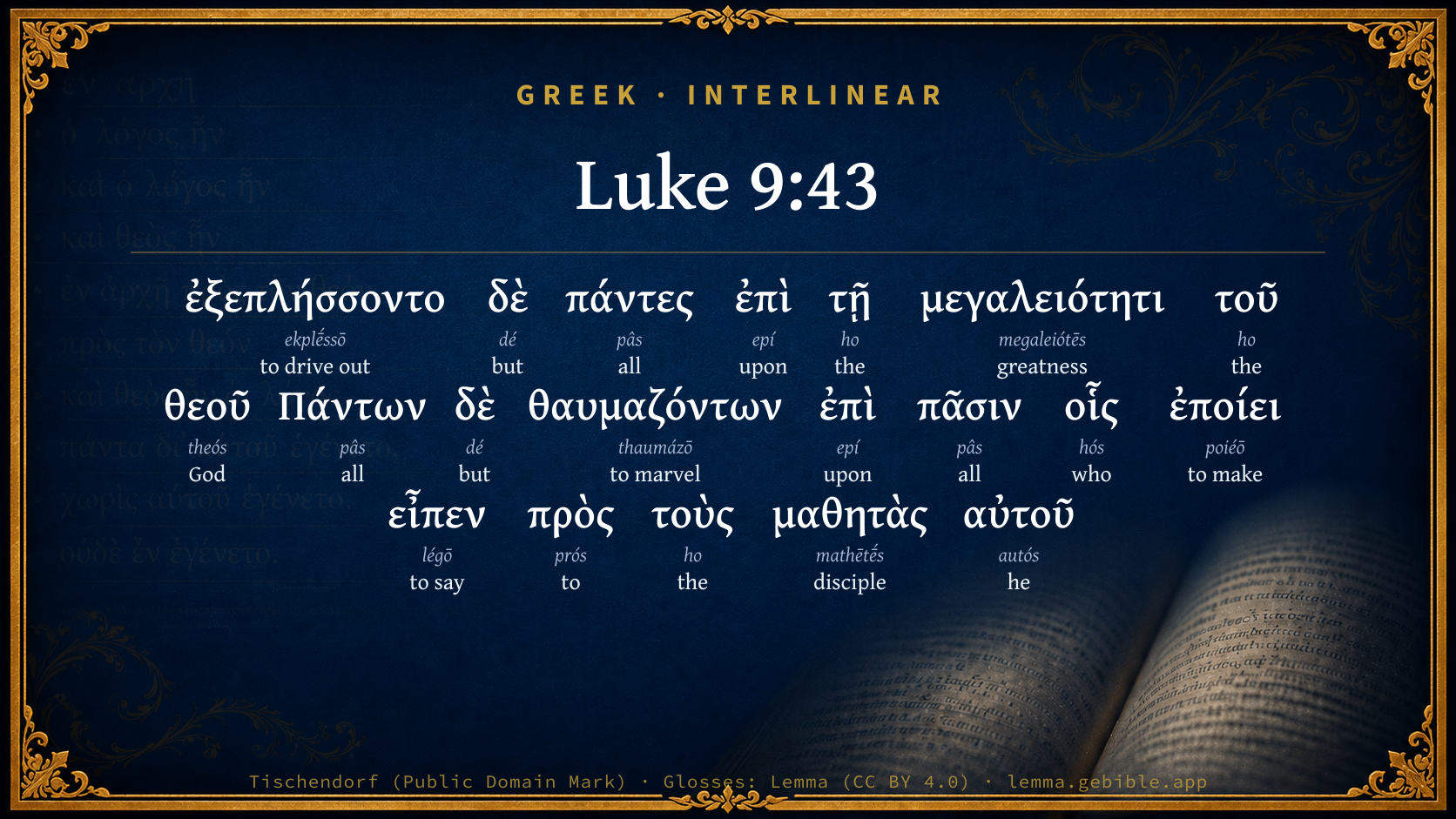
Download image
Cite this verse

Luke 9:43 (World English Bible). Public Domain. Lemma interlinear Bible study tool, https://lemma.gebible.app/v/luke/9/43.

Show BibTeX & RIS
BibTeX
RIS
English Translation
They were all astonished at the majesty of God. But while all were marveling at all the things which Jesus did, he said to his disciples,
World English Bible · Public Domain
Highlights
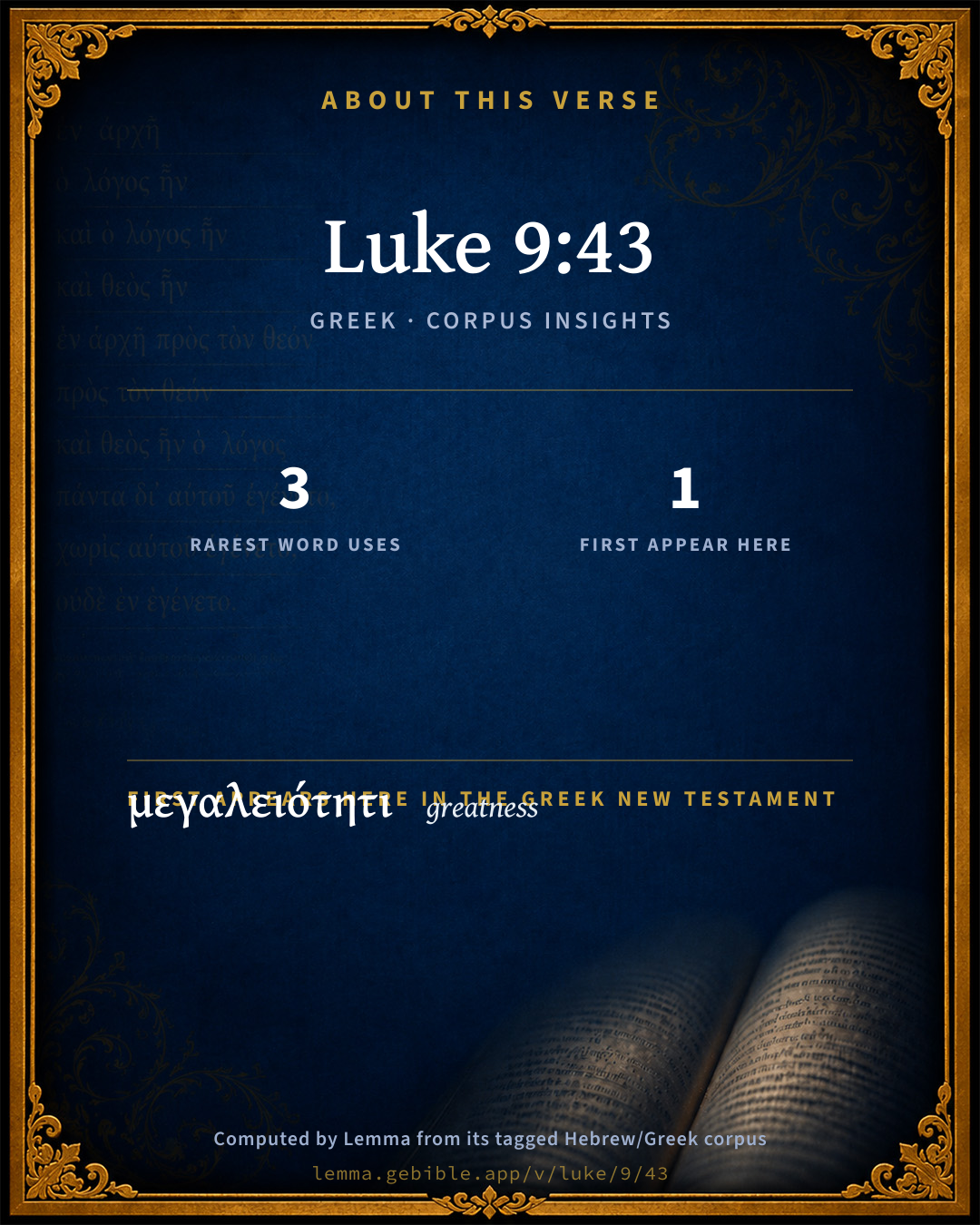
  • 1 first appearance in the Greek New Testament
Full analysis ↓
Download a study sheet

One document with this verse’s original text, its word-by-word gloss line, the meaning frame, cross-references with their text, attributed commentary, and full source and license credits — printable, and it pastes into notes with its structure intact.

This verse Autodidact and up

Study sheet (.html) Plain text (.txt)

A passage Seminary Student

Up to 50 verses in one chapter. A passage sheet keeps up to 6 commentary sources and 12 cross-references per verse, in the order this page ranks them, and says so on the sheet whenever that leaves anything out. Ask for a single verse and you get the Autodidact verse sheet above.

Everything on this page stays free to read, with no account — the sheet is a download of what is already on screen, not access to it.

Want to remove ads? Support Godless Engineer
Compare translations 3

The same verse in 3 English versions, stacked beneath the original-language interlinear above. Click any original word for its lexicon entry.

Each is an independent rendering of the whole verse — the interlinear is not word-aligned to these translations.

Highlighted words mark where these versions differ — a whole-verse word diff, not a word-by-word alignment.

  • World English Bible Public Domain
    They were all astonished at the majesty of God. But while all were marveling at all the things which Jesus did, he said to his disciples,
  • King James Version Public Domain
    And they were all amazed at the mighty power of God. But while they wondered every one at all things which Jesus did, he said unto his disciples,
  • unfoldingWord Literal Text CC BY-SA 4.0
    Then they were all amazed at the majesty of God. But all were marveling at everything that he was doing, he said to his disciples,

unfoldingWord Literal Text — © unfoldingWord, licensed CC BY-SA 4.0. Word-aligned USFM3 via Door43 (git.door43.org/unfoldingWord/en_ult).

Versions to compare (up to 4)

3 of 4 selected

Show all 19 translations

Every available English version of this verse, each an independent rendering of the whole verse.

  • World English Bible Public Domain
    They were all astonished at the majesty of God. But while all were marveling at all the things which Jesus did, he said to his disciples,
  • Berean Standard Bible Public Domain
    And they were all astonished at the greatness of God. While everyone was marveling at all that Jesus was doing, He said to His disciples,
  • Majority Standard Bible Public Domain
    And they were all astonished at the greatness of God. While everyone was marveling at all that Jesus had done, He said to His disciples,
  • King James Version Public Domain
    And they were all amazed at the mighty power of God. But while they wondered every one at all things which Jesus did, he said unto his disciples,
  • American Standard Version (1901) Public Domain
    And they were all astonished at the majesty of God. But while all were marvelling at all the things which he did, he said unto his disciples,
  • Revised Version (1885) Public Domain
    And they were all astonished at the majesty of God. But while all were marveling at all the things which he did, he said unto his disciples,
  • Geneva Bible (1599) Public Domain
    And they were all amased at the mightie power of God: and while they all wondered at al things, which Iesus did, he said vnto his disciples,
  • Douay-Rheims (1899) Public Domain
    And Jesus rebuked the unclean spirit, and cured the boy, and restored him to his father.
  • Young's Literal Translation Public Domain
    And they were all amazed at the greatness of God, and while all are wondering at all things that Jesus did, he said unto his disciples,
  • Literal Standard Version CC BY-SA 4.0
    And they were all amazed at the greatness of God, and while all are wondering at all things that Jesus did, He said to His disciples,
  • Unlocked Literal Bible CC BY-SA 4.0
    Then they were all amazed at the greatness of God. While they all were marveling at everything he was doing, he said to his disciples,
  • unfoldingWord Literal Text CC BY-SA 4.0
    Then they were all amazed at the majesty of God. But all were marveling at everything that he was doing, he said to his disciples,
  • Darby Bible Public Domain
    And all were astonished at the glorious greatness of God. And as all wondered at all the things which [Jesus] did, he said to his disciples,
  • World Messianic Bible Public Domain
    They were all astonished at the majesty of God. But while all were marveling at all the things which Yeshua did, he said to his disciples,
  • Webster's Bible Public Domain
    And they were all amazed at the mighty power of God. But while they were all wondering at all things which Jesus did, he said to his disciples,
  • Free Bible Version CC BY-SA 4.0
    Everyone was amazed at this demonstration of God's power. However, even though everyone was amazed by all he did, Jesus warned his disciples,
  • Bible in Basic English Public Domain
    And they were full of wonder at the great power of God. But while they were all wondering at all the things which he did, he said to his disciples,
  • Text-Critical English NT CC BY 4.0
    And they were all astonished at the majesty of God. Jesus Predicts His Death a Second Time But while everyone was marveling at all that Jesus had done, he said to his disciples,
  • Tyndale New Testament (1534) Public Domain
    Whyll they wondred every one at all thinges which he dyd he sayd vnto his disciples:

Literal Standard Version (2020), Covenant Press — licensed CC BY-SA 4.0. Text via the HelloAO Bible API (eBible.org). Unlocked Literal Bible (unfoldingWord) — licensed CC BY-SA 4.0. Text via the HelloAO Bible API (eBible.org). unfoldingWord Literal Text — © unfoldingWord, licensed CC BY-SA 4.0. Word-aligned USFM3 via Door43 (git.door43.org/unfoldingWord/en_ult). Free Bible Version, Dr. Jonathan Gallagher — licensed CC BY-SA 4.0. Text via the HelloAO Bible API (eBible.org).

Word by word

More ways to search: Search by grammar → Find every occurrence → Compare this word →

Practice this passage: Drill this verse → Learn its vocabulary →

μεγαλειότητι
megaleiótēs
G3168
“greatness”
Noun, Dative, Singular, Feminine
Part of Speech
Noun
Case
Dative
Number
Singular
Gender
Feminine
Full Thayer's Definition

Origin: from G3167

TDNT: 13:01,6

1. greatness, magnificence a. of the majesty of God b. of the visible splendour of the divine majesty as it appeared in the transfiguration of Christ
  1. ἐξεπλήσσοντο ekplḗssō G1605 “to drive out” Verb, Imperfect, Passive, Indicative, 3rd person, Plural
  2. δὲ dé G1161 “but” Conjunction
  3. πάντες pâs G3956 “all” Adjective, Nominative, Plural, Masculine
  4. ἐπὶ epí G1909 “upon” Preposition
  5. τῇ ho G3588 “the” Article, Dative, Singular, Feminine
  6. τοῦ ho G3588 “the” Article, Genitive, Singular, Masculine
  7. θεοῦ theós G2316 “God” Noun, Genitive, Singular, Masculine
  8. Πάντων pâs G3956 “all” Adjective, Genitive, Plural, Masculine
  9. δὲ dé G1161 “but” Conjunction
  10. θαυμαζόντων thaumázō G2296 “to marvel” Verb, Present, Active, Participle, Genitive, Plural, Masculine
  11. ἐπὶ epí G1909 “upon” Preposition
  12. πᾶσιν pâs G3956 “all” Adjective, Dative, Plural, Neuter
  13. οἷς hós G3739 “who” Relative pronoun, Dative, Plural, Neuter
  14. ἐποίει poiéō G4160 “to make” Verb, Imperfect, Active, Indicative, 3rd person, Singular
  15. εἶπεν légō G3004 “to say” Verb, Aorist, Active, Indicative, 3rd person, Singular
  16. πρὸς prós G4314 “to” Preposition
  17. τοὺς ho G3588 “the” Article, Accusative, Plural, Masculine
  18. μαθητὰς mathētḗs G3101 “disciple” Noun, Accusative, Plural, Masculine
  19. αὐτοῦ autós G846 “he” Personal pronoun, Genitive, Singular, Masculine

About this verse

These counts appear in no published source. They are computed here, from the morphology-tagged text and Lemma’s own curated glosses. What Lemma adds →

20
words
14
distinct lemmas
Gospels
section

Notable vocabulary

The rarest word here is μεγαλειότητι greatness G3168 — appearing just 3 times in the whole Greek New Testament.

First appearance in Scripture

This word makes its first canonical appearance in the Greek New Testament here:

  • μεγαλειότητι greatness G3168

Shared distinctive vocabulary

μεγαλειότητι greatness G3168 occurs in 3 verses of the Greek New Testament. Also found in:
Repetition

Words recur within this verse:

Cross-references

12

Topical passages linked to Luke 9:43 in the Treasury of Scripture Knowledge — connected by theme and wording, ordered by reader-vote popularity; previews shown in the World English Bible.

  • Luke 9:43–45 They were all astonished at the majesty of God. But while all were marveling at all the things which Jesus did, he said to his disciples,
  • Luke 5:26 Amazement took hold on all, and they glorified God. They were filled with fear, saying, "We have seen strange things today."
  • Matthew 17:22 While they were staying in Galilee, Jesus said to them, "The Son of Man is about to be delivered up into the hands of men,
  • Mark 9:30–32 They went out from there, and passed through Galilee. He didn't want anyone to know it.
  • Luke 8:25 He said to them, "Where is your faith?" Being afraid they marveled, saying one to another, "Who is this, then, that he commands even the winds and the water, and they obey him?"
  • Acts 3:10–13 They recognized him, that it was he who used to sit begging for gifts for the needy at the Beautiful Gate of the temple. They were filled with wonder and amazement at what had happened to him.
  • Zechariah 8:6 Thus says Yahweh of Hosts: "If it is marvelous in the eyes of the remnant of this people in those days, should it also be marvelous in my eyes?" says Yahweh of Hosts.
  • Mark 6:51 He got into the boat with them; and the wind ceased, and they were very amazed among themselves, and marveled;
  • Luke 4:36 Amazement came on all, and they spoke together, one with another, saying, "What is this word? For with authority and power he commands the unclean spirits, and they come out!"
  • Luke 5:9 For he was amazed, and all who were with him, at the catch of fish which they had caught;
  • 2 Peter 1:16 For we did not follow cunningly devised fables, when we made known to you the power and coming of our Lord Jesus Christ, but we were eyewitnesses of his majesty.
  • Psalms 139:14 I will give thanks to you, For I am fearfully and wonderfully made. Your works are wonderful. My soul knows that very well.

Cross-references courtesy of OpenBible.info (CC BY 4.0).

Where the printed editions differ

1 variant

Places in this verse where the major printed Greek editions disagree on the wording in a way that affects the translation — a comparison of editions, not a manuscript-by-manuscript collation. The editions are the modern critical texts (Nestlé-Aland 28/27, SBL, Westcott-Hort, Tregelles, Tyndale House) and the traditional texts behind the KJV (the Textus Receptus and the Byzantine/Majority text). It is not a claim about which reading is original.

  1. Extra text
    Ἰησοῦς,

    “Jesus”

    In TRByz Not in NA28NA27TynSBLWHTreg

    Ἰησοῦς, (Iēsous) 'Jesus' is only in traditional manuscripts (TR+Byz)

Textual data: Translators Amalgamated Greek New Testament (STEPBible TAGNT) · CC BY 4.0.

Commentary

Notes on Luke 9:43 from classic Christian and Jewish commentators (each source and its license shown beneath its notes). The classic Christian expositions comment on the surrounding passage and are grouped to its opening verse, so a note may address several verses; the Jewish commentaries on the Tanakh (Rashi and others) are per-verse, so they appear only where the commentator wrote on this verse.

Lemma curates 59 commentaries, every one of them public domain or Creative Commons licensed, each selected and text-cleaned for this edition rather than reprinted as found. About our sources →

Matthew Henry's Commentary

We may observe here, I. The impression which Christ's miracles made upon all that beheld them (Luk 9:43): They were all amazed at the mighty power of God, which they could not but see in all the miracles Christ wrought. Note, The works of God's almighty power are amazing, especially those that are wrought by the hand of the Lord Jesus; for he is the power of God, and his name is Wonderful. Their wonder was universal: they wondered every one. The causes of it were universal: they wondered at all things which Jesus did; all his actions had something uncommon and surprising in them.

II. The notice Christ gave to his disciples of his approaching sufferings: The Son of man shall be delivered into the hands of men, wicked men, men of the worst character; they shall be permitted to abuse him at their pleasure. That is here implied which is expressed by the other evangelists: They shall kill him. But that which is peculiar here is, 1. The connection of this with what goes next before, of the admiration with which the people were struck at beholding Christ's miracles (Luk 9:43): While they all wondered at all things which Jesus did, he said this to his disciples. They had a fond conceit of his temporal kingdom, and that he should reign, and they with him, in secular pomp and power; and now they thought that this mighty power of his would easily effect the thing, and his interest gained by his miracles in the people would contribute to it; and therefore Christ, who knew what was in their hearts, takes this occasion to tell them again, what he had told them before, that he was so far from having men delivered into his hands that he must be delivered into the hands of men, so far from living in honour that he must die in disgrace; and all his miracles, and the interest he has by them gained in the hearts of the people, will not be able to prevent it. 2. The solemn preface with which it is introduced: "Let these sayings sink down into your ears; take special notice of what I say, and mix faith with it; let not the notions you have of the temporal kingdom of the Messiah stop your ears against it, nor make you unwilling to believe it. Admit what I say, and submit to it." Let it sink down into your hearts; so the Syriac and Arabic read it. The word of Christ does us no good, unless we let it sink down into our heads and hearts. 3. The unaccountable stupidity of the disciples, with reference to this prediction of Christ's sufferings. It was said in Mark, They understood not that saying. It was plain enough, but they would not understand it in the literal sense, because it agreed not with their notions; and they could not understand it in any other, and were afraid to ask him lest they should be undeceived and awaked out of their pleasing dream. But it is here added that it was hidden from them, that they perceived it not, through the weakness of faith and the power of prejudice. We cannot think that it was in mercy hidden from them, lest they should be swallowed up with overmuch sorrow at the prospect of it; but that it was a paradox, because they made it so to themselves.

III. The rebuke Christ gave to his disciples for their disputing among themselves which should be greatest, Luk 9:46-48. This passage we had before, and, the more is the pity, we shall meet with the like again. Observe here,

1. Ambition of honour, and strife for superiority and precedency, are sins that most easily beset the disciples of our Lord Jesus, for which they deserve to be severely rebuked; they flow from corruptions which they are highly concerned to subdue and mortify, Luk 9:46. They that expect to be great in this world commonly aim high, and nothing will serve them short of being greatest; this exposes them to a great deal of temptation and trouble, which they are safe from that are content to be little, to be least, to be less than the least.

2. Jesus Christ is perfectly acquainted with the thoughts and intents of our hearts: He perceived their thoughts, Luk 9:47. Thoughts are words to him, and whispers are loud cries. It is a good reason why we should keep up a strict government of our thoughts because Christ takes a strict cognizance of them.

3. Christ will have his disciples to aim at that honour which is to be obtained by a quiet and condescending humility, and not at that which is to be obtained by a restless and aspiring ambition. Christ took a child, and set him by him, Luk 9:47 (for he always expressed a tenderness and kindness for little children), and he proposed this child to them for an example. (1.) Let them be of the temper of this child, humble and quiet, and easy to itself; let them not affect worldly pomp, or grandeur, or high titles, but be as dead to them as this child; let them bear no more malice to their rivals and competitors than this child did. Let them be willing to be the least, if that would contribute any thing to their usefulness, to stoop to the meanest office whereby they might do good. (2.) Let them assure themselves that this was the way to preferment; for this would recommend them to the esteem of their brethren: they that loved Christ would therefore receive them in his name, because they did most resemble him, and they would likewise recommend themselves to his favour, for Christ would take the kindnesses done to them as done to himself: Whosoever shall receive one such child, a preacher of the gospel that is of such a disposition as this, he placeth his respect aright, and receiveth me; and whosoever receiveth me, in such a minister, receiveth him that sent me; and what greater honour can any man attain to in this world than to be received by men as a messenger of God and Christ, and to have God and Christ own themselves received and welcomed in him? This honour have all the humble disciples of Jesus Christ, and thus they shall be truly great that are least among them.

IV. The rebuke Christ gave to his disciples for discouraging one that honoured him and served him, but was not of their communion, not only not one of the twelve, nor one of the seventy, but not one of those that ever associated with them, or attended on them, but, upon occasional hearing of Christ, believed in him, and made use of his name with faith and prayer in a serious manner, for the casting out of devils. Now, 1. This man they rebuked and restrained; they would not let him pray and preach, though it was to the honour of Christ, though it did good to men and weakened Satan's kingdom, because he did not follow Christ with them; he separated from their church, was not ordained as they were, paid them no respect, nor gave them the right hand of fellowship. Now, if ever any society of Christians in this world had reason to silence those that were not of their communion, the twelve disciples at this time had; and yet, 2. Jesus Christ chid them for what they did, and warned them not to do the like again, nor any that profess to be successors of the apostles: "Forbid him not (Luk 9:50), but rather encourage him, for he is carrying on the same design that you are, though, for reasons best known to himself, he does not follow with you; and he will meet you in the same end, though he does not accompany you in the same way. You do well to do as you do, but it does not therefore follow that he does ill to do as he does, and that you do well to put him under an interdict, for he that is not against us is for us, and therefore ought to be countenanced by us." We need not lose any of our friends, while we have so few, and so many enemies. Those may be found faithful followers of Christ, and, as such, may be accepted of him, though they do not follow with us. See Mar 9:38, Mar 9:39. O what a great deal of mischief to the church, even from those that boast of relation to Christ, and pretend to envy for his sake, would be prevented, if this passage of story were but duly considered!

Matthew Henry's Commentary on the Whole Bible (1708–1710) — public domain (CC PDM 1.0). Text via the HelloAO Bible API.

Whedon's Commentary on the Bible

Daniel D. Whedon

§ 77.—JESUS FORETELLS HIS SUFFERINGS AND RESURRECTION, Luk_9:43-45.

Mat_17:22-23; Mar_9:30-32, also notes on parallel sections in Mar_9:10; Mar_16:10-11.

Daniel D. Whedon (gen. ed.), Commentary on the Old and New Testaments (1874–1909) — public domain. Text from a community e-Sword module.

Godbey's Commentary on the New Testament

William B. Godbey

CHAPTER 38

DEATH AND RESURRECTION

Mat 17:22-23; Mar 9:30-32; Luk 9:43-45. Mark: “And having gone out from thence, they continued to journey through Galilee.” As Galilee extends up to the very suburbs of Caesarea-Philippi, this passage is a clinching argument for the location of the transfiguration in that vicinity. Luke: “Place these words in your ears; for the Son of man is about to be delivered into the hands of sinners.” Matthew & Mark say: “They will kill Him; and having been killed, on the third day He will arise.” “And they did not know this word, and it was hidden from them, in order that they may not understand it; and they feared to ask Him concerning this word.” This took place in His conversation with His disciples while journeying down the Jordan, from Caesarea-Philippi, back to the sea of Galilee. You observe that this is the second time that He has positively told them about His coming arrest, execution, and resurrection. As you here see, “it was hidden from them,” so they did not understand it. Do you know that this dark veil wrapped the important item in our Lord’s biography till He had actually risen from the dead, though He had distinctly and positively spoken it out to them three times? Why was this revealed to them, and still withheld from them? It was really indispensable that it should be revealed, in order to the completion of the prophetical curriculum, destined, as in all bygone ages, to constitute the basis of faith for all future generations; hence the necessity of its revealment is clear and demonstrative. Then why was it withheld from them, so they never did receive it till after He had risen from the dead? This is equally obvious. If His disciples had understood it, they would have rallied His friends and fought for Him, thus precipitating on the country a bloody revolution, which Jesus did not want. Consequently, the blessed Holy Spirit just took it away from them, so they never caught the idea till after He had risen from the dead.

William B. Godbey, Commentary on the New Testament (1896–1900) — public domain. Text from a community e-Sword module.

Bengel's Gnomon

Johann Albrecht Bengel

Luk 9:43. Ἐξεπλήσσοντο, they were struck with amazement) in mind.—μεγαλειότητι) God is, μέγας, great; His works are μεγαλεῖα, magnificent.—θαυμαζόντων, whilst they were wondering) and were also expressing their wonder in words.—εἶπε, said) For this one word the Gothic Version has the following: Quath Pætrus, Fan, du vve veis ni mahtedum usdreiban thamma: ith Jesus quath: thata kuni ni usgangith nibai in bidom jah in fastubnja: quath than; that is, Peter said, Lord, why were we not able to cast him out? And Jesus said, This sort goeth not forth but in prayer and fasting. Then He said, etc. Comp. App. Crit. Ed. ii. on this passage.[83] If Luke himself wrote these words, we must suppose that Peter along with the rest, struck with admiration at the magnificent miracles performed by the Lord, identifies himself with the inability of the disciples to perform the miracle, and acknowledges that if he had been present [which he was not, being at the transfiguration at the time], he would not have prevailed against the unclean spirit. Therefore he inquires the cause why not.[84]

[83] ABDab Vulg. support the omission of these words. c however agrees with Goth. Vers. in inserting them. They seem to me to have crept in here through the Harmonies and transcribers from the parallel passages, Mat 17:19; Mat 17:21, Mar 9:28-29.—ED. and TRANSL.

[84] However the Vers. Germ. omits this inserted clause.—E. B.

Bengel's Gnomon of the New Testament — English translation (T&T Clark, Edinburgh, 1860) — public domain. Text from a community e-Sword module.

Expositor's Greek Testament

ed. W. Robertson Nicoll

Luk 9:43-45 . Second prediction of the Passion (Mat 17:22-23 , Mar 9:30-32 ). πάντων θαυμαζόντων , etc., while all were wondering at all the things which He did. The reference is to the cure of the epileptic, which led the multitude to see in Jesus the bearer of the majesty or greatness of the Almighty. εἶπε . Jesus spoke a second time of His approaching death, in connection with this prevailing wonder, and His aim was to keep the disciples from being misled by it. The setting in Mt. and Mk. is different. There Jesus speaks of His passion, while He with the Twelve is wandering about in Galilee, endeavouring, according to Mk., to remain unnoticed, and He speaks of it simply because it is the engrossing theme with which His mind is constantly preoccupied. Here, on the other hand, the second announcement is elicited by an external occasion, the admiration of the people.

Luk 9:43 . ἐπὶ τῇ μεγαλειότητι τ . Θεοῦ , the people were astonished at the majesty of God , revealed in the power that could work such a cure. In Act 2:22 God is represented as working miracles through Jesus. So the matter is conceived here. But Lk. thinks of the majesty of God as immanent in Jesus.

The Expositor's Greek Testament, edited by W. Robertson Nicoll (1897–1910) — public domain. Text from a community e-Sword module.

Godet's Commentaries

Frédéric Louis Godet

6. The three last Incidents of Jesus’ Galilean Ministry: 9.43b-50.

1 st. The Second Announcement of the Passion: Luk 9:43 b-45.

We may infer from the two other Syn. (Mat 17:22-23; Mar 9:30-32), more especially from Mark, that it was during the return from Caesarea Philippi to Capernaum that Jesus had this second conversation with His disciples respecting His sufferings. Luke places it in connection with the state of excitement into which the minds of those who were with Jesus had been thrown by the preceding miracles. The Lord desires to suppress this dangerous excitement in the hearts of His disciples. And we can understand, therefore, why this time Jesus makes no mention of the resurrection (comp. Luk 9:22). By the pronoun ὑμεῖς, you, He distinguishes the apostles from the multitude: “You who ought to know the real state of things.” The expression θέσθε εἰς τὰ ὦτα, literally, put this into your ears, is very forcible. “If even you do not understand it, nevertheless impress it on your memory; keep it as a saying.”

The sayings which they are thus to preserve, are those which are summarized in this very 44th verse, and not, as Meyer would have us think, the enthusiastic utterances of the people to which allusion is made in Luk 9:43. The for which follows is not opposed to this meaning, which is the only natural one: “Remember these sayings; for incredible as they appear to you, they will not fail to be realized.”

The term, be delivered into the hands of men, refers to the counsel of God, and not to the treachery of Judas.

They can know very little of the influence exercised by the will on the reason who find a difficulty in the want of understanding shown by the disciples (Luk 9:45). The prospect which Jesus put before them was regarded with aversion (Mat 5:23), and consequently they refused to pay any serious attention to it, or even to question Jesus about it (Mar 5:32). Nothing more fully accords with psychological experience than this moral phenomenon indicated afresh by Luke. The following narrative will prove its reality. The ἵνα, in order that, Luk 9:45, does not signify simply, so that. The idea of purpose implied in this conjunction refers to the providential dispensation which permitted this blindness.

2 d. The question: Which is the greatest? Luk 9:46-48.

This incident also must belong, according to Matthew and Mark, to the same time (Mat 18:1 et seq.; Mar 9:33 et seq.). According to Mark, the dispute on this question had taken place on the road, during their return from Caesarea to Capernaum. “What were ye talking about by the way?” Jesus asked them after their arrival (Luk 9:33); and it was then that the following scene took place in a house which, according to Matthew, was probably Peter’s. We have several other indications of a serious dispute between the disciples happening about this time; for example, that admonition preserved by Mark at the end of the discourse spoken by Jesus on this occasion (Luk 9:50): “Have salt in yourselves, and be at peace among yourselves;” then there is the instruction of Jesus on the conduct to be pursued in the case of offences between brethren, Mat 18:15: “If thy brother sin against thee...;” lastly, the question of Peter: “How many times am I to forgive my brother?” and the answer of Jesus, Luk 18:21-22. All these sayings belong to the period of the return to Capernaum, and are indications of a serious altercation between the disciples. According to the highly dramatic account of Mark, it is Jesus Himself who takes the initiative, and who questions them as to the subject of their dispute. Shame-stricken, like guilty children, at first they are silent; then they make up their minds to avow what the question was about which they had quarrelled. Each had put forward his claims to the first place, and depreciated those of the rest. Peter had been the most eager and, perhaps, the most severely handled. We see how superficial was the impression made on them by the announcement of their Master’s sufferings. Jesus then seated Himself (Mar 9:35), and gathering the Twelve about Him, gave them the following instruction. All these circumstances are omitted by Matthew. In his concise way of dealing with facts, contrary to all moral probability, he puts the question: Which of us is the greatest? into the mouth of the disciples who address it to Jesus. All he regards as important is the teaching given on the occasion. As to Luke, Bleek, pressing the words ἐν αὐτοῖς, in them, supposes that, according to him, we have simply to do with the thoughts which had arisen in the hearts of the disciples (comp. Luk 9:47, τῆς καρδίας), and not with any outward quarrel. But the term εἰσῆλθε, occurred, indicates a positive fact, just such as that Mark so graphically describes; and the expression in them, or among them, applies to the circle of the disciples in the midst of which this discussion had taken place.

Jesus takes a child, and makes him the subject of His demonstration. It is a law of heaven, that the feeblest creature here below shall enjoy the largest measure of heavenly help and tenderness (Mat 18:10). In conformity with this law of heaven, Jesus avows a peculiar interest in children, and commends them to the special care of His own people. Whoever entering into His views receives them as such, receives Him. He receives Jesus as the riches which have come to fill the void of his own existence, which in itself is so poor, and in Jesus, God, who, as a consequence of the same principle, is the constant complement of the existence of Jesus (Joh 6:57). Consequently, for a man to devote himself from love to Jesus to the service of the little ones, and so make himself the least, is to be on the road towards possessing God most completely, and becoming the greatest.

The meaning of Jesus’ words in Matthew is somewhat different, at least as far as concerns the first part of the answer. Here Jesus lays down as the measure of true greatness, not a tender sympathy for the little, but the feeling of one’s own littleness. The child set in the midst is not presented to the disciples as one in whom they are to interest themselves, but as an example of the feeling with which they must themselves be possessed. It is an invitation to return to their infantine humility and simplicity, rather than to love the little ones. It is only in the 5th verse that Matthew passes from this idea, by a natural transition, to that which is contained in the answer of Jesus as given by Luke and Mark. It is probable that the first part of the answer in Matthew is borrowed from another scene, which we find occurring later in Mark (Mar 10:13-16) and Luke (Luk 18:15-17), as well as in Matthew himself (Luk 19:13-15); this Gospel combines here, as usual, in a single discourse elements belonging to different occasions. Meyer thinks that in this expression, receive in my name, the in my name refers not to the disposition of him who receives, but of him who is received, in so far as he presents himself as a disciple of Jesus. But these two notions: presenting oneself in the name of Jesus (consciously or unconsciously), and being received in this name, cannot be opposed one to the other. As soon as the welcome takes place, one becomes united with the other.

The Alex. reading ἐστί, is, is more spiritual than the Byz. ἔσται, shall be, which has an eschatological meaning. It is difficult to decide between them.

Frédéric Louis Godet — Commentaries on Luke, John, Romans, and 1 Corinthians — English translation (T&T Clark, Edinburgh, 1870s–1890s) — public domain. Text from a community e-Sword module.

Geneva Bible (1599)

Geneva Bible translators

We have no cause to promise ourselves rest and quietness in this world, seeing that they themselves which seemed to fawn upon Christ, do shortly after crucify him.

Geneva Bible (1599) marginal notes — public domain. Text via Bolls.life.

Jamieson, Fausset & Brown

Robert Jamieson, A. R. Fausset & David Brown

DEMONIAC AND LUNATIC BOY HEALED--CHRIST'S SECOND EXPLICIT ANNOUNCEMENT OF HIS DEATH AND RESURRECTION. (Luk 9:37-45)

the mighty power of God--"the majesty" or "mightiness" of God in this last miracle, the transfiguration, &c.: the divine grandeur of Christ rising upon them daily. By comparing Mat 17:22, and Mar 9:30, we gather that this had been the subject of conversation between the Twelve and their Master as they journeyed along.

Jamieson, Fausset & Brown — Commentary Critical and Explanatory on the Whole Bible (1871) — public domain (CC PDM 1.0). Text via the HelloAO Bible API.

Adam Clarke's Commentary

Verse 43. The mighty power] This majesty of God, μεγαλειοτητι του Θεου. They plainly saw that it was a case in which any power inferior to that of God could be of no avail; and they were deeply struck with the majesty of God manifested in the conduct of the blessed Jesus.

Adam Clarke's Commentary on the Bible (1810–1826) — public domain. Text from a community e-Sword/MySword module.

Ellicott's Commentary for English Readers

(43) At the mighty power of God.—The word so rendered is a somewhat remarkable one, and, like the exodos of Luk_9:31, appears again in 2Pe_1:16 in close connection with a reference to the history of the Transfiguration. There it is rendered “majesty,” and in Act_19:27 “magnificence.” Here greatness would, perhaps, be the best equivalent. St. Luke describes the emotion which the men of the East feel when they say “God is great.”

The division of verses here is singularly unfortunate. The new paragraph should clearly begin, as above, with the words, “But while they wondered.”

A Bible Commentary for English Readers, edited by Charles John Ellicott (1878–1897) — public domain. Text from a community e-Sword module.

The Cambridge Bible for Schools and Colleges

gen. ed. J. J. S. Perowne

43. mighty power] Rather, majesty. 2Pe_1:16.

while they wondered] The power of the last miracle had rekindled some of their Messianic enthusiasm. Jesus had now reached the northern limits of Palestine, and—apparently through bypaths, and with the utmost seeresy—was retracing His steps, perhaps along the western bank of the Jordan, to Galilee, Mat_17:22; Mar_9:30.

he said unto his disciples] The imperfects in Mar_9:31 shew that these warnings of His approaching betrayal, death, and resurrection now formed a constant topic of His teaching.

The Cambridge Bible for Schools and Colleges (gen. ed. J. J. S. Perowne; Cambridge University Press, 1878–1918) — public domain. Text from a community e-Sword module.

John Gill's Exposition

Then there arose a reasoning among them,.... The Vulgate Latin, Syriac, and Arabic versions read, "a thought entered into them"; suggested very likely by Satan, which broke out into words, and issued in a warm dispute among them; and this was in the way, as they were travelling from Caesarea Philippi, to Capernaum; see Mar 9:33.

Which of them should be greatest; that is, "in the kingdom of heaven", as in Mat 18:1 in the kingdom of the Messiah, which they expected would be a temporal one: wherefore the dispute was not about degrees in glory, nor in grace; nor who should be the greatest apostle and preacher of the Gospel; but who should be prime minister to the king Messiah, when he should set up his monarchy in all its grandeur and glory.

John Gill's Exposition of the Whole Bible (1746–1763) — public domain (CC PDM 1.0). Text via the HelloAO Bible API.

The Pulpit Commentary

And they were all amazed at the mighty power of God. But while they wondered every one at all things which Jesus did, he said unto his disciples. Once more were kindled the disciples" hopes of an earthly royalty in the Person of that strange Messiah. For was he not Messiah after all, who with a word worked such stupendous works as the miracle they had just witnessed? But Jesus read their thoughts, and again tells them (in ver. 44) of the terrible doom which awaited him. They must remember there was no earthly crown or human sovereignty for him.

The Pulpit Commentary (1880–1919), ed. H.D.M. Spence-Jones & Joseph S. Exell — public domain. Text from a community e-Sword module.

Scofield Reference Notes

C. I. Scofield

the mighty power

Or, the majesty of God.

The Scofield Reference Bible (1917 edition), notes by C. I. Scofield — public domain. Text from a community e-Sword module.

Kretzmann's Popular Commentary

Paul E. Kretzmann

The second prediction:

v. 43. And they were all amazed at the mighty power of God. But while they wondered, every one, at all things which Jesus did, He said unto His disciples,

v. 44. Let these sayings sink down into your ears; for the Son of Man shall be delivered into the hands of men.

v. 45. But they understood not this saying, and it was hid from them, that they perceived it not; and they feared to ask Him of that saying.

The people were greatly astonished at the majesty of God, revealed in the power that could work such a cure. This majesty is the essence of Jesus, it is given to Him as man, in the state of humiliation. He is true God and eternal Life. But while they were all wondering about the great deed which Jesus had performed, He took His disciples aside and spoke to them privately, affirming once more that they should set into their ears the words which He was now telling them, that they should remember them and get their understanding: It will be done that the Son of Man will be delivered into the hands of men. This is a certainty; and He wanted His disciples to become accustomed to the thought that such was the fulfillment of the Old Testament prophecies. But, as Luke remarks in a pitying aside, they did not understand this saying, and it was totally hidden from them to the extent that they did not have the faintest understanding of it. At the same time, they were afraid to ask Him with regard to this saying of His. The evidence of His ineffable majesty had stood out so strongly in His recent miracle that the disciples could not muster the courage to question Him on the matter.

Paul E. Kretzmann, Popular Commentary of the Bible (1921–1924) — public domain. Text from a community e-Sword module.

Burkitt's Expository Notes on the New Testament

William Burkitt

Observable it is how frequently our Saviour forewarned his disciples of his approaching sufferings, and as the time of his suffering drew nearer, he did more frequently warn them of his death. But all this was little enough to arm them against the scandal of the cross; and to reconcile them to the thoughts of his suffering condition; how an ordinary prophet should be delivered into the hands of men they could easily understand, but how the Messiah should be so treated they could not apprehend; for the disciples had taken up the common opinion, that the Messiah was to be a temporal prince, and should conquer and reign here upon earth; and how to reconcile this with being killed, they could no ways apprehend; and they were afraid to be too particular in their enquiries about it.

Now, from Christ’s so frequently warning his disciples of his approaching sufferings, we may gather that we can never hear, either too often or too much, of the doctrine of the cross, nor be too frequently instructed in our duty to prepare for a suffering state; as Christ went from his cross to his crown, from a state of abasement to a state of exaltation, so must all his disciples and followers expect likewise.

William Burkitt's Expository Notes on the New Testament (1700–1703) — public domain. Text from a community e-Sword module.

The People's New Testament

B. W. Johnson

43–45. For this second statement of the Lord's suffering at Jerusalem, see notes on Matt. 17:22, 23 and Mark 9:31, 32.

B. W. Johnson's The People's New Testament with Notes (1889–1891) — public domain. Electronic text from the Christian Classics Ethereal Library (CCEL) ThML edition.

unfoldingWord translationNotes

Door43 World Missions Community

they were all amazed at the greatness of God

Jesus performed the miracle, but the crowd recognized that God was the power behind the healing.

everything he was doing

"everything Jesus was doing"

Let these words go deeply into your ears

This is an idiom that means they should pay attention. AT: "Listen carefully and remember" or "Do not forget this" (See: Idiom)

The Son of Man will be betrayed into the hands of men

This can be stated with an active clause. Here "hands" refers to power or control. AT: "they will betray the Son of Man and put him in the control of men" (See: Active or Passive and Metonymy)

The Son of Man will be betrayed into the hands of men

Jesus is speaking about himself in the third person. The word "hands" is a synecdoche for the people whose hands they are or a metonym for the power that uses those hands. You may need to make explicit who these men are. AT: "I, the Son of Man will be betrayed into the hands of men" or "The Son of Man will be betrayed into the power of his enemies" or "I, the Son of Man will be betrayed to my enemies" (See: First, Second, or Third Person and Synecdoche and Metonymy and Assumed Knowledge and Implicit Information)

It was hidden from them

This can be stated in active form. AT: "God hid the meaning from them" (See: Active or Passive)

translationWords

amazed

God

disciple

word

Son of Man

hand

understand

unfoldingWord translationNotes — © Distant Shores Media and the Door43 World Missions Community, licensed CC BY-SA 4.0. Source: git.door43.org/Door43/en_tn.

Cambridge Greek Testament for Schools and Colleges

43. τῇ μεγαλειότητι. ‘Majesty.’ 2Pe 1:16. Vulg[204] ‘magnitudine.’

[204] Vulg. Vulgate.

θαυμαζόντων. The power of the last miracle had rekindled some of their Messianic enthusiasm. Jesus had now reached the northern limits of Palestine, and—apparently through bypaths, and with the utmost secrecy—was retracing His steps, perhaps along the western bank of the Jordan, to Galilee, Mat 17:22; Mar 9:30.

εἶπεν. The imperfects in Mar 9:31 shew that these warnings of His approaching betrayal, death, and resurrection now formed a constant topic of His teaching.

Cambridge Greek Testament for Schools and Colleges (Cambridge University Press, 1896; 21 vols, various authors incl. Carr, Maclear, Plummer, Farrar, Lumby, Moule, M. R. James, Simcox) — public domain. Text from a community e-Sword module.

Alford’s Greek Testament

Henry Alford

43-45.] Our Lord’s second announcement of His death. Mat 17:22, Mat 17:23.Mar 9:30-32Mar 9:30-32.

43,

Henry Alford, The Greek Testament (1849–1861) — public domain. Text from a community e-Sword module.

International Critical Commentary

43. This also is peculiar to Lk., who omits the rebuke to the disciples, thus again sparing them. The division of the verses is unfortunate, half of ver. 43 belonging to one section and half to another. For μεγαλειότητι comp. Act 19:27; 2Pe 1:16: Latin texts have magnitudo (Vulg.), magnificentia (e), magnalia (d). The πάντες in the first half of the verse, and the πάντων ἐπὶ πᾶσιν in the second half, strongly illustrate Lk.’s fondness for πᾶς: see on 7:35 and 11:4; and comp. Act 4:10, Act 17:30, Act 21:28, Act 24:3.

43-45. The Second Announcement of the Passion. Mat 17:23; Mar 9:31, Mar 9:32.

Besides the πάντων and πᾶσιν, we have as marks of Lk.’s style, θαυμαζόντων ἐπί, the attraction in πᾶσιν οἷς, πρός after εῖπεν (ver. 43), and the analytical ἦν παρακεκελυμμένον (ver. 45). See on 2:33 and 3:19.

43. θαυμαζόντων ἐπὶ πᾶσιν οἷς ἐποίει. See small print on 2:33 and 3:19. The imperfects include more than the preceding incident. It was because, the people were so constantly in an attitude of empty admiration and wonder at His miracles, that Jesus tells the disciples of the real nature of His Messiahship. He is not going to reign as an earthly king, but to suffer as a criminal.

Here d has one of several attempts to reproduce the gen. abs. in Latin: omnium autem mirantium. Comp.et cogitantium omnium (3:15); audientium autem eorum (19:11); quorundam dicentium (21:5); accipientium autem eorum (24:31); hæc autem eorum loquentium (24:36).

International Critical Commentary — older volumes (1896–1929), various authors — public domain. Text from a community e-Sword module.

Vincent's Word Studies in the New Testament

Marvin R. Vincent

Astonished [εξεπησσοντο] . See on Mt 7:28.

Mighty power [μεγαλειοτητι] . Used only by Luke and at 2Pe 1:16, on which see note.

He did [εποιει] . Imperfect. Better, was doing.

Marvin R. Vincent, Word Studies in the New Testament (1887–1900) — public domain. Text from a community e-Sword/MySword module.

Lesson kit

Teaching starters — assembled from the data on this page, not authored interpretation. Every prompt links to the verse data it draws on. Edit before teaching.

Luke, in the Gospels, opens this verse with 20 words (14 distinct Greek lemmas). Its most distinctive word is megaleiótēs (“greatness”). A historical commentator’s framing appears above. Read the whole chapter for the surrounding context.

Discussion questions

  1. How does “greatness” (megaleiótēs) shape what this verse is saying?
  2. This is the first place “greatness” appears in Scripture (first appears here). What does its debut here establish?
  3. How does Acts 19:27, which shares the word «greatness», read alongside this verse?
  4. What does the repetition of “all” (3× in this one verse) do in this verse?
  5. The translations on this page render this verse differently — a whole-verse word diff, not a word-by-word alignment. What might account for the different wordings?
  6. Compare how Matthew Henry's Commentary and Whedon's Commentary on the Bible read this verse. Where do they agree or differ?

Things to notice

  • 1 word makes its first canonical appearance in Scripture here.
  • These translations choose different wording for 16 words in this verse.
  • “all” occurs 3× in this single verse.
  • 14 distinct Greek lemmas span 20 words in this verse.

Reading settings

Reading text

Shown beneath each verse's original-language words.

Old Testament
Old Testament edition

Read the OT as the Masoretic Hebrew (MT) or the Greek Septuagint (LXX).

English shown for the Greek Septuagint (in the Hebrew ↔ Greek comparison).

Comparing translations? Open the Compare panel on any verse page to stack up to four side by side.