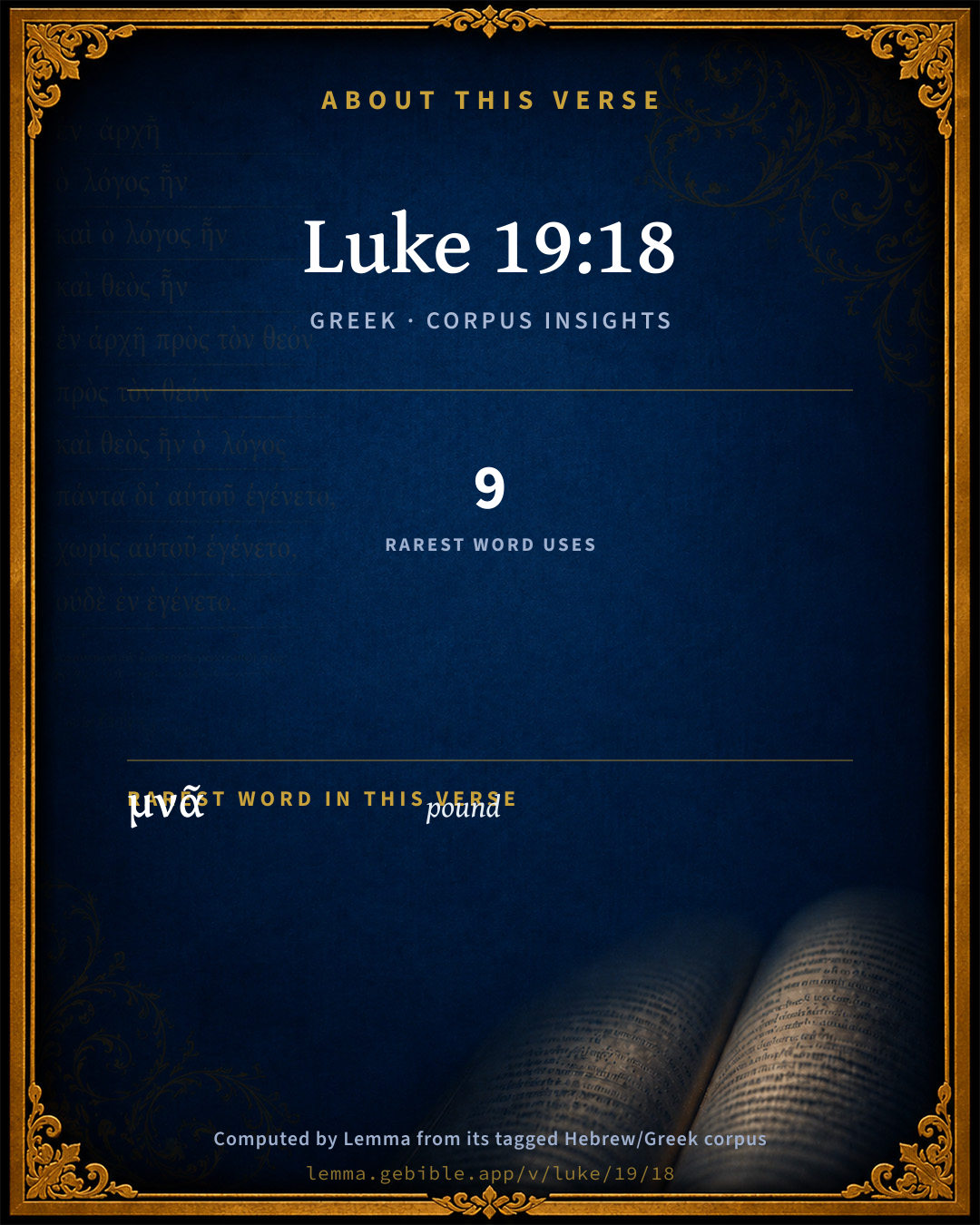
Luke 19:18

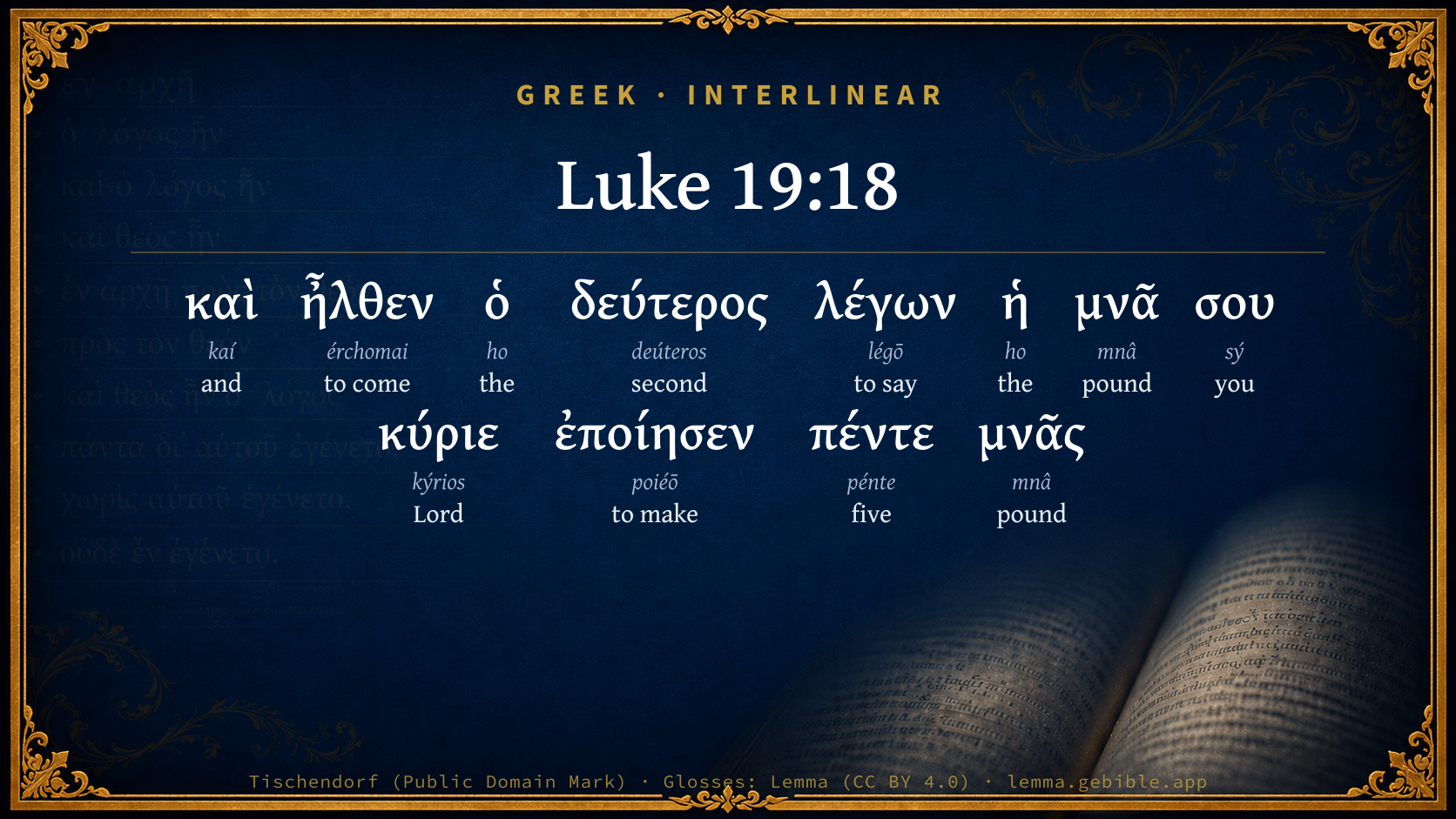
Greek (Tischendorf 8th ed.) Luke 19:18 appears in the Greek New Testament. The text above is from the Tischendorf 8th edition. Each word links to its Strong’s number and a concise gloss. Click any word for its full Thayer’s Greek Lexicon entry.
Download image
Cite this verse

Luke 19:18 (World English Bible). Public Domain. Lemma interlinear Bible study tool, https://lemma.gebible.app/v/luke/19/18.

Show BibTeX & RIS
BibTeX
RIS
English Translation
"The second came, saying, 'Your mina, Lord, has made five minas.'
World English Bible · Public Domain
Download a study sheet

One document with this verse’s original text, its word-by-word gloss line, the meaning frame, cross-references with their text, attributed commentary, and full source and license credits — printable, and it pastes into notes with its structure intact.

This verse Autodidact and up

Study sheet (.html) Plain text (.txt)

A passage Seminary Student

Up to 50 verses in one chapter. A passage sheet keeps up to 6 commentary sources and 12 cross-references per verse, in the order this page ranks them, and says so on the sheet whenever that leaves anything out. Ask for a single verse and you get the Autodidact verse sheet above.

Everything on this page stays free to read, with no account — the sheet is a download of what is already on screen, not access to it.

Want to remove ads? Support Godless Engineer
Compare translations 3

The same verse in 3 English versions, stacked beneath the original-language interlinear above. Click any original word for its lexicon entry.

Each is an independent rendering of the whole verse — the interlinear is not word-aligned to these translations.

Highlighted words mark where these versions differ — a whole-verse word diff, not a word-by-word alignment.

  • World English Bible Public Domain
    "The second came, saying, 'Your mina, Lord, has made five minas.'
  • King James Version Public Domain
    And the second came, saying, Lord, thy pound hath gained five pounds.
  • unfoldingWord Literal Text CC BY-SA 4.0
    And the second came said, ‘Your mina, master, has made five minas.’

unfoldingWord Literal Text — © unfoldingWord, licensed CC BY-SA 4.0. Word-aligned USFM3 via Door43 (git.door43.org/unfoldingWord/en_ult).

Versions to compare (up to 4)

3 of 4 selected

Show all 19 translations

Every available English version of this verse, each an independent rendering of the whole verse.

  • World English Bible Public Domain
    "The second came, saying, 'Your mina, Lord, has made five minas.'
  • Berean Standard Bible Public Domain
    The second servant came and said, ‘Master, your mina has made five minas.’
  • Majority Standard Bible Public Domain
    The second servant came and said, ‘Master, your mina has made five minas.’
  • King James Version Public Domain
    And the second came, saying, Lord, thy pound hath gained five pounds.
  • American Standard Version (1901) Public Domain
    And the second came, saying, Thy pound, Lord, hath made five pounds.
  • Revised Version (1885) Public Domain
    And the second came, saying, Thy pound, Lord, hath made five pounds.
  • Geneva Bible (1599) Public Domain
    And the second came, saying, Lord, thy piece hath encreased fiue pieces.
  • Douay-Rheims (1899) Public Domain
    And the second came, saying: Lord, thy pound hath gained five pounds.
  • Young's Literal Translation Public Domain
    `And the second came, saying, Sir, thy pound made five pounds;
  • Literal Standard Version CC BY-SA 4.0
    And the second came, saying, Lord, your mina made five minas;
  • Unlocked Literal Bible CC BY-SA 4.0
    The second came, saying, 'Your mina, lord, has made five minas.'
  • unfoldingWord Literal Text CC BY-SA 4.0
    And the second came said, ‘Your mina, master, has made five minas.’
  • Darby Bible Public Domain
    And the second came, saying, [My] Lord, thy mina has made five minas.
  • World Messianic Bible Public Domain
    “The second came, saying, ‘Your mina, Lord, has made five minas.’
  • Webster's Bible Public Domain
    And the second came, saying, Lord, thy pound hath gained five pounds.
  • Free Bible Version CC BY-SA 4.0
    The second servant came in and said, ‘Lord, your money has earned five times as much.’
  • Bible in Basic English Public Domain
    And another came, saying, Your pound has made five pounds.
  • Text-Critical English NT CC BY 4.0
    The second came and said, ‘Master, yoʋr mina has made five minas.’
  • Tyndale New Testament (1534) Public Domain
    And the other came sayinge: Lorde thy poude hath encreased fyve pounde.

Literal Standard Version (2020), Covenant Press — licensed CC BY-SA 4.0. Text via the HelloAO Bible API (eBible.org). Unlocked Literal Bible (unfoldingWord) — licensed CC BY-SA 4.0. Text via the HelloAO Bible API (eBible.org). unfoldingWord Literal Text — © unfoldingWord, licensed CC BY-SA 4.0. Word-aligned USFM3 via Door43 (git.door43.org/unfoldingWord/en_ult). Free Bible Version, Dr. Jonathan Gallagher — licensed CC BY-SA 4.0. Text via the HelloAO Bible API (eBible.org).

Word by word

More ways to search: Search by grammar → Find every occurrence → Compare this word →

Practice this passage: Drill this verse → Learn its vocabulary →

μνᾶ
mnâ
G3414
“pound”
Noun, Nominative, Singular, Feminine
Part of Speech
Noun
Case
Nominative
Number
Singular
Gender
Feminine
Full Thayer's Definition

Origin: of Latin origin

TDNT: None

1. in the OT, a weight of 300 shekels was one pound 2. In the NT, a weight and sum of money equal to 100 drachmae, one talent was 100 pounds, a pound equalled 10 1/3 oz. (300 gm)
  1. καὶ kaí G2532 “and” Conjunction
  2. ἦλθεν érchomai G2064 “to come” Verb, Aorist, Active, Indicative, 3rd person, Singular
  3. ὁ ho G3588 “the” Article, Nominative, Singular, Masculine
  4. δεύτερος deúteros G1208 “second” Adjective, Nominative, Singular, Masculine
  5. λέγων légō G3004 “to say” Verb, Present, Active, Participle, Nominative, Singular, Masculine
  6. ἡ ho G3588 “the” Article, Nominative, Singular, Feminine
  7. σου sý G4771 “you” Personal pronoun, 2nd person, Genitive, Singular
  8. κύριε kýrios G2962 “Lord” Noun, Vocative, Singular, Masculine
  9. ἐποίησεν poiéō G4160 “to make” Verb, Aorist, Active, Indicative, 3rd person, Singular
  10. πέντε pénte G4002 “five” Adjective, Numeral (indeclinable)
  11. μνᾶς mnâ G3414 “pound” Noun, Accusative, Plural, Feminine

About this verse

These counts appear in no published source. They are computed here, from the morphology-tagged text and Lemma’s own curated glosses. What Lemma adds →

12
words
10
distinct lemmas
Gospels
section

Notable vocabulary

The rarest word here is μνᾶ pound G3414 — appearing just 9 times in the whole Greek New Testament.

Shared distinctive vocabulary

μνᾶ pound G3414 occurs in 6 verses of the Greek New Testament. Also found in:

Repetition

Words recur within this verse:

Cross-references

3

Topical passages linked to Luke 19:18 in the Treasury of Scripture Knowledge — connected by theme and wording, ordered by reader-vote popularity; previews shown in the World English Bible.

  • Matthew 13:23 What was sown on the good ground, this is he who hears the word, and understands it, who most assuredly bears fruit, and brings forth, some one hundred times as much, some sixty, and some thirty."
  • Mark 4:20 These are those which were sown on the good ground: such as hear the word, and accept it, and bear fruit, some thirty times, some sixty times, and some one hundred times."
  • 2 Corinthians 8:12 For if the readiness is there, it is acceptable according to what you have, not according to what you don't have.

Cross-references courtesy of OpenBible.info (CC BY 4.0).

Commentary

Notes on Luke 19:18 from classic Christian and Jewish commentators (each source and its license shown beneath its notes). The classic Christian expositions comment on the surrounding passage and are grouped to its opening verse, so a note may address several verses; the Jewish commentaries on the Tanakh (Rashi and others) are per-verse, so they appear only where the commentator wrote on this verse.

Lemma curates 59 commentaries, every one of them public domain or Creative Commons licensed, each selected and text-cleaned for this edition rather than reprinted as found. About our sources →

John Gill's Exposition

And he said likewise to him,.... He commended him as a good and faithful servant, though this is not expressed; and added,

be thou over five cities; which does not denote any inequality of glory in Christ's ministers, who will all shine as the firmament, and as the stars for ever and ever; at least, there will be no inequality in the ultimate state of happiness, when all the saints shall shine as the sun in the kingdom of their Father, whatever there may be in the kingdom state, or in Christ's personal reign with his saints on earth. The above learned writer would have this passage compared with Isa 19:18.

John Gill's Exposition of the Whole Bible (1746–1763) — public domain (CC PDM 1.0). Text via the HelloAO Bible API.

MacLaren's Expositions of Holy Scripture

Alexander MacLaren

Luke

THE TRADING SERVANTS

Luk 19:16, Luk 19:18.

The Evangelist, contrary to his usual practice, tells us what was the occasion of this parable. It was spoken at Jericho, on our Lord’s last journey to Jerusalem, Bethany was but a day’s march distant; Calvary but a week ahead. An unusual tension of spirit marked our Lord’s demeanour, and was noticed by the disciples with awe. It infected them, and the excitable crowd, which was more than usually excitable because on its way to the passover festival. The air was electric, and everybody felt that something was impending. They ‘thought that the kingdom of God should immediately appear.’ So Christ spoke this parable to damp down that expectation which might easily flash up into the flame of rebellion. He tells them His real programme. He was to go a long way off to receive the kingdom. That was a familiar experience amongst the nations tributary to Rome, and more than one of the Herodian family had passed through it. In the meantime there was to be a period of expectancy. It was to be a long time, for he had to go to a ‘far country,’ and it was to be extended enough for the servants to turn their money over many times during His absence. When He did return it was not to do what they expected. They thought that the kingdom meant Jewish lordship over subject nations. He teaches them that it meant the destruction of the rebellious citizens, and a rigid scrutiny of the servants’ faithfulness.

Now, the words of my two texts bring out in connection with this outline of the future some large lessons which I desire to draw.

I. Notice the small capital that the servants receive to trade with.

It was a pound apiece, which, numismatic authorities tell us, is somewhat about the same value as some £6 odd of English money; though, of course, the purchasing power would be considerably greater. A small amount, and an equal amount to every servant-these are the two salient points of this parable. They make the broad distinction between it and the other parable, which is often mixed up with it, the parable of the talents. There, instead of the amount being excessively small, it is exceedingly great; for a talent was worth some £400, and ten talents would be £4000, a fair capital for a man to start with. The other point of difference between the two parables, which belongs to the essence of each, is that while the gift in the one case is identical, in the other case it is graduated and different.

Now, to suppose that these are but two varying versions of the same parable, which the Evangelists have manipulated is, in my judgment, to be blind to the plainest of the lessons to be drawn from them.

There are two sorts of gifts. In one, all Christian men, the Master’s servants, are alike; in another, they differ. Now, what is the thing in which all Christians are alike? What gift do they all possess equally; rich and poor, largely endowed or slenderly equipped; ‘talented’-as we use the word from the parable-or not? The rich man and the poor, the wise man and the foolish, the cultured man and the ignorant, the Fijian and the Englishman, have one thing alike-the message of salvation which we call the Gospel of the blessed Lord. That is the ‘pound.’ We all stand upon an equal platform there, however differently we are endowed in respect of capacities and other matters. All have it; and all have the same.

Now if that is the interpretation of this parable, there are considerations that flow from that thought, and on which I would dwell for a moment.

The first of them is the apparent smallness of the gift. You may feel a difficulty in accepting that explanation, and may have been saying to yourselves that it cannot be correct, because Jesus Christ would never compare the unspeakable gift of His message of salvation through Him, to that paltry sum. But throw yourselves back to the moment of utterance, and I think you will feel the pathos and power of the metaphor. Here was that handful of disciples set in the midst of a hostile world, dead against them, with its banded superstitions, venerable idolatries, systematised philosophies, the force of the mightiest instruments of material power that the world had ever seen, in the organisation and military power of Rome. And there stood twelve Galilean men, with their simple, unlettered message; one poor ‘pound,’ and that was all. ‘The foolishness of preaching,’ the message which to ‘the Jews was a stumbling-block, and to the Greeks was folly,’ was all that they were equipped with. Their Master, who left them to seek a Kingdom, had so little to bestow, before He received His crown, that all that He could spare them was that small sum. They had to go into business in a very poor way. They had to be content to do a very insignificant retail trade. ‘The foolishness of God is wiser than men; and the weakness of God is stronger than men.’ The old experience of the leather sling and the five stones out of the brook, in the hand of the stripling, that made short work of the brazen armour of the giant, and penetrated with a whizz into his thick skull, and laid him prostrate, was to be repeated. ‘He called his servants, and gave them’-a pound apiece! If you and I, Christian men and women, were true to the Master’s legacy, and believed that we have in it more wealth than the treasures of wisdom and knowledge or force which the world has laid up, we should find that our mite was more than they all have in their possession.

Further, the texts suggest the purpose for which the pound is given. The servants had to live on it themselves, no doubt. So have we. They had to trade with it. So have we. Now that means two things. We get the Gospel, not as some of us lazily suppose, in order to secure that we shall not be punished for our past sins whilst we live, and go to heaven when we die. We get it, not only to enjoy its consolations and its sweetness, but to do business with.

And there are two ways in which this trading is to be done by us. The main one is the honest application of the principles and powers of the Gospel to the moulding of our own characters, and the making us better, purer, gentler, more heavenly-minded, and more Christlike. That is the first trading that we have to carry on with the Word. We get it not for an indolent assent, as so many of us misuse it. We receive it not merely to say, ‘Oh I believe it,’ and there an end, but that we may bring it to bear upon all our conduct, and that it may be the chief formative influence in our characters. Christian people! is that what you do with your Christianity? Is the Gospel moulding you, hour by hour, moment by moment? Have you brought all its great truths to bear upon your daily lives? Have you inwrought its substance into, not merely your understandings or your emotions, but your daily conduct? Is it indeed the life of your lives, and the leaven that is leavening your whole character? You have it to trade with; see that you do not wrap it in a napkin, and stow it idly away in some corner.

Then there is the other way of trading and that is, telling it to others. That is an obligation incumbent on all Christians. There may be differences in regard to other gifts, which determine the manner in which each shall use the equal gift which we all possess alike. But these are of subordinate importance. The main thing is to feel that the possession of Christian faith, which is our way of receiving the pound, carries with it indissolubly the obligation of Christian evangelism. However it may be discharged, discharged it is to be, by every true servant. I am sometimes half disposed to think that it would have been better for the Church if there had never been any men in my position, on whom the mass of unspiritual, idle because busy, and silent because little-loving, Christian professors contentedly roll the whole obligation to preach God’s Gospel. My brethren, the world is not going to be evangelised by officials. Until all Christian people wake up to the sense that they have the ‘pound’ to trade with, there will be nothing adequate done to bring the world to the obedience and the love of Jesus Christ. You say you have the Gospel; if you have it what are you doing with it?

Self-centred Christianity, if such a thing were possible, is a mistake. It is generally a sham; it is always a crime. A man that puts away his pound, and never goes out and says, ‘Come, share with me in the wealth that I have found in Jesus Christ’ will be like a miser that puts his hoardings into an old stocking, and hides it in the ground somewhere. When he goes to dig it up, he is only too likely to find that all the coins have slipped out. If you want to keep your Christianity, let the air into it. If you want it to increase, sow it. There are hosts of you who would be far happier Christian people, if you came out of your shells and traded with your pound.

II. Observe the varying profits of the trading.

The one man says, ‘Thy pound hath gained ten pounds.’ The other says, ‘Thy pound hath gained five pounds.’ And the others who are not mentioned, no doubt, had also varying results to present. Now that inequality of profits from an equal capital to start with, is but a picturesque way of saying what is, alas! too obviously true, that Christian people do not all stand on the same level in regard to the use they have made of, and the benefits they have derived from, the one equal gift which was bestowed upon them. It is the same to every one at the beginning, but differences develop as they go on. One man makes twice as much out of it as another does.

Now, let us distinctly understand what sort of differences these are which our Lord signalises here. Let me clear away a mistake which may interfere with the true lessons of this parable, that the differences in question are the superficial ones in apparent results which follow from difference of endowments, or from difference of influential position. That is the kind of meaning that is often attached to the ‘ten pounds’ or the ‘five pounds’ in the text. We think that the ten pounder is the man who has been able to do some large spiritual work for Jesus Christ, that fills the world with its greatness, the man who has been set in some most conspicuous place, and by reason of intellectual ability or other talent has been able to gather in many souls into the kingdom; but that is not Christ’s way of estimating. We should be going dead in the teeth of everything that He teaches if we thought that such as these were the differences intended. No, no! Every man that co-operates in a great work with equal diligence and devotion has an equal place in his eyes. The soldier that clapped Luther on the back as he was going into the Diet of Worms, and said, ‘You have a bigger fight to fight than we ever had; cheer up, little monk!’ stands on the same level as the great reformer, if what he did was done from the game motive and with as full consecration of himself. The old law of Israel states the true principle of Christian recompense: they that ‘abide by the stuff’ have the same share in the spoil as they ‘that go down into the battle.’ All servants who have exercised equal faithfulness and equal diligence stand on the same level and have the same success; no matter how different may be their estimation in the eyes of men; no matter how different may be the conspicuousness of the places that they fill in the eyes of the world whilst they live, or in the records of the Church when they are dead. Equal diligence will issue in equal results in the development of character, and the only reason for the diversity of results is the diversity of faithfulness and of zeal in trading with the pound.

Notice, too, before I go further, how all who trade make profits. There are no bad debts in that business. There are no investments that result in a loss. Everybody that goes into it makes something by it; which is just to say that any man who is honest and earnest in the attempt to utilise the powers of Christ’s Gospel for his own culture, or for the world’s good, will succeed in reality, however he may seem to fail in appearance. There are no commercial failures in this trading. The man with his ten pounds of profit made them because he worked hardest. The man that made the five made all that his work entitled him to. There was no one who came and said, ‘Lord! I put thy pound into my little shop, and I did my best with it, and it is all gone!’ Every Christian effort is crowned with success.

III. Lastly, we have here the final declaration of profits.

The master has come back. He is a king now, but he is the master still, and he wants to know what has become of the money that was left in the servants’ hands. Now, that is but a metaphorical way of bringing to our minds that which we cannot conceive of without metaphor-viz., the retribution that lies beyond the grave for us all. Although we cannot conceive it without metaphor, we may reach, through the metaphor to some apprehension, at any rate, of the facts that lie behind it. There are two points in reference to this final declaration of profits suggested here.

The first is this, that all the profit is ascribed to the capital. Neither of the two men say: ‘I, with thy pound, have gained,’ but ‘Thy pound hath gained.’ That is accurately true. For if I accept, and live by, any great moral truth or principle, it is the principle or the truth that is the real productive cause of the change in my life and character. I, by my acceptance of it, simply put the belt on the drum that connects my loom with the engine, but it is the engine that drives the looms and the shuttle, and brings out the web at last. And so, Christian people who, with God’s grace in their hearts, have utilised the ‘pound,’ and thereby made themselves Christlike, have to say, ‘It was not I, but Christ in me. It was the Gospel, and not my faith in the Gospel, that wrought this change.’ Is it your teeth or your dinner that nourishes you? Is it the Gospel or your trust in the Gospel that is the true cause of your sanctifying?

With regard to the other aspect of this trading, the same thing is true. Is it my word or Christ’s Word ministered by me that helps any of my hearers who are helped? Surely! surely! there is no question about that. It is the ‘pound’ that gains the ‘pounds.’ ‘Paul planted, Apollos watered, but God gave the increase. So, then, neither is he that planteth anything nor he that watereth, but God that giveth the increase.’

The other consideration suggested by these words is the exact knowledge of the precise results of a life, which is possessed at last. Each servant knew precisely what was the net outcome of his whole activity. That is exactly what we do not know here, and never shall, and never can know. But yonder all illusions will have vanished; and there will be two sorts of disillusionising then. Men, for instance, of my profession, whose names are familiar, and who hold high places in the esteem of the Church, and may be tempted to suppose that they have done a great deal-I am afraid that many of us will find, when we get yonder, that we have not done nearly so much as our admirers in this world, and we ourselves, were sometimes tempted to think that we had done. The searching light that comes in will show a great many seamy places in the cloth that looks very sound when it is inspected in the twilight. And there will be another kind of disillusionising. Many a man has said, ‘Lord! I have laboured in vain, and spent my strength for nought,’ who will find out that he was mistaken, and that where he saw failure there were solid results; that where he thought the grain had perished in the furrows, it had sprung up and borne fruit unto life everlasting. ‘Lord! when saw we Thee in prison, and visited Thee?’ We never knew that we had done anything of the sort. ‘Behold! I was left alone,’ said the widowed Jerusalem when she was restored to her husband, ‘these’-children that have gathered round me-’where had they been?’ We shall know, for good or bad, exactly the results of our lives.

We shall have to tell them. The slothful servant, too, was under this compulsion of absolute honesty. If he had not been so, do you think he would have ventured to stand up before his master, a king now, and insult him to his face? But he had to turn himself inside out, and tell then what he had thought in his inmost heart. So ‘every one of us shall give an account of himself to God’; and like a man in the bankruptcy court, we shall have to explain our books, and go into all our transactions. We are working in the dark today. Our work will be seen as it is, in the light. The coral reef rises in the ocean, and the creatures that made it do not see it. The ocean will be drained away, and the reef will stand up sheer and distinct.

My brother! ‘I counsel thee to buy of me gold tried in the fire’-and when you have bought your pound, see that you use it; for ‘it is required in stewards that a man be found faithful.’

Alexander MacLaren, Expositions of Holy Scripture (1904–1910) — public domain. Text from a community e-Sword module.

Expositor's Greek Testament

ed. W. Robertson Nicoll

Luk 19:18 . πέντε , five, half as much, implying less capacity, diligence, conscientiousness, or luck which, however, is not taken into account.

The Expositor's Greek Testament, edited by W. Robertson Nicoll (1897–1910) — public domain. Text from a community e-Sword module.

Trapp's Complete Commentary

John Trapp

18 And the second came, saying, Lord, thy pound hath gained five pounds.

Ver. 18. See Mat 25:21-22, &c.

John Trapp, A Commentary or Exposition upon All the Books of the Old and New Testament (1647–1656) — public domain. Text from a community e-Sword module.

unfoldingWord translationNotes

Door43 World Missions Community

Connecting Statement:

Jesus continues to tell the parable he began in Luke 19:11.

The second

"The second servant" (See: Ordinal Numbers)

Your mina, lord, has made five minas

It is implied that the servant was the one who caused the profit. AT: "Lord, I used your mina to make a profit of five more minas" (See: Assumed Knowledge and Implicit Information)

mina

A mina was 600 grams, probably of silver. Each mina was equal to 100 days' wages, what people would be paid for about four months' work. See how you translated this in Luke 19:13. (See: Biblical Weight)

You take charge over five cities

"You will have authority over five cities"

translationWords

noble

unfoldingWord translationNotes — © Distant Shores Media and the Door43 World Missions Community, licensed CC BY-SA 4.0. Source: git.door43.org/Door43/en_tn.

Cambridge Greek Testament for Schools and Colleges

18. ἐποίησεν. ‘Made,’ in the same idiomatic sense as in English ‘to make money.’

Cambridge Greek Testament for Schools and Colleges (Cambridge University Press, 1896; 21 vols, various authors incl. Carr, Maclear, Plummer, Farrar, Lumby, Moule, M. R. James, Simcox) — public domain. Text from a community e-Sword module.

International Critical Commentary

18. With ἐποίησεν πέντε μνᾶς comp. εἰ μὴ εἴ τις αὐτῶν ἀργύριον ποιεἰ (plat Rep. ix. 581 C): pecuniam facere is fairly common.

International Critical Commentary — older volumes (1896–1929), various authors — public domain. Text from a community e-Sword module.

Vincent's Word Studies in the New Testament

Marvin R. Vincent

Made [εποιησεν] . See on Mt 25:16.

Marvin R. Vincent, Word Studies in the New Testament (1887–1900) — public domain. Text from a community e-Sword/MySword module.

Lesson kit

Teaching starters — assembled from the data on this page, not authored interpretation. Every prompt links to the verse data it draws on. Edit before teaching.

Luke, in the Gospels, opens this verse with 12 words (10 distinct Greek lemmas). Its most distinctive word is mnâ (“pound”). A historical commentator’s framing appears above. Read the whole chapter for the surrounding context.

Discussion questions

  1. The word mnâ carries the sense “pound.” How does it shape the verse?
  2. Luke 19:13 shares the word «pound» with this verse. How do the two illuminate each other?
  3. “pound” occurs 2× in this one verse. What is the effect of the repetition?
  4. These translations render this verse differently; the difference is in the English rendering, not the original. What questions does that raise?
  5. Reading how John Gill's Exposition and MacLaren's Expositions of Holy Scripture read this verse, where do the two commentators agree and where do they part?

Things to notice

Reading settings

Reading text

Shown beneath each verse's original-language words.

Old Testament
Old Testament edition

Read the OT as the Masoretic Hebrew (MT) or the Greek Septuagint (LXX).

English shown for the Greek Septuagint (in the Hebrew ↔ Greek comparison).

Comparing translations? Open the Compare panel on any verse page to stack up to four side by side.