
Matthew 23:15

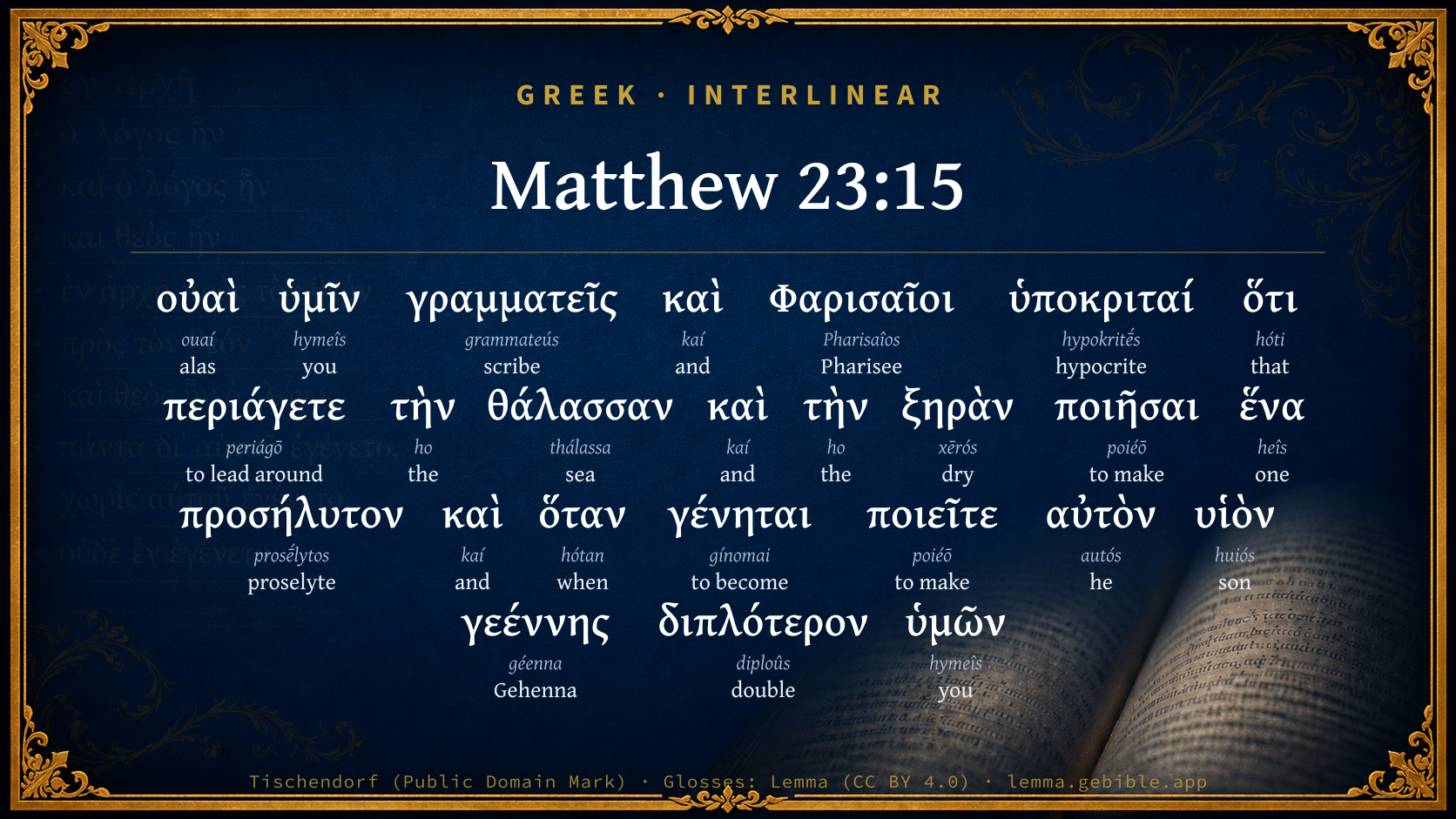
Greek (Tischendorf 8th ed.) Matthew 23:15 appears in the Greek New Testament. The text above is from the Tischendorf 8th edition. Each word links to its Strong’s number and a concise gloss. Click any word for its full Thayer’s Greek Lexicon entry.
Download image
Cite this verse

Matthew 23:15 (World English Bible). Public Domain. Lemma interlinear Bible study tool, https://lemma.gebible.app/v/matthew/23/15.

Show BibTeX & RIS
BibTeX
RIS
English Translation
Woe to you, scribes and Pharisees, hypocrites! For you travel around by sea and land to make one proselyte; and when he becomes one, you make him twice as much of a son of Gehenna as yourselves.
World English Bible · Public Domain
Highlights
  • 2 first appearances in the Greek New Testament
Full analysis ↓
Download a study sheet

One document with this verse’s original text, its word-by-word gloss line, the meaning frame, cross-references with their text, attributed commentary, and full source and license credits — printable, and it pastes into notes with its structure intact.

This verse Autodidact and up

Study sheet (.html) Plain text (.txt)

A passage Seminary Student

Up to 50 verses in one chapter. A passage sheet keeps up to 6 commentary sources and 12 cross-references per verse, in the order this page ranks them, and says so on the sheet whenever that leaves anything out. Ask for a single verse and you get the Autodidact verse sheet above.

Everything on this page stays free to read, with no account — the sheet is a download of what is already on screen, not access to it.

Want to remove ads? Support Godless Engineer
Compare translations 3

The same verse in 3 English versions, stacked beneath the original-language interlinear above. Click any original word for its lexicon entry.

Each is an independent rendering of the whole verse — the interlinear is not word-aligned to these translations.

Highlighted words mark where these versions differ — a whole-verse word diff, not a word-by-word alignment.

  • World English Bible Public Domain
    Woe to you, scribes and Pharisees, hypocrites! For you travel around by sea and land to make one proselyte; and when he becomes one, you make him twice as much of a son of Gehenna as yourselves.
  • King James Version Public Domain
    Woe unto you, scribes and Pharisees, hypocrites! for ye compass sea and land to make one proselyte, and when he is made, ye make him twofold more the child of hell than yourselves.
  • unfoldingWord Literal Text CC BY-SA 4.0
    Woe to you, scribes and Pharisees, hypocrites! For you go around the sea and the dry land to make one proselyte, and when he becomes, you make him twice as much a son of Gehenna as you.

unfoldingWord Literal Text — © unfoldingWord, licensed CC BY-SA 4.0. Word-aligned USFM3 via Door43 (git.door43.org/unfoldingWord/en_ult).

Versions to compare (up to 4)

3 of 4 selected

Show all 19 translations

Every available English version of this verse, each an independent rendering of the whole verse.

  • World English Bible Public Domain
    Woe to you, scribes and Pharisees, hypocrites! For you travel around by sea and land to make one proselyte; and when he becomes one, you make him twice as much of a son of Gehenna as yourselves.
  • Berean Standard Bible Public Domain
    Woe to you, scribes and Pharisees, you hypocrites! You traverse land and sea to win a single convert, and when he becomes one, you make him twice as much a son of hell as you are.
  • Majority Standard Bible Public Domain
    Woe to you, scribes and Pharisees, you hypocrites! You traverse land and sea to win a single convert, and when he becomes one, you make him twice as much a son of hell as you are.
  • King James Version Public Domain
    Woe unto you, scribes and Pharisees, hypocrites! for ye compass sea and land to make one proselyte, and when he is made, ye make him twofold more the child of hell than yourselves.
  • American Standard Version (1901) Public Domain
    Woe unto you, scribes and Pharisees, hypocrites! for ye compass sea and land to make one proselyte; and when he is become so, ye make him twofold more a son of hell than yourselves.
  • Revised Version (1885) Public Domain
    Woe unto you, scribes and Pharisees, hypocrites! for ye compass sea and land to make one proselyte; and when he is become so, ye make him twofold more a son of hell than yourselves.
  • Geneva Bible (1599) Public Domain
    Wo be vnto you, Scribes and Pharises, hypocrites: for ye compasse sea and land to make one of your profession: and when he is made, ye make him two folde more the childe of hell, then you your selues.
  • Douay-Rheims (1899) Public Domain
    Woe to you scribes and Pharisees, hypocrites; because you go round about the sea and the land to make one proselyte; and when he is made, you make him the child of hell twofold more than yourselves.
  • Young's Literal Translation Public Domain
    `Wo to you, Scribes and Pharisees, hypocrites! because ye go round the sea and the dry land to make one proselyte, and whenever it may happen -- ye make him a son of gehenna twofold more than yourselves.
  • Literal Standard Version CC BY-SA 4.0
    Woe to you, scribes and Pharisees, hypocrites! Because you go around the sea and the dry land to make one proselyte, and whenever it may happen—you make him a son of Gehenna twofold more than yourselves.
  • Unlocked Literal Bible CC BY-SA 4.0
    Woe to you, scribes and Pharisees, hypocrites! For you go over sea and land to make one convert, and when he has become one, you make him twice as much a son of hell as you.
  • unfoldingWord Literal Text CC BY-SA 4.0
    Woe to you, scribes and Pharisees, hypocrites! For you go around the sea and the dry land to make one proselyte, and when he becomes, you make him twice as much a son of Gehenna as you.
  • Darby Bible Public Domain
    Woe to you, scribes and Pharisees, hypocrites, for ye compass the sea and the dry [land] to make one proselyte, and when he is become [such], ye make him twofold more [the] son of hell than yourselves.
  • World Messianic Bible Public Domain
    Woe to you, scribes and Pharisees, hypocrites! For you travel around by sea and land to make one proselyte; and when he becomes one, you make him twice as much a son of Gehinnom as yourselves.
  • Webster's Bible Public Domain
    Woe to you, scribes and Pharisees, hypocrites! for ye compass sea and land to make one proselyte, and when he is made, ye make him two-fold more the child of hell than yourselves.
  • Free Bible Version CC BY-SA 4.0
    What a disaster is coming on you, religious teachers and Pharisees, you hypocrites! For you travel over land and sea to make a single convert, and when you do, you make him twice a son of Gehenna as you are yourselves.
  • Bible in Basic English Public Domain
    A curse is on you, scribes and Pharisees, false ones! for you go about land and sea to get one disciple and, having him, you make him twice as much a son of hell as yourselves.
  • Text-Critical English NT CC BY 4.0
    “Woe to you, scribes and Pharisees, hypocrites! For you cross sea and land to make a single convert, and when he has become one, you make him twice as much a son of hell as yourselves.
  • Tyndale New Testament (1534) Public Domain
    Wo be vnto you Scribes and Pharises ypocrites which compasse see and londe to bringe one in to youre belefe: and when he ys brought ye make him two folde more the chylde of hell then ye youre selves are.

Literal Standard Version (2020), Covenant Press — licensed CC BY-SA 4.0. Text via the HelloAO Bible API (eBible.org). Unlocked Literal Bible (unfoldingWord) — licensed CC BY-SA 4.0. Text via the HelloAO Bible API (eBible.org). unfoldingWord Literal Text — © unfoldingWord, licensed CC BY-SA 4.0. Word-aligned USFM3 via Door43 (git.door43.org/unfoldingWord/en_ult). Free Bible Version, Dr. Jonathan Gallagher — licensed CC BY-SA 4.0. Text via the HelloAO Bible API (eBible.org).

Word by word

More ways to search: Search by grammar → Find every occurrence → Compare this word →

Practice this passage: Drill this verse → Learn its vocabulary →

προσήλυτον
prosḗlytos
G4339
“proselyte”
Noun, Accusative, Singular, Masculine
Part of Speech
Noun
Case
Accusative
Number
Singular
Gender
Masculine
Full Thayer's Definition

Origin: from the alternate of G4334

TDNT: 18:07,9

1. a newcomer a. a stranger, alien 2. a proselyte a. one who has come over from a Gentile religion to Judaism
  1. οὐαὶ ouaí G3759 “alas” Interjection
  2. ὑμῖν hymeîs G5210 “you” Personal pronoun, 2nd person, Dative, Plural
  3. γραμματεῖς grammateús G1122 “scribe” Noun, Vocative, Plural, Masculine
  4. καὶ kaí G2532 “and” Conjunction
  5. Φαρισαῖοι Pharisaîos G5330 “Pharisee” Noun, Vocative, Plural, Masculine
  6. ὑποκριταί hypokritḗs G5273 “hypocrite” Noun, Vocative, Plural, Masculine
  7. ὅτι hóti G3754 “that” Conjunction
  8. περιάγετε periágō G4013 “to lead around” Verb, Present, Active, Indicative, 2nd person, Plural
  9. τὴν ho G3588 “the” Article, Accusative, Singular, Feminine
  10. θάλασσαν thálassa G2281 “sea” Noun, Accusative, Singular, Feminine
  11. καὶ kaí G2532 “and” Conjunction
  12. τὴν ho G3588 “the” Article, Accusative, Singular, Feminine
  13. ξηρὰν xērós G3584 “dry” Adjective, Accusative, Singular, Feminine
  14. ποιῆσαι poiéō G4160 “to make” Verb, Aorist, Active, Infinitive
  15. ἕνα heîs G1520 “one” Adjective, Accusative, Singular, Masculine
  16. καὶ kaí G2532 “and” Conjunction
  17. ὅταν hótan G3752 “when” Conjunction
  18. γένηται gínomai G1096 “to become” Verb, Aorist, Middle deponent, Subjunctive, 3rd person, Singular
  19. ποιεῖτε poiéō G4160 “to make” Verb, Present, Active, Indicative, 2nd person, Plural
  20. αὐτὸν autós G846 “he” Personal pronoun, Accusative, Singular, Masculine
  21. υἱὸν huiós G5207 “son” Noun, Accusative, Singular, Masculine
  22. γεέννης géenna G1067 “Gehenna” Noun, Genitive, Singular, Feminine
  23. διπλότερον diploûs G1362 “double” Adjective, Accusative, Singular, Masculine, Comparative
  24. ὑμῶν hymeîs G5210 “you” Personal pronoun, 2nd person, Genitive, Plural

About this verse

These counts appear in no published source. They are computed here, from the morphology-tagged text and Lemma’s own curated glosses. What Lemma adds →

25
words
20
distinct lemmas
Gospels
section

Notable vocabulary

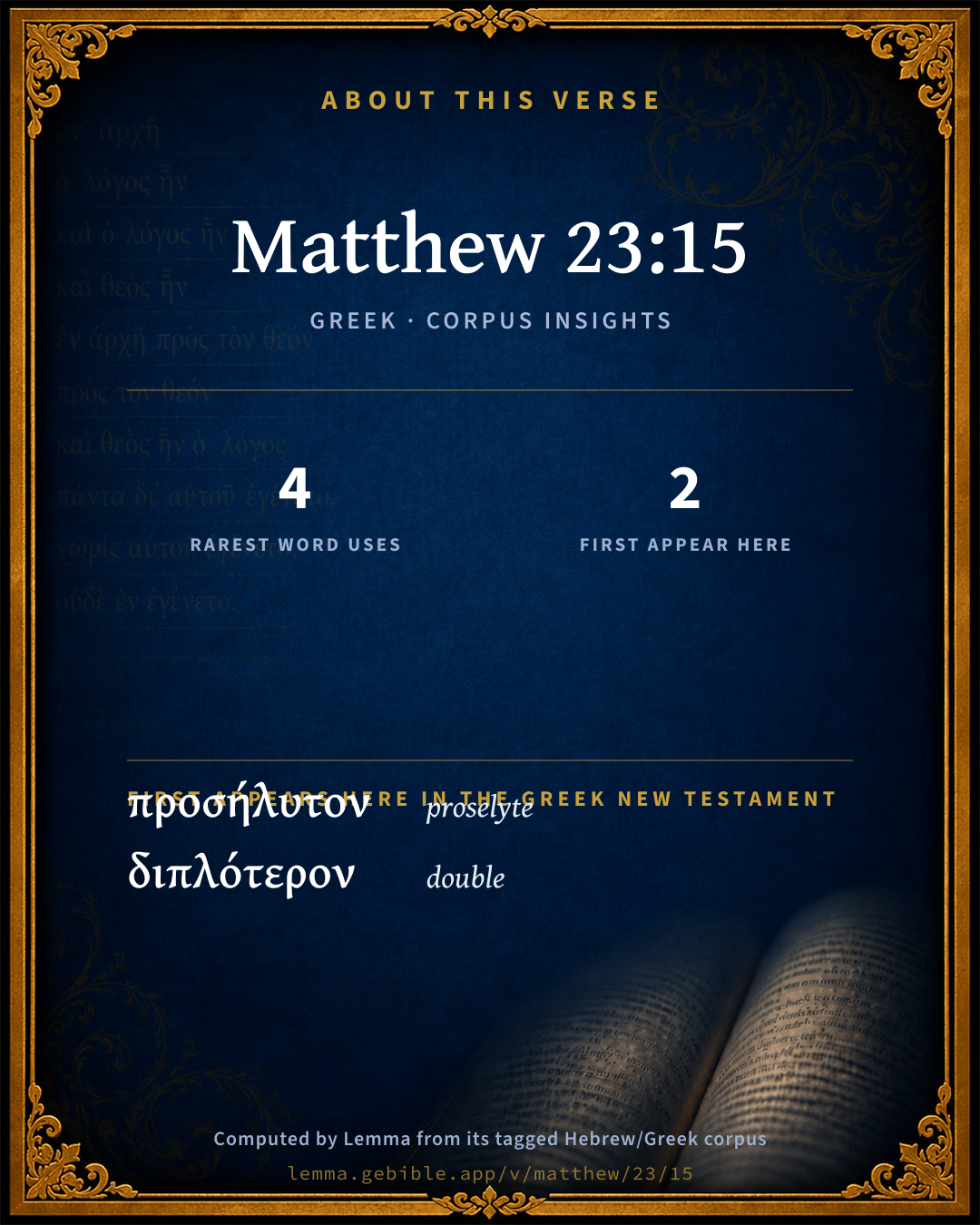
The rarest word here is προσήλυτον proselyte G4339 — appearing just 4 times in the whole Greek New Testament.

First appearance in Scripture

These words make their first canonical appearance in the Greek New Testament here:

  • προσήλυτον proselyte G4339
  • διπλότερον double G1362

Shared distinctive vocabulary

προσήλυτον proselyte G4339 occurs in 4 verses of the Greek New Testament. Also found in:
Repetition

Words recur within this verse:

  • ποιῆσαι to make G4160 ×2
  • καὶ and G2532 ×3
  • ὑμῖν you G5210 ×2
  • τὴν the G3588 ×2

Cross-references

14

Topical passages linked to Matthew 23:15 in the Treasury of Scripture Knowledge — connected by theme and wording, ordered by reader-vote popularity; previews shown in the World English Bible.

  • Acts 13:10 and said, "Full of all deceit and all cunning, you son of the devil, you enemy of all righteousness, will you not cease to pervert the right ways of the Lord?
  • Acts 13:43 Now when the synagogue broke up, many of the Jews and of the devout proselytes followed Paul and Barnabas; who, speaking to them, urged them to continue in the grace of God.
  • Ephesians 2:3 among whom we also all once lived in the lust of our flesh, doing the desires of the flesh and of the mind, and were by nature children of wrath, even as the rest.
  • John 8:44 You are of your Father, the devil, and you want to do the desires of your father. He was a murderer from the beginning, and doesn't stand in the truth, because there is no truth in him. When he speaks a lie, he speaks on his own; for he is a liar, and the father of it.
  • Acts 14:2 But the disbelieving Jews stirred up and embittered the souls of the Gentiles against the brothers.
  • Galatians 4:17 They zealously seek you in no good way. No, they desire to alienate you, that you may seek them.
  • Galatians 6:12 As many as desire to look good in the flesh, they compel you to be circumcised; only that they may not be persecuted for the cross of Christ.
  • Matthew 5:22 But I tell you, that everyone who is angry with his brother without a cause shall be in danger of the judgment; and whoever shall say to his brother, 'Raca!' shall be in danger of the council; and whoever shall say, 'You fool!' shall be in danger of the fire of Gehenna.
  • Acts 17:5–6 But the unpersuaded Jews took along some wicked men from the marketplace, and gathering a crowd, set the city in an uproar. Assaulting the house of Jason, they sought to bring them out to the people.
  • Esther 8:17 In every province, and in every city, wherever the king's commandment and his decree came, the Jews had gladness and joy, a feast and a good day. Many from among the peoples of the land became Jews; for the fear of the Jews was fallen on them.
  • Acts 2:10 Phrygia, Pamphylia, Egypt, the parts of Libya around Cyrene, visitors from Rome, both Jews and proselytes,
  • Acts 17:13 But when the Jews of Thessalonica had knowledge that the word of God was proclaimed by Paul at Beroea also, they came there likewise, agitating the multitudes.
  • Acts 6:5 These words pleased the whole multitude. They chose Stephen, a man full of faith and of the Holy Spirit, Philip, Prochorus, Nicanor, Timon, Parmenas, and Nicolaus, a proselyte of Antioch;
  • Acts 14:19 But some Jews from Antioch and Iconium came there, and having persuaded the multitudes, they stoned Paul, and dragged him out of the city, supposing that he was dead.

Cross-references courtesy of OpenBible.info (CC BY 4.0).

Commentary

Notes on Matthew 23:15 from classic Christian and Jewish commentators (each source and its license shown beneath its notes). The classic Christian expositions comment on the surrounding passage and are grouped to its opening verse, so a note may address several verses; the Jewish commentaries on the Tanakh (Rashi and others) are per-verse, so they appear only where the commentator wrote on this verse.

Lemma curates 59 commentaries, every one of them public domain or Creative Commons licensed, each selected and text-cleaned for this edition rather than reprinted as found. About our sources →

Tyndale Open Study Notes

Tyndale Open Resources

23:15 A convert (proselyte) made a full conversion to Judaism, performing such observances as baptism, sacrifice, and circumcision (see Acts 13:43). A convert was thus distinct from a “God-fearer,” who adopted certain Jewish beliefs, most notably monotheism, without fully converting to Judaism (see Luke 7:4-5; Acts 10:2). It is likely that to make one convert means to persuade God-fearers to become full converts to Judaism by undergoing circumcision (cp. Gal 2:3, 14; 5:2-12; 6:12-13). • of hell: Greek of Gehenna; see study note on 5:29.

Tyndale Open Study Notes — © Tyndale Open Resources, licensed CC BY-SA 4.0. Text via the HelloAO Bible API.

Bengel's Gnomon

Johann Albrecht Bengel

Mat 23:15. Περιάγετε, κ.τ.λ., ye compass, etc.) A proverbial expression. Ye compass, or go about, as Rabbis; see Mat 23:7.—ἕνα προσήλυτον, one proselyte) with great zeal, but little efficacy; so that you hardly obtain one.—υἱὸν Γεέννης, a child of hell) i.e. worthy of hell. Thus in Deu 25:2, בן הבות[999] is rendered by the LXX. ἌΞΙΟς ΠΛΗΓῶΝ, worthy of stripes.[1000]—διπλότερον, twofold more) on account of his greater hypocrisy,[1001] though he might have attained to a high rank among the people of God.

[999] Literally, “a son to be beaten.”—(I. B.)

[1000] E. V. “Worthy to be beaten.”—(I. B.)

[1001] Which he adopts from his teachers, independently of and exceeding his heathen corruptions, which he has not laid aside.—V. g.

Bengel's Gnomon of the New Testament — English translation (T&T Clark, Edinburgh, 1860) — public domain. Text from a community e-Sword module.

Meyer's Critical & Exegetical Commentary

Heinrich August Wilhelm Meyer

Mat_23:15. Instead of helping men into the Messiahs kingdom, what contemptible efforts to secure proselytes to their own way of thinking! This representation of pharisaic zeal is doubtless hyperbolical, though it is, at the same time, based upon actual journeyings for the purpose of making converts (Joseph. Antt. xx. 2. 4). On Jewish proselytism generally, see Danz in Meuschen, N. T. ex Talm. ill. p. 649. Wetsteins note on this passage.

ἕνα] a single.

καὶ ὅταν γένηται] sc. προσήλυτος.

υἱὸν γεέννης] one fit for Gehenna, condemned to be punished in it. Comp. on Mat_8:12; Joh_17:12.

διπλότερον ὑμῶν] is commonly taken in an adverbial sense (Vulg.: duplo quam), a sense in which it is consequently to be understood in the corresponding passage of Justin (c. Tr. 122): νῦν δὲ διπλότερον υἱοὶ γεέννης, ὡς αὐτὸς εἶπε, γίνεσθε. Coming as it does after υἱόν, it is more natural to regard it, with Valla, as an adjective: who is doubly more so than you are. For the comparative itself, comp. App. Hist. praef. 10 : σκεύη διπλότερα τούτων. But it is still rendered doubtful whether διπλότερον is to be taken in an adverbial or adjective sense by a passage from Justin as above: οἱ δὲ προσήλυτοι οὐ μόνον οὐ πιστεύουσιν, ἀλλὰ διπλότερον ὑμῶν βλασφημοῦσι. This passage is likewise unfavourable to Kypkes interpretation: fallaciorem, which adjective would be of a more specific character than the context would admit of. But in how far was Jesus justifiable in using the words διπλότερον ὑμῶν? According to Chrysostom, Theodore of Mopsuestia, Euthymius Zigabenus: in consequence of the evil example of him who made the convert, which was such that ex malo ethnico fit pejor Judaeus (Erasmus); according to de Wette: in consequence of the high estimate in which the teachers are held by their disciples, and because superstition and error usually appear with a twofold greater intensity in the taught than in the teachers; according to Olshausen: because the converted heathen had not the advantage of enjoying the spiritual aid to be found in Mosaism; according to Bleek: because it was common also to admit as converts those who were influenced by mere external considerations. According to the context (ποιεῖτε): on account of the manner in which the proselytes continued to be influenced and wrought upon by those who converted them, in consequence of which they were generally found to become more bigoted, more unloving, and more extreme than their instructors, and, of course, necessarily more corrupt.

Meyer — Critical and Exegetical Commentary on the New Testament — English translation by Peter Christie, edited by Frederick Crombie (T&T Clark, 1880) — public domain. Text from a community e-Sword module.

Expositor's Greek Testament

ed. W. Robertson Nicoll

Mat 23:15 . he second woe is the complement of the first: it represents the false guides, as, while utterly incompetent for the function, extremely eager to exercise it. περιάγετε , ye move about, intransitive, the accusative following being governed by περὶ . τ . ξηρὰν , the dry (land), sometimes ὑγρὰ is similarly used for the sea (examples in Elsner). Cf. ψυχρόν for cold water in Mat 10:42 . To compass sea and land is proverbial for doing anything with great zeal. π . ἕνα προσήλυτον , to make a single proselyte. The zeal here ascribed to the Pharisees seems in one sense alien to their character as described in Luk 18:11 . One would expect them rather to be pleased to be a select few superior to all others than to be animated with a burning desire to gain recruits whether from Jews or from Gentiles. For an elaborate discussion of the question as to the existence of the proselytising spirit among the Jews vide Danz’s treatise in Meuschen, Nov. Test. ex Tal. illustratum , p. 649. Vide also Wetstein, ad loc. Wünsche ( Beiträge , p. 285) cites passages from the Talmud to prove that the Pharisees, far from being addicted to proselytising, were rather reserved in this respect. He concludes that Mat 23:15 must refer not to making proselytes to Judaism from Gentiles, but to making additions to their sect from among Jews ( Sectirerei ). This, however, is against the meaning of προσήλυτος . Assuming the fact to have been as stated, the point to be noted is that the Pharisees and scribes aimed chiefly, not at bringing men into the Kingdom of God, but into their own coterie. διπλότερον ὑ ., twofold more, duplo quam , Vulgate. Kypke, while aware that the comparative of διπλοῦς ( διπλότερος ) does not occur in profane writers, thinks it is used here in the sense of deceitful, and renders, ye make him a son of gehenna , more fraudulent, more hypocritical than yourselves. Briefly the idea is: the more converted the more perverted, “je bekehrter desto verkehrter” (Holtz., H. C.).

The Expositor's Greek Testament, edited by W. Robertson Nicoll (1897–1910) — public domain. Text from a community e-Sword module.

Geneva Bible (1599)

Geneva Bible translators

The dry part: now that part of that earth is called dry, which the Lord hath given us to dwell upon.

Geneva Bible (1599) marginal notes — public domain. Text via Bolls.life.

Jamieson, Fausset & Brown

Robert Jamieson, A. R. Fausset & David Brown

Woe unto you, scribes and Pharisees, hypocrites! for ye compass sea and land to make one proselyte--from heathenism. We have evidence of this in JOSEPHUS.

and when he is made, ye make him twofold more the child of hell than yourselves--condemned, for the hypocrisy he would learn to practice, both by the religion he left and that he embraced.

Jamieson, Fausset & Brown — Commentary Critical and Explanatory on the Whole Bible (1871) — public domain (CC PDM 1.0). Text via the HelloAO Bible API.

Adam Clarke's Commentary

Verse 15. Compass sea and land] A proverbial expression, similar to ours, You leave no stone unturned; intimating that they did all in their power to gain converts, not to God, but to their sect. These we may suppose were principally sought for among the Gentiles, for the bulk of the Jewish nation was already on the side of the Pharisees.

Proselyte] προσηλυτος, a stranger, or foreigner; one who is come from his own people and country, to sojourn with another. See the different kinds of proselytes explained in Clarke's note on "Ex 12:43".

The child of hell] A Hebraism for an excessively wicked person, such as might claim hell for his mother, and the devil for his father.

Twofold - the child of] The Greek word διπλοτερον, which has generally been translated twofold, KYPKE has demonstrated to mean more deceitful. απλους is used by the best Greek writers for simple, sincere, απλοτης for simplicity, sincerity; so διπλους, deceitful, dissembling, and διπλοη, hypocrisy, fraudulence, and διπλοτερον, more fraudulent, more deceitful, more hypocritical. See also Suidas in διπλοη.

Dr. Lightfoot, and others, observe, that the proselytes were considered by the Jewish nation as the scabs of the Church, and hindered the coming of the Messiah; and Justin Martyr observes, that "the proselytes did not only disbelieve Christ's doctrine, but were abundantly more blasphemous against him than the Jews themselves, endeavouring to torment and cut off the Christians wherever they could; they being in this the instruments of the scribes and Pharisees."

Adam Clarke's Commentary on the Bible (1810–1826) — public domain. Text from a community e-Sword/MySword module.

Ellicott's Commentary for English Readers

(15) To make one proselyte.—The zeal of the earlier Pharisees had showed itself in a propagandism which reminds us rather of the spread of the religion of Mahomet than of that of Christ. John Hyrcanus, the last of the Maccabean priest-rulers, had offered the Idumeans the alternative of death, exile, or circumcision (Jos. Ant. xiii. 9, § 3). When the government of Rome rendered such measures impossible, they resorted to all the arts of persuasion, and exulted when they succeeded in enrolling a heathen convert as a member of their party. But the proselytes thus made were too often a scandal and proverb of reproach. There was no real conversion, and those who were most active in the work of proselytising were, for the most part, blind leaders of the blind. The vices of the Jew were engrafted on the vices of the heathen. The ties of duty and natural affection were ruthlessly snapped asunder. The popular Jewish feeling about them was like that of the popular Christian feeling about a converted Jew. Proselytes were regarded as the leprosy of Israel, hindering the coming of the Messiah. It became a proverb that no one should trust a proselyte, even to the twenty-fourth generation. Our Lord was, in part at least, expressing the judgment of the better Jews when He taught that the proselyte thus made was “two-fold more the child of hell”—i.e., of Gehenna—than his masters.

A Bible Commentary for English Readers, edited by Charles John Ellicott (1878–1897) — public domain. Text from a community e-Sword module.

The Cambridge Bible for Schools and Colleges

gen. ed. J. J. S. Perowne

15. compass] “go about,” “traverse.” The word is used of our Lord’s “circuits” in Galilee, ch. Mat_4:23; Mat_9:35.

proselyte] Literally, one who approaches, hence, “a worshipper,” (cp. Heb_10:1), “a convert.” The Pharisee, St Paul, carried with him into his new faith the same zeal, with a higher motive. He describes (2Co_11:26) “the perils by water, perils in the city, and perils in the wilderness,” which this eager “compassing of land and sea” brought to him.

Judaism has been classed among the non-missionary religions. This is true at the present day, and through most of its history. Indeed, Rabbinical sayings display jealousy of proselytes. On the other hand, John Hyrcanus imposed Judaism on Edom at the point of the sword (1Ma_5:65-66). The conversion is recorded of whole tribes in Arabia, and on the shores of the Caspian. Also, it appears from the Acts that the number of proselytes in Asia Minor and in Greece was considerable. And in later days Solomon Malco, a Portuguese Jew, was burnt to death under Charles V. on a charge of proselytizing. Probably the proselytism in the text is connected with the charge of rapacity; the Pharisees seeking to convert wealthy Gentiles, over whom they obtained influence.

child of hell] Rather, son of Gehenna.

twofold more the child of hell than yourselves] In accordance with a tendency in new converts to exaggerate the external points of the creed which they adopt, Gentile proselytes strained to the utmost the worst features of Pharisaism.

The Cambridge Bible for Schools and Colleges (gen. ed. J. J. S. Perowne; Cambridge University Press, 1878–1918) — public domain. Text from a community e-Sword module.

John Gill's Exposition

Woe unto you, you blind guides,.... Meaning the same persons, the Scribes and Pharisees, as before, though not named, who pretended to be "guides of the blind", Rom 2:19 but were them selves blind, and so very unfit to be guides of others; they were as they were born, ignorant of divine things, of God in Christ, of the true Messiah, of the true meaning of the Scriptures, of the spirituality of the law, and of the Gospel of Christ; and the way of salvation by him; and their minds were blinded by the God of this world, and with a greedy, and insatiable covetousness after the things of it, of which Christ here gives an instance:

which say, whosoever shall swear by the temple, it is nothing; meaning either that it was no sin to use such an oath, or it was not binding upon a man: he might choose whether he would abide by what he swore by the temple he would do; and thus they ignorantly, and wickedly encouraged vain swearing and perjury. It was usual with them to swear by the temple: take an instance or two.

"Says R. Jochanan (p), "by the temple", it is in our hands; but what shall I do?''

The gloss upon it is;

"it is an oath by the temple of God, that it is in our power to reveal the illegitimacy of the families of the land of Israel.''

"Says R. Zechariah ben Hakatzab (q), , "by this habitation" (meaning the temple), her hand was not removed from my hand from the time the Gentiles entered into Jerusalem, to the time they went out.''

Jarchi and Bartenora's note on it is, this is an oath. Again,

"says R. Simeon ben Gamaliel (r), , "by this habitation"; I will not rest this night until they (doves) are sold for pence apiece.''

The gloss on it is, "he swore by the sanctuary."

But whosoever shall swear by the gold of the temple, he is guilty; or is bound, or is a debtor, to make good his oath; he cannot be excused, but must be obliged to fulfil it; or if he does not, he is guilty of perjury. This is to be understood not of the gold that covered any part of the temple; nor of the golden vessels in it; but of the gold, or money, or gifts which were offered for the service of the temple: and the sense is, that whosoever swore by "Korban", and that this, or that should be as "Korban", he should not go back from it; he was obliged to give it. This showed the covetous disposition of these men, who made nothing of oaths that were swore by the temple; but those that were made by the "Korban", or the gifts of it, were binding, because their interest was in it; it was for their gain.

(p) T. Bab. Kiddushin, fol. 71. 1. (q) Misn. Cetubot, c. 2. sect. 9. Juchasin, fol. 56. 1. (r) T. Bab. Bava Bathra, fol 166. 1. Misn. Ceritot, c. 1. sect. 7. Vid. c. 6. sect. 3.

John Gill's Exposition of the Whole Bible (1746–1763) — public domain (CC PDM 1.0). Text via the HelloAO Bible API.

Trapp's Complete Commentary

John Trapp

15 Woe unto you, scribes and Pharisees, hypocrites! for ye compass sea and land to make one proselyte, and when he is made, ye make him twofold more the child of hell than yourselves.

Ver. 15. Ye compass sea and land] They walked the round, as the devil doth, to gain proselytes; they spared for no pains to pervert men (as now the Jesuits those Circulatores et Agyrtae). Should not we be as diligent and indefatigable to convert them to God? Shall we not be as busy in building staircases for heaven as seducers are in digging descents to hell? If Saul seeking asses found a kingdom, shall not we, by seeking others, find heaven?

Ye make him twofold more the child of hell] Either because they relapse to Gentilism, as finding you so vile and vicious in your lives; or because ye teach them only ceremonies and superstitions; or, because you keep them ignorant of Christ, and plant in them a hatred of the truth, as the Jesuits do in their proselytes. So that of them we may say, as Ambrose did of Polemo, who of a drunkard, by hearing Xenocrates, became a philosopher, Si resipuit a vino, fuit semper tamen temulentus sacrilegio. Though he be now no drunkard, yet he remains drunk still with superstition.

John Trapp, A Commentary or Exposition upon All the Books of the Old and New Testament (1647–1656) — public domain. Text from a community e-Sword module.

Albert Barnes' Notes on the Bible

Ye compass sea and land - You take every means, spare no pains, to gain proselytes.

Proselyte - One that comes over from a foreign nation, religion, or sect to us - a convert. Among the Jews there were two kinds of proselytes:

“Proselytes of righteousness,” or those who wholly and fully embraced the Jewish religion, who were baptized, who were circumcised, and who conformed to all the rites of the Mosaic institutions. “Proselytes of the gate,” or those who approved of the Jewish religion, renounced the pagan superstitions, and conformed to some of the rites of the Jews, but were not circumcised or baptized.

Twofold more the child of hell - That is, twice as bad. To be a child of hell was a Hebrew phrase, signifying to be deserving of hell, to be awfully wicked. Compare the notes at Mat 1:1. The Jewish writers themselves say that the proselytes were “scabs of Israel,” and “hindered the coming of the Messiah” by their great wickedness. The Pharisees gained them either to swell their own numbers, or to make gain by extorting their money under various pretences; and when they had accomplished that, they took no pains to instruct them or to restrain them. They had renounced their superstition which had before somewhat restrained them, but the Pharisees had given them no religion in its place to restrain them, and they were consequently left to the full indulgence of their vices.

Albert Barnes' Notes on the Bible (1834–1885) — public domain. Text from a community e-Sword/MySword module.

Haydock's Catholic Bible Commentary

Because whilst a Gentile he sinned without a perfect knowledge of the evil, and was not then a two-fold child of hell; but after his conversion, seeing the vices of his masters, and perceiving that they acted in direct opposition to the doctrines they taught, he returns to the vomit, and renders himself a prevaricator, by adoring the idols he formerly left, and sells his soul doubly to the devil. (St. John Chrysostom) --- They that teach that it is sufficient to have faith only, do make such Christians as blindly follow them, as these Jews did their proselytes, children of hell far more than before. (St. Augustine, lib. de fide et oper. chap. xxvi.)

George Leo Haydock (1774–1849), Haydock's Catholic Family Bible and Commentary, 1859 edition — public domain. Excludes Psalms (Douay-Rheims chapter numbering differs from Protestant) and Deuterocanonical books (Catholic canon only).

Matthew Poole's English Annotations

A third woe followeth, expressed in this verse, because they corrupted their proselytes, both as to doctrine and manners, so as they were twice more the children of the devil, and in danger of hell, than before. A proselyte was one who, coming from some pagan nation, relinquished idols, and worshipped one true and living God. Of these writers tell us there were two sorts; one that only professed to believe and worship one God, though he did not embrace the Jewish religion: such a one they suffered to live amongst them, and called him a proselyte of the gate. Others embraced the Jewish religion, and were admitted into their church, by circumcision, and baptism, and sacrifice (as their writers tell us): these they called proselytes of righteousness. Our Saviour saith the scribes and Pharisees compassed sea and land, that is, would take any pains, (it is a proverbial expression), to make one a proselyte; nor was this blameworthy in them, but that which followeth, that they made him twofold more the child of hell than before; corrupting him with their false doctrine, and setting him examples of an ill life. Their business was not to turn men from sin unto God, but merely to convert them to an opinion, if they had once got them into their church, so as they could make their markets of them; never regarding their souls more, nor to press upon them the reformation of their lives, that they might be saved. Thus priests and Jesuits at this day go to China, Japan, to proselyte men to the Roman faith; and use all imaginable arts to seduce persons born and bred under the profession of the protestant religion in protestant countries, and boast much of their converts; but he who looks upon the Scriptures, and considereth the lives of the most of their converts, will easily see they are but twice more the children of hell, being licensed, by their indulgences, pardons, absolutions, nay, by their very casuists, to live most prodigious impious lives, to say nothing of their damnable errors in matters of faith.

Matthew Poole's English Annotations on the Holy Bible (1683–1685) — public domain. Text from a community e-Sword/MySword module.

Whedon's Commentary on the Bible

Daniel D. Whedon

15. Proselyte — The THIRD WOE is pronounced upon their efforts to extend their unhallowed dominion. The Jews were very zealous to make proselytes, and in our Saviour’s day were not a little successful. Twofold more the child of hell — They did not sanctify the proselyte from his old heathen vices, and they imparted to him new Jewish wickedness.

A proselyte was a convert from heathenism to Judaism. Proselytes have usually been divided into proselytes of righteousness, which included all who went so far as to worship the true God and observe the practice of primitive morality; and proselytes of the gate, including those who entered completely into Judaism by circumcision and the assuming the obligations of the whole Mosaic ritual. This is, however, comparatively a modern division.

Daniel D. Whedon (gen. ed.), Commentary on the Old and New Testaments (1874–1909) — public domain. Text from a community e-Sword module.

The Pulpit Commentary

Third woe against evil proselytizing. Ye compass sea and land to make one proselyte. The word proshlutov is used in the Septuagint to signify "a stranger" or "sojourner", (Exo_12:48, Exo_12:49, etc.) and at this time was applied to a convert to Judaism, (Act_2:10 Act_6:5) whether circumcised, "a proselyte of righteousness;" or uncircumcised, "a proselyte of the gate." To compass sea and land is a proverbial expression, denoting the employment of every means, the exercise of the utmost effort. One might have thought that, in its proud isolation and exclusiveness, Judaism would not have exposed itself to this reproach. But what says Josephus? In more than one passage of his histories he testifies to the zealous propagation of the Jewish religion, and in some cases the enforcement of circumcision on vanquished enemies (see "Ant.," 18:3. 5; 20:2. 4; "Bell. Jud:," 2:17:10; "Vita," Tacitus ("Hist.," 5:5) gives a most unfavourable account of the numerous converts which Hebrews made throughout the Roman provinces; and St. Augustine ("De Civit.," 6:11) quotes Seneca saying, "Cum interim usque eo sceleratissimae gentis consuetudo convaluit, ut per omnes jam terras recepta sit, victi victoribus leges dederunt" (Edersheim). For similar testimony, we may refer to Horace, "Sat.," 1:4. 142, 143; and Juvenal, "Sat.," 6:541, etc. But it was not proselytizing in itself that the Lord censured. As possessing revelation and the only true religion in the world, the Jews might well have deemed it their business to enlighten the gross darkness of heathenism, and to endeavour to shed abroad the pure light which was confided to their care to tend and cherish. That they were not expressly commanded to do this, and that little blessing attended their efforts in this direction, was dependent upon the transitory and imperfect character of the old covenant, and the many evils which would be consequent upon association with alien peoples. In making converts, the Pharisees sought rather to secure outward conformity than inward piety, change of external religion than change of heart. There was no love of souls, no burning zeal for the honour of God, in their proselytism. They were prompted only by selfish and base motives vain glory, party spirit, covetousness; and if they converted men to their own opinions, with their false tenets, gross externalism, and practical immorality, they had far better have left them in their irresponsible ignorance. When he is made; when he is become a proselyte. Twofold more the child of hell; a son of Gehenna; i.e. worthy of hell fire. So we have 2Sa_12:5, "a son of death;" Joh_17:12, "the son of perdition". (comp. 2Th_2:3) The converts became doubly the children of hell because, seeing the iniquities of their teachers, they learned an evil lesson from them, "engrafted the vices of the Jews on the vices of the heathen," distrusted all goodness, discarded their old religion and disbelieved the new, making utter shipwreck of their moral life. "Ita natura comparati sumus," says an old commentator, "ut vitia potius quam virtutes imitemur, et in rebus malis a discipulis magistri facile superentur.

The peril of making proselytes.

The term "proselytes" is used, and not "converts" or "disciples." it is employed when the idea to be conveyed is "persuasion" to accept some particular opinion or hobby, or to join some particular system or party. "Conversion" suggests an inward change and renewal; "proselyting" suggests outward association with a party. "Conversion" is full of hope; "proselyting" is full of peril. The word was used by the Jews for persons who had been heathen, but had accepted Judaism, and they distinguished between

(1) proselytes of the gate, who received the teachings of the Old Testament, but not the ceremonial Law; and

(2) proselytes of righteousness, who conformed to the whole Law. Our modern term "pervert" conveys something of the idea our Lord attached to "proselyte." Dean Plumptre gives a historical reference, which skilfully brings out the point of our Lord"s reproof. "The zeal of the earlier Pharisees had shown itself in a propagandism which reminds us rather of the spread of the religion of Mahomet than of that of Christ. John Hyrcanus, the last of the Maccabean priest rulers, had offered the Idumaeans the alternative of death, exile, or circumcision. When the government of Rome rendered such measures impossible, they resorted to all the arts of persuasion, and exulted when they succeeded in enrolling a heathen convert as a member of their party. but the proselytes thus made were too often a scandal and proverb of reproach. There was no real conversion, and those who were most active in the work of proselytizing were for the most part blind leaders of the blind. The vices of the Jew were engrafted on the vices of the heathen. The ties of duty and natural affection were ruthlessly snapped asunder. The popular Jewish feeling about them was like that of the popular Christian feeling about a converted Jew.

I THE PERIL OF MAKING PROSELYTES FOR THOSE WHO MAKE THEM. Open such points as these:

1. A man must exaggerate sectarian differences before he can try to win proselytes to an opinion.

2. A man must make more of the outward form than the inward spirit.

3. A man is only too likely to use bad means in gaining such an end.

4. A man who makes proselytes honours himself rather than God.

5. And such a man is only too likely to be deceived in the result he attains.

II THE PERIL OF MAKING PROSELYTES FOR THOSE WHO ARE MADE. Open these points:

1. Men may be overpressed to accept opinions on which they have really formed no judgment.

2. Perverts notoriously exaggerate the formalities of the new creed they adopt, and become bitterest partisans. R.T.

The Pulpit Commentary (1880–1919), ed. H.D.M. Spence-Jones & Joseph S. Exell — public domain. Text from a community e-Sword module.

Scofield Reference Notes

C. I. Scofield

hell

Gehenna. (See Scofield "Mat 5:22")

The Scofield Reference Bible (1917 edition), notes by C. I. Scofield — public domain. Text from a community e-Sword module.

Kretzmann's Popular Commentary

Paul E. Kretzmann

The third woe:

v. 15. Woe unto you, scribes and Pharisees, hypocrites! For ye compass sea and land to make one proselyte, and when he is made, ye make him twofold more the child of hell than yourselves.

In their eagerness to make an impression upon the people, the scribes and Pharisees were zealously active in gaining proselytes for the Jewish Church. They crossed the seas, they traveled into deserts seeking men and women that might be gained for the Jewish religion, and the number of proselytes of the gate and proselytes of righteousness, those that accepted the Jewish doctrines without and with circumcision and baptism, was at times notable. But in adding people to the Church outwardly, they harmed their souls for all eternity by teaching them the religion of hypocrisy. Many of the proselytes of righteousness were far more fanatical than the Jews themselves. Thus the Pharisees again proved themselves adepts at dissimulation, for it appeared before men as though they were zealous for God, and gained many people away from their idolatry, while, as a matter of fact, they introduced them into far greater, though more hidden, idolatry than before—the faith in their own good works.

Paul E. Kretzmann, Popular Commentary of the Bible (1921–1924) — public domain. Text from a community e-Sword module.

Burkitt's Expository Notes on the New Testament

William Burkitt

The next woe denounced is for their false-ended zeal and earnestness in proselyting heathens to the Jewish religion; not with a pious intention to save them, but to serve themselves upon them, to have their consciences and purses under their power: and when you have poisoned them, says our Saviour, by your corrupt doctrine, and hardened them in a course of sin by your wicked example, they are more the children of hell than before you practised upon them.

Learn, 1. Great is the diligence and indefatigable the industry which false teachers use in gaining proselytes to their opinion and party: They compass sea and land to make one proselyte.

2. That such as are proselyted to error, are oftentimes faster riveted in their false opinions than their teachers themselves: They are made two-fold more the children of hell than yourselves.

William Burkitt's Expository Notes on the New Testament (1700–1703) — public domain. Text from a community e-Sword module.

The People's New Testament

B. W. Johnson

15. Ye compass sea and land. Spare no effort. To make a proselyte. Induce Gentiles to become circumcised and to keep the Jewish religion. This is the sense in which “proselyte” was then always used. Twofold more a child of hell. Usually the proselytes of such teachers went to even more foolish sectarian extremes than their teachers.

B. W. Johnson's The People's New Testament with Notes (1889–1891) — public domain. Electronic text from the Christian Classics Ethereal Library (CCEL) ThML edition.

Cambridge Greek Testament for Schools and Colleges

15. περιάγετε, ‘go about,’ ‘traverse.’ The word is used of our Lord’s ‘circuits’ in Galilee, ch. Mat 4:23; Mat 9:35.

προσήλυτον. Literally, one who approaches, hence, ‘a worshipper,’ (cp. Heb 10:1), ‘a convert.’ The word occurs in three other passages Act 2:11; Act 6:5; Act 13:43. Elsewhere proselytes are called οἱ σεβόμενοι, εὐλαβεῖς and οἱ φοβούμενοι θεόν. The word occurs in no classical author. It is used in the LXX. for ‘one who comes,’ i.e. a stranger (Hebr. ger), like the classical ἐπήλυτος and ἔπηλυς. Cp. Exo 12:48, νόμος εἷς ἔσται τῷ ἐγχωρίῳ καὶ τῷ προσελθόντι προσηλύτῳ ἐν ὑμῖν. The passage shows the word would easily pass from the meaning of ‘stranger’ to that of one who conforms to the law—a convert. The Pharisee, St Paul, carried with him into his new faith the same zeal, with a higher motive. He describes (2Co 11:26) ‘the perils by water, perils in the city, and perils in the wilderness,’ which this eager ‘compassing of land and sea’ brought to him.

Judaism has been classed among the non-missionary religions. This is true at the present day, and through most of its history. Indeed, Rabbinical sayings display jealousy of proselytes. On the other hand, John Hyrcanus imposed Judaism on Edom at the point of the sword (1Ma 5:65-66). The conversion is recorded of whole tribes in Arabia, and on the shores of the Caspian. Also, it appears from the Acts that the number of proselytes in Asia Minor and in Greece was considerable. And in later days Solomon Malco, a Portuguese Jew, was burnt to death under Charles V. on a charge of proselytizing. Probably the proselytism in the text is connected with the charge of rapacity; the Pharisees seeking to convert wealthy Gentiles, over whom they obtained influence.

The decrees recorded by Tacitus and Suetonius against the introduction of Jewish rites point to the same spirit of proselytism: ‘actum et de sacris Ægyptiis Judaicisque pellendis,’ Tacit. Ann. II. 85. The result was the deportation of 6000 ‘libertini generis’ to Sardinia. ‘Extimas cæremonias Ægyptios Judaicosque ritus compescuit (Tiberius)’, Suet. Tib. 36.

υἱὸν γεέννης διπλότερον ὑμῶν. In accordance with a tendency in new converts to exaggerate the external points of the creed which they adopt, Gentile proselytes strained to the utmost the worst features of Pharisaism.

υἱὸν γεέννης. ‘Subject to the doom of Gehenna,’ i.e. either (1) to the severest sentence known to the Jewish law—to be slain and then flung into the accursed valley of Hinnom; or (2) worthy of being cast into the Gehenna of the after world—that division of Sheol (Hades) into which the accursed were thrown. But the two thoughts were so closely connected in the Jewish mind as scarcely to be separable. In neither view should the expression be literally pressed. Oriental speech delights in strong expressions, and the absence of superlatives in Hebrew necessitated the use of such phrases. Comp. ‘a son of death,’ i.e. ‘worthy of death,’ or ‘doomed to die.’

Observe the contrast between Mat 23:14-15. The Pharisee suffers not those who are entering the kingdom to come in, to their salvation—whereas he spares no effort to bring in a single proselyte, to his ruin. The verbal correspondence between τοὺς εἰσερχομένους … εἰσελθεῖν and προσήλυτον is probably not unintentional though it does not appear to have been noticed.

Cambridge Greek Testament for Schools and Colleges (Cambridge University Press, 1896; 21 vols, various authors incl. Carr, Maclear, Plummer, Farrar, Lumby, Moule, M. R. James, Simcox) — public domain. Text from a community e-Sword module.

Alford’s Greek Testament

Henry Alford

15.] And with all this betrayal of your trust as οἱ διδάσκαλοι τοῦ Ἰσραήλ (Joh 3:10), as if all your work at home were done, ye περιάγ. τ. θ. κ.τ.λ. This was their work of supererogation—not commanded them, nor in the spirit of their law. The Lord speaks not here of those pious Godfearing men, who were found dwelling among the Jews, favouring and often attending their worship—but of the proselytes of righteousness, so called, who by persuasion of the Pharisees, took on them the whole Jewish law and its observances. These were rare—and it was to the credit of our nature that they were. For what could such a proselyte, made by such teachers, become? A disciple of hypocrisy merely—neither a sincere heathen nor a sincere Jew—doubly the child of hell—condemned by the religion which he had left—condemned again by that which he had taken. The expression διπλότερον ὑμῶν occurs in the same connexion, and probably in allusion to this passage, in Justin Martyr, Tryph. § 122, p. 215, οἱ δὲ προσήλυτοι οὐ μόνον οὐ πιστεύουσιν, ἀλλὰ διπλότερον ὑμῶν βλασφημοῦσιν εἰς τὸ ὄνομα αὐτοῦ.

Henry Alford, The Greek Testament (1849–1861) — public domain. Text from a community e-Sword module.

International Critical Commentary

15. But woe to you, scribes and Pharisees, hvpocrites! for ye go about sea and land to make one proselyte, and when he is become (one) ye make him twice as much as yourselves a son of Gehenna.] For the Jewish Propaganda, cf. Bousset, Rel. Jüd. 80-82; Schürer, 11 ii. 291 ff. For τὴν ξηράν= τὴν γῆν, cf. Jon 1:9, Hag 2:6.—υἱὸν γεέννης] that is, one destined for Gehenna; cf. בני גיחנם, Rosh ha Sh 17a, בן העולם הבא= “son of the coming age”, Berakh 57a.

ποιῆσαι ἕνα προσήλυτον] i.e. to Pharisaism. Whilst the number of heathen attracted to Judaism at this period was very great, a comparatively small proportion would have been regarded by the Pharisees as satisfactory converts. The Hellenistic Jewish literature, e.g. the writings of Philo and the Sibylline Oracles (Book iii.), are evidence of the zeal of Jews of the Dispersion to attract Gentiles to the worship of the one God. But converts to Pharisaism as distinguished from Judaism, with its infinite variety of shades of belief and practice (Pharisees, Sadducees, Essenes, Therapeutæ, and those who belonged to none of these orders), were probably few. ἕνα may reflect upon this comparative failure of Pharisaic missionary zeal. Friedländer1 ingeniously illustrates the verse by reference to Jos. Ant. xx. 34-48. It is there recorded that a Jew named Ananias converted to the worship of God Izates, son of Monobazus of Adiabene, but told him that he could worship God without being circumcised. However, another Jew, “reputed to be accurately acquainted with Jewish learning,” πάνυ περὶ τὰ πάτρια δοκῶν ἀκριβὴς εἶναι, persuaded Izates to be circumcised, on the ground that he was guilty of impiety in neglecting to do so. Friedländer sees in this story an example of the Pharisaic zeal in compassing sea and land to make one proselyte to their own rigid interpretation of the universal application of the requirements of the law to the Gentiles.

(L)

International Critical Commentary — older volumes (1896–1929), various authors — public domain. Text from a community e-Sword module.

Lesson kit

Teaching starters — assembled from the data on this page, not authored interpretation. Every prompt links to the verse data it draws on. Edit before teaching.

Matthew, in the Gospels, opens this verse with 25 words (20 distinct Greek lemmas). Its most distinctive word is prosḗlytos (“proselyte”). A historical commentator’s framing appears above. Read the whole chapter for the surrounding context.

Discussion questions

  1. The word prosḗlytos carries the sense “proselyte.” How does it shape the verse?
  2. 2 words make their first appearance in Scripture here. What does this debut establish?
  3. How does Acts 2:10, which shares the word «proselyte», read alongside this verse?
  4. What does the repetition of “to make” (2× in this one verse) do in this verse?
  5. The translations on this page render this verse differently — a whole-verse word diff, not a word-by-word alignment. What might account for the different wordings?
  6. Compare how Tyndale Open Study Notes and Bengel's Gnomon read this verse. Where do they agree or differ?

Things to notice

  • 2 words make their first canonical appearance in Scripture here.
  • These translations choose different wording for 16 words in this verse.
  • “to make” occurs 2× in this single verse.
  • 20 distinct Greek lemmas span 25 words in this verse.

Reading settings

Reading text

Shown beneath each verse's original-language words.

Old Testament
Old Testament edition

Read the OT as the Masoretic Hebrew (MT) or the Greek Septuagint (LXX).

English shown for the Greek Septuagint (in the Hebrew ↔ Greek comparison).

Comparing translations? Open the Compare panel on any verse page to stack up to four side by side.