Luke 3:12

Greek (Tischendorf 8th ed.) Luke 3:12 appears in the Greek New Testament. The text above is from the Tischendorf 8th edition. Each word links to its Strong’s number and a concise gloss. Click any word for its full Thayer’s Greek Lexicon entry.
Download image
Cite this verse

Luke 3:12 (World English Bible). Public Domain. Lemma interlinear Bible study tool, https://lemma.gebible.app/v/luke/3/12.

Show BibTeX & RIS
BibTeX
RIS
English Translation
Tax collectors also came to be baptized, and they said to him, "Teacher, what must we do?"
World English Bible · Public Domain
Download a study sheet

One document with this verse’s original text, its word-by-word gloss line, the meaning frame, cross-references with their text, attributed commentary, and full source and license credits — printable, and it pastes into notes with its structure intact.

This verse Autodidact and up

Study sheet (.html) Plain text (.txt)

A passage Seminary Student

Up to 50 verses in one chapter. A passage sheet keeps up to 6 commentary sources and 12 cross-references per verse, in the order this page ranks them, and says so on the sheet whenever that leaves anything out. Ask for a single verse and you get the Autodidact verse sheet above.

Everything on this page stays free to read, with no account — the sheet is a download of what is already on screen, not access to it.

Want to remove ads? Support Godless Engineer
Compare translations 3

The same verse in 3 English versions, stacked beneath the original-language interlinear above. Click any original word for its lexicon entry.

Each is an independent rendering of the whole verse — the interlinear is not word-aligned to these translations.

Highlighted words mark where these versions differ — a whole-verse word diff, not a word-by-word alignment.

  • World English Bible Public Domain
    Tax collectors also came to be baptized, and they said to him, "Teacher, what must we do?"
  • King James Version Public Domain
    Then came also publicans to be baptized, and said unto him, Master, what shall we do?
  • unfoldingWord Literal Text CC BY-SA 4.0
    Then tax collectors also came to be baptized, and they said to him, “Teacher, what should we do?”

unfoldingWord Literal Text — © unfoldingWord, licensed CC BY-SA 4.0. Word-aligned USFM3 via Door43 (git.door43.org/unfoldingWord/en_ult).

Versions to compare (up to 4)

3 of 4 selected

Show all 19 translations

Every available English version of this verse, each an independent rendering of the whole verse.

  • World English Bible Public Domain
    Tax collectors also came to be baptized, and they said to him, "Teacher, what must we do?"
  • Berean Standard Bible Public Domain
    Even tax collectors came to be baptized. “Teacher,” they asked, “what should we do?”
  • Majority Standard Bible Public Domain
    Even tax collectors came to be baptized. “Teacher,” they asked, “what should we do?”
  • King James Version Public Domain
    Then came also publicans to be baptized, and said unto him, Master, what shall we do?
  • American Standard Version (1901) Public Domain
    And there came also publicans to be baptized, and they said unto him, Teacher, what must we do?
  • Revised Version (1885) Public Domain
    And there came also publicans to be baptized, and they said unto him, Master, what must we do?
  • Geneva Bible (1599) Public Domain
    Then came there Publicanes also to bee baptized, and saide vnto him, Master, what shall we doe?
  • Douay-Rheims (1899) Public Domain
    And the publicans also came to be baptized, and said to him: Master, what shall we do?
  • Young's Literal Translation Public Domain
    And there came also tax-gatherers to be baptised, and they said unto him, `Teacher, what shall we do?'
  • Literal Standard Version CC BY-SA 4.0
    And there also came tax collectors to be immersed, and they said to him, “Teacher, what will we do?”
  • Unlocked Literal Bible CC BY-SA 4.0
    Tax collectors also came to be baptized, and they said to him, “Teacher, what must we do?”
  • unfoldingWord Literal Text CC BY-SA 4.0
    Then tax collectors also came to be baptized, and they said to him, “Teacher, what should we do?”
  • Darby Bible Public Domain
    And tax-gatherers came also to be baptised, and they said to him, Teacher, what should we do?
  • World Messianic Bible Public Domain
    Tax collectors also came to be immersed, and they said to him, “Rabbi, what must we do?”
  • Webster's Bible Public Domain
    Then came also publicans to be baptized, and said to him, Master, what shall we do?
  • Free Bible Version CC BY-SA 4.0
    Some tax collectors came to be baptized. “Teacher, what should we do?” they also asked.
  • Bible in Basic English Public Domain
    Then tax-farmers came to him for baptism and said to him, Master, what have we to do?
  • Text-Critical English NT CC BY 4.0
    Some tax collectors also came to be baptized, and they said to him, “Teacher, what should we do?”
  • Tyndale New Testament (1534) Public Domain
    Then came ther Publicans to be baptised and sayde vnto him: Master what shall we do?

Literal Standard Version (2020), Covenant Press — licensed CC BY-SA 4.0. Text via the HelloAO Bible API (eBible.org). Unlocked Literal Bible (unfoldingWord) — licensed CC BY-SA 4.0. Text via the HelloAO Bible API (eBible.org). unfoldingWord Literal Text — © unfoldingWord, licensed CC BY-SA 4.0. Word-aligned USFM3 via Door43 (git.door43.org/unfoldingWord/en_ult). Free Bible Version, Dr. Jonathan Gallagher — licensed CC BY-SA 4.0. Text via the HelloAO Bible API (eBible.org).

Word by word

More ways to search: Search by grammar → Find every occurrence → Compare this word →

Practice this passage: Drill this verse → Learn its vocabulary →

τελῶναι
telṓnēs
G5057
“tax collector”
Noun, Nominative, Plural, Masculine
Part of Speech
Noun
Case
Nominative
Number
Plural
Gender
Masculine
Full Thayer's Definition

Origin: from G5056 and G5608

TDNT: 09:28,1

1. a renter or farmer of taxes a. among the Romans, usually a man of equestrian rank 2. a tax gatherer, collector of taxes or tolls, one employed by a publican or farmer general in the collection of taxes. The tax collectors were as a class, detested not only by the Jews, but by other nations also, both on account of their employment and of the harshness, greed, and deception, with which they did their job.
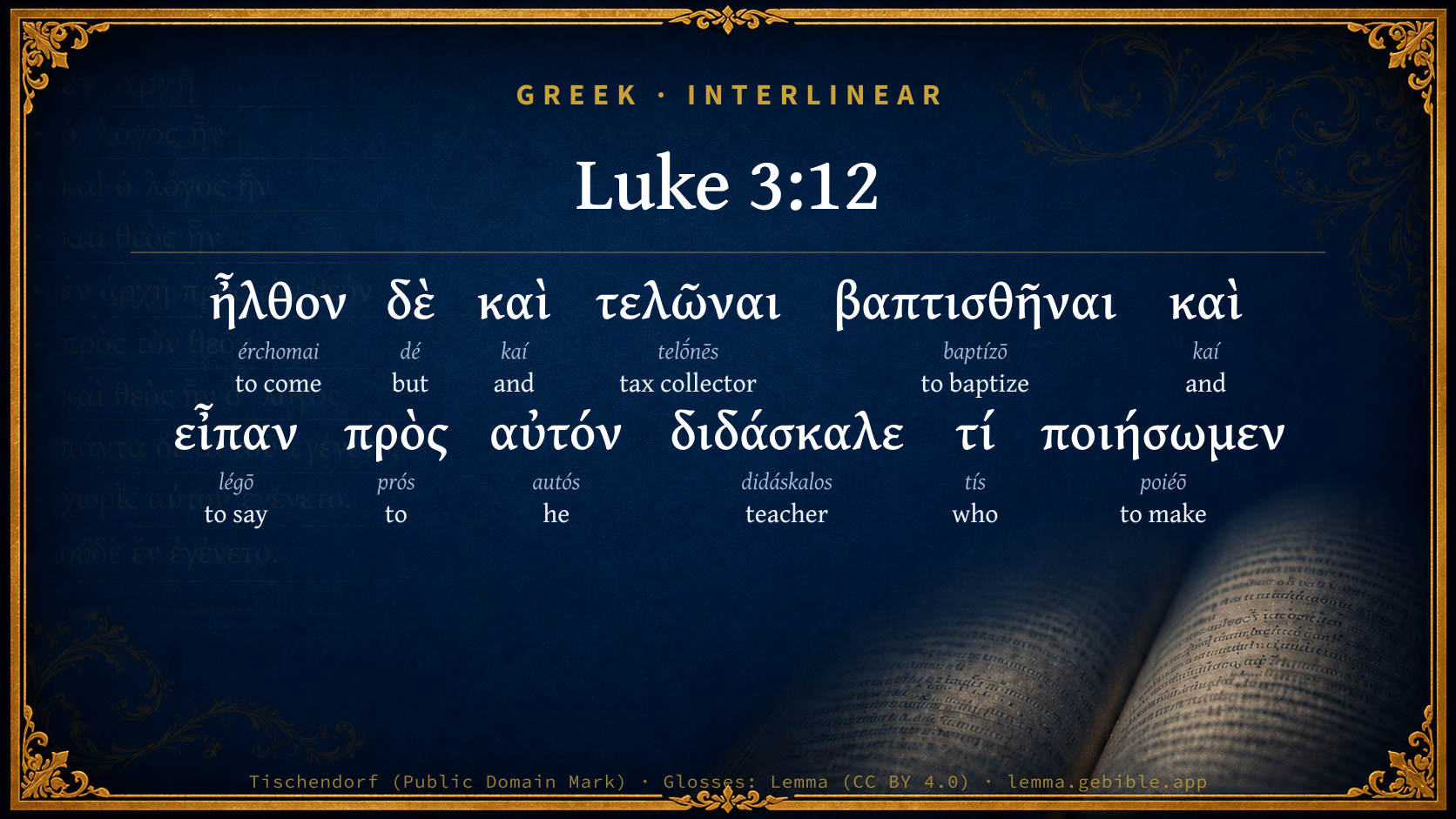
  1. ἦλθον érchomai G2064 “to come” Verb, Aorist, Active, Indicative, 3rd person, Plural
  2. δὲ dé G1161 “but” Conjunction
  3. καὶ kaí G2532 “and” Conjunction
  4. βαπτισθῆναι baptízō G907 “to baptize” Verb, Aorist, Passive, Infinitive
  5. καὶ kaí G2532 “and” Conjunction
  6. εἶπαν légō G3004 “to say” Verb, Aorist, Active, Indicative, 3rd person, Plural
  7. πρὸς prós G4314 “to” Preposition
  8. αὐτόν autós G846 “he” Personal pronoun, Accusative, Singular, Masculine
  9. διδάσκαλε didáskalos G1320 “teacher” Noun, Vocative, Singular, Masculine
  10. τί tís G5101 “who” Interrogative pronoun, Accusative, Singular, Neuter
  11. ποιήσωμεν poiéō G4160 “to make” Verb, Aorist, Active, Subjunctive, 1st person, Plural

About this verse

These counts appear in no published source. They are computed here, from the morphology-tagged text and Lemma’s own curated glosses. What Lemma adds →

12
words
11
distinct lemmas
Gospels
section

Notable vocabulary

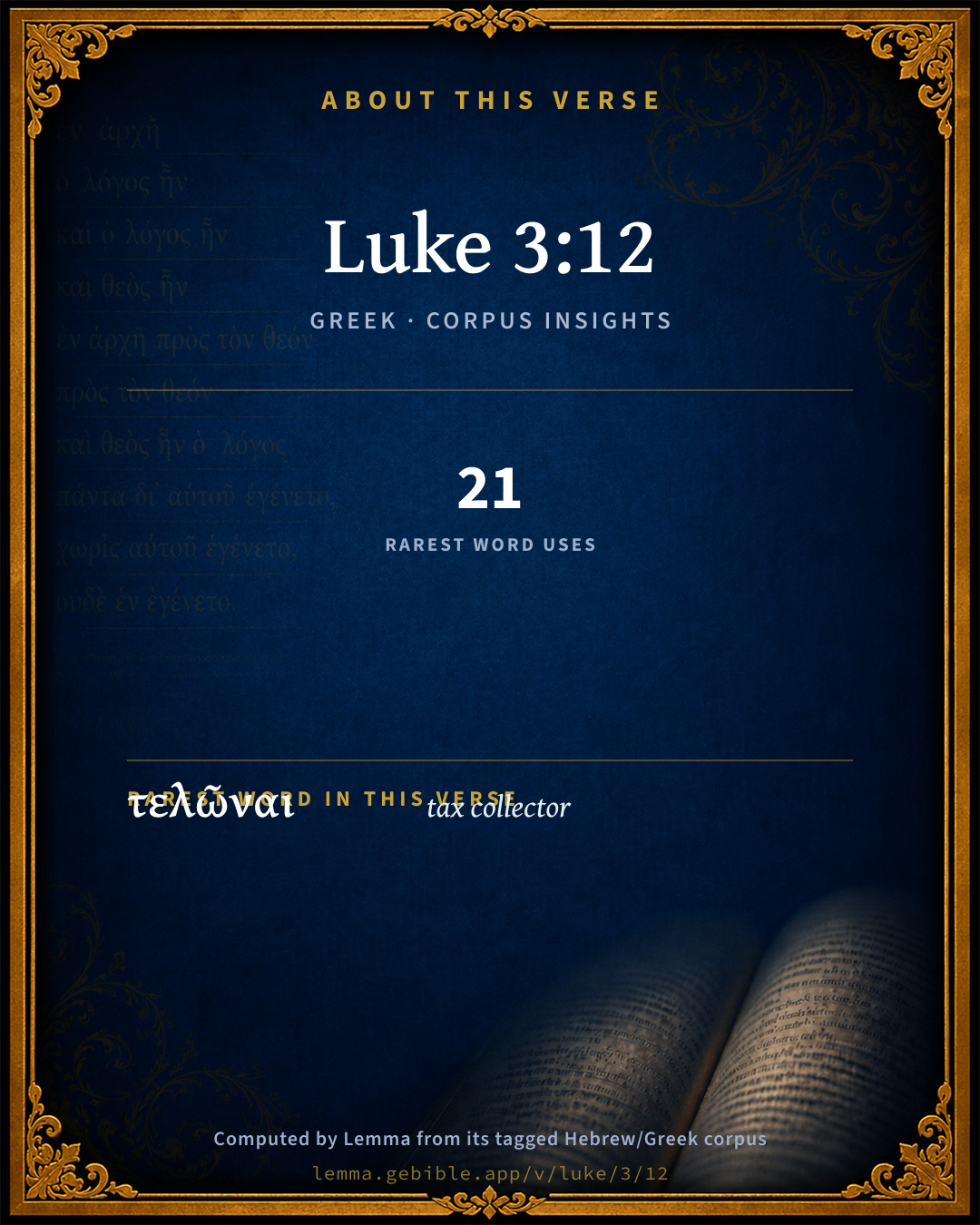
The rarest word here is τελῶναι tax collector G5057 — appearing just 21 times in the whole Greek New Testament.

Shared distinctive vocabulary

τελῶναι tax collector G5057 occurs in 20 verses of the Greek New Testament. Also found in:

Repetition

A word recurs within this verse:

Cross-references

4

Topical passages linked to Luke 3:12 in the Treasury of Scripture Knowledge — connected by theme and wording, ordered by reader-vote popularity; previews shown in the World English Bible.

  • Luke 7:29 When all the people and the tax collectors heard this, they declared God to be just, having been baptized with John's baptism.
  • Matthew 21:31–32 Which of the two did the will of his father?" They said to him, "The first." Jesus said to them, "Most assuredly I tell you that the tax collectors and the prostitutes are entering into the Kingdom of God before you.
  • Luke 15:1–2 Now all the tax collectors and sinners were coming close to him to hear him.
  • Luke 18:13 But the tax collector, standing far away, wouldn't even lift up his eyes to heaven, but beat his breast, saying, 'God, be merciful to me, a sinner!'

Cross-references courtesy of OpenBible.info (CC BY 4.0).

Commentary

Notes on Luke 3:12 from classic Christian and Jewish commentators (each source and its license shown beneath its notes). The classic Christian expositions comment on the surrounding passage and are grouped to its opening verse, so a note may address several verses; the Jewish commentaries on the Tanakh (Rashi and others) are per-verse, so they appear only where the commentator wrote on this verse.

Lemma curates 59 commentaries, every one of them public domain or Creative Commons licensed, each selected and text-cleaned for this edition rather than reprinted as found. About our sources →

Tyndale Open Study Notes

Tyndale Open Resources

3:12 corrupt tax collectors: The word for “corrupt” is not in the Greek, but it accurately expresses the connotation that “tax collector” had for first-century readers. They despised tax collectors, who were notoriously corrupt and worked for the hated Roman authorities.

Tyndale Open Study Notes — © Tyndale Open Resources, licensed CC BY-SA 4.0. Text via the HelloAO Bible API.

Bengel's Gnomon

Johann Albrecht Bengel

Luk 3:12. Διδάσκαλε, master) The publicans treat Him with greater reverence than any of the others.

Bengel's Gnomon of the New Testament — English translation (T&T Clark, Edinburgh, 1860) — public domain. Text from a community e-Sword module.

Meyer's Critical & Exegetical Commentary

Heinrich August Wilhelm Meyer

Luk_3:12-13. Τελῶναι] See on Mat_5:46.

παρὰ τὸ διατεταγμ. ὑμῖν] over and above what is prescribed to you (to demand in payment). See Winer, p. 215 [E. T. 300 f.]. The unrighteousness and the exactions of those who farmed the taxes are well known. See Paulus, Exeget. Handb. I. p. 353 f. On πράσσειν, to demand payment, to exact, see Blomfield, Gloss. ad Aesch. Pers. 482; Krüger, ad Xen. Anab. vii. 6. 17.

Meyer — Critical and Exegetical Commentary on the New Testament — English translation by Peter Christie, edited by Frederick Crombie (T&T Clark, 1880) — public domain. Text from a community e-Sword module.

Jamieson, Fausset & Brown

Robert Jamieson, A. R. Fausset & David Brown

publicans, &c. (Also see on Mat 3:10.)

Jamieson, Fausset & Brown — Commentary Critical and Explanatory on the Whole Bible (1871) — public domain (CC PDM 1.0). Text via the HelloAO Bible API.

Adam Clarke's Commentary

Verse 12. Then came also publicans] He next instructs the tax-gatherers in the proper discharge of their duty: though it was an office detested by the Jews at large, yet the Baptist does not condemn it. It is only the abuse of it that he speaks against. If taxes be necessary for the support of a state, there must be collectors of them; and the collector, if he properly discharge his duty, is not only a useful, but also a respectable officer. But it seems the Jewish tax-gatherers exacted much more from the people than government authorized them to do, Lu 3:13, and the surplus they pocketed. See the conduct of many of our surveyors and assessors. They are oppressors of the people, and enrich themselves by unjust surcharges. This, I am inclined to think, is too common an evil; and the executive government is often the people's scape-goat, to bear the crimes of its officers, crimes in which it has no concern. For an account of the publicans, See Clarke on Mt 5:46.

Adam Clarke's Commentary on the Bible (1810–1826) — public domain. Text from a community e-Sword/MySword module.

Ellicott's Commentary for English Readers

(12) Then came also publicans.—The other Gospels do not mention the presence of this class in their narratives of the Baptist’s work, but it is implied in Mat_21:32.

A Bible Commentary for English Readers, edited by Charles John Ellicott (1878–1897) — public domain. Text from a community e-Sword module.

The Cambridge Bible for Schools and Colleges

gen. ed. J. J. S. Perowne

12. the publicans] Rather, tax-gatherers (without the article). The word is a corruption of the Latin publicani ‘farmers of the taxes.’ The Roman government did not collect its own taxes, but leased them out to speculators of the equestrian order, who were called publicani, and who made their own profit out of the transaction. These knights appointed subordinates, who from the unpleasant character of the task could only be secured from the lowest of the people. These officials were not only detested as the agents of an odious system, but also for their notorious malpractices. A strict Jew could hardly force himself even to pay taxes, and therefore naturally looked with scorn and hatred on any Jew who could sink so low as to collect them. Hence in our Lord’s time the word “publican” had become proverbial, as expressive of the worst opprobrium (Mat_18:17). The Jews were not however peculiar in their dislike of publicans. The Greeks too regarded the word as a synonym of ‘plunderer,’ and an ‘innocent publican’ was regarded as a marvellous phenomenon (Suet. Vesp. i). Suidas defines the life of a publican as “unrestrained plunder, unblushing greed, unreasonable pettifogging, shameless business.” The relation of the publicans to John is referred to in Mat_21:32.

Master] Rather, Teacher. The word is not Epistata (as in Luk_8:24) but Didaskale. See Luk_7:29.

what shall we do?] We have the same question, but with the answer which was only possible after the Resurrection, in Act_2:37; Act_16:30; Act_22:10.

The Cambridge Bible for Schools and Colleges (gen. ed. J. J. S. Perowne; Cambridge University Press, 1878–1918) — public domain. Text from a community e-Sword module.

John Gill's Exposition

Then came also publicans to be baptized,.... Being convinced under John's ministry of the evils of their past life, and desirous of being admitted to baptism, to which they understood repentance, and fruits meet for the same, were pre-requisite: these came nearer to John,

and said unto him, master, what shall we do? we have been very wicked persons, what shall we do to escape divine vengeance? or what are the particular duties we are to perform? or the fruits meet for repentance, we are to bring forth; that so we may be admitted to the ordinance of baptism, which requires, as previous to it, a true and hearty repentance? of these men,

See Gill on Mat 5:46, Mat 9:9, Mat 9:10, Mat 9:11

John Gill's Exposition of the Whole Bible (1746–1763) — public domain (CC PDM 1.0). Text via the HelloAO Bible API.

Trapp's Complete Commentary

John Trapp

12 Then came also publicans to be baptized, and said unto him, Master, what shall we do?

Ver. 12. Then came also publicans] These were toll takers, custom gatherers for the Romans, and most of them greedy gripers. Publicans they were called, because they took up publica, the goods of the empire. {See Trapp on "Mat 9:9"}

John Trapp, A Commentary or Exposition upon All the Books of the Old and New Testament (1647–1656) — public domain. Text from a community e-Sword module.

Albert Barnes' Notes on the Bible

The publicans - See the notes at Mat 5:47. There is reason to think that the “publicans” or “tax-gatherers” were especially oppressive and hard in their dealings with the people; and that, as they had every opportunity of exacting more than they ought, so they often did it, and thus enriched themselves. The evidence of repentance in them would be to break off their sins in this respect, and to deal justly.

Albert Barnes' Notes on the Bible (1834–1885) — public domain. Text from a community e-Sword/MySword module.

Haydock's Catholic Bible Commentary

The Baptist exhorts worldlings to abstain from every species of fraud, that by first restraining all desires of the goods of others, they may at length come to communicate some of their own to their neighbours. (Ven. Bede)

George Leo Haydock (1774–1849), Haydock's Catholic Family Bible and Commentary, 1859 edition — public domain. Excludes Psalms (Douay-Rheims chapter numbering differs from Protestant) and Deuterocanonical books (Catholic canon only).

Matthew Poole's English Annotations

We have showed often before that the publicans were men that collected the public revenue. In all times that sort of men have been charged with exactions of what was more than their due. The Baptist, as a fruit or indication of the truth of their repentance, cautions them against exaction, thereby declaring, that acts of justice as well as mercy are true fruits of repentance, and that repentance is vainly pretended while men go on in the same sinful courses wherein they have formerly walked. Our Lord here doth not disapprove of the office of publicans, nor certainly was that to be condemned: if magistrates may impose taxes and payments, which without question they may, for the support of the government for our protection, there is no question but they may appoint officers under what titles they please to collect it. But both those that impose and those that collect such payments are obliged to the rule of justice; the former, to impose no more than is necessary for the end, and in a just proportion; the others, to exact no more than what is appointed them.

Matthew Poole's English Annotations on the Holy Bible (1683–1685) — public domain. Text from a community e-Sword/MySword module.

The Pulpit Commentary

Then came also publicans to be baptized, and said unto him, Master, what shall we do? This is the first time this class of men, who on several occasions come before us in the gospel story, is mentioned. The English rendering is most unhappy, for to many of our people it either suggests nothing, or else supplies a wrong chain of reasoning. The telwnai , the Latin publicani (whence our rendering), were men who collected the Roman taxes or imposts. These imperial taxes, the most painful and ever-present reminder to the Jew of his subject and dependent position, were in the first instance leased out to jobbers and speculators of the equestrian order; these were properly the publicani. Beneath them and in their employ were a numerous staff who performed for these farmers of the imperial revenue the various disagreeable duties connected with the collection of the taxes. Then, as now in the East, bribery, corruption, oppression, and unfair dealing, were too common among all ranks of officials First, then, the duty itself, the being concerned in the collection of a tribute for that is what these taxes really were for Gentile Rome, and, secondly, the various iniquities connected with the gathering of this tribute, made the tax or tribute collectors of all ranks odious among the Jews dwelling in Palestine. Many of the posts, especially the subordinate ones, in this department of tribute and taxes, were held by Jews, in all ages singularly gifted in matters which have to do with finance. The Jew, however in the days of John the Baptist, who could stoop to such an employment, lucrative though it might be, was looked upon by his stricter fellow-countrymen with feelings of intense scorn. Yet even these men are not bidden by this inspired prophet of the Highest to change their way of life, but only its manner. "Would you," he says to these men who belonged to the hated calling, "indeed wash and be clean in the eyes of the All-Seeing? then in that profession of yours, remember, be scrupulous, be honest."

The Pulpit Commentary (1880–1919), ed. H.D.M. Spence-Jones & Joseph S. Exell — public domain. Text from a community e-Sword module.

Burkitt's Expository Notes on the New Testament

William Burkitt

The publicans were persons employed by the Romans to gather the tax of tribute among the Jews, who were now tributaries to the Romans, and paid them a public revenue. These publicans were great oppressors, exacting more than was the emperor’s due. Therefore we find the publicans and sinners so often joined together in the gospel. These men enquiring what fruits of repentance they should bring forth, St. John directs them to acts of justice: Exact not.

Where note, 1. That acts of justice and righteousness, as well as of charity and mercy, are real fruits of sincere repentance.

Observe, 2. John doth not condemn the office, but cautions the officer. If magistrates may impose taxes, they may doubtless appoint officers to collect those taxes. Christian charity then must always teach us to distinguish betwixt the calling and the crime. We must not censure any office, either in church or state, for the sake of their mal-administration who are employed in that office.

William Burkitt's Expository Notes on the New Testament (1700–1703) — public domain. Text from a community e-Sword module.

The People's New Testament

B. W. Johnson

12. Publicans. The gatherers of the Roman tax.

B. W. Johnson's The People's New Testament with Notes (1889–1891) — public domain. Electronic text from the Christian Classics Ethereal Library (CCEL) ThML edition.

unfoldingWord translationNotes

Door43 World Missions Community

to be baptized

This can be stated in active form. AT: "for John to baptize them" (See: Active or Passive)

Do not collect more money

"Do not ask for more money" or "Do not demand more money." Tax collectors had been collecting more money than they should have been collecting. John tells them to stop doing that.

than you have been ordered to collect

This is passive to show that the tax collector's authority comes from Rome. AT: "than what the Romans have authorized you to take" (See: Active or Passive)

translationWords

tax

baptize

teacher

unfoldingWord translationNotes — © Distant Shores Media and the Door43 World Missions Community, licensed CC BY-SA 4.0. Source: git.door43.org/Door43/en_tn.

Cambridge Greek Testament for Schools and Colleges

10, 12, 14. ποιήσωμεν is better supported than ποιήσομεν. Gr[70] La[71] Ti[72]

[70] Gr. Griesbach.

[71] La. Lachmann.

[72] Ti. Tischendorf.

12. τελῶναι, ‘tax-gatherers’ (without the article). The English word ‘publican’ is a corruption of the Latin publicani ‘farmers of the taxes.’ The Roman government did not collect its own taxes, but leased them out to speculators of the equestrian order, who were called publicani, and who made their own profit out of the transaction. These knights appointed subordinates, who from the unpleasant character of the task could only be secured from the lowest of the people. These officials were not only detested as the agents of an odious system, but also for their notorious malpractices. It is true that by an edict of Gaius (Caligula) the Jews were allowed, as perhaps they were allowed even at this earlier date, to pay a regular tribute which was not farmed out to the equestrian publicani (Jos. Antt. XIV. 10, § 5). But even then the actual collection of the tax had to be entrusted to underlings (see Wieseler, Beiträge, p. 78). A strict Jew could hardly force himself even to pay taxes, and therefore naturally looked with scorn and hatred on any Jew who could sink so low as to collect them. Hence in our Lord’s time the word “publican” had become proverbial, as expressive of the worst opprobrium (Mat 18:17). The Jews were not however peculiar in their dislike of publicans. The Greeks too regarded the word as a synonym of ‘plunderer,’ and an ‘innocent publican’ was looked upon as a marvellous phenomenon (Suet. Vesp. I.). Suidas defines the life of a publican as “unrestrained plunder, unblushing greed, unreasonable pettifogging, shameless business.” The relation of the publicans to John is referred to in Mat 21:32. See Luk 7:29.

διδάσκαλε, teacher. In Luk 8:24 we have Ἐπιστάτα, Master.

τί ποιήσωμεν; See Luk 3:10. We have the same question, but with the answer which was only possible after the Resurrection, in Act 2:37; Act 16:30; Act 22:10.

Cambridge Greek Testament for Schools and Colleges (Cambridge University Press, 1896; 21 vols, various authors incl. Carr, Maclear, Plummer, Farrar, Lumby, Moule, M. R. James, Simcox) — public domain. Text from a community e-Sword module.

Alford’s Greek Testament

Henry Alford

12. τελῶναι] See on Mat 5:46.

Henry Alford, The Greek Testament (1849–1861) — public domain. Text from a community e-Sword module.

International Critical Commentary

12. τελῶναι. From τέλη (Mat 17:25; Rom 13:7) and ὠνέομαι; so that etymologically τελῶναι = publicani, “those who bought or farmed the taxes” under the Roman government. But in usage τελῶναι = portitores, “those who collected the taxes” for the publicani. This usage is common elsewhere, and invariable in N.T. Sometimes, and perhaps often, there was an intermediate agent between the τελῶναι and the publicani, e.g. ἀρχιτελώνης or magister (19:2).

These “tax-collectors” were detested everywhere, because of their oppressiveness and fraud, and were classed with the vilest of mankind: μοιχοὶ καὶ πορνοβοσκοὶ καὶ τελῶναι καὶ κόλακες καὶ συκοφάνται, καὶ τοιοῦτος ὅμιλος τῶν πάντα κυκώντων ἐν τῷ βίῳ (Lucian. Necyomant. xi.; comp. Aristoph. Equit. 248; Theophr. Charac. vi.; Grotius, in loco; Wetst. on Mt. v. 46). The Jews especially abhorred them as bloodsuckers for a heathen conqueror. For a Jew to enter such a service was the most utter degradation. He was excommunicated, and his whole was regarded as disgraced. But the Romans allowed the Herods to retain some powers of taxation; and therefore not all tax-collectors in Palestine were in the service of Rome. Yet the characteristic faults of the profession prevailed, whether the money was collected in the name of Cæsar or of Herod; and what these were is indicated by the Baptist’s answer. See Lightfoot, Opera, i. pp. 324, 325; Herzog, Pro_2 art. Zoll; Edersh. L. & T. 1. p. 515.

International Critical Commentary — older volumes (1896–1929), various authors — public domain. Text from a community e-Sword module.

Vincent's Word Studies in the New Testament

Marvin R. Vincent

Publicans [τελωναι] . From telov, a tax, and wjneomai, to buy. The collectors of Roman imposts. The Romans farmed out the direct taxes and customs duties to capitalists, on their payment of a certain sum in publicum, into the public treasury, whence they were called publicani, publicans. Sometimes this sum, being greater than any one person could pay, was paid by a company. Under these were the submagistri, living in the provinces; and under these again the portitores, or actual custom house officers, who are referred to by the term telwnai in the New Testament. They were often chosen from the dregs of the people, and wee so notorious for their extortions that they were habitually included in the same category with harlots and sinners. "If a Jew could scarcely persuade himself that it was right to pay taxes, how much more heinous a crime must it have been in his eyes to become the questionably honest instrument for collecting them. If a publican was hated, how still more intense must have been the disgust entertained against a publican who was also a Jew" (Farrar, "Life of Christ "). The word" publican, "as a popular term of reproach, was used even by our Lord (Mt 18:17). Even the Gentiles despised them. Farrar cites a Greek saying," All publicans are robbers. "

Marvin R. Vincent, Word Studies in the New Testament (1887–1900) — public domain. Text from a community e-Sword/MySword module.

Lesson kit

Teaching starters — assembled from the data on this page, not authored interpretation. Every prompt links to the verse data it draws on. Edit before teaching.

Luke, in the Gospels, opens this verse with 12 words (11 distinct Greek lemmas). Its most distinctive word is telṓnēs (“tax collector”). A historical commentator’s framing appears above. Read the whole chapter for the surrounding context.

Discussion questions

  1. How does “tax collector” (telṓnēs) shape what this verse is saying?
  2. How does Matthew 5:46, which shares the word «tax collector», read alongside this verse?
  3. What does the repetition of “and” (2× in this one verse) do in this verse?
  4. These translations render this verse differently; the difference is in the English rendering, not the original. What questions does that raise?
  5. Compare how Tyndale Open Study Notes and Bengel's Gnomon read this verse. Where do they agree or differ?

Things to notice

Reading settings

Reading text

Shown beneath each verse's original-language words.

Old Testament
Old Testament edition

Read the OT as the Masoretic Hebrew (MT) or the Greek Septuagint (LXX).

English shown for the Greek Septuagint (in the Hebrew ↔ Greek comparison).

Comparing translations? Open the Compare panel on any verse page to stack up to four side by side.