
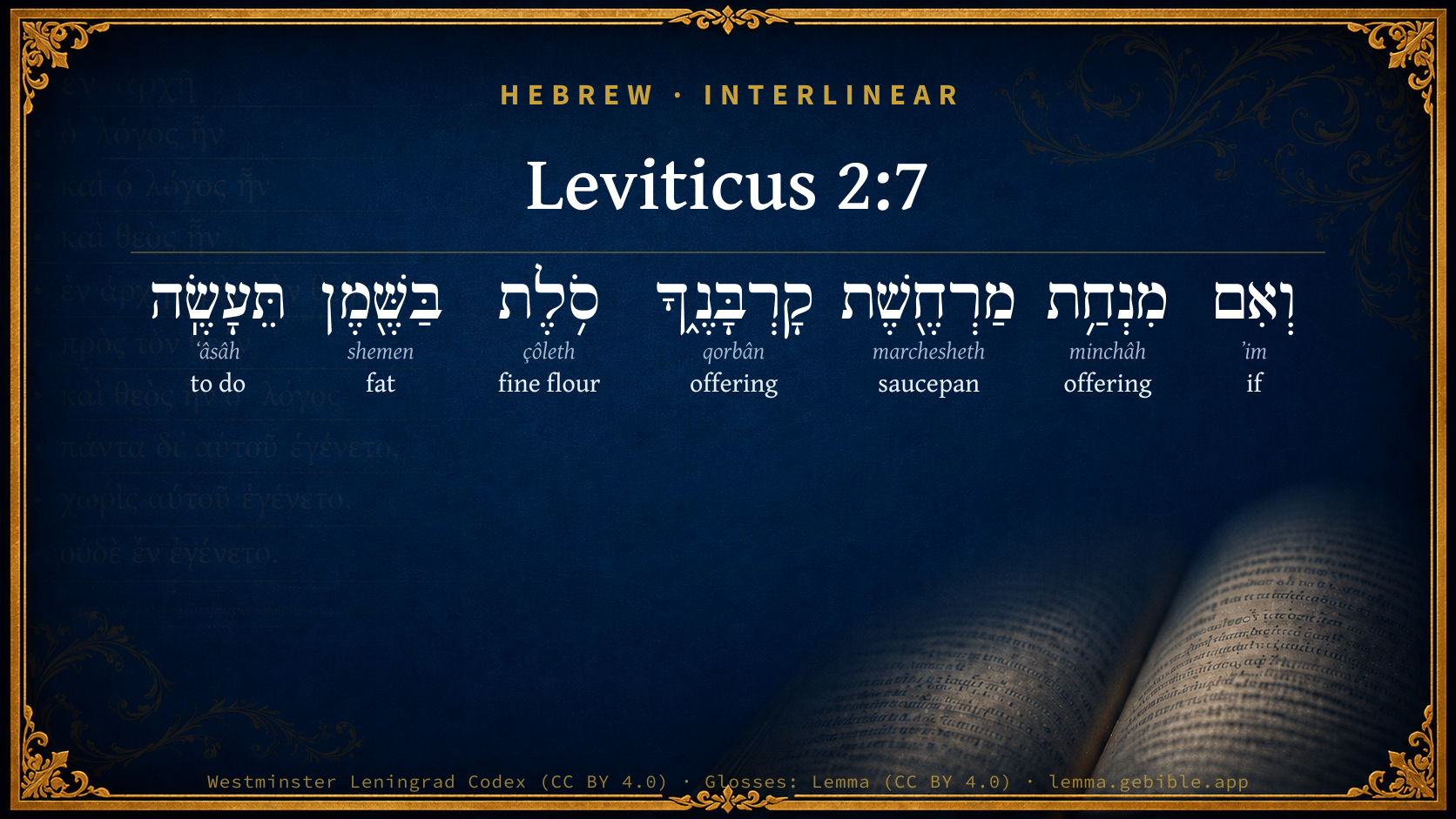
Leviticus 2:7

Hebrew (Westminster Leningrad Codex) Leviticus 2:7 appears in the Hebrew Old Testament. The text above is from the Westminster Leningrad Codex. Each word links to its Strong’s number, a concise gloss, and parsing drawn from the Open Scriptures Hebrew Bible morphology. Click any word for its full Brown-Driver-Briggs (BDB) entry.
Download image
Cite this verse

Leviticus 2:7 (World English Bible). Public Domain. Lemma interlinear Bible study tool, https://lemma.gebible.app/v/leviticus/2/7.

Show BibTeX & RIS
BibTeX
RIS
English Translation
If your offering is a meal offering of the frying pan, it shall be made of fine flour with oil.
World English Bible · Public Domain
Highlights
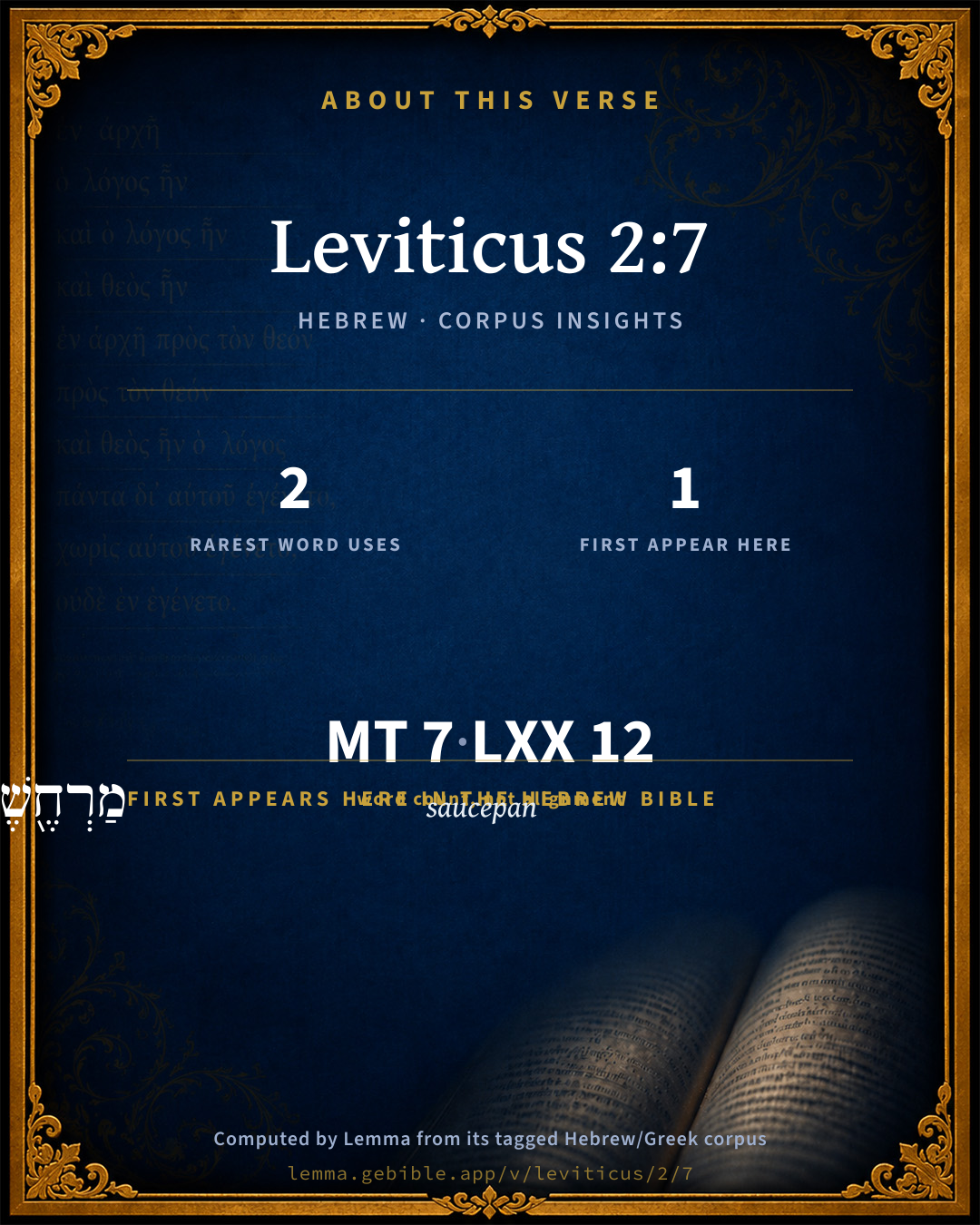
  • 1 first appearance in the Hebrew Bible
Full analysis ↓
Download a study sheet

One document with this verse’s original text, its word-by-word gloss line, the meaning frame, cross-references with their text, attributed commentary, and full source and license credits — printable, and it pastes into notes with its structure intact.

This verse Autodidact and up

Study sheet (.html) Plain text (.txt)

A passage Seminary Student

Up to 50 verses in one chapter. A passage sheet keeps up to 6 commentary sources and 12 cross-references per verse, in the order this page ranks them, and says so on the sheet whenever that leaves anything out. Ask for a single verse and you get the Autodidact verse sheet above.

Everything on this page stays free to read, with no account — the sheet is a download of what is already on screen, not access to it.

Want to remove ads? Support Godless Engineer
Compare translations 3

The same verse in 3 English versions, stacked beneath the original-language interlinear above. Click any original word for its lexicon entry.

Each is an independent rendering of the whole verse — the interlinear is not word-aligned to these translations.

Highlighted words mark where these versions differ — a whole-verse word diff, not a word-by-word alignment.

  • World English Bible Public Domain
    If your offering is a meal offering of the frying pan, it shall be made of fine flour with oil.
  • King James Version Public Domain
    And if thy oblation be a meat offering baked in the frying pan, it shall be made of fine flour with oil.
  • unfoldingWord Literal Text CC BY-SA 4.0
    And if your offering is a grain offering of a pan, flour shall be made with oil.

unfoldingWord Literal Text — © unfoldingWord, licensed CC BY-SA 4.0. Word-aligned USFM3 via Door43 (git.door43.org/unfoldingWord/en_ult).

Versions to compare (up to 4)

3 of 4 selected

Show all 18 translations

Every available English version of this verse, each an independent rendering of the whole verse.

  • World English Bible Public Domain
    If your offering is a meal offering of the frying pan, it shall be made of fine flour with oil.
  • Berean Standard Bible Public Domain
    If your offering is a grain offering cooked in a pan, it must consist of fine flour with oil.
  • Majority Standard Bible Public Domain
    If your offering is a grain offering cooked in a pan, it must consist of fine flour with oil.
  • King James Version Public Domain
    And if thy oblation be a meat offering baked in the frying pan, it shall be made of fine flour with oil.
  • American Standard Version (1901) Public Domain
    And if thy oblation be a meal-offering of the frying-pan, it shall be made of fine flour with oil.
  • Revised Version (1885) Public Domain
    And if thy oblation be a meal offering of the frying pan, it shall be made of fine flour with oil.
  • Geneva Bible (1599) Public Domain
    And if thy meate offring be an oblation made in the caldron, it shalbe made of fine floure with oyle.
  • Douay-Rheims (1899) Public Domain
    And if the sacrifice be from the gridiron, in like manner the flour shall be tempered with oil:
  • Young's Literal Translation Public Domain
    `And if thine offering `is' a present `made' on the frying-pan, of flour with oil it is made,
  • Literal Standard Version CC BY-SA 4.0
    And if your offering [is] a present [made] on the frying-pan, it is made of flour with oil,
  • Unlocked Literal Bible CC BY-SA 4.0
    If your grain offering is cooked in a pan, it must be made with fine flour and oil.
  • unfoldingWord Literal Text CC BY-SA 4.0
    And if your offering is a grain offering of a pan, flour shall be made with oil.
  • Darby Bible Public Domain
    And if thine offering be an oblation [prepared] in the cauldron, it shall be made of fine flour with oil.
  • World Messianic Bible Public Domain
    If your offering is a meal offering of the pan, it shall be made of fine flour with oil.
  • Webster's Bible Public Domain
    And if thy oblation shall be a meat-offering baked in the frying-pan, it shall be made of fine flour with oil.
  • Free Bible Version CC BY-SA 4.0
    If your offering is a grain offering cooked in a pan, it must be made of fine flour with olive oil.
  • Bible in Basic English Public Domain
    And if your offering is of meal cooked in fat over the fire, let it be made of the best meal mixed with oil.
  • JPS Tanakh (1917) Public Domain
    And if thy offering be a meal-offering of the stewing-pan, it shall be made of fine flour with oil.

Literal Standard Version (2020), Covenant Press — licensed CC BY-SA 4.0. Text via the HelloAO Bible API (eBible.org). Unlocked Literal Bible (unfoldingWord) — licensed CC BY-SA 4.0. Text via the HelloAO Bible API (eBible.org). unfoldingWord Literal Text — © unfoldingWord, licensed CC BY-SA 4.0. Word-aligned USFM3 via Door43 (git.door43.org/unfoldingWord/en_ult). Free Bible Version, Dr. Jonathan Gallagher — licensed CC BY-SA 4.0. Text via the HelloAO Bible API (eBible.org).

Word by word

More ways to search: Search by grammar → Find every occurrence → Compare this word →

Practice this passage: Drill this verse → Learn its vocabulary →

About this verse

These counts appear in no published source. They are computed here, from the morphology-tagged text and Lemma’s own curated glosses. What Lemma adds →

7
words
7
distinct lemmas
Pentateuch
section

Notable vocabulary

The rarest word here is מַרְחֶ֖שֶׁת saucepan H4802 — appearing just 2 times in the whole Hebrew Bible.

First appearance in Scripture

This word makes its first canonical appearance in the Hebrew Bible here:

  • מַרְחֶ֖שֶׁת saucepan H4802

Shared distinctive vocabulary

מַרְחֶ֖שֶׁת saucepan H4802 occurs in 2 verses of the Hebrew Bible. Also found in:

Grammatical profile

  • 1 verb
  • 5 nouns
  • 1 conjunction

Verb forms

  • תֵּעָשֶֽׂה Niphal · Imperfect

Hebrew & Septuagint length

In English translation the verse runs 20 words from the Hebrew and 19 from the Septuagint (LXX English) — closely comparable.

A rough comparison of the two English renderings, which tokenize alike — not a word-level alignment.

Word counts can differ between the Hebrew and the Greek without any difference in meaning — e.g. the Hebrew direct-object marker אֵת has no separate Greek word, and Greek often adds the article ὁ.

In the original languages it is 7 Hebrew tokens and 12 Greek tokens — but the two are counted differently (Hebrew bundles its prefixes and suffixes into one token; the Greek is in lemma form), so that isn’t a like-for-like length.

Cross-references

2

Topical passages linked to Leviticus 2:7 in the Treasury of Scripture Knowledge — connected by theme and wording, ordered by reader-vote popularity; previews shown in the World English Bible.

  • Leviticus 2:1–2 "'When anyone offers an offering of a meal offering to Yahweh, his offering shall be of fine flour; and he shall pour oil on it, and put frankincense on it.
  • Leviticus 7:9 Every meal offering that is baked in the oven, and all that is dressed in the frying pan, and on the baking pan, shall be the priest's who offers it.

Cross-references courtesy of OpenBible.info (CC BY 4.0).

Hebrew and Greek witnesses Masoretic Hebrew ↔ Greek Septuagint

The same verse in the two great witnesses to the Old Testament, shown verse-for-verse.

These are two independent witnesses, not word-aligned to each other, and the Septuagint is shown in lemma (dictionary) form.

Hebrew Leviticus 2:7 Masoretic · Westminster Leningrad Codex

וְאִם מִנְחַ֥ת מַרְחֶ֖שֶׁת קָרְבָּנֶ֑ךָ סֹ֥לֶת בַּשֶּׁ֖מֶן תֵּעָשֶֽׂה

If your offering is a meal offering of the frying pan, it shall be made of fine flour with oil.

World English Bible · Public Domain

Greek LXX Leviticus 2:7 Septuagint · lemma form

ἐάν δέ θυσία ἀπό ἐσχάρα ὁ δῶρον σύ σεμίδαλις ἐν ἔλαιον ποιέω

And if your gift be a sacrifice from the hearth, it shall be made of fine flour with oil.

LXX2012 (modern English Septuagint) · Public Domain

On this verse, Adam Clarke's Commentary discusses the Septuagint’s reading. Read the note in Commentary ↓

Hebrew: Westminster Leningrad Codex (CC BY 4.0). Greek: Septuagint (public domain); English from LXX2012 (modern English Septuagint) (Public Domain). How the Septuagint differs from the Hebrew →

Targum (Aramaic paraphrase)

2

The Targum is the ancient Jewish Aramaic paraphrase of the Hebrew Scriptures — an interpretive translation, not the Hebrew text itself. Onkelos (literal) and Pseudo-Jonathan (expansive) render the Torah, and Jonathan the Prophets. Coverage is partial: where no permissively-licensed English translation exists for a verse, only the Aramaic is shown. This is verse-level text, not a word-by-word alignment to the Hebrew. Some Onkelos verses here show an unreviewed machine translation (clearly flagged), not a published edition.

  1. Targum Onkelos Torah (Genesis–Deuteronomy)
    וְאִם מִנְחָתָא דְרַדְתָּא קוּרְבָּנָךְ סוּלְתָּא בִּמְשַׁח תִּתְעֲבֵד

    Unreviewed machine translation (Claude Sonnet 5) — not public domain confidence: high

    And if your offering is a meal-offering of the pan, it shall be made of fine flour with oil.

    Generated by an AI translate-then-audit pipeline and checked against an independent public-domain English translation of the underlying Hebrew for drift only. Not a published edition; pending human review.

    Aramaic base: public-domain Targum Onkelos (via Sefaria). The English above is the unreviewed machine translation, not public domain.

  2. Targum Pseudo-Jonathan Torah (Genesis–Deuteronomy)
    וְאִין מִנְחַת מַרְתְּחָא קָרְבָּנָךְ סְמִידָא רְתַח בִּמְשַׁח תִּתְעֲבֵיד

    And if thy oblation be a mincha from the gridiron, it shall be made of flour broiled with oil.

    Targum Pseudo-Jonathan — Aramaic: “Targum Jonathan on Genesis” (public domain); “Targum Jonathan on Exodus” (public domain); “Targum Jonathan on Leviticus” (public domain); “Targum Jonathan on Numbers” (public domain); “Targum Jonathan on Deuteronomy” (public domain). English: “The Targum of Jonathan ben Uzziel, trans. J. W. Etheridge, London, 1862” (public domain). Text via Sefaria.

Commentary

Notes on Leviticus 2:7 from classic Christian and Jewish commentators (each source and its license shown beneath its notes). The classic Christian expositions comment on the surrounding passage and are grouped to its opening verse, so a note may address several verses; the Jewish commentaries on the Tanakh (Rashi and others) are per-verse, so they appear only where the commentator wrote on this verse.

Lemma curates 59 commentaries, every one of them public domain or Creative Commons licensed, each selected and text-cleaned for this edition rather than reprinted as found. About our sources →

Trapp's Complete Commentary

John Trapp

Lev 2:7 And if thy oblation [be] a meat offering [baken] in the fryingpan, it shall be made [of] fine flour with oil.

Ver. 7. Baken in the frying pan.] So, My heart is frying of a good matter, saith David. {Psa 45:1}

John Trapp, A Commentary or Exposition upon All the Books of the Old and New Testament (1647–1656) — public domain. Text from a community e-Sword module.

Whedon's Commentary on the Bible

Daniel D. Whedon

7. Fryingpan — The Hebrew word is found in only one other place in the Bible, Lev_7:9. Gesenius and Furst define it as a kettle for boiling. Others think that it is still to be found among the Bedouins in the form of a shallow earthen vessel called a tajen, a word which sounds much like the τηγανον of the Seventy, the pan of Lev_2:5. Maimonides suggests that the translation of these two utensils in Lev_2:7; Lev_2:5 should be reversed.

Daniel D. Whedon (gen. ed.), Commentary on the Old and New Testaments (1874–1909) — public domain. Text from a community e-Sword module.

Tyndale Open Study Notes

Tyndale Open Resources

2:7 Dough prepared in a pan was fried with oil until crisp.

Tyndale Open Study Notes — © Tyndale Open Resources, licensed CC BY-SA 4.0. Text via the HelloAO Bible API.

Adam Clarke's Commentary

Verse 7. The frying-pan] מרחשת marchesheth, supposed to be the same with that called by the Arabs a ta-jen, a shallow earthen vessel like a frying-pan, used not only to fry in, but for other purposes. On the different instruments, as well as the manner of baking in the east, Mr. Harmer, in his observations on select passages of Scripture, has collected the following curious information.

"Dr. Shaw informs us that in the cities and villages of Barbary, there are public ovens, but that among the Bedouins, who live in tents, and the Kabyles, who live in miserable hovels in the mountains, their bread, made into thin cakes, is baked either immediately upon the coals, or else in a ta-jen, which he tells us is a shallow earthen vessel like a frying-pan: and then cites the Septuagint to show that the supposed pan, mentioned Le 2:5, was the same thing as a ta-jen. The ta-jen, according to Dr. Russel, is exactly the same among the Bedouins as the ρηγανον, a word of the same sound as well as meaning, was among the Greeks. So the Septuagint, Le 2:5: if thy oblation be a meat-offering, baken in a pan, (απο τηγανου), it shall be of fine flour unleavened, mingled with oil.

"This account given by the doctor is curious; but as it does not give us all the eastern ways of baking, so neither does it furnish us, I am afraid, with a complete comment on that variety of methods of preparing the meat-offerings which is mentioned by Moses in Le 2:1-16. So long ago as Queen Elizabeth's time, Rauwolff observed that travellers frequently baked bread in the deserts of Arabia on the ground, heated for that purpose by fire, covering their cakes of bread with ashes and coals, and turning them several times until they were baked enough; but that some of the Arabians had in their tents, stones, or copper plates, made on purpose for baking. Dr. Pococke very lately made a like observation, speaking of iron hearths used for baking their bread.

"Sir John Chardin, mentioning the several ways of baking their bread in the east, describes these iron plates as small and convex. These plates are most commonly used, he tells us, in Persia, and among the wandering people that dwell in tents, as being the easiest way of baking, and done with the least expense; the bread being as thin as a skin, and soon prepared. Another way (for he mentions four) is by baking on the hearth. That bread is about an inch thick; they make no other all along the Black Sea from the Palus Maeotis to the Caspian Sea, in Chaldea, and in Mesopotamia, except in towns. This, he supposes, is owing to their being woody countries. These people make a fire in the middle of a room; when the bread is ready for baking they sweep a corner of the hearth, lay the bread there, and cover it with hot ashes and embers; in a quarter of an hour they turn it: this bread is very good. The third way is that which is common among us. The last way, and that which is common through all Asia, is thus: they make an oven in the ground, four or five feet deep and three in diameter, well plastered with mortar. When it is hot, they place the bread (which is commonly long, and not thicker than a finger) against the sides, and it is baked in a moment.

"D'Arvieux mentions another way used by the Arabs about Mount Carmel, who sometimes bake in an oven, and at other time on the hearth; but have a third method, which is, to make a fire in a great stone pitcher and when it is heated, they mix meal and water, as we do to make paste to glue things together, which they apply with the hollow of their hands to the outside of the pitcher, and this extremely soft paste spreading itself upon it is baked in an instant. The heat of the pitcher having dried up all the moisture, the bread comes off as thin as our wafers; and the operation is so speedily performed that in a very little time a sufficient quantity is made.

"Maimonides and the Septuagint differ in their explanation of Le 2:5; for that Egyptian rabbi supposes this verse speaks of a fiat plate, and these more ancient interpreters, of a ta-jen. But they both seem to agree that these were two of the methods of preparing the meat-offering; for Maimonides supposes the seventh verse speaks of a frying-pan or ta-jen; whereas the Septuagint, on the contrary, thought the word there meant a hearth, which term takes in an iron or copper plate, though it extends farther.

"The meat-offerings of the fourth verse answer as well to the Arab bread, baked by means of their stone pitchers, which are used by them for the baking of wafers, as to their cakes of bread mentioned by D'Arvieux, who, describing the way of baking among the modern Arabs, after mentioning some of their methods, says they bake their best sort of bread, either by heating an oven, or a large pitcher, half full of certain little smooth shining flints, upon which they lay the dough, spread out in form of a thin broad cake. The mention of wafers seems to fix the meaning of Moses to these oven pitchers, though perhaps it may be thought an objection that this meat-offering is said to have been baked in an oven; but it will be sufficient to observe that the Hebrew words only signify a meat-offering of the oven, and consequently may be understood as well of wafers baked on the outside of these oven pitchers, as of cakes of bread baked in them. And if thou bring an oblation, a baked thing, of the oven, it shall be an unleavened cake of fine flour mingled with oil, or unleavened wafers anointed with oil. Whoever then attends to these accounts of the stone pitcher, the ta-jen, and the copper plate or iron hearth, will enter into this second of Leviticus, I believe, much more perfectly than any commentator has done, and will find in these accounts what answers perfectly well to the description Moses gives us of the different ways of preparing the meat-offerings. A ta-jen indeed, according to Dr. Shaw, serves for a frying-pan as well as for a baking vessel; for he says, the bagreah of the people of Barbary differs not much from our pancakes, only that, instead of rubbing the ta-jen or pan in which they fry them with butter, they rub it with soap, to make them like a honeycomb.

"Moses possibly intended a meat-offering of that kind might be presented to the Lord; and our translators seem to prefer that supposition, since, though the margin mentions the opinion of Maimonides, the reading of the text in the sixth verse opposes a pan for baking to a pan for frying in the seventeenth verse. The thought, however, of Maimonides seems to be most just, as Moses appears to be speaking of different kinds of bread only, not of other farinaceous preparations.

"These oven pitchers mentioned by D'Arvieux, and used by the modern Arabs for baking cakes of bread in them, and wafers on their outsides, are not the only portable ovens of the east. St. Jerome, in his commentary on La 5:10, describes an eastern oven as a round vessel of brass, blackened on the outside by the surrounding fire which heats it within. Such an oven I have seen used in England. Which of these the Mishnah refers to when it speaks of the women lending their ovens to one another, as well as their mills and their sieves, I do not know; but the foregoing observations may serve to remove a surprise that this circumstance may otherwise occasion in the reader of the Mishnah. Almost every body knows that little portable handmills are extremely common in the Levant; movable ovens are not so well known. Whether ovens of the kind which St. Jerome mentions be as ancient as the days of Moses, does not appear, unless the ta-jen be used after this manner; but the pitcher ovens of the Arabs are, without doubt, of that remote antiquity.

"Travellers agree that the eastern bread is made in small thin moist cakes, must be eaten new, and is good for nothing when kept longer than a day. This, however, admits of exceptions. Dr. Russel of late, and Rauwolff formerly, assure us that they have several sorts of bread and cakes: some, Rauwolff tells us, done with yolk of eggs; some mixed with several sorts of seed, as of sesamum, Romish coriander, and wild garden saffron, which are also stewed upon it; and he elsewhere supposes that they prepare biscuits for travelling. Russel, who mentions this stewing of seeds on their cakes says, they have a variety of rusks and biscuits. To these authors let me add Pitts, who tells us the biscuits they carry with them from Egypt will last them to Mecca and back again.

"The Scriptures suppose their loaves of bread were very small, three of them being requisite for the entertainment of a single person, Lu 11:5. That they were generally eaten new, and baked as they wanted them, as appears from the case of Abraham. That sometimes, however, they were made so as to keep several days; so the shew-bread was fit food, after lying before the Lord a week. And that bread for travellers was wont to be made to keep some time, as appears from the pretences of the Gibeonites, Jos 9:12, and the preparations made for Jacob's journey into Egypt, Ge 45:23. The bread or rusks for travelling is often made in the form of large rings, and is moistened or soaked in water before it is used. In like manner, too, they seem to have had there a variety of eatables of this kind as the Aleppines now have. In particular, some made like those on which seeds are strewed, as we may collect from that part of the presents of Jeroboam's wife to the Prophet Ahijah, which our translators have rendered cracknels, 1Kg 14:3. Buxtorf indeed supposes the original word נקדים nikkuddim signifies biscuits, called by this name, either because they were formed into little buttons like some of our gingerbread, or because they were pricked full of holes after a particular manner. The last of these two conjectures, I imagine, was embraced by our translators of this passage; for cracknels, if they are all over England of the same form, are full of holes, being formed into a kind of flourish of lattice-work. I have seen some of the unleavened bread of the English Jews made in like manner in a net form. Nevertheless I should think it more natural to understand the word of biscuit spotted with seeds; for it is used elsewhere to signify works of gold spotted with studs of silver; and, as it should seem, bread spotted with mould, Jos 9:5-12; how much more natural is it then to understand the word of cakes spotted with seeds, which are so common in the east! Is not לבבות lebiboth, in particular, the word that in general means rich cakes? a sort of which Tamar used to prepare that was not common, and furnished Amnon with a pretence for desiring her being sent to his house, that she might make some of that kind for him in the time of his indisposition, his fancy running upon them; see 2Sa 13:2-8. Parkhurst supposes the original word to signify pancakes, and translates the root לבב labab to move or toss up and down: 'And she took the dough, (ותלוש vattalosh), and kneaded (ותלבב vattelabbeb, and tossed) it in his sight, ותבשל vattebashshel, and dressed the cakes.' In this passage, says Mr. Parkhurst, it is to be observed that לבב is distinguished from לש to knead, and from בשל to dress, which agrees with the interpretation here given.

"The account which Mr. Jackson gives of an Arab baking apparatus, and the manner of kneading and tossing their cakes, will at once, if I mistake not, fix the meaning of this passage, and cast much light on Le 11:35. "I was much amused by observing the dexterity of the Arab women in baking their bread. They have a small place built with clay, between two and three feet high, having a hole in the bottom for the convenience of drawing out the ashes, somewhat similar to that of a lime-kiln. The oven, which I think is the most proper name for this place, is usually about fifteen inches wide at top, and gradually grows wider to the bottom. It is heated with wood, and when sufficiently hot, and perfectly clear from smoke, having nothing but clear embers at the bottom, which continue to reflect great heat, they prepare the dough in a large bowl, and mould the cakes to the desired size on a board or stone placed near the oven. After they have kneaded the cake to a proper consistence, they pat it a little, then toss it about with great dexterity in one hand till it is as thin as they choose to make it. They then wet one side of it with water, at the same time wetting the hand and arm with which they put it into the oven. The side of the cake adheres fast to the side of the oven till it is sufficiently baked, when, if not paid proper attention to, it would fall down among the embers. If they were not exceedingly quick at this work, the heat of the oven would burn their arms; but they perform it with such amazing dexterity that one woman will continue keeping three or four cakes in the oven at once, till she has done baking. This mode, let me add, does not require half the fuel that is made use of in Europe." See more in HARMER'S Observat., vol. i., p. 414, &c., Edit. 1808.

Adam Clarke's Commentary on the Bible (1810–1826) — public domain. Text from a community e-Sword/MySword module.

Ellicott's Commentary for English Readers

(7) Baken in the frying-pan.—Better, boiled in a pan. This is a deeper vessel than the frying-pan, and corresponds more to our stew-pan or pot. In this deep vessel the cakes were boiled in oil.

A Bible Commentary for English Readers, edited by Charles John Ellicott (1878–1897) — public domain. Text from a community e-Sword module.

The Cambridge Bible for Schools and Colleges

gen. ed. J. J. S. Perowne

7. frying pan] Only here and Lev_7:9. The Mishna (Tal. Bab. Menaḥoth 63 a) describes this vessel as having a cover and deep; what is put into it is boiled and moist, while what is placed on the baking pan (‘flat plate’ mg. of R.V. and A.V.) is baked crisp and hard, and broken into pieces (Lev_2:6). Cp. Lev_7:9-10.

The Cambridge Bible for Schools and Colleges (gen. ed. J. J. S. Perowne; Cambridge University Press, 1878–1918) — public domain. Text from a community e-Sword module.

John Gill's Exposition

And if thy oblation be a meat offering baken in the fryingpan,.... It is asked (m), what difference there is between the pan, and the fryingpan? the fryingpan has a cover, but the pan has no cover; the fryingpan is deep, and its works (or paste) flow, or are thin, but the pan is extended, and its works (or paste) are hard or stiff; which Maimonides (n) explains thus, the fryingpan is a deep vessel, which has a lip or edge round about it, and the paste which is baked in it is thin and flows; the pan is a vessel which has no lip or edge, and therefore its paste is hard or stiff, that it flow not: now all these acts of mixing the flour, and kneading, and baking, and frying, and cutting in pieces, as well as burning part on the altar, signify the dolorous sufferings of Christ when he was sacrificed for us, to be both an atonement for our sins, and food for our faith:

it shall be made of fine flour with oil: as the other sort of meat offerings before mentioned.

(m) Misn. Menachot. c. 5. sect. 8. (n) Misn. ib. & Maaseh Hakorbanot, c. 5. sect. 7. Vid. Jarchi & Gersom & Ben Melech in loc.

John Gill's Exposition of the Whole Bible (1746–1763) — public domain (CC PDM 1.0). Text via the HelloAO Bible API.

The Pulpit Commentary

Vers. 7-13. The offering of daily life.

It is interesting to perceive how the instructions here recorded made it possible for all classes of the people to bring sacrifices to Jehovah. None could complain of want of sufficient means or of the necessary cooking utensils. All such objections are forestalled by these inclusive arrangements. Whether consisting of "cakes" or "wafers," whether baked on a fiat iron plate or boiled in a pot, the offering was lawful and acceptable. How, then, can we imagine that Christian work and gifts are so restricted in their nature as to be procurable only by a few?

I THE MATERIAL OF WHICH THIS OFFERING WAS COMPOSED. "His offering shall be of fine flour." The sacrifice God desires is of what man deems most precious, viz. life. As the animal was killed, giving up its life to God, so now there is presented in this oblation:

1. Something that belongs to daily life.

2. Contributing to its support;

3. and enjoyment.

By bestowing of our substance upon God, all our property is sanctified. To set apart specifically a portion of time in which to worship God, hallows the remainder of the week. See in Jesus the true Meal Oblation, the Bread of Life. We ask the Father to accept his offering on our behalf, and we also live on him as our spiritual food.

4. The sample presented must be of the best of its kind. God will not be slighted with scanty adoration and inferior exercise of our powers. Only wheaten flour is permitted.

II ACCOMPANIMENTS OF THE OFFERING. Allusions to the Jewish sacrifices are frequent in the New Testament, and we cannot be wrong in guiding ourselves by such an interpretation of these figurative regulations.

1. Oil must be added. It was the element of consecration, and reminds us of the needful anointing of the Spirit to qualify us for our duties. "Ye have an unction from the Holy One." As used, like butter, to impart a relish to food, it became a symbol of gladness. So the Christian motto is, "Rejoice in the Lord always.

2. Frankincense is required that a pleasant odour may ascend to the skies. So may our service be redolent to earth and heaven of a fragrant savour. In Rev_8:3, incense is offered with the prayers of the saints, and speaks to us of the intercession of Christ, by which our pleadings are made effectual. Let prayer be the constant attitude of our souls, and let us connect the Saviour with all we do and say.

3. It must be seasoned with salt, a remembrance and an emblem of God"s covenant, by which his people are admitted to intimacy and friendship with him. The status of the believer is an indissoluble alliance with the Almighty on the ground of promise and oath. This is his privilege and motive power. Every sacrifice must be salted with the salt of holy obedience, producing peace and purity, and preserving it from corruption.

III THINGS PROHIBITED.

1. Leaven, the emblem of wickedness, of hypocrisy, of fermenting putridity.

2. Honey, which, though sweet and increasing the delight with which food is partaken of, quickly turns to bitterness and corruption. It is regarded as typical of fleshly lusts which war against the soul, that love of the world which mars Christian character. The warning conveyed by these prohibitions is worthy of being sharply outlined in modern days, when the tendency waxes stronger to obliterate the dividing line between the Church and the world, and attempts are made to purify the impure, or to whiten the outside of sepulchers, and to seduce Christians into the belief that all the pursuits and pleasures of life may be harmlessly indulged in, and even sanctified to the glory of God. The first intention may be good, but the ultimate issue is unbounded license. Christ and Belial, light and darkness, can have no lasting concord. We may, however, take the leaven and honey as indicating the truth that some things lawful in themselves and at certain seasons, are at other times displeasing to God. The mirth and music and demeanour that are innocent as such, may not befit us in the solemnity of special circumstances, for example, the worship of the sanctuary. "To everything there is a season.

CONCLUSION. The perfect realization of every offering is seen in the Lord our Saviour. What a matchless life was his! No stain of malice or lust; grace, beauty, purity, all exemplified in fullest degree; on him the Spirit ever rested; his words and works a continual sacrifice to his Father, evoking the exclamation, "This is my beloved Son: hear him." As the heavenly Manna, he satisfies the wants of his kingdom of priests, and his Body was consumed in the flames of Calvary as our memento before God. S.R.A.

The Pulpit Commentary (1880–1919), ed. H.D.M. Spence-Jones & Joseph S. Exell — public domain. Text from a community e-Sword module.

Rashi

Rabbi Shlomo Yitzchaki (Rashi)

מרחשת [AND IF THOU BRING A MEAL OFFERING PREPARED IN A] מרחשת — This was a vessel used in the Temple, a deep one, and because it was deep the oil in it was heaped up (of considerable depth) and the fire did not burn it, and therefore the meal-offering made in it was, as it were, creeping). Every thing that is soft (elastic) because of the liquid contained in it appears as though it were creeping and moving (Sifra, Vayikra Dibbura d'Nedavah, Chapter 12 7; Menachot 63a).

Rashi on the Tanakh — English translations: “The Judaica Press complete Tanach with Rashi, translated by A. J. Rosenberg” (CC BY 4.0); “Pentateuch with Rashi's commentary by M. Rosenbaum and A.M. Silbermann, 1929-1934” (public domain); “The Metsudah Tanach series, Lakewood, N.J” (CC BY 4.0); and “The Book of Joshua, Metsudah Publications, 1997” (CC BY 4.0). Text via Sefaria.

Lesson kit

Teaching starters — assembled from the data on this page, not authored interpretation. Every prompt links to the verse data it draws on. Edit before teaching.

Leviticus, in the Pentateuch, opens this verse with 7 words (7 distinct Hebrew lemmas). Its most distinctive word is marchesheth (“saucepan”). A historical commentator’s framing appears above. Read the whole chapter for the surrounding context.

Discussion questions

  1. The word marchesheth carries the sense “saucepan.” How does it shape the verse?
  2. This is the first place “saucepan” appears in Scripture (first appears here). What does its debut here establish?
  3. How does Leviticus 7:9, which shares the word «saucepan», read alongside this verse?
  4. These translations render this verse differently; the difference is in the English rendering, not the original. What questions does that raise?
  5. «תֵּעָשֶֽׂה» is a Niphal Imperfect verb. How does that grammatical form shape the action described?
  6. Compare how Trapp's Complete Commentary and Whedon's Commentary on the Bible read this verse. Where do they agree or differ?

Things to notice

Reading settings

Reading text

Shown beneath each verse's original-language words.

Old Testament
Old Testament edition

Read the OT as the Masoretic Hebrew (MT) or the Greek Septuagint (LXX).

English shown for the Greek Septuagint (in the Hebrew ↔ Greek comparison).

Comparing translations? Open the Compare panel on any verse page to stack up to four side by side.