Luke 19:48

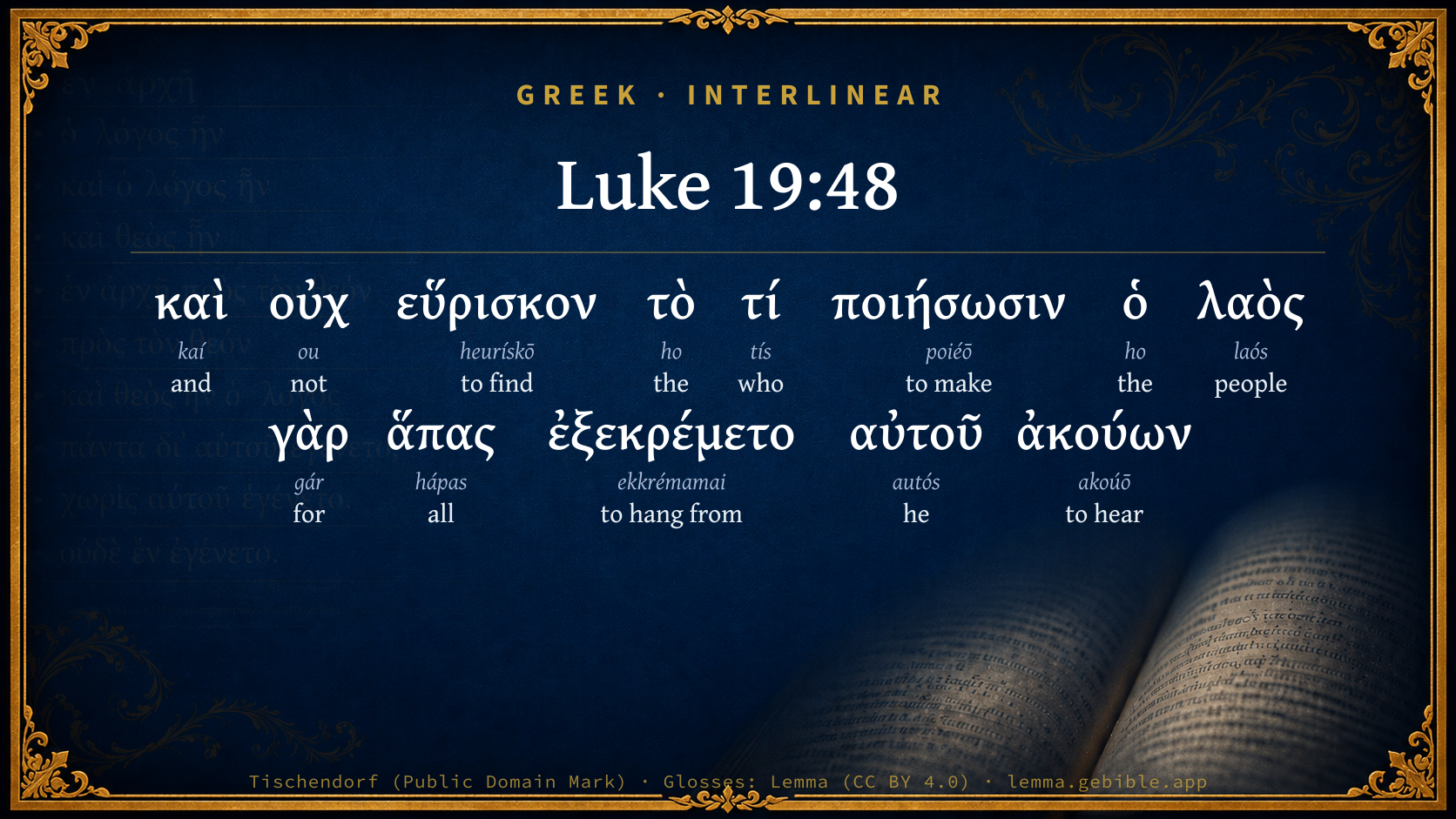
Greek (Tischendorf 8th ed.) Luke 19:48 appears in the Greek New Testament. The text above is from the Tischendorf 8th edition. Each word links to its Strong’s number and a concise gloss. Click any word for its full Thayer’s Greek Lexicon entry.
Download image
Cite this verse

Luke 19:48 (World English Bible). Public Domain. Lemma interlinear Bible study tool, https://lemma.gebible.app/v/luke/19/48.

Show BibTeX & RIS
BibTeX
RIS
English Translation
They couldn't find what they might do, for all the people hung on to every word that he said.
World English Bible · Public Domain
Highlights
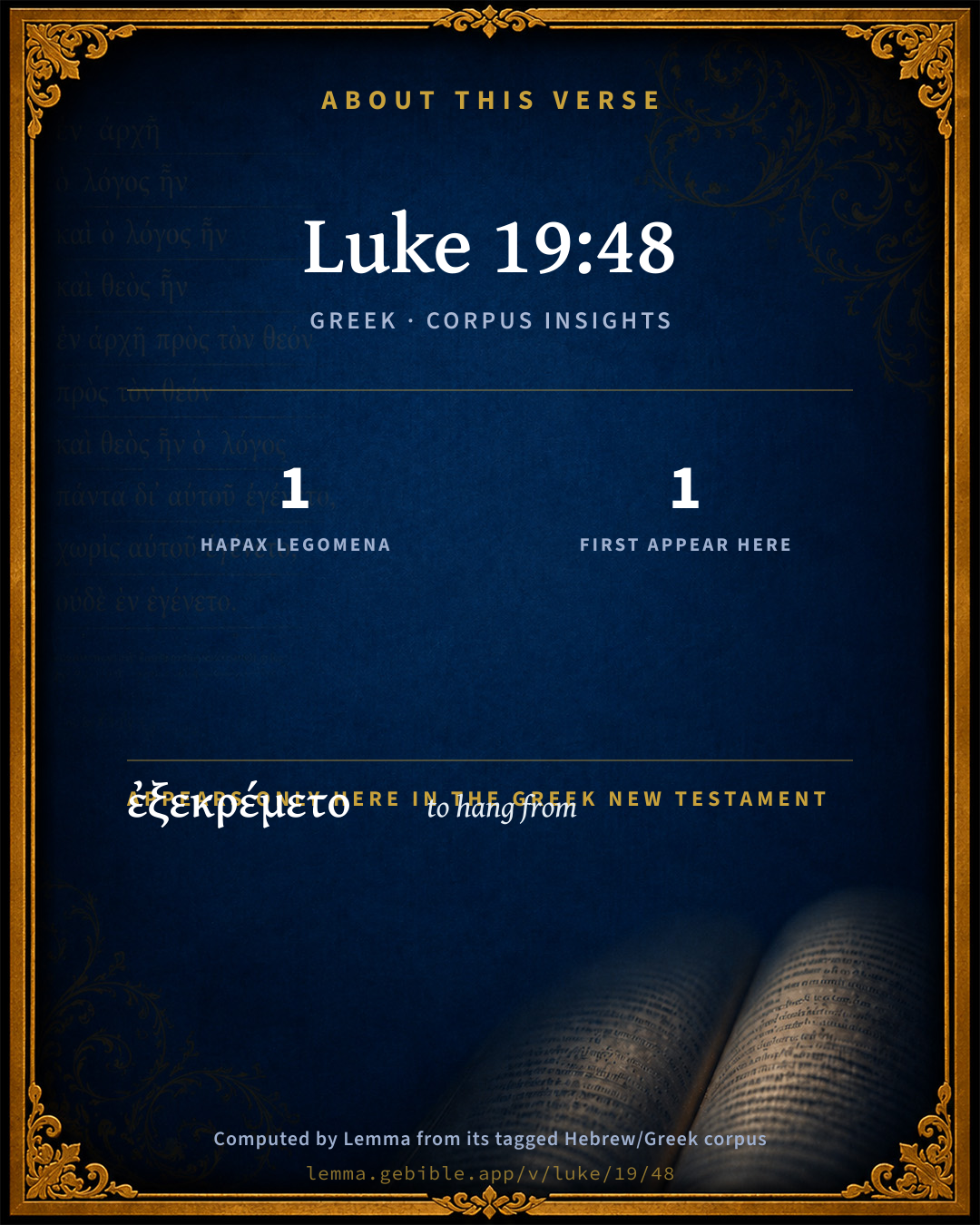
  • 1 hapax legomenon — only here in the Greek New Testament
  • 1 first appearance in the Greek New Testament
Full analysis ↓
Download a study sheet

One document with this verse’s original text, its word-by-word gloss line, the meaning frame, cross-references with their text, attributed commentary, and full source and license credits — printable, and it pastes into notes with its structure intact.

This verse Autodidact and up

Study sheet (.html) Plain text (.txt)

A passage Seminary Student

Up to 50 verses in one chapter. A passage sheet keeps up to 6 commentary sources and 12 cross-references per verse, in the order this page ranks them, and says so on the sheet whenever that leaves anything out. Ask for a single verse and you get the Autodidact verse sheet above.

Everything on this page stays free to read, with no account — the sheet is a download of what is already on screen, not access to it.

Want to remove ads? Support Godless Engineer
Compare translations 3

The same verse in 3 English versions, stacked beneath the original-language interlinear above. Click any original word for its lexicon entry.

Each is an independent rendering of the whole verse — the interlinear is not word-aligned to these translations.

Highlighted words mark where these versions differ — a whole-verse word diff, not a word-by-word alignment.

  • World English Bible Public Domain
    They couldn't find what they might do, for all the people hung on to every word that he said.
  • King James Version Public Domain
    And could not find what they might do: for all the people were very attentive to hear him.
  • unfoldingWord Literal Text CC BY-SA 4.0
    And they were not finding something that they might do, for all the people were hanging on him listening.

unfoldingWord Literal Text — © unfoldingWord, licensed CC BY-SA 4.0. Word-aligned USFM3 via Door43 (git.door43.org/unfoldingWord/en_ult).

Versions to compare (up to 4)

3 of 4 selected

Show all 19 translations

Every available English version of this verse, each an independent rendering of the whole verse.

  • World English Bible Public Domain
    They couldn't find what they might do, for all the people hung on to every word that he said.
  • Berean Standard Bible Public Domain
    Yet they could not find a way to do so, because all the people hung on His words.
  • Majority Standard Bible Public Domain
    Yet they could not find a way to do so, because all the people hung on His words.
  • King James Version Public Domain
    And could not find what they might do: for all the people were very attentive to hear him.
  • American Standard Version (1901) Public Domain
    and they could not find what they might do; for the people all hung upon him, listening.
  • Revised Version (1885) Public Domain
    and they could not find what they might do; for the people all hung upon him, listening.
  • Geneva Bible (1599) Public Domain
    But they could not finde what they might doe to him: for all the people hanged vpon him when they heard him.
  • Douay-Rheims (1899) Public Domain
    And they found not what to do to him: for all the people were very attentive to hear him.
  • Young's Literal Translation Public Domain
    and they were not finding what they shall do, for all the people were hanging on him, hearing him.
  • Literal Standard Version CC BY-SA 4.0
    and they were not finding what they will do, for all the people were hanging on Him, hearing Him.
  • Unlocked Literal Bible CC BY-SA 4.0
    but they could not find a way to do it, because all the people were listening to him intently.
  • unfoldingWord Literal Text CC BY-SA 4.0
    And they were not finding something that they might do, for all the people were hanging on him listening.
  • Darby Bible Public Domain
    and did not find what they could do, for all the people hung on him to hear.
  • World Messianic Bible Public Domain
    They couldn’t find what they might do, for all the people hung on to every word that he said.
  • Webster's Bible Public Domain
    And could not find what they might do: for all the people were very attentive to hear him.
  • Free Bible Version CC BY-SA 4.0
    But they couldn't find a way to do it because everyone appreciated him, hanging on his every word.
  • Bible in Basic English Public Domain
    But they were not able to do anything, because the people all kept near him, being greatly interested in his words.
  • Text-Critical English NT CC BY 4.0
    But they could not figure out what to do, for all the people were hanging on his every word as they listened to him.
  • Tyndale New Testament (1534) Public Domain
    but coulde not finde what to do. For all the people stacke by him and gave him audience.

Literal Standard Version (2020), Covenant Press — licensed CC BY-SA 4.0. Text via the HelloAO Bible API (eBible.org). Unlocked Literal Bible (unfoldingWord) — licensed CC BY-SA 4.0. Text via the HelloAO Bible API (eBible.org). unfoldingWord Literal Text — © unfoldingWord, licensed CC BY-SA 4.0. Word-aligned USFM3 via Door43 (git.door43.org/unfoldingWord/en_ult). Free Bible Version, Dr. Jonathan Gallagher — licensed CC BY-SA 4.0. Text via the HelloAO Bible API (eBible.org).

Word by word

More ways to search: Search by grammar → Find every occurrence → Compare this word →

Practice this passage: Drill this verse → Learn its vocabulary →

ἐξεκρέμετο
ekkrémamai
G1582
“to hang from”
Verb, Imperfect, Middle, Indicative, 3rd person, Singular
Part of Speech
Verb
Tense
Imperfect
Voice
Middle
Mood
Indicative
Person
3rd person
Number
Singular
Full Thayer's Definition

Origin: middle voice from G1537 and G2910

TDNT: 18:15,5

1. to hang from
  1. καὶ kaí G2532 “and” Conjunction
  2. οὐχ ou G3756 “not” Particle, Negative
  3. εὕρισκον heurískō G2147 “to find” Verb, Imperfect, Active, Indicative, 3rd person, Plural
  4. τὸ ho G3588 “the” Article, Accusative, Singular, Neuter
  5. τί tís G5101 “who” Interrogative pronoun, Accusative, Singular, Neuter
  6. ποιήσωσιν poiéō G4160 “to make” Verb, Aorist, Active, Subjunctive, 3rd person, Plural
  7. ὁ ho G3588 “the” Article, Nominative, Singular, Masculine
  8. λαὸς laós G2992 “people” Noun, Nominative, Singular, Masculine
  9. γὰρ gár G1063 “for” Conjunction
  10. ἅπας hápas G537 “all” Adjective, Nominative, Singular, Masculine
  11. αὐτοῦ autós G846 “he” Personal pronoun, Genitive, Singular, Masculine
  12. ἀκούων akoúō G191 “to hear” Verb, Present, Active, Participle, Nominative, Singular, Masculine

About this verse

These counts appear in no published source. They are computed here, from the morphology-tagged text and Lemma’s own curated glosses. What Lemma adds →

13
words
12
distinct lemmas
Gospels
section

Notable vocabulary

1 hapax legomenon — a word that appears only here in the entire Greek New Testament:

  • ἐξεκρέμετο to hang from G1582

First appearance in Scripture

This word makes its first canonical appearance in the Greek New Testament here:

  • ἐξεκρέμετο to hang from G1582

Shared distinctive vocabulary

ἅπας all G537 occurs in 41 verses of the Greek New Testament. Also found in:

Repetition

A word recurs within this verse:

Cross-references

6

Topical passages linked to Luke 19:48 in the Treasury of Scripture Knowledge — connected by theme and wording, ordered by reader-vote popularity; previews shown in the World English Bible.

  • Nehemiah 8:3 He read therein before the broad place that was before the water gate from early morning until midday, in the presence of the men and the women, and of those who could understand; and the ears of all the people were [attentive] to the book of the law.
  • Matthew 22:15–16 Then the Pharisees went and took counsel how they might entrap him in his talk.
  • Luke 20:19–20 The chief priests and the scribes sought to lay hands on Him that very hour, but they feared the people--for they knew He had spoken this parable against them.
  • Luke 22:2–4 The chief priests and the scribes sought how they might put him to death, for they feared the people.
  • John 7:46–49 The officers answered, "No man ever spoke like this man!"
  • Acts 16:14 A certain woman named Lydia, a seller of purple, of the city of Thyatira, one who worshiped God, heard us; whose heart the Lord opened to listen to the things which were spoken by Paul.

Cross-references courtesy of OpenBible.info (CC BY 4.0).

Commentary

Notes on Luke 19:48 from classic Christian and Jewish commentators (each source and its license shown beneath its notes). The classic Christian expositions comment on the surrounding passage and are grouped to its opening verse, so a note may address several verses; the Jewish commentaries on the Tanakh (Rashi and others) are per-verse, so they appear only where the commentator wrote on this verse.

Lemma curates 59 commentaries, every one of them public domain or Creative Commons licensed, each selected and text-cleaned for this edition rather than reprinted as found. About our sources →

Expositor's Greek Testament

ed. W. Robertson Nicoll

Luk 19:48 . τὸ τί ποιήσωσιν , “the what to do”; the will to kill there, but the way dark ( cf. Luk 1:62 , Luk 22:24 ). ὁ λαὸς , the people, the common mass, with their inconvenient liking for a true, outspoken, brave, heroic man. ἐξεκρέμετο α ., hung upon Him (hearing), an expressive phrase, and classical; examples in Wetstein and Pricaeus and in Loesner from Philo. From the Latins they cite:

Pendentque iterum narrantis ab ore. Virg., Aen., ver. 79.

Narrantis conjux pendet ab ore viri. Ovid., Her., 1, 30.

Pricaeus suggests that the metaphor is taken from iron and the magnet.

The Expositor's Greek Testament, edited by W. Robertson Nicoll (1897–1910) — public domain. Text from a community e-Sword module.

Jamieson, Fausset & Brown

Robert Jamieson, A. R. Fausset & David Brown

were very attentive to hear him--hung upon His words.

Next: Luke Chapter 20

Jamieson, Fausset & Brown — Commentary Critical and Explanatory on the Whole Bible (1871) — public domain (CC PDM 1.0). Text via the HelloAO Bible API.

Adam Clarke's Commentary

Verse 48. Were very attentive to hear him.] Or, They heard him with the utmost attention, εξεκρεματο αυτου ακουων, literally, They hung upon him, hearing. The same form of speech is used often by both Greek and Latin writers of the best repute.

Ex vultu dicentis, pendet omnium vultus.

The face of every man hung on the face of the speaker.

--------Pendetque iterum narrantis ab ore.

Virg. AEn. iv. 79.

And she hung again on the lips of the narrator.

The words of the evangelist mark, not only the deepest attention because of the importance of the subject, but also the very high gratification which the hearers had from the discourse. Those who read or hear the words of Christ, in this way, must inevitably become wise to salvation.

THE reader is requested to refer to Mt 24, and to Mt 25:14, for more extensive information on the different subjects in this chapter, and to the other parallel places marked in the margin. The prophecy relative to the destruction of Jerusalem is one of the most circumstantial, and the most literally fulfilled, of any prediction ever delivered. See this particularly remarked at the conclusion of Mt 24, where the whole subject is amply reviewed.

Adam Clarke's Commentary on the Bible (1810–1826) — public domain. Text from a community e-Sword/MySword module.

Ellicott's Commentary for English Readers

(48) All the people were very attentive to hear him.—Literally, hung upon him as they heard. The Greek phrase is another of the words characteristic of St. Luke. Its force may be gathered by its use in the Greek version of Gen_44:30, where it stands for “his life is bound up in” (or, hangs upon) “the lad’s life.”

A Bible Commentary for English Readers, edited by Charles John Ellicott (1878–1897) — public domain. Text from a community e-Sword module.

The Cambridge Bible for Schools and Colleges

gen. ed. J. J. S. Perowne

48. were very attentive to hear him] Literally, “were hanging from him,” i.e. hung on His lips; “pendebot ab ore,” Verg. Aen. iv. 79.

The Cambridge Bible for Schools and Colleges (gen. ed. J. J. S. Perowne; Cambridge University Press, 1878–1918) — public domain. Text from a community e-Sword module.

Trapp's Complete Commentary

John Trapp

48 And could not find what they might do: for all the people were very attentive to hear him.

Ver. 48. Were very attentive to hear him] Gr. εξεκρεματο, hanged on him, as the bee doth on the flower, the babe on the breast, or the little bird on the bill of her dam. Christ drew the people after him, as it were, by the golden chain of his heavenly eloquence.

John Trapp, A Commentary or Exposition upon All the Books of the Old and New Testament (1647–1656) — public domain. Text from a community e-Sword module.

Albert Barnes' Notes on the Bible

Could not find ... - Were not able to accomplish their purpose; they did not know “how” to bring it about.

Very attentive - literally, “hung upon him” to hear him. The word denotes an anxious desire, a fixed attention, a cleaving to him, and an unwillingness to “leave” him, so that they might hear his words. This is always the case when people become anxious about their salvation. They manifest it by hanging on the preaching of the gospel; by fixed attention; and by an unwillingness to leave the place where the word of God is preached. In view of the fact that the Lord Jesus wept over Jerusalem, we may remark:

It was on account of the sins and danger of the inhabitants, and of the fact that they had rejected offered mercy.

(2)There was “occasion” for weeping. Jesus would not have wept had there been no cause for it. If they were in no danger, if there was no punishment in the future world, why should he have wept? When the Lord Jesus weeps over sinners, it is the fullest proof that they are in danger.

(3)Sinners are in the same danger now. They reject Christ as sinners did then. They despise the gospel as they did then. They refuse now to come to him as the inhabitants of Jerusalem did. Why are they not then in the same danger?

(4)Deep feeling, gushing emotions, lively affections, are proper in religion. If the Saviour wept, it is not improper for us to weep - it is right. Nay, can it be right “not” to weep over the condition of lost man.

Religion is tenderness and love. It led the Saviour to weep, and it teaches us to sympathize and to feel deeply. Sin hardens the heart, and makes it insensible to every pure and noble emotion; but religion teaches us to feel “for others’ woes,” and to sympathize in the danger of others. Christians and Christian ministers should weep over lost sinners. They have souls just as precious as they had then; they are in the same danger; they are going to the judgment-bar; they are wholly insensible to their danger and their duty.

“Did Christ o’er sinners weep?

And shall our cheeks be dry?

Let floods of penitential grief.

Burst forth from every eye.

“The Son of God in tears.

Angels with wonder see!

Be thou astonished, O my soul;

He shed those tears for thee.

“He wept that we might weep;

Each sin demands a tear:

In heaven alone no sin is found.

And there’s no weeping there.”

Albert Barnes' Notes on the Bible (1834–1885) — public domain. Text from a community e-Sword/MySword module.

Haydock's Catholic Bible Commentary

All the people, as they heard him with so great attention. So Virgil said: -----pendetque iterum narrantis ab ore. (Witham)

--- The original Greek, exekremato autou akouon, shews how eagerly they catched the words that dropped from his sacred lips, all enraptured with the wisdom of his answers, and the commanding superiority of his doctrines. Seneca (Controv ix. 1.) uses a similar turn of expression: Ex vultu discentis pendent omnium vultus. The chief priests and rulers were all apprehension lest the people, who followed Jesus with such avidity, and who had conceived such high sentiments of his character, might prevent the execution of their murderous designs.

====================

George Leo Haydock (1774–1849), Haydock's Catholic Family Bible and Commentary, 1859 edition — public domain. Excludes Psalms (Douay-Rheims chapter numbering differs from Protestant) and Deuterocanonical books (Catholic canon only).

Whedon's Commentary on the Bible

Daniel D. Whedon

48. All the people were very attentive to hear him—The Passover brought numbers of his friends from Galilee; his preaching had won many followers in the region beyond Jordan; the raising of Lazarus in Bethany had made his name wonderful among the people of Jerusalem and its precincts. The influence of the ruling orders was for the time overborne, and the cause of Jesus seemed for the time triumphant.

Daniel D. Whedon (gen. ed.), Commentary on the Old and New Testaments (1874–1909) — public domain. Text from a community e-Sword module.

The Pulpit Commentary

Christ"s popularity.

That Jesus Christ, as a Teacher, had no small share of popularity is beyond all question. "The people were astonished at his doctrine; for his word was with power;" "He taught them as one that had authority." His hearers wanted to know "whence hath this Man this wisdom?" The officers of the Sanhedrin declared that "Never man spake like this Man." His enemies" purpose was defeated: "They could not find what they might do: for all the people were very attentive to hear him." Large companies of men and women flocked to hear him; he had not to seek an audience; he had to seek shelter from their curiosity and intrusion. "Whence had this Man" this popularity? What was the source and the secret of it? There were

I THREE THINGS IN SPITE OF WHICH HE WAS POPULAR WITH THE PEOPLE.

1. The depth of his doctrine. Many gain a ready audience with the people by carefully restricting themselves to those truths which their hearers can easily understand: superficialities are generally acceptable. Not so with the great Teacher. He struck far below the surface, and was frequently announcing and enforcing truths which the majority of his hearers must have found "hard to be understood." Many of his utterances were "hard sayings". (Joh_6:60)

2. The height of his purpose. Christ would have "got on "with the multitude much further and faster if he had but brought down his teaching to the level of their national aspirations. But when they were thinking of something as shallow and as transitory as a political revolution, he was laying broad and deep the foundations of a spiritual, universal, everlasting kingdom of God. The strength and straightness of his charge. "Do you suppose these men were extraordinary sinners? I tell you, Nay; but except ye repent," etc.; "Except ye be converted, and become as little children, ye cannot enter the kingdom;" "Except your righteousness exceed the righteousness of the scriber," etc. (Luk_13:2, 3 Mat_18:3 Mat_5:20)

II TWO THINGS WHICH CONTRIBUTED TO, WITHOUT ACCOUNTING FOR, HIS POPULARITY.

1. The illustrativeness of his style. He called to his aid all visible nature, all homely occupations, the familiarities of social and domestic life. "He talked of grass and wind and taint And fig trees and fair weather, And made it his delight to bring Heaven and the earth together. He spoke of lilies, vines, and corn, The sparrow and the raven; And words so natural, yet so wise, Were on men"s hearts engraven.

2. The fearless front he showed to those who were the worst enemies of the people. He denounced in unsparing terms the selfishness and rapacity as well as the pretentiousness and actual impiety of those who were fastening the bonds of a merciless and oppressive legality on the necks of their victims; and the people looked on with approval and with enjoyment. Men always listen with delight when oppression is unsparingly denounced. They always like to see the mask torn off the face of falsehood. But it is not here that the secret of the popularity of Jesus is to be found.

III FOUR THINGS WHICH MADE CHRIST"S TEACHING ACCEPTABLE TO THOSE WHO HEARD HIM, and may well make his doctrine acceptable to us to-day.

1. He spoke of those things the truth of which the people most wanted to know. They did not want to know a number of legal niceties and small social and domestic proprieties of which the scribes spoke to them. They wanted to know what God thought of them, and how he felt toward them, and what was the way by which they could gain and claim his favour; what was the meaning and the purpose and the possibility of human life; what followed death; and what was the true hope for the after-time. On such themes Jesus spoke to men, and we need not wonder that "all the people listened attentively" as he spake.

2. He spoke as one that knew. He spoke "with authority, and not as the scribes." "His word was with power. " He did not indulge in hair-splitting argumentations, nor in vague and dreamy imaginings, nor in doubtful and unreliable guesses. He spake as one that knew; as one who could speak about God, because he came forth from him, and dwelt with him; about prayer, because he was in constant communion with Heaven; about righteousness, because he himself was pure in heart; about love, because his whole life was one act of self-denial. Oat of the depths of a living soul he gave the known facts of experience, the certain truths of God.

3. His teaching was that of helpfulness and hopefulness. He saw men "as sheep without a shepherd, tired out and lying down," wandering, smitten, dying. He grieved over the multitudes that were being misled, and he longed to do them good, to lead them back; he knew that he could help, that he could restore them. So he announced himself as that One who came "to preach good tidings to the poor, to heal the broken-hearted, to preach deliverance to the captive;" he offered himself as One to whom all the heavy-laden might repair, and in whom they would find rest unto their souls. He stretched forth an uplifting hand to those who were thought by every one else to have fallen beyond recovery. He breathed hope and life into despairing and dying ears.

4. His doctrine was sustained by his character and his life. Men listened to him, not only because he "spake as never man spake," but because he lived as never man lived before in such perfect purity, in such constant devotion, in such self forgetting love, with such gracious and tender sympathy in his heart and upon his countenance. They listened to him with such wrapt attention because they loved him for his goodness and for his love.

(1) Such popularity as springs from such sources as these we may desire and seek to obtain.

(2) For these same reasons we should be as attentive to hear the Master as were "the common people who heard him gladly" when he lived amongst us. C.

The Pulpit Commentary (1880–1919), ed. H.D.M. Spence-Jones & Joseph S. Exell — public domain. Text from a community e-Sword module.

Scofield Reference Notes

C. I. Scofield

were very attentive

Or, hanged on him.

The Scofield Reference Bible (1917 edition), notes by C. I. Scofield — public domain. Text from a community e-Sword module.

Cambridge Greek Testament for Schools and Colleges

48. ἐξεκρέματο αὐτοῦ. Literally, “were hanging from him,” i.e. hung on His lips; “pendet ab ore,” Verg. Aen. IV. 79. The word occurs here only in the N.T., but is found in Gen 44:30, LXX[338] Scarcely a single version preserves the vivid metaphor of the original; most of them coldly paraphrase it, like the A.V[339] Tyndale and Cranmer have ‘stuck by him,’ and Vulg[340] suspensus erat.

[338] LXX. Septuagint.

[339] A.V. Authorised Version.

[340] Vulg. Vulgate.

“On thee the loyal-hearted hung.”

TENNYSON.

“Hanged on Him, as the bee doth on the flower, the babe on the breast, the little bird on the bill of her dam. Christ drew the people after Him by the golden chain of His heavenly eloquence.” J. Trapp.

Cambridge Greek Testament for Schools and Colleges (Cambridge University Press, 1896; 21 vols, various authors incl. Carr, Maclear, Plummer, Farrar, Lumby, Moule, M. R. James, Simcox) — public domain. Text from a community e-Sword module.

Alford’s Greek Testament

Henry Alford

48.] A general description of His employment during these last days, the particulars of which follow. It is rightly however placed at the end of a chapter, for it forms a close to the long section wherein the last journey to Jerusalem has been described.

Henry Alford, The Greek Testament (1849–1861) — public domain. Text from a community e-Sword module.

International Critical Commentary

48. τὸ τί ποιήσωσιν. For this use of τό see on 1:62, and comp. 6:11.

ὁ λαὸς γὰρ ἅπας. Not ὄχλος, not the mere crowd, but the whole nation, which was numerously represented. A mixed multitude of Jews from all puts of the world was gathering there for the Passover. These would sympathize with His cleansing of the temple; and His miracles of healing would add to the attractiveness of His teaching. This representative multitude “hung on His lips, listening.” Comp. pendet narrantis ab ore (Aen. iv. 79); narrantis conjux pendet ab ore viri (Ov. Her. i. 30). Other examples in Wetst. and McClellan. See on 11:29.

The form ἐξεκρέμετο (א B, Orig.) is preferred by Tisch. and WH. It implies a pres. κρέμομαι. But ἐξεκρέματο, if genuine, is imperf. also. Veitch, s. κρέμαμαι.

§ Found in Luke alone.

Clem. Alex. Clement of Alexandria.

B B. Cod. Vaticanus, sæc. 4. In the Vatican Library certainly since 15331 (Batiffol, La Vaticane de Paul 3, etc., p. 86).

K K. Cod. Cyprius, sæc. ix. In the National Library at Paris. Contains the whole Gospel.

U U. Cod. Nanianus, sæc. x. In the Library of St. Mark’s, Venice. Contains the whole Gospel.

Vulg. Vulgate.

om. omit.

D D. Cod. Bezae, sæc. vi. Given by Beza to the University Library at Cambridge 1581. Greek and Latin. Contains the whole Gospel.

A A. Cod. Alexandrinus, sæc. v. Once in the Patriarchal Library at Alexandria; sent by Cyril Lucar as a present to Charles 1. in 1628, and now in the British Museum. Complete.

R R. Cod. Nitriensis Rescriptus, sæc. 8. Brought from a convent in the Nitrian desert about 1847, and now in the British Museum. Contains 1:1-13, 1:69-2:4, 16-27, 4:38-5:5, 5:25-6:8, 18-36, 39, 6:49-7:22, 44, 46, 47, 8:5-15, 8:25-9:1, 12-43, 10:3-16, 11:5-27, 12:4-15, 40-52, 13:26-14:1, 14:12-15:1, 15:13-16:16, 17:21-18:10, 18:22-20:20, 20:33-47, 21:12-22:15, 42-56, 22:71-23:11, 38-51. By a second hand 15:19-21.

אԠא Cod. Sinaiticus, sæc. iv. Brought by Tischendorf from the Convent of St. Catherine on Mt. Sinai; now at St. Petersburg. Contains the whole Gospel complete.

L L. Cod. Regius Parisiensis, sæc. viii. National Library at Paris. Contains the whole Gospel.

Boh. Bohairic.

Goth. Gothic.

TR. Textus Receptus.

Maldon. Maldonatus.

WH. Westcott and Hort.

Treg. Tregelles.

Tisch. Tischendorf.

RV. Revised Version.

Iren. Irenæus.

Ambr. Ambrose.

Chrys. Chrysostom.

Euthym. Euthymius Zigabenus.

Theoph. Theophylact.

Aug. Augustine.

Grot. Grotius.

Nösg. Nösgen.

Cypr. Cyprian.

1 In the Roman church this verse is Part of the gospel in the service for the dedication of churches.

L. J. Leben Jesu

Jos. Josephus.

Mey. Meyer.

AV. Authorized Version.

Wic. Wiclif.

Rhem. Rheims (or Douay).

Cov. Coverdale.

Tyn. Tyndale.

Arm. Armenian.

Aeth. Ethiopic.

Latt. Latin.

Orig. Origen.

Syrr. Syriac.

Burton. Burton, N.T. Moods and Tenses.

C

C. Cod. Ephraemi Rescriptus, sæc. 5. In the National Library at Paris. Contains the following portions of the Gospel: 1:2-2:5, 2:42-3:21, 4:25-6:4, 6:37-7:16, or 17, 8:28-12:3, 19:42-20:27, 21:21-22:19, 23:25-24:7, 24:46-53.

These four MSS. are parts of what were once complete Bibles, and are designated by the same letter throughout the LXX and N.T.

Beng. Bengel.

Trench, Trench, New Testament Synonyms.

Luth. Luther.

Wsctt. Westcott.

Cur. Curetonian.

Sin. Sinaitic.

M M. Cod. Campianus, sæc. ix. In the National Library at Paris. Contains the whole Gospel.

Aegyptt. Egyptian.

D. B. Smith’s Dictionary of the Bible, 2nd edition.

1 Mk. says ἐπʼ αὐτόν (τὸν πῶλον), Jn. ἐπʼ αὐτό (ὀνάριον). Mt. alone mentions both the colt and its mother and continues the plural throughout; ἐπέθηκαν ἐπʼ αὐτῶν τὰ ἱμάτια, καὶ ἐπεκάθισεν ἐπάνω αὐτῶν: over which Strauss is sarcastically critical.

Wetst. Wetstein.

Tert. Tertullian.

Edersh. Edersheim, Life and Times of Jesus the Messiah.

Δ̠Δ. Cod. Sangallensis, sæc. ix. In the monastery of St. Gall in Switzerland. Greek and Latin. Contains the whole Gospel.

Win. Winer, Grammar of N.T. Greek (the page refers to Moulton’s edition).

Lft. J. B. Lightfoot, * Notes on Epistles of S. Paul.

Iren-lat. Latin Version of Irenæus

Eus. Eusebius of Cæsarea

Bas. Basil.

Epiph. Epipnamus.

Gen. Geneva.

V. de J. Vie de Jésus.

International Critical Commentary — older volumes (1896–1929), various authors — public domain. Text from a community e-Sword module.

Vincent's Word Studies in the New Testament

Marvin R. Vincent

Were very attentive [εξεκρεματο] . Only here in New Testament.

Lit., as Rev., hung upon him. Tynd., stuck by him. ===Luk20

CHAPTER XX

1 - 8. Compare Mt 21:23 - 32; Mr 11:27 - 33.

Marvin R. Vincent, Word Studies in the New Testament (1887–1900) — public domain. Text from a community e-Sword/MySword module.

Lesson kit

Teaching starters — assembled from the data on this page, not authored interpretation. Every prompt links to the verse data it draws on. Edit before teaching.

Luke, in the Gospels, opens this verse with 13 words (12 distinct Greek lemmas). Its most distinctive word is ekkrémamai (“to hang from”). A historical commentator’s framing appears above. Read the whole chapter for the surrounding context.

Discussion questions

  1. The word ekkrémamai carries the sense “to hang from.” How does it shape the verse?
  2. 1 word here appears nowhere else in the Greek New Testament. Why might the author reach for such rare wording?
  3. This is the first place “to hang from” appears in Scripture (first appears here). What does its debut here establish?
  4. How does Matthew 6:32, which shares the word «all», read alongside this verse?
  5. What does the repetition of “the” (2× in this one verse) do in this verse?
  6. These translations render this verse differently. What is at stake in choosing one wording over another?
  7. Compare how Expositor's Greek Testament and Jamieson, Fausset & Brown read this verse. Where do they agree or differ?

Things to notice

  • 1 word in this verse appears nowhere else in the Greek New Testament.
  • 1 word makes its first canonical appearance in Scripture here.
  • These translations choose different wording for 16 words in this verse.
  • “the” occurs 2× in this single verse.
  • 12 distinct Greek lemmas span 13 words in this verse.

Reading settings

Reading text

Shown beneath each verse's original-language words.

Old Testament
Old Testament edition

Read the OT as the Masoretic Hebrew (MT) or the Greek Septuagint (LXX).

English shown for the Greek Septuagint (in the Hebrew ↔ Greek comparison).

Comparing translations? Open the Compare panel on any verse page to stack up to four side by side.