

Luke 6:49
Greek (Tischendorf 8th ed.) Luke 6:49 appears in the Greek New Testament. The text above is from the Tischendorf 8th edition. Each word links to its Strong’s number and a concise gloss. Click any word for its full Thayer’s Greek Lexicon entry.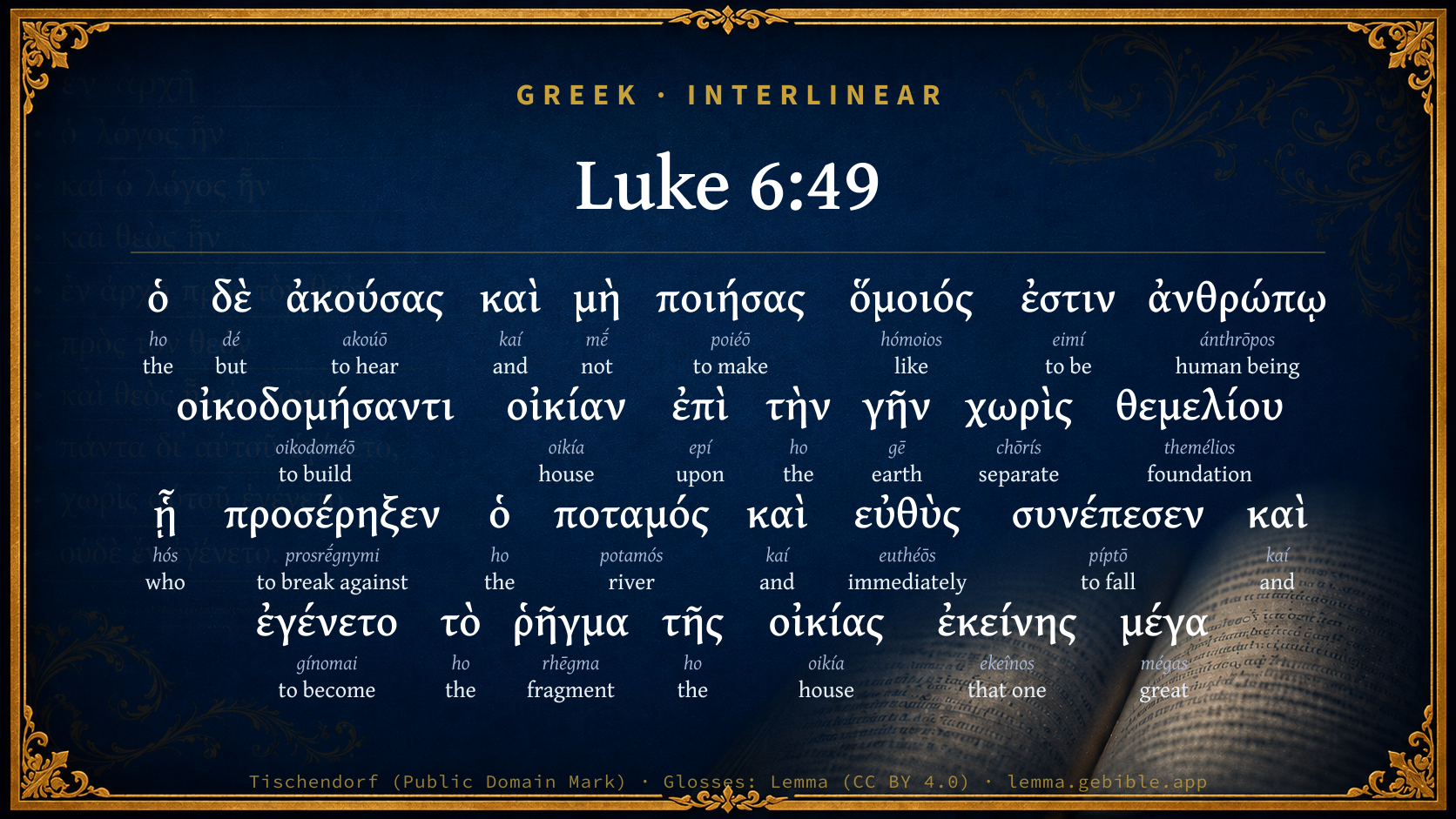
But he who hears, and doesn't do, is like a man who built a house on the earth without a foundation, against which the stream broke, and immediately it fell, and the ruin of that house was great."
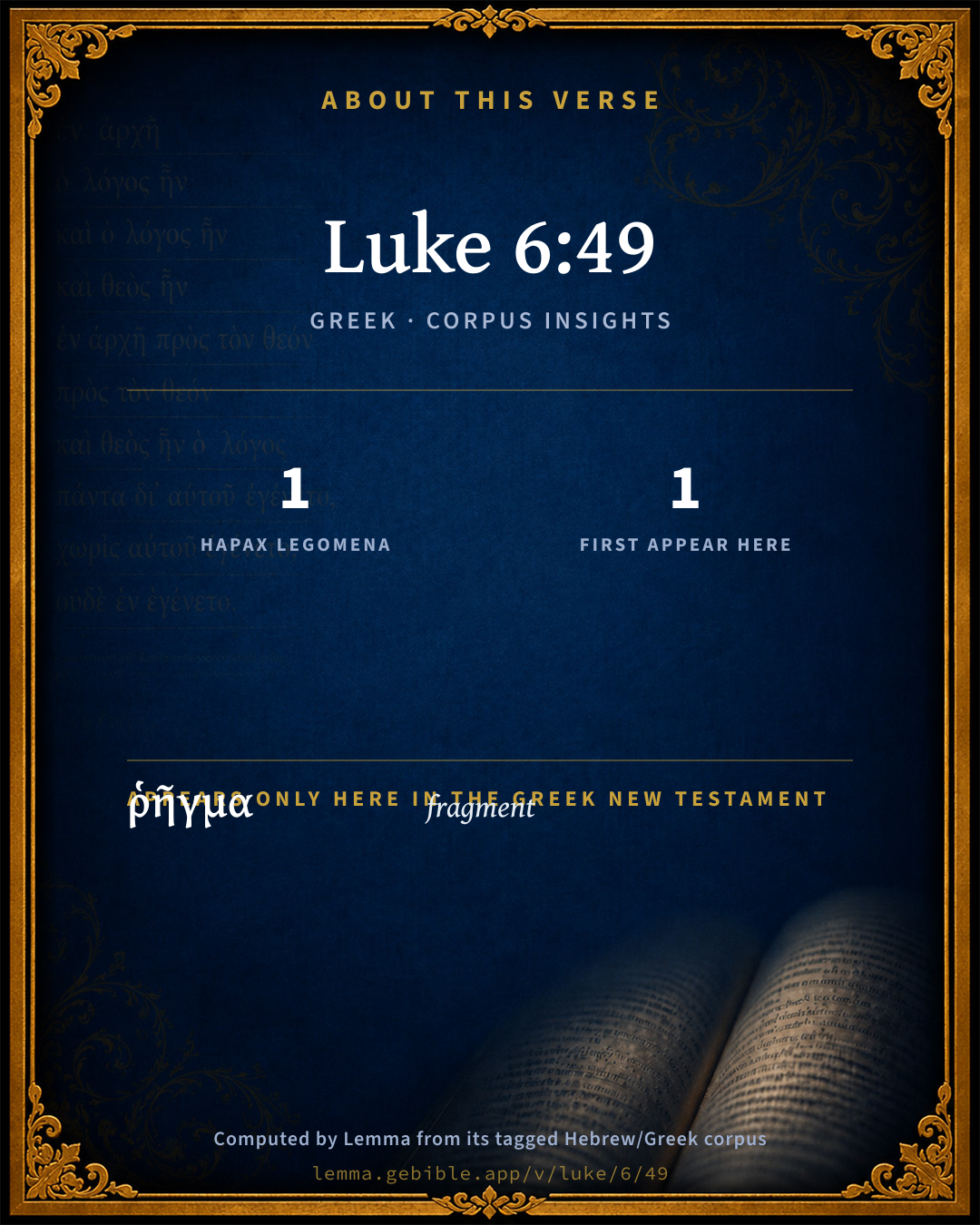
- 1 hapax legomenon — only here in the Greek New Testament
- 1 first appearance in the Greek New Testament
Download a study sheet
One document with this verse’s original text, its word-by-word gloss line, the meaning frame, cross-references with their text, attributed commentary, and full source and license credits — printable, and it pastes into notes with its structure intact.
This verse Autodidact and up
A passage Seminary Student
Up to 50 verses in one chapter. A passage sheet keeps up to 6 commentary sources and 12 cross-references per verse, in the order this page ranks them, and says so on the sheet whenever that leaves anything out. Ask for a single verse and you get the Autodidact verse sheet above.
Everything on this page stays free to read, with no account — the sheet is a download of what is already on screen, not access to it.
Compare translations 3
The same verse in 3 English versions, stacked beneath the original-language interlinear above. Click any original word for its lexicon entry.
Each is an independent rendering of the whole verse — the interlinear is not word-aligned to these translations.
Highlighted words mark where these versions differ — a whole-verse word diff, not a word-by-word alignment.
-
World English Bible Public Domain
But he who hears, and doesn't do, is like a man who built a house on the earth without a foundation, against which the stream broke, and immediately it fell, and the ruin of that house was great."
-
King James Version Public Domain
But he that heareth, and doeth not, is like a man that without a foundation built an house upon the earth; against which the stream did beat vehemently, and immediately it fell; and the ruin of that house was great.
-
unfoldingWord Literal Text CC BY-SA 4.0
But the one having heard and not having done, he is like a man having built a house on the ground without a foundation, against which the torrent of water flowed, and immediately it collapsed, and the ruin of that house was great.”
unfoldingWord Literal Text — © unfoldingWord, licensed CC BY-SA 4.0. Word-aligned USFM3 via Door43 (git.door43.org/unfoldingWord/en_ult).
Show all 19 translations
Every available English version of this verse, each an independent rendering of the whole verse.
-
World English Bible Public Domain
But he who hears, and doesn't do, is like a man who built a house on the earth without a foundation, against which the stream broke, and immediately it fell, and the ruin of that house was great."
-
Berean Standard Bible Public Domain
But the one who hears My words and does not act on them is like a man who built his house on ground without a foundation. The torrent crashed against that house, and immediately it fell—and great was its destruction!”
-
Majority Standard Bible Public Domain
But the one who hears My words and does not act on them is like a man who built his house on ground without a foundation. The torrent crashed against that house, and immediately it fell—and great was its destruction!”
-
King James Version Public Domain
But he that heareth, and doeth not, is like a man that without a foundation built an house upon the earth; against which the stream did beat vehemently, and immediately it fell; and the ruin of that house was great.
-
American Standard Version (1901) Public Domain
But he that heareth, and doeth not, is like a man that built a house upon the earth without a foundation; against which the stream brake, and straightway it fell in; and the ruin of that house was great.
-
Revised Version (1885) Public Domain
But he that heareth, and doeth not, is like a man that built a house upon the earth without a foundation; against which the stream brake, and straightway it fell in; and the ruin of that house was great.
-
Geneva Bible (1599) Public Domain
But hee that heareth and doeth not, is like a man that built an house vpon the earth without foundation, against which the flood did beate, and it fell by and by: and the fall of that house was great.
-
Douay-Rheims (1899) Public Domain
But he that heareth, and doth not, is like to a man building his house upon the earth without a foundation: against which the stream beat vehemently, and immediately it fell, and the ruin of that house was great.
-
Young's Literal Translation Public Domain
`And he who heard and did not, is like to a man having builded a house upon the earth, without a foundation, against which the stream brake forth, and immediately it fell, and the ruin of that house became great.'
-
Literal Standard Version CC BY-SA 4.0
And he who heard and did not, is like to a man having built a house on the earth, without a foundation, against which the stream broke forth, and immediately it fell, and the ruin of that house became great.”
-
Unlocked Literal Bible CC BY-SA 4.0
But the person who hears my words and does not obey them, he is like a man who built a house on top of the ground without a foundation. When the torrent of water flowed against that house, it immediately collapsed, and the ruin of that house was complete.”
-
unfoldingWord Literal Text CC BY-SA 4.0
But the one having heard and not having done, he is like a man having built a house on the ground without a foundation, against which the torrent of water flowed, and immediately it collapsed, and the ruin of that house was great.”
-
Darby Bible Public Domain
And he that has heard and not done, is like a man who has built a house on the ground without [a] foundation, on which the stream broke, and immediately it fell, and the breach of that house was great.
-
World Messianic Bible Public Domain
But he who hears and doesn’t do, is like a man who built a house on the earth without a foundation, against which the stream broke, and immediately it fell; and the ruin of that house was great.”
-
Webster's Bible Public Domain
But he that heareth, and doeth not, is like a man that, without a foundation, built a house on the earth, against which the stream beat vehemently, and immediately it fell, and the ruin of that house was great.
-
Free Bible Version CC BY-SA 4.0
The person who hears me but doesn't do what I say is like a man who builds a house without foundations. When the floodwater breaks against the house it collapses immediately—it's completely destroyed.”
-
Bible in Basic English Public Domain
But he who gives hearing, without doing, is like a man building a house on the earth without a base for it; and when the force of the river came against it, straight away it came down; and the destruction of that house was great.
-
Text-Critical English NT CC BY 4.0
But he who hears my words and does not act accordingly is like a man who built a house on the ground without a foundation. As soon as the river burst against that house, it fell and was utterly destroyed.”
-
Tyndale New Testament (1534) Public Domain
But he that heareth and doth not is lyke a man that with out foundacion bylt an housse apon the erth agaynst which the fludde did bet: and it fell by and by. And the fall of that housse was greate.
Literal Standard Version (2020), Covenant Press — licensed CC BY-SA 4.0. Text via the HelloAO Bible API (eBible.org). Unlocked Literal Bible (unfoldingWord) — licensed CC BY-SA 4.0. Text via the HelloAO Bible API (eBible.org). unfoldingWord Literal Text — © unfoldingWord, licensed CC BY-SA 4.0. Word-aligned USFM3 via Door43 (git.door43.org/unfoldingWord/en_ult). Free Bible Version, Dr. Jonathan Gallagher — licensed CC BY-SA 4.0. Text via the HelloAO Bible API (eBible.org).
Word by word
More ways to search: Search by grammar → Find every occurrence → Compare this word →
Practice this passage: Drill this verse → Learn its vocabulary →
- Appears 1× in the Greek New Testament
- First appears here
- Part of Speech
- Noun
- Case
- Nominative
- Number
- Singular
- Gender
- Neuter
Full Thayer's Definition
- ὁ ho G3588 “the” Article, Nominative, Singular, Masculine
- δὲ dé G1161 “but” Conjunction
- ἀκούσας akoúō G191 “to hear” Verb, Aorist, Active, Participle, Nominative, Singular, Masculine
- καὶ kaí G2532 “and” Conjunction
- μὴ mḗ G3361 “not” Particle, Negative
- ποιήσας poiéō G4160 “to make” Verb, Aorist, Active, Participle, Nominative, Singular, Masculine
- ὅμοιός hómoios G3664 “like” Adjective, Nominative, Singular, Masculine
- ἐστιν eimí G1510 “to be” Verb, Present, Active, Indicative, 3rd person, Singular
- ἀνθρώπῳ ánthrōpos G444 “human being” Noun, Dative, Singular, Masculine
- οἰκοδομήσαντι oikodoméō G3618 “to build” Verb, Aorist, Active, Participle, Dative, Singular, Masculine
- οἰκίαν oikía G3614 “house” Noun, Accusative, Singular, Feminine
- ἐπὶ epí G1909 “upon” Preposition
- τὴν ho G3588 “the” Article, Accusative, Singular, Feminine
- γῆν gē G1093 “earth” Noun, Accusative, Singular, Feminine
- χωρὶς chōrís G5565 “separate” Adverb
- θεμελίου themélios G2310 “foundation” Noun, Genitive, Singular, Masculine
- ᾗ hós G3739 “who” Relative pronoun, Dative, Singular, Feminine
- προσέρηξεν prosrḗgnymi G4366 “to break against” Verb, Aorist, Active, Indicative, 3rd person, Singular
- ὁ ho G3588 “the” Article, Nominative, Singular, Masculine
- ποταμός potamós G4215 “river” Noun, Nominative, Singular, Masculine
- καὶ kaí G2532 “and” Conjunction
- εὐθὺς euthéōs G2112 “immediately” Adverb
- συνέπεσεν píptō G4098 “to fall” Verb, Aorist, Active, Indicative, 3rd person, Singular
- καὶ kaí G2532 “and” Conjunction
- ἐγένετο gínomai G1096 “to become” Verb, Aorist, Middle deponent, Indicative, 3rd person, Singular
- τὸ ho G3588 “the” Article, Nominative, Singular, Neuter
- ῥῆγμα rhēgma G4485 “fragment” Noun, Nominative, Singular, Neuter
- τῆς ho G3588 “the” Article, Genitive, Singular, Feminine
- οἰκίας oikía G3614 “house” Noun, Genitive, Singular, Feminine
- ἐκείνης ekeînos G1565 “that one” Demonstrative pronoun, Genitive, Singular, Feminine
- μέγα mégas G3173 “great” Adjective, Nominative, Singular, Neuter
About this verse
These counts appear in no published source. They are computed here, from the morphology-tagged text and Lemma’s own curated glosses. What Lemma adds →
- 31
- words
- 24
- distinct lemmas
- Gospels
- section
Notable vocabulary
1 hapax legomenon — a word that appears only here in the entire Greek New Testament:
- ῥῆγμα fragment G4485
First appearance in Scripture
This word makes its first canonical appearance in the Greek New Testament here:
- ῥῆγμα fragment G4485
Shared distinctive vocabulary
προσέρηξεν to break against G4366 occurs in 2 verses of the Greek New Testament. Also found in:
Cross-references
26Topical passages linked to Luke 6:49 in the Treasury of Scripture Knowledge — connected by theme and wording, ordered by reader-vote popularity; previews shown in the World English Bible.
- Ezekiel 33:31 They come to you as the people comes, and they sit before you as my people, and they hear your words, but don't do them; for with their mouth they show much love, but their heart goes after their gain.
- James 1:22–26 But be doers of the word, and not only hearers, deluding your own selves.
- Matthew 13:20–22 What was sown on the rocky places, this is he who hears the word, and immediately with joy receives it;
- Matthew 23:3 All things therefore whatever they tell you to observe, observe and do, but don't do their works; for they say, and don't do.
- 2 Peter 1:5–9 Yes, and for this very cause adding on your part all diligence, in your faith supply moral excellence; and in moral excellence, knowledge;
- 1 John 2:3–4 This is how we know that we know him: if we keep his commandments.
- Proverbs 28:18 Whoever walks blamelessly is kept safe; But one with perverse ways will fall suddenly.
- Mark 4:17 They have no root in themselves, but are short-lived. When oppression or persecution arises because of the word, immediately they stumble.
- Luke 6:46 "Why do you call me, 'Lord, Lord,' and don't do the things which I say?
- Luke 8:5–7 "The farmer went out to sow his seed. As he sowed, some fell along the road, and it was trampled under foot, and the birds of the sky devoured it.
- Luke 10:12–16 I tell you, it will be more tolerable in that day for Sodom than for that city.
- Luke 12:47 That servant, who knew his lord's will, and didn't prepare, nor do what he wanted, will be beaten with many stripes,
- John 15:2 Every branch in me that doesn't bear fruit, he takes away. Every branch that bears fruit, he prunes, that it may bear more fruit.
- James 2:17–26 Even so faith, if it has no works, is dead in itself.
- Matthew 12:43–45 But the unclean spirit, when he is gone out of the man, passes through waterless places, seeking rest, and doesn't find it.
- Luke 11:24–26 The unclean spirit, when he has gone out of the man, passes through dry places, seeking rest, and finding none, he says, 'I will turn back to my house from which I came out.'
- Hebrews 10:26–29 For if we sin willfully after we have received the knowledge of the truth, there remains no more a sacrifice for sins,
- 1 John 2:19 They went out from us, but they didn't belong to us; for if they had belonged to us, they would have continued with us. But they left, that they might be revealed that none of them belong to us.
- Matthew 21:29–30 He answered, 'I will not,' but afterward he changed his mind, and went.
- Matthew 24:10 Then many will stumble, and will deliver up one another, and will hate one another.
- Luke 19:14 But his citizens hated him, and sent an envoy after him, saying, 'We don't want this man to reign over us.'
- Luke 19:27 But bring those enemies of mine who didn't want me to reign over them here, and kill them before me.'"
- Acts 20:29 For I know that after my departure, vicious wolves will enter in among you, not sparing the flock.
- Acts 26:11 Punishing them often in all the synagogues, I tried to make them blaspheme. Being exceedingly enraged against them, I persecuted them even to foreign cities.
- 1 Thessalonians 3:5 For this cause I also, when I couldn't stand it any longer, sent that I might know your faith, for fear that by any means the tempter had tempted you, and our labor would have been in vain.
- 2 Peter 2:20 For if, after they have escaped the defilement of the world through the knowledge of the Lord and Savior Jesus Christ, they are again entangled therein and overcome, the last state has become worse with them than the first.
Cross-references courtesy of OpenBible.info (CC BY 4.0).
Lesson kit
Teaching starters — assembled from the data on this page, not authored interpretation. Every prompt links to the verse data it draws on. Edit before teaching.
Luke, in the Gospels, opens this verse with 31 words (24 distinct Greek lemmas). Its most distinctive word is rhēgma (“fragment”). A historical commentator’s framing appears above. Read the whole chapter for the surrounding context.
Discussion questions
- The word rhēgma carries the sense “fragment.” How does it shape the verse?
- This verse holds 1 word here found nowhere else in the Greek New Testament. What might the rare word draw attention to?
- The word “fragment” first appears here in Scripture. What is being introduced at this debut?
- Luke 6:48 shares the word «to break against» with this verse. How do the two illuminate each other?
- “house” occurs 2× in this one verse. What is the effect of the repetition?
- The translations on this page render this verse differently — a whole-verse word diff, not a word-by-word alignment. What might account for the different wordings?
- Reading how Tyndale Open Study Notes and Expositor's Greek Testament read this verse, where do the two commentators agree and where do they part?
Things to notice
- 1 word in this verse appears nowhere else in the Greek New Testament.
- 1 word makes its first canonical appearance in Scripture here.
- These translations choose different wording for 23 words in this verse.
- “house” occurs 2× in this single verse.
- 24 distinct Greek lemmas span 31 words in this verse.
Commentary
Notes on Luke 6:49 from classic Christian and Jewish commentators (each source and its license shown beneath its notes). The classic Christian expositions comment on the surrounding passage and are grouped to its opening verse, so a note may address several verses; the Jewish commentaries on the Tanakh (Rashi and others) are per-verse, so they appear only where the commentator wrote on this verse.
Lemma curates 59 commentaries, every one of them public domain or Creative Commons licensed, each selected and text-cleaned for this edition rather than reprinted as found. About our sources →
Tyndale Open Study Notes
Tyndale Open Resources
Tyndale Open Study Notes — © Tyndale Open Resources, licensed CC BY-SA 4.0. Text via the HelloAO Bible API.
Expositor's Greek Testament
ed. W. Robertson Nicoll
The Expositor's Greek Testament, edited by W. Robertson Nicoll (1897–1910) — public domain. Text from a community e-Sword module.
Adam Clarke's Commentary
Adam Clarke's Commentary on the Bible (1810–1826) — public domain. Text from a community e-Sword/MySword module.
Ellicott's Commentary for English Readers
A Bible Commentary for English Readers, edited by Charles John Ellicott (1878–1897) — public domain. Text from a community e-Sword module.
The Cambridge Bible for Schools and Colleges
gen. ed. J. J. S. Perowne
The Cambridge Bible for Schools and Colleges (gen. ed. J. J. S. Perowne; Cambridge University Press, 1878–1918) — public domain. Text from a community e-Sword module.
Trapp's Complete Commentary
John Trapp
John Trapp, A Commentary or Exposition upon All the Books of the Old and New Testament (1647–1656) — public domain. Text from a community e-Sword module.
unfoldingWord translationNotes
Door43 World Missions Community
unfoldingWord translationNotes — © Distant Shores Media and the Door43 World Missions Community, licensed CC BY-SA 4.0. Source: git.door43.org/Door43/en_tn.
Cambridge Greek Testament for Schools and Colleges
Cambridge Greek Testament for Schools and Colleges (Cambridge University Press, 1896; 21 vols, various authors incl. Carr, Maclear, Plummer, Farrar, Lumby, Moule, M. R. James, Simcox) — public domain. Text from a community e-Sword module.
Alford’s Greek Testament
Henry Alford
Henry Alford, The Greek Testament (1849–1861) — public domain. Text from a community e-Sword module.
International Critical Commentary
International Critical Commentary — older volumes (1896–1929), various authors — public domain. Text from a community e-Sword module.
Vincent's Word Studies in the New Testament
Marvin R. Vincent
Marvin R. Vincent, Word Studies in the New Testament (1887–1900) — public domain. Text from a community e-Sword/MySword module.