
Luke 6:31

Greek (Tischendorf 8th ed.) Luke 6:31 appears in the Greek New Testament. The text above is from the Tischendorf 8th edition. Each word links to its Strong’s number and a concise gloss. Click any word for its full Thayer’s Greek Lexicon entry.
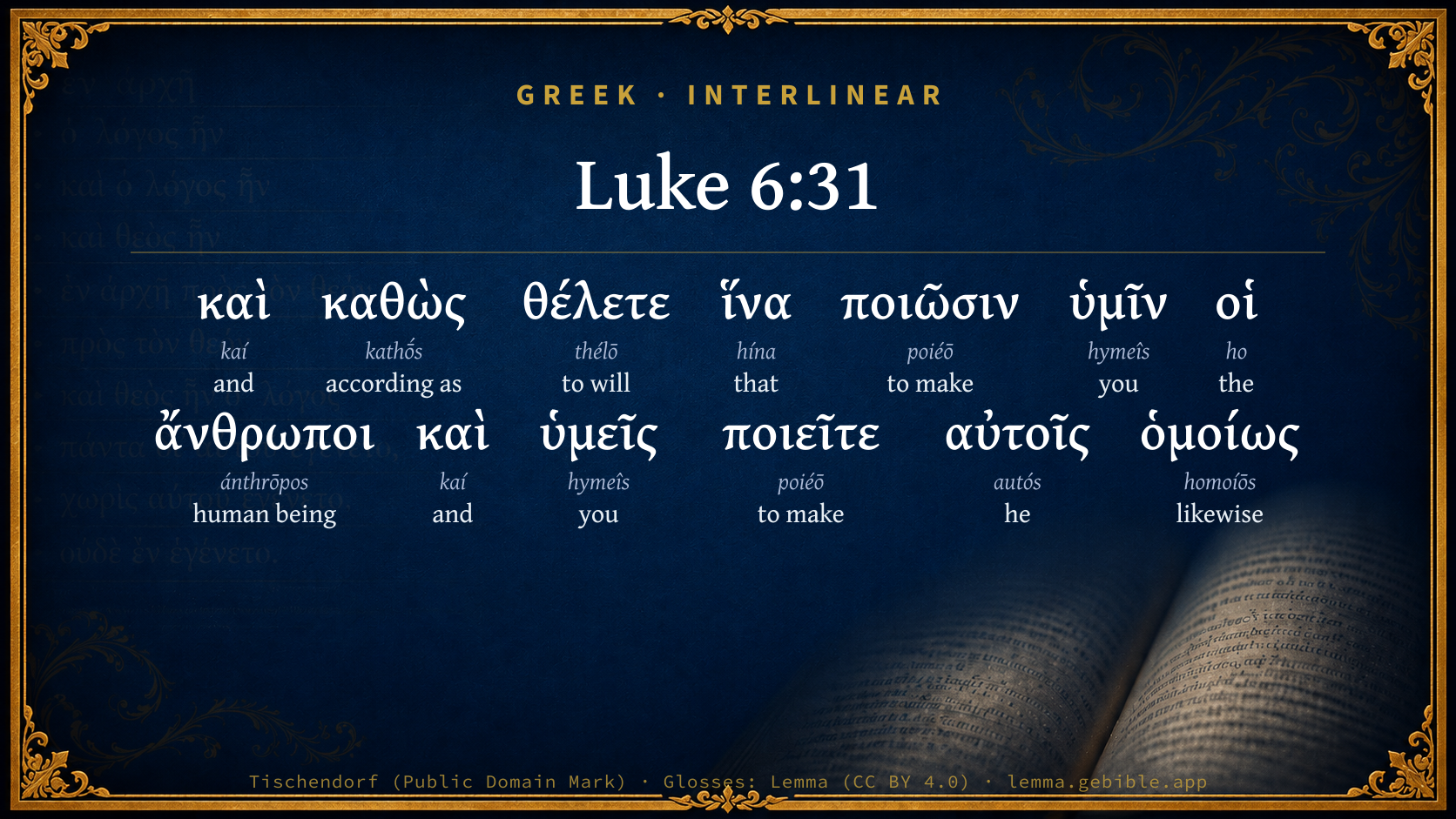
Download image
Cite this verse

Luke 6:31 (World English Bible). Public Domain. Lemma interlinear Bible study tool, https://lemma.gebible.app/v/luke/6/31.

Show BibTeX & RIS
BibTeX
RIS
English Translation
"As you would like people to do to you, do exactly so to them.
World English Bible · Public Domain
Download a study sheet

One document with this verse’s original text, its word-by-word gloss line, the meaning frame, cross-references with their text, attributed commentary, and full source and license credits — printable, and it pastes into notes with its structure intact.

This verse Autodidact and up

Study sheet (.html) Plain text (.txt)

A passage Seminary Student

Up to 50 verses in one chapter. A passage sheet keeps up to 6 commentary sources and 12 cross-references per verse, in the order this page ranks them, and says so on the sheet whenever that leaves anything out. Ask for a single verse and you get the Autodidact verse sheet above.

Everything on this page stays free to read, with no account — the sheet is a download of what is already on screen, not access to it.

Want to remove ads? Support Godless Engineer
Compare translations 3

The same verse in 3 English versions, stacked beneath the original-language interlinear above. Click any original word for its lexicon entry.

Each is an independent rendering of the whole verse — the interlinear is not word-aligned to these translations.

Highlighted words mark where these versions differ — a whole-verse word diff, not a word-by-word alignment.

  • World English Bible Public Domain
    "As you would like people to do to you, do exactly so to them.
  • King James Version Public Domain
    And as ye would that men should do to you, do ye also to them likewise.
  • unfoldingWord Literal Text CC BY-SA 4.0
    And as you desire that men would do to you, do the same to them.

unfoldingWord Literal Text — © unfoldingWord, licensed CC BY-SA 4.0. Word-aligned USFM3 via Door43 (git.door43.org/unfoldingWord/en_ult).

Versions to compare (up to 4)

3 of 4 selected

Show all 19 translations

Every available English version of this verse, each an independent rendering of the whole verse.

  • World English Bible Public Domain
    "As you would like people to do to you, do exactly so to them.
  • Berean Standard Bible Public Domain
    Do to others as you would have them do to you.
  • Majority Standard Bible Public Domain
    Do to others as you would have them do to you.
  • King James Version Public Domain
    And as ye would that men should do to you, do ye also to them likewise.
  • American Standard Version (1901) Public Domain
    And as ye would that men should do to you, do ye also to them likewise.
  • Revised Version (1885) Public Domain
    And as ye would that men should do to you, do ye also to them likewise.
  • Geneva Bible (1599) Public Domain
    And as ye would that men should doe to you, so doe ye to them likewise.
  • Douay-Rheims (1899) Public Domain
    And as you would that men should do to you, do you also to them in like manner.
  • Young's Literal Translation Public Domain
    and as ye wish that men may do to you, do ye also to them in like manner;
  • Literal Standard Version CC BY-SA 4.0
    and as you wish that men may do to you, do also to them in like manner;
  • Unlocked Literal Bible CC BY-SA 4.0
    As you want people to do to you, you should do the same to them.
  • unfoldingWord Literal Text CC BY-SA 4.0
    And as you desire that men would do to you, do the same to them.
  • Darby Bible Public Domain
    And as ye wish that men should do to you, do *ye* also to them in like manner.
  • World Messianic Bible Public Domain
    “As you would like people to do to you, do exactly so to them.
  • Webster's Bible Public Domain
    And as ye would that men should do to you, do ye also to them likewise.
  • Free Bible Version CC BY-SA 4.0
    Do to others what you want them to do to you.
  • Bible in Basic English Public Domain
    Do to others as you would have them do to you.
  • Text-Critical English NT CC BY 4.0
    As you wish that others would do to you, do the same also to them.
  • Tyndale New Testament (1534) Public Domain
    And as the wolde that men shuld doo to you: so do ye to them lyke wyse.

Literal Standard Version (2020), Covenant Press — licensed CC BY-SA 4.0. Text via the HelloAO Bible API (eBible.org). Unlocked Literal Bible (unfoldingWord) — licensed CC BY-SA 4.0. Text via the HelloAO Bible API (eBible.org). unfoldingWord Literal Text — © unfoldingWord, licensed CC BY-SA 4.0. Word-aligned USFM3 via Door43 (git.door43.org/unfoldingWord/en_ult). Free Bible Version, Dr. Jonathan Gallagher — licensed CC BY-SA 4.0. Text via the HelloAO Bible API (eBible.org).

Word by word

More ways to search: Search by grammar → Find every occurrence → Compare this word →

Practice this passage: Drill this verse → Learn its vocabulary →

About this verse

These counts appear in no published source. They are computed here, from the morphology-tagged text and Lemma’s own curated glosses. What Lemma adds →

13
words
10
distinct lemmas
Gospels
section

Shared distinctive vocabulary

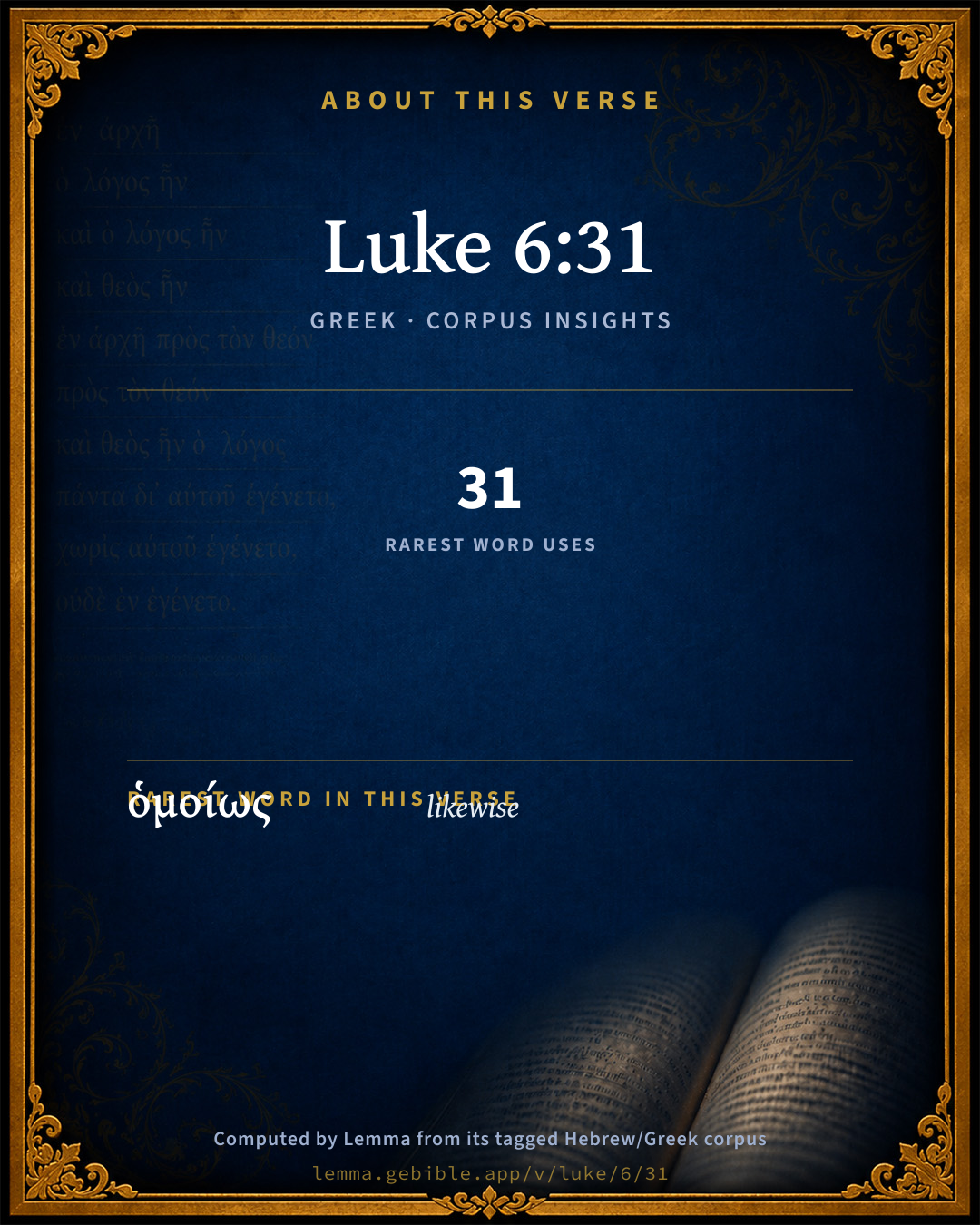
ὁμοίως likewise G3668 occurs in 31 verses of the Greek New Testament. Also found in:
Repetition

Words recur within this verse:

  • ποιῶσιν to make G4160 ×2
  • καὶ and G2532 ×2
  • ὑμῖν you G5210 ×2

Cross-references

4

Topical passages linked to Luke 6:31 in the Treasury of Scripture Knowledge — connected by theme and wording, ordered by reader-vote popularity; previews shown in the World English Bible.

  • Matthew 7:12 Therefore whatever you desire for men to do to you, you shall also do to them; for this is the law and the prophets.
  • Galatians 5:14 For the whole law is fulfilled in one word, in this: "You shall love your neighbor as yourself."
  • Matthew 22:39 A second likewise is this, 'You shall love your neighbor as yourself.'
  • James 2:8–16 However, if you fulfill the royal law, according to the Scripture, "You shall love your neighbor as yourself," you do well.

Cross-references courtesy of OpenBible.info (CC BY 4.0).

Commentary

Notes on Luke 6:31 from classic Christian and Jewish commentators (each source and its license shown beneath its notes). The classic Christian expositions comment on the surrounding passage and are grouped to its opening verse, so a note may address several verses; the Jewish commentaries on the Tanakh (Rashi and others) are per-verse, so they appear only where the commentator wrote on this verse.

Lemma curates 59 commentaries, every one of them public domain or Creative Commons licensed, each selected and text-cleaned for this edition rather than reprinted as found. About our sources →

The Biblical Illustrator

Joseph S. Exell

Luk_6:31

And as ye would that men should do to you, do ye also to them likewise.

What would we that men should do unto us?

1. That they should deal with us honestly.

2. That they should treat us generously.

3. That they should deal with us faithfully; warning us of any danger into which we are liable to fall.

4. That they should be patient with us. (H. S. Brown.)

The royal law

I. THE LAW ITSELF--

1. Teaches us to take the initiative; to begin to do for others what we conceive they ought to do for us.

2. Teaches us that the standard we set up for others must be the measure of our own conduct.

3. Teaches us that the end of our duty is the good of humanity.

II. THE WORKING OF THE LAW.

1. In the home-life.

2. In our social relationships.

3. In relation to business in all shapes and forms.

4. In relation to party politics.

5. In relation to church life. (J. B. Walton, B. A.)

Do as you would be done by

Men who neglect Christianity nevertheless do acknowledge this precept; men of experience, practical, intelligent, when talked to upon the subject of religion will not scruple to say: My religion is this--Do as you would be done by. And yet they fail to apply this to the claim of Jesus Christ upon them. All who have lived and died, all who are now living--all combined, have not the claim on my life that Jesus Christ has. I ask you how you dare to say that all your religion is Do as you would be done by, if you fail to apply it to Him who has done so much for you. Do it, and you must dedicate all you have and all you are to His glory. (Dr. Deems.)

Was the golden rule original?

The gold in the Golden Rule is not its newness but its goodness. (A. Macleod, D. D.)

The rule and the test of morality

The light and warmth of the sun no more clearly bespeak the hand that formed it, than the excellence of this rule of conduct declares it to be from God. Although no rule is perhaps so universally admired, yet none is more universally broken.

I. TO EXPLAIN THE RULE. In explaining the rule, let us examine the different parts of it. All things whatsoever. This clause declares its universal extent. We may do some things, perhaps many things, to others which we would wish them to do to us, and yet in many other things be wholly and habitually selfish. A man, for example, may give food to the hungry, but Habitually overreach and defraud. No matter who he is, whether friend or enemy, if he is a fellow-creature, one of your own species, a man, you must be governed by this rule in all that you do toward him. Do ye even so. In this clause we are directed not only to do the things themselves which we would that others should do to us, but also to the utmost exactness in doing so. What, then, are we to understand by the clause, Whatsoever ye would that men should do to you? It has commonly been supposed, by commentators, that a literal interpretation of this text is inconsistent with other plain scriptural duties, and that therefore the rule is to be explained by certain qualifications or restrictions not expressed in it; for our desires of good from others may be selfish and extravagant, and to make such desires the measure of what we are to do to others, would in many cases be doing what is not required, as well as what is forbidden. For example, a rich man may feel and say, If I were in that poor mans place and he in mine, I should wish him to give me his estate; and now, if I am to do as I would be done by, I am to show him the same kindness, and give him my estate. This difficulty evidently arises from inadequate views of the text. The rule contains its own explanation and limitation. If I am to do to others as I would that they should do to me, then I am to love them as I love myself; not them more than myself, nor myself more than them. If, therefore, I were to give my estate, if I were rich, to a poor man, I should do that which in this respect would imply that I loved him more than myself, which would be a palpable violation of the rule. Besides, how can I, putting myself in the poor mans place, wish another to give me his estate--wish that he should impoverish himself to enrich me, without violatingthe rule. In this very wish I am desiring my own happiness more than my neighbours, and thus I counteract the very spirit and letter of the rule itself. In deciding what we would that others should do to us--i.e., in forming our desires of good from others--we are to remember that we are to cherish the same desires to impart good to them. Thus one desire is to check and regulate and define the other. Thus the rule aims directly at the utter extinction of all selfish inordinate desires of good, and requires simply that what we would on disinterested principles desire from others, were we in their circumstances and they in ours, we are to do to them. Let us examine this a little further. We are to do to others what we would on truly benevolent principles desire from them. The existence of the happiness of one man, other things being equal, is of equal value with that of another. The simple fact that the happiness of one of the two is mine, gives it no additional value. It has precisely the same value as when it is the happiness of another. All the value which I can reasonably attach to my happiness, because it is mine, he can us reasonably attach to his, because it is his. All that I am to myself he is to himself, and all that I am as it respects him he is as it respects me. The reason why I should regard his happiness as much as my own, circumstances being tile same, is as plain and conclusive as that things of equal value ought to be equally loved or desired. If my right lays him under obligation to me, his right lays me under the same obligation to him. There is a great diversity in the character and stations of men. It is very desirable there should be, and as it is not in our power so it is not our duty, on principles of true benevolence, to wish to alter them. There is, therefore, a consequent variety of duties owed to men. But we can easily determine, by the rule before us, what these duties are. Thus a ruler is to treat his subjects as he would wish to be treated were he a subject. But he is not bound to yield that submission to his subjects which, as a ruler, he justly demands of them. This he could not do without sacrificing the public good to private interest--i.e., he could not do it on disinterested principles. For, if he were a subject, he could not on such principles wish for the submission and obedience of a ruler to himself. A judge is not required to acquit, though he might on selfish principles wish, were he the criminal, to be acquitted, because he could not on benevolent principles wish the laws of justice to be abandoned, and the guilty to go unpunished. Thus, too, a parent or head of a family is not required to neglect to promote the welfare of his own household, to promote the welfare of his neighbours, because on truly disinterested principles he could not wish his neighbour to do so by him. So, also, an individual is not required to sacrifice his own happiness to promote an equal degree of happiness in another individual, because it is as right that the former should enjoy it, if but one can enjoy it, as that the latter should; and therefore the former could not, on truly disinterested principles, desire that the latter should do so by him. On the same principle we are not required to put our property into common stock for the equal benefit of all. This would tend, as a general rule, to promote so many evils, that if we were poor we could not, on benevolent principles, desire it. The amount of this rule of our Lord is, that in determining what our duty is to others, and in performing it, our selfishness is to have no voice and no influence. It is as if our Lord had said: Regard your neighbour in his wants, his rights, his happiness, as another self. Ask, then, how, as a reasonable, disinterested man, you would be treated by him: and treat him exactly in that manner.

II. To ENFORCE THE DUTY.

1. God has commanded it.

2. The duty is obviously reasonable and right.

3. This rule has a most direct and effectual tendency to promote the happiness of men.

4. Obedience to this rule is the most ennobling character of man. The spirit inculcated is the very opposite of selfishness; and selfishness is the very substance of moral degradation. But behold the man who loves his neighbour as himself! Behold him raised, as it were to heaven, by the principles just described; behold his heart fixed on the good of his fellowmen, his friends, his enemies, his neighbour, and the stranger, as on his own happiness! What is there lovely, what of good report, what of moral beauty, that does not shine in such a character? Is it not real greatness to be like him?

5. We can neither be fit for, nor admitted into heaven without this character. It is impossible not to see in every page of the Scriptures the necessity of a fitness for heaven which consists in the subjugation of selfish to benevolent principles, and which are all summed up in one expressive term, Holiness, without which no man shall see the Lord.

Remarks:

1. We see that many things which are deemed consistent with this rule of Christs are direct violations of it. Why does the duelist consent that his antagonist should take his life if he can do it? That he may have an opportunity to take that of a fellow-creature. Is this being willing to give up his life to another from motives of disinterested love? Must one or the other die; and rather than that his neighbour should die, does he consent to die himself? Why, too, is the gambler, or the man who takes undue advantage of his neighbour in trade, willing that others should do to him as he does to them? For the same reason substantially, as it respects the morality of the act that governs the duelist. They are willing that others should treat them thus, that they may obtain, or at least have the opportunity of obtaining, their neighbours property without an equivalent. For, if they are really willing their neighbours should have their property without an equivalent, why not give it to them directly? My hearers, such is the deception which men practise on themselves, in these and a thousand other cases. They are not willing to do as they pretend; the proof is, that they do not do it. They are at most willing to run the hazard of being injured themselves, for the privilege of injuring their neighbour.

2. We remark that there is very little genuine morality in the world.

3. How it would commend the religion of the gospel to all, if there were more of the spirit of the text manifested by its professors.

4. I cannot close without remarking, how much we all need a Saviour! I say all; for, let it be noticed, that to condemn what is wrong in the professors of religion, does not justify what is wrong in those who are not. (N. W. Taylor, D. D.)

On the great Christian law of reciprocity between man and man

Let a man, in fact, give himself up to a strict and literal observation of the precept in this verse, and it will impress a twofold direction upon him. It will not only guide him to certain performances of good in behalf of others, but it will guide him to the regulation of his own desires of good from them. For his desires of good from others are here set up as the measure of his performances of good to others. The more selfish and unbounded his desires are, the larger are those performances with the obligation of which he is burdened. Whatsoever he would that others should do unto him, he is bound to do unto them; and therefore, the more he gives way to ungenerous and extravagant wishes of service from those who are around him, the heavier and more insupportable is the load of duty which he brings upon himself. The commandment is quite imperative, and there is no escaping from it; and if he, by the excess of his selfishness, should render it impracticable, then the whole punishment due to the guilt of casting aside the authority of this commandment, follows in that train of punishment which is annexed to selfishness. There is one way of being relieved from such a burden. There is one way of reducing this verse to a moderate and practicable requirement; and that is, just to give up selfishness- just to stifle all ungenerous desires- just to moderate every wish of service or liberality from others, down to the standard of what is right and equitable; and then there may be other verses in the Bible, by which we are called to be kind even to the evil and to the unthankful. But most assuredly this verse lays upon us none other thing than that we should do such services for others as are right and equitable. The operation is somewhat like that of a governor or fly in mechanism. This is a very happy contrivance, by which all that is defective or excessive in the motion, is confined within the limits of equability; and every tendency, in particular, to any mischievous acceleration is restrained. The impulse given by this verse to the conduct of man among his fellows, would seem, to a superficial observer, to carry him to all the excesses of a most ruinous and quixotic benevolence. But let him only look to the skilful adaptation of the fly. Just suppose the control of moderation and equity to be laid upon his own wishes, and there is not a single impulse given to his conduct beyond the rate of moderation and equity. You are not required here to do all things whatsoever in behalf of others, but to do all things whatsoever for them, that you would should be done unto yourself. This is the check by which the whole of the bidden movement is governed, and kept from running out into any hurtful excess. And such is the beautiful operation of that piece of moral mechanism that we are now employed in contemplating, that while it keeps down all the aspirations of selfishness, it does, in fact, restrain every extravagancy, and impresses on its obedient subjects no other movement than that of an even and inflexible justice. This rule of our Saviours, then, prescribes moderation to our desires of good from others, as well as generosity to our doings in behalf of others; and makes the first the measure of obligation to the second. There is nothing in the humble condition of life they occupy which precludes them from all that is great or graceful in human charity. There is a way in which they may equal, and even outpeer, the wealthiest of the land, in that very virtue of which wealth alone has been conceived to have the exclusive inheritance. There is a pervading character in humanity which the varieties of rank do not obliterate; and as, in virtue of the common corruption the poor man may be as effectually the rapacious despoiler of his brethren, as the man of opulence above him--so, there is a common excellence attainable by both; and through which the poor man may, to the full, be as splendid in generosity as the rich, and yield a far more important contribution to the peace and comfort of society. To make this plain--it is in virtue of a generous doing on the part of a rich man, when a sum of money is offered for the relief of want; and it is in virtue of a generous desire on the part of a poor man, when this money is refused; when, with the feeling that his necessities do not just warrant him to be yet a burden upon others, he declines to touch the offered liberality; when, with a delicate recoil from the unlooked-for proposal, he still resolves to put it for the present away, and to find, if possible, for himself a little longer; when, standing on the very margin of dependence, he would yet like to struggle with the difficulties of his situation, and to maintain this severe but honourable conflict, till hard necessity should force him to surrender. Let the money which he has thus so nobly shifted from himself take some new direction to another; and who, we ask, is the giver of it? The first and most obvious reply is, that it is he who owned it; but, it is still more emphatically true, that it is he who has declined it. It came originally out of the rich mans abundance; but it was the noble-hearted generosity of the poor man that handed it onwards to its final destination. Thus it is, that when Christianity becomes universal, the doings of the one party, and the desires of the other, will meet and overpass. The poor will wish for no more than the rich will be delighted to bestow; and the rule of our text, which every real Christian at present finds so practicable, will, when carried over the face of society, bind all the members of it into one consenting brotherhood. The duty of doing good to others will then coalesce with that counterpart duty which regulates our desires of good from them; and the work of benevolence will, at length, be prosecuted without that alloy of rapacity on the one hand, and distrust on the other, which serve so much to fester and disturb the whole of this ministration. To complete this adjustment, it is in every way as necessary to lay all the incumbent moralities on those who ask, as on those who confer; and never till the whole text, which comprehends the wishes of man as well as his actions, wield its entire authority over the species, will the disgusts and the prejudices, which form such a barrier between the ranks of human life, be effectually done away. It is not by the abolition of rank, but by assigning to each rank its duties, that peace and friendship and order will at length be firmly established in our world. We should not have dwelt so long upon this lesson, were it not for the essential Christian principle that is involved in it. The morality of the gospel is not more strenuous on the side of the duty of giving of this worlds goods when it is needed, than it is against the desire of receiving when it is not needed. ( T. Chalmers, D. D.)

The golden rule taught by an Indian

Some time before the war between the English and the Indians in Pennsylvania broke out, an English gentleman, who lived on the borders of the province, was standing one evening at his door, when an Indian came and desired a little food. He answered, he had none for him. He then asked for a little beer, and received the same answer. Not yet discouraged, he begged for a little water; but the gentleman only answered, Get you gone for an Indian dog. The Indian fixed his eye for a little time on the Englishman, and then went away. Some time after, this gentleman, who was fond of shooting, pursued his game till he was lost in the woods. After wandering a while, he saw an Indian hut, and went to it to inquire his way to some plantation. The Indian said, It is a great way off, and the sun is near going down; you cannot reach it to-night, and if you stay in the woods the wolves will eat you up; but if you have a mind to lodge with me, you may. The gentleman gladly accepted the invitation, and went in. The Indian boiled a little venison for him, gave him some rum and water, and then spread some deer skins for him to lie upon; having done this, himself and another Indian went and lay at the other side of the hut. He called the gentleman in the morning, telling him that the sun was up, and that he had a great way to go to the plantation, but that he would show him the way. Taking their guns, the two Indians went forward, and he followed. When they had gone several miles, the Indian told him he was within two miles of the plantation he wanted; then, stepping before him, he said, Do you know me? In great confusion, the gentleman replied, I have seen you. Yes, said the Indian, you have seen me at your own doer; and I will give you a piece of advice: when a poor Indian, who is hungry, and dry, and faint, again asks you for a little meat or drink, do not bid him get him gone for an Indian dog. So he turned and went away. Which of these two was to be commended, or which acted most agreeably to the Saviours golden rule in the text?

The Biblical Illustrator, edited by Joseph S. Exell (c. 1880s–1900s) — public domain. Text from a community e-Sword module.

Tyndale Open Study Notes

Tyndale Open Resources

6:31 Do to others as you would like them to do to you: While the Golden Rule appears in some form in various religious and philosophical traditions, only in Jesus’ teaching is love for all people, including enemies, the fundamental ethic that governs all behavior.

Tyndale Open Study Notes — © Tyndale Open Resources, licensed CC BY-SA 4.0. Text via the HelloAO Bible API.

Meyer's Critical & Exegetical Commentary

Heinrich August Wilhelm Meyer

Luk_6:31. Comp. Mat_7:12. To the injunction given and specialized at Luk_6:27 ff. of the love of ones enemy, Jesus now adds the general moral rule (Theophylact: νόμον ἔμφυτον ἐν ταῖς καρδίαις ἡμῶν ἐγγεγραμμένον), from which, moreover, results the duty of the love of ones enemy. It is self-evident that while this general principle is completely applicable to the love of ones enemy in itself and in general, it is applicable to the special precepts mentioned in Luk_6:29-30 only in accordance with the idea (of self-denial), whose concrete representation they contain: hence Luk_6:31 is not in this place inappropriate (in opposition to de Wette).

καὶ καθὼς κ.τ.λ.] a simple carrying forward of the discourse to the general principle: and, in general, as ye, etc.

ἵνα] Contents of the θέλετε under the notion of purposeye will, that they should, etc. Comp. Mar_6:25; Mar_9:30; Mar_10:35; Joh_17:24; 1Co_14:5. See also Nägelsbach, Anm. z. Ilias, ed. 3, p. 62 f.

Meyer — Critical and Exegetical Commentary on the New Testament — English translation by Peter Christie, edited by Frederick Crombie (T&T Clark, 1880) — public domain. Text from a community e-Sword module.

Expositor's Greek Testament

ed. W. Robertson Nicoll

Luk 6:31 . Lk. brings in here the law of reciprocity (Mat 7:12 ), hardly in its proper place, as the change from singular to plural shows, but in sympathy with what goes before, though not quite in line, and therefore inserted at this point as the best place to be found for the golden rule. It seems to be meant as a general heading for the particular hypothetical cases following = you would like men to love you, therefore love them whether they love you or not, etc.

The Expositor's Greek Testament, edited by W. Robertson Nicoll (1897–1910) — public domain. Text from a community e-Sword module.

Ellicott's Commentary for English Readers

(31) As ye would that men should do to you . . .—See Note on Mat_7:12. The very different arrangement of the precepts in the two discourses is obviously an argument against their identity.

A Bible Commentary for English Readers, edited by Charles John Ellicott (1878–1897) — public domain. Text from a community e-Sword module.

The Cambridge Bible for Schools and Colleges

gen. ed. J. J. S. Perowne

31. as ye would that men should do to you] The golden rule of Christianity of which our Lord said that it was “the Law and the Prophets,” Mat_7:12. The modem ‘Altruism’ and ‘vivre pour autrui,’ though pompously enunciated as the bases of a new religion, are but a mutilated reproduction of this.

The Cambridge Bible for Schools and Colleges (gen. ed. J. J. S. Perowne; Cambridge University Press, 1878–1918) — public domain. Text from a community e-Sword module.

John Gill's Exposition

For if ye love them which love you, what thank have ye?.... Or, "what grace have ye?" this is no fruit, nor evidence of grace, nor any exercise of the true grace of love; nor is it any favour conferred upon the object loved, which deserves the respect shown, nor can any reward be expected for such treatment: and thus it is expressed in Matthew, "what reward have ye?" and the Arabic version renders it so here:

for sinners also love those who love them: men that are destitute of the grace of God, profligate sinners, even the worst of them, such as publicans, do this; See Gill on Mat 5:46.

John Gill's Exposition of the Whole Bible (1746–1763) — public domain (CC PDM 1.0). Text via the HelloAO Bible API.

Trapp's Complete Commentary

John Trapp

31 And as ye would that men should do to you, do ye also to them likewise.

Ver. 31. And as ye would that men, &c.] The most part of the Turk’s civil justice is grounded upon this rule, as is above noted.

John Trapp, A Commentary or Exposition upon All the Books of the Old and New Testament (1647–1656) — public domain. Text from a community e-Sword module.

Matthew Poole's English Annotations

See Poole on "Mat 7:12". This is the law of nature the golden rule of all justice, and may also serve for a guide to us to expound the former verses, and some other precepts of charity in this chapter. Men in all these cases should consider what they would be glad, and think reasonable, that others should do to them, were they in their circumstances, and the others had the same ability or advantage to do good to them; and by this they should measure their acts both of justice and charity.

Matthew Poole's English Annotations on the Holy Bible (1683–1685) — public domain. Text from a community e-Sword/MySword module.

The Pulpit Commentary

The golden rule.

We call this precept of Christ "the golden rule;" probably we intend thereby to pay it the highest honour we can offer it. But it is the "precious metal," rather than the admirable precept, to which the compliment is paid by the association of the two. For if this rule of our Lord were only illustrated in the daily life of men, they would be enriched as no imaginable quantity of gold could enrich them. Then would such a revolution be effected as no statesman has ever dreamed of working; then would all social evils for ever disappear; then would human life wear another aspect from that which now saddens and shames us; for the golden rule, enacted in the lives of men, would soon inaugurate the "golden year." We look at

I ITS SURPASSING EXCELLENCY,

1. It is within all mens apprehension. It is no learned, erudite definition, requiring much culture to comprehend. The most simpleminded can understand it.

2. It commends itself to all mens conscience. It is not one of those commandments which require much thought and much practice to appreciate. It is obviously just and fair. It hardly admits of dispute. Every one can see, every one must feel if "the light that is in him be not darkness that it is the right thing for him to do.

3. It excludes all evasions. No man can shield himself under any misrepresentation of the rule. He must know whether or not he is trying to act toward his neighbour as he would that his neighbour should act toward him.

4. It covers the entire range of human life, so far as our relations to one another are concerned. It covers:

(1) Action, and also inaction; including in its sweep not only those things we do, but those we leave undone the attention, the kindness, the consideration, the return we should render but may be withholding.

(2) The judgment we form of others; the right they have to our patient, impartial, intelligent, charitable judgment; the claim they may fairly make that we should attribute the worthy rather than the unworthy, the pure rather than the impure, the generous rather than the mean motive.

(3) Our speech; the utterance of the kind and true word of our neigh-hour, and also to him.

(4) Conduct-all our dealings and doings, of all kinds whatsoever, in all the varied relations in which we stand to our fellow-men. This one rule of Christ is a powerful test and solvent of all other prescriptions. If they can be carried out and yet leave us short, in our practice, of doing to others as they would like us to act toward them, these rules are imperfect. They leave something to be desired and to be attained.

II THE INSPIRATION WE NEED TO FULFIL IT. This great precept of Christ is not to be translated into action like any ordinary military or municipal regulation. We must gain some inspiration from our Lord himself if we are to keep this great commandment. And we must be prompted by three things.

1. An earnest desire to follow Christ"s own example.

2. A strong purpose of heart to do his holy will, that we may please and honour him.

3. A kind and Christian interest in our neighbours; a gracious pity for those whom he pitied, and for whom he suffered and died; a warm interest in their welfare; a firm faith that they can be raised and renewed and refined; a holy love for all those who love him. C.

The Pulpit Commentary (1880–1919), ed. H.D.M. Spence-Jones & Joseph S. Exell — public domain. Text from a community e-Sword module.

John Wesley's Explanatory Notes

Matt. vii, 12.

John Wesley, Explanatory Notes Upon the Whole Bible (1754–1765) — public domain. Text via the GEBible commentary corpus.

Burkitt's Expository Notes on the New Testament

William Burkitt

Here our Saviour lays down a most excellent rule of life, for all his disciples and followers to walk by, namely, always to do as we would be done by. The golden rule of justice and equity in all our dealings with men is this, To do as we would be done unto. It is a full rule, a clear rule, a most just and equitable rule, which the light of nature, and the law of Christ, binds upon us.

This is the law and the prophets; Mat 7:12 That is, the sum of the Old Testament, and the substance of the second table. The whole of the law is this; to love God above ourselves, and to love our neighbors as ourselves.

William Burkitt's Expository Notes on the New Testament (1700–1703) — public domain. Text from a community e-Sword module.

McGarvey & Pendleton's Commentaries

J. W. McGarvey

J. W. McGarvey's The Fourfold Gospel [XLII. I. The Golden Rule].

XLII. THE SERMON ON THE MOUNT. (A Mountain Plateau not far from Capernaum.) Subdivision I. THE GOLDEN RULE. aMATT. VII. 12; cLUKE VI. 31.

a12 All things therefore whatsoever ye would c31 and as ye would that men should do to aunto you, even so do ye also unto cto them likewise. afor this is the law and the prophets. [Jesus connects the Golden Rule with what precedes with the word "therefore." We are to practice the Golden Rule because God's divine judgment teaches forbearance, and his goodness teaches kindness. This precept is fitly called the Golden Rule, for it embraces in its few words the underlying and governing principle of all morality. It contains all the precepts of the law with regard to man, and all the amplifications of those precepts given by the prophets. It teaches us to put ourselves in our neighbor's place, and direct our conduct accordingly. It assumes, of course, that when we put ourselves in our neighbor's place, we are wise enough not to make any foolish wishes, and good enough not to make any evil ones. The great sages Socrates, Buddha, Confucius and Hillel each [265] groped after this truth, but they stated it thus: "Do not do to others what you would not have done to you;" thus making it a rule of not doing rather than of doing. But the striking difference between these teachers and Christ lies not in the statements so much as in the exemplification. Jesus lived the Golden Rule in his conduct toward men, and maintained perfect righteousness before God in addition thereto.]

[FFG 265-266]

J. W. McGarvey (with Philip Y. Pendleton), Commentaries on the New Testament (The Fourfold Gospel, 1914; Acts; and the epistles) — public domain. Text from a community e-Sword/MySword module.

unfoldingWord translationNotes

Door43 World Missions Community

As you want people to do to you, you should do the same to them

In some languages it may be more natural to reverse the order. AT: "You should do to people the same as what you want them to do to you" or "Treat people they way you want them to treat you"

what credit is that to you?

"what reward will you receive?" or "what praise will you receive for doing that?" This can be written as a statement. AT: "you will not receive any reward for that." or "God will not reward you for that." (See: Rhetorical Question)

to get back the same amount

The law of Moses commanded the Jews not to receive interest on money they loaned to each other. (See: Assumed Knowledge and Implicit Information)

translationWords

love

sin

good

unfoldingWord translationNotes — © Distant Shores Media and the Door43 World Missions Community, licensed CC BY-SA 4.0. Source: git.door43.org/Door43/en_tn.

Cambridge Greek Testament for Schools and Colleges

31. καθὼς θέλετε κ.τ.λ. The golden rule of Christianity of which our Lord said that it was “the Law and the Prophets,” Mat 7:12. The modern ‘Altruism’ and ‘vivre pour autrui,’ though pompously enunciated as the basis of a new religion, are but a mutilated reproduction of this.

ἵνα ποιῶσιν. Another instance of the loose Hellenistic expansion of the use of ἵνα.

Cambridge Greek Testament for Schools and Colleges (Cambridge University Press, 1896; 21 vols, various authors incl. Carr, Maclear, Plummer, Farrar, Lumby, Moule, M. R. James, Simcox) — public domain. Text from a community e-Sword module.

Alford’s Greek Testament

Henry Alford

31.] Mat 7:12; but here it seems somewhat out of connexion, for the sense of vv. 29, 30, has been resist not evil, whereas this precept refers to the duty of man to man, injury being out of the question.

Henry Alford, The Greek Testament (1849–1861) — public domain. Text from a community e-Sword module.

International Critical Commentary

31. 7:12. 47-49. 24-27.

31. καὶ καθὼς θέλετε. The καὶ introduces the general principle which covers all these cases: “and in short, in a word.” How would one wish to be treated oneself if one was an aggressor? How ought one to wish to be treated? But obviously the principle covers a great deal more than the treatment of aggressors and enemies. In Tobit 4:15 we have, “Do that to no man which thou hatest”; but this purely negative precept, which was common with the Rabbis, falls immeasurably short of the positive command of Christ. Isocrates has ἃ πάσχοντες ὑφʼ ἐτέρων ὀργίζεσθε, ταῦτα τοῖς ἄλλοις μὴ ποιεῖτε, and the stoics said, Quod tibi fieri non vis, alteri ne feceris; and the same is found in Buddhism. In the Δισαχή, 1:2, and Apost. Const. vii. 2, 1, we have both the positive and the negative form. Cod. D, Iren. (3:12, 14), Cypr. (Test. iii. 119) and other authorities insert the negative form Act 15:29. How inadequate the so-called Rabbinical parallels to the sermon on the Mount are, as collected by Wünsche and others, has been shown by Edersheim (L. & T. 1. p. 531). Note the καθώς, “even as, precisely as”: the conformity is to be exact. For θέλειν ἵνα Comp. Mat 7:12; Mar 6:25, Mar 6:9:30, Mar 6:10:35; Joh 17:24, and see on 4:3. The καὶ ὑμεῖς before ποιεῖτε is omitted by B and some Latin texts. “Do likewise” occurs only here, 3:11, and 10:37.

International Critical Commentary — older volumes (1896–1929), various authors — public domain. Text from a community e-Sword module.

Godet's Commentaries

Frédéric Louis Godet

2 d. After having described the applications of the new principle, Jesus gives a formal enunciation of it, Luk 6:31: “And as ye would that men should do to you, do ye also to them likewise.”

The natural heart says, indeed, with the Rabbins. “What is disagreeable to thyself, do not do to thy neighbour.” But charity says, by the mouth of Jesus: “Whatsoever thou desirest for thyself, that do to thy neighbour.” Treat thy neighbour in everything as thine other self. It is obvious that Jesus only means desires that are reasonable and really salutary. His disciples are regarded as unable to form any others for themselves. Καί, and, may be rendered here by, in a word. In Matthew this precept is found in chap. 7 towards the end of the discourse, between an exhortation to prayer and a call to conversion, consequently without any natural connection with what precedes and follows. Notwithstanding this, Tholuck prefers the position which it has in Matthew. He regards this saying as a summary of the whole discourse (p. 498). But is it not manifest that it is more naturally connected with a series of precepts on charity, than with an exhortation to prayer?

Frédéric Louis Godet — Commentaries on Luke, John, Romans, and 1 Corinthians — English translation (T&T Clark, Edinburgh, 1870s–1890s) — public domain. Text from a community e-Sword module.

Lesson kit

Teaching starters — assembled from the data on this page, not authored interpretation. Every prompt links to the verse data it draws on. Edit before teaching.

Luke, in the Gospels, opens this verse with 13 words (10 distinct Greek lemmas). Its most distinctive word is homoíōs (“likewise”). A historical commentator’s framing appears above. Read the whole chapter for the surrounding context.

Discussion questions

  1. What does “likewise” (homoíōs) contribute to the verse as a whole?
  2. How does Matthew 22:26, which shares the word «likewise», read alongside this verse?
  3. What does the repetition of “to make” (2× in this one verse) do in this verse?
  4. The translations on this page render this verse differently — a whole-verse word diff, not a word-by-word alignment. What might account for the different wordings?
  5. Compare how The Biblical Illustrator and Tyndale Open Study Notes read this verse. Where do they agree or differ?

Things to notice

  • These translations choose different wording for 9 words in this verse.
  • “to make” occurs 2× in this single verse.
  • 10 distinct Greek lemmas span 13 words in this verse.

Reading settings

Reading text

Shown beneath each verse's original-language words.

Old Testament
Old Testament edition

Read the OT as the Masoretic Hebrew (MT) or the Greek Septuagint (LXX).

English shown for the Greek Septuagint (in the Hebrew ↔ Greek comparison).

Comparing translations? Open the Compare panel on any verse page to stack up to four side by side.