

Matthew 20:12
Greek (Tischendorf 8th ed.) Matthew 20:12 appears in the Greek New Testament. The text above is from the Tischendorf 8th edition. Each word links to its Strong’s number and a concise gloss. Click any word for its full Thayer’s Greek Lexicon entry.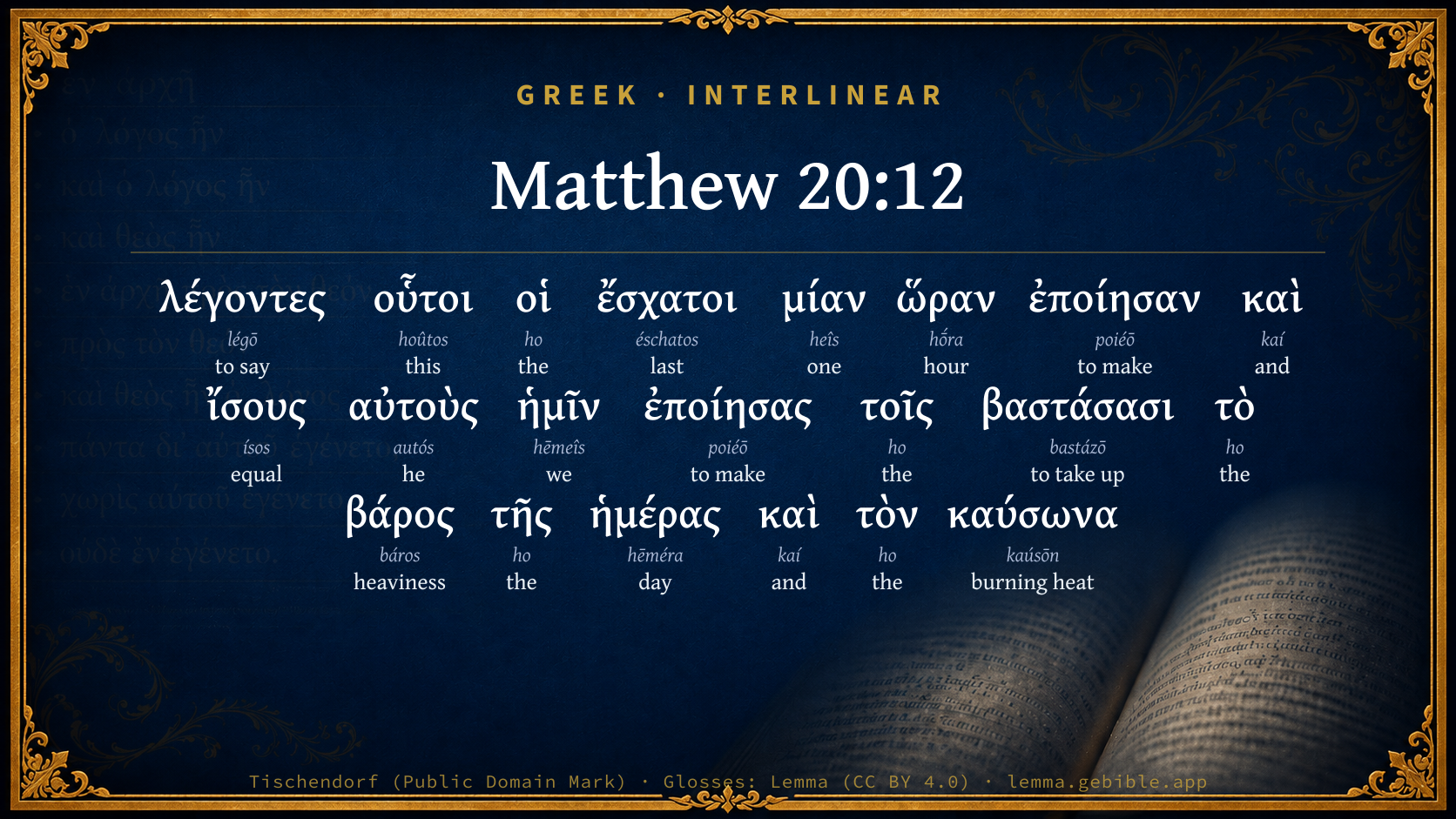
saying, 'These last have spent one hour, and you have made them equal to us, who have borne the burden of the day and the scorching heat!'
Download a study sheet
One document with this verse’s original text, its word-by-word gloss line, the meaning frame, cross-references with their text, attributed commentary, and full source and license credits — printable, and it pastes into notes with its structure intact.
This verse Autodidact and up
A passage Seminary Student
Up to 50 verses in one chapter. A passage sheet keeps up to 6 commentary sources and 12 cross-references per verse, in the order this page ranks them, and says so on the sheet whenever that leaves anything out. Ask for a single verse and you get the Autodidact verse sheet above.
Everything on this page stays free to read, with no account — the sheet is a download of what is already on screen, not access to it.
Compare translations 3
The same verse in 3 English versions, stacked beneath the original-language interlinear above. Click any original word for its lexicon entry.
Each is an independent rendering of the whole verse — the interlinear is not word-aligned to these translations.
Highlighted words mark where these versions differ — a whole-verse word diff, not a word-by-word alignment.
-
World English Bible Public Domain
saying, 'These last have spent one hour, and you have made them equal to us, who have borne the burden of the day and the scorching heat!'
-
King James Version Public Domain
Saying, These last have wrought but one hour, and thou hast made them equal unto us, which have borne the burden and heat of the day.
-
unfoldingWord Literal Text CC BY-SA 4.0
saying, ‘These last ones have done one hour, but you made them equal to us, the ones having borne the burden of the day and the scorching heat.’
unfoldingWord Literal Text — © unfoldingWord, licensed CC BY-SA 4.0. Word-aligned USFM3 via Door43 (git.door43.org/unfoldingWord/en_ult).
Show all 19 translations
Every available English version of this verse, each an independent rendering of the whole verse.
-
World English Bible Public Domain
saying, 'These last have spent one hour, and you have made them equal to us, who have borne the burden of the day and the scorching heat!'
-
Berean Standard Bible Public Domain
‘These men who were hired last worked only one hour,’ they said, ‘and you have made them equal to us who have borne the burden and the scorching heat of the day.’
-
Majority Standard Bible Public Domain
‘These men who were hired last worked only one hour,’ they said, ‘and you have made them equal to us who have borne the burden and the scorching heat of the day.’
-
King James Version Public Domain
Saying, These last have wrought but one hour, and thou hast made them equal unto us, which have borne the burden and heat of the day.
-
American Standard Version (1901) Public Domain
saying, These last have spent `but' one hour, and thou hast made them equal unto us, who have borne the burden of the day and the scorching heat.
-
Revised Version (1885) Public Domain
saying, These last have spent but one hour, and thou hast made them equal unto us, which have borne the burden of the day and the scorching heat.
-
Geneva Bible (1599) Public Domain
Saying, These last haue wrought but one houre, and thou hast made them equall vnto vs, which haue borne the burden and heate of the day.
-
Douay-Rheims (1899) Public Domain
Saying: These last have worked but one hour, and thou hast made them equal to us, that have borne the burden of the day and the heats.
-
Young's Literal Translation Public Domain
that These, the last, wrought one hour, and thou didst make them equal to us, who were bearing the burden of the day -- and the heat.
-
Literal Standard Version CC BY-SA 4.0
that, These, the last, worked one hour, and you made them equal to us, who were bearing the burden of the day—and the heat.
-
Unlocked Literal Bible CC BY-SA 4.0
They said, 'These last workers have spent only one hour in work, but you have made them equal to us, we who have borne the burden of the day and the scorching heat.'
-
unfoldingWord Literal Text CC BY-SA 4.0
saying, ‘These last ones have done one hour, but you made them equal to us, the ones having borne the burden of the day and the scorching heat.’
-
Darby Bible Public Domain
saying, These last have worked one hour, and thou hast made them equal to us, who have borne the burden of the day and the heat.
-
World Messianic Bible Public Domain
saying, ‘These last have spent one hour, and you have made them equal to us who have borne the burden of the day and the scorching heat!’
-
Webster's Bible Public Domain
Saying, These last have wrought but one hour, and thou hast made them equal to us, who have borne the burden and heat of the day.
-
Free Bible Version CC BY-SA 4.0
‘Those who were hired last only worked for an hour, and you've paid them the same as us who worked the whole day in the burning heat,’ they grumbled.
-
Bible in Basic English Public Domain
Saying, These last have done only one hour's work, and you have made them equal to us, who have undergone the hard work of the day and the burning heat.
-
Text-Critical English NT CC BY 4.0
saying, ‘These last men worked for one hour, and yoʋ have made them equal to us, who have borne the burden of the day and the scorching heat.’
-
Tyndale New Testament (1534) Public Domain
saying: These laste have wrought but one houre and thou hast made them equall vnto vs which have born the burthe and heet of the daye.
Literal Standard Version (2020), Covenant Press — licensed CC BY-SA 4.0. Text via the HelloAO Bible API (eBible.org). Unlocked Literal Bible (unfoldingWord) — licensed CC BY-SA 4.0. Text via the HelloAO Bible API (eBible.org). unfoldingWord Literal Text — © unfoldingWord, licensed CC BY-SA 4.0. Word-aligned USFM3 via Door43 (git.door43.org/unfoldingWord/en_ult). Free Bible Version, Dr. Jonathan Gallagher — licensed CC BY-SA 4.0. Text via the HelloAO Bible API (eBible.org).
Word by word
More ways to search: Search by grammar → Find every occurrence → Compare this word →
Practice this passage: Drill this verse → Learn its vocabulary →
- Appears 3× in the Greek New Testament
- First appears here
- Part of Speech
- Noun
- Case
- Accusative
- Number
- Singular
- Gender
- Masculine
Full Thayer's Definition
- λέγοντες légō G3004 “to say” Verb, Present, Active, Participle, Nominative, Plural, Masculine
- οὗτοι hoûtos G3778 “this” Demonstrative pronoun, Nominative, Plural, Masculine
- οἱ ho G3588 “the” Article, Nominative, Plural, Masculine
- ἔσχατοι éschatos G2078 “last” Adjective, Nominative, Plural, Masculine, Superlative
- μίαν heîs G1520 “one” Adjective, Accusative, Singular, Feminine
- ὥραν hṓra G5610 “hour” Noun, Accusative, Singular, Feminine
- ἐποίησαν poiéō G4160 “to make” Verb, Aorist, Active, Indicative, 3rd person, Plural
- καὶ kaí G2532 “and” Conjunction
- ἴσους ísos G2470 “equal” Adjective, Accusative, Plural, Masculine
- αὐτοὺς autós G846 “he” Personal pronoun, Accusative, Plural, Masculine
- ἡμῖν hēmeîs G2249 “we” Personal pronoun, 1st person, Dative, Plural
- ἐποίησας poiéō G4160 “to make” Verb, Aorist, Active, Indicative, 2nd person, Singular
- τοῖς ho G3588 “the” Article, Dative, Plural, Masculine
- βαστάσασι bastázō G941 “to take up” Verb, Aorist, Active, Participle, Dative, Plural, Masculine
- τὸ ho G3588 “the” Article, Accusative, Singular, Neuter
- βάρος báros G922 “heaviness” Noun, Accusative, Singular, Neuter
- τῆς ho G3588 “the” Article, Genitive, Singular, Feminine
- ἡμέρας hēméra G2250 “day” Noun, Genitive, Singular, Feminine
- καὶ kaí G2532 “and” Conjunction
- τὸν ho G3588 “the” Article, Accusative, Singular, Masculine
- καύσωνα kaúsōn G2742 “burning heat” Noun, Accusative, Singular, Masculine
About this verse
These counts appear in no published source. They are computed here, from the morphology-tagged text and Lemma’s own curated glosses. What Lemma adds →
- 21
- words
- 15
- distinct lemmas
- Gospels
- section
Notable vocabulary
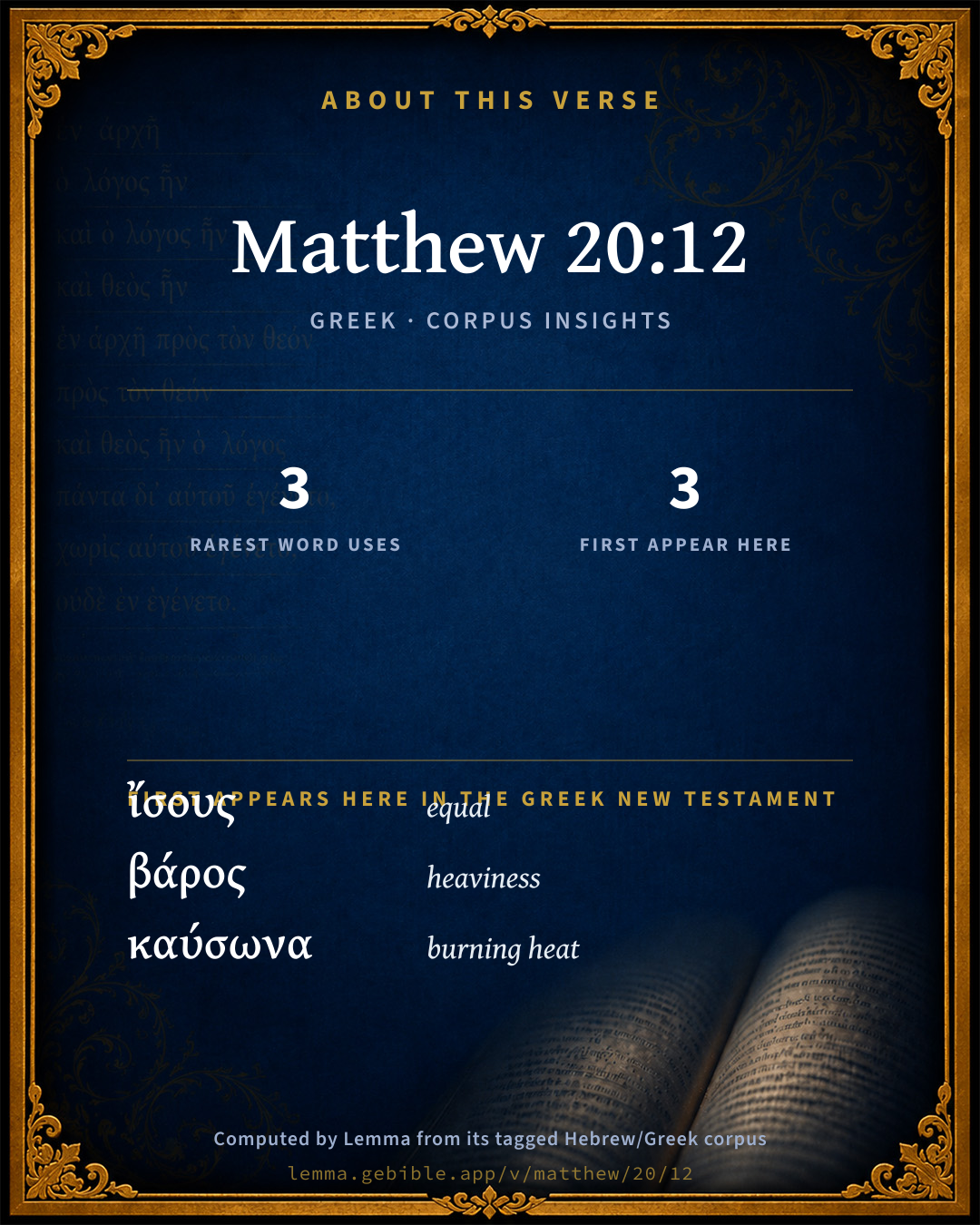
The rarest word here is καύσωνα burning heat G2742 — appearing just 3 times in the whole Greek New Testament.
First appearance in Scripture
These words make their first canonical appearance in the Greek New Testament here:
Shared distinctive vocabulary
καύσωνα burning heat G2742 occurs in 3 verses of the Greek New Testament. Also found in:
Cross-references
19Topical passages linked to Matthew 20:12 in the Treasury of Scripture Knowledge — connected by theme and wording, ordered by reader-vote popularity; previews shown in the World English Bible.
- Romans 11:5–6 Even so then at this present time also there is a remnant according to the election of grace.
- 2 Corinthians 11:23–28 Are they servants of Christ? (I speak as one beside himself) I am more so; in labors more abundantly, in prisons more abundantly, in stripes above measure, in deaths often.
- Luke 12:55 When a south wind blows, you say, 'There will be a scorching heat,' and it happens.
- Luke 14:10–11 But when you are invited, go and sit in the lowest place, so that when he who invited you comes, he may tell you, 'Friend, move up higher.' Then you will be honored in the presence of all who sit at the table with you.
- Luke 18:11–12 The Pharisee stood and prayed to himself like this: 'God, I thank you, that I am not like the rest of men, extortioners, unrighteous, adulterers, or even like this tax collector.
- 1 Corinthians 4:11 Even to this present hour we hunger, thirst, are naked, are beaten, and have no certain dwelling place.
- Isaiah 58:2–3 Yet they seek me daily, and delight to know my ways: as a nation that did righteousness, and didn't forsake the ordinance of their God, they ask of me righteous judgments; they delight to draw near to God.
- Jonah 4:8 It happened, when the sun arose, that God prepared a sultry east wind; and the sun beat on Jonah's head, so that he fainted, and requested for himself that he might die, and said, "It is better for me to die than to live."
- Zechariah 7:3–5 and to speak to the priests of the house of Yahweh of Hosts, and to the prophets, saying, "Should I weep in the fifth month, separating myself, as I have done these so many years?"
- Malachi 1:13 You say also, 'Behold, what a weariness it is!' and you have sniffed at it," says Yahweh of Hosts; "and you have brought that which was taken by violence, the lame, and the sick; thus you bring the offering. Should I accept this at your hand?" says Yahweh.
- Malachi 3:14 You have said, 'It is vain to serve God;' and 'What profit is it that we have kept his charge, and that we have walked mournfully before Yahweh of Hosts?
- Luke 15:29–30 But he answered his father, 'Behold, these many years I have served you, and I never disobeyed a commandment of yours, but you never gave me a goat, that I might celebrate with my friends.
- Romans 3:22–24 even the righteousness of God through faith in Jesus Christ to all and on all those who believe. For there is no distinction,
- Romans 3:27 Where then is the boasting? It is excluded. By what manner of law? Of works? No, but by a law of faith.
- Romans 3:30 since indeed there is one God who will justify the circumcised by faith, and the uncircumcised through faith.
- Romans 9:30–32 What shall we say then? That the Gentiles, who didn't follow after righteousness, attained to righteousness, even the righteousness which is of faith;
- Romans 10:1–3 Brothers, my heart's desire and my prayer to God is for Israel, that they may be saved.
- Ephesians 3:6 that the Gentiles are fellow heirs, and fellow members of the body, and fellow partakers of his promise in Christ Jesus through the Gospel,
- James 1:11 For the sun arises with the scorching wind, and withers the grass, and the flower in it falls, and the beauty of its appearance perishes. So also will the rich man fade away in his pursuits.
Cross-references courtesy of OpenBible.info (CC BY 4.0).
Lesson kit
Teaching starters — assembled from the data on this page, not authored interpretation. Every prompt links to the verse data it draws on. Edit before teaching.
Matthew, in the Gospels, opens this verse with 21 words (15 distinct Greek lemmas). Its most distinctive word is kaúsōn (“burning heat”). A historical commentator’s framing appears above. Read the whole chapter for the surrounding context.
Discussion questions
- How does “burning heat” (kaúsōn) shape what this verse is saying?
- 3 words make their first appearance in Scripture here. What does this debut establish?
- How does Luke 12:55, which shares the word «burning heat», read alongside this verse?
- What does the repetition of “to make” (2× in this one verse) do in this verse?
- These translations render this verse differently. What is at stake in choosing one wording over another?
- Compare how Bengel's Gnomon and Meyer's Critical & Exegetical Commentary read this verse. Where do they agree or differ?
Things to notice
- 3 words make their first canonical appearance in Scripture here.
- These translations choose different wording for 9 words in this verse.
- “to make” occurs 2× in this single verse.
- 15 distinct Greek lemmas span 21 words in this verse.
Commentary
Notes on Matthew 20:12 from classic Christian and Jewish commentators (each source and its license shown beneath its notes). The classic Christian expositions comment on the surrounding passage and are grouped to its opening verse, so a note may address several verses; the Jewish commentaries on the Tanakh (Rashi and others) are per-verse, so they appear only where the commentator wrote on this verse.
Lemma curates 59 commentaries, every one of them public domain or Creative Commons licensed, each selected and text-cleaned for this edition rather than reprinted as found. About our sources →
Bengel's Gnomon
Johann Albrecht Bengel
Bengel's Gnomon of the New Testament — English translation (T&T Clark, Edinburgh, 1860) — public domain. Text from a community e-Sword module.
Meyer's Critical & Exegetical Commentary
Heinrich August Wilhelm Meyer
Meyer — Critical and Exegetical Commentary on the New Testament — English translation by Peter Christie, edited by Frederick Crombie (T&T Clark, 1880) — public domain. Text from a community e-Sword module.
Expositor's Greek Testament
ed. W. Robertson Nicoll
The Expositor's Greek Testament, edited by W. Robertson Nicoll (1897–1910) — public domain. Text from a community e-Sword module.
Jamieson, Fausset & Brown
Robert Jamieson, A. R. Fausset & David Brown
Jamieson, Fausset & Brown — Commentary Critical and Explanatory on the Whole Bible (1871) — public domain (CC PDM 1.0). Text via the HelloAO Bible API.
Ellicott's Commentary for English Readers
A Bible Commentary for English Readers, edited by Charles John Ellicott (1878–1897) — public domain. Text from a community e-Sword module.
The Cambridge Bible for Schools and Colleges
gen. ed. J. J. S. Perowne
The Cambridge Bible for Schools and Colleges (gen. ed. J. J. S. Perowne; Cambridge University Press, 1878–1918) — public domain. Text from a community e-Sword module.
John Gill's Exposition
John Gill's Exposition of the Whole Bible (1746–1763) — public domain (CC PDM 1.0). Text via the HelloAO Bible API.
Trapp's Complete Commentary
John Trapp
John Trapp, A Commentary or Exposition upon All the Books of the Old and New Testament (1647–1656) — public domain. Text from a community e-Sword module.
Albert Barnes' Notes on the Bible
Albert Barnes' Notes on the Bible (1834–1885) — public domain. Text from a community e-Sword/MySword module.
Whedon's Commentary on the Bible
Daniel D. Whedon
Daniel D. Whedon (gen. ed.), Commentary on the Old and New Testaments (1874–1909) — public domain. Text from a community e-Sword module.
The Pulpit Commentary
The Pulpit Commentary (1880–1919), ed. H.D.M. Spence-Jones & Joseph S. Exell — public domain. Text from a community e-Sword module.
John Wesley's Explanatory Notes
John Wesley, Explanatory Notes Upon the Whole Bible (1754–1765) — public domain. Text via the GEBible commentary corpus.
Cambridge Greek Testament for Schools and Colleges
Cambridge Greek Testament for Schools and Colleges (Cambridge University Press, 1896; 21 vols, various authors incl. Carr, Maclear, Plummer, Farrar, Lumby, Moule, M. R. James, Simcox) — public domain. Text from a community e-Sword module.
Alford’s Greek Testament
Henry Alford
Henry Alford, The Greek Testament (1849–1861) — public domain. Text from a community e-Sword module.
Vincent's Word Studies in the New Testament
Marvin R. Vincent
Marvin R. Vincent, Word Studies in the New Testament (1887–1900) — public domain. Text from a community e-Sword/MySword module.