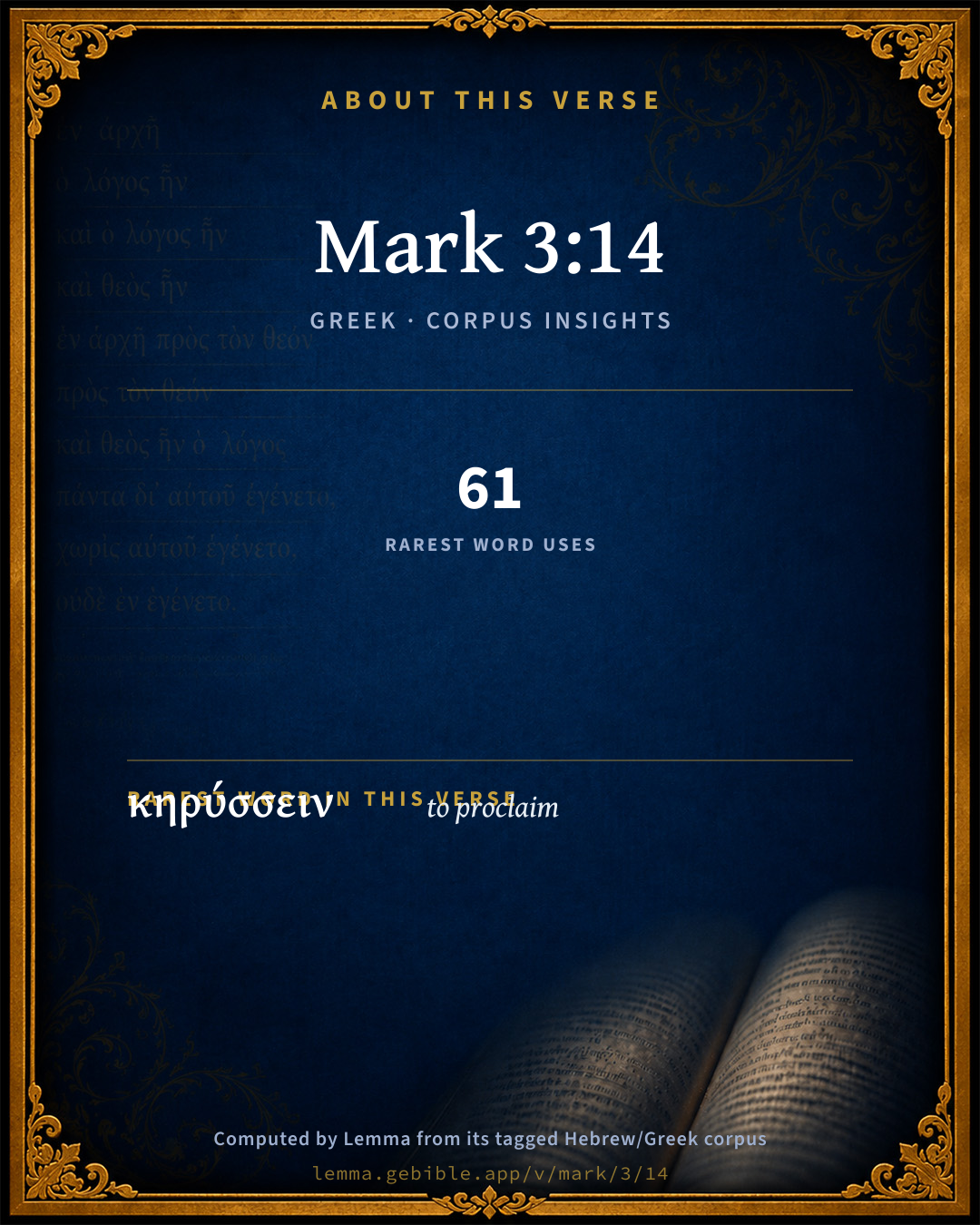
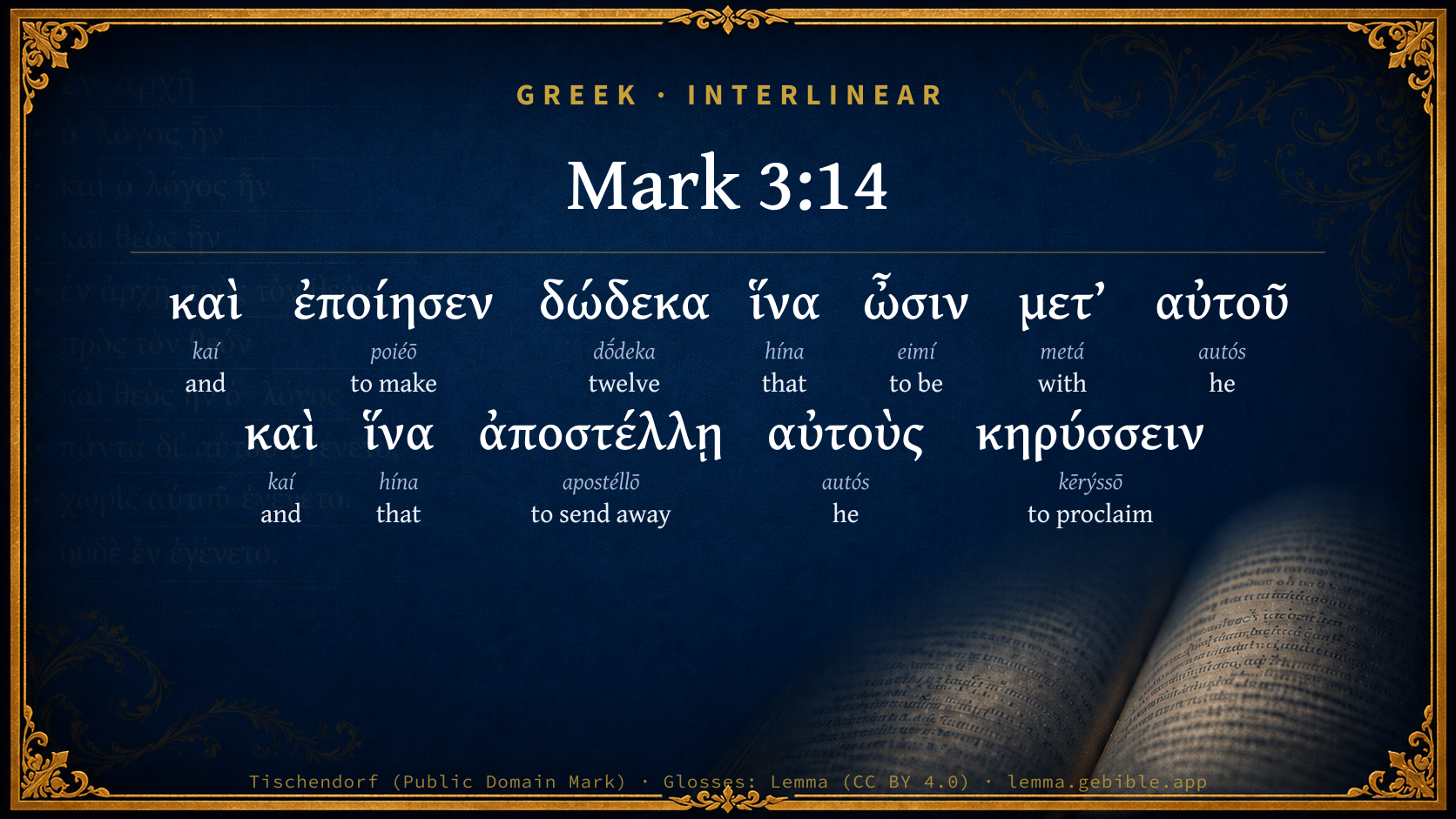
Mark 3:14

Greek (Tischendorf 8th ed.) Mark 3:14 appears in the Greek New Testament. The text above is from the Tischendorf 8th edition. Each word links to its Strong’s number and a concise gloss. Click any word for its full Thayer’s Greek Lexicon entry.
Download image
Cite this verse

Mark 3:14 (World English Bible). Public Domain. Lemma interlinear Bible study tool, https://lemma.gebible.app/v/mark/3/14.

Show BibTeX & RIS
BibTeX
RIS
English Translation
He appointed twelve, that they might be with him, and that he might send them out to preach,
World English Bible · Public Domain
Download a study sheet

One document with this verse’s original text, its word-by-word gloss line, the meaning frame, cross-references with their text, attributed commentary, and full source and license credits — printable, and it pastes into notes with its structure intact.

This verse Autodidact and up

Study sheet (.html) Plain text (.txt)

A passage Seminary Student

Up to 50 verses in one chapter. A passage sheet keeps up to 6 commentary sources and 12 cross-references per verse, in the order this page ranks them, and says so on the sheet whenever that leaves anything out. Ask for a single verse and you get the Autodidact verse sheet above.

Everything on this page stays free to read, with no account — the sheet is a download of what is already on screen, not access to it.

Want to remove ads? Support Godless Engineer
Compare translations 3

The same verse in 3 English versions, stacked beneath the original-language interlinear above. Click any original word for its lexicon entry.

Each is an independent rendering of the whole verse — the interlinear is not word-aligned to these translations.

Highlighted words mark where these versions differ — a whole-verse word diff, not a word-by-word alignment.

  • World English Bible Public Domain
    He appointed twelve, that they might be with him, and that he might send them out to preach,
  • King James Version Public Domain
    And he ordained twelve, that they should be with him, and that he might send them forth to preach,
  • unfoldingWord Literal Text CC BY-SA 4.0
    And he appointed 12, whom he also named apostles, so that they might be with him and so that he might send them to preach

unfoldingWord Literal Text — © unfoldingWord, licensed CC BY-SA 4.0. Word-aligned USFM3 via Door43 (git.door43.org/unfoldingWord/en_ult).

Versions to compare (up to 4)

3 of 4 selected

Show all 19 translations

Every available English version of this verse, each an independent rendering of the whole verse.

  • World English Bible Public Domain
    He appointed twelve, that they might be with him, and that he might send them out to preach,
  • Berean Standard Bible Public Domain
    He appointed twelve of them, whom He designated as apostles, to accompany Him, to be sent out to preach,
  • Majority Standard Bible Public Domain
    He appointed twelve of them to accompany Him, to be sent out to preach,
  • King James Version Public Domain
    And he ordained twelve, that they should be with him, and that he might send them forth to preach,
  • American Standard Version (1901) Public Domain
    And he appointed twelve, that they might be with him, and that he might send them forth to preach,
  • Revised Version (1885) Public Domain
    And he appointed twelve, that they might be with him, and that he might send them forth to preach,
  • Geneva Bible (1599) Public Domain
    And hee appoynted twelue that they should be with him, and that he might send them to preache,
  • Douay-Rheims (1899) Public Domain
    And he made that twelve should be with him, and that he might send them to preach.
  • Young's Literal Translation Public Domain
    and he appointed twelve, that they may be with him, and that he may send them forth to preach,
  • Literal Standard Version CC BY-SA 4.0
    and He appointed twelve, that they may be with Him, and that He may send them forth to preach,
  • Unlocked Literal Bible CC BY-SA 4.0
    He appointed the twelve (whom he named apostles) so that they might be with him and he might send them to proclaim the message,
  • unfoldingWord Literal Text CC BY-SA 4.0
    And he appointed 12, whom he also named apostles, so that they might be with him and so that he might send them to preach
  • Darby Bible Public Domain
    And he appointed twelve that they might be with him, and that he might send them to preach,
  • World Messianic Bible Public Domain
    He appointed twelve, that they might be with him, and that he might send them out to proclaim
  • Webster's Bible Public Domain
    And he ordained twelve, that they should be with him, and that he might send them forth to preach,
  • Free Bible Version CC BY-SA 4.0
    He chose twelve to be with him, and called them apostles. They were to be with him, and he would send them out to announce the good news,
  • Bible in Basic English Public Domain
    And he took twelve to be with him, so that he might send them out as preachers,
  • Text-Critical English NT CC BY 4.0
    He appointed twelve so that they might be with him and so that he might send them out to preach
  • Tyndale New Testament (1534) Public Domain
    And he ordeyned the.xii. that they shuld be with him and that he myght sende the to preache:

Literal Standard Version (2020), Covenant Press — licensed CC BY-SA 4.0. Text via the HelloAO Bible API (eBible.org). Unlocked Literal Bible (unfoldingWord) — licensed CC BY-SA 4.0. Text via the HelloAO Bible API (eBible.org). unfoldingWord Literal Text — © unfoldingWord, licensed CC BY-SA 4.0. Word-aligned USFM3 via Door43 (git.door43.org/unfoldingWord/en_ult). Free Bible Version, Dr. Jonathan Gallagher — licensed CC BY-SA 4.0. Text via the HelloAO Bible API (eBible.org).

Word by word

More ways to search: Search by grammar → Find every occurrence → Compare this word →

Practice this passage: Drill this verse → Learn its vocabulary →

κηρύσσειν
kērýssō
G2784
“to proclaim”
Verb, Present, Active, Infinitive
Part of Speech
Verb
Tense
Present
Voice
Active
Mood
Infinitive
Full Thayer's Definition

Origin: of uncertain affinity

TDNT: 14:37,4

1. to be a herald, to officiate as a herald a. to proclaim after the manner of a herald b. always with the suggestion of formality, gravity and an authority which must be listened to and obeyed 2. to publish, proclaim openly: something which has been done 3. used of the public proclamation of the gospel and matters pertaining to it, made by John the Baptist, by Jesus, by the apostles and other Christian teachers
  1. καὶ kaí G2532 “and” Conjunction
  2. ἐποίησεν poiéō G4160 “to make” Verb, Aorist, Active, Indicative, 3rd person, Singular
  3. δώδεκα dṓdeka G1427 “twelve” Adjective, Numeral (indeclinable)
  4. ἵνα hína G2443 “that” Conjunction
  5. ὦσιν eimí G1510 “to be” Verb, Present, Active, Subjunctive, 3rd person, Plural
  6. μετ’ metá G3326 “with” Preposition
  7. αὐτοῦ autós G846 “he” Personal pronoun, Genitive, Singular, Masculine
  8. καὶ kaí G2532 “and” Conjunction
  9. ἵνα hína G2443 “that” Conjunction
  10. ἀποστέλλῃ apostéllō G649 “to send away” Verb, Present, Active, Subjunctive, 3rd person, Singular
  11. αὐτοὺς autós G846 “he” Personal pronoun, Accusative, Plural, Masculine

About this verse

These counts appear in no published source. They are computed here, from the morphology-tagged text and Lemma’s own curated glosses. What Lemma adds →

12
words
9
distinct lemmas
Gospels
section

Repetition

Words recur within this verse:

  • καὶ and G2532 ×2
  • ἵνα that G2443 ×2
  • αὐτοῦ he G846 ×2

Cross-references

8

Topical passages linked to Mark 3:14 in the Treasury of Scripture Knowledge — connected by theme and wording, ordered by reader-vote popularity; previews shown in the World English Bible.

  • Acts 1:8 But you will receive power when the Holy Spirit has come upon you. You will be witnesses to me in Jerusalem, in all Judea and Samaria, and to the uttermost parts of the earth."
  • Luke 9:1–6 He called the twelve together, and gave them power and authority over all demons, and to cure diseases.
  • John 15:16 You didn't choose me, but I chose you, and appointed you, that you should go and bear fruit, and that your fruit should remain; that whatever you will ask of the Father in my name, he may give it to you.
  • Luke 10:1–11 Now after these things, the Lord also appointed seventy others, and sent them two by two ahead of him into every city and place, where he was about to come.
  • Acts 1:24–25 They prayed, and said, "You, Lord, who know the hearts of all men, show which one of these two you have chosen
  • Galatians 1:1 Paul, an apostle (not from men, neither through man, but through Jesus Christ, and God the Father, who raised him from the dead),
  • Luke 24:47 and that repentance and remission of sins should be preached in his name to all the nations, beginning at Jerusalem.
  • Galatians 1:15–20 But when it was the good pleasure of God, who separated me from my mother's womb, and called me through his grace,

Cross-references courtesy of OpenBible.info (CC BY 4.0).

Where the printed editions differ

1 variant

Places in this verse where the major printed Greek editions disagree on the wording in a way that affects the translation — a comparison of editions, not a manuscript-by-manuscript collation. The editions are the modern critical texts (Nestlé-Aland 28/27, SBL, Westcott-Hort, Tregelles, Tyndale House) and the traditional texts behind the KJV (the Textus Receptus and the Byzantine/Majority text). It is not a claim about which reading is original.

  1. Extra text
    οὓς καὶ ἀποστόλους ὠνόμασεν

    “whom also apostles He called [them]”

    In NA27WH Not in NA28TynSBLTregTRByz

    οὓς καὶ ἀποστόλους ὠνόμασεν (hous kai apostolous ōnomasen) 'whom also apostles He called [them]' is only in older manuscripts (NA27+WH)

Textual data: Translators Amalgamated Greek New Testament (STEPBible TAGNT) · CC BY 4.0.

Commentary

Notes on Mark 3:14 from classic Christian and Jewish commentators (each source and its license shown beneath its notes). The classic Christian expositions comment on the surrounding passage and are grouped to its opening verse, so a note may address several verses; the Jewish commentaries on the Tanakh (Rashi and others) are per-verse, so they appear only where the commentator wrote on this verse.

Lemma curates 59 commentaries, every one of them public domain or Creative Commons licensed, each selected and text-cleaned for this edition rather than reprinted as found. About our sources →

Joseph Benson's Commentary

Mar 3:14-16. He ordained, Gr. εποιησε, he made, constituted, or appointed, twelve — The word is elsewhere used for appointing to an office. See 1Sa 12:6 — Greek; Heb 3:2. Henry thinks our Lord appointed them by imposition of hands, but of this there is no proof. Indeed, this appointment seems to have been made some time before they were sent out to preach, or entered properly on their office. They were now called and appointed merely to be with him, that is, not only to attend on his public ministry, but to enjoy the benefit of his private conversation and daily instructions, that they might thereby be better fitted for the great work in which they were to be employed. If, as is generally supposed, our Lord, in appointing twelve, had a reference to the twelve patriarchs, and twelve tribes of Israel, and therefore, on the death of Judas, another was chosen to make up the number, this was only a piece of respect paid to that people, previous to the grand offer of the gospel to them. For, when they had generally rejected it, two more, Paul and Barnabas, were added, without any regard to the particular number of twelve. That he might send them forth to preach — His gospel, and thereby make way for his own visits to some places where he had not been; and to have power to heal sicknesses, &c. — And thereby to show that they were sent of God, and that he approved and confirmed their doctrine. After their election, these twelve accompanied Jesus constantly, lived with him on one common stock as his family, and never departed from him unless by his express appointment.

Joseph Benson's Commentary on the Old and New Testaments (1811–1818) — public domain. Text from a community e-Sword module.

The Expositor's Bible

CHAPTER 3:14-19 (Mar_3:14-19)

CHARACTERISTICS OF THE TWELVE

"And He appointed twelve, that they might be with Him, and that He might send them forth to preach, and to have authority to cast out devils: and Simon He surnamed Peter; and James the son of Zebedee, and John the brother of James; and them He surnamed Boanerges, which is, Sons of thunder; and Andrew, and Philip, and Bartholomew, and Matthew, and Thomas, and James the son of Alphaeus, and Thaddeaus, and Simon the Cananean, and Judas Iscariot which also betrayed Him." Mar_3:14-19 (R.V.)

THE pictures of the Twelve, then, are drawn from a living group. And when they are examined in detail, this appearance of vitality is strengthened, by the richest and most vivid indications of individual character, such indeed as in several cases to throw light upon the choice of Jesus. To invent such touches is the last attainment of dramatic genius, and the artist rarely succeeds except by deliberate and palpable character-painting. The whole story of Hamlet and of Lear is constructed with this end in view, but no one has ever conjectured that the Gospels were psychological studies. If, them, we can discover several well-defined characters, harmoniously drawn by various writers, as natural as the central figure is supernatural, and to be recognized equally in the common and the miraculous narratives, this will be an evidence of the utmost value.

We are all familiar with the impetuous vigor of St. Peter, a quality which betrayed him into grave and well-nigh fatal errors, but when chastened by suffering made him a noble and formidable leader of the Twelve. We recognize it when he says, "Thou shalt never wash my feet," "Though all men should deny Thee, yet will I never deny Thee," "Lord, to whom should we go? Thou hast the words of everlasting life," "Thou art the Christ, the Son of the living God," and in his rebuke of Jesus for self-sacrifice, and in his rash blow in the garden. Does this, the best established mental quality of any apostle, fail or grow faint in the miraculous stories which are condemned as the accretions of a later time? In such stories he is related to have cried out, "Depart from me, for I am a sinful man, O Lord," he would walk upon the sea to Jesus, he proposed to shelter Moses and Elijah from the night air in booths (a notion so natural to a bewildered man, so exquisite in its officious well-meaning absurdity as to prove itself, for who could have invented it?), he ventured into the empty sepulcher while John stood awe-stricken at the portal, he plunged into the lake to seek his risen Master on the shore, and he was presently the first to draw the net to land. Observe the restless curiosity which beckoned to John to ask who was the traitor, and compare it with his question, "Lord, and what shall this man do?" But the second of these was after the resurrection, and in answer to a prophecy. Everywhere we find a real person and the same, and the vehemence is everywhere that of a warm heart, which could fail signally but could weep bitterly as well, which could learn not to claim, though twice invited, greater love than that of others, but when asked "Lovest thou Me" at all, broke out into the passionate appeal, "Lord, Thou knowest all things, Thou knowest that I love Thee." Dull is the ear of the critic which fails to recognize here the voice of Simon. Yet the story implies the resurrection.

The mind of Jesus was too lofty and grave for epigram; but He put the willful self-reliance which Peter had to subdue even to crucifixion, into one delicate and subtle phrase: "When thou wast young, thou girdest thyself, and walkedst whither thou wouldest." That self-willed stride, with the loins girded, is the natural gait of Peter, when he was young.

St. James, the first apostolic martyr, seems to have over-topped for a while his greater brother St. John, before whom he is usually named, and who is once distinguished as "the brother of James." He shares with him the title of a Son of Thunder (Mar_3:17). They were together in desiring to rival the fiery and avenging miracle of Elijah, and to partake of the profound baptism and bitter cup of Christ. It is an undesigned coincidence in character, that while the latter of these events is recorded by St. Matthew and St. Mark, the former, which, it will be observed implies perfect confidence in the supernatural power of Christ, is found in St. Luke alone, who has not mentioned the title it justifies so curiously (Mat_20:20; Mar_10:35; Luk_9:54). It is more remarkable that he whom Christ bade to share his distinctive title with another, should not once be named as having acted or spoken by himself. With a fire like that of Peter, but no such power of initiative and of chieftainship, how natural it is that his appointed task was martyrdom. Is it objected that his brother also, the great apostle St. John, received only a share in that divided title? But the family trait is quite as palpable in him. The deeds of John were seldom wrought upon his own responsibility, never if we except the bringing of Peter into the palace of the high priest. He is a keen observer and a deep thinker. But he cannot, like his Master, combine the quality of leader with those of student and sage. In company with Andrew he found the Messiah. We have seen James leading him for a time. It was in obedience to a sign from Peter that he asked who was the traitor. With Peter, when Jesus was arrested, he followed afar off. It is very characteristic that he shrank from entering the sepulcher until Peter, coming up behind, when in first, although it was John who thereupon "saw and believed." [5]

With like discernment, he was the first to recognize Jesus beside the lake, but then it was equally natural that he should tell Peter, and follow in the ship, dragging the net to land, as that Peter should gird himself and plunge into the lake. Peter, when Jesus drew him aside, turned and saw the disciple whom Jesus loved following, with the same silent, gentle, and sociable affection, which had so recently joined him with the saddest and tenderest of all companions underneath the cross. At this point there is a delicate and suggestive turn of phrase. By what incident would any pen except his own have chosen to describe the beloved disciple as Peter then beheld him? Assuredly we should have written, The disciple whom Jesus loved, who also followed Him to Calvary, and to whom He confided His mother. But from St. John himself there would have been a trace of boastfulness in such a phrase. Now the author of the Fourth Gospel, choosing rather to speak of privilege than service, wrote "The disciple whom Jesus loved, which also leaned back on His breast at the supper, and said, Lord, who is he that betrayeth Thee?"

St. John was again with St. Peter at the Beautiful Gate, and although it was not he who healed the cripple, yet his cooperation is implied in the words, "Peter, fastening his eyes on him, with John." And when the Council would fain have silence them, the boldness which spoke in Peter's reply was "the boldness of Peter and John."

Could any series of events justify more perfectly a title which implied much zeal, yet zeal that did not demand a specific unshared epithet? But these events are interwoven with the miraculous narratives.

Add to this the keenness and deliberation which so much of his story exhibits, which at the beginning tendered no hasty homage, but followed Jesus to examine and to learn, which saw the meaning of the orderly arrangement of the graveclothes in the empty tomb, which was first to recognize the Lord upon the beach, which before this had felt something in Christ's regard for the least and weakest, inconsistent with the forbidding of any one to cast out devils, and we have the very qualities required to supplement those of Peter, without being discordant or uncongenial. And therefore it is with Peter, even more than with his brother, that we have seen John associated. In fact Christ, who sent out His apostles by two and two, joins these in such small matters as the tracking a man with a pitcher into the house where He would keep the Passover. And so, when Mary of Magdala would announce the resurrection, she found the penitent Simon in company with this loving John, comforted, and ready to seek the tomb where he met the Lord of all Pardons.

All this is not only coherent, and full of vital force, but it also strengthens powerfully the evidence for his authorship of the Gospel, written the last, looking deepest into sacred mysteries, and comparatively unconcerned for the mere flow of narrative, but tender with private and loving discourse, with thoughts of the protecting Shepherd, the sustaining Vine, the Friend Who wept by a grave, Who loved John, Who provided amid tortures for His mother, Who knew that Peter loved Him, and bade him feed the lambs -- and yet thunderous as becomes a Boanerges, with indignation half suppressed against "the Jews" (so called as if he had renounced his murderous nation), against the selfish high-priest of "that same year," and against the son of perdition, for whom certain astute worldlings have surmised that his wrath was such as they best understand, personal, and perhaps a little spiteful. The temperament of John revealed throughout, was that of August, brooding and warm and hushed and fruitful, with low rumblings of tempest in the night.

It is remarkable that such another family resemblance as between James and John exists between Peter and Andrew. The directness and self-sacrifice of his greater brother may be discovered in the few incidents recorded of Andrew also. At the beginning, and after one interview with Jesus, when he finds his brother, and becomes the first of the Twelve to spread the gospel, he utters the short unhesitating announcement, "We have found the Messiah." When Philip is uncertain about introducing the Greeks who would see Jesus, he consults Andrew, and there is no more hesitation, Andrew and Philip tell Jesus. And in just the same way, when Philip argues that two hundred pennyworth of bread are not enough for the multitude, Andrew intervenes with practical information about the five barley loaves and the two small fishes, insufficient although they seem. A man prompt and ready, and not blind to the resources that exist because they appear scanty.

Twice we have found Philip mentioned in conjunction with him. It was Philip, apparently accosted by the Greeks because of his Gentile name, who could not take upon himself the responsibility of telling Jesus of their wish. And it was he, when consulted about the feeding of the five thousand, who went off into a calculation of the price of the food required -- two hundred pennyworth, he says, would not suffice. Is it not highly consistent with this slow deliberation, that he should have accosted Nathanael with a statement so measured and explicit: "We have found Him, of whom Moses in the law, and the prophets did write, Jesus of Nazareth, the Son of Joseph." What a contrast to Andrew's terse announcement, "We have found the Messiah." And how natural that Philip should answer the objection, "Can any good thing come out of Nazareth?" with the passionless reasonable invitation, "Come and see." It was in the same unimaginative prosaic way that he said long after, "Lord, show us the Father, and it sufficeth us." To this comparatively sluggish temperament, therefore, Jesus Himself had to address the first demand He made on any. "Follow me, He said, and was obeyed. It would not be easy to compress into such brief and incidental notices a more graphic indication of character.

Of the others we know little except the names. The choice of Matthew, the man of business, is chiefly explained by the nature of his Gospel, so explicit, orderly, and methodical, and until it approaches the crucifixion, so devoid of fire.

But when we come to Thomas, we are once more aware of a defined and vivid personality, somewhat perplexed and melancholy, of little hope but settled loyalty.

All three saying reported of him belong to a dejected temperament: "Let us also go, that we may died with Him" -- as if there could be no brighter meaning than death in Christ's proposal to interrupt a dead man's sleep. "Lord, we know not whither Thou goest, and how can we know the way?" -- these words express exactly the same despondent failure to apprehend. And so it comes to pass that nothing short of tangible experience will convince him of the resurrection. And yet there is a warm and devoted heart to be recognized in the proposal to share Christ's death, in the yearning to know whither He went, and even in that agony of unbelief, which dwelt upon the cruel details of suffering, until it gave way to one glad cry of recognition and of worship; therefore his demand was granted, although a richer blessing was reserved for those who, not having seen, believed.

[5] It is also very natural that, in telling the story, he should remember how, while hesitating to enter, he "stooped down" to gaze, in the wild dawn of his new hope.

William Robertson Nicoll, ed., The Expositor's Bible (London: Hodder & Stoughton, 1887–1910) — public domain. 65 of 66 books (1 Corinthians is not separately keyed, as that volume carries no machine-parseable verse references); section-level commentary keyed to the opening verse. Introductory and overview sections not keyed to a specific passage are excluded.

Tyndale Open Study Notes

Tyndale Open Resources

3:14-15 Jesus appointed twelve to represent Israel’s twelve tribes and to proclaim that the Kingdom of God had arrived. He called them apostles (Greek apostoloi, “emissaries”). He chose them to accompany him and to be sent out (Greek apostellō) to preach and to cast out demons. They represented Jesus and were endowed with his authority.

Tyndale Open Study Notes — © Tyndale Open Resources, licensed CC BY-SA 4.0. Text via the HelloAO Bible API.

Bengel's Gnomon

Johann Albrecht Bengel

Mar 3:14. Δώδεκα, twelve) The characteristic notes of an apostle were, an immediate and direct call, a continuous intercourse with Christ, the being an eye-witness, the right of preaching universally [and not merely restricted to one locality], the gift of miracles.

Bengel's Gnomon of the New Testament — English translation (T&T Clark, Edinburgh, 1860) — public domain. Text from a community e-Sword module.

Expositor's Greek Testament

ed. W. Robertson Nicoll

Mar 3:14 . He is now on the hill top, surrounded by a body of disciples, perhaps some scores, picked out from the great mass of followers. καὶ ἐποίησε δώδεκα : and He made, constituted as a compact body, Twelve , by a second selection. For use of ποιεῖν in this sense vide 1Sa 12:6 , Act 2:36 , Heb 3:2 . God “made” Jesus as Jesus “made” the Twelve. What the process of “making” in the case of the Twelve consisted in we do not know. It might take place after days of close intercourse on the hill. ἵνα ὦσιν μετʼ αὐτοῦ , that they might be (constantly) with Him; first and very important aim of the making, mentioned only by Mk training contemplated. ἵνα ἀποστέλλῃ : to send them out on a preaching and healing mission, also in view, but only after a while. This verb frequent in Mk. Note the absence of τοῦ before κηρύσσειν and ἔχειν (Mar 3:15 ).

The Expositor's Greek Testament, edited by W. Robertson Nicoll (1897–1910) — public domain. Text from a community e-Sword module.

Geneva Bible (1599)

Geneva Bible translators

Chose and appointed out twelve to be familiar and conversant with him.

The twelve Apostles are set apart to be trained up to the office of the Apostleship.

Geneva Bible (1599) marginal notes — public domain. Text via Bolls.life.

Adam Clarke's Commentary

Verse 14. He ordained twelve] εποιησε, he made twelve. Here is nothing of what we call ordaining. Christ simply appointed them to be with him; and that he might send them occasionally to preach, &c.

To preach] The Codex Bezae, Saxon, and all the Itala, except one, add το ευαγγελιον, the Gospel.

Adam Clarke's Commentary on the Bible (1810–1826) — public domain. Text from a community e-Sword/MySword module.

The Cambridge Bible for Schools and Colleges

gen. ed. J. J. S. Perowne

14. ordained twelve] Hitherto they had been His friends and disciples in a wider sense, now He formally called them, and joined them in a united band, that (i) they “might be with Him” (comp. Act_1:21), (ii) that He might “send them forth” as heralds to preach, and (iii) that they “might have power to cast out demons,” for the words “to heal sicknesses” are omitted in some of the best MSS.

(i) The number of the Apostles. The number selected, answering to the twelve sons of Jacob, was small indeed as compared with the hundreds who enrolled themselves as disciples of a Hillel or a Gamaliel, and their position in life was humble and obscure, but “the weak things of the world were to confound the things which are mighty” (1Co_1:27), and these Twelve were to be the Twelve Pillars of the Church.

(ii) Their calling and training. Observe that the calling and training of the Twelve was a most important part of our Lord’s ministerial work. (a) Immediately after His Baptism and Temptation He began to prepare some of them for their future vocation (Joh_1:35-51); (b) to their training He devoted the greater part of His time and strength; (c) after His resurrection He continued for forty days His personal efforts for their improvement, and (d) at last He bestowed upon them His promised gift of the Holy Ghost.

(iii) Their title. The name also which He gave to them deserves attention. He named them Apostles (Luk_6:13). The word thus rendered means (i) as an adjective, despatched or sent forth, (ii) as a substantive, the actual delegate of the person who sends him.

(a) In Classical Greek the word was almost entirely restricted to the meaning of a “naval expedition,” a “fleet despatched on foreign service,” and this meaning entirely superseded any other.

(b) In the Septuagint the word occurs only once, namely, in 1Ki_14:6, in the sense of “a messenger,” “one who has a commission from God,” where Abijah says to the wife of Jeroboam, “I am a messenger unto thee of heavy tidings.”

(c) With the later Jews the word was in common use, and was the title of those, who were sent from the mother city on any foreign mission, especially the collection of the tribute for the Temple service.

(d) Thus when He employed it to designate His immediate and most favoured disciples, “our Lord was not introducing a new term, but adopting one which from its current usage would suggest to His hearers the idea of a highly responsible mission.” In Heb_3:1 He Himself is styled “The Apostle and high priest of our profession,” with which compare Joh_17:18. Canon Lightfoot on the Epistle to the Galatians, p. 94.

The Cambridge Bible for Schools and Colleges (gen. ed. J. J. S. Perowne; Cambridge University Press, 1878–1918) — public domain. Text from a community e-Sword module.

John Gill's Exposition

And he ordained twelve,.... Or made, constituted, and appointed twelve men, out of those he called to him. The Arabic version adds, "and called them apostles"; which seems to be taken out of Luk 6:13.

That they should be with him; constantly, in private and in public; be taken into his family, and reckoned such; be his familiars, and privy to all his affairs; hear all his discourses, and see his miracles; that so they might be trained up and fitted for the great work he designed them for:

and that he might send them forth to preach; the Gospel in Judea first, and then in all the world: for he did not at this time send them to preach, only chose; called, and appointed them; and after they had been with him some time, and were better qualified for such service, he sent them forth, as in Mat 10:1, for this constitution of them was before that mission, and was in order to it.

John Gill's Exposition of the Whole Bible (1746–1763) — public domain (CC PDM 1.0). Text via the HelloAO Bible API.

Trapp's Complete Commentary

John Trapp

14 And he ordained twelve, that they should be with him, and that he might send them forth to preach,

Ver. 14. That they should be with him] As his household servants, more happy therein than those of Solomon. Christ hath many retainers, few fast and faithful servants that follow him in the regeneration. There are those that will wear his livery, but serve themselves.

John Trapp, A Commentary or Exposition upon All the Books of the Old and New Testament (1647–1656) — public domain. Text from a community e-Sword module.

Haydock's Catholic Bible Commentary

The number twelve is mystical, as appeareth by choosing Mathias to full up the place of Judas: they are the twelve foundations, under Christ, of the heavenly Jerusalem. (Apocalypse xxi.)

George Leo Haydock (1774–1849), Haydock's Catholic Family Bible and Commentary, 1859 edition — public domain. Excludes Psalms (Douay-Rheims chapter numbering differs from Protestant) and Deuterocanonical books (Catholic canon only).

Whedon's Commentary on the Bible

Daniel D. Whedon

14. And he ordained twelve — It appears by Luk_6:12-19, that the regular selection of the twelve from the number of his disciples was made, and their ordination performed, just before his pronunciation of his sermon on the mount.

Several were called previous to that. Mat_28:19-20. Their full qualification they received at the day of Pentecost. Acts 2.

Daniel D. Whedon (gen. ed.), Commentary on the Old and New Testaments (1874–1909) — public domain. Text from a community e-Sword module.

The Pulpit Commentary

Vers. 14, 15. Out of those who thus came to him, he ordained twelve literally, he made or appointed twelve. They were not solemnly ordained or consecrated to their office until after his resurrection. Their actual consecration (of all of them at least but one, namely, Judas Iscariot) took place when he breathed on them and said, "Receive ye the Holy Ghost". (Joh_20:22) But from this time they were his apostles "designate." They were henceforth to Be with him as his attendants and disciples. They were to go forth and preach under his direction, and by his power they were to cast out devils. Several manuscripts add here that they were "to heal sicknesses," but the words are emitted in some of the oldest authorities. The authority over unclean spirits is more formally conveyed later on, (see Mar_6:7) so that here St. Mark speaks by anticipation. But this shows how much importance was attached to this part of their mission; for it recognizes the spiritual world, and the special purpose of the manifestation of the Son of God, namely, that he might "destroy the works of the devil." He appointed twelve. The number twelve symbolizes perfection and universality. The number three indicates what is Divine; and the number four, created things. Three multiplied by four gives twelve, the number of those who were to go forth as apostles into the four quarters of the world called to the faith of the holy Trinity.

The Pulpit Commentary (1880–1919), ed. H.D.M. Spence-Jones & Joseph S. Exell — public domain. Text from a community e-Sword module.

John Wesley's Explanatory Notes

Matt. x, 2; Luke vi, 13; Acts i, 13.

John Wesley, Explanatory Notes Upon the Whole Bible (1754–1765) — public domain. Text via the GEBible commentary corpus.

The People's New Testament

B. W. Johnson

14. Ordained twelve, that they should be with him. They were to attend him into order to be specially prepared to preach Christ.

B. W. Johnson's The People's New Testament with Notes (1889–1891) — public domain. Electronic text from the Christian Classics Ethereal Library (CCEL) ThML edition.

Cambridge Greek Testament for Schools and Colleges

14. οὓς καὶ ἀποστόλους ὠνόμασεν ([486][487][488][489][490], Memph.) is omitted by [491][492]2[493][494][495] Latt. Syrr. Goth. Arm., and may come from Luk 6:13.

[486] Codex Sinaiticus. 4th cent. Discovered by Tischendorf in 1859 at the Monastery of St Katharine on Mount Sinai. Now at St Petersburg. The whole Gospel, ending at Mar 16:8. Photographic facsimile, 1911.

[487] Codex Vaticanus. 4th cent., but perhaps a little later than א. In the Vatican Library almost since its foundation by Pope Nicolas V., and one of its greatest treasures. The whole Gospel, ending at Mar 16:8. Photographic facsimile, 1889.

[488] Codex Ephraemi. 5th cent. A palimpsest: the original writing has been partially rubbed out, and the works of Ephraem the Syrian have been written over it; but a great deal of the original writing has been recovered; of Mark we have Mar 1:17 to Mar 6:31, Mar 8:5 to Mar 12:29, Mar 13:19 to Mar 16:20. In the National Library at Paris.

[489] An asterisk denotes that the word is not found elsewhere in N.T., and such words are included in the index, even if there is no note on them in the commentary.

[490] Codex Sangallensis. 9th or 10th cent. Contains the Gospels nearly complete, with an interlinear Latin translation. The text of Mark is specially good, agreeing often with CL. At St Gall.

[491] Codex Alexandrinus. 5th cent. Brought by Cyril Lucar, Patriarch of Constantinople, from Alexandria, and afterwards presented by him to King Charles I. in 1628. In the British Museum. The whole Gospel. Photographic facsimile, 1879.

[492] Codex Ephraemi. 5th cent. A palimpsest: the original writing has been partially rubbed out, and the works of Ephraem the Syrian have been written over it; but a great deal of the original writing has been recovered; of Mark we have Mar 1:17 to Mar 6:31, Mar 8:5 to Mar 12:29, Mar 13:19 to Mar 16:20. In the National Library at Paris.

[493] Codex Bezae. 6th cent. Has a Latin translation (d) side by side with the Greek text, and the two do not quite always agree. Presented by Beza to the University Library of Cambridge in 1581. Remarkable for its frequent divergences from other texts. Contains Mark, except Mar 16:15-20, which has been added by a later hand. Photographic facsimile, 1899.

[494] Codex Regius. 8th cent. An important witness. At Paris. Contains Mar 1:1 to Mar 10:15; Mar 10:30 to Mar 15:1; Mar 15:20 to Mar 16:20, but the shorter ending is inserted between Mar 16:8 and Mar 16:9, showing that the scribe preferred it to the longer one.

[495] Codex Guelpherbytanus. 6th cent. Contains Mar 1:2-11; Mar 3:5-17; Mar 14:13-24; Mar 14:48-61; Mar 15:12-37.

14. ἐποίησεν δώδεκα. He appointed (Act 2:36; Heb 3:2; Rev 5:10) twelve. That “the Twelve” quickly became an official designation, is clear from all the Gospels. Mk mentions “the Twelve” nine times, Mt. and Jn each four times, Lk. six times. Mt. alone speaks of “the twelve disciples” (Mat 10:1, Mat 11:1, Mat 20:17, Mart 26:20). Still earlier, St Paul uses “the Twelve” of the Apostolic body even when not all the Twelve were present (1Co 15:5). Their correspondence with the Twelve Tribes is also soon recognized (Mat 19:28; Luk 22:30; Rev 21:14; Ep. of Barnabas viii. 3); they are the Twelve Patriachs of the new Israel. The modern attempt to connect them with the twelve signs of the Zodiac is a curiosity of criticism; and it is hardly worth mentioning, even as a coincidence, that on one occasion Buddha is said to have had just twelve disciples.

οὓς καὶ ἀποστόλους ὠνόμασεν. See crit. note. It is difficult to decide whether these strongly attested words are an early interpolation from Luk 6:13. We cannot say that Mar 6:30 implies a previous mention of this title, for in Joh 6:67; Joh 6:70, “the Twelve” are spoken of without previous mention of appointment or number. We need not suppose that Christ named them “Apostles” at the time when He appointed them; but it was He who sent them out to do His work who gave them a title which implies a special mission. DCG. art. “Apostles”; Lightfoot, Galatians, pp. 92–101.

ἵνα … καὶ ἵνα. Two separate purposes of the appointment, one relating to the present and one to the future, are clearly marked; (1) they are to remain with Him to be trained, and (2) He is to send them out to proclaim the good tidings and to have authority to cast out the demons. This is exactly His own work as defined Mar 1:39. Everything is kept in His own hands. He selects the larger circle of disciples; out of these He selects the Twelve; He trains them; He sends them to do work chosen by Himself, and their power over evil spirits is conferred by Him. They originate nothing, and they have nothing but what He bestows.

ἀποστέλλῃ. The verb which corresponds with ἀπόστολος is deliberately used; it implies, what πέμπω does not, a definite mission. As in Mar 1:39, κηρύσσειν is used absolutely. Bede remarks that He who had forbidden unclean spirits to proclaim Him, now sends men of pure minds to proclaim the Gospel.

Cambridge Greek Testament for Schools and Colleges (Cambridge University Press, 1896; 21 vols, various authors incl. Carr, Maclear, Plummer, Farrar, Lumby, Moule, M. R. James, Simcox) — public domain. Text from a community e-Sword module.

Alford’s Greek Testament

Henry Alford

14. ἐποίησεν] nominated,—set apart: see reff. We have here the most distinct intimation of any, of the reason of this appointment.

Henry Alford, The Greek Testament (1849–1861) — public domain. Text from a community e-Sword module.

International Critical Commentary

14. ἐποίησε δώδεκα—he appointed twelve. This use of the verb comes under the head of making one something,—king or priest, for instance. Only here, that to which they were appointed is expressed, not as an office, but as the purpose of the appointment. This purpose is expressed under two heads, the first being association with himself, and the second, to act as his messengers in the work of proclaiming the good news of the kingdom and of healing the sick. Apparently, the former was the only one fully carried out during our Lord’s life, the second becoming their work when they were made necessarily independent of him by his death. And in accordance with this, the name generally given in the Gospels is disciples, and afterward, in the Acts and Epistles, they are called apostles.

οὕς καὶ ἀποστόλους ὠνόμαζεν, whom he also named apostles, is inserted after ἐποίησε δώδεκα by WH. RV.marg. א BC* Δ 13, 28, 69, 124, 238, 346, Memph. Harcl. marg. Tisch. thinks it has been copied from Luk 6:13. But on the whole, considering the strength of the testimony for it, it seems at least equally possible that Lk. found it in the original Mk.

κηρύσσειν—to herald, or here, where it is used absolutely, to act as heralds. The word conveys the idea of authority, a herald being an official who makes public proclamation of weighty affairs. The proclamation which they were to make was the coming of the kingdom of God.

International Critical Commentary — older volumes (1896–1929), various authors — public domain. Text from a community e-Sword module.

Vincent's Word Studies in the New Testament

Marvin R. Vincent

Ordained [εποιησεν] . Lit., made. Rev., appointed.

Might send them forth [αποστελλη] . As apostles. Compare the kindred noun ajpostoloi, apostles.

Marvin R. Vincent, Word Studies in the New Testament (1887–1900) — public domain. Text from a community e-Sword/MySword module.

Lesson kit

Teaching starters — assembled from the data on this page, not authored interpretation. Every prompt links to the verse data it draws on. Edit before teaching.

Mark, in the Gospels, opens this verse with 12 words (9 distinct Greek lemmas). Its most distinctive word is kērýssō (“to proclaim”). A historical commentator’s framing appears above. Read the whole chapter for the surrounding context.

Discussion questions

  1. How does “to proclaim” (kērýssō) shape what this verse is saying?
  2. How does Acts 1:8, which shares this passage’s theme, read alongside this verse?
  3. What does the repetition of “and” (2× in this one verse) do in this verse?
  4. These translations render this verse differently. What is at stake in choosing one wording over another?
  5. Compare how Joseph Benson's Commentary and The Expositor's Bible read this verse. Where do they agree or differ?

Things to notice

Reading settings

Reading text

Shown beneath each verse's original-language words.

Old Testament
Old Testament edition

Read the OT as the Masoretic Hebrew (MT) or the Greek Septuagint (LXX).

English shown for the Greek Septuagint (in the Hebrew ↔ Greek comparison).

Comparing translations? Open the Compare panel on any verse page to stack up to four side by side.