

Luke 12:17
Greek (Tischendorf 8th ed.) Luke 12:17 appears in the Greek New Testament. The text above is from the Tischendorf 8th edition. Each word links to its Strong’s number and a concise gloss. Click any word for its full Thayer’s Greek Lexicon entry.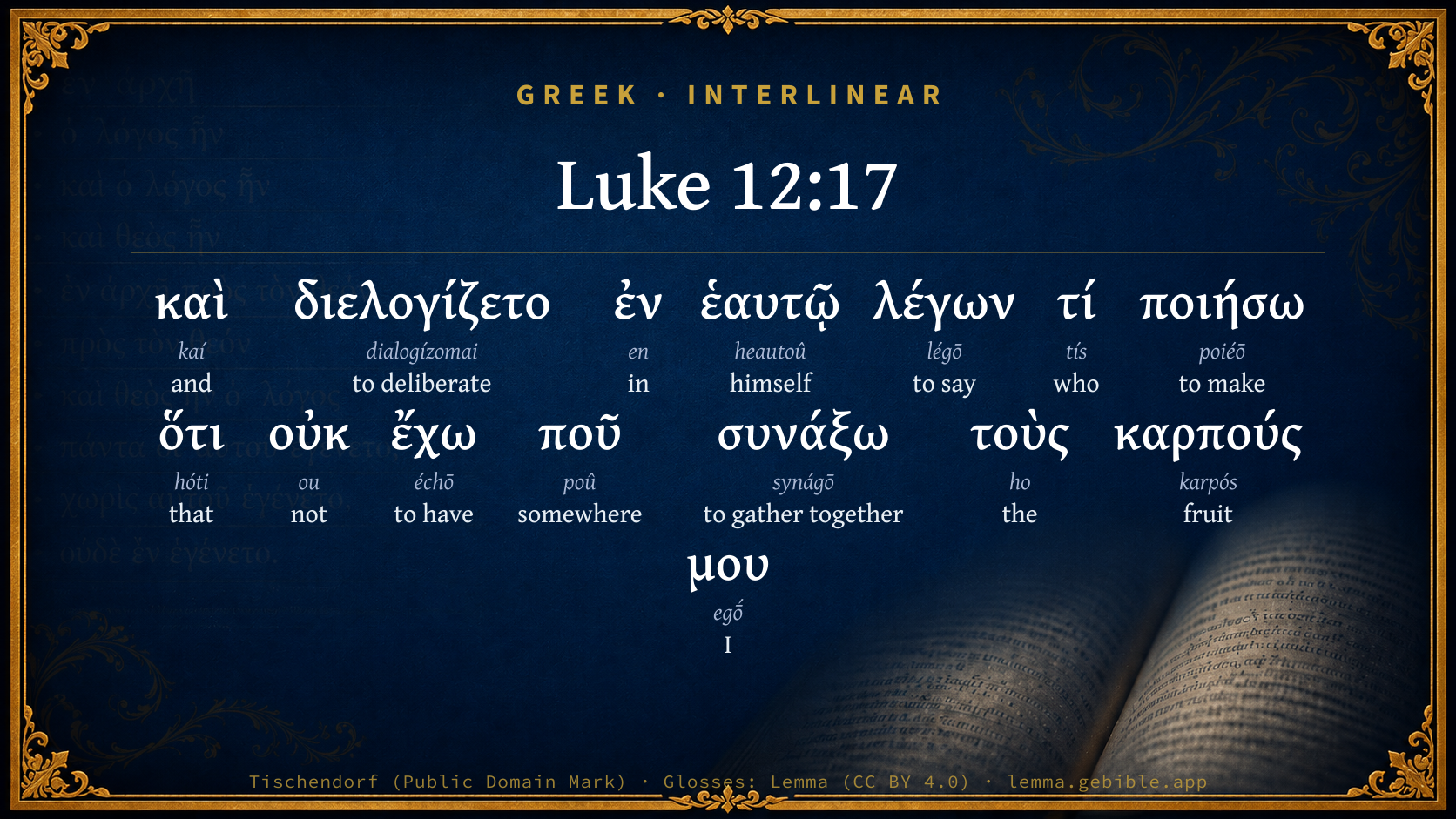
He reasoned within himself, saying, 'What will I do, because I don't have room to store my crops?'
Download a study sheet
One document with this verse’s original text, its word-by-word gloss line, the meaning frame, cross-references with their text, attributed commentary, and full source and license credits — printable, and it pastes into notes with its structure intact.
This verse Autodidact and up
A passage Seminary Student
Up to 50 verses in one chapter. A passage sheet keeps up to 6 commentary sources and 12 cross-references per verse, in the order this page ranks them, and says so on the sheet whenever that leaves anything out. Ask for a single verse and you get the Autodidact verse sheet above.
Everything on this page stays free to read, with no account — the sheet is a download of what is already on screen, not access to it.
Compare translations 3
The same verse in 3 English versions, stacked beneath the original-language interlinear above. Click any original word for its lexicon entry.
Each is an independent rendering of the whole verse — the interlinear is not word-aligned to these translations.
Highlighted words mark where these versions differ — a whole-verse word diff, not a word-by-word alignment.
-
World English Bible Public Domain
He reasoned within himself, saying, 'What will I do, because I don't have room to store my crops?'
-
King James Version Public Domain
And he thought within himself, saying, What shall I do, because I have no room where to bestow my fruits?
-
unfoldingWord Literal Text CC BY-SA 4.0
and he reasoned with himself, saying, ‘What should I do, since I do not have anywhere to gather my crops?’
unfoldingWord Literal Text — © unfoldingWord, licensed CC BY-SA 4.0. Word-aligned USFM3 via Door43 (git.door43.org/unfoldingWord/en_ult).
Show all 19 translations
Every available English version of this verse, each an independent rendering of the whole verse.
-
World English Bible Public Domain
He reasoned within himself, saying, 'What will I do, because I don't have room to store my crops?'
-
Berean Standard Bible Public Domain
So he thought to himself, ‘What shall I do, since I have nowhere to store my crops?’
-
Majority Standard Bible Public Domain
So he thought to himself, ‘What shall I do, since I have nowhere to store my crops?’
-
King James Version Public Domain
And he thought within himself, saying, What shall I do, because I have no room where to bestow my fruits?
-
American Standard Version (1901) Public Domain
and he reasoned within himself, saying, What shall I do, because I have not where to bestow my fruits?
-
Revised Version (1885) Public Domain
and he reasoned within himself, saying, What shall I do, because I have not where to bestow my fruits?
-
Geneva Bible (1599) Public Domain
Therefore he thought with himselfe, saying, What shall I doe, because I haue no roume, where I may lay vp my fruites?
-
Douay-Rheims (1899) Public Domain
And he thought within himself, saying: What shall I do, because I have no room where to bestow my fruits?
-
Young's Literal Translation Public Domain
and he was reasoning within himself, saying, What shall I do, because I have not where I shall gather together my fruits?
-
Literal Standard Version CC BY-SA 4.0
and he was reasoning within himself, saying, What will I do, because I have nowhere I will gather together my fruits?
-
Unlocked Literal Bible CC BY-SA 4.0
and he reasoned with himself, saying, 'What will I do, because I do not have a place to store my crops?'
-
unfoldingWord Literal Text CC BY-SA 4.0
and he reasoned with himself, saying, ‘What should I do, since I do not have anywhere to gather my crops?’
-
Darby Bible Public Domain
And he reasoned within himself saying, What shall I do? for I have not [a place] where I shall lay up my fruits.
-
World Messianic Bible Public Domain
He reasoned within himself, saying, ‘What will I do, because I don’t have room to store my crops?’
-
Webster's Bible Public Domain
And he thought within himself, saying, What shall I do, because I have no room where to deposit my fruits?
-
Free Bible Version CC BY-SA 4.0
After thinking things through, the man said to himself, ‘What shall I do? I've nowhere to store my crops.
-
Bible in Basic English Public Domain
And he said to himself, What is to be done? for I have no place in which to put all my fruit.
-
Text-Critical English NT CC BY 4.0
So he thought to himself, ‘What should I do, for I do not have anywhere to store my crops?’
-
Tyndale New Testament (1534) Public Domain
and he thought in himsilfe sayinge: what shall I do? because I have noo roume where to bestowe my frutes?
Literal Standard Version (2020), Covenant Press — licensed CC BY-SA 4.0. Text via the HelloAO Bible API (eBible.org). Unlocked Literal Bible (unfoldingWord) — licensed CC BY-SA 4.0. Text via the HelloAO Bible API (eBible.org). unfoldingWord Literal Text — © unfoldingWord, licensed CC BY-SA 4.0. Word-aligned USFM3 via Door43 (git.door43.org/unfoldingWord/en_ult). Free Bible Version, Dr. Jonathan Gallagher — licensed CC BY-SA 4.0. Text via the HelloAO Bible API (eBible.org).
Word by word
More ways to search: Search by grammar → Find every occurrence → Compare this word →
Practice this passage: Drill this verse → Learn its vocabulary →
- Appears 16× in the Greek New Testament
- First appears at Matthew 16:7
- Part of Speech
- Verb
- Tense
- Imperfect
- Voice
- Middle or Passive deponent
- Mood
- Indicative
- Person
- 3rd person
- Number
- Singular
Full Thayer's Definition
- καὶ kaí G2532 “and” Conjunction
- διελογίζετο dialogízomai G1260 “to deliberate” Verb, Imperfect, Middle or Passive deponent, Indicative, 3rd person, Singular
- ἐν en G1722 “in” Preposition
- ἑαυτῷ heautoû G1438 “himself” Reflexive pronoun, 3rd person, Dative, Singular, Masculine
- λέγων légō G3004 “to say” Verb, Present, Active, Participle, Nominative, Singular, Masculine
- τί tís G5101 “who” Interrogative pronoun, Accusative, Singular, Neuter
- ποιήσω poiéō G4160 “to make” Verb, Aorist, Active, Subjunctive, 1st person, Singular
- ὅτι hóti G3754 “that” Conjunction
- οὐκ ou G3756 “not” Particle, Negative
- ἔχω échō G2192 “to have” Verb, Present, Active, Indicative, 1st person, Singular
- ποῦ poû G4226 “somewhere” Particle, Interrogative
- συνάξω synágō G4863 “to gather together” Verb, Future, Active, Indicative, 1st person, Singular
- τοὺς ho G3588 “the” Article, Accusative, Plural, Masculine
- καρπούς karpós G2590 “fruit” Noun, Accusative, Plural, Masculine
- μου egṓ G1473 “I” Personal pronoun, 1st person, Genitive, Singular
About this verse
These counts appear in no published source. They are computed here, from the morphology-tagged text and Lemma’s own curated glosses. What Lemma adds →
- 15
- words
- 15
- distinct lemmas
- Gospels
- section
Cross-references
20Topical passages linked to Luke 12:17 in the Treasury of Scripture Knowledge — connected by theme and wording, ordered by reader-vote popularity; previews shown in the World English Bible.
- Matthew 5:42 Give to him who asks you, and don't turn away him who desires to borrow from you.
- Isaiah 58:7 Isn't it to deal your bread to the hungry, and that you bring the poor who are cast out to your house? when you see the naked, that you cover him; and that you not hide yourself from your own flesh?
- Romans 12:13 contributing to the needs of the saints; given to hospitality.
- 2 Corinthians 9:6–15 Remember this: he who sows sparingly will also reap sparingly. He who sows bountifully will also reap bountifully.
- Luke 11:41 But give for gifts to the needy those things which are within, and behold, all things will be clean to you.
- Luke 16:9 I tell you, make for yourselves friends by means of unrighteous mammon, so that when you fail, they may receive you into the eternal tents.
- Luke 18:22 When Jesus heard these things, he said to him, "You still lack one thing. Sell all that you have, and distribute it to the poor. You will have treasure in heaven. Come, follow me."
- Luke 19:17 "He said to him, 'Well done, you good servant! Because you were found faithful with very little, you shall have authority over ten cities.'
- Acts 16:30 and brought them out and said, "Sirs, what must I do to be saved?"
- 1 John 3:16 By this we know love, because he laid down his life for us. And we ought to lay down our lives for the brothers.
- Ecclesiastes 11:2 Give a portion to seven, yes, even to eight; For you don't know what evil will be on the earth.
- Luke 3:11 He answered them, "He who has two coats, let him give to him who has none. He who has food, let him do likewise."
- Luke 10:25 Behold, a certain lawyer stood up and tested him, saying, "Teacher, what shall I do to inherit eternal life?"
- Luke 12:22 He said to his disciples, "Therefore I tell you, don't be anxious for your life, what you will eat, nor yet for your body, what you will wear.
- Luke 12:29 Don't seek what you will eat or what you will drink; neither be anxious.
- Luke 12:33 Sell that which you have, and give gifts to the needy. Make for yourselves purses which don't grow old, a treasure in the heavens that doesn't fail, where no thief approaches, neither moth destroys.
- Luke 14:13–14 But when you make a feast, ask the poor, the maimed, the lame, or the blind;
- Luke 16:3 "The manager said within himself, 'What will I do, seeing that my lord is taking away the management position from me? I don't have strength to dig. I am ashamed to beg.
- Acts 2:37 Now when they heard this, they were cut to the heart, and said to Peter and the rest of the apostles, "Brothers, what shall we do?"
- 1 Timothy 6:17 Charge those who are rich in this present world that they not be haughty, nor have their hope set on the uncertainty of riches, but on the living God, who richly provides us with everything to enjoy;
Cross-references courtesy of OpenBible.info (CC BY 4.0).
Lesson kit
Teaching starters — assembled from the data on this page, not authored interpretation. Every prompt links to the verse data it draws on. Edit before teaching.
Luke, in the Gospels, opens this verse with 15 words (15 distinct Greek lemmas). Its most distinctive word is dialogízomai (“to deliberate”). A historical commentator’s framing appears above. Read the whole chapter for the surrounding context.
Discussion questions
- What does “to deliberate” (dialogízomai) contribute to the verse as a whole?
- Matthew 16:7 shares the word «to deliberate» with this verse. How do the two illuminate each other?
- The translations on this page render this verse differently — a whole-verse word diff, not a word-by-word alignment. What might account for the different wordings?
- Reading how Bengel's Gnomon and Geneva Bible (1599) read this verse, where do the two commentators agree and where do they part?
Things to notice
- These translations choose different wording for 17 words in this verse.
- 15 distinct Greek lemmas span 15 words in this verse.
Commentary
Notes on Luke 12:17 from classic Christian and Jewish commentators (each source and its license shown beneath its notes). The classic Christian expositions comment on the surrounding passage and are grouped to its opening verse, so a note may address several verses; the Jewish commentaries on the Tanakh (Rashi and others) are per-verse, so they appear only where the commentator wrote on this verse.
Lemma curates 59 commentaries, every one of them public domain or Creative Commons licensed, each selected and text-cleaned for this edition rather than reprinted as found. About our sources →
Bengel's Gnomon
Johann Albrecht Bengel
Bengel's Gnomon of the New Testament — English translation (T&T Clark, Edinburgh, 1860) — public domain. Text from a community e-Sword module.
Geneva Bible (1599)
Geneva Bible translators
Geneva Bible (1599) marginal notes — public domain. Text via Bolls.life.
Adam Clarke's Commentary
Adam Clarke's Commentary on the Bible (1810–1826) — public domain. Text from a community e-Sword/MySword module.
Ellicott's Commentary for English Readers
A Bible Commentary for English Readers, edited by Charles John Ellicott (1878–1897) — public domain. Text from a community e-Sword module.
The Cambridge Bible for Schools and Colleges
gen. ed. J. J. S. Perowne
The Cambridge Bible for Schools and Colleges (gen. ed. J. J. S. Perowne; Cambridge University Press, 1878–1918) — public domain. Text from a community e-Sword module.
John Gill's Exposition
John Gill's Exposition of the Whole Bible (1746–1763) — public domain (CC PDM 1.0). Text via the HelloAO Bible API.
Trapp's Complete Commentary
John Trapp
John Trapp, A Commentary or Exposition upon All the Books of the Old and New Testament (1647–1656) — public domain. Text from a community e-Sword module.
Albert Barnes' Notes on the Bible
Albert Barnes' Notes on the Bible (1834–1885) — public domain. Text from a community e-Sword/MySword module.
Whedon's Commentary on the Bible
Daniel D. Whedon
Daniel D. Whedon (gen. ed.), Commentary on the Old and New Testaments (1874–1909) — public domain. Text from a community e-Sword module.
The Pulpit Commentary
The Pulpit Commentary (1880–1919), ed. H.D.M. Spence-Jones & Joseph S. Exell — public domain. Text from a community e-Sword module.
John Wesley's Explanatory Notes
John Wesley, Explanatory Notes Upon the Whole Bible (1754–1765) — public domain. Text via the GEBible commentary corpus.
Cambridge Greek Testament for Schools and Colleges
Cambridge Greek Testament for Schools and Colleges (Cambridge University Press, 1896; 21 vols, various authors incl. Carr, Maclear, Plummer, Farrar, Lumby, Moule, M. R. James, Simcox) — public domain. Text from a community e-Sword module.
Alford’s Greek Testament
Henry Alford
Henry Alford, The Greek Testament (1849–1861) — public domain. Text from a community e-Sword module.
International Critical Commentary
International Critical Commentary — older volumes (1896–1929), various authors — public domain. Text from a community e-Sword module.
Vincent's Word Studies in the New Testament
Marvin R. Vincent
Marvin R. Vincent, Word Studies in the New Testament (1887–1900) — public domain. Text from a community e-Sword/MySword module.