

Luke 11:42
Greek (Tischendorf 8th ed.) Luke 11:42 appears in the Greek New Testament. The text above is from the Tischendorf 8th edition. Each word links to its Strong’s number and a concise gloss. Click any word for its full Thayer’s Greek Lexicon entry.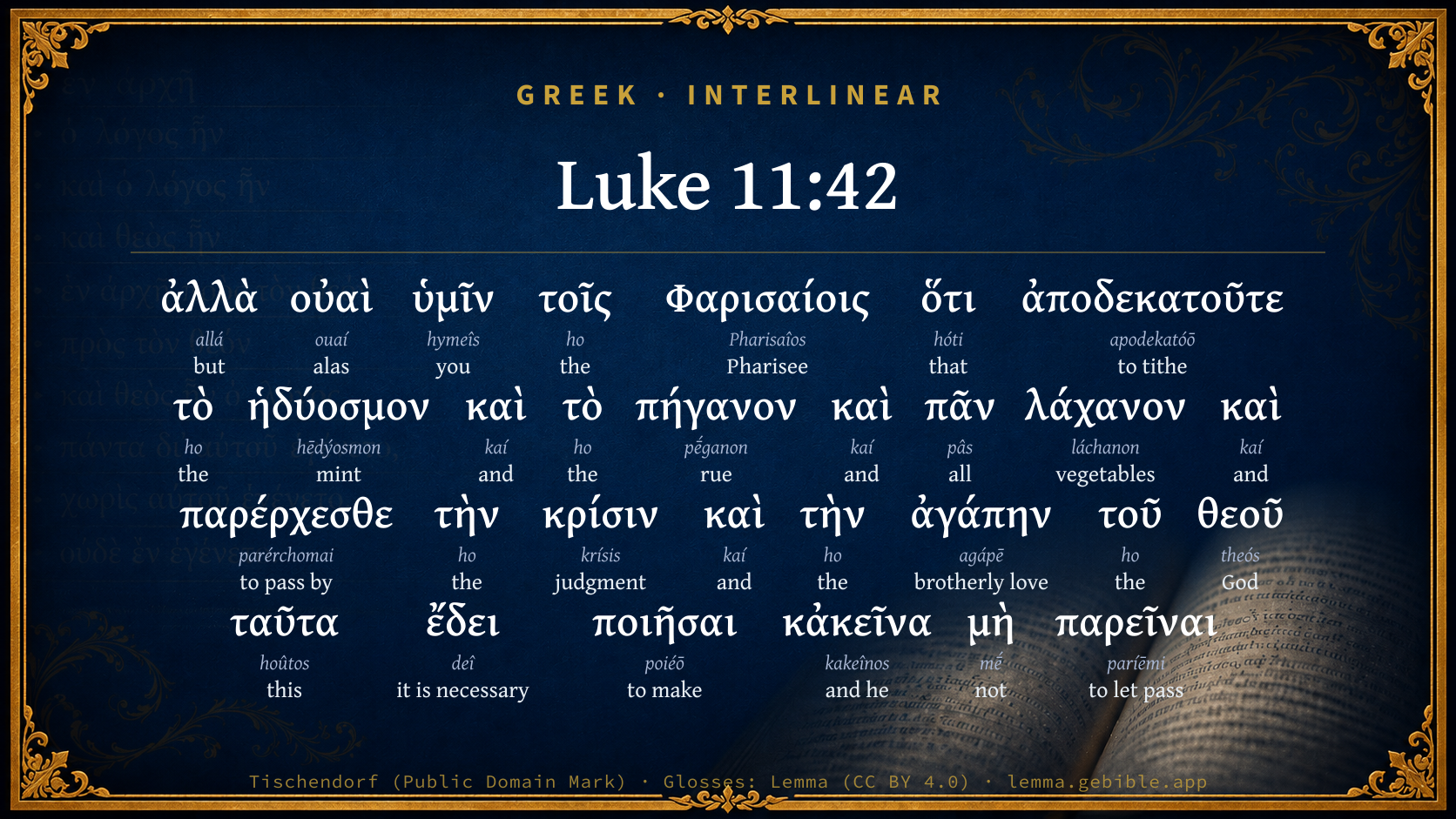
But woe to you Pharisees! For you tithe mint and rue and every herb, but you bypass justice and the love of God. You ought to have done these, and not to have left the other undone.
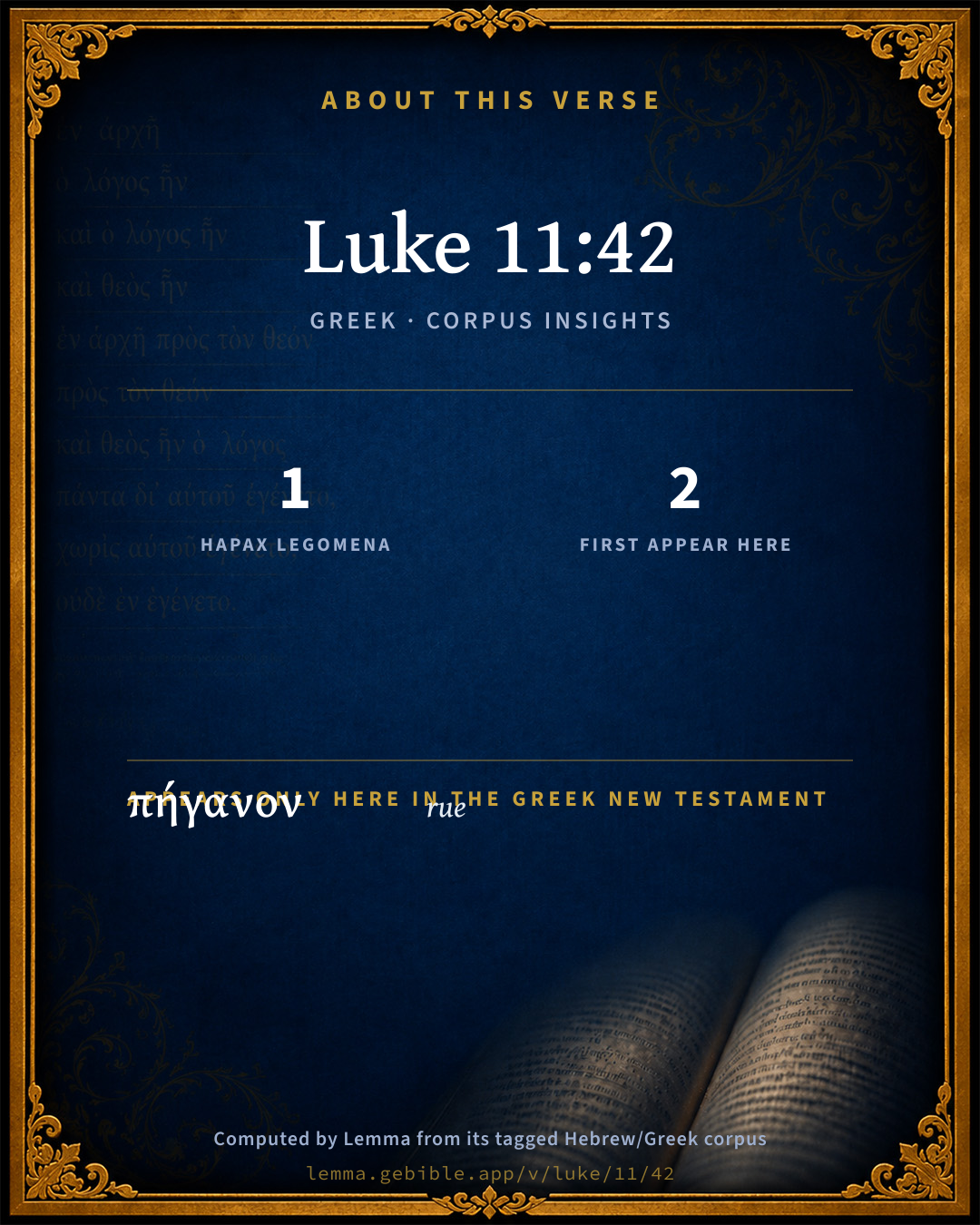
- 1 hapax legomenon — only here in the Greek New Testament
- 2 first appearances in the Greek New Testament
Download a study sheet
One document with this verse’s original text, its word-by-word gloss line, the meaning frame, cross-references with their text, attributed commentary, and full source and license credits — printable, and it pastes into notes with its structure intact.
This verse Autodidact and up
A passage Seminary Student
Up to 50 verses in one chapter. A passage sheet keeps up to 6 commentary sources and 12 cross-references per verse, in the order this page ranks them, and says so on the sheet whenever that leaves anything out. Ask for a single verse and you get the Autodidact verse sheet above.
Everything on this page stays free to read, with no account — the sheet is a download of what is already on screen, not access to it.
Compare translations 3
The same verse in 3 English versions, stacked beneath the original-language interlinear above. Click any original word for its lexicon entry.
Each is an independent rendering of the whole verse — the interlinear is not word-aligned to these translations.
Highlighted words mark where these versions differ — a whole-verse word diff, not a word-by-word alignment.
-
World English Bible Public Domain
But woe to you Pharisees! For you tithe mint and rue and every herb, but you bypass justice and the love of God. You ought to have done these, and not to have left the other undone.
-
King James Version Public Domain
But woe unto you, Pharisees! for ye tithe mint and rue and all manner of herbs, and pass over judgment and the love of God: these ought ye to have done, and not to leave the other undone.
-
unfoldingWord Literal Text CC BY-SA 4.0
But woe to you Pharisees, because you tithe the mint and the rue and every garden herb, but you neglect the justice and the love of God. But it was necessary to do these and those not to neglect.
unfoldingWord Literal Text — © unfoldingWord, licensed CC BY-SA 4.0. Word-aligned USFM3 via Door43 (git.door43.org/unfoldingWord/en_ult).
Show all 19 translations
Every available English version of this verse, each an independent rendering of the whole verse.
-
World English Bible Public Domain
But woe to you Pharisees! For you tithe mint and rue and every herb, but you bypass justice and the love of God. You ought to have done these, and not to have left the other undone.
-
Berean Standard Bible Public Domain
Woe to you Pharisees! You pay tithes of mint, rue, and every herb, but you disregard justice and the love of God. You should have practiced the latter without neglecting the former.
-
Majority Standard Bible Public Domain
Woe to you Pharisees! For you pay tithes of mint, rue, and every herb, but you disregard justice and the love of God. You should have practiced the latter without neglecting the former.
-
King James Version Public Domain
But woe unto you, Pharisees! for ye tithe mint and rue and all manner of herbs, and pass over judgment and the love of God: these ought ye to have done, and not to leave the other undone.
-
American Standard Version (1901) Public Domain
But woe unto you Pharisees! for ye tithe mint and rue and every herb, and pass over justice and the love of God: but these ought ye to have done, and not to leave the other undone.
-
Revised Version (1885) Public Domain
But woe unto you Pharisees! for ye tithe mint and rue and every herb, and pass over judgment and the love of God: but these ought ye to have done, and not to leave the other undone.
-
Geneva Bible (1599) Public Domain
But wo be to you, Pharises: for ye tithe the mynt and the rewe, and all maner herbs, and passe ouer iudgement and the loue of God: these ought yee to haue done, and not to haue left the other vndone.
-
Douay-Rheims (1899) Public Domain
But woe to you, Pharisees, because you tithe mint and rue and every herb; and pass over judgment, and the charity of God. Now these things you ought to have done, and not to leave the other undone.
-
Young's Literal Translation Public Domain
`But wo to you, the Pharisees, because ye tithe the mint, and the rue, and every herb, and ye pass by the judgment, and the love of God; these things it behoveth to do, and those not to be neglecting.
-
Literal Standard Version CC BY-SA 4.0
But woe to you, the Pharisees, because you tithe the mint, and the rue, and every herb, and you pass by the judgment and the love of God; these things [you] should do, and those not to be neglecting.
-
Unlocked Literal Bible CC BY-SA 4.0
But woe to you Pharisees, because you tithe mint and rue and every other garden herb, but you neglect justice and the love of God. It is necessary to act justly and love God, without failing to do the other things also.
-
unfoldingWord Literal Text CC BY-SA 4.0
But woe to you Pharisees, because you tithe the mint and the rue and every garden herb, but you neglect the justice and the love of God. But it was necessary to do these and those not to neglect.
-
Darby Bible Public Domain
But woe unto you, Pharisees, for ye pay tithes of mint and rue and every herb, and pass by the judgment and the love of God: these ye ought to have done, and not have left those aside.
-
World Messianic Bible Public Domain
But woe to you Pharisees! For you tithe mint and rue and every herb, but you bypass justice and God’s love. You ought to have done these, and not to have left the other undone.
-
Webster's Bible Public Domain
But woe to you, Pharisees! for ye tithe mint, and rue, and all manner of herbs, and pass over judgment and the love of God: these ought ye to have done, and not to leave the others undone.
-
Free Bible Version CC BY-SA 4.0
Shame on you Pharisees! You pay tithe on herbs and plants, but you neglect justice and the love of God. You need to pay attention to the latter, while not leaving the former things undone.
-
Bible in Basic English Public Domain
But a curse is on you, Pharisees! for you make men give a tenth of every sort of plant, and give no thought to right and the love of God; but it is right for you to do these things, and not let the others be undone.
-
Text-Critical English NT CC BY 4.0
“But woe to you, Pharisees! For you tithe mint, rue, and every herb, yet you ignore justice and the love of God. These you ought to have practiced without neglecting the other things.
-
Tyndale New Testament (1534) Public Domain
But wo be to you Pharises for ye tithe the mynt and rewe and all manner erbes and passe over iudgment and the love of God. These ought ye to have done and yet not to have left the other vndone.
Literal Standard Version (2020), Covenant Press — licensed CC BY-SA 4.0. Text via the HelloAO Bible API (eBible.org). Unlocked Literal Bible (unfoldingWord) — licensed CC BY-SA 4.0. Text via the HelloAO Bible API (eBible.org). unfoldingWord Literal Text — © unfoldingWord, licensed CC BY-SA 4.0. Word-aligned USFM3 via Door43 (git.door43.org/unfoldingWord/en_ult). Free Bible Version, Dr. Jonathan Gallagher — licensed CC BY-SA 4.0. Text via the HelloAO Bible API (eBible.org).
Word by word
More ways to search: Search by grammar → Find every occurrence → Compare this word →
Practice this passage: Drill this verse → Learn its vocabulary →
- Appears 1× in the Greek New Testament
- First appears here
- Part of Speech
- Noun
- Case
- Accusative
- Number
- Singular
- Gender
- Neuter
Full Thayer's Definition
- ἀλλὰ allá G235 “but” Conjunction
- οὐαὶ ouaí G3759 “alas” Interjection
- ὑμῖν hymeîs G5210 “you” Personal pronoun, 2nd person, Dative, Plural
- τοῖς ho G3588 “the” Article, Dative, Plural, Masculine
- Φαρισαίοις Pharisaîos G5330 “Pharisee” Noun, Dative, Plural, Masculine
- ὅτι hóti G3754 “that” Conjunction
- ἀποδεκατοῦτε apodekatóō G586 “to tithe” Verb, Present, Active, Indicative, 2nd person, Plural
- τὸ ho G3588 “the” Article, Accusative, Singular, Neuter
- ἡδύοσμον hēdýosmon G2238 “mint” Noun, Accusative, Singular, Neuter
- καὶ kaí G2532 “and” Conjunction
- τὸ ho G3588 “the” Article, Accusative, Singular, Neuter
- πήγανον pḗganon G4076 “rue” Noun, Accusative, Singular, Neuter
- καὶ kaí G2532 “and” Conjunction
- πᾶν pâs G3956 “all” Adjective, Accusative, Singular, Neuter
- λάχανον láchanon G3001 “vegetables” Noun, Accusative, Singular, Neuter
- καὶ kaí G2532 “and” Conjunction
- παρέρχεσθε parérchomai G3928 “to pass by” Verb, Present, Middle or Passive deponent, Indicative, 2nd person, Plural
- τὴν ho G3588 “the” Article, Accusative, Singular, Feminine
- κρίσιν krísis G2920 “judgment” Noun, Accusative, Singular, Feminine
- καὶ kaí G2532 “and” Conjunction
- τὴν ho G3588 “the” Article, Accusative, Singular, Feminine
- ἀγάπην agápē G26 “brotherly love” Noun, Accusative, Singular, Feminine
- τοῦ ho G3588 “the” Article, Genitive, Singular, Masculine
- θεοῦ theós G2316 “God” Noun, Genitive, Singular, Masculine
- ταῦτα hoûtos G3778 “this” Demonstrative pronoun, Accusative, Plural, Neuter
- ἔδει deî G1163 “it is necessary” Verb, Imperfect, Active, Indicative, 3rd person, Singular
- ποιῆσαι poiéō G4160 “to make” Verb, Aorist, Active, Infinitive
- κἀκεῖνα kakeînos G2548 “and he” Demonstrative pronoun, Nominative, Plural, Neuter, Aramaic form
- μὴ mḗ G3361 “not” Particle, Negative
- παρεῖναι paríēmi G3935 “to let pass” Verb, Aorist, Active, Infinitive
About this verse
These counts appear in no published source. They are computed here, from the morphology-tagged text and Lemma’s own curated glosses. What Lemma adds →
- 30
- words
- 22
- distinct lemmas
- Gospels
- section
Notable vocabulary
1 hapax legomenon — a word that appears only here in the entire Greek New Testament:
- πήγανον rue G4076
First appearance in Scripture
These words make their first canonical appearance in the Greek New Testament here:
Shared distinctive vocabulary
ἡδύοσμον mint G2238 occurs in 2 verses of the Greek New Testament. Also found in:
Cross-references
22Topical passages linked to Luke 11:42 in the Treasury of Scripture Knowledge — connected by theme and wording, ordered by reader-vote popularity; previews shown in the World English Bible.
- Matthew 23:23 "Woe to you, scribes and Pharisees, hypocrites! For you tithe mint, dill, and cumin, and have left undone the weightier matters of the law: justice, mercy, and faith. But you ought to have done these, and not to have left the other undone.
- Proverbs 21:3 To do righteousness and justice Is more acceptable to Yahweh than sacrifice.
- Luke 18:12 I fast twice a week. I give tithes of all that I get.'
- Deuteronomy 10:12–13 Now, Israel, what does Yahweh your God require of you, but to fear Yahweh your God, to walk in all his ways, and to love him, and to serve Yahweh your God with all your heart and with all your soul,
- Micah 6:8 He has shown you, O man, what is good. What does Yahweh require of you, but to act justly, To love mercy, and to walk humbly with your God?
- Malachi 3:8 Will a man rob God? Yet you rob me! But you say, 'How have we robbed you?' In tithes and offerings.
- 1 John 4:20 If a man says, "I love God," and hates his brother, he is a liar; for he who doesn't love his brother whom he has seen, how can he love God whom he has not seen?
- 1 Samuel 15:22 Samuel said, Has Yahweh as great delight in burnt offerings and sacrifices, as in obeying the voice of Yahweh? Behold, to obey is better than sacrifice, and to listen than the fat of rams.
- Matthew 23:27 "Woe to you, scribes and Pharisees, hypocrites! For you are like whitened tombs, which outwardly appear beautiful, but inwardly are full of dead men's bones, and of all uncleanness.
- Leviticus 27:30–33 "'All the tithe of the land, whether of the seed of the land or of the fruit of the trees, is Yahweh's. It is holy to Yahweh.
- 2 Chronicles 31:5–10 As soon as the commandment came abroad, the children of Israel gave in abundance the first fruits of grain, new wine, and oil, and honey, and of all the increase of the field; and the tithe of all things brought they in abundantly.
- Titus 2:11–12 For the grace of God has appeared, bringing salvation to all men,
- Nehemiah 10:37 and that we should bring the first fruits of our dough, and our heave-offerings, and the fruit of all manner of trees, the new wine and the oil, to the priests, to the chambers of the house of our God; and the tithes of our ground to the Levites; for they, the Levites, take the tithes in all the cities of our tillage.
- Ecclesiastes 7:18 It is good that you should take hold of this. Yes, also from that don't withdraw your hand; for he who fears God will come forth from them all.
- Isaiah 1:10–17 Hear the word of Yahweh, you rulers of Sodom! Listen to the law of our God, you people of Gomorrah!
- Isaiah 58:2–6 Yet they seek me daily, and delight to know my ways: as a nation that did righteousness, and didn't forsake the ordinance of their God, they ask of me righteous judgments; they delight to draw near to God.
- Jeremiah 7:2–10 Stand in the gate of Yahweh's house, and proclaim there this word, and say, Hear the word of Yahweh, all you of Judah, who enter in at these gates to worship Yahweh.
- Jeremiah 7:21–22 Thus says Yahweh of Hosts, the God of Israel: Add your burnt offerings to your sacrifices, and eat you flesh.
- Malachi 1:6 "A son honors his father, and a servant his master. If I am a father, then where is my honor? And if I am a master, where is the respect due me? Says Yahweh of Hosts to you, priests, who despise my name. You say, 'How have we despised your name?'
- Malachi 2:17 You have wearied Yahweh with your words. Yet you say, 'How have we wearied him?' In that you say, 'Everyone who does evil is good in the sight of Yahweh, and he delights in them;' or 'Where is the God of justice?'
- Matthew 23:13 "Woe to you, scribes and Pharisees, hypocrites! For you devour widows' houses, and as a pretense you make long prayers. Therefore you will receive greater condemnation.
- John 5:42 But I know you, that you don't have God's love in yourselves.
Cross-references courtesy of OpenBible.info (CC BY 4.0).
Where the printed editions differ
1 variantPlaces in this verse where the major printed Greek editions disagree on the wording in a way that affects the translation — a comparison of editions, not a manuscript-by-manuscript collation. The editions are the modern critical texts (Nestlé-Aland 28/27, SBL, Westcott-Hort, Tregelles, Tyndale House) and the traditional texts behind the KJV (the Textus Receptus and the Byzantine/Majority text). It is not a claim about which reading is original.
-
Extra text
δὲ
“also”
In NA28NA27TynSBLWHTreg Not in TRByzδὲ (de) 'also' is only in older manuscripts (NA28+NA27+Tyn+SBL+WH+Treg)
Textual data: Translators Amalgamated Greek New Testament (STEPBible TAGNT) · CC BY 4.0.
Lesson kit
Teaching starters — assembled from the data on this page, not authored interpretation. Every prompt links to the verse data it draws on. Edit before teaching.
Luke, in the Gospels, opens this verse with 30 words (22 distinct Greek lemmas). Its most distinctive word is pḗganon (“rue”). A historical commentator’s framing appears above. Read the whole chapter for the surrounding context.
Discussion questions
- The word pḗganon carries the sense “rue.” How does it shape the verse?
- 1 word here appears nowhere else in the Greek New Testament. Why might the author reach for such rare wording?
- 2 words make their first appearance in Scripture here. What does this debut establish?
- How does Matthew 23:23, which shares the word «mint», read alongside this verse?
- What does the repetition of “the” (6× in this one verse) do in this verse?
- These translations render this verse differently. What is at stake in choosing one wording over another?
- Compare how The Biblical Illustrator and Godbey's Commentary on the New Testament read this verse. Where do they agree or differ?
Things to notice
- 1 word in this verse appears nowhere else in the Greek New Testament.
- 2 words make their first canonical appearance in Scripture here.
- These translations choose different wording for 22 words in this verse.
- “the” occurs 6× in this single verse.
- 22 distinct Greek lemmas span 30 words in this verse.
Commentary
Notes on Luke 11:42 from classic Christian and Jewish commentators (each source and its license shown beneath its notes). The classic Christian expositions comment on the surrounding passage and are grouped to its opening verse, so a note may address several verses; the Jewish commentaries on the Tanakh (Rashi and others) are per-verse, so they appear only where the commentator wrote on this verse.
Lemma curates 59 commentaries, every one of them public domain or Creative Commons licensed, each selected and text-cleaned for this edition rather than reprinted as found. About our sources →
The Biblical Illustrator
Joseph S. Exell
The Biblical Illustrator, edited by Joseph S. Exell (c. 1880s–1900s) — public domain. Text from a community e-Sword module.
Godbey's Commentary on the New Testament
William B. Godbey
William B. Godbey, Commentary on the New Testament (1896–1900) — public domain. Text from a community e-Sword module.
Tyndale Open Study Notes
Tyndale Open Resources
Tyndale Open Study Notes — © Tyndale Open Resources, licensed CC BY-SA 4.0. Text via the HelloAO Bible API.
Bengel's Gnomon
Johann Albrecht Bengel
Bengel's Gnomon of the New Testament — English translation (T&T Clark, Edinburgh, 1860) — public domain. Text from a community e-Sword module.
Meyer's Critical & Exegetical Commentary
Heinrich August Wilhelm Meyer
Meyer — Critical and Exegetical Commentary on the New Testament — English translation by Peter Christie, edited by Frederick Crombie (T&T Clark, 1880) — public domain. Text from a community e-Sword module.
Expositor's Greek Testament
ed. W. Robertson Nicoll
The Expositor's Greek Testament, edited by W. Robertson Nicoll (1897–1910) — public domain. Text from a community e-Sword module.
Geneva Bible (1599)
Geneva Bible translators
Geneva Bible (1599) marginal notes — public domain. Text via Bolls.life.
Jamieson, Fausset & Brown
Robert Jamieson, A. R. Fausset & David Brown
Jamieson, Fausset & Brown — Commentary Critical and Explanatory on the Whole Bible (1871) — public domain (CC PDM 1.0). Text via the HelloAO Bible API.
Adam Clarke's Commentary
Adam Clarke's Commentary on the Bible (1810–1826) — public domain. Text from a community e-Sword/MySword module.
Ellicott's Commentary for English Readers
A Bible Commentary for English Readers, edited by Charles John Ellicott (1878–1897) — public domain. Text from a community e-Sword module.
The Cambridge Bible for Schools and Colleges
gen. ed. J. J. S. Perowne
The Cambridge Bible for Schools and Colleges (gen. ed. J. J. S. Perowne; Cambridge University Press, 1878–1918) — public domain. Text from a community e-Sword module.
John Gill's Exposition
John Gill's Exposition of the Whole Bible (1746–1763) — public domain (CC PDM 1.0). Text via the HelloAO Bible API.
Trapp's Complete Commentary
John Trapp
John Trapp, A Commentary or Exposition upon All the Books of the Old and New Testament (1647–1656) — public domain. Text from a community e-Sword module.
Albert Barnes' Notes on the Bible
Albert Barnes' Notes on the Bible (1834–1885) — public domain. Text from a community e-Sword/MySword module.
Matthew Poole's English Annotations
Matthew Poole's English Annotations on the Holy Bible (1683–1685) — public domain. Text from a community e-Sword/MySword module.
The Pulpit Commentary
The Pulpit Commentary (1880–1919), ed. H.D.M. Spence-Jones & Joseph S. Exell — public domain. Text from a community e-Sword module.
John Wesley's Explanatory Notes
John Wesley, Explanatory Notes Upon the Whole Bible (1754–1765) — public domain. Text via the GEBible commentary corpus.
Kretzmann's Popular Commentary
Paul E. Kretzmann
Paul E. Kretzmann, Popular Commentary of the Bible (1921–1924) — public domain. Text from a community e-Sword module.
Burkitt's Expository Notes on the New Testament
William Burkitt
William Burkitt's Expository Notes on the New Testament (1700–1703) — public domain. Text from a community e-Sword module.
unfoldingWord translationNotes
Door43 World Missions Community
unfoldingWord translationNotes — © Distant Shores Media and the Door43 World Missions Community, licensed CC BY-SA 4.0. Source: git.door43.org/Door43/en_tn.
Cambridge Greek Testament for Schools and Colleges
Cambridge Greek Testament for Schools and Colleges (Cambridge University Press, 1896; 21 vols, various authors incl. Carr, Maclear, Plummer, Farrar, Lumby, Moule, M. R. James, Simcox) — public domain. Text from a community e-Sword module.
Alford’s Greek Testament
Henry Alford
Henry Alford, The Greek Testament (1849–1861) — public domain. Text from a community e-Sword module.
International Critical Commentary
International Critical Commentary — older volumes (1896–1929), various authors — public domain. Text from a community e-Sword module.
Vincent's Word Studies in the New Testament
Marvin R. Vincent
Marvin R. Vincent, Word Studies in the New Testament (1887–1900) — public domain. Text from a community e-Sword/MySword module.