

Revelation 22:15
Greek (Tischendorf 8th ed.) Revelation 22:15 appears in the Greek New Testament. The text above is from the Tischendorf 8th edition. Each word links to its Strong’s number and a concise gloss. Click any word for its full Thayer’s Greek Lexicon entry.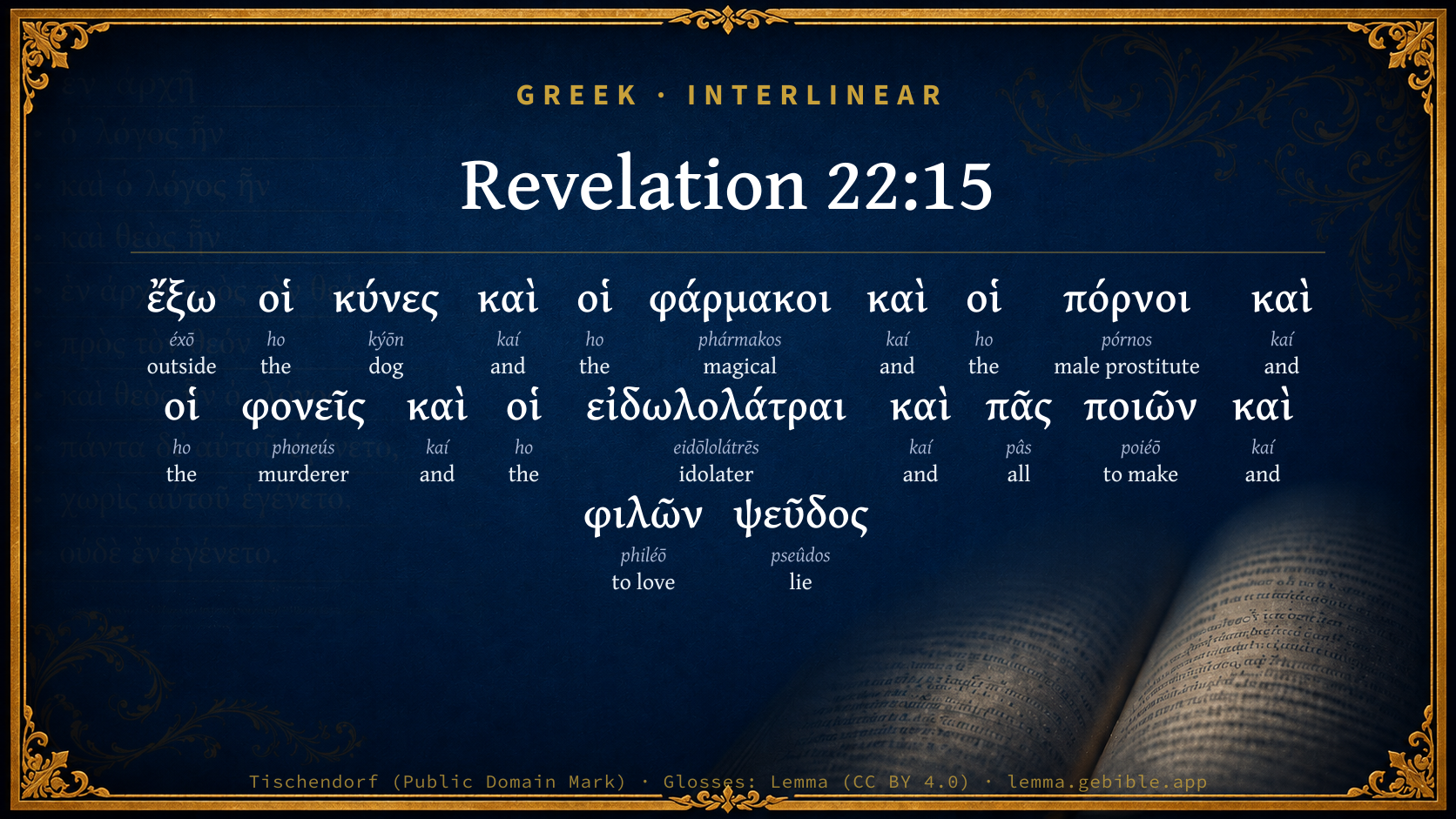
Outside are the dogs, the sorcerers, the sexually immoral, the murderers, the idolaters, and everyone who loves and practices falsehood.
Download a study sheet
One document with this verse’s original text, its word-by-word gloss line, the meaning frame, cross-references with their text, attributed commentary, and full source and license credits — printable, and it pastes into notes with its structure intact.
This verse Autodidact and up
A passage Seminary Student
Up to 50 verses in one chapter. A passage sheet keeps up to 6 commentary sources and 12 cross-references per verse, in the order this page ranks them, and says so on the sheet whenever that leaves anything out. Ask for a single verse and you get the Autodidact verse sheet above.
Everything on this page stays free to read, with no account — the sheet is a download of what is already on screen, not access to it.
Compare translations 3
The same verse in 3 English versions, stacked beneath the original-language interlinear above. Click any original word for its lexicon entry.
Each is an independent rendering of the whole verse — the interlinear is not word-aligned to these translations.
Highlighted words mark where these versions differ — a whole-verse word diff, not a word-by-word alignment.
-
World English Bible Public Domain
Outside are the dogs, the sorcerers, the sexually immoral, the murderers, the idolaters, and everyone who loves and practices falsehood.
-
King James Version Public Domain
For without are dogs, and sorcerers, and whoremongers, and murderers, and idolaters, and whosoever loveth and maketh a lie.
-
unfoldingWord Literal Text CC BY-SA 4.0
Outside dogs and sorcerers and the sexually immoral and murderers and idolaters and everyone loving and doing falsehood.
unfoldingWord Literal Text — © unfoldingWord, licensed CC BY-SA 4.0. Word-aligned USFM3 via Door43 (git.door43.org/unfoldingWord/en_ult).
Show all 19 translations
Every available English version of this verse, each an independent rendering of the whole verse.
-
World English Bible Public Domain
Outside are the dogs, the sorcerers, the sexually immoral, the murderers, the idolaters, and everyone who loves and practices falsehood.
-
Berean Standard Bible Public Domain
But outside are the dogs, the sorcerers, the sexually immoral, the murderers, the idolaters, and everyone who loves and practices falsehood.
-
Majority Standard Bible Public Domain
But outside are the dogs, the sorcerers, the sexually immoral, the murderers, the idolaters, and everyone who loves and practices falsehood.
-
King James Version Public Domain
For without are dogs, and sorcerers, and whoremongers, and murderers, and idolaters, and whosoever loveth and maketh a lie.
-
American Standard Version (1901) Public Domain
Without are the dogs, and the sorcerers, and the fornicators, and the murderers, and the idolaters, and every one that loveth and maketh a lie.
-
Revised Version (1885) Public Domain
Without are the dogs, and the sorcerers, and the fornicators, and the murderers, and the idolaters, and every one that loveth and maketh a lie.
-
Geneva Bible (1599) Public Domain
For without shall be dogs and inchanters, and whoremongers, and murtherers, and idolaters, and whosoeuer loueth or maketh lies.
-
Douay-Rheims (1899) Public Domain
Without are dogs, and sorcerers, and unchaste, and murderers, and servers of idols, and every one that loveth and maketh a lie.
-
Young's Literal Translation Public Domain
and without `are' the dogs, and the sorcerers, and the whoremongers, and the murderers, and the idolaters, and every one who is loving and is doing a lie.
-
Literal Standard Version CC BY-SA 4.0
and outside [are] the dogs, and the sorcerers, and the whoremongers, and the murderers, and the idolaters, and everyone cherishing and doing falsehood.
-
Unlocked Literal Bible CC BY-SA 4.0
Outside are the dogs, the sorcerers, the sexually immoral, the murderers, the idolaters, and everyone who loves and practices falsehood.
-
unfoldingWord Literal Text CC BY-SA 4.0
Outside dogs and sorcerers and the sexually immoral and murderers and idolaters and everyone loving and doing falsehood.
-
Darby Bible Public Domain
Without [are] the dogs, and the sorcerers, and the fornicators, and the murderers, and the idolaters, and every one that loves and makes a lie.
-
World Messianic Bible Public Domain
Outside are the dogs, the sorcerers, the sexually immoral, the murderers, the idolaters, and everyone who loves and practices falsehood.
-
Webster's Bible Public Domain
For without are dogs, and sorcerers, and lewd men, and murderers, and idolaters, and whoever loveth and maketh a lie.
-
Free Bible Version CC BY-SA 4.0
Those outside the city are dogs, those who practice witchcraft, those who are sexually immoral, those who murder, those who worship idols, and all those who love and invent lies.
-
Bible in Basic English Public Domain
Outside are the dogs, and those who make use of evil powers, those who make themselves unclean, and the takers of life, and those who give worship to images, and everyone whose delight is in what is false.
-
Text-Critical English NT CC BY 4.0
Outside are the dogs, the sorcerers, the fornicators, the murderers, the idolaters, and everyone who loves and practices falsehood.
-
Tyndale New Testament (1534) Public Domain
For without shalbe dogges and inchauters and whormongers and mortherers and ydolaters and whosoever loveth or makith lesynges.
Literal Standard Version (2020), Covenant Press — licensed CC BY-SA 4.0. Text via the HelloAO Bible API (eBible.org). Unlocked Literal Bible (unfoldingWord) — licensed CC BY-SA 4.0. Text via the HelloAO Bible API (eBible.org). unfoldingWord Literal Text — © unfoldingWord, licensed CC BY-SA 4.0. Word-aligned USFM3 via Door43 (git.door43.org/unfoldingWord/en_ult). Free Bible Version, Dr. Jonathan Gallagher — licensed CC BY-SA 4.0. Text via the HelloAO Bible API (eBible.org).
Word by word
More ways to search: Search by grammar → Find every occurrence → Compare this word →
Practice this passage: Drill this verse → Learn its vocabulary →
- Appears 2× in the Greek New Testament
- First appears at Revelation 21:8
- Part of Speech
- Noun
- Case
- Nominative
- Number
- Plural
- Gender
- Masculine
Full Thayer's Definition
- ἔξω éxō G1854 “outside” Adverb
- οἱ ho G3588 “the” Article, Nominative, Plural, Masculine
- κύνες kýōn G2965 “dog” Noun, Nominative, Plural, Masculine
- καὶ kaí G2532 “and” Conjunction
- οἱ ho G3588 “the” Article, Nominative, Plural, Masculine
- φάρμακοι phármakos G5333 “magical” Noun, Nominative, Plural, Masculine
- καὶ kaí G2532 “and” Conjunction
- οἱ ho G3588 “the” Article, Nominative, Plural, Masculine
- πόρνοι pórnos G4205 “male prostitute” Noun, Nominative, Plural, Masculine
- καὶ kaí G2532 “and” Conjunction
- οἱ ho G3588 “the” Article, Nominative, Plural, Masculine
- φονεῖς phoneús G5406 “murderer” Noun, Nominative, Plural, Masculine
- καὶ kaí G2532 “and” Conjunction
- οἱ ho G3588 “the” Article, Nominative, Plural, Masculine
- εἰδωλολάτραι eidōlolátrēs G1496 “idolater” Noun, Nominative, Plural, Masculine
- καὶ kaí G2532 “and” Conjunction
- πᾶς pâs G3956 “all” Adjective, Nominative, Singular, Masculine
- ποιῶν poiéō G4160 “to make” Verb, Present, Active, Participle, Nominative, Singular, Masculine
- καὶ kaí G2532 “and” Conjunction
- φιλῶν philéō G5368 “to love” Verb, Present, Active, Participle, Nominative, Singular, Masculine
- ψεῦδος pseûdos G5579 “lie” Noun, Accusative, Singular, Neuter
About this verse
These counts appear in no published source. They are computed here, from the morphology-tagged text and Lemma’s own curated glosses. What Lemma adds →
- 21
- words
- 12
- distinct lemmas
- Revelation
- section
Cross-references
24Topical passages linked to Revelation 22:15 in the Treasury of Scripture Knowledge — connected by theme and wording, ordered by reader-vote popularity; previews shown in the World English Bible.
- Revelation 21:8 But for the cowardly, unbelieving, sinners, abominable, murderers, sexually immoral, sorcerers, idolaters, and all liars, their part is in the lake that burns with fire and sulfur, which is the second death."
- Galatians 5:19–21 Now the works of the flesh are obvious, which are: adultery, sexual immorality, uncleanness, lustfulness,
- Philippians 3:2 Beware of the dogs, beware of the evil workers, beware of the false circumcision.
- 1 Corinthians 6:9–10 Or don't you know that the unrighteous will not inherit the Kingdom of God? Don't be deceived. Neither the sexually immoral, nor idolaters, nor adulterers, nor male prostitutes, nor homosexuals,
- Revelation 21:27 There will in no way enter into it anything profane, or one who causes an abomination or a lie, but only those who are written in the Lamb's book of life.
- Revelation 9:20–21 The rest of mankind, who were not killed with these plagues, didn't repent of the works of their hands, that they wouldn't worship demons, and the idols of gold, and of silver, and of brass, and of stone, and of wood; which can neither see, nor hear, nor walk.
- John 3:18–21 He who believes in him is not judged. He who doesn't believe has been judged already, because he has not believed in the name of the one and only Son of God.
- Colossians 3:6 for which things' sake the wrath of God comes on the children of disobedience.
- Malachi 3:5 I will come near to you to judgment; and I will be a swift witness against the sorcerers, and against the adulterers, and against the perjurers, and against those who oppress the hireling in his wages, the widow, and the fatherless, and who deprive the foreigner of justice, and don't fear me," says Yahweh of Hosts.
- Ephesians 5:3–6 But sexual immorality, and all uncleanness, or covetousness, let it not even be mentioned among you, as becomes saints;
- 2 Thessalonians 2:10–12 and with all deception of wickedness for those who are being lost, because they didn't receive the love of the truth, that they might be saved.
- Revelation 18:23 The light of a lamp will shine no more at all in you. The voice of the bridegroom and of the bride will be heard no more at all in you; for your merchants were the princes of the earth; for with your sorcery all the nations were deceived.
- Isaiah 57:3 But draw near here, you sons of the sorceress, the seed of the adulterer and the prostitute.
- Jeremiah 5:31 the prophets prophesy falsely, and the priests bear rule by their means; and my people love to have it so: and what will you do in the end of it?
- Acts 8:11 They listened to him, because for a long time he had amazed them with his sorceries.
- Acts 13:6–11 When they had gone through the island to Paphos, they found a certain sorcerer, a false prophet, a Jew, whose name was Bar Jesus,
- Revelation 17:1–6 One of the seven angels who had the seven bowls came and spoke with me, saying, "Come here. I will show you the judgment of the great prostitute who sits on many waters,
- 1 Kings 22:8 The king of Israel said to Jehoshaphat, there is yet one man by whom we may inquire of Yahweh, Micaiah the son of Imlah: but I hate him; for he does not prophesy good concerning me, but evil. Jehoshaphat said, "Don't let the king say so."
- 1 Kings 22:21–23 There came forth a spirit, and stood before Yahweh, and said, I will entice him.
- Isaiah 9:15–16 The elder and the honorable man, he is the head; and the prophet who teaches lies, he is the tail.
- Isaiah 47:9 but these two things shall come to you in a moment in one day, the loss of children, and widowhood; in their full measure shall they come on you, in the multitude of your sorceries, and the great abundance of your enchantments.
- Isaiah 47:12 Stand now with your enchantments, and with the multitude of your sorceries, in which you have labored from your youth; if so be you shall be able to profit, if so be you may prevail.
- Matthew 8:12 but the children of the Kingdom will be thrown out into the outer darkness. There will be weeping and the gnashing of teeth."
- John 8:46 Which of you convicts me of sin? If I tell the truth, why do you not believe me?
Cross-references courtesy of OpenBible.info (CC BY 4.0).
Lesson kit
Teaching starters — assembled from the data on this page, not authored interpretation. Every prompt links to the verse data it draws on. Edit before teaching.
Revelation, in the Revelation, opens this verse with 21 words (12 distinct Greek lemmas). Its most distinctive word is phármakos (“magical”). A historical commentator’s framing appears above. Read the whole chapter for the surrounding context.
Discussion questions
- What does “magical” (phármakos) contribute to the verse as a whole?
- How does Revelation 21:8, which shares the word «magical», read alongside this verse?
- What does the repetition of “and” (6× in this one verse) do in this verse?
- These translations render this verse differently. What is at stake in choosing one wording over another?
- Compare how Tyndale Open Study Notes and Bengel's Gnomon read this verse. Where do they agree or differ?
Things to notice
- These translations choose different wording for 16 words in this verse.
- “and” occurs 6× in this single verse.
- 12 distinct Greek lemmas span 21 words in this verse.
Commentary
Notes on Revelation 22:15 from classic Christian and Jewish commentators (each source and its license shown beneath its notes). The classic Christian expositions comment on the surrounding passage and are grouped to its opening verse, so a note may address several verses; the Jewish commentaries on the Tanakh (Rashi and others) are per-verse, so they appear only where the commentator wrote on this verse.
Lemma curates 59 commentaries, every one of them public domain or Creative Commons licensed, each selected and text-cleaned for this edition rather than reprinted as found. About our sources →
Tyndale Open Study Notes
Tyndale Open Resources
Tyndale Open Study Notes — © Tyndale Open Resources, licensed CC BY-SA 4.0. Text via the HelloAO Bible API.
Bengel's Gnomon
Johann Albrecht Bengel
Bengel's Gnomon of the New Testament — English translation (T&T Clark, Edinburgh, 1860) — public domain. Text from a community e-Sword module.
Jamieson, Fausset & Brown
Robert Jamieson, A. R. Fausset & David Brown
Jamieson, Fausset & Brown — Commentary Critical and Explanatory on the Whole Bible (1871) — public domain (CC PDM 1.0). Text via the HelloAO Bible API.
Adam Clarke's Commentary
Adam Clarke's Commentary on the Bible (1810–1826) — public domain. Text from a community e-Sword/MySword module.
Ellicott's Commentary for English Readers
A Bible Commentary for English Readers, edited by Charles John Ellicott (1878–1897) — public domain. Text from a community e-Sword module.
The Cambridge Bible for Schools and Colleges
gen. ed. J. J. S. Perowne
The Cambridge Bible for Schools and Colleges (gen. ed. J. J. S. Perowne; Cambridge University Press, 1878–1918) — public domain. Text from a community e-Sword module.
John Gill's Exposition
John Gill's Exposition of the Whole Bible (1746–1763) — public domain (CC PDM 1.0). Text via the HelloAO Bible API.
Trapp's Complete Commentary
John Trapp
John Trapp, A Commentary or Exposition upon All the Books of the Old and New Testament (1647–1656) — public domain. Text from a community e-Sword module.
Albert Barnes' Notes on the Bible
Albert Barnes' Notes on the Bible (1834–1885) — public domain. Text from a community e-Sword/MySword module.
Haydock's Catholic Bible Commentary
George Leo Haydock (1774–1849), Haydock's Catholic Family Bible and Commentary, 1859 edition — public domain. Excludes Psalms (Douay-Rheims chapter numbering differs from Protestant) and Deuterocanonical books (Catholic canon only).
Whedon's Commentary on the Bible
Daniel D. Whedon
Daniel D. Whedon (gen. ed.), Commentary on the Old and New Testaments (1874–1909) — public domain. Text from a community e-Sword module.
The Pulpit Commentary
The Pulpit Commentary (1880–1919), ed. H.D.M. Spence-Jones & Joseph S. Exell — public domain. Text from a community e-Sword module.
John Wesley's Explanatory Notes
John Wesley, Explanatory Notes Upon the Whole Bible (1754–1765) — public domain. Text via the GEBible commentary corpus.
Burkitt's Expository Notes on the New Testament
William Burkitt
William Burkitt's Expository Notes on the New Testament (1700–1703) — public domain. Text from a community e-Sword module.
The People's New Testament
B. W. Johnson
B. W. Johnson's The People's New Testament with Notes (1889–1891) — public domain. Electronic text from the Christian Classics Ethereal Library (CCEL) ThML edition.
Expositor's Greek Testament
ed. W. Robertson Nicoll
The Expositor's Greek Testament, edited by W. Robertson Nicoll (1897–1910) — public domain. Text from a community e-Sword module.
Cambridge Greek Testament for Schools and Colleges
Cambridge Greek Testament for Schools and Colleges (Cambridge University Press, 1896; 21 vols, various authors incl. Carr, Maclear, Plummer, Farrar, Lumby, Moule, M. R. James, Simcox) — public domain. Text from a community e-Sword module.
Vincent's Word Studies in the New Testament
Marvin R. Vincent
Marvin R. Vincent, Word Studies in the New Testament (1887–1900) — public domain. Text from a community e-Sword/MySword module.