
Genesis 6:16

Hebrew (Westminster Leningrad Codex) Genesis 6:16 appears in the Hebrew Old Testament. The text above is from the Westminster Leningrad Codex. Each word links to its Strong’s number, a concise gloss, and parsing drawn from the Open Scriptures Hebrew Bible morphology. Click any word for its full Brown-Driver-Briggs (BDB) entry.
Download image
Cite this verse

Genesis 6:16 (World English Bible). Public Domain. Lemma interlinear Bible study tool, https://lemma.gebible.app/v/genesis/6/16.

Show BibTeX & RIS
BibTeX
RIS
English Translation
You shall make a roof in the ark, and to a cubit shall you finish it upward. You shall set the door of the ark in the side of it. You shall make it with lower, second, and third levels.
World English Bible · Public Domain
Highlights
  • 4 first appearances in the Hebrew Bible
Full analysis ↓
Download a study sheet

One document with this verse’s original text, its word-by-word gloss line, the meaning frame, cross-references with their text, attributed commentary, and full source and license credits — printable, and it pastes into notes with its structure intact.

This verse Autodidact and up

Study sheet (.html) Plain text (.txt)

A passage Seminary Student

Up to 50 verses in one chapter. A passage sheet keeps up to 6 commentary sources and 12 cross-references per verse, in the order this page ranks them, and says so on the sheet whenever that leaves anything out. Ask for a single verse and you get the Autodidact verse sheet above.

Everything on this page stays free to read, with no account — the sheet is a download of what is already on screen, not access to it.

Want to remove ads? Support Godless Engineer
Compare translations 3

The same verse in 3 English versions, stacked beneath the original-language interlinear above. Click any original word for its lexicon entry.

Each is an independent rendering of the whole verse — the interlinear is not word-aligned to these translations.

Highlighted words mark where these versions differ — a whole-verse word diff, not a word-by-word alignment.

  • World English Bible Public Domain
    You shall make a roof in the ark, and to a cubit shall you finish it upward. You shall set the door of the ark in the side of it. You shall make it with lower, second, and third levels.
  • King James Version Public Domain
    A window shalt thou make to the ark, and in a cubit shalt thou finish it above; and the door of the ark shalt thou set in the side thereof; with lower, second, and third stories shalt thou make it.
  • unfoldingWord Literal Text CC BY-SA 4.0
    Make a window for the ark and finish it to within one cubit from the top. And put the door of the ark in its side. Make a lower, a second, and a third.

unfoldingWord Literal Text — © unfoldingWord, licensed CC BY-SA 4.0. Word-aligned USFM3 via Door43 (git.door43.org/unfoldingWord/en_ult).

Versions to compare (up to 4)

3 of 4 selected

Show all 18 translations

Every available English version of this verse, each an independent rendering of the whole verse.

  • World English Bible Public Domain
    You shall make a roof in the ark, and to a cubit shall you finish it upward. You shall set the door of the ark in the side of it. You shall make it with lower, second, and third levels.
  • Berean Standard Bible Public Domain
    You are to make a roof for the ark, finish its walls a cubit from the top, place a door in the side of the ark, and build lower, middle, and upper decks.
  • Majority Standard Bible Public Domain
    You are to make a roof for the ark, finish its walls a cubit from the top, place a door in the side of the ark, and build lower, middle, and upper decks.
  • King James Version Public Domain
    A window shalt thou make to the ark, and in a cubit shalt thou finish it above; and the door of the ark shalt thou set in the side thereof; with lower, second, and third stories shalt thou make it.
  • American Standard Version (1901) Public Domain
    A light shalt thou make to the ark, and to a cubit shalt thou finish it upward; and the door of the ark shalt thou set in the side thereof; with lower, second, and third stories shalt thou make it.
  • Revised Version (1885) Public Domain
    A light shalt thou make to the ark, and to a cubit shalt thou finish it upward; and the door of the ark shalt thou set in the side thereof; with lower, second, and third stories shalt thou make it.
  • Geneva Bible (1599) Public Domain
    A windowe shalt thou make in the Arke, and in a cubite shalt thou finish it aboue, and the doore of the Arke shalt thou set in the side thereof: thou shalt make it with the lowe, seconde and third roume.
  • Douay-Rheims (1899) Public Domain
    Thou shalt make a window in the ark, and in a cubit shalt thou finish the top of it: and the door of the ark thou shalt set in the side: with lower, middle chambers, and third stories shalt thou make it.
  • Young's Literal Translation Public Domain
    a window dost thou make for the ark, and unto a cubit thou dost restrain it from above; and the opening of the ark thou dost put in its side, -- lower, second, and third `stories' dost thou make it.
  • Literal Standard Version CC BY-SA 4.0
    you make a window for the Ark, and you finish it to a cubit from above; and you put the opening of the Ark in its side; you make it [with] lower, second, and third [stories].
  • Unlocked Literal Bible CC BY-SA 4.0
    Make a roof for the ark, and finish it at a cubit from the top of the side. Place a door in the side of the ark and make a lower, a second, and a third deck.
  • unfoldingWord Literal Text CC BY-SA 4.0
    Make a window for the ark and finish it to within one cubit from the top. And put the door of the ark in its side. Make a lower, a second, and a third.
  • Darby Bible Public Domain
    A light shalt thou make to the ark; and to a cubit high shalt thou finish it above. And the door of the ark shalt thou set in its side: [with] a lower, second, and third [story] shalt thou make it.
  • World Messianic Bible Public Domain
    You shall make a roof in the ship, and you shall finish it to a cubit upward. You shall set the door of the ship in its side. You shall make it with lower, second, and third levels.
  • Webster's Bible Public Domain
    A window shalt thou make to the ark, and in a cubit shalt thou finish it above; and the door of the ark shalt thou set in its side: with lower, second, and third stories shalt thou make it.
  • Free Bible Version CC BY-SA 4.0
    Make a roof for the ark, leaving a cubit-wide opening between the roof and the top of the sides. Put a door in the side of the ark, and construct three decks inside.
  • Bible in Basic English Public Domain
    You are to put a window in the ark, a cubit from the roof, and a door in the side of it, and you are to make it with a lower and second and third floors.
  • JPS Tanakh (1917) Public Domain
    A light shalt thou make to the ark, and to a cubit shalt thou finish it upward; and the door of the ark shalt thou set in the side thereof; with lower, second, and third stories shalt thou make it.

Literal Standard Version (2020), Covenant Press — licensed CC BY-SA 4.0. Text via the HelloAO Bible API (eBible.org). Unlocked Literal Bible (unfoldingWord) — licensed CC BY-SA 4.0. Text via the HelloAO Bible API (eBible.org). unfoldingWord Literal Text — © unfoldingWord, licensed CC BY-SA 4.0. Word-aligned USFM3 via Door43 (git.door43.org/unfoldingWord/en_ult). Free Bible Version, Dr. Jonathan Gallagher — licensed CC BY-SA 4.0. Text via the HelloAO Bible API (eBible.org).

Word by word

More ways to search: Search by grammar → Find every occurrence → Compare this word →

Practice this passage: Drill this verse → Learn its vocabulary →

תַּחְתִּיִּ֛ם
tachtîy
H8482
“low”
Adjective, Adjective, Masculine, Plural, Absolute
Part of Speech
Adjective
Type
Adjective
Gender
Masculine
Number
Plural
State
Absolute
Full BDB Definition

Origin: from H8478

TWOT: 2504b

low, lower, lowest - lowest (as adjective) - the lower parts (substantive)
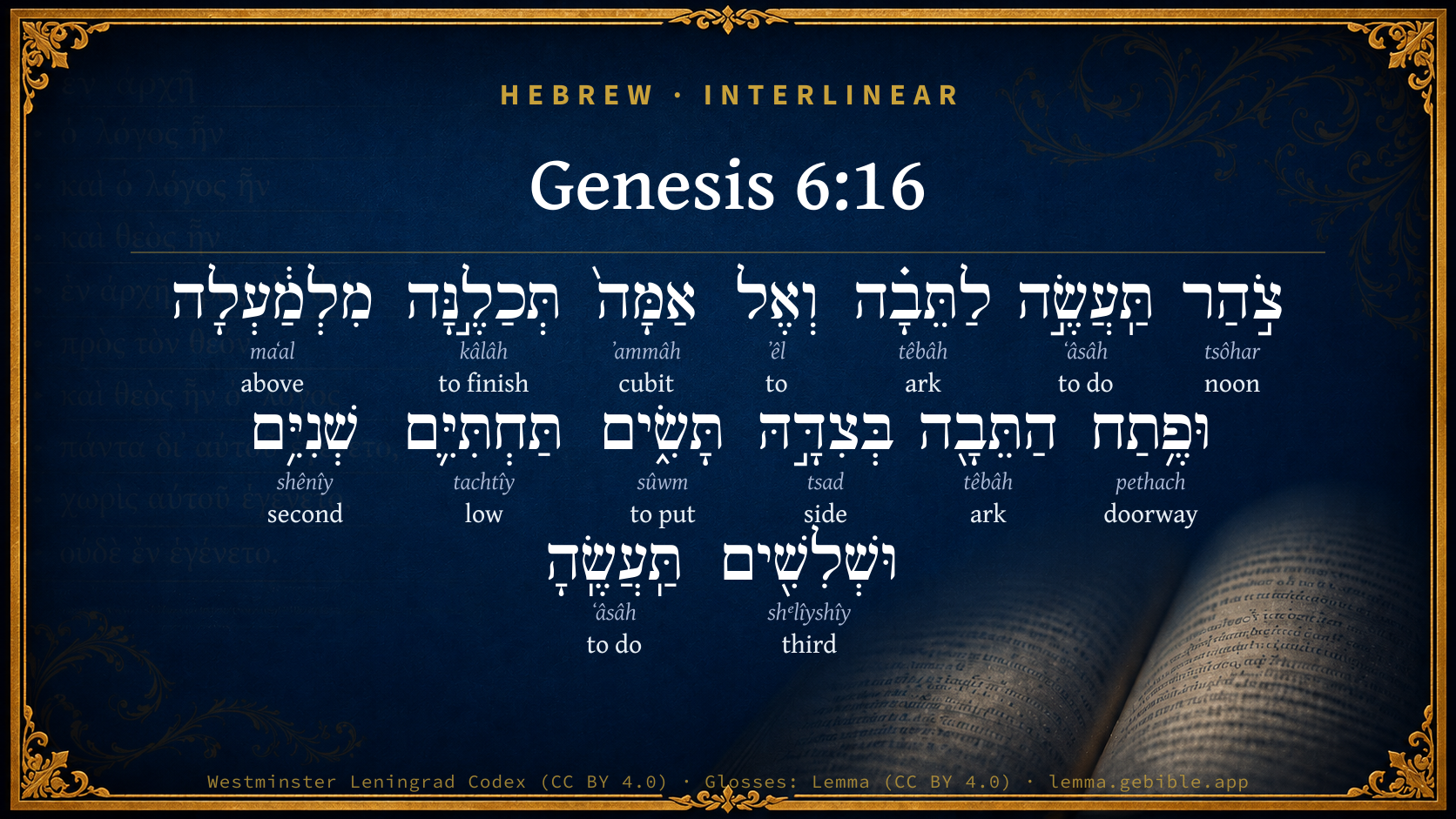
  1. צֹ֣הַר tsôhar H6672 “noon” Noun, Common, Feminine, Singular, Absolute
  2. תַּֽעֲשֶׂ֣ה ʻâsâh H6213 “to do” Verb, Qal, Imperfect, 2nd Person, Masculine, Singular
  3. לַתֵּבָ֗ה têbâh H8392 “to/for the · ark” Preposition, Determined + Noun, Common, Feminine, Singular, Absolute
  4. וְאֶל ʼêl H413 “and · to” Conjunction + Preposition
  5. אַמָּה֙ ʼammâh H520 “cubit” Noun, Common, Feminine, Singular, Absolute
  6. תְּכַלֶ֣נָּה kâlâh H3615 “to finish · her” Verb, Piel, Imperfect, 2nd Person, Masculine, Singular + Suffix, Personal, 3rd Person, Feminine, Singular
  7. מִלְמַ֔עְלָה maʻal H4605 “from · to/for · above · toward” Preposition + Preposition + Adverb + Suffix, Demonstrative
  8. וּפֶ֥תַח pethach H6607 “and · doorway of” Conjunction + Noun, Common, Masculine, Singular, Construct
  9. הַתֵּבָ֖ה têbâh H8392 “the · ark” Particle, Definite Article + Noun, Common, Feminine, Singular, Absolute
  10. בְּצִדָּ֣הּ tsad H6654 “in/at · side · her” Preposition + Noun, Common, Masculine, Singular, Construct + Suffix, Personal, 3rd Person, Feminine, Singular
  11. תָּשִׂ֑ים sûwm H7760 “to put” Verb, Qal, Imperfect, 2nd Person, Masculine, Singular
  12. שְׁנִיִּ֥ם shênîy H8145 “second” Adjective, Ordinal number, Masculine, Plural, Absolute
  13. וּשְׁלִשִׁ֖ים shᵉlîyshîy H7992 “and · third” Conjunction + Adjective, Ordinal number, Masculine, Plural, Absolute
  14. תַּֽעֲשֶֽׂהָ ʻâsâh H6213 “to do · her” Verb, Qal, Imperfect, 2nd Person, Masculine, Singular + Suffix, Personal, 3rd Person, Feminine, Singular

About this verse

These counts appear in no published source. They are computed here, from the morphology-tagged text and Lemma’s own curated glosses. What Lemma adds →

15
words
13
distinct lemmas
Pentateuch
section

Notable vocabulary

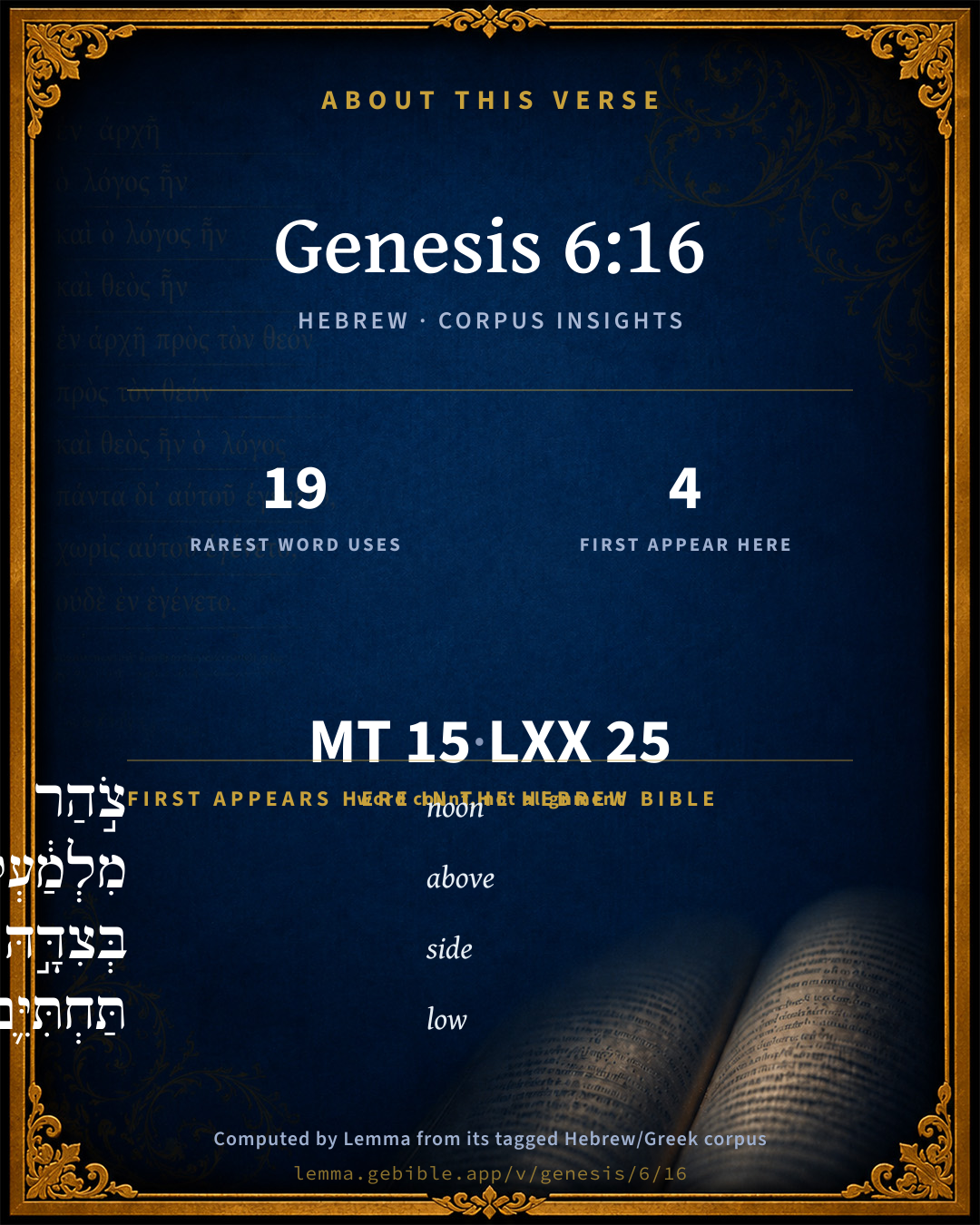
The rarest word here is תַּחְתִּיִּ֛ם low H8482 — appearing just 19 times in the whole Hebrew Bible.

First appearance in Scripture

These words make their first canonical appearance in the Hebrew Bible here:

  • צֹ֣הַר noon H6672
  • מִלְמַ֔עְלָה above H4605
  • בְּצִדָּ֣הּ side H6654
  • תַּחְתִּיִּ֛ם low H8482

Shared distinctive vocabulary

תַּחְתִּיִּ֛ם low H8482 occurs in 19 verses of the Hebrew Bible. Also found in:

Grammatical profile

  • 4 verbs
  • 6 nouns
  • 3 adjectives
  • 1 preposition
  • 1 adverb

Verb forms

  • תַּֽעֲשֶׂ֣ה Qal · Imperfect
  • תְּכַלֶ֣נָּה Piel · Imperfect
  • תָּשִׂ֑ים Qal · Imperfect
  • תַּֽעֲשֶֽׂהָ Qal · Imperfect

Repetition

Words recur within this verse — often emphatic in Hebrew:

  • תַּֽעֲשֶׂ֣ה to do H6213 ×2
  • לַתֵּבָ֗ה ark H8392 ×2

Hebrew & Septuagint length

In English translation the verse runs 40 words from the Hebrew and 39 from the Septuagint (LXX English) — closely comparable.

A rough comparison of the two English renderings, which tokenize alike — not a word-level alignment.

Word counts can differ between the Hebrew and the Greek without any difference in meaning — e.g. the Hebrew direct-object marker אֵת has no separate Greek word, and Greek often adds the article ὁ.

In the original languages it is 15 Hebrew tokens and 25 Greek tokens — but the two are counted differently (Hebrew bundles its prefixes and suffixes into one token; the Greek is in lemma form), so that isn’t a like-for-like length.

Cross-references

7

Topical passages linked to Genesis 6:16 in the Treasury of Scripture Knowledge — connected by theme and wording, ordered by reader-vote popularity; previews shown in the World English Bible.

  • Genesis 7:16 Those who went in, went in male and female of all flesh, as God commanded him; and Yahweh shut him in.
  • Genesis 8:6 It happened at the end of forty days, that Noah opened the window of the ark which he had made,
  • Ezekiel 41:16 the thresholds, and the closed windows, and the galleries round about on their three stories, over against the threshold, with wood ceilings round about, and [from] the ground up to the windows, (now the windows were covered),
  • 2 Samuel 6:16 It was so, as the ark of Yahweh came into the city of David, that Michal the daughter of Saul looked out at the window, and saw king David leaping and dancing before Yahweh; and she despised him in her heart.
  • 2 Kings 9:30 When Jehu was come to Jezreel, Jezebel heard of it; and she painted her eyes, and attired her head, and looked out at the window.
  • Ezekiel 42:3 Over against the twenty [cubits] which belonged to the inner court, and over against the pavement which belonged to the outer court, was gallery against gallery in the third story.
  • Luke 13:25 When once the master of the house has risen up, and has shut the door, and you begin to stand outside, and to knock at the door, saying, 'Lord, Lord, open to us!' then he will answer and tell you, 'I don't know you or where you come from.'

Cross-references courtesy of OpenBible.info (CC BY 4.0).

Hebrew and Greek witnesses Masoretic Hebrew ↔ Greek Septuagint

The same verse in the two great witnesses to the Old Testament, shown verse-for-verse.

These are two independent witnesses, not word-aligned to each other, and the Septuagint is shown in lemma (dictionary) form.

Hebrew Genesis 6:16 Masoretic · Westminster Leningrad Codex

צֹ֣הַר תַּֽעֲשֶׂ֣ה לַתֵּבָ֗ה וְאֶל אַמָּה֙ תְּכַלֶ֣נָּה מִלְמַ֔עְלָה וּפֶ֥תַח הַתֵּבָ֖ה בְּצִדָּ֣הּ תָּשִׂ֑ים תַּחְתִּיִּ֛ם שְׁנִיִּ֥ם וּשְׁלִשִׁ֖ים תַּֽעֲשֶֽׂהָ

You shall make a roof in the ark, and to a cubit shall you finish it upward. You shall set the door of the ark in the side of it. You shall make it with lower, second, and third levels.

World English Bible · Public Domain

Greek LXX Genesis 6:16 Septuagint · lemma form

ἐπι συνἄγω ποιέω ὁ κιβωτός καί εἰς πῆχυς συντελέω αὐτός ἄνωθεν ὁ δέ θύρα ὁ κιβωτός ποιέω ἐκ πλάγιος κατάγαιος διώροφος καί τριώροφος ποιέω αὐτός

You shall narrow the ark in making it, and in a cubit above you shall finish it, and the door of the ark you shall make on the side; with lower, second, and third stories you shall make it.

LXX2012 (modern English Septuagint) · Public Domain

On this verse, Adam Clarke's Commentary discusses the Septuagint’s reading. Read the note in Commentary ↓

Hebrew: Westminster Leningrad Codex (CC BY 4.0). Greek: Septuagint (public domain); English from LXX2012 (modern English Septuagint) (Public Domain). How the Septuagint differs from the Hebrew →

Targum (Aramaic paraphrase)

2

The Targum is the ancient Jewish Aramaic paraphrase of the Hebrew Scriptures — an interpretive translation, not the Hebrew text itself. Onkelos (literal) and Pseudo-Jonathan (expansive) render the Torah, and Jonathan the Prophets. Coverage is partial: where no permissively-licensed English translation exists for a verse, only the Aramaic is shown. This is verse-level text, not a word-by-word alignment to the Hebrew.

  1. Targum Onkelos Torah (Genesis–Deuteronomy)
    נֵהוֹר תַּעְבֵּיד לְתֵבוֹתָא וּלְאַמְתָא תְּשַׁכְלְלִינַהּ מִלְּעֵלָּא וְתַרְעָא דְתֵבוֹתָא בְּסִטְרַהּ תְּשַׁוִּי מְדוֹרִין אֲרָעִין תִּנְיָנִין וּתְלִיתָאִין תַּעְבְּדִנַּהּ

    A light shalt thou make to the ark, and at a cubit shalt thou complete it above, and the door of the ark thou shalt place in its side. Lower dwellings, second and third, shalt thou make in it.

    Targum Onkelos — Aramaic: “Onkelos Genesis” (public domain); “Onkelos Exodus” (public domain); “Onkelos Leviticus” (public domain); “Onkelos Numbers” (public domain); “Onkelos Deuteronomy” (public domain). English: “Sefaria Community Translation” (CC0 1.0 (public-domain dedication)); “J.W. Etheridge. The Targums of Onkelos and Jonathan Ben Uzziel on the Pentateuch. London: Longmans, Green, 1862” (public domain). Text via Sefaria.

  2. Targum Pseudo-Jonathan Torah (Genesis–Deuteronomy)
    אִיזֵל לְפִישׁוֹן וְסַב מִתַּמָן יוֹהֲרָא וְתִשְׁוִנֵיהּ בְּתֵיבוּתָא לְאַנְהָרָא לְכוֹן וּלְגַרְמִידָא תְשֵׁצִינֵיהּ מִלְעֵיל וְתַרְעָא דְתֵיבוּתָא בְּצִטְרָא תְשַׁוֵי מְדוֹרִין תַּתָּאִין תִּנְיָנִין וּתְלִיתָאִין תַּעַבְדִינֵהּ

    Go thou unto Phison, and take from thence a precious stone, and fix it in the ark to illuminate you: with the measure of a cubit (or span) shalt thou complete it above. And a door shalt thou set in the side of the ark; and with dwelling-places, inferior, second, and third, shalt thou make it.

    Targum Pseudo-Jonathan — Aramaic: “Targum Jonathan on Genesis” (public domain); “Targum Jonathan on Exodus” (public domain); “Targum Jonathan on Leviticus” (public domain); “Targum Jonathan on Numbers” (public domain); “Targum Jonathan on Deuteronomy” (public domain). English: “The Targum of Jonathan ben Uzziel, trans. J. W. Etheridge, London, 1862” (public domain). Text via Sefaria.

Commentary

Notes on Genesis 6:16 from classic Christian and Jewish commentators (each source and its license shown beneath its notes). The classic Christian expositions comment on the surrounding passage and are grouped to its opening verse, so a note may address several verses; the Jewish commentaries on the Tanakh (Rashi and others) are per-verse, so they appear only where the commentator wrote on this verse.

Lemma curates 59 commentaries, every one of them public domain or Creative Commons licensed, each selected and text-cleaned for this edition rather than reprinted as found. About our sources →

Trapp's Complete Commentary

John Trapp

Gen 6:16 A window shalt thou make to the ark, and in a cubit shalt thou finish it above; and the door of the ark shalt thou set in the side thereof; [with] lower, second, and third [stories] shalt thou make it.

Ver. 16. A window shalt thou make.] The ark had little outward light; so the Church, till she become triumphant. There could not but be much stench among all those creatures, though shut up in several rooms; so here, there is much annoyance to those that have their "senses exercised to discern good and evil". {Heb 5:14} Compare the estate of Prince Charles in his queen-mother’s womb with his condition at full age, in all the glory of his father’s court; there is a broad difference. And it may fitly resemble, saith one, {a} the difference of our present and future estate; while the Church doth here travail of us, we are pent up in dark cloisters, and annoyed with much stench of sin, both in ourselves and others; but when we come to heaven, we shall see and enjoy the light of life, our feet shall be as hinds’ feet, upon the everlasting mountains.

{a} Bain’s Letter,

John Trapp, A Commentary or Exposition upon All the Books of the Old and New Testament (1647–1656) — public domain. Text from a community e-Sword module.

Tyndale Open Study Notes

Tyndale Open Resources

6:16 An 18-inch opening below the roof encircled the boat, providing light and air. • Noah was to build a door and God would close it (7:16). God was the captain of this peculiar boat with no sail or rudder. God also brought the animals to Noah (6:20).

Tyndale Open Study Notes — © Tyndale Open Resources, licensed CC BY-SA 4.0. Text via the HelloAO Bible API.

Geneva Bible (1599)

Geneva Bible translators

That is, of three heights, as appeareth in the figure.

Geneva Bible (1599) marginal notes — public domain. Text via Bolls.life.

Jamieson, Fausset & Brown

Robert Jamieson, A. R. Fausset & David Brown

A window--probably a skylight, formed of some transparent substance unknown.

in a cubit shalt thou finish it above--a direction to raise the roof in the middle, seemingly to form a gentle slope for letting the water run off.

Jamieson, Fausset & Brown — Commentary Critical and Explanatory on the Whole Bible (1871) — public domain (CC PDM 1.0). Text via the HelloAO Bible API.

Adam Clarke's Commentary

Verse 16. A window shalt thou make] What this was cannot be absolutely ascertained. The original word צהר tsohar signifies clear or bright; the Septuagint translate it by επωυναγων, "collecting, thou shalt make the ark," which plainly shows they did not understand the word as signifying any kind of window or light. Symmacbus translates it διαφανες, a transparency; and Aquila, μεσημβρινον, the noon. Jonathan ben Uzziel supposes that it was a precious luminous stone which Noah, by Divine command, brought from the river Pison. It is probably a word which should be taken in a collective sense, signifying apertures for air and light.

In a cubit shalt thou finish it above] Probably meaning that the roof should be left a cubit broad at the apex or top, and that it should not terminate in a sharp ridge. But this place is variously understood.

Adam Clarke's Commentary on the Bible (1810–1826) — public domain. Text from a community e-Sword/MySword module.

Ellicott's Commentary for English Readers

(16) A window.—Not the word so rendered in Gen_7:11; Gen_8:2, which means a lattice; nor that in. Gen_8:6, which means an aperture; but “zohar,” light, brightness. In the dual, double-light, it is the usual word for “midday,” but it does not occur elsewhere in the singular. It was evidently a means, not merely of lighting the ark, but also of ventilating it; for as it was thickly covered within and without with bitumen—a point strongly insisted upon in the Chaldean Genesis—the two lower storeys would be so ill supplied with air as to be fit only for stores and. ballast, and the upper storey alone capable of being inhabited. If this zohar was an open space one cubit in height, running all round the ark, and formed by not boarding over the upright beams, it would have given a sufficient supply of air, and being protected by the overhanging eaves of the roof—for the ark had no deck—would not have admitted any serious amount. of rain. So in the Chaldean Genesis the ark has no deck, but a roof (p. 281).

Above.—Or, upward. The word is one of those reduplicated forms by means of which the Hebrew language expresses so much within a little compass. Consisting of only six letters, it is nevertheless a compound of five particles, and signifies from to upward .· that is, thou shalt finish it (the ark, as is shown by the gender) from beneath, working upwards till the last cubit, which is not to be finished, but left open for ventilation and light.

The door, on which also much stress is laid in the Chaldean account as being essential for the protection of the inmates (p. 281), was to be at the side, and probably extended throughout the three storeys, two-thirds of which, however, might be closed as soon as the lower storeys had received their freightage of provisions. Besides this door, there must also have been apertures to admit of cleaning the cells in which the animals were confined and removing their litter, but of such lower arrangements no mention is made.

It is not necessary to suppose that Noah and his three sons built this vast vessel with their own hands. He was probably a powerful chieftain, and many of the Sethites may have given him aid. Implements of iron had been invented by the Cainites, and on the intermarriage of the two lines would be brought into general use. It is difficult, however, to understand now four men could feed, clean, and give water to a very large collection of animals for so many months. Without scrupulous attention to such matters, a murrain would have broken out, and as only two of many species were taken into the ark, the loss of any one of these animals would have been equivalent to the destruction of the race. The narrative, however, implies that the health of man and beast throughout the twelve months was perfect; and probably the number of the animals received into the ark was less than is commonly supposed.

A Bible Commentary for English Readers, edited by Charles John Ellicott (1878–1897) — public domain. Text from a community e-Sword module.

The Cambridge Bible for Schools and Colleges

gen. ed. J. J. S. Perowne

16. Alight] Perhaps better than a roof. The word so rendered (ṣôhar) only occurs here in the singular: in the dual it is the regular Heb. word for “noonday.” Accepting the rendering which connects it with “light,” we should probably be right in conjecturing that it means here “a window,” or “opening,” beneath the over-hanging eaves of the roof on both sides of the ark. So Latin, fenestram. In the Babylonian version, a window is mentioned. Others, connecting the word with an Arabic form, render it by roof, deeming that the roof, being of such importance to the inmates, could not have been omitted in the description. LXX ἐπισυνάγων is unintelligible, but possibly gives the idea of the converging sides of the covering.

and to a cubit, &c.] This clause is very difficult. (a) The commonest opinion is that, if the reference be to a window, it was to be a cubit high, running round the ark. This, however, would have been a mere slit, and practically inadequate for purposes of light and air. Perhaps it may mean the distance of a cubit from the top of the window to the roof. (b) The idea that it represented a little square window in Noah’s own cell is fanciful. (c) If the word rendered “light” denoted the roof, the cubit “upward,” or “from above,” might indicate the amount of slope, which, however, would be extremely small. An allusion to the “window” is the most probable explanation. The opening would have run all round the ship, with the necessary intervals of beams and supports. The description must not be judged by modern standards either of ship-building or of hygiene. It is more or less imaginative.

upward] The rendering of the margin, from above, gives a more intelligible meaning.

Gunkel, who considers that the text is corrupt, makes the strange conjectural emendation, “and on a hinge shalt thou make it revolve.”

the door] Cf. Gen_7:16.

stories] The Babylonian account is more elaborate: “Then I built 6 decks in it so that it was divided into 7 stories. The interior (of each storey) I divided into 9 compartments.”

The Cambridge Bible for Schools and Colleges (gen. ed. J. J. S. Perowne; Cambridge University Press, 1878–1918) — public domain. Text from a community e-Sword module.

John Gill's Exposition

But with thee will I establish my covenant,.... Made with Noah at this time, though not expressed, that on his making an ark, as God directed him, and going into it at his command, he would preserve him while building it from the rage of wicked men, and save him in it and his family, when the flood should come; and that they should come safe out of it, and repeople the world, which should be no more destroyed by one; for this covenant respects that later mentioned, Gen 9:11 so Aben Ezra; or the promise of the Messiah, which should spring from him, for the fulfilment of which Noah and his family were spared; and this in every article God would confirm, of which he might be assured from his power, veracity, and faithfulness, and other perfections of his:

and thou shalt come into the ark; when the covenant would begin more clearly to be established, and more plainly to be fulfilling; Noah on the one hand being obedient to the divine will, having built an ark, and entering into it; and on the other, God giving him leave, and an order to enter into it, and shutting him up in it to preserve him:

thou and thy sons, and thy wife, and thy sons' wives with thee; that is, Noah and his wife, and his sons and their wives, in all eight persons; and eight only, as the Apostle Peter observes, Pe1 3:20 by this it appears that Noah's three sons were married before the flood, but as yet had no children. Jarchi concludes, from the mode of expression used, that the men and women were to be separate; that they entered the ark in this manner, and continued so, the use of the marriage bed being forbidden them while in the ark.

John Gill's Exposition of the Whole Bible (1746–1763) — public domain (CC PDM 1.0). Text via the HelloAO Bible API.

Haydock's Catholic Bible Commentary

In a cubit. This is understood by some, of the height of the window; by others, of the roof, which would be almost flat, like the top of a coach. Menoch supposes, that the whole ark was to be measured with the cubit in every part, from the bottom to the top; and the words of it, properly refer to the ark. --- Side, or at the end, about the middle way, that the animals might be coveyed easily to their stalls. The door would open into the story allotted to the beasts, and all things might enter it by a sort of bridge, or by sloping planks. (Calmet) --- Ordure might be thrown down into the lowest part of the ark, separated from the reservoir of fresh water, or might be brought up with ropes and buckets to the window at the top, which would easily open. (Tirinus)

George Leo Haydock (1774–1849), Haydock's Catholic Family Bible and Commentary, 1859 edition — public domain. Excludes Psalms (Douay-Rheims chapter numbering differs from Protestant) and Deuterocanonical books (Catholic canon only).

Matthew Poole's English Annotations

A window, or a light; or lights, or windows; the singular number being put for the plural, which is most frequent: or it might be one great light or lantern, by which light might be derived and distributed into several rooms.

Shalt thou finish it above, i.e. either,

1. The window, which was to be a cubit square. Or rather,

2. The ark; as appears,

1. From the gender of the Hebrew affix, which is feminine, and therefore agrees with the ark, which in the Hebrew is of the feminine gender, not with the window, which is masculine.

2. From the nature of the thing, the ark requiring a roof, and that sloping, that the rain might slide off from it, and not sink into it; for which end the roof in the middle was to be higher than the ark by a cubit. And as the other parts of the ark were made with exquisite contrivance, so doubtless this was not defective therein.

The highest story was for men and birds; the second for provision for the brute creatures; the lowest for the beasts, under which was the sink of the ark, which most probably was made sloping at the bottom, as all ships and boats are, where serpents and such like creatures might be put, with their proper provisions.

Matthew Poole's English Annotations on the Holy Bible (1683–1685) — public domain. Text from a community e-Sword/MySword module.

Whedon's Commentary on the Bible

Daniel D. Whedon

16. A window — צהר. The Hebrew word here employed occurs nowhere else in the singular, but is frequently found in the dual, denoting the noontide. A different word is used in Gen_8:6, to describe the window which Noah opened to send forth the raven. The making of that window is nowhere described.

In a cubit… finish it above — Or, unto a cubit (within a cubit of the ridge) shalt thou finish it (the ark) from above, (on the roof, measuring from the eaves upward.) Leave an aperture the whole length of the roof and a cubit wide, on each side of the ridge. This seems to be the best interpretation of this concise and obscure passage. This aperture, two cubits wide and running through the middle of the roof, was at once a skylight and a ventilator, being wholly or partially closed by some sort of a covering, perhaps a semi-transparent awning, (Gen_8:13,) during the rain, and which Noah lifted up to get a wide view of the face of the earth. Directly beneath the ridge there was probably a wide space, or hall, the whole length and depth of the ark, into which the rooms or stalls opened on the right and left. It was thus a vast three-story building, with a hall through the middle from floor to ridge.

The door — One large door for entrance and exit in the side.

Daniel D. Whedon (gen. ed.), Commentary on the Old and New Testaments (1874–1909) — public domain. Text from a community e-Sword module.

The Pulpit Commentary

A window rhO, from rh; to shine, hence light ( double light, or light of midday (Gen_43:16; Jer_6:4) Not the window which Noah afterwards opened to let out the dove, which is called wOLh, (Gen_8:6) but obviously a lighting apparatus, which may have been a series of windows (Gesenius), scarcely one (Theodotion, quran; Symmachus, diafanev; Vulgate, fenestram; Kimchi, Luther, Calvin); or an opening running along the top of the sides of the ark, occupied by some translucent substance, and sheltered by the eaves of the roof (Knobel); or, what appears more probable, a light opening in the upper deck, stretching along the entire length, and continued down through the different stories (Baumgarten, Lange); or, if the roof sloped, as is most likely, an aperture along the ridge, which would admit the clear light of heaven (tsohar), and serve as a meridional line enabling Noah and the inmates of the ark to ascertain the hour of noon (Taylor Lewis). Keil and Murphy think we can form no proper conception of the light arrangement of the ark. The conjecture of Schultens, which is followed by Dathius, Michaelis, Rosenm and others, that the tsohar meant the covering (tectum, dorsum), "quo sane hoc aedificium carere non potuit, propter pluviam tot diernm continuam," is obviously incorrectshalt thou make to the ark, and in a cubit to a cubit, i.e. all but a cubit (T. Lewis); into a cubit, i.e. to the extent of a cubit (Ainsworth); by the cubit, i.e. by a just measure (Kalisch)shalt thou finish it not the window (Gesenins, Ewald, Tueh), the feminine suffix agreeing with tebah, which is feminine, and not with tsohar, which is masculine; but the arkabove. Literally, from above to above; i.e. , according to the above interpretations of the preposition, either the roof, after the construction of the windows, should be regularly finished "by the just measure" (Kalisch); or the roof should be arched but a cubit, that it might be almost flat (Ainsworth); or from the eaves up toward the ridge it should be completed, leaving a cubit open or unfinished (T. Lewis). And the door of the ark the opening which should admit its inmatesshalt thou set in the side thereof; with lower, second, and third stories. The word stories is not in the original, but some such word must be supplied. Lunge thinks that each fiat or story had an entrance or door in the side.

The Pulpit Commentary (1880–1919), ed. H.D.M. Spence-Jones & Joseph S. Exell — public domain. Text from a community e-Sword module.

unfoldingWord translationNotes

Door43 World Missions Community

a roof for the ark

This was probably a peaked or slanted roof. Its purpose was to protect everything in the ark from the rain.

cubit

A cubit was a little less than half a meter long. See how you translated this in Genesis 6:15. (See: Biblical Distance)

a lower, a second, and a third deck

"a lower deck, a middle deck, and an upper deck" or "three decks inside"

deck

"floor" or "level"

Listen

God said this in order to emphasize that he would do what he was about to say. "Pay attention" or "Listen to what I am saying"

I am about to bring the flood of waters

In some languages it may b e better to say "to send" instead of "to bring. It is also possible to avoid the direction and say "to cause." AT: "I am about to send a flood of waters" or "I am about to cause a flood" (See: Go and Come)

all flesh

Here "flesh" represents all physical beings, including humans and animals. (See: Synecdoche)

that has in it the breath of life

Here "breath" represents life. AT: "that lives" (See: Metonymy)

translationWords

flood

flesh

heaven

unfoldingWord translationNotes — © Distant Shores Media and the Door43 World Missions Community, licensed CC BY-SA 4.0. Source: git.door43.org/Door43/en_tn.

Rashi

Rabbi Shlomo Yitzchaki (Rashi)

צהר A LIGHT — Some say this was a window; others say that it was a precious stone that gave light to them (Genesis Rabbah 31:11).

ואל אמה תכלנה מלמעלה AND TO A CUBIT SHALT THOU FINISH IT UPWARD — Its covering (roof) slanted upwards so that it narrowed at the top to a cubit, in order that the water should run off on both sides.

בצדה תשים THOU SHALT SET [THE DOOR] IN THE SIDE THEREOF — in order that the rain might not penetrate.

תחתים שנים ושלישים WITH LOWER, SECOND AND THIRD STORIES — Three stories one above the other: the top rooms for the human beings, the middle ones as cabins for the cattle, and the bottom was for the refuse (Sanhedrin 108b).

Rashi on the Tanakh — English translations: “The Judaica Press complete Tanach with Rashi, translated by A. J. Rosenberg” (CC BY 4.0); “Pentateuch with Rashi's commentary by M. Rosenbaum and A.M. Silbermann, 1929-1934” (public domain); “The Metsudah Tanach series, Lakewood, N.J” (CC BY 4.0); and “The Book of Joshua, Metsudah Publications, 1997” (CC BY 4.0). Text via Sefaria.

Radak

Rabbi David Kimhi (Radak)

צהר, this word is derived from the word צהרים, “noon,” an instruction that Noach make a window in the ark that would let in the light after the rain would stop falling, during the long period when the water level would gradually subside. This is what is meant in 8,7 when the Torah wrote ויפתח נח את החלון, “Noach opened the window.” Some of our sages (Bereshit Rabbah 31,11 ) believe that Noach suspended a brilliant gemstone which provided light inside the ark. The words תעשה לתבה, “you shall construct for or inside the ark,” contradict such an explanation. There is no question that Noach had prepared oil for the lamps he took along into the ark. The window mentioned here in our verse is a natural source of light, affixed by Noach in the highest part of the ark.

ואל אמה, to the uppermost cubit of the slanting roof of the ark. It is called thus seeing that at the top there was no more than one cubit of width between the roof sloping down on one side and that sloping down on the other side. The purpose of the slanting roof was to let the rain run off the ark.

ופתח התבה, the entrance/exit which was closed after everybody who was entitled to enter the ark had entered it.

תחתים, a lower deck; the letter י in this word serves a dual purpose, a) to represent the plural mode of the word, as well as 2) a letter describing a relative and not an absolute position. When speaking of the third deck, שלשים, the letter י which would reflect the relative position is unnecessary (seeing it was the top, i.e. highest deck) so that we do not find the dagesh in the י in that word. The י describing the plural mode does appear, just as it does in words such as נכרים, gentiles, or in מצרים, Egyptians. In Bereshit Rabbah 31,11 we are told that the lower deck served as the container of refuse, the middle deck as the accommodation for the family of Noach and the pure animals, [the ones fit as sacrifices], whereas the upper deck served as accommodation for the impure species of animals. Some scholars believe that the lowest deck accommodated the ritually impure species of animals, the middle deck was reserved for Noach and his family as well as for the ritually pure animals, whereas the top deck was for the refuse. Noach constructed sort of a trap door through which he shoveled the refuse.

Radak on the Tanakh — English translations: “Sefaria Community Translation” (CC0 1.0 (public-domain dedication)); “Eliyahu Munk, HaChut Hameshulash” (CC BY 4.0); “Rabbi Mike Feuer, Jerusalem Anthology” (CC BY 4.0); and “R. David Kimhi on the first book of Psalms, Translated by R.G. Finch, London, 1919” (public domain). Text via Sefaria.

Lesson kit

Teaching starters — assembled from the data on this page, not authored interpretation. Every prompt links to the verse data it draws on. Edit before teaching.

Genesis, in the Pentateuch, opens this verse with 15 words (13 distinct Hebrew lemmas). Its most distinctive word is tachtîy (“low”). A historical commentator’s framing appears above. Read the whole chapter for the surrounding context.

Discussion questions

  1. How does “low” (tachtîy) shape what this verse is saying?
  2. 4 words make their first appearance in Scripture here. What does this debut establish?
  3. How does Exodus 19:17, which shares the word «low», read alongside this verse?
  4. What does the repetition of “to do” (2× in this one verse) do in this verse?
  5. The translations on this page render this verse differently — a whole-verse word diff, not a word-by-word alignment. What might account for the different wordings?
  6. «תַּֽעֲשֶׂ֣ה» is a Qal Imperfect verb. How does that grammatical form shape the action described?
  7. Compare how Trapp's Complete Commentary and Tyndale Open Study Notes read this verse. Where do they agree or differ?

Things to notice

Reading settings

Reading text

Shown beneath each verse's original-language words.

Old Testament
Old Testament edition

Read the OT as the Masoretic Hebrew (MT) or the Greek Septuagint (LXX).

English shown for the Greek Septuagint (in the Hebrew ↔ Greek comparison).

Comparing translations? Open the Compare panel on any verse page to stack up to four side by side.