
Matthew 21:24

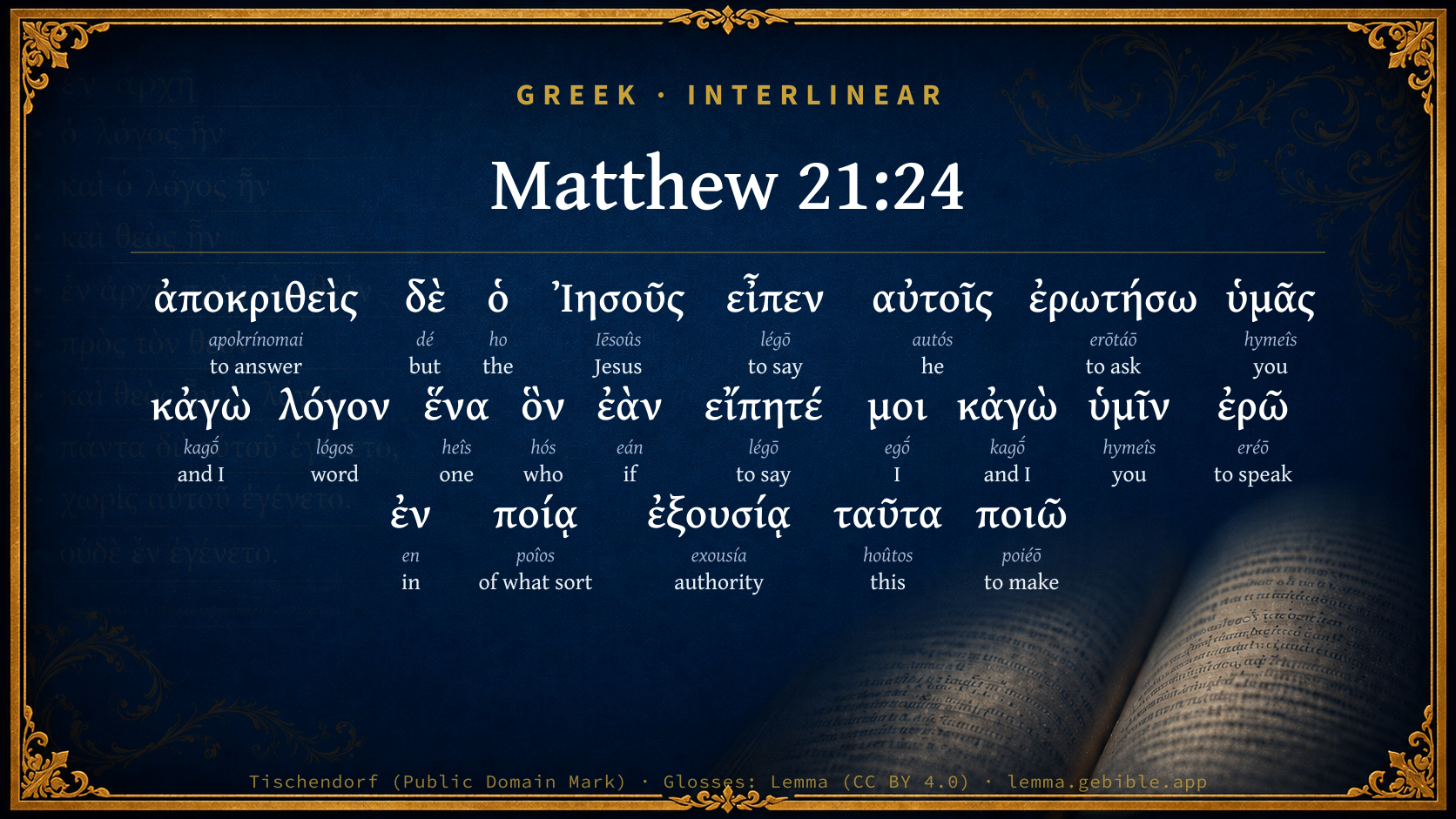
Greek (Tischendorf 8th ed.) Matthew 21:24 appears in the Greek New Testament. The text above is from the Tischendorf 8th edition. Each word links to its Strong’s number and a concise gloss. Click any word for its full Thayer’s Greek Lexicon entry.
Download image
Cite this verse

Matthew 21:24 (World English Bible). Public Domain. Lemma interlinear Bible study tool, https://lemma.gebible.app/v/matthew/21/24.

Show BibTeX & RIS
BibTeX
RIS
English Translation
Jesus answered them, "I also will ask you one question, which if you tell me, I likewise will tell you by what authority I do these things.
World English Bible · Public Domain
Download a study sheet

One document with this verse’s original text, its word-by-word gloss line, the meaning frame, cross-references with their text, attributed commentary, and full source and license credits — printable, and it pastes into notes with its structure intact.

This verse Autodidact and up

Study sheet (.html) Plain text (.txt)

A passage Seminary Student

Up to 50 verses in one chapter. A passage sheet keeps up to 6 commentary sources and 12 cross-references per verse, in the order this page ranks them, and says so on the sheet whenever that leaves anything out. Ask for a single verse and you get the Autodidact verse sheet above.

Everything on this page stays free to read, with no account — the sheet is a download of what is already on screen, not access to it.

Want to remove ads? Support Godless Engineer
Compare translations 3

The same verse in 3 English versions, stacked beneath the original-language interlinear above. Click any original word for its lexicon entry.

Each is an independent rendering of the whole verse — the interlinear is not word-aligned to these translations.

Highlighted words mark where these versions differ — a whole-verse word diff, not a word-by-word alignment.

  • World English Bible Public Domain
    Jesus answered them, "I also will ask you one question, which if you tell me, I likewise will tell you by what authority I do these things.
  • King James Version Public Domain
    And Jesus answered and said unto them, I also will ask you one thing, which if ye tell me, I in like wise will tell you by what authority I do these things.
  • unfoldingWord Literal Text CC BY-SA 4.0
    But answering, Jesus said to them, “I also will ask you one word, which if you tell me, I also will tell you by what authority I do these things.

unfoldingWord Literal Text — © unfoldingWord, licensed CC BY-SA 4.0. Word-aligned USFM3 via Door43 (git.door43.org/unfoldingWord/en_ult).

Versions to compare (up to 4)

3 of 4 selected

Show all 19 translations

Every available English version of this verse, each an independent rendering of the whole verse.

  • World English Bible Public Domain
    Jesus answered them, "I also will ask you one question, which if you tell me, I likewise will tell you by what authority I do these things.
  • Berean Standard Bible Public Domain
    “I will also ask you one question,” Jesus replied, “and if you answer Me, I will tell you by what authority I am doing these things.
  • Majority Standard Bible Public Domain
    “I will also ask you one question,” Jesus replied, “and if you answer Me, I will tell you by what authority I am doing these things.
  • King James Version Public Domain
    And Jesus answered and said unto them, I also will ask you one thing, which if ye tell me, I in like wise will tell you by what authority I do these things.
  • American Standard Version (1901) Public Domain
    And Jesus answered and said unto them, I also will ask you one question, which if ye tell me, I likewise will tell you by what authority I do these things.
  • Revised Version (1885) Public Domain
    And Jesus answered and said unto them, I also will ask you one question, which if ye tell me, I likewise will tell you by what authority I do these things.
  • Geneva Bible (1599) Public Domain
    Then Iesus answered and said vnto them, I also will aske of you a certaine thing, which if ye tell me, I likewise will tell you by what authoritie I doe these things.
  • Douay-Rheims (1899) Public Domain
    Jesus answering, said to them: I also will ask you one word, which if you shall tell me, I will also tell you by what authority I do these things.
  • Young's Literal Translation Public Domain
    And Jesus answering said to them, `I will ask you -- I also -- one word, which if ye may tell me, I also will tell you by what authority I do these things;
  • Literal Standard Version CC BY-SA 4.0
    And Jesus answering said to them, “I will ask you—I also—one word, which if you may tell Me, I also will tell you by what authority I do these things;
  • Unlocked Literal Bible CC BY-SA 4.0
    Jesus answered and said to them, “I also will ask you one question. If you tell me, I will tell you by what authority I do these things.
  • unfoldingWord Literal Text CC BY-SA 4.0
    But answering, Jesus said to them, “I also will ask you one word, which if you tell me, I also will tell you by what authority I do these things.
  • Darby Bible Public Domain
    And Jesus answering said to them, *I* also will ask you one thing, which if ye tell me, *I* also will tell you by what authority I do these things:
  • World Messianic Bible Public Domain
    Yeshua answered them, “I also will ask you one question, which if you tell me, I likewise will tell you by what authority I do these things.
  • Webster's Bible Public Domain
    And Jesus answered and said to them, I also will ask you one thing, which if ye tell me, I also will tell you by what authority I do these things.
  • Free Bible Version CC BY-SA 4.0
    “I too will ask you a question,” Jesus replied. “If you give me the answer, I will tell you by what authority I do these things.
  • Bible in Basic English Public Domain
    And Jesus said to them in answer, I will put one question to you, and if you give me the answer, I will say by what authority I do these things.
  • Text-Critical English NT CC BY 4.0
    Jesus answered them, “I will also ask you one question. If you tell me the answer, I will also tell you by what authority I am doing these things.
  • Tyndale New Testament (1534) Public Domain
    Iesus answered and sayde vnto them: I also will axe of you a certayne question which if ye assoyle me I in lyke wyse wyll tell you by what auctorite I do these thinges.

Literal Standard Version (2020), Covenant Press — licensed CC BY-SA 4.0. Text via the HelloAO Bible API (eBible.org). Unlocked Literal Bible (unfoldingWord) — licensed CC BY-SA 4.0. Text via the HelloAO Bible API (eBible.org). unfoldingWord Literal Text — © unfoldingWord, licensed CC BY-SA 4.0. Word-aligned USFM3 via Door43 (git.door43.org/unfoldingWord/en_ult). Free Bible Version, Dr. Jonathan Gallagher — licensed CC BY-SA 4.0. Text via the HelloAO Bible API (eBible.org).

Word by word

More ways to search: Search by grammar → Find every occurrence → Compare this word →

Practice this passage: Drill this verse → Learn its vocabulary →

ποίᾳ
poîos
G4169
“of what sort”
Interrogative pronoun, Dative, Singular, Feminine
Part of Speech
Interrogative pronoun
Case
Dative
Number
Singular
Gender
Feminine
Full Thayer's Definition

Origin: from the base of G4226 and G3634

TDNT: None

1. of what sort or nature
  1. ἀποκριθεὶς apokrínomai G611 “to answer” Verb, Aorist, Passive deponent, Participle, Nominative, Singular, Masculine
  2. δὲ dé G1161 “but” Conjunction
  3. ὁ ho G3588 “the” Article, Nominative, Singular, Masculine
  4. Ἰησοῦς Iēsoûs G2424 “Jesus” Noun, Nominative, Singular, Masculine
  5. εἶπεν légō G3004 “to say” Verb, Aorist, Active, Indicative, 3rd person, Singular
  6. αὐτοῖς autós G846 “he” Personal pronoun, Dative, Plural, Masculine
  7. ἐρωτήσω erōtáō G2065 “to ask” Verb, Future, Active, Indicative, 1st person, Singular
  8. ὑμᾶς hymeîs G5210 “you” Personal pronoun, 2nd person, Accusative, Plural
  9. κἀγὼ kagṓ G2504 “and I” Personal pronoun, 1st person, Nominative, Singular, Aramaic form
  10. λόγον lógos G3056 “word” Noun, Accusative, Singular, Masculine
  11. ἕνα heîs G1520 “one” Adjective, Accusative, Singular, Masculine
  12. ὃν hós G3739 “who” Relative pronoun, Accusative, Singular, Masculine
  13. ἐὰν eán G1437 “if” Conditional
  14. εἴπητέ légō G3004 “to say” Verb, Aorist, Active, Subjunctive, 2nd person, Plural
  15. μοι egṓ G1473 “I” Personal pronoun, 1st person, Dative, Singular
  16. κἀγὼ kagṓ G2504 “and I” Personal pronoun, 1st person, Nominative, Singular, Aramaic form
  17. ὑμῖν hymeîs G5210 “you” Personal pronoun, 2nd person, Dative, Plural
  18. ἐρῶ eréō G2046 “to speak” Verb, Future, Active, Indicative, 1st person, Singular
  19. ἐν en G1722 “in” Preposition
  20. ἐξουσίᾳ exousía G1849 “authority” Noun, Dative, Singular, Feminine
  21. ταῦτα hoûtos G3778 “this” Demonstrative pronoun, Accusative, Plural, Neuter
  22. ποιῶ poiéō G4160 “to make” Verb, Present, Active, Indicative, 1st person, Singular

About this verse

These counts appear in no published source. They are computed here, from the morphology-tagged text and Lemma’s own curated glosses. What Lemma adds →

23
words
20
distinct lemmas
Gospels
section

Shared distinctive vocabulary

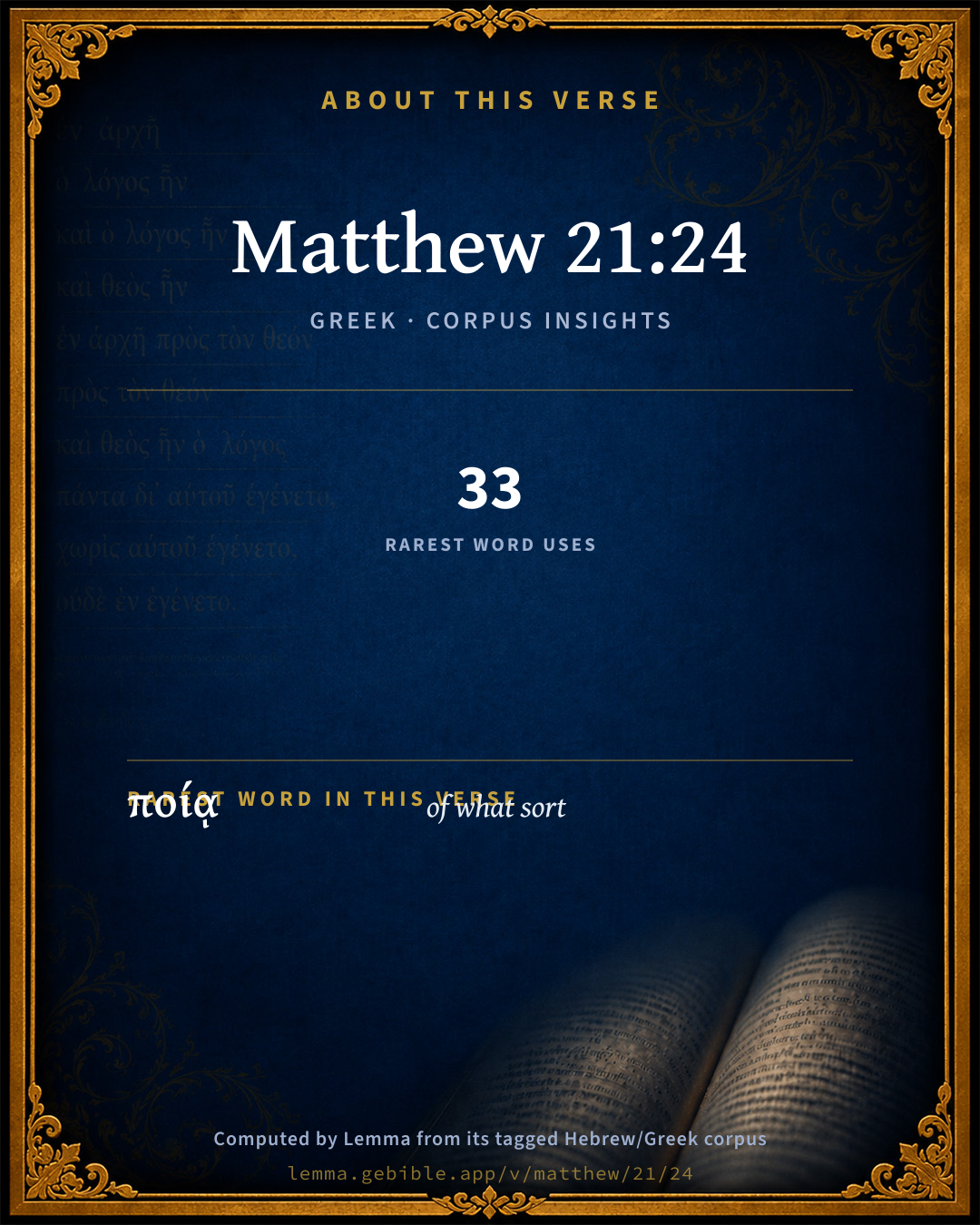
ποίᾳ of what sort G4169 occurs in 32 verses of the Greek New Testament. Also found in:
Repetition

Words recur within this verse:

  • εἶπεν to say G3004 ×2
  • κἀγὼ and I G2504 ×2
  • ὑμᾶς you G5210 ×2

Cross-references

4

Topical passages linked to Matthew 21:24 in the Treasury of Scripture Knowledge — connected by theme and wording, ordered by reader-vote popularity; previews shown in the World English Bible.

  • Luke 6:9 Then Jesus said to them, "I will ask you something: Is it lawful on the Sabbath to do good, or to do harm? To save a life, or to kill?"
  • Matthew 10:16 "Behold, I send you out as sheep in the midst of wolves. Therefore be wise as serpents, and harmless as doves.
  • Colossians 4:6 Let your speech always be with grace, seasoned with salt, that you may know how you ought to answer each one.
  • Proverbs 26:4–5 Don't answer a fool according to his folly, Lest you also be like him.

Cross-references courtesy of OpenBible.info (CC BY 4.0).

Commentary

Notes on Matthew 21:24 from classic Christian and Jewish commentators (each source and its license shown beneath its notes). The classic Christian expositions comment on the surrounding passage and are grouped to its opening verse, so a note may address several verses; the Jewish commentaries on the Tanakh (Rashi and others) are per-verse, so they appear only where the commentator wrote on this verse.

Lemma curates 59 commentaries, every one of them public domain or Creative Commons licensed, each selected and text-cleaned for this edition rather than reprinted as found. About our sources →

Tyndale Open Study Notes

Tyndale Open Resources

21:24 Jesus propounded a riddle, the solution to which answered the leaders’ question and forced them into a dilemma that revealed their hearts (21:25-26). Answering by counter-question was typical for such debates.

Tyndale Open Study Notes — © Tyndale Open Resources, licensed CC BY-SA 4.0. Text via the HelloAO Bible API.

Bengel's Gnomon

Johann Albrecht Bengel

Mat 21:24. Ἀποκριθεὶς δὲ ὁ Ἰησοῦς, but Jesus answered, etc.) A suitable mode of answering those who tempted Him.—ἐρωτήσω ὑμᾶς κἀγὼ, κ.τ.λ., I will also ask you, etc.) Thus also in ch. Mat 22:41. Mosheim rightly observes, “Those expositors are mistaken, who imagine that Christ had no other object in this question than to silence His adversaries.”—Oration on Christ the only model for the imitation of Theologians, p. 17.—ἕνα, one) and that too connected with your own question; one, after you have asked Me so many things, both now and heretofore. John the Baptist, though without a human call, could be and was a prophet; therefore also Jesus. If they had acknowledged the baptism of His forerunner, they would have acknowledged the authority of Christ; but since they did not acknowledge John (see Mat 21:32), they could not believe in Jesus. Nor did they deserve that any further communications should be thrown away by Him on their pride and unbelief. To him that hath is given; from him that hath not is taken away.

Bengel's Gnomon of the New Testament — English translation (T&T Clark, Edinburgh, 1860) — public domain. Text from a community e-Sword module.

Meyer's Critical & Exegetical Commentary

Heinrich August Wilhelm Meyer

Mat_21:24 f. Jesus prudently frustrates their design by proposing in reply a puzzling question, which, in the circumstances, they did not know how to answer.

λόγον ἕνα] a single word, a single question; not more. The subject of the question itself is admirably chosen, seeing that the work of reform in which Jesus was engaged had a necessary connection with that of John; both would stand and fall together.

πόθεν ἦν] whence did it proceed? The following alternative is explanatory: was it from God, who had commissioned John, or from men, so that he baptized simply on his own authority or that of his fellow-mortals? The latter was out of the question, if John was a prophet (Mat_21:26). Comp., further, Act_5:39.

διελογ. παρʼ ἑαυτοῖς] they deliberated by themselves, privately κατʼ ἰδίαν, i.e. with each other, during a brief pause for private consultation, before giving their decision, which was intimated in the subsequent ἀποκριθέντες τῷ Ἰησοῦ. διαλογίζεσθαι in this instance also denotes reflection combined with mutual consultation. Comp. Mat_16:7; Mar_8:16; Luk_20:14.

ἐπιστεύσατε αὐτῷ] λέγοντι πολλὰ καὶ μεγάλα περὶ ἐμοῦ, Euthymius Zigabenus.

Meyer — Critical and Exegetical Commentary on the New Testament — English translation by Peter Christie, edited by Frederick Crombie (T&T Clark, 1880) — public domain. Text from a community e-Sword module.

Expositor's Greek Testament

ed. W. Robertson Nicoll

Mat 21:24 . esus replies by an embarrassing counter-question as to the ministry of the Baptist. λόγον ἔνα , hardly: one question for your many (Beng.) rather: a question, or thing, one and the same ( cf. for εἶς in this sense Gen 41:25-26 ; 1Co 3:8 ; 1Co 11:5 ), an analogous question as we should say; one answer would do for theirs and for His.

The Expositor's Greek Testament, edited by W. Robertson Nicoll (1897–1910) — public domain. Text from a community e-Sword module.

Geneva Bible (1599)

Geneva Bible translators

One word, that is to say, I will ask you in one word.

Geneva Bible (1599) marginal notes — public domain. Text via Bolls.life.

Jamieson, Fausset & Brown

Robert Jamieson, A. R. Fausset & David Brown

And Jesus answered and said unto them, I also will ask you one thing, &c.

Jamieson, Fausset & Brown — Commentary Critical and Explanatory on the Whole Bible (1871) — public domain (CC PDM 1.0). Text via the HelloAO Bible API.

Adam Clarke's Commentary

Verse 24. I also will ask you one thing] Our Lord was certainly under no obligation to answer their question: he had already given them such proofs of his Divine mission as could not possibly be exceeded, in the miracles which he wrought before their eyes, and before all Judea; and, as they would not credit him on this evidence, it would have been in vain to have expected their acknowledgment of him on any profession he would make.

Adam Clarke's Commentary on the Bible (1810–1826) — public domain. Text from a community e-Sword/MySword module.

Ellicott's Commentary for English Readers

(24) I also will ask you one thing.—The question is met by another question. As One who taught as “having authority, and not as the scribes” (Mat_7:29), He challenges their right to interrogate Him on the ground of precedent. Had they exercised that right in the case of the Baptist, and if so, with what result? If they had left his claim unquestioned, or if they had shrunk from confessing the result of their inquiry, they had virtually abdicated their office, and had no right, in logical consistency, to exercise it, as by fits and starts, in the case of another teacher.

A Bible Commentary for English Readers, edited by Charles John Ellicott (1878–1897) — public domain. Text from a community e-Sword module.

The Cambridge Bible for Schools and Colleges

gen. ed. J. J. S. Perowne

24. I also will ask you one thing] This form of argument was usual. The question of the Elders was really an attack. Jesus meets that attack by a counter-question which presented equal difficulties in three ways—whether they said from heaven or of men, or left it unanswered. To say from heaven was equivalent to acknowledging Jesus as Christ, to say from men was to incur the hostility of the people, to be silent was to resign their pretensions as spiritual chiefs of the nation.

The Cambridge Bible for Schools and Colleges (gen. ed. J. J. S. Perowne; Cambridge University Press, 1878–1918) — public domain. Text from a community e-Sword module.

John Gill's Exposition

And Jesus answered and said unto them,.... Not by replying directly to their question, but by putting another question to them, whereby he escaped the snare he saw they laid for him:

I also will ask you one thing, word, or question,

which if ye tell me; honestly, and plainly answer to it,

I likewise will tell you by what authority I do these things: which was putting the thing upon such a foot, and in such a form, as they could not well object to; for Christ promises, that if they would return a plain answer to the question he had to put to them, and which was no unreasonable, nor impertinent one, he would thoroughly satisfy them in this point; and expressly declare his commission and authority, what it was, and from whence he had it. The question is as follows:

John Gill's Exposition of the Whole Bible (1746–1763) — public domain (CC PDM 1.0). Text via the HelloAO Bible API.

Trapp's Complete Commentary

John Trapp

24 And Jesus answered and said unto them, I also will ask you one thing, which if ye tell me, I in like wise will tell you by what authority I do these things.

Ver. 24. I also will ask you one thing] Our Saviour could have answered them roundly, that what he did he did by the will and appointment of his heavenly Father. But because he had avouched that so often, and they believed him not, therefore he took another course. We must be ready to render a reason of our faith; but then it must be the time when we see it will be to some good purpose; as if otherwise, forbear, or untie one knot with another, as Christ here doth, nodum nodo dissipat. (Aret.)

John Trapp, A Commentary or Exposition upon All the Books of the Old and New Testament (1647–1656) — public domain. Text from a community e-Sword module.

Haydock's Catholic Bible Commentary

The baptism of John, by which is also understood his doctrine and preaching, was it from heaven or not? (Witham)

George Leo Haydock (1774–1849), Haydock's Catholic Family Bible and Commentary, 1859 edition — public domain. Excludes Psalms (Douay-Rheims chapter numbering differs from Protestant) and Deuterocanonical books (Catholic canon only).

Matthew Poole's English Annotations

We have the same without any considerable alteration Mar 11:27-33. Luke also records the same history, Luk 20:1-8, with no considerable difference, only he thus prefaceth to it: And it came to pass, that on one of those days, as he taught the people in the temple, and preached the gospel, the chief priests and the scribes came upon him with the elders: which makes it plain, that their question principally related to our Saviour’s preaching. It should seem, they had a law prohibiting any to preach in the temple without authority from the chief priests and elders. If any one think this was not an apposite answer to the question propounded to him,

1. They ought to consider, that our Saviour did truly judge they deserved no answer, for his works had testified of him that he acted by a Divine power; he should not need tell them so, in so many words.

2. In very deed there was a direct answer couched in this question of our Saviour. I pray, saith he, by what authority did John preach and baptize? They could not say, By a human authority, for they knew he was not licensed by their masters: it must follow that he acted by virtue of an extraordinary Divine mission.

So do I, saith our Saviour, and have given you a greater proof of it than ever John Baptist did. But our Lord well knew that the Pharisees had a greater reverence for John the Baptist than for him, and that many of the people had a great opinion of John, indeed greater than of him; our Saviour coming eating and drinking, as he expresses it, that is, being of a more free and sociable conversation, which did not so please the Pharisaical morose, and supercilious humour: he therefore chooseth to teach them by a question, in which, as soon as they could resolve themselves, they might know by what authority he did what he did. Besides, by the baptism of John, mentioned in our Saviour’s question, is not to be understood only his administration of baptism, but his doctrine, and indeed the whole of his ministry; for as his baptism is called the baptism of repentance, so the Pharisees here argue, that if they should say, From heaven, he would say, Why then did ye not believe him? Which must be understood of his doctrine. A great part of John’s doctrine was, that the Messiah was come, that Christ was he; Joh 1:29, he pointed to him and said, Behold the Lamb of God which taketh away the sin of the world; which had they believed, they would never have come to him with so silly a question. The Pharisees therefore rightly judged how they would be ensnared, if they said John’s baptism and doctrine was from God, for then a Divine faith was due to his words, and they must have owned Christ to be the Messiah. But why did not they say, Of men? The text saith, they feared the people. Those who will not fear God, shall have something to fear sordidly and slavishly. The people all owning John as a prophet, a man that had an extraordinary mission from God, and commission to reveal the mind and will of God, would have cried shame upon them had they disparaged him, as one that spake of his own head. They say,

We cannot tell. Herein they lied. Our Saviour replies,

Neither do I tell you, & c. Not, I cannot tell you, but I do not tell you: I will tell you no more than what John hath long since told you, and what, if you will, you and all men may know by my miracles.

Matthew Poole's English Annotations on the Holy Bible (1683–1685) — public domain. Text from a community e-Sword/MySword module.

The Pulpit Commentary

I also will ask you one thing; logon ena : one word, question. Jesus does not reply directly to their insidious demand. He might have asserted his Divine mission, and appealed to his miracles in confirmation of such claim, which would have been in strict conformity with the old, established rule for discriminating false and true prophets; (see Deu_18:22 Jer_28:9) but he knew too well their scepticism and malice and inveterate prejudice to lay stress on this allegation at the present moment. Before he satisfied their inquiry, he must have their opinion concerning one whom they had received as a prophet a few years ago, and whose memory was still held in the highest respect, John the Baptist. The manner in which they regarded him and his testimony would enable them to answer their own interrogation.

Christ become a Questioner.

Those who came to Christ on this occasion were distinctly officials, representatives of the Sanhedrin, the council which claimed and exercised authority in all matters related to religion. "Before its tribunal false prophets were arraigned. It dealt with questions of doctrine, and, when occasion arose, could exercise the functions of a council." "In the New Testament we see Christ before the Sanhedrin as a blasphemer; (Mat_26:65) the Apostles Peter and John, as false prophets and seducers of the people; the Deacon Stephen, as having blasphemed against God; and the Apostle Paul, as subverting the Law." This was, no doubt, a very imposing deputation. Schemes to entangle Christ in his talk had miserably failed; now the officials resolved to act straightforwardly and imposingly. They would demand to know the authority on which Jesus acted. The three elements of the Sanhedrin chief priests, elders, and scribes were all represented, and we seem to see the confident haughtiness of their approach.

I CHRIST ASSERTING A SUPERIOR AUTHORITY. "He knew what was in man." He was not in the least alarmed. He know their guilefulness so well that he was not in the least deferential. The prophet was never submissive to the temple officials. His authority was his commission direct from God. They had been pleased to decide that no one could be permitted to teach who had not passed through a rabbinical school. Jesus knew that every man has a right to teach who is himself taught of God. He, moreover, was more than a prophet; he was, in the highest and holiest sense, the Son and Sent of God. They had no right to question him. He would recognize no such right, and give to their questionings no answer, he would exert his authority and question them; and never was official deputation more humiliated than when these men found themselves questioned, and hopelessly entangled by the question put to them. All putting Christ to the test implies a wrong state of mind. He speaks in the name of God, and as God, and our duty is unquestioning obedience.

II CHRIST DISCOMFITING HIS FOES BY HIS SUPERIOR AUTHORITY. They felt his authority, and did not for a moment attempt to dispute it. They did not think of saying, "We came to question you, and cannot allow you to question us." They were mastered by his calmness, by his manifest superiority, by the skill of his question, which put them into the most awkward and humiliating position. They retired defeated and angry. R.T.

The Pulpit Commentary (1880–1919), ed. H.D.M. Spence-Jones & Joseph S. Exell — public domain. Text from a community e-Sword module.

John Wesley's Explanatory Notes

I will ask you one thing - Who have asked me many: The baptism, that is, the whole ministry of John, was it from heaven or from men? - By what authority did he act and teach? Did man or God give him that authority? Was it not God? But if so, the consequence was clear. For John testified that Jesus was the Christ.

John Wesley, Explanatory Notes Upon the Whole Bible (1754–1765) — public domain. Text via the GEBible commentary corpus.

Kretzmann's Popular Commentary

Paul E. Kretzmann

The answer:

v. 24. And Jesus answered and said unto them, I also will ask you one thing, which if ye tell Me, I in likewise will tell you by what authority I do these things.

v. 25. The baptism of John, whence was it, from heaven or of men? And they reasoned with themselves, saying, If we shall say, From heaven, He will say unto us, Why did ye not then believe him?

v. 26. But if we shall say, Of men, we fear the people; for all hold John as a prophet.

v. 27. And they answered Jesus and said, We cannot tell. And He said unto them, Neither tell I you by what authority I do these things.

Christ’s method of answering question with question again proved effective. He wanted information regarding only one thing. If the answer to this question would be forthcoming, He would be pleased to give them the account they desired. But His question placed them in a dilemma, by what authority John the Baptist had performed the work. of his ministry, and especially his baptizing. They considered the matter very carefully among themselves, they carefully weighed a possible answer which would not compromise them. But there was only this alternative: In one case they invited a censure of Christ, in the other, the hatred of the people. If John had divine authority for his baptism, there was no excuse for their opposition to him, for their refusal to believe. If, on the other hand, they should dare to express their belief that John had no divine authority, the hatred of the people could easily have made it more than unpleasant for them. And so they preferred to give no answer, thereby absolving Jesus from the necessity of answering their question. There was a distinct reproof in the answer of Jesus. If they had to admit that John had divine authority, how much more did the teaching and the miracles of Jesus argue for His being sent by God. Unbelief is immoral. The unbelievers cannot deny the evidence of Scripture, but do not want to accept the truth; and therefore lies, evasion, and excuses are their only weapons.

Paul E. Kretzmann, Popular Commentary of the Bible (1921–1924) — public domain. Text from a community e-Sword module.

The People's New Testament

B. W. Johnson

24. I also will ask you one question. A malicious question is often best answered by a question which will expose the questioners.

B. W. Johnson's The People's New Testament with Notes (1889–1891) — public domain. Electronic text from the Christian Classics Ethereal Library (CCEL) ThML edition.

Cambridge Greek Testament for Schools and Colleges

24. ἐρωτήσω ὑμᾶς κἀγὼ λόγον ἕνα. This form of argument was usual. The question of the Elders was really an attack. Jesus meets that attack by a counter-question which presented equal difficulties in three ways—whether they said from heaven or of men, or left it unanswered. To say from heaven was equivalent to acknowledging Jesus as Christ, to say from men was to incur the hostility of the people, to be silent was to resign their pretensions as spiritual chiefs of the nation.

Cambridge Greek Testament for Schools and Colleges (Cambridge University Press, 1896; 21 vols, various authors incl. Carr, Maclear, Plummer, Farrar, Lumby, Moule, M. R. James, Simcox) — public domain. Text from a community e-Sword module.

International Critical Commentary

(M) 24. And Jesus answered and said to them, I also will ask you one thing, which if ye tell Me, I, too, will tell you by what authority I do these things.] Mk. has: “And Jesus said to them, I will ask you one thing, and answer Me, and I will tell you by what authority I do these things.” Mt.’s ὃν ἐὰν εἴπητέ μοι κἀγὼ ἐρῶ is a grammatical correction of Mk.’s καὶ ἀποκρίθητέ μοι καὶ ἐρῶ.

International Critical Commentary — older volumes (1896–1929), various authors — public domain. Text from a community e-Sword module.

Lesson kit

Teaching starters — assembled from the data on this page, not authored interpretation. Every prompt links to the verse data it draws on. Edit before teaching.

Matthew, in the Gospels, opens this verse with 23 words (20 distinct Greek lemmas). Its most distinctive word is poîos (“of what sort”). A historical commentator’s framing appears above. Read the whole chapter for the surrounding context.

Discussion questions

  1. What does “of what sort” (poîos) contribute to the verse as a whole?
  2. How does Matthew 19:18, which shares the word «of what sort», read alongside this verse?
  3. What does the repetition of “to say” (2× in this one verse) do in this verse?
  4. These translations render this verse differently; the difference is in the English rendering, not the original. What questions does that raise?
  5. Compare how Tyndale Open Study Notes and Bengel's Gnomon read this verse. Where do they agree or differ?

Things to notice

  • These translations choose different wording for 9 words in this verse.
  • “to say” occurs 2× in this single verse.
  • 20 distinct Greek lemmas span 23 words in this verse.

Reading settings

Reading text

Shown beneath each verse's original-language words.

Old Testament
Old Testament edition

Read the OT as the Masoretic Hebrew (MT) or the Greek Septuagint (LXX).

English shown for the Greek Septuagint (in the Hebrew ↔ Greek comparison).

Comparing translations? Open the Compare panel on any verse page to stack up to four side by side.