James 4:17

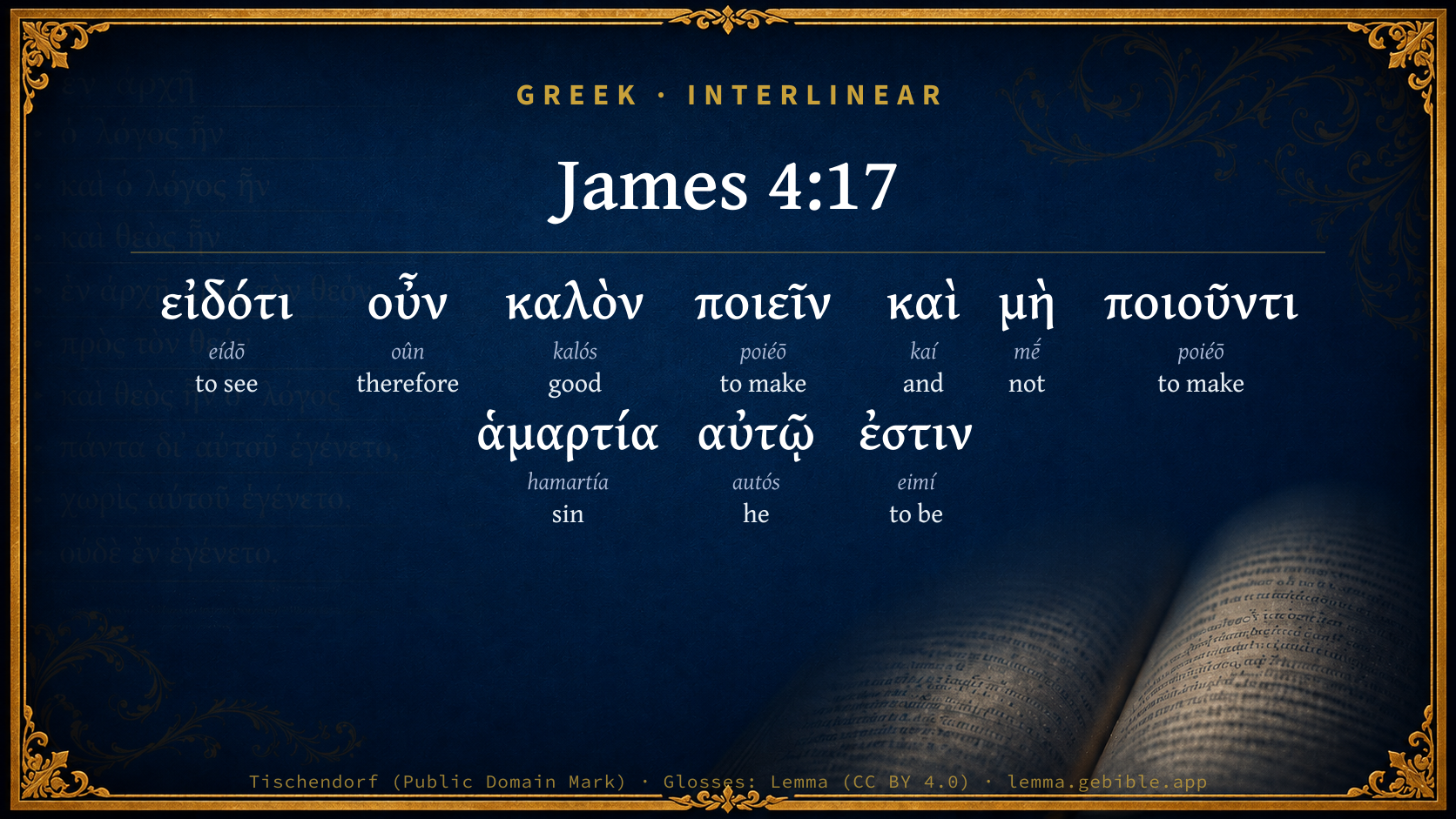
Greek (Tischendorf 8th ed.) James 4:17 appears in the Greek New Testament. The text above is from the Tischendorf 8th edition. Each word links to its Strong’s number and a concise gloss. Click any word for its full Thayer’s Greek Lexicon entry.
Download image
Cite this verse

James 4:17 (World English Bible). Public Domain. Lemma interlinear Bible study tool, https://lemma.gebible.app/v/james/4/17.

Show BibTeX & RIS
BibTeX
RIS
English Translation
To him therefore who knows to do good, and doesn't do it, to him it is sin.
World English Bible · Public Domain
Download a study sheet

One document with this verse’s original text, its word-by-word gloss line, the meaning frame, cross-references with their text, attributed commentary, and full source and license credits — printable, and it pastes into notes with its structure intact.

This verse Autodidact and up

Study sheet (.html) Plain text (.txt)

A passage Seminary Student

Up to 50 verses in one chapter. A passage sheet keeps up to 6 commentary sources and 12 cross-references per verse, in the order this page ranks them, and says so on the sheet whenever that leaves anything out. Ask for a single verse and you get the Autodidact verse sheet above.

Everything on this page stays free to read, with no account — the sheet is a download of what is already on screen, not access to it.

Want to remove ads? Support Godless Engineer
Compare translations 3

The same verse in 3 English versions, stacked beneath the original-language interlinear above. Click any original word for its lexicon entry.

Each is an independent rendering of the whole verse — the interlinear is not word-aligned to these translations.

Highlighted words mark where these versions differ — a whole-verse word diff, not a word-by-word alignment.

  • World English Bible Public Domain
    To him therefore who knows to do good, and doesn't do it, to him it is sin.
  • King James Version Public Domain
    Therefore to him that knoweth to do good, and doeth it not, to him it is sin.
  • unfoldingWord Literal Text CC BY-SA 4.0
    Therefore to the one having known to do good and not doing, to him it is sin.

unfoldingWord Literal Text — © unfoldingWord, licensed CC BY-SA 4.0. Word-aligned USFM3 via Door43 (git.door43.org/unfoldingWord/en_ult).

Versions to compare (up to 4)

3 of 4 selected

Show all 19 translations

Every available English version of this verse, each an independent rendering of the whole verse.

  • World English Bible Public Domain
    To him therefore who knows to do good, and doesn't do it, to him it is sin.
  • Berean Standard Bible Public Domain
    Anyone, then, who knows the right thing to do, yet fails to do it, is guilty of sin.
  • Majority Standard Bible Public Domain
    Anyone, then, who knows the right thing to do, yet fails to do it, is guilty of sin.
  • King James Version Public Domain
    Therefore to him that knoweth to do good, and doeth it not, to him it is sin.
  • American Standard Version (1901) Public Domain
    To him therefore that knoweth to do good, and doeth it not, to him it is sin.
  • Revised Version (1885) Public Domain
    To him therefore that knoweth to do good, and doeth it not, to him it is sin.
  • Geneva Bible (1599) Public Domain
    Therefore, to him that knoweth how to doe well, and doeth it not, to him it is sinne.
  • Douay-Rheims (1899) Public Domain
    To him therefore who knoweth to do good, and doth it not, to him it is sin.
  • Young's Literal Translation Public Domain
    to him, then, knowing to do good, and not doing, sin it is to him.
  • Literal Standard Version CC BY-SA 4.0
    to him, then, knowing to do good, and not doing [it], it is sin to him.
  • Unlocked Literal Bible CC BY-SA 4.0
    So for anyone who knows to do good but does not do it, for him it is sin.
  • unfoldingWord Literal Text CC BY-SA 4.0
    Therefore to the one having known to do good and not doing, to him it is sin.
  • Darby Bible Public Domain
    To him therefore who knows how to do good, and does it not, to him it is sin.
  • World Messianic Bible Public Domain
    To him therefore who knows to do good and doesn’t do it, to him it is sin.
  • Webster's Bible Public Domain
    Therefore to him that knoweth to do good, and doeth it not, to him it is sin.
  • Free Bible Version CC BY-SA 4.0
    For it is a sin if you know to do what's right but don't do it.
  • Bible in Basic English Public Domain
    The man who has knowledge of how to do good and does not do it, to him it is sin.
  • Text-Critical English NT CC BY 4.0
    So whoever knows the right thing to do and does not do it, for him it is sin.
  • Tyndale New Testament (1534) Public Domain
    Therfore to him that knoweth how to do good and doth it not to him it is synne.

Literal Standard Version (2020), Covenant Press — licensed CC BY-SA 4.0. Text via the HelloAO Bible API (eBible.org). Unlocked Literal Bible (unfoldingWord) — licensed CC BY-SA 4.0. Text via the HelloAO Bible API (eBible.org). unfoldingWord Literal Text — © unfoldingWord, licensed CC BY-SA 4.0. Word-aligned USFM3 via Door43 (git.door43.org/unfoldingWord/en_ult). Free Bible Version, Dr. Jonathan Gallagher — licensed CC BY-SA 4.0. Text via the HelloAO Bible API (eBible.org).

Word by word

More ways to search: Search by grammar → Find every occurrence → Compare this word →

Practice this passage: Drill this verse → Learn its vocabulary →

καλὸν
kalós
G2570
“good”
Adjective, Accusative, Singular, Masculine
Part of Speech
Adjective
Case
Accusative
Number
Singular
Gender
Masculine
Full Thayer's Definition

Origin: of uncertain affinity

TDNT: 11:56,4

1. beautiful, handsome, excellent, eminent, choice, surpassing, precious, useful, suitable, commendable, admirable a. beautiful to look at, shapely, magnificent b. good, excellent in its nature and characteristics, and therefore well adapted to its ends 1. genuine, approved 2. precious 3. joined to names of men designated by their office, competent, able, such as one ought to be 4. praiseworthy, noble c. beautiful by reason of purity of heart and life, and hence praiseworthy 1. morally good, noble d. honourable, conferring honour e. affecting the mind agreeably, comforting and confirming
  1. εἰδότι eídō G1492 “to see” Verb, Perfect, Active, Participle, Dative, Singular, Masculine
  2. οὖν oûn G3767 “therefore” Conjunction
  3. ποιεῖν poiéō G4160 “to make” Verb, Present, Active, Infinitive
  4. καὶ kaí G2532 “and” Conjunction
  5. μὴ mḗ G3361 “not” Particle, Negative
  6. ποιοῦντι poiéō G4160 “to make” Verb, Present, Active, Participle, Dative, Singular, Masculine
  7. ἁμαρτία hamartía G266 “sin” Noun, Nominative, Singular, Feminine
  8. αὐτῷ autós G846 “he” Personal pronoun, Dative, Singular, Masculine
  9. ἐστιν eimí G1510 “to be” Verb, Present, Active, Indicative, 3rd person, Singular

About this verse

These counts appear in no published source. They are computed here, from the morphology-tagged text and Lemma’s own curated glosses. What Lemma adds →

10
words
9
distinct lemmas
General Epistles
section

Repetition

A word recurs within this verse:

  • ποιεῖν to make G4160 ×2

Cross-references

9

Topical passages linked to James 4:17 in the Treasury of Scripture Knowledge — connected by theme and wording, ordered by reader-vote popularity; previews shown in the World English Bible.

  • John 9:41 Jesus said to them, "If you were blind, you would have no sin; but now you say, 'We see.' Therefore your sin remains.
  • John 13:17 If you know these things, blessed are you if you do them.
  • John 15:22 If I had not come and spoken to them, they would not have had sin; but now they have no excuse for their sin.
  • 2 Peter 2:21 For it would be better for them not to have known the way of righteousness, than, after knowing it, to turn back from the holy commandment delivered to them.
  • Luke 12:47–48 That servant, who knew his lord's will, and didn't prepare, nor do what he wanted, will be beaten with many stripes,
  • Romans 1:32 who, knowing the ordinance of God, that those who practice such things are worthy of death, not only do the same, but also approve of those who practice them.
  • Romans 2:17–23 Indeed you bear the name of a Jew, and rest on the law, and glory in God,
  • Romans 1:20–21 For the invisible things of him since the creation of the world are clearly seen, being perceived through the things that are made, even his everlasting power and divinity; that they may be without excuse.
  • Romans 7:13 Did then that which is good become death to me? May it never be! But sin, that it might be shown to be sin, by working death to me through that which is good; that through the commandment sin might become exceeding sinful.

Cross-references courtesy of OpenBible.info (CC BY 4.0).

Commentary

Notes on James 4:17 from classic Christian and Jewish commentators (each source and its license shown beneath its notes). The classic Christian expositions comment on the surrounding passage and are grouped to its opening verse, so a note may address several verses; the Jewish commentaries on the Tanakh (Rashi and others) are per-verse, so they appear only where the commentator wrote on this verse.

Lemma curates 59 commentaries, every one of them public domain or Creative Commons licensed, each selected and text-cleaned for this edition rather than reprinted as found. About our sources →

Tyndale Open Study Notes

Tyndale Open Resources

4:17 Remember: This verse is probably a maxim that James expected his readers to recognize. Its source is unknown, but it is consistent with the teaching of Scripture (cp. Deut 24:15; Prov 3:27-28; Matt 25:41-46; Luke 12:47).

Tyndale Open Study Notes — © Tyndale Open Resources, licensed CC BY-SA 4.0. Text via the HelloAO Bible API.

Bengel's Gnomon

Johann Albrecht Bengel

Jas 4:17. Εἰδότι, to him who knows) A brief conclusion, leaving the haughty to themselves.—μὴ, not) A sin of omission.

Bengel's Gnomon of the New Testament — English translation (T&T Clark, Edinburgh, 1860) — public domain. Text from a community e-Sword module.

Meyer's Critical & Exegetical Commentary

Heinrich August Wilhelm Meyer

Jam_4:17. With the general sentence: Whosoever knoweth to do good and doeth it not, to him it is sin, James concludes what he has hitherto said.

οὖν] is used in the sense of conclusion, but indicates that the concluding thought is the result of what has gone before.

καλὸν ποιεῖν] belong together, dependent on εἰδότι; not whosoever knows the good that is to be done, which would be to take ποιεῖν as an epexegetical infinitive. Wiesinger correctly remarks: καλόν is not the idea of good, in which case the article would be put, but that which is fair, in contrast to an action which in its moral nature is πονηρόν. That the discourse is concerning a sin of omission as such, to which this sentence is commonly referred (Bengel, Jachmann, and others), is rightly contested by de Wette and Wiesinger.[212]

ἉΜΑΡΤΊΑ ΑὐΤῷ ἘΣΤΊΝ] De Wette: In the sense of reckoning; Joh_15:22; Luk_12:47 f. (so already Estius, also Schneckenburger, Wiesinger, and others).

ΑὐΤῷ is here put, as frequently in the N. T., especially after the participle; comp. Mat_5:40; see Al. Buttmann, p. 125 [E. T. 143]. With regard to the connection in which this sentence stands with the preceding, most expositors understand it as enforcing that to which James has formerly exhorted his readers, and refer ΕἸΔΌΤΙ to the knowledge which they have now received by the word of James. But against this is the objection, that if this expression be referred to all the previous exhortations (Estius: jam de omnibus satis vos admonui, vobis bene nota sunt), this would not be its proper place, because later on more exhortations follow; but if it is only referred to the last remark (Grotius: moniti estis a me, ignorantiam non potestis obtendere, si quid posthac tale dixeritis, gravior erit culpa; so also Pott, Theile, de Wette, Wiesinger), we cannot see why James should have added such a remark to this exhortation, as it would be equally suitable to any other. It is accordingly better to refer ΕἸΔΌΤΙ to the already existing knowledge of the subject just treated of; namely, the uncertainty of human life is something so manifest, that those who notwithstanding talk in their presumption as if it did not exist, as if their life were not dependent on God, contrary to their own knowledge, do not that which is seemly, but that which is unseemly, and therefore this is so much the more sin unto them.[213]

[212] Since καλόν is the antithesis of πονηρόν, and not some positive good as beneficence, the defect of which is not πονηρόν, as de Wette correctly remarks, μὴ ποιοῦντι does not merely signify a sin of omission, but the omission of καλόν is necessarily a doing of πονηρόν.

[213] When Lange, in arguing against this explanation, maintains that the word refers to the better knowledge of the readers, of evangelical behaviour in general, the definite connection of thought, in which here the general sentence is placed, is not properly considered by him.

Meyer — Critical and Exegetical Commentary on the New Testament — English translation by Peter Christie, edited by Frederick Crombie (T&T Clark, 1880) — public domain. Text from a community e-Sword module.

Expositor's Greek Testament

ed. W. Robertson Nicoll

Jas 4:17 . Although this verse may be regarded as standing independent of what has preceded, and as being in the form of a more or less inexact quotation, it is quite permissible to take it with what has gone before. Those to whom the words have been addressed had, to some extent, erred through thoughtlessness; now that things have been made quite plain to them, they are in a position to know how to act; if, therefore, in spite of knowing now how to act aright, the proper course is neglected, then it is sinful. This seems to be the point of the words of this verse. The words are perhaps an echo of Luk 12:47 , ἐκεῖνος δὲ ὁ δοῦλος ὁ γνοὺς τὸ θέλημα τοῦ κυρίου αὐτοῦ καὶ μὴ ἑτοιμάσας ἢ ποιήσας πρὸς τὸ θέλημα αὐτοῦ δαρήσεται πολλάς . With καλὸν ποιεῖν cf. Gal 6:9 , τὸ δὲ καλὸν ποιοῦντες μὴ ἐνκακῶμεν . ἁμαρτία αὐτῷ ἐστιν : for the converse of this, namely, doing what is wrong in ignorance in which case it is excusable see Act 3:17 , “And now, brethren, I wot that in ignorance ye did it, as did also your rulers”; 1Ti 1:13 , “… howbeit, I obtained mercy, because I did it ignorantly in unbelief”. It is, however, quite possible that we have in these words the enunciation of the principle that sins of omission are as sinful as those of commission; when our Lord says, “… these things ought ye to have done, and not to have left the other undone” (Mat 23:23 ), it is clear that the sins of omission are regarded as wilful sin equally with those of commission, cf. Mat 25:41-45 . There is always a tendency to reckon the things which are left undone as less serious than actually committed sin; this was certainly, though not wholly so, in Judaism. It is exceptional when we read, for example, in 1Sa 12:23 , “God forbid that I should sin against the Lord in ceasing to pray for you”; as a rule sins of omission are regarded as venial, according to the Jewish doctrine, and are not punishable. The conception of sin according to Rabbinical ideas is well seen in what is called the ‘Al Chêt ( i.e. , “For the sin,” from the opening words of each sentence in the great Widdui [“Confession”] said on Yom Kippur [“the Day of Atonement”]); in the long list of sins here, mention is made only of committed sins. In the Jerusalem Talmud ( Yoma , viii. 6) it is said that the Day of Atonement brings atonement, even without repentance, for sins of omission; in Pesikta , 7 b the words in Zep 1:12 , “I will search Jerusalem with candles, and I will punish the men …,” are commented on by saying, “not by daylight, nor with the torch, but with candles, so as not to detect venial sins,” among these being, of course, included sins of omission. Although this is, in the main, the traditional teaching, there are some exceptions to be found, e.g., Shabbath , 54 b ; “ ‘Whosoever is in a position to prevent sins being committed by the members of his household, but refrains from doing so, becomes liable for their sins.’ The same rule applies to the govenour of a town, or even of a whole country” (see Jewish Encycl. , xi. 378).

Having regard to the very Jewish character of our Epistle, it is quite possible that in the verse before us the reference is to this subject of sins of omission.

The Expositor's Greek Testament, edited by W. Robertson Nicoll (1897–1910) — public domain. Text from a community e-Sword module.

Geneva Bible (1599)

Geneva Bible translators

The conclusion of all the former treatise: The knowledge of the will of God doth not only nothing at all profit, unless the life be answerable unto it, but also maketh the sins far more grievous.

Geneva Bible (1599) marginal notes — public domain. Text via Bolls.life.

Jamieson, Fausset & Brown

Robert Jamieson, A. R. Fausset & David Brown

The general principle illustrated by the particular example just discussed is here stated: knowledge without practice is imputed to a man as great and presumptuous sin. James reverts to the principle with which he started. Nothing more injures the soul than wasted impressions. Feelings exhaust themselves and evaporate, if not embodied in practice. As we will not act except we feel, so if we will not act out our feelings, we shall soon cease to feel.

Next: James Chapter 5

Jamieson, Fausset & Brown — Commentary Critical and Explanatory on the Whole Bible (1871) — public domain (CC PDM 1.0). Text via the HelloAO Bible API.

Adam Clarke's Commentary

Verse 17. To him that knoweth to do good] As if he had said: After this warning none of you can plead ignorance; if, therefore, any of you shall be found to act their ungodly part, not acknowledging the Divine providence, the uncertainty of life, and the necessity of standing every moment prepared to meet God-as you will have the greater sin, you will infallibly get the greater punishment. This may be applied to all who know better than they act. He who does not the Master's will because he does not know it, will be beaten with few stripes; but he who knows it and does not do it, shall be beaten with many; Lu 12:47; Lu 12:48. St. James may have the Christians in view who were converted from Judaism to Christianity. They had much more light and religious knowledge than the Jews had; and God would require a proportionable improvement from them.

1. SAADY, a celebrated Persian poet, in his Gulistan, gives us a remarkable example of this going from city to city to buy and sell, and get gain. "I knew," says he, "a merchant who used to travel with a hundred camels laden with merchandise, and who had forty slaves in his employ. This person took me one day to his warehouse, and entertained me a long time with conversation good for nothing. 'I have,' said he, 'such a partner in Turquestan; such and such property in India; a bond for so much cash in such a province; a security for such another sum.' Then, changing the subject, he said, 'I purpose to go and settle at Alexandria, because the air of that city is salubrious.' Correcting himself, he said, 'No, I will not go to Alexandria; the African sea (the Mediterranean) is too dangerous. But I will make another voyage; and after that I will retire into some quiet corner of the world, and give up a mercantile life.' I asked him (says Saady) what voyage he intended to make. He answered, 'I intend to take brimstone to Persia and China, where I am informed it brings a good price; from China I shall take porcelain to Greece; from Greece I shall take gold tissue to India; from India I shall carry steel to Haleb (Aleppo;) from Haleb I shall carry glass to Yemen (Arabia Felix;) and from Yemen I shall carry printed goods to Persia. When this is accomplished I shall bid farewell to the mercantile life, which requires so many troublesome journeys, and spend the rest of my life in a shop.' He said so much on this subject, till at last he wearied himself with talking; then turning to me he said, 'I entreat thee, Saady, to relate to me something of what thou hast seen and heard in thy travels.' I answered, Hast thou never heard what a traveller said, who fell from his camel in the desert of Joor? Two things only can fill the eye of a covetous man-contentment, or the earth that is cast on him when laid in his grave."

This is an instructive story, and is taken from real life. In this very way, to those same places and with the above specified goods, trade is carried on to this day in the Levant. And often the same person takes all these journeys, and even more. We learn also from it that a covetous man is restless and unhappy, and that to avarice there are no bounds. This account properly illustrates that to which St. James refers: To-day or to-morrow we will go into such a city, and continue there a year, and buy and sell, and get gain.

2. Providence is God's government of the world; he who properly trusts in Divine providence trusts in God; and he who expects God's direction and help must walk uprightly before him; for it is absurd to expect God to be our friend if we continue to be his enemy.

3. That man walks most safely who has the least confidence in himself. True magnanimity keeps God continually in view. He appoints it its work, and furnishes discretion and power; and its chief excellence consists in being a resolute worker together with him. Pride ever sinks where humility swims; for that man who abases himself God will exalt. To know that we are dependent creatures is well; to feel it, and to act suitably, is still better.

Adam Clarke's Commentary on the Bible (1810–1826) — public domain. Text from a community e-Sword/MySword module.

Ellicott's Commentary for English Readers

(17) Therefore . . . .—A difficulty presents itself in this verse—whether the application be general, or a particular comment on the words preceding. Probably both ideas are correct. We learn the converse to the evil of vainglory in life, namely, the good which may be wrought by every one. Occasions of well-doing lie in the abject at our doors, and the pleadings of pity in our very hearts. And thus it is that omission is at times worse than commission; and more souls are in jeopardy for things left undone than for things done. In “The Beautiful Legend” there is a strife between the call of duty to give out a dole of bread to the hungry, and the temptation to linger in religious ecstasy over a vision of Christ. But the true brother knew “to do good,” and did it; and, returning at the end of his work, found his cell full of the radiant presence of the Lord, and heard the words of rich approval—

“Hadst thou stayed, I must have fled.”

And again, in another succession of thoughts on the text, God has no need of human knowledge; no, nor of our ignorance; “and it is a sin to shut the ears to instruction: it is a duty to get knowledge, to increase in knowledge, to abound in knowledge.” Nor must we rest therein, but (2Pe_1:6-7) “add to knowledge temperance, patience, godliness, brotherly kindness, charity.”

A Bible Commentary for English Readers, edited by Charles John Ellicott (1878–1897) — public domain. Text from a community e-Sword module.

The Cambridge Bible for Schools and Colleges

gen. ed. J. J. S. Perowne

17. Therefore to him that knoweth to do good …] The law of conscience is here enforced in its utmost width. To leave undone what we know we ought to do, is sin, even though there be no outward act of what men call crime or vice. The bearing of the general axiom on the immediate context is obviously that though men assented then, as we too often assent, to the abstract truth of the shortness of life and the uncertainty of the future, they went on practically as before with far-stretching calculations. Such men need to be reminded that this inconsistency is of the very essence of sin.

The Cambridge Bible for Schools and Colleges (gen. ed. J. J. S. Perowne; Cambridge University Press, 1878–1918) — public domain. Text from a community e-Sword module.

John Gill's Exposition

Therefore to him that knoweth to do good,.... This may regard not only the last particular of referring all things to the will of God, the sovereign disposer of life, and all events, which some might have the knowledge of in theory, though they did not practise according to it; but all the good things the apostle had exhorted to, and the contrary to which he had warned from, in this epistle; and suggests, that a Gnostic, or one that knows the will of God, in the several branches of it, revealed in his word,

and doth it not, to him it is sin: it is a greater sin; it is an aggravated one; it is criminal in him that is ignorant of what is good, and does that which is evil, nor shall he escape punishment; but it is much more wicked in a man that knows what is right and good, and ought to be done, and does it not, but that which is evil, and his condemnation will be greater; see Luk 12:47. The omission of a known duty, as well as the commission of a known sin, is criminal.

Next: James Chapter 5

John Gill's Exposition of the Whole Bible (1746–1763) — public domain (CC PDM 1.0). Text via the HelloAO Bible API.

Trapp's Complete Commentary

John Trapp

17 Therefore to him that knoweth to do good, and doeth it not, to him it is sin.

Ver. 17. To him that knoweth] Lest they should reply, we know all this, that except we live and God list, we can do nothing. Do ye know to do well, saith he, and do it not? this increaseth your guilt. Sin against knowledge is sin with an accent, wickedness with a witness, such as is not to be excused by any plea or colour. See Joh 9:41. {See Trapp on "Joh 9:41"}

John Trapp, A Commentary or Exposition upon All the Books of the Old and New Testament (1647–1656) — public domain. Text from a community e-Sword module.

Albert Barnes' Notes on the Bible

Therefore to him that knoweth to do good, and doeth it not, to him it is sin - That is, he is guilty of sin if he does not do it. Cotton Mather adopted it as a principle of action, “that the ability to do good in any case imposes an obligation to do it.” The proposition in the verse before us is of a general character, but probably the apostle meant that it should refer to the point specified in the previous verses - the forming of plans respecting the future. The particular meaning then would be, “that he who knows what sort of views he should take in regard to the future, and how he should form his plans in view of the uncertainty of life, and still does not do it, but goes on recklessly, forming his plans beastingly and confident of success, is guilty of sin against God.” Still, the proposition will admit of a more general application. It is universally true that if a man knows what is right, and does not do it, he is guilty of sin.

If he understands what his duty is; if he has the means of doing good to others; if by his name, his influence, his wealth, he can promote a good cause; if he can, consistently with other duties, relieve the distressed, the poor, the prisoner, the oppressed; if he can send the gospel to other lands, or can wipe away the tear of the mourner; if he has talents by which he can lift a voice that shall be heard in favor of temperance, chastity, liberty, and religion, he is under obligations to do it: and if, by indolence, or avarice, or selfishness, or the dread of the loss of popularity, he does not do it, he is guilty of sin before God. No man can be released from the obligation to do good in this world to the extent of his ability; no one should desire to be. The highest privilege conferred on a mortal, besides that of securing the salvation of his own soul, is that of doing good to others - of alleviating sorrow, instructing ignorance, raising up the bowed down, comforting those that mourn, delivering the wronged and the oppressed, supplying the wants of the needy guiding inquirers into the way of truth, and sending liberty, knowledge, and salvation around the world. If a man does not do this when he has the means, he sins against his own soul, against humanity, and against his Maker; if he does it cheerfully and to the extent of his means, it likens him more than anything else to God.

Albert Barnes' Notes on the Bible (1834–1885) — public domain. Text from a community e-Sword/MySword module.

Matthew Poole's English Annotations

Either this may relate to all that the apostle had been before speaking of; q.d. I have admonished you of your duty, and now ye know what ye are to do, and therefore if you do it not it will be your sin: or, it may refer to what he was immediately before discoursing of, and may be spoken to prevent an objection. They might say, he taught them no more than what they knew already; and that they acknowledged God’s providence in all things. To this he replies, that if they knew their duty, they ought to practise it, and so actually submit themselves and their affairs to the conduct of that providence; and their not doing it, now that they knew it, would the rather be their sin.

To him it is sin; i.e. sin indeed, or (as we say) sin with a witness; a greater sin, and which hath more of the nature of sin in it, or is more highly aggravated, by being against knowledge, and so is punishable with severer vengeance, than if done out of ignorance, Luk 12:47. See the like expression, Joh 9:41; 15:22,24.

Matthew Poole's English Annotations on the Holy Bible (1683–1685) — public domain. Text from a community e-Sword/MySword module.

Whedon's Commentary on the Bible

Daniel D. Whedon

17. Therefore—As a summing up.

To do good—Rather, to do well, in opposition to the evil of the last verse. The doing well is the ceasing from such boasting, and the trusting ourselves to the divine hand. It is not the purpose of the text to condemn sins of omission.

Daniel D. Whedon (gen. ed.), Commentary on the Old and New Testaments (1874–1909) — public domain. Text from a community e-Sword module.

The Pulpit Commentary

Conclusion of the section. "Some have supposed a direct reference to Rom_14:23, "Whatsover is not of faith is sin." We can scarcely assume so much; but the correspondence is very remarkable, and St. James supplements St. Paul. It is sin to doubt whether a thing be right, and yet do it. It is also sin to know that a thing is right, and yet to leave it undone" (Dean Scott, in the "Speaker"s Commentary")

The greatness of sins of omission.

It is not only sinful to do wrong; it is also sinful to lose an opportunity of doing good. God means us not only to be harmless, but also to be useful; not only to be innocent, but to be followers of that which is good. How miserable is the satisfied acquiescence in the thought, "I never did anybody any harm a thought which is falsely used as a consolation at many a death-bed! The slothful servant who hid the talent in a napkin did no wrong with it, but nevertheless he was condemned. He had failed to do good. So God claims from all of us, not merely that we should "cease to do evil," but also that we should "learn to do well;" for "to him that knoweth to do good, and doeth it not, to him it is sin."

The Pulpit Commentary (1880–1919), ed. H.D.M. Spence-Jones & Joseph S. Exell — public domain. Text from a community e-Sword module.

John Wesley's Explanatory Notes

Therefore to him that knoweth to do good and doeth it not - That knows what is right, and does not practice it. To him it is sin - This knowledge does not prevent, but increase, his condemnation.

John Wesley, Explanatory Notes Upon the Whole Bible (1754–1765) — public domain. Text via the GEBible commentary corpus.

Scofield Reference Notes

C. I. Scofield

sin

Sin. (See Scofield "Rom 3:23").

The Scofield Reference Bible (1917 edition), notes by C. I. Scofield — public domain. Text from a community e-Sword module.

Burkitt's Expository Notes on the New Testament

William Burkitt

Observe here, 1. That sins of ignorance are sins, and render men greatly culpable, though ignorance will in some degree lessen their punishment.

Observe here, 2. That to sin against light and knowledge is a very heinous aggravation of sin; because the knowlege of our duty lays us under the greatest obligation to do it.

3. That the greater advantages and opportunities any man has of knowing his duty; and the more knowlege he sins against in not doing of it, the greater is his sin, and the more grievous will be his condemnation.

William Burkitt's Expository Notes on the New Testament (1700–1703) — public domain. Text from a community e-Sword module.

The People's New Testament

B. W. Johnson

17. To him that knoweth to do good. The connection of thought is probably as follows: “I have warned you that such boasting is wrong, and that the right way is to speak submissively (as in verse 15). If you know how to do the right and yet do it not the sin is the greater on account of your knowledge.”

B. W. Johnson's The People's New Testament with Notes (1889–1891) — public domain. Electronic text from the Christian Classics Ethereal Library (CCEL) ThML edition.

Cambridge Greek Testament for Schools and Colleges

17. εἰδότι οὖν καλὸν ποιεῖν, if a man knows how to do what is right and honest and does it not, to him such a course is sin.

CHAPTER 5

Cambridge Greek Testament for Schools and Colleges (Cambridge University Press, 1896; 21 vols, various authors incl. Carr, Maclear, Plummer, Farrar, Lumby, Moule, M. R. James, Simcox) — public domain. Text from a community e-Sword module.

Alford’s Greek Testament

Henry Alford

17.] This conclusion is most naturally understood to refer to the universal notoriety of the shortness of human life, and to apply only to the subject just treated. Otherwise, if, as many Commentators, we take it for a general conclusion to all that has gone before, we must understand it as Estius, “Jam de his omnibus satis vos admonui, vobis bene nota sunt:” in which case this would hardly be the place for it, considering that more exhortations follow, ch. 5. Grotius takes it to mean, “Moniti estis a me, ignorantiam non potestis obtendere, si quid tale posthac dixeritis, gravior erit culpa:” and so Theile, Wiesinger, De Wette, al. But in this case, why should such a conclusion follow this, rather than any other exhortation? So that (οὖν here does not prove what follows, but refers the particular case to the general principle; q. d. therefore we see ‘hoc exemplo’ the truth of the general axiom, &c.) to him who knoweth to do good (not τὸ καλόν: καλόν is not any positive good, as beneficence; but merely the opposite of πονηρόν. So Wiesinger, rightly: and ποιεῖν is the object after εἰδότι, not the epexegetic inf. as De Wette, “knows the good, that he must do it”) and doeth it not (not merely, omits to do it, as might be the case if it were some one definite deed that was spoken of. It is not sins of omission that men are here convicted of, as so often mistakenly supposed: but the doing πονηρόν, as in the case of the speech above supposed, where καλόν is easy and obvious), it is sin to him (i. e. reckoned to him as sin. Schneckenburger well remarks, “Videre licet, Jacobum omnia.… ad thema suum primarium revocare, recti scientiam requirere recti exercitationem”).

Henry Alford, The Greek Testament (1849–1861) — public domain. Text from a community e-Sword module.

International Critical Commentary

17. This is a maxim added merely to call attention to the preceding, and with no obvious special application. It is almost like our “verbum sap sat, ” and means, “You have now been fully warned.” For the same characteristic method of capping the discussion with a sententious maxim, cf. 1:18, 2:13, 3:18.

There is, however, a certain pointedness in v. 17 by reason of its relation to James’s fundamental thought. “You Christians have in your knowledge of the law a privilege, and you value it (cf. the reliance on faith in 2:14 ff.); this should spur you to right action.” Cf. Rom 2:17-20, of the requirement of conduct imposed on the Jews by their superior knowledge.

οὖν, “so then,” serving to introduce this summary concluding sentence, which is applicable to the whole situation just described; see Lex. s. v. οὖν, d; cf. Mat 1:17, Mat 7:24, Act 26:22.

καλόν, “good,” opposed to πονηρός (cf. v. 16). So nearly always in N. T. (only Luk 21:5 in sense of “beautiful”), cf. Jas 2:7, Jas 3:13, Mat 5:16 ὑμῶν τὰ καλὰ ἔργα.

ἁμαρτία αὐτῷ ἐστίν, sc. τὸ καλόν, i. e. the good thing which he does not do.

On αὐτῷ, cf. Clem. Rom. 44:4, and the similar expression ἔστιν ἐν σοὶ ἁμαρτία, which is a standing phrase in Deut., e. g. 15:9, 23:21 f. 24:15.

Bultmann R. Bultmann, Der Stil der Paulinischen Predigt und die kynisch-stoische Diatribe (Forschungen zur Religion und Literatur des Alten und Neuen Testaments, xiii), 1910.

Winer G. B. Winer, A Grammar of the Idiom of the New Testament, Thayer’s translation, 21873.

Buttmann A. Buttmann, A Grammar of the New Testament Greek, Thayer’s translation, 1876.

Mayor J. B. Mayor, The Epistle of St. James, 1892, 21897, 31910.

Ol. olim (used to indicate Gregory’s former numeration of Greek Mss., in Prolegomena, 1894).

Trench, R. C. Trench, Synonyms of the New Testament, 121894.

L. and S. H. G. Liddell and R. Scott, A Greek-English Lexicon, 71883.

J. H. Moulton, A Grammar of New Testament Greek. Vol I. Prolegomena, 1906, 31908.

Lex. J. H. Thayer, A Greek-English Lexicon of the New Testament, 1886.

Blass F. Blass, Grammatik des Neutestamentlichen Griechisch, 21902.

* The objection, however, that this interpretation makes it necessary to take ἡ γραφή to mean “the Scriptures” as a whole is not conclusive, cf. Lightfoot on Gal 3:22, Hort on 1Pe 2:6.

Heisen H. Heisen, Novae hypotheses interpretandae epistolae Jacobi, Bremen, 1739.

Pott D. J. Pott, in Novum Testamentum Grœce, editio Koppiana, Göttingen, 31816.

Gebser A.R. Gebser, Der Brief des Jakobus, Berlin, 1828.

Zahn Theodor Zahn

* On this whole passage, see Corssen, Göttingische gelehrte Anzeigen, 1893, pp. 578 f.; B. Weiss, Zeitschrift für wissenschaftliche Theologie, vol. xxxvii, 1894, pp. 434 f. The view taken above is substantially that of Corssen. The resulting text is the same as that underlying the translation of the English R. V.

JE The Jewish Encyclopedia, 1901-1906.

International Critical Commentary — older volumes (1896–1929), various authors — public domain. Text from a community e-Sword module.

Lesson kit

Teaching starters — assembled from the data on this page, not authored interpretation. Every prompt links to the verse data it draws on. Edit before teaching.

James, in the General Epistles, opens this verse with 10 words (9 distinct Greek lemmas). Its most distinctive word is kalós (“good”). A historical commentator’s framing appears above. Read the whole chapter for the surrounding context.

Discussion questions

  1. What does “good” (kalós) contribute to the verse as a whole?
  2. John 9:41 shares this passage’s theme. How do the two illuminate each other?
  3. “to make” occurs 2× in this one verse. What is the effect of the repetition?
  4. These translations render this verse differently; the difference is in the English rendering, not the original. What questions does that raise?
  5. Reading how Tyndale Open Study Notes and Bengel's Gnomon read this verse, where do the two commentators agree and where do they part?

Things to notice

  • These translations choose different wording for 9 words in this verse.
  • “to make” occurs 2× in this single verse.
  • 9 distinct Greek lemmas span 10 words in this verse.

Reading settings

Reading text

Shown beneath each verse's original-language words.

Old Testament
Old Testament edition

Read the OT as the Masoretic Hebrew (MT) or the Greek Septuagint (LXX).

English shown for the Greek Septuagint (in the Hebrew ↔ Greek comparison).

Comparing translations? Open the Compare panel on any verse page to stack up to four side by side.