
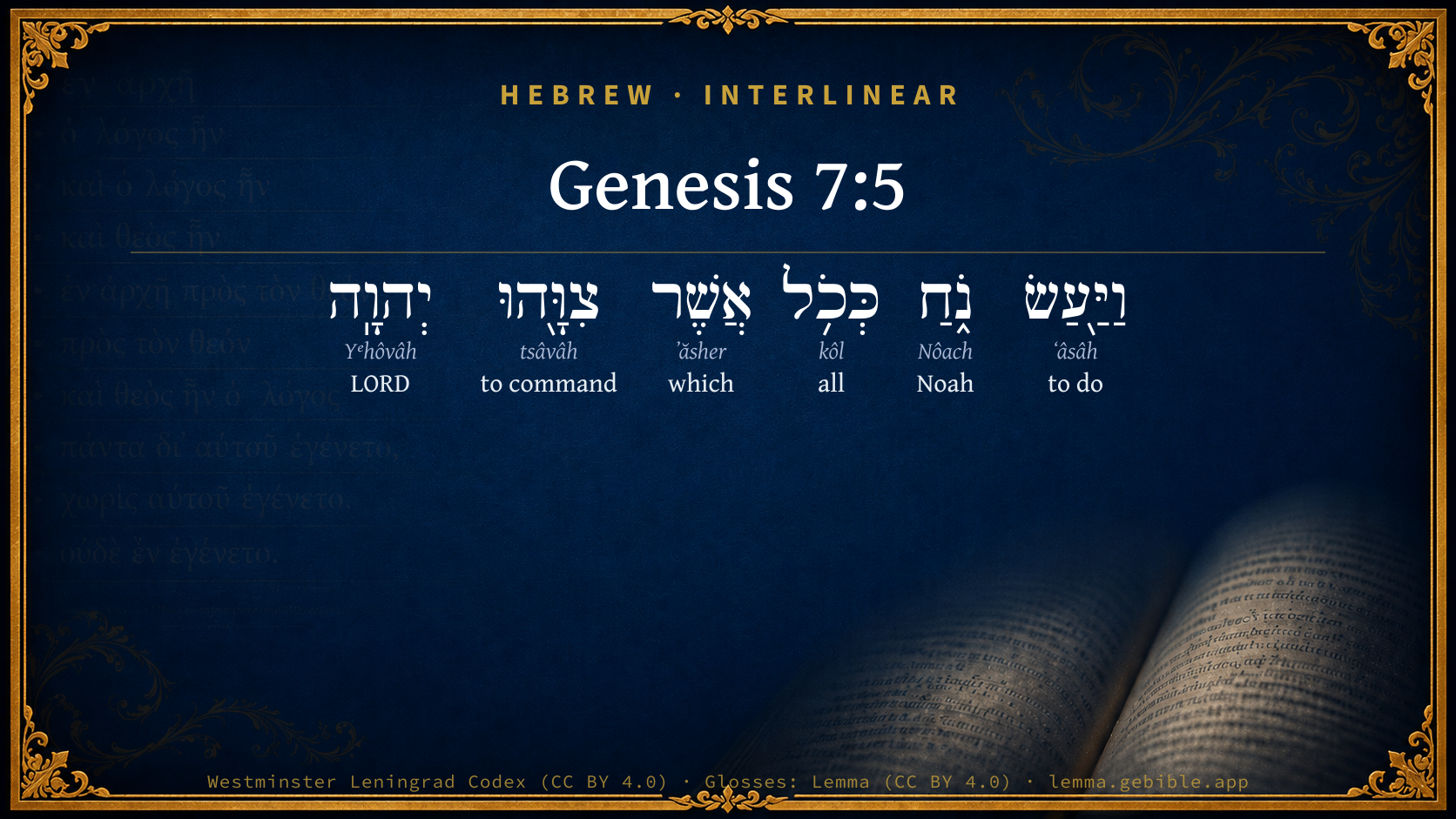
Genesis 7:5

Hebrew (Westminster Leningrad Codex) Genesis 7:5 appears in the Hebrew Old Testament. The text above is from the Westminster Leningrad Codex. Each word links to its Strong’s number, a concise gloss, and parsing drawn from the Open Scriptures Hebrew Bible morphology. Click any word for its full Brown-Driver-Briggs (BDB) entry.
Download image
Cite this verse

Genesis 7:5 (World English Bible). Public Domain. Lemma interlinear Bible study tool, https://lemma.gebible.app/v/genesis/7/5.

Show BibTeX & RIS
BibTeX
RIS
English Translation
Noah did everything that Yahweh commanded him.
World English Bible · Public Domain
Download a study sheet

One document with this verse’s original text, its word-by-word gloss line, the meaning frame, cross-references with their text, attributed commentary, and full source and license credits — printable, and it pastes into notes with its structure intact.

This verse Autodidact and up

Study sheet (.html) Plain text (.txt)

A passage Seminary Student

Up to 50 verses in one chapter. A passage sheet keeps up to 6 commentary sources and 12 cross-references per verse, in the order this page ranks them, and says so on the sheet whenever that leaves anything out. Ask for a single verse and you get the Autodidact verse sheet above.

Everything on this page stays free to read, with no account — the sheet is a download of what is already on screen, not access to it.

Want to remove ads? Support Godless Engineer
Compare translations 3

The same verse in 3 English versions, stacked beneath the original-language interlinear above. Click any original word for its lexicon entry.

Each is an independent rendering of the whole verse — the interlinear is not word-aligned to these translations.

Highlighted words mark where these versions differ — a whole-verse word diff, not a word-by-word alignment.

  • World English Bible Public Domain
    Noah did everything that Yahweh commanded him.
  • King James Version Public Domain
    And Noah did according unto all that the LORD commanded him.
  • unfoldingWord Literal Text CC BY-SA 4.0
    Then Noah did all that Yahweh had commanded him.

unfoldingWord Literal Text — © unfoldingWord, licensed CC BY-SA 4.0. Word-aligned USFM3 via Door43 (git.door43.org/unfoldingWord/en_ult).

Versions to compare (up to 4)

3 of 4 selected

Show all 18 translations

Every available English version of this verse, each an independent rendering of the whole verse.

  • World English Bible Public Domain
    Noah did everything that Yahweh commanded him.
  • Berean Standard Bible Public Domain
    And Noah did all that the LORD had commanded him.
  • Majority Standard Bible Public Domain
    And Noah did all that the LORD had commanded him.
  • King James Version Public Domain
    And Noah did according unto all that the LORD commanded him.
  • American Standard Version (1901) Public Domain
    And Noah did according unto all that Jehovah commanded him.
  • Revised Version (1885) Public Domain
    And Noah did according unto all that the LORD commanded him.
  • Geneva Bible (1599) Public Domain
    Noah therefore did according vnto all that the Lord commanded him.
  • Douay-Rheims (1899) Public Domain
    And Noe did all things which the Lord had commanded him.
  • Young's Literal Translation Public Domain
    And Noah doth according to all that Jehovah hath commanded him:
  • Literal Standard Version CC BY-SA 4.0
    And Noah does according to all that YHWH has commanded him.
  • Unlocked Literal Bible CC BY-SA 4.0
    Noah did all that Yahweh commanded him.
  • unfoldingWord Literal Text CC BY-SA 4.0
    Then Noah did all that Yahweh had commanded him.
  • Darby Bible Public Domain
    And Noah did according to all that Jehovah had commanded him.
  • World Messianic Bible Public Domain
    Noah did everything that the LORD commanded him.
  • Webster's Bible Public Domain
    And Noah did according to all that the LORD commanded him.
  • Free Bible Version CC BY-SA 4.0
    Noah did exactly what the Lord ordered him to do.
  • Bible in Basic English Public Domain
    And Noah did everything which the Lord said he was to do.
  • JPS Tanakh (1917) Public Domain
    And Noah did according unto all that the LORD commanded him.

Literal Standard Version (2020), Covenant Press — licensed CC BY-SA 4.0. Text via the HelloAO Bible API (eBible.org). Unlocked Literal Bible (unfoldingWord) — licensed CC BY-SA 4.0. Text via the HelloAO Bible API (eBible.org). unfoldingWord Literal Text — © unfoldingWord, licensed CC BY-SA 4.0. Word-aligned USFM3 via Door43 (git.door43.org/unfoldingWord/en_ult). Free Bible Version, Dr. Jonathan Gallagher — licensed CC BY-SA 4.0. Text via the HelloAO Bible API (eBible.org).

Word by word

More ways to search: Search by grammar → Find every occurrence → Compare this word →

Practice this passage: Drill this verse → Learn its vocabulary →

About this verse

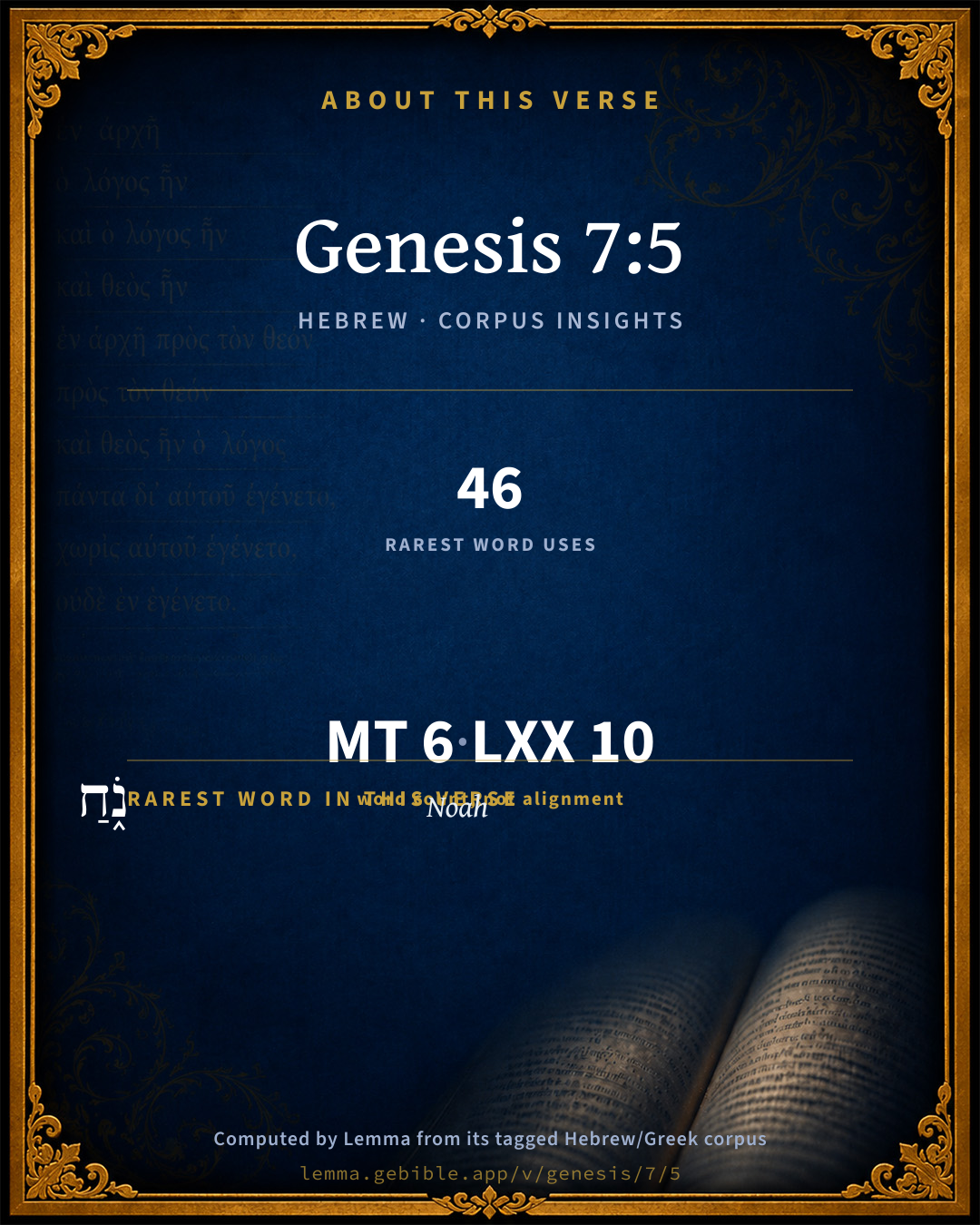
These counts appear in no published source. They are computed here, from the morphology-tagged text and Lemma’s own curated glosses. What Lemma adds →

6
words
6
distinct lemmas
Pentateuch
section

Shared distinctive vocabulary

נֹ֑חַ Noah H5146 occurs in 39 verses of the Hebrew Bible. Also found in:

Grammatical profile

  • 2 verbs
  • 3 nouns
  • 1 particle

Verb forms

  • וַיַּ֖עַשׂ Qal · Sequential Imperfect
  • צִוָּ֖הוּ Piel · Perfect

Hebrew & Septuagint length

In English translation the verse runs 7 words from the Hebrew and 11 from the Septuagint (LXX English) — the Septuagint runs noticeably longer here. See the side-by-side →

A rough comparison of the two English renderings, which tokenize alike — not a word-level alignment.

Word counts can differ between the Hebrew and the Greek without any difference in meaning — e.g. the Hebrew direct-object marker אֵת has no separate Greek word, and Greek often adds the article ὁ.

In the original languages it is 6 Hebrew tokens and 10 Greek tokens — but the two are counted differently (Hebrew bundles its prefixes and suffixes into one token; the Greek is in lemma form), so that isn’t a like-for-like length.

Cross-references

12

Topical passages linked to Genesis 7:5 in the Treasury of Scripture Knowledge — connected by theme and wording, ordered by reader-vote popularity; previews shown in the World English Bible.

  • Genesis 6:22 Thus Noah did. According to all that God commanded him, so he did.
  • Luke 8:21 But he answered them, "My mother and my brothers are these who hear the word of God, and do it."
  • Exodus 39:32 Thus all the work of the tent of the tent of meeting was finished. The children of Israel did according to all that Yahweh commanded Moses; so they did.
  • Exodus 39:42–43 According to all that Yahweh commanded Moses, so the children of Israel did all the work.
  • Psalms 119:6 Then I wouldn't be disappointed, When I consider all of your commandments.
  • Exodus 40:16 Thus did Moses: according to all that Yahweh commanded him, so he did.
  • Matthew 3:15 But Jesus, answering, said to him, "Allow it now, for this is the fitting way for us to fulfill all righteousness." Then he allowed him.
  • John 13:17 If you know these things, blessed are you if you do them.
  • Philippians 2:8 And being found in human form, he humbled himself, becoming obedient to death, yes, the death of the cross.
  • Hebrews 5:8 though he was a Son, yet learned obedience by the things which he suffered.
  • John 2:5 His mother said to the servants, "Whatever he says to you, do it."
  • John 8:28–29 Jesus therefore said to them, "When you have lifted up the Son of Man, then you will know that I am he, and I do nothing of myself, but as my Father taught me, I say these things.

Cross-references courtesy of OpenBible.info (CC BY 4.0).

Hebrew and Greek witnesses Masoretic Hebrew ↔ Greek Septuagint

The same verse in the two great witnesses to the Old Testament, shown verse-for-verse.

Here the Septuagint runs noticeably longer than the Hebrew — LXX2012 (modern English Septuagint) 11 words vs World English Bible 7. A rough length comparison of the two English translations, not a word-level alignment — read both below.

These are two independent witnesses, not word-aligned to each other, and the Septuagint is shown in lemma (dictionary) form.

Hebrew Genesis 7:5 Masoretic · Westminster Leningrad Codex

וַיַּ֖עַשׂ נֹ֑חַ כְּכֹ֥ל אֲשֶׁר צִוָּ֖הוּ יְהוָֽה

Noah did everything that Yahweh commanded him.

World English Bible · Public Domain

Greek LXX Genesis 7:5 Septuagint · lemma form

καί ποιέω νωε πᾶς ὅσος ἐντέλλομαι αὐτός κύριος ὁ θεός

And Noe did all things whatever the Lord God commanded him.

LXX2012 (modern English Septuagint) · Public Domain

Hebrew: Westminster Leningrad Codex (CC BY 4.0). Greek: Septuagint (public domain); English from LXX2012 (modern English Septuagint) (Public Domain). How the Septuagint differs from the Hebrew →

Targum (Aramaic paraphrase)

2

The Targum is the ancient Jewish Aramaic paraphrase of the Hebrew Scriptures — an interpretive translation, not the Hebrew text itself. Onkelos (literal) and Pseudo-Jonathan (expansive) render the Torah, and Jonathan the Prophets. Coverage is partial: where no permissively-licensed English translation exists for a verse, only the Aramaic is shown. This is verse-level text, not a word-by-word alignment to the Hebrew.

  1. Targum Onkelos Torah (Genesis–Deuteronomy)
    וַעֲבַד נֹחַ כְּכֹל דִּי פַקְּדֵהּ יְיָ

    And Noach did according to all that the Lord had instructed him.

    Targum Onkelos — Aramaic: “Onkelos Genesis” (public domain); “Onkelos Exodus” (public domain); “Onkelos Leviticus” (public domain); “Onkelos Numbers” (public domain); “Onkelos Deuteronomy” (public domain). English: “Sefaria Community Translation” (CC0 1.0 (public-domain dedication)); “J.W. Etheridge. The Targums of Onkelos and Jonathan Ben Uzziel on the Pentateuch. London: Longmans, Green, 1862” (public domain). Text via Sefaria.

  2. Targum Pseudo-Jonathan Torah (Genesis–Deuteronomy)
    וְעָבַד נחַ כְּכָל דְפַקְדֵיהּ יְיָ

    And Noah did according to all that the Lord had commanded him.

    Targum Pseudo-Jonathan — Aramaic: “Targum Jonathan on Genesis” (public domain); “Targum Jonathan on Exodus” (public domain); “Targum Jonathan on Leviticus” (public domain); “Targum Jonathan on Numbers” (public domain); “Targum Jonathan on Deuteronomy” (public domain). English: “The Targum of Jonathan ben Uzziel, trans. J. W. Etheridge, London, 1862” (public domain). Text via Sefaria.

Commentary

Notes on Genesis 7:5 from classic Christian and Jewish commentators (each source and its license shown beneath its notes). The classic Christian expositions comment on the surrounding passage and are grouped to its opening verse, so a note may address several verses; the Jewish commentaries on the Tanakh (Rashi and others) are per-verse, so they appear only where the commentator wrote on this verse.

Lemma curates 59 commentaries, every one of them public domain or Creative Commons licensed, each selected and text-cleaned for this edition rather than reprinted as found. About our sources →

Trapp's Complete Commentary

John Trapp

Gen 7:5 And Noah did according unto all that the LORD commanded him.

Ver. 5. And Noah did according unto all.] This "All," is a little word, but of large extent. He doth not his master’s but his own will, that doth no more than himself will. A dispensatory conscience is an evil conscience. God cries to us, η ολως, η μη ολως. He will have universal obedience both for subject and object. ( Quicquid propter Deum sit, aequaliter sit .) We must be entirely willing in all things to please God, or we utterly displease him. Herod did many things, and was not a button the better. Jehu’s golden calves made an end of him, though he made an end of Baal’s worship. He that doth some, and not "all God’s will," with David, {θεληματα, Act 13:22} in desire and affection at least, doth but as Benhadad, recover of one disease, and die of another: yea, if he take not a better course for himself, he doth but take pains to go to hell. Then shall we not be ashamed, when we have respect, at least, to all God’s commandments. {Psa 119:6}

John Trapp, A Commentary or Exposition upon All the Books of the Old and New Testament (1647–1656) — public domain. Text from a community e-Sword module.

The Biblical Illustrator

Joseph S. Exell

Gen_7:5

Noah did according unto all that the Lord commanded him

The obedience of Noah to the commands of God

I.

IT WAS OBEDIENCE RENDERED UNDER THE MOST TRYING CIRCUMSTANCES.

II. IT WAS OBEDIENCE RENDERED IN THE MOST ARDUOUS WORK.

III. IT WAS OBEDIENCE RENDERED IN THE MOST HEROIC MANNER. (J. S.Exell, M. A.)

Safely kept by God

When Paul was in danger from the forty men who laid wait to kill him, Providence shut him up in Caesarea, where he was free from the peril. When Luther would probably have been slain by wicked Papists, he was taken by force to a strong castle, where he was in good keeping till it was safe for him to go abroad. Jesus, too, as a babe, was taken into Egypt for His preservation from death.

The entrance of the animals into the ark

At last the allotted time is fully or nearly expired. Noah has laid the last planks of the ark, which now stands up like a mountain, relieved against the sky. But that sky is as yet serene and cloudless, and there seems as little prospect of a deluge as there was a hundred and twenty years ago. The general interest in the matter has languished and nearly expired, when it is suddenly awakened into an intense glow by an extraordinary occurrence. The people bad laughed at the immense size of the ark, at its many rooms, at the quantity of food Noah had collected, and had asked, Whence are the animals to come that are to fill these corners and to consume these stores? But now a strange rumour flies abroad; it is, that a vast and motley throng of birds, beasts, and creeping things are thronging from every quarter toward the ark. There are cries, indeed, in contradiction to this It cannot be, it is a mere report got up by Noah; but soon it forces itself as a fact upon the conviction of all, and the most obstinately incredulous have to stand dumb beside; and worse, have no power to obstruct the passage. It is a sight the sublimity of which they are compelled to admire, even while they tremble thereat; being, indeed, a repetition on a larger scale of the passage of the animals before Adam. The lion and the lioness come, loth, it would seem in a degree, to circumscribe their wild freedom and majesty, yet unable to resist the pressure of the power above. The tiger and his mate, like fiends chained, but the chains not seen; the rhinoceros, buffalo, and mammoth, causing the earth to groan beneath their tread; panthers and leopards swiftly advancing; the slow-moving bear and the solemn elephant; the bull, the stag, and the elk, with their flashing horns; the horse, the glory of his nostrils terrible still, although tamed somewhat in the shadow of his unseen rider, God; the antelope and the wolf met together; the fox and the lamb embracing each other; the hyena, horrible even in his transient tameness; besides fifty more forms of brutal life, clean or unclean, beneath whose ranks you see thick streams of reptile existence, from the serpent to the scorpion, from the boa constrictor to the lizard, wriggling on their ark-ward way. And high overhead are flights of birds, here all oracular of doom, winging their courses--the earnest eagle, the gloom glowing raven, the reluctant vulture, the heavy kite, the fierce-eyed falcon, the high-soaring hawk, the lark with her lyric melody, the dove with her spotless plumage, the humming bird with her sparkling gem-like shape, the nightingale with her sober plumage and melting song, the swallow with the dark-light glance and shivered beauty of her wing, and a hundred more of those skiey demons or angels now sweep past to their prepared nests in the ark, even as spirits from a thousand deaths on a battlefield find their winged way to the land of souls! Surely you might have expected that such a throng of natures children, all subdued into one harmony, aiming at one mark, and animated by one spirit, as by one supernatural soul, should have not only awed, but convinced and converted the multitude who saw their passage. But it was not so. In what way or through means of what sophistry they contrived to evade the impression made by such a startling event, we cannot tell; but evade it they did--proving that there have sometimes been hearts so hard and consciences so seared that the most stupendous miracles have been unable to move them or melt them into repentance. (G. Gilfillan.)

The ark open for all

On the morning when the ark door was opened you might have seen in the sky a pair of eagles, a pair of sparrows, a pair of vultures, a pair of ravens, a pair of humming birds, a pair of all kinds of birds that ever cut the azure, that ever floated on wing, or whispered their song to the evening gales. In they came. But, if you had watched down on the earth, you would have seen come creeping along a pair of snails, a pair of snakes, and a pair of worms. There ran along a pair of mice; there came a pair of lizards; and in there flew a pair of locusts. There were pairs of creeping creatures, as well as pairs of flying creatures. Do you see what I mean by that? There are some of you that can fly so high in knowledge that I should never be able to scan your great and extensive wisdom; and others of you so ignorant that you can hardly read your Bibles. Never mind: the eagle must come down to the door, and you must go up to it. There is only one entrance for you all; and, as God saved the birds that flew, so He saved the reptiles that crawled. Are you a poor, ignorant, crawling creature, that never was noticed--without intellect, without repute, without fame, without honour? Come along, crawling One! God will not exclude you. (C. H.Spurgeon.)

The Biblical Illustrator, edited by Joseph S. Exell (c. 1880s–1900s) — public domain. Text from a community e-Sword module.

Geneva Bible (1599)

Geneva Bible translators

Matt. 24:37; Luke 27:26; 1 Pet. 3:20

Geneva Bible (1599) marginal notes — public domain. Text via Bolls.life.

Matthew Henry's Commentary

Here is Noah's ready obedience to the commands that God gave him. Observe, 1. He went into the ark, upon notice that the flood would come after seven days, though probably as yet there appeared no visible sign of its approach, no cloud arising that threatened it, nothing done towards it, but all continued serene and clear; for, as he prepared the ark by faith in the warning given that the flood would come, so he went into it by faith in this warning that it would come quickly, though he did not see that the second causes had yet begun to work. In every step he took, he walked by faith, and not by sense. During these seven days, it is likely, he was settling himself and his family in the ark, and distributing the creatures into their several apartments. This was the conclusion of that visible sermon which he had long been preaching to his careless neighbours, and which, one would think, might have awakened them; but, not obtaining that desired end, it left their blood upon their own heads. 2. He took all his family along with him, his wife, to be his companion and comfort (though it should seem that, after this, he had no children by her), his sons, and his sons' wives, that by them not only his family, but the world of mankind, might be built up. Observe, Though men were to be reduced to so small a number, and it would be very desirable to have the world speedily repeopled, yet Noah's sons were each of them to have but one wife, which strengthens the argument against having many wives; for from the beginning of this new world it was not so: as, at first, God made, so now he kept alive, but one woman for one man. See Mat 19:4, Mat 19:8. 3. The brute creatures readily went in with him. The same hand that at first brought them to Adam to be named now brought them to Noah to be preserved. The ox now knew his owner, and the ass his protector's crib, nay, even the wildest creatures flocked to it; but man had become more brutish than the brutes themselves, and did not know, did not consider, Isa 1:3.

Matthew Henry's Commentary on the Whole Bible (1708–1710) — public domain (CC PDM 1.0). Text via the HelloAO Bible API.

John Calvin's Commentaries

5. And Noah did according to all that the Lord commanded. This is not a bare repetition of the former sentence; but Moses commends Noah’s uniform tenor of obedience in keeping all God’s commandments; as if he would say, that in whatever particular it pleased God to try his obedience, he always remained constant. And, certainly, it is not becoming to obey one or another commandment of God only, so that when we have performed a defective obedience, we should feel at liberty to withdraw; for we must keep in memory the declaration of James,

‘He who forbade thee to kill, forbade thee also to steal, and to commit adultery,’ (James 2:11.)

John Calvin's Commentaries (1540-1563) — public domain. Text from the Calvin Translation Society English edition (1840s-50s) via the Christian Classics Ethereal Library (ccel.org). Calvin's coverage is partial (roughly two-thirds of the Bible); uncommented books and verses are honest gaps, never fabricated. The 19th-century editor's footnotes and remarks are omitted so the notes are faithfully Calvin's own voice.

John Gill's Exposition

And Noah did according to all that the Lord commanded him,.... He prepared for his entrance into the ark, and all the creatures with him; got everything ready for them, the rooms for their habitation, and food for their sustenance.

And Noah did according to all that the Lord commanded him,.... He prepared for his entrance into the ark, and all the creatures with him; got everything ready for them, the rooms for their habitation, and food for their sustenance.

Genesis 7:6

gen 7:6

gen 7:6

gen 7:6And Noah was six hundred years old when the flood of waters was upon the earth,.... When it began, for he was in his six hundred and first year when it ended, Gen 8:13 his eldest son was now an hundred years old, since when Noah was five hundred years old he begat children, Gen 5:32.

John Gill's Exposition of the Whole Bible (1746–1763) — public domain (CC PDM 1.0). Text via the HelloAO Bible API.

Matthew Poole's English Annotations

Which was said Gen 6:22, and is here repeated, because this was an eminent instance of his faith and obedience.

Matthew Poole's English Annotations on the Holy Bible (1683–1685) — public domain. Text from a community e-Sword/MySword module.

Rashi

Rabbi Shlomo Yitzchaki (Rashi)

ויעש נח AND NOAH DID — This refers to his coming to the Ark.

Rashi on the Tanakh — English translations: “The Judaica Press complete Tanach with Rashi, translated by A. J. Rosenberg” (CC BY 4.0); “Pentateuch with Rashi's commentary by M. Rosenbaum and A.M. Silbermann, 1929-1934” (public domain); “The Metsudah Tanach series, Lakewood, N.J” (CC BY 4.0); and “The Book of Joshua, Metsudah Publications, 1997” (CC BY 4.0). Text via Sefaria.

Radak

Rabbi David Kimhi (Radak)

ויעש נח, he entered the ark together with the animals slated for survival, as mentioned in ויבא נח in verse 7.

Radak on the Tanakh — English translations: “Sefaria Community Translation” (CC0 1.0 (public-domain dedication)); “Eliyahu Munk, HaChut Hameshulash” (CC BY 4.0); “Rabbi Mike Feuer, Jerusalem Anthology” (CC BY 4.0); and “R. David Kimhi on the first book of Psalms, Translated by R.G. Finch, London, 1919” (public domain). Text via Sefaria.

Ibn Ezra

Rabbi Abraham ibn Ezra

Noach did all. At this point he only brought his family near to the ark but did not enter.

Ibn Ezra on the Tanakh — English translations: “Sefaria Community Translation” (CC0 1.0 (public-domain dedication)); “Yalkut, Sifsei Chachomim Chumash, Metsudah Publications, 2009” (CC BY 4.0); and “Commentary of Ibn Ezra on Isaiah - trans. by M. Friedlander, 1873” (public domain). Text via Sefaria.

Lesson kit

Teaching starters — assembled from the data on this page, not authored interpretation. Every prompt links to the verse data it draws on. Edit before teaching.

Genesis, in the Pentateuch, opens this verse with 6 words (6 distinct Hebrew lemmas). Its most distinctive word is Nôach (“Noah”). The Greek Septuagint runs longer here. A historical commentator’s framing appears above. Read the whole chapter for the surrounding context.

Discussion questions

  1. What does “Noah” (Nôach) contribute to the verse as a whole?
  2. Genesis 5:29 shares the word «Noah» with this verse. How do the two illuminate each other?
  3. Compared with the Hebrew, the Septuagint runs longer here. What questions does that raise?
  4. These translations render this verse differently; the difference is in the English rendering, not the original. What questions does that raise?
  5. The verb «וַיַּ֖עַשׂ» is Qal Sequential Imperfect. How does its form color the action?
  6. Reading how Trapp's Complete Commentary and The Biblical Illustrator read this verse, where do the two commentators agree and where do they part?

Things to notice

Reading settings

Reading text

Shown beneath each verse's original-language words.

Old Testament
Old Testament edition

Read the OT as the Masoretic Hebrew (MT) or the Greek Septuagint (LXX).

English shown for the Greek Septuagint (in the Hebrew ↔ Greek comparison).

Comparing translations? Open the Compare panel on any verse page to stack up to four side by side.