
Luke 10:37

Greek (Tischendorf 8th ed.) Luke 10:37 appears in the Greek New Testament. The text above is from the Tischendorf 8th edition. Each word links to its Strong’s number and a concise gloss. Click any word for its full Thayer’s Greek Lexicon entry.
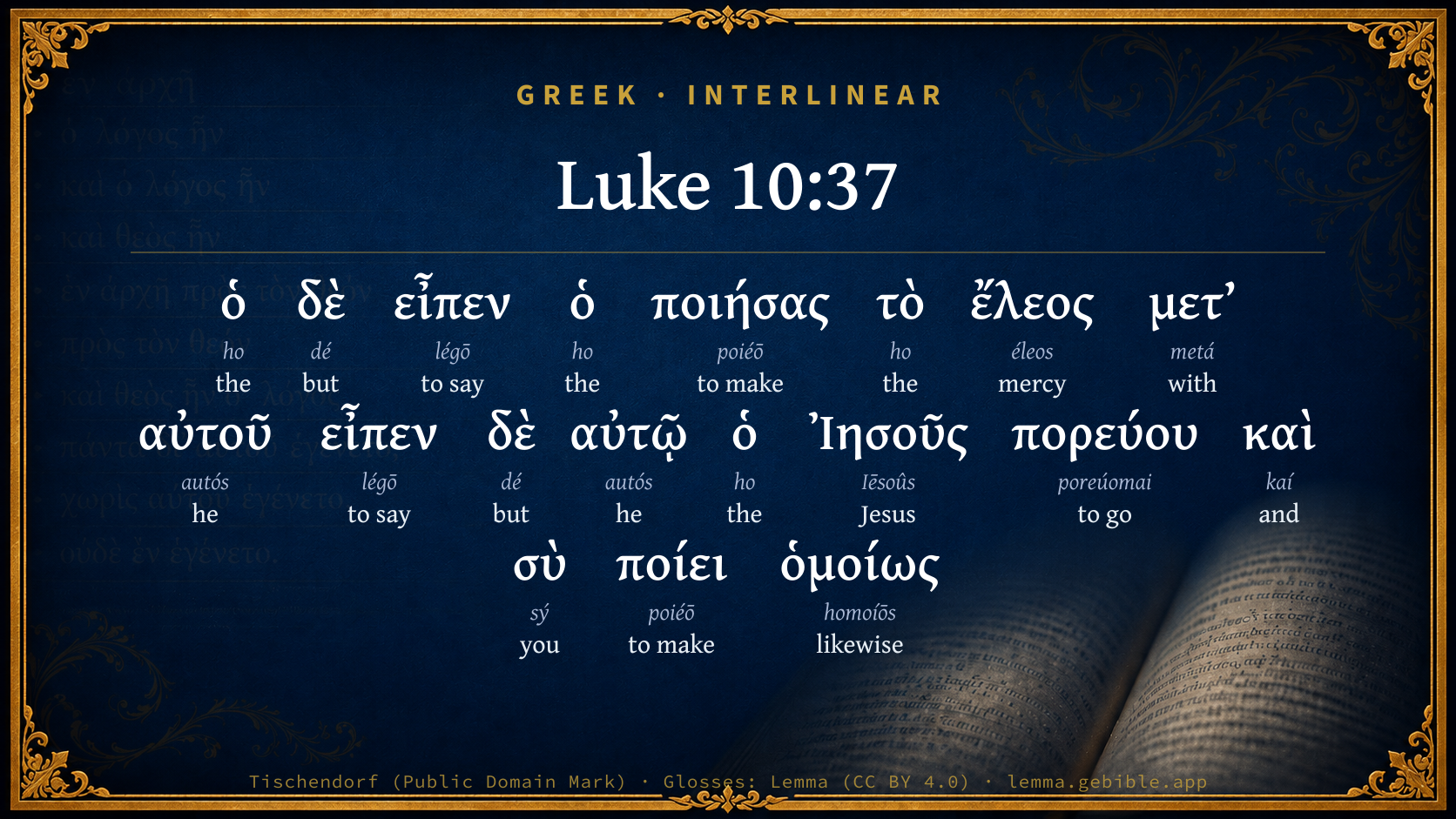
Download image
Cite this verse

Luke 10:37 (World English Bible). Public Domain. Lemma interlinear Bible study tool, https://lemma.gebible.app/v/luke/10/37.

Show BibTeX & RIS
BibTeX
RIS
English Translation
He said, "He who showed mercy on him." Then Jesus said to him, "Go and do likewise."
World English Bible · Public Domain
Download a study sheet

One document with this verse’s original text, its word-by-word gloss line, the meaning frame, cross-references with their text, attributed commentary, and full source and license credits — printable, and it pastes into notes with its structure intact.

This verse Autodidact and up

Study sheet (.html) Plain text (.txt)

A passage Seminary Student

Up to 50 verses in one chapter. A passage sheet keeps up to 6 commentary sources and 12 cross-references per verse, in the order this page ranks them, and says so on the sheet whenever that leaves anything out. Ask for a single verse and you get the Autodidact verse sheet above.

Everything on this page stays free to read, with no account — the sheet is a download of what is already on screen, not access to it.

Want to remove ads? Support Godless Engineer
Compare translations 3

The same verse in 3 English versions, stacked beneath the original-language interlinear above. Click any original word for its lexicon entry.

Each is an independent rendering of the whole verse — the interlinear is not word-aligned to these translations.

Highlighted words mark where these versions differ — a whole-verse word diff, not a word-by-word alignment.

  • World English Bible Public Domain
    He said, "He who showed mercy on him." Then Jesus said to him, "Go and do likewise."
  • King James Version Public Domain
    And he said, He that shewed mercy on him. Then said Jesus unto him, Go, and do thou likewise.
  • unfoldingWord Literal Text CC BY-SA 4.0
    And he said, “The one having shown mercy to him.” Then Jesus said to him, “You go and do likewise.”

unfoldingWord Literal Text — © unfoldingWord, licensed CC BY-SA 4.0. Word-aligned USFM3 via Door43 (git.door43.org/unfoldingWord/en_ult).

Versions to compare (up to 4)

3 of 4 selected

Show all 19 translations

Every available English version of this verse, each an independent rendering of the whole verse.

  • World English Bible Public Domain
    He said, "He who showed mercy on him." Then Jesus said to him, "Go and do likewise."
  • Berean Standard Bible Public Domain
    “The one who showed him mercy,” replied the expert in the law. Then Jesus told him, “Go and do likewise.”
  • Majority Standard Bible Public Domain
    “The one who showed him mercy,” replied the expert in the law. Then Jesus told him, “Go and do likewise.”
  • King James Version Public Domain
    And he said, He that shewed mercy on him. Then said Jesus unto him, Go, and do thou likewise.
  • American Standard Version (1901) Public Domain
    And he said, He that showed mercy on him. And Jesus said unto him, Go, and do thou likewise.
  • Revised Version (1885) Public Domain
    And he said, He that shewed mercy on him. And Jesus said unto him, Go, and do thou likewise.
  • Geneva Bible (1599) Public Domain
    And he saide, He that shewed mercie on him. Then said Iesus vnto him, Goe, and do thou likewise.
  • Douay-Rheims (1899) Public Domain
    But he said: He that shewed mercy to him. And Jesus said to him: Go, and do thou in like manner.
  • Young's Literal Translation Public Domain
    and he said, `He who did the kindness with him,' then Jesus said to him, `Be going on, and thou be doing in like manner.'
  • Literal Standard Version CC BY-SA 4.0
    And he said, “He who did the kindness with him,” then Jesus said to him, “Be going on, and you be doing in like manner.”
  • Unlocked Literal Bible CC BY-SA 4.0
    The teacher said, “The one who showed mercy to him.” Jesus said to him, “Go and do the same.”
  • unfoldingWord Literal Text CC BY-SA 4.0
    And he said, “The one having shown mercy to him.” Then Jesus said to him, “You go and do likewise.”
  • Darby Bible Public Domain
    And he said, He that shewed him mercy. And Jesus said to him, Go, and do *thou* likewise.
  • World Messianic Bible Public Domain
    He said, “He who showed mercy on him.” Then Yeshua said to him, “Go and do likewise.”
  • Webster's Bible Public Domain
    And he said, He that showed mercy on him. Then said Jesus to him, Go, and do thou likewise.
  • Free Bible Version CC BY-SA 4.0
    “The one who showed him kindness,” the man replied. “You go and do the same,” Jesus told him.
  • Bible in Basic English Public Domain
    And he said, The one who had mercy on him. And Jesus said, Go and do the same.
  • Text-Critical English NT CC BY 4.0
    The lawyer said, “The one who showed him mercy.” Jesus said to him, “Go and do likewise.”
  • Tyndale New Testament (1534) Public Domain
    And he sayde: he that shewed mercy on him. Then sayde Iesus vnto him. Goo and do thou lyke wyse.

Literal Standard Version (2020), Covenant Press — licensed CC BY-SA 4.0. Text via the HelloAO Bible API (eBible.org). Unlocked Literal Bible (unfoldingWord) — licensed CC BY-SA 4.0. Text via the HelloAO Bible API (eBible.org). unfoldingWord Literal Text — © unfoldingWord, licensed CC BY-SA 4.0. Word-aligned USFM3 via Door43 (git.door43.org/unfoldingWord/en_ult). Free Bible Version, Dr. Jonathan Gallagher — licensed CC BY-SA 4.0. Text via the HelloAO Bible API (eBible.org).

Word by word

More ways to search: Search by grammar → Find every occurrence → Compare this word →

Practice this passage: Drill this verse → Learn its vocabulary →

ἔλεος
éleos
G1656
“mercy”
Noun, Accusative, Singular, Neuter
Part of Speech
Noun
Case
Accusative
Number
Singular
Gender
Neuter
Full Thayer's Definition

Origin: of uncertain affinity

TDNT: 09:57,2

1. mercy: kindness or good will towards the miserable and the afflicted, joined with a desire to help them a. of men towards men: to exercise the virtue of mercy, show one's self merciful b. of God towards men: in general providence; the mercy and clemency of God in providing and offering to men salvation by Christ c. the mercy of Christ, whereby at his return to judgment he will bless true Christians with eternal life
  1. ὁ ho G3588 “the” Article, Nominative, Singular, Masculine
  2. δὲ dé G1161 “but” Conjunction
  3. εἶπεν légō G3004 “to say” Verb, Aorist, Active, Indicative, 3rd person, Singular
  4. ὁ ho G3588 “the” Article, Nominative, Singular, Masculine
  5. ποιήσας poiéō G4160 “to make” Verb, Aorist, Active, Participle, Nominative, Singular, Masculine
  6. τὸ ho G3588 “the” Article, Accusative, Singular, Neuter
  7. μετ’ metá G3326 “with” Preposition
  8. αὐτοῦ autós G846 “he” Personal pronoun, Genitive, Singular, Masculine
  9. εἶπεν légō G3004 “to say” Verb, Aorist, Active, Indicative, 3rd person, Singular
  10. δὲ dé G1161 “but” Conjunction
  11. αὐτῷ autós G846 “he” Personal pronoun, Dative, Singular, Masculine
  12. ὁ ho G3588 “the” Article, Nominative, Singular, Masculine
  13. Ἰησοῦς Iēsoûs G2424 “Jesus” Noun, Nominative, Singular, Masculine
  14. πορεύου poreúomai G4198 “to go” Verb, Present, Middle or Passive deponent, Imperative, 2nd person, Singular
  15. καὶ kaí G2532 “and” Conjunction
  16. σὺ sý G4771 “you” Personal pronoun, 2nd person, Nominative, Singular
  17. ποίει poiéō G4160 “to make” Verb, Present, Active, Imperative, 2nd person, Singular
  18. ὁμοίως homoíōs G3668 “likewise” Adverb

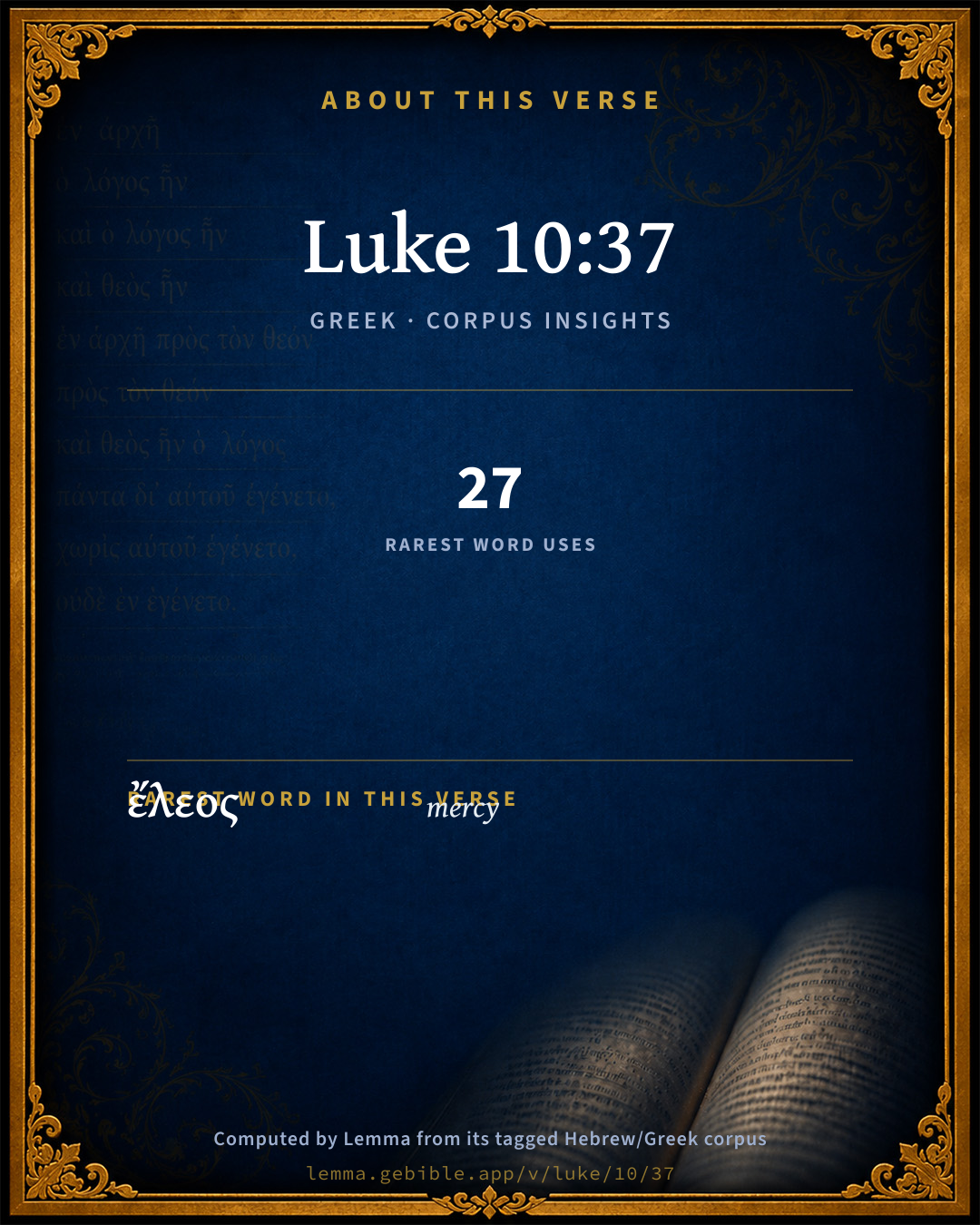
About this verse

These counts appear in no published source. They are computed here, from the morphology-tagged text and Lemma’s own curated glosses. What Lemma adds →

19
words
12
distinct lemmas
Gospels
section

Shared distinctive vocabulary

ἔλεος mercy G1656 occurs in 26 verses of the Greek New Testament. Also found in:
Repetition

Words recur within this verse:

  • εἶπεν to say G3004 ×2
  • ποιήσας to make G4160 ×2
  • ὁ the G3588 ×4
  • δὲ but G1161 ×2
  • αὐτοῦ he G846 ×2

Cross-references

16

Topical passages linked to Luke 10:37 in the Treasury of Scripture Knowledge — connected by theme and wording, ordered by reader-vote popularity; previews shown in the World English Bible.

  • 1 John 3:16–18 By this we know love, because he laid down his life for us. And we ought to lay down our lives for the brothers.
  • Micah 6:8 He has shown you, O man, what is good. What does Yahweh require of you, but to act justly, To love mercy, and to walk humbly with your God?
  • 1 Peter 2:21 For to this you were called, because Christ also suffered for us, leaving you an example, that you should follow his steps,
  • 2 Corinthians 8:9 For you know the grace of our Lord Jesus Christ, that, though he was rich, yet for your sakes he became poor, that you through his poverty might become rich.
  • 1 John 4:10–11 In this is love, not that we loved God, but that he loved us, and sent his Son as the atoning sacrifice for our sins.
  • Luke 6:32–36 If you love those who love you, what credit is that to you? For even sinners love those who love them.
  • John 13:15–17 For I have given you an example, that you also should do as I have done to you.
  • Hosea 6:6 For I desire mercy, and not sacrifice; And the knowledge of God more than burnt offerings.
  • Matthew 23:23 "Woe to you, scribes and Pharisees, hypocrites! For you tithe mint, dill, and cumin, and have left undone the weightier matters of the law: justice, mercy, and faith. But you ought to have done these, and not to have left the other undone.
  • Ephesians 5:2 Walk in love, even as Christ also loved you, and gave himself up for us, an offering and a sacrifice to God for a sweet-smelling fragrance.
  • Proverbs 14:21 He who despises his neighbor sins, But blessed is he who has pity on the poor.
  • Matthew 20:28 even as the Son of Man came not to be served, but to serve, and to give his life as a ransom for many."
  • 1 John 3:23–24 This is his commandment, that we should believe in the name of his Son, Jesus Christ, and love one another, even as he commanded.
  • Revelation 1:5 and from Jesus Christ, the faithful witness, the firstborn of the dead, and the ruler of the kings of the earth. To him who loves us, and washed us from our sins by his blood;
  • Ephesians 3:18–19 may be strengthened to comprehend with all the saints what is the breadth and length and height and depth,
  • Hebrews 2:9–15 But we see him who has been made a little lower than the angels, Jesus, because of the suffering of death crowned with glory and honor, that by the grace of God he should taste of death for everyone.

Cross-references courtesy of OpenBible.info (CC BY 4.0).

Commentary

Notes on Luke 10:37 from classic Christian and Jewish commentators (each source and its license shown beneath its notes). The classic Christian expositions comment on the surrounding passage and are grouped to its opening verse, so a note may address several verses; the Jewish commentaries on the Tanakh (Rashi and others) are per-verse, so they appear only where the commentator wrote on this verse.

Lemma curates 59 commentaries, every one of them public domain or Creative Commons licensed, each selected and text-cleaned for this edition rather than reprinted as found. About our sources →

Bengel's Gnomon

Johann Albrecht Bengel

Luk 10:37. Ὁ ποιήσας τὸ ἔλεος μετʼ αὐτοῦ) LXX. 2Sa 9:1, etc., has ποιήσω μετʼ αὐτοῦ ἔλεος. It is not without design, that the lawyer refrains from giving the proper appellation, “the Samaritan.” [He shrunk from attributing such credit to a Samaritan, and therefore does not use the name.]—πορεύου, go thy way) Not yet was this lawyer fit for discipleship.—καὶ σὺ, thou also) When once the love of one’s own people and sect is removed out of the way, the access then at length is the easier to the Grace, which is free and common to all. Therefore the Samaritan, say you, has by this act of his obtained eternal life? [Luk 10:25.] Comp. Luk 10:27-29. The answer to this may be given from Rom 2:26.—ποίει, do) This is in consonance with ὁ ποιήσας, he that did the deed of mercy.—[ὁμοίως, likewise) We need not he ashamed of copying any good example set us, even though it be a Samaritan who is to be imitated.—V. g.]

Bengel's Gnomon of the New Testament — English translation (T&T Clark, Edinburgh, 1860) — public domain. Text from a community e-Sword module.

Meyer's Critical & Exegetical Commentary

Heinrich August Wilhelm Meyer

Luk_10:37. Ὁ ποιήσας κ.τ.λ.] Bengel: Non invitus abstinet legisperitus appellatione propria Samaritae. On the expression, comp. Luk_1:72.

τὸ ἔλεος] the compassion related; καὶ σύ: thou also; not to be joined to πορεύου (Lachmann), but to ποίει. Comp. Luk_6:31.

REMARK.

Instead of giving to the theoretical question of the scribe, Luk_10:29, a direct and theoretical decision as to whom he was to regard as his neighbour, Jesus, by the feigned (according to Grotius and others, the circumstance actually occurred) history of the compassionate Samaritan, with all the force of the contrast that puts to shame the cold Jewish arrogance, gives a practical lesson on the question: how one actually becomes the neighbour of ANOTHER, namely, by the exercise of helpful love, independently of the nationality and religion of the persons concerned. And the questioner, in being dismissed with the direction, καὶ σὺ ποίει ὁμοίως, has therein indirectly the answer to his question, τίς ἐστί μου πλησίον; namely: Every one, without distinction of people and faith, to whom the circumstances analogous to the instance of the Samaritan direct thee to exercise helpful love in order thereby to become his neighbour, thou hast to regard as thy neighbour. This turn on the part of Jesus, like every feature of the improvised narrative, bears the stamp of originality in the pregnancy of its meaning, in the insight which suggested it, and in the quiet and yet perfectly frank way in which the questioner, by a direct personal appeal, was put to the blush.[138]

[138] The Fathers, as Origen, Ambrose, Augustine, Theophylact, Euthymius Zigabenus, have been able to impart mystical meanings to the individual points of the history. Thus the ἄνθρωπός τις signifies Adam; Jerusalem, paradise; Jericho, the world; the thieves, the demons; the priest, the law; the Levite, the prophets; the Samaritan, Christ; the beast, Christs body; the inn, the church; the landlord, the bishop; the Denarii, the Old and New Testaments; the return, the Parousia. See especially Origen, Hom. 34 in Luc., and Theophylact, sub loc. Luther also similarly allegorises in his sermons. Calvin wisely says: Scripturae major habenda est reverentia, quam ut germanum ejus sensum hac licentia transfigurare liceat.

Meyer — Critical and Exegetical Commentary on the New Testament — English translation by Peter Christie, edited by Frederick Crombie (T&T Clark, 1880) — public domain. Text from a community e-Sword module.

Expositor's Greek Testament

ed. W. Robertson Nicoll

Luk 10:37 . ὁ ποιήσας , etc. If the lawyer was captious to begin with he is captious no longer. He might have been, for his question had not been directly (though very radically) answered. But the moral pathos of the “parable” has appealed to his better nature, and he quibbles no longer. But the prejudice of his class tacitly finds expression by avoidance of the word “Samaritan,” and the use instead of the phrase ὁ ποιήσας τὸ ἔλεος μετʼ αὐτοῦ . Yet perhaps we do him injustice here, for the phrase really expresses the essence of neighbourhood, and so indicates not only who is neighbour but why . For the same phrase vide Luk 1:58 ; Luk 1:72 . This story teaches the whole doctrine of neighbourhood: first and directly, what it is to be a neighbour, viz. , to give succour when and where needed; next, indirectly but by obvious consequence, who is a neighbour, viz. , any one who needs help and whom I have opportunity and power to help, no matter what his rank, race, or religion may be: neighbourhood coextensive with humanity.

The Expositor's Greek Testament, edited by W. Robertson Nicoll (1897–1910) — public domain. Text from a community e-Sword module.

Jamieson, Fausset & Brown

Robert Jamieson, A. R. Fausset & David Brown

Go, &c.--O exquisite, matchless teaching! What new fountains of charity has not this opened up in the human spirit--rivers in the wilderness, streams in the desert! What noble Christian institutions have not such words founded, all undreamed of till that wondrous One came to bless this heartless world of ours with His incomparable love--first in words, and then in deeds which have translated His words into flesh and blood, and poured the life of them through that humanity which He made His own! Was this parable, now, designed to magnify the law of love, and to show who fulfils it and who not? And who did this as never man did it, as our Brother Man, "our Neighbor?" The priests and Levites had not strengthened the diseased, nor bound up the broken (Eze 34:4), while He bound up the brokenhearted (Isa 61:1), and poured into all wounded spirits the balm of sweetest consolation. All the Fathers saw through the thin veil of this noblest of stories, the Story of love, and never wearied of tracing the analogy (though sometimes fancifully enough) [TRENCH]. Exclaims GREGORY NAZIANZEN (in the fourth century), "He hungered, but He fed thousands; He was weary, but He is the Rest of the weary; He is saluted 'Samaritan' and 'Demoniac,' but He saves him that went down from Jerusalem and fell among thieves," &c.

Jamieson, Fausset & Brown — Commentary Critical and Explanatory on the Whole Bible (1871) — public domain (CC PDM 1.0). Text via the HelloAO Bible API.

Adam Clarke's Commentary

Verse 37. He that showed mercy] Or, so much mercy. His prejudice would not permit him to name the Samaritan, yet his conscience obliged him to acknowledge that he was the only righteous person of the three.

Go, and do thou likewise] Be even to thy enemy in distress as kind, humane, and merciful, as this Samaritan was. As the distress was on the part of a Jew, and the relief was afforded by a Samaritan, the lawyer, to be consistent with the decision he had already given, must feel the force of our Lord's inference, that it was his duty to act to any person, of whatever nation or religion he might be, as this Samaritan had acted toward his countryman. It is very likely that what our Lord relates here was a real matter of fact, and not a parable; otherwise the captious lawyer might have objected that no such case had ever existed, and that any inference drawn from it was only begging the question; but as he was, in all probability, in possession of the fact himself, he was forced to acknowledge the propriety of our Lord's inference and advice.

Those who are determined to find something allegorical, even in the plainest portions of Scripture, affirm that the whole of this relation is to be allegorically considered; and, according to them, the following is the true exposition of the text.

The certain man means Adam - went down, his fall - from Jerusalem, יראה שלום yorih shalom, he shall see peace, perfection, c., meaning his state of primitive innocence and excellence - to Jericho, (ירחי yareacho, his moon,) the transitory and changeable state of existence in this world - thieves, sin and Satan - stripped, took away his righteousness, which was the clothing of the soul-wounded, infected his heart with all evil and hurtful desires, which are the wounds of the spirit - half dead, possessing a living body, carrying about a soul dead in sin.

The priest, the moral law - the Levite, the ceremonial law - passed by, either could not or would not afford any relief, because by the law is the knowledge of sin, not the cure of it. A certain Samaritan, Christ for so he was called by the Jews, Joh 8:48 - as he journeyed, meaning his coming from heaven to earth; his being incarnated - came where he was, put himself in man's place, and bore the punishment due to his sins - had compassion, it is through the love and compassion of Christ that the work of redemption was accomplished - went to him, Christ first seeks the sinner, who, through his miserable estate, is incapable of seeking or going to Christ - bound up his wounds, gives him comfortable promises, and draws him by his love - pouring in oil, pardoning mercy - wine, the consolations of the Holy Ghost - set him on his own beast, supported him entirely by his grace and goodness, so that he no longer lives, but Christ lives in him - took him to an inn, his Church, uniting him with his people - took care of him, placed him under the continual notice of his providence and love - when he departed, when he left the world and ascended to the Father - took out two pence, or denarii, the law and the Gospel; the one to convince of sin, the other to show how it is to be removed - gave them to the host, the ministers of the Gospel for the edification of the Church of Christ - take care of him, as they are Gods watchmen and God's stewards, they are to watch over the flock of Christ, and give to each his portion of meat in due season. What thou spendest more, if thou shouldst lose thy health and life in this work - when I come again, to judge the world, I will repay thee, I will reward thee with an eternity of glory.

Several primitive and modern fathers treat the text in this way. What I have given before is, I believe, the meaning of our blessed Lord. What I have given here is generally true in itself, but certainly does not follow from the text. Mr. Baxter's note here is good: "They who make the wounded man Adam, and the good Samaritan Christ, abuse the passage." A practice of this kind cannot be too strongly reprehended. Men may take that advantage of the circumstances of the case to illustrate the above facts and doctrines; but let no man say this is the meaning of the relation; no: but he may say, we may make this use of it. Though I cannot recommend this kind of preaching, yet I know that some simple upright souls have been edified by it. I dare not forbid a man to work by whom God may choose to work a miracle, because he follows not with us. But such a mode of interpretation I can never recommend.

Adam Clarke's Commentary on the Bible (1810–1826) — public domain. Text from a community e-Sword/MySword module.

Ellicott's Commentary for English Readers

(37) Go, and do thou likewise.—This was the practical, though not the formal, answer to the question of the lawyer. If he acted in the spirit of the Samaritan, he would need no “nicely-calculated less or more” of casuistic distinctions as to who was and who was not his neighbour. Fellowship in the same human nature, and any kind of even passing contact, were enough to constitute a ground for neighbourly kindness. Of such a question it may be said, Solvitur amando. We love, and the problem presents no difficulty.

Nothing should lead us away from recognising this as the main lesson of the parable. But there is another application of it which, within limits, is legitimate enough as a development of thought, and which has commended itself to so many devout minds, both in ancient and modern times, that it at least deserves a notice. Christ Himself, it is said, is the great pattern of a wide, universal love for man as man, acting out the lesson which the parable teaches in its highest form. May we not think of Him as shadowed forth in the good Samaritan, as accepting, in that sense, the name which had been flung at Him in scorn? Starting from this thought, the circumstances fit in with a strange aptness. The traveller stands as representing mankind at large. The journey is from Jerusalem, the heavenly city, the paradise of man’s first estate, to Jericho, the evil and accursed city (Jos_6:17), the sin into which man entered by yielding to temptation. The robbers are the powers of evil, who strip him of his robe of innocence and purity, who smite him sore, and leave him, as regards his higher life, half-dead. The priest and the Levite represent the Law in its sacrificial and ceremonial aspects, and they have no power to relieve or rescue. The Christ comes and helps where they have failed. The beast on which He rides is the human nature in which the Word dwelt, and it is upon that humanity of His that He bids us rest for comfort and support. The inn represents the visible Church of Christ, and the host its pastors and teachers; even the two pence, perhaps, the ordinances and means of grace committed to the Church. There is an obvious risk, in all such application, of an element that is fantastic and unreal; but the main line of parallelism seems to commend itself, if not to the reason, at least to the imagination of the devout interpreter.

A Bible Commentary for English Readers, edited by Charles John Ellicott (1878–1897) — public domain. Text from a community e-Sword module.

The Cambridge Bible for Schools and Colleges

gen. ed. J. J. S. Perowne

37. He that shewed mercy on him] Rather, the pity. By this poor periphrasis the lawyer avoids the shock to his own prejudices, which would have been involved in the hated word, ‘the Samaritan.’ “He will not name the Samaritan by name, the haughty hypocrite.” Luther.

Go, and do thou likewise] The general lesson is that of the Sermon on the Mount, Mat_5:44.

The Cambridge Bible for Schools and Colleges (gen. ed. J. J. S. Perowne; Cambridge University Press, 1878–1918) — public domain. Text from a community e-Sword module.

John Gill's Exposition

Now it came to pass as they went,.... As Christ and his disciples went from Jerusalem, having been at the feast of tabernacles, Joh 7:2 or at the feast of dedication, Joh 10:22 to some other parts of Judea:

that he entered into a certain village; called Bethany, which was about fifteen furlongs, or two miles from Jerusalem, Joh 11:1

and a certain woman named Martha. This is a common name with the Jews; hence we read of Samuel bar Martha (y), and of Abba bar Martha (z), and of Isaac bar Martha (a); and of Martha, the daughter of Baithus (b), who is said to be a rich widow; and this Martha here, is thought by Grotins to be a widow also, with whom her brother Lazarus, and sister Mary lived: though sometimes, this name was given to men; so we read of Martha, (c) the uncle of Rab, who had five brethren; and the same writer observes (d), that it is not known whether Martha is, a man or a woman, but this is determined here:

received him into her house; in a very kind and courteous manner, she being mistress of it; and having known Christ before, or at least had heard much of him, and believed in him, as the true Messiah.

(y) T. Bab. Beracot, fol. 13. 2. & 25. 2. & Pesachim, fol. 106. 2. Yoma, fol. 19. 2. Juchuin, fol. 76. 2. (z) T. Bab. Sabbat, fol. 121. 2. Juchasin, fol. 72. 2. (a) T. Bab. Pesachim, fol. 33. 2. Juchasin, fol. 91. 1. (b) Misn. Yebamot, c. 6. sect. 4. T. Bob. Yoma, fol. 18. 1. Succa, fol. 52. 2. Cetubot, fol. 104. 1. Gittin, fol. 56. 1. Juchasin, fol. 57. 1. (c) Juchasin, fol. 99. 1. (d) lb. fol. 105. 1.

John Gill's Exposition of the Whole Bible (1746–1763) — public domain (CC PDM 1.0). Text via the HelloAO Bible API.

Trapp's Complete Commentary

John Trapp

37 And he said, He that shewed mercy on him. Then said Jesus unto him, Go, and do thou likewise.

Ver. 37. Go, and do thou likewise] Help him that hath need of thee, though he be a stranger; yea, or an enemy.

John Trapp, A Commentary or Exposition upon All the Books of the Old and New Testament (1647–1656) — public domain. Text from a community e-Sword module.

Albert Barnes' Notes on the Bible

He that showed mercy - His “Jewish” prejudice would not permit him “to name” the Samaritan, but there was no impropriety, even in his view, in saying that the man who showed so much mercy was really the neighbor to the afflicted, and not he who “professed” to be his neighbor, but who would “do nothing” for his welfare.

Go, and do thou likewise - Show the same kindness to “all” - to friend and foe - and “then” you will have evidence that you keep the law, and not “till” then. Of this man we know nothing farther; but from this inimitably beautiful parable we may learn:

1. That the knowledge of the law is useful to make us acquainted with our own sinfulness and need of a Saviour.

2. That it is not he who “professes” most kindness that really loves us most, but he who will most deny himself that he may do us good in times of want.

3. That religion requires us to do good to “all” people, however “accidentally” we may become acquainted with their calamities.

4. That we should do good to our enemies. Real love to them will lead us to deny ourselves, and to sacrifice our own welfare, that we may help them in times of distress and alleviate their wants.

5. That he is really our neighbor who does us the most good - who helps us in our necessities, and especially if he does this when there has been “a controversy or difference” between us and him.

6. We hence see the beauty of religion. Nothing else will induce people to surmount their prejudices, to overcome opposition, and to do good to those who are at enmity with them. True religion teaches us to regard every man as our neighbor; prompts us to do good to all, to forget all national or sectional distinctions, and to aid all those who are in circumstances of poverty and want. If religion were valuable for nothing “but this,” it would be the most lovely and desirable principle on earth, and all, especially in their early years, should seek it. Nothing that a young person can gain will be so valuable as the feeling that regards all the world as one great family, and to learn early to do good to all.

7. The difference between the Jew and the Samaritan was a difference in “religion” and “religious opinion;” and from the example of the latter we may learn that, while people differ in “opinions” on subjects of religion, and while they are zealous for what they hold to be the truth, still they should treat each other kindly; that they should aid each other in necessity; and that they should thus show that religion is a principle superior to the love of sect, and that the cord which binds man to man is one that is to be sundered by no difference of opinion, that Christian kindness is to be marred by no forms of worship, and by no bigoted attachment for what we esteem the doctrines of the gospel.

Albert Barnes' Notes on the Bible (1834–1885) — public domain. Text from a community e-Sword/MySword module.

John Wesley's Explanatory Notes

And he said, He that showed mercy on him - He could not for shame say otherwise, though he thereby condemned himself and overthrew his own false notion of the neighbour to whom our love is due. Go and do thou in like manner - Let us go and do likewise, regarding every man as our neighbour who needs our assistance. Let us renounce that bigotry and party zeal which would contract our hearts into an insensibility for all the human race, but a small number whose sentiments and practices are so much our own, that our love to them is but self love reflected. With an honest openness of mind let us always remember that kindred between man and man, and cultivate that happy instinct whereby, in the original constitution of our nature, God has strongly bound us to each other.

John Wesley, Explanatory Notes Upon the Whole Bible (1754–1765) — public domain. Text via the GEBible commentary corpus.

Cambridge Greek Testament for Schools and Colleges

37. τὸ ἔλεος. ‘The pity.’ By this poor periphrasis the lawyer avoids the shock to his own prejudices, which would have been involved in the hated word, ‘the Samaritan.’ “He will not name the Samaritan by name, the haughty hypocrite.” Luther.

μετ’ αὐτοῦ. An unclassical use of μετά. The recipient of the act is here (inaccurately) regarded as a partner in it. The use of μετὰ is extended in later and modern Greek. Winer, p. 471.

πορεύου καὶ σὺ ποίει ὁμοίως. The general lesson is that of the Sermon on the Mount, Mat 5:44. The Scribe had looked for a scholastic, theologically accurate definition of the word “neighbour,” such as a Pharisaic Rabbi would have furnished to his pupils. Our Lord never gave scholastic or theological answers, but shews him how he could make anyone his neighbour.

Cambridge Greek Testament for Schools and Colleges (Cambridge University Press, 1896; 21 vols, various authors incl. Carr, Maclear, Plummer, Farrar, Lumby, Moule, M. R. James, Simcox) — public domain. Text from a community e-Sword module.

Alford’s Greek Testament

Henry Alford

37. πορεύου, κ.τ.λ.] The rendering is as in E. V., go and do thou likewise. The καὶ σύ belongs, not to the πορεύου, but to the ποίει, which carries the main stress, the πορεύου being only secondary.

The lawyer does not answer—‘The Samaritan:’ he avoids this; but he cannot avoid it in conviction and matter of fact.

ποίει ὁμ., i.e. ‘count all men thy neighbours and love them as thyself.’

The student accustomed to look at all below the surface of Scripture, will not miss the meaning which lies behind this parable, and which—while disclaiming all fanciful allegorizing of the text—I do not hesitate to say that our Lord Himself had in view when He uttered it. All acts of charity and mercy done here below, are but fragments and derivatives of that one great act of mercy which the Saviour came on earth to perform. And as He took on Him the nature of us all, being ‘not ashamed to call us brethren,’ counting us all His kindred,—so it is but natural that in holding up a mirror (for such is a parable) of the truth in this matter of duty, we should see in it not only the present and prominent group, but also Himself and His act of mercy behind. And thus we shall not (in spite of the scoffs which are sure to beset such an interpretation, from the superficial school of critics) give up the interpretation of the Fathers and other divines, who see in this poor traveller, going from the heavenly to the accursed city (Jos 6:26: 1Ki 16:34),—the race of man, the Adam who fell;—in the robbers and murderers, him who was a murderer from the beginning (Joh 8:44);—in the treatment of the traveller, the deep wounds and despoilment which we have inherited from the fall;—in the priest and the Levite passing by, the inefficacy of the law and sacrifice to heal and clothe us: Gal 3:21 (Trench remarks, Parables, p. 316, note, edn. 4, that the Church, by joining the passage Gal 3:16-23 as Epistle, with this Parable as Gospel for the 13th Sunday after Trinity, has stamped this interpretation with her approval):—in the good Samaritan, Him of whom it was lately said, “Say we not well that thou art a Samaritan, and hast a devil?” (Joh 8:48)—who came to bind up the broken-hearted, to give them the oil of joy for mourning (Isa 61:1 ff.);—who for our sakes became poor, that we through His poverty might become rich: who, though now gone from us, has left with us precious gifts, and charged His ministers to feed His lambs, promising them, when the chief Shepherd shall appear, a crown of glory that fadeth not away (1Pe 5:2, 1Pe 5:4). Further perhaps it is well not to go;—or, if we do, only in our own private meditations, where, if we have the great clue to such interpretations,—knowledge of Christ for ourselves, and a sound mind under the guidance of His Spirit,—we shall not go far wrong. But minutely to allegorize, is to bring the sound spiritual interpretation into disrepute, and throw stumbling-blocks in the way of many, who might otherwise arrive at it.

Henry Alford, The Greek Testament (1849–1861) — public domain. Text from a community e-Sword module.

International Critical Commentary

37. Ὁ ποιήσας τὸ ἔλεος μετʼ αὐτοῦ. The lawyer goes back to his own question, τί ποιήσας; He thereby avoids using the hateful name Samaritan: “He that showed the act of mercy upon him,” the ἔλεος related of him. Comp. ποιῆσαι ἔλεος μετὰ τῶν πατέρων ἡμῶν (1:72), and ἐμεγάλυνεν τὸ ἔλεος αὐτοῦ μετʼ αὐτῆς (1:58). The phrase is Hebraistic, and in N.T. peculiar to Lk. (Act 14:27, Act 15:4): freq. in LXX (Gen 24:12; Jdg 1:24, Jdg 8:35, etc.).

Πορεύου καὶ σὺ ποίει ὁμοίως. Either, “Go; thou also do likewise”; or, “Go thou also; do likewise.” Chrysostom seems to take it in the latter way: πορεύου οὖν, φησί, καὶ σύ, καὶ ποίει ὁμοίως (xi. p. 109, B). There is a rather awkward asyndeton in either case; but καὶ σύ must be taken together. Comp. Mat 26:69; 2Sa 15:19; Oba 1:11. “Go, and do thou likewise” would be πορεύου καὶ ποίει σὺ ὁμοίως. Field, Otium Norvic. iii. p. 44. Note the pres. imperat. “Thou also habitually do likewise.” It is no single act, but lifelong conduct that is required. Also that καὶ ζήσῃ does not follow ποίει, as in ver. 28; perhaps because the parable says nothing about loving God, which does not come within its scope. It is an answer to the question, “Who is it that I ought to love as myself?” and we have no means of knowing that anything more than this is intended. Comp. 6:31.

The Fathers delight in mystical interpretations of the parable. For references and examples see Wordsw. Comm. in loco; Trench, Par. xvii. notes. Such things are permissible so long as they are not put forward as the meaning which the Propounder of the Parable designed to teach. That Christ Himself was a unique realiation of the Good Samaritan is unquestionable. That He intended the Good Samaritan to represent himself, in His dealings with fallen humanity, is more than we know.1

International Critical Commentary — older volumes (1896–1929), various authors — public domain. Text from a community e-Sword module.

Vincent's Word Studies in the New Testament

Marvin R. Vincent

He that shewed mercy on him. Rather with him [μετα] : dealt with him as with a brother. The lawyer avoids the hated word Samaritan.

THE VISIT AT THE HOUSE IN BETHANY,

38 - 42. Peculiar to Luke.

Marvin R. Vincent, Word Studies in the New Testament (1887–1900) — public domain. Text from a community e-Sword/MySword module.

Lesson kit

Teaching starters — assembled from the data on this page, not authored interpretation. Every prompt links to the verse data it draws on. Edit before teaching.

Luke, in the Gospels, opens this verse with 19 words (12 distinct Greek lemmas). Its most distinctive word is éleos (“mercy”). A historical commentator’s framing appears above. Read the whole chapter for the surrounding context.

Discussion questions

  1. What does “mercy” (éleos) contribute to the verse as a whole?
  2. Matthew 9:13 shares the word «mercy» with this verse. How do the two illuminate each other?
  3. “to say” occurs 2× in this one verse. What is the effect of the repetition?
  4. The translations on this page render this verse differently — a whole-verse word diff, not a word-by-word alignment. What might account for the different wordings?
  5. Reading how Bengel's Gnomon and Meyer's Critical & Exegetical Commentary read this verse, where do the two commentators agree and where do they part?

Things to notice

  • These translations choose different wording for 7 words in this verse.
  • “to say” occurs 2× in this single verse.
  • 12 distinct Greek lemmas span 19 words in this verse.

Reading settings

Reading text

Shown beneath each verse's original-language words.

Old Testament
Old Testament edition

Read the OT as the Masoretic Hebrew (MT) or the Greek Septuagint (LXX).

English shown for the Greek Septuagint (in the Hebrew ↔ Greek comparison).

Comparing translations? Open the Compare panel on any verse page to stack up to four side by side.