
Matthew 5:47

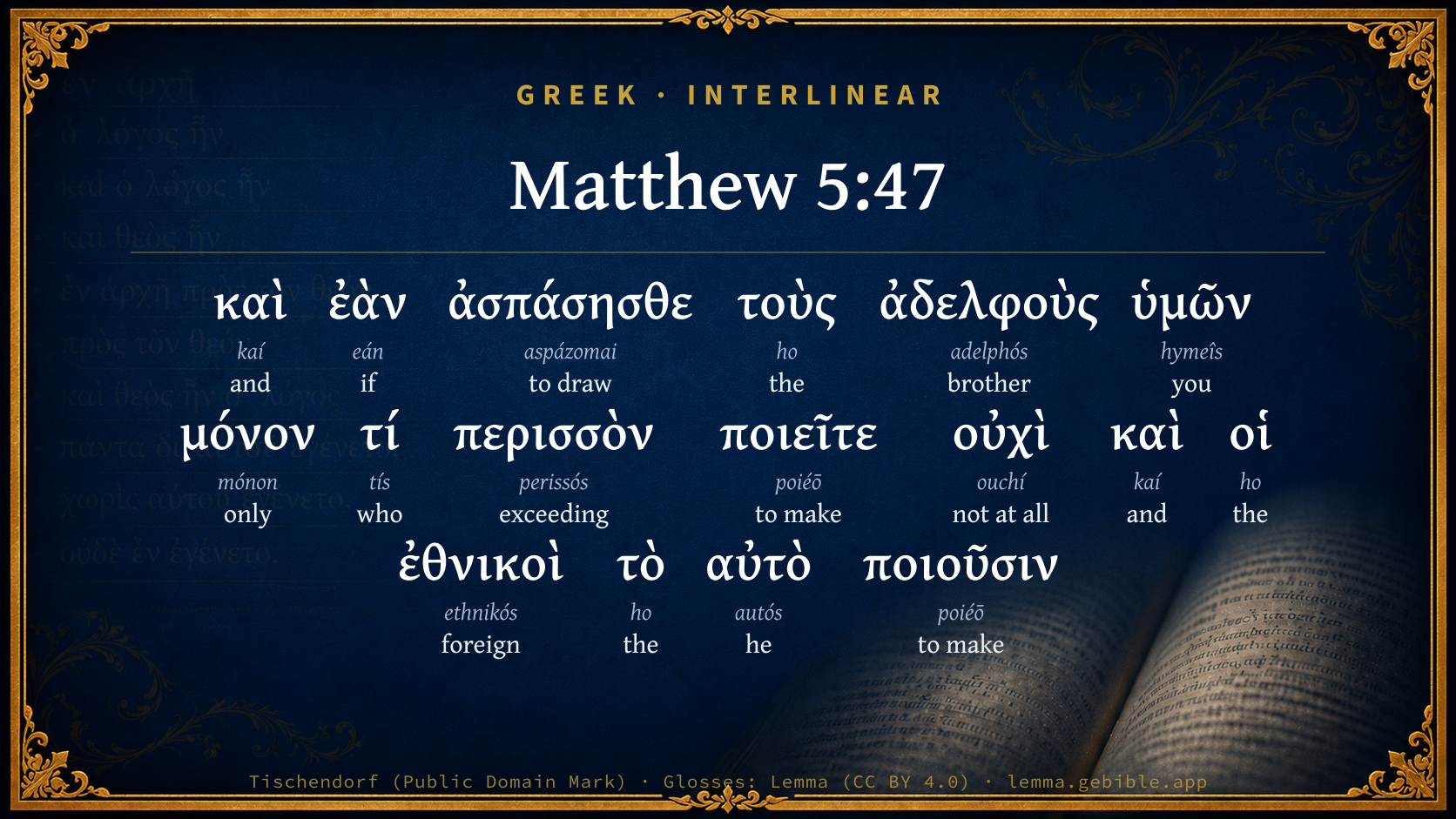
Greek (Tischendorf 8th ed.) Matthew 5:47 appears in the Greek New Testament. The text above is from the Tischendorf 8th edition. Each word links to its Strong’s number and a concise gloss. Click any word for its full Thayer’s Greek Lexicon entry.
Download image
Cite this verse

Matthew 5:47 (World English Bible). Public Domain. Lemma interlinear Bible study tool, https://lemma.gebible.app/v/matthew/5/47.

Show BibTeX & RIS
BibTeX
RIS
English Translation
If you only greet your friends, what more do you do than others? Don't even the tax collectors do the same?
World English Bible · Public Domain
Highlights
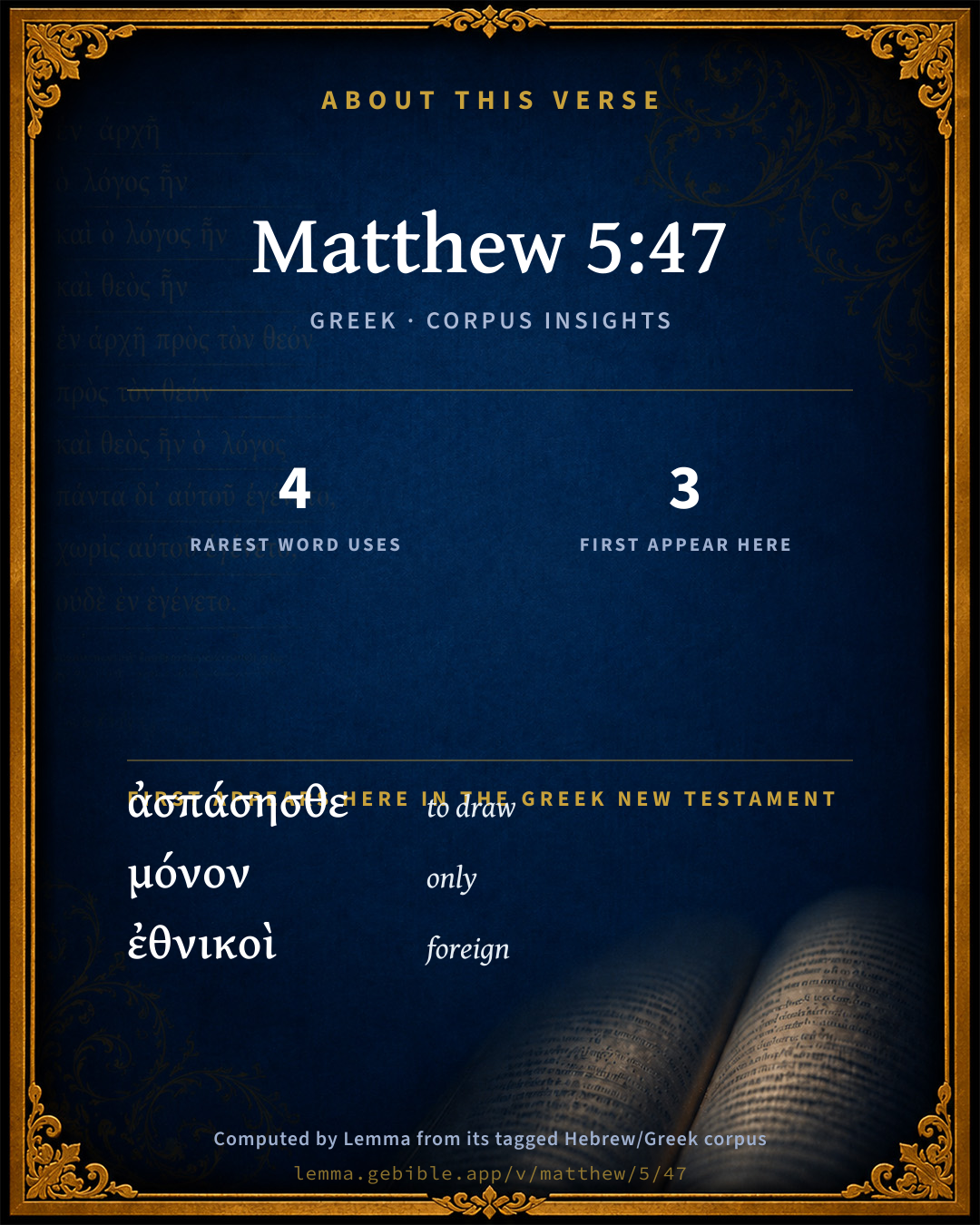
  • 3 first appearances in the Greek New Testament
Full analysis ↓
Download a study sheet

One document with this verse’s original text, its word-by-word gloss line, the meaning frame, cross-references with their text, attributed commentary, and full source and license credits — printable, and it pastes into notes with its structure intact.

This verse Autodidact and up

Study sheet (.html) Plain text (.txt)

A passage Seminary Student

Up to 50 verses in one chapter. A passage sheet keeps up to 6 commentary sources and 12 cross-references per verse, in the order this page ranks them, and says so on the sheet whenever that leaves anything out. Ask for a single verse and you get the Autodidact verse sheet above.

Everything on this page stays free to read, with no account — the sheet is a download of what is already on screen, not access to it.

Want to remove ads? Support Godless Engineer
Compare translations 3

The same verse in 3 English versions, stacked beneath the original-language interlinear above. Click any original word for its lexicon entry.

Each is an independent rendering of the whole verse — the interlinear is not word-aligned to these translations.

Highlighted words mark where these versions differ — a whole-verse word diff, not a word-by-word alignment.

  • World English Bible Public Domain
    If you only greet your friends, what more do you do than others? Don't even the tax collectors do the same?
  • King James Version Public Domain
    And if ye salute your brethren only, what do ye more than others? do not even the publicans so?
  • unfoldingWord Literal Text CC BY-SA 4.0
    And if you greet only your brothers, what do you do more? Do not even the Gentiles do the same thing?

unfoldingWord Literal Text — © unfoldingWord, licensed CC BY-SA 4.0. Word-aligned USFM3 via Door43 (git.door43.org/unfoldingWord/en_ult).

Versions to compare (up to 4)

3 of 4 selected

Show all 19 translations

Every available English version of this verse, each an independent rendering of the whole verse.

  • World English Bible Public Domain
    If you only greet your friends, what more do you do than others? Don't even the tax collectors do the same?
  • Berean Standard Bible Public Domain
    And if you greet only your brothers, what are you doing more than others? Do not even Gentiles do the same?
  • Majority Standard Bible Public Domain
    And if you greet only your friends, what are you doing more than others? Do not even the tax collectors do the same?
  • King James Version Public Domain
    And if ye salute your brethren only, what do ye more than others? do not even the publicans so?
  • American Standard Version (1901) Public Domain
    And if ye salute your brethren only, what do ye more `than others?' do not even the Gentiles the same?
  • Revised Version (1885) Public Domain
    And if ye salute your brethren only, what do ye more than others? do not even the Gentiles the same?
  • Geneva Bible (1599) Public Domain
    And if ye be friendly to your brethren onely, what singular thing doe ye? doe not euen the Publicanes likewise?
  • Douay-Rheims (1899) Public Domain
    And if you salute your brethren only, what do you more? do not also the heathens this?
  • Young's Literal Translation Public Domain
    and if ye may salute your brethren only, what do ye abundant? do not also the tax-gatherers so?
  • Literal Standard Version CC BY-SA 4.0
    And if you may greet your brothers only, what do you do abundant? Do the nations not also do so?
  • Unlocked Literal Bible CC BY-SA 4.0
    If you greet only your brothers, what do you do more than others? Do not even the Gentiles do the same thing?
  • unfoldingWord Literal Text CC BY-SA 4.0
    And if you greet only your brothers, what do you do more? Do not even the Gentiles do the same thing?
  • Darby Bible Public Domain
    And if ye should salute your brethren only, what do ye extraordinary? Do not also the Gentiles the same?
  • World Messianic Bible Public Domain
    If you only greet your friends, what more do you do than others? Don’t even the tax collectors do the same?
  • Webster's Bible Public Domain
    And if ye salute your brethren only, what do ye more than others? do not even the publicans so?
  • Free Bible Version CC BY-SA 4.0
    If you only speak kindly to your family, what more are you doing than anyone else? Even the heathen do that!
  • Bible in Basic English Public Domain
    And if you say, Good day, to your brothers only, what do you do more than others? do not even the Gentiles the same?
  • Text-Critical English NT CC BY 4.0
    And if you greet only your friends, what are you doing that is out of the ordinary? Do not even the tax collectors do that?
  • Tyndale New Testament (1534) Public Domain
    And yf ye be frendly to youre brethren onlye: what singuler thynge doo ye?

Literal Standard Version (2020), Covenant Press — licensed CC BY-SA 4.0. Text via the HelloAO Bible API (eBible.org). Unlocked Literal Bible (unfoldingWord) — licensed CC BY-SA 4.0. Text via the HelloAO Bible API (eBible.org). unfoldingWord Literal Text — © unfoldingWord, licensed CC BY-SA 4.0. Word-aligned USFM3 via Door43 (git.door43.org/unfoldingWord/en_ult). Free Bible Version, Dr. Jonathan Gallagher — licensed CC BY-SA 4.0. Text via the HelloAO Bible API (eBible.org).

Word by word

More ways to search: Search by grammar → Find every occurrence → Compare this word →

Practice this passage: Drill this verse → Learn its vocabulary →

ἐθνικοὶ
ethnikós
G1482
“foreign”
Adjective, Nominative, Plural, Masculine
Part of Speech
Adjective
Case
Nominative
Number
Plural
Gender
Masculine
Full Thayer's Definition

Origin: from G1484

TDNT: 08:12,2

1. adapted to the genius or customs of a people, peculiar to a people, national 2. suited to the manners or language of foreigners, strange, foreign 3. in the NT savouring of the nature of pagans, alien to the worship of the true God, heathenish a. of the pagan, the Gentile
  1. καὶ kaí G2532 “and” Conjunction
  2. ἐὰν eán G1437 “if” Conditional
  3. ἀσπάσησθε aspázomai G782 “to draw” Verb, Aorist, Middle deponent, Subjunctive, 2nd person, Plural
  4. τοὺς ho G3588 “the” Article, Accusative, Plural, Masculine
  5. ἀδελφοὺς adelphós G80 “brother” Noun, Accusative, Plural, Masculine
  6. ὑμῶν hymeîs G5210 “you” Personal pronoun, 2nd person, Genitive, Plural
  7. μόνον mónon G3440 “only” Adverb
  8. τί tís G5101 “who” Interrogative pronoun, Accusative, Singular, Neuter
  9. περισσὸν perissós G4053 “exceeding” Adjective, Accusative, Singular, Neuter
  10. ποιεῖτε poiéō G4160 “to make” Verb, Present, Active, Indicative, 2nd person, Plural
  11. οὐχὶ ouchí G3780 “not at all” Particle, Interrogative
  12. καὶ kaí G2532 “and” Conjunction
  13. οἱ ho G3588 “the” Article, Nominative, Plural, Masculine
  14. τὸ ho G3588 “the” Article, Accusative, Singular, Neuter
  15. αὐτὸ autós G846 “he” Personal pronoun, Accusative, Singular, Neuter
  16. ποιοῦσιν poiéō G4160 “to make” Verb, Present, Active, Indicative, 3rd person, Plural

About this verse

These counts appear in no published source. They are computed here, from the morphology-tagged text and Lemma’s own curated glosses. What Lemma adds →

17
words
13
distinct lemmas
Gospels
section

Notable vocabulary

The rarest word here is ἐθνικοὶ foreign G1482 — appearing just 4 times in the whole Greek New Testament.

First appearance in Scripture

These words make their first canonical appearance in the Greek New Testament here:

  • ἀσπάσησθε to draw G782
  • μόνον only G3440
  • ἐθνικοὶ foreign G1482

Shared distinctive vocabulary

ἐθνικοὶ foreign G1482 occurs in 4 verses of the Greek New Testament. Also found in:
Repetition

Words recur within this verse:

  • ποιεῖτε to make G4160 ×2
  • τοὺς the G3588 ×3
  • καὶ and G2532 ×2

Cross-references

4

Topical passages linked to Matthew 5:47 in the Treasury of Scripture Knowledge — connected by theme and wording, ordered by reader-vote popularity; previews shown in the World English Bible.

  • Matthew 5:20 For I tell you that unless your righteousness exceeds that of the scribes and Pharisees, there is no way you will enter into the Kingdom of Heaven.
  • Luke 6:32 If you love those who love you, what credit is that to you? For even sinners love those who love them.
  • 1 Peter 2:20 For what glory is it if, when you sin, you patiently endure beating? But if, when you do well, you patiently endure suffering, this is commendable with God.
  • Luke 10:4–5 Carry no purse, nor wallet, nor sandals. Greet no one on the way.

Cross-references courtesy of OpenBible.info (CC BY 4.0).

Where the printed editions differ

2 variants

Places in this verse where the major printed Greek editions disagree on the wording in a way that affects the translation — a comparison of editions, not a manuscript-by-manuscript collation. The editions are the modern critical texts (Nestlé-Aland 28/27, SBL, Westcott-Hort, Tregelles, Tyndale House) and the traditional texts behind the KJV (the Textus Receptus and the Byzantine/Majority text). It is not a claim about which reading is original.

  1. Different wording
    ἀδελφοὺς

    “brothers”

    In NA28NA27TynSBLWHTregTR Not in Byz

    φίλους (philous) 'friends' occurs in a few manuscripts (Byz) instead of ἀδελφοὺς (adelphous) 'brothers' in older manuscripts (NA28+NA27+Tyn+SBL+WH+Treg+TR)

  2. Different wording
    ἐθνικοὶ

    “Gentiles”

    In NA28NA27TynSBLWHTreg Not in TRByz

    τελῶναι (telōnai) 'tax collectors' occurs in traditional manuscripts (TR+Byz) instead of ἐθνικοὶ (ethnikoi) 'Gentiles' in older manuscripts (NA28+NA27+Tyn+SBL+WH+Treg)

Textual data: Translators Amalgamated Greek New Testament (STEPBible TAGNT) · CC BY 4.0.

Commentary

Notes on Matthew 5:47 from classic Christian and Jewish commentators (each source and its license shown beneath its notes). The classic Christian expositions comment on the surrounding passage and are grouped to its opening verse, so a note may address several verses; the Jewish commentaries on the Tanakh (Rashi and others) are per-verse, so they appear only where the commentator wrote on this verse.

Lemma curates 59 commentaries, every one of them public domain or Creative Commons licensed, each selected and text-cleaned for this edition rather than reprinted as found. About our sources →

Adam Clarke's Commentary

Verse 47. And if ye salute your brethren only] Instead of αδελφους brethren, upwards of one hundred MSS., and several of them of great authority and antiquity, have φιλους friends. The Armenian Slavonic, and Gothic versions, with the later Syriac, and some of the primitive fathers, agree in this reading. I scarcely know which to prefer; as brother is more conformable to the Jewish mode of address, it should be retained in the text: the other reading, however, tends to confirm that of the Codex Graevii on Mt 5:43.

On the subject of giving and receiving salutations in Asiatic countries, Mr. Harmer, Observat. vol. ii. p. 327, c., edit. 1808, has collected much valuable information: the following extract will be sufficient to elucidate our Lord's meaning.

"Dr. Doddridge supposes that the salutation our Lord refers to, Mt 5:47, If ye salute your brethren only, what do ye more than others? do not even the publicans so? means embracing, though it is a different word. I would observe, that it is made use of in the Septuagint to express that action of endearment and which is made use of by an apocryphal writer, (Ecclus. 30:19,) whereas, the word we translate salute is of a much more general nature: this, I apprehend, arose from his being struck with the thought, that it could never be necessary to caution his disciples, not to restrain the civilities of a common salutation to those of their own religious party. Juvenal, when he satirizes the Jews of the apostolic age for their religious opinions, and represents them as unfriendly, and even malevolent, to other people, Sat. xiv., and when he mentions their refusing to show travellers the way, Non monstrare vias, c., or to point out to them where they might find water to drink when thirsty with journeying, takes no notice of their not saluting those of another nation yet there is no reason to believe, from these words of CHRIST, that many of them at least would not, and that even a Jewish public an received no salutations from one of his own nation, excepting brother publicans.

"Nor shall we wonder at this, or think it requisite to suppose the word we translate salute (ασπαζομαι) and which certainly, sometimes at least, signifies nothing more than making use of some friendly words upon meeting with people, must here signify something more particular, since we find some of the present inhabitants of the east seem to want this admonition of our Lord. 'When the Arabs salute one another,' according to Niebuhr, 'it is generally in these terms, Salam aleikum, Peace be with you; in speaking which words they lay the right hand on the heart. The answer is, Aleikum essalam, With you be peace. Aged people are inclined to add to these words, And the mercy and blessing of God. The Mohammedans of Egypt and Syria never salute a Christian in this manner; they content themselves with saying to them, Good day to you; or, Friend, how do you do? The Arabs of Yemen, who seldom see any Christians, are not so zealous but that sometimes they will give them the Salam aleikum.'

"Presently after he says: 'For a long time I thought the Mohammedan custom, of saluting Christians in a different manner from that made use of to those of their own profession, was an effect of their pride and religious bigotry. I saluted them sometimes with the Salam aleikum, and I had often only the common answer. At length I observed in Natolia, that the Christians themselves might probably be the cause that Mohammedans did not make the same return to their civilities that they did to those of their own religion. For the Greek merchants, with whom I travelled in that country, did not seem pleased with my saluting Mohammedans in the Mohammedan manner. And when they were not known to be Christians, by those Turks whom they met with in their journeying, (it being allowed Christian travellers in these provinces to wear a white turban, Christians in common being obliged to wear the sash of their turbans white striped with blue, that banditti might take them at a distance for Turks, and people of courage,) they never answered those that addressed them with the compliment of Salam aleikum. One would not, perhaps, suspect that similar customs obtain in our times, among Europeans: but I find that the Roman Catholics of some provinces of Germany never address the Protestants that live among them with the compliment JESUS CHRIST be praised; and, when such a thing happens by mistake, the Protestants do not return it after the manner in use among Catholics, For ever and ever. Amen!'

"After this, the words of our Lord in the close of the fifth of Matthew want no farther commentary. The Jews would not address the usual compliment of Peace be to you, to either heathens or publicans; the publicans of the Jewish nation would use it to their countrymen that were publicans, but not to heathens; though the more rigid Jews would not do it to them, any more than to heathens: our Lord required his disciples to lay aside the moroseness of Jews, and express more extensive benevolence in their salutations. There seems to be nothing of embracing thought of in this case, though that, doubtless, was practised anciently among relations, and intimate friends, as it is among modern Asiatics."

If not to salute be a heathenish indifference, to hide hatred under outward civilities is a diabolic treachery. To pretend much love and affection for those for whom we have neither-to use towards them complimentary phrases, to which we affix no meaning, but that they mean, nothing, is highly offensive in the sight of that God by whom actions are weighed and words judged.

Do not - the publicans] τελωναι, - but εθνικοι heathens, is adopted by Griesbach, instead of τελωναι, on the authority of Codd. Vatican. Bezae, and several others together with the Coptic, Syriac later, and Syriac Jerusalem; two Arabic, Persic, Slavonic; all the Itala but one; Vulgate, Saxon, and several of the primitive fathers.

Adam Clarke's Commentary on the Bible (1810–1826) — public domain. Text from a community e-Sword/MySword module.

The Biblical Illustrator

Joseph S. Exell

Mat_5:47

What do ye more?

Christian benevolence

I. What have we more than others?

1. You have forgiveness of sins.

2. Peace with God.

3. Fellowship with God.

4. You have in expectation a perfect deliverance from evil contact with sin.

5. You have in expectation the resurrection of your bodies.

II. What Do ye more than others?

1. The first obligation is to be thankful.

2. The second obligation is to be boastful: My soul shall make her boast in the Lord.

3. To be loving towards all men, but especially towards the household of faith.

4. We must do more than others because more has been done for us, and more is expected of us. (H. McNeile.)

Christian service

I. The question is suggestive of duty. For whom?

(1) More for themselves.

(2) For their families.

(3) For their neighbours.

(4) For their country.

(5) For the world.

By what means? By use of their tongue, pen, purse. For what reasons?

(1) Because they know more.

(2) Because they have received more.

(3) Because they enjoy more.

(4) Because they profess more.

(5) Because they expect more.

(6) Because they are responsible for more.

II. The question implies doubt. (J. Morgan.)

The superiority of the Christian

I. On what ground this superiority may be challenged. More is required of Christians because more is done for them, expected of them, can be accomplished by them, has been realized by them.

II. The works and evidences that this superiority should assume. They will always have recourse to a higher standard and motives than others. By an unfeigned attachment to the cause of Christ. They must openly commit themselves to the cause and interest of the Church. As to the estimate they form of the world. In a strict observance of all religious ordinances. By engrafting in all their ordinary virtues those which are extraordinary.

`III. To what practical purpose the enforcement of the subject may be applied? It is often requisite to ask Christians what they do because a considerable odium attaches itself to evangelical doctrine. There is greater evil in hollow friendship than open hostility; they are prone to coldness and neglect. (Dr. R. W. Hamilton.)

I. Explain why as Christians we ought to do more than others. Because we underlie special obligations-are endowed with supernatural strength, acknowledge a higher standard of duty-burdened with a heavier responsibility.

II. Inquire whether we do more than others. For our own souls, our families, the Church, our race? (G. Brooks.)

The superior obligations of Christians

While all men are under one sovereign law, some by voluntary profession bring themselves an additional accountableness. We must not compare ourselves with the worst of men. On looking on others and forming judgments, we may specify points of admonitory comparison.

1. They will observe and feel a very limited sense of responsibility.

2. They will observe the lamentably small effects of admitted truth.

3. A different sensibility to the evils which affect mankind.

4. What good things they do not that they might. We must beware of the sad tendency there is to the less in any good thing, instead of the more. Consider the extent of what there is to be clone; where we should have been if there had not been persons in every age to do more than others, such as Wicliff, Luther, etc.; consider how we talk of imitating excellent examples. Those who desire to do more than others must not be discouraged by the disposition that will show itself to depreciate and obstruct. This obligation is increased by the fact that others do less than they ought.

In this comparison with others we must have regard to the motive which leads us to exceed them, and also respecting the equity in the mode of making the comparison. We must beware of seeming to be admired and set off in invidious comparison. There must be no motive of self-merit. A word on the equity of the comparison.

1. Let there be a jealous watchfulness on the propensity to magnify ours and to diminish theirs.

2. The others with whom the comparison is made may have more difficulties than we are aware of.

3. Those of larger means are not to consider themselves as doing more, unless according to that proportion.

4. A man must not compare his most against anothers least.

5. Our Lord when on earth did more than all other men. (J. Foster.)

A call to holy living

I. The grounds for expecting more from Christians.

1. They profess more.

2. True Christians are more than others.

3. It is certain the true Christian can do more than others, he has the Holy Spirit within him.

4. They have more.

5. They are looking for more than others.

II. Matters in which we may naturally look for the Christian to do more than others.

1. To set a more godly example.

2. A more exact performance of the Divine will.

3. To excel all others in gentleness.

4. In purity.

5. In truthfulness.

6. In forbearance.

7. In love to mankind.

III. Reasons for doing more than others.

1. By our fruits we are to be known.

2. Works are to be evidence at last.

3. By them the mouths of gainsayers are stopped.

4. God is glorified. (C. H. Spurgeon.)

The Biblical Illustrator, edited by Joseph S. Exell (c. 1880s–1900s) — public domain. Text from a community e-Sword module.

Tyndale Open Study Notes

Tyndale Open Resources

5:47 If you are kind only to your friends (literally, If you greet only your brothers): Jews were instructed to greet Gentiles for the sake of maintaining peaceful relations, but such greetings were not the same as those for “brothers”—i.e., fellow Jews.

Tyndale Open Study Notes — © Tyndale Open Resources, licensed CC BY-SA 4.0. Text via the HelloAO Bible API.

Bengel's Gnomon

Johann Albrecht Bengel

Mat 5:47. Εἃν ἀσπάσησθε, if ye salute) contrasted with, bless ye, etc., in Mat 5:44. The very verb ἀγαπάω, to love, is repeated in Mat 5:46 from Mat 5:44; but as the heathens do not also bless and pray, the verb to salute is put here instead of either blessing or praying.—τοὐς ἀδελφοὺς ὑμῶν, your brethren[236]—ἐθνικοὶ, the heathen) The Publicans regard their own interest, the Heathens perform also offices of kindness towards their connections and friends, and more especially towards their blood relations. In Mat 5:46, therefore, the example of the Publicans is cited; in Mat 5:47, that of the Heathens.—τί περισσὸν, what remarkable thing)[237] such as befits the sons of God.[238]

[236] The margin of Beng. Ed. π and Vers. Germ. prefer φίλους to ἀδελφοῦς: But not so the larger Edition of α. 1734. Lucifer reads amicos, also of second rate Uncial MSS. L Δ. But the oldest MSS. and Vulg. ἀδελφοὺς, fratres.—ED.

[237] E. V. What do ye more than others?—(I. B.)

[238] He who does nothing but what is customary ought to stand in fear (soll in Sorge stehen.)—B. G. V.

Bengel's Gnomon of the New Testament — English translation (T&T Clark, Edinburgh, 1860) — public domain. Text from a community e-Sword module.

Meyer's Critical & Exegetical Commentary

Heinrich August Wilhelm Meyer

Mat_5:47. And if ye shall have welcomed your brethren alone (saluted them lovingly), what special thing have you done? The conception, to act in a friendly manner (Luther, Tholuck, Bleek, Hofmann), is not the significatio, but certainly the adsignificatio of ἀσπάζεσθαι, as often in classic writers. Comp. ἀσπάζεσθαι καὶ φιλεῖν, Stallbaum, ad Plat. Ap. p. 29 D, and Rep. 499 A.

τοὺς ἀδελφ. ὑμῶν μόνον] is not to be limited to the members of families and other close associations (Tholuck and others), as was already done by the reading φίλους, approved of by Griesbach; but it refers to the members of the nation, and applies to the national particularism of the Jews; consequently the national antithesis is οἱ ἐθνικοί. Comp. Bleek.

τί περισσόν] what preference? what distinguishes you above others, ut decet filios Dei, Bengel. Comp. Rom_3:1; Soph. O. R. 841. Instead of τί περισσόν, Justin, Apol. i. 15, quotes τί καινόν, which substantially agrees with τί περισσόν, and belongs only to another form of the idea, not to a higher point of view (Hilgenfeld). See Ritschl in the Theol. Jahrb. 1851, p. 490 f.

Meyer — Critical and Exegetical Commentary on the New Testament — English translation by Peter Christie, edited by Frederick Crombie (T&T Clark, 1880) — public domain. Text from a community e-Sword module.

Expositor's Greek Testament

ed. W. Robertson Nicoll

Mat 5:47 . ἀσπάσησθε , “Salute,” a very slight display of love from our Western point of view, a mere civility; more significant in the East; symbolic here of friendly relations, hence Tholuck, Bleek and others interpret, “to act in a friendly manner,” which, as Meyer remarks, is, if not the significatio , at least the adsignificatio . περισσὸν , used adverbially, literally “that which is over and above”; A. V [36] , “more”; here, tropically = distinguished, unusually good = “quid magnum, eximium, insigne” (Pricaeus), so in Rom 3:1 . In Plutarch, Romulus , xi., of one who excelled in casting horoscopes. Christ would awaken in disciples the ambition to excel. He does not wish them to be moral mediocrities, men of average morality, but to be morally superior, uncommon. This seems to come perilously near to the spirit of Pharisaism ( cf. Gal 1:14 , προέκοπτον ), but only seems. Christ commends being superior, not thinking oneself superior, the Pharisaic characteristic. Justin, Apol. i. 15, mixes Mat 5:46-47 , and for περισσὸν puts καινὸν , and for τελῶναι , or ἐθνικοὶ , πόρνοι : “If ye love those who love you what new thing do ye? for even fornicators do this.” ἐθνικοὶ , here as elsewhere in the Gospels associated with τελῶναι (Mat 18:17 ). A good many of the publicans would be Gentiles. For a Jew it was a virtue to despise and shun both classes. Surely disciples will not be content to be on a moral level with them! Note that Jesus sees some good even in despised classes, social outcasts.

[36] Authorised Version.

The Expositor's Greek Testament, edited by W. Robertson Nicoll (1897–1910) — public domain. Text from a community e-Sword module.

Geneva Bible (1599)

Geneva Bible translators

They that were the toll masters, and had the oversight of tributes and customs: a kind of men that the Jews hated to death, both because they served the Romans in these offices, (whose yokeful bondage they could hardly away withall) and also because these toll masters are for the most part given to covetousness.

Geneva Bible (1599) marginal notes — public domain. Text via Bolls.life.

Jamieson, Fausset & Brown

Robert Jamieson, A. R. Fausset & David Brown

And if ye salute your brethren only--of the same nation and religion with yourselves.

what do ye more than others?--what do ye uncommon or extraordinary? that is, wherein do ye excel?

do not even the publicans so?--The true reading here appears to be, "Do not even the heathens the same?" Compare Mat 18:17, where the excommunicated person is said to be "as an heathen man and a publican."

Jamieson, Fausset & Brown — Commentary Critical and Explanatory on the Whole Bible (1871) — public domain (CC PDM 1.0). Text via the HelloAO Bible API.

Ellicott's Commentary for English Readers

(47) If ye salute your brethren.—The prominence of salutation in the social life of the East gives a special vividness to this precept. To utter the formal “Peace be with you,” to follow that up by manifold compliments and wishes, was to recognise those whom men saluted as friends and brothers. But this the very heathen did (heathen rather than “publicans” being here the true reading): were the followers of Christ to be content with copying heathen customs?

A Bible Commentary for English Readers, edited by Charles John Ellicott (1878–1897) — public domain. Text from a community e-Sword module.

The Cambridge Bible for Schools and Colleges

gen. ed. J. J. S. Perowne

47. salute your brethren only] See Mat_5:43. The Hebrew salutation was Shalom (peace).

The higher MS. authority gives “Gentiles” or “heathen,” instead of “publicans.”

The Cambridge Bible for Schools and Colleges (gen. ed. J. J. S. Perowne; Cambridge University Press, 1878–1918) — public domain. Text from a community e-Sword module.

John Gill's Exposition

And if you salute your brethren only,.... This does not mean salutation by embraces or kisses, but by words, asking of each other's welfare, and wishing prosperity and happiness to one another.

"The manner of salutation among the wise men was this (e); he that salutes says, a good day to my lord; and he replies, saying, a good, and long day to my lord: always he that replies doubles the salutation.''

The persons they usually gave their salutations to were those of their own nation, their countrymen, relations, and friends; and who are here designed by "brethren"; meaning, not brethren in the strict sense, but any kindred, acquaintance, or any of their own nation. Some copies read it "friends", who, generally speaking, only partook of such favours.

"A man, (says Maimonides (f),) might not salute his master, nor return a salutation to him in the manner they gave a salutation to "friends": and they return it to one another.''

They were not very free in saluting any persons, as strangers and Gentiles: such advice as this is indeed given (g), "prevent every man with a salutation", or be first in saluting every man; upon which passage their commentators (h) say, even a Gentile in the streets. Accordingly, it is elsewhere (i) observed, that

"R. Abai used to say, let a man be always cunning with fear, for "a soft answer turns away wrath"; and multiply salutation with his brethren, and with his relations, and with every man, even with a stranger in the streets.''

But this proceeded not from any cordial hearty respect, but out of policy, and from fear; and in order to maintain peace; and for selfish ends, and with sinister views: otherwise their salutations were confined to their brethren and kinsfolk after the flesh. Now, this being the case, says Christ,

what do ye more than others? do not even publicans so? Or, as some copies read it, Gentiles or Heathens; and accordingly the Ethiopic version, and the Vulgate Latin so render it: the Arabic renders it "idolaters". Now, what great matter was this to salute their brethren and their friends, when even the very Heathens, who had nothing but the light of nature to guide them, did the same?

(e) Sepher Chasidim, fol. 5. col. 2. apud Buxtorf. Florileg. Heb. p. 300, 301. (f) Hilch. Talmud Tora, c. 5. sect. 5. (g) Pirke Abot, c. 4. sect. 15. (h) Jarchi & Bartenora in ib. (i) T. Bab. Beracot, fol. 17. 1.

John Gill's Exposition of the Whole Bible (1746–1763) — public domain (CC PDM 1.0). Text via the HelloAO Bible API.

Trapp's Complete Commentary

John Trapp

47 And if ye salute your brethren only, what do ye more than others? do not even the publicans so?

Ver. 47. What do ye more than others?] Singular things are expected and required of such as have received singular grace and mercy. As to be eminent in good works, to get above others, to have our feet where other men’s heads are. {a} The way of the righteous is on high, saith Solomon: he goes a higher way to work than ordinary, and walks ακριβως, accurately, exactly; {b} he gets even to the very top of godliness, as the word importeth. He knows that more than the common stint is required of him, and that he must do that which the world will never do: as to be hot in religion, Rev 3:16. The carnal gospeller saith, Religiosum oportet esse, non religantem, it is fit to be religious, but not so conscientious. So, to be zealous of good works, Tit 2:14, but with discretion, saith the worldling. The King of Navarre told Beza he would launch no further into the sea than he might be sure to return safe to the haven. {c} Though he showed some countenance to religion, yet he would be sure to save himself. So, to abound in God’s work, to have a heart full of goodness, as those Romans, Rom 15:14; a life full of good works, as Tabitha, Act 9:33. But this is to be wise overly much, saith the flesh, Ecc 7:16. Philosophandum, sed paucis. Philosophize but little. Cicero. What need this waste? said Judas. It is too much for you to go up to Jerusalem to worship, said Jeroboam to the people, take a shorter cut rather to the golden calves. "They are idle, they are idle," said Pharaoh of God’s busiest servants. So, God would have his to walk precisely, Eph 5:15. This the mad world mocks at. To pluck out their right eyes, this is a hard saying, saith the sensualist, Mat 5:29. To offer violence to God’s kingdom: "fair and softly goes far;" and it is good keeping on the warm side of the hedge, saith the politician. To keep God’s command ment as the apple of thine eyes; but how few are there that will not break the hedge of any commandment, so they may shun a piece of foul way? Lastly, to love an enemy, do good to them that hate us, &c.; but this seems to be the most unreasonable and impossible. What? love those that hate and hurt them, that daily rage and rail at them, with such bitterness, as if they had been as far as hell for every word that tumbleth out of their mouths against them? &c. Love this man? Nay, then, love the devil himself. They will rather die a thousand deaths than endure such a one: if they could love him, yet they would not. They are prime Christians in these men’s opinions that ascend to Saul’s measure, "I will do thee no hurt, my son David." If they pass him by when he is in their power, as the priest and the Levite did the wounded man; if they fall not foul upon him with recriminations, and retaliate injuries, they have gone far and done fair: and such a measure of charity they hold little less than angelic, hardly here attainable. This is the voice and guise of flesh and blood. "The spirit that is in us lusteth to envy," and prompteth us to requite taunt with taunt, suit with suit, blow with blow, and holds them fools that do not. But this is the wisdom from beneath, and is earthly, sensual, devilish: {Jas 3:15, expounded} whereas that "from above is first pure, and then peaceable," (well assured of pardon of sin and peace with God, and thence) gentle or equable to men (επιεικης), and easily persuaded, full of mercy (to an offending brother) and good fruits (friendly expressions), without wrangling or lawing (αδιακριτος), and without hypocrisy: such as can be heartily reconciled, and love again without dissimulation, "not in word and in tongue, but in deed and in truth," Rom 12:9; 1Jn 3:18; not covering a potsherd with silver dross, a wicked heart with burning lips. Seven abominations are in such a heart, and his wickedness shall be shown before the whole congregation, as Absalom’s usage of Amnon, Pro 14:20; Pro 19:7; Pro 26:23-26. A godly man carries neither cruel hatred, a desire to hurt whom he hates, as Esau, nor simple hatred, where there is no desire to hurt, but a disdain to help: he forgives not only, but forgets, as Joseph, Gen 50:20. (For injuries remembered are hardly remitted.) And although he loves not his enemies’ sins, yet he doth their persons: striving to seal up his love by all loving usage both in word and deed. And herein he doth more than others; that which is singular, and in the world’s account, seraphical: that which (in truth) is extraordinary and above common possibility, it is a high point of Christian perfection: and let as many as are perfect be thus minded. Benaiah was honourable among thirty, but he attained not to the first three. A natural man may be renowned for his patience and beneficence; but the child of God must herein go before all the wicked men in the world, and strive to be conformed to the first three, the blessed Trinity.

{a} των καλων εργων προιστασθαι, Tit 3:14.

{b} Eph 5:15, ακριβως το εις ακρον βαινειν. Gellius.

{c} Pelago se non ita commissuru esset, quin quando liberet, pedem referre posset.

John Trapp, A Commentary or Exposition upon All the Books of the Old and New Testament (1647–1656) — public domain. Text from a community e-Sword module.

Albert Barnes' Notes on the Bible

And if you salute your brethren ... - The word “salute” here means to show the customary tokens of civility, or to treat with the common marks of friendship. See the notes at Luk 10:4. The Saviour says that the worst men, the very publicans, would do this. Christians should do more; they should show that they have a different spirit; they should treat their “enemies” as well as wicked people do their “friends.” This should be done:

Because it is “right;” it is the only really amiable spirit; and, We should show that religion is not selfish, and is superior to all other principles of action.

Albert Barnes' Notes on the Bible (1834–1885) — public domain. Text from a community e-Sword/MySword module.

Whedon's Commentary on the Bible

Daniel D. Whedon

47. Do ye more than others — How much soever civilization and the general influences of religion have improved society, the Christian ought to let his light shine by some way showing a superior excellence. He ought ever to be above the average standard of virtue around him. This should not be shown by an extra severity and moroseness, but by an extra serenity, sweetness, generosity, love, and devotion.

Daniel D. Whedon (gen. ed.), Commentary on the Old and New Testaments (1874–1909) — public domain. Text from a community e-Sword module.

The Pulpit Commentary

And if ye salute. It seems almost a bathos after "love." But it expresses love publicly showing itself by kindly greeting. Your brethren; with whom you have the fellow-feeling of common origin in this case not national, but spiritual (cf. ver. 22, note). What do you more than others? (ti perisso); Tyndale," What singuler thynge doe ye?" Do not even the publicans? Revised Version, the Gentiles? with the manuscripts. "The form used (eynikov) describes character rather than mere position"; (Bishop Westcott, on 3Jn_1:7) "hethen men" (Wickliffe). So; Revised Version, the same, with the manuscripts. To auto , notwithstanding its occurrence in ver. 46 and parallel passage, Luk_6:33, was altered to the commoner outwv poiein ..

The Pulpit Commentary (1880–1919), ed. H.D.M. Spence-Jones & Joseph S. Exell — public domain. Text from a community e-Sword module.

John Wesley's Explanatory Notes

And if ye salute your friends only - Our Lord probably glances at those prejudices, which different sects had against each other, and intimates, that he would not have his followers imbibe that narrow spirit. Would to God this had been more attended to among the unhappy divisions and subdivisions, into which his Church has been crumbled! And that we might at least advance so far, as cordially to embrace our brethren in Christ, of whatever party or denomination they are!

John Wesley, Explanatory Notes Upon the Whole Bible (1754–1765) — public domain. Text via the GEBible commentary corpus.

The People's New Testament

B. W. Johnson

47. Salute your brethren only. The Jews usually disdained to speak to a Gentile, a publican, or a “sinner,” but would salute orthodox Jews. Even the Gentiles, the heathen nations, had enough of love for this. Unless the disciples could love better than the Jews, they would be on a level with publicans and heathen.

B. W. Johnson's The People's New Testament with Notes (1889–1891) — public domain. Electronic text from the Christian Classics Ethereal Library (CCEL) ThML edition.

Cambridge Greek Testament for Schools and Colleges

47. ἐθνικοὶ for τελῶναι of the textus receptus, on the highest authority.

47. τοὐς ἀδελφοὺς ὑμῶν μόνον. See Mat 5:43. The Hebrew salutation was Shalom (peace).

Cambridge Greek Testament for Schools and Colleges (Cambridge University Press, 1896; 21 vols, various authors incl. Carr, Maclear, Plummer, Farrar, Lumby, Moule, M. R. James, Simcox) — public domain. Text from a community e-Sword module.

Alford’s Greek Testament

Henry Alford

47. ἀσπάσησθε] Here, most probably in its literal sense. Jews did not salute Gentiles: Mohammedans do not salute Christians even now in the East.

Henry Alford, The Greek Testament (1849–1861) — public domain. Text from a community e-Sword module.

International Critical Commentary

47. The verse is omitted by S1 k either by homœoteleuton or intentionally. The “salute” is widened into “love” by Aphraates.

2 On the Sermon on the Mount, see especially the article of Votaw in DB., Extra Volume, pp. 1ff.

E editorial passages.

L the Matthæan Logia.

LXX. The Septuagint Version.

B. Babylonian Talmud.

S Syriac version: Sinaitic MS.

S Syriac version: Peshitta.

S Syriac version: Harclean.

S Syriac version: Jerusalem Lectionary.

Tert. Tertullian.

1 iii. 780 on Mat 17:3, but in iii. 740 on 16:16 the other order is given.

S Syriac version: Curetonian.

Tat. Tatian.

2 See Zahn, Forschungen, i. 131.

DB. Dictionary of the Bible (Hastings).

Ps.-Sol. The Psalms of Solomon.

al i.e. with other uncial MSS.

Luc. Lucian.

1 He was a disciple of Akiba.

Dalm. Dalman.

1 Cited by Schoettgen, in loc.

Bab. Babylonian Talmud.

Aristoph. Aristophanes.

Arist. Aristotle.

1 Cf. The Instruction of Ptah-Hotep, p. 53: “Set out therefore after a quarrel; be at peace with him that is hostile to (thee) his opponent. It is such souls that makes love grow.”

Sym. Symmachus.

1 = Mishnah Gittin 9:10.

Deissm. Deissmann.

Hdt. Herodotus.

Jos. Josephus.

Polyb. Polybius.

Plut. Plutarch.

Targ. Targum.

International Critical Commentary — older volumes (1896–1929), various authors — public domain. Text from a community e-Sword module.

Lesson kit

Teaching starters — assembled from the data on this page, not authored interpretation. Every prompt links to the verse data it draws on. Edit before teaching.

Matthew, in the Gospels, opens this verse with 17 words (13 distinct Greek lemmas). Its most distinctive word is ethnikós (“foreign”). A historical commentator’s framing appears above. Read the whole chapter for the surrounding context.

Discussion questions

  1. What does “foreign” (ethnikós) contribute to the verse as a whole?
  2. 3 words here appear for the first time in Scripture. What is being introduced at this debut?
  3. Matthew 6:7 shares the word «foreign» with this verse. How do the two illuminate each other?
  4. “to make” occurs 2× in this one verse. What is the effect of the repetition?
  5. The translations on this page render this verse differently — a whole-verse word diff, not a word-by-word alignment. What might account for the different wordings?
  6. Reading how Adam Clarke's Commentary and The Biblical Illustrator read this verse, where do the two commentators agree and where do they part?

Things to notice

  • 3 words make their first canonical appearance in Scripture here.
  • These translations choose different wording for 14 words in this verse.
  • “to make” occurs 2× in this single verse.
  • 13 distinct Greek lemmas span 17 words in this verse.

Reading settings

Reading text

Shown beneath each verse's original-language words.

Old Testament
Old Testament edition

Read the OT as the Masoretic Hebrew (MT) or the Greek Septuagint (LXX).

English shown for the Greek Septuagint (in the Hebrew ↔ Greek comparison).

Comparing translations? Open the Compare panel on any verse page to stack up to four side by side.