
Mark 11:3

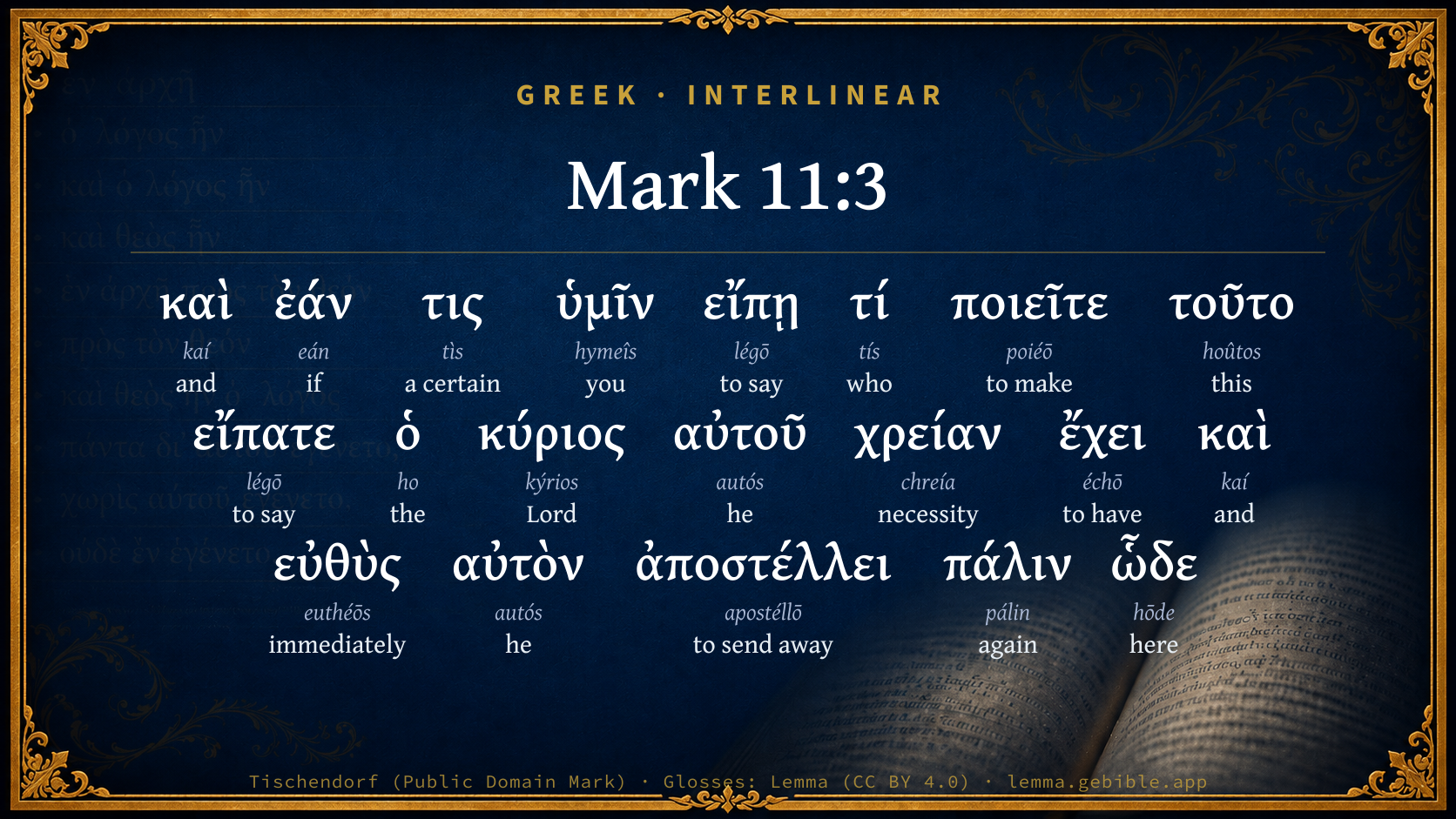
Greek (Tischendorf 8th ed.) Mark 11:3 appears in the Greek New Testament. The text above is from the Tischendorf 8th edition. Each word links to its Strong’s number and a concise gloss. Click any word for its full Thayer’s Greek Lexicon entry.
Download image
Cite this verse

Mark 11:3 (World English Bible). Public Domain. Lemma interlinear Bible study tool, https://lemma.gebible.app/v/mark/11/3.

Show BibTeX & RIS
BibTeX
RIS
English Translation
If anyone asks you, 'Why are you doing this?' say, 'The Lord needs him;' and immediately he will send him back here."
World English Bible · Public Domain
Download a study sheet

One document with this verse’s original text, its word-by-word gloss line, the meaning frame, cross-references with their text, attributed commentary, and full source and license credits — printable, and it pastes into notes with its structure intact.

This verse Autodidact and up

Study sheet (.html) Plain text (.txt)

A passage Seminary Student

Up to 50 verses in one chapter. A passage sheet keeps up to 6 commentary sources and 12 cross-references per verse, in the order this page ranks them, and says so on the sheet whenever that leaves anything out. Ask for a single verse and you get the Autodidact verse sheet above.

Everything on this page stays free to read, with no account — the sheet is a download of what is already on screen, not access to it.

Want to remove ads? Support Godless Engineer
Compare translations 3

The same verse in 3 English versions, stacked beneath the original-language interlinear above. Click any original word for its lexicon entry.

Each is an independent rendering of the whole verse — the interlinear is not word-aligned to these translations.

Highlighted words mark where these versions differ — a whole-verse word diff, not a word-by-word alignment.

  • World English Bible Public Domain
    If anyone asks you, 'Why are you doing this?' say, 'The Lord needs him;' and immediately he will send him back here."
  • King James Version Public Domain
    And if any man say unto you, Why do ye this? say ye that the Lord hath need of him; and straightway he will send him hither.
  • unfoldingWord Literal Text CC BY-SA 4.0
    And if anyone says to you, ‘Why are you doing this?’ say, ‘The Lord has need of it and immediately he sends it back here.’”

unfoldingWord Literal Text — © unfoldingWord, licensed CC BY-SA 4.0. Word-aligned USFM3 via Door43 (git.door43.org/unfoldingWord/en_ult).

Versions to compare (up to 4)

3 of 4 selected

Show all 19 translations

Every available English version of this verse, each an independent rendering of the whole verse.

  • World English Bible Public Domain
    If anyone asks you, 'Why are you doing this?' say, 'The Lord needs him;' and immediately he will send him back here."
  • Berean Standard Bible Public Domain
    If anyone asks, ‘Why are you doing this?’ tell him, ‘The Lord needs it and will return it shortly.’”
  • Majority Standard Bible Public Domain
    If anyone asks, ‘Why are you doing this?’ tell him, ‘The Lord needs it,’ and he will send it here immediately.”
  • King James Version Public Domain
    And if any man say unto you, Why do ye this? say ye that the Lord hath need of him; and straightway he will send him hither.
  • American Standard Version (1901) Public Domain
    And if any one say unto you, Why do ye this? say ye, The Lord hath need of him; and straightway he will send him back hither.
  • Revised Version (1885) Public Domain
    And if any one say unto you, Why do ye this? say ye, The Lord hath need of him; and straightway he will send him back hither.
  • Geneva Bible (1599) Public Domain
    And if any man say vnto you, Why doe ye this? Say that the Lord hath neede of him, and straightway he will send him hither.
  • Douay-Rheims (1899) Public Domain
    And if any man shall say to you, What are you doing? say ye that the Lord hath need of him: and immediately he will let him come hither.
  • Young's Literal Translation Public Domain
    and if any one may say to you, Why do ye this? say ye that the lord hath need of it, and immediately he will send it hither.'
  • Literal Standard Version CC BY-SA 4.0
    and if anyone may say to you, Why do you do this? Say that the LORD has need of it, and immediately He will send it here.”
  • Unlocked Literal Bible CC BY-SA 4.0
    If anyone says to you, 'Why are you doing this?' you should say, 'The Lord has need of it and will immediately send it back here.'”
  • unfoldingWord Literal Text CC BY-SA 4.0
    And if anyone says to you, ‘Why are you doing this?’ say, ‘The Lord has need of it and immediately he sends it back here.’”
  • Darby Bible Public Domain
    And if any one say to you, Why do ye this? say, The Lord has need of it; and straightway he sends it hither.
  • World Messianic Bible Public Domain
    If anyone asks you, ‘Why are you doing this?’ say, ‘The Lord needs him;’ and immediately he will send him back here.”
  • Webster's Bible Public Domain
    And if any man shall say to you, Why do ye this? say ye that the Lord hath need of him; and immediately he will send him hither.
  • Free Bible Version CC BY-SA 4.0
    If anyone asks you what you are doing, tell them, ‘The Lord needs it and will send it back soon.’”
  • Bible in Basic English Public Domain
    And if anyone says to you, Why are you doing this? say, The Lord has need of him and will send him back straight away.
  • Text-Critical English NT CC BY 4.0
    If anyone says to you, ‘Why are you doing this?’ say, ‘The Lord has need of it.’ Then he will immediately send it here.”
  • Tyndale New Testament (1534) Public Domain
    And if eny man saye vnto you: why do ye soo? Saye that the Lorde hath neade of him: and streight waye he will sende him hidder.

Literal Standard Version (2020), Covenant Press — licensed CC BY-SA 4.0. Text via the HelloAO Bible API (eBible.org). Unlocked Literal Bible (unfoldingWord) — licensed CC BY-SA 4.0. Text via the HelloAO Bible API (eBible.org). unfoldingWord Literal Text — © unfoldingWord, licensed CC BY-SA 4.0. Word-aligned USFM3 via Door43 (git.door43.org/unfoldingWord/en_ult). Free Bible Version, Dr. Jonathan Gallagher — licensed CC BY-SA 4.0. Text via the HelloAO Bible API (eBible.org).

Word by word

More ways to search: Search by grammar → Find every occurrence → Compare this word →

Practice this passage: Drill this verse → Learn its vocabulary →

χρείαν
chreía
G5532
“necessity”
Noun, Accusative, Singular, Feminine
Part of Speech
Noun
Case
Accusative
Number
Singular
Gender
Feminine
Full Thayer's Definition

Origin: from the base of G5530 or G5534

TDNT: None

1. necessity, need 2. duty, business
  1. καὶ kaí G2532 “and” Conjunction
  2. ἐάν eán G1437 “if” Conditional
  3. τις tìs G5100 “a certain” Indefinite pronoun, Nominative, Singular, Masculine
  4. ὑμῖν hymeîs G5210 “you” Personal pronoun, 2nd person, Dative, Plural
  5. εἴπῃ légō G3004 “to say” Verb, Aorist, Active, Subjunctive, 3rd person, Singular
  6. τί tís G5101 “who” Interrogative pronoun, Accusative, Singular, Neuter
  7. ποιεῖτε poiéō G4160 “to make” Verb, Present, Active, Indicative, 2nd person, Plural
  8. τοῦτο hoûtos G3778 “this” Demonstrative pronoun, Accusative, Singular, Neuter
  9. εἴπατε légō G3004 “to say” Verb, Aorist, Active, Imperative, 2nd person, Plural
  10. ὁ ho G3588 “the” Article, Nominative, Singular, Masculine
  11. κύριος kýrios G2962 “Lord” Noun, Nominative, Singular, Masculine
  12. αὐτοῦ autós G846 “he” Personal pronoun, Genitive, Singular, Masculine
  13. ἔχει échō G2192 “to have” Verb, Present, Active, Indicative, 3rd person, Singular
  14. καὶ kaí G2532 “and” Conjunction
  15. εὐθὺς euthéōs G2112 “immediately” Adverb
  16. αὐτὸν autós G846 “he” Personal pronoun, Accusative, Singular, Masculine
  17. ἀποστέλλει apostéllō G649 “to send away” Verb, Present, Active, Indicative, 3rd person, Singular
  18. πάλιν pálin G3825 “again” Adverb
  19. ὧδε hōde G5602 “here” Adverb

About this verse

These counts appear in no published source. They are computed here, from the morphology-tagged text and Lemma’s own curated glosses. What Lemma adds →

20
words
17
distinct lemmas
Gospels
section

Shared distinctive vocabulary

χρείαν necessity G5532 occurs in 47 verses of the Greek New Testament. Also found in:
Repetition

Words recur within this verse:

  • εἴπῃ to say G3004 ×2
  • καὶ and G2532 ×2
  • αὐτοῦ he G846 ×2

Cross-references

9

Topical passages linked to Mark 11:3 in the Treasury of Scripture Knowledge — connected by theme and wording, ordered by reader-vote popularity; previews shown in the World English Bible.

  • Mark 14:15 He will himself show you a large upper room furnished and ready. Make ready for us there."
  • Acts 10:36 The word which he sent to the children of Israel, preaching good news of peace by Jesus Christ--he is Lord of all--
  • Acts 17:25 neither is he served by men's hands, as though he needed anything, seeing he himself gives to all life and breath, and all things.
  • 2 Corinthians 8:9 For you know the grace of our Lord Jesus Christ, that, though he was rich, yet for your sakes he became poor, that you through his poverty might become rich.
  • Hebrews 2:7–9 You made him a little lower than the angels; You crowned him with glory and honor.
  • 1 Chronicles 29:12–18 Both riches and honor come of you, and you rule over all; and in your hand is power and might; and it is in your hand to make great, and to give strength to all.
  • Psalms 24:1 The earth is Yahweh's, with its fullness; The world, and those who dwell therein.
  • Psalms 110:3 Your people offer themselves willingly in the day of your power, in holy array. Out of the womb of the morning, you have the dew of your youth.
  • Acts 1:24 They prayed, and said, "You, Lord, who know the hearts of all men, show which one of these two you have chosen

Cross-references courtesy of OpenBible.info (CC BY 4.0).

Commentary

Notes on Mark 11:3 from classic Christian and Jewish commentators (each source and its license shown beneath its notes). The classic Christian expositions comment on the surrounding passage and are grouped to its opening verse, so a note may address several verses; the Jewish commentaries on the Tanakh (Rashi and others) are per-verse, so they appear only where the commentator wrote on this verse.

Lemma curates 59 commentaries, every one of them public domain or Creative Commons licensed, each selected and text-cleaned for this edition rather than reprinted as found. About our sources →

The Biblical Illustrator

Joseph S. Exell

Mar_11:3-6

Say ye that the Lord hath need of him.

The Lord hath need of you

I. He wants you for Himself. Jesus loves you; you are to be the compensation to Him for all He suffered. Christ feels incomplete without you.

II. He wants you for His Church. The Church is a building; you can never tell what stone the Great Master Builder may require next. It is a family-you complete the circle.

III. He wants you for His work.

IV. He wants you for His glory. When the Lord wants anything you will let Him have it.

1. Your money. If He takes it you will know that He had need of it.

2. Death. He has need of those dear to us. There is great comfort in the fact that when Christ sent to appropriate what was indeed His own, He sent also the constraining power of His own grace to overrule that it might consent to the surrender. (J. Vaughan, M. A.)

On obeying Christ

The two disciples, without any questioning, proceeded upon their Masters mission.

I. The principle we have stated applies to all new undertakings in which we engage as servants of our Saviour, acting under His direction. It was a new thing He asked them to do when He sent them to bring to Him the colt. Our Lord often asks us to do unlikely and unexpected things. God told Moses to go to Egypt. God asked Jonah to do a new thing. If God asks us to take a new departure, His hand will guide us.

II. The principle illustrated here applies to undertakings which are difficult and mysterious, to which our Lord calls us. What right had they to the colt? There was a touch of mystery-why such a beast of burden? God often calls His people to difficult and mysterious duties. Try to do it and all is well ordered.

III. The principle here illustrated applies to all undertakings in which Christs servants engage directly for His sake. The Lord hath need of him. (A. Scott.)

The Biblical Illustrator, edited by Joseph S. Exell (c. 1880s–1900s) — public domain. Text from a community e-Sword module.

MacLaren's Expositions of Holy Scripture

Alexander MacLaren

Mark

CHRIST’S NEED OF US AND OURS

Mar 11:3.

You will remember that Jesus Christ sent two of His disciples into the village that looked down on the road from Bethany to Jerusalem, with minute instructions and information as to what they were to do and find there. The instructions may have one of two explanations-they suggest either superhuman knowledge or a previous arrangement. Perhaps, although it is less familiar to our thoughts, the latter is the explanation. There is a remarkable resemblance, in that respect, to another incident which lies close beside this one in time, when our Lord again sent two disciples to make preparation for the Passover, and, with similar minuteness, told them that they would find, at a certain point, a man bearing a pitcher of water. Him they were to accost, and he would take them to the room that had been prepared. Now the old explanation of both these incidents is that Jesus Christ knew what was going to happen. Another possible explanation, and in my view more probable and quite as instructive, is, that Jesus Christ had settled with the two owners what was to happen. Clearly, the owner of the colt was a disciple, because at once he gave up his property when the message was repeated, ‘the Lord hath need of him.’ Probably he had been one of the guests at the modest festival that had been held the night before, in the village close by, in Simon’s house, and had seen how Mary had expended her most precious possession on the Lord, and, under the influence of the resurrection of Lazarus, he, too, perhaps, was touched, and was glad to arrange with Jesus Christ to have his colt waiting there at the cross-road for his Master’s convenience. But, be that as it may, it seems to me that this incident, and especially these words that I have read for a text, carry very striking and important lessons for us, whether we look at them in connection with the incident itself, or whether we venture to give them a somewhat wider application. Let me take these two points in turn.

I. Now, what strikes one about our Lord’s requisitioning the colt is this, that here is a piece of conduct on His part singularly unlike all the rest of His life.

All through it, up to this last moment, His one care was to damp down popular enthusiasm, to put on the drag whenever there came to be the least symptom of it, to discourage any reference to Him as the Messiah-King of Israel, to shrink back from the coarse adulation of the crowd, and to glide quietly through the world, blessing and doing good. But now, at the end, He flings off all disguise. He deliberately sets Himself, at a time when popular enthusiasm ran highest and was most turbid and difficult to manage, at the gathering of the nation for the Passover in Jerusalem, to cast an effervescing element into the caldron. If He had planned to create a popular rising, He could not have done anything more certain to bring it about than what He did that morning when He made arrangements for a triumphal procession into the city, amidst the excited crowds gathered from every quarter of the land. Why did He do that? What was the meaning of it? Then there is another point in this requisitioning of the colt. He not only deliberately set Himself to stir up popular excitement, but He consciously did what would be an outward fulfilment of a great Messianic prophecy. I hope you are wiser than to fancy that Zechariah’s prophecy of the peaceful monarch who was to come to Zion, meek and victorious, and riding upon a ‘colt the foal of an ass,’ was fulfilled by the outward fact of Christ being mounted on this colt ‘whereon never man sat.’ That is only the shell, and if there had been no such triumphal entry, our Lord would as completely have fulfilled Zechariah’s prophecy. The fulfilment of it did not depend on the petty detail of the animal upon which He sat when He entered the city, nor even on that entrance. The meaning of the prophecy was that to Zion, wherever and whatever it is, there should come that Messianic King, whose reign owed nothing to chariots and horses and weapons of war for its establishment, but who, meek and patient, pacing upon the humble animal used only for peaceful services, and not mounted on the prancing steed of the warrior, should inaugurate the reign of majesty and of meekness. Our Lord uses the external fact just as the prophet had used it, as of no value in itself, but as a picturesque emblem of the very spirit of His kingdom. The literal fulfilment was a kind of finger-post for inattentive onlookers, which might induce them to look more closely, and so see that He was indeed the King Messiah, because of more important correspondences with prophecy than His once riding on an ass. Do not so degrade these Old Testament prophecies as to fancy that their literal fulfilment is of chief importance. That is the shell: the kernel is the all-important thing, and Jesus Christ would have fulfilled the r? that was sketched for Him by the prophets of old, just as completely if there never had been this entrance into Jerusalem.

But, further, the fact that He had to borrow the colt was as significant as the choice of it. For so we see blended two things, the blending of which makes the unique peculiarity and sublimity of Christ’s life: absolute authority, and meekness of poverty and lowliness. A King, and yet a pauper-King! A King claiming His dominion, and yet obliged to borrow another man’s colt in order that He might do it! A strange kind of monarch!-and yet that remarkable combination runs through all His life. He had to be obliged to a couple of fishermen for a boat, but He sat in it, to speak words of divine wisdom. He had to be obliged to a lad in the crowd for barley loaves and fishes, but when He took them into His hands they were multiplied. He had to be obliged for a grave, and yet He rose from the borrowed grave the Lord of life and death. And so when He would pose as a King, He has to borrow the regalia, and to be obliged to this anonymous friend for the colt which made the emphasis of His claim. ‘Who, though He was rich, yet for our sakes became poor, that we through His poverty might be rich.’

II. And now turn for a moment to the wider application of these words.

‘The Lord hath need of him.’ That opens the door to thoughts, that I cannot crowd into the few minutes that I have at my disposal, as to that great and wonderful truth that Christ cannot assume His kingdom in this world without your help, and that of the other people whose hearts are touched by His love. ‘The Lord hath need’ of them. Though upon that Cross of Calvary He did all that was necessary for the redemption of the world and the salvation of humanity as a whole, yet for the bearing of that blessing into individual hearts, and for the application of the full powers that are stored in the Gospel and in Jesus, to their work in the world, the missing link is man. We ‘are fellow-labourers with God.’ We are Christ’s tools. The instruments by which He builds His kingdom are the souls that have already accepted His authority. ‘The Lord hath need of him,’ though, as the psalmist sings, ‘If I were hungry I would not tell thee, for all the beasts of the forest are Mine.’ Yes, and when the Word was made flesh, He had need of one of the humblest of the beasts. The Christ that redeemed the world needs us, to carry out and to bring into effect His redemption. ‘God mend all,’ said one, and the answer was, ‘We must help Him to mend it.’

Notice again the authoritative demand, which does not contemplate the possibility of reluctance or refusal. ‘The Lord hath need of him.’ That is all. There is no explanation or motive alleged to induce surrender to the demand. This is a royal style of speech. It is the way in which, in despotic countries, kings lay their demands upon a poor man’s whole plenishing and possession, and sweep away all.

Jesus Christ comes to us in like fashion, and brushes aside all our convenience and everything else, and says, ‘I want you, and that is enough.’ Is it not enough? Should it not be enough? If He demands, He has the right to demand. For we are His, ‘bought with a price.’ All the slave’s possessions are his owner’s property. The slave is given a little patch of garden ground, and perhaps allowed to keep a fowl or two, but the master can come and say, ‘Now I want them,’ and the slave has nothing for it but to give them up.

‘The Lord hath need of him’ is in the autocratic tone of One who has absolute power over us and ours. And that power, where does it come from? It comes from His absolute surrender of Himself to us, and because He has wholly given Himself for us. He does not expect us to say one contrary word when He sends and says, ‘I have need of you, or of yours.’

Here, again, we have an instance of glad surrender. The last words of my text are susceptible of a double meaning. ‘Straightway he will send him hither’-who is ‘he’? It is usually understood to be the owner of the colt, and the clause is supposed to be Christ’s assurance to the two messengers of the success of their errand. So understood, the words suggest the great truth that Love loosens the hand that grasps possessions, and unlocks our treasure-houses. There is nothing more blessed than to give in response to the requirement of love. And so, to Christ’s authoritative demand, the only proper answer is obedience swift and glad, because it is loving. Many possibilities of joy and blessing are lost by us through not yielding on the instant to Christ’s demands. Hesitation and delay are dangerous. In ‘straightway’ complying are security and joy. If the owner had begun to say to himself that he very much needed the colt, or that he saw no reason why some one else’s beast should not have been taken, or that he would send the animal very soon, but must have the use of him for an hour or two first, he would probably never have sent him at all, and so would have missed the greatest honour of his life. As soon as I know what Christ wants from me, without delay let me do it; for if I begin with delaying I shall probably end with declining. The Psalmist was wise when he laid emphasis on the swiftness of his obedience, and said, ‘I made haste and delayed not, but made haste to keep Thy commandments.’

But another view of the words makes them part of the message to the owner of the colt, and not of the assurance to the disciples. ‘Say ye that the Lord hath need of him, and that straightway {when He has done with him} He will send him back again.’ That is a possible rendering, and I am disposed to think it is the proper one. By it the owner is told that he is not parting with his property for good and all, that Jesus only wishes to borrow the animal for the morning, and that it will be returned in the afternoon. What does that view of the words suggest to us? Do you not think that that colt, when it did come back-for of course it came back some time or other,-was a great deal more precious to its owner than it ever had been before, or ever could have been if it had not been lent to Christ, and Christ had not made His royal entry upon it? Can you not fancy that the man, if he was, as he evidently was, a disciple and lover of the Lord, would look at it, especially after the Crucifixion and the Ascension, and think, ‘What an honour to me, that I provided the mount for that triumphal entry!’? It is always so. If you wish anything to become precious, lend it to Jesus Christ, and when it comes back again, as it will come back, there will be a fragrance about it, a touch of His fingers will be left upon it, a memory that He has used it. If you desire to own yourselves, and to make yourselves worth owning, give yourselves to Christ. If you wish to get the greatest possible blessing and good out of possessions, lay them at His feet. If you wish love to be hallowed, joy to be calmed, perpetuated, and deepened, carry it to Him. ‘If the house be worthy, your peace shall rest upon it; if not,’ like the dove to the ark when it could find no footing in the turbid and drowned world, ‘it shall come back to you again. Straightway He will ‘send him back again,’ and that which I give to Jesus He will return enhanced, and it will be more truly and more blessedly mine, because I have laid it in His hands. This ‘altar’ sanctifies the giver and the gift.

Alexander MacLaren, Expositions of Holy Scripture (1904–1910) — public domain. Text from a community e-Sword module.

Tyndale Open Study Notes

Tyndale Open Resources

11:3 The Lord needs it and will return it soon: Mark’s readers have already seen the word Lord used to refer to Jesus (1:3; 2:28; 5:19; see also 12:36-37; 13:35), so they would understand it as referring to the Lord Jesus Christ, who needed the colt (see also Rom 10:9; Phil 2:11).

Tyndale Open Study Notes — © Tyndale Open Resources, licensed CC BY-SA 4.0. Text via the HelloAO Bible API.

Expositor's Greek Testament

ed. W. Robertson Nicoll

Mar 11:3 . ὁ κύριος α . χ . ἔχει , the Master hath need of him. Vide on this at Mat 21:3 . καὶ εὐθὺς , etc., and straightway He returneth him (the colt) again. πάλιν , a well-attested reading, clearly implies this meaning, i.e. , that Jesus bids His disciples promise the owner that He will return the colt without delay, after He has had His use of it. So without hesitation Weiss (in Meyer) and Holtzmann (H. C.). Meyer thinks this a paltry thing for Christ to say, and rejects πάλιν as an addition due to misunderstanding. Biassed by the same sense of decorum “below the dignity of the occasion and of the Speaker” the Speaker’s Comm. cherishes doubt as to πάλιν , sheltering itself behind the facts that, while the MSS. which insert “again” are generally more remarkable for omissions than additions, yet in this instance they lack the support of ancient versions and early Fathers. I do not feel the force of the argument from decorum. It judges Christ’s action by a conventional standard. Why should not Jesus instruct His disciples to say “it will be returned without delay” as an inducement to lend it? Dignity! How much will have to go if that is to be the test of historicity! There was not only dignity but humiliation in the manner of entering Jerusalem: the need for the colt, the use of it, the fact that it had to be borrowed all enter as elements in the lowly state of the Son of Man. On the whole subject vide notes on Mt. This is another of Mk.’s realisms, which Mt.’s version obliterates. Field ( Otium Nor. ), often bold in his interpretations, here succumbs to the decorum argument, and is biassed by it against the reading πάλιν contained in so many important MSS. ( vide above).

The Expositor's Greek Testament, edited by W. Robertson Nicoll (1897–1910) — public domain. Text from a community e-Sword module.

Alford’s Greek Testament

Henry Alford

3. ὁ κύρ … ὧδε] The pres. ἀποστέλλει, is used of future things whose occurrence is undoubted; see Mat 17:11; 11:3 .: but the words are somewhat ambiguous. From the ancient interpolation of πάλιν, it seems that they were understood all to belong to ὁ κύριος—‘the Lord hath need of it, and will immediately send it [back].’ Lachm., by printing the words without a stop, evidently adopts this rendering: and Origen, tom. xvi. in Matt. § 16, vol. iii. p. 741, favours it. But verisimilitude seems to me to be against it: and the final clause in ver. 6, καὶ ἀφῆκαν αὐτούς, appears to correspond with this. So that I would understand it as in E. V.: and straightway he (the speaker or owner) will send it hither.

Henry Alford, The Greek Testament (1849–1861) — public domain. Text from a community e-Sword module.

Adam Clarke's Commentary

Verse 3. And straightway he will send him hither.] From the text, I think it is exceedingly plain, that our Lord did not beg, but borrow, the colt; therefore the latter clause of this verse should be understood as the promise of returning him. Is not the proper translation the following? And if any one say to you, Why do ye this? Say, the Lord hath need of him, and will speedily send him back hither - και ευθεως αυτον αποστελλει ὡδε. Some eminent critics take the same view of the passage.

Adam Clarke's Commentary on the Bible (1810–1826) — public domain. Text from a community e-Sword/MySword module.

The Cambridge Bible for Schools and Colleges

gen. ed. J. J. S. Perowne

3. the Lord hath need of him] The words suggest that the man may have been a secret disciple. “Secret disciples, such as the five hundred who afterwards gathered to one spot in Galilee, and the hundred and twenty who met after the resurrection (1Co_15:6; Act_1:15), were scattered in many places.”

The Cambridge Bible for Schools and Colleges (gen. ed. J. J. S. Perowne; Cambridge University Press, 1878–1918) — public domain. Text from a community e-Sword module.

John Gill's Exposition

And if any man say unto you,.... As very likely they would, and it would be strange if they should not say something to them, especially the owners of it:

why do ye this? Why do ye untie the ass, and attempt to carry it away, when it is none of your own, and it belongs to another man?

Say ye that the Lord hath need of him; our Lord and yours, the Lord of heaven and earth, and all things in it; it looks as if this title, "the Lord", was what Jesus was well known by; see Joh 11:28; unless it can be thought, that the owners of the colt were such, that believed in Christ, as is not improbable; and so would at once understand by the language who it was for, and let it go:

and straightway he will send him, hither; as soon as ever he hears that the Lord, by whom he would presently understand Jesus, wanted him for his present purpose; he will send him with all readiness and cheerfulness, without the least hesitation, or making any dispute about it.

John Gill's Exposition of the Whole Bible (1746–1763) — public domain (CC PDM 1.0). Text via the HelloAO Bible API.

Trapp's Complete Commentary

John Trapp

3 And if any man say unto you, Why do ye this? say ye that the Lord hath need of him; and straightway he will send him hither.

Ver. 3. Say ye that the Lord hath need of him] See here six different arguments of our Saviour’s Deity: 1. That he knew there was such an ass colt. 2. That he sent for it. 3. Foresaw that the masters of the colt would question them that set it. 4. That he professeth himself the Lord of all. 5. That he could tell they would send the colt. 6. That accordingly they did so. (Piscater.)

John Trapp, A Commentary or Exposition upon All the Books of the Old and New Testament (1647–1656) — public domain. Text from a community e-Sword module.

Matthew Poole's English Annotations

See Poole on "Mat 21:3", &c. All along the story of our Saviour’s life and actions we shall find certain indications of his Divine power and virtue: his knowing men’s thoughts, and declarations of such his knowledge to them: his certain prediction of future contingencies, being able to tell persons such particulars as no man could know. How could he who was not God have told the disciples, that at their entrance into the village they should find a colt on which never man sat, that the owners would not resist strangers to take it away? Yet notwithstanding all this disciples very imperfectly believed him to be so, until he was risen from the dead. The time was not yet come when Christ would have this published, and till he gave them a power to believe it, i.e. to have a full persuasion of it, all these moral arguments were not sufficient to work in their hearts a full persuasion. The faith of the Christians of that time seemeth to have had these three gradations:

1. They believed him a great Prophet, that had received great power from God.

2. They owned him as the Messiah, as the Son of David, and now and then they would drop some expressions arguing some persuasions that he was the Son of God.

3. Last of all, they came to a firm persuasion that he was truly God, as well as man, after that he was risen from the dead, and declared with power to be such, as the apostle saith.

Yet what means imaginable could they have had more than,

1. A voice from heaven declaring it.

2. The Spirit descending in a visible shape.

3. The great miracles he had wrought by sea and land, commanding the winds and the waves, healing incurable diseases and all others in an instant without use of rational means, raising the dead, &c.

4. His telling their thoughts, foretelling future contingencies, &c.

Yet all these produced in the generality of the people no more than amazement and astonishment; and in the apostles themselves, rather a disposition to such a faith, or an opinion or suspicion of such a thing, than a firm and fixed persuasion concerning it.

Matthew Poole's English Annotations on the Holy Bible (1683–1685) — public domain. Text from a community e-Sword/MySword module.

The Pulpit Commentary

And if any one say unto you, Why do ye this? say ye, The Lord hath need of him; and straightway he will send him back hither. The Greek, according to the best authorities here, is euyewv autolin wde : literally, straightway he sendeth it back hither again, The verb here in the present may represent the verb in the future, "he will send it back." But the word "again" (palin) is not quite so easily explained. There is strong authority for the insertion of this word, which necessarily changes the meaning of the sentence. Without the palin , the sentence would actually mean that our Lord, by his Divine prescience, here tells his disciples that when the colt was demanded by them the owner would at once permit them to take it. But if the word palin be inserted, it can only mean that this was a part of the message which our Lord directed his disciples to deliver as from himself, "The Lord hath need of him; and he, the Lord, will forthwith send him back again." The passage is so interpreted by Origen, who twice introduces the adverb in his commentary on St. Matthew. The evidence of the oldest uncials is strongly in favor of this insertion. Our Lord was unwilling that the disciples should take away the colt if the owner objected, lie might have taken the animals away in his own supreme right, but he chose to accomplish his will by his providence, powerfully and yet gently; and, if the reading here be allowed, he further influenced them by the promise that their property should be returned to them. It was the will and purpose of Christ, who for these three years had gone about on foot, and traveled over the whole of Palestine in this way, to show himself at length the King of Judah, that is, the Messiah and Heir of David; and so he resolves to enter Jerusalem, the metropolis, the city of the great King, with royal dignity. But he will not be surrounded with the" pomp and circumstance" of an earthly monarch. He rides on an ass"s colt, that he might show his kingdom to be of another kind, that is, spiritual and heavenly. And so he assumes a humble equipage, riding upon a colt, his only housings being the clothes of his disciples. And yet there was dignity as well as humility in his equipage. The ass of the East was, and is, a superior animal to that known amongst us. The judges and princes of Israel rode on "white asses," and their sons on asses" colts. So our Lord rode upon an ass"s colt; and there were no gleaming swords in his procession, or other signs of strife and bloodshed. But there were palm branches and garments spread all along his path the evidences of devotion to him. So he came in gentleness, not that he might be feared on account of his power, but that he might be loved on account of his goodness.

"The Lord hath need of him.

How singular the conjunction! Need of a colt! In what sense was such a creature necessary for the Lord of all? In what sense is anything created necessary to the Creator? As showing forth his glory, and fulfilling his purposes.

I THE LOWLIEST THINGS HAVE SOME HIGH PURPOSE, OR CAPACITY OF GLORIFYING GOD.

II IN SOME CIRCUMSTANCES THE LOWLIEST THINGS MAY EXCLUSIVELY OR MORE FITTINGLY EXPRESS A CERTAIN PHASE OF THE DIVINE GLORY. What else could so set forth the meekness, the lowliness, of the Son of man? or the privilege and freedom the young Church, of which he was the only burden and law? In that colt the brute world had its most honored representative. So in human poverty, simplicity, weakness, and ignorance, the glory of God may be shown forth the more conspicuously.

III LET US LOOK FOR AND GIVE EFFECT TO THE GLORY OF CHRIST, i.e. OF GOD, ALL THINGS.

IV A FORTIORI LET US OFFER OUR OWN SELVES SO GLORIOUSLY ENDOWED, IN PERSONAL CONSECRATION AND EFFORT FOR THE GLORY OF God. If he had need for a colt, we cannot say he has no need for us. M.

The Pulpit Commentary (1880–1919), ed. H.D.M. Spence-Jones & Joseph S. Exell — public domain. Text from a community e-Sword module.

Cambridge Greek Testament for Schools and Colleges

3. ἀποστέλλει ([2461][2462][2463][2464][2465][2466][2467]) rather than ἀποστελεῖ ([2468][2469]). πάλιν ὧδε ([2470][2471][2472][2473][2474][2475][2476]) rather than ὧδε ([2477][2478]2[2479][2480][2481][2482]).

[2461] Codex Sinaiticus. 4th cent. Discovered by Tischendorf in 1859 at the Monastery of St Katharine on Mount Sinai. Now at St Petersburg. The whole Gospel, ending at Mar 16:8. Photographic facsimile, 1911.

[2462] Codex Alexandrinus. 5th cent. Brought by Cyril Lucar, Patriarch of Constantinople, from Alexandria, and afterwards presented by him to King Charles I. in 1628. In the British Museum. The whole Gospel. Photographic facsimile, 1879.

[2463] Codex Vaticanus. 4th cent., but perhaps a little later than א. In the Vatican Library almost since its foundation by Pope Nicolas V., and one of its greatest treasures. The whole Gospel, ending at Mar 16:8. Photographic facsimile, 1889.

[2464] Codex Ephraemi. 5th cent. A palimpsest: the original writing has been partially rubbed out, and the works of Ephraem the Syrian have been written over it; but a great deal of the original writing has been recovered; of Mark we have Mar 1:17 to Mar 6:31, Mar 8:5 to Mar 12:29, Mar 13:19 to Mar 16:20. In the National Library at Paris.

[2465] Codex Bezae. 6th cent. Has a Latin translation (d) side by side with the Greek text, and the two do not quite always agree. Presented by Beza to the University Library of Cambridge in 1581. Remarkable for its frequent divergences from other texts. Contains Mark, except Mar 16:15-20, which has been added by a later hand. Photographic facsimile, 1899.

[2466] Codex Regius. 8th cent. An important witness. At Paris. Contains Mar 1:1 to Mar 10:15; Mar 10:30 to Mar 15:1; Mar 15:20 to Mar 16:20, but the shorter ending is inserted between Mar 16:8 and Mar 16:9, showing that the scribe preferred it to the longer one.

[2467] Codex Sangallensis. 9th or 10th cent. Contains the Gospels nearly complete, with an interlinear Latin translation. The text of Mark is specially good, agreeing often with CL. At St Gall.

[2468] Codex Petropolitanus. 9th cent. Gospels almost complete. Mar 16:18-20 is in a later hand.

[2469] Codex Athous Laurae. 8th cent. Like N and Σ, it is written in silver letters on purple vellum. Contains Mar 9:5 to Mar 16:20, and, as in L, the shorter ending is inserted between Mar 16:8 and Mar 16:9. As in Δ, the text of Mark is specially good.

[2470] Codex Sinaiticus. 4th cent. Discovered by Tischendorf in 1859 at the Monastery of St Katharine on Mount Sinai. Now at St Petersburg. The whole Gospel, ending at Mar 16:8. Photographic facsimile, 1911.

[2471] Codex Vaticanus. 4th cent., but perhaps a little later than א. In the Vatican Library almost since its foundation by Pope Nicolas V., and one of its greatest treasures. The whole Gospel, ending at Mar 16:8. Photographic facsimile, 1889.

[2472] Codex Ephraemi. 5th cent. A palimpsest: the original writing has been partially rubbed out, and the works of Ephraem the Syrian have been written over it; but a great deal of the original writing has been recovered; of Mark we have Mar 1:17 to Mar 6:31, Mar 8:5 to Mar 12:29, Mar 13:19 to Mar 16:20. In the National Library at Paris.

[2473] An asterisk denotes that the word is not found elsewhere in N.T., and such words are included in the index, even if there is no note on them in the commentary.

[2474] Codex Bezae. 6th cent. Has a Latin translation (d) side by side with the Greek text, and the two do not quite always agree. Presented by Beza to the University Library of Cambridge in 1581. Remarkable for its frequent divergences from other texts. Contains Mark, except Mar 16:15-20, which has been added by a later hand. Photographic facsimile, 1899.

[2475] Codex Regius. 8th cent. An important witness. At Paris. Contains Mar 1:1 to Mar 10:15; Mar 10:30 to Mar 15:1; Mar 15:20 to Mar 16:20, but the shorter ending is inserted between Mar 16:8 and Mar 16:9, showing that the scribe preferred it to the longer one.

[2476] Codex Sangallensis. 9th or 10th cent. Contains the Gospels nearly complete, with an interlinear Latin translation. The text of Mark is specially good, agreeing often with CL. At St Gall.

[2477] Codex Alexandrinus. 5th cent. Brought by Cyril Lucar, Patriarch of Constantinople, from Alexandria, and afterwards presented by him to King Charles I. in 1628. In the British Museum. The whole Gospel. Photographic facsimile, 1879.

[2478] Codex Ephraemi. 5th cent. A palimpsest: the original writing has been partially rubbed out, and the works of Ephraem the Syrian have been written over it; but a great deal of the original writing has been recovered; of Mark we have Mar 1:17 to Mar 6:31, Mar 8:5 to Mar 12:29, Mar 13:19 to Mar 16:20. In the National Library at Paris.

[2479] Codex Monacensis. 10th cent. Contains Mar 6:47 to Mar 16:20. Many verses in 14, 15, 16 are defective.

[2480] Codex Oxoniensis. 9th cent. Contains Mark, except Mar 3:35 to Mar 6:20.

[2481] Codex Petropolitanus. 9th cent. Gospels almost complete. Mar 16:18-20 is in a later hand.

[2482] Codex Athous Laurae. 8th cent. Like N and Σ, it is written in silver letters on purple vellum. Contains Mar 9:5 to Mar 16:20, and, as in L, the shorter ending is inserted between Mar 16:8 and Mar 16:9. As in Δ, the text of Mark is specially good.

3. Τί ποιεῖτε τοῦτο; Either Why do ye this? (A.V., R.V.), or “What are you doing?” Vulg. Quid facitis?

Ὁ κύριος χρείαν ἔχει. In all three; cf. Mar 2:17, Mar 14:63. There is probably little difference between ὁ κύριος here and ὁ διδάσκαλος Mar 14:13; both represent Rabbi. See on Mar 9:5. The Lord’s humiliation and poverty continue to the end; even for His triumphal entry into Jerusalem He has to borrow an animal to ride upon. But it was no part of His humiliation that the animal was an ass; Jdg 1:14; Jdg 5:10; Jdg 10:4; 1Sa 25:20; 2Sa 17:23; 2Sa 19:26. The ass was quite consistent with a royal personage coming peaceably. Moore, Judges, p. 274.

καὶ εὐθὺς αὐτὸν ἀποστέλλει πάλιν ὧδε. See crit. note. And straightway He sendeth him back hither (R.V. marg.). The Lord will not keep the colt longer than is necessary; He is going to send it back directly. This strongly attested reading is not prosaic and commonplace; it is pleasing and natural. Christ anticipates the owner’s anxiety. Mt. turns the promise into a prediction that the owner will at once send the ass and the foal. It is apparently through a misunderstanding of Zec 9:9 that he mentions two animals; the “ass” and the “foal of an ass” are the same animal.

Cambridge Greek Testament for Schools and Colleges (Cambridge University Press, 1896; 21 vols, various authors incl. Carr, Maclear, Plummer, Farrar, Lumby, Moule, M. R. James, Simcox) — public domain. Text from a community e-Sword module.

International Critical Commentary

3. Ὁ Κύριος αὐτοῦ χρείαν ἔχει, καὶ εὐθὺς αὐτὸν ἀποστέλλει πάλιν ὦδε—the Master has need of it, and will send (sends) it here again immediately.

Omit Ὅτι before ὁ Κύριος Tisch. Treg. (Treg. marg.) WH. RV. B Δ 239, 433, mss. Lat. Vet. ἀποστέλλει, instead of ἀποστελεῖ, Tisch. Treg. WH. RV. and most authorities. Insert πάλιν, again, after ἀποστέλλει Tisch. Treg. (Treg. marg.) WH. RV. א BC* DL Δ.

ὁ κύριος—the Master. This title was so frequently applied to Jesus by himself and others, that there is little reason to suppose that there is any special significance in its use here. It indicates in general his relation to his disciples, and not any special phase of that relation. It would not be used here, e.g., to indicate that he has assumed his Messianic position, since it is a title common to this with the time before. καὶ εὐθὺς αὐτὸν ἀποστέλλει πάλιν ὥδε—and will send (sends) him here again immediately. With this insertion of again, these words make a part of Jesus’ message to the owner of the animal, instead of his announcement to the disciples of what the owner will do in response to the message. He promises to return the animal immediately.

International Critical Commentary — older volumes (1896–1929), various authors — public domain. Text from a community e-Sword module.

Lesson kit

Teaching starters — assembled from the data on this page, not authored interpretation. Every prompt links to the verse data it draws on. Edit before teaching.

Mark, in the Gospels, opens this verse with 20 words (17 distinct Greek lemmas). Its most distinctive word is chreía (“necessity”). A historical commentator’s framing appears above. Read the whole chapter for the surrounding context.

Discussion questions

  1. The word chreía carries the sense “necessity.” How does it shape the verse?
  2. Matthew 3:14 shares the word «necessity» with this verse. How do the two illuminate each other?
  3. “to say” occurs 2× in this one verse. What is the effect of the repetition?
  4. These translations render this verse differently; the difference is in the English rendering, not the original. What questions does that raise?
  5. Reading how The Biblical Illustrator and MacLaren's Expositions of Holy Scripture read this verse, where do the two commentators agree and where do they part?

Things to notice

Reading settings

Reading text

Shown beneath each verse's original-language words.

Old Testament
Old Testament edition

Read the OT as the Masoretic Hebrew (MT) or the Greek Septuagint (LXX).

English shown for the Greek Septuagint (in the Hebrew ↔ Greek comparison).

Comparing translations? Open the Compare panel on any verse page to stack up to four side by side.