

Luke 14:13
Greek (Tischendorf 8th ed.) Luke 14:13 appears in the Greek New Testament. The text above is from the Tischendorf 8th edition. Each word links to its Strong’s number and a concise gloss. Click any word for its full Thayer’s Greek Lexicon entry.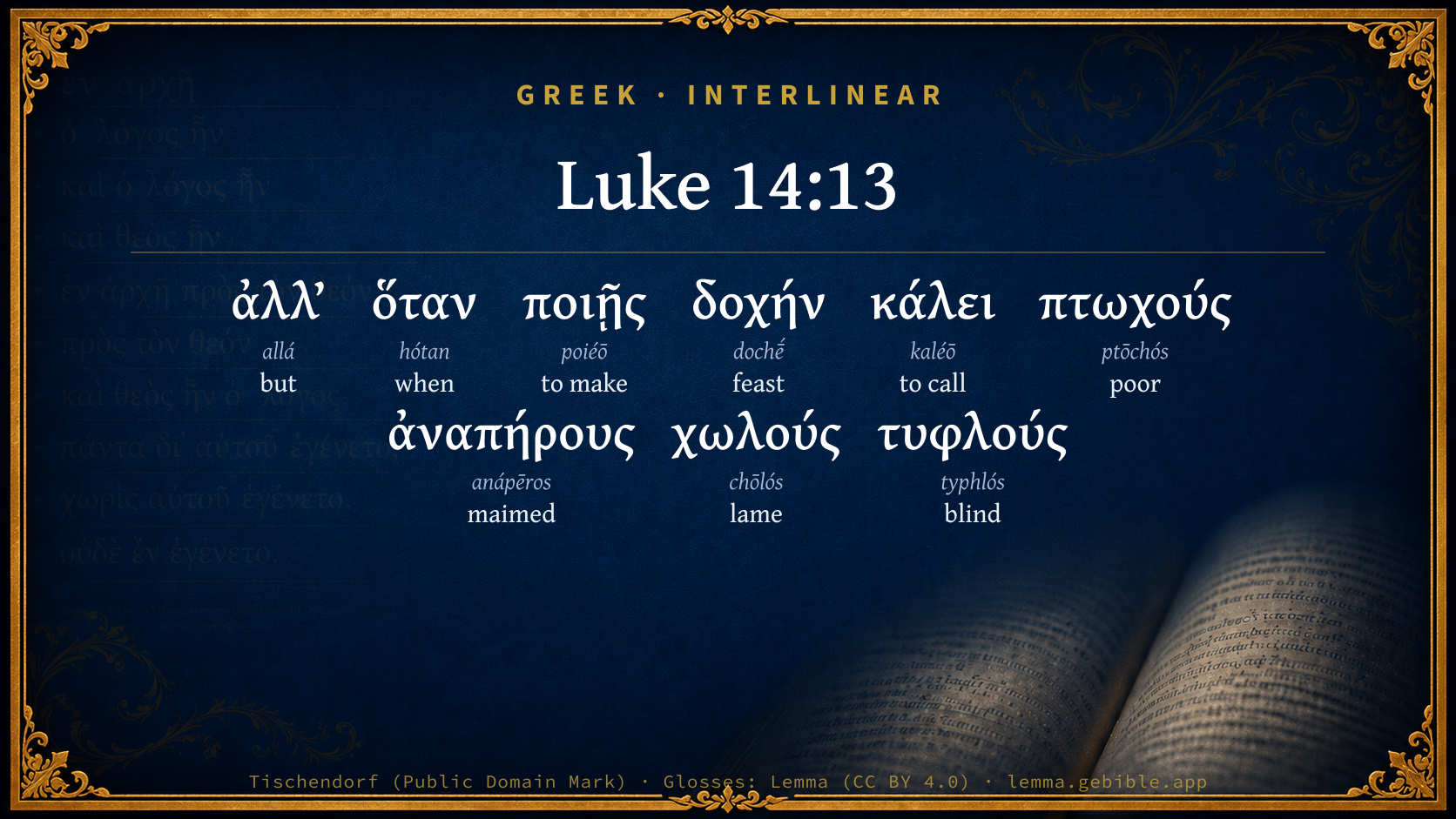
But when you make a feast, ask the poor, the maimed, the lame, or the blind;
Download a study sheet
One document with this verse’s original text, its word-by-word gloss line, the meaning frame, cross-references with their text, attributed commentary, and full source and license credits — printable, and it pastes into notes with its structure intact.
This verse Autodidact and up
A passage Seminary Student
Up to 50 verses in one chapter. A passage sheet keeps up to 6 commentary sources and 12 cross-references per verse, in the order this page ranks them, and says so on the sheet whenever that leaves anything out. Ask for a single verse and you get the Autodidact verse sheet above.
Everything on this page stays free to read, with no account — the sheet is a download of what is already on screen, not access to it.
Compare translations 3
The same verse in 3 English versions, stacked beneath the original-language interlinear above. Click any original word for its lexicon entry.
Each is an independent rendering of the whole verse — the interlinear is not word-aligned to these translations.
Highlighted words mark where these versions differ — a whole-verse word diff, not a word-by-word alignment.
-
World English Bible Public Domain
But when you make a feast, ask the poor, the maimed, the lame, or the blind;
-
King James Version Public Domain
But when thou makest a feast, call the poor, the maimed, the lame, the blind:
-
unfoldingWord Literal Text CC BY-SA 4.0
But when you give a banquet, invite the poor, the crippled, the lame, blind,
unfoldingWord Literal Text — © unfoldingWord, licensed CC BY-SA 4.0. Word-aligned USFM3 via Door43 (git.door43.org/unfoldingWord/en_ult).
Show all 19 translations
Every available English version of this verse, each an independent rendering of the whole verse.
-
World English Bible Public Domain
But when you make a feast, ask the poor, the maimed, the lame, or the blind;
-
Berean Standard Bible Public Domain
But when you host a banquet, invite the poor, the crippled, the lame, and the blind,
-
Majority Standard Bible Public Domain
But when you host a banquet, invite the poor, the crippled, the lame, and the blind,
-
King James Version Public Domain
But when thou makest a feast, call the poor, the maimed, the lame, the blind:
-
American Standard Version (1901) Public Domain
But when thou makest a feast, bid the poor, the maimed, the lame, the blind:
-
Revised Version (1885) Public Domain
But when thou makest a feast, bid the poor, the maimed, the lame, the blind:
-
Geneva Bible (1599) Public Domain
But when thou makest a feast, call ye poore, the maimed, the lame, and the blind,
-
Douay-Rheims (1899) Public Domain
But when thou makest a feast, call the poor, the maimed, the lame, and the blind;
-
Young's Literal Translation Public Domain
but when thou mayest make a feast, be calling poor, maimed, lame, blind,
-
Literal Standard Version CC BY-SA 4.0
but when you may make a feast, be calling poor, maimed, lame, blind,
-
Unlocked Literal Bible CC BY-SA 4.0
But when you give a banquet, invite the poor, the crippled, the lame, and the blind,
-
unfoldingWord Literal Text CC BY-SA 4.0
But when you give a banquet, invite the poor, the crippled, the lame, blind,
-
Darby Bible Public Domain
But when thou makest a feast, call poor, crippled, lame, blind:
-
World Messianic Bible Public Domain
But when you make a feast, ask the poor, the maimed, the lame, or the blind;
-
Webster's Bible Public Domain
But when thou makest a feast, call the poor, the maimed, the lame, the blind:
-
Free Bible Version CC BY-SA 4.0
Instead, when you give a banquet, invite the poor, the crippled, the lame, and the blind,
-
Bible in Basic English Public Domain
But when you give a feast, send for the poor and the blind and those who are broken in body:
-
Text-Critical English NT CC BY 4.0
But when yoʋ prepare a banquet, invite the poor, the maimed, the lame, and the blind.
-
Tyndale New Testament (1534) Public Domain
But when thou makest afeast call the poore the maymed the lame and the blynde
Literal Standard Version (2020), Covenant Press — licensed CC BY-SA 4.0. Text via the HelloAO Bible API (eBible.org). Unlocked Literal Bible (unfoldingWord) — licensed CC BY-SA 4.0. Text via the HelloAO Bible API (eBible.org). unfoldingWord Literal Text — © unfoldingWord, licensed CC BY-SA 4.0. Word-aligned USFM3 via Door43 (git.door43.org/unfoldingWord/en_ult). Free Bible Version, Dr. Jonathan Gallagher — licensed CC BY-SA 4.0. Text via the HelloAO Bible API (eBible.org).
Word by word
More ways to search: Search by grammar → Find every occurrence → Compare this word →
Practice this passage: Drill this verse → Learn its vocabulary →
- Appears 2× in the Greek New Testament
- First appears at Luke 5:29
- Part of Speech
- Noun
- Case
- Accusative
- Number
- Singular
- Gender
- Feminine
Full Thayer's Definition
- ἀλλ’ allá G235 “but” Conjunction
- ὅταν hótan G3752 “when” Conjunction
- ποιῇς poiéō G4160 “to make” Verb, Present, Active, Subjunctive, 2nd person, Singular
- δοχήν dochḗ G1403 “feast” Noun, Accusative, Singular, Feminine
- κάλει kaléō G2564 “to call” Verb, Present, Active, Imperative, 2nd person, Singular
- πτωχούς ptōchós G4434 “poor” Adjective, Accusative, Plural, Masculine
- ἀναπήρους anápēros G376 “maimed” Adjective, Accusative, Plural, Masculine
- χωλούς chōlós G5560 “lame” Adjective, Accusative, Plural, Masculine
- τυφλούς typhlós G5185 “blind” Adjective, Accusative, Plural, Masculine
About this verse
These counts appear in no published source. They are computed here, from the morphology-tagged text and Lemma’s own curated glosses. What Lemma adds →
- 9
- words
- 9
- distinct lemmas
- Gospels
- section
Notable vocabulary
The rarest word here is δοχήν feast G1403 — appearing just 2 times in the whole Greek New Testament.
First appearance in Scripture
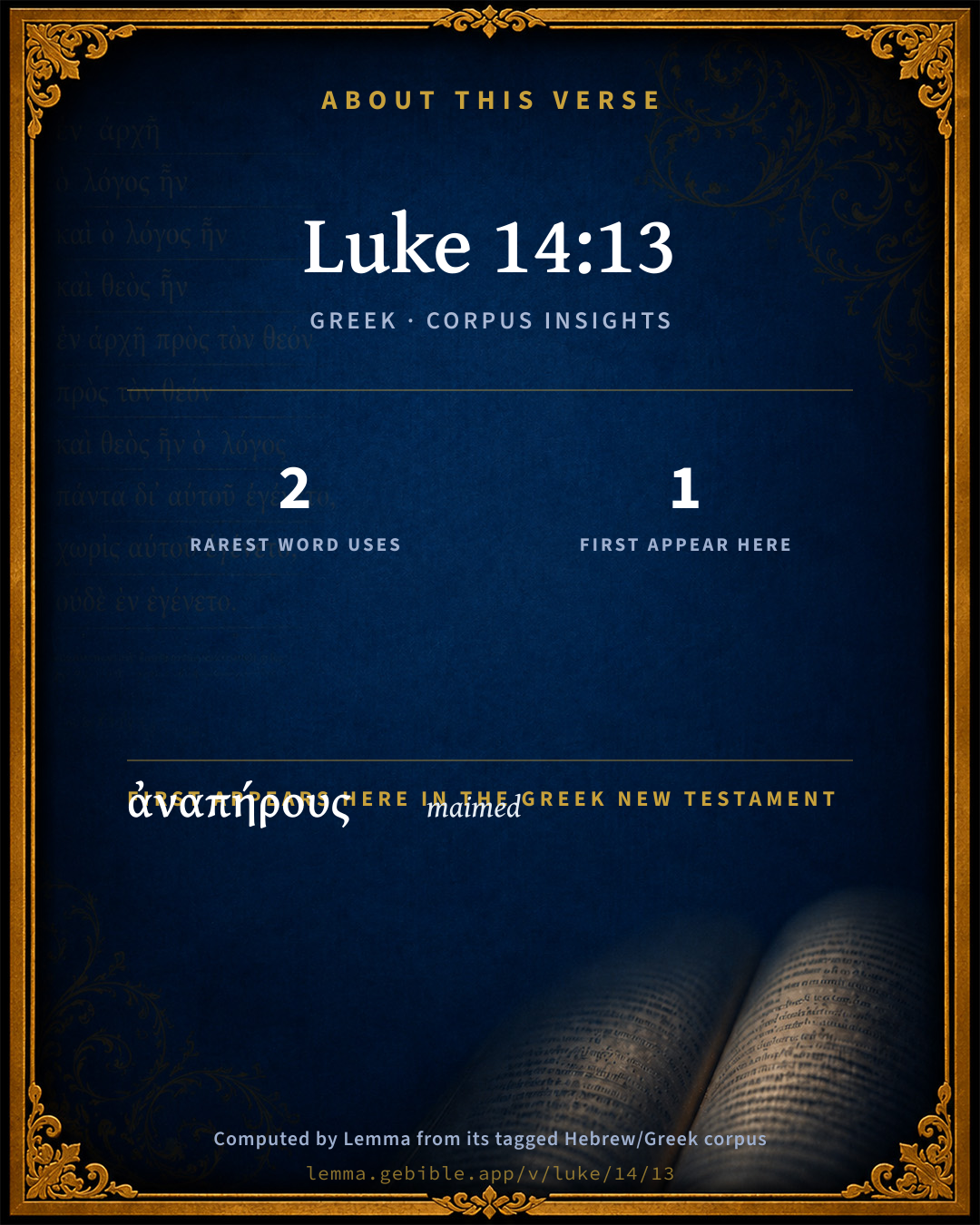
This word makes its first canonical appearance in the Greek New Testament here:
- ἀναπήρους maimed G376
Shared distinctive vocabulary
δοχήν feast G1403 occurs in 2 verses of the Greek New Testament. Also found in:
Cross-references
27Topical passages linked to Luke 14:13 in the Treasury of Scripture Knowledge — connected by theme and wording, ordered by reader-vote popularity; previews shown in the World English Bible.
- Luke 14:21 "That servant came, and told his lord these things. Then the master of the house, being angry, said to his servant, 'Go out quickly into the streets and lanes of the city, and bring in the poor, maimed, blind, and lame.'
- Isaiah 58:10 and if you draw out your soul to the hungry, and satisfy the afflicted soul: then shall your light rise in darkness, and your obscurity be as the noonday;
- Proverbs 14:31 He who oppresses the poor shows contempt for his Maker, But he who is kind to the needy honors him.
- Isaiah 58:7 Isn't it to deal your bread to the hungry, and that you bring the poor who are cast out to your house? when you see the naked, that you cover him; and that you not hide yourself from your own flesh?
- Job 29:15–16 I was eyes to the blind, And feet to the lame.
- Hebrews 13:2 Don't forget to show hospitality to strangers, for in doing so, some have entertained angels without knowing it.
- Nehemiah 8:10 Then he said to them, Go your way, eat the fat, and drink the sweet, and send portions to him for whom nothing is prepared; for this day is holy to our Lord: neither be you grieved; for the joy of Yahweh is your strength.
- Job 31:16–20 "If I have withheld the poor from their desire, Or have caused the eyes of the widow to fail,
- Deuteronomy 16:14 and you shall rejoice in your feast, you, and your son, and your daughter, and your man-servant, and your maid-servant, and the Levite, and the foreigner, and the fatherless, and the widow, who are within your gates.
- Matthew 14:14–21 Jesus went out, and he saw a great multitude. He had compassion on them, and healed their sick.
- Matthew 22:10 Those servants went out into the highways, and gathered together as many as they found, both bad and good. The wedding was filled with guests.
- Deuteronomy 14:29 and the Levite, because he has no portion nor inheritance with you, and the foreigner living among you, and the fatherless, and the widow, who are within your gates, shall come, and shall eat and be satisfied; that Yahweh your God may bless you in all the work of your hand which you do.
- Deuteronomy 16:11 and you shall rejoice before Yahweh your God, you, and your son, and your daughter, and your man-servant, and your maid-servant, and the Levite who is within your gates, and the foreigner, and the fatherless, and the widow, who are in the midst of you, in the place which Yahweh your God shall choose, to cause his name to dwell there.
- Deuteronomy 26:12–13 When you have made an end of tithing all the tithe of your increase in the third year, which is the year of tithing, then you shall give it to the Levite, to the foreigner, to the fatherless, and to the widow, that they may eat within your gates, and be filled.
- Proverbs 3:9–10 Honor Yahweh with your substance, With the first fruits of all your increase:
- 1 Timothy 5:10 being approved by good works, if she has brought up children, if she has been hospitable to strangers, if she has washed the saints' feet, if she has relieved the afflicted, and if she has diligently followed every good work.
- 2 Samuel 6:19 He dealt among all the people, even among the whole multitude of Israel, both to men and women, to everyone a cake of bread, and a portion [of flesh], and a cake of raisins. So all the people departed everyone to his house.
- 2 Chronicles 30:24 For Hezekiah king of Judah did give to the assembly for offerings one thousand bulls and seven thousand sheep; and the princes gave to the assembly a thousand bulls and ten thousand sheep: and a great number of priests sanctified themselves.
- Nehemiah 8:12 All the people went their way to eat, and to drink, and to send portions, and to make great mirth, because they had understood the words that were declared to them.
- Job 29:13 The blessing of him who was ready to perish came on me, And I caused the widow's heart to sing for joy.
- Proverbs 31:6–7 Give strong drink to him who is ready to perish; And wine to the bitter in soul:
- Matthew 15:32–39 Jesus summoned his disciples and said, "I have compassion on the multitude, because they continue with me now three days and have nothing to eat. I don't want to send them away fasting, or they might faint on the way."
- Acts 2:44–45 All who believed were together, and had all things in common.
- Acts 4:34–35 For neither was there among them any who lacked, for as many as were owners of lands or houses sold them, and brought the proceeds of the things that were sold,
- Romans 12:13–16 contributing to the needs of the saints; given to hospitality.
- 1 Timothy 3:2 The overseer therefore must be without reproach, the husband of one wife, temperate, sensible, modest, hospitable, good at teaching;
- Titus 1:8 but given to hospitality, as a lover of good, sober-minded, fair, holy, self-controlled;
Cross-references courtesy of OpenBible.info (CC BY 4.0).
Lesson kit
Teaching starters — assembled from the data on this page, not authored interpretation. Every prompt links to the verse data it draws on. Edit before teaching.
Luke, in the Gospels, opens this verse with 9 words (9 distinct Greek lemmas). Its most distinctive word is dochḗ (“feast”). A historical commentator’s framing appears above. Read the whole chapter for the surrounding context.
Discussion questions
- How does “feast” (dochḗ) shape what this verse is saying?
- The word “maimed” first appears here in Scripture. What is being introduced at this debut?
- Luke 5:29 shares the word «feast» with this verse. How do the two illuminate each other?
- The translations on this page render this verse differently — a whole-verse word diff, not a word-by-word alignment. What might account for the different wordings?
- Reading how Bengel's Gnomon and Expositor's Greek Testament read this verse, where do the two commentators agree and where do they part?
Things to notice
- 1 word makes its first canonical appearance in Scripture here.
- These translations choose different wording for 11 words in this verse.
- 9 distinct Greek lemmas span 9 words in this verse.
Commentary
Notes on Luke 14:13 from classic Christian and Jewish commentators (each source and its license shown beneath its notes). The classic Christian expositions comment on the surrounding passage and are grouped to its opening verse, so a note may address several verses; the Jewish commentaries on the Tanakh (Rashi and others) are per-verse, so they appear only where the commentator wrote on this verse.
Lemma curates 59 commentaries, every one of them public domain or Creative Commons licensed, each selected and text-cleaned for this edition rather than reprinted as found. About our sources →
Bengel's Gnomon
Johann Albrecht Bengel
Bengel's Gnomon of the New Testament — English translation (T&T Clark, Edinburgh, 1860) — public domain. Text from a community e-Sword module.
Expositor's Greek Testament
ed. W. Robertson Nicoll
The Expositor's Greek Testament, edited by W. Robertson Nicoll (1897–1910) — public domain. Text from a community e-Sword module.
Jamieson, Fausset & Brown
Robert Jamieson, A. R. Fausset & David Brown
Jamieson, Fausset & Brown — Commentary Critical and Explanatory on the Whole Bible (1871) — public domain (CC PDM 1.0). Text via the HelloAO Bible API.
Ellicott's Commentary for English Readers
A Bible Commentary for English Readers, edited by Charles John Ellicott (1878–1897) — public domain. Text from a community e-Sword module.
The Cambridge Bible for Schools and Colleges
gen. ed. J. J. S. Perowne
The Cambridge Bible for Schools and Colleges (gen. ed. J. J. S. Perowne; Cambridge University Press, 1878–1918) — public domain. Text from a community e-Sword module.
John Gill's Exposition
John Gill's Exposition of the Whole Bible (1746–1763) — public domain (CC PDM 1.0). Text via the HelloAO Bible API.
Trapp's Complete Commentary
John Trapp
John Trapp, A Commentary or Exposition upon All the Books of the Old and New Testament (1647–1656) — public domain. Text from a community e-Sword module.
Albert Barnes' Notes on the Bible
Albert Barnes' Notes on the Bible (1834–1885) — public domain. Text from a community e-Sword/MySword module.
The Pulpit Commentary
The Pulpit Commentary (1880–1919), ed. H.D.M. Spence-Jones & Joseph S. Exell — public domain. Text from a community e-Sword module.
unfoldingWord translationNotes
Door43 World Missions Community
unfoldingWord translationNotes — © Distant Shores Media and the Door43 World Missions Community, licensed CC BY-SA 4.0. Source: git.door43.org/Door43/en_tn.
Cambridge Greek Testament for Schools and Colleges
Cambridge Greek Testament for Schools and Colleges (Cambridge University Press, 1896; 21 vols, various authors incl. Carr, Maclear, Plummer, Farrar, Lumby, Moule, M. R. James, Simcox) — public domain. Text from a community e-Sword module.
International Critical Commentary
International Critical Commentary — older volumes (1896–1929), various authors — public domain. Text from a community e-Sword module.
Vincent's Word Studies in the New Testament
Marvin R. Vincent
Marvin R. Vincent, Word Studies in the New Testament (1887–1900) — public domain. Text from a community e-Sword/MySword module.