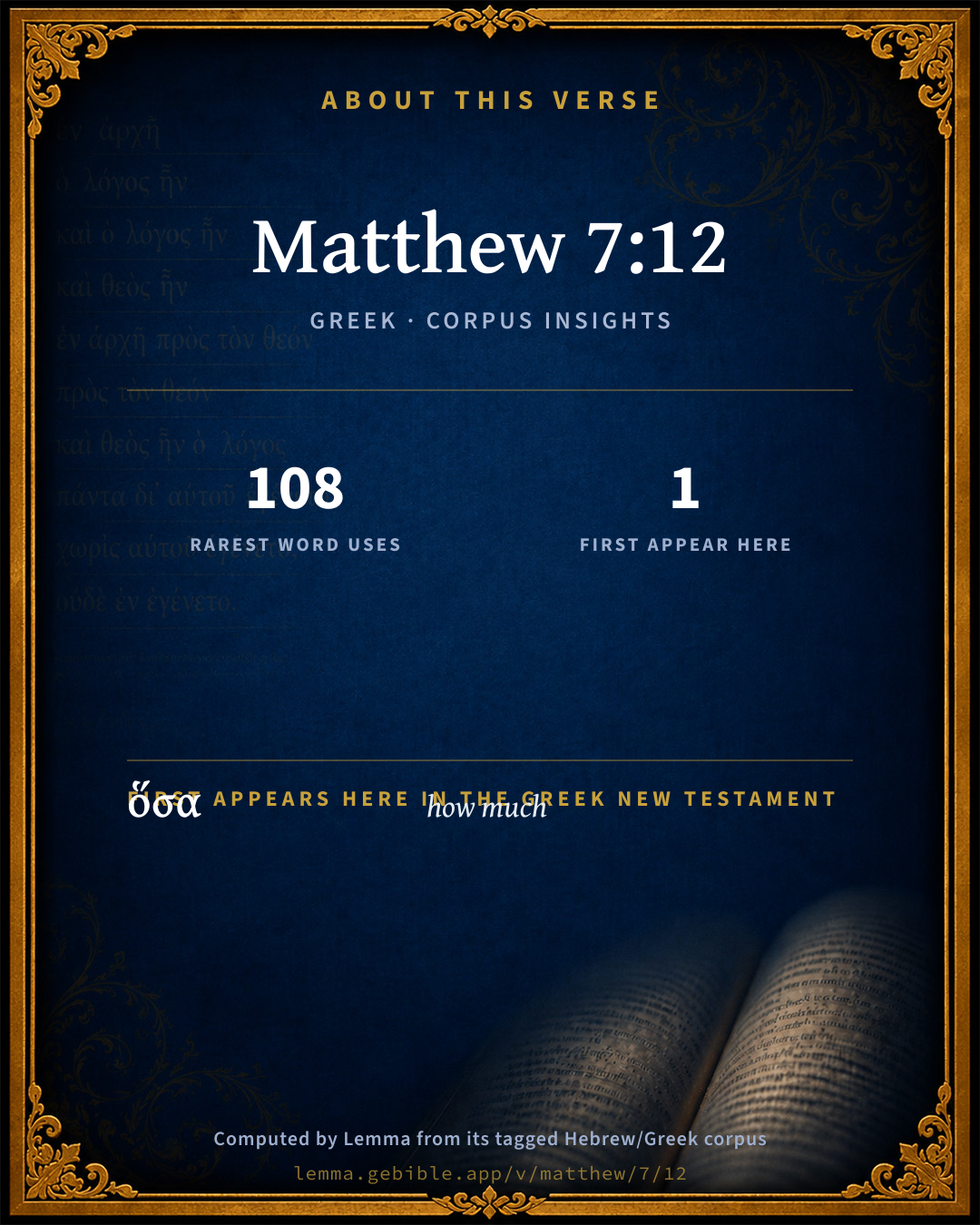
Matthew 7:12

Greek (Tischendorf 8th ed.) Matthew 7:12 appears in the Greek New Testament. The text above is from the Tischendorf 8th edition. Each word links to its Strong’s number and a concise gloss. Click any word for its full Thayer’s Greek Lexicon entry.
Download image
Cite this verse

Matthew 7:12 (World English Bible). Public Domain. Lemma interlinear Bible study tool, https://lemma.gebible.app/v/matthew/7/12.

Show BibTeX & RIS
BibTeX
RIS
English Translation
Therefore whatever you desire for men to do to you, you shall also do to them; for this is the law and the prophets.
World English Bible · Public Domain
Highlights
  • 1 first appearance in the Greek New Testament
Full analysis ↓
Download a study sheet

One document with this verse’s original text, its word-by-word gloss line, the meaning frame, cross-references with their text, attributed commentary, and full source and license credits — printable, and it pastes into notes with its structure intact.

This verse Autodidact and up

Study sheet (.html) Plain text (.txt)

A passage Seminary Student

Up to 50 verses in one chapter. A passage sheet keeps up to 6 commentary sources and 12 cross-references per verse, in the order this page ranks them, and says so on the sheet whenever that leaves anything out. Ask for a single verse and you get the Autodidact verse sheet above.

Everything on this page stays free to read, with no account — the sheet is a download of what is already on screen, not access to it.

Want to remove ads? Support Godless Engineer
Compare translations 3

The same verse in 3 English versions, stacked beneath the original-language interlinear above. Click any original word for its lexicon entry.

Each is an independent rendering of the whole verse — the interlinear is not word-aligned to these translations.

Highlighted words mark where these versions differ — a whole-verse word diff, not a word-by-word alignment.

  • World English Bible Public Domain
    Therefore whatever you desire for men to do to you, you shall also do to them; for this is the law and the prophets.
  • King James Version Public Domain
    Therefore all things whatsoever ye would that men should do to you, do ye even so to them: for this is the law and the prophets.
  • unfoldingWord Literal Text CC BY-SA 4.0
    Therefore, all things in as much as you desire that men do to you, in this manner also, you do to them, for this is the Law and the Prophets.

unfoldingWord Literal Text — © unfoldingWord, licensed CC BY-SA 4.0. Word-aligned USFM3 via Door43 (git.door43.org/unfoldingWord/en_ult).

Versions to compare (up to 4)

3 of 4 selected

Show all 19 translations

Every available English version of this verse, each an independent rendering of the whole verse.

  • World English Bible Public Domain
    Therefore whatever you desire for men to do to you, you shall also do to them; for this is the law and the prophets.
  • Berean Standard Bible Public Domain
    In everything, then, do to others as you would have them do to you. For this is the essence of the Law and the Prophets.
  • Majority Standard Bible Public Domain
    In everything, then, do to others as you would have them do to you. For this is the essence of the Law and the Prophets.
  • King James Version Public Domain
    Therefore all things whatsoever ye would that men should do to you, do ye even so to them: for this is the law and the prophets.
  • American Standard Version (1901) Public Domain
    All things therefore whatsoever ye would that men should do unto you, even so do ye also unto them: for this is the law and the prophets.
  • Revised Version (1885) Public Domain
    All things therefore whatsoever ye would that men should do unto you, even so do ye also unto them: for this is the law and the prophets.
  • Geneva Bible (1599) Public Domain
    Therefore whatsoeuer ye woulde that men should doe to you, euen so doe ye to them: for this is the Lawe and the Prophets.
  • Douay-Rheims (1899) Public Domain
    All things therefore whatsoever you would that men should do to you, do you also to them. For this is the law and the prophets.
  • Young's Literal Translation Public Domain
    `All things, therefore, whatever ye may will that men may be doing to you, so also do to them, for this is the law and the prophets.
  • Literal Standard Version CC BY-SA 4.0
    All things, therefore, whatever you may will that men may be doing to you, so also do to them, for this is the Law and the Prophets.
  • Unlocked Literal Bible CC BY-SA 4.0
    Therefore, whatever things you want people to do to you, you should also do to them, for this is the law and the prophets.
  • unfoldingWord Literal Text CC BY-SA 4.0
    Therefore, all things in as much as you desire that men do to you, in this manner also, you do to them, for this is the Law and the Prophets.
  • Darby Bible Public Domain
    Therefore all things whatever ye desire that men should do to you, thus do *ye* also do to them; for this is the law and the prophets.
  • World Messianic Bible Public Domain
    Therefore, whatever you desire for men to do to you, you shall also do to them; for this is the Torah and the Prophets.
  • Webster's Bible Public Domain
    Therefore all things whatever ye would that men should do to you, do ye even so to them: for this is the law and the prophets.
  • Free Bible Version CC BY-SA 4.0
    Treat others the way you want them to treat you. This sums up the law and the prophets.
  • Bible in Basic English Public Domain
    All those things, then, which you would have men do to you, even so do you to them: because this is the law and the prophets.
  • Text-Critical English NT CC BY 4.0
    “Therefore whatever you wish that others would do to you, do the same also to them, for this is the Law and the Prophets.
  • Tyndale New Testament (1534) Public Domain
    Therfore whatsoever the wolde that men shulde do to you even so do ye to them. This ys the lawe and the Prophettes.

Literal Standard Version (2020), Covenant Press — licensed CC BY-SA 4.0. Text via the HelloAO Bible API (eBible.org). Unlocked Literal Bible (unfoldingWord) — licensed CC BY-SA 4.0. Text via the HelloAO Bible API (eBible.org). unfoldingWord Literal Text — © unfoldingWord, licensed CC BY-SA 4.0. Word-aligned USFM3 via Door43 (git.door43.org/unfoldingWord/en_ult). Free Bible Version, Dr. Jonathan Gallagher — licensed CC BY-SA 4.0. Text via the HelloAO Bible API (eBible.org).

Word by word

More ways to search: Search by grammar → Find every occurrence → Compare this word →

Practice this passage: Drill this verse → Learn its vocabulary →

ὅσα
hósos
G3745
“how much”
Correlative pronoun, Accusative, Plural, Neuter
Part of Speech
Correlative pronoun
Case
Accusative
Number
Plural
Gender
Neuter
Full Thayer's Definition

Origin: by reduplication from G3739

TDNT: None

1. as great as, as far as, how much, how many, whoever
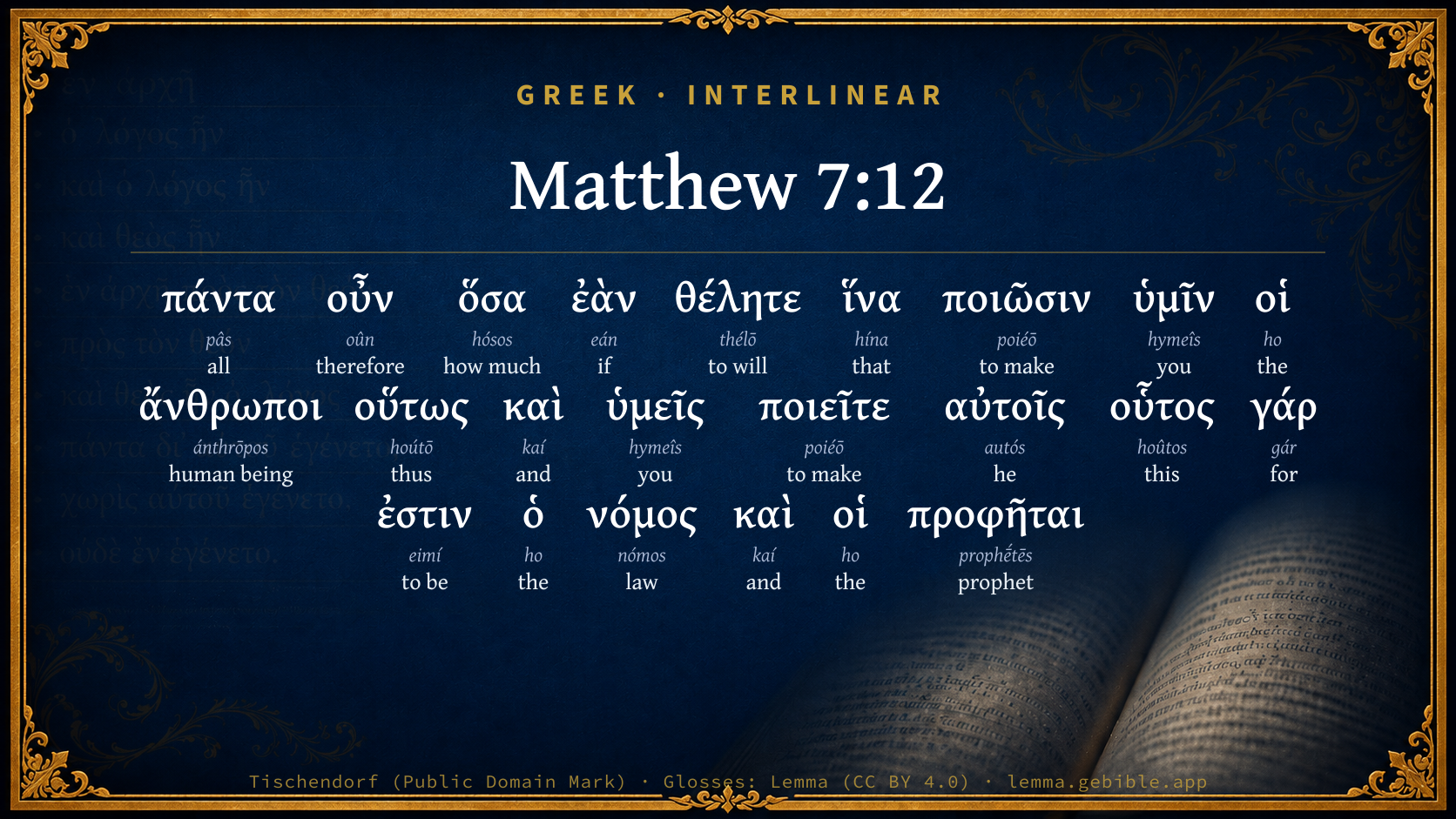
  1. πάντα pâs G3956 “all” Adjective, Accusative, Plural, Neuter
  2. οὖν oûn G3767 “therefore” Conjunction
  3. ἐὰν eán G1437 “if” Conditional
  4. θέλητε thélō G2309 “to will” Verb, Present, Active, Subjunctive, 2nd person, Plural
  5. ἵνα hína G2443 “that” Conjunction
  6. ποιῶσιν poiéō G4160 “to make” Verb, Present, Active, Subjunctive, 3rd person, Plural
  7. ὑμῖν hymeîs G5210 “you” Personal pronoun, 2nd person, Dative, Plural
  8. οἱ ho G3588 “the” Article, Nominative, Plural, Masculine
  9. ἄνθρωποι ánthrōpos G444 “human being” Noun, Nominative, Plural, Masculine
  10. οὕτως hoútō G3779 “thus” Adverb
  11. καὶ kaí G2532 “and” Conjunction
  12. ὑμεῖς hymeîs G5210 “you” Personal pronoun, 2nd person, Nominative, Plural
  13. ποιεῖτε poiéō G4160 “to make” Verb, Present, Active, Imperative, 2nd person, Plural
  14. αὐτοῖς autós G846 “he” Personal pronoun, Dative, Plural, Masculine
  15. οὗτος hoûtos G3778 “this” Demonstrative pronoun, Nominative, Singular, Masculine
  16. γάρ gár G1063 “for” Conjunction
  17. ἐστιν eimí G1510 “to be” Verb, Present, Active, Indicative, 3rd person, Singular
  18. ὁ ho G3588 “the” Article, Nominative, Singular, Masculine
  19. νόμος nómos G3551 “law” Noun, Nominative, Singular, Masculine
  20. καὶ kaí G2532 “and” Conjunction
  21. οἱ ho G3588 “the” Article, Nominative, Plural, Masculine
  22. προφῆται prophḗtēs G4396 “prophet” Noun, Nominative, Plural, Masculine

About this verse

These counts appear in no published source. They are computed here, from the morphology-tagged text and Lemma’s own curated glosses. What Lemma adds →

23
words
18
distinct lemmas
Gospels
section

First appearance in Scripture

This word makes its first canonical appearance in the Greek New Testament here:

Repetition

Words recur within this verse:

  • ποιῶσιν to make G4160 ×2
  • οἱ the G3588 ×3
  • ὑμῖν you G5210 ×2
  • καὶ and G2532 ×2

Cross-references

17

Topical passages linked to Matthew 7:12 in the Treasury of Scripture Knowledge — connected by theme and wording, ordered by reader-vote popularity; previews shown in the World English Bible.

  • Luke 6:31 "As you would like people to do to you, do exactly so to them.
  • Romans 13:8–10 Owe no one anything, except to love one another; for he who loves his neighbor has fulfilled the law.
  • Galatians 5:13–14 For you, brothers, were called for freedom. Only don't use your freedom for gain to the flesh, but through love be servants to one another.
  • Leviticus 19:18 You shall not take vengeance, nor bear any grudge against the children of your people; but you shall love your neighbor as yourself. I am Yahweh.
  • Mark 12:29–34 Jesus answered, "The greatest is, 'Hear, Israel, the Lord our God, the Lord is one:
  • Matthew 22:39–40 A second likewise is this, 'You shall love your neighbor as yourself.'
  • Micah 6:8 He has shown you, O man, what is good. What does Yahweh require of you, but to act justly, To love mercy, and to walk humbly with your God?
  • Zechariah 8:16–17 These are the things that you shall do: speak every man the truth with his neighbor. Execute the judgment of truth and peace in your gates,
  • 1 Timothy 1:5 but the end of the charge is love, out of a pure heart and a good conscience and unfeigned faith;
  • Amos 5:14–15 Seek good, and not evil, That you may live; And so Yahweh, the God of hosts, will be with you, As you say.
  • Ezekiel 18:7–8 and has not wronged any, but has restored to the debtor his pledge, has taken nothing by robbery, has given his bread to the hungry, and has covered the naked with a garment;
  • Malachi 3:5 I will come near to you to judgment; and I will be a swift witness against the sorcerers, and against the adulterers, and against the perjurers, and against those who oppress the hireling in his wages, the widow, and the fatherless, and who deprive the foreigner of justice, and don't fear me," says Yahweh of Hosts.
  • Isaiah 1:17–18 Learn to do well. Seek justice, Relieve the oppressed, Judge the fatherless, Plead for the widow."
  • Jeremiah 7:5–6 For if you thoroughly amend your ways and your doings; if you thoroughly execute justice between a man and his neighbor;
  • Zechariah 7:7–10 Aren't these the words which Yahweh proclaimed by the former prophets, when Jerusalem was inhabited and in prosperity, and its cities around her, and the South and the lowland were inhabited?'"
  • James 2:10–13 For whoever shall keep the whole law, and yet stumble in one point, he has become guilty of all.
  • Ezekiel 18:21 But if the wicked turn from all his sins that he has committed, and keep all my statutes, and do that which is lawful and right, he shall surely live, he shall not die.

Cross-references courtesy of OpenBible.info (CC BY 4.0).

Commentary

Notes on Matthew 7:12 from classic Christian and Jewish commentators (each source and its license shown beneath its notes). The classic Christian expositions comment on the surrounding passage and are grouped to its opening verse, so a note may address several verses; the Jewish commentaries on the Tanakh (Rashi and others) are per-verse, so they appear only where the commentator wrote on this verse.

Lemma curates 59 commentaries, every one of them public domain or Creative Commons licensed, each selected and text-cleaned for this edition rather than reprinted as found. About our sources →

Matthew Henry's Commentary

Our Lord Jesus here presses upon us that righteousness towards men which is an essential branch of true religion, and that religion towards God which is an essential branch of universal righteousness.

I. We must make righteousness our rule, and be ruled by it, Mat 7:12. Therefore, lay this down for your principle, to do as you would be done by; therefore, that you may conform to the foregoing precepts, which are particular, that you may not judge and censure others, go by this rule in general; (you would not be censured, therefore do not censure), Or that you may have the benefit of the foregoing promises. Fitly is the law of justice subjoined to the law of prayer, for unless we be honest in our conversation, God will not hear our prayers, Isa 1:15-17; Isa 58:6, Isa 58:9; Zac 7:9, Zac 7:13. We cannot expect to receive good things from God, if we do not fair things, and that which is honest, and lovely, and of good report among men. We must not only be devout, but honest, else our devotion is but hypocrisy. Now here we have,

1. The rule of justice laid down; Whatsoever ye would that men should do to you, do you even so to them. Christ came to teach us, not only what we are to know and believe, but what we are to do; what we are to do, not only toward God, but toward men; not only towards our fellow-disciples, those of our party and persuasion, but towards men in general, all with whom we have to do. The golden rule of equity is, to do to others as we would they should do to us. Alexander Severus, a heathen emperor, was a great admirer of this rule, had it written upon the walls of his closet, often quoted it in giving judgment, honoured Christ, and favoured Christians for the sake of it. Quod tibi, hoc alteri - do to others as you would they should do to you. Take it negatively (Quod tibi fieri non vis, ne alteri feceris), or positively, it comes all to the same. We must not do to others the evil they have done us, nor the evil which they would do to us, if it were in their power; nor may we do that which we think, if it were done to us, we could bear contentedly, but what we desire should be done to us. This is grounded upon that great commandment, Thou shalt love thy neighbor as thyself. As we must bear the same affection to our neighbour that we would have borne to ourselves, so we must do the same good offices. The meaning of this rule lies in three things. (1.) We must do that to our neighbour which we ourselves acknowledge to be fit and reasonable: the appeal is made to our own judgment, and the discovery of our judgment is referred to that which is our own will and expectation, when it is our own case. (2.) We must put other people upon the level with ourselves, and reckon we are as much obliged to them, as they to us. We are as much bound to the duty of justice as they, and they as much entitled to the benefit of it as we. (3.) We must, in our dealings with men, suppose ourselves in the same particular case and circumstances with those we have to do with, and deal accordingly. If I were making such a one's bargain, labouring under such a one's infirmity and affliction, how should I desire and expect to be treated? And this is a just supposition, because we know not how soon their case may really be ours: at least we may fear, lest God by his judgments should do to us as we have done to others, if we have not done as we would be done by.

2. A reason given to enforce this rule; This is the law and the prophets. It is the summary of that second great commandment, which is one of the two, on which hang all the law and the prophets, Mat 22:40. We have not this in so many words, either in the law or the prophets, but it is the concurring language of the whole. All that is there said concerning our duty towards our neighbour (and that is no little) may be reduced to this rule. Christ has here adopted it into this law; so that both the Old Testament and the New agree in prescribing this to us, to do as we would be done by. By this rule the law of Christ is commended, but the lives of Christians are condemned by comparing them with it. Aut hoc non evangelium, aut hi non evangelici. - Either this is not the gospel, or these are not Christians.

II. We must make religion our business, and be intent upon it; we must be strict and circumspect in our conversation, which is here represented to us as entering in at a strait gate, and walking on in a narrow way, Mat 7:13, Mat 7:14. Observe here,

1. The account that is given of the bad way of sin, and the good way of holiness. There are but two ways, right and wrong, good and evil; the way to heaven, and the way to hell; in the one of which we are all of us walking: no middle place hereafter, no middle way now: the distinction of the children of men into saints and sinners, godly and ungodly, will swallow up all to eternity.

Here is, (1.) An account given us of the way of sin and sinners; both what is the best, and what is the worst of it.

[1.] That which allures multitudes into it, and keeps them in it; the gate is wide, and the way broad, and there are many travellers in that way. First, "You will have abundance of liberty in that way; the gate is wide, and stands wide open to tempt those that go right on their way. You may go in at this gate with all your lusts about you; it gives no check to your appetites, to your passions: you may walk in the way of your heart, and in the sight of your eyes; that gives room enough." It is a broad way, for there is nothing to hedge in those that walk in it, but they wander endlessly; a broad way, for there are many paths in it; there is choice of sinful ways, contrary to each other, but all paths in this broad way. Secondly, "You will have abundance of company in that way: many there be that go in at this gate, and walk in this way." If we follow the multitude, it will be to do evil: if we go with the crowd, it will be the wrong way. It is natural for us to incline to go down the stream, and do as the most do; but it is too great a compliment, to be willing to be damned for company, and to go to hell with them, because they will not go to heaven with us: if many perish, we should be the more cautious.

[2.] That which should affright us all from it is, that it leads to destruction. Death, eternal death, is at the end of it (and the way of sin tends to it), - everlasting destruction from the presence of the Lord. Whether it be the high way of open profaneness, or the back way of close hypocrisy, if it be a way of sin, it will be our ruin, if we repent not.

(2.) Here is an account given us of the way of holiness.

[1.] What there is in it that frightens many from it; let us know the worst of it, that we may sit down and count the cost. Christ deals faithfully with us, and tells us,

First, That the gate is strait. Conversion and regeneration are the gate, by which we enter into this way, in which we begin a life of faith and serious godliness; out of a state of sin into a state of grace we must pass, by the new birth, Joh 3:3, Joh 3:5. This is a strait gate, hard to find, and hard to get through; like a passage between two rocks, Sa1 14:4. There must be a new heart, and a new spirit, and old things must pass away. The bent of the soul must be changed, corrupt habits and customs broken off; what we have been doing all our days must be undone again. We must swim against the stream; much opposition must be struggled with, and broken through, from without, and from within. It is easier to set a man against all the world than against himself, and yet this must be in conversion. It is a strait gate, for we must stoop, or we cannot go in at it; we must become as little children; high thoughts must be brought down; nay, we must strip, must deny ourselves, put off the world, put off the old man; we must be willing to forsake all for our interest in Christ. The gate is strait to all, but to some straiter than others; as to the rich, to some that have been long prejudiced against religion. The gate is strait; blessed be God, it is not shut up, nor locked against us, nor kept with a flaming sword, as it will be shortly, Mat 25:10.

Secondly, That the way is narrow. We are not in heaven as soon as we have got through the strait gate, nor in Canaan as soon as we have got through the Red Sea; no, we must go through a wilderness, must travel a narrow way, hedged in by the divine law, which is exceedingly broad, and that makes the way narrow; self must be denied, the body kept under, corruptions mortified, that are as a right eye and a right hand; daily temptations must be resisted; duties must be done that are against our inclination. We must endure hardness, must wrestle and be in an agony, must watch in all things, and walk with care and circumspection. We must go through much tribulation. It is hodos tethlimmenē - an afflicted way, a way hedged about with thorns; blessed be God, it is not hedged up. The bodies we carry about with us, and the corruptions remaining in us, make the way of our duty difficult; but, as the understanding and will grow more and more sound, it will open and enlarge, and grow more and more pleasant.

Thirdly, The gate being so strait and the way so narrow, it is not strange that there are but few that find it, and choose it. Many pass it by, through carelessness; they will not be at the pains to find it; they are well as they are, and see no need to change their way. Others look upon it, but shun it; they like not to be so limited and restrained. Those that are going to heaven are but few, compared to those that are going to hell; a remnant, a little flock, like the grape-gleanings of the vintage; as the eight that were saved in the ark, Pe1 3:20. In vitia alter alterum trudimus; Quomodo ad salutem revocari potest, quum nullus retrahit, et populus impellit - In the ways of vice men urge each other onward: how shall any one be restored to the path of safety, when impelled forwards by the multitude, without any counteracting influence? Seneca, Epist. 29. This discourages many: they are loth to be singular, to be solitary; but instead of stumbling at this, say rather, If so few are going to heaven, there shall be one the more for me.

[2.] Let us see what there is in this way, which, notwithstanding this, should invite us all to it; it leads to life, to present comfort in the favour of God, which is the life of the soul; to eternal bliss, the hope of which, at the end of our way, should reconcile us to all the difficulties and inconveniences of the road. Life and godliness are put together (Pe2 1:3); The gate is strait and the way narrow and up-hill, but one hour in heaven will make amends for it.

2. The great concern and duty of every one of us, in consideration of all this; Enter ye in at the strait gate. The matter is fairly stated; life and death, good and evil, are set before us; both the ways, and both the ends: now let the matter be taken entire, and considered impartially, and then choose you this day which you will walk in; nay, the matter determines itself, and will not admit of a debate. No man, in his wits, would choose to go to the gallows, because it is a smooth, pleasant way to it, nor refuse the offer of a palace and a throne, because it is a rough, dirty way to it; yet such absurdities as these are men guilty of, in the concerns of their souls. Delay not, therefore; deliberate not any longer, but enter ye in at the strait gate; knock at it by sincere and constant prayers and endeavors, and it shall be opened; nay, a wide door shall be opened, and an effectual one. It is true, we can neither go in, nor go on, without the assistance of divine grace; but it is as true, that grace is freely offered, and shall not be wanting to those that seek it, and submit to it. Conversion is hard work, but it is needful, and, blessed be God, it is not impossible if we strive, Luk 13:24.

Matthew Henry's Commentary on the Whole Bible (1708–1710) — public domain (CC PDM 1.0). Text via the HelloAO Bible API.

The Biblical Illustrator

Joseph S. Exell

Mat_7:12

That men should do to you, do ye even so to them.

Wherein lies that exact righteousness which is required between man and man

I. The expectation of it. Put thyself into the place and circumstances of every man with whom thou hast to do. This is an exact rule. It is plain and easy. Three things are to be done before this rule will be of use to us.

1. We must make it appear reasonable.

2. Make it certain.

3. Make it practicable.

(1) Labour to understand truly every mans condition so far as you have opportunity.

(2) When from distance, self-interest you cannot understand, trust the concurrent experience of others that are in that condition.

(3) Conclude that in cases between superiors and inferiors, the partiality is usually on the inferiors side.

(4) In judging of your present condition and circumstances, always abate something for the presence of them, for self-love and self-interest and other passions.

II. The grounds of this. The equity of the rule stands upon these foundations.

1. All men are equal in many things, and these the greatest things.

2. In most of those things wherein we are unequal, the inequality is not considerable, so as to be a ground of any unequal dealing with one another.

3. In all these things wherein men are unequal, the inequality is not fixed and constant, but mutable and by turns.

4. Among other grounds is the mutual and universal equity and advantage of this rule.

5. The absurdity and inconvenience of the contrary.

III. The instances.

1. In matters of civil respect and conversation.

2. In matters of kindness and courtesies.

3. In matters of charity and compassion.

4. In matters of forbearance and forgiveness.

5. In matters of report and representation of other men, and their actions.

6. In matters of trust and fidelity.

7. In matters of duty and obedience.

8. In matters of freedom and liberty, which are not determined by natural or positive law.

9. In matters of commerce and contracts which arise from thence.

IV. Rules for directing our commerce.

1. Impose upon no mans ignorance or unskilfulness.

2. Impose upon no mans necessity.

3. Use plainness in all your dealings.

4. In matters of fancy use moderation. Let us not revenge ourselves. (J. Tillotson, D. D.)

It is sometimes said that Christians are defective in the duties of the second table; hypocrites may be, but not real Christians.

I. A rule of life. This precept may be considered in the affirmative and negative; the latter to restrain injury, the former to do good. To impress this rule in the negative sense take four considerations.

1. That in the duties of the second table we have more light than we have in the first, for in the first we are to love God with all our heart (Mat_22:26; Mat_22:37), but the love to our neighbour is a measure more discernible. Love will tell us what is good for ourselves; in guiding our love to God we need many rules.

2. The breach of the rule is more evil in him which hath experienced the bitterness of wrongs, than in another; because experience giveth us a truer knowledge of things, than a naked conception of them. Thus conscience worketh in the way of restraint.

3. That this rule is spiritual, and concerneth the inward man as well as the outward, thoughts as well as actions.

4. This rule must be done not only out of love to man, but out of love to God, and as an act of obedience. Self-love is the measure, but not the principle, of our action. Now take the affirmative part.

1. In giving. Be as ready to do as to receive good.

2. In forgiving.

II. Vindicate this rule.

1. It seems not to be so perfect a rule: because many desire and wish much evil to themselves.

2. It seems to make all men equal, and destroy order and superiority, as master and servant.

3. Doth not this establish revenge and retaliation?

4. Is not this to impose a restraint upon the Christian from which others are free, and so to expose to constant loss?

III. The equity of this rule.

1. The actual equality of all men by nature.

2. The possible equality of all men as to condition and state of life.

IV. The illative particle Therefore.

1. That God is the judge of human actions. He will see whether you do to others as they do to you, and you shall hear of it in your dealing with God.

2. That the usage we expect from God the same in measure we should deal out to others. Application: What an advantage religion is to mankind in the present life.

(1) How securely we might live one by another.

(2) How mutually helpful men would be to each other.

(3) How much mankind have degenerated, and how few live Christians in the world. (J. Manton, D. D.)

Duty towards our neighbour

The several capacities wherein we can help or hinder him.

I. As to his soul. Promote its good by-

1. Prayer.

2. Example.

II. As to the body we must do as we would be done by.

III. We must deal with our neigh-bout as we desire be should deal with us, in respect of his good name.

IV. This rule extends to mens estates.

1. Justice.

2. Charity. Some motives to induce the the practice of this rule:

1. The first shall be taken from the end for which they were made.

2. From the intrinsic beauty and loveliness of the rule itself.

3. Because we and they both bear the same stamp and impress of heaven.

4. Because if we be just and generous in time of our prosperity, it will cause a like affection in others to us.

5. It would be the best security of our lives, honour, reputation, riches, power. (Dr. Barrow.)

1. The mutual dependence of man upon his fellow man.

2. The duty which devolves on each to assist his neighbour, especially in spiritual things. (Bishop of Winchester.)

The golden rule

I. What is the true meaning of this Divine rule? That we practise toward our neighbour in such a manner as our hearts and consciences would think it reasonable he should practise towards us in a like case.

II. What is the special argument that our Lord uses in order to enforce it.

III. Wherein its particular excellencies appear. It is easy to be understood and applied, easy to be remembered, carries greater evidence to the conscience than any other rule of virtue, includes a powerful motive, will secure our neighbour from injury and us from guilt, as fitted to awaken repentance as to direct to duty, suits all stations, etc., includes all actions and duties, a rule of the highest prudence, and fitted to make the whole world happy.

IV. Reflections. How compendious the Saviours method of providing for the practice of all the moral duties enjoined by Moses and the prophets! What Divine wisdom to make the golden rule a fundamental law in both the Jewish and Christian systems. (Dr. Watts.)

Concerning this rule or principle note the following facts:

I. It is a golden rule. It is sound throughout and very precious.

II. This is our Saviours golden rule.

III. It is a revolutionary rule.

IV. It is a very stringent rule.

V. It is an evangelical rule. Whoever thinks about it cannot fail to see two things. His need of Gods forgiveness and Gods grace.

VI. Following the golden rule we shall be led to our duty and therefore to blessedness. (Anon.)

The golden rule of gospel equity

I. The precept itself and the limitations with which it is to be understood. We must not make what we expect others would do in our circumstances the rule of conduct; because we expect selfishness, we must not be selfish; this is retaliation. The rule of the text does not apply when what we would is inconsistent with the well-being of society; a creditor need not forego a just debt. So this rule has equity and right reason as a limit. We must not take too favourable views of our individual case and form an exaggerated estimate of what we are entitled to at the hands of a neighbour. Anger may be justified.

II. The excellency of this rule, and the grounds on which we claim for it the respect of mankind.

1. Its reasonableness, as founded on the original equality of all men.

2. Its capability of easy and immediate application.

3. The beneficence of such a rule in relation to ourselves. God seems to let us make our own laws.

III. A few practical illustrations of the way in which this rule may be applied.

1. Let the rule be applied to the civilities of social intercourse.

2. To the practice of neighhourly charities and compassions. Ye were strangers in the land of Egypt.

3. To the rights, properties, and good name of all around us.

4. To the social duties falling under no special name, regard for the opinions of others.

5. The connection of these several duties with the sinners acceptance with God. (D. Moore, M. A.)

The golden rule

I. The righteous rule of conduct here laid down.

1. In order to the performance of this duty there must be a sameness of circumstances. There is a diversity in the station and character of men; this requires diversity of duty towards them.

2. We must carefully observe the measure by which we are to regulate our conduct towards others. It is not what they actually do, but what we would desire they should do, which is to be our rule.

3. This rule must be taken with certain modifications, not absolutely; we might wish others to do things unreasonable and sinful; it must recognize the law of God.

II. Its excellence.

1. Its brevity.

2. Its comprehensiveness-All things.

3. Its perfect justice.

III. A few considerations to enforce obedience to it.

1. The argument exhibited by our Lord-For this is the law and the prophets.

2. The injunction of our Lord on this subject.

3. The powerful recommendation such u course would prove to the gospel of our Lord.

4. It is enforced by the benevolent and righteous example of Him who gave it.

`Learn:

1. It presents a most invaluable testimony to the truth of Christianity.

2. How happy will be the world when the religion of Jesus Christ shall be universally diffused. (J. E. Good.)

The golden rule a fundamental law

Natures great law that matter attracts matter; that a vast central world will attract planets from a straight line into a circle; that an earth will draw a falling apple to itself, and hold its liquid sea and liquid air close to itself, and will hold the seas under the air and the land under the sea, is not more fundamental in the material world than the golden rule is in the world of duty and happiness. Take away the single principle discovered by Newton, and the organized universe-is at once dissolved; air and water and land mingle; our globe would become a fluid, and fill its orbit with a floating debris of itself. The golden rule underlies our public and private justice, our society, our charity, our education, our religion; and the sorrows of bad government, of famine, of war, of caste, of slavery, have come from contempt of this principle. (D. Swing.)

Christ did not originate the golden rule, but gave it new meaning and power over men

To find the glory, therefore, of a truth you must not pause with the man who may have first announced it, for he may have had no conception of its worth, and may have given it little love, like the Sibyl who wrote prophecies which she did not herself understand, and which, written upon leaves, she permitted the winds to carry about never to be seen or eared for again. In order to locate the glory of discovery you must measure the heart and mind that first took hold of the idea or taw in its infancy or later life. You will find the word liberty in Caesars history and in Ciceros ethics, but they knew nothing of the idea as compared with that conception of the word in the mind of a Wilberforce or a Polish exile. (D. Swing.)

The golden rule a portable law

By that I mean it is always at hand, always ready to be appealed to. It is like the two-foot rule which the skilful artizan always carries with him ready to take the measurement of any work to which he is called; a rule is his that can measure the brick that is but of few inches length, or that could compute the height of the pyramids. So is it with this law. Other social regulations, such as those of professional etiquette, of trade customs, and even of national statutes, are continually failing men according to the class or country in which they are found. But this is ever at hand. (U. R. Thomas.)

The golden rule should be remembered in the infliction of punishment

The Emperor Alexander Severus was so charmed by the excellence of this golden rule, that he obliged a crier to repeat it whenever he had occasion to punish any person; and caused it to be inscribed in the most noted parts of his palace, and on many of the public buildings: he also professed so high a regard for Christ, as having been the author of so excellent a rule, that he desired to have Him enrolled among the deities.

The Biblical Illustrator, edited by Joseph S. Exell (c. 1880s–1900s) — public domain. Text from a community e-Sword module.

Joseph Benson's Commentary

Mat 7:12. Therefore all things, &c. — As if he had said, But it is only on this condition that he will give, and continue to give them, viz., that ye follow the example of his equity and benevolence, that you imitate the God of love; that, being “animated by his goodness, you study to express your gratitude for it by your integrity and kindness to your fellow-creatures, treating them, in every instance, as you would think it reasonable to be treated by them, if you were in their circumstances and they in yours: for this is, in effect, a summary and abstract of all the human and social virtues recommended in the moral precepts of the law and the prophets, and it was one of the greatest ends of both to bring men to this equitable and amiable temper. I say, one of the greatest, that this may be reconciled with our Lord’s declaring the love of God to be the first and great commandment, Mat 22:38. And, indeed, it is a most absurd and fatal error to imagine, that the regulation of social life is the only end of religion.” — Doddridge. Thus far proceeds the doctrinal part of this sermon. In the next verse begins the exhortation to practise it.

Joseph Benson's Commentary on the Old and New Testaments (1811–1818) — public domain. Text from a community e-Sword module.

Tyndale Open Study Notes

Tyndale Open Resources

7:12 the law and the prophets: The teaching of Jesus in 5:21–7:6 is the goal and true expression of the law of Moses. Love is at the core of discipleship (see also Gal 5:13-14, 18).

Tyndale Open Study Notes — © Tyndale Open Resources, licensed CC BY-SA 4.0. Text via the HelloAO Bible API.

Bengel's Gnomon

Johann Albrecht Bengel

Mat 7:12. Οὖν, therefore) The sum of all that has been said from the beginning of the chapter. He concludes [this portion of the discourse], and at the same time returns to ch. Mat 5:17. The conclusion corresponds with the commencement. And we ought to imitate the Divine goodness, mentioned in Mat 7:11.—θέλητε ἵνα ποιῶσιν, ye would that they should do) “Ye would:” this is pointedly said (notanter): for men often do otherwise [than what ye would that they should do]. We are not to follow their example. Sc. by benefiting, not injuring.—οἱ ἄνθρωποι, men) The indefinite appellation of men, frequently employed by the Saviour, already alludes to the future propagation of His teaching throughout the whole human race.—οὓτω, thus) The same things in the same way: or thus, as I have told you up to this point.—οὗτος, this) The law and the prophets enjoin many other things, as for example the love of God: but yet the law and the prophets also tend to this as their especial scope, viz. whatsoever ye would, etc., and he who performs this, performs all the rest more easily: see ch. Mat 19:19.

Bengel's Gnomon of the New Testament — English translation (T&T Clark, Edinburgh, 1860) — public domain. Text from a community e-Sword module.

Meyer's Critical & Exegetical Commentary

Heinrich August Wilhelm Meyer

Mat_7:12. At this point Jesus takes a retrospective glance at all that He has been saying since Mat_5:17,beginning with Moses and the prophets,concerning our duty to our neighbour, but introducing, indeed, many other instructions and exhortations. But putting out of view such matters as are foreign to His discourse, He now recapitulates all that has been said on the duties we owe to our neighbour, so that οὖν points back to Mat_5:17. The correctness of this view is evident from the following: οὗτος γάρ ἐστιν ὁ νόμος, etc., from which it further appears that οὖν does not merely refer back to Mat_5:1-5 (Kuinoel, Neander, Baumgarten-Crusius). As Luther well observes: With those words He concludes the instructions contained in those three chapters, and gathers them all into one little bundle. Fritzsche is somewhat illogical when he says that οὖν generalizes the conclusion from οἴδατε δόματα … τέκνοις ὑμῶν, which proposition, however, was a mere lemma. Ewald thinks that Mat_7:12 is here in its wrong place, that its original position was somewhere before ἀγαπᾶτε, Mat_5:44, and might still be repeated after Mat_5:48; according to Bleek and Holtzmann, founding on Luk_6:31, its original position was after Mat_5:42. But it is precisely its significant position as a concluding sentence, along with its reference to the law and the prophets, that Luke has taken away from it. Comp. Weiss. On θέλειν ἵνα, see note on Luk_6:31.

οὕτω] not for ταῦτα, as if the matter were merged in the manner (de Wette), but in such a manner, in this way, corresponding, that is, to this your θέλειν.

The truth of this Christian maxim lies in this, that the words ὅσα ἂν θέλητε, etc., as spoken by Jesus, and, on the ground of His fulfilment of the law (οὖν), which presupposes faith in Him, can only mean a willing of a truly moral kind, and not that of a self-seeking nature, such as the desire for flattery.

οὗτος, etc.] for this is the sum of moral duty, and so on.

For parallels from profane writers, see Wetstein; Bab. Schabb. f. 31. 1 : Quod tibi ipsi odiosum est, proximo ne facias; nam haec est tota lex. But being all of a negative character, like Tob_4:15, they are essentially different from the present passage. For coincidences of a more meagre kind from Greek writers, see Spiess, Logos Spermat. p. 24.

Meyer — Critical and Exegetical Commentary on the New Testament — English translation by Peter Christie, edited by Frederick Crombie (T&T Clark, 1880) — public domain. Text from a community e-Sword module.

Expositor's Greek Testament

ed. W. Robertson Nicoll

Mat 7:12 . The golden rule . οὖν here probably because in the source, cf. καὶ in quotation in Heb 1:6 . The connection must be a matter of conjecture with Mat 7:11 , a, “Extend your goodness from children to all,” Fritzsche; with Mat 7:11 , b, “Imitate the divine goodness,” Bengel; with Mat 7:1-5 ; Mat 7:6-11 being an interpolation, Weiss and Holtz. (H.C.). Luk 6:31 places it after the precept contained in Mat 5:42 , and Wendt, in his reconstruction of the logia (L. J., i. 61), follows that clue. The thought is certainly in sympathy with the teaching of Mat 5:38-48 , and might very well be expounded in that connection. But the meaning is not dependent on connection. The sentence is a worthy close to the discourse beginning at Mat 5:17 . “Respondent ultima primis,” Beng. Here as there “law and prophets”. ἵνα with subjunctive after θέλητε , instead of infinitive. πάντα οὖν … ποιεῖτε αὐτοῖς . The law of nature, says Rosenmüller. Not quite. Wetstein, indeed, gives copious instances of something similar in Greek and Roman writers and Rabbinical sources, and the modern science of comparative religion enables us to multiply them. But recent commentators (including Holtz., H.C.) have remarked that, in these instances, the rule is stated in negative terms. So, e.g. , in Tob 4:15 , ὃ μισεῖς , μηδενὶ ποιήσῃς , quoted by Hillel in reply to one who asked him to teach the whole law while he stood on one leg. So also in the saying of Confucius: “Do not to others what you would not wish done to yourself,” Legge, Chinese Classics , i. 191 f. The negative confines us to the region of justice ; the positive takes us into the region of generosity or grace , and so embraces both law and prophets. We wish much more than we can claim to be helped in need, encouraged in struggles, defended when misrepresented, and befriended when our back is at the wall. Christ would have us do all that in a magnanimous, benignant way; to be not merely δίκαιος but ἀγαθός . νόμος καὶ προφῆται : perhaps to a certain extent a current phrase = all that is necessary, but, no doubt, seriously meant; therefore, may help us to understand the statement in Mat 5:17 , “I came not to destroy, but to fulfil”. The golden rule was Law and Prophets only in an ideal sense, and in the same sense only was Christ a fulfiller. vide Wendt, L. J., ii. 341.

The Expositor's Greek Testament, edited by W. Robertson Nicoll (1897–1910) — public domain. Text from a community e-Sword module.

International Critical Commentary

12. All things therefore whatsoever ye wish that men should do to you, so also do ye to them: for this is the law and the prophets.] Luk 6:31 has: “And as ye wish that men should do to you, do ye to them likewise.” Lk. has this saying after the parallel to Mat 5:42. Mt. no doubt found it in the Logia in the Sermon, possibly after 7:1, 2. But it seems more in place in Lk.’s connection, i.e. to say somewhere within Mat 5:38-48 which concern the treatment of others. In its present connection in Mt. the verse seems out of place, but 7:1, 2 deal with behaviour to other people, and so does 7:6. If vv. 3-5 and 7-11 are interpolations from other parts of the Logia, 7:12 may have stood in connection with 7:1, 2, 6. A negative form of this saying was attributed to Hillel: “What is hateful to thee, do not do to thy neighbour,” Shabbath 31a; and is found in To 4:16 ἂ μισεῖς μηδενὶ ποιήσης. Cf. Philo apud Eus. Prœp. Ev. viii. 7. 6: ἄ τις παθεῖν ἐχθαίρει μὴ ποιεῖν αὐτόν1 (b)

International Critical Commentary — older volumes (1896–1929), various authors — public domain. Text from a community e-Sword module.

Geneva Bible (1599)

Geneva Bible translators

Luke 6:31; Job 4:16

That is to say, the doctrine of the Law and Prophets.

A rehearsal of the meaning of the second table.

Geneva Bible (1599) marginal notes — public domain. Text via Bolls.life.

Jamieson, Fausset & Brown

Robert Jamieson, A. R. Fausset & David Brown

Therefore--to say all in one word.

all things whatsoever ye would that men should do to you, do ye even so to them--the same thing and in the same way.

for this is the law and the prophets--"This is the substance of all relative duty; all Scripture in a nutshell." Incomparable summary! How well called "the royal law!" (Jam 2:8; compare Rom 13:9). It is true that similar maxims are found floating in the writings of the cultivated Greeks and Romans, and naturally enough in the Rabbinical writings. But so expressed as it is here--in immediate connection with, and as the sum of such duties as has been just enjoined, and such principles as had been before taught--it is to be found nowhere else. And the best commentary upon this fact is, that never till our Lord came down thus to teach did men effectually and widely exemplify it in their practice. The precise sense of the maxim is best referred to common sense. It is not, of course, what--in our wayward, capricious, gasping moods--we should wish that men would do to us, that we are to hold ourselves bound to do to them; but only what--in the exercise of an impartial judgment, and putting ourselves in their place--we consider it reasonable that they should do to us, that we are to do to them.

Jamieson, Fausset & Brown — Commentary Critical and Explanatory on the Whole Bible (1871) — public domain (CC PDM 1.0). Text via the HelloAO Bible API.

Adam Clarke's Commentary

Verse 12. Therefore all things whatsoever ye would that men]. This is a most sublime precept, and highly worthy of the grandeur and beneficence of the just God who gave it. The general meaning of it is this: "Guided by justice and mercy, do unto all men as you would have them to do to you, were your circumstances and theirs reversed." Yet this saying may be misunderstood. "If the prisoner should ask the judge, 'whether he would be content to be hanged, were he in his case,' he would answer, 'No.' Then, says the prisoner, do as you would be done to. - Neither of them must do as private men; but the judge must do by him as they have publicly agreed: that is, both judge and prisoner have consented to a law, that if either of them steal he shall be hanged." - Selden. None but he whose heart is filled with love to God and all mankind can keep this precept, either in its spirit or letter. Self-love will feel itself sadly cramped when brought within the limits of this precept; but God hath spoken it: it is the spirit and design of the law and the prophets; the sum of all that is laid down in the Sacred Writings, relative to men's conduct toward each other. It seems as if God had written it upon the hearts of all men, for sayings of this kind may be found among all nations, Jewish, Christian, and Heathen. See many examples in Wetstein's notes.

Adam Clarke's Commentary on the Bible (1810–1826) — public domain. Text from a community e-Sword/MySword module.

Ellicott's Commentary for English Readers

(12) Therefore . . . whatsoever.—The sequence of thought requires, perhaps, some explanation. God gives His good things in answer to our wishes, if only what we wish for is really for our good. It is man’s highest blessedness to be like God, to “be perfect as our Father in heaven is perfect,” and therefore in this respect too he must strive to resemble Him. The ground thus taken gives a new character to that which otherwise had already become almost one of the “common-places” of Jewish and heathen ethics. Perhaps the most interesting illustration of the former is the well-known story of the Gentile inquirer who went to Shammai, the great scribe, and asked to be taught the law, in a few brief words, while he stood on one foot. The Rabbi turned away in anger. The questioner then went to Hillel, and made the same demand; and the sage turned and said, “Whatsoever thou wouldest that men should not do to thee, that do not thou to them. All our law is summed up in that.” And so the Gentile became a proselyte. A like negative rule is quoted by Gibbon (Decl. and Fall, c. liv., note 2) from Isocrates, not without a sneer, as if it anticipated the teaching of the Christ. The nearest approach to our Lord’s rule is, however, found in the saying ascribed to Aristotle, who, when asked how we should act towards our friends, replied, “As we would they should act to us” (Diog. Laert., v. 1, § 21). All these, however, though we may welcome them as instances of the testimonium animæ naturaliter Christianæ (as Tertullian calls it), are yet wanting in the completeness of our Lord’s precept, and still more do they fall below it in regard of the ground on which the precept rests, and the power given to perform it. Yet even here, too, there is, of necessity, an implied limitation. We cannot comply with all men’s desires, nor ought we to wish that they should comply with ours, for those desires may be foolish and frivolous, or may involve the indulgence of lust or passion. The rule is only safe when our own will has been first purified, so that we wish only from others that which is really good. Reciprocity in evil or in folly is obviously altogether alien from the mind of Christ.

A Bible Commentary for English Readers, edited by Charles John Ellicott (1878–1897) — public domain. Text from a community e-Sword module.

The Cambridge Bible for Schools and Colleges

gen. ed. J. J. S. Perowne

12. Therefore] The practical result of what has been said both in regard to judgment and to prayer is mutual charity. The thought of the divine judgment teaches forbearance; the thought of the divine goodness teaches kindness.

The Cambridge Bible for Schools and Colleges (gen. ed. J. J. S. Perowne; Cambridge University Press, 1878–1918) — public domain. Text from a community e-Sword module.

John Gill's Exposition

Enter ye in at the strait gate,.... By the "strait gate" is meant Christ himself; who elsewhere calls himself "the door", Joh 10:7 as he is into the church below, and into all the ordinances and privileges of it; as also to the Father, by whom we have access unto him, and are let into communion with him, and a participation of all the blessings of grace; yea, he is the gate of heaven, through which we have boldness to enter into the holiest of all by faith and hope now; as there will be hereafter an abundant entrance into the kingdom and glory of God, through his blood and righteousness. This is called "strait"; because faith in Christ, a profession of it, and a life and conversation agreeable to it, are attended with many afflictions, temptations, reproaches, and persecutions. "Entering" in at it is by faith, and making a profession of it: hence it follows, that faith is not the gate itself, but the grace, by which men enter in at the right door, and walk on in Christ, as they begin with him.

For wide is the gate, and broad is the way, that leadeth to destruction; so that the one may be easily known from the other. There is no difficulty in finding out, or entering in at, or walking in the way of sin, which leads to eternal ruin. The gate of carnal lusts, and worldly pleasures, stands wide open,

and many there be which go in thereat; even all men in a state of nature; the way of the ungodly is "broad", smooth, easy, and every way agreeable to the flesh; it takes in a large compass of vices, and has in it abundance of company; but its end is destruction. Our Lord seems to allude to the private and public roads, whose measures are fixed by the Jewish canons; which say (p), that

"a private way was four cubits broad, a way from city to city eight cubits, a public way sixteen cubits, and the way to the cities of refuge thirty two cubits.''

(p) T. Bab. Bava Bathra, fol. 100. 1, 2. Vid. Maimon. & R. Sampson in Misn. Peah, c. 2. sect. 1. & Maimon in Sabbat. c. 1. sect. 1.

John Gill's Exposition of the Whole Bible (1746–1763) — public domain (CC PDM 1.0). Text via the HelloAO Bible API.

Trapp's Complete Commentary

John Trapp

12 Therefore all things whatsoever ye would that men should do to you, do ye even so to them: for this is the law and the prophets.

Ver. 12. Therefore all things whatsoever ye would, &c.] q.d. To wind up all in a word (for it would be too tedious to set down each particular duty), let this serve for a general rule of direction in common conversation, and mutual interdealings one with another: "Whatsoever ye would that men should do to you, do ye even so to them." This is the royal law, the standard of all equity in this kind, a sealed weight and rule, according to which we must converse with all men. Severus the emperor had this sentence of our Saviour often in his mouth; and commanded it to be proclaimed by the crier, whensoever he punished such of his soldiers as had offered injury to others. For there is no doubt (saith Mr Calvin upon this text) but that perfect right should rule among us, were we but as faithful disciples of active charity (if we may so speak) as we are acute doctors of passive charity did we but love our neighbour as ourself. Charity (it is true) begins at home in regard of order, but not in regard of time; for so soon as thou beginnest to love thyself, thou must love thy neighbour as thyself; neither may any man at any time hide his eyes from his own flesh, that is, from his neighbour of the same stock with himself, Isa 58:3.

For this is the law and the prophets] i.e. This is as much as either of them have said touching love to our neighbour. Yea, this is the sum of all that Christ and the apostles have spoken of it; for love (that seeketh not her own things, 1Co 13:5) is both the complement of the law and the supplement of the gospel, Rom 13:8; Rom 13:10 Gal 5:14; Joh 15:12; Mat 7:14, Christ maketh love to our brethren the same with keeping the commandments. So Act 15:20. St James in that sacred synod gives this suffrage, to lay upon the believing Gentiles no greater burden than these necessary things; "that they abstain from pollutions of idols, and from fornication, from things strangled, and from blood;" and in certain ancient manuscripts, as also by Irenaeus and Cyprian, it is added, And what thing soever ye would not that others should do to you, that ye do not the same to them. {a} Timothy naturally cared for the Philippians (γνησιως), which was rare, Php 2:20; Php 2:22. So should all Christians one for another, Gal 5:13; 1Co 10:24; Rom 15:1-2. Self-lovers begin the black bead role, 2Ti 3:2.

{a} Και οσα μη Θελωσιν αυτοις γινεσθαι, ετεροις μη πονειν. Beza.

John Trapp, A Commentary or Exposition upon All the Books of the Old and New Testament (1647–1656) — public domain. Text from a community e-Sword module.

Albert Barnes' Notes on the Bible

All things whatsoever ... - This command has been usually called the “Saviour’s golden rule,” a name given to it on account of its great value. All that you “expect” or “desire” of others in similar circumstances, do to them. Act not from selfishness or injustice, but put yourself in the place of the other, and ask what you would expect of him. This would make you impartial, candid, and just. It would destroy avarice, envy, treachery, unkindness, slander, theft, adultery, and murder. It has been well said that this law is what the balance-wheel is to machinery. It would prevent all irregularity of movement in the moral world, as that does in a steam-engine. It is easily applied, its justice is seen by all people, and all must acknowledge its force and value.

This is the law and the prophets - That is, this is the sum or substance of the Old Testament. It is nowhere found in so many words, but if is a summary expression of all that the law required. The sentiment was in use among the Jews. Hillel, an ancient Rabbi, said to a man who wished to become a proselyte, and who asked him to teach him the whole law, “Whatever is hateful to you, do not do to another.” Something of the same sentiment was found among the ancient Greeks and Romans, and is found in the writings of Confucius.

Albert Barnes' Notes on the Bible (1834–1885) — public domain. Text from a community e-Sword/MySword module.

Haydock's Catholic Bible Commentary

For this is the law and the prophets; that is, all precepts that regard our neighbour are directed by this golden rule, do as you would be done by. (Witham) --- The whole law and all the duties between man and man, inculcated by the prophets, have this principle for foundation. The Roman emperor Alexander Severus, is related to have said, that he esteemed the Christians for their acting on this principle. (Haydock) --- This is the sum of the law and of the prophets, the whole law of the Jews. (Menochius)

George Leo Haydock (1774–1849), Haydock's Catholic Family Bible and Commentary, 1859 edition — public domain. Excludes Psalms (Douay-Rheims chapter numbering differs from Protestant) and Deuterocanonical books (Catholic canon only).

Matthew Poole's English Annotations

Most interpreters think the term therefore here redundant, as some such little particles often are in holy writ, for it is hard to make out this to be a proper inference from the premises. This precept containeth in it the substance of all that is to be found in the books of the law and the prophets which concerneth us in reference to others, the sum of the second table, which requireth only justice and charity. Christ doth not say, this is all the law and the prophets, but this is the law and the prophets. There is no man but would have others deal justly with him in giving him what is his own, whether honour, or tribute, or estate, &c., neither taking nor withholding his own from him. Nor is there any but, if he stood in need of it, would desire the charitable help of another, or a charitable remission from him of what he might in exact justice require. Do ye (saith our Saviour) the same unto them. And indeed this is but a confirmation of the light and law of nature, no more than what men would do if they would hearken to the light within them. And without this in vain do men pretend to religion, as our Saviour teacheth, Mar 7:9-13; which makes some think that our Saviour by this reflects upon the Pharisees, who laid all their religion upon ceremonies, and some ritual performances in observance of their traditions, and omitted the weightier things of the law, judgment, mercy, and faith, Mat 23:23.

Matthew Poole's English Annotations on the Holy Bible (1683–1685) — public domain. Text from a community e-Sword/MySword module.

Whedon's Commentary on the Bible

Daniel D. Whedon

12. Therefore — Inasmuch as you expect to be well treated by your heavenly Parent, as your children are well treated by you, generalize this rule of reciprocity. Benefit not only your children, as you would be parentally benefited; but treat all as you would be treated.

That is, whatsoever, as a fair and righteous man, ye would have from others, that do to others. What you feel would be right for you in their place, that concede ye to them in their own place. Make their case your own, and think what you could then fairly demand. Law and the prophets — Our Saviour does not claim this to be a new, but an old rule. It is a condensation of the principles of the Old Testament. It is a divine ratification of the law written upon the human heart. It has been repeatedly expressed by various moralists in different ages with more or less completeness. It is, indeed, the central axiom of right, the divine concentration of human morality, the test of social justice, the truly GOLDEN RULE.

Daniel D. Whedon (gen. ed.), Commentary on the Old and New Testaments (1874–1909) — public domain. Text from a community e-Sword module.

The Pulpit Commentary

Ver. 12 a, parallel passage: Luk_6:31; 12b, Matthew only. All things therefore. Therefore. Summing up the lesson of vers. 1-11 (cf. ver. 7, note). In consequence of all that I have said about censoriousness and the means of overcoming it, let the very opposite feeling rule your conduct towards others. Let all (emphatic) your dealings with men be conducted in the same spirit in which you would desire them to deal with you. Even so. Not "these things" do ye to them; for our Lord carefully avoids any expression that might lead to a legal enumeration of different details, but "thus" (outwv), referring to the character of your own wishes. (For this "golden rule," cf. RAPC Tob 4:15 (negative form); cf. also patristic references in Resch, "Agrapha," pp. 95, 135.) On the occasional similarity of pre-Christian writings to the teaching of our Lord, Augustine (vide Trench, "Serm.," in loc. ) well says it is "the glory of the written and spoken law, that it is the transcript of that which was from the first, and not merely as old as this man or that, but as the Creation itself, a reproduction of that obscured and forgotten law written at the beginning by the finger of God on the hearts of all men. When, therefore, heathen sages or poets proclaimed any part of this, they had not thereby anticipated Christ; they had only deciphered some fragment of that law, which he gave from the first, and which, when men, exiles and fugitives from themselves and from the knowledge of their own hearts, had lost the power of reading, tie came in the flesh to read to them anew, and to bring out the well-nigh obliterated characters afresh." (Compare also Bishop Lightfoot"s essay on "St. Paul and Seneca," in his "Philippians.") For this is the law and the prophets. For this. This principle of action and mode of life is, in fact, the sum of all Bible teaching. (cf. Lev_19:18) Observe:

(1) Our Lord brings out the same thought, but with its necessary limitation to the second table, in Mat_22:40. (cf. Rom_13:10)

(2) Our Lord thus returns to the main subject of his sermon, the relation in which he and his must stand to the Law. (Mat_5:17)

The golden rule.

This is the great Christian rule of life. In some respects it was not unknown before Christ; the famous rabbi Hillel is said to have uttered a maxim somewhat like it. Nevertheless, it is distinctly Christian because Christ sets it before us as of primary importance, because it is the first rule of Christian conduct, because it is the law of our Lord"s own life, and because he alone shows us how it can be carried out in practice and so makes it real and living.

I WHAT IT MEANS. It is an application of the old principle of the Law that we are to love our neighbours as ourselves. It sets before us an excellent test by which we may see whether we are doing so, an admirable standard by which we may measure ourselves. Observe its characteristics.

1. Action. It carries us beyond the love of sentiment to the love that is seen in action. It is useless to feel kindly to others if we do not act fairly.

2. Breadth. "All things whatsoever" are included under it. It is to apply to men generally not merely to brethren, friends, neighbours, fellow-Christians, fellow-citizens. It applies to strangers, disagreeable people, foreign nations, the heathen, savage races.

3. Lucidity. Here is a clear guiding light. We can well perceive what we should like ourselves. We know how we should like to be treated under certain circumstances. Accordingly we may see how others would also wish to be treated. Thus we can perceive what is desirable, and instead of letting self-interest blind us to our duty to others, we may use the voice of self-interest as the very indicator of what should be done to them.

4. Reasonableness. Nothing unfair is here laid upon us. No one can possibly complain of this rule. It is a principle of perfect justice, and every man is to be his own judge in regard to it.

II WHAT IT CONTAINS. "The Law and the Prophets," i.e. the whole Scripture. Here is the whole duty of man. Of course, it is evident that Christ is referring to that side of man"s duty which belongs to his fellowmen. Yet even the further duty of serving God is here best fulfilled. "He prayeth best who loveth best All things both great and small.

In human intercourse this maxim may be taken as a universal guide. Were it always employed no more would be needed. It is set forth in Kant"s categorical imperative, "So act that thy conduct may be a universal law to mankind.

III HOW IT IS PRACTICABLE. The chief distinction between Christ and moralists when he deals with moral questions is not so much the superior character of his teaching though that must be apparent to all as the power that accompanies it. The Utopian dream of the ethical thinker becomes a possibility, becomes a reality in the kingdom of heaven. The golden rule floats hopelessly above our reach until we come into personal contact with Christ. But it is the very law of the life of Christ, and when we are united to him the inspiration of his life makes it possible for us. Thus it is not just to say that this rule is Christianity, and that all else in our religion is needless. On the contrary, it is a living, spiritual Christianity faith in Christ and devotion to him that enables us to carry out Christ"s great rule of conduct. W.F.A.

Primary moral duties not original.

It is critically urged that our Lord"s moral teachings were not original. We may gladly admit that they were not. How could they be? What are original moral teachings? Man was endowed from the beginning with the complete circle of moral principles. If he had them not at the very first, he gained them all in the first experiences of human relationship; and the "Decalogue" did but state, in brief and formal sentences, the moral duties which man has always apprehended that he owed to man. Did any one arise now, and presume to teach us authoritatively new morals, we should know well what to say to him. "The new is not true, and the true is not new." It would have been the moralist"s criticism of the teachings of Christ, if they had been original and new. Hillel, the great Jewish teacher, is reported to have said, "Do not unto another what thou wouldest not have another do unto thee. This is the whole Law; the rest is mere commentary." If we expand this moral duty, it will at once appear how common, how human, and how universal it is. Every noble moral teacher will find expression for it in some more or less appropriate form.

I THAT WHICH IS PLEASING TO SELF IS LIKELY TO BE PLEASING TO OTHERS. This is recognized as a good assumption to go upon; but it does not always prove a correct assumption. Probably it would if the "pleasing" were not too often made the equivalent of self-indulgence. Clearly we should try to please others. The standard to begin with is what pleases us; but this will be altered as we get accurately to know them.

II THAT WHICH IS RIGHT FOR SELF IS LIKELY TO BE RIGHT FOR OTHERS. But we err in two ways.

1. We claim rights which we are not prepared to give.

2. We give ourselves liberties which we deny others. And universal morality stamps both these as unfair. My rights my brother can equally claim; my liberties are my brother"s due.

III THAT WHICH WE CLAIM FROM OTHERS WE MAY REASONABLY EXPECT OTHERS TO CLAIM FROM US. This may appear to fail in recognizing the various relations of classes in society. But it is based on what is the true equality of mankind. Equality of ability, place, opportunity, education, influence, even of character, there can never be. But equality in service, mutual service, there can be. The master serves the servant; the servant serves the master. Then Christ"s Law is seen to apply. "The service I seek is the service I should give. R.T.

The Pulpit Commentary (1880–1919), ed. H.D.M. Spence-Jones & Joseph S. Exell — public domain. Text from a community e-Sword module.

John Wesley's Explanatory Notes

Luke vi, 31.

John Wesley, Explanatory Notes Upon the Whole Bible (1754–1765) — public domain. Text via the GEBible commentary corpus.

Kretzmann's Popular Commentary

Paul E. Kretzmann

The Golden Rule:

v. 12. Therefore, all things whatsoever ye would that men should do to you, do ye even so to them; for this is the Law and the prophets.

Here is a summary which embraces in one short sentence all the admonitions to charity that are found in the entire sermon, all that is laid down in the sacred writings with regard to the behavior of men toward each other. As God’s goodness is bountiful toward all men, so shall men pattern their conduct after this example, applying it in all their dealings, brother toward brother, in a full measure of generosity. If this rule were always followed, perfect peace, love, and harmony would obtain in the world. "With these words He closes His teaching, done in these three chapters, and gathers it in a small bundle, in which any one may surely find it, and every one put it into his bosom and keep it well. And it is surely a fine manner of doing which Christ here affects that He uses no other example than ourselves. He thus brings His commandment so near to us that it could not be brought any nearer, that is, into our heart, body, and life and into all our members, that no one need run far after it, but thou thyself art thy Bible, master, doctor, and preacher. Thou hast so many preachers, many a business, ware, tool, and other instrument in thy house and yard. That cries loudly against thee: My friend, deal with me toward thy neighbor as thou wouldest have thy neighbor act toward thee with his possessions. And the best thing in this passage is that He does not say: Other people shall do it to you, but: You shall do it to other people. For everyone likes that, when others do good to him. But some say: I would surely also do what I should, if other people would first do so to me. But this verse says thus: Thou shalt begin and be the first one, if thou wilt have other people act thus to thee; and if they will not, yet do thou do it. He that wishes to be pious may not be hindered by other people’s example. Thou mayest, then, by thine example, move people to do thee good in return, also those that formerly did evil to thee."

Paul E. Kretzmann, Popular Commentary of the Bible (1921–1924) — public domain. Text from a community e-Sword module.

Burkitt's Expository Notes on the New Testament

William Burkitt

Observe here, 1. An incomparable rule of life; always to do as we would be done by.

Note, That the great rule of righteousness and equity in all our dealings with men is this, To do us we would be done unto: it is a short rule, a full rule, and a clear rule; both the light of nature and the law of Christ bind it upon us.

Observe, 2. The commendation of this rule. It is the law and the prophets; that is, the sum of the Old Testament, so far as concerns our duty to our neighbour, and the substance of the second table.

Learn, That it is the design on the scriptures of the Old Testament, first to render men dutiful and obedient to God, and then righteous and charitable one to another.

This is the law and the prophets, yea, the whole of the law and the prophets, to love God above ourselves, and to love our neighbours as ourselves.

William Burkitt's Expository Notes on the New Testament (1700–1703) — public domain. Text from a community e-Sword module.

McGarvey & Pendleton's Commentaries

J. W. McGarvey

J. W. McGarvey's The Fourfold Gospel [XLII. I. The Golden Rule].

XLII. THE SERMON ON THE MOUNT. (A Mountain Plateau not far from Capernaum.) Subdivision I. THE GOLDEN RULE. aMATT. VII. 12; cLUKE VI. 31.

a12 All things therefore whatsoever ye would c31 and as ye would that men should do to aunto you, even so do ye also unto cto them likewise. afor this is the law and the prophets. [Jesus connects the Golden Rule with what precedes with the word "therefore." We are to practice the Golden Rule because God's divine judgment teaches forbearance, and his goodness teaches kindness. This precept is fitly called the Golden Rule, for it embraces in its few words the underlying and governing principle of all morality. It contains all the precepts of the law with regard to man, and all the amplifications of those precepts given by the prophets. It teaches us to put ourselves in our neighbor's place, and direct our conduct accordingly. It assumes, of course, that when we put ourselves in our neighbor's place, we are wise enough not to make any foolish wishes, and good enough not to make any evil ones. The great sages Socrates, Buddha, Confucius and Hillel each [265] groped after this truth, but they stated it thus: "Do not do to others what you would not have done to you;" thus making it a rule of not doing rather than of doing. But the striking difference between these teachers and Christ lies not in the statements so much as in the exemplification. Jesus lived the Golden Rule in his conduct toward men, and maintained perfect righteousness before God in addition thereto.]

[FFG 265-266]

J. W. McGarvey (with Philip Y. Pendleton), Commentaries on the New Testament (The Fourfold Gospel, 1914; Acts; and the epistles) — public domain. Text from a community e-Sword/MySword module.

The People's New Testament

B. W. Johnson

12. Whatsoever … do ye even so to them. This does not imply that we are always to do to others as they wish, but what we would like to have done to ourselves if we were placed in their condition and they in ours. We might injure them by complying with their foolish wishes. A maxim similar to the Golden Rule is found in the teachings of various sages; Socrates among the Greeks, Buddha and Confucius among the Orientals, and Hillel among the Jews. But the other teachers do not come up to Christ's standard. Their maxim is negative and passive. They say: “Do not do to others what you would not have done to you.” It is a rule of not doing, rather than of doing.

B. W. Johnson's The People's New Testament with Notes (1889–1891) — public domain. Electronic text from the Christian Classics Ethereal Library (CCEL) ThML edition.

Cambridge Greek Testament for Schools and Colleges

12. οὖν. The practical result of what has been said both in regard to judgment and to prayer is mutual charity. The thought of the divine judgment teaches forbearance; the thought of the divine goodness teaches kindness.

(c) The narrow entrance to the Kingdom, 13, 14

These verses are linked to the preceding by the thought of prayer, for it is by prayer chiefly that the narrow entrance must be gained.

Cambridge Greek Testament for Schools and Colleges (Cambridge University Press, 1896; 21 vols, various authors incl. Carr, Maclear, Plummer, Farrar, Lumby, Moule, M. R. James, Simcox) — public domain. Text from a community e-Sword module.

Alford’s Greek Testament

Henry Alford

12.] Trench (Serm. Mount, p. 143) has noticed Augustine’s refutation of the sneer of infidels (such as Gibbon’s against this precept), that some of our Lord’s sayings have been before written by heathen authors. (See examples in . ad loc.) ‘Dixit hoc Pythagoras, dixit hoc Plato.… Propterea si inventus fuerit aliquis eorum hoc dixisse quod dixit et Christus, gratulamur illi, non sequimur illum. Sed prior fuit ille quam Christus. Si quis vera loquitur, prior est quam ipsa Veritas! O homo, attende Christum, non quando ad te venerit, sed quando te fecerit.’ Enarr. in Psa 140:6, § 19, vol. iv. pt. ii.

ουν is the inference indeed from the preceding eleven verses, but immediately from the δώσει ἀγαθὰ τοῖς αἰτοῦσιν αὐτόν just said,—and thus closes this section of the Sermon with a lesson similar to the last verse of ch. 5, which is, indeed, the ground-tone of the whole Sermon—‘Be ye like unto God.’

οὕτως, viz., after the pattern of ὅσα ἄν: not = ταῦτα, because what might suit us, might not suit others. We are to think what we should like done to us, and then apply that rule to our dealings with others: viz., by doing to them what we have reason to suppose they would like done to them. This is a most important distinction, and one often overlooked in the interpretation of this golden maxim.

Henry Alford, The Greek Testament (1849–1861) — public domain. Text from a community e-Sword module.

Lesson kit

Teaching starters — assembled from the data on this page, not authored interpretation. Every prompt links to the verse data it draws on. Edit before teaching.

Matthew, in the Gospels, opens this verse with 23 words (18 distinct Greek lemmas). Its most distinctive word is hósos (“how much”). A historical commentator’s framing appears above. Read the whole chapter for the surrounding context.

Discussion questions

  1. What does “how much” (hósos) contribute to the verse as a whole?
  2. The word “how much” first appears here in Scripture. What is being introduced at this debut?
  3. Luke 6:31 shares this passage’s theme. How do the two illuminate each other?
  4. “to make” occurs 2× in this one verse. What is the effect of the repetition?
  5. These translations render this verse differently; the difference is in the English rendering, not the original. What questions does that raise?
  6. Reading how Matthew Henry's Commentary and The Biblical Illustrator read this verse, where do the two commentators agree and where do they part?

Things to notice

  • 1 word makes its first canonical appearance in Scripture here.
  • These translations choose different wording for 12 words in this verse.
  • “to make” occurs 2× in this single verse.
  • 18 distinct Greek lemmas span 23 words in this verse.

Reading settings

Reading text

Shown beneath each verse's original-language words.

Old Testament
Old Testament edition

Read the OT as the Masoretic Hebrew (MT) or the Greek Septuagint (LXX).

English shown for the Greek Septuagint (in the Hebrew ↔ Greek comparison).

Comparing translations? Open the Compare panel on any verse page to stack up to four side by side.