Luke 1:49

Greek (Tischendorf 8th ed.) Luke 1:49 appears in the Greek New Testament. The text above is from the Tischendorf 8th edition. Each word links to its Strong’s number and a concise gloss. Click any word for its full Thayer’s Greek Lexicon entry.
Download image
Cite this verse

Luke 1:49 (World English Bible). Public Domain. Lemma interlinear Bible study tool, https://lemma.gebible.app/v/luke/1/49.

Show BibTeX & RIS
BibTeX
RIS
English Translation
For he who is mighty has done great things for me. Holy is his name.
World English Bible · Public Domain
Download a study sheet

One document with this verse’s original text, its word-by-word gloss line, the meaning frame, cross-references with their text, attributed commentary, and full source and license credits — printable, and it pastes into notes with its structure intact.

This verse Autodidact and up

Study sheet (.html) Plain text (.txt)

A passage Seminary Student

Up to 50 verses in one chapter. A passage sheet keeps up to 6 commentary sources and 12 cross-references per verse, in the order this page ranks them, and says so on the sheet whenever that leaves anything out. Ask for a single verse and you get the Autodidact verse sheet above.

Everything on this page stays free to read, with no account — the sheet is a download of what is already on screen, not access to it.

Want to remove ads? Support Godless Engineer
Compare translations 3

The same verse in 3 English versions, stacked beneath the original-language interlinear above. Click any original word for its lexicon entry.

Each is an independent rendering of the whole verse — the interlinear is not word-aligned to these translations.

Highlighted words mark where these versions differ — a whole-verse word diff, not a word-by-word alignment.

  • World English Bible Public Domain
    For he who is mighty has done great things for me. Holy is his name.
  • King James Version Public Domain
    For he that is mighty hath done to me great things; and holy is his name.
  • unfoldingWord Literal Text CC BY-SA 4.0
    for the Mighty One has done great things for me, and his name holy,

unfoldingWord Literal Text — © unfoldingWord, licensed CC BY-SA 4.0. Word-aligned USFM3 via Door43 (git.door43.org/unfoldingWord/en_ult).

Versions to compare (up to 4)

3 of 4 selected

Show all 19 translations

Every available English version of this verse, each an independent rendering of the whole verse.

  • World English Bible Public Domain
    For he who is mighty has done great things for me. Holy is his name.
  • Berean Standard Bible Public Domain
    For the Mighty One has done great things for me. Holy is His name.
  • Majority Standard Bible Public Domain
    For the Mighty One has done great things for me. Holy is His name.
  • King James Version Public Domain
    For he that is mighty hath done to me great things; and holy is his name.
  • American Standard Version (1901) Public Domain
    For he that is mighty hath done to me great things; And holy is his name.
  • Revised Version (1885) Public Domain
    For he that is mighty hath done to me great things; And holy is his name.
  • Geneva Bible (1599) Public Domain
    Because hee that is mightie, hath done for me great things, and holy is his Name.
  • Douay-Rheims (1899) Public Domain
    Because he that is mighty, hath done great things to me; and holy is his name.
  • Young's Literal Translation Public Domain
    For He who is mighty did to me great things, And holy `is' His name,
  • Literal Standard Version CC BY-SA 4.0
    For He who is mighty did great things to me, || And holy [is] His Name,
  • Unlocked Literal Bible CC BY-SA 4.0
    For he who is mighty has done great things for me, and his name is holy.
  • unfoldingWord Literal Text CC BY-SA 4.0
    for the Mighty One has done great things for me, and his name holy,
  • Darby Bible Public Domain
    For the Mighty One has done to me great things, and holy [is] his name;
  • World Messianic Bible Public Domain
    For he who is mighty has done great things for me. Holy is his name.
  • Webster's Bible Public Domain
    For he that is mighty hath done to me great things, and holy is his name.
  • Free Bible Version CC BY-SA 4.0
    God Almighty has done great things for me; his name is holy.
  • Bible in Basic English Public Domain
    For he who is strong has done great things for me; and holy is his name.
  • Text-Critical English NT CC BY 4.0
    because the Mighty One has done great things for me; holy is his name.
  • Tyndale New Testament (1534) Public Domain
    For he that is myghty hath done to me greate thinges and holye is his name.

Literal Standard Version (2020), Covenant Press — licensed CC BY-SA 4.0. Text via the HelloAO Bible API (eBible.org). Unlocked Literal Bible (unfoldingWord) — licensed CC BY-SA 4.0. Text via the HelloAO Bible API (eBible.org). unfoldingWord Literal Text — © unfoldingWord, licensed CC BY-SA 4.0. Word-aligned USFM3 via Door43 (git.door43.org/unfoldingWord/en_ult). Free Bible Version, Dr. Jonathan Gallagher — licensed CC BY-SA 4.0. Text via the HelloAO Bible API (eBible.org).

Word by word

More ways to search: Search by grammar → Find every occurrence → Compare this word →

Practice this passage: Drill this verse → Learn its vocabulary →

δυνατός
dynatós
G1415
“mighty”
Adjective, Nominative, Singular, Masculine
Part of Speech
Adjective
Case
Nominative
Number
Singular
Gender
Masculine
Full Thayer's Definition

Origin: from G1410

TDNT: 06:44,2

1. able, powerful, mighty, strong a. mighty in wealth and influence b. strong in soul 1. to bear calamities and trials with fortitude and patience 2. strong in Christian virtue 2. to be able (to do something) a. mighty, excelling in something b. having power for something
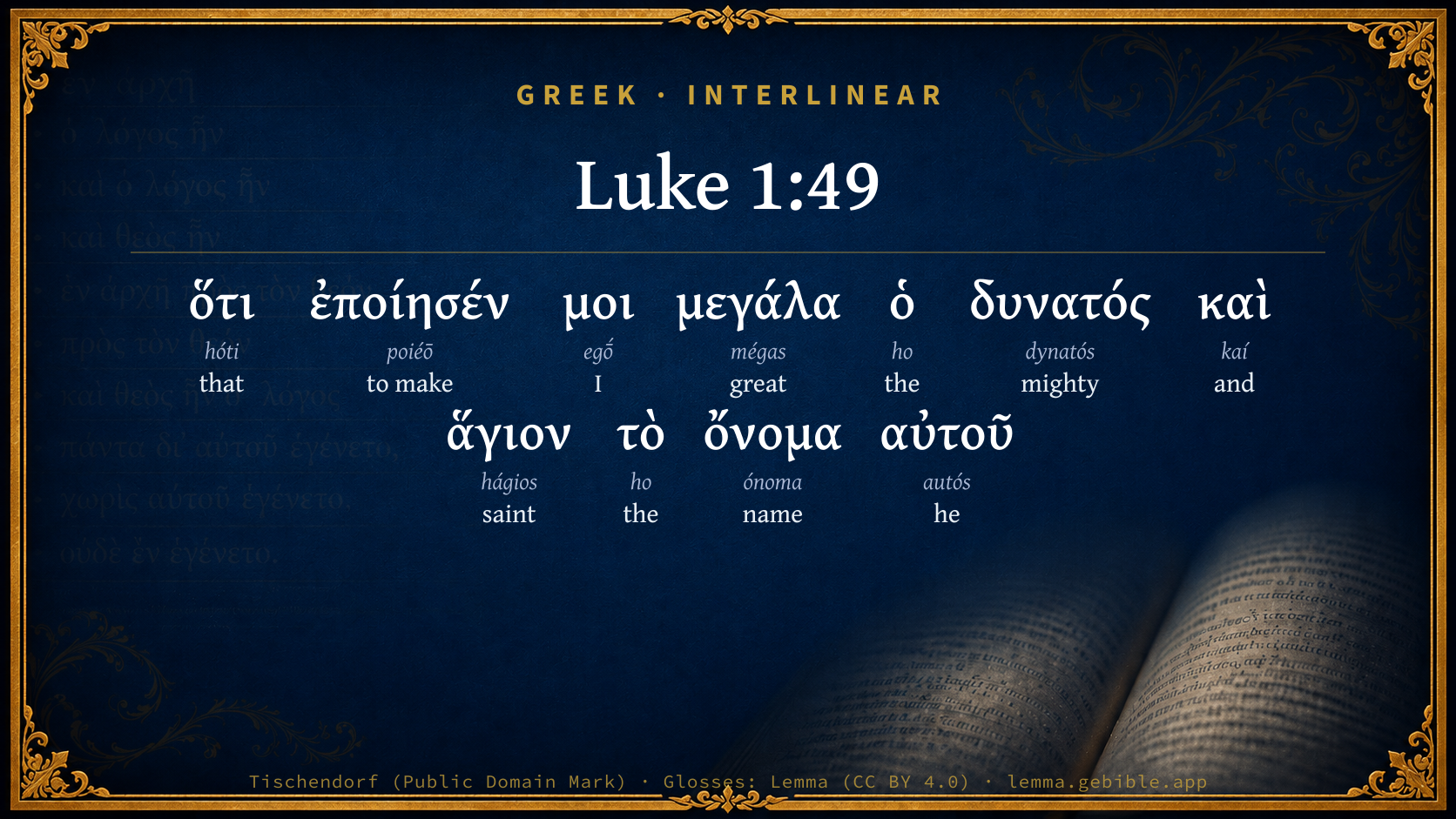
  1. ὅτι hóti G3754 “that” Conjunction
  2. ἐποίησέν poiéō G4160 “to make” Verb, Aorist, Active, Indicative, 3rd person, Singular
  3. μοι egṓ G1473 “I” Personal pronoun, 1st person, Dative, Singular
  4. μεγάλα mégas G3173 “great” Adjective, Accusative, Plural, Neuter
  5. ὁ ho G3588 “the” Article, Nominative, Singular, Masculine
  6. καὶ kaí G2532 “and” Conjunction
  7. ἅγιον hágios G40 “saint” Adjective, Accusative, Singular, Neuter
  8. τὸ ho G3588 “the” Article, Nominative, Singular, Neuter
  9. ὄνομα ónoma G3686 “name” Noun, Nominative, Singular, Neuter
  10. αὐτοῦ autós G846 “he” Personal pronoun, Genitive, Singular, Masculine

About this verse

These counts appear in no published source. They are computed here, from the morphology-tagged text and Lemma’s own curated glosses. What Lemma adds →

11
words
10
distinct lemmas
Gospels
section

Shared distinctive vocabulary

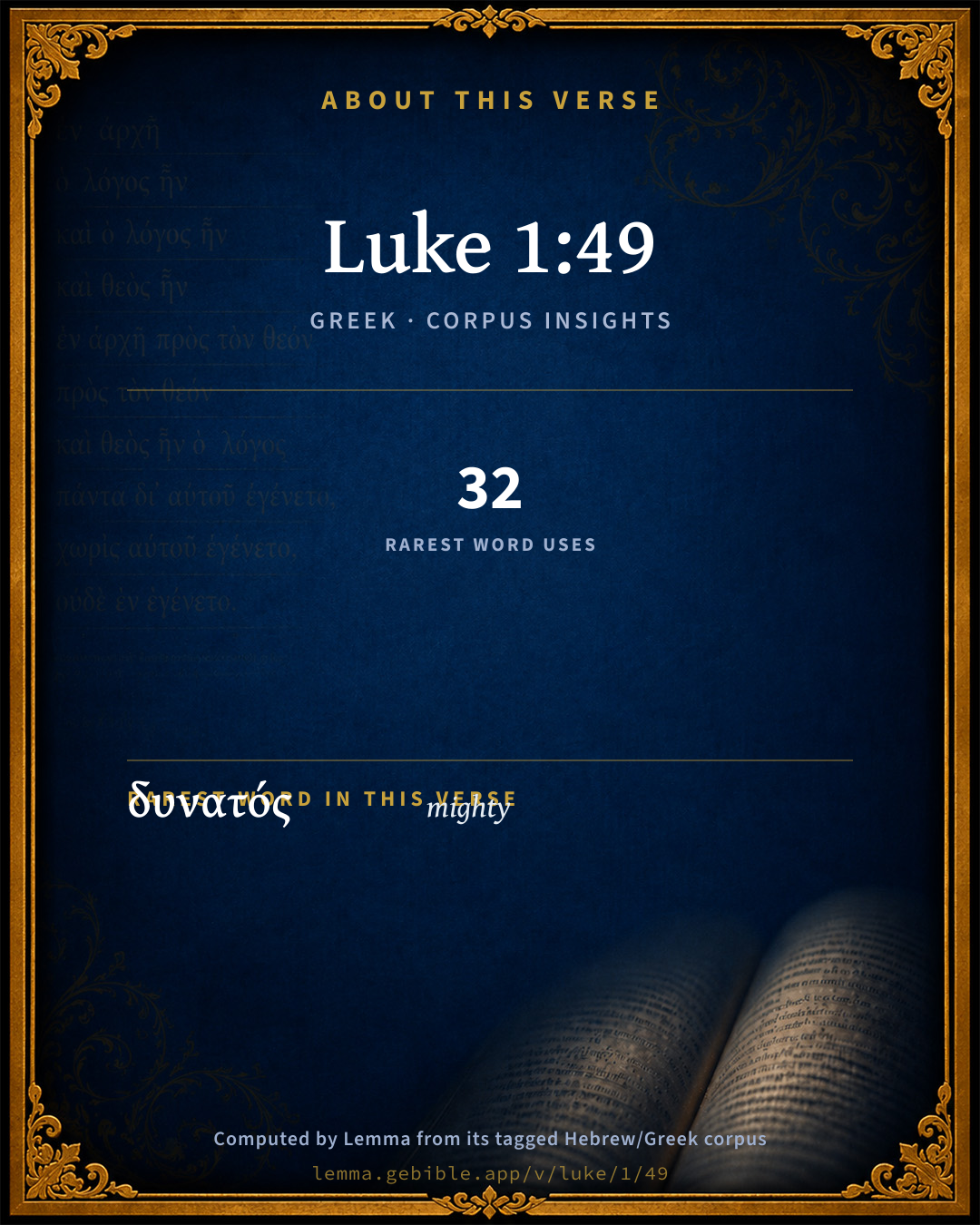
δυνατός mighty G1415 occurs in 32 verses of the Greek New Testament. Also found in:

Repetition

A word recurs within this verse:

Cross-references

19

Topical passages linked to Luke 1:49 in the Treasury of Scripture Knowledge — connected by theme and wording, ordered by reader-vote popularity; previews shown in the World English Bible.

  • Psalms 111:9 He has sent redemption to his people. He has ordained his covenant forever. His name is holy and awesome!
  • Psalms 126:2–3 Then our mouth was filled with laughter, And our tongue with singing. Then they said among the nations, "Yahweh has done great things for them."
  • Ephesians 3:20 Now to him who is able to do exceedingly abundantly above all that we ask or think, according to the power that works in us,
  • Psalms 99:3 Let them praise your great and awesome name. He is Holy!
  • Genesis 17:1 When Abram was ninety-nine years old, Yahweh appeared to Abram, and said to him, "I am God Almighty. Walk before me, and be blameless.
  • Jeremiah 10:6 There is none like you, Yahweh; you are great, and your name is great in might.
  • Revelation 15:4 Who wouldn't fear you, Lord, And glorify your name? For you only are holy. For all the nations will come and worship before you. For your righteous acts have been revealed."
  • Isaiah 57:15 For thus says the high and lofty One who inhabits eternity, whose name is Holy: I dwell in the high and holy place, with him also who is of a contrite and humble spirit, to revive the spirit of the humble, and to revive the heart of the contrite.
  • Exodus 15:11 Who is like you, Yahweh, among the gods? Who is like you, glorious in holiness, Fearful in praises, doing wonders?
  • Psalms 99:9 Exalt Yahweh, our God. Worship at his holy hill, For Yahweh, our God, is holy!
  • 1 Samuel 2:2 There is none holy as Yahweh; For there is none besides you, Neither is there any rock like our God.
  • Jeremiah 20:11 But Yahweh is with me as an awesome mighty one: therefore my persecutors shall stumble, and they shall not prevail; they shall be utterly disappointed, because they have not dealt wisely, even with an everlasting dishonor which shall never be forgotten.
  • Psalms 24:8 Who is the King of glory? Yahweh strong and mighty, Yahweh mighty in battle.
  • Psalms 71:19–21 Your righteousness also, God, reaches to the heavens; You have done great things. God, who is like you?
  • Isaiah 6:3 One called to another, and said, "Holy, holy, holy, is Yahweh of Hosts! The whole earth is full of his glory!"
  • Mark 5:13 At once Jesus gave them permission. The unclean spirits came out and entered into the pigs. The herd of about two thousand rushed down the steep bank into the sea, and they were drowned in the sea.
  • Revelation 4:8 The four living creatures, each one of them having six wings, are full of eyes around about and within. They have no rest day and night, saying, "Holy, holy, holy, holy, holy, holy, holy, holy, holy is the Lord God, the Almighty, who was and who is and who is to come!"
  • Isaiah 1:24 Therefore the Lord, Yahweh of Hosts, The Mighty One of Israel, says: "Ah, I will get relief from my adversaries, And avenge myself of my enemies;
  • Isaiah 63:1 Who is this who comes from Edom, with dyed garments from Bozrah? this who is glorious in his clothing, marching in the greatness of his strength? I who speak in righteousness, mighty to save.

Cross-references courtesy of OpenBible.info (CC BY 4.0).

Commentary

Notes on Luke 1:49 from classic Christian and Jewish commentators (each source and its license shown beneath its notes). The classic Christian expositions comment on the surrounding passage and are grouped to its opening verse, so a note may address several verses; the Jewish commentaries on the Tanakh (Rashi and others) are per-verse, so they appear only where the commentator wrote on this verse.

Lemma curates 59 commentaries, every one of them public domain or Creative Commons licensed, each selected and text-cleaned for this edition rather than reprinted as found. About our sources →

Joseph Benson's Commentary

Luk 1:49-51. He that is mighty — Beyond all our conceptions, even the Almighty God, to whom this strange event is not only possible, but easy; hath done to me great things — Miracles, as the words μεγαλα and μεγαλεια often signify in the Old Testament, being applied by the LXX. to the miracles wrought in Egypt, and in the wilderness. Probably, Mary had now in her eye her miraculous conception of the Messiah, being astonished that God should have chosen her, a person of the meanest condition, to be his mother. Yet from her belief of the divine perfections, she was convinced that all was done in wisdom and truth, and therefore she adds, and holy is his name. And his mercy is on them that fear him — It always has been so; he has ever looked on them with an eye of peculiar favour, who have looked up to him with an eye of filial fear. But he hath manifested his mercy, so as he had never done before, in sending his Son to bring in an everlasting righteousness, and work out an everlasting salvation for them that fear him, and this from generation to generation: for there are gospel privileges, transmitted by entail, and intended for perpetuity. Those that fear God, as their Creator and Judge, are encouraged to hope for mercy from him, through their Mediator and Advocate; and in him mercy is settled upon all such, while the world stands. In Christ he keepeth mercy for thousands. He hath showed strength with his arm — That is, he hath shown the exceeding greatness of his power. She speaks prophetically of those things as already done which God was about to do by the Messiah. Grotius observes, that God’s great power is represented by his finger, his greater by his hand, and his greatest by his arm. The production of lice was by the finger of God, Exo 7:18; and the other miracles in Egypt were done by his right hand, Exo 3:20. But the destruction of Pharaoh and his host in the Red Sea was brought to pass by his arm, Exo 15:16. Wherefore the virgin’s meaning is, that in this dispensation of his providence, God mightily manifested his sovereign power. He hath scattered the proud, &c. — In the course of God’s providence it is his usual method to cross the expectations of men, and proceed quite otherwise than they promise themselves. Proud men expect with ease to effect their purposes, and carry all before them; but he scatters them in the imagination of their hearts; breaks their measures, blasts their projects; nay, and brings them low by those very counsels, with which they thought to advance and establish themselves. Some read this clause, He hath scattered those that prided themselves in the imagination, or thought, of their heart. But the words will better bear the translation which we give them, which certainly expresses a more emphatical sense, and one “peculiarly applicable to the gospel, in which God doth not only cast down imaginations and every high thing, &c., (2Co 10:5,) by the humbling scheme of his recovering grace, but hath remarkably confounded his most insolent enemies in their own most elaborate projects, and established his sacred cause by the violent attempts they have made to suppress it: compare Psa 2:1-3; a triumph of divine wisdom, of which succeeding ages furnish out memorable and frequent instances.” — Doddridge.

Joseph Benson's Commentary on the Old and New Testaments (1811–1818) — public domain. Text from a community e-Sword module.

Bengel's Gnomon

Johann Albrecht Bengel

Luk 1:49-50, Καὶ, and) He [that is mighty, etc.], Whose name is holy, and Whose mercy, etc. [but Engl. Vers. “And holy is His name, and His mercy,” etc.] For these three clauses are joined together by the and, repeated. So the Hebrew relative, אשר, is often not expressed but understood. It is not until Luk 1:51 that the new paragraph begins.

Bengel's Gnomon of the New Testament — English translation (T&T Clark, Edinburgh, 1860) — public domain. Text from a community e-Sword module.

Meyer's Critical & Exegetical Commentary

Heinrich August Wilhelm Meyer

Luk_1:49 f. Because the Mighty One did to me great things, in making me the mother of the Messiah.

καὶ ἅγιον κ.τ.λ.] not for οὗ τὸ ὄν. ἅγιον (Luther, Castalio, Bengel, and many, including Kuinoel), but lyrically unperiodic: and holy is His name! Hence, also, a full stop is not to be placed after δυνατός (Lachmann, Tischendorf, Bleek), but only a comma. To the might the holiness attaches itself.

εἰς γενεὰς κ. γενεάς] Comp. Isa_51:8; 1Ma_2:61; Test. XII. Patr. p. 568: unto generations and generations, i.e. ever onward from one generation to the following. The Recepta εἰς γενεὰς γενεῶν would mean: to the uttermost generations; these would be conceived of as forming a superlative. Analogous Greek superlative designations, especially from the dramatic writers, may be seen in Brunck, ad Oedip. R. 466; Bernhardy, p. 154.

τοῖς φοβουμ. αὐτ.] sc. ἐστι. It denotes the essence of theocratic piety. Comp. Exo_20:6; Psa_103:7.

Meyer — Critical and Exegetical Commentary on the New Testament — English translation by Peter Christie, edited by Frederick Crombie (T&T Clark, 1880) — public domain. Text from a community e-Sword module.

Adam Clarke's Commentary

Verse 49. He that is mighty hath done to me great things] Or, miracles, μεγαλεια. As God fills her with his goodness, she empties herself to him in praises; and, sinking into her own nothingness, she ever confesses that God alone is all in all.

Holy is his name] Probably the word which Mary used was חסד chesed, which though we sometimes translate holy, see Ps 86:2; Ps 145:17, yet the proper meaning is abundant goodness, exuberant kindness; and this well agrees with the following clause.

Adam Clarke's Commentary on the Bible (1810–1826) — public domain. Text from a community e-Sword/MySword module.

The Cambridge Bible for Schools and Colleges

gen. ed. J. J. S. Perowne

49. he that is mighty] El Shaddai, Job_8:3; also Gibbôr, Psa_24:8. See Pearson On the Creed, Art. i.

great things] Gedolôth, Psa_71:21; Psa_126:3.

holy is his name] Psa_111:9; “Thou only art holy,” Rev_15:4. Shem, ‘name,’ is often a reverent periphrasis in Hebrew for God Himself. Psa_91:14; 2Ch_6:20, &c.

The Cambridge Bible for Schools and Colleges (gen. ed. J. J. S. Perowne; Cambridge University Press, 1878–1918) — public domain. Text from a community e-Sword module.

John Gill's Exposition

For he that is mighty hath done to me great things,.... With respect to the incarnation of Christ, a new, a great, and unheard of thing; in causing her, though a virgin, to conceive; and also to bear such a Son, who should be called Jesus, a Saviour, Immanuel, God with us; and who was no other than the mighty God, the everlasting Father, and Prince of Peace: wherefore she describes God the author of it, by a proper periphrasis of him, "he that is mighty"; since this was a work of almighty power, and very justly adds,

and holy is his name: seeing this was brought about without any impurity, through the overshadowing influence of the Holy Ghost; whereby the human nature was preserved from the infection of sin, was sanctified, and fit to be united to the Son of God, and to be a sacrifice for the sins of his people. This may also have regard to the great things God had done for her in a spiritual sense; in the choice of her to eternal life, in the redemption of her by the Messiah, and in her regeneration and sanctification; wherein God had displayed his sovereign grace and goodness, and his almighty power, in a way consistent with his justice and holiness.

John Gill's Exposition of the Whole Bible (1746–1763) — public domain (CC PDM 1.0). Text via the HelloAO Bible API.

Trapp's Complete Commentary

John Trapp

49 For he that is mighty hath done to me great things; and holy is his name.

Ver. 49. He that is mighty] האל The mighty strong God, οο δυνατος..

Hath done great things for me] No small things can fall from so great a hand. He gives like himself.

And holy is his name] God that is holy, is to be sanctified in holiness, Isa 5:16, when men see their children especially (as here) the work of God’s hands, Isa 29:23.

John Trapp, A Commentary or Exposition upon All the Books of the Old and New Testament (1647–1656) — public domain. Text from a community e-Sword module.

Albert Barnes' Notes on the Bible

He that is mighty - God.

Hath done to me great things - Hath conferred on me great favors and distinguished mercies.

And holy is his name - This is an expression of Mary’s feelings, desiring to bestow on God all honor and praise. As the highest honor, she declared that his “name” was “holy” - that is, that God was free from sin, injustice, and impurity. The “name” of God is often put for God Himself. The proper name of God is יהוה Yahweh, a word expressive of His “essential being,” derived from the word “to be,” Exo 3:14; Exo 6:3; Psa 83:18. That name is holy; is to be regarded as holy; and to make a common or profane use of it is solemnly forbidden, Exo 20:7.

Albert Barnes' Notes on the Bible (1834–1885) — public domain. Text from a community e-Sword/MySword module.

Matthew Poole's English Annotations

That which is observable both in this verse, and in this whole song, is how the blessed virgin attributes all to God, and ascribes nothing to herself, or any merits of her own, much like unto her father David. Psa 115:1, Not unto us, O Lord, not unto us, but unto thy name give glory, for thy mercy, and for thy truth’s sake; and herein she teacheth those generations, which she had even now said should call her blessed, how to take notice of her, viz. as one highly favoured of the Lord, one for whom God indeed had done great things, but not as one who had merited any thing at God’s hand, much less as one to whom we should pay a greater devotion than to her Son, and speak to her that she should command her Son, according to the blasphemous devotion and idolatry of the papists. Mary is very careful of giving succeeding generations any occasion from her expressions for any such superstitions.

And holy is his name: holy, that is, glorious and venerable.

His name, that is, he himself is glorious and holy, far above the conception and comprehension of poor creatures.

Matthew Poole's English Annotations on the Holy Bible (1683–1685) — public domain. Text from a community e-Sword/MySword module.

The Pulpit Commentary

Ver. 49, 50. For he that is mighty hath done to me great things; and holy is his Name. And his mercy is on them that fear him from generation to generation. In this strophe, the second division of the hymn of praise, she glorifies three of the principal Divine attributes God"s power, his holiness, and his mercy. His power or might, alluding to the words of the angel (verse 85), "The power of the Highest shall overshadow thee." Surely in all the records of the Lord"s works since the world"s creation, his might had been never shown as it was now about to be manifest in her. His holiness had been displayed to her in the way in which the mighty acts of ineffable love had been carried out. His mercy: this attribute of God came home with intense power to the heart of the Jewish girl, into which God"s protecting Spirit was shining with so clear a light. She saw something of the great redemption mystery which was then in so strange a way developing itself.

Vers. 49-55. God revealed in Jesus Christ.

We see much more in Mary"s words than the thoughts which were present to her mind at the time of utterance; for we stand well within that kingdom of God of which she stood on the threshold. To the holy confidence she entertained in God"s goodness to all Israel, and especially to herself up to that hour, there was added a reverent wonder as to this new manifestation of Divine mercy. So she sang of the power and the holiness, the mercy and the faithfulness, of Jehovah. Through bitterest experiences (Luk_2:35) she passed into the light of truth and the rest of God, and now she sees how much greater occasion she had than she knew at the moment to sing in such strains of the character of God. We look at these Divine attributes as expressed in the coming of the Savior.

I HIS DIVINE POWER. "He that is mighty hath done... great things" (verse 49); "He hath showed strength with his arm" (verse 51). God"s power is very gloriously manifested in the formation and furniture of this earthly home, in the creation of successive generations of mankind, in the providential government of the world, including the mastery of all physical forces and the control of all human energies; but by far the most wonderful exhibition of Divine power is in the redemption of the world by Jesus Christ. To exert a transforming power on one intelligent, free, disloyal spirit; to conquer a rebellious, to win an estranged, soul; to raise a fallen nature, and uplift it to a height of holy excellence; to make that which had lowered itself to the basest fit for the society of the holiest in heaven; to do this not in one individual case but in the case of "ten thousand times ten thousand;" to introduce a power which can elevate an ennoble families, communities, nations; which is changing the character and condition of the entire race; this is the power of God," this is the doing of him "that is mighty.

II HIS DIVINE HOLINESS. "Holy is his Name" (verse 49); "He hath scattered the proud," etc. (verses 51, 52). God"s holiness is shown in his providential interpositions, in his humbling the haughty, in his scattering the cruel and the profane, in his raising the lowly and the pure and the true. Thus he has been revealing his righteousness in every nation and in every age. But nowhere does his holiness appear as it is seen in

(1) the mission of his Son, who came to put away sin; in

(2) the life and language of his Son, who illustrated all purity and condemned all iniquity; in

(3) the death of his Son, who by the sacrifice of himself uttered God"s thought and feeling about sin as nothing else could speak it, and struck it such a death-blow as nothing else could strike it.

III HIS DIVINE MERCY. (Verse 50) Many are the testimonies borne by Old Testament saints to the pity, the patience, the mercy, of the Lord. But in Jesus Christ in his spirit, in his example, and more particularly in his redeeming death and work is the manifestation of the grace of God. "God commendeth his love toward us, in that, while we were yet sinners, Christ died for us." In the gospel of Christ the pity, the patience, the magnanimity, of God rise to their fullest height, reach to their noblest breadth.

IV HIS DIVINE FAITHFULNESS. (Verses 53-55) God, who made us for himself and for truth and righteousness, who has made our hearts to hunger for the highest good, does not leave us to pine and perish; he fills us with the "rich provision" of his truth and grace in Jesus Christ. "As he spake unto our fathers," so he has done, granting not only such a One as they hoped for, but One that has been to the whole race of man a glorious Redeemer, in whom all nations are blessed with a blessing immeasurably transcending the most sanguine hopes of his ancient people.

1. Let our souls be so filled with the greatness and the goodness of God as thus revealed, that we shall break forth into grateful song, magnifying his Name.

2. Let us return at once to him, if we yet remain at a distance from him; for we have no right to hope, and no reason to expect, that he will ever manifest himself to us in more attractive features than as we see him in the Son that was born of the lowly Virgin. C.

The Pulpit Commentary (1880–1919), ed. H.D.M. Spence-Jones & Joseph S. Exell — public domain. Text from a community e-Sword module.

Cambridge Greek Testament for Schools and Colleges

49. μεγάλα. אBDL La[8] Ti[9], ‘great things’ R. V[10], Vulg[11] magna. μεγαλεῖα may be taken from Psa 71:19.

[8] La. Lachmann.

[9] Ti. Tischendorf.

[10] R. V. Revised Version.

[11] Vulg. Vulgate.

49. μεγάλα. gedolôth, Psa 71:21; Psa 126:3.

ὁ δυνατός. El Shaddai, Job 8:3; also Gibbôr, Psa 24:8. See Pearson On the Creed, Art. i.

ἅγιον τὸ ἔνομα αὐτοῦ. Psa 111:9; “Thou only art holy,” Rev 15:4. Shem, ‘name,’ is often a reverent periphrasis in Hebrew for God Himself. Lev 24:11; Lev 24:16; Psa 91:14; 2Ch 6:20, &c.

Cambridge Greek Testament for Schools and Colleges (Cambridge University Press, 1896; 21 vols, various authors incl. Carr, Maclear, Plummer, Farrar, Lumby, Moule, M. R. James, Simcox) — public domain. Text from a community e-Sword module.

International Critical Commentary

49. ὅτι ἐποίησέν μοι μεγάλα ὁ δυνατός. Here the second strophe begins. The reading μεγαλεῖα may come from Act 2:11: comp. ἃ ἐποίησας μεγαλεῖα (Ps. 70:19). With ὁ δυνατός comp. δύναμις Ὑψίστου (ver. 35) and Κύριος κραταιὸς καὶ δυνατός (Ps. 23:8). In LXX δυνατός is very common, but almost invariably of men. After both δυνατός and αὐτοῦ we should place a colon. The clause καὶ ἅγιον τὸ ὄνομα αὐτοῦ is a separate sentence, neither dependent upon the preceding ὅτι, nor very closely connected with what follows.

International Critical Commentary — older volumes (1896–1929), various authors — public domain. Text from a community e-Sword module.

Lesson kit

Teaching starters — assembled from the data on this page, not authored interpretation. Every prompt links to the verse data it draws on. Edit before teaching.

Luke, in the Gospels, opens this verse with 11 words (10 distinct Greek lemmas). Its most distinctive word is dynatós (“mighty”). A historical commentator’s framing appears above. Read the whole chapter for the surrounding context.

Discussion questions

  1. How does “mighty” (dynatós) shape what this verse is saying?
  2. How does Matthew 19:26, which shares the word «mighty», read alongside this verse?
  3. What does the repetition of “the” (2× in this one verse) do in this verse?
  4. These translations render this verse differently; the difference is in the English rendering, not the original. What questions does that raise?
  5. Compare how Joseph Benson's Commentary and Bengel's Gnomon read this verse. Where do they agree or differ?

Things to notice

Reading settings

Reading text

Shown beneath each verse's original-language words.

Old Testament
Old Testament edition

Read the OT as the Masoretic Hebrew (MT) or the Greek Septuagint (LXX).

English shown for the Greek Septuagint (in the Hebrew ↔ Greek comparison).

Comparing translations? Open the Compare panel on any verse page to stack up to four side by side.