
Luke 3:14

Greek (Tischendorf 8th ed.) Luke 3:14 appears in the Greek New Testament. The text above is from the Tischendorf 8th edition. Each word links to its Strong’s number and a concise gloss. Click any word for its full Thayer’s Greek Lexicon entry.
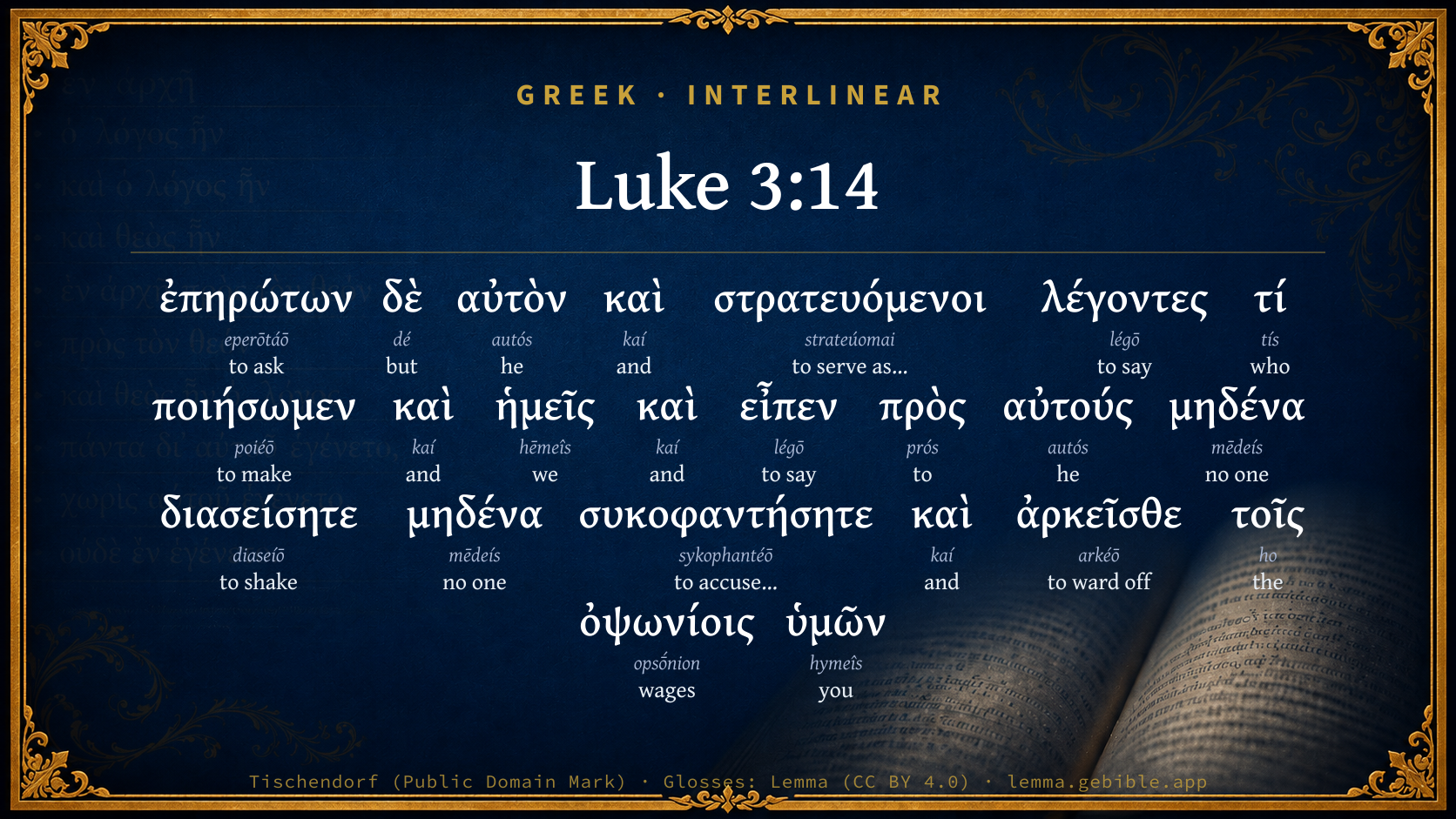
Download image
Cite this verse

Luke 3:14 (World English Bible). Public Domain. Lemma interlinear Bible study tool, https://lemma.gebible.app/v/luke/3/14.

Show BibTeX & RIS
BibTeX
RIS
English Translation
Soldiers also asked him, saying, "What about us? What must we do?" He said to them, "Extort from no one by violence, neither accuse anyone wrongfully. Be content with your wages."
World English Bible · Public Domain
Highlights
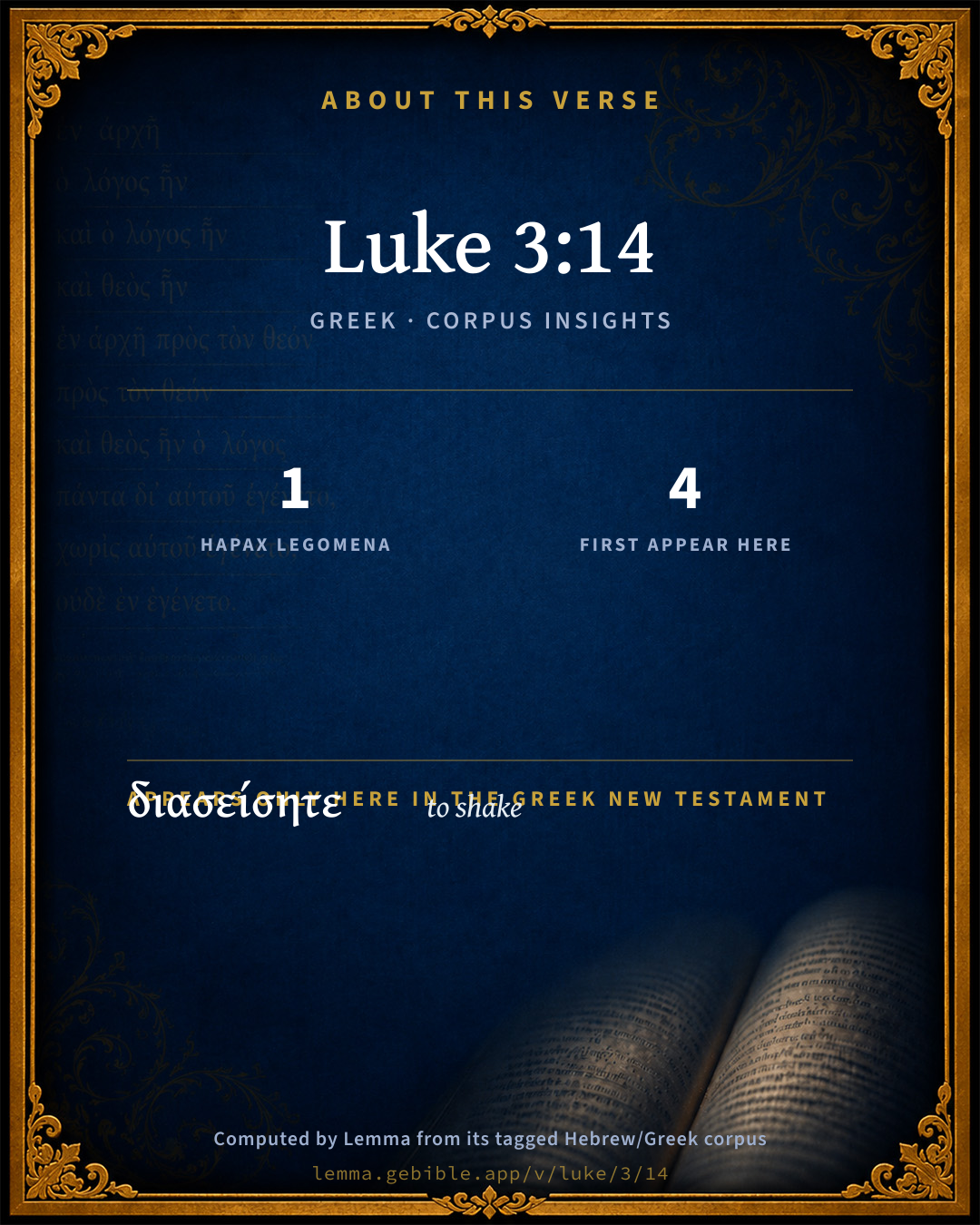
  • 1 hapax legomenon — only here in the Greek New Testament
  • 4 first appearances in the Greek New Testament
Full analysis ↓
Download a study sheet

One document with this verse’s original text, its word-by-word gloss line, the meaning frame, cross-references with their text, attributed commentary, and full source and license credits — printable, and it pastes into notes with its structure intact.

This verse Autodidact and up

Study sheet (.html) Plain text (.txt)

A passage Seminary Student

Up to 50 verses in one chapter. A passage sheet keeps up to 6 commentary sources and 12 cross-references per verse, in the order this page ranks them, and says so on the sheet whenever that leaves anything out. Ask for a single verse and you get the Autodidact verse sheet above.

Everything on this page stays free to read, with no account — the sheet is a download of what is already on screen, not access to it.

Want to remove ads? Support Godless Engineer
Compare translations 3

The same verse in 3 English versions, stacked beneath the original-language interlinear above. Click any original word for its lexicon entry.

Each is an independent rendering of the whole verse — the interlinear is not word-aligned to these translations.

Highlighted words mark where these versions differ — a whole-verse word diff, not a word-by-word alignment.

  • World English Bible Public Domain
    Soldiers also asked him, saying, "What about us? What must we do?" He said to them, "Extort from no one by violence, neither accuse anyone wrongfully. Be content with your wages."
  • King James Version Public Domain
    And the soldiers likewise demanded of him, saying, And what shall we do? And he said unto them, Do violence to no man, neither accuse any falsely; and be content with your wages.
  • unfoldingWord Literal Text CC BY-SA 4.0
    Then soldiers also asked him, saying, “And us, what should we do?” And he said to them, “Take nothing by force, and do not accuse falsely, and be contented with your wages.”

unfoldingWord Literal Text — © unfoldingWord, licensed CC BY-SA 4.0. Word-aligned USFM3 via Door43 (git.door43.org/unfoldingWord/en_ult).

Versions to compare (up to 4)

3 of 4 selected

Show all 19 translations

Every available English version of this verse, each an independent rendering of the whole verse.

  • World English Bible Public Domain
    Soldiers also asked him, saying, "What about us? What must we do?" He said to them, "Extort from no one by violence, neither accuse anyone wrongfully. Be content with your wages."
  • Berean Standard Bible Public Domain
    Then some soldiers asked him, “And what should we do?” “Do not take money by force or false accusation,” he said. “Be content with your wages.”
  • Majority Standard Bible Public Domain
    Then some soldiers asked him, “And what should we do?” “Do not take money by force or false accusation,” he said. “Be content with your wages.”
  • King James Version Public Domain
    And the soldiers likewise demanded of him, saying, And what shall we do? And he said unto them, Do violence to no man, neither accuse any falsely; and be content with your wages.
  • American Standard Version (1901) Public Domain
    And soldiers also asked him, saying, And we, what must we do? And he said unto them, Extort from no man by violence, neither accuse `any one' wrongfully; and be content with your wages.
  • Revised Version (1885) Public Domain
    And soldiers also asked him, saying, And we, what must we do? And he said unto them, Do violence to no man, neither exact anything wrongfully; and be content with your wages.
  • Geneva Bible (1599) Public Domain
    The souldiers likewise demaunded of him, saying, And what shall we doe? And he saide vnto them, Doe violence to no man, neither accuse any falsely, and be content with your wages.
  • Douay-Rheims (1899) Public Domain
    And the soldiers also asked him, saying: And what shall we do? And he said to them: Do violence to no man; neither calumniate any man; and be content with your pay.
  • Young's Literal Translation Public Domain
    And questioning him also were those warring, saying, `And we, what shall we do?' and he said unto them, `Do violence to no one, nor accuse falsely, and be content with your wages.'
  • Literal Standard Version CC BY-SA 4.0
    And also questioning him were those warring, saying, “And we, what will we do?” And he said to them, “Do violence to no one, nor accuse falsely, and be content with your wages.”
  • Unlocked Literal Bible CC BY-SA 4.0
    Some soldiers also asked him, saying, “What about us? What must we do?” He said to them, “Do not take money from anyone by force, and do not accuse anyone falsely. Be content with your wages.”
  • unfoldingWord Literal Text CC BY-SA 4.0
    Then soldiers also asked him, saying, “And us, what should we do?” And he said to them, “Take nothing by force, and do not accuse falsely, and be contented with your wages.”
  • Darby Bible Public Domain
    And persons engaged in military service also asked him saying, And we, what should we do? And he said to them, Oppress no one, nor accuse falsely, and be satisfied with your pay.
  • World Messianic Bible Public Domain
    Soldiers also asked him, saying, “What about us? What must we do?” He said to them, “Extort from no one by violence, neither accuse anyone wrongfully. Be content with your wages.”
  • Webster's Bible Public Domain
    And the soldiers likewise asked him, saying, And what shall we do? And he said to them, Do violence to no man, neither accuse any falsely, and be content with your wages.
  • Free Bible Version CC BY-SA 4.0
    “What about us?” some soldiers asked. “What should we do?” “Don't demand money with threats of violence. Don't make accusations that are untrue. Be satisfied with your wages,” he replied.
  • Bible in Basic English Public Domain
    And men of the army put questions to him, saying, And what have we to do? And he said to them, Do no violent acts to any man, and do not take anything without right, and let your payment be enough for you.
  • Text-Critical English NT CC BY 4.0
    Then some soldiers asked him, “And what should we do?” He said to them, “Do not extort money from anyone by threats or false accusations, and be content with your wages.”
  • Tyndale New Testament (1534) Public Domain
    The soudyoures lyke wyse demaunded of hym sayinge: and what shall we do? And he sayde to them: Do violence to noo man: nether trouble eny man wrongfully: but be content with youre wages.

Literal Standard Version (2020), Covenant Press — licensed CC BY-SA 4.0. Text via the HelloAO Bible API (eBible.org). Unlocked Literal Bible (unfoldingWord) — licensed CC BY-SA 4.0. Text via the HelloAO Bible API (eBible.org). unfoldingWord Literal Text — © unfoldingWord, licensed CC BY-SA 4.0. Word-aligned USFM3 via Door43 (git.door43.org/unfoldingWord/en_ult). Free Bible Version, Dr. Jonathan Gallagher — licensed CC BY-SA 4.0. Text via the HelloAO Bible API (eBible.org).

Word by word

More ways to search: Search by grammar → Find every occurrence → Compare this word →

Practice this passage: Drill this verse → Learn its vocabulary →

διασείσητε
diaseíō
G1286
“to shake”
Verb, Aorist, Active, Subjunctive, 2nd person, Plural
Part of Speech
Verb
Tense
Aorist
Voice
Active
Mood
Subjunctive
Person
2nd person
Number
Plural
Full Thayer's Definition

Origin: from G1223 and G4579

TDNT: None

1. to shake thoroughly 2. to make to tremble 3. to terrify 4. to agitate 5. to extort from one by intimidation money or other property
  1. ἐπηρώτων eperōtáō G1905 “to ask” Verb, Imperfect, Active, Indicative, 3rd person, Plural
  2. δὲ dé G1161 “but” Conjunction
  3. αὐτὸν autós G846 “he” Personal pronoun, Accusative, Singular, Masculine
  4. καὶ kaí G2532 “and” Conjunction
  5. στρατευόμενοι strateúomai G4754 “to serve as soldier” Verb, Present, Middle, Participle, Nominative, Plural, Masculine
  6. λέγοντες légō G3004 “to say” Verb, Present, Active, Participle, Nominative, Plural, Masculine
  7. τί tís G5101 “who” Interrogative pronoun, Accusative, Singular, Neuter
  8. ποιήσωμεν poiéō G4160 “to make” Verb, Aorist, Active, Subjunctive, 1st person, Plural
  9. καὶ kaí G2532 “and” Conjunction
  10. ἡμεῖς hēmeîs G2249 “we” Personal pronoun, 1st person, Nominative, Plural
  11. καὶ kaí G2532 “and” Conjunction
  12. εἶπεν légō G3004 “to say” Verb, Aorist, Active, Indicative, 3rd person, Singular
  13. πρὸς prós G4314 “to” Preposition
  14. αὐτούς autós G846 “he” Personal pronoun, Accusative, Plural, Masculine
  15. μηδένα mēdeís G3367 “no one” Adjective, Accusative, Singular, Masculine, Negative
  16. μηδένα mēdeís G3367 “no one” Adjective, Accusative, Singular, Masculine, Negative
  17. συκοφαντήσητε sykophantéō G4811 “to accuse wrongfully” Verb, Aorist, Active, Subjunctive, 2nd person, Plural
  18. καὶ kaí G2532 “and” Conjunction
  19. ἀρκεῖσθε arkéō G714 “to ward off” Verb, Present, Passive, Imperative, 2nd person, Plural
  20. τοῖς ho G3588 “the” Article, Dative, Plural, Neuter
  21. ὀψωνίοις opsṓnion G3800 “wages” Noun, Dative, Plural, Neuter
  22. ὑμῶν hymeîs G5210 “you” Personal pronoun, 2nd person, Genitive, Plural

About this verse

These counts appear in no published source. They are computed here, from the morphology-tagged text and Lemma’s own curated glosses. What Lemma adds →

23
words
17
distinct lemmas
Gospels
section

Notable vocabulary

1 hapax legomenon — a word that appears only here in the entire Greek New Testament:

  • διασείσητε to shake G1286

First appearance in Scripture

These words make their first canonical appearance in the Greek New Testament here:

  • στρατευόμενοι to serve as soldier G4754
  • διασείσητε to shake G1286
  • συκοφαντήσητε to accuse wrongfully G4811
  • ὀψωνίοις wages G3800

Shared distinctive vocabulary

συκοφαντήσητε to accuse wrongfully G4811 occurs in 2 verses of the Greek New Testament. Also found in:
Repetition

Words recur within this verse:

  • λέγοντες to say G3004 ×2
  • μηδένα no one G3367 ×2
  • καὶ and G2532 ×4
  • αὐτὸν he G846 ×2

Cross-references

11

Topical passages linked to Luke 3:14 in the Treasury of Scripture Knowledge — connected by theme and wording, ordered by reader-vote popularity; previews shown in the World English Bible.

  • Hebrews 13:5–6 Be free from the love of money, content with such things as you have, for he has said, "I will in no way leave you, neither will I in any way forsake you."
  • Exodus 20:16 "You shall not give false testimony against your neighbor.
  • Exodus 23:1 "You shall not spread a false report. Don't join your hand with the wicked to be a malicious witness.
  • Philippians 4:11 Not that I speak in respect to lack, for I have learned in whatever state I am, to be content in it.
  • 1 Timothy 6:8–10 But having food and clothing, we will be content with that.
  • Leviticus 19:11 "'You shall not steal; neither shall you deal falsely, nor lie to one another.
  • Romans 13:9–10 For the commandments, "You shall not commit adultery," "You shall not murder," "You shall not steal," "You shall not give false testimony," "You shall not covet," and whatever other commandments there are, are all summed up in this saying, namely, "You shall love your neighbor as yourself."
  • Luke 19:8 Zacchaeus stood and said to the Lord, "Behold, Lord, half of my goods I give to the poor. If I have wrongfully exacted anything of anyone, I restore four times as much."
  • Philippians 2:15 that you may become blameless and harmless, children of God without blemish in the midst of a crooked and perverse generation, among whom you are seen as lights in the world,
  • Titus 2:3 and that older women likewise be reverent in behavior, not slanderers nor enslaved to much wine, teachers of that which is good;
  • Revelation 12:10 I heard a loud voice in heaven, saying, "Now is come the salvation, the power, and the Kingdom of our God, and the authority of his Christ; for the accuser of our brothers has been thrown down, who accuses them before our God day and night.

Cross-references courtesy of OpenBible.info (CC BY 4.0).

Commentary

Notes on Luke 3:14 from classic Christian and Jewish commentators (each source and its license shown beneath its notes). The classic Christian expositions comment on the surrounding passage and are grouped to its opening verse, so a note may address several verses; the Jewish commentaries on the Tanakh (Rashi and others) are per-verse, so they appear only where the commentator wrote on this verse.

Lemma curates 59 commentaries, every one of them public domain or Creative Commons licensed, each selected and text-cleaned for this edition rather than reprinted as found. About our sources →

The Biblical Illustrator

Joseph S. Exell

Luk_3:14

And the soldiers likewise

The lawfulness of arms

The common argument, founded on this for the lawfulness of the military profession, seems unanswerable.

It is true that war is contrary to the mild spirit of Christianity, and that the guilt of it must be always chargeable, at least on one side. But there are several professions for which there would be no use, were it not for human depravity and injustice; e.g., there would be no use for magistrates or for civil or criminal law at all, were it not for the lawless and disobedient. So, though it is often a delicate point to settle when war becomes just or necessary, its justice and necessity in some cases are beyond dispute, and therefore the employment of the soldier must, generally speaking, be a lawful one. But, to look no farther than to the authority before us, when soldiers under concern about salvation and the path of duty applied to John for direction, would that intrepid teacher have hesitated a moment, if their profession had been unlawful, to tell them so, and to exhort them to quit it immediately, whatever might have been the consequence? Instead of this, however, he tells them how to conduct themselves in it. (James Foote, M. A.)

Encouragement for soldiers

Notwithstanding the too general prevalence of impiety and immorality in the military life, there are many honourable exceptions. We read of the believing and humble centurion of Capernaum, who said that he was not worthy that Christ should come under his roof, and that if He would but speak the word his servant should be healed; which led our Lord to declare, that He had not found so great faith, no, not in Israel. We read, too, of Cornelius, a centurion of the Italian band, a devout man, who feared God with all his house, and gave much alms to the people, and prayed to God always, and to whom Peter was sent, more fully to instruct him. There is something peculiarly interesting in almost every case in which genuine religion decidedly influences the mind and conduct of a soldier. These principles must be sincere, and of considerable strength, which enable him to overcome the varied temptations with which he is beset. The trials of his physical and mental courage have been severe, and his opportunities of observation have been extensive. The result of all this is the obvious, and, in the eye of the enlightened Christian, the very adorning and engaging, union of frankness with caution, of complaisance with faithfulness, of meekness with manliness, and of the knowledge of the world, from which, however, he is separated, with the knowledge of God, in which he continues to grow, and under the influence and in the comfort of which he is prepared, if it be the will of God, to live, and equally prepared, if it be the will of God, to die. Let no soldier be so infatuated as to imagine, that his profession will be sustained as a satisfactory excuse for his impiety, when he comes to stand before the judgment-seat of God: for whatever be the difficulties in his way, he is offered Divine aid in proportion to these difficulties, if he apply for it. Let no soldier imagine that, because he is a soldier, irreligion, or profane swearing, or violence, or intemperance, or licentiousness in him, can possibly be passed over, unless he exercise repentance towards God and faith towards the Lord Jesus Christ, unless he be actually reformed and converted. On the other hand, let no soldier who is in earnest about his salvation be discouraged. Let him be prepared to set at nought the profane and unhandsome sneers with which he may expect to meet. Let him study at once to live like a Christian, and to be exemplary in the duties of his profession, and then even those who affect to despise will inwardly respect him, and even in their own estimations appear small before him. (James Foote, M. A. )

Outrages by soldiers

The soldiers, so necessary as a class in all such civil constitutions as those of the East, receive advice of which the Zabtiehs, or Turkish soldier-police, of today stand in great need; especially in provinces more remote from the capital. The outrages they commit, in violence done to men and women; and the false accusations which they bring to ruin them, would scarcely be believed here; and indeed they are mostly too shocking to relate. The writer remembers a case which occurred in Cyprus while he was there, where the Zabtieh had been too brutal and fiendish in his behaviour in the house of a newly-married couple. But not daring to resist him openly, the wife had managed to cajole him into drinking heavily, and when drunk the husband stabbed him to the heart. The soldierpoliceman is an object of dread in every country village. His coming can scarcely be looked upon as anything but a calamity. In many cases--always, indeed, in actual service--it would be hard fare for him to be content with his wages, or rations. But the people with whom they are quartered, or whom they come to protect, would doubtless be glad to give peaceably out of their deep poverty enough to support the soldiers, if they might thus be relieved of their violence and false accusations. (Professor Isaac H. Hall.)

Disastrous result of a false report

I have read that a foolish young English clerk--fond of practical jokes--once said to a friend, Have you heard that E & Co., the bankers, have stopped payment? He merely meant that the banking-house had, as usual, closed up for the night. But he amused himself by seeing how he had startled his friend. He did not stop to explain his real meaning. His friend mentioned the alarming report to another: the rumour spread. Next day there was a run upon the bank, and Messrs. E & Co., were obliged to suspend payment. The silly youth did not mean to burn down the commercial credit of a prosperous house: he only meant to amuse himself by playing with fire. And a kindred mischief to his is perpetrated by every one who retails contemptible gossip, or gives birth to a scurrilous slander. An abomination to the Lord is the false witness who speaketh lies, and he that soweth discord among brethren. (Dr. Cuyler.)

Refusing to act unjustly

While Athens was governed by the thirty tyrants, Socrates, the philosopher, was summoned to the senate-house, and ordered to go with some other persons, whom they named, to seize one Leon, a man of rank and fortune, whom they determined to put out of the way, that they might enjoy his estate. This commission Socrates positively refused. I will not willingly, said he, assist in an unjust act. Chericles sharply replied, Dost thou think, Socrates, to talk in this high tone, and not to suffer? Far from it, replied he: I expect to suffer a thousand ills, but not so great as to do unjustly.

Example of contentment

John Wesselus of Groningen, who was one of the most learned men in the fifteenth century, and was, on account of his extensive attainments, called the light of the world, having been once introduced into the presence of the pope, was requested by that pontiff to ask for some favour for himself. Then, said Wesselus, I beg you to give me out of the Vatican Library a Greek and a Hebrew Bible. You shall have them, said Sixtus; but, foolish man, why dont you ask for a bishopric, or something of that sort? Said Wesselus, Because I do not want such things.

Cato and Marius Curius

Care, a pattern of moderation, was very early taught the happy art of contentment, by the following circumstance:--Near his country seat was a cottage, formerly belonging to Marius Curius, who was thrice honoured with a triumph. Care often walked thither, and reflecting on the smallness of the farm and the meanness of the dwelling, used to meditate on the peculiar virtues of the man, who, though he was the most illustrious character in Rome, had subdued the fiercest nations, and driven Pyrrhus out of Italy, cultivated this little spot of ground with his own hands, and, after three triumphs, retired to his own cottage. Here the ambassadors of the Samnites found him in the chimney-corner dressing turnips, and offered him a large present of gold; but he absolutely refused it, remarking, A man who can be satisfied with such a supper, has no need of gold; and I think it more glorious to conquer the possessors of it, than to possess it myself. Full of these thoughts, Cato returned home; and taking a view of his own estates, his servants, and his manner of life, increased his labour, and retrenched his expenses.

The secret of contentment

An Italian bishop struggled through great difficulties, without repining or betraying the least impatience. One of his intimate friends, who highly admired the virtues which he thought it impossible to imitate, one day asked the prelate if he could communicate the secret of being always easy. Yes, replied the old man; I can teach you my secret with great facility; it consists in nothing more than making a right use of my eyes. His friend begged of him to explain himself. Most willingly, replied the bishop. In whatever state I am, I first of all look up to heaven, and remember that my principal business here is to get there; I then look down upon the earth, and call to mind how small a place I shall occupy in it when I die and am buried; I then look abroad into the world, and observe what multitudes there are who are in all respects more unhappy than myself. Thus I learn where true happiness is placed; where all our cares must end; and what little reason I have to repine or to complain.

Two sorts of blessings

It is a great blessing to possess what one wishes, said some one to an ancient philosopher; to which the wise man immediately replied, It is a greater blessing still, not to desire what one does not possess.

Contentment

Those who preach contentment to all, do but teach some how to dwell in misery; unless you will grant content desire, and chide her but for murmuring. Let not man so sleep in content, as to neglect the means of making himself more happy and blessed; nor yet, when the contrary of what he looked for comes, let him murmur at that providence which disposed it to cross his expectation. I like the man who is never content with what he does enjoy; but by a calm and fair course, has a mind still rising to a higher happiness. But I like not him who is so dissatisfied as to repine at anything that does befall him. Let him take the present patiently, joyfully, thankfully; but let him still be soberly in quest of better; and indeed it is impossible to find a life so happy here, as that we shall not find something we would add to it, something we would take away from it. The world itself is not a garden, wherein all the flowers of joy are growing; nor can one man enjoy the whole of those that are there. There is no absolute contentment here below; nor can we in reason think there should be; since whatsoever is created, was created tending to some end, and till it arrives at that end, it cannot be fully at rest. (Owen Felltham.)

Content with his position

Joe Martin, an Indian chief, residing in New Brunswick, was interrogated by a professional gentleman who held an important office under Government, whether he would accept the commission of a captain among the Indians, which, he observed, it was in his power to procure for him; to which the Indian made the following reply:--Now Joe Martin love God, pray to God; now Joe Martin humble; certain not good to make Indian proud; when Indian proud, him forget God: for this reason Joe Martin never must be captain! He accordingly declined it.

Contentment

It is not so much the large stars shining on a dark night that makes the sky luminous, but the multitude of little ones, all doing their best in their separate places. There are comparatively few of the large ones--not enough by any means to light up the infinite reaches of spacebetween us and them--and so here is the need of the little ones. Are you pining in your place for the honour of a large star? Be content; your mission is just as high a one as that of the largest orb that shines. Though not equal in size, you may yet be in brightness. Keep steadily to your appointed place, making all the light you can, and you are the largest star in the eyes of the great God who ruleth over all.

The Biblical Illustrator, edited by Joseph S. Exell (c. 1880s–1900s) — public domain. Text from a community e-Sword module.

Tyndale Open Study Notes

Tyndale Open Resources

3:14 These soldiers were probably not Roman, but local Jewish troops under the authority of Herod Antipas. They might have been assigned to protect the tax collectors. John does not condemn either tax collectors or soldiers but calls them to honesty and integrity.

Tyndale Open Study Notes — © Tyndale Open Resources, licensed CC BY-SA 4.0. Text via the HelloAO Bible API.

Bengel's Gnomon

Johann Albrecht Bengel

Luk 3:14. Στρατευόμενοι) Those serving as soldiers; we come to these after the publicans in successive gradation.—μηδένα διασείσητε) shake no one violently [Do violence to no man].—μηδὲ συκοφαντήσητε) with calumnies, as though proceeding by right of law: Gen 43:18 [LXX. εἰσαγόμεθα τοῦ συκοφαντήσαι ἡμᾶς, “we are brought in that he may falsely accuse us.” Hebr. “that he may roll himself upon us.” Engl. “that he may seek occasion against us.”]

Bengel's Gnomon of the New Testament — English translation (T&T Clark, Edinburgh, 1860) — public domain. Text from a community e-Sword module.

Meyer's Critical & Exegetical Commentary

Heinrich August Wilhelm Meyer

Luk_3:14. Στρατευόμενοι] those who were engaged in military service, an idea less extensive than στρατιῶται. See the passages in Wetstein. Historically, it is not to be more precisely defined. See references in regard to Jewish military service in Grotius. According to Michaelis, there were Thracians, Germans, and Galatians in the service of Herod in his war against Aretas; but this war was later, and certainly Jewish soldiers are meant. According to Ewald: soldiers who were chiefly engaged in police inspection, e.g. in connection with the customs.

καὶ ἡμεῖς] we also. They expect an injunction similar (καί) to that which the publicans received.

διασείειν] to do violence to, is used by later writers of exactions by threats and other kinds of annoyance (to lay under contribution), as concutere. Comp. 3Ma_7:21; see Wetstein, and Schneider, ad Xen. Mem. ii. 9. 1.

συκοφαντεῖν, in its primitive meaning, although no longer occurring in this sense, is to be a fig-shower. According to the usual view (yet see in general, Ast, ad Plat. Rep. p. 362; Westermann, ad Plut. Sol. 24), it was applied to one who denounced for punishment those who transgressed the prohibition of the export of figs from Attica. According to the actual usage, it means to denounce falsely, to traduce, and, as in this place, to be guilty of chicane. It is often thus used also in the Greek writers. See Rettig in the Stud. u. Krit. 1838, p. 775 ff.; Becker, Char. I. p. 289 ff. Πονηρὸν, πονηρὸν ὁ συκοφάντης ἀεὶ καὶ βάσκανον, Dem. 307. 23; Herbst, ad Xen. Symp. iv. 30, p. 79 f.

Meyer — Critical and Exegetical Commentary on the New Testament — English translation by Peter Christie, edited by Frederick Crombie (T&T Clark, 1880) — public domain. Text from a community e-Sword module.

Expositor's Greek Testament

ed. W. Robertson Nicoll

Luk 3:14 . στρατευόμενοι , “soldiers on service”. R. V [40] margin. So also Farrar. But Field disputes this rendering. “The advice seems rather to point to soldiers at home, mixing among their fellow-citizens, than to those who were on the march in an enemy’s country” ( Ot. Nor. ). Schürer, whom J. Weiss follows, thinks they would be heathen. διασείσητε : the verb (here only) means literally to shake much, here = to extort money by intimidation = concertio in law Latin. This military vice would be practised on the poor. συκοφαντήσητε : literally to inform on those who exported figs from Athens; here = to obtain money by acting as informers (against the rich). ὀψωνίοις ( ὄψον , ὠνέομαι ): a late Greek word, primarily anything eaten with bread, specially fish, “kitchen”; salary paid in kind; then generally wages. Vide Rom 6:23 , where the idea is, the “kitchen,” the best thing sin has to give is death .

[40] Revised Version.

The Expositor's Greek Testament, edited by W. Robertson Nicoll (1897–1910) — public domain. Text from a community e-Sword module.

Geneva Bible (1599)

Geneva Bible translators

Which was paid them partly in money, and partly in victual.

Geneva Bible (1599) marginal notes — public domain. Text via Bolls.life.

Jamieson, Fausset & Brown

Robert Jamieson, A. R. Fausset & David Brown

soldiers . . . Do violence to none--The word signifies to "shake thoroughly," and so to "intimidate," probably in order to extort money or other property. (Also see on Mat 3:10.)

accuse . . . falsely--acting as informers vexatiously, on frivolous or false grounds.

content with your wages--"rations." We may take this as a warning against mutiny, which the officers attempted to suppress by largesses and donations [WEBSTER and WILKINSON]. And thus the "fruits" which would evidence their repentance were just resistance to the reigning sins, particularly of the class to which the penitent belonged, and the manifestation of an opposite spirit.

Jamieson, Fausset & Brown — Commentary Critical and Explanatory on the Whole Bible (1871) — public domain (CC PDM 1.0). Text via the HelloAO Bible API.

Adam Clarke's Commentary

Verse 14. The soldiers likewise demanded of him] He, thirdly, instructs those among the military. They were either Roman soldiers, or the soldiers of Herod or Philip. Use no violence to any, μηδενα διασεισητε, do not extort money or goods by force or violence from any. This is the import of the words neminein concutite, used here by the Vulgate, and points out a crime of which the Roman soldiers were notoriously guilty, their own writers being witnesses. Concussio has the above meaning in the Roman law. See RAPHELIUS in loco.

Neither accuse any falsely] Or, on a frivolous pretence - μηδε συκοφαντησητε, be not sycophants, like those who are base flatterers of their masters, who to ingratiate themselves into their esteem, malign, accuse, and impeach the innocent. Bishop PEARCE observes that, when the concussio above referred to did not produce the effect they wished, they often falsely accused the persons, which is the reason why this advice is added. See Clarke on Lu 19:7.

Be content with your wages.] οψωνιοις. The word signifies not only the money which was allotted to a Roman soldier, which was tico oboli, about three halfpence per day, but also the necessary supply of wheat, barley, &c. See Raphelius.

Adam Clarke's Commentary on the Bible (1810–1826) — public domain. Text from a community e-Sword/MySword module.

Ellicott's Commentary for English Readers

(14) And the soldiers likewise . . .—The Greek word has not the definite article, and is a participle. Better, and soldiers, as they were marching. The words probably point to the troops of Antipas on their way down the valley of the Jordan to attack Aretas (comp. Notes on 2Co_11:32), the father of the Tetrarch’s divorced wife, who had declared war on account of the wrong thus done to his daughter. Roman soldiers were not likely to have come to the Baptist’s preaching.

Do violence to no man.—The Greek word was the exact equivalent of the Latin concutere (whence our “concussion”), and was applied to the violence which was used by irregular troops to extort money or provisions.

Neither accuse any falsely.—The word occurs again in the confession of Zacchæus (Luk_19:8). It is supposed to have been primarily used of those who informed against the export of figs from Attica at a time when that trade was prohibited. They were known, it is said, as “sycophants,” though no actual instance of this use of the word is extant. The word came, in course of time, to be applied to informers generally, and then, in its modern sense, to those who court the favour of princes by informing against others—the delatores, who at this time were so conspicuous in the imperial court, on which that of the Tetrarch’s had been modelled.

Be content with your wages.—Better, pay. The word meant primarily the “rations” of a soldier, and then the money received in lieu of rations. As used in the New Testament, the idea of pay for soldier’s work as distinct from the wages of a labourer, is almost always connected with it. (Comp. Rom_6:23; 1Co_9:7.)

A Bible Commentary for English Readers, edited by Charles John Ellicott (1878–1897) — public domain. Text from a community e-Sword module.

The Cambridge Bible for Schools and Colleges

gen. ed. J. J. S. Perowne

14. the soldiers] Rather, soldiers on the march. On what expedition these soldiers were engaged it is impossible to say. They cannot have been Roman soldiers, and were certainly not any detachment of the army of Antipas marching against his injured father-in-law Hareth (Aretas), ethnarch of Arabia, for their quarrel was long subsequent to this.

demanded of him] Rather, asked him. The imperfect tense however (as before in Luk_3:10) implies that such questions were put to him by bodies of soldiers in succession.

Do violence to no man] Rather, Extort money by threats from no one. Diaseio, like the Latin concutio, is a technical word. It implies robbery and violence.

accuse any falsely] Rather, cheat by false accusation. The Greek implies pettifogging charges on trivial grounds, and is the word from which sycophant is derived. The temptation of soldiers, strong in their solidarity, was to terrify the poor by violence, and undermine the rich by acting as informers. The best comment on the Baptist’s advice to them is the xvith Satire of Juvenal, which is aimed at their brutality and threats.

be content with your wages] Rather, pay. This is a late meaning of the word opsonia (Rom_6:23), which means in the first instance ‘boiled fish eaten as a relish with meat.’ It is remarkable that the Baptist does not bid even soldiers to abandon their profession, but to serve God in it. This is important as shewing that he did not hold up the life of the hermit or the ascetic as a model or ideal for all. He evidently held, like the good St Hugo of Avalon, that “God meant us to be good men, not monks and hermits.” Josephus, when (Antt. xviii. v. 2) he sums up the teaching of the Baptist by saying that “he commanded the Jews to practise virtue both in righteousness to one another and piety to God,” rightly estimates the practical, but omits the prophetic side of his teaching.

The Cambridge Bible for Schools and Colleges (gen. ed. J. J. S. Perowne; Cambridge University Press, 1878–1918) — public domain. Text from a community e-Sword module.

John Gill's Exposition

And the soldiers likewise demanded of him,.... Or "asked him": why our translators have rendered it, "demanded of him", I know not, unless they thought that such language best suited persons of a military character. Some think these were Gentile soldiers, since it does not look so likely that the Romans would employ Jews as soldiers in their own country; though it is more probable that they were Jews, in the pay of the Romans, who belonged to Herod, tetrarch of Galilee, or to Philip of Ituraea, whose dominions lay near the place where John was: since it is certain, that there were many of the Jews that betook themselves to a military life; and seeing John instructed them in no part of natural or revealed religion, but what was suitable to their character and employment: for upon these men saying,

what shall we do? to avoid the threatened ruin, and to prove the truth of our repentance, that so we may be admitted to the holy ordinance of baptism; John replied,

do violence to no man; or "shake" him, or put him, into bodily fear, by threatening, hectoring, and bullying him, and drawing the sword upon him, which is usual, upon the least offence, for such persons to do;

neither accuse any falsely, or play the sycophant; who, in order to flatter some, bring malicious accusations against others; and which was a vice that too much prevailed among the Jewish soldiery; who either to curry favour with the Roman officers and governors, would wrongfully accuse their fellow soldiers, or country men, to them; or in order to extort sums of money from them, that they might live in a more luxurious manner than their common pay would admit of: wherefore, it follows,

and be content with your wages; allowed by the government, and do not seek to increase them by any unlawful methods, as by mutiny and sedition, by rebelling against your officers, or by ill usage of the people. The Jewish Rabbins have adopted this word, into their language in the Misnic and Talmudic writings (w): and their gloss explains it by the money, for the soldiers, and the hire of soldiers, as here; and it includes every thing which by the Romans were given to their soldiers for pay, and which was food as well as money.

(w) Misn. Sanhedrin, c. 2. sect. 4. T. Bab. Sanhedrin, fol. 18. 2. & 21. 2.

John Gill's Exposition of the Whole Bible (1746–1763) — public domain (CC PDM 1.0). Text via the HelloAO Bible API.

Trapp's Complete Commentary

John Trapp

14 And the soldiers likewise demanded of him, saying, And what shall we do? And he said unto them, Do violence to no man, neither accuse any falsely; and be content with your wages.

Ver. 14. Do violence to no man] Διασεισητε, shake no man by the shoulders, toss no man to and fro to put him into a fright, smite no man with the fist of wickedness. Tamerlane took such order with his soldiers that none were injured by them: if any soldier of his had but taken an apple or the like from any man, he died for it. One of his soldiers having taken a little milk from a country woman, and she thereof complaining, he caused the said soldier to be presently killed, and his stomach to be ripped, where the milk that he had of late drunk being found, he contented the woman, and so sent her away, who had otherwise undoubtedly died for her false accusation, had it not so appeared.

Neither accuse any falsely] Get nothing by sycophancy, (calumnious accusation) Μηδε συκοφαντησητε. Oppress no man either by force or fraud, and forged cavillation, as it is rendered, Luk 19:8.

John Trapp, A Commentary or Exposition upon All the Books of the Old and New Testament (1647–1656) — public domain. Text from a community e-Sword module.

Albert Barnes' Notes on the Bible

The soldiers likewise - It seems that “they,” also came to his baptism. Whether these were Jews or Romans cannot be ascertained. It is not improbable that, as Judea was a Roman province, they were Jews or Jewish proselytes in the service of Herod Antipas or Philip, and so were really in the Roman service.

Do violence ... - Do not take the property of any by unlawful force, or do not use unjust force against the person or property of any individual. it is probable that many of them were oppressive, or prone to violence, rapine, or theft, and burdensome even in times of peace to the inhabitants.

Neither accuse any falsely - It is probable that when they wished the property of others and could not obtain it by violence, or when there was no pretext for violence, they often attempted the same thing in another way, and falsely accused the persons of crime. The word rendered “falsely accused” is the one from which our word “sycophant” is derived. The proper meaning of the word “sycophant” was this: There was a law in Athens which prohibited the importation of “figs.” The “sycophant” (literally “the man who made figs to appear,” or who showed them) was one who made complaint to the magistrate of persons who had imported figs contrary to law, or who was an “informer;” and then the word came to be used in a general sense to denote “any” complainer - a calumniator - an accuser - an informer. As such persons were usually cringing and fawning, and looked for a reward, the word came to be used also to denote a fawner or flatterer. It is always used in a bad sense. It is correctly rendered here, “do not accuse any falsely.”

Be content ... - Do not murmur or complain, or take unlawful means to increase your wages.

Wages - This word means not only the “money” which was paid them, but also their “rations” or daily allowance of food. By this they were to show that their repentance was genuine; that it had a practical influence; that it produced a real reformation of life; and it is clear that “no other” repentance would be genuine. Every profession of repentance which is not attended with a change of life is mere hypocrisy. It may farther be remarked that John did not condemn their profession, or say that it was unlawful to be a soldier, or that they must abandon the business in order to be true penitents. It was possible to be a good man and yet a soldier. What was required was that in their profession they should show that they were really upright, and did not commit the crimes which were often practiced in that calling. It is lawful to defend oneself, one’s family, or one’s country, and hence, it is lawful to be a soldier. Man everywhere, in all professions, should be a Christian, and then he will do honor to his profession, and his profession, if it is not a direct violation of the law of God, will be honorable.

Albert Barnes' Notes on the Bible (1834–1885) — public domain. Text from a community e-Sword/MySword module.

Haydock's Catholic Bible Commentary

The Baptist knew that such as engage in war, are not murderers, but ministers of the law; not avengers of injuries, but defenders of the public weal. Had he thought otherwise, he would have said: "cast away your arms, abandon the service, never strike, maim, or destroy any one:" these are not the things which are blameable in the military, but their cruelty, their revenge, their implacable dispositions, and lust of power. (St. Augustine, lib. 22. cont. Faust.)

George Leo Haydock (1774–1849), Haydock's Catholic Family Bible and Commentary, 1859 edition — public domain. Excludes Psalms (Douay-Rheims chapter numbering differs from Protestant) and Deuterocanonical books (Catholic canon only).

Matthew Poole's English Annotations

A good and faithful minister of Christ should be one able to bring out of his storehouse things new and old, to give every one their portion in their season, and so courageous and faithful as not to be afraid to do it, nor for any reason decline the doing of it. Such was John the Baptist. These were the Roman soldiers, kept by them to maintain their conquest of Judea. Some of these also come to hear John the Baptist preach: hearing him press repentance, and bringing forth fruits that might testify the truth of it, they ask what they should do. John saith to them,

Do violence to no man, &c. Experience hath taught all people, that soldiers (especially employed to keep garrisons amongst a conquered people) are often very insolent, and for their own gain prone to accuse innocent persons, and the jealousy of conquerors often allows them too easy an ear; as also how apt they are by oppression to mend their short commons, or to exact upon others that they may spend luxuriously. All these are acts or species of injustice, which the Baptist lets them know must be left, if they would bring forth fruits fit for repentance. He doth not blame the employment of a soldier, but only regulates their behaviour in that employment. Wars in just causes are undoubtedly lawful under the gospel, and consequently so is the employment of a soldier; we read of several good centurions or captains of hundreds. But the soldier stands highly concerned to look:

1. That the cause be good in which he draweth his sword.

2. That he behaveth himself in it lawfully, not using any needless violence, not accusing any wrongfully, not endeavouring to mend his pay by any, rapine, or unjustly taking away what is another’s, either to spend in luxury, or to uphold himself in his station.

From this instruction of John the Baptist, we may learn several things concerning the nature of repentance.

1. That where there is a true root of repentance, it will bring forth fruits worthy of it.

2. That acts of mercy and justice are true and proper fruits of a true repentance, without which there can be nothing of it in truth.

3. That true repentance is best discovered by our abhorrence of and declining such sinful courses as we have formerly been addicted to, and have daily temptations to from the circumstances of our lives, and those callings, and places, and courses of life wherein the providence of God had fixed us.

4. That these things, repentance and faith, are such proper effects of both, as discover the truth of those gracious habits in the soul, and without which there can be no true evidence of them.

Matthew Poole's English Annotations on the Holy Bible (1683–1685) — public domain. Text from a community e-Sword/MySword module.

Whedon's Commentary on the Bible

Daniel D. Whedon

14. Soldiers—The word soldiers here is a participle, signifying those who were in actual performance of war duties, and hence it has been supposed that the soldiers specified were those engaged in the war of Herod against Aretas. See note on Mat_14:1. But the participle perhaps is used because war was so frequent that the soldier was always considered as warring.

Do violence to no man—John does not forbid the forcible execution of military duties as ordered by the government, but that illegal violence which transforms the soldier into a private ruffian.

Content with your wages—Without adding pillage thereto. And this very injunction implies their continuance in the military service for which the wages were received. That is, war, as an act of government, is allowed by the divine law.

Daniel D. Whedon (gen. ed.), Commentary on the Old and New Testaments (1874–1909) — public domain. Text from a community e-Sword module.

The Pulpit Commentary

And the soldiers likewise demanded of him, saying, And what shall we do? Commentators generally discuss here who these soldiers were. The question is of little moment whether they were legionaries of Rome, or mercenaries in the pay of one of the tetrarchs or neighboring princes. The lesson is clear. As above to the publicans, so here to the soldiers, John says, "Remain in that profession of arms; you may. if you will, serve God in it, for it is never the work which ennobles, hut the way in which the work is done."

The Pulpit Commentary (1880–1919), ed. H.D.M. Spence-Jones & Joseph S. Exell — public domain. Text from a community e-Sword module.

Burkitt's Expository Notes on the New Testament

William Burkitt

Observe here, what a general resort there was of all sorts of persons to John’s ministry; Pharisees, Sadducees, publicans, soldiers; these last here enquire of him what they should do to gain acceptance with God? He answers, Do no violence, defraud no man of his own by false accusation, but be content with the allowance assigned you for your maintenance.

Where it is, 1. Strongly supposed that soldiers are insolent oppressors, making no conscience or injustice, false accusation, and violent oppression.

Yet, 2. The office and employment of a soldier is not condemned, but regulated; he does not bid them cast away their arms, abandon war, appear no more as military men in the field; but manage their employment inoffensively.

Whence we learn, that in some cases, and under some circumstances, for Christians to make war is both lawful and necessary. To make a war lawful, there is required a lawful authority, a righteous cause, an honourable aim and intention, and a just and righteous manner of prosecution, without vanity and ostentation, without cruelty and oppression. Courage and compassion on the one hand, and cowardice and cruelty on the other hand, do frequently accompany one another.

William Burkitt's Expository Notes on the New Testament (1700–1703) — public domain. Text from a community e-Sword module.

The People's New Testament

B. W. Johnson

14. And the soldiers. Whether these were Jews or Romans cannot be ascertained. It is not improbable that, as Judea was a Roman province, they were Jews or Jewish proselytes in the service of Herod Antipas or Philip, and so were really in the Roman service.

B. W. Johnson's The People's New Testament with Notes (1889–1891) — public domain. Electronic text from the Christian Classics Ethereal Library (CCEL) ThML edition.

unfoldingWord translationNotes

Door43 World Missions Community

What about us? What must we do?

"How about us soldiers, what must we do?" John is not included in the words "us" and "we." The soldiers have implied that John had told the crowd and the tax collector what they must do and want to know what they as soldiers are to do. (See: Exclusive and Inclusive "We")

do not accuse anyone falsely

It seems that the soldiers were making false charges against people in order to get money. This can be stated clearly. AT: "in the same way, do not accuse anyone falsely in order to get money from them" or "do not say that an innocent person has done something illegal"

Be content with your wages

"Be satisfied with your pay"

translationWords

soldier

accuse

unfoldingWord translationNotes — © Distant Shores Media and the Door43 World Missions Community, licensed CC BY-SA 4.0. Source: git.door43.org/Door43/en_tn.

Cambridge Greek Testament for Schools and Colleges

10, 12, 14. ποιήσωμεν is better supported than ποιήσομεν. Gr[70] La[71] Ti[72]

[70] Gr. Griesbach.

[71] La. Lachmann.

[72] Ti. Tischendorf.

14. ἐπηρώτων δὲ αὐτόν, ‘asked him.’ The imperfect tense however (as before in Luk 3:10) implies that such questions were put to him by bodies of soldiers in succession.

στρατευόμενοι, ‘soldiers on the march’ or on service. On what expedition these soldiers were engaged it is impossible to say. They cannot have been Roman soldiers, and were certainly not any detachment of the army of Antipas marching against his injured father-in-law Hareth (Aretas), ethnarch of Arabia, for their quarrel was long subsequent to this. The word στρατευόμενοι is less definite than στρατιῶται. Ewald supposes that they were a sort of police (gendarmerie) engaged in custom-house duties.

μηδένα διασείσητε. ‘Extort money by threats from no one.’ Διασείω, like the Latin concutio, is a technical word. It implies robbery and violence, and something of this sense is retained in the French ‘concussion’ (Littré s. v.). See 3Ma 7:21.

συκοφαντήσητε. ‘Cheat by false accusation.’ The Greek word implies pettifogging charges on trivial grounds, and is the word from which sycophant is derived. The temptation of soldiers, strong in their solidarity, was to terrify the poor by violence, and undermine the rich by acting as informers. The best comment on the Baptist’s advice to them is the XVIth Satire of Juvenal, which is aimed at their brutality and threats.

ἀρκεῖσθε τοῖς ὀψωνίοις ὑμῶν. Be content with your pay. This is a late meaning of the word ὀψώνια (Rom 6:23), which means in the first instance ‘boiled fish (ἕψω) eaten as a relish with meat.’ It is remarkable that the Baptist does not bid even soldiers to abandon their profession, but to serve God in it. This is important as shewing that he did not hold up the life of the hermit or the ascetic as a model or ideal for all. He evidently held, like the good St Hugo of Avalon, that “God meant us to be good men, not monks and hermits.” Josephus, when (Antt. XVIII. Luk 3:2) he sums up the teaching of the Baptist by saying that “he commanded the Jews to practise virtue both in righteousness to one another and piety to God,” rightly estimates the practical, but omits the prophetic side of his teaching.

Cambridge Greek Testament for Schools and Colleges (Cambridge University Press, 1896; 21 vols, various authors incl. Carr, Maclear, Plummer, Farrar, Lumby, Moule, M. R. James, Simcox) — public domain. Text from a community e-Sword module.

Alford’s Greek Testament

Henry Alford

14.] στρατευόμενοι—properly, men on march: see Lexx.: but this need not be pressed, only that they were soldiers, serving in an army. Who these were, we have no means of determining. Certainly not soldiers of the army which Herod Antipas sent against Aretas, his father-in-law: see notes on Mat 14:1 ff.

διασείειν prim., to shake violently. So Plato, τὰς ἶνας εἰς ἀταξίαν διέσεισε, p. 85: also met., to confound, διασείσειν τὰ Ἀθηναίων φρονήματα ὥστε μηδίσαι, Herod. vi. 109. The meaning here, to oppress or vex, corresponding to the Lat. concutere, seems to be confined to ecclesiastical use. Macarius, Hom. xliii. p. 139, ed. Migne, has it in this sense: ὥσπερ εἰσὶν οἱ τελῶναι καθεζόμενοι εἰς τὰς στενὰς ὁδούς, καὶ κατέχοντες τοὺς παριόντας καὶ διασείοντες.

συκοφ.] The way in which soldiers would be likely to act the part of informers, would be by laying vexatious charges of disaffection against persons. In assigning a derivation for this verb, notice Liddell and Scott’s remark (after Passow): “The literal signif. is not found in any ancient writer, and is perhaps altogether an invention.”

Henry Alford, The Greek Testament (1849–1861) — public domain. Text from a community e-Sword module.

International Critical Commentary

14. στρατευόμενοι. “Men on service, on military duty”; militantes rather than milites (Vulg.). In 2Ti 2:4, οὐδεὶς στρατευόμενος is rightly rendered nemo militans. Who these “men on service” were cannot be determined; but they were Jewish soldiers and not Roman, and not on service in the war between Antipas and his father-in-law Aretas about the former’s repudiation of the latter’s daughter in order to make room for Herodias. That war took place after the Baptist’s death (Jos. Ant. xviii. 5, 2), two or three years later than this, and probably a.d. 32 (Lewin, Fasti Sacri, 1171, 1412). These στρατευόμενοι were possibly gendarmerie, soldiers acting as police, perhaps in support of the tax-collectors. Such persons, as some modern nations know to their cost, have great opportunities for bullying and delation. By their καὶ ἡμεῖς they seem to connect themselves with the τελῶναι, either as knowing that they also were unpopular, or as expecting a similar answer from John.

Μηδένα διασείσητε. Like concutio, διασείω is used of intimidation, especially of intimidating to extort money (3 Mac. 7:21). Eusebius uses it of the extortions of Paul of Samosata (H. E. vii. 30. 7); where, however, the true reading may be ἐκσείει. In this sense σείω also is used (Aristoph. Equit. 840; Pax, 639); and it is interesting to see that Antipho couples σείω with συκοφαντῶ. Φιλοκράτης οὑτοσὶ ἑτέρους τῶν ὑπευθεύνων ἔσειε καὶ ἐσυκοφάντει (Orat. vi. p. 146, l. 22).1 This last passage, combined with the verse before us, renders it probable that συκοφάντης, a “fig-shower,” is not one who gives information to the police about the exportation of figs, but one who shows figs by shaking the tree; i.e. who makes the rich yield money by intimidating them. Nowhere is συκοφάντης found in the sense of “informer,” nor yet of “sycophant.” It always denotes a “false accuser,” especially with a view to obtaining money; Arist. Ach. 559, 825, 828. Hatch quotes from Brunet de Presle, Notices et textes du Musée du Louvre, a letter of b.c. 145 from Dioscorides, a chief officer of finance, to his subordinate Dorion: περὶ δὲ διασεισμῶν καὶ παραλειῶν ἐνίων δὲ καὶ συκοφαντεῖσθαι προσφερομένων βουλόμεθα ὑμᾶς μὴ διαλανθάνειν, κ.τ.λ., “in the matter of fictitious legal proceedings and plunderings, some persons being, moreover, alleged to be even made the victims of false accusations,” etc. (Bibl. Grk. p. 91). Comp. Lev 19:11; Job 35:9. Hesychius explains συκοφάντης as ψευδοκατήγορος.

ὀψωνίοις. From ὄψον, “cooked food” to be eaten with bread, and ὠμέομαι, “I buy”: hence “rations, allowance, pay” of a soldier; 1Co 9:7; 1Co_1 Mac. 3:28, Mal 3:14:32; Mal_1 Esdr. 4:56; and freq. in Polybius. John does not tell these men on service that theirs is an unlawful calling. Nor did the early Christians condemn the life of a soldier: see quotations in Grotius and J. B Mozley, University Sermons, Serm. v.

International Critical Commentary — older volumes (1896–1929), various authors — public domain. Text from a community e-Sword module.

Vincent's Word Studies in the New Testament

Marvin R. Vincent

Soldiers [στρατευομενοι] . Strictly, soldiers on service : hence the participle, seving as soldiers, instead of the more comprehensive term stratiwtai, soldiers by profession. Some explain it of soldiers engaged in police inspection in connection with the customs, and hence naturally associated with the publicans.

What shall we do? The we in the Greek is emphatic, closing the question.

Hence Rev., very aptly, and we, what must we do?

Do violence [διασεισητε] . Only here in New Testament. Lit., to shake violently; hence to agitate or terrify; and so to extort money from one by terrifying him. The corresponding Latin word concutere is used by later writers in the same sense. Xenophon says of Socrates : "I know of his once having heard from Crito that life at Athens was a hard thing for a man who desired to mind his own business. 'For, ' said he, 'they bring actions against me, not because they are wronged by me, but because they think I would rather pay money than have any trouble '" (" Memorabilia, "2 9, 1). For this process of blackmail, seiw, to shake, was used. Thus Aristophanes (" Knights," 840) :

"Thou shalt make much money by falsely accusing and frightening" [σειων τε και ταραττων] .

And again (" Peace, " 639) :

"And of their allies they falsely accused [εσειον] the substantial and rich" The word in this passage of Luke has the later, secondary meaning, to extort; and therefore the American Revisers rightly insist on, extort from no man by violence. It is used by medical writers, as, for instance, by Hippocrates, of shaking the palsied or benumbed limbs of a patient; or of a shaking by which the liver was relieved of an obstruction. Luke also uses two other compounds of the verb seiw : kataseiw, to beckon, Act 12:17 (peculiar to Luke); and ajnaseiw, to stir up, which occurs also in Mr 14:11. Both these are also used by medical writers.

Accuse any falsely [συκοφαντησητε] . The common explanation of this word is based on the derivation from sukon, a fig, and fainw, to make known; hence of informing against persons who exported figs from Attica, contrary to the law, or who plundered sacred fig trees. As informers were tempted to accuse innocent persons by the reward paid for pointing out violators of the law, the verb acquired the meaning to accuse falsely. Such is the old explanation, which is now rejected by scholars, though the real explanation is merely conjectural. The fig tree was the pride of Attica, ranking with honey and olives as one of the principal products, and there is no authority for the statement that there was a time when figs were scarce, and required legal protection against export. Neither is it proven that there was a sacred kind of fig.. Rettig, in an interesting paper in the "Studien und Kritiken" (1838), explains that, as tribute in Attica was paid in kind as well as in money, and as figs represented a great deal of property, there was a temptation to make false returns of the amount of figs to the assessors; and that thus a class of informers arose who detected and reported these false returns, and received a percentage of the fine which was imposed. These were known as fig - shewers. Another writer has suggested that the reference is to one who brings figs to light by shaking the tree; and so, metaphorically, to one who makes rich men yield up the fruits of their labor or rascality by false accusation. Whatever explanation we may accept, it is evident that the word had some original connection with figs, and that it came to mean to slander or accuse falsely. From it comes our word sycophant. The sycophants as a class were encouraged at Athens, and their services were rewarded. Socrates is said by Xenophon to have advised Crito to take a sycophant into his pay, in order to thwart another who was annoying him; and this person, says Xenophon, "quickly dicovered on the part of Crito's accusers many illegal acts, and many persons who were enemies to those accusers; one of whom he summoned to a public trial, in which it would be settled what he should suffer or pay, and he would not let him off until he ceased to molest Crito and paid a sum of money besides." Demosthenes thus describes one : " He glides about the market like a scorpion, with his venomous sting all ready, spying out whom he may suprise with misfortune and ruin, and from whom he can most easily extort money, by threatening him with an action dangerous in its consequences....

It is the bane of our city that it protects and cherishes this poisonous brood, and uses them as informers, so that even the honest man must flatter and court them, in order to be safe from their machinations. " The word occurs only here and chapters 19; 8, of Zacchaeus, the publican. The American Revisers hold to the A. V., and render neither accuse any one wrongfully, extortion being described by the previous word. Wyc., neither make ye false challenge. In the Sept. it is used in the sense of to oppress or deceive.

Wages [οψωνιοις] . From oyon, cooked meat, and later, generally, provisions. At Athens, especially, fish. Compare ojyarion, fish, Joh 21:9, 10, 13. Hence ojywnion is primarily provision money, and so used of supplies and pay for an army. With this understanding the use of the word at Rom 6:23, "the wages of sin," becomes highly suggestive.

Marvin R. Vincent, Word Studies in the New Testament (1887–1900) — public domain. Text from a community e-Sword/MySword module.

Lesson kit

Teaching starters — assembled from the data on this page, not authored interpretation. Every prompt links to the verse data it draws on. Edit before teaching.

Luke, in the Gospels, opens this verse with 23 words (17 distinct Greek lemmas). Its most distinctive word is diaseíō (“to shake”). A historical commentator’s framing appears above. Read the whole chapter for the surrounding context.

Discussion questions

  1. The word diaseíō carries the sense “to shake.” How does it shape the verse?
  2. 1 word here appears nowhere else in the Greek New Testament. Why might the author reach for such rare wording?
  3. 4 words make their first appearance in Scripture here. What does this debut establish?
  4. How does Luke 19:8, which shares the word «to accuse wrongfully», read alongside this verse?
  5. What does the repetition of “to say” (2× in this one verse) do in this verse?
  6. These translations render this verse differently. What is at stake in choosing one wording over another?
  7. Compare how The Biblical Illustrator and Tyndale Open Study Notes read this verse. Where do they agree or differ?

Things to notice

  • 1 word in this verse appears nowhere else in the Greek New Testament.
  • 4 words make their first canonical appearance in Scripture here.
  • These translations choose different wording for 23 words in this verse.
  • “to say” occurs 2× in this single verse.
  • 17 distinct Greek lemmas span 23 words in this verse.

Reading settings

Reading text

Shown beneath each verse's original-language words.

Old Testament
Old Testament edition

Read the OT as the Masoretic Hebrew (MT) or the Greek Septuagint (LXX).

English shown for the Greek Septuagint (in the Hebrew ↔ Greek comparison).

Comparing translations? Open the Compare panel on any verse page to stack up to four side by side.